• About

northierthanthou

northierthanthou

Category Archives: Native American Themes

This is where I talk about Native American themes. No, I’m not Native; I’m just your generic white guy. That said, I have lived and worked in indigenous communities for a significant portion of my life, so I have a few thoughts on the subject. Whether or not they are worth considering depends on who you ask.

Ten Little White Indians: Reflections on a Hollywood Cliché

18 Wednesday Apr 2012

Posted by danielwalldammit in History, Movies, Native American Themes, White Indians

≈ 24 Comments

Tags

Dance Me Outside, Film, History, Holywood, Hombre, Indian, Little Big Man, Movies, Native American, Stereotypes, White Indians

Let’s talk about American Indians!

Better yet, let’s talk about Indians in the movies!

You ever notice how many movies about Indians are really movies about white people? More specifically, many stories about Indians are actually about white people who live among them. Such characters are often called “white Indians” in the literature. They are certainly a worthy subject in their own right, but Hollywood seems quite dependent on these characters in its treatment of Native American subjects. The white character provides a lens through which non-natives can observe native culture. It is a role that we can identify with, even as we are shown a world perhaps foreign to us (assuming the film actually does attempt to show us something about the lives of Native Americans, which is not always the case).

It’s an old cliché, often tiresome, and in some respects outright pernicious, but I must admit that a couple of these characters actually resonate for me. At other times, it tempts my lunch to return to the free air about me. At the very least, I think one ought to be clear about the subject matter. All too often these films about non-natives are pitched to the public as films about the lives and customs of Native Americans. Even if this is just a difference in emphasis, the emphasis is often highly significant.

So, let’s see a few examples, shall we?

***
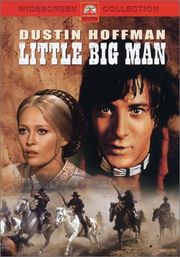
Little Big Man

We shall begin with an old favorite of mine, LITTLE BIG MAN. This is the story of Jack Crabb, supposedly the sole white survivor of the Battle of Little Bighorn. We meet jack in an old folks home as a man well over a hundred years old. Visited by an anthropologist, Jack is angered at the suggestion that was an old Indian fighter and proceeds to tell his life story with a tape recorder rolling.

It turns out that Jack had been adopted by Cheyenne (whom he refers to as “Human Beings” throughout the narrative) after his family was slaughtered by Pawnee. During the course of his life, Jack returns to white society for a time and experiences life as a religious youth, a con artist, a “gun fighter,” a drunkard, and even a mule skinner. But Jack returns to the Human Beings several times during the course of the movie, even taking a wife (eventually four) and living among them. Jack explains that he reckoned he would stay there and live among Human Beings for the rest of his life, right there on the Washita River.

And for those that know a little about the history of Indian-white relations, the appearance of Custer will be no surprise. For me at least, the scenes that follow are quite difficult to watch. It is in revenge for this attack, that Jack Crabb ultimately plots to lead Custer into a trap, tricking him as it were into attacking the Indian village at Little Bighorn.

Little Big man was the first major motion picture in decades to take an explicitly pro-Indian stance on the history of the west. It is almost too late to capture the full shock value of its portrayal. The movie and television audiences of the 1970s had seen many depictions of Indian savagery. To see the U.S. cavalry shooting women and children in cold blood was a straight-forward reversal of the prevailing expectations of the time.

More than that, Little Big Man is filled with vibrant Cheyenne characters, not least of them being Old Medicine Lodge (played by chief Dan George). The characters are even allowed to occupy social roles defined at least partly by Cheyenne cultural patterns. (We are for example introduced to a contrary and a hee-man-eh.) Crabb himself manages to occupy the role of the White Indian without crowding the Native American characters into the background. He is accepted among the Human Beings, not because he is a great warrior (not really, at any rate), but because he has a knack for survival. Crabb bumbles his way through life, understanding a lot about what goes on around him, but without ever really taking control of his own fate.
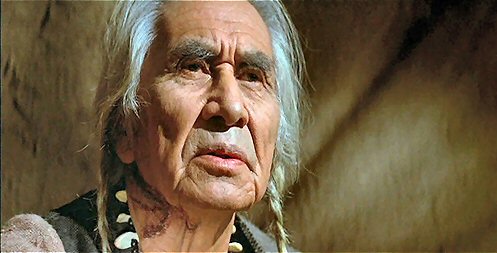
Chief Dan George

But what has always struck me as the true genius of this movie is that having done far more than normal for the times, it makes no real claims to historical accuracy. Jack Crabb is essentially telling us a tall tale, and his own biases provide the filter through which each event is portrayed. One gets the impression that Crabb’s story must approximate the actual truth (he simply knows too much to have made everything up), but if we believe him a number of the particulars, we have certainly gone well beyond the boundaries of fact when he takes credit for the slaughter of Custer.

But who could fault Crabb for stretching the truth. We can only love him for somehow surviving the real events of his life whatever they may have been, and for sharing a perspective on events which was at that time completely novel to the motion picture industry of that day.

***
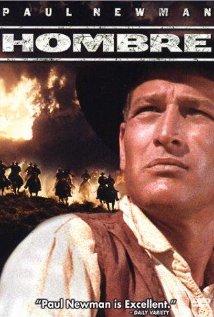
Hombre

Did you know that Paul Newman once played an Apache? …well, sort of. In HOMBRE, Newman plays John Russell, a white man raised among the Apache. Old pictures of Apaches fill the screen during the opening credits, and soon we are treated to an image of Newman dressed as an Apache.

Hombre

Russel and two Apache companions have been earning a living by capturing wild horses to be sold to the stage-coach line. They learn that a railroad will soon replace the stage-coach line, and horses will no longer be needed.

Russell learns that he has inherited a boarding house from his original family. He returns to civilization and sells the house before heading back west aboard a stage-coach.

Newman in Hombre

When the stage-coach is robbed, it is Russell (with his superior survival instincts) who keeps the other passengers alive, their prejudice against him notwithstanding. In time, Russell learns that the robbers are after money meant for the San Carlos Apache reservation. It had been stolen by a fellow passenger. Russell’s treatment of his companions is harsh, bordering on cruel, which seems fitting enough given their own attitudes towards him. In the end, Russell will sacrifice himself to save a woman who would not share the stage-coach with him. He asks only that the money should be taken to the people for whom it was intended.

The movie ends with a vintage photograph. It contains the image of a white boy surrounded by Apache children of his own age.

***
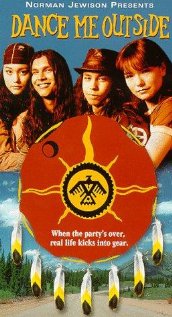
Dance Me Outside

DANCE ME OUTSIDE: This movie is not on the whole about a white Indian. I include it in this list, because it has an absolutely wonderful scene which serves to comment on the whole phenomenon. For reasons which we need not get into here, the main characters, Silas crow and Frank Fencepost (both Anishinabe), are asked to keep Robert McVey, a white in-law, busy while his wife is off doing something important. Unable to think of anything else to do, and really unhappy about spending the night in his rather lame company, Silas and Frank decide to initiate him into the tribe. What follows is a hilariously improvised ceremony. The scene could easily have been painful to watch, but there is something about the way the white character embraces the ceremony which comes across as endearing. It is as though he has simply chosen to accept the ritual for whatever it is. The man commits so completely to the absurd little made-up ritual that his own sincerity (absurd as it is) seems to redeem the whole event. In the end, he earns a grudging respect from Silas and Frank, not for being a properly initiated member of the tribe, but for simply being human, foibles and all.

Silas and Frank

What I particularly like about this scene is the sense of compassion behind the treatment of this subject. This movie takes the piss out the old white Indian cliché as well as anyone has, but it does it without rancor. The white character is mocked, yes, but he is mocked with a gentle touch. Dance me outside is an obscure movie, and I must say that it has a kind of after-school special quality to it. Still it’s a wonderful tale well told.

***

That’s it for now. There will be two more volumes in this one.

***

Okay, no I can’t let my readers off that easy. These movies are actually pretty good, so I’m afraid you haven’t got the full cringe-worthyness of this subject. So, let’s have a listen shall we?

…okay, I know. That was unnecessary. I’m a bad man, and I’m sorry.

…sort of.

71.271549 -156.751450

Share this:

  • Tweet
  • Share on Tumblr
  • Click to print (Opens in new window) Print
  • Click to email a link to a friend (Opens in new window) Email
  • Click to share on Reddit (Opens in new window) Reddit
Like Loading...

Real World Villains, Volume III: Those Troublesome Alaska Natives!

15 Sunday Apr 2012

Posted by danielwalldammit in Alaska, History, Justice, Native American Themes, Politics

≈ 15 Comments

Tags

Alaska, Alaska Natives, Alberta Schenck, civil Rights, Duck-In, Ducks, Elizabeth Peratrovitch, Hunting, Inupiat, Subsistence

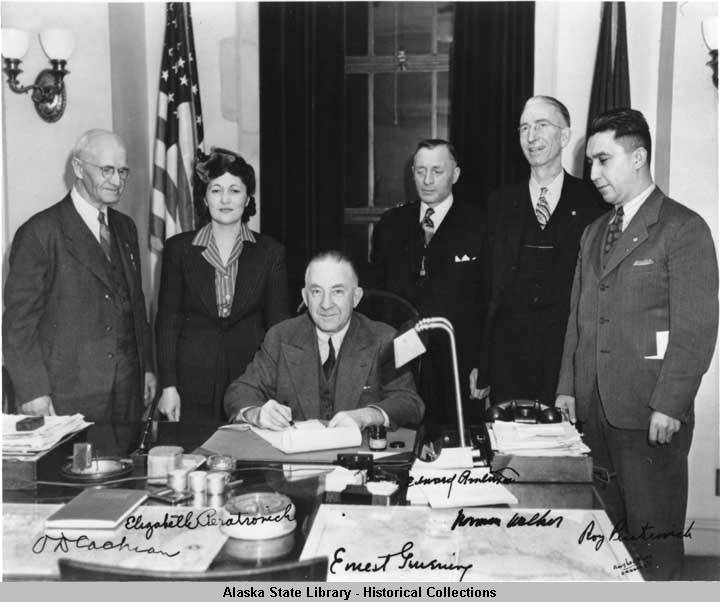
Governor Gruening Signs the Anti-Discrimination Act of 1945

“What the Hell is a duck in?”

That must have been my first response to one of the stories I want to write about today. Hopefully, I didn’t say it out loud, but the duck-in is one of many historical narratives that has changed my sense of the political landscape since coming to Alaska.

Yes, I’m still a lefty. I said “changed” not “destroyed.”

And like many a lefty, I spend a fair amount of time thinking about civil rights issue. You know, Martin Luther King, the Freedom Rides, Brown vs. Board of Education, …all good stuff!

Since coming to Alaska, I have been blessed to learn about several new and unexpected additions to the list of civil rights struggles, some with clear parallels to those taking place outside Alaska.

Somewhere in my list of my thoughts about nuclear power, I now add the struggle over Project Chariot. Next to the relocation of Japanese in World War II, I now have a definite place for the story of Anangan (Aleutian) relocation. And of course the big story up here, at least in my mental timeline would certainly be passage of the Alaska Native Lands Claims Act.

But I don’t want to talk about any of those things today.

No, what interests me at the moment is a range of smaller battles, and the story of those who fought them. I’m talking about battles like the one fought by Alberta Schenck.

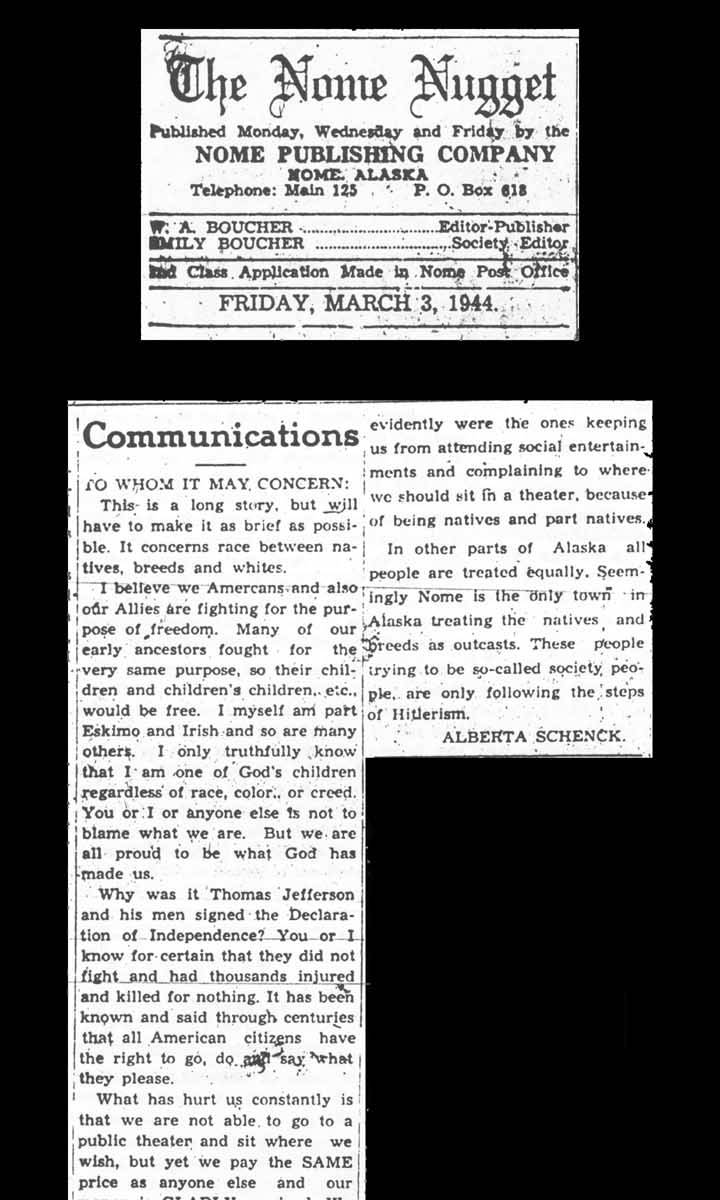
Alberta Schenck Letter

Who is Alberta Schenck? Well, she was the best kind of troublemaker. As a girl of mixed heritage (her mother was Inupiat and her father was white), Schenck faced discrimination against Alaska Natives and “half breeds” on several occasions. At the age of 16, she wrote this letter to the editor of the Nome Nugget, protesting the segregated seating of natives and whites at a local movie house, known as the Dream Theater. To say that the significance of her protest stretched beyond the specific policies of that specific theater would be an understatement.

It’s worth noting that Schenck herself worked at Dream Theater, at least she did until the letter was published. She later returned to that very theater on a date with a white army sergeant. After refusing to leave her seat, the Chief of Police for the city of Nome physically removed Schenck from her seat and she spent the night in jail.

Outrage over Schenck’s arrest helped eventually to fuel for passage of the Anti-Dicrimnatory act of 1945. She was subsequently elected Queen of Nome during the Spring Carnival of that year. This was in 1944, 11 years before Rosa Parks picked her fight with the city of Montgomery Alabama. …well before the sit-ins, or the freedom rides.

And then of course there is Elizabeth Peratrovitch, a Tlingit Native whose testimony before the territorial senate helped to secure the final passage of the Anti-Discriminatory Act, mentioned above. She said a lot of things in that testimony, but this particular line is particularly memorable:

I would not have expected that I, who am barely out of savagery, would have to remind gentlemen with five thousand years of recorded civilization behind them, of our Bill of Rights.

With actions like those of Alberta Schenck and testimony such as that of Elizabeth Peratrovich, the territory finally passed a law banning such acts of discrimination.

I should add that the law did not merely eliminate discriminatory policies at the government level; it forbade discrimination by private businesses. Opponents of the bill had argued, as many do today, that government had no role to play in limiting the choices of private businessmen. Fortunately, that argument lost in 1945, as it did in 1964, and as it should today. Those who imagine it is enough to keep government policies free of racial bias have seriously underestimated the impact of private discrimination. Here as elsewhere the individual decisions of private businesses were the centerpiece of segregation.

But my all time favorite story about civil disobedience in the great state of Alaska would have to be the “Duck in.” This narrative begins in 1918 with a treaty between the United States, Canada, and Mexico. Under this treaty, the U.S. agreed to ban the taking of migratory waterfowl from the period between March 10th and September 1st.

So what’s the trouble? That is the ONLY time that migratory waterfowl can be found on the North Slope of Alaska. For a people very much dependent on subsistence hunting for their survival, the terms of this treaty removed a critical resource from the Spring and Summer menu.

The issue does not appear to have been much of a problem, at least not until Alaska became a state and began to enforce Federal laws with greater diligence. Then Fish and Wildlife officers began arresting people and confiscating their weapons, and their catch.

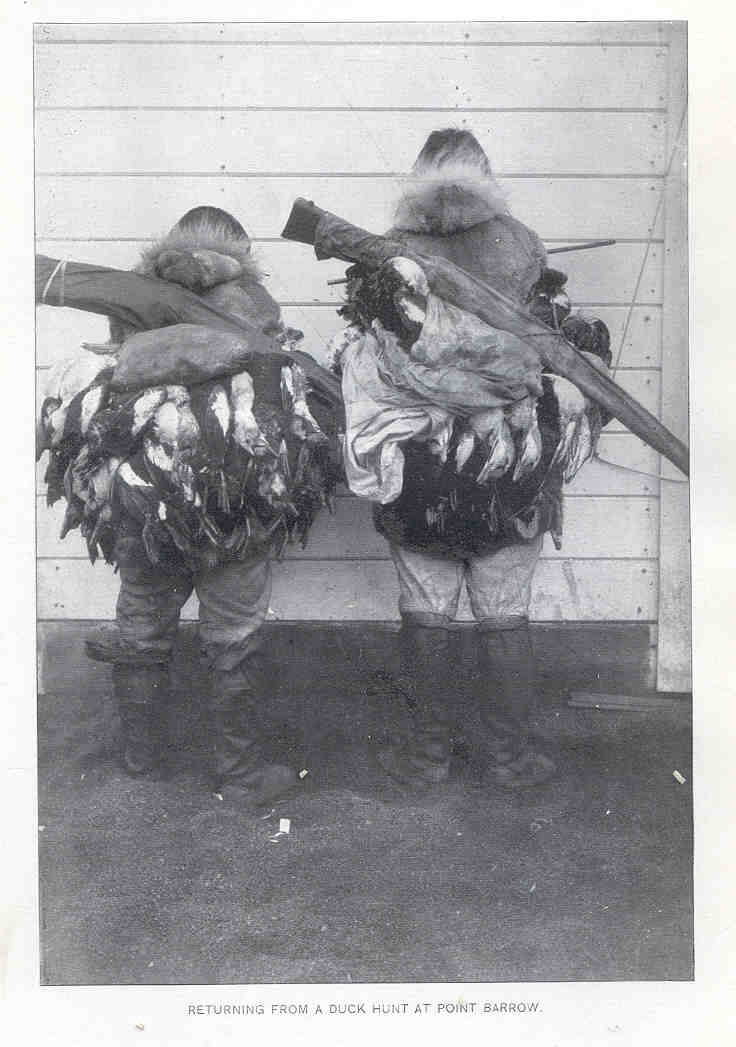
Duck Hunters at Point Barrow

How did the Inupiat population of Barrow respond to the arrest of people in their own community? How did they deal with a game warden in town to enforce the hunting regulations?

Well, they were very cooperative.

He found about a hundred and fifty Barrow residents outside his hotel room one day, each with a duck in hand. He didn’t have enough forms to process all the arrests, so Barrow Magistrate Sadie Neakok advised him to record the names on extra paper and attach them to the main form. And thus, everyone with a duck got counted.

Subsequent to this, State Senator, Eben Hopson, sent a request to then Governor, William Egan, asking that welfare officials be sent to help take care of all the children whose parents would be locked up due to enforcement of the law.

…and Fish and Wildlife simply stopped enforcing the regulations.

That’s called a ‘win’ folks!

*********************

Okay, that’s it, just a few of my favorite stories about troublesome Alaska Natives. I haven’t covered any of this with sufficient detail to do justice to these stories, so I’ll just briefly mention some better sources:

Rachel Naninaaq Edwardson produced a wonderful documentary on the Duck In. It is available through the North Slope Borough School District.

Wikipedia does seem to have a page on Elizabeth Peratrovitch. , and she is mentioned in quite a few additional sources. This one from Alaschool.org has a pretty thorough discussion of her contributions to the state of Alaska.

Numerous references to Alberta Schenck may be found in sundry parts of the net. Her memorial website would be a good place to start.

One good reading on the subject of discrimination would be an article by Terrence M. Cole, “Jim Crow in Alaska: The Passage of the Alaska Equal Rights act of 1945,” in Stephen W. Haycox and Mary Childers Mangusso (eds.) An Alaska Anthology: Interpreting the Past, (Seattle and London. University of Washington Press, 1996) pp 314-335.

The Images of Governor Gruening signing the Anti-discriminatory Act, Elizabeth Peratrovich, and Alberta Schenck’s letter are from Alaska’s Digital Archives. The image of Duck Hunters came from the Marine Image Bank of the Digital Collections at the University of Washington.

71.271549 -156.751450

Share this:

  • Tweet
  • Share on Tumblr
  • Click to print (Opens in new window) Print
  • Click to email a link to a friend (Opens in new window) Email
  • Click to share on Reddit (Opens in new window) Reddit
Like Loading...

Quanah Parker, Progress, and the Lack Thereof, …Christmas and Torture!

18 Sunday Dec 2011

Posted by danielwalldammit in Books, History, Native American Themes

≈ 2 Comments

Tags

American Indian, American West, Comanche, Cruelty, Native American, Progress, Quanah Parker, Texas, Torture

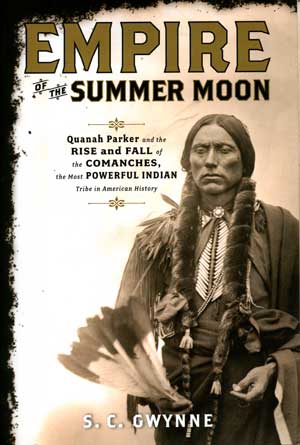
There is always one! One book in the airport bookstore that looks like something I might actually want to read. This time it was “Empire of the Summer Moon: Quanah Parker and the Rise and Fall of the Comanches, the Most Powerful Indian Tribe in American History,” by S.C. Gwynne (Scribner, 2011).

Mind you, the title alone carries at least one red flag. Were the Comanche really the “most powerful Indian tribe in American history?” Reading the book, I began to wonder if there was ever a raid, or a battle, or a tribe that didn’t strike the author as “the most’ or “the greatest” something?  Seriously, this book, has the most superlatives contained in any volume published in this century. (Okay, not really, but it has enough of them that it looked kind of fun. So, I thought I’d try it.) But faced with 16 hours in the hands of the airlines (the most air-time ever… Okay I’ll stop, really, I will), it just looked like the kind of fun-read that might do the trick for all those hours imitating a sardine. So, I bought it and put my larger, more theoretical, volume on the back burner, at least until Quanah could be “tamed,’ as I thought surely the book would put it.

I was not disappointed.

It is certainly an enjoyable yarn, and I learned a few things while reading it, but excessive superlatives aside, there are also a number of factual problems in the book. Gwynne, for example credits Spanish failure to protect the Pueblos with the cause of the Pueblo Revolt of 1680. This is simple confirmation bias. It ties their story more closely to the one Gwynne is telling. But it’s outright fiction. The Pueblo’s rebelled against the Spanish because what the Spanish were doing to them, not because of what the Spanish were not doing for them. Other critics have raised similar objections to other parts of the book, but I’m not really interested in picking apart the details.

What does strike me about this work is its use of a familiar spin. Gwynne is a firm believer in the march of progress, and he does not hesitate to frame the Comanche squarely in this larger story. Channeling Frederick Jackson Turner, Gwynne is telling the tale of the clash between savagery and civilization at the edge of the frontier. And Comanche play a damned familiar role in that story.

It is not really that Gwynne describes the horrors of Comanche raiding in vivid detail, or that he recounts the torture and execution of white captives in numerous chapters. I don’t need sugar-coating in my history books, nor do I need constant reassurance that an author is not a racist. But “progress” is a faith I can do without, and this book would have been much better without it.

Simply put, Gwynne sees Comanche’s as exemplars of a more primitive life-way than Europeans, or even a number of other Indian peoples. His reasons are familiar; they are hunter-gatherers, which sets them apart from and well behind the progress of agricultural societies, from the Pueblos to the Spaniards, …maybe even the Texans. To Gwynn, the cruelties that Comanche’s inflicted on their enemies stem from their lack of progress in comparison to Agricultural tribes such as those found in Mexico.

If the irony of that comparison doesn’t scream in your ears, then perhaps we could take a little time to discuss the history of Central American civilization. …Well some other time, anyway.

On some level, I cannot help but think Gwynne must know better. He certainly does not hesitate to tell us about the atrocities committed by other peoples, including Texans. At times, he seems quite prepared to concede all the facts which should suggest a degree of moral parity. Yet Gwynne sees a difference between the cruelties of commanches and those of other people.

Gwynne has at least the beginnings of an explanation for the difference. He maintains that other peoples consistently show some level of condemnation for the act of torture. Such brutal violence may be carried out by civilizations as modern as our own, but Gwynne seems to suggest, we at least know it is wrong. The Comanche however, revel in it. And that makes all the difference in the world to Gwynne. It is the difference between a “savage,” a “low barbarian,” and someone from a civilization.

So, apparently, cognitive dissonance is a virtue. If you have to torture someone, then you should at least have the decency to feel bad about it.

But I cannot help thinking we can do better than that! We can relegate the job to soldiers serving on some far-flung corner of the world, and if those soldiers should fail to be just as violant as we wish them to be (no more and no less), or should they fail to cover up any actual cruelties they might commit, then perhaps we can just disown them. If nothing else fails, we can at least wring our hands about it, schedule a few talking heads to debate it on the news channels, and sweat a lot over the whole thing. Because knowing at least that torture is wrong sets us apart from those that do not, or so it would seem

In torture, as in Christmas gifts, it is apparently the thought that counts.

It is an interesting question, just how it is that societies allocate boundaries within which cruelty becomes objectionable, and how do they square those boundaries with the interests of military defense, …or outright conquest? Both of these are damned tough problem to sort out, and woe be unto those who end up on the wrong side of the sorting, at least when someone with a camera-phone is around to record it!

The story of Quanah Parker would not be a bad spring board for addressing questions about the cultural construction of violence. It certainly provides enough fodder to get the issue squarely on the table, but of course all this falls by the wayside when the author has recourse to a convenient explanation with a lot of cultural force behind it. The Comanche’s are cruel because they are savage. Others are cruel because their civilization has yet to be perfected.

Problem solved!

This probably is not the best place to try to refute the notion of progress. Suffice to say, that I consider it largely a dead issue, at least as applied to the history of Indian-white relations, and certainly in reference to the comparison between hunter-gathering economies and those of settled agriculturists. Hell, the critique of this notion has been done and redone for a couple of generations of scholarship now. Were I to come across a learned article purporting to refute the notion of progress, I would no doubt feel sympathy for the dead horse that was about to be kicked. And yet, in this book, I find that dead horse alive and grazing in the pastures of every airport in the country.

When the average American reads about Comanche history for the next few months anyway, there is a damned good chance they will read it in this book. They will learn a lot to be sure, much of it reasonably accurate, informative, and interesting. And they will also read in that book yet another chapter in the myth of the progress of civilization.

It is just a little depressing.

71.271549 -156.751450

Share this:

  • Tweet
  • Share on Tumblr
  • Click to print (Opens in new window) Print
  • Click to email a link to a friend (Opens in new window) Email
  • Click to share on Reddit (Opens in new window) Reddit
Like Loading...

California Admitted as a Free State, …Oh Wait!

16 Wednesday Nov 2011

Posted by danielwalldammit in Education, History, Native American Themes, Politics

≈ 5 Comments

Tags

American Indian, California, Civil War, History, Narrative, Native American, Semantics, Slavery, Story-Telling, teaching

Okay, so we just started a section on slavery and the civil war in my American history class. One thing that always irritates me here, or maybe it just amuses me, I don’t know… Anyway, I think about it whenever I cover this subject. Every textbook I have ever used on American history explains that California was admitted as a free state under the terms of the Compromise of 1850.

So, what’s the problem?

The problem is a little known law passed in California that very year, ostensibly for the protection of Indians. The law imposes a $50.00 fine on anyone forcing an Indian to work against his will. So, that should be good, right?

Actually, no.

The law also contains the following provisions:

When an Indian is convicted of an offence before a Justice of the Peace punishable by a fine, any white person may, by consent of the Justice, give bond for said Indian, conditioned for the payment of said fine and costs, and in such case the Indian shall be compelled to work for the person so bailing, until he has discharged or cancelled the fine assessed against him…

and

Any Indian able to work and support himself in some honest calling, not having wherewithal to maintain himself, who shall be found loitering and strolling about, or frequenting public places where liquors are sold, begging, or leading an immoral and profligate course of life, shall be liable to be arrested on the complaint of any resident citizen of the county, and brought before any Justice of the Peace of the proper county, Mayor or Recorder of any incorporated town or city, who shall examine said accused Indian, and hear the testimony in relation thereto, and if said Justice, Mayor or Recorder shall be satisfied that he is a vagrant, as above set forth, he shall make out a warrant under his hand and seal, authorizing and requiring the officer having him in charge or custody, to hire out such vagrant within twenty four hours to the best bidder, by public notice given as he shall direct, for the highest price that can be had, for any term not exceeding four months; and such vagrant shall be subject to and governed by the provisions of this Act, regulating guardians and minors, during the time for which he has been so hired.

Oh there is a lot more to the act, and plenty of reassuring clauses that appear to keep people from exploiting natives, but it should not take a lot of imagination to read between the lines here and see how this story actually went down. To say that this law opened up the native labor-market to exploitation would be putting it mildly. …too mildly.

In essence, the law made it illegal to enslave an Indian, at least on one’s own initiative, but if someone was caught being an Indian on a city street, the city could bond him over to you for a price. Oh yes, folks would have to go through the trouble of slighting the moral integrity of the Indian first, but how difficult do you think it would be to find a white guy willing to do that?

Not very.

It’s not the most efficient form of slavery one could devise, but it is slavery non-the-less, and that is why it always bugs me to see textbook after textbook announce that California was admitted to the Union as a free state under the terms of the compromise of 1850.

…in the very year they created a legal procedure for enslaving Indians.

Oh I get it; this kind of issue simply falls outside the scope of the narrative in question. It was not even on the horizons of those debating the major issues of the day in Congress. So, if one is recounting the events leading up to the Civil War, then this piece of information does not really change that story much. Neither does the existence of a viable slave-trade in the interior Southwest. If one is focused on the question of slavery as it was framed in the national politics of the day, then yes, California was certainly admitted as a free state.

Or is that the problem, the terms of that debate?

The bottom line is that ‘slavery’ is just a word, and you can choose to use it or not as easily as you can any other term regardless of the realities of the labor conditions in question. So, historians can skate right past these instances of captive labor (much as the great figures of the era did in their own approach to the issue) while focusing on the institutional forms of slavery that were the main issues of the day. But of course that same sleight of hand is necessary to cap off the story of the Civil War in the standard way, describing it as bringing about the end of slavery in America.

To give closure to the issue of slavery in our national storyline, one has to ignore the use of debt-peonage in conjunction with Jim Crow Laws, or at least classify them as a whole new kind of problem. Using the word “slavery” in the chapters leading up the Civil War and dropping it afterwards creates the illusion that the new social problems are significantly different than the old ones. This approach suggests that the problems associated with slavery were somehow resolved with the closing chapters of Reconstruction, perhaps not to the satisfaction of all concerned, but resolved nonetheless. And Jim Crow then becomes a whole different kind of problem, as do a host of similar practices.

Just like the California Law for the protection of the Indian.

***

Note: The law can be found in the California Statutes from 1850. It is also included in the primary documents for the following textbook:

Albert L. Hurtado, Peter Iverson. Major Problems in American Indian History: Documents and Essays. Second Edition. (Houghton Mifflin, 2001).

71.271549 -156.751450

Share this:

  • Tweet
  • Share on Tumblr
  • Click to print (Opens in new window) Print
  • Click to email a link to a friend (Opens in new window) Email
  • Click to share on Reddit (Opens in new window) Reddit
Like Loading...

Old Gripes, New Tundra, and a Thin Ray of Hope.

10 Thursday Nov 2011

Posted by danielwalldammit in Alaska, Education, Native American Themes

≈ Leave a comment

Tags

Alaska, Arizona, College, Culture, Curriculum Development, Diné, Education, Indigenization, Inupiat, Native American, Navajo, North Slope

How do you adapt course material to the cultural context of a tribal college? I have had enough conversations about that topic in the last couple days to last me a little while. Whether any of them will help or not is of course an open question, but for the moment, I have a little time to reflect on the matter.

It feels like I am never on the same page with others when the topic comes up. Most of the cultural materials I have seen have been saturated with over-extended metaphors, clunky diagrams with over-simplified cultural motifs all over them, and deep philosophical discussions on the English gloss of some native term. When such materials show up, I always feel some trepidation. When such materials show up, I can’t help but want to step outside and get a breath of fresh air.

It’s no big deal, really. I get that feeling in most meetings sooner or later. Why should those aimed at indigenizing education be any different!

But seriously, before moving on I suppose I should say that my ‘exhibit A’ for how not to to an indigenous educational policy would be Diné Educational Philosophy, at least as it was taught when I was at Diné College. At the heart of this policy was a grand metaphor in which call lessons could be divided into four stages of learning, each of which corresponded to four stages of life development, which in turn corresponded to the four cardinal directions, and from there the metaphors multiplied as various aspects of Navajo cosmology could be mapped onto this four-part division. I should say that the whole thing always fascinated me, and there are a lot of interesting details about it that just are not going to make it into this blog piece. In practice, it was an awful clunky system.

Mind you, it was college policy that all classes had to incorporate a methodology based on this metaphor into each of our classes. New full-time instructors took classes in the subject (unless it conflicted with our schedules) and part-time instructors had a training day on it (or at least they were supposed to). So what most of us did was to draw a circle on the board, divide it into a four-piece pie, attach the requisite metaphors, and get on with what we would have been doing anyway. To say that this paint-by-numbers approach to an indigenous education was less than helpful would be putting it mildly. As often as not, it was the more “traditional” students who were displeased to see one  of those circles go up on the board at the beginning of a lesson.

So, leaving my past frustrations aside, how would I prefer to approach this? I’m still relatively new to the North slope, so my learning curve is still pretty steep. And tonight, I think I may have just had a mini epiphany, the kind that advances the process for me. It came while reading the blog, “Stop and Smell the Lichen,” written by Rainey Hopson, a woman living in Anaktuvuk pass.

A wonderful piece entitled, “A Good Person,” had the following observations about how one judges character in a small village:

In the village you know everyone, and everyone knows you. You know their secrets and their deeds of kindness. You know wether they are kind to the elder that needed help walking on slippery ice. You know every mean word that they ever said. You know the bad as well as the good. You always act as politely as you can, because you know you will have to deal with this person for the rest of your life, wether you like them or not. You know, after years of interaction and observing a persons actions wether they are good or not, wether you can trust them for certain things, wether or not this person speaks with authority and knowledge. We see each other as permanent beings in our life, and the job and the money and the physical objects as fleeting insubstantial things. A very different view. A different set of scales.”

There is a lot to think about in this piece, but what turned my head back to the subject of adapting lessons to the cultural context of teaching native students was the realization that this is a critical difference between the great city of Barrow (with its enormous population of around 4,000 people) and the smaller villages with populations in the low hundreds.

To someone living in a modern city, much less a metropolitan center, the difference must seem negligible. Living in a town of four thousand and isolated from any major cities by hundreds of miles of tundra must seem to pose many of the same challenges as living in one with a few hundred people. But there are critical differences.

Barrow does have a small town feel. But here it is still possible, even for long-time residents, to see people one does not yet know, or to choose whether one wishes to deal with at least some people. If the population is small, it is not so small as to render relationships entirely inevitable as the village relationships Mrs. Hopson describes in the passage above. Small wonder that our “village students” often seem to have trouble adapting to life in the big city of Barrow, or (more to the point, perhaps) to life away from home.

Thinking about this, I made a small connection to just one lesson in one of the classes that I teach, an introductory course on cultural anthropology. What part of my anthropology class did I connect to this piece? Well life in the Amazonian rainforest of course.My textbook for that class contains an extensive discussion of the limits of leadership by personal credibility. When leaders lack coercive authority, the ability to influence others depends on the ability to form direct personal relationships with them. Some anthropologists have attempted to put a number on the possibilities, an objective limit to the number of people whose actions you can guide without the ability to issue an order, point to a rule, or hand out a set punishment.

What is the magic number? Pssh! Don’t believe everything I tell you!

…Okay, if you insist. To say this is an oversimplification is an an understatement dipped in some damned weak sauce, but anyway, the limit is somewhere in the low hundreds.

It occurred to me that the difference between the smaller villages and Barrow falls somewhere in the vicinity of that same set of limitations. Whatever the number in question, the point is that there is some point at which a population becomes too big to ensure significant personal interactions with someone in any given household, and THAT means real differences in the social organization of the community. What Rainey Hopson described in her blog is a quality of social life that is present in the smaller of the North Slope. If the Amazonian specialists covered in my anthropology texts are to be believed, it also exists (or existed) in a number of Amazonian societies.

So, in reading Mrs. Hopson’s blog I had a little ‘aha!’ moment about a connection between something my students have not experienced at all (life in an Amazonian village) and something they with which they will most likely have some familiarity. Even those students who have not lived in the villages will likely be familiar with the difference. They will know there is a difference, and those that have lived here all their lives will have formed ideas about that difference. This means that I can use the comparison as a jumping off point for exploring a range of related issues. I can now use the bridge between these topics as a means of helping students understand he foreign topics of Amazonian villagers and in turn use the study of those Amazonian villages as a jumping off point for discussions of local living conditions.

So, now I have a link between something I will teach at least once a year (and the truth is it will come up in other classes). The question is what to do with it? Some might view this as an opportunity to create a lesson plan, some set exercise in which students will be invited to meditate on the linkage. And such a lesson may or may not be a good thing. To me, however, that is not really the point.

For myself, I will address this point in as many different ways as I can in my different classes, asking students a variety of questions, and working to see just how far I can push the connection, just how much it can explain, and where else might the topic lea.

The point is that I need more moments like that, more links between the familiar pieces of life here on the North Slope, and various strange topics that I cover in my classes (many of which are as foreign to my life experiences as to those of my students).

And that is where my revulsion at so much prefabricated cultural literacy comes in. It is a simple question of where you want to put your effort. If I’m a new teacher, just in from off-slope, I don’t need an exercise or a diagram that will draw this connection for me. …one that I can use in my classroom with or without understanding the point at hand myself. I don’t need a master mataphore in which to plug all my regular lessons. What I need to help me do my job is a venue wherein I can learn as much as possible about life here in this area, where I can talk to people from the local communities about things relevant to my teaching responsibilities. What I need is something that helps me form personal relationships with the right folks, learn the right information from them, and put that information into practice in my courses.

And here is where so many educators in this area miss the boat, because it is simply easier (and perhaps more effective when dealing with accreditation agencies) to produce formulaic educational materials than it is to build learning environments. It is easier to dictate cultural content to instructors than it is to facilitate learning that will enable an educator to draw connections between their subject and the cultural environment in which they work.

This is how I actually approached my classes at Diné College, and it is how I hope to approach them here; learning as much as I can about the cultural setting and engaging my native students in dialogue about the issues that affect their lives here.

If circles go on the board, hopefully, it won’t be because they have become a procedural requirement.

Note: The photo is a picture of the village of Wainwright, AK. The Anthropology text mentioned above is John H. Bodley. Cultural Anthropology: Tribes, States, and the Global System. Fourth Edition. (Boston: McGraw Hill) 2005. Rainey Hopson’s blog is called; “Stop and Smell the Lichen.”

http://www.salmonberryblood.blogspot.com/

71.271549 -156.751450

Share this:

  • Tweet
  • Share on Tumblr
  • Click to print (Opens in new window) Print
  • Click to email a link to a friend (Opens in new window) Email
  • Click to share on Reddit (Opens in new window) Reddit
Like Loading...

Alaska Federation of Natives, 2011

28 Friday Oct 2011

Posted by danielwalldammit in Alaska, Native American Themes, Politics

≈ Leave a comment

Tags

Activism, Alaska, American Indian, Anchorage, Elections, Indigenous, Joe Miller, Lisa Murkowski, Native American, Politics, Tea Party

The Alaska Federation of Natives held its annual meeting in Anchorage this last week (October 20-22). This is a big event and it’s filled with enough stories to fill many a blog. What grabbed my attention this year was the participation of Senator Lisa Murkowski.  Watching the first of two presentations she was to give at this year’s convention, brought to mind two other moments.

First, there was last year’s meeting of the AFN, held in Fairbanks. Senator Murkowski spoke then as well. At that time, she was a write-in candidate for her own office. Her principal opposition, Joe Miller, had secured the Republican nomination for Murkowski’s position. A Tea Party favorite, Miller had been openly critical of Alaska’s tribal corporations. Faced with a near certain Republican victory, Alaska’s Native leadership threw its weight behind Murkowski. Lost in the shuffle, the Democratic nominee, Scott McAdams, struggled to keep in the race.

The Alaska Federation of Natives endorsed Murkowski and she spoke at their convention. Denied the chance to debate Murkowski in a public forum, or to speak on their own, McAdams and Joe Miller made appearances on the floor of the convention. If McAdams received little in the way of attention, Miller must have received a very chilly reception.

A year later, Senator Murkowski took to the podium again, this time at the Dena’ina Civic and Convention center appropriately enough, the very location at which she announced her write-in candidacy. This year, Murkowski took to the floor once during the convention itself, and once again at the closing banquet, both times the substance of her speech was an expression of thanks. If Murkowski’s gratitude was apparent, so was the pride of AFN leadership. They had played a substantial role in getting her back into office, and this year’s AFN proved to be an opportune moment to trumpet that victory.

The second thing on my mind proved to be a very different kind of moment in the politics of indigenous affairs. In early February, 1998, then President of the Navajo Nation, Albert Hale, threatened to shut down the roads passing through Navajo lands. Doing so, he suggested would help to teach non-natives to respect the sovereignty of the Navajo Nation

The immediate response to Hale’s threat was fascinating. Non-Indians wrote all manner of letters to various local newspapers, most of them angry. On the one hand, much of the criticism seemed understandable. Hale hadn’t really put any specific issue on the table, so no-one knew really what he wanted out of the move. (Some of the more cynical among us might have believed it was to draw attention away from an ethics investigation which soon led to Hale’s ouster.) But something more interested proved to be happening in those letters; an awful lot of non-natives were learning the hard way that Indian people’s still held a measure of power in the United States. For all the poverty and corruption one can find in Indian country, for all the problems that tribal leadership seemed unable to resolve, there were at least a few things that they could still do. And one of those things was to make it a lot more difficult to drive through parts of the Southwest.

This is where the other letters from that time come in, the ones from the Navajo people. Many were less than pleased with Hale’s gambit themselves. I was living in Fort Defiance at the time and I recall quite well the shaking heads and office gossip. This was not the way to do things, at least according to the folks I knew.  What use is sovereignty if it only means shutting down roads, some seemed to say? It would be far better, so the argument went, to build a road, or at least to repair the roads already there.  A gesture intended to show the power and force of the Navajo Nation, Hale’s threats seemed only to underscore the relative weakness of Navajo leadership.

I couldn’t help but think about Albert Hale’s road-gambit as I saw Lisa Murkowski speak at AFN.  The basis for the comparison sis simple enough. To me, Hale’s move had always been something of a low-moment in Native American politics, but now I was watching a high one, at least as measured by raw political power. This was Native Alaskans doing what Hale had failed to do back in 1998, they were actually building something.  Now as it happens, it wasn’t a road that Alaskan natives built here, it was a political base capable of affecting a major election, but that election itself is precisely what it will take to get the roads built in Alaska’s Native communities.  Faced with a threat from an outside source, The Alaska Federation of Natives did what it took to ensure that their own interests were protected.

Such victories are hardly new for the Alaska Federation of Natives, but perhaps that is my point. In a world where native politics is so often relegated to symbolic victories, this organization stands out as one of the major players in Alaskan politics. The theme for this meeting of the AFN was “Strength in Unity,” and what better proof could its leaders offer than the re-election of Murkowski to the U.S. Senate. Here at least, Native Leaders had demonstrated with perfect clarity that they were a force to be reckoned with.

Share this:

  • Tweet
  • Share on Tumblr
  • Click to print (Opens in new window) Print
  • Click to email a link to a friend (Opens in new window) Email
  • Click to share on Reddit (Opens in new window) Reddit
Like Loading...
Newer posts →

Top Posts & Pages

  • I'll Just Leave This Here
    I'll Just Leave This Here
  • Ten Little White Indians, Volume II (Spoilers Abound!)
    Ten Little White Indians, Volume II (Spoilers Abound!)
  • Recollections of WIPCE 2014
    Recollections of WIPCE 2014
  • Paul Newman IS Homo Economicus: A Spoiler-Filled Review of Hud.
    Paul Newman IS Homo Economicus: A Spoiler-Filled Review of Hud.
  • An American Flag as a Weapon, Redux.
    An American Flag as a Weapon, Redux.
  • An Irritation Meditation: The Majority Rules Meme
    An Irritation Meditation: The Majority Rules Meme
  • Fake Patriots and Fake George Washington Quotes
    Fake Patriots and Fake George Washington Quotes
  • When Sex Falls Out of the Performance
    When Sex Falls Out of the Performance
  • Movie Review: The Orator
    Movie Review: The Orator
  • An Uncommon Security Guard: Dave Eshelman, AKA 'John Wayne'
    An Uncommon Security Guard: Dave Eshelman, AKA 'John Wayne'

Topics

  • Alaska
  • Animals
  • Anthropology
  • atheism
  • Bad Photography
  • Books
  • Childhood
  • Education
  • Gaming
  • General
  • History
  • Irritation Meditation
  • Justice
  • Las Vegas
  • Minis
  • Movie Villainy
  • Movies
  • Museums
  • Music
  • Narrative VIolence
  • Native American Themes
  • Philosophy
  • Politics
  • Public History
  • Re-Creations
  • Religion
  • Street Art
  • The Bullet Point Mind
  • Travel
  • Uncategorized
  • Uncommonday
  • White Indians
  • Write Drunk, Edit Stoned

Blogroll

  • American Creation
  • An Historian Goes to the Movies
  • Aunt Phil's Trunk
  • Bob's Blog
  • Dr. Gerald Stein
  • Hinterlogics
  • Ignorance WIthout Arrogance
  • Im-North
  • Insta-North
  • Just a Girl from Homer
  • Multo (Ghost)
  • Native America
  • Norbert Haupt
  • Northwest History
  • Northy Pins
  • Northy-Tok
  • Nunawhaa
  • Religion in American History
  • The History Blog
  • The History Chicks
  • What Do I Know?

Archives

  • December 2023
  • November 2023
  • June 2023
  • April 2023
  • February 2023
  • December 2022
  • November 2022
  • October 2022
  • September 2022
  • August 2022
  • July 2022
  • June 2022
  • April 2022
  • January 2022
  • December 2021
  • November 2021
  • October 2021
  • September 2021
  • August 2021
  • June 2021
  • May 2021
  • March 2021
  • February 2021
  • January 2021
  • December 2020
  • November 2020
  • October 2020
  • September 2020
  • June 2020
  • May 2020
  • March 2020
  • February 2020
  • January 2020
  • December 2019
  • November 2019
  • September 2019
  • August 2019
  • July 2019
  • June 2019
  • May 2019
  • April 2019
  • January 2019
  • December 2018
  • November 2018
  • October 2018
  • September 2018
  • August 2018
  • July 2018
  • June 2018
  • May 2018
  • April 2018
  • March 2018
  • February 2018
  • January 2018
  • December 2017
  • November 2017
  • October 2017
  • September 2017
  • August 2017
  • July 2017
  • June 2017
  • May 2017
  • April 2017
  • March 2017
  • January 2017
  • December 2016
  • November 2016
  • October 2016
  • September 2016
  • August 2016
  • July 2016
  • June 2016
  • May 2016
  • April 2016
  • March 2016
  • February 2016
  • January 2016
  • December 2015
  • November 2015
  • October 2015
  • September 2015
  • August 2015
  • July 2015
  • June 2015
  • May 2015
  • April 2015
  • March 2015
  • January 2015
  • December 2014
  • November 2014
  • October 2014
  • July 2014
  • June 2014
  • May 2014
  • April 2014
  • March 2014
  • February 2014
  • January 2014
  • December 2013
  • November 2013
  • October 2013
  • September 2013
  • August 2013
  • July 2013
  • June 2013
  • May 2013
  • April 2013
  • March 2013
  • February 2013
  • January 2013
  • December 2012
  • November 2012
  • October 2012
  • September 2012
  • August 2012
  • July 2012
  • June 2012
  • May 2012
  • April 2012
  • March 2012
  • January 2012
  • December 2011
  • November 2011
  • October 2011

My Twitter Feed

Follow @Brimshack

RSS Feed

  • RSS - Posts
  • RSS - Comments

Enter your email address to follow this blog and receive notifications of new posts by email.

Join 8,075 other subscribers

Blog at WordPress.com.

  • Subscribe Subscribed
    • northierthanthou
    • Join 8,075 other subscribers
    • Already have a WordPress.com account? Log in now.
    • northierthanthou
    • Subscribe Subscribed
    • Sign up
    • Log in
    • Report this content
    • View site in Reader
    • Manage subscriptions
    • Collapse this bar
 

Loading Comments...
 

    %d