• About

northierthanthou

northierthanthou

Category Archives: Politics

Rapture Blister Burn …Spoiler Alert!

18 Monday Apr 2016

Posted by danielwalldammit in Alaska, Politics, Uncategorized

≈ 2 Comments

Tags

Alaska, Anchorage, Betty Friedan, Feminism, Gina Gionfriddo, Phyllis Schlafly, Play, Rapture Blister Burn, Theater

RBBPamphlet

Catherine Croll (Anna Wyndham) writes about violent pornography. She’s a well known feminist and a successful scholar. So, what is she doing singing the praises of Phyllis Schlafly?

Well it seems that something is missing from Catherine’s life, and that something is the family that conservative anti-feminist Schlafly warned women about so many decades past. Coming home to help her ailing mother, Catherine finds herself living near her college boy-friend, Don Harper (played by Frank Delaney) and his wife. Don’s wife is Catherine’s own former friend and roommate, Gwen (Shelly Wozniak). The two of them have two children. Catherine can see that they are struggling, and yet she can’t help but envy them. Seeing them makes her rethink some of her own life choices, and a part of her wishes she could exchange her life for Gwen’s. Impossible, right?

But what if it isn’t?

As it turns out, Gwen has second thoughts about her own life, and Don? Well, Don still fancies Catherine. So, it just may be that she can have him after all. It may well be that she can step right into Gwen’s life as Gwen runs off to pursue an advanced degree of her own.

Yep! The ghost of Trading Places haunts this play. It does indeed.

***
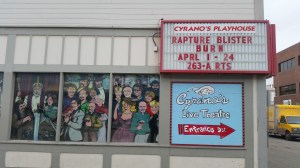
20160415_101933There isn’t a lot of live theater on the North Slope of Alaska. No, there isn’t. Heck, there isn’t a lot of movie theater on the North Slope. Nope! Hell, there isn’t even a lot of television theater in my own home. (Okay, that’s my own choice, but still!). So, I often check to see if anything is playing at a local theater when I’m in Anchorage. This time the answer was yes, at Cyrano’s, and my schedule didn’t even stop me. So, there I sat watching the opening scenes of this play and realizing for the first time what it was about.

The play is Rapture Blister Burn, written by Gina Gionfriddo and directed by Krista M. Schwarting. It’s been playing at Cyrano’s since April 1st and it’ll continue running through the 24th. If you’re in the area, and if the F-word doesn’t scare you, it’s definitely worth seeing.

So anyway, there I sat, watching as a series of inter-related stories began to unfold on the small stage in front of me. Much of the action takes place in a class Catherine teaches during the summer. Put together at the last minute, the class ends up with exactly two students, Gwen, and a young college student named Avery (Olivia Shrum). When Catherine’s mother, Alice (Sharon Harrison) joins the conversation, the result is three generations of women gathered together to discuss feminist theory. We are soon treated to a quick and dirty version of Betty Friedan’s critique of domesticity, followed shortly thereafter by an account of Schlafly’s critique of feminism. Throughout this, the focus of discussion remains squarely on the trade-off between family life and a career as each of the characters weighs in on the (dis-)advantages of each.

20160414_201115I’m not normally a fan of explicit theory in a story-line. I always want to ask the writer to write an essay if that’s what they really want to do. In this case, however, all this theory really is part of a story. The real question here is how the women use these theories to make sense of their own lives and to communicate with one another about the decisions each of them face. We are asked to consider the theories, yes, but we are also invited to think about what each theory means to the characters invoking them.

Oddly enough, it is Gwen (the stay at home mother) who champions Friedan and Catherine (the single woman with a successful career) who keeps telling us that Schlafly “had a point.” Avery and Alice are there largely to provide a running commentary as each of the two main participants struggle to rework their own life stories in light of the course material.  This is very much a story about women in their middle-ages, women with enough life behind them to have a few regrets and with enough ahead of them to feel a trace of hope.

I would be remiss if I didn’t take a moment to say how much fun the dialogue can be in this play. each of the characters comes into her own at some point in the story. Even Don has his moments, but for my money Avery has the best lines. Perhaps, it’s just the wicked joy that Shrum seems to take in playing her. At any rate, she had me laughing. But then they all did at one time or another.

Catherine’s praise for Schlafly is ironic, of course. We are supposed to understand this is a heresy of sorts, and yet it’s a heresy born of a deeply personal dilemma. For all her success, Catherine is clearly not happy, and she sees in Gwen’s family something that is missing in her own life. She will of course get a chance to test this theory. She will get Don back, if only briefly. She will get a chance to take care of Gwen’s youngest child, and she will see this arrangement all fall apart before the end of the summer. Gwen will give up grad school and return home. Don will prove himself unwilling to keep up with a successful spouse and opt for the comfortable life he has already made for himself, leaving Catherine with little to do but take up her promising career once again and plow through her successful life without a steady relationship.

It is perhaps not such a bad fate for Catherine, so it would seem. She is free despite herself. In the end, we are told Schlafly was right, though perhaps the lonely fate of a successful feminist is not so bad after all.

***

I’m back in the North Slope now and still wondering what it was I watched. I find myself in the ever so odd position of feeling a bit out-cyniced. That doesn’t often happen to me. There is a story in here about families. It’s not a very pretty one. Don and Gwen are pathetic. They had created a family out of their own personal failures, and in the course of the story, they recreated it when their newfound courage failed them once again. Catherine and Avery are the only ones who walk away from the story with anything like a future, but they do so with little hope for families of their own. In Catherine’s case, at least, that is a genuine loss. She did want to have her cake and eat it too, and in this case she just isn’t going to get to do that.

So, how do I feel about this? It depends on the stories of the moral.

The play is at its strongest if we minimize the lesson. This can be a story about how life has a way of refuting our theories and foiling our choices. As a story about middle-aged people, this is also a story about how decisions once meant to create a life become the source of limitations inhibiting our lives. We see in this story how Catherine once sacrificed a relationship for a career only to find (too late) the choice cost her more than she imagined. Don and Gwen both chose a family life over career ambitions only to find their own family languishing in the lack of professional rewards. Each of these characters seems to find the down-side of their past decisions a bit more significant than they once imagined. It’s an excellent story about the many ways that simply being human can damned well get in the way of trying to be something else. That’s a lesson I can identify with.

As specific statement about feminism, I can’t help thinking the play is a bit more objectionable. It’s view of family life is especially grim, perhaps unfairly so. (By perhaps, I probably mean something more like “almost certainly.”) What the play says about career women seems still more egregious. It asks us to accept that this one woman, Catherine, must choose between a family and a career, and of course the real problem here is just how much we may generalize about her dilemma. That is where I find myself wanting to back out of the premise.

It isn’t just that I think Catherine should have her cake and eat it too. I could swear that I know women who have done precisely that. I’ve dated women who’ve done that. Hell, I’ve worked with and/or for women who have raised families and enjoyed successful careers. I don’t doubt the stress of doing both may have made misery of their lives on at least a few occasions, and I don’t doubt the cost of trying to do both falls harder on women than it does men. I don’t even doubt that in some individual cases, handling both becomes too much, but my point is that women have done it.

Of course, I can accept the premise that trying to have both isn’t working for a single character in a wonderful little play. But I can’t help thinking the story isn’t just about her. There is a reason, she and the others spend so much time telling us about feminist theory, and it isn’t because this is only a particular story of a particular woman and her particular set of friends.

Which brings us to yet another story. Whatever else this play is about, it definitely contains a story about feminism. But in this respect it is NOT a story about middle-aged women at all. It is a story about elderly and deceased women. I can’t help wondering at the focus on Friedan and Schlafly. These are the iconic figures that haunt the tales told by the characters in this story, the figures who have shaped the stories of those characters. Their choices have thus been framed in terms of gender politics as they were defined quite some time ago. I’m a little out of my element here, but I feel safe in suggesting other theorists might have provided these characters with an entirely different set of questions to struggle with. This is an interesting story, but I suspect one that missed a few options in the telling.

By ‘missed’ I might mean ‘denied’.

***

(Whenever I’m a Cyrano’s I can’t help wishing I’d been around for a few of these plays. …Jihad Jones?)

?
?
?
?
?
?
?
?
?
?

Share this:

  • Tweet
  • Share on Tumblr
  • Print (Opens in new window) Print
  • Email a link to a friend (Opens in new window) Email
  • Share on Reddit (Opens in new window) Reddit
Like Loading...

The Fog of Hedges

05 Tuesday Apr 2016

Posted by danielwalldammit in History, Movies, Politics

≈ 4 Comments

Tags

Atomic Bomb, Documentaries, Euphemism, Firebombing, Language and Culture, Movies, Robert McNamara, The Fog of War, War

thumb_624_default_bigFor me, The Fog of War (2003) is absolutely the gift that keeps on giving. I get more fascinated every time I watch this film. There are so many angles to it, so many sub-themes to explore. Lately, I find myself more and more interested in its language. The Fog of War was directed by Errol Morris (of the Thin Blue Line). It consists of a series of interviews with Robert S. McNamara, a man at the center of conflict throughout much of the twentieth-century. Few people could have provided more direct insight into the thinking behind some of the most terrible decisions of that era. By ‘terrible decisions’ I don’t mean poor choices so much as decisions with so much at stake, one can’t help tremble at the thought of them. That many of these decisions were also (arguably) also poor choices in the other sense, choices that cost the lives of countless people is also a big part of this story.

A lesser man might not struggle with such questions at all, resting certain in whatever rationalizations suited him best. But there McNamara is in the Fog of War, right on screen talking about those very decisions, and trembling at the thought of them, right in front of the camera. For a man with blood on his hands (and frankly, enormous quantities of it), McNamara is remarkably candid. Also remarkably thoughtful. Still, there are moments when his honesty fails him. Limits he doesn’t seem quite willing to cross, and possibilities he clearly doesn’t want to explore. In those moments, the hesitation is all over his language.

It begins in some of the first frames of the movie. McNamara tells us that in the course of his life he has been “part of wars.” Fair enough, one might say, but more fairly still he has been more than part of wars. He has been a driving force in wars, perhaps in some cases against his better judgement, but he has certainly been more than part of wars. The wording is mild, perhaps a simple lead-in, but the phrase just doesn’t do justice to the facts that will follow.

***

The film is punctuated with lessons drawn from McNamara’s experiences. It is Morris that pulls the lessons out of the narrative and presents them as bullet points for our benefit. The first lesson begins with the importance of empathy, not simply as a source of human kindness, but as a method of survival, a means of understanding adversaries. This alone saved the world from total devastation during the Cuban Missile Crisis, according to McNamara. Morris interrupts him to suggest that McNamara left out a few things in his account of the Russian motivations. Perhaps he didn’t like being interrupted. Perhaps, he wasn’t prepared to acknowledge some of the facts at issue. McNamara is reluctant to get into the issue of genuine Russian grievances, but rallies so to speak, even going so far as to add a few facts in their favor. Still, he wavers at the end, not quite able to come clean on his own role in some of those grievances.

Morris: “Also, we had attempted to invade Cuba.

McNamara: Well, with the Bay of Pigs, that undoubtedly influenced their thinking. I think that’s correct, but more importantly, from a Cuban and a Russian point of view, they knew, what in a sense I really didn’t know. We had attempted to assassinate Castro under Eisenhower and under Kennedy, and later under Johnson, and in addition to that, major voices in the U.S. were calling for invasion.

Every time I watch this film, I wonder what that means. In what sense is it that McNamara didn’t know that the U.S. had tried to assassinate Castro? Is this a fatal failure moral courage? Is McNamara simply unable to admit what he knew? Or is this a key to understanding the (dis-)organization of American diplomacy? Is it possible that he was the left hand, only dimly aware of what the right one was up to? Don’t know, but seriously, that’s a Hell of a hedge coming through an otherwise brilliant narrative.

***

McNamara served in the U.S. Air Forces during World War II, serving under General Curtis LeMay. He provided statistical analysis of U.S. bombing missions. I know paperwork, right? But sometimes the pen really is mightier than the sword, or even the canon. Clearly, McNamara’s reports were not simply filed…

McNamara: I was on the island of Guam, in his command, in March of 1945. In that single night, we burned to death a hundred thousand Japanese civilians in Tokyo. Men, Women, and children.

Morris: Were you aware this was going to happen?

McNamara: Well, I was…, I was part of a mechanism that in a sense recommended it.

I analyzed bombing operations and how to make them more efficient, i.e. not more efficient in the sense of killing more, but more efficient in the sense of weakening the adversary. I wrote one report analyzing the efficiency of the B-29 operations. The B-29 could get above the fighter aircraft, and above the air defense, so the loss rate would be much less. The problem was the accuracy was also much less. Now I don’t want to suggest that it was my report that led to, I’ll call it the firebombing. It isn’t that I’m trying to absolve myself of blame for the firebombing. I don’t want to suggest that it was I that put in LeMay’s mind that his operations were totally inefficient and had to be drastically changed, but anyway that’s what he did. He took the B-29s down to 5,000 feet, and he decided to bomb with firebombs.

The first phrasing of interest here is the recommendation. This is a double hedge. McNamara doesn’t take personal responsibility in this statement. He submerges himself in a larger “mechanism,” but that isn’t enough, because that mechanism only recommends the firebombing “in a sense.” McNamara thus starts his answer to Morris two full shields removed from personal responsibility for the firebombings. He then goes onto assure us that the measure of efficiency he used was not simply the number of people killed but the effectiveness of the bombing in weakening the enemy. It is an interesting distinction, albeit one perhaps lost at the moment when the fires reached their victims. That McNamara struggles with this is clear enough throughout this and many other segments of the film. I don’t mean to suggest he is insensitive to the topic. Rather, his struggle seems to suggest the opposite. McNamara hasn’t quite explained his own role adequately to himself, and the result is the final mess of hedging about the question of personal responsibility. He denies it, but he also denies that he denies it. It’s easy enough to point to LeMay, and with good reason; it was LeMay’s decision. Still, I can’t help thinking that answer wasn’t even sufficient for McNamara.

***

Morris: The choice of incendiary bombs, where did that come from?

McNamara: I think the issue is not so much incendiary bombs. I think the issue is in order to win a war should you kill a hundred thousand people in one night, by firebombing or any other way. LeMay’s answer would be clearly ‘yes’. McNamara do you mean to say that instead of killing a hundred thousand, burning to death of a hundred thousand Japanese civilians in that one night, we should have burned to death a lesser number, or none, and then had our soldiers cross the beaches in Tokyo and been slaughtered in the tens of thousands? Is that what you’re proposing? Is that moral? Is that wise?

Why was it necessary to drop the nuclear bomb if LeMay was burning up Japan? And he went on from Tokyo to firebomb other cities. 58% of Yokohama. Yokohama is roughly the size of Cleveland. 58% of Cleveland destroyed. Tokyo is roughly the size of New York. 51% percent of New York destroyed. 99% of the equivalent of Chattanooga, which was Toyama. 40% of the equivalent of Los Angeles, which was Nagoya. This was all done before the dropping of the nuclear bomb, which by the way was dropped by LeMay’s command. Proportionality should be a guideline in war. Killing 50% to 90% of the people of 67 Japanese cities and then bombing them with two nuclear bombs is not proportional, in the minds of some people, to the objectives we were trying to achieve. I don’t fault Truman for dropping the nuclear bomb. The U.S. Japanese war was one of the most brutal wars in all of human history; kamikaze pilots, suicide, unbelievable. What one can criticize is that the human race, prior to that time, and today, has not really grappled with what are, I’ll call it the rules of war. Was there a rule then that said you shouldn’t bomb, shouldn’t kill, shouldn’t burn to death a hundred thousand civilians in a night. LeMay said, if we’d lost the war, we’d all have been prosecuted as war criminals. And I think he’s right. He, and I’d say  I were behaving as war criminals.  LeMay recognized that what he was doing would be thought immoral if his side had lost. But what makes it immoral if your lose and not immoral if you win?

This one of the most fascinating monologues I have yet seen in a film. McNamara seems determined to ensure we understand the full gravity of the situation, almost urging the case against himself and others. He wants us to know this was a terrible decision, perhaps even a crime. And yet, he builds a kind of defense into the narrative. It begins with his refusal to answer the question. He had been asked who was responsible for the decision to use incendiary bombs, thus generating more civilian deaths than conventional ordinance might have. Whatever else, McNamara’s speech here gives us, it does not give us a direct answer to that question.

The narrative also serves to shape questions about McNamara’s own role in the affair in terms of his relationship to his commander. It is LeMay’s thoughts on the subject which control McNamara’s story-line. His own decisions are thus framed in terms of what LeMay might have said in response to any argument against the decision to firebomb the Japanese cities. If McNamara himself might have objected, this story suggests, his concerns would have been simply overruled.

Lastly, McNamara deflects the moral questions onto humanity itself. Nevermind who was responsible for this particular decision. The real question is one that falls to humanity itself. How might humanity have handled such an issue? McNamara seems to suggest, the answer would take the form of a rule of war. The specific feasibility of such rules at that time (or any other) is not so clear, but seems to be how he wants to address the issue. And in the end, this means NOT addressing the issue of just who is responsible for burning all those women and children up during World War II. McNamara wants us to understand it’s a serious issue, but he is at great pains to avoid dealing with it too directly.

***

This may seem like a side-issue, but I can’t help thinking it points to a Hell of a drama in its own right. McNamara’s thoughts on his own family and the impact of his service as Secretary of Defense under President Kennedy contain some interesting hedges of their own.

That’s the way it (his role as Secretary of State) began. You know, there was a traumatic period. My wife probably got ulcers from it, may have even ultimately have died from the stress. My son got ulcers; it was a very traumatic, but they were some of the best years of our lives, and all the members of my family benefited from it. It was terrific.

I can’t help wondering how McNamara could say that his service benefited all members of his family while telling us the job may well have killed his wife. It seems cruel to me, even to point this out, and yet, it seems an important fact. Among the many who suffered through this man’s career, one may well count members of his own family. No doubt, this too has its reasons, reasons he doesn’t owe us, but as much as he gives is damned disturbing. And I wonder if that sort of story isn’t a bit more common than one might suspect.

***

Regarding the build-up of the Vietnam War…

There was a coup in South Vietnam. Diem was overthrown, and he and his brother were killed. I was present with the President when together we received information of that coup. I have never seem him more upset. He totally blanched. President Kennedy and I had tremendous problems with Diem, but My God! He was the authority, he was the head of state, and he was overthrown by a military coup, and Kennedy knew, and I knew, that to some degree the U.S. Government was responsible for that.

Here again, one seems to see McNamara posing as the left hand struggling to understand what the right hand was doing. Government is complex, sure, but I can’t help wondering; if I were in a more polemic mood, might I start a criticism of this war by asking just how in the Hell the CIA could give it’s blessings to a coup the President and his Secretary of Defence didn’t support?

***

Speaking of Vietnam, there is a fascinating moment covering the Gulf of Tonkin incident. Twice in August of 1964, the Destroyer USS Maddox reported attacks from North Vietnamese forces. These attacks have long been disputed, but nevertheless, they provided the rational for a resolution authorizing use of greater force by Lyndon Johnson. McNamara provides his own take on the details. One of the more interesting gems here is an audio-taped recording of a man on the Maddox reporting the attacks. Asked if he is sure that a torpedo had been fired at the ship, he replies in the affirmative; “No doubt about that, …I think.”

***

“What I’m doing is thinking it through with hindsight, but you don’t have hindsight available at the time. I’m very proud of my accomplishments, and I’m very sorry that in the process of accomplishing things, I’ve made errors.”

This line comes toward the end of the film as McNamara is beginning to summarize the whole thing. One might question whether or not ‘errors’ would be the most appropriate word to use for the sense of moral transgression that haunts this film. Perhaps, this may seem unfair. McNamara and those he served with had responsibilities some of us will thankfully never know. Had he done too little, he might well have faced similarly questions about the loss of American lives due to failure of nerve. So, does this render the whole issue a kind of practical calculation, a simple cost-benefit analysis? McNamara seems to have been well trained in such accounting. This might well be his honest sense of the issues. Sill,  one has to wonder at the use of ‘error’ to describe the moral significance of lives lost wasted.

***

What is morally appropriate in a wartime environment? Let me give you an illustration. While I was Secretary, we used what’s called “Agent Orange” in Vietnam, a chemical that strips leaves off of trees. After the war, it is claimed that that was a toxic chemical, and it killed many individuals, soldiers and civilians exposed to it. Were those who issued the approval to use Agent Orange criminals? Were they committing a crime against humanity? Let’s look at the law. Now what kind of law do we have that says these chemicals are acceptable for use in war and these chemicals are not. We don’t have clear definitions of that kind. I never in the world would have authorized an illegal action. I’m not really sure I authorized Agent Orange. I don’t remember it, but it certainly occurred, the use of it occurred while I was Secretary.

What is most striking about this passage is the distance between McNamara and a decision for which he was clearly responsible. McNamara does acknowledge this happened on his watch. And yet he discusses the issue for the most part as though the responsibility must fall on the shoulders of someone else. Again, McNamara seems to look to the laws for answers to these questions, but that too seems to be a bit of a dodge. Does he really need a law to tell him not to poison people?

…also noteworthy here would be the sense that something is odd about the claim that a chemical that strips leaves from plants might be harmful humans. McNamara doesn’t quite acknowledge that it is harmful. He is content to tell us that “it is claimed…”

***

Near the end of the film, McNamara relates the story of a protester. His account here is fascinating in many ways. What interests me about it at present is the way he frames the moral questions again in terms of humanity itself. This was a protester who died trying to communicate something to McNamara himself, but McNamara saw the significance of his death in the language of the man’s wife, as a question for all of humanity. Perhaps such questions are well asked of all of humanity, and yet I can’t help thinking that a question asked of all of humanity isn’t really asked of any particular person.

…or perhaps, more to the point, a person weary of answering such questions in his own life, weary of his own answers and the consequences of the answers he has given, might well prefer to have humanity itself grapple with those questions.

Anyway, we’ll leave it with this last quote.

Norman Morrison was a Quaker. He was opposed to war, the violence of war, the killing. He came to the Pentagon, doused himself with gasoline. Burned himself to death below my office. He held a child in his arms, his daughter. Passersby shouted, “Save the child!” He threw the child out of his arms, and the child lived, and is alive today. His wife issued a very moving statement, uh; ‘Human beings must stop killing other human beings.’ And that’s a belief that I shared. I shared it then and I believe it even more strongly today. How much evil must we do in order to do good? We have certain ideals, certain responsibilities. Recognize that at times you will have to engage in evil, but minimize it.

Share this:

  • Tweet
  • Share on Tumblr
  • Print (Opens in new window) Print
  • Email a link to a friend (Opens in new window) Email
  • Share on Reddit (Opens in new window) Reddit
Like Loading...

Libertarian Josey Whales

29 Tuesday Mar 2016

Posted by danielwalldammit in Movies, Politics

≈ 7 Comments

Tags

Clint Eastwood, Cowboys, Film, Free Markets, Libertarianism, Movies, Outlaw Josey Whales, Politics, Westerns

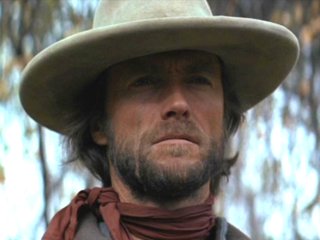
JoseyWDon’t get me wrong. I owe countless hours of entertainment, and many profound lessons learned to Clint Eastwood and his lifetime of utter brilliance. In this post, I will of course repay him by attacking his work on one of my all-time favorite films.

I guess I am feeling lucky.

…or maybe it’s just a blog post, but anyway, that’s not the film I mean to ramble about. I’m thinking about Josey Whales. There is one scene in this film that really bothers me. Maybe it’s meant to. Hell, probably, it’s meant to, but in this case the bother skips out of the bounds of the movie itself and starts to become a real-world bothertation.

I am talking about a scene in which Josey enters a trading post to find two men raping a young Navajo woman right there in the building. He grimaces a bit, and we get the impression he doesn’t really approve, and of course he does what so many of Eastwood’s characters do in this film; he goes on about his business, at least until the men become his business. This character is a reluctant hero after all, not some white-hat good-guy. When the rapists decide to try and take him prisoner, Josey, …uh, …SPOILER ALERT, …shoots them both dead, thus effectively saving the woman from sexual assault even as he saves his own life.

It’s great drama, and one of the things that makes it great is the moral ambiguity of its main character. Would he have helped the young woman if the two men hadn’t gone after him? We might hope so, but the film itself gives us no reason to suspect he would have. What we do know is that he walked right past them, and right past his first chance to help her. The whole scene ends with a disconcerting sense that Josey has put a stop to a number of bad things without ever really making a decision to do so.

It’s good storytelling. Hell, it’s great story-telling. So what’s the problem?

I think of this scene every time I hear of Clint Eastwood’s approach to libertarianism. His take on the subject is often described as “everyone leaves everyone alone” or some variant thereof. I actually rather like this expression, at least for a moment or two whenever I hear it. I can just imagine it being directed at some fussy bastard whose getting into other people’s business, in effect telling them to mind their own. I can get behind that sort of thing, sure I can. But then I find myself thinking that’s not really where this message is going, is it? Not in the grand scheme of things.

Time and again, we see libertarians in league with mainstream conservatives. On the topics of government aid to the poor and interference with the economy their messages are synchronous. On the topic of gender politics, their views clash, and near as I can tell the mainstream conservative themes win-out just about every time. This tells us a lot about the priorities at stake here, and I get damned tired of hearing a message that promises respect for individuals across the board only to see that message work consistently to the benefit of those already powerful at the expense of those struggling just to survive.

…which of course brings us right back to that scene from Josey Whales.

You could think of “everyone leave everyone alone” as a rule that might stop the rapists, albeit, it’s damned weak wording for a crime such as that. More to the point, I can’t help thinking it has more to do with Josey’s initial decision to go about his business, leaving the men free to hurt a young woman in his presence. I can’t help thinking that in that moment, Josey was minding his own business, just as the real Clint Eastwood seems to suggest we should all do.

Of course things work out in the end with Josey Whales, but they work out in the end because that’s the way the story is written. The bad guys go one step too far, thus triggering Josey’s own trigger, and it doesn’t hurt that they are foolish enough to let him get the best of them, just as all the other bad guys in that story do. Evil is vanquished in Josey Whales, but not because anyone has made a conscious choice to oppose it. Indeed, the movie seems rather set against the wisdom of such choices. No, the good that happens in this movie happens as if by accident, as Josey and his companions go about their daily lives, just trying to survive. And so the invisible hand of the writer seems to bring good  things from morally ambiguous behavior, much as the invisible hand of God in free market folklore.

It’s good storytelling, yes, but it’s piss-poor politics.

Share this:

  • Tweet
  • Share on Tumblr
  • Print (Opens in new window) Print
  • Email a link to a friend (Opens in new window) Email
  • Share on Reddit (Opens in new window) Reddit
Like Loading...

Black and Blue

11 Thursday Feb 2016

Posted by danielwalldammit in History, Music, Politics

≈ 5 Comments

Tags

Black History Month, Blue, February, Langston Hughes, Leyla McCalla, Music, Sarcasm, Stacey Dash, Too Blue


I’ve been thinking about what Stacy Dash said about black history month, and I think I agree with her. We shouldn’t have black history month. Let’s put getting rid of it on the agenda. We’ll do that immediately after we get black history a secure and solid place in the rest of the curriculum.

Yep!

In the interim, here is Leyla McCalla putting an old Langston Hughes poem to music.

Think I’ll listen to it while I put together a lesson on the Harlem Renaissance.

…no reason.

Share this:

  • Tweet
  • Share on Tumblr
  • Print (Opens in new window) Print
  • Email a link to a friend (Opens in new window) Email
  • Share on Reddit (Opens in new window) Reddit
Like Loading...

The Look of Silence, a Review

29 Friday Jan 2016

Posted by danielwalldammit in Movies, Narrative VIolence, Politics

≈ 6 Comments

Tags

Communism, Documentaries, Film, Indonesia, Joshua Oppenheimer, Movies, The Act of Killing, The Look of Silence, Violence

MV5BOTMwMjI4MjQ3MF5BMl5BanBnXkFtZTgwMjkwOTM2NTE@._V1_SY317_CR0,0,214,317_AL_It’s easy to think of silence as the auditory equivalent to a blank page, a kind of nothing that fits in between the sounds where we actually expect to find meaning. At times, though, silence conveys more than we can hope to cram into the sounds we call words. Joshua Oppenheimer is one person who clearly understands this. His latest film, The Look of Silence explores this topic in one of its more sinister forms. This film is a companion piece to The Act of Killing. Both movies deal with a genocide carried out in 1965 after the government of Indonesia had been taken over by the nation’s military. In the aftermath of this coup anywhere from half a million to a million people were killed. Victims included communists, ethnic Chinese, and those openly critical of the new government. The Act of Killing explored these events through the narratives of killers themselves and the stories they tell about their own actions. In The Look of Silence, Oppenheimer explores the lives of those who survived the massacre, those who lost loved ones in the killings and have since then had to live their lives among those who carried out the killings.

Whatever else silence conveys in this film, it clearly conveys a strong sense of terror, both because the stories it relates are as terrifying as they are real, and because the film-makers exposed themselves to danger in order to get those very stories.

Time and again, we see the main protagonist of the film, Adi Rukun, staring in silence as he listens to the killers of 1965 describing in great detail the horrors they themselves perpetrated in 1965. Sometimes Adi watches the killers telling their stories in video clips. Sometimes, he interviews them himself. Adi’s older brother was one of those killed in 1965. The story of his brother’s killing is among those he learns about over the course of this film.

If there is a plot to The Look of Silence, it is generated from Adi’s own decision to confront the killers, to speak to them himself, to risk engagement on a subject about which he is expected to remain silent. Adi is an Optometrist, and his subjects are aging. An eye exam thus becomes the pretext for one interview after another, each one an opportunity to breach the subject of past horrors. The resulting story is filled with this tension between silence and speech. The possibility that events discussed in the narratives of the killers could well happen again haunts one throughout the film. More to the point, one cannot escape the sense that Adi’s efforts could well make subject him and his own family to such violence. Those he interviews remind him of this frequently over the course of the film. The hints are subtle, but they are real, and they are horrifying.

It seems trite to suggest this, but the silent moments occurring in each interview are as interesting as the words themselves. We learn so much from the killers in this film. They tell us so many things about their past actions and their motivations, and yet each tries to withhold some part of their own stories from Adi and from us. Oppenheimer lets the camera linger in the awkward moments wherein they reconsider their stories and adjust their narratives to new questions and uncomfortable revelations. Always there is Audi, sitting there quietly, courageously choosing his words and listening to their responses. At times he is inscrutable. At others, one can almost feel the tears rising within him. …or the rage. Most often I cannot help thinking it is shame that I see in his face, a kind of deep-seated embarrassment for the murderers and for their inability to face the truth of their own actions.

If this is a story of silence, it isn’t merely the silence of Indonesians that unfolds in this story. American foreign policy is all over the events described in the movie, its long-term significance pervasive not merely in the lives of Indonesians themselves, but also in the consumer culture of Americans.

…in products we’ve all enjoyed in our own lives.

…without every knowing their cost.

Share this:

  • Tweet
  • Share on Tumblr
  • Print (Opens in new window) Print
  • Email a link to a friend (Opens in new window) Email
  • Share on Reddit (Opens in new window) Reddit
Like Loading...

Of Trumps Walls and Wires!

25 Friday Dec 2015

Posted by danielwalldammit in Politics, Street Art

≈ 2 Comments

Tags

Art, Donald Trump, GOP, Immigration, Satire, Shoe, Street Art, Subtle, The Apprentice

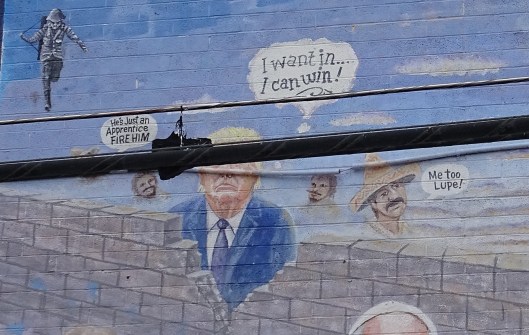
trumpcrop5One of the things I like most about street art is the way it interacts with the environment. Case in point, this wire in front of this mural in the Vegas Art District irritated me at first. Then I came to see it as a sort of design feature.


A good one.

Here’s the full panel.

trumpcrop3

Share this:

  • Tweet
  • Share on Tumblr
  • Print (Opens in new window) Print
  • Email a link to a friend (Opens in new window) Email
  • Share on Reddit (Opens in new window) Reddit
Like Loading...

Islam is not a Race! …Or an Apple, or a Hacksaw. It’s Not Even a Loud or a Sour.

24 Thursday Dec 2015

Posted by danielwalldammit in Politics

≈ 1 Comment

Tags

Distinction, Donald Trump, Islam, Islamophobia, prejudice, Race, Racism, Richard Dawkins, Terrorism

Trump's Friend

One of Donald Trump’s fans

Prejudice Paints in broad strokes, but its defense is typically written in fine print. So very often the same person who begins with broad generalizations will find all manner of fine-tuned distinctions to make in support of them. Hatred of Muslims gives us not just one but two of these games. In the first, people worry over whether or not Islamophobia is a word. In the second they reassure us that Islam is not a race.

By people, I suppose I mean Richard Dawkins.

I also mean a lot of other people too, but we’ll start with Dawkins. He just happens to have given us a couple of good examples of the sort of games people play on this subject. The first occurred in a discussion of Ahmed Mohamed (the Muslim boy who’s clock earned him national attention awhile back. Accused of Islamophobia in his comments on the subject, Dawkins dismissed this as a non-word. The second appears on his Twitter stream on December 8th:

DawkinsCropped

What both of these examples have in common is a flippant response to concerns about hatred and fear of Islam and/or Muslims. The issue is far from limited to Dawkins or his critics. Trump and his fans have provided countless examples of these games over the last few months. Let’s take each of these issues in turn.

***

Is Islamophobia a word? Yes, it is. Whether or not that word can be used to communicate something useful is a more serious question. We’ll pursue that one here.

I’ve spoken with some folks who oppose the use of the word to describe attacks on Muslims.They interpret the word as applying only to attacks on Islam itself which ought in their view to be fair game for reasonable criticism (as opposed to attacks on actual Muslims). It’s an interesting distinction to make, but there are at least 2 problems with it, no 3.

1) While it may be true (and I certainly think it is) that there are perfectly reasonable criticisms of Islam itself, it is also true that there are unreasonable and highly biased criticisms of Islam. So, restricting our concerns about unfair criticism to actual people doesn’t do much to ensure responsible dialogue.

2) Actual prejudice simply isn’t limited to such neat distinctions. Unreasonable and biased criticism of Islam itself is indeed one of the many ways that someone seeking to spread hatred of Muslims may communicate his or her prejudice.

3) There are serious questions about the social footing in which even a sound rational criticism of Islam will take place today. Sure, we can put a reasonable Muslim in a room with a reasonable critic and ask them to hold a reasonable debate, but in the present political climate, the comments flying back and forth across various media bleed far too much into other topics such as terrorism, war, and national policy. Whn issues such as misogyny and homophobia are used, as they often are to explain what is wrong with Islam, it becomes that much easier to justify military action against Islamic countries. But bombs fall on women and those of homosexual orientation, just as they do straight men. And the poetic injustice reaches its final flourish when women and children in flight from ISIS are denied refuge because so many in the west can imagine Islam only in context of its horrors. In this context, it’s at least a little difficult to take the notion of reasonable criticism at face value.

As another way of putting this last point, I would say that a reasonable criticism is not simply one rooted in sound reasoning; it is one made in a context wherein constructive dialogue may actually take place.  When that context is not present, many arguments that mihght at face value seem quite reasonable can often do more to spread hatred than to address real problems in a rational way.

This doesn’t resolve every question about Islamophobia, to be sure. The term may be directed at those with legitimate concerns about Islam or its adherents. Then again, words don’t come with guarantees about their own usage. Excessive and irresponsible criticisms of Islam and its adherents do happen, and concerns about such issues ought not to be dismissed with a quip about voicabulary.

***

For my own part, I shall continue to use the word, Islamophobia. I shall use it to describe what I take to be irrational prejudice against Islam, Muslims, or Muslim entities (Mosques, charitable organizations, states, etc.). I will distinguish it from criticisms that I do regard to be rational. I’m open to debate as to which is which, but I shall regard preemptive dismissal (such as that of Dawkins) as a sign of bad faith.

***

The notion that Islamophobia is a form of racism is itself interesting on a number of levels. To be sure, there are times when I am tempted to say that some other term might be more appropriate than ‘racism’, but when someone points out a prejudice, a discussion of whether or not that prejudice is about race, religion, nationality, or some other category can be pretty damned underwhelming. It’s well enough to dot your Is and cross your Ts, but that sort of quest shouldn’t be used to obscure the larger point that some form of prejudice is at stake in the issue.

As to the specific notion that critics of Islamophobia think Islam is a race, well it’s tough to decide whether or not that ‘s a straw man or a red herring. Perhaps it’s a straw herring.

I imagine someone out there may well think that Islam is a race, though I have yet to encounter the fellow. The vast majority of those asserting that Islamophobia is a form of racism are not, however, asserting any such thing. The notion that Islamophobia is a form of racism can be argued in a variety of ways:

1) In some cases the argument is essentially analogical reasoning. Islamophobia shares enough of the traits of racism that some feel justified in using the term on that basis alone. Some may not find this particularly convincing, but even so the denial just leaves us in search of a different word for the prejudice, and in no case does it involve mythical ideas of a Muslim race.

Trump&Friends

Trump’s milkshake brings all the White Supremacists to the yard!

2) Others emphasize the role of racial motivation in support for attacks against Islam. White Supremacists can and do criticize Islam as a way of attacking other ethnic groups. Because Islam is associated with specific demographic populations, criticism of Islam is an effective way of criticizing those groups. You can see this for example in the white racist memes often posted as replies in support of Trump these days. You can also see this in the number of crimes and attacks on others such as Sikhs commonly mistaken for Muslim, or in criticisms that oddly take practices from one Islamic region as arguments against people from another one (see my last post). When folks describe Syrian refugees in mass as terrorists, then no, this is not a criticism of any religion, and no, specific security concerns about the possibility that terrorists COULD come into the country as refugees do nothing to justify the sweeping generalizations often made against these refugees. In these and countless other ways, the religious nature of Islam is confounded with issues of ethnic identity and nationality.

…which is incidentally just what one would normally expect from racists.

Simply put, the question here is not whether those serving as the object of purportedly racist attacks really constitute a race (as if ‘race’ were real to begin with); it’s whether or not racism plays a role in the motivations of those launching the attacks.

3) Perhaps the most substantial argument in favor of the notion that Islamophobia is a form of aracism lies in the notion that attacks on Islam actually serve to re-enforce some of the same institutional inequalities once promoted through racism. Where previous generations may have justified colonialism and discrimination in the name of the ‘white man’s burden’, we now bomb Islamic nations with disturbing regularity and debate whether or not to take in their refugees through reference to Islam and Islamism. In effect, one might suggest that Islam is just the latest label used to perpetuate regional aggression as well as individual acts of discrimination. The vocabulary of racism may have changed, but it’s not terribly precise to begin with, and its effects remain largely the same.

***

Whatever the basis for describing Islamophobia as a form of racism, the notion that Islam is literally a race simply isn’t among them. That is little more than a flippant excuse for dismissing serious concerns. That’s definitely not helpful.


Share this:

  • Tweet
  • Share on Tumblr
  • Print (Opens in new window) Print
  • Email a link to a friend (Opens in new window) Email
  • Share on Reddit (Opens in new window) Reddit
Like Loading...

The Mating Calls of Violent Men!

20 Friday Nov 2015

Posted by danielwalldammit in Politics, Religion

≈ 12 Comments

Tags

Ann Coulter, Genocide, Islam, Muslims, Native Americans, prejudice, Racism, Right Wing Politics, Syria

CUPDyz-UkAEwa14

Please accept my apologies for posting this piece of filth

So this morning I’m surfing the hashtags on Twitter, cause I have plenty better to do of course, but anyway…

…and I come across the image to your left. It’s just one of many memes produced every day by the right wing hate machine. This one in particular happens to have been retweeted by professional bigot Ann Coulter.

I look at this image and I can’t help but think of the words ‘nits make lice.’ the saying is popularly attributed to Colonel John Chivington, another of history’s great war-mongers who didn’t care to distinguish children from enemies. Ostensibly charged with protecting the people of Colorado from Cheyenne and Arapaho, Chivington wasn’t much good at fighting real warriors, but he sure knew how to kill women and children, and on November 29th, 1864, he knew exactly where to find a band of Cheyenne who weren’t going anywhere. They weren’t going anywhere, because they’d already been placed under the protection of the army at Fort Lyon. Chivington didn’t care.

Neither do people who produce images like this.

Sadly such folk are not such a fringe group in America, or in other parts of the western world. Today the net is also abuzz with talk of plans from Narcissa Trump to force Muslims to register all across the nation so we can keep track of them. We’re still hearing the echoes of a Jeb Bush plan to admit only Christian refugees to America. And of course calls abound to reject all Syrian refugees out of some generalized fears about terrorism. Some are concerned about the possibility of terrorists inserting themselves into the refugee population. Many more simply refuse to think of any Muslims, or those coming from Muslim regions, as anything but terrorists.

CUCnndDWsAEIM4z

Because of course what some Afghans do is the best argument against helping Syrians in distress

I find myself waxing nostalgic for the days after 9-11 when President Bush carefully made it clear that our nation is not at war with Islam. I’ve never been a fan of Bush, but in this regard he at least held the rising tide of right wing malice to within certain degrees of sanity. In the intervening years, pseudo-conservative culture warriors have been working damned hard to overcome that limitation, and they have made great progress. They want a general war between the west (and Christendom) and Islam itself. Sometimes folks will qualify this by saying we are at war with ‘radical Islam’ as if ‘radical’ were ever enough to clarify the difference. These people want desperately for America to commit to general war against proponents of Islam all over the world.

And in this respect, they want very much the same thing that terrorists want. It’s as fascinating as it is disturbing to the dance of dangerous men and their couch-bound cheerleaders. Nothing brings the bigots out from under the rocks that hide them in America quite like events such as Paris. They find in terrorist acts a real source of empowerment, and they use that empowerment as much to attack moderates here in the west as any radicals abroad.

What is the worst thing about Isis? To so many right wingers, that would be Obama.

…or liberals in general.

What these war-mongers want doesn’t have much to do with ending terrorism or defeating actual terrorists, but they will make life miserable for those who happen to live near terrorists, who happen to look like terrorists, or (in the case of Syrian refugees) who happen to have already been hurt themselves by such terrorists. They would have been right at home with Chivington and the Colorado 3rd.

Each act of terrorism is an opportunity for right wingers to push aside the rest of us, to finally defeat their own domestic enemies and set the nation and the world at large on a violent course. They see in Paris and every act by the terrorists proof positive that their own violent worldview is the correct one, and that our nations must ever more place warfare at the center of public policy. That our own war efforts may have similar effects in far regions of the world could hardly be an objection to such a mind-set. It is synergy in action, the benefits of an ever escalating rhetoric of violence. As much as these people hate each other, they hate the rest of us more.

Its tough not to see a measure of alliance between terrorists and those who would reduce of American policy to a war against them, and against all of Islam. In some cases, this connection would be concrete, because you can bet the KKK and everyone at Storm Front are among the voices flooding social media this last week. In other cases the connection takes more thought. But each act of violence brings both forth cries for more of the same. These messages come ostensibly from enemies, and yet they coalesce into an odd sort of harmony.

The mating calls of violent men!

These violent men only have eyes for each other. And if they have their way, the world at large will soon be nothing but a battle ground between such people.

It will also be a dance hall for the morbidly obsessed.

Share this:

  • Tweet
  • Share on Tumblr
  • Print (Opens in new window) Print
  • Email a link to a friend (Opens in new window) Email
  • Share on Reddit (Opens in new window) Reddit
Like Loading...

A Visit to the Museum that Goes Boom!

23 Wednesday Sep 2015

Posted by danielwalldammit in History, Las Vegas, Museums, Politics

≈ 3 Comments

Tags

Atomic Testing, History, Las Vegas, Museums, Nevada, Nuclear Power, Project Chariot, Radiation, Vegas

IMG_4686The Atomic testing Museum in Las Vegas would be among the more interesting places I visited this summer. The museum has two major exhibits, one for Atomic testing and one for Area 51. I’m really not sure what to make of the Area 51 section, and really I’d just as son not be picked up by the Men in Black, so we’ll just leave commentary on that aside for the present. Besides, the Atomic Testing Museum provides plenty of interesting material t consider.

Seeing the Dina Titus reading room in there made me smile. It’s been a long time, but I do remember my old Political Science Professor rather fondly. Her book, Bombs in the Backyard would be the most obvious connection to this facility, though I’m not entirely sure how much of a role she played in the development of the museum and it’s collections. She does provide one of the more critical voices in one of the films shown in museum. I find myself wondering if her views couldn’t have received more coverage.

I’d have to say the material collections in this museum are fantastic. I’ll include a few pictures, but they really don’t do the place justice. It’s worth a trip to see this stuff, so remember this place if you’re ever in Las Vegas and your hangover is under control. Of course you may also pick up a bit about Nuclear testing at the Neon Museum, because nuclear tourism was once so very Vegas. But of course the Atomic testing Museum is a long way from Neon. Much of it is drab green and grey, just like I remember my dad’s old military paraphernalia, which is very fitting I suppose.

There is a tremendously matter-of-fact tone to the presentation in this museum. As you proceed down it’s halls you will learn how scientists first came to understand the possibilities which would give rise to nuclear technology; you will learn about the rush to acquire that technology during World War II, and you will learn about the many twists and turns of the nuclear arms race which would follow. Also you will learn about the steps and procedures taken to set up and run the actual facilities in Nevada.What bothers me is just how unproblematic each step in this process would seem to be in the narratives this museum provides.

The Atomic testing Museum presents the rationale for each stage in the history of its subject in a very straightforward manner. It does the same with protests, and even with various decisions to scale back nuclear testing and/or to discontinue certain programs. I wouldn’t say that the museum slights the protest movement in an overt manner, but the museum leaves a strong impression that the development of nuclear technology proceeded along a rational course. Whatever the pros and cons of nuclear testing, and of specific events in the history of nuclear testing, the planning process behind that history was, at least as far as the narrators here would have it, utterly reasonable.

This is of course exactly how I remember those in favor of nuclear testing presenting the case for it when I lived in Nevada. It’s also what I see whenever I dip my toes into the history of Atomic power. For whatever its worth, this does appear to be the view of those who worked in the industry. And of course those who worked in the industry are strongly represented in the Museum and its supporters.

This doesn’t mean that the museum is insensitive to critics of Atomic testing, but it does mean that the narrative presentation at the museum provides a strong bias in favor of the grounds for testing in each of its various phases. Whether testing is right or wrong, so it would seem, the case for doing was always a function of careful, rational consideration. The problem is of course that this just isn’t entirely true. It may well be that the arms race was inevitable. It may well be that the bomb needed to be dropped on Japan, as so many still argue today. It may even be that we needed to keep testing for so many years into the cold war. All these things may well be (and yet they may not), but that doesn’t mean that each step in the process can be fully explained as a rationale decision by someone genuinely interested in pursuing national security.

There are moments in the history of Nuclear testing in which the larger narratives just don’t fully explain what’s going on; moments in which the fingerprints of Dr. Strangelove seem to be found all over the course of nuclear testing; moments in the mad scientist seems to upstage the soldiers and scientist doing heir grim duty for the sake of loved ones, the nation, and possibly the entire world. When I see images of U.S. troops marching towards ground zero of an explosion because someone wanted to see how the bomb would affect troop movements, I can’t help thinking that I’m seeing one such moment in the history of nuclear testing

I look at such an image and I can’t help but wonder at the supposed reason for putting those troops in harms way, at least on that particular day and in that particular manner. Was this really a serious research question? Or was someone doing that simply because they could? Because they could put people out there and expose them to great danger in the name of science, and because being able to put human beings in danger for any reason must be one of the surest signs ever that you are somebody and that what you do is important.

I’m fairly certain that I see one such moment in one of the smaller placards of the museum, that devoted to Operation Plowshare. The placard reads as follows:

The Atomic Energy Commission’s Plowshare Program was named after a Biblical verse referring to “beating swords into plowshares.” The program was intended to find peaceful applications for nuclear weapons.

The Plowshare program, initiated in 1958, sought to develop peaceful uses for nuclear explosives to construct major facilities such as canals, harbors, earthen dams, and other engineering projects. Twenty-Six of the 35 Plowshare nuclear experiments were conducted at the Nevada test site. In 1961, the first off-site multi-purpose experiment, “Project Gnome,” near Carlsbad New Mexico was fired in a salt dome to study heat generated by a nuclear explosion, isotope and energy production, and seismic measurements. The most notable experiment in 1962 was Sedan, a 104 kiloton thermonuclear detonation, equivalent t an earthquake magnitude of 4.75 on the Richter Scale. The blast displaced 12 million tons of earth, creating a crater 1,280 feet in diameter and 320 feet deep. The crater could hold four football fields, end to end. Concluding the experiments in 1973 was Rio Blanco near Rifle, Colorado which focused on fracturing natural gas-bearing formations. The Plowshare program terminated in 1975 due to waning industrial interest and mounting public concern about the environmental consequences.

Not mentioned in this placard would one of the Plowshare projects never completed, Project Chariot. Project Chariot was an effort to build a harbor via nuclear detonations at a site just south of Point Hope, Alaska. Dan ONeill’s book, The Firecracker Boys provides a pretty thorough account of the politics behind this project as well as the opposition which eventually killed the project. Rachel Naninaaq Edwardson’s documentary, Project Chariot, also provides an interesting take on the subject, one focused the local Iñupiat population and their efforts to deal with the lasting impact of their brief encounter with an almost-bombing. I don’t particularly wish to rehash the full subject here, but it’s hardly a study in rational scientific inquiry. The Atomic Energy Commission ignored a great deal of science in planning the project, misrepresented the findings of its own scientists, lied to the people of Point Hope, and finally, when forced to abandon their plans to bomb the Alaskan coastline, the research team left radioactive material buried at the site without telling anyone.

I think about project Chariot when I read this placard telling us about the many successes of Operation Plowshare, when I see this matter of fact discussion of Plowshare’s goals and the simple decision to discontinue it. I think about the lives of scientists whose careers were trashed because they opposed it, and I think about the people in Point Hope today still unsure of just what did actually happen in their region, still wondering what effect it had upon them. In it’s pursuit of Project Chariot, the behavior of the Atomic Energy Commission was (as ONeill suggests) closer to that of kids with firecrackers, all-too eager to blow something up, than the sort of benign search for new ways to help mankind that one might expect from reading this placard on Operation Plowshare.

I think about all that, and I wonder how many similar stories never made it into the placards at the Atomic Testing Museum.

***

(Gallery. You may click the pictures. Don’t worry. They won’t explode!)

Neat Ad
Yep!
Newe Segobia, the most bombed nation on earth. …did I type that out loud?

Really Cool Stuff
Plowshare
Cool Stuff

Cold War
Stuff in detail
Stuff!

Why?
Why again?
Photo-Boom!

Just what it looks like.

Share this:

  • Tweet
  • Share on Tumblr
  • Print (Opens in new window) Print
  • Email a link to a friend (Opens in new window) Email
  • Share on Reddit (Opens in new window) Reddit
Like Loading...

Ask Not What the Alibi Buddy Says About You!

04 Tuesday Aug 2015

Posted by danielwalldammit in Philosophy, Politics

≈ 6 Comments

Tags

Bigotry, Excuses, Homophobia, Politics, prejudice, Racism, Rhetoric, Sexism

possible sighting?

possible sighting?

We’ve all heard about the alibi buddy. He’s that gay guy whose best friends with the man telling you he’s against gay rights. He’s also the black guy who hangs out with the fellow bashing African-Americans. He’s the Muslim who totally agrees with all of someone’s generalizations about Muslims, Arabs, and even Sikhs, cause that’s close enough, right? And of course he’s the Mexican drinking buddy to the guy telling you all about those damned immigrants, …er illegal immigrants, just the illegal ones, I mean. Cause we all know that people who bash immigrants are very precise about their concerns, and they never-ever cap on legal immigrants in any way! (Alibi buddy would probably tell us that if he were here.)

Does anybody else have any questions about this buddy, the one we never seem to meet? For that, matter, does anyone have questions for him? Who is he? Where does he live? Or does he really exist when the conversation is over? He might just be a kind of Berkleyian presence, only there when you’re in the room. I can’t be the only person to question if his reality outlives the moment. You gotta wonder if his friend even remembers him when the conversation is over and he doesn’t need an alibi anymore.

But it’s worse than that, I reckon, cause the alibi buddy ain’t there when you’re in the room either. So, this alibi guy is really weird, you know. He is and he ain’t, but he’s both of these (and neither) only when you’re in the room talking to the guy who has something bad to say about some group which totally includes the alibi buddy.

Which is confusing, I know.

Is or ain’t though, I’m convinced the alibi buddy is a singularity. I know, I know, the empirical evidence doesn’t say one way or another. It could be that all these people are talking about a whole bunch of different guys. It could even be that each community has its own ur-alibi, so to speak, a kind of minority spirit-keeper. There could be just that one guy who is friends with all the people capping on African-Americans, another one for Asians, and of course one sinister bastard for all the left-handed people. I mean it could well be that each disenfranchised group has its own alibi spirit who exists for the sole purpose of licensing friends to talk bad about them. On the face of it, this is at least possible.

…as is the existence of vast hoards of minorities living somewhere else, all of whom sent their trusted friends to say bad things about them.

…in good faith.

Still, the alibi buddy is just too perfect isn’t he? Always friends with someone who needs him, but never really there to answer any serious questions. Can that kind of perfection really be divisible. I think not. So, I really do think there is just one alibi-buddy for all the trash-talking not-really-bigots out there. You know it makes sense. There is just one alibi-buddy, one gay-Jewish-Afro-Asiatic Mexi-black man with a lisp. The alibi-buddy is is no Doubt a number of other things besides that, but really, he can only not be in the room for just so many reasons. So, we can probably rule out a few things. Alibi buddy isn’t white; I think we can all agree on that. He also isn’t straight. I would say that he isn’t a guy, but I can’t help thinking a woman would have the good sense to show up to set us straight.

The alibi buddy never does that, does he? No.

There is just one alibi buddy for all the people talking about him, and he is never really here to tell us how he feels about the issues. Evidently, he has a number of friends and they are all strikingly adversarial to the poor alibi buddy and his kin, but apparently he loves them anyway. Alibi buddy must be a very patient guy.

I say that, but I don’t really know for certain, which is frustrating, because I really would like to ask him something.  I’d like to ask him if he knows how his friends are talking about him? Does he know that his friend wants to make sure he can’t get married? Does he know his other friend wants him to go home (and I don’t mean Ohio)? That his drinking buddy thinks he’s unqualified and terrible at his job? I mean seriously, if his friends are any measure of alibi-buddy’s life, that poor guy doesn’t need anymore enemies!

Now I ask you; is this anyway to treat a singular entity capable of such miraculous patience? His friends always seem to want us to care about what alibi buddy thinks, …of them anyway. Just once, I wish someone would think of him and his feelings. As much as I’d like to know what he really has to say about all this, the question has always really been just what do his friends say about him.

…and the answer to that question is never all that pretty.

Share this:

  • Tweet
  • Share on Tumblr
  • Print (Opens in new window) Print
  • Email a link to a friend (Opens in new window) Email
  • Share on Reddit (Opens in new window) Reddit
Like Loading...
← Older posts
Newer posts →

Top Posts & Pages

  • Movie Review: The Orator
    Movie Review: The Orator
  • An Uncommon Security Guard: Dave Eshelman, AKA 'John Wayne'
    An Uncommon Security Guard: Dave Eshelman, AKA 'John Wayne'
  • When Sex Falls Out of the Performance
    When Sex Falls Out of the Performance
  • Southern Paiutes as Portrayed in Las Vegas Area Museums.
    Southern Paiutes as Portrayed in Las Vegas Area Museums.
  • When Culture Appropriates You
    When Culture Appropriates You
  • Kavanaugh, Young and Old
    Kavanaugh, Young and Old
  • The Village of Wainwright, Alaska
    The Village of Wainwright, Alaska
  • Candace Owens in Context
    Candace Owens in Context
  • Credible Story Not Required
    Credible Story Not Required
  • An American Flag as a Weapon, Redux.
    An American Flag as a Weapon, Redux.

Topics

  • Alaska
  • Animals
  • Anthropology
  • atheism
  • Bad Photography
  • Books
  • Childhood
  • Education
  • Gaming
  • General
  • History
  • Irritation Meditation
  • Justice
  • Las Vegas
  • Minis
  • Movie Villainy
  • Movies
  • Museums
  • Music
  • Narrative VIolence
  • Native American Themes
  • Philosophy
  • Politics
  • Public History
  • Re-Creations
  • Religion
  • Street Art
  • The Bullet Point Mind
  • Travel
  • Uncategorized
  • Uncommonday
  • White Indians
  • Write Drunk, Edit Stoned

Blogroll

  • American Creation
  • An Historian Goes to the Movies
  • Aunt Phil's Trunk
  • Bob's Blog
  • Dr. Gerald Stein
  • Hinterlogics
  • Ignorance WIthout Arrogance
  • Im-North
  • Insta-North
  • Just a Girl from Homer
  • Multo (Ghost)
  • Native America
  • Norbert Haupt
  • Northwest History
  • Northy Pins
  • Northy-Tok
  • Nunawhaa
  • Religion in American History
  • The History Blog
  • The History Chicks
  • What Do I Know?

Archives

  • December 2023
  • November 2023
  • June 2023
  • April 2023
  • February 2023
  • December 2022
  • November 2022
  • October 2022
  • September 2022
  • August 2022
  • July 2022
  • June 2022
  • April 2022
  • January 2022
  • December 2021
  • November 2021
  • October 2021
  • September 2021
  • August 2021
  • June 2021
  • May 2021
  • March 2021
  • February 2021
  • January 2021
  • December 2020
  • November 2020
  • October 2020
  • September 2020
  • June 2020
  • May 2020
  • March 2020
  • February 2020
  • January 2020
  • December 2019
  • November 2019
  • September 2019
  • August 2019
  • July 2019
  • June 2019
  • May 2019
  • April 2019
  • January 2019
  • December 2018
  • November 2018
  • October 2018
  • September 2018
  • August 2018
  • July 2018
  • June 2018
  • May 2018
  • April 2018
  • March 2018
  • February 2018
  • January 2018
  • December 2017
  • November 2017
  • October 2017
  • September 2017
  • August 2017
  • July 2017
  • June 2017
  • May 2017
  • April 2017
  • March 2017
  • January 2017
  • December 2016
  • November 2016
  • October 2016
  • September 2016
  • August 2016
  • July 2016
  • June 2016
  • May 2016
  • April 2016
  • March 2016
  • February 2016
  • January 2016
  • December 2015
  • November 2015
  • October 2015
  • September 2015
  • August 2015
  • July 2015
  • June 2015
  • May 2015
  • April 2015
  • March 2015
  • January 2015
  • December 2014
  • November 2014
  • October 2014
  • July 2014
  • June 2014
  • May 2014
  • April 2014
  • March 2014
  • February 2014
  • January 2014
  • December 2013
  • November 2013
  • October 2013
  • September 2013
  • August 2013
  • July 2013
  • June 2013
  • May 2013
  • April 2013
  • March 2013
  • February 2013
  • January 2013
  • December 2012
  • November 2012
  • October 2012
  • September 2012
  • August 2012
  • July 2012
  • June 2012
  • May 2012
  • April 2012
  • March 2012
  • January 2012
  • December 2011
  • November 2011
  • October 2011

My Twitter Feed

Follow @Brimshack

RSS Feed

  • RSS - Posts
  • RSS - Comments

Enter your email address to follow this blog and receive notifications of new posts by email.

Join 8,070 other subscribers

Blog at WordPress.com.

  • Subscribe Subscribed
    • northierthanthou
    • Join 8,070 other subscribers
    • Already have a WordPress.com account? Log in now.
    • northierthanthou
    • Subscribe Subscribed
    • Sign up
    • Log in
    • Report this content
    • View site in Reader
    • Manage subscriptions
    • Collapse this bar
 

Loading Comments...
 

    %d