• About

northierthanthou

northierthanthou

Category Archives: Politics

Get ready to crack heads; cause shit gets real here, yo!

…or something like that.

An American Flag as a Weapon, Redux.

21 Thursday Jan 2021

Posted by danielwalldammit in History, Politics, Re-Creations

≈ 4 Comments

Tags

American Flag, Busing, Desegregation, Insurrection, MAGA, Patriotism, Race, Riot, Violence

Right wing patriots love their country in much the same way that an abusive spouse loves his wife.

“I love you baby, now do what I say or else!”

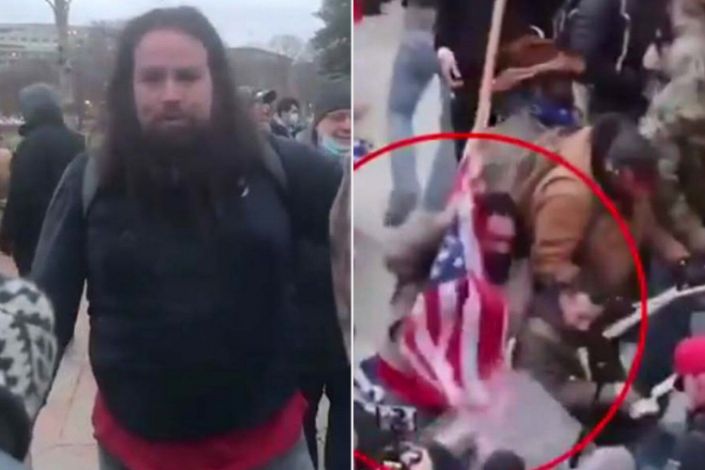
When one of those participating in the riots on the 6th picked up a flag used it to beat an officer, that struck me as rather par for the course. Independent of all the other crap perpetrated by those engaged in this insurrection, Francis Stager’s choice of a weapon might have seemed ironic to some, but for me it actually seemed rather telling. An American flag used as a weapon makes a fitting symbol for right wing politics.

It makes a fitting symbol of right wing patriotism.

Peter Stager beat Capitol Police Officer with American Flag Credit: FBI

This morning I started thinking about another image of a flag used as a weapon.

Was it the hard had riot of the Nixon era?

No.

After digging around a bit, I fount it. This iconic photo, “The Soiling of Old Glory,” captures a moment in the busing riots of 1976. This time the flag wielder was a student upset that his friends would be bused away in an effort to desegregate the schools. His target wasn’t a cop, it was a random African-American.

Luckily, he missed!

I don’t know if Joseph Rakes, the flag-wielding student, fits the right wing stereotype quite so well as Francis Stager, but the meaning of the moment seems comparable enough. As does the outrageous nature of the action. You’d be hard-pressed to avoid seeing in either conflict some sense of the defense of privilege; harder to still to find any meaningful excuse for the decision to turn the arguments of the day into a physical assault against a momentarily defenseless victim. Whatever the cop might have done in some other context, he was hopelessly outnumbered when Stager attacked him. Ted Landsmark, the black man in the 76 photo hadn’t done a damned thing; he too was hopelessly outnumbered and already realing from another blow. Neither deserved to be attacked with a deadly weapon.

Not any weapon.

Still, the weapon in each of these cases does seem to make a statement.

It’s just not a very good one.

***

The photo of the Capital Hill riots is taken from Yahoo News.

The Soiling of Old Glory is taken from an NPR story about it.

Share this:

  • Tweet
  • Share on Tumblr
  • Click to print (Opens in new window) Print
  • Click to email a link to a friend (Opens in new window) Email
  • Click to share on Reddit (Opens in new window) Reddit
Like Loading...

Religious Freedoms

15 Friday Jan 2021

Posted by danielwalldammit in Justice, Native American Themes, Politics

≈ 4 Comments

Tags

civil Rights, Establishment Clause, Free Exercise Clause, Freedom, History, Indian Civil Rights Act, Jurisdiction, liberty, religious freedom

Russian orthodox Church in Anchorage

Here is an interesting question (to me anyway). What legal mechanism prevents the Federal Government from banning your church?

(Hopefully, they don’t want to, but humor me…)

That would be the First Amendment, right, or more precisely the ‘free exercise clause’ of the First Amendment.

Okay, so what stops your state government from banning your church?

It’s not the First Amendment, not alone anyway. The relevant text of the First Amendment reads as follows; “Congress shall make no law respecting an establishment of religion, or prohibiting the free exercise thereof…” So, that prevents CONGRESS, and by extension other Federal entities operating under the authority of Congress, from banning your church. It doesn’t say anything about the actions of state governments.

What would prevent a state government from doing such a thing?

That would be the Fourteenth Amendment, or perhaps the First Amendment, as incorporated into state jurisdiction via the Fourteenth Amendment.

Section I of the Fourteenth Amendment reads as follows (emphasis added):

“All persons born or naturalized in the United States, and subject to the jurisdiction thereof, are citizens of the United States and of the state wherein they reside. No state shall make or enforce any law which shall abridge the privileges or immunities of citizens of the United States; nor shall any state deprive any person of life, liberty, or property, without due process of law; nor deny to any person within its jurisdiction the equal protection of the laws.”

This is significantly more ambiguous, of course, but I do believe most people, and more importantly, most of the relevant legal authorities, generally take this to mean that state governments have been operating under the free exercise clause (or some principle like it) since the ratification of the Fourteenth Amendment.

Okay, good fun, right?

Now here is a question, most Americans might not think about. What prevents a tribal government from banning a church on their own lands?

By tribal government, I mean the government of any Federally recognized tribe within the United States. We are talking about American Indians or Alaska Natives here. So, I am asking what legal mechanism would prevent a tribal government representing one of the indigenous peoples of the United States from banning a church under the own jurisdiction?

It isn’t any explicit measure in the U.S. Constitution itself.

Nope!

There is nothing specific in the text of the U.S. Constitution which limits the authority of a tribal government to restrict the religious activities of anyone subject to their jurisdiction. Congress has of course asserted plenary power to alter the relationship between tribal governments and the Federal Government at will since Lone Wolf v. Hitchcock (1903). (At least that is when the doctrine of ‘plenary power’ received its most explicit expression under the Federal courts.) Still, absent any explicit action from Congress restricting the authority of an Indian tribe, indigenous people are assumed under U.S. Law to retain any sovereign powers they had before colonization began. So, in the absence of any clear Federal statement to the Contrary, a tribal government may resolve the matter of religion and religious freedom as they deem fit. (Some would argue, that is exactly how it ought to work.) In any event, the Tenth District of the Federal Courts ruled in 1959 that no such law existed. According to the decision in Native American Church v. Navajo Tribal Council (1959), neither the U.S. Constitution nor any Federal Law obligates tribal governments to respect the free exercise clause or any principle like it.

Now, as I mentioned earlier, some would say that is how it should be. Let indigenous people settle any questions about religious freedom for their own members (or others subject to their jurisdiction) themselves! For good or for ill, it’s their business.

Well, that’s not what happened.

What happened was The Indian Civil Rights Act of 1968.

In other words, the answer to my third question is The Indian Civil Rights Act of 1968.

What stops a tribal government from banning a church is The Indian Civil Rights Act. This was part of a larger Federal Law expanding civil rights in a number of areas (most of which were of more direct concern to African Americans at the time). The Indian Civil Rights Act applies most of the provisions of the Bill of Rights to the actions of tribal governments. Significantly, it does not incorporate the establishment clause of the First Amendment into tribal jurisdiction. Tribal governments are free to establish their own religions, but they are not free to restrict the religious activities of those subject to their jurisdiction.

You can see this in the relevant text.

“No Indian tribe in exercising powers of self-government shall—

  1. make or enforce any law prohibiting the free exercise of religion, or abridging the freedom of speech, or of the press, or the right of the people peaceably to assemble and to petition for a redress of grievances…”

Note that there is a clear reference to the principle of free exercise, and yet, there is no mention of establishment. So, you can see it in the text. The Indian Civil Rights Act only incorporates 1 of the 2 basic religion clauses of the First Amendment into the context of tribal government. This somewhat belies the thinking of America’s founding fathers who might have suggested that the two clauses work together to ensure that religion will not become a source of abuse, or more to the point, to prevent an establishment of religion from becoming the reason religious freedom is restricted, but of course all of this ignores the context of colonialism here. The power of any religious establishment that might occur under tribal jurisdiction is significantly blunted by the presence of a larger Federal government which has already compromised a great deal of tribal sovereignty,not to mention state governments eager to eat away at what might be left of tribal sovereignty. In any event, the thinking at the time the ICRA was passed is that traditional tribal government is far too entangled with the ceremonial systems and spiritual narratives of the people in question to introduce the proverbial “separation of church and state.”

Of course, the ICRA has other significant limitations, particularly insofar as anyone might attempt to apply it to civil disputes, but that’s another matter.

All of this is to say nothing whatsoever about the religious freedoms of Native Americans facing regulations by the Federal and State governments. That’s a whole other messy history in itself.

Damned ugly one at that!

Finally, one reason I think this little exercise is worth doing is it helps to illustrate the way that religious freedom sits in the context of American law. Most people just think they have a right of religious freedom. They don’t really distinguish the establishment clause from the free exercise clause much less think about how these measures relate to one another. More importantly, folks tend not to think very carefully about the way that concepts of religious freedom play out in different layers of American government. Of course far too many people, think government is government is government, until they are pushed to start making distinctions, but the point at the present is this, religious freedom is not simply an abstract concept under the U.S. Constitution. Religious Freedom takes different forms in relation to different layers of American government.

Share this:

  • Tweet
  • Share on Tumblr
  • Click to print (Opens in new window) Print
  • Click to email a link to a friend (Opens in new window) Email
  • Click to share on Reddit (Opens in new window) Reddit
Like Loading...

Timothy McVeigh Would have Been Proud!

09 Saturday Jan 2021

Posted by danielwalldammit in Politics

≈ 12 Comments

Tags

Coup, Cultural Conservatism, Deplorables, Donald Trump, Election, GOP, Rush Limbaugh, TCOT, Trump

NOT Antifa!

Believe it or not, there was a time when liberals were the civil libertarians of American politics and conservatives were the folks most likely to advocate repression of individual rights. I do not mean simply that this was the substance of our nation’s politics at that time. No. I mean, that this was largely the understanding of people across the board of American politics. Lest you think this makes liberals the obvious good guys and conservatives the obvious baddies, I should add that a good portion of conservative rhetoric stressed the excess and indulgence of civil rights themes in liberal politics. The Republican Party was also much more invested in a kind of Edmund Burke version of ‘conservatism,’ so they were explicitly concerned with the preservation of long standing traditions, even at the expense of individual rights. Hell, they used to tell you so!

I don’t know how far this pattern stretches back in American history, but as I came of age in the 80s, it was sufficiently common to be taken for granted by a good number of people on each side of the battles we then fought. Back then, liberals consistently played the underdog, a stance often granted without challenge. For their part, conservatives often spoke with the authority of the ages; they spoke on behalf of powerful institutions, and they were the voices most likely to wield power consciously at the expense of individual rights.

A lot has changed.

…at least in the way we Americans typically talk about politics.

***

This is all broad strokes commentary, of course, but I think you can see it in the general tenor of the times. William F. Buckley, Jr.s first book, for example, was an appeal to Yale to crack down on the damned unbelievers at that institution. It was liberals who fought the banning of books. It was liberals who defended artists in music and film facing censorship from government in one form or another. It was liberals who supported birth control, gay rights, and much of the sexual revolution. It was liberals who defended the burning of the flag, and so on. In those days, before the right wing learned how to tell stories of ‘political correctness’ there was a definite sense that in any political battle you could expect the liberals (and along with them, many on the far left) to side with advocates of individual liberty and conservatives would tell us why something else mattered more.

There were exceptions of course, the most significant ones lying in the area of economics, which threw actually skewed the normal response to power inn both liberal and conservatives politics. So, we could certainly find some battles where the dominant themes were reversed. Also, some of the battles outlined above still track the same way now, but even there, the vocabulary has changed. One topics such as racism, for example, even the moderate left is no longer interested in individual acts of discrimination. If it ain’t systemic, it ain’t racism in left wing circles anymore. Meanwhile, the right wing is happy to use individual acts of racism as a wedge in which to insert the word ‘reverse’ into any discussion of racism in which they willingly take part. If it ain’t reverse racism, it ain’t racism in right wing circles anymore. It’s an absurd situation, to say the least, and part of what got us here is a massive shift in the means by which left and right wingers frame the issues in American politics. The left (and here I am including moderate liberals) wants to talk about larger issues; the right just wants to talk about individual rights.

What we don’t talk, at least not with each other, is how these themes intersect.

***

How the left got to where it is today is an interesting question, but I am not going to talk about that in this post. I am more interested in how the right got to where it now sits, utterly blind to the public welfare and completely disingenuous in its sense of individual rights.

Suffice to say that I do not think this evolution has been a positive force in American politics. The right wing embrace of individual rights hasn’t done much to enhance them.

Far from it!

***

How did we get to the point where a significant portion of America’s right wing thinks it’s acceptable to set aside the results of an election on little more than rumors and pornographic conspiracy narratives? How did we reach the moment in which the President of the United States would incite a riot and shut down our government over this very thing? How did we arrive at the principle that protesters could occupy federal buildings with weapons on their person?

The extreme violence of this event has been repudiated, of course, even by those who helped to stir that very mob to its frenzy, and the great bulk of Republican leadership is still unwilling to see in this event – the bloodshed spilled in our government buildings on behalf of a sitting President – anything so significant as to merit impeachment or invocation of Amendment 25. Mike Pence, one of the very people literally hunted by the domestic terrorists at the head of this riot (people who would have counted him an ally just last month), even Mike Pence doesn’t think this is worthy of removing the lunatic from the office Trump trashes with his very presence.

And still concern trolls all about the country urge us all to try and understand the perspective of Trump and his supporters!

How did we get here?

I think a large part of the answer to that question lies in the way ‘conservative’ ideas about authority and individual liberty have changed over the last couple decades.

***

What happened?

In a name, it was Bill Clinton!

No, I don’t mean to suggest that it was anything Clinton did that caused this change, though Goddammit he sure did enough to lend credence to the worst of his detractors. What I mean to suggest is that his own Presidency signaled a radical change in the way that conservatives approached our government. They didn’t like Carter before him, no, but they REALLY didn’t like Clinton. More to the point, they simply didn’t accept losing control of the White House.

During the administration of Bill Clinton, elements within the Republican Party abandoned any pretense to work with their opposition. Newt Gingrich led the charge in Congress, abandoning efforts to compromise on actual legislation and putting the GOP political machine on permanent campaign mode. He repudiated the very notion of putting country over party, and made it the norm to fight on any and all fronts, even at the expense of the American people.

I mean, what the Hell? You can always blame the other side, right?

That’s what Newt would do.

It’s what he did.

***

What happened to cultural conservatism was more important.

What happened there was Rush Limbaugh. First Morton Downy, Jr., of course, but after him, Rush Limbaugh. I still don’t think the majority of Americans quite realize how important Limbaugh was back in the early 90s. It was Limbaugh who taught countless bullies and bigots to call themselves ‘conservatives,’ people who weren’t really all that interested in politics but were happy to laugh at anyone supported by liberals and to berate any woman foolish enough to call themselves ‘feminists.’ Limbaugh entertained his audiences by attacking a parade of underprivileged people seeking help in various forms, and he gave his audience the weapons to hurt such people for generations to come. It was also Limbaugh who transformed the culture of conservatism from a Burkeian defense of tradition into the smart-ass voice of a teen rebel, or for that matter an internet troll. Limbaugh never really made a serious case for cultural conservatism, but he was relentless in his critique of liberalism and his challenge of any authority liberals might come to wield. Whether it was the campus speech codes coming into fruition at the time or inclusiveness in the academic curriculum, the authority of the Bureau of Land Management, efforts to enlist government in combating the AIDS epidemic (yes, Limbaugh made fun of that!), or any number of issues in the culture wars of the time, what Limbaugh did most was to poke fun at liberal pretense and tell stories about the abuse of authority by liberals. Conservative use of similar authority was never at issue on his shows, but this was simple hypocrisy. It was a conscious effort to equate liberalism with the abuse of authority, to delegitimize liberal use of authority in any form, and where necessary, to burn down the authority of any institutions then dominated by liberal voices. Attendant to this cause was a willful erasure of thought about conservative use of authority, and erasure of consciousness that that could ever really happen. Even when conservatives were in charge, their actions would be measured, henceforth, in terms of the response to liberal authority. Limbaugh’s audience bought that story to be sure.

It was through Limbaugh that countless Americans came to see authority as the domain of liberalism, so much so, that even a sitting president could count as an underdog, so much so that Hillary’s years in Washington could have made her responsible for everything that happened in government in the decades before 2016, that Biden’s years in office could now make him the new fall-guy for everything done by the Federal government over the last 40 years, so much so that Biden rather than Donald Trump could be the man most responsible for America’s failure to mount an effective response to the Covid outbreak.

So complete is the equation of authority with liberalism in right wing thought at this stage in our history that Joe Biden, a private citizen in 2020, was regarded by many cultural conservatives as more responsible for our nation’s disastrous pandemic response than the very President of the United States!

In right wing thought, all government power is liberalism. Conservative use of power is by definition the opposition to liberalism, the opposition to big government, even if the policies in question expand the power of that government. If a conservative is found to have expanded the power of the feds in the end, well then they were never really a conservative after all.

It takes cultural conservatives the time it takes to read a tweet now to wash their hands of one of their own.

Any of their own!

It was Rush Limbaugh that taught cultural conservatives these narratives. His message has been re-enforced, of course, by countless pundits in the echo-chamber, but no other voice in American politics could was ever so consistent, so loud, or so shameless in its repetition of this theme. He played the smart-ass in the back of the room mocking the liberalism as though it were a teacher hated by every student (American citizen) in the class, and he played that role so well, it became the dominant trope of right wing politics.

***

At least one other major development in U.S. politics helped to shape the rise of underdog themes in American conservatism, and that is a series of conflicts that reshaped the way conservatives thought about (or at least talked about) police power. Oh they are still happy to back the blue, of course, so long as we are talking about treatment of individual suspects, and certainly in relation to just about any conflict with persons of color, but during the early years of the Clinton administration, America’s right wingers added a new victim narrative to their own list of stories about police power.

They did this in the wake of Waco and Ruby Ridge.

I still think about this with a bitter sense of irony as I remember conservatives around me responding to the initial conflict at Waco by telling me how much they worried that the Clinton administration would simply let those bastards get by with it. Police had been shot, and they were deeply worried that a liberal softy might prove soft on the thugs who did it. After the travesty, I also remember conservatives laughing and telling me how glad they were that those idiots got what was coming to them.

That was before the Branch Davidians became martyrs to conservative politics, along with those killed at Ruby Ridge.

In the wake of these tragedies, Federal authorities doing much the same as they had under Republican administrations suddenly became symbols of liberal authoritarianism. The right wing folded in complains of a “New World Order” to be ushered in by Bill Clinton in with the horror stores about Waco and Ruby Ridge, all the while while forgetting that George Bush, Senior, had used that very phrase to help sell his war in the Gulf (a war most of these folks had openly supported). Everywhere fears of oppression by big government made their way into right wing rhetoric. G. Gordon Liddy spoke openly of shooting ‘jack-booted thugs” in the head, and countless cultural conservatives forgot that Liddy himself had been one of the worst of these thugs, the most openly corrupt.

Everything the Feds did under Clinton became fodder for these stories. When Elián González became embroiled in a custody dispute between relatives in Florida and his father back in Cuba, he too became a symbol of liberal excess. Countless Republicans declared Janet Reno’s determination to send González back to his father as the height of liberal abuse. How, they asked, could we send a small child back to a miserable life in Castro’s Cuba?

…as thousands of Haitian refugees, including their children, rotted in an internment camp at Guantanamo Bay.

The right wing wing spin on these events was shameless in the extreme.

And it worked.

A substantial portion of America’s so-called ‘conservatives’ embraced these themes about conflict between private citizens and “jack-booted thugs” serving the Federal Government. That these thugs were presumed to serve liberal interests goes without saying, not that that story makes any sense. All of this dovetails with the standard rhetoric from the NRA (“from my cold dead hands…”), and it must have been a real comfort to white supremacists to see otherwise mainstream Republicans taking common cause with them on conflicts with Federal authorities. If the KKK and its brethren had lingered in the wilderness of American politics for a time, this narrative about armed conflicts with the Feds brought them in out of the cold.

Today’s Republican Party gives them a place at the table.

***

On a personal note: it was this theme that led me to wash my own hands of the gun culture. I’d grown up with firearms, loved them at one point in my life, and still harbored a soft spot in my heart for firearms. Listening to the growing fanaticism of the gun lobby, back in the 90s, I came to see the gun lobby as a positive evil independent of the firearms themselves. Whatever the ins and outs of gun control, it just isn’t a good thing to have a substantial portion of the American public openly fantasizing about armed conflict with the Federal Government. In selling its products to the right wing through such stories, the NRA and their allies do us all a great disservice.

***

It’s one thing to talk about gong to war with the Federal Government, but that begs the question of just who will you be fighting when that happens. When Timothy McVeigh addressed that question in 1995, his answer was people in a government building in Oklahoma City.

Those people included children.

Anyone who couldn’t see this coming was beyond blind to the realities of right wing politics.

Then, as now, they talked about such things openly. One has only to take them at their word.

I still recall a leader from the very Michigan Militia which McVeigh had ties with speaking at a televised “Town Hall” meeting after the bombing. He cited a long litany of abuses by the Federal government as partt of the reason for his own politics. I still remember that one of the horrors he cited was the Sand Creek massacre, an event carried about by the Third Colorado Cavalry, in affect a local militia. The American public learned about events at Sand Creek largely through the efforts of Federal troops who refused to take part in it. None of this prevented the event in question from becoming fodder for the relentless story of big government run amok and the hope that militias could counter that.

The irony of that was excruciating!

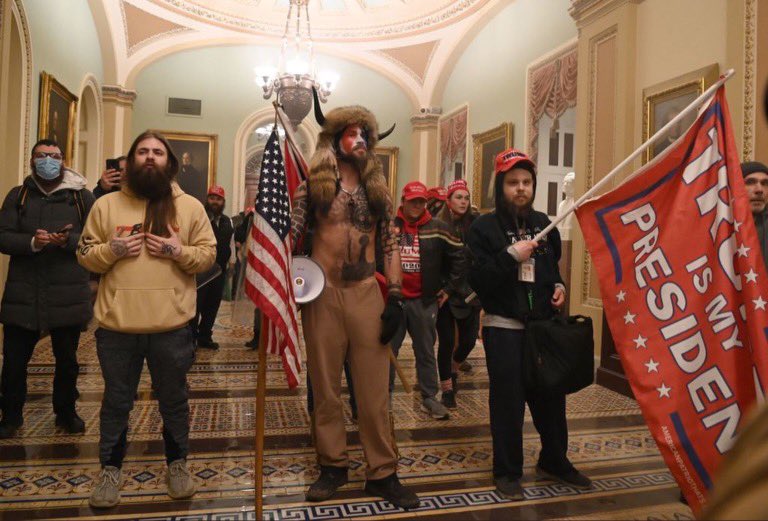
I thought about all of this when I heard that Michigan Militia had recently plotted to kidnap and put Governor Whitmer on trial. I thought about that plot recently as I watched video of a domestic terrorist inside Congressional buildings with his face covered and police-style zip-ties in his hand. I try not to jump to conclusions, but it’s hard to escape the notion that he was looking to make his political enemies into hostages. And if that seems to extreme to think about, one has only to remember that McVeigh’s own efforts to put right wing rhetoric into practice.

It should not surprise us to find that people who speak of the government as their enemy would be willing to carry out violent attacks against that very government.

***

In the past few days I have been told by numerous people that the recent attack on our government was carried out by extremists, that the actual violence was done by Antifa, and that no-one, not even Donald Trump himself has sanctioned their crimes or their violence. Of course it isn’t the first time that right wing violence has been blamed on Antifa, but this is a particularly shameless version of that theme. Anyone who thought this was going to be peaceful would have been naive in the extreme to do so. Anyone who thought Trump wished it to be so was ignoring the extremism of his own rhetoric (and the precedent he set in encouraging people to beat protesters at his rallies back in 2016), Plausible deniability is an art form in right circles, and Trump is one of its greatest practitioners, but the extremist rhetoric used to sell the “wild” protest could hardly be thought innocent. Trump wanted a disruptive presence in Washington on the day his loss would become official. Nothing short of stopping Congress in its tracks would have served his purposes.

Anyone who says that Donald Trump or his supporters are not responsible for these events is a Goddamned liar.

I have also been told that one of the problems here is the degree to which the media, the courts, and the rest of us have been dismissive of concerns about the integrity of the election. This was an insurrection to be sure, but it was an insurrection led, so I am told, by people whose voice and whose votes have been silenced by the powers that be.

And here we have it!

This is the ultimate pay-off for all these years of underdogging right wing politics. An action carried out in the service of the President of the United States, a man born to wealth and sporting a long history of abusing it, will count for so many cultural conservatives as being done out of love for the common citizen. An effort to set aside the legitimate votes of 80 million Americans is, in effect, no more than an effort to protect the rights of the voters. And a mob full of people who literally attacked our nation’s government still counts as patriots! Those whose hatred of American government, of liberal politicians, and even of the newly demonized Vice President, still count as having acted out of love for their country.

Even as they attacked it!

***

I still say; “Damn them all to Hell!

Along with anyone that humors them.

Share this:

  • Tweet
  • Share on Tumblr
  • Click to print (Opens in new window) Print
  • Click to email a link to a friend (Opens in new window) Email
  • Click to share on Reddit (Opens in new window) Reddit
Like Loading...

The Good Lord Baldwin Country, and to Hell With Buckley Anyway!

03 Sunday Jan 2021

Posted by danielwalldammit in History, Justice, Politics

≈ 3 Comments

Tags

Debate, History, Horror, James Baldwin, Lovecraft Country, Racism, Slavery, The Good Lord Bird, White Privilege, William F. Buckley

“Are white South African or Mississippi sharecropper, or Mississippi sheriff, or a Frenchman driven out of Algeria, all have, at bottom, a system of reality which compels them to, for example, in the case of the French exile from Algeria, to offend French reasons from having ruled Algeria. The Mississippi or Alabama sheriff, who really does believe, when he’s facing a Negro boy or girl, that this woman, this man, this child must be insane to attack the system to which he owes his entire identity.”

God damn that James Baldwin!

He was right about far too many things.

He was right about them in 1965, and speaking as he was in 1965, he is just as right about them today, damn it anyhow. It’s enough to make a white guy raised on stories of progress feel all somehow!

I really do hate that!

You can hear Baldwin’s voice in the first episode of Lovecraft Country. An exerpt from a speech he gave at Cambridge Union back in 1965 plays over a couple scenes this in this episode.

This is as brilliant as it is ironic.

This Baldwinization of Lovecraft effectively transforms the literary themes of a known racist into a meditation on the nature of racism in American history. You can see Lovecraft in the monsters. You can see Baldwin in the protagonists.

YEAH SPOILERS!

Lest one miss the connection to Baldwin’s speech in 1965, one has only to think about a few more of his words;

“We talk about integration in America as though it was some great new conundrum. The problem in America is that we’ve been integrated for a very long time. Put me next to any African and you will see what I mean. My grandmother was not a rapist.”

Now just think about the plot-line for the male lead in Lovecraft country, a back man (Atticus Freeman – played by Jonathan Majors) turns out to be an heir of a rich white explorer. Far from being a blessing, this proves to be a terrible curse.

Lovecraft Country, is James Baldwin’s critique of American racism transformed into a horror story. Just how much of a transformation that took is another question. It should come as no surprise to find Jordan Peele listed as one of the show’s producers. It wouldn’t be the first time, he mapped the patterns of racism directly onto a horror story and left some of us more than a little disturbed at how easy and obvious the connection turned out to be. It’s also fitting that Lovecraft, in particular, would be the vehicle for this narrative, not just because of the delicious irony, but because so much of Lovecraftian horror resides in the prospect of insanity. In Lovecraft, this horror is about the encounter with horrors such as C’thulhu, in the consequence of knowing one day a monstrous God will destroy everything and there is nothing we can do about it. In Baldwin, this insanity the consequences of racism. It is about the perception of whites threatened by those challenging racism, and about the impact of racism itself on the minds of white people struggling to rationalize our own privilege. As Baldwin suggests, white privilege leads us to think of those who challenge it as insane, and yet that same same privilege cannot skew the reality of those who benefit from it. Racism, as Baldwin describes it, does merely enable one segment of society to oppress another; it twists the minds of each into a distorted of reality.

“I suggest that what has happened to white Southerners is in some ways, after all, much worse than what has happened to Negroes there because Sheriff Clark in Selma, Alabama, cannot be considered – you know, no one can be dismissed as a total monster. I’m sure he loves his wife, his children. I’m sure, you know, he likes to get drunk. You know, after all, one’s got to assume he is visibly a man like me. But he doesn’t know what drives him to use the club, to menace with the gun and to use the cattle prod. Something awful must have happened to a human being to be able to put a cattle prod against a woman’s breasts, for example. What happens to the woman is ghastly. What happens to the man who does it is in some ways much, much worse.”

You can see the psychological impact of racism all over Lovecraft country. The horrors faced by the central characters in this story are consistently brought to them by white people. For their own part, the world of the white characters in this series appears to be quite insane.

But of course!

How could the white characters in this world not prove insane. They are on the back end of the cattle prod, so to speak, and that, as Baldwin warns us, has its own hazards.

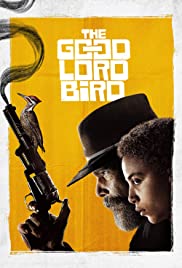
This same theme, the psychological effect of racism, also plays out in yet another contemporary series, The Good Lord Bird. Ostensibly a story about John Brown, the series turns into a meditation on the insanity of slavery, and in particular of its effect on those who benefit from it. There are few well-grounded characters in this story. Most of them are slaves. Even Frederick Douglas comes across as a man spoiled by privilege, one whose sense of reality is distorted by his own fame as an abolitionist, and whose commitments to the abolition of slavery are compromised by that very fame. To say nothing of John Brown himself! As he is portrayed in this series, Brown is an absolute lunatic. We love him, of course, at least in the end, but there is little question about his sanity. He doesn’t have it. No. To find a sensible character in this story, one has to look with the characters held in bondage. The slaves in this story are the only characters with the good sense to look after themselves. The rest are either too busy defending slavery and exploiting it or spiraling into ever more crazy schemes for opposing it. For those held in bondage, slavery in the Good Lord Bird is a force which keeps subjected to it well grounded; it is a force which sends those free of it into ever more bizarre flights of fancy.

The Good Lord Bird follows the story of an adolescent boy, Henry Shackleford (played by Joshua Caleb Johnson). Henry is labeled a girl by John Brown himself and Christened with a new nickname, ‘Onion’. When Brown proves incapable of correction, Henry simply accepts his new identity and thus becomes ‘Onion’ for the rest of the series. Henry knows who he is of course, but this is what it takes to get along in a world driven mad by people high on the privilege of freedom denied to others.

There is something especially interesting about the insanity of Brown and Douglas in the Good Lord Bird. It is as though the series producers believe you would have to be a little crazy to cut so far against the grain of the society in which you live, to seek to act effectively in opposition to slavery, to actually do what it takes to end it. Brown is typically regarded as something of a lunatic or a fanatic in history. (As I recall, this was one of the gripes mentioned by James Loewen in Lies My Teachers Told Me.) But how does one oppose an institution as powerful as slavery without becoming a lunatic or a fanatic. You can mumble, “oh that’s wrong,” or speak of some day overcoming the institution, but systemic oppression is not so fragile as to be threatened by expressions of passive regret. To actually confront the institution is to wage war against so many other things right along with it, even to risk bringing about harm to many people. That would of course include friends, and family, and even those one might seek to help in the end. You’d have to be a little crazy to want to do such a thing. Ethan Hawke is a lot crazy as John Brown in this series, and (for some of us anyway) it is a truly lovable performance.

James Baldwin reminds us that it shouldn’t surprise anyone to see a man confronting slavery treated as a crazy person, not at the time, not the history books, and not now on screen.

Damn that Baldwin!

His ghost is writing scripts for cable television.

But of course Baldwin wrote one other script with his speech back in Cambridge. He wrote the script for his debate opponent. You see, Baldwin was there in Cambridge on that day in 1965 to debate William F. Buckley, Jr. The topic for the debate was the proposition; “The American dream is at the expense of the negro.” Baldwin was to take the affirmative and Buckley was there to oppose it.

Two things are particularly striking about this debate: the absolute brilliance of Baldwin’s own speech, and the utterly pathetic response that Buckley makes to it.

It’s worth noting that two separate publications haunt the debate. (See, I haven’t given up the horror references.)

The first of these writings was an article published in 1957 by William F, Buckley entitled “Why the South Must Prevail.” In this publication, Buckley, argued in defense of segregation, suggesting that white southerners needed to maintain segregated institutions and reserve power to whites until such a time as African-Americans (‘negroes’ in Buckley’s article) would prove worthy of it. Now some have suggested Buckley had changed his mind by 1965, but at least in this debate the difference is little more than a courteous veneer. Buckley was always capable of being courteous (though Gore Vidal might have thought otherwise); he was always capable of putting a polite face on his life-log defense of elitism and privilege. The second of these publications was book Baldwin had published in in 1963, The Fire Next Time, which is said to contain a warning that violence could well be the result of continued injustice. Buckley would have described it as a threat. Buckley’s article is the reason he was invited to debate Baldwin. Baldwin’s book is the key to Buckley’s response.

That and Baldwin’s tip that opposing racism must seem like insanity to those whose identity is tied to it.

It’s worth noting that Baldwin makes a point of personalizing the issue of race in his own speech. He claims that he built the infrastructure of the American south, that he himself is the subject of discrimination and racist policies. In effect he makes of himself an indexical icon (as my old professor would have put it), through which to contemplate all of the implications of racism. This offends Buckley a great (as it often seems to offend many today to hear that racism has a negative impact on persons of color). So, Buckley’s first move is to deny it. He suggests that he is going to treat Baldwin as though he were white, and that he will do so, because Baldwin’s race is irrelevant to the matter at hand. He does this in order to deny Baldwin the protections afforded to him as a public speaker making use of a negro identity.

And thus, Buckley’s own speech begins in a world where in Baldwin’s race is irrelevant to the topic of racism; a world in which being black is a privilege, one to which Baldwin is not actually entitled.

But that’s not insane is it?

(Of course it is.)

It gets worse from there!

Buckley does not defend segregation here, nor racism. Instead he dissembles his way through the topic, describing segregation as a ‘dastardly situation’, mocking the excessive concern about racism in American Universities, and suggesting in the end that it is negroes themselves that have failed to advance themselves as a people. In Buckley’s narrative, Segregation appears to be a ghost in the machine, a presence over which no-one takes responsibility, except as it seems, those oppressed by it. If only those gosh-darned negroes and their rotten liberal friends could just get over the whole thing and get on with their lives! As Buckley would have it, the only reason racism is still with us, is because it lives in the efforts of those actively opposing it. You can hear people saying similar things, today of course. It’s just a little more jarring to see someone saying this in the very era in which buses were burned, bombs, were set off, and children spat upon while going to school, all over the topic of racism. …but wait! Dammit! It’s just as jarring to hear it in the era when cops put a knee to man’s neck in broad daylight and on camera, when the Republican Party actively works to deny African-Americans the right to vote, and when white supremacists openly mix their own flags and symbols with those of mainstream American politics.

Shit!

That Baldwin guy just keeps getting righter and righterer!

It’s almost like he’s had some personal experiences with racism or something.

Dammit!

And what about this segregation anyway!?! Buckley’s vision of segregation is a monster worthy of Lovecraft country, one which somehow appears to the majority of us only in hindsight, but which haunts the lives of those afflicted with it. One must think those who complain of racism terribly insane to be afflicted by a demon that exists only in their own politics! Buckley certainly seems to think so. Those telling us “liberalism is a mental illness” today surely do, but of course the brunt of their criticism falls less on liberals than on those in need of remediation. We get insulted; they get to go on living with the with the demon folks like Buckley and his modern descendants will neither claim as their own nor confront in any meaningful way. Buckley did a lot to set ‘conservative’ politics on this course through his publication, National Review. That his vapid waffling response to racism could be considered intellectualism, as it has for so many calling themselves ‘conservative’ has always been a mystery to me. Buckley, never really had anything to say about anything, but he could sure as Hell take more words to say nothing than most any other public figure in modern history. Most particularly, he had nothing meaningful to say about racism or segregation in response to Baldwin.

Buckley concludes his meandering speech by warning Baldwin and those who sympathize with him of an apocalyptic scenario worthy of modern horror films. If, Buckley suggests, folks such as Baldwin insist that the American dream itself is antithetical to the justice which they seek, then he and others who love their country will be forced to fight over it, “on the beaches,” so to speak. Oddly enough, they would be doing so, even for for the benefit of the negro himself, as Buckley would have us believe.

Thus, Buckley ends his speech by imagining, not how segregation might be ended, but how the call for it threatens everything he loves, and how the defense of segregation under the pretense of basic patriotism is in the end, all for the benefit of those oppressed by it.

As beautiful as Baldwin’s speech was, Buckley’s own efforts are sickening.

What’s worse! This debate hasn’t moved a whole Hell of a lot since 1965. In this Debate, Baldwin struggled not to impress the audience with the notion that racism is wrong, but to get people to give a damn about it, to act meaningfully against it. For his part, Buckley struggles to hide it, and to hide the degree to which racism was always central to the world he defended throughout his life. Buckley has a lot in common with an awful lot of people today.

Small wonder that the script for this debate can still be found on your cable television networks.

***

Those present voted 544 to 164 in favor of Baldwin as the winner of the debate. For his part Buckley, bragged that he “didn’t give them a goddamned inch,” or something to that effect.

People can be proud of the strangest things!

Share this:

  • Tweet
  • Share on Tumblr
  • Click to print (Opens in new window) Print
  • Click to email a link to a friend (Opens in new window) Email
  • Click to share on Reddit (Opens in new window) Reddit
Like Loading...

Negligence as Principle

05 Saturday Dec 2020

Posted by danielwalldammit in Politics

≈ 8 Comments

Tags

Big Government, GOP, Help, Ideology, Joe Biden, Kristi Noem, Libertarianism, Republican Party, Ronald Reagan

“I didn’t leave the Democratic Party, the Democratic Party left me.”

Ronald Reagan

“The nine most terrifying words in the English language are: I’m from the Government, and I’m here to help. “

Also Ronald Reagan

***

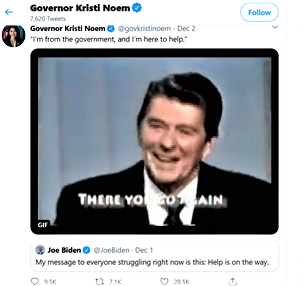
At times, it seems like there is no real difference between the Democratic Party and that of the Republicans. At other times, the difference seems loud and clear. In other moments you can practically see the gap between the two parties widening.. South Dakota Governor, Kristi Noem’s response to Joe Biden up above is one such moment.

Scratch that: It’s two!

First we have Joe Biden suggesting that he will help struggling Americans once he becomes President.

Then we have Kristi Noem reminding us of the old Reagan quote to the effect that the worst thing you can hear is that someone from the government is coming to help you.

By 2 moments when the gap between Republicans and Democrats widens, you might think I mean, first Biden’s comment, then Noem’s, but I don’t. I mean the Reagan quote and then Noem’s use of it. Those two references reveal the ever-deepening cynicism of the Republican Party.

It was Reagan that really embedded the libertarian themes in modern Republican politics. He did so through folksy statements like the one Noem’s quoted above, statements which contributed to a growing sense that government couldn’t be used to solve real-world problems, and a sense that this view was as natural to any real Americans as life itself. Through statements like that one, Reagan took the GOP in a direction which would become ever more hostile to American government. What might have sounded like skepticism at first, the response of those unconvinced in the efficacy of government aid, has become ever more strident, until we have now reached a moment wherein the faithful cannot bring themselves to imagine the possibility of that government could do anything but hurt people.

The trajectory that takes people from this modest skepticism to the fanatical anti-government stance we see in so many today is a simple shift from figurative speech to literal interpretation. One has only to take Reagan’s clever turn of a phrase literally. One has only to mean it, and to mean it literally.

One of the ironic things about Reagan’s anti-government rhetoric? It came from a fan of Franklin Delano Roosevelt, the architect of the New Deal, a President who did more to insert government into American lives than any President in American history. Reagan was fond of saying he wasn’t the one that changed; it was the Democrats, but this is plainly not true. Reagan changed from a man who could celebrate a champion of big government to one who preached against government programs every chance he got.

Statements from Reagan like the one Noem chose to quote above helped to build a new anti-governemnt ideology that now underscores the ideology of modern Republicans. Those seeking government aid are not merely wrong-headed, they are a source of positive evil. You can see this world view in Newt Gingrich’s contract With America, and in the careers of every pundit with a prominent place in the right wing echo chamber. You can also see it in the Oklahoma City Bombing, and in the rhetoric of local ‘militia’s’ all over the United States. More to the point, you can see it in Noem’s glib dismissal of the possibility that a new President could actually help the American people during a time of crisis.

What we see in the modern GOP is a cult which takes Reagan’s maxim quite literally. This is not mere skepticism; it is a pious confrontation with evil itself, or so they imagine. What they see in any effort to use the power of government to help Americans is nothing less than a genuine attack on the American people. The horrors they imagine to follow from government aid are more real to the true believers in the Republican Party than the realities of Covid19 or its economic consequences. The possibilities of government aid seem more terrible to them than the actual deaths of their friends and family. We are thus left with a political party that not only fails to take reasonable steps to combat a pandemic, it actively resists those efforts and even takes steps (such as Trump rallies) to endanger more people.

What does it take to make sense of the Republican Party and its refusal to take responsible measures in combating this life-threatening disease? One needs only to take them at their word.

People like Kristi Noem do not think government can help people.

So they don’t try.

She will not protect her people. To do so would be a heresy against Reagan’s old maxim.

Instead, she lets them die.

Share this:

  • Tweet
  • Share on Tumblr
  • Click to print (Opens in new window) Print
  • Click to email a link to a friend (Opens in new window) Email
  • Click to share on Reddit (Opens in new window) Reddit
Like Loading...

About a Dress!

17 Tuesday Nov 2020

Posted by danielwalldammit in Politics

≈ 9 Comments

Tags

Ben Shapiro, Burlesque, Candace Owens, Cheer Leaders, Fashion, Gender, High School, Masculinity, Vogue Magazine

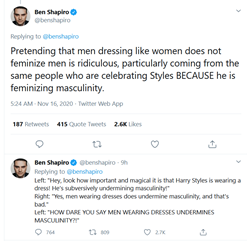
So, Harry Styles put on a dress or three in a piece for Vogue Magazine.

Apparently, it’s the end of the world!

Or at least the manly parts of it.

So says Candace Owens.

It’s cool though, because the internets needed a good laugh.

Enter the cavalry…

It’s all kinda ludicrous.

The reaction, I mean.

And by ‘kinda’ I kinda mean ‘definitely.’

No, definitely. I definitely mean ‘definitely.’

Anyway, I’m gonna ignore the larger battle here, because better social justice warriors than I are on this thing already. I’m just going to comment on one thing that seems to escape a few folks here. It might even escape a few of Harry’s defenders. It definitely escapes Candace and Ben, as most things seem to do. They totally forgot about the jocks from my high school.

Totally!

Once every year, the jocks from my old high school would dress up in cheer-leader outfits and perform a kind of burlesque for the rest of us. It was one of the few assemblies I genuinely enjoyed. Hell, it was one of the few things that actually got me out to one of those assemblies to begin with. Dog knows, I hated assemblies!

Still do, actually.

I don’t remember much detail. I can’t remember if it was a cheer or a dance that they did, or if it was a little of each. One thing I am sure of is that these guys were not exploring their feminine side.

Far from it!

The point of these bro-leader performances was clearly to underscore the masculinity of the young male athletes doing them by juxtaposing their ostensibly feminine performance with all the manliness they could muster. The cheer-leader outfits didn’t belong on them. The dance moves were not meant for them. Everything about their approach was meant to enhance this impression. Far from breaking down gender-roles, these performances were meant to re-affirm those very roles, to show us once and for all that men were men, even if you put them in a cheerleader outfit. What made the show so funny was precisely the incongruity of the whole thing. These young men were not cheer-leaders. They were not girls, and they would not become women. They would soon become men.

…manly men.

That was point was driven home with every botched move they made.

No exceptions.

Don’t get me wrong. I laughed. Not at them; with them. At 15 I was down for this message. For all my contrarian thoughts at the time, this perfectly conventional message resonated for me; men were men and women were women, and Hell, this time, we could even laugh at the whole thing. I didn’t get the politics of the performance at the time. I doubt they did either. It was just funny.

Anyway, I think about this whenever somebody seems to assume the only reason a man would put on a dress is to muddy the waters between manliness and femininity. Sometimes, men put on a dress to become a woman, yes, and sometimes they do it (as these young Bro-leaders did) to affirm the difference between men and women. Frankly, I don’t think Harry Styles fits into either of these profiles.

The Vogue article in question speaks a lot of fashion and of Harry’s eagerness to play around with the possibilities of dressing up. No great agenda there, and you certainly don’t see Harry minxing it up in the photos. He’s in a dress, yes, but neither his pose nor his overall demeanor suggests any serious effort to feminize himself. The dresses do seem a little incongruous on his body. He isn’t exaggerating that effect, but it is certainly there. Seems to me that Harry has his own reasons for donning a dress, and those reasons may not have much to do with the culture wars some people are trying to fight over this.

It is at least possible that Styles was counting on some folks to bite at the bait of seeing a man in a dress and generate controversy. Of course it is also possible that some of those folks who bit at the story of Harry in a dress may have been counting on the rest of us to get mad at them and add fuel to that same controversy.

…oops!

Ah well! The whole thing makes for quite a sordid story.

Might lead to dancing.

Share this:

  • Tweet
  • Share on Tumblr
  • Click to print (Opens in new window) Print
  • Click to email a link to a friend (Opens in new window) Email
  • Click to share on Reddit (Opens in new window) Reddit
Like Loading...

Biases All the Way Down, Yes, but Some Biases are More Troublesome Than Others

15 Sunday Nov 2020

Posted by danielwalldammit in Philosophy, Politics

≈ 13 Comments

Tags

Bias, Education, epistemology, Judgement, Knowledge, Objectivity, Polemics, prejudice, Subjectivity

Bending to the Left?

When I listen to people complaining about indoctrination in the schools or dismissing perfectly sound journalism by chanting the mantra “fake news,” I’m always struck by the hopeless of trying to reason with them. These phrases do not usually convey skepticism; they do not challenge us to provide evidence or compelling reason. Instead, they signal an absolute barrier to any hope of meaningful communication. These phrases did not become popular in the American political vocabulary because they help to explain the problem with erroneous or dishonest journalism, nor have these phrases been generallyused to correct flawed textbooks or abusive teachers. As they are commonly used in America today, these phrases consistently provide thoughtless people with a shield against unwelcome information.

As I listen to such folks talk, or read anything they write, I can’t help thinking those who find nothing but bias in academia or mainstream news are often the same folks who speak of objectivity in terms of the most naive realism. Phrases like “just the facts” spill from their mouths, their keyboards, and their keypads quite often, and not a few of them are happy to remind us that facts do not care about our feelings. Facticity is part of their cultural capital, they own it (so they seem to think), and so they invoke it freely in encounters with others. Ask these people what it means to do a good job as a teacher or a journalist, a documentary film-maker, etc. and they will describe an absolute devotion to facts coupled with a complete absence of subjectivity. They have few thoughts as to how that works, but the goal seems pretty obvious to them.

If pressed, some might concede that such an account of any given subject never really happens, but they are likely to insist that it should be an ideal of sorts, a goal to which one ought to aspire. They don’t understand that the idela itself isn’t even coherent. You cannot describe a fact without injecting yourself into the description. Even the facts you choose to relate reflect a choice and a value statement about what is and what is not important in a story. So, does the language you use to describe those facts, and of course the conclusions you draw from whatever you take to be the settled facts of a story also reflect all sorts of choices about what lessons might be worth learning from the world around us. We never actually get a purely factual account of anything; we can’t even conceive of it in the abstract, because the most rigorous visions of evidence-based reasoning are themselves saturated with value judgements and personal biases.

If objectivity is meaningful at all, it is as a element in relation to subjectivity, (or perhaps inter-subjectivity), not as a pair of alternatives from which we choose. We can speak of an object only in relation to a subject. To imagine the one without the other is to indulge in fiction.

To those who suppose this fictional objectivity is reality, I suppose it is the rhetorical equivalent to reality television, a pretense to veracity offered with a smirk and wink even as any claims to meet that standard unravels unravels around us.

This naive realism goes hand in hand with a pan-partisanship in the consumption of information. As nobody ever actually meets these impossible standards of objectivity, it provides a ready excuse to dismiss any information one doesn’t wish to hear. You can always pick apart the choices other people make when they try to state facts. You can quibble over the language they use to express themselves or ask why they think this fact here is important and not that one there? Nobody meets the standard in actual practice, so each and every source of information comes ready-made with all manner of excuses for rejecting it. One has only to make exceptions for those one wishes to keep after all. If those exceptions seem selective, well then, by what standard would anyone presume to make such a judgement?

***

All of this leaves us with is a sense of bias which provides license for more of the same, and a way of talking about bias that reduces everyone and every approach to information to the level of open partisanship and nothing but partisanship. All biases are equal in this mindset, because those adopting it do not really think about how one sorts a reasonable account of any given subject from a foolish one. They needn’t accept the authority (or the credibility) of a judge, or a scholar, or a journalist, because they can find evidence of a personal point of view in each.

…if they want to.

This flattening of critical merit makes every controversy into a sort of intellectual playground, a range of possibilities all of which possess equal intellectual merit. It puts every couch-potato responding to a 3-minute news segment on Covid19 right on par with a scientist who has studied infectious diseases throughout her career. It empowers the Dunning-Krueger effect, in effect, by denying that there is any meaningful difference in knowledge to begin with.

***

I keep coming back to this, not because the problem is conceptually interesting, but because I find myself talking to so many people who seem to live in this mindset. They know what sources they like, and they know which sources they cannot be bothered with, but their own explanations boil down to a kind of unacknowledged voluntarism. Intellectual rigor of any kind simply does not enter into this mindset, because every actual stance is, for them rooted in pure personal bias. A professional historian writing about World War II might as well be their friend Frank who told them about a thing he saw once in a movie. A journalist summarizing countless hours of research enjoys no more credibility than the first thought that jumps into their own head upon hearing the story. A medical doctor talking about a global pandemic is easily trumped by a blog post detailing an elaborate conspiracy theory. These same people are happy to sing the praises of objectivity, and in particular to use high standards as a foil against their enemies, but in practice, their mental life is a playground of choices made on thin pretexts. That is all they hear from others; it is all they produce themselves.

I find myself struggling to produce a simple account of objectivity and bias, one which affirms neither this naive realism nor this practical pan-partisanship.

***

If I am thinking about bias in the presentation of information, and I am, I usually want to make a distinction between 3 broadly different approaches, objective, polemic, and deceptive. This distinction isn’t metaphysical. It’s a question of intent.

When I refer to an account as objective, I do not mean to suggest that its author has achieved some miraculous account devoid of any personal bias. What I mean in such cases, is that the author has made an effort to express the relevant facts of the story, and perhaps to provide an account of the different positions others have taken on the subject. I will still have questions about the author’s specific choices, the accuracy of their descriptions, and if I know something about the subject, I am likely to sense bias creeping into their narratives. When I call it ‘objective’, it is because I can still see some objective information creeping through the haze of personal bias, and because I perceive the author’s goal as being rooted in the objective features of the story. Whatever their personal views, there is something about the facts of the matter that has their interest. If they are doing their job right, it will have mine as well.

If I am ever tempted to dismiss the prospect of an objective account as a result of the many subjectivities that always seem to accompany them, I have only to consider some of the alternatives. There is a world of difference between someone who is trying to tell a story based on the facts as they understand them, and someone for whom a story is solely an instrument of their own personal agenda. While bias might count as failure in the former case, in the latter, that bias is precisely the point.

If ever we forget the merits of an objective account, their absence is certainly noticed whenever we encounter polemic work. An author or speaker whose primary goal is the advancement of a partisan view tells a very different story than one who is trying to give us an objective account. The facts they elect to provide are not merely shaded by personal bias, they are explicitly chosen on that basis. One literally doesn’t get any information that doesn’t help the polemicist build his case. His language too is chosen for the purpose of expressing a clear stance on the subject in question. We don’t expect of such writers that they will spend a lot of time on things that don’t facilitate their own argument. To so so would be setting ourselves up for disappointment.

What do I mean? Let’s take for example the dropping of the atomic bomb on Japan at the end of WWII. I have plenty of textbooks that provide a basic (if horribly brief) account of this event. One of the major controversies of this story is the question of whether or not doing so was necessary and/or justified in any sense by the circumstances facing the allies near the end of that war. Any author trying to tell me that story will normally provide some account of the reasons for dropping the bomb, and in doing so, they are likely to show some sense of their own take on that controversial subject They will cover the facts most relevant to their position on the subject, and they will likely describe them in language that suggests some degree of their own sense as to whether or not the decision was sound. Some authors try to address the controversy by providing an account of the controversy itself, telling us what different people have said about the question over the years. In such cases, it would not be unreasonable to expect they will do a better job of accounting for those positions they agree with than the ones they do not agree with.

…all of which is very different from reading a text in which an author takes a stand on that very question. You can find such readings. You can find people who will tell you the decision was absolutely appropriate, and they will make the case as to why. Others will describe it as an atrocity, and they too will provide an argument as to why that is the case. In neither of these instances would one expect the polemicist to spend a great deal of time covering facts which don’t help their case. If they do, it will only be to show how their position deals with these facts after all, and so their account of these seemingly neutral features of the story will of course be largely an exercise in stretching a specific viewpoint to cover the facts in question. None of this is a terrible thing. There is a place for polemics in human communication. My point is simply that a polemic is very different from an attempt at an objective account. If bias is a bug in the former; it is a feature of the latter, a genuine benefit. If polemic writing is well done, it leaves us with a clear vision of the viewpoint expressed within it. It is a good thing, but it is a different kind of thing than we get from those trying to write a more through and objective account.

Whatever the goals of a writer or a speaker, whether it be polemic or objective, we can also distinguish between those who show a certain respect for truth and reason and those who are consciously deceptive about such matters. Even the most strident of polemicists is perfectly capable of telling the truth as she understands it and using reasoning that is at least plausible rather than fallacious. On the other hand, some people are just bad actors. Not only do they make a conscious choice to advance a single point of view; they are willing to deceive to us in the service of that point of view. Their account of the facts will contain not mere errors but conscious lies, and their reasoning will include deliberate cases of misdirection. Such people are not merely influenced by personal values and personal agendas; they operate free of any moral or intellectual restraint. Lest we forget that objectivity matters, or give up on it altogether, an encounter with such a deceitful soul ought to remind us that facts matter after all, and so does sound reasoning.

***

As I finish this, I am struck by my own feelings of discomfort over the way I am talking about ‘objectivity.’ I really do not mean to advocate some naive objective metaphysics, but I am sure some folks will say the way I have tried to qualify my use of the term here is inadequate, but this post isn’t really meant to outline an epistemological theory. It is mean to describe some differences in communicative practice. The need to do so is motivated less by abstract philosophical questions than a general sense that it is becoming increasingly difficult to maintain any standards of honesty or intellectual rigor in public discourse. The problem isn’t just that some people cannot tell the difference between sound journalism and internet gossip; it is that such people increasingly dominate our public discourse and they are increasingly able to obscure such distinctions for purposes of public policy. Much of their ability to do so lies in their ability to find personal or political bias in even the most professional of publications (whether scholarly or journalistic). My own point here is not to suggest that some people are above personal bias; it is call attention to the different ways in which bias enters into the work of public media.

For some people bias is a problem they can never really seem to escape.

For others, bias is precisely the point.

For some, it is the only point.

Share this:

  • Tweet
  • Share on Tumblr
  • Click to print (Opens in new window) Print
  • Click to email a link to a friend (Opens in new window) Email
  • Click to share on Reddit (Opens in new window) Reddit
Like Loading...

Just How Much Fallacy is Your To Quoque?

07 Saturday Nov 2020

Posted by danielwalldammit in Philosophy, Politics

≈ 9 Comments

Tags

Ad Hominem, Context, Critical Thinking, Donald Trump, Elections, False Alternatives, Logic, Rhetoric, Tu Quoque

Judging you!!!

We all learned that two wrongs don’t make a right when we were kids, didn’t we?

And we learned that ‘you too’ arguments are a fallacy back in Freshman logic class, right?

Right?

Okay, maybe not everybody, but this is a lesson a lot of us probably have in common. Most educated people ought to know that there is something wrong with answering a criticism by saying “you do it too!” or some variation thereof. Hell, most decent people ought to know better than that regardless of their education.

So, why do we do it?

Hell, almost everybody does it on at least some occasions. To be fair, some people do it more than others. They will do it every chance they get. Others try not to, most of the time anyway. So, the penchant for answering a serious concern with a quick ‘you-too’ gambit varies from one person to another, but I don’t know that anyone avoids it entirely.

This tactic also comes and goes with the times. It’s been particularly common for the last 4 years, so much so that folks even coined a new term for it; ‘whataboutism.’ The “Your side does it too” gambit has made a regular appearance in public debate for a long time, but it’s been particularly common for the space of about one presidential administration (or an administration plus the campaign before it). So, the internet collectively coined a new term to describe it.

Okay, but why is this kind of argument so common?

One reason? It’s not always a fallacy.

Another? For some people, it really is a way of life.

Variable Relevance: The (ir-)relevance of ‘you too’ games varies in a couple of interesting ways.

If someone corrects my behavior and I respond with “you do it too?” am I really engaging in a fallacy?

Variable Conclusions: If I mean by that you-too response that I am not really wrong, because you do it too, then yes. Hell yes! If that’s what I mean, then I am absolutely engaging in the tu quoque fallacy. If, on the other hand, I mean; “Okay, I need to correct my behavior, but so should you, because you do in fact do this too,” then my response is not entirely unreasonable. I’m not denying my wrong-doing in this instance. I am just asking you to correct your own behavior right along with me.

Alternatively, I could employ a ‘you-too’ argument by of refusing to accept a rule that I have good reason to believe others are not going to follow themselves. Let’s imagine we are playing a game of soccer and you tell me I should stop touching the ball with my hands. I could then say you do it too as a means of insisting either that you stop yourself or that we are just going to continue playing an odd game of soccer in which both of us are allowed to touch the ball with our hands. In this case, I am refusing to play by unfair rules, or unfair application of those rules.

It seems that there are at least some conclusions which could be reasonably drawn from a premise beginning with an assertion that is essentially saying “you do it too.”

Plus Alternatives: There is another context in which “you too” starts to become more relevant than it would otherwise be. In this case, the tu-quoque fallacy has some company, because the False Alternatives fallacy comes in here right along with it. This is the context of constrained choices. If I tell you that apples bother my teeth, so I don’t like eating them, it would normally be quite foolish to respond by telling me that cookies have too much sugar. Whether or not cookies have too much sugar, apples still bother my teeth (always feels like I am biting into styrofoam). That does not change if cookies are bad for me. So, the cookie-themed response seems quite irrelevant.

…unless I want a snack, and I have exactly 2 options!

If my universe of possible choices includes an apple and a cookie, then problems with one might very well be a reasonable answer to my expressed concerns about the other. Someone hears me complaining about the apple, realizes I have offered it as a reason for choosing the cookie instead, and responds by reminding me of a good reason to avoid the cookie

Of course apples and cookies don’t make these arguments themselves, so if this is a concern about false alternatives, how does it relate to the tu-quoque fallacy? Well, it comes into play when the apples and cookies do make these arguments themselves, or at least when we divide ourselves up into an obviously apple camp and a clearly cookie camp.

Or maybe when we try to pick a President.

If I say that Donald Trump has been self-dealing throughout his Presidency as a means of saying he is a terrible President, it wouldn’t normally help matters to say that Hillary does it too (using the Uranium One story about her charity foundation for example). Neither would it help to raise the prospect of similar corruption on the part of the Biden family. These become relevant during elections precisely because the obvious alternative choice is understood, and so the range of viable possibilities is narrowed sufficiently to make these normally irrelevant arguments matter after all.

And here, 3rd party-proponents will have an obvious complaint of their own. What if there are better choices? What if you can point to a candidate that doesn’t have a history of self-dealing (or, more to the point, a history of having the charge of self-dealing leveled at them by political opponents)? That’s a reasonable concern and one that speaks directly to the very kind of problem that logicians are trying to call our attention to when speaking about ‘false alternatives’ and ‘tu-quoque’ fallacies. Of course, part of the concern here lies in just how viable the third parties really are and what you are trying to accomplish with your vote, both of which speak to the question of just how constrained the alternatives here really are. If a 3rd party might really win, then it would be quite illogical to respond to a criticism of one major party candidate as though it were an obvious endorsement of another. Conversely, you may know that the 3rd party is going to lose but choose to vote for them anyway as a means of signaling to the major parties that your support cannot be taken for granted. If enough others vote the same way, this could become leverage in the next election. If a 3rd party candidate is, however, not a serious contender for winning an election, and the election is just too important to risk on a symbolic statement, then we may be back in the realm of 2 real choices and dirt on one viable candidate really will have to be weighed against dirt on the other. In such cases, “your guy does it too” and “the alternative is worse” start to become relevant again.

Where your choices are constrained, criticisms of one choice can provide a meaningful response to criticisms of another, but this is still problematic. Such arguments don’t erase problems, and they don’t disprove initial claims. If you tell me, for example, that Hunter Biden was using his father’s position as Vice President under the Obama administration to make money, reminding you that the Trump family profits from his role as President (e.g. through fees paid by the Secret Service to Trump properties during his visits, use of political leverage to get Ivanka’s patents in China, or simply the profits made when foreign diplomats choose to stay at Trump properties while negotiating with him) will not prove the claims about Hunter Biden are untrue. If I want to do that, then I have to provide an argument directly debunking the claims about Hunter Biden activities. What do I get out of calling attention to similar shenanigans about Trump? I get an argument about the significance of one relative to the other. I get an argument about how each balances against the other when we assume both criticisms are of roughly equal merit. That may not be the best argument I could produce on the topic, but it would not be fallacious. It’s in this context that ‘you too’ (or at least ‘your guy too’) arguments start to make a little more sense.

One fascinating thing about this is the way that the relevance of such arguments comes and goes. I understood claims about Uranium One, debunked as they are, as a concern in the 2016 election. It was fascinating to me, however, seeing Trump fans continue bringing this up in response to criticism of his actions well into the Trump administration. I found myself saying; “well let’s impeach her too” then, by which I hoped to suggest that this was no longer a relevant means of answering concerns about Trump’s own actions. As the 2020 election heated up, concerns about Biden became a more viable means of offsetting those about Trump (at least to those who care nothing about proportion or credibility of the sources). In terms of addressing the choice at hand, it was useful for the Trump camp to have a claim about political corruption in play precisely because they knew many such claims could be held against Donald. The merits of each of these accusations are of course a debatable question, but it is certainly useful to have comparable accusations on the table.

When we were all expected to weigh Donald Trump’s character against that of another person, complaints about that other person could pass a certain test of minimal relevance to complaints about him. So, the relevance comparison to other people to criticisms of Donald Trump came and went over the course of his Presidential administration. When he was operating on his own, and the only viable question was about his own competence and integrity, they should have gone away.

Of course they didn’t.

Constraining Personalities: This brings us to one last point; some people thrive on the sort of constrained choices I am describing here. When they face an open range of possibilities, they work very hard to create the illusion of constrained choices anyway.

Yes, I have Donald Trump in mind here.

I am also writing about his many fans.

There is a reason the Trump camp was such a source of whataboutism claims throughout his Presidency. This is both a feature of the base to which he consciously pitched his politics and to personality of Donald Trump himself.

Audience: There are people who live in a world of artificially constrained choices, and you can see it their responses to a broad range if issues. Did you say Fox news got something wrong? Well then you must be watching too much MSNBC. If there is a problem with capitalism, well then why don’t you just go try China? Don’t like Christianity? You must be an atheist! Is the American healthcare system broken? Well then, let me tell you the horror stories coming out of Canada! Concerned about police brutality? You must support riots in the streets! Don’t like coke? Shut up and drink your Beer!

And so on…

(Okay, I might not be that be that serious about the coke and beer example.)

Perhaps all of us fall into this way of thinking from time to time, but some people really do seem to think in such terms on a regular basis. They live in a world of social Manichaeism, a world in which 2 rival forces contend with one another for control of the world and of our loyalties. Anything said against one can clearly be understood as support for the other, because all questions of value must be measured according to the standard of which force one wishes to align oneself with. Other options are always illusory. You are with the lord of light or you are with the lord of darkness, and if you don’t declare your loyalties openly, then that is a good reason to suspect you are on the wrong side of this conflict. In effect, such people keep making use of the false-alternatives fallacy because they actually do live in a world in which their choices are always constrained. Their assumptions about the world around them and the choices available to all of us consistently reduce all choices to a binary opposition.

Always!

Brief Technicality: I should add that the not all binary opposition are equal. What typically happens here is that people looking at contrary relationships often construe them as contradictory relationships? What is the difference? In a Contradictory relationship between two claims, they two have opposite truth values. If one is true, the other is false. If one is false, the other is true. In a contrary relationship between two claims, on the other hand, one of them must be false, but it is at least possible that both will be false.

In the case of either a contrary relationship or a contradictory relationship, you could infer the falsehood of one claim from the truth of the other, but you could only infer the truth of one claim from the falsehood of the other in the case of a contradictory relationship, not in the case of a contrary relationship.

Case in point: If I know that John is voting for Biden, I can conclude he is clearly not voting for Trump (unless he wants his ballot to be thrown out). If, on the other hand, I know he is not voting for Biden, I could not normally conclude that he is voting for Trump. He might be voting for a third party after all (and whether or not that is a good idea brings up all the points made above). So, political loyalties are not usually well modeled on the basis of a contradictory relationship. Such loyalties are contrary at best even if specific choices made on the basis of those loyalties (e.g. voting) might be framed in terms of contradictory relationships.

Another example? If you like capitalism, it’s probably safe to assume you are not in favor of communism, but could we really infer from a criticism of capitalism that you were a communist? No. You could be in favor of some alternative political economy. Old fashioned trade guilds, perhaps coupled with mercantilism, subsistence economics (as practiced in many indigenous communities), or good old Georgism (which may or may not be a form of socialism, depending on who you ask), all come to mind. (So, does rejecting the terms ‘capitalism’ or ‘communism’ outright as being to vague and sweeping.). Inferring support for one of these highly loaded terms from opposition to the other is hardly reasonable, and yet, people do it all the time.

People who should know better.

But people often treat contrary relationships as though they were contradictory, thus enabling a faulty implicature, the inference of a specific loyalty from criticism of an alternative commonly understood to be its opposite. This empowers both false alternatives and tu-quoque arguments. For some people this approach to decision making is just too gratifying to resist.

We sometimes encounter simple ‘yes’ or ‘no’ questions, and hence make choices between contradictory values, but much of our thinking takes place in a world with a broader range of possibilities. Those locked into the mindset of Social manichaeism are constantly pushing us to think in narrower terms to begin with. If all of us are prone to miss the possibilities from time to time, then some people seem to take this as a point of principle.

Personality: Enter a living train-wreck such as Donald Trump! He thrives on constrained choices precisely because his own actions and his own statements cannot stand up to scrutiny on their own merits. Whatever the man may have been like when he was younger, he has long since accumulated a range of of bad deals, unpaid debts, and obvious lies in a personal history of chronically abusive behavior. His own credibility would never stand up to scrutiny, not from anyone making an honest effort.

So, how does he manage?

He always brings with him a broad range of bluffs and diversions, and one of the most important is a constant penchant for attacking someone in virtually any context, and for doing it in the most humiliating way possible. Every claim he might make, every question one might ask, is then subsumed under the effect of this personal attack. For those under attack, this means trying to balance the need to defend yourself against the effort to address any objective issues that may be on the table. For bystanders, it is a question of balancing concerns over Trump’s behavior against those he raises about others. In the ensuing hostilities, trump can raise and drop any issues he wishes, make false claims, and set them aside at his liesure. If he is caught flat footed, the solution is as simple as insulting the person who pointed it out or any source they may rely upon. The end-result is a choice between him or someone else, and any doubts about that other person whatsoever will be enough for Donald. He has spent his lifetime exploiting the benefit of the doubt. It is a benefit does not share with others.

The logic of the whataboutism gambit suits Trump’s style perfectly.

Is Trump University credible? What about Hillary!?!

Did Donald tell a lie? Ask Obama if you can keep your insurance!?!

Is he mistreating immigrants? What are the Dems doing to protect us!?! (…and after 2016, ask Obama, because he did it first?)

Is the Trump family self-dealing through their position in government? Where is Hunter!?!

You get the idea.

This is a man in deep need of enemies. The closest he will ever get to redemption lies in the hope that those around him will think him better than the alternative. Small wonder that he preferred to keep Hillary on the table as a kind of shadow President, a mythic character he could use as a whipping woman even in the 2020 election. At the peak of his Presidency, when she should have been off the table entirely, she was still the answer to concerns about Trump, replaced only when Biden stepped in to become Trump’s new foil, and only partially so at that. Trump has always needed a constrained choice to make a case for himself, because he is of no value on his own.

To know the worth of Donald Trump, one has always to ask what about someone else.

A man like that is made for the sort of strife we have seen this week, and throughout his Presidency. He is at his peak when the whole world has to think in terms of the constrained choices he seeks to bring about in all times and all places. For most of us these moments come and go. For the likes of Donald Trump, such moments are the only ones that count.

***

Is Donald Trump the only person like this? Not by a long shot, but he is my exhibit ‘A’, and as he is still in a position to do us all harm, he seems to be a relevant example. It was the dramatic nature of our recent elections that got me thinking about the way that certain arguments seem more compelling at some times than other.

I could just as easily have written an epitaph for nuance.

Perhaps that would have been more to the point.

Let us hope that subtlety finds room to breathe in all our minds sometime soon! It is one thing to say ‘no’ with conviction when that is what is called for, and it is quite another to live in a world that is polemics all the way down.

In the end, the point here is that there seem to be some folks who really thrive on the ability to reduce the world to a pair of choices under the assumption that to affirm one is to deny the other. Elections may be a special time to such folks, a moment in which certain patterns of thought seem a little less flawed and a moment in which the rest of the world may just be happy to join in that same pattern of thinking.

We probably all engage in similar patterns of thought in many other contexts, sports rivalries and all manner of brand loyalties come to mind. For my own part, I hope soon to set some of this aside and think about other things. I can’t quite say that i am ready yet.

I can’t quite say that the rest of America is either.

Hopefully soon!

Share this:

  • Tweet
  • Share on Tumblr
  • Click to print (Opens in new window) Print
  • Click to email a link to a friend (Opens in new window) Email
  • Click to share on Reddit (Opens in new window) Reddit
Like Loading...

The Politics of Personification

04 Wednesday Nov 2020

Posted by danielwalldammit in Politics

≈ 11 Comments

Tags

Elections, Electoral College, Metaphor, Personification, Stories, Trump, USA, Votes, Voting

As I watch the election coverage tonight, and I wonder how a President who has compromised our national security, broken countless laws, enriched himself at the public expense, and willfully allowed an infectious disease to kill thousands of Americans is still in the running, or even on the ticket at this point, I am thinking more and more about the way Americans think about the electoral college.

What first got me thinking about this?

It was the election maps deplorables began circulating after 2016, maps showing how much of America voted in favor of Donald Trump. Comparing the vast swaths of red turf against the lonely spots of blue on these maps, it was easy to think of Trump’s victory as fitting. How could the rest of us doubt his legitimacy if so much of America voted for him? This wasn’t even close.

Clearly, the vast majority of America wanted Trump as President!

Of course these maps show us territories, not people, a fact easily demonstrated by accounting for population using a 3D projection.

Once you do that, the story quickly changes!

If you are counting territory on a map, Trump’s win back in 2016 looks impressive as Hell. It’s a decisive victory. In fact, it’s a grand slam! How could any Democrat even show their face in public after such a one-sided slaughter?

Once you account for actual people, however, it’s easier to remember that Donald Trump didn’t even win the popular vote. He won the electoral college, but the majority of Americans who weighed in on the 2016 election actually chose the other candidate.

If the will of the American people had determined the 2016 election, Hillary Clinton would have been president these last 4 years.

The discrepancy between the popular vote and the actual outcome of the 2016 election kicked off a new round of discussion about the electoral college. Democrats had a new reason to oppose it. Republicans had a new reason to defend it. This of course means some of us were treated to a whole new round of sophomoric semantics over the difference between a republic and a democracy.

Which brings me to a fascinating argument in favor of the electoral college. You see this a lot from the right wing, the notion that without the electoral college, a few states would dominate our national politic. According to some of these folks, L.A. County alone would have more impact than many states. New York City would have more impact than quite a few states. The Electoral College is, according to this narrative, the only thing preventing ‘coastal elites’ from dictating every major political decision at the expense of the more rural states.

It’s a fascinating narrative, one with clear villains and clear victims. The story elicits a genuine fear for the states that would be oppressed under such conditions.

What’s particularly fascinating about this narrative is that its characters are geographical units. They are stretches of land. Without the electoral college, it is the Dakotas that will suffer, Montana, Wyoming, or even my own state of Alaska. Actual people appear in this story, only as the loosely implied victims of oppression by virtue of being within the rural states of our nation. The implication that anything is wrong only emerges so long as you remain focused on geography, forgetting how the electoral college actually skews the significance of individual voters to begin with.

As a citizen of Alaska, my vote counts more than that of the Californians in my family. Hell, it even counts more than those of the Texans! It is the electoral college which makes this possible, because it boosts the impact of smaller states, giving us more representation per person than than states with larger populations. This means each individual voter gets more impact out of a vote cast in a rural state than she does in a vote cast somewhere like New York. Without the electoral college, our votes could be given equal value, and if certain states have less impact in such a system, it would only be because our individual votes are actually given equal value. The present system gives some people more of a say over who becomes President than others. Equalizing our the votes of individual citizens effectively skews the significance of regions, even as it puts us on a level playing field with each other. So, the narrative which has us crying about mistreatment of rural sates has the ironic effect of making equality look like its opposite, and that only works if we mistake states for people.

So, what does this mean? It means the prospect of keeping or rejecting the electoral college poses a decision over which matters more?

Geography?

Or people?

Share this:

  • Tweet
  • Share on Tumblr
  • Click to print (Opens in new window) Print
  • Click to email a link to a friend (Opens in new window) Email
  • Click to share on Reddit (Opens in new window) Reddit
Like Loading...

A Certain Value of ‘Greatness’

25 Sunday Oct 2020

Posted by danielwalldammit in History, Native American Themes, Politics

≈ 17 Comments

Tags

America, Crime, Donald Trump, Gender, Indian Wars, Labor, Slavery, Trump, USA

When exactly do you suppose America was great according to Donald Trump?

When do you suppose it was great in the minds of his supporters?

America is not great now, at least not in the minds of Donald Trump, and it certainly wasn’t great when he ran for office. That much is clear from the very nature of his old campaign slogan. “Make America great AGAIN,” certainly means it’s not great in the present age, at least not when he decided to run.

Perhaps Trump and his supporters might think to claim the economic stats he used to parade as success stories in the first 3 years of his administration made the difference and pulled us all the way from something else to greatness. How those economic trends differed from those under Obama is a different question, and whether or not Trump did anything but coast his way to a good look on paper is another. Either way, I could imagine he and his supporters might see in that enough cause to claim putting his label on the nation had made us all great again, but that would be a thin pretext indeed. Regardless, the moment in which this pretext could be claimed is long since gone at this point, and we are back to the same other-than-great world Trump seemed to see in America back in 2016.

***

So, when was America great in the minds of Trump and his supporters?

Could it be when Thomas Jefferson said that “all men are created equal?

Or when Martin Luther King challenged us all to live up to that very principle?

Some folks might say ‘both,’ and maybe so, but that is the answer to a different question. I didn’t ask which message you approve or admire? I asked when do you think America was great in the minds of Donald Trump and his supporters?

Maybe the former, but only if we discount the latter. They might well love the promise of equality and freedom, but only so long as that promise remained unfulfilled for a great many Americans. To the deplorables, the gap between American ideals and our political realities is an essential feature of our greatness. The greatness they seek is always gained at the expense of others.

***

I really don’t see how there could be any doubt in the matter. This man is a bully, and he has a bully’s sense of the world around him. His heroes are bullies. His villains are those that stand in their way. The vast majority of mankind are but cannon fodder by which his heroes distinguish themselves. They are the human sacrifices by which true greatness distinguishes itself from the mere men and women of ordinary humanity. Greatness in the world of Trump is a boot ground into the neck of someone unable to do anything about it.

(Or a knee.)

When was American great according yo Donald Trump and those who support him?

***

When slaves were sold on the market in Charleston, South Carolina, and when the profits from slavery flowed into all of the United States, North and South alike. This was greatness in Donald Trump’s world.

When Confederate Statues went up all across the south, reminding African-American that those who held slaves in bondage were the real heroes of their time, that was greatness in the world of Donald Trump. The suffering of African-Americans in slavery, and in segregation was (and is) a small price to pay for the greatness made possible by the profits of slavery.

…and the second class citizenship which was to follow.

There are those who would return African-Americans to that very second class status in the most explicit terms possible. Trump is a hero to these people. He would deny it of course, but countless White Supremacists have organized in the wake of his rise to power, encouraged by a dog-whistle here, a slow condemnation there, and of course the occasional glaring statement of racist sentiments by Trump or those in his inner circles.

There were those who thought the existence of a plebeian class in America was critical to republic, the price of greatness for those free enough to enjoy it. Clearly, a number of Americans see in Trump’s rise to power the chance to reconstitute that servile class of Americans who don’t quite enjoy their full rights.

For those who share this vision, every confederate statue is a memorial, not just to history, but to a natural aristocracy. Most, I expect imagine themselves the righteous heirs to that aristocracy, denied their proper station by the corruption of liberals and various minorities who are but pawns duped by the white liberal agenda.

It’s a message driven home every time right wingers tell us about the evils of the “Democratic plantation,” or tell us, as Phil Robertson once did, that African-Americans were happier in the days of Jim Crow than they are now living in the shadow of this very ‘plantation.’

For a good portion of Trump’s base, greatness lies in hierarchy, but only when it’s the right kind of hierarchy. In their world, we are all a little happier with slavery or something as close as they can get to it. Equality just means people end up in the wrong places within that hierarchy. For America to be great, each must be in his or her proper place.

***

Lest anyone forget this greatness, the greatness of slavery, it is celebrated in the Star Spangled Banner before every ritual in America’s one true religion, professional sports! This celebration takes the form of the star Spangled Banner, a song which triggers in every good American the obligation to display their loyalty and love of the nation by standing with their hands over their hearts for all to see. Any athletes who take exception to this on behalf of African-Americans mistreated by the police become enemies of America itself, and of its greatness, at least in the eyes of Trump and the deplorables.

That the full song includes a stanza celebrating the return of escaped slaves to their former bondage is perhaps a little more significant than this little-known passage would seem to suggest. That great celebration of freedom is also a celebration of slavery.

A point well made every time Trump and his fans demand obesiance of players and seek punishment for those who hesitate.

***

When Jewish women jumped from the upper floors of the Triangle Shirtwaist Factory in hopes of escaping the flames consuming the building and those within it, that was greatness to Donald Trump. It was greatness, because it was the price paid for great profits and a nation of industry unfettered by regulation or those Goddamned unions and all that bullshit red tape that comes with them. Those were days when Captains of industry were free, dammit, free from the death of a thousand paper cuts that require working fire escapes, reasonable work hours, and countless other protections for the safety and dignity of workers. That world without such regulations, that was greatness to the likes of Donald trump. The women who died in that fire? They were the price paid for the captains of industry to thrive, and the success of those men was worth every life snuffed out in the Triangle Shirtwaist fire.

…and every indignity suffered by any worker ever sacrificed in the name of that greatness.

***

When Custer died for our sins on the greasy grass, THAT was greatness.

A great sacrifice.

And before that when Custer sacrificed the lives of Cheyenne Women and children at the Washita River, that was greatness, a greatness beautified by the music of Garyowen. Garyowen was the song played by Custer as he attacked Black Kettle’s encampment in the early morning of November 27th, 1868. Still reeling from the massacre at Sand Creek, Black Kettle had come to the Washita River in the hopes that he and his people could camp in peace and stay out of the fighting (just as they had tried to do at Sand Creek 4 years earlier). Custer showed them American greatness!

Lest the lesson be lost on any of us, the Trump administration made a point to play Garyowen at their July 4th celebration at the Black Hills this last summer. Most of America would have missed the message sent to Native American activists that day, perhaps noticing only a slight trace of nostalgia for the old west upon hearing the tune without quite knowing how they had come to form that association. For those that knew the tune, however, the message was unmistakable. What made American great was its willingness to slaughter Native Americans, not to respect them or their lands or anything else about them, but to slaughter them.

Accompanied by a catchy tune!

***

This message should have been clear enough earlier in Trump’s administration when he honored the Navajo Code Talkers.

With the name ‘Pocahontas’ falling from his sneering lips.

And the image of Andrew Jackson presiding over the whole scene.

***

Was greatness Abigail Adams telling her husband; “Remember the Ladies?” Or was it John Adams’ response, dismissing her concerns with platitudes about who is really in charge? Does greatness lie in Susan B. Anthony’s efforts to cast a vote in direct violation of the laws of her day. Or does it reside in the fine levied against her for doing so? Perhaps it can be found in Trump’s decision to pardon her? Or in the decision of the Susan B. Anthony Museum and House to reject that very pardon?

Could her greatness reside in the courage to break an unjust law, a greatness only erased by Trump’s worthless pardon?

Or did greatness actually reside in Trump’s pardon itself, a gesture which effectively put Anthony in a league with then likes of Sheriff Arpaio, Roger Stone, or Dinesh D’Souza, all men who have spent their entire lives punching down at those less fortunate than themselves? Some might think these men unworthy of respect. Clearly, they meet Trump’s standards of greatness. I somehow doubt, he’d have thought to put Anthony on par with these feckless whores if she were alive today and ready to give him a piece of her mind. A few a Republicans have indulged in fantasies about taking the vote away from women since Trump’s rise to office. If Anthony really does count as great to Trump, it is for a cause that neither he nor his supporters seem eager to support themselves. I don’t think Trump has suggested taking the vote away from women himself, at least not in public, but it’s easy enough to see how others might see it in Trump’s willingness to trash any woman who stands up to him in public.

…a point driven home withe every humiliation Trump unleashes on any woman who dares to stand up to him in public.

…or when facile deplorables make a point to remind us of the women who Trump always finds to speak on his behalf.

…as he punches down at others.

…other women.

***

I could go on of course, but you get the point. If America was ever great in Trump’s eyes, it was precisely when America’s greatness was clearly obtained at the expense of others, and that expense was itself celebrated openly in full view of bystanders and surviving victims alike.

For both Trump and his supporters, it must be said, the cruelty is always the point. If there is anything about America that they well and truly love, that is it.

Cruelty

That is what passes for greatness in the land of Trump.

Share this:

  • Tweet
  • Share on Tumblr
  • Click to print (Opens in new window) Print
  • Click to email a link to a friend (Opens in new window) Email
  • Click to share on Reddit (Opens in new window) Reddit
Like Loading...
← Older posts
Newer posts →

Top Posts & Pages

  • I'll Just Leave This Here
    I'll Just Leave This Here
  • Movie Review: The Orator
    Movie Review: The Orator
  • An Uncommon Security Guard: Dave Eshelman, AKA 'John Wayne'
    An Uncommon Security Guard: Dave Eshelman, AKA 'John Wayne'
  • Hostiles and Spoilers: A Magic Studi
    Hostiles and Spoilers: A Magic Studi
  • A Joke from a Bygone Era
    A Joke from a Bygone Era
  • An Ironic Beating
    An Ironic Beating
  • An American Flag as a Weapon, Redux.
    An American Flag as a Weapon, Redux.
  • An Irritation Meditation: The Majority Rules Meme
    An Irritation Meditation: The Majority Rules Meme

Topics

  • Alaska
  • Animals
  • Anthropology
  • atheism
  • Bad Photography
  • Books
  • Childhood
  • Education
  • Gaming
  • General
  • History
  • Irritation Meditation
  • Justice
  • Las Vegas
  • Minis
  • Movie Villainy
  • Movies
  • Museums
  • Music
  • Narrative VIolence
  • Native American Themes
  • Philosophy
  • Politics
  • Public History
  • Re-Creations
  • Religion
  • Street Art
  • The Bullet Point Mind
  • Travel
  • Uncategorized
  • Uncommonday
  • White Indians
  • Write Drunk, Edit Stoned

Blogroll

  • American Creation
  • An Historian Goes to the Movies
  • Aunt Phil's Trunk
  • Bob's Blog
  • Dr. Gerald Stein
  • Hinterlogics
  • Ignorance WIthout Arrogance
  • Im-North
  • Insta-North
  • Just a Girl from Homer
  • Multo (Ghost)
  • Native America
  • Norbert Haupt
  • Northwest History
  • Northy Pins
  • Northy-Tok
  • Nunawhaa
  • Religion in American History
  • The History Blog
  • The History Chicks
  • What Do I Know?

Archives

  • December 2023
  • November 2023
  • June 2023
  • April 2023
  • February 2023
  • December 2022
  • November 2022
  • October 2022
  • September 2022
  • August 2022
  • July 2022
  • June 2022
  • April 2022
  • January 2022
  • December 2021
  • November 2021
  • October 2021
  • September 2021
  • August 2021
  • June 2021
  • May 2021
  • March 2021
  • February 2021
  • January 2021
  • December 2020
  • November 2020
  • October 2020
  • September 2020
  • June 2020
  • May 2020
  • March 2020
  • February 2020
  • January 2020
  • December 2019
  • November 2019
  • September 2019
  • August 2019
  • July 2019
  • June 2019
  • May 2019
  • April 2019
  • January 2019
  • December 2018
  • November 2018
  • October 2018
  • September 2018
  • August 2018
  • July 2018
  • June 2018
  • May 2018
  • April 2018
  • March 2018
  • February 2018
  • January 2018
  • December 2017
  • November 2017
  • October 2017
  • September 2017
  • August 2017
  • July 2017
  • June 2017
  • May 2017
  • April 2017
  • March 2017
  • January 2017
  • December 2016
  • November 2016
  • October 2016
  • September 2016
  • August 2016
  • July 2016
  • June 2016
  • May 2016
  • April 2016
  • March 2016
  • February 2016
  • January 2016
  • December 2015
  • November 2015
  • October 2015
  • September 2015
  • August 2015
  • July 2015
  • June 2015
  • May 2015
  • April 2015
  • March 2015
  • January 2015
  • December 2014
  • November 2014
  • October 2014
  • July 2014
  • June 2014
  • May 2014
  • April 2014
  • March 2014
  • February 2014
  • January 2014
  • December 2013
  • November 2013
  • October 2013
  • September 2013
  • August 2013
  • July 2013
  • June 2013
  • May 2013
  • April 2013
  • March 2013
  • February 2013
  • January 2013
  • December 2012
  • November 2012
  • October 2012
  • September 2012
  • August 2012
  • July 2012
  • June 2012
  • May 2012
  • April 2012
  • March 2012
  • January 2012
  • December 2011
  • November 2011
  • October 2011

My Twitter Feed

Follow @Brimshack

RSS Feed

  • RSS - Posts
  • RSS - Comments

Enter your email address to follow this blog and receive notifications of new posts by email.

Join 8,075 other subscribers

Blog at WordPress.com.

  • Subscribe Subscribed
    • northierthanthou
    • Join 8,075 other subscribers
    • Already have a WordPress.com account? Log in now.
    • northierthanthou
    • Subscribe Subscribed
    • Sign up
    • Log in
    • Report this content
    • View site in Reader
    • Manage subscriptions
    • Collapse this bar
 

Loading Comments...
 

    %d