• About

northierthanthou

northierthanthou

Category Archives: atheism

This is where I get godless in a big way. But seriously, I’m not mad at the Deity; I just don’t believe in Her.

Atheists Attack! …Coming to a Theater Near You

04 Tuesday Mar 2014

Posted by danielwalldammit in atheism, Write Drunk, Edit Stoned

≈ 13 Comments

Tags

atheism, Criticism, Ethics, Hemant Mehta, Hyperbole, Matthew McConaughey, Miley Cyrus, P.Z. Myers, Rickey Gervais

airbus-a400m-military-transport-cargo-plane-flares“Atheists attack…” I see this phrase a lot. I read it and I imagine Apache helicopters and seal teams dropping in on folks locked&loaded. …or perhaps a platoon of World War II era soldiers. …at least a gang of thugs with baseball bats and crowbars! Maybe a drone missile?

The reality is always so disappointing.

I’m told that my fellow non-believers have been attacking Mathew McConaughey of late, and certainly the twitterverse has come through with an exhibit or three of genuine uglitude. I’m not sure if any greater sources have opened up on Mr. McConaughey, but I suspect that he and his award are alive and well. Both of them, really. Mathew and his Oscar are alive and eating cold pizza while looking out of the sundeck somewhere. Both of them. The statue is saying to Mathew; “Mathew, can you believe what those impious assholes are saying about you and the speech you made when we first met?”

Mathew says; “Not at all, Oscar. Non-believers are like that you know, but when did you start talking?”

“Your Dad quickened me to get him a cold beer. It seems that the Duke drank all the Bud during at the viewing party on cloud 9 and Jesus only brings wine to parties. But seriously, can you believe those guys are upset over your speech?”

Mathew peers out the curtains, “It’s hard to believe, but you know those guys gotta attack someone. They’re just attacky people. Anyhow, I’m grateful for their attacks, Oscar, really I am.”

“Grateful? Are you out of your down-home slow-drawlin’ mind? How can you be grateful? They’re attacking you!”

“I know, I know, and truth be told I am a little worried about ninjas; I just figure gratitude is my best defense. After all, they will reciprocate.”

“Are you sure?”

“It’s a scientific fact.”

They stare at each other a moment, and Oscar gets a kind of pained expression on his golden face. Mathew continues; “So, how do I send my dad a beer anyway?”

Oscar replies; “You know how things keep getting lost in the bottom-left corner of your refrigerator?”

“Yes.”

“Just put a six-pack there, and your dad will get it.”

Mathew thinks a bit and slowly nods his head, “…Alright, alright, alright.”

Anyway, I expect Mr. McCounaughey will survive the savaging of the godless. As I understand it Miley Cyrus came under great threat some time back, something about a terribly impious road. I think this attack may have struck home, really I do. Given her recent behavior, we can only conclude that Satan and his impious minions have talked Miley into doing something scandalous, …or at least the MTV version thereof.

Miley Cyrus twerks. Checkmate Jesus!

Yes I do realize that some criticisms are overboard, some are unwarranted, and some are just plain obnoxious. …and yes, some criticisms can be fairly described as ‘attacks’ (warranted or otherwise). Actually every argument can be described asn an attack; the argument-as-warfare theme is an oldie but a goodie, just ask Lakoff and Johnson. But folks don’t always seem to use the term with quite the same sense of urgency, which I find it fascinating to see just how easily the narrative seems to flow off some keyboards and out of some lips. If I am sometimes sympathetic to object of heathenous abuse, I am frequently frustrated at the effectiveness with which the ‘atheists attack’ meme seems to help people dodge the attack, so to speak. Many a point seems good and lost the minute one learns that it has been made by a mad angry atheist. …cause we’re mad angry people, it would seem, and full of angry power.

Sticks and Stones, Hell! Apparently bones should fear the words of a cynic! It’s tempting to think I and my fellow non-believers have stumbled into some ironic form of magical power. All we need do is disagree and a terrible pestilence will fall upon the land. The power is of course unevenly distributed; one sees it most in the prophets of critical doom.

Ricky Gervais tweets something snarky and temples fall. P.Z. Meyers says hello to a mother and puppies barf biscuits three states over. Hemant Mehta politely disagrees with a Priest and eight countries pledge troops in support of the Vatican. The spirit of Hitchens haunts every debate hall and devours the bees of the world. Sam Harris himself may yet cause California to fall into the sea, and of course all of this is in mere preparation for the appearance of he who must not be named. Resistance is futile believers. We will not stop until all feel the magical force of our negative naughtitude and all around general meanyositude.

– The unbeliever says ‘nay’ and flowers wilt.

– He demands evidence and bunnies cease to hop.

– He shakes his head and kittens everywhere become just a little less fluffy.

Such is the power of the skeptical word. None can escape it, not even on Sunday. Am I engaging in hyperbole? Yes, but in this case hyperbole is poetic justice.

Take that Jehova!

***

Postscript: I’m trying to be nice today, but if I ever have to write anything about Mathew McConaughey again, I swear by the Nullitude I’m gonna mispel his damned name. I know it’s cruel, but we atheists can be vicious like that.

71.271549 -156.751450

Share this:

  • Tweet
  • Share on Tumblr
  • Click to print (Opens in new window) Print
  • Click to email a link to a friend (Opens in new window) Email
  • Click to share on Reddit (Opens in new window) Reddit
Like Loading...

Silencing the Base Villains and Sending us Back to the Old Narratives: Yep ‘Atheism’ Again

03 Friday Jan 2014

Posted by danielwalldammit in atheism, Philosophy

≈ 16 Comments

Tags

Agnosticism, Apologetics, atheism, Bertrand Russell, God, religion, Story-Telling, Unbelief, Villainy

"Who should I swear by? thou believest no god: That granted, how canst thou believe an oath?"

“Who should I swear by? thou believest no god: That granted, how canst thou believe an oath?” – Titus Andronicus

It isn’t often that the villains of a narrative grow up to lead lives of their own. Such a thing seems beyond improbably; the mere suggestion flirts with magical realism. And yet, such a thing has happened, ironically enough in the growth of modern atheism.

For many centuries, atheists lived in churches and temples, so to speak, or rather, they lived in the stories told in such places. For those equating belief in a god with moral values, unbelievers have long provides a ready source of villainy, a bad counter-example to the moral of many a pious story. One really doesn’t find people proudly claiming the name of atheism until the modern era. It is only then that stories about atheists as an other come to compete with narratives told by those of us who claim the label for ourselves.

One can see readily enough that the existence of self-proclaimed atheists is perplexing to some believers. The resulting confrontations can be a rather telling moment, as some believers adjust and alter their messages to engage in real dialogue. Others seem only to find it deeply offensive that characters who should be under their control have shown up in person and refused the roles assigned to them. It isn’t really all that surprising then that a good portion of the popular dialogue over unbelief should focus on the meaning of ‘atheism’ and questions about just who gets to claim the term. It is also a question about whether ‘atheism’ will remain the province of characters known primarily in the third person, or will it now remain a label that lives in first person?

You might think that the matter has been settled in fact if not in principle, but one often finds folks trying to put the genii back in the bottle. One of the most common stratagems is a simple evidence press. “How can you be sure?” I’ve been asked that question directly a few times, and I find variations of it in a broad range of apologetics. In some of the more telling variations, atheists appear once again as the villains of a religious narrative, one in which we are presumed to be arrogant since only an omniscient being could possibly be sure that no gods exist. Those rejecting claims to omniscience may soon find themselves told they aren’t really ‘atheists’.

…they probably aren’t really Scottsmen either!

I often marvel at the double standard behind this approach; but of course it’s not just a double standard, it’s also a double bind. On the one hand people proclaiming all manner of faiths can stake out their stance on the existence or nature of God(s), and few would think to infer anything about their sense of certainty from this alone. We don’t typically assume someone has claimed omniscience simply by choosing which church they will attend on Sunday. On the other hand, that sense of certainty seems uniquely objectionable when it is projected into the mind of an atheist. Time and again, I hear (or read) believers claiming that they know with absolute certainty that God exists, and few would think they were bragging up their own abilities in so doing. Yet many of these same believers seem quite aghast at the possibility that anyone could be so certain as to the existence of God(s) as to take up the mantle of atheism. To be an atheist is, many would assume, to assert with absolutely certainty that which cannot be known at all.

Perhaps the believers are right. Perhaps there is something about the nature of the question that ties the no gods stance to some unique scale of uber-gnosticism. You can believe in Mormon-Jesus, Krishna, or even the Virgin Mary with or without certitude, but to say ‘no’ to the lot of them one must be omniscient.

Meh, ….I don’t think so.

This is somewhat of a sticking point, however, and those of us proclaiming our god-free lives must deal with the problem in one manner or another. Somewhere in the process of breathing life into the stale villain’s role of atheism, a non-believer must arrive at an answer to the question of what to do about all the possible gods, not merely the one that this or that believer is urging on you at this particular moment. If this sweeping negation of gods seems implausible, at least to the believers, then it seems a fitting enough cause to cancel the improbably narrative turn, …sufficient reason so to speak to return ‘atheism’ to the province of believers, to grant them once again the exclusive right to use that notion as they see fit.

The consolation prize is invariably ‘agnosticism’.

Old Berti!

Old Berti!

Take for example, an essay written by Clare Carlisle, a Lecturer at King’s College in London. This is part of a series on Bertrand Russell, focusing on his views on religion and spirituality in general. Russell is of course one the great figures of freethought, and many atheists (myself among them) would count him as a strong and positive influence. Carlisle insists that Russell was an agnostic who rejected atheism. She explains:

However, the same intellectual integrity that made Russell unable to accept religious beliefs also prevented him from embracing atheism. Rather like the 18th-century Scottish philosopher David Hume, Russell maintained a sceptical attitude to metaphysical questions. He explains this position very clearly in a 1953 essay on his agnosticism, where he states that, ‘it is impossible, or at least impossible at the present time, to know the truth in matters such as God and the future life with which Christianity and other religions are concerned.’ Theoretically, agnosticism is very different from atheism, for atheists and theists share the conviction that knowledge about such matters is attainable – and, indeed, that they have attained it while their opponents have failed to do so. However, from a practical point of view Russell admits that agnosticism can come very close to atheism, for many agnostics claim that the existence of God is so improbable that it is not worth serious consideration.

Carlisle goes on to recount some of Russell’s criticism of religion and ends this particular piece by telling us that there is something spiritual about Russell’s agnosticism, that it is in fact analogous to Christian proclamations that one should not pass judgement upon other people. She has an interesting take on the subject, and I do not see clear factual errors, but I do think their is something misleading about her narrative. Far from an admission, I think Russell’s claim that agnosticism is often in practice equivalent to atheism is rather precisely the direction he wanted to take his point to begin with.

A few years back, John Wilkins of the Science Blogs used this same essay from 1953 to suggest that many who now call themselves ‘atheist’ are simply mistaken, and I sense at least a trace of that implication in some of those now shopping Carlisle’s piece around. It wasn’t that long ago that giddy believers were reminding us at every turn about rumors of Anthony Flew‘s conversion to belief (which proved true-ish). Details matter, and they often matter more in the philosophical discussions than they do in popular discussion about the great icons of any philosophical position. So, we are left with a twofold question (this seems to be a morning of homologous reasoning); was Russell in any sense an atheist? And what is the best way to deal with the problem mentioned above, nameless the impossibility of knowing whether or not God exists.

Happily Russell himself outlined the beginnings of an answer to both questions in another essay, entitled Am I an Atheist or an Agnostic, published in 1947. Russell explains:

Here there comes a practical question which has often troubled me. Whenever I go into a foreign country or a prison or any similar place they always ask me what is my religion.

I never know whether I should say “Agnostic” or whether I should say “Atheist”. It is a very difficult question and I daresay that some of you have been troubled by it. As a philosopher, if I were speaking to a purely philosophic audience I should say that I ought to describe myself as an Agnostic, because I do not think that there is a conclusive argument by which one prove (sic) that there is not a God.

On the other hand, if I am to convey the right impression to the ordinary man in the street I think I ought to say that I am an Atheist, because when I say that I cannot prove that there is not a God, I ought to add equally that I cannot prove that there are not the Homeric gods.

None of us would seriously consider the possibility that all the gods of homer really exist, and yet if you were to set to work to give a logical demonstration that Zeus, Hera, Poseidon, and the rest of them did not exist you would find it an awful job. You could not get such proof.

Therefore, in regard to the Olympic gods, speaking to a purely philosophical audience, I would say that I am an Agnostic. But speaking popularly, I think that all of us would say in regard to those gods that we were Atheists. In regard to the Christian God, I should, I think, take exactly the same line.

Significantly, the passage above addresses the issue in terms quite similar to those of the latter article. Here is the passage Carlisle referenced, as quoted in Wilkin’s own piece:

Are agnostics atheists? No. An atheist, like a Christian, holds that we can know whether or not there is a God. The Christian holds that we can know there is a God; the atheist, that we can know there is not. The Agnostic suspends judgment, saying that there are not sufficient grounds either for affirmation or for denial. At the same time, an Agnostic may hold that the existence of God, though not impossible, is very improbable; he may even hold it so improbable that it is not worth considering in practice. In that case, he is not far removed from atheism. His attitude may be that which a careful philosopher would have towards the gods of ancient Greece. If I were asked to prove that Zeus and Poseidon and Hera and the rest of the Olympians do not exist, I should be at a loss to find conclusive arguments. An Agnostic may think the Christian God as improbable as the Olympians; in that case, he is, for practical purposes, at one with the atheists.

Perhaps the latter essay reflects Russell’s final take on the matter, but what seems most interesting about the two passages above is just how closely the mirror each other. The only difference is that in 1946, Russell was claiming to be an agnostic in one sense and an atheist in another. In 1953, he was distinguishing atheism from agnosticism on the basis of the claim that atheism necessarily believe they can know whether or not God exists.

The problem with this hard and fast distinction between atheism and agnosticism is illustrated in both passages. Russell is aware of that problem, and he is commenting on it directly in both essays. On the one hand, Russell’s earlier text shows us clearly what is lost in the narrower use of the term ‘atheism’, a sense of the active rejection, a sense of someone who has considered the prospect of God’s existence and in effect decided against it. This atheism doesn’t reside in epistemology, but it is worth noting just the same. Ironically, this atheism comes close to some of the more archaic uses of atheism as if it were a synonym for immorality, those informing the character of Aaron the Moor for example in Titus Andronicus. Labels such as this one are not merely descriptions of theoretical positions in technical discussion; they are also descriptions of the way one lives one’s life. Believers have been commenting on that larger question of godlessness for millennia, and I don’t believe unbelievers gain much by restricting our self-representation to the more theoretical questions about what can and cannot prove with absolute certainty

Which brings us to a second points…

Both passages above proceed immediately from a comparison of atheism and agnosticism to present a more subtle approach to the question of belief. Russell seems to be suggesting that the possibilities at hand are not sufficient to resolve the problem. One could perhaps recognize hints of Russell’s Teapot in both passages, but more to the point, in both of these essays Russell moves on to suggest that we need a more finely grained approach to the question of knowledge to deal with this question. He raises the prospect of degrees of certainty in the essay of 1946 whereas he speaks of probability in 1953, ending the quote above by telling us that for practical purposes an agnostic might as well be an atheist. In both cases, Russell suggests grounds for rejecting belief in God even as he concedes his inability to present a categorical solution to the question of his existence.

Russell’s position is little different from that of many atheists today; it is his use of vocabulary which seems different, and he is clearly uncomfortable with that vocabulary.

This is far and away from a rejection of atheism; it is at best a qualification as to what atheism means. Russell is effectively locating his atheism in the practical sphere of life, distinguishing it in some sense from a philosophical claim. Significantly, he appears to assume (as many do today) that philosophical atheism must take the form of a strong assertion backed by something greater than considerations of probability. But of course there is little reason to restrict use of the word ‘atheism’ to such narrow grounds, and still less precedent for that approach in the vocabulary used for other people’s beliefs and religious orientations.

I don’t particularly know if Carlisle or anyone else is hoping to inspire others to reject atheism through this argument as she believes Russell does, but she does seem intent on working a wedge into the difference between agnosticism and atheism. In point of practice, this denies to atheists a range of considerations quite available to believers, and it provides yet another spurious reason to restrict use of ‘atheism’ to an exceedingly narrow range of acceptable applications. Suffice to say that I do not find the argument convincing.

71.271549 -156.751450

Share this:

  • Tweet
  • Share on Tumblr
  • Click to print (Opens in new window) Print
  • Click to email a link to a friend (Opens in new window) Email
  • Click to share on Reddit (Opens in new window) Reddit
Like Loading...

Your Lips Say ‘No’, But Your Eyes Say ‘Chicken-Whistle Star-Bullets!’

01 Sunday Dec 2013

Posted by danielwalldammit in atheism, Movies, Religion

≈ 15 Comments

Tags

atheism, Critical Thinking, Debate, Film, Movies, Religulous, Reliion, Rhetoric, Sarcasm

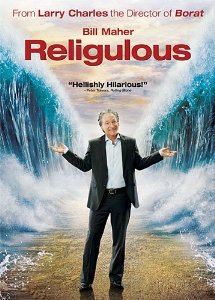
51mGiYaPfqL._SY300_So I finally watched Religulous. I found it a truly underwhelming experience. Honestly, I think I must be over the joys of poking holes in religious thinking. In other news, boxing with Girl Scouts no longer brings me quite the same thrills that it used to.

…at least on Thursdays and Saturdays. It is entirely possible that I may relapse on Tuesdays and Fridays.

Okay, it’s not always that easy, I know; sometimes I meet a religious person with genuinely challenging thoughts, but perhaps that is my point. One can find a pretty broad range of qualities fitting under the heading of ‘religion’, and it can be just a little too easy to look for the easy pickings. Some people treat debunking religion as a sport, and those people rarely seek out the challenging thinkers. No, they hunt the naive in remote and highly uneducated corners of the globe; they sniff out the cooks and the crankcases. I should point out that the sport-debunker isn’t always an atheist, but of course, this time it is.

Religulous is the intellectual equivalent of a canned hunt. In this movie, Bill Maher seeks out and makes a fool of one believer after another and I cannot help but think most of those interviewed have been selected for their capacity to appear nutty to the rest of us. Maher does little to explore the intellectual lives of any of those interviewed in Religulous. His discussions bear a strong-resemblance to a cross-examination in a courtroom (or at least a courtroom drama). Maher’s questions rarely veer far from the effort to produce a contradiction or an implausible claim, and he doesn’t hesitate to interrupt, argue, or insult his subjects at any point in the movie. Not wanting his subjects to go-off half-mocked, Maher includes several segments in which he trashes those already interviewed while driving about, presumably on the way to the next ambush interview. When he does interview intelligent believers, Maher’s sole interest seems to be getting them to help debunk their brethren. The most interesting and complex thinkers in this movie would easily include a number of Priests but they are of interest to Maher only insofar as they help us to dismiss the beliefs of others.

I have to admit, there was a time when I would have been into this. Now, I just find it rather predictable.

…and pointlessly rude.

Ironically, I think Maher’s snide disrespect for his quarry in this film actually blunts the force of his criticism and lets them off the hook. In interviewing John Westcott,  an ex-gay minister, for example, Maher makes a point to suggest the sexuality of the man’s children remains in question. In the commentary track, he further laughs at the irony of a man denying his homosexuality when Maher can tell by his behavior that the man is gay. Personally, I think this underscores the irony of a man proporting to call a believer to task for mistreatment of homosexuality while exhibiting all the insight and sensitivity one might expect to find in the boys locker room of a high school football game. Maher’s games do absolutely nothing to reveal the intellectual dishonesty and outright harmfulness of ex-gay therapies and related ministries. While Maher plays to the cheap seats by making fun of the man and his children, the interview goes nowhere. Maher learns nothing about the minister’s actual point of view, and he does nothing to show us just how harmful these organizations can actually be.

And I wonder if I am supposed to be pleased with this?

Maher is casting religion in a bad light, and in this movie (as in other contexts), he does sometimes score a hit, or even a home-run. I should be able to enjoy this, and I would, if I thought Maher was doing a consistently good job of it, but what bothers me most about this movie is a sneaking suspicion that it isn’t an exercise in healthy skepticism, that in fact Maher is selling a message that doesn’t quite fit the label on the packaging. Shallow as it is, Maher’s engagement with the proponent’s of God-talk is not merely intended to show us how foolish they are. He is building a narrative with assumptions going well beyond the foibles of his hapless quarry.

One particularly telling moment occurs during an interview with a Muslim cleric. the man’s cell phone goes off, and the ringtone is Led Zeppelin’s Kashmir. Maher suggests that this is odd. The prospect that a song called ‘Kashmir’ might strike a cord with a Muslim seems to have completely escaped him. More to the point, he doesn’t ask why the Cleric uses that ringtone or what it means to him. To Maher it seems to be self-evident that the Cleric’s choice of music reveals an inconsistency. He drives this point home further in the commentary track, suggesting that people steeped in outdated beliefs should not get to use modern conveniences.

The mode of engagement used here is consistently that of polemics. Maher wants to poke holes in religion; he doesn’t want to understand anything else about the people he is talking to, or at least he doesn’t want to show us anything else in the final cut of the movie. To describe the end result as superficial would be giving superficial a bad name. But of course there is something a little more insidious at work here. It arises in the notion that religion is simply outdated, that the cleric’s interest in a cell phone is simply incommensurate with religious beliefs. This is old fashioned unilineal evolution, the belief that human history follows a set course. To Maher (and evidently his producer) it goes without saying that religious beliefs are chatter out of place, so to speak, and that history is incomplete so long as these throwbacks remain with us. This is the key to his polemic approach. He wants to show us that religion is stupid, urge us all to leave it all behind, and thereby advance one further step in human history.

In taking this approach, Maher is unfortunately (and ironically) doing a good deal more than debunking the beliefs of his interview subjects; he is advancing a faith of his own, a faith in Progress with a capital ‘P’, and a specific vision of that Progress. The film ends with an emphasis on growing conflicts between Muslims and Christians, and a recurrent expression of fear that these faiths will lead us to nuclear disaster. Maher addresses the claim that these conflicts are really political, and of course it is easy enough for Maher to assert that they are also religious, but of course this is a unique marriage of the fallacies of straw man false alternatives. The question is not which category various conflicts fall into, but rather how politics and religion intersect in actual human history. That is a question Maher is completely unprepared to answer, or even ask. He relies on a stock vision of humanity’s course throughout the film, and herein lies the value of his deceptively simple interview agenda. So long as we are focused on the foibles of the faithful we may not take the time to think critically about Maher’s own millenarian vision of the future.

This is bait & switch.

Maher quite rightly calls some of his interview subjects to task for glossing over the role of faith in political violence, but his refusal to address the politics is itself a telling source of ignorance. He is telling as simple story in which the source of modern evil is found in beliefs and beliefs alone. If only we can deal with the bad beliefs once and for all in the fashion of lunch-room debate tactics, then the world will be a better place.

In advancing this simple message Maher shows us that he has a lot more in common with believers than he would suppose.

71.271549 -156.751450

Share this:

  • Tweet
  • Share on Tumblr
  • Click to print (Opens in new window) Print
  • Click to email a link to a friend (Opens in new window) Email
  • Click to share on Reddit (Opens in new window) Reddit
Like Loading...

Who Needs Christmas? I Can be a Grinch All Year Long!

19 Thursday Sep 2013

Posted by danielwalldammit in atheism, Religion

≈ 15 Comments

Tags

atheism, Christianity, Comedy, Debate, Humor, Jamie Kilstein, John Fugelsang, Kamau Bell, Race

Y’all might have noticed a little clip making the rounds on the net lately. It’s a debate between Jamie Kilstein and John Fugelsang over the existence of God. It occurs on Totally Biased with Kamau Bell, and frankly, the whole thing is a lot of fun.

Yes, I am going to take a stand against fun here. I mean, someone has to do it!

Seriously though, it’s hard to dislike this piece, because all three come across as funny and likable, and all three make interesting points, though I have to say the best point Kilstein makes is the one he attributes to his girlfriend. I’d have to give the edge to Fugelsang on this one though. His humor was the edgier of the bunch, and definitely the most thoughtful. If I had to pick a winner, …or even if I didn’t, I’d give it to the believers in this one.

Lest you think I have already give up the gripe and joined the fan-club though, let me get to the problem. Okay, I don’t really have a problem with anything in this video. I don’t literally agree with a lot of the points made by any of these guys, but I’m happy to have a laugh and take it as food for thought. What bothers me is the way some folks are touting this as a model of religious discussions and debate between different viewpoints. By some people, frankly I mean the folks at Upworthy.

…and I like Upworthy, but that’s not going to stop me from cappin’ on them.

…the bastards!

By ‘bastards’ in this case I mean Joseph Lamour, who has this to say about the segment:

If you’re religious, think about the last time you had a talk with an atheist about religion. If you’re an atheist, think about the last time you talked religion with someone who was devout.

Now think how you would have liked that to go.

Okay, Lamour isn’t really a bastard, but dammit, I’m trying to pick a fight here, so I’m calling him one anyway. Someone has to be the bad guy amidst all this goodwill and nice-ossity.

…dammit!

I should add that Upworthy puts this page under the following title: “A Debate Between An Atheist And A Christian Has Quite A Surprising Result.”

So what’s the problem?

Well first, I’m still looking for my surprise. Believe it or not, a polite and friendly conversation doesn’t count as a surprise ending for some of us. These happen all the time; ugly conversations too, but friendly and polite conversations about religious topics are not that rare. If that was supposed to be the surprise, then I’m a little disappointed. I feel like a kid who just got a Happy Meal without a toy. And no, I don’t want the damned cashier to give me one now; it’s too damn late dammit!

I do damn-say.

I do!

Okay, but what’s the real problem with this piece? It’s this. There are reasons this debate went so well, and those reasons should make it perfectly clear why this bit of comedy fun isn’t really a model for how these discussions are supposed to work. If this is a fun chapter in the story of interfaith discussion and debate, it is ultimately a unique chapter, and it isn’t going to set the tone for the rest of that story. Sorry, it just isn’t.

For one thing the Christian wasn’t very ‘Christian’, so to speak. That might actually be because he was too Christian for Christians, though I suspect many would respond that he wasn’t Christian enough, and of course he may well be right to say that Jesus wouldn’t be either, cause Christianity is a tough club and the Prince of Peace may well be barred entrance at this point, and well, …fun with identity-belief games. The point is that he wasn’t representative of Christianity as it is conventionally defined in the public eye. That may be a good thing in itself, but let’s be honest, it’s one of the reasons this debate went so well.

Fugelsang’s values, at least as he represented them in this discussion, don’t necessarily clash with those of Kilstein or any number of secularists such as, …well, myself. He may well have values to which we object, but he did not put those values front and center in the discussion above. Fogelsang may believe in something we don’t, but in this discussion he did not threaten many (or perhaps any) secular ideas about how to live and behave. Put a conservative Christian up there, standing up for conservative Christian values, and we would have a much deeper clash between all the parties involved. I suspect that both Kilstein and Bell would have had a much more difficult time relating with God’s man in this debate had he taken a different approach to the issues in question.

Is Fugelsang’s faith better, more accurate, or more true than that of the folks we normally associate with the label? Well that’s a battle between him and them (though I kinda hope he win’s it). For the present, the point is that he is for many of us in the just-say-no-to-God club the kinda Christian we can readily get along with.

So, perhaps it isn’t so surprising that the folks in this debate got along after all.

More to the point, look at the contours of the debate. These are comedians; they are playing for laughs. Each makes his points, but not one of them really scrutinizes the claims made by the others. In fact, each gets by with a lot of shaky reasoning and imprecise language because we don’t normally expect rigorous arguments from comedians. We expect to laugh. …and if a comedian also gives us something to think about, well hey, then that’s a plus. But we don’t sit in the front row and shout “red herring” at folks like this. And apparently they don’t do it to each other either.

…which is another reason why this turns out to be a friendly debate. The poison pens and trashy talk comes out on this issue when people actually begin to take apart each other’s reasoning on the subject. That’s when it starts to get personal, not necessarily because the other guy is calling you names, but because your own thinking is actually on the line in such a debate. …and okay, because people also call each other names. Discussions about religion get a lot more heated when people actually respond directly to the arguments of the other person, …when they say things like; “that’s not true!” or “that’s totally irrelevant.” It’s at such moments that people start to pepper the discussion with additional phrases like “…you stupid git” or “you miserable cur!” It is much easier to keep it calm when folks just outline their basic point of view and move-on. It’s counter-arguments that turn up the heat on iterfaith conversations, and those really didn’t happen here.

Which means none of these guys got called-out on their cheap shots, their wonky reasoning, or their not-literally-true claims. None of these guys even had to make up his mind as to just how serious he was about the claims he made on the topic, much less answer a direct challenge to the truth of those claims. The tougher arguments don’t necessarily happen because people are trying to be mean, but because there are genuine questions about whether or not some points of view are just wrong, and once you put those questions on the table, the pulse rates start to go up. Counter-arguments are where the shit gets real, and counter-arguments didn’t really happen here.

Counter-arguments didn’t happen, because of course this wasn’t really a debate; it was a venue providing each party with a chance to highlight aspects of their comedy routine, and each did so with remarkable skill. In short, this was comedians doing what comedians do.

The debate wasn’t ugly, because they never really got to the ugly questions.

Won’t someone please think of the ugly questions?

71.271549 -156.751450

Share this:

  • Tweet
  • Share on Tumblr
  • Click to print (Opens in new window) Print
  • Click to email a link to a friend (Opens in new window) Email
  • Click to share on Reddit (Opens in new window) Reddit
Like Loading...

Irritation Meditation # 5: Persecution Ain’t a Fricking Contest!

29 Monday Apr 2013

Posted by danielwalldammit in atheism, Irritation Meditation, Religion

≈ 33 Comments

Tags

atheism, discrimination, First World Problems, Logos, Persecution, religion, Repression, T-Shirts

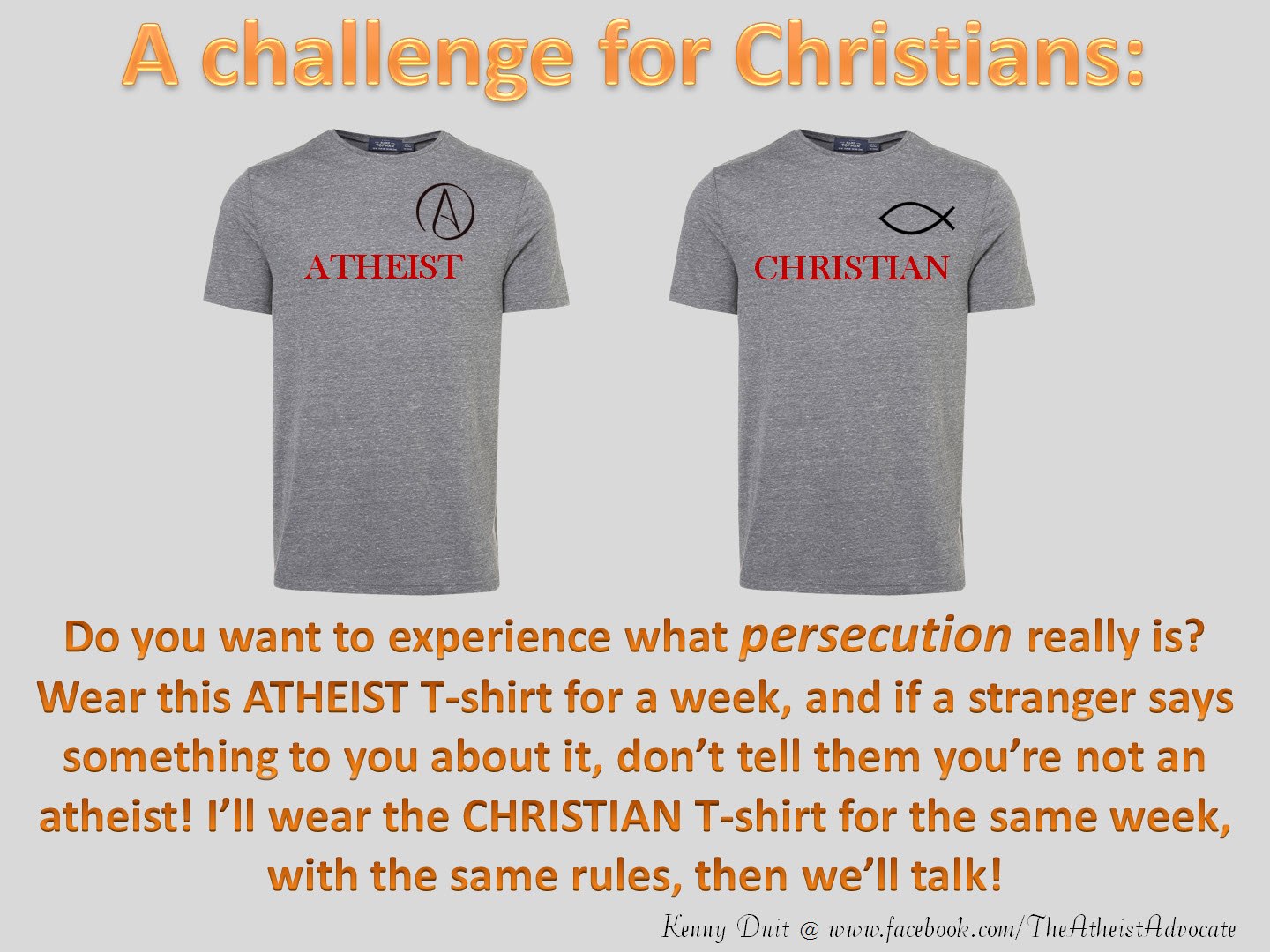
FXdukveAs far as irritation goes, this one comes close to being a mere amusement. I am talking about a challenge issued by The Atheist Advocate, the terms of which are fairly well explained by the illustration here, and I have to admit it’s tempting to just get behind this one. Seriously, I can almost go along with it.

…almost.

If only I had a nickel for all the times I have seen Christians complain about petty grievances or pass along outright falsehoods about this or that attack on their faith, well I could certainly afford another nice meal on that change. Hell, the non-existent war on Christmas alone ought to earn some believers a permanent subscription to “Cry Wolf Daily” (which actually wouldn’t be a bad blog project, come to think of it). Anyway, the point is that it gets damned tiresome to hear a dominant religious majority whine about how religious minorities are oppressing them.

But of course it isn’t really a dominant majority that spreads these cries of repression. Rather it is a small and highly vocal group of political Christians who would like very much to define repression of their beliefs so broadly as to include the failure to bow to their every Goddamned whim.

Taken at face value, I can’t help thinking this little gambit doesn’t quite rise above the difficulties it seeks to address. This whole thing really strikes me as something of a contest over First World Problems. One would hate to run into the occasional lunatic that might make either of these T-Shirts cause for real violence. …or the occasional workplace bigot that might actually use less violent means of putting someone from the wrong camp in their place. In any event, I expect most folks here in America would probably face little other than an uncomfortable conversation or three over wearing either of these shirts. There are some definite regional exceptions to be sure (cough! …deep South! …midwest!), but for the most part I think we are talking about a war of words.

Yes, I do figure those wearing an ‘atheist’ T-Shirt will have quite a few more of those unpleasant conversations than those wearing a ‘Christian’ T-Shirt, but I am open to the possibility that I am wrong about that, and I certainly wouldn’t estimate the flack for wearing the Christian shirt to be zero. Oddly enough, I expect some of the grief given to both Christians and atheists over this sort of thing could come from the same sources. An awful lot of people seem to want to have their sin and get to heaven too, so to speak, and they can be equally testy with religious fundamentalists and non-believers alike. This ‘moderate’ bunch can be especially testy if they believe someone else has brought the issue to the table and tried to force the question, …say by advertizing their (non-)beliefs in public.

That said, yes, I do think Christians are more likely to get a free pass on public expressions of their views f for no other reasn than that they have had their foot in that door for longer than those of us in the just-say-no camp. What strikes me as far more important is the fact that the list of people who have found out what ‘persecution really is’ would be unlikely to include anyone whose main worry of the day is what people will say about an ugly T-Shirt. There are people out there who face real consequences because of their belief-stances, and both atheists and theists are among them. That list also includes plenty of people who face real suffering as a result of things over which they have absolutely no control whatsoever. So, I think people should count themselves blessed if they live somewhere that you could actually play this game and expect life to continue in the wake of it.

As a general rule, I think anyone who wants others to appreciate the struggles they face could do better than to start by trivializing those of others people. I also think we would all be better served if folks spent less time claiming the title of most-repressed and more time thinking about what constitutes reasonable treatment of those with whom we disagree.

Oddly enough I’m not really opposed to the challenge, per se, just a certain over-billing of its significance. Still, if this leads a few of the more self-important Christians to rethink their narratives of martyrdom, then perhaps it’s a good thing. If it leads some people of either camp (or any other) to think carefully about their own bully-triggers and what we can do to help those under the gun for such things, so much the better.

71.271549 -156.751450

Share this:

  • Tweet
  • Share on Tumblr
  • Click to print (Opens in new window) Print
  • Click to email a link to a friend (Opens in new window) Email
  • Click to share on Reddit (Opens in new window) Reddit
Like Loading...

A Hyponym Walks into a Bar…

18 Monday Mar 2013

Posted by danielwalldammit in atheism, Philosophy

≈ 27 Comments

Tags

Agnosticism, Apologetics, atheism, Belief, Debate, Hyponym, Philosophy, Rhetoric, Semantics

Here is how I would spend that money!

I could believe in a God of Korean BBQ, yes I could!

I Grumble: I wish I had a nickel for every time a Christian told me that my take on the existence of God isn’t really atheism; it’s agnosticism. No, those nickels wouldn’t make me rich, but they would add up to a nice meal at a decent restaurant, and with enough change to leave a damned good tip.

On one level, this is  interpersonal aggression. If someone can take your identity away (or at least that part of your identity most salient to the topic at hand), then the rest of the discussion is going to suck no matter how well you handle the particulars. It’s the sort of argument that is really about who is in charge.

…and I mean in a right-here-and-now kinda way.

Just like a husband and wife engaged in a two-day spat over which brand of butter would have been a better purchase, atheists and theists (mostly Christians) will tap away on our keyboards well into the wee hours of the morning, all over the question of just what atheism really is and who gets to call themselves an ‘atheist’. It’s almost as though we have that agreement, you know the one about never going to bed with unresolved issues, only we never do get to the make-up sex on this particular topic. We just keep jabbering at each other until the sun rises and it’s time to go to work tired. (Thanks honey!) The bottom line is what ought to be the opening stages of a larger dialogue becomes the overwhelming focus of an exhausting (and often pointless) pseudo-discussion.

On another level, the subject is certainly worth some time. The semantics are tricky here, and one will need to sort the meaningful possibilities out before proceeding to any substantive issues. And Hell, I figure I’ve encountered a genuine concern or three amidst all the bunk believers have thrown at me on this issue over the years. I know I have a few truth-in-advertizing concerns for those calling themselves Christians as well. Plus, I think I’m actually adjusting my views on this one a bit lately. So, I’m going to have a go at this all-too familiar old topic and hope that the results won’t lead to any incidents of self-mutilation.

So, please take a deep breath!

***

The Basics: The problem is this, among the group of people calling themselves atheists, some of us will happily do so without presenting any reason to believe that there are no gods. If pressed on the issue, we will often claim that the burden of proof lies with the believer. Atheism thus represents a stance we will take in the absence of positive reason to believe in God. This approach to atheism is sometimes known as “weak atheism,” as opposed to “strong atheism,” which is generally taken to refer to the stance of someone prepared to argue that no gods exist at all. Some might say that a weak atheist simply doesn’t believe in any gods whereas a strong atheist says there are no gods.

And here is where Theists often cry foul. Isn’t the neutral position really that of agnosticism, they will say, and how can it be that atheists (weak or otherwise) have no burden of proof? Isn’t that unfair?

But of course atheists have a number of arguments in favor of these terms, not the least of them being an analogy to legal reasoning and/or the structure of formal debate organization wherein an affirmative position is often given the burden of proof. If someone is accused of a crime, we do not expect the defense to prove them innocent; we expect the prosecutors to prove them guilty. The problem, as weak atheists often phrase it is that you cannot prove a negative. This isn’t quite true, or even close really; but it does touch on a real problem. Many negatives can be proven true, but many cannot. If for example the original claim to be disproved is too vague, it will be difficult to formulate grounds for proving it false. Making someone responsible for proving a negative thus creates a double-bind of sorts, making the critic responsible for any ambiguities in the position he seeks to criticize.

The weak atheist position construes this debate in terms of a proof that at least one God exists. If the theist can make his case, then great he wins, but if he fails, then we go back to our default judgement that no gods exist.

Theists typically reject these terms of debate, often by suggesting its proponents have mislabeled themselves. ‘Atheism’, they will suggest should be reserved for those prepared to prove god doesn’t exist and those who merely assume he doesn’t in the absence of evidence are better described as ‘agnostics’.

It is actually a rather soft version of agnosticism that theists keep advancing as the proper alternative to the weak atheist position; effectively telling us; “if you don’t know, then leave it at that.” The shoulder-shrug version of agnosticism is not to be confused with hard agnosticism (i.e. the notion that questions about the existence of God are inherently unknowable, in short; “I don’t know, and neither do you”).

Of course soft agnosticism could be a perfectly reasonable description of the absence of affirmative belief, but so would weak atheism. In fact, the two categories could well apply at the same time. …hence the common practice of referring to oneself as an agnostic atheist.

Many do just that.

***

Holy Holistics Batman!  It’s worth considering that such labels go well beyond the stance one takes in a particular debate and extend to questions about behavior, values, etc. Life is full of decisions one has to make in the absence of perfect information, and this is one of them. Sooner or later we have to make decisions predicated on our answer to questions about whether or not God does exist. I will either keep the Sabbath or not; I will either say the Sinner’s Prayer with conviction, or not. I will either covet my neighbor’s hot wife or not. …you get the idea. If the debate over whether or not God exists ends in a stalemate the actual pace of real life decisions does NOT respect that stalemate (and from what I hear, neither will the God of Abraham). Whatever the balance of evidence, one has to make a decision. This is exactly what burdens of proof are about. Assigning a default judgement is a process of deciding what you will do if you do not know the answer to a given question.

The weak atheist position may be frustrating as Hell to theists, but it has the virtue of addressing this question of how one will actually live.

***

Let’s Take a Step Back: There is just one thing about that last twist in the argument above; it isn’t quite a function of logic or reason, …not entirely so anyway. Rather, it is a question of how the merits of a reasoned position will map onto the practical judgements of actual life.

Default judgements lie at the intersection between reason and social interaction, and the question of who has the burden of proof in this debate is just one of the moments when the politics of religion intrudes on the intellectual exercise of reasoning about it. However much the participants may want to imagine themselves capable of resolving the issue on the merits of the case, the prospect looms large that it will still be an open case long after any particular discussion (or even years of study and centuries of dialogue). It would be nice if someone could produce end-game proof one way or another, but the reality is that most of us will end up making our decisions about a range of relevant issues in the wake of a stalemate shaded by a little other than a sense that one side or another has a good point here and a slight advantage there. In short, the debate may never end, but sooner or later we have to declare our own take on the issue. At that moment, when we have to decide in the absence of a clear accounting, the burden of proof may well prove to be the decisive consideration.

And so we haggle about the terms of the debate even to the point of never getting to the debate itself, partly because we know this little technicality is likely to make a difference on down the road a bit.

Whatever else weak atheists are saying, they are also saying “let’s handle this issue one God at a time. You give me one sound case for one God as you define Her, and I’ll give up my position and go with that one God.” This position offers real advantages for both parties, not the least of them being that it bundles all the tricky semantic questions about what one means by ‘God’ into the same package and lets the Theist have first crack at resolving them. The details of the discussion will then be on her terms (or at least about her terms).

This has the advantage of providing for a pretty direct test of that God, at least for those willing to approach the subject by means of reason (which is admittedly a diminishing portion of the population …it having become an article of faith that religion is about faith). In short, this approach to the conversation maximizes the relevance of any conclusions drawn to the actual beliefs of the Theist involved in any particular discussion.

But what about the atheist? For him, this way of modelling the issue really tests a pretty narrow aspect of his professed stance; his ability to present a reasonable objection to one particular approach to belief in one particular god, …at least as argued by one particular person. It leaves his take on any other gods pretty much off the table altogether. And (here is where I am cutting against years of habit) I think there is some justice to the claim that this is something of a dodge.

If someone has concluded that there are no gods, or even that he sees no reason to believe in any, then even this latter version of his stance necessarily goes well beyond the subject of one debate with one believer. It’s a fair question; what about the others? How do you deal with them?

Those professing weak atheism are generally unwilling to enter onto that turf, not the least of reasons being that any attempt to produce an end-game argument on the subject will effectively make them responsible for resolving all he tricky semantic questions while theists stand-by with an easy out. If an atheist attempts to prove that all gods don’t exist; he has to settle on a definition, and he has to do it without a claim that that definition fits the real thing (since he doesn’t think there is a real thing). The mistakes of believers thus become the responsibility of the atheist, and the liar’s paradox then mocks his every move.

And yet, there remains some trace of a legitimate question here. Does the stance of even a weak atheist not go beyond the particular gods of the particular theists with whom he is talking at any given moment? Clearly, he expects to reject any given god with whom he he is confronted at any given time. If that expectation does not yield a direct argument on the topic, is there no accounting for it whatsoever? None?

At the very least we could frame the conclusion that there are no gods as an induction of sorts, derived from our past experiences debating the existence of particular gods with particular people in a variety of different conversations. At some point, one begins to form an expectation, even a tentative conclusion. The judgement is there, and one can even find ways of framing it for purposes of discussion. It’s just that the conversation gets kind of messy if you go this route.

But maybe that’s a mess more of us ought to consider getting into.

***

Let’s Wrap it Up (and it’s About Time!): The issue here isn’t really what kind of atheist are you; it’s what kind of conversation do you want to have? How do you prefer to frame the debate? And the truth is that most of those professing weak atheism do in fact cultivate a number of alternative approaches to the subject; they just don’t recognize them as appropriate answers to questions about the existence of God or gods. This happens precisely because the conversation must at some point cease to be a question of metaphysics and become a question about social practice.

Ultimately, the judgement that there are no gods has less to do with the nature of the universe than the value of certain ways of talking about it. It is a judgement that god-talk never has nor ever will produce a description of a superntural entity that is literally true. On a good day, god-talk might produce inspiring poetry, amazing architecture,  profound moral thoughts, or even deeply moving personal narratives, but it will not produce a plausible case for a supernatural entity. Even the assertion of a weak atheist stance means at least this much; that one does not expect to hear talk of gods produce a believable claim about the existence of such a being. One may prefer to test that one god at a time with the Theist on the hot seat, but those of us claiming the label are certainly communicating something about our expectations regarding the subject at hand.

We can do more than that, and we actually do more than that every time we comment on the realities of religious practice; every time we describe the horrors committed in god’s name or link any poor judgement to the vagaries of religious thought. This sort of talk doesn’t always rise far above the level of gossip (or even outright idiocy), but it often calls attention to real problems. At least part of the rationale for rejecting belief in God is a sense that talk about him is unlikely to produce a claim worth affirming, at least not in its most literal sense. (Some of us may find Martin Luther King Jr.’s words inspiring or even turn the radio up for a religious tune or two, but there is always some sense in which we are not quite down with the whole message.) And herein lies the moment when even a ‘weak atheist’ goes a little beyond the confrontation with any one case for God; he is pronouncing a verdict on a vast range of discourse about gods, and he is telling us that all of it (in his estimation) fails to produce a compelling case for belief in that God. In some instances the God is too vague, in others She is a contradiction, and when a clear and coherent concept does make an appearance it just doesn’t have the ring of truth to it. This is a judgement that goes beyond the test of one particular god belief, and weak atheists make these sorts of judgements on a pretty regular basis.

So, it isn’t really that we have two types of atheists here so much as two (or more) different ways of setting up a discussion with theists over the subject. One typically uses the deductive models of metaphysical reasoning to test one God at a time (preferably that of the particular believer we happen to be talking to). The other typically uses probabalistic reasoning to pass judgement on a range of loosely connected ideas sailing under the rubric of god-talk. In effect, the second approach deals not with God Herself so much as the language in which she is typically presented, and it deals with that subject in terms of summary judgements. There is nothing inherently wrong with this approach, but it’s a bit less rhetorically satisfying, especially when squaring off over the subject with someone who insists that some version of God is real after all.

Most of us are uncomfortable with generalizations, and I think even atheists are oddly attached to the sense of absolute truth that one expects from metaphysical discussion. When we approach the topic that way, we can often say ‘no’ with something approaching certainty. It is the certainty of deductive reasoning and all-or-nothing proofs. Theoretically those are the stakes, the theist too could win one for the Gipper, …or Jesus, I suppose. If these are the stakes, then yes, I think I am still inclined to opt for the weak atheist position. But I do think it is reasonable to expect some accounting for the rejection that goes beyond the god of one particular conversation; that account will of necessity turn into a form of social commentary. And thus my rejection of god turns out to be a rejection of what men say about Her, and on that score perhaps there are sufficient grounds to field an affirmative argument.

About the hyponym? Turns out he’s kinda hyper.

71.271549 -156.751450

Share this:

  • Tweet
  • Share on Tumblr
  • Click to print (Opens in new window) Print
  • Click to email a link to a friend (Opens in new window) Email
  • Click to share on Reddit (Opens in new window) Reddit
Like Loading...

Preaching to the Non-Choir and Slouching Towards an Apologetic Tradition

05 Tuesday Mar 2013

Posted by danielwalldammit in atheism, Philosophy

≈ 20 Comments

Tags

Apologetics, Argumentation, atheism, Friendly Atheist, Internet, Philosophy, Ray Comfort, Rhetoric

http://redwing.hutman.net

http://redwing.hutman.net

What is the difference between a Christian philosopher and a Christian apologist?

Quite simply, marketing.

When I think of a Christian philosopher, I think of someone genuinely engaged in thinking through the issues, someone who makes his bread and butter by addressing alternative viewpoints in a direct and reasonable manner. His career depends on his ability to challenge others with cogent arguments to the topic at hand. He writes and he speaks with an audience in mind that includes non-believers, even dedicated opponents of his own position. Good Christian philosophers give me pause; they make me think twice, and I enjoy reading or listening to their thoughts.

When I think of a Christian apologist, I think of someone whose real audience is already sitting in the church, and they have no intention of going anywhere else on a Sunday. That audience is happy to take in some argument fresh out of a can, telling them why the other guys (people like me) are wrong. They don’t really need convincing, just reassurance, and they certainly won’t be asking any tough questions, at least not without accepting any token answers that may come along. When I think of apologists I think of endless circular arguments and enough straw men to earn a visit from the fire marshal. Apologists can do this, precisely because they are not really making an effort to engage non-believers, they are just making a show of it for the benefit of the faithful.

The philosopher has a potentially hostile audience, and he knows it; the apologist is preaching to the choir, and he knows it too.

When I think of Christian philosophers I think of Alvin Plantinga. When I think of apologists I think of Ray Comfort and his damned banana. (Then I think of Dunning and Kruger, but that’s a rant for a different day.) Don’t get me wrong, there is no hard and fast dividing line between these practices, but one cannott help noticing the differences at the far ends of the continuum. Some folks are making an honest effort to engage people with different views, and some folks are just going through the motions.

An entire industry falls on the less-than-worthy side of that distinction, producing stock arguments for the benefit of believers everywhere. Diehard consumers of this literature often become adept at identifying the issues, naming the conventional arguments, and applying the necessary responses, or at least the labels thereof. Being tone-deaf to the particulars of any given conversation, such folks are happy to point you to a book or even supply a link to some guy who answered your argument (or at least another argument that would fall under the same label). “Just go there and read it and you’ll see…”

Damned irritating is the nicest thing I can say about such people.

But all of this is just background material. What has me thinking about this is the possibility of an emergent apologetics tradition within atheism. Now some might take it for granted that everything I just said about arguments for Christianity would be true of non-believers as well; if one side of a debate is doing it, so a kind of popular wisdom goes, you can sure bet the other side is doing it too. But that just isn’t always the case. (Allow us please the possibility of a different set of vices.) In this instance the difference lies in the relative absence of a viable market for such messages.

…until recently.

For most of my life being an atheist has been a rather lonely experience. Oh sure, I could find lots of people happy to bitch about religion, and plenty more who could tell me (their faces beaming) about the time their minister got mad at them for asking too many questions. But with few exceptions, these same folks stop well short of  denying the existence of God altogether. Most have little better tom say about atheists than they do the preachers of those stories.

http://xkcd.com/774/

http://xkcd.com/774/

Perhaps, my experiences have been atypical, but I don’t think so. Near as I can tell, unbelievers haven’t generally run in crowds all that much, not in the western world at any rate, not the least of reasons being that we have a hard time finding each other.

Had, that is! …had.

The Friendly Atheist, Hemant Mehta, once suggested that the invention of the internet has served to empower atheism in important ways, perhaps even given us an edge over believers in public discourse. I have my reservations over Mehta’s full take on the subject, but there is something about his observations that ring true for me. I do think the net is a bit of a game changer even if the outlook of this new game may be less than clear at this point.

The whole issue reminds me of an evening spent surfing the Apologetics page at Christianforums.com only to find the only other people on there were atheists like me. I challenged one of my fellow heathen to debate me anyway, suggesting we flip a coin to decide who would play the part of a believer, but he just wrote ‘lol’. The internet had no love for an argumentative guy that night. Anyway, that was my first taste of the power of the net to draw the unbelievers out into the open, or at least the virtual equivalent thereof.

I live and work in a remote village in the Bible hat of the country. I’ve met three self-professed atheists (that I know of) since moving here, and that’s three more than I met the dozen or so years I worked on the Navajo Nation. In this respect my experience is clearly not typical, but here is my point, I still count dozens of atheists as my friends, and I can interact with them as often as I want to. I have only to go online. That, for me anyway, is the difference between unbelief with the net and unbelief without it.

And yes, that strikes me as a good thing.

What worries me is the possibility that with this form of empowerment, some of us have picked up a few vices, not the east of them being a penchant for crafting arguments with less probative value than inflammatory potential. You can often do both at the same time, and maybe there is good reason to rally the troops on occasion, but sometimes people do make a choice, even without realizing it. There is something deeply inauthentic about fielding an argument that just doesn’t confront the other side in a meaningful way.

It is concerns about this that have me looking sideways at some of the memes circulating through the unbelieving corners of the net. Don’t get me wrong, I laugh at (and hit the ‘like’ button) on lots of these, but some are just genuinely foolish or outright deceptive. I did find it a little disturbing one day when I realized the front page of the atheist reddit consisted of nothing but memes, and I shudder to think at the 140-bit mindset developing on twitter. One can hope that people are learning and developing more complex messages in other contexts, but the medium of expression does shape content. And I can’t help thinking the sound-bite quality of some internet media will have an impact on the sorts of messages circulating about in them.

But of course I am not simply talking about a non-believing net. Recent years have seen the rise of countless conferences for skepticism, secularism, and non belief. Numerous unbelieving organizations, including a range of student groups have come into being, each pursuing a range of closely related agendas. Once again, there is tremendous potential in this. But at least part of that potential is a capacity for group-think and a chance to build a reputation (perhaps even a career) out of interactions with mostly like-minded people. In itself, that isn’t necessarily a bad thing, but it doesn’t hep if one’s goals are at least partly to engage with others.

The recent Palin-Billboard debacle over at American Atheists would be a nice case-in-point. Everyone makes mistakes, but not everyone puts them on a billboard, or doubles down on the subject when questioned about it (or brags about high standards when finally correcting the mistake). No, not everyone does that, and David Barton is NOT good company folks. But of course the point here is hardly that someone made a mistake and was slow to correct it. The problem is that such behavior becomes much more likely when your bread&butter does not rest so much on your ability to issue a credible challenge to believers as it does on your ability to comfort those already in your own camp.

No, this post is not about being nice, and it’s not about compromise. It’s about taking the time and effort to do more than tell dirty stories about the stupidity of believers, and to field arguments that will do more than make other non-believers feel good. We are all hit or miss on the topic, even with the best of intentions, but some folks may not even be making that effort.

When your intended audience is in your camp, it is amazing how easy it is to field a compelling argument.

But that is a path that leads to Comfort and bananas.

The point here is that those of us who just say ‘no’ to gods can communicate our views more effectively now than ever. We can reach more people and we can insert our views into more conversations than previously possible. It would be a damned shame if these new possibilities were wasted on the production of in-jokes and arguments appealing only to confirmation bias.

I’m not against Schadenfreude either; I don’t much care what people laugh about three beers into a night out with the guys. But one ought to know the difference between a cheap shot and cogent argument. And one ought to be able to sober up when the time comes and field a case for one’s own position, a case that actually moves the conversation with others forward in some meaningful way.

I do think a few folks could work on that a bit.

71.271549 -156.751450

Share this:

  • Tweet
  • Share on Tumblr
  • Click to print (Opens in new window) Print
  • Click to email a link to a friend (Opens in new window) Email
  • Click to share on Reddit (Opens in new window) Reddit
Like Loading...

Cognitive Bias Goes to Church: Irritation Meditation Number 4 (This Time With Smilies!)

18 Monday Feb 2013

Posted by danielwalldammit in atheism, Irritation Meditation, Religion

≈ 14 Comments

Tags

Actor-Observer Bias, atheism, Cognitive Science, Faith, Fundamental Attribution Error, Judgement, Memes, Psychology, religion

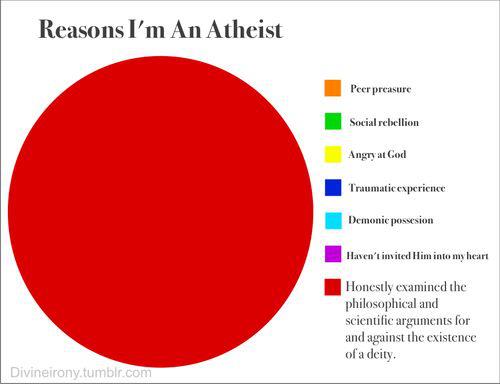
atheist-reasonsI found this piece on Stumbleupon, I believe. As far as Memes go, I actually kind of like this one. And by ‘kind of” I mean ‘really’ …kind of.

You see, I look at this meme, and a part of me wants to shout; “Yeah Boyeeee!” (…preferably in the face of some believer who has just suggested one of the alternatives). It’s damned frustrating to deal with that kind of commentary. You know how it goes; “The only reason you don’t believe is blah blah, blah…” …Blech! Seriously I’ve heard that line way too many times (and apparently so did someone else). So, it’s nice to see a bold affirmation that one’s own judgement really is the basis of, …well, ones own judgement!

…as opposed to some dismissive third person narrative.

Still, I wonder, would this look any different from any other religious perspective? If I asked for ‘Reasons I believe in God’, used the exact same sentence for the red color, and then made just a few strategic changes to the decoy list (Peer Pressure, Social Conformity, Afraid of Death, Raised That Way, Mental Disturbance, Haven’t Really Thought About It), I imagine we could present this to a few believers and generate exactly the same sense of vindication that I feel looking at this meme right now. “Damned right,” I can just hear them saying about that red line. …some might even add a “Praise Jesus!” or something like that, but my mind’s ear just doesn’t really want to go there.

Seriously, …yuck!

My point is of course that trivializing generalizations are a stick in the side of lots of folks, not just atheists. This is just the tip of the iceberg, a larger problem looms beneath the surface. And no, I didn’t just choose that image, because I live in Alaska; I actually thought about it and decided that it would be the best metaphor I could… well, anyway… the point is that this is part of a larger problem.

In the classic formulation of the problem, humans seem to possess a nearly universal tendency to explain other people’s actions (particularly those we don’t like) as a function of some consistent feature of their own personality while explaining our own actions in terms of situational factors. This tendency has generally been described as the Fundamental Attribution Error, or alternatively, as a function of Actor-Obeserver Asymmetry. What does this mean? Well, it means the reason you didn’t pay your bill on time this month is because of those unexpected medical expenses, the repair bill for the car, and well, it was little Johnny’s birthday, and you had to get him something… (You know the story). The reason your friend didn’t pay you the money he owes you? Well, he’s just a lazy bastard!

Okay, so that’s classical attribution theory, at least if you add a little salt to the vocabulary. Recent studies have shown that this basic contrast between situational versus dispositional explanations doesn’t quite explain the full range of data on this topic. Not to worry, a replacement theory is available, and it seems to illustrate the same point, albeit with a little less flair. The folk-conceptual theory approaches this same phenomenon by suggesting that people apply a range of different folk models to explain their own behavior and those around them. Depending on just how much one identifies with a person whose behavior they seek to explain, he/she is likely to adopt radically different descriptions of the behavior in question. One of the variables, for example is a difference between offering a reason for a behavior as its explanation and offering a history of reasoning as its explanation.

Case in point?

Saying; “I don’t believe in the Christian God, because the problem of evil renders this notion incoherent,” or conversely, saying; “I believe in God, because aspects of DNA coding appear to be irreducibly complex, and hence they require more of an explanation than chance evolution could provide.” What both of these explanations for a belief have in common is that each serves to explain a belief and at the same time to advance an active case for it. Conversely, saying “That guy Johnny, well he believes what he believes, because he has a deep fear of death (or Hell).” This latter sort of explanation describes a stage in a causal chain of behavior, one which doesn’t actively make much of a case for Johnny’s beliefs. In fact, the explanation undermines his credibility. The bottom line here is that we are looking at two different types of explanation, and the choice of which type to offer depends an awful lot on the disposition of the speaker towards the behavior/belief in question.

People thus have different ways of explaining behavior that they value and behavior that they don’t, and those differences serve more to shift the narrative around our feet than they do to set up a straight-forward evaluation of the issue. I really do think this is the key to the problem addressed in that meme above. People use dismissive explanations for beliefs they don’t identify with while presenting the reasons for beliefs they do identify with in terms of their own judgements.

You can see this consistently in the sphere of religious and philosophical discussions wherein you and I can supply all manner of thoughtful reasons for the judgements we’ve made, but that guy over there? Well, you know where he was raised and how his parents are! And all those people in the church on the corner? Well, they just have to believe in something; it fills a void somehow; they really are just brained washed aren’t they!?!

…and so on.

I’m including you in the good and thoughtful narrative of course, dear reader, but that’s just because you are reading my blog. When you’re gone I’m going to tell my other friend that you just had a traumatic experience.

😛

The bottom line is that it’s difficult to disentangle the full range of human motivation, and when we do this for religion, the tendency is to do it in a way that privileges one’s own judgement while trivializing that of others. Folks we identify with can enjoy praise by association, and those that we don’t, well damn them anyhow, right? They really need to learn to think for themselves!

So, why do I like this meme? Well, it took me down that path just now, and lucky you, I brought you along for the ride. I guess this is yet another instance of ‘liking’ something not quite meaning that I agree with it.

This meme is a good answer to half of the actor-observer bias.

…and it’s a damned good illustration of the other half.

I suppose that is something of a win-win situation.

😕

71.271549 -156.751450

Share this:

  • Tweet
  • Share on Tumblr
  • Click to print (Opens in new window) Print
  • Click to email a link to a friend (Opens in new window) Email
  • Click to share on Reddit (Opens in new window) Reddit
Like Loading...

Willy Wonka Gets Wiggy With the Woo! Irritation Meditation Number Three.

18 Friday Jan 2013

Posted by danielwalldammit in atheism, Irritation Meditation

≈ 12 Comments

Tags

atheism, Condescending Wonka, Ethics, God, Memes, Morality, religion, Rhetoric

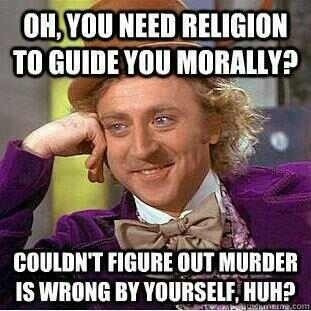
20130118-0632321Okay, I love Condescending Wonka as much as the next connoisseur of sarcasm, but sometimes its difficult to separate the crap he rightfully calls out from the crap he obscures in the process.

Case in point?

Look to your left.

The thing about this gem is that it skewers a pretense for which I have absolutely no sympathy. I’ve been asked far too many times why I don’t commit great acts of cruelty dishonesty, or outright villainy, all on the assumption that failure to believe in God apparently means you are well on your way to doing the worst things imaginable. It’s a pretty common theme in the amateur apologetics camps, and some folks keep coming back to it no matter how often (or how reasonably) you answer their questions.

And yes, the people who insist that all sense of morality goes out the window once you walk away from God scare me, …more than a little bit.

So, I have no sympathy for the mindset mocked by this little meme, none whatsoever.

But Wonka’s argument here is a little troubling in itself, because of course nobody really does figure out that murder is wrong, all by themselves. It might be easier if the category in question were simply ‘killing’, but it isn’t. It’s ‘murder’. And murder is a social construction. (How many people are really against ‘killing’ in all its forms anyway, or even ‘killing sentient creatures.’ No. Most of us are quite willing to kill under the right circumstances, even if we might find it difficult to do so.

Attempted-Murder-500x346If you’ve ever tried to sort the difference between killing that is acceptable from killing that isn’t you can see how very quickly a simple question leads to a very complex maze of possible answers. Issues of self defense, defense of others, and military or police service all skew the simple answer in a variety of ways. Add in possible mercy killings and a mix of government and business polices that lead accidentally or by design to deaths of innocent people in one part of the world or another, the whole damned thing gets that much more messy.

I’m not even suggesting that you can’t sort the mess. What I am saying is that social conventions are a big part of the means by which this mess does get sorted. We don’t figure out that murder is wrong all by ourselves; we learn what murder is from those around us. Others are actively involved in helping is form an orientation towards the prospect of killing another person, helping us decide when and under what circumstances we would be willing to do so.

It’s worth noting that references to God(s) serve as a pretty common part of that social process by which this and other moral questions are sorted out for a lot of people. One could question, as I do, whether or not gods are an essential part5 of that equation, and even conceding the role that gods do play in communicating ethics for many people does not entail belief in the literal existence of any of them. But there is a big difference between suggesting you can be good without God, or even questioning the role of divine entities in ethical lessons and the pretense that it’s all so perfectly obvious you can settle the whole matter all on your own.

It’s a particularly obnoxious fellow that insists we would all go conky-wobble with each other in the absence of God. More reasonable theologians have asked whether or not non-believers can produce an adequate explanation for the ethics that we do have. …I think the answer is yes, but that’s a response to a different kind of discussion. It’s hard to tell what to do when one runs into someone who insists that we are all one god shy of an shoot-out at the K-Mart Corral. Their position is crap, and their arguments are profoundly disturbing.

Still, it isn’t quite true that each of us handles the moral questions of life on the strength of our own individual conscience alone. We get a lot of help from our friends and loved ones.

The answer to both Wonka and the target of his abuse turns out to be the same; it’s more complicated than that.

71.271549 -156.751450

Share this:

  • Tweet
  • Share on Tumblr
  • Click to print (Opens in new window) Print
  • Click to email a link to a friend (Opens in new window) Email
  • Click to share on Reddit (Opens in new window) Reddit
Like Loading...

An Irritation Meditation: The Majority Rules Meme

02 Wednesday Jan 2013

Posted by danielwalldammit in atheism, Irritation Meditation

≈ 13 Comments

Tags

Ad Hominem, ad populum, atheism, Critical Thinking, Dialogue, Majoritarianism, Memes, Poisoning the Well, prejudice, reddit

A_n1-a9CYAAFH_TI enjoy a good meme as much as the next guy, but sometimes it’s a guilty pleasure. Other times, it’s just damned irritating to see what passes for smartitude in various corners of the net. Case in point?

This little bit of net-douchery. It certainly does sell a seductive message. What thinking person couldn’t identify with that sense of standing alone against a crowd of idiots, all bent on some tragically wrong-headed notion with all the certainty of gravity. And who among us who has gone that far hasn’t indulged in the thought that all those in the crowd weren’t just a bunch of gullible morons, no more and no less?

Could it be that simple?

Well, it appears that whoever put this meme together thinks it is, or at least he wants the rest of us to think so. But it’s all just a little too self-indulgent for my tastes.

I have no problem with the first sentence… Wait a minute? Yes, I do.

Oh, I certainly agree that the notion that majority rule does not make the majority right. But does this point really need to be made? Why say it? I’m not entirely too sure how many people really believe that majority consensus constitutes objective truth, though it’s a common enough claim in the heat of an argument. This is an interesting problem itself, mapping the relationship between specific claims onto something like a belief, …pardon me, Belief. It isn’t at all clear that there are a lot of people out there who think that majoritarian principles constitute a procedure for getting at the truth. At the very least, I think it is safe to say that the number of people using ad populum arguments far exceeds the number of people prepared to vouch for the existence of some epistemological principle that justifies them. So, the first statement strikes me as a bit of grandstanding.

If only it were limited to that.

That first sentence serves also to engage in a little bit of cognitive priming. Having suggested what majority rules do NOT mean, the meme proceeds blissfully onward to tell us what majority rules DO mean. Apparently, it means that the majority are gullible.

And if you bang your head against a table enough times, perhaps that inference will seem plausible. Alternatively, you could visit the atheist reddit and keep reading bullshit like this one until it starts to pass for normal.

Bashing your skull against a solid object / reading the atheist reddit

Tomaeto / Tomahto!

It would seem that the author of this bit hoped we would be so happy to reject the epistemological certitude of majority rule that we wouldn’t notice he had slipped en entry of his own into the competition for supreme foolishness on this subject. Even if we assume that the majority in this fantasy scenario is in fact gullible, it is by no means clear that the one leads to the other in any substantive manner.

But of course the meme gets a lot of mileage out of the expectations of its intended audience. Many of the atheists encountering this meme will be only to happy to think of believers as gullible, all the more so when they are depicted as a formless mass of people menacing the lone nay-sayer in the image. Poor guy! Who wouldn’t be happy to think ill of the collective bunch of bullies in that caricature? So, it’s easy to give the inference a pass, to accept the logic because we are easily tempted to agree with its conclusion.

It should also be said that many of us unbelievers will identify with the feeling of being alone against a tide of believers, though I suspect quite a few believers could point to similar experiences. But of course underdog elitism is far less effective when you let too many people in the kennel of kicked puppies. Far more satisfying to pretend the experience is unique to one’s own kind.

And herein lies the real danger of preaching to the choir, as this meme does. It suggests that the real difference between the believer and the non-believer is an innate quality, something we don’t really have to work at. Whether that quality is intelligence or moral courage, or both, the meme presents a just-so explanation of the difference between believers and non-believers. They are gullible and we are not. Yippee! We are in the good camp

Damned flattering!

…and also very convenient.

But here is where the medium does not fit the message. If there is something of moral courage, intelligence, and honesty in the position of the non-believer, it is not present in the smug assertion of some monopoly over these qualities. These qualities are not present in the asinine assertion that all of these qualities are miraculously absent in the multitude of believers. These qualities are present in the slow, patient process of sorting claims against evidence and logical support, of constructive dialogue and small careful adjustments to one’s views on this and myriad other subjects. They are present in anyone who is willing and prepared to engage in that sort of process, regardless of what side of the line they fall on for this particular question. And they are present in messages that open up such dialogue and invite others to come and play in the sandbox of reason, so to speak.

These qualities are not present in self-congratulatory sound bites that invite us to point and laugh at the other guys.

71.271549 -156.751450

Share this:

  • Tweet
  • Share on Tumblr
  • Click to print (Opens in new window) Print
  • Click to email a link to a friend (Opens in new window) Email
  • Click to share on Reddit (Opens in new window) Reddit
Like Loading...
← Older posts
Newer posts →

Top Posts & Pages

  • Master and Commander Kinda Queered
    Master and Commander Kinda Queered
  • I'll Just Leave This Here
    I'll Just Leave This Here
  • Uncommonly Slow on the Uptake
    Uncommonly Slow on the Uptake
  • A Joke from a Bygone Era
    A Joke from a Bygone Era
  • Uncommonday Morning Blues - Ian Anderson Learns to Play the Flute
    Uncommonday Morning Blues - Ian Anderson Learns to Play the Flute
  • When Sex Falls Out of the Performance
    When Sex Falls Out of the Performance
  • An Uncommon Security Guard: Dave Eshelman, AKA 'John Wayne'
    An Uncommon Security Guard: Dave Eshelman, AKA 'John Wayne'
  • What are the Necessities of Life?
    What are the Necessities of Life?
  • The Murals of Española
    The Murals of Española
  • An Uncommon Request
    An Uncommon Request

Topics

  • Alaska
  • Animals
  • Anthropology
  • atheism
  • Bad Photography
  • Books
  • Childhood
  • Education
  • Gaming
  • General
  • History
  • Irritation Meditation
  • Justice
  • Las Vegas
  • Minis
  • Movie Villainy
  • Movies
  • Museums
  • Music
  • Narrative VIolence
  • Native American Themes
  • Philosophy
  • Politics
  • Public History
  • Re-Creations
  • Religion
  • Street Art
  • The Bullet Point Mind
  • Travel
  • Uncategorized
  • Uncommonday
  • White Indians
  • Write Drunk, Edit Stoned

Blogroll

  • American Creation
  • An Historian Goes to the Movies
  • Aunt Phil's Trunk
  • Bob's Blog
  • Dr. Gerald Stein
  • Hinterlogics
  • Ignorance WIthout Arrogance
  • Im-North
  • Insta-North
  • Just a Girl from Homer
  • Multo (Ghost)
  • Native America
  • Norbert Haupt
  • Northwest History
  • Northy Pins
  • Northy-Tok
  • Nunawhaa
  • Religion in American History
  • The History Blog
  • The History Chicks
  • What Do I Know?

Archives

  • December 2023
  • November 2023
  • June 2023
  • April 2023
  • February 2023
  • December 2022
  • November 2022
  • October 2022
  • September 2022
  • August 2022
  • July 2022
  • June 2022
  • April 2022
  • January 2022
  • December 2021
  • November 2021
  • October 2021
  • September 2021
  • August 2021
  • June 2021
  • May 2021
  • March 2021
  • February 2021
  • January 2021
  • December 2020
  • November 2020
  • October 2020
  • September 2020
  • June 2020
  • May 2020
  • March 2020
  • February 2020
  • January 2020
  • December 2019
  • November 2019
  • September 2019
  • August 2019
  • July 2019
  • June 2019
  • May 2019
  • April 2019
  • January 2019
  • December 2018
  • November 2018
  • October 2018
  • September 2018
  • August 2018
  • July 2018
  • June 2018
  • May 2018
  • April 2018
  • March 2018
  • February 2018
  • January 2018
  • December 2017
  • November 2017
  • October 2017
  • September 2017
  • August 2017
  • July 2017
  • June 2017
  • May 2017
  • April 2017
  • March 2017
  • January 2017
  • December 2016
  • November 2016
  • October 2016
  • September 2016
  • August 2016
  • July 2016
  • June 2016
  • May 2016
  • April 2016
  • March 2016
  • February 2016
  • January 2016
  • December 2015
  • November 2015
  • October 2015
  • September 2015
  • August 2015
  • July 2015
  • June 2015
  • May 2015
  • April 2015
  • March 2015
  • January 2015
  • December 2014
  • November 2014
  • October 2014
  • July 2014
  • June 2014
  • May 2014
  • April 2014
  • March 2014
  • February 2014
  • January 2014
  • December 2013
  • November 2013
  • October 2013
  • September 2013
  • August 2013
  • July 2013
  • June 2013
  • May 2013
  • April 2013
  • March 2013
  • February 2013
  • January 2013
  • December 2012
  • November 2012
  • October 2012
  • September 2012
  • August 2012
  • July 2012
  • June 2012
  • May 2012
  • April 2012
  • March 2012
  • January 2012
  • December 2011
  • November 2011
  • October 2011

My Twitter Feed

Follow @Brimshack

RSS Feed

  • RSS - Posts
  • RSS - Comments

Enter your email address to follow this blog and receive notifications of new posts by email.

Join 8,076 other subscribers

Blog at WordPress.com.

  • Subscribe Subscribed
    • northierthanthou
    • Join 8,076 other subscribers
    • Already have a WordPress.com account? Log in now.
    • northierthanthou
    • Subscribe Subscribed
    • Sign up
    • Log in
    • Report this content
    • View site in Reader
    • Manage subscriptions
    • Collapse this bar
 

Loading Comments...
 

    %d