• About

northierthanthou

northierthanthou

Category Archives: Justice

Most of the posts appearing here will involve that special kind of outrage that comes from knowing someone who didn’t deserve it got really screwed.

Mansplaining Hobby Lobby At the Silly Girls: Ain’t Free Exercise Fun!?!

25 Tuesday Mar 2014

Posted by danielwalldammit in Justice, Politics, Religion

≈ 24 Comments

Tags

Affordable Care Act, Birth Control, First Amendment, Free Exercise Clause, Hobby Lobby, Obamacare, religion, Supreme Court
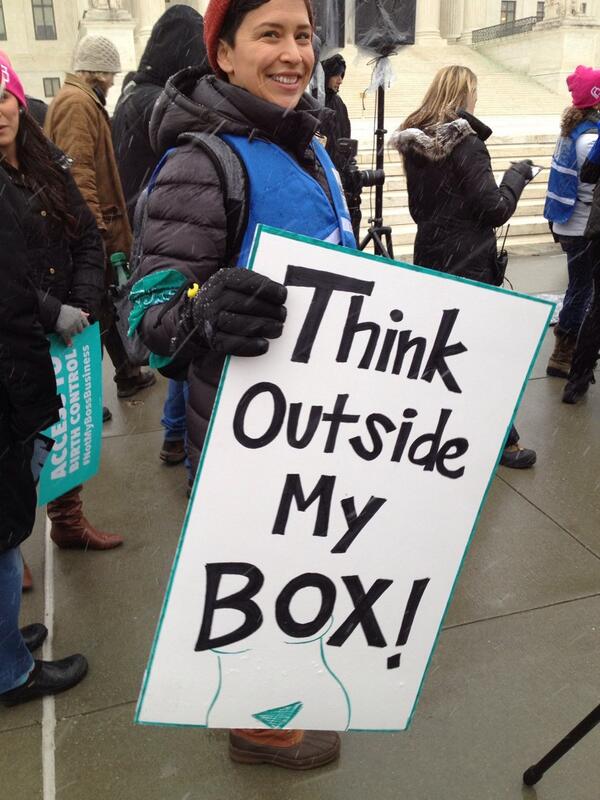
Bjk4aOWIEAABqBXI understand the compulsion to wish that people would separate religion from politics, but you might as well tell the wind to stand in a corner and think about all the tall grass it pushes around. Religion IS politics. It always has been and it always will be. So, it really shouldn’t come as a surprise that the GOP has found Jesus again. The Prince of Peace showed them a little leg by means of Citizens United, and the good political Christians have been composing love poems ever since. Today it’s working on rhyme scheme full of obby, gobby, and a great big bibilo-bobby.

It’s moments like these when the distinction between religion and politics simply vanishes. Both embrace visions of a moral order; both anchor that order in some vision of the world at large, and both impose that order on real people. So, it shouldn’t come as any surprise when Jesus turns out to want the same things Uncle Sam does (especially when he’s talking out the right side of his mouth). Does it really make a difference whether the government controls your body or a church? …or for that matter a hobby store?

For practical purposes the word ‘your’ today excludes anything claimed by those of us with a y chromosome, but take heart mens’ rights activists! I’m sure someone is oppressing a man somewhere; y’all can still howl!

This notion that corporations are persons for purposes of the Bill of Rights really has opened up new ground in the frontiers of collectivism, and all manner of good commie-bashing Republicans have jumped the gun to homestead this new turf without the slightest trace of irony. So, today we face the perverse prospect that the religious views of a corporate entity may trump the personal liberties of a woman (along with the good judgement of her doctor).

Pardon me, I have to vomit.

If there was ever any doubt that religious exemptions to the terms of the Affordable Care Act are about controlling the bodies of women, that should have been dispelled long ago. It should have been dispelled the day Rush Limbaugh reacted to a critic of these exemptions by calling her a ‘slut’ and a ‘prostitute’ and spreading lies about her sex life. It should certainly have been dispelled when good respectable conservatives all across the land shouted ‘yea verily’ at the grand bigot-pontiff of hack radio and promptly drafted themselves up a rash of laws restricting the health options of any women unfortunate enough to live in the wrong state or county. For all the rhetoric of rights, one doesn’t have to look hard to see the naked power politics of the right wing’s current approach to women’s health. Control over women’s bodies is an end in itself, and the Republicans want it now.

On this topic, they can count on the support of half-baked misogynists everywhere.

Today the great masculine hope lies with Hobby Lobby and misogynists are lining up to buy a kitchy piece of cloth, or perhaps a nice candle. Others are happy to simply tweet their support. Their keyboards say ‘Religious freedom’, but so often their texts read sexism, and they read it loud and clear. Take for example this little gem from the Matt Walsh Blog. Matt’s thoughts on individual rights aren’t particularly interesting; one is hard-pressed actually to call them thoughts, at least insofar as they appear on the pages of this post, but what’s really fascinating to me is the social posture he takes in this post, the footing as it were. You see Matt isn’t content to frame a basic argument about religious freedom or the rights of supposedly Christian corporations, he wants to set his post up as a direct response to those women who may want birth control. The result is epic mansplaining.

I’ve poured through mounds of research, read pages and pages of court precedent; I’ve reflected on it, meditated, retreated into the mountains to ponder this mystery in peace; I’ve even Googled it, and all of these measures have brought me to one incredible solution for women who want birth control:

Pay for it yourselves.

Or find an employer that chooses to provide it.

Or have sex and don’t use it.

Or don’t have sex.

Basically, take responsibility for your sex life, one way or another.

By ‘epic’ I suppose I mean childish and petty, but what do you expect. Anyway, there you have it folks; at bottom this issue is basic childishness. Apparently, women need to take more responsibility for their own sex lives. So, Matt is going to give them all a good lecture and be done with it.

Can you just hear the guy saying “I won’t cum inside you baby?” No really just the tip? If it comes to that, he no doubt promises to do the honorable thing.  …You get the idea. I’m almost sorry if this is too graphic, but I’ll be damned if the issue of personal responsibility for sexual matters doesn’t play out in just such moments all over the world. Seriously the notion that women need to take more responsibility for their sex lives is perversely ironic and that is precisely what Walsh’s framing of the issue sets up. His blog post isn’t a polemic on a tricky political problem, it is a lecture given to an errant little girl, one whose rights certainly don’t extend to questions about her own medical care. Why not? Well, let’s let Matt tell you…

It used to be that your rights were infringed upon if the government punished or threatened you for expressing your sincerest beliefs.

Now, your rights are infringed upon if you want something but someone refuses to buy it for you.

It used to be that the vision of tyranny was a man or woman bound, gagged, and shoved in a cage for speaking his or her mind.

Now, tyranny is the tragic image of man or woman forced to spend their own money on something because nobody would give it to them for free.

We used to fight and die for free speech.

Now we sit around and whine for free birth control.

Here Matt’s language echoes that of Limbaugh’s old attack on Sandra Fluke. This is a simple case of someone wanting something for free (which isn’t true, but don’t tell these hacks). Gone is any consideration of larger medical issues or questions about how one decides to deal with his or her own body. I say ‘his’ because I think most of us can relate to those moments when an insurance company turns out to be the reason your doc is doing this as opposed to that, and I sincerely doubt that Matt and his fawning fans are any less likely to grumble about such things when faced with them. But when Hobby Lobby turns out to be the reason why a woman can’t get birth control, well that’s just the facts of life, dontchaknow! Oh yes, of course she can pay for the birth control herself, just like you can pay for any number of medical procedures and prescriptions yourself. The fact is that in THIS world, and I by THIS world (I mean the crappy world of health-care we have here in the U.S.A.) what insurance will and won’t pay for is often the difference between what we get and what we don’t. In the real world Hobby Lobby’s policies will make a difference in the care some women get. Some of us think that difference ought to be up to her and her doctor, but apparently that is the view of tyrants.

…and of silly girls who whine.

Of course this is the tip of the Obamacare iceberg here, and many of those telling women to go fly a kite for contraception are the same folks who fought tooth and nail to stop the Affordable Care Act. Their solution for women is the same solution they offered all of us in the years leading up to the ACA, let the market run its course. Pay for your own insurance or pay for your own medical care; that’s what apple pies and supply curves are all about! That folks would say this knowing that medical bills in the U.S. have long since become prohibitive for large sections of the working public is irresponsible in the extreme. It isn’t just governments that skew the market; corporations (and particularly insurance corporations) do that too, but don’t tell the free market fundamentalists. They’ll call you un-American, …or maybe a slut or something.

In any event, the ACA is law now, warts and all, and the present battle is a classic exercise in scapegoating. It turns out that health-care for women is more complicated than it is for men, and when it comes to sex and its consequences, women are more vulnerable than men. So, Hobby Lobby and its pious supporters have risen to the occasion, leading the right wing to its scape-goat. We may have to accept this abortion of a law, they seem to be suggesting, but at least we can leave the sluts out in the cold.

And if they don’t like it?

Well then there are always mansplaining culture warriors to put them in their place. You can’t help but notice the pleasure some of these folks take in explaining the issue. For some, it’s a kind of theatrical moment, a chance to play the role of the stern father or maybe the soup Nazi.

No sex for you!

Ah well! Let’s give Matt the last word here:

And, seriously, in case I forgot to mention it: pay for your own birth control.

The end.

Next issue?


71.271549 -156.751450

Share this:

  • Tweet
  • Share on Tumblr
  • Print (Opens in new window) Print
  • Email a link to a friend (Opens in new window) Email
  • Share on Reddit (Opens in new window) Reddit
Like Loading...

An Uncommon Harbor and a Stolen Victory

24 Monday Mar 2014

Posted by danielwalldammit in Alaska, Justice

≈ 2 Comments

Tags

Alaska, Cape Thompson, Eskimos, Inupiat, Nuclear Energy, Operation Ploughshare, Point Hope, Project Chariot, The Atomic Energy Commision

Point Hope from the Air

Point Hope from the Air

Have you heard about the big harbor at Cape Thompson in Alaska? Oh it doesn’t exist, of course, no thanks to the Atomic Energy Commission. they were going to make a harbor at Cape Thompson, just south of Point Hope. They were going to build it in a jiffy, so to speak.

I did mention this was the Atomic Energy Commission, didn’t I?

Project Chariot would have set off a series of atomic bombs at Cape Thompson in an effort to provide the proof of concept for operation Plowshare, a program to develop peaceful uses for nuclear explosives. In 1958, the prospect of geological engineering stood high on the agenda for the folks behind Operation Plowshare, and the Iñupiat people of the North Slope stood to become human guinea pigs in the process. Already showing signs of increased radiation due to above ground tests, the native population of the North Slope would have seen still more radiation flowing into the lichen to caribou highway to their own bodies. Luckily the natives of Point Hope understood radiation enough to fight back. It took an extensive public relations campaign and several years of struggle to stop Project Chariot. A lot of people fought damned hard to keep that harbor from happening and thankfully, they won, but that was hardly the end of the story.

.

When the Atomic Energy Commission finally gave up its plan to bomb the North Slope of Alaska for the purpose of building a useless harbor, it then proceeded to conduct a study of the radiation would have on Ogotoruk creek in Cape Thompson. Toward this end, they planted radioactive material in the creek and studied the effects.

…without telling anyone in the area.

Are you mad yet? I know I was when I first learned about this story. Bastard that I am, I just had to share the outrage, but I’m not going to tell that full story here, partly because I really am a bastard, and partly because others have already told that story better than I could. A thorough account of the controversy can be found in Dan O’Neill’s book, The Firecracker Boys. More recently, Iñupiat movie-maker Rachel Naninaaq Edwardson  released a documentary on Project Chariot. Edwardson’s work raises a number of questions about the lingering effects of the tracer study and health problems in the Point Hope community (including concerns that something may still be buried at Ogotoruk Creek). Her film is available through the North Slope Borough School District.

71.271549 -156.751450

Share this:

  • Tweet
  • Share on Tumblr
  • Print (Opens in new window) Print
  • Email a link to a friend (Opens in new window) Email
  • Share on Reddit (Opens in new window) Reddit
Like Loading...

It’s the Sub-Deduction Stupid: Scalia’s Thoughts on Absurdity and Gay Rights

30 Saturday Mar 2013

Posted by danielwalldammit in Justice, Politics

≈ 17 Comments

Tags

Critical Thinking, Gay Marriage, Hollingsworth v. Perry, Homosexuality, Lawrence v. Texas, Marriage, Reductio Ad Absurdum, United States v. Windsor

Justice Scalia testifies on Capitol Hill in WashingtonTime was when Antonin Scalia seemed fairly dedicated to the pretense of Judicial restraint. These days he appears content to be known as a political lobbyist for the right wing echo chamber. We can see this in the increasing number of public statements he has made on a range of political issues, effectively tipping his hand to those weighing their prospects in the legal arena.

…all of which makes Scalia’s role in the gay rights cases recently argued before the Supreme Court (Hollingsworth v. Perry and United States v. Windsor) that much more disturbing. Not surprisingly, the subject has come up in his extra-judicial engagements. Asked to defend his equation between homosexuality and sundry horribles such as incest, bestiality, and child pornography (among other things) in Lawrence v. Texas, Scalia made the following remarks at Princeton University:

It’s a form of argument that I thought you would have known, which is called the ‘reduction to the absurd,'” Scalia told [freshman Duncan] Hosie of San Francisco during the question-and-answer period. “If we cannot have moral feelings against homosexuality, can we have it against murder? Can we have it against other things?

Condescension aside, what Scalia is saying is basically Freshman Logic material. In his Dissenting opinion for Lawrence, Scalia had indeed used the standard argument form of a reductio ad absurdum against the position taken by the majority (holding that a Texas law banning sodomy was in violation of the Due Process Clause of the 14th Amendment). A reductio ad absurdum essentially consists of an attempt to derive an absurd conclusion from a given claim as a means of refuting it. If a given assertion can be shown to lead to absurd implications, so the logic goes, then one ought to reject it. In this case, the claim at stake would be something along the lines of a restriction on judgements (or laws) against homosexual activity. Scalia hopes to show that this holding will lead to an intolerable list of absurdities.

I sincerely doubt that Hosie failed to recognize the argument form, and Scalia’s response does little to shed light on the logic of his argument. The question in this case is more properly, whether or not Scalia’s had successfully shown that the claim made by the majority in Lawrence was actually absurd. In essence, the question is whether or not Scalia had successfully negotiated the transition from the claim he wished to refute to the absurdity he wished to assert in his argument. That transition is sometimes described as the ‘Sub-deduction’ of the argument. That is, in this instance, where the real argument lies.

And here is where the story gets interesting.

The sub-deduction of Scalia’s argument comes in a weak and a ‘strong’ version. By ‘weak’, I mean ‘truly shitty’ and by ‘strong’ I mean rather heartless’, but allow me to demonstrate…

Sub-Deductions in Need of a Workout: Sundry net warriors will be familiar with the weak version, because we’ve heard it from conservative Christians for years. It is essentially an argument against moral relativism, or at least a certain straw rendering thereof. We heard it a little more in the wake of Lawrence, and frankly, Scalia’s remarks in this instance tended toward the weak version, if only because their brevity does little to shed light on the logic of his original argument on the subject. Rick Santorum gifted us with one of the best examples of this tripe in an interview with USA Today back in 2003:

You have the problem within the church. Again, it goes back to this moral relativism, which is very accepting of a variety of different lifestyles. And if you make the case that if you can do whatever you want to do, as long as it’s in the privacy of your own home, this “right to privacy,” then why be surprised that people are doing things that are deviant within their own home? If you say, there is no deviant as long as it’s private, as long as it’s consensual, then don’t be surprised what you get. You’re going to get a lot of things that you’re sending signals that as long as you do it privately and consensually, we don’t really care what you do. And that leads to a culture that is not one that is nurturing and necessarily healthy. I would make the argument in areas where you have that as an accepted lifestyle, don’t be surprised that you get more of it.

Here, Santorum treats the right to privacy as an abandonment of moral principles altogether, arguing that if we can’t condemn homosexuality, then we can’t condemn anything. We can’t stop people from molesting children; we can’t stop polygamy; we can’t stop any number of horribles from happening. It’s worth noting that in this instance Santorum was arguing that the sex abuse scandals of the catholic Church were essentially a problem of homosexuality, which is in itself a pathetically ignorant position to have taken. But I suppose it’s fitting that someone facing what he takes to be the obliteration of moral judgement would respond to that by abandoning any honest effort to address the actual claims at stake in the issue.

Yes, Rick Santorum lives in a special place where ignorance and dishonesty come together and start a family, but sadly, he has a lot of neighbors in the land of ignorance which is the weak version of this argument. A large number of conservative Christians have approached the notion of a right to privacy in precisely these terms.

Setting aside the folk-demon of relativism, the problem with this take on right to privacy is it ignores the essential balancing tests by means of which that right enters into the American legal system. The point of a right to privacy has never been that you actually get to do anything you want so long as it’s in the privacy of your bed-room, but rather that government interest in stopping you must be weighed against the right to privacy. In simple terms, if the government has a legitimate interest in doing so (say if you are hurting a child), then the right to privacy folds and the government wins. If no such government interest is present, or if that interest pales in significance to the cost to others, then the right to privacy wins.

Here the sub-deduction fails for precisely the same reason that moral opportunists find it attractive in the first place. They hope to refute the notion of a right to privacy by connecting it to a range of genuinely harmful activities. Faced with a choice between condemning homosexuality and allowing child abuse, practitioners of this stratagem hope that most of us will throw the gay folks under the bus. But when real harms can be shown, the right to privacy would not prevail, and the sub-deduction fails.

The courts have never presented the right ti privacy as an absolute boundary to government regulation; it is if anything a sort of raising of the ante, a provision that requires government officials to show they have a good reason for what they are doing. Rick Santorum and Christian net-warriors all over the land don’t seem to understand this.

Scalia does, at least when he needs to.

Mach-Macho-Subdeductions: Now we come to the strong version of Scalia’s argument which is a rejection of the balancing tests themselves, at least as applied in Lawrence. In this case, Scalia isn’t making a broad point about the value of moral judgements. His point isn’t that granting a right to privacy leads to the destruction of western civilization, or that it will lead us to turn our children over to the nearest sexual predator. No, in Lawrence, Scalia was saying that the courts should not be the ones to weigh the benefits of legislation against the costs to people’s privacy, or at least that the court had failed to articulate a principle in that case which would enable it to make a sound distinction between issues like homosexuality and those likely to be regarded as more abhorrent, even to those in favor of gay rights. Absent a clear and coherent principle on which to make a decision, Scalia suggested that the court was making just the sort of judgement call that legislators ought to be doing, not judges. Such judgement calls are intrinsically political, and ought in Scalia’s view to be left to those branches of government best suited to making political judgements. It is in other words a variant of his oft-repeated call to Judicial restraint. Hence, the following remarks from Scalia’s dissent in Lawrence (at 603-4):

Let me be clear that I have nothing against homosexuals, or any other group, promoting their agenda through normal democratic means. Social perceptions of sexual and other morality change over time, and every group has the right to persuade its fellow citizens that its view of such matters is the best. That homosexuals have achieved some success in that enterprise is attested to by the fact that Texas is one of the few remaining States that criminalize private, consensual homosexual acts. But persuading one’s fellow citizens is one thing, and imposing one’s views in absence of democratic majority will is something else. I would no more require a State to criminalize homosexual acts-or, for that matter, display any moral disapprobation of them-than I would forbid it to do so. What Texas has chosen to do is well within the range of traditional democratic action, and its hand should not be stayed through the invention of a brand-new “constitutional right” by a Court that is impatient of democratic change. It is indeed true that “later generations can see that laws once thought necessary and proper in fact serve only to oppress,” ante, at 579; and when that happens, later generations can repeal those laws. But it is the premise of our system that those judgments are to be made by the people, and not imposed by a governing caste that knows best.

There is in the strong version of Scalia’s argument a logical consistency which is entirely lacking in the pop-Christian variants of this same position as articulated by Santorum and legions of faith-bigots happy to explain why homosexuality is wrong. Where Scalia was actually making a point about the nature of Judicial reasoning, various cultural conservatives have carried forward that argument in the form of a simplistic claim that if we can’t condemn homosexuality, then we can’t condemn anything.

In the babblerized version of the reductio ad absurdum, the sub-deduction simply does not follow. In scalia’s, it is at least plausible.

Balancing the Unbalanced: But where does that leave us? Scalia would say that that it leaves us with a better balance of powers and a stronger system of checks and balances. Yet, one can see in Scalia’s own writing and comments hints at the costs of such an approach. Regarding the prospect of overturning Roe v. Wade, for example, Scalia offers the following:

Many States would unquestionably have declined to prohibit abortion, and others would not have prohibited it within six months (after which the most significant reliance interests would have expired). Even for persons in States other than these, the choice would not have been between abortion and childbirth, but between abortion nearby and abortion in a neighboring State.

Here Scalia makes an interesting point, that removing the precedent of Roe v. Wade would not necessarily have meant an immediate ban on abortions everywhere, but rather the creation of legislative options which some states would take and others would not. The actual choices presented to women with unwanted pregnancies would then be a question of travel (at least for those in geographically unfortunate circumstances). It’s an interesting scenario, and one in which the right to have an abortion does not die with Roe v. Wade, but that scenario would of course be cold comfort for those women unable to travel. The right to an abortion now enjoyed under Roe would translate through this scenario into an option more or less available, depending on one’s finances and/or family obligations.

The right thus becomes a privilege, and that privilege then falls beyond the reach of many that need it most.

One imagines that the right to engage in homosexual acts (or any number of proscribed sexual practices) would translate into a similar choice under Scalia’s approach, and residence might soon become a function of sexual proclivities. Do you want the right to have sex with your own gender? Better then to move out of a red state under this approach. And we can only imagine just how much more heartache this will cause in some instances, and how many lives lived through deception in others.

Apparently, this is an acceptable outcome in Scalia’s view.

It may well be that the right to vote as a minority could also become a function of where one lives if we are to give up the ‘racial entitlements‘ included in the present voting rights act, as Scalia terms them. Granted the issue there is a technical one, pre-clearance of voting procedures for selected states, but the language of Scalia’s recent questions in reference to the Voting Rights Act is more than a little disconcerting.

Or consider Scalia’s remarks in Oregon v. Smith, 1990. In the majority opinion for that case he argued that the free exercise clause of the First Amendment did not provide members of the Native American Church with a valid reason for exemption from generally applicable state laws banning use of peyote.  Scalia then moved on to suggest that while states might allow for such an exemption, it was not required of them, hence leaving the rights of religious freedom for the Native American Church open to the political process. What Scalia wrote next has always struck me as one of the most telling features of his approach to jurisprudence.

It may fairly be said that leaving accommodation to the political process will place at a relative disadvantage those religious practices that are not widely engaged in; but that unavoidable consequence of democratic government must be preferred to a system in which each conscience is a law unto itself or in which judges weigh the social importance of all laws against the centrality of all religious beliefs.

Here Scalia has essentially conceded to the tenuous status of minority rights under his approach (though perhaps he would say that they are not rights, as such). Those with less leverage over the political process must simply accept a reduced set of options? What are the benefits? The court will behaving as it ought to under Scalia’s view, showing proper restraint and deference to the legislative branch of government.

The problem in this instance is not as simple as the utter foolishness seen in remarks like those of Santorum, or even that of Scalia’s answer to Hosie; Scalia’s argument in Lawrence seems plausible to me, at least on the face of it.  The problem is that the value which is central to Scalia’s argument in this instance (the strong version of the sub-deduction) is awfully hollow in comparison to the conceded costs of its adoption. What Scalia offers us is a narrative in which every part of government rests in its proper place. What he is willing to sacrifice in order to get that value is the actual liberty of countless minorities seeking only the enjoyment of options fully available to the rest of us. The absurdity to which Scalia points us is one in which judges behave a little less like judges, and quite frankly some of us find that a little less absurd than the notion that liberty is best preserved by leaving this and so many other issues central to the happiness of many at the mercy of a political process which has proven time and again that it is inadequate to ensure.

Irony of Ironies: It is worth noting that the strong version of Scalia’s argument empowers the weak version. Whatever else he is saying, Scalia is also saying that if enough people seem to think that the only way to save our children from a list of horribles too awful to bear is to deny those of homosexual orientation the liberty to conduct themselves as they see fit, then they are within their rights to pass all manner of laws restricting gay rights. No effort to show that homosexual conduct really will hurt anybody would be needed in Scalia’s approach, at least not i the courtroom.

And in the legislatures and the court of political opinion, flippant remarks like those Scalia gave to Hosie, and patently offensive rhetoric like that of Santorum will be all that is needed to consign some people to lives lived without the benefit of meaningful liberty.

Absurd, indeed.

71.271549 -156.751450

Share this:

  • Tweet
  • Share on Tumblr
  • Print (Opens in new window) Print
  • Email a link to a friend (Opens in new window) Email
  • Share on Reddit (Opens in new window) Reddit
Like Loading...

Irritation Meditation Number 2: The Second Amendment and Japanese Internment

14 Monday Jan 2013

Posted by danielwalldammit in Irritation Meditation, Justice, Politics

≈ 24 Comments

Tags

civil Rights, Gun COntrol, Internment Camps, Japanese Internment, Justice, Memes, Politics, Second Amendment, The National Rifle Association

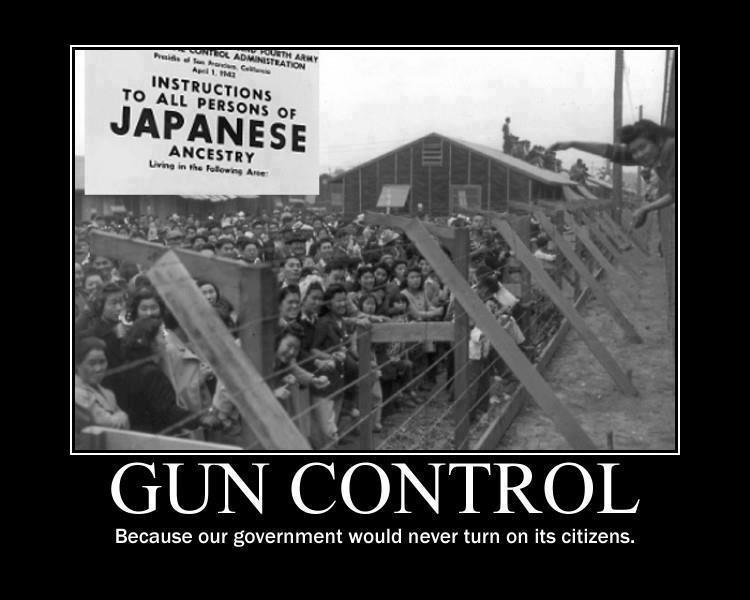
580694_475788705791155_2127648074_nI suppose it is too much to ask that folks distinguish the varieties of gun control from an outright ban. The way the gun rights crowd raises the specter of a completely disarmed populace when speaking about any variety lesser measures smacks of dishonesty.

It would hardly give away the farm to distinguish such things from one another. There are plenty of legitimate questions about the efficacy of lesser gun control measures, especially when applied to a population already so well armed as we are here in the U.S. But that is an interesting and well focused discussion some folks don’t seem to want to risk.

But what is really fascinating about memes like this is the slippage between a right to bear arms and a prescription for doing so. The second Amendment was alive and well when the internment of Japanese occurred in the first place. So, that right and that right alone simply is not a cure for the evil that this pic wants us to think about. The meme only works if we are to imagine a population which is not merely in possession of the right to bear arms, but which actively uses that right even to the point of preparing for war against its own government.

And can anyone really imagine Japanese immigrant population of the west coast doing this in the years leading up to World War II? Can anyone imagine the response from their neighbors?

This is not merely a defense of the Second Amendment, it is an argument for the expansion of private gun ownership well beyond anything previously imagined in American history. To make this argument work, we need more than just the right to bear arms, we all need to have the arms, the training to use them, and enough firepower to make them an effective counter to the powers of the United States Government.

Is the author suggesting that gun owners could stop such a thing as internment? Perhaps, but would they?

It’s a pretty common claim from the gun rights crowd, the notion that the Second Amendment puts the teeth in the rest of our civil rights. It is through gun ownership, so the argument goes, that people are protected from abuse by government officials. It is the most important means by which our rights are protected.

Pardon me, …from ‘thuh government.’

But gun owners did not stop the internment of Japanese.

Or of Aleuts during the same war.

Neither did they stop lynching of blacks.

Nor did gun owners secure the right to vote for African Americans.

…or for women.

…or Native Americans.

Gun owners did not stop the Federal Government from kidnapping Native American children to be taken to schools far from their families.

They didn’t stop police harassment of homosexuals.

They didn’t improve treatment of the mentally ill.

They didn’t stop the Zoot Suit Riots.

…or legacy provisions precluding Jews from owning homes in some neighborhoods.

Gun Ownership didn’t stop Jim Crow laws.

It was not gun owners that secured for any number of minorities the right to an education or any other protections by states or the federal government.

In each of these instances, the rights in question were won by protestors, and lawyers, and people who talked a hell of a lot, even if their main opponents didn’t. In many of these instances gun owners were actively involved in the very repression suffered by those in question. Since the founding of the country, Gun violence has played a far greater role in the repression of civil rights than it has in protecting them. There are exceptions to be sure, but this narrative is not built on the exceptions. It is built on a fantasy that skips any active consideration of how these things actually work.

Herein lies the biggest problem with this fantasy scenario; it presents us with the image of a government acting on its own, independent of the public will. That could happen, I suppose, but is far less likely than the countless times in which government policies actually have facilitated repressive measures popular with the American people, or at least a large segment of it. And in such moments, the victims of repression have rarely been sufficiently well armed to make an effective stand against those who wanted a piece of their liberty.

In real world history, those who have suffered the greatest deprivations did not merely face the threat of Federal Authority; they also have had to contend with the prejudice of an American population content to have them suffer.

…one that sometimes even demanded it.

We can imagine the victims of repression better armed, yes, but only if we also imagine the majority better armed as well. This is hardly a story which leads to a successful defense of liberty. I would call the scenario anarchy, but I don’t wish to sully the term ‘anarchy’ with such a vision of violence and destruction.

It’s damned hard to read these self-indulgent fantsies when considering the actual history of people struggling for their rights. It’s hard to give credence to this juvenile narrative, knowing what it took for the people in these camps to survive, what it took the Freedom Riders to earn rights enjoyed by gun-toting whites in the South. And it is especially hard to hear such arguments from those with so little to say about such things as Guantanamo Bay or the countless encroachments on Fourth Amendment Rights we’ve seen over the last few decades.

What pisses me off about this argument isn’t the defense of gun ownership, or even opposition to gun control. Frankly I don’t think this kind of crap even touches either one of those issues. It sheds no light on those issues whatsoever, and leave us with a whole different discussion to have if we can ever get clear of noise like this. What bothers me about this stuff is the scorched-earth tactics; the vision of politics as warfare and questions about rights as an invitation to shoot at one another. It’s a vision of government as a faceless evil empire in opposition to private citizens, and begging for opposition from heroic gun-owners everywhere. Folks telling this yarn have no sense of how such things actually happen. But they are happy to tell stories of gun-toting heroes squaring off against a government turned inexplicably on its own population. How that will work is a Hell we can only hope we will never see.

And it’s a Hell as likely to be brought about by gun-owners defending their own rights (as they define them) as anything done by a corrupt and tyrannical government.

While others have struggled and died for some of the most basic human rights imaginable, so many in the gun crowd openly fantasize about acts of violence over basic policy disagreements and the possibility of restricted access to a commodity. The pretense that this commodity is the key to civil rights plays a big role in these fantasies. The end result is a tantrum born of paranoia and privilege and a gun culture increasingly dangerous to the rest of us.

No. I’m not talking about the weapons. I am talking about the mindset of people who produce memes like the one above. People who make such arguments are not interested in protecting anyone under serious threat of government repression. The gun rights crowd did not protect the Japanese during World War II, and I for one don’t believe they will be there the next time someone decides to create camps like this.

…unless of course it is to close and lock the gates.

71.271549 -156.751450

Share this:

  • Tweet
  • Share on Tumblr
  • Print (Opens in new window) Print
  • Email a link to a friend (Opens in new window) Email
  • Share on Reddit (Opens in new window) Reddit
Like Loading...

Mitt and McCain On Gay Marriage, Or Hell No, We Can’t Just Get Along!

24 Tuesday Jul 2012

Posted by danielwalldammit in Justice, Politics

≈ 14 Comments

Tags

Gay Marriage, Gay Rights, Homosexuality, John McCain, Justice, Law, Mitt Romney, Politics, Sally Ride

What does it take to make the words “agreement to disagree” work? I’d say at minimum, it requires a certain understanding of each others’ position, but perhaps that is a point for a different discussion. At present I am wondering just how much such an agreement can cost one of the parties before that respectful disagreement turns to shit.

Case in point, this conversation between John McCain and Ellen Degeneres:

I hear McCain frame this issue as respectful disagreement all the while diminishing a woman’s love to her very face, and I just can’t find the words or how I feel about it. You can see how uncomfortable he is about it, but that doesn’t stop him. I wonder if his words sick to the bottom of his own stomach the way they do mine? Or if he has words to explain the painful look on his own face?

But of course, history repeats himself.

See how respectfully Mitt Romney denies this man the same rights that he himself enjoys. He looks almost pained as he says this. Luckily he respects the mans right to disagree with him over the issue.

…and once again, I am at a loss for words.

And then of course we have the controversy over today’s Twitter comments on Sally Ride. It seems rude to throw it back in Romney’s face that her partner of 27 years will not now be entitled to spousal benefits, an option his stance on gay marriage would deny her as a point of principle.

That really does seem,  …No, wait a minute, what’s rude is the part about denying  someone the right to marry the love of her life on principle. What’s rude is the fact that someone surviving a 27-year relationship is denied the dignity as well as the benefits available to the rest of us.

That’s rude!

No, “rude” doesn’t even come close.

If the folks who so carefully frame this as respectful disagreement would drop their own sense of entitlement and show some decency for a change, then maybe, we wouldn’t have to bring up such issues AT THE END OF SOMEONE’S LIFE.

Anyway, I think I just found the words I was looking for. They come from Greta Christina  at the Freethought Blogs. She wants to send Mitt a memo; it simply says “Fuck You.”

71.271549 -156.751450

Share this:

  • Tweet
  • Share on Tumblr
  • Print (Opens in new window) Print
  • Email a link to a friend (Opens in new window) Email
  • Share on Reddit (Opens in new window) Reddit
Like Loading...

In Reno With a Camera – Trouble Ensues!

21 Saturday Jul 2012

Posted by danielwalldammit in Bad Photography, Justice, Street Art

≈ 26 Comments

Tags

First Amendment, Free Speech, Freedom of the Press, Mural, Nevada, Photography, Reno, Sculpture, Street Art

So, I have this brand new camera, and I have been busy confirming my lack of photographic skills whenever I get a chance. Alone for a day in Reno, NV, I decided to go check out some of the artwork around town.

So, I figured these pics might go up on Facebook, but this isn’t a photo-blog, so I really didn’t think my trip to Reno would end up here at the northy place.

That was before I got to the Bruce R. Thompson, United States Courthouse & Federal Building. It had kind of an interesting sculpture in front of it, so I tried a few times to get a decent pic; zoomed in and out, turned the camera 90 degrees, tried it again, …you know the drill.

Enter the security guard.

He walked up rather briskly and asked me if I was doing this for commercial purposes? I answered ‘no’, and he proceeded to explain to me that if I had been doing it for commercial purposes, then I would need to get a permit. As long as I was just doing it, because I thought it was an interesting building I was okay, but taking a picture for commercial purposes required a permit. Asked why this was the case, the guard simply shrugged and said the politicians always have their regulations. What they were, he didn’t seem to know.

I had my pictures, so I walked off.

…but this has been eating me. Oh, the guard was perfectly nice about the whole thing, but still it’s eating me. I’ve studied enough legal conflicts to know just how complicated and counter-intuitive these matters can get, and normally I like to sort through the particulars before saying anything. Still! Somewhere in the scope of the First Amendment, I just can’t help thinking there ought to be room for taking a picture of a perfectly public building from a perfectly public sidewalk.

…and it shouldn’t require a damned permit to do it.

At this point I have no idea what the regulation is, or how broad its scope happens to be, much less how its framers envision its relationship to the rights of citizens. Nor do I know how much may have been lost in the translation from the particulars to what that guard said to me at that particular moment. But this is one case where I just can’t help thinking that no matter how the particulars shake out, it shouldn’t lead to exchanges like the one I had there with that guard.

Perhaps I am being unreasonable; I just don’t think so.

Since I’m thinking about it (airports and free time, you know how it goes), and since I now have story (however brief) to go with my bad photography, I am now going to inflict my pictures on those of you unfortunate enough to stumble across my blog today.

What did you expect? I’m a bad man!

Reno From Above
It’s entirely possible that the trouble began with check-in.
Now that’s a climbing wall!

They actually use it!
Reno, Mural 1
Reno Sculpture 1

Church in Reno
A river passes through Reno. It’s quite beautiful.
The Rover Again

So, …my new camera ain’t much, but it beats a cell-phone!
Duck!
Reno, Mural 2

Reno Mural 2, Close-Up
Reno Mural 2, Close-Up 2
Reno Mural 2, Close-Up 3

Reno, Sculpture 2
And here is the infamous sculpture!
The Federal Building

Federal Building and the Sculpture in the Same Shot, Oh yeah!
Reno, Mural 3
Reno, Mural 3

Reno, Mural 4
Reno, Mural 5
Reno, Mural 6

Reno, Mural 7
Reno, Mural 8
Reno, Mural 8, Close Up

Reno, Mural 8, Closer-Upper
Reno, Mural 9
Reno, Mural 10

Reno, Mural 11
Reno, Mural 12
Reno, Mural 13

Reno, Mural 13, Close-Up

71.271549 -156.751450

Share this:

  • Tweet
  • Share on Tumblr
  • Print (Opens in new window) Print
  • Email a link to a friend (Opens in new window) Email
  • Share on Reddit (Opens in new window) Reddit
Like Loading...

Old Pranks Don’t Matter, …Unless They Do.

11 Friday May 2012

Posted by danielwalldammit in Justice, Politics, Religion

≈ 15 Comments

Tags

Bullying, Election, Gay Rights, Gay-Bashing, Homophobia, Homosexuality, Mitt Romney, Politics, Presidential Candidate

Picture Courtesy of The New Civil Rights Movement

Until today, I haven’t thought of Mitt Romney as a cruel person.

Insensitive? Perhaps. Completely out of touch with the vast majority of working Americans? Definitely. Willing to serve the interests of malicious parties if that’s what it takes to get elected? Absolutely. I’ve thought all these things about the presumptive Republican candidate. But I have never really thought of the man as overtly cruel.

Until today.

Today, I have a new perspective on Mitt Romney, and it is not a flattering one. Perhaps you might think it was a recent story in the Washington Post that led me to rethink the issue of his character? According to the Post, Romney led a bullying incident in his youth. Apparently, Mitt Romney found the young man’s hair unacceptable. So, he took it upon himself to rally a number of classmates, tracked down the younger student, tackled him, and cut his hair while the young boy screamed for help.

That’s pretty cruel, isn’t it? You might think it was this story that has me rethinking the character of the presumptive Republican candidate.

Well not quite. See, I’m not in the habit of holding what middle-aged people did back in high school against them. Short of a dead body or a crashed car at least, I am generally willing to give folks the benefit of the doubt for their youthful conduct. …Hell, I can even forgive a crashed car. There is just too much ground between this incident and today’s politics to make this story a clear case against voting for Mitt Romney. I would normally have been willing to believe that Romney was no longer the sort of person to attack and humiliate an individual just because that person was gay, …or that he had weird hair.

Until, that is, the Romney camp opened their mouths and weighed in on the issue. In an interview with Fox News, Romney has said he doesn’t remember the incident. He and his wife have also taken to playing up the story that Romney was a bit of a prankster in his youth, all part of an obvious attempt to minimize the issue. Romney tells us he didn’t mean to hurt anyone, but if he has he is certainly sorry.

Great!

Mitt is hypothetically sorry for anyone he might have inadvertently hurt, but he assured us he didn’t mean to.

Which is utterly pathetic.

This response isn’t simply minimizing the damage to Romney’s campaign, it is minimizing the damage done by such incidents. I understand Romney’s desire to do the one, but the other is completely unacceptable. Hell, there are genuine questions about the accuracy of the Post article. Romney could reasonably quibble with a number of the specifics. I’m not entirely sold on some of the details in the Post article (the exact role of sexual orientation in this incident is certainly questionable). Instead, he seems to suggest that this sort of thing just doesn’t matter.

In this response, Mitt Romney has shown us the heartless little bastard who once attacked and humiliated a classmate over his hair is still with us. Is that too strong? Well then, he has certainly shown that such incidents don’t warrant a place in his memory, and that they count as little more than practical jokes in his book. But (you may ask) what if he really doesn’t remember? Well then I should think a little more surprise might be in order. He could at least acknowledge the gravity of the charge.

In likening this event to a harmless prank, Mitt Romney has shown us what such a thing would mean to him now, and that is not much. He hasn’t been accused of an overly raucous joke; he has been accused of an action clearly intended to leave a lasting, miserable, impression. He has lots of room to maneuver on this, at least he had, but what he came up with was as dismissive a response as any bully has ever given to the suffering of his victims.

Mitt Romney will be the spokesman for homophobia in the coming election, among other things to be sure, but that will clearly be part of his job. It is expected of Republican Presidential Candidates. Until today I had no idea just how well qualified Mitt Romney will be for this aspect of his coming task.

What Romney is accused of doing may have happened long ago, but we should all be able to address the question of whether or not it is acceptable in a straight-forward manner. As the accused party in this instance, Romney has a responsibility to own up to what he did, defend his actions, or apologize for them in clear terms. Whether or not you personally care about such things, well that is a decision we will all have to make for ourselves.

Mitt clearly doesn’t.

71.271549 -156.751450

Share this:

  • Tweet
  • Share on Tumblr
  • Print (Opens in new window) Print
  • Email a link to a friend (Opens in new window) Email
  • Share on Reddit (Opens in new window) Reddit
Like Loading...

Real World Villains, Volume III: Those Troublesome Alaska Natives!

15 Sunday Apr 2012

Posted by danielwalldammit in Alaska, History, Justice, Native American Themes, Politics

≈ 15 Comments

Tags

Alaska, Alaska Natives, Alberta Schenck, civil Rights, Duck-In, Ducks, Elizabeth Peratrovitch, Hunting, Inupiat, Subsistence

Governor Gruening Signs the Anti-Discrimination Act of 1945

“What the Hell is a duck in?”

That must have been my first response to one of the stories I want to write about today. Hopefully, I didn’t say it out loud, but the duck-in is one of many historical narratives that has changed my sense of the political landscape since coming to Alaska.

Yes, I’m still a lefty. I said “changed” not “destroyed.”

And like many a lefty, I spend a fair amount of time thinking about civil rights issue. You know, Martin Luther King, the Freedom Rides, Brown vs. Board of Education, …all good stuff!

Since coming to Alaska, I have been blessed to learn about several new and unexpected additions to the list of civil rights struggles, some with clear parallels to those taking place outside Alaska.

Somewhere in my list of my thoughts about nuclear power, I now add the struggle over Project Chariot. Next to the relocation of Japanese in World War II, I now have a definite place for the story of Anangan (Aleutian) relocation. And of course the big story up here, at least in my mental timeline would certainly be passage of the Alaska Native Lands Claims Act.

But I don’t want to talk about any of those things today.

No, what interests me at the moment is a range of smaller battles, and the story of those who fought them. I’m talking about battles like the one fought by Alberta Schenck.

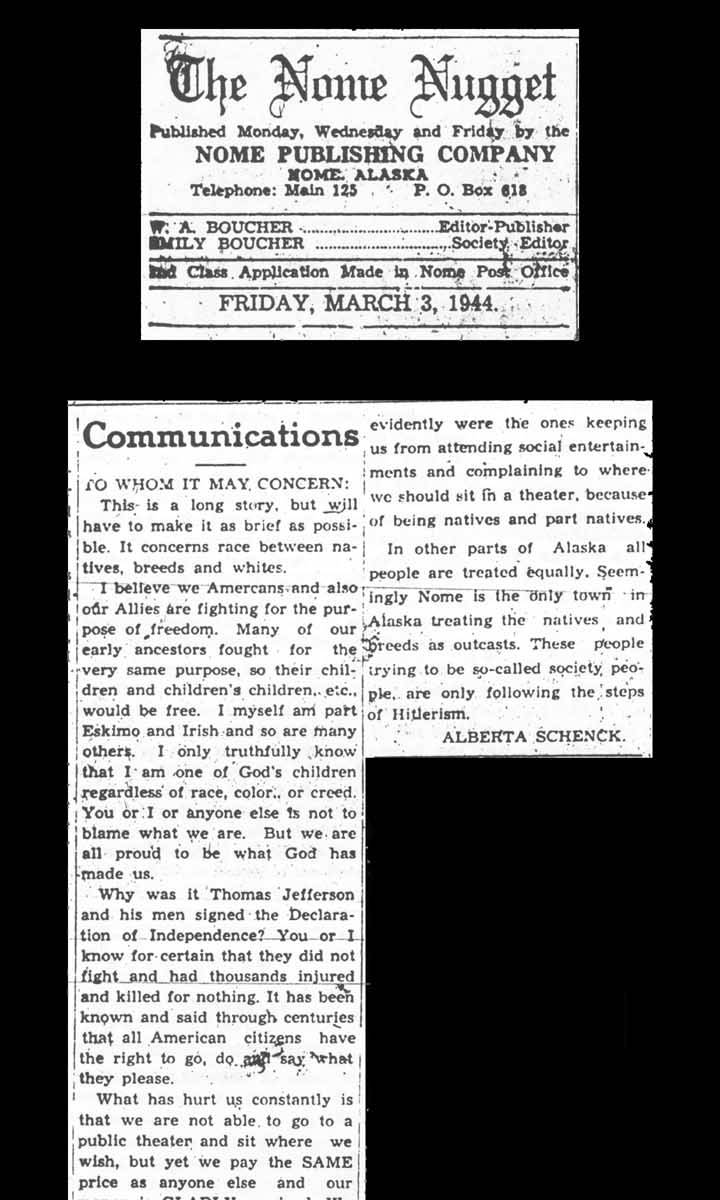
Alberta Schenck Letter

Who is Alberta Schenck? Well, she was the best kind of troublemaker. As a girl of mixed heritage (her mother was Inupiat and her father was white), Schenck faced discrimination against Alaska Natives and “half breeds” on several occasions. At the age of 16, she wrote this letter to the editor of the Nome Nugget, protesting the segregated seating of natives and whites at a local movie house, known as the Dream Theater. To say that the significance of her protest stretched beyond the specific policies of that specific theater would be an understatement.

It’s worth noting that Schenck herself worked at Dream Theater, at least she did until the letter was published. She later returned to that very theater on a date with a white army sergeant. After refusing to leave her seat, the Chief of Police for the city of Nome physically removed Schenck from her seat and she spent the night in jail.

Outrage over Schenck’s arrest helped eventually to fuel for passage of the Anti-Dicrimnatory act of 1945. She was subsequently elected Queen of Nome during the Spring Carnival of that year. This was in 1944, 11 years before Rosa Parks picked her fight with the city of Montgomery Alabama. …well before the sit-ins, or the freedom rides.

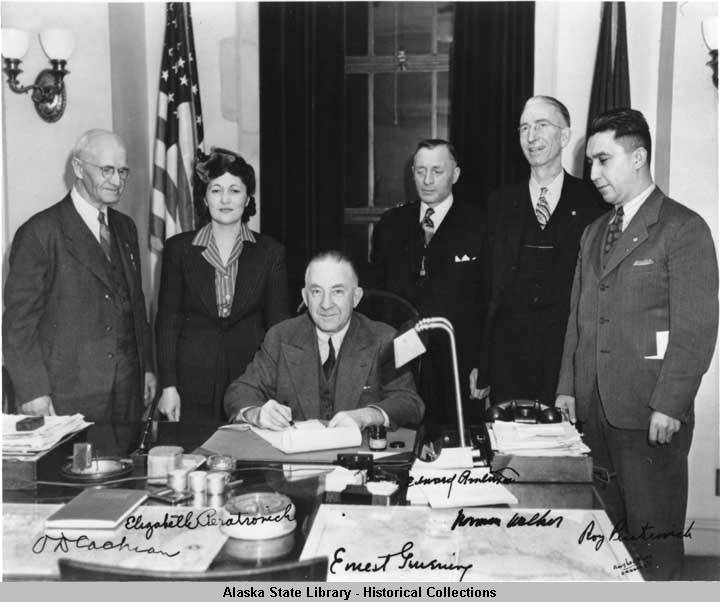
And then of course there is Elizabeth Peratrovitch, a Tlingit Native whose testimony before the territorial senate helped to secure the final passage of the Anti-Discriminatory Act, mentioned above. She said a lot of things in that testimony, but this particular line is particularly memorable:

I would not have expected that I, who am barely out of savagery, would have to remind gentlemen with five thousand years of recorded civilization behind them, of our Bill of Rights.

With actions like those of Alberta Schenck and testimony such as that of Elizabeth Peratrovich, the territory finally passed a law banning such acts of discrimination.

I should add that the law did not merely eliminate discriminatory policies at the government level; it forbade discrimination by private businesses. Opponents of the bill had argued, as many do today, that government had no role to play in limiting the choices of private businessmen. Fortunately, that argument lost in 1945, as it did in 1964, and as it should today. Those who imagine it is enough to keep government policies free of racial bias have seriously underestimated the impact of private discrimination. Here as elsewhere the individual decisions of private businesses were the centerpiece of segregation.

But my all time favorite story about civil disobedience in the great state of Alaska would have to be the “Duck in.” This narrative begins in 1918 with a treaty between the United States, Canada, and Mexico. Under this treaty, the U.S. agreed to ban the taking of migratory waterfowl from the period between March 10th and September 1st.

So what’s the trouble? That is the ONLY time that migratory waterfowl can be found on the North Slope of Alaska. For a people very much dependent on subsistence hunting for their survival, the terms of this treaty removed a critical resource from the Spring and Summer menu.

The issue does not appear to have been much of a problem, at least not until Alaska became a state and began to enforce Federal laws with greater diligence. Then Fish and Wildlife officers began arresting people and confiscating their weapons, and their catch.

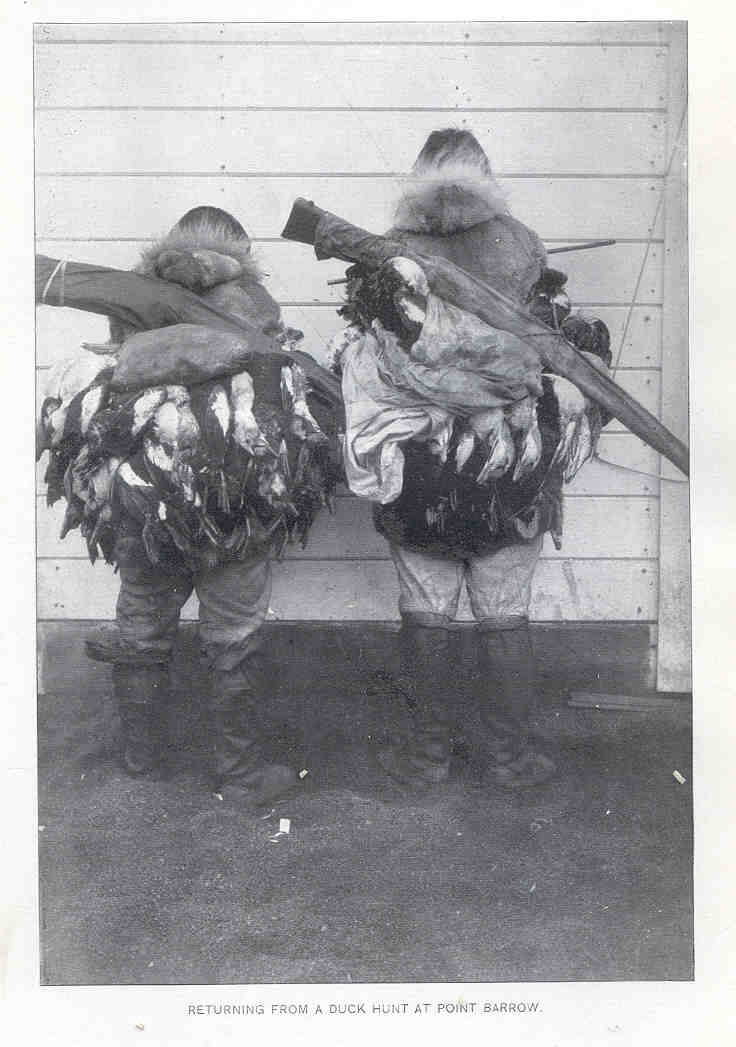
Duck Hunters at Point Barrow

How did the Inupiat population of Barrow respond to the arrest of people in their own community? How did they deal with a game warden in town to enforce the hunting regulations?

Well, they were very cooperative.

He found about a hundred and fifty Barrow residents outside his hotel room one day, each with a duck in hand. He didn’t have enough forms to process all the arrests, so Barrow Magistrate Sadie Neakok advised him to record the names on extra paper and attach them to the main form. And thus, everyone with a duck got counted.

Subsequent to this, State Senator, Eben Hopson, sent a request to then Governor, William Egan, asking that welfare officials be sent to help take care of all the children whose parents would be locked up due to enforcement of the law.

…and Fish and Wildlife simply stopped enforcing the regulations.

That’s called a ‘win’ folks!

*********************

Okay, that’s it, just a few of my favorite stories about troublesome Alaska Natives. I haven’t covered any of this with sufficient detail to do justice to these stories, so I’ll just briefly mention some better sources:

Rachel Naninaaq Edwardson produced a wonderful documentary on the Duck In. It is available through the North Slope Borough School District.

Wikipedia does seem to have a page on Elizabeth Peratrovitch. , and she is mentioned in quite a few additional sources. This one from Alaschool.org has a pretty thorough discussion of her contributions to the state of Alaska.

Numerous references to Alberta Schenck may be found in sundry parts of the net. Her memorial website would be a good place to start.

One good reading on the subject of discrimination would be an article by Terrence M. Cole, “Jim Crow in Alaska: The Passage of the Alaska Equal Rights act of 1945,” in Stephen W. Haycox and Mary Childers Mangusso (eds.) An Alaska Anthology: Interpreting the Past, (Seattle and London. University of Washington Press, 1996) pp 314-335.

The Images of Governor Gruening signing the Anti-discriminatory Act, Elizabeth Peratrovich, and Alberta Schenck’s letter are from Alaska’s Digital Archives. The image of Duck Hunters came from the Marine Image Bank of the Digital Collections at the University of Washington.

71.271549 -156.751450

Share this:

  • Tweet
  • Share on Tumblr
  • Print (Opens in new window) Print
  • Email a link to a friend (Opens in new window) Email
  • Share on Reddit (Opens in new window) Reddit
Like Loading...
Newer posts →

Top Posts & Pages

  • An Uncommon Security Guard: Dave Eshelman, AKA 'John Wayne'
    An Uncommon Security Guard: Dave Eshelman, AKA 'John Wayne'
  • I'll Just Leave This Here
    I'll Just Leave This Here
  • Hostiles and Spoilers: A Magic Studi
    Hostiles and Spoilers: A Magic Studi
  • Want to Hear Gay Porn? Listen to a Homophobic Crusader!
    Want to Hear Gay Porn? Listen to a Homophobic Crusader!
  • I Pledge Allegiance to the Declastution of the Divided States of O'Murica!
    I Pledge Allegiance to the Declastution of the Divided States of O'Murica!
  • Tom Horn Died for Your Sins
    Tom Horn Died for Your Sins
  • Fragments of Skepticism From My Youth
    Fragments of Skepticism From My Youth
  • Not Raised by Wolves, but Damned Close!
    Not Raised by Wolves, but Damned Close!
  • Thanks Fido, It Was a Rhetorical Question
    Thanks Fido, It Was a Rhetorical Question
  • Leetul Buurdz!
    Leetul Buurdz!

Topics

  • Alaska
  • Animals
  • Anthropology
  • atheism
  • Bad Photography
  • Books
  • Childhood
  • Education
  • Gaming
  • General
  • History
  • Irritation Meditation
  • Justice
  • Las Vegas
  • Minis
  • Movie Villainy
  • Movies
  • Museums
  • Music
  • Narrative VIolence
  • Native American Themes
  • Philosophy
  • Politics
  • Public History
  • Re-Creations
  • Religion
  • Street Art
  • The Bullet Point Mind
  • Travel
  • Uncategorized
  • Uncommonday
  • White Indians
  • Write Drunk, Edit Stoned

Blogroll

  • American Creation
  • An Historian Goes to the Movies
  • Aunt Phil's Trunk
  • Bob's Blog
  • Dr. Gerald Stein
  • Hinterlogics
  • Ignorance WIthout Arrogance
  • Im-North
  • Insta-North
  • Just a Girl from Homer
  • Multo (Ghost)
  • Native America
  • Norbert Haupt
  • Northwest History
  • Northy Pins
  • Northy-Tok
  • Nunawhaa
  • Religion in American History
  • The History Blog
  • The History Chicks
  • What Do I Know?

Archives

  • December 2023
  • November 2023
  • June 2023
  • April 2023
  • February 2023
  • December 2022
  • November 2022
  • October 2022
  • September 2022
  • August 2022
  • July 2022
  • June 2022
  • April 2022
  • January 2022
  • December 2021
  • November 2021
  • October 2021
  • September 2021
  • August 2021
  • June 2021
  • May 2021
  • March 2021
  • February 2021
  • January 2021
  • December 2020
  • November 2020
  • October 2020
  • September 2020
  • June 2020
  • May 2020
  • March 2020
  • February 2020
  • January 2020
  • December 2019
  • November 2019
  • September 2019
  • August 2019
  • July 2019
  • June 2019
  • May 2019
  • April 2019
  • January 2019
  • December 2018
  • November 2018
  • October 2018
  • September 2018
  • August 2018
  • July 2018
  • June 2018
  • May 2018
  • April 2018
  • March 2018
  • February 2018
  • January 2018
  • December 2017
  • November 2017
  • October 2017
  • September 2017
  • August 2017
  • July 2017
  • June 2017
  • May 2017
  • April 2017
  • March 2017
  • January 2017
  • December 2016
  • November 2016
  • October 2016
  • September 2016
  • August 2016
  • July 2016
  • June 2016
  • May 2016
  • April 2016
  • March 2016
  • February 2016
  • January 2016
  • December 2015
  • November 2015
  • October 2015
  • September 2015
  • August 2015
  • July 2015
  • June 2015
  • May 2015
  • April 2015
  • March 2015
  • January 2015
  • December 2014
  • November 2014
  • October 2014
  • July 2014
  • June 2014
  • May 2014
  • April 2014
  • March 2014
  • February 2014
  • January 2014
  • December 2013
  • November 2013
  • October 2013
  • September 2013
  • August 2013
  • July 2013
  • June 2013
  • May 2013
  • April 2013
  • March 2013
  • February 2013
  • January 2013
  • December 2012
  • November 2012
  • October 2012
  • September 2012
  • August 2012
  • July 2012
  • June 2012
  • May 2012
  • April 2012
  • March 2012
  • January 2012
  • December 2011
  • November 2011
  • October 2011

My Twitter Feed

Follow @Brimshack

RSS Feed

  • RSS - Posts
  • RSS - Comments

Enter your email address to follow this blog and receive notifications of new posts by email.

Join 8,070 other subscribers

Blog at WordPress.com.

  • Subscribe Subscribed
    • northierthanthou
    • Join 8,070 other subscribers
    • Already have a WordPress.com account? Log in now.
    • northierthanthou
    • Subscribe Subscribed
    • Sign up
    • Log in
    • Report this content
    • View site in Reader
    • Manage subscriptions
    • Collapse this bar
 

Loading Comments...
 

    %d