• About

northierthanthou

northierthanthou

Category Archives: Politics

Get ready to crack heads; cause shit gets real here, yo!

…or something like that.

The Mandela Effect Trumperates in Conspiratorial Oprahtations!

28 Monday Jun 2021

Posted by danielwalldammit in Politics

≈ 16 Comments

Tags

Burden of Proof, Deplorables, Donald Trump, GOP, Mandela Effect, Oprah, Quotes, Republican Party, Trump

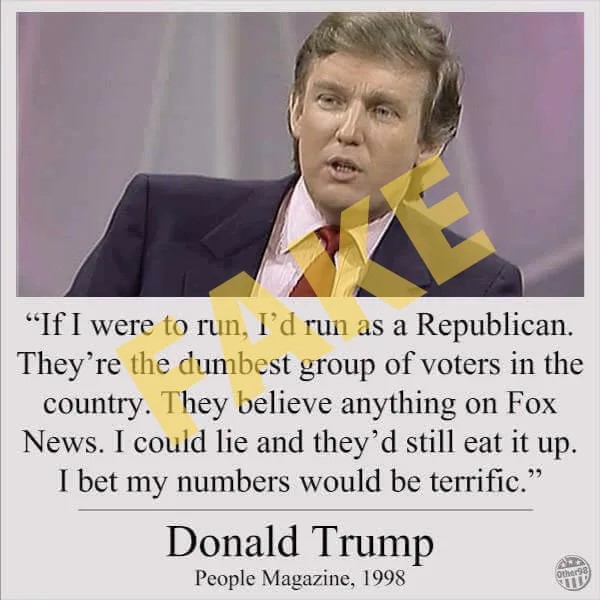
I see people passing this meme around from time to time. It’s pretty devastating, actually, or at least it ought to be. This of course makes the meme an awful lot like a lot of criticisms directed at the Trump camp insofar as one could really wonder why this isn’t an end-game argument? Except, in this case, there is a clear answer. The quote in the meme is not real.

At least, it’s undocumented.

The quote really is just a bit too perfect, really. It seems almost as if it was made up for the sole purpose of discrediting the man along with anyone foolish enough to vote for him. And the unfortunate fact is that it was probably made up for just that very purpose. In any event, there is no evidence that Donald Trump ever really said this.

Too bad!

Maybe this would have got some folks attention.

Then again, so many other things that should have mattered when he ran for President didn’t, not in 2016 anyway, and not now for those still waiting for the second coming of the deplorable messiah.

In any event, a few other folks have checked into this quote (The Reno Gazette Journal, Snopes, Politifact, CNN, etc.); all have found the quote to be spurious. Several noted that the meme itself first made an appearance in 2015, but all of those who checked for an actual source have come up empty.

Significantly, the meme attributes the quote to a statement made to People Magazine in 1998, but the image likely shows an appearance by Donald Trump on Oprah Winfrey in 1988. More on that later…

From time to time, I have tried to suggest that people refrain from passing along this meme as it does not appear to be accurate, and of course I encounter the usual bullshit responses from people too keen on their delicious gotcha-game to give it up on account of pesky questions about evidence. (It’s a little bit more frustrating to see such weak sauce coming from folks you might otherwise agree with than it is to hear it coming from the mouths of the deplorables, but anyway!) I figure anyone who thinks they have to use a likely fake quote to criticize Donald Trump has not been paying attention to the living train wreck that is his public life.

One thing does fascinate me…

I have frequently encountered people who swear up and down that they have heard Donald Trump make this very statement.

One of the reasons this caught my attention is the fact that I too once thought I remembered seeing a video clip of Trump saying this very thing. In the run-up to the 2016 election, I recall making a point to find the clip so I could post it on every corner of the net that I could reach. (I really wondered why a link to the clip wasn’t the obvious answer to every pro-Trump statement any republican could make?) Only I couldn’t find the clip anywhere, nor could I find an audio-recording, or even a credible written source. I did find a clip from the episode of Oprah in which she interviewed him about the possibility of making a run for the Presidency, but Trump does not say this on that clip. (In fact, his tone is wrong for the quote anyway. In the clip, he is trying to sound moderate and thoughtful, not brash and rude as he appears in the quote, or pretty much at any time during his Presidency.) Realizing that was likely the clip I thought I had remembered, I chalked it up to a bad memory and accepted the fact that I was likely wrong on that subject.

Yet people still insist they too have seen the clip and/or that they know other people who can verify that Trump did in fact say the very thing attributed to him in this meme. When I Tiked a Tok about this in 2020, a couple people told me that they would look around the net and get back to me when they found it. When I Tiked another Tok about it a couple weeks back, several people once again assured that it was real. A few people even got downright testy with me for doubting the matter. All of which leads me to wonder…

Is this the Mandela effect in action?

I know, pop-psychology is another net-hazard, but I can’t help thinking this instance might add up to a decent case for it. For those unfamiliar with the term, “The Mandela effect” refers to a shared memory that turns out to be false. It gets its name from a woman named Fiona Broome who had become convinced that Nelson Mandela had died in prison in the 1980s. She was also convinced that thousands of others shared this belief, all of which must have made his tenure as president of post-Apartheid South Africa from 1994-1999 rather surprising). Some might have their doubts about this particular source, but there are plenty of other examples of the Mandela Effect to be found. I’m not entirely sure why the notion of a shared false memory is all that surprising to begin with. We know that memory is a creative process, and it shouldn’t surprise us that perfectly public sources of information could skew the memories of more than one person thinking about any given subject. So, before, anyone goes off to see this as proof of an alternative universe wherein Trump actually did say this…

Oh man!

I suddenly realize I should have written this entire post on the premise that these are memories of an alternative universe in which Trump actually did say this, and perhaps even one where the Mandela effect really is proof that alternative universes do exist, but I can only hope that there exists an alternative universe wherein the American people were smart enough to say ‘no’ to this festering bloodfart back in 2016, but then, dammit, why do I have to live in the one where a whole buncha people just weren’t?

…Okay, so, before you go off thinking this effect points us to alternative universes, let’s just say this is just the sort of distortion that we ought to expect from perfectly fallible people trying to reconstruct our perfectly fallible memories in the present.

Anyway, the point, is I can’t help thinking the number of people who seem to remember seeing and hearing this (likely fake) quote might be a good example of the Mandela effect.

Other options?

  • One person told me the quote comes from Playboy magazine, but I have yet to see any direct reference to any specific publication.
  • Others have suggested the quote comes from an interview that Trump did with Howard Stern, but I think this is actually a reference to a clip in which Stern describes Trump as being contemptuous of his fan base. The stern clip is interesting, but its not Trump saying it himself, and I have yet to see any other relevant clips coming from Stern or any of his shows.
  • Quite a few folks have pointed to People Magazine, but this claim has been checked pretty thoroughly (see the fact-check links above), and nobody has found any evidence for it.
  • By far and away, the most common angle is to suggest that the actual quote comes from the Oprah interview that seems to be the source of the image contained in the meme. This is the most common clip from that interview. As you can hear from the clip, it does not contain the quote in question. A search on Oprah’s website, reveals a couple other clips that seem to come from the same interview, which appears to have occurred on April 25th, 1988. What I can’t seem to find, on Oprah’s website or any other source on the net, is any full-length recording of the complete interview. Apparently, others cannot find such a clip either.

The inability to find a recording of the complete Trump interview with Oprah creates an interesting problem. Why can’t we find such a recording? I for one have no idea. I don’t know how Oprah’s archives work, how thorough they were back in 1988, or just how common it would be for people to have at least an old VHS tape (or even a Beta) of the interview. I really haven’t assessed the odds against this absence of an episode actually happening by natural chance. For at least a few folks, however, this is all so damned suspicious. They will commonly tell us the complete clip has been scrubbed from the internet, and that the elites (including Oprah) have conspired to prevent any evidence of the quote coming out. We could talk about how likely this is (and here the Streisand effect might also make an appearance), or we could insist on asking for solid evidence for the authenticity of the quote, rejecting any excuses for the lack of it. That so many people swear they remember hearing Trump actually speak the words contained in the quote doesn’t count for nothing, but eye-witness testimony isn’t the most dependable source of information. It’s a little less dependable when it’s provided by random guys on the net. At the end of the day this leaves us with a larger question…

What do we do when we don’t know?

What do we infer (or simply assume) when we don’t get a definitive answer to our questions?

Short of any substantial evidence in support of the alleged quotation, this effort to suggest the absence of evidence isitself evidence of a larger conspiracy isn’t the least bit helpful. I like my conspiracy talk in the other guy’s camp where it can keep good company with the likes of Q-Anon fans, Birthers, and Truthers, none of whom have anything worthwhile to add to our present-day politics. I think it far more likely that all the people who think they remember seeing and hearing Trump speak the words in this clip are reading them into their memories of the common Oprah clip. It’s a shared memory, but it’s a false memory.

…and Trump is every bit as awful as any of us might remember. That memory isn’t false.

…and we don’t have to make up anything to criticize Trump.

…or the fools who support him.

Share this:

  • Tweet
  • Share on Tumblr
  • Click to print (Opens in new window) Print
  • Click to email a link to a friend (Opens in new window) Email
  • Click to share on Reddit (Opens in new window) Reddit
Like Loading...

Spurious Hitler Spuriates Furiously About Guns!

13 Sunday Jun 2021

Posted by danielwalldammit in History, Justice, Politics

≈ 2 Comments

Tags

Germany, Gun COntrol, Gun Lobby, Guns, History, Hitler, Nazi Party, NRA, Quote Mining

Thanks to Moni for a certain modification.

The notion that gun control was the key to Hitler’s tyranny (and in particular to the holocaust) has become a standard talking point among gun rights activists. To say that this is utter and complete bullshit is an insult to bullshit, which somehow ought to be accorded more dignity than this perfectly idiotic and highly deceitful bit of right wing rhetoric. It is, among other things, an effort to co-opt the story of an atrocity for the convenience of an interest group defined largely by those in positions of relative social power, and frankly, one that has historically included a rather large number of Nazi sympathizers. Simply put, those harping the notion that gun control is the gateway to the holocaust includes far too many people who face no such threats themselves, consistently show little to no concern for those that do, and who frequently express views which would put them closer to the guard towers of than the inside of any concentration camps.

There is nothing about this game that merits respect.

Nothing!

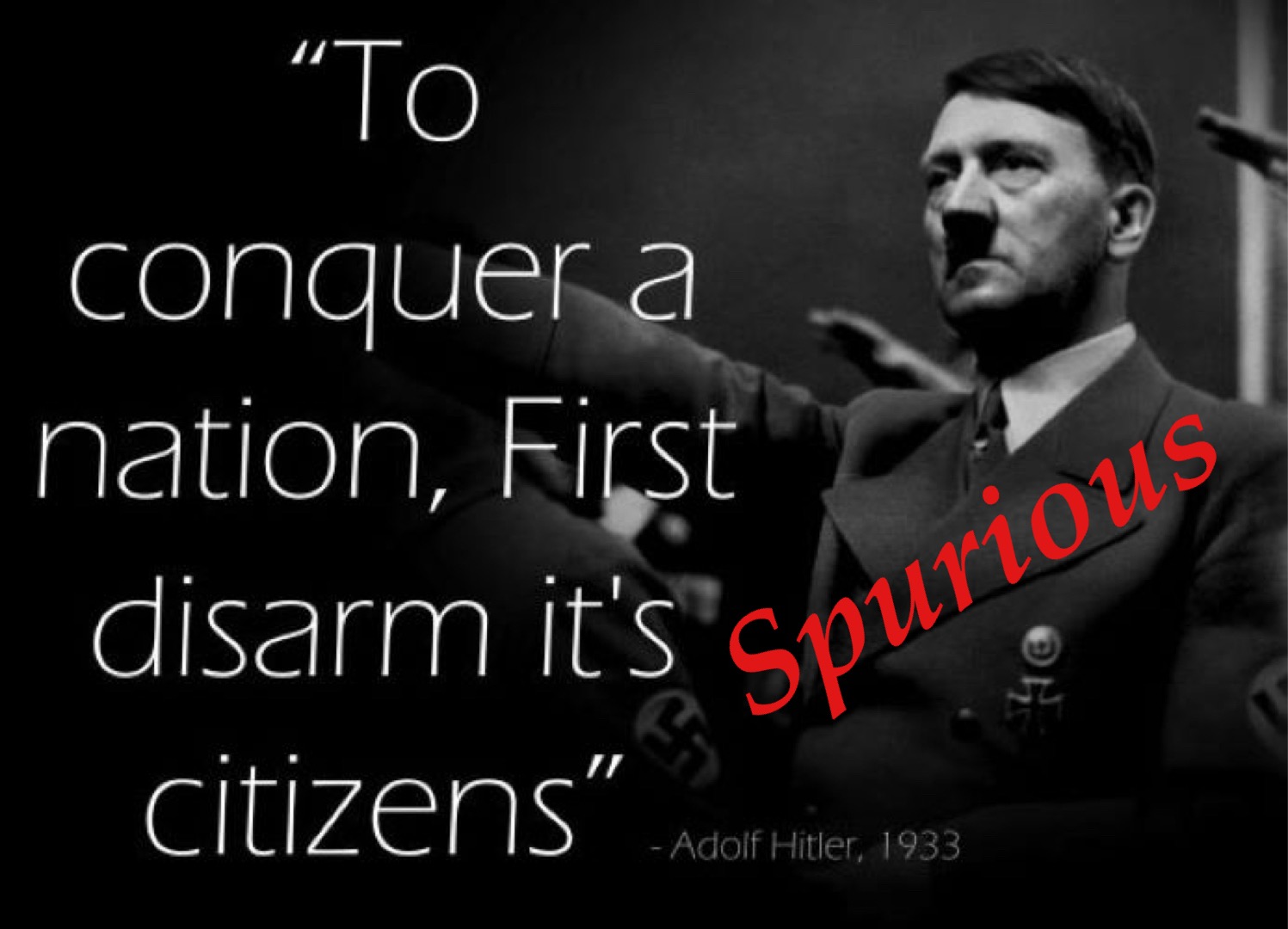
For the present, however, I wish only to remark upon one thing; a funny little made-up quote that features prominently in the babblerized politics of the gun lobby. Yes, it’s the quote of the meme to the left, which isn’t really all that funny after all, I suppose.

Except that there is no evidence that Hitler ever said it.

Of course, quote mining is a childish and deceitful enterprise to begin with. A single line here or there, presented entirely devoid of context, is no basis for drawing conclusions about anything. So, even when the quote is accurate, those passing these contextomies around like the tokens in a collectible card game are certainly not doing anything of merit.

But the whole pathetic project does get a lot worse when the quote itself is fake.

Excuse me, …spurious.

Oddly enough, Snopes thinks they have a candidate for something that comes close to this quotation, so they give it a mixed rating, saying that the claim that he said this is partially true. I think they are being overly generous, frankly, but anyway…

Let’s have a look!

The quote comes from a book called, “Hitler’s Table Talk, 1941-1944: Secret Conversations” which contains the following comments;

“The most foolish mistake we could possibly make would be to allow the subjugated races to possess arms. History shows that all conquerors who have allowed their subjugated races to carry arms have prepared their own downfall by so doing. Indeed, I would go so far as to say that the supply of arms to the underdogs is a sine qua non for the overthrow of any sovereignty. So let’s not have any native militia or native police.”

Of course, this passage does not match the wording of the quote in question, and those spreading that quote are not content to frame it as a paraphrase, so we probably shouldn’t let people get by with pretending to have an exact quote only to fall back on the pretense that it was only intended as a paraphrase.

It’s probably less helpful when someone else has to make that argument for them.

Anyway…

Snopes goes on to say that if you interpret “conquer a nation” in the spurious quote to mean making yourself a dictator over that nation, then sure, this actual quote from the actual Hitler would not fit the bill, because it is actually about the need to disarm peoples subjected by foreign conquest (eastern Europeans in this case).

If on the other hand, the phrase “conquer a nation” is taken to mean actually conquering another nation, then this quote might fit the bill after all because that is exactly what Hitler is talking about in the passage from the Table Talks volume.

The problem here is that the right wing use of this meme assumes the former definition, because the gun rights crowd is consistently using it as a means of commenting on domestic gun control. As always, the constant equation between gun control and disarmament is one of the central lies perpetuated by the gun lobby, but putting that aside, this quote doesn’t work at all if Hitler is really talking about how he means to treat subjugated populations of foreign countries, which Hitler is clearly doing in the table-talk passage. So, even if we grant the possibility that the quote could serve as a kind of paraphrase of the Table Talk passage, then the result is a passage that has no relevance to its present use by gun rights advocates.

So, even this bit of nothing much doesn’t mean what some folks might want it to mean.

Hitler simply didn’t say what some folks keep telling us he did.

At least, there is no reason to believe that he did.

Of course this is just scraping the surface of the garbage-heap that the present-day understanding of Nazi history among America’s ever-more fascist Republican base. Those closer America’s right wing gets to going full Nazi themselves, the more effort they put into redefining fascist policies and distorting the history so many of them now choose to emulate. Hell, I remember Glenn Beck once suggesting that empathy was the first step to the Nazi atrocities. If there was a time when America’s ‘conservatives’ would have known better, I can’t help thinking it is long since past. All of which is to say nothing of the not-even-post-hoc fallacy that goes with talk of a certain supposed gun control law, the Germans passed in 1938. In any event, the quote pictured above is fake.

Pardon me…

Spurious.

Share this:

  • Tweet
  • Share on Tumblr
  • Click to print (Opens in new window) Print
  • Click to email a link to a friend (Opens in new window) Email
  • Click to share on Reddit (Opens in new window) Reddit
Like Loading...

Religious Freedom and a Great Big Church!

17 Wednesday Mar 2021

Posted by danielwalldammit in Native American Themes, Politics, Religion

≈ 4 Comments

Tags

Blue Lake, Congress, First Amendment, free exercise, religion, Religious Crimes Codes, religious freedom, Taos, Taos Pueblo

What does religious freedom look like today?

Apparently it’s a wedding cake, or more to the point, the absence thereof.

Today, religious freedom is a-cakeism.

For some folks anyway!

Religious freedom has meant different things to different people at different times.

Let me tell you about a time when religious freedom looked like a lake!

I don’t have a picture of the lake. I don’t even have a picture of the absence of it, because the lake is real; I just can’t go to it. Most of us can’t go to it. That’s religious freedom.

At least it does to the people of Taos Pueblo.

What I am talking about here is a landmark piece of legislation, known as the Blue Lake Amendments, which was signed into law by Richard Nixon in 1970. The law returned Blue Lake, along with its watershed to the people of Taos Pueblo, in effect placing roughly 48,000 acres under trust title for the benefit of the Pueblo. This rationale for doing this was explicit; this was done because it was deemed the only effective means of protecting the religious freedom of Taos Pueblo and its people.

That’s right!

Congress placed 48,000 acres of land under trust title because doing so was necessary for the protection of religious freedom.

***

To fully appreciate this, you have two wrap your minds around two things (at least by my reckoning);

  1. it isn’t clear that Native American peoples practice ‘religion,’ or at least that this term with all its Euro-American baggage can be applied to any aspect of Native American society without distorting a few things in the process.
  1. Prior to 1970, Native Americans simply did not enjoy religious freedoms, and the elders of Taos Pueblo had been especially targeted for abuse on the basis of religious practices.

Is that a contradiction?

To say that Native Americans don’t necessarily have religions, then to say that their religious practices have been attacked?

Perhaps.

But only because language is a tricky thing.

***

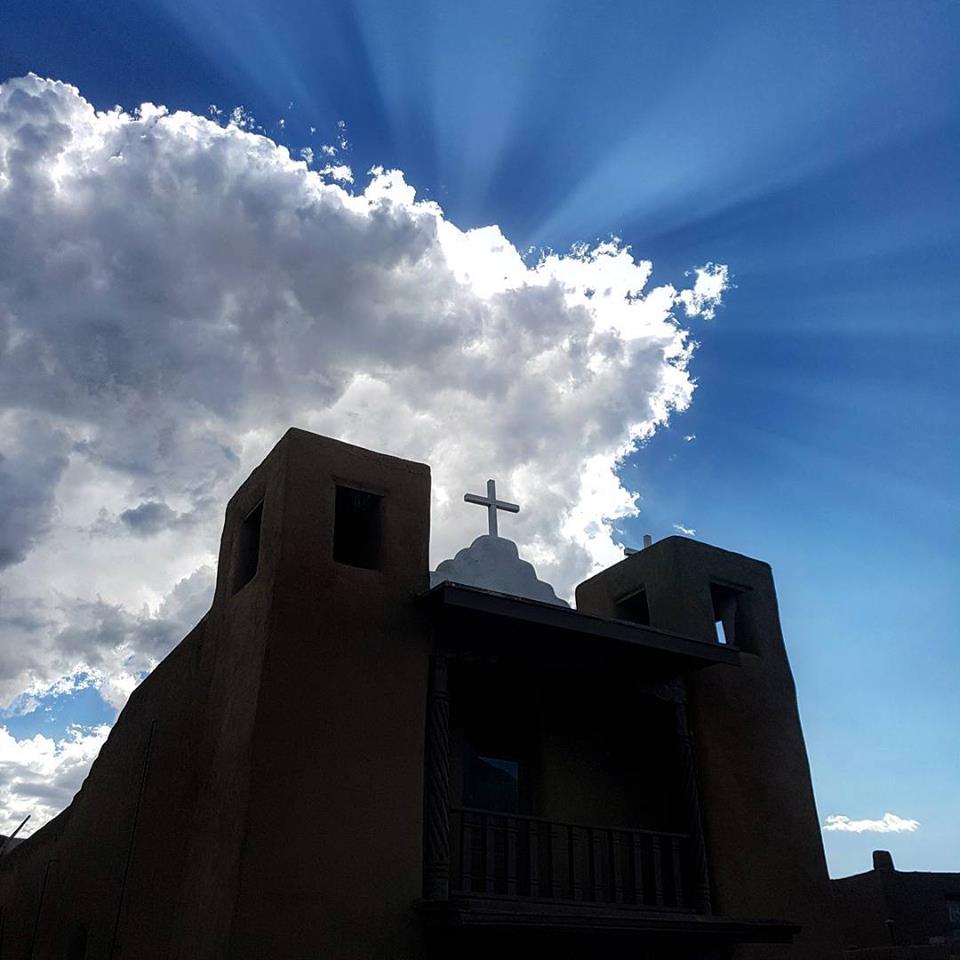
The current church at Taos

The first point is a question of social morphology, i.e. the language we use to chop up society into meaningful chunks of related activities. As it has typically been defined in western traditions, religion is a function of what you believe. Your membership in a given faith is a function of your decision to affirm or deny its tenets, and you religious practice is largely a function of prayer. Church may be a good place for prayer, but prayer is something you can do yourself.

As to the role of priests, mileage varies.

My point is simply that the concept of religious freedom has developed in a tradition in which religion is defined largely in individualistic terms. We can see how religion influences art, education, politics, and so on, but we can usually find some means of separating what counts as religion from what counts as the rest. It’s a lot harder to do this with Native American societies in which ceremonial participation was typically a function of community membership. Rather than helping Lutherans distinguish themselves from Methodists, etc. these ceremonial systems were historically much better suited to uniting communities, at least for a moment of social interaction. The practices in question are accordingly ubiquitous. Native ceremonial themes pop up in their politics, their art, their kinship, their hunting and farming techniques, etc. This is why the establishment clause was omitted from the Indian Civil Rights Act. It’s also why the word ‘sacred’ has become a highly over-used buzz-term in Indian-white relations. It’s short-hand for “this is important,” and for; “You guys probably wouldn’t understand.”

I think you could honestly say that Native American societies do contain almost everything we typically convey with the term ‘religion.’ What I don’t think we can say is that they isolate those elements of religious meaning from other aspects of their social life. This makes it kind of difficult to think about religious freedom in the context of Native American social practice.

Course it helps if you try.

***

North side of the Pueblo

Which brings us to point number two, which is that for most of United States history, you’d be hard pressed to find anyone who thought about any aspect of Native American life in terms of religious freedom. Few in Native American circles seemed to try the argument, and fewer still outside those circles were prepared to respect those freedoms, or even to recognize them as such. When the office of Indian affairs turned its attention to cultural warfare instead of literal shooting wars, one of the first things they did was to formulate the religious crimes codes outlining punishments for Native American religious practice. This was all part of the effort to ‘kill the Indian’ in order to ‘save the man,’ so to speak, but for the present, the point is that government officials deliberately sought to punish Native Americans for practicing heir own religions. They even used the word ‘religion.’

The word ‘freedom’ didn’t enter into it.

It’s hard to say just how much these rules were enforced. It fell upon indigenous judges to do this, and it should surprise no one if more than a few of those judges found reasons not to. What we can say is that Taos felt the sting of these codes well into the twentieth-century, In the 1920s, Commissioner of Indian Affairs, Charles Burke had a number of Taos elders locked up on the authority of the Religious Crimes Codes. He was particularly outraged that they had taken children out of the schools for purpose of training in the ceremonial kivas.

Somewhere between the 1920s and 1970, the political climate in America had changed sufficiently that same government which had once locked up Taos elders for practicing their faith (and in particular, for teaching it to their children) was now prepared to protect the religious freedom fof Taos people, even to the extent of making claims on a rather large tract of land.

***

What happened?

Significant changes in Federal Indian policy combined with shifts in the national culture may have helped the case for return of Blue Lake, but much of the credit would have to go to the Taos people themselves. Their own response to conflict over the lake forged much of the logic for return of Blue Lake to their land base. Arguably, their decisions also transformed the way that native and non-native alike came to view a range of issues now commonly thought of as involving matters of religious freedom.

***

Flowing down from Blue lake itself, this stream cuts through the center of town

The trouble began in 1906, when…

No, it began before that.

The trouble began with the Treaty of Guadalupe Hidalgo in 1848. This treaty concludes the Mexican-American war. Its terms include cession of lands to the United States, including present-day New Mexico, and it also includes guarantees that pueblo land grants within New Mexico would be recognized and protected by the United States. Unfortunately, Blue Lake was not in the land grant for Taos, a fact which had never been much of an issue under Spanish or Mexican occupation. As Americans began settling into the area, the lack of title would soon become a problem.

This brings us back to 1906.

In 1906, the Federal government placed Blue lake and the surrounding lands under the control of the Forest Service. Today, some will tell you this is when the trouble began. Interestingly enough, this wasn’t seen as trouble at the time. An informal understanding with administrators in the Forest Service served for a time to help protect the lake from outside encroachment. It wasn’t until later, with changes in local administration, that this legal status became a problem.

What made it a problem?

It was a problem that the forest service clear-cut a section of land within the watershed.

It was a problem that they stocked the lake with game fish for sport fishing.

It was a problem that they built a cabin by the lake.

It was a problem when they allowed visitors into the area.

None of these things were consistent with the Pueblo’s own use of the lake which was largely centered around ceremonial practices carried out at the lake at specific times of the year. The Forest Service was implementing its own multiple use policies and planning long-term harvesting of the trees, consistent with the conservationist policies of the era. Such practices threatened the pristine environment critical to the significance of the lake in Taoseño cosmology. These changes were already too much. Who knows what could happen next? So, the Pueblo began to seek return of Blue Lake.

The campaign to secure return of Blue Lake was a long haul. It took many twists and turns, not the least of them being an effort to bargain with the Pueblo Lands Board (in effect, conceding interest in lands held by non-native squatters in exchange for a recommendation that Blue Lake be returned, …the concession was accepted; the recommendation was not made). Somewhere along the line, there was a cooperative agreement with the Forest Service, but that didn’t work out. When the Pueblo won a case before the Indian Claims Commission, they side-stepped the financial compensation to which they would be entitled, seeking instead to secure the return of Blue Lake and its watershed. This was not within the mandate of the claims commission, so the Pueblo turned to Congress.

This is where the argument for religious freedom came in.

(Believe me, I am skipping a lot of great detail here.)

In their dealings with Congress, lawyers working for the tribe began making arguments for the return of Blue Lake based on an explicit appeal to the principle of religious freedom. The people of the Taos Pueblo needed exclusive access to the lake and its watershed to perform the rituals central to their religious practice. It was, so the argument went, their church. Even the need to explain all this placed a double-bind on the tribe, however, because much of the religious symbolism of the lake and the ritual performed there was secret, being known only to leadership in the kiva societies. As each of these societies was responsible for different aspects of the ceremonial system, this meant nobody within the Pueblo had full knowledge the matter themselves, let alone some outsider. Explaining the details of the ceremonial sustem to outsiders would violate their religious interests as effectively as preventing access to the lake. This was a problem that cut both directions. If providing this information was a threat to the religious freedom of the Pueblo, failure to do so was a problem for Congress. They had to be sure they were acting on good faith claims. The solution took the form of outside experts. Anthropologist John Bodine, was particularly helpful in outlining the significance of the lake for the Taos people to the satisfaction of Congress.

To be clear, this was a hard sell. Some folks balked at the notion of 48,000 acre church, let alone one that could not be fully explained to outsiders. Additional concerns were raised about other indigenous peoples with sacred sites of their own. What sort of precedent would this set? All of these questions and more stem from the uneven fit between indigenous ceremonial systems and mainstream American ideas about religious freedom, but how was Taos to answer them? How was Congress? A court might have addressed these issues differently. A court would have had to demonstrate its fairness to an opposing legal team, and a court would have had to think quite seriously about that legal precedent they were setting for future cases. But this was Congress, and Congress could set aside 48,000 acres without answering to an appeal or spelling out a precedent for the future. As a legislative body, Congress had more options than a court would, and that meant it could accept the argument for religious freedom as the basis for a one-time decision.

One-time deal, or not, Blue Lake was a precedent in the moral sense. It established the principle that Native Americans were entitled to religious freedom, and if their traditions were more difficult to address within the context of American legal system, this was no longer an excuse for ignoring them altogether. Congress would later pass The American Indian religious Freedom Act (AIRFA), affirming the principle of religious freedom for Native Americans and arguably mandating that federal officials take that freedom into account in their own policies. This didn’t always go as planned. Courts had a way of finding against native claimants throughout the 70s and 80s, a pattern which included several cases involving sacred sites, and of course Scalia took a wrecking ball to the whole damned free exercise clause in the Smith peyote decision. Compliance with the AIRFA by federal agencies has been a mixed bag. Yet, even these mixed results are a marked improvement over previous eras. Lest this seem like faint praise, one has only to remember the crimes codes and the fact that it was once official U.S. policy that Native Americans could be locked up for practicing their own ceremonies. Today, the notion that Native Americans are entitled to religious freedom, just like the rest of us, is now commonly accepted as a given.

It was Taos Pueblo that brought made this possible.

***

What does a sacred site look like?

In this instance, it looks like a lake that most of us will never see.

That is a kind of religious freedom.

***

A note on sources: At one time or another, I read everything I could on this topic, but that’s ancient personal history. I wrote this mostly from memory, and from an old grad school paper, but my old files aren’t with me. As far as I am aware, the best single source to get a relatively complete version of this story here was written by R.C. Gordon-McCutchan, Taos Indians and the Battle for Blue Lake.

Regarding the pictures, I am still nervous about them. It wasn’t that long ago that visitors to Taos Pueblo were expected to refrain from taking them. A few years back, I remember being told we could take them for personal use, and the last couple times I visited, we were simply allowed to take pictures with no restrictions mentioned. I think I still refrained from taking any pics for at least one visit, and finally snapped a few pics. It is a really beautiful place though, and if it is now okay with the Pueblo, as I believe it is, I thought I’d like to share the few images posted here.

Share this:

  • Tweet
  • Share on Tumblr
  • Click to print (Opens in new window) Print
  • Click to email a link to a friend (Opens in new window) Email
  • Click to share on Reddit (Opens in new window) Reddit
Like Loading...

At the End of Black History Month – Goddam!

28 Sunday Feb 2021

Posted by danielwalldammit in Justice, Music, Politics, Re-Creations

≈ 3 Comments

Tags

AhSa-Ti Nu, Black Lives Matter, Cover Tunes, Desegregation, Mississippi Goddam, Nina Simone, Race, Racism, Social Justice

As we close out Black History Month, and my two efforts to say something worthy of the subject ended up in the e-trash, I was thinking about giving Nina Simone the final word on the month here on my blog. A question struck me; has anyone covered “Mississippi Goddam?” Would anyone dare?

Turns out someone has.

Really glad I thought to look.

Share this:

  • Tweet
  • Share on Tumblr
  • Click to print (Opens in new window) Print
  • Click to email a link to a friend (Opens in new window) Email
  • Click to share on Reddit (Opens in new window) Reddit
Like Loading...

The Declastution, Reconsidered

27 Saturday Feb 2021

Posted by danielwalldammit in History, Philosophy, Politics, Religion

≈ 8 Comments

Tags

Conservatism, Constitution, Cultural Conservatives, God, Rights, Social Contract, The Declaration of Independence, Thomas Jefferson, U.S. Constitution

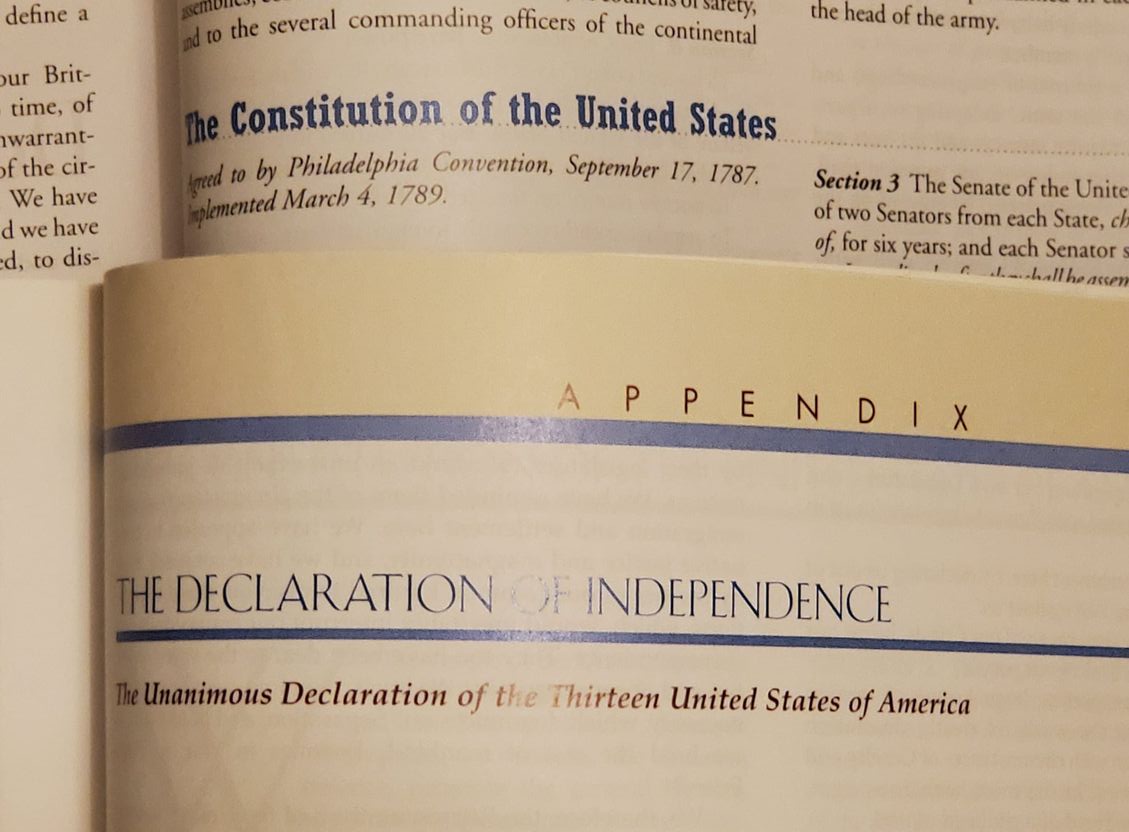
Have you ever had anyone cite the following words from the “Constitution?”

We hold these truths to be self-evident, that all men are created equal, that they are endowed by their Creator with certain unalienable Rights, that among these are Life, Liberty and the pursuit of Happiness.–That to secure these rights, Governments are instituted among Men, deriving their just powers from the consent of the governed…

Did this strike you as odd?

It should have, because that paragraph is not in the Constitution. It’s in the Declaration of Independence.

To be fair, I have seen people on both the left and the right make this mistake.

Some in the middle too!

Also, to be fair, the left, the middle, and the right are not equally invested in the mistake.

***

When the left confuses this passage from the Declaration with the U.S. Constitution, they are generally aiming at a point not altogether different from that of the preamble to the U.S. Constitution.

We the People of the United States, in Order to form a more perfect Union, establish Justice, insure domestic Tranquility, provide for the common defence, promote the general Welfare, and secure the Blessings of Liberty to ourselves and our Posterity, do ordain and establish this Constitution for the United States of America.

Lefties confusing the passage from the Declaration with the U.S. Constitution are trying to establish the importance of rights in the formation of government. Whether these rights are best thought of as ‘individual rights,’ ‘human rights,’ ‘civil rights,’ or even ‘natural rights’ is a rather more complicated question. The left and the right differ on that one, but most will find rights of some kind to be at issue in the nature of American government. Suffice to say the Declaration is content to describe them as ‘inalienable,’ which was enough to put them on the table in 1776. I have yet to see anyone on the left misquote this passage for any reason other than to establish the importance of our rights to the formation of the U.S. Government.

Perhaps, people can be excused for confusing the two passages, at least insofar as they both evoke the importance of government in facilitating the happiness of human beings (ignoring for the moment the gender politics of the passages in question). If there is any difference between the two passages, it lies in the agency involved. The Declaration is a little bit ambiguous as to who creates the governments ‘among men,’ but it does mention a ‘Creator’ as the source of inalienable rights. God is not mentioned in the preamble to the U.S. Constitution; it lays the responsibility for creation of the new government squarely at the feet of the people.

…which is where we get the biggest difference between the left and the right on the misreading of the passage from the Declaration.

***

When the right mistakes the Declaration for the Constitution, they are generally trying to tell us that the passage in question establishes the importance of God in our Constitution. Cultural conservatives will often tell us that God is mentioned in the actual Constitution. The only actual reference to God in the Constitution would be found in the date of its signatures wherein the document says;

done in Convention by the Unanimous Consent of the States present the Seventeenth Day of September in the Year of our Lord one thousand seven hundred and Eighty seven and of the Independance of the United States of America the Twelfth In witness whereof We have hereunto subscribed our Name

That reference isn’t much to hang your hat on.

Those simply telling us that God is mentioned in the Constitution are most likely thinking about that passage from the Declaration of Independence, which they have confused with the Constitution itself. In their imagination, and that of other confused Americans, the second paragraph of the Declaration is also the Constitution. The two documents are one in the same.

We might even call that document the ‘Declastution!’

When cultural conservatives confuse this passage with the Constitution, they are working a very particular angle. Their point is not the existence of rights (individual, civil, natural, or human); it is the existence of God. What they are trying to show us is that belief in God (or more specifically; belief in Jesus) is essential to the founder’s vision of American government. They wish to instill in American government (and by extension American law) an explicit homage to God in some official or quasi-official form. They like having Him on our money and in our pledge, and they like prayer in public schools and in public meetings, and many will happily seek additional entanglements between religion and government when and where they can get it. To them, the establishment clause of the Constitution is a narrow principle that prevents little more than explicitly sectarian policies (if it prevents even that). A general acknowledgement of God [or the Judeo Christian God (or, frankly; …Jesus)] in the official policies of the U.S. government is to them quite consistent with the Constitution, even required by it.

How do they know it is required?

Because that is how Jefferson wrote it.

Simply put, because the Declastution derives our rights from God, so conservative thinking goes, everything else that follows must hinge on the existence of God. Take away God and we have no rights and hence no government, and no ice-cream for desert, dammit, just go to bed!

(Sorry. I get carried away sometimes.)

Simply put; when the right confuses these two documents, they do so with a purpose.

Now the argument in question doesn’t always begin with a confusion of documents. Another common approach is to tell us that the Declaration is actually the ‘foundation’ of our government, and that everything about the U.S., including the Constitution itself is built upon that foundation. Over-used architectural metaphors aside, the point is to read the Constitution in light of the Declaration. We take the principles from the Declaration, as these guys understand them, and we apply them to the Constitution, so if God is mentioned the in Declaration, then he is implied in the Constitution, right?

Right?

Even if the Constitution itself says very clearly that the authority upon which our government rests derives from the people!

Anyway, that seems to be the point.

***

There are a couple problems with this, of course, and probably a couple more. These include the following:

1: Jefferson is the main author of the Declaration, and his own views on God are far from straight forward. He is often described as a Deist, though this might be a bit strong; he certainly was not an orthodox Christian. It is my understanding that he stopped short of denying the possibility of miracles outright (though he was sufficiently uncomfortable with the idea of miracles to remove them from his own account of the life of Jesus). So, what does the term ‘Creator’ mean in this passage? What could it have meant to Jefferson when he wrote it? There is little reason to believe Jefferson was talking about Jesus. Had he been referring to Jesus, there is still less reason to believe he would have had anything in mind like the present-day Christian understanding of their Lord and Savior.

2) More to the point, this is a political document, not a theological tract. Hell, it’s a propaganda piece! In writing it, Jefferson is committing an act of treason and trying to get enough support to survive the consequences of his own actions. He wants and needs to reach every colonist he can get to support the cause of separation from England. “Creator” is a nice way to reach Christians, Jews, Unitarians, and even the most strident of Deists without inviting any real cause for disagreement between them. I reckon, a few other beliefs could be read into that reference too, but I suspect Jefferson was more interested in reaching people in that range. Simply put, Jefferson wasn’t trying to separate the believers from the unbelievers with that reference, not by a long shot. What today’s Christians are doing when they read this document as an explicitly Christian (or Judeo-Christian) tract is to turn a document aimed at appealing to a broad range of religious views into an instrument for narrowing the range of views relevant to contemporary American politics.

Their fight was not Jefferson’s.

Far from it!

3) Finally, did I mention that this was a political document?

Cause its a political document.

Really, it is a political document!

The point of the passage in question is not to prove that God exists or even that belief in God, or subservience to God (or a Creator of any kind) is essential for public life. No, the point of the passage in question to establish the existence of rights, and from there to explain the existence of government as an expression of those rights and an instrument for satisfying them. This of course stands in stark contrast to the “divine right of kings,” which was still very influential in the merry Motherland. Jefferson’s point is not that God exists; it is that rights exist. God (or more importantly, a ‘Creator’) in this passage is merely a premise used to arrive at his political conclusions. Really, it isn’t all that clear that this Creator is all that essential to the premise anyway. Hobbes does a pretty good job of making a similar argument without giving a central role to such an entity. Jefferson’s begins with the assumption that people have rights. That they get them from a Creator is not entirely critical to the argument at hand; the point is that they have rights, and that these rights are the foundation of government.

…a theory of government in direct contrast to the notion that God himself had put the King of England in charge of the British people. The Divine Right of Kings, as James had espoused it, placed the authority for government authority on God, just as modern Christians would have it, whereas both the Declaration and the Constitution set the people up as the source of authority for government power. If God plays any role in this under the narrative contained in the Declaration, it is largely theoretical. Even that is missing from the Constitution.

Irony of ironies then that conservative Christians wish to read the Declaration as an effort to place God at the center of American government.

Not just ironic.

Perversely so!

***

It is no accident that cultural conservatives would wish to base their case for theocracy on the Declaration rather than the Constitution. The Declaration gives them foot in the door, at least if you don’t read it all that carefully. The Constitution doesn’t even give them that much.

The Declastution was born out of the need to ignore the difference.

***

I suppose the Declastution will live on in American politics for some time to come. People will continue to cite the Declaration while calling it the Constitution, and red the Declaration which they read as though it were a Baptist prayer book, but none of this has much to do with the meaning of the documents in question. It’s a kind of shell game the right wing likes to play with themselves, and with the rest of us.

They aren’t playing this shell game because they are interested in what either document has to say.

Far from it!

Share this:

  • Tweet
  • Share on Tumblr
  • Click to print (Opens in new window) Print
  • Click to email a link to a friend (Opens in new window) Email
  • Click to share on Reddit (Opens in new window) Reddit
Like Loading...

The Life of Q

23 Tuesday Feb 2021

Posted by danielwalldammit in Politics

≈ 2 Comments

Tags

Conspiracies, Conspiracy Theory, Facebook, Parler, Parody, Pizzagate, QAnon, Rumors, Social Media

“I am Q”

…said the real Q.

Dumbfounded, the crowd stared back at him. They glanced around at each other, and then turned their eyes back to him.

And there was much blinking.

Finally, a woman with long flowing hair mustered up the courage to speak; “The real Q would never call himself the Q.”

Many nodded and grunted their assent to this.

“Anyway, everyone knows the real Q is shorter than you,” added a tall man. “And Hunter Biden would have shot you by now.”

“Hillary’s emails would get you,” someone growled.

“It’s true,” echoed a short bald man. “If you were Q, exploding popsicles would have found you within mere moments of that confession.”

“No really, I am Q,” said the real Q.

“Oh really,” asked the short bald man, “what’s your favorite kinda pizza?”

“I…” the real Q hesitated “…I don’t really like pizza.”

The crowd gasped.

“What?” asked the real Q.

“You knew it was a trick question,” the tall man piped up. “Any kind of favorite pizza would condemn you once and for all!”

“Damned pervert, for sure,” echoed the woman with the long flowing hair.

“Pepperoni?” asked the real Q.

“Pervert!” answered the tall man.

“Canadian Bacon?”

“Pervert for sure,” echoed the crowd.

“But you knew that, didn’t you?” said the short bald man.

A well-dressed old codger sneered, “I’ll bet he likes pineapple on his pizza.”

“Told you, he was a pervert!” Said the woman with the long flowing hair.

“You didn’t say the wrong thing,” said the tall man. “It’s all very suspicious.”

“Could it…” Once again the real Q hesitated. “Could it be that I just don’t have a favorite pizza? Or maybe I know the deal with pizzas, because I’ve told you about them before, and I avoid them as all good Americans should?”

A chorus of rejection came pouring out of his ears; “No,” “Definitely not,” “Cut the bullshit!” “We know better!”

“Seriously, how do you know I’m shorter than, …well,” the real Q was getting irritated. “How do you know I’m shorter than me?”

“You once mentioned your shoe size,” said the tall man.

“It’s true,” nodded the woman with the long flowing hair,” I saw it on Parler.

“No, not Parler,” the old codger snapped. “He said it on Facebook; that was before we all turned our backs on Facebook?”

“We have?” asked the tall man.

Several people struck him with their hats.

“Anyway, it wasn’t his shoe size on Facebook,” said an old woman leaning upon a cane. “It was his favorite mug.”

“No, that was on Chan,” said a young man wearing spectacles.

“Don’t follow the Parler shoe,” shouted another woman. “Follow the Chan Mug!”

“No, he speaks to us through Rumble,” said another voice from the back of the crowd.

“Not the Rumble; the truth is on Parler,” the woman with the long flowing hair shouted.

“Was,” said the bald man.

“Was on Parler,” the woman with you-know-what-kinda hair corrected herself.

“OKAY FINE!” shouted the real Q. “You read my shoe size on Parler.”

“Facebook!”

“Fine, FACEBOOK,” shouted the real Q. “You read my shoe size on Facebook. How do you know that was me that wrote it?”

“We don’t.” Said a man named Tim. “we don’t know that you’re Q, so we don’t know that you’re the real Q. Even if you were the real Q, you wouldn’t really be Q to anyone who believed in Q, not even if you could prove that you are Q, or even if Q could prove you were Q. The real Q saw to it that no Q could be proven, so if you are here offering up proofs of your Qness, then you must not be the real Q after all.”

The crowd shouted in unison, “So say all the Q!”

“What?” asked the real Q.

“Do we get to stone him?” asked the tall man.

“Wrong parody,” said the woman with some kinda hair.

“OKAY, FINE! FINE!” The real Q shouted over the lot of them. “If I’m not the real Q, and you have no way of knowing just who is and who isn’t the real Q, then how do you decide when to assume someone is the real Q and listen to what he says?

All agreed this was a good question,

“Um,” A dim-looking man spoke slowly at first. “If it’s cool.”

The real Q shot him a dirty look.

A smart looking fellow with a tree on his shirt tipped back his hat and proclaimed loudly; “We decide it is the real Q if it is cool AND if it says bad things about people we want to think badly about.”

All nodded in agreement.

“But it does have to be pretty cool,” the dim-looking man added.

The crowd reluctantly assented to this addition.

“Look,” said the real Q, “This is why I came out to you. the joke has just gone too far. You can’t just treat a message as coming from Q if you hate the people it asks you too. You have to have some independent means of knowing whether or not they are worth hating.”

“That’s what Q is for.” said the bald man, “If it’s Q, then they are just as awful as he says they are .”

“And if you want to think they are as awful as he says they are, that’s how you know who is the real Q?”

“Precisely,” the crowd affirmed.

“Isn’t that what you wanted?” asked the woman who really did have hair.

“Well n…” seeing the crowd around him tense up, the the real Q hesitated one more time. “I mean, yeah; that was my plan all along.”

“Uh huh,” the tall man nodded. “Just when did you decide this was your plan?”

“When I realized that was the plan that you wanted me to have, which is exactly what real Q followers would want the plan to be and exactly how they would want the real Q to figure anything out, just as they do.” The real Q almost looked confident. “Right?”

“Maybe,” said the man named Tim.

“We’re going to have to run it by the executive committee,” said the tall man.

“The executive committee?” asked the real Q.

“Yes, the executive committee,” said the old codger. “The executive committee of the Proud People’s Front.?”

“Not the People’s front of Boogaloo?” asked the real Q.

“Hell no,” spat the tall man.

“Splitters! the crowd shouted in unison.

“I thought you guys were boogaloos.” said the real Q.

“Say that again and I’ll turn you into a liberal,” snarled the man named Tim.

“Not since Tuesday,” said the woman who’s hair really was a wig all along. “We don’t boog our loos, no more!”

The real Q strode to the center of the crowd and gathered up all of his courage. “Look, you can’t just live like this. You can’t be one group of terror, patriots, one day and a different bunch of patrio-terrorists the next, love Mike Pence in December and try to kill him in January. You can’t believe everything you read on Facebook one day and dismiss it all the next, learn everything you know from Fox news for decades and one day decide their a bunch of Goddamned liberals. Sooner or later you have to make an effort; you have to find some way of sorting the truth out from the crap and sticking with it instead of blowing like a leaf on the winds of the latest semi-pornographic narrative to catch your eye while surfing through cat memes. You just just can’t live like that!”

“We can’t.”

“No, you can’t. That’s no way to live!”

“DON’T YOU OPPRESS US!!!”

Share this:

  • Tweet
  • Share on Tumblr
  • Click to print (Opens in new window) Print
  • Click to email a link to a friend (Opens in new window) Email
  • Click to share on Reddit (Opens in new window) Reddit
Like Loading...

Addendum to the Legacy of Rush Limbaugh: The Cost of His Antics

20 Saturday Feb 2021

Posted by danielwalldammit in Politics

≈ 12 Comments

Tags

Affordable Healthcare Act, Birth Control, GOP, Legacy, Obamacare, Politics, Rhetoric, Rush Limbaugh, Sandra Fluke

I’ve read a few things about Rush Limbaugh this last week or so. Of course, I shared my own thoughts on the man, and no, they were not be the kindest things you might read about Rush, but I meant every damned word of it. What I see in the way of praise for Limbaugh coming from the right wing blogosphere in the wake of his detah has me shaking me shaking my head and grumbling. No surprise there, of course, but it does bring to mind an extra thought on the matter of this awful man and his awful legacy.

I have often thought that people like Rush Limbaugh do more damage to conservatism than they will ever do to liberalism or progressivism. We still think what we think over on this side of the political spectrum. Professional bigots such as Rush Limbaugh may be able to drown out our voices from time to time, but they can’t force us to follow their own script, to think the way they pretend we do. Our politics remains what it is despite their best efforts to distort it.

The same cannot be said of conservatism.

More than any other right wing hack, Rush Limbaugh successfully redefined conservatism in American politics. He made it what it is today. This is what all the countless posthumous dittos written in remembrance of rush consistently amount to, a story about hoe he redefined conservatism and effectively made conservative politics the force that it is today. Throw in a couple gratuitous bits of pseudo-patrtiotism and some faux Christian sentiments, and you have the bulk of what is said to honor the man; he made conservatism what it is today.

Just think about what that means!

How it actually worked?

The Sandra Fluke debacle is a great example. It illustrates perfectly why Rush Limbaugh’s impact on conservatism is nothing to celebrate. Sandra Fluke’s testimony was about an aspect of Affordable Care Act, something conservatives generally opposed. There were plenty of things that could be said in response to Fluke’s testimony. People could have questioned her estimates of the cost. They could have pressed her to substantiate various anecdotes in her testimony. They could have argued any number of details, and at the end of the day, there would still have been one very serious question about whether or not a national policy mandating the details of insurance coverage for institutions like Georgetown is really the best way to handle any of America’s healthcare problems, let alone those that Fluke was talking about. That is the debate I would expect to have with conservatives on such a matter.

That debate did not happen.

Instead, we got a national dialogue about the sex life of a law student.

We got the debate about the sex life of Sandra Fluke, not because she invited it, but because Rush Limbaugh preferred that round of right wing gossip to the substantive debate we could have had – should have had! In dropping this gigantic red herring on the national stage, Rush Limbaugh did not merely silence Fluke, he also silenced the legitimate voices of conservatives who had something worthwhile to say about the matter. This was not the decision of a strong conservative voice; this was the preference of a cowardly man who had nothing to contribute on the topic hand. Limbaugh had to lie to get his version of the debate in the public sphere, and he did not hesitate, not this time or any other. That his intervention could be thought of as a strong expression of conservatism is damning praise for conservatives. A strong voice for any cause doesn’t start diverting attention from the real issues, which was always Limbaugh’s modus operandi.

In the end, we on the left still know why we support the ACA, some form of universal payer, or any other sweeping national reform, but the ranks of Republicans who can tell you anything more than sordid stories from the right wing gossip industry grow thinner with every passing year. They do so, because right wing media was remade in the image of Rush Limbaugh.

What Rush did for conservatives was to replace their best arguments with a range of cheap gotcha games like the one he played on Fluke. Of course, by the time of the Fluke affair, Rush already had countless allied pundits who desperately wanted to be him. Combined with Rush himself, their collective chorus of nonsense effectively drowned out any serious efforts to discuss healthcare. Instead we debated whether or not Obama was a socialist, a Muslim, or Kenyan. And then of course, there was talk of death panels. Don’t make the mistake of thinking this nonsense is merely a means to an end; it drives the public consciousness and narrows the options of those who rise to fame on the basis of such lies. To this day, countless Republicans think Barack Obama is a Muslim and that he is not a natural born citizen of the United States. I also hear talk of lizard-people, but anyway… This was the crap that filled our nations airwaves as some struggled to fix our very broken healthcare system.

This was also the crap that fed the imagination of the idiots who stormed our capital.

And the sleazy right wing pundits and politicians who spurred them on.

…and the idiots who don’t understand how the one led to the other.

We can lay this fact, the fact that conservatives all over America were so easily distracted then and now, directly at Limbaugh’s feet. It was Limbaugh who took diversions like the one he played on Fluke to the top of the media market and the stage for propaganda operations like Fox News. It was Limbaugh that crushed any hope that conservatives with anything substantive to say would find their way into the news cycle and replaced it with an endless supply of bobble-head pundits ready and willing to caricature themselves and their supposed politics.

The modern republican Party is an talent agency for right wing media. Folks run for office so they can command better speaker fees and maybe even land a spot on some cable television program pretending to be conservative. Thoughts of actual governance completely escape the modern Republican leadership. That’s why Ted Cruz ended up in Cancun while AOC and Beto went to work helping people through the crisis in Texas. Time was when we could have debated whose vision was better for America. Today, we are left with the simple fact that they tried and he didn’t. Hell, Cruz didn’t even come back to address the crisis killing people in his state; he came back to address his own PR crisis, no more and no less.

If you think that example an outlier in Republican politics, then you have not been paying attention.

Limbaugh certainly did redefine conservative politics; he transformed it into a form of low-grade pornography. It sells better than conservatism did before he came along, and it distracts voters and party officials alike from the real work that needs to be done in American government. But it does get ratings.

Our former President liked ratings.

He liked them a lot.

These priorities did not come from nowhere. They came from a right wing circus crafted in the image of Rush Limbaugh.

Once again, his legacy is nothing to be proud of.

Share this:

  • Tweet
  • Share on Tumblr
  • Click to print (Opens in new window) Print
  • Click to email a link to a friend (Opens in new window) Email
  • Click to share on Reddit (Opens in new window) Reddit
Like Loading...

The Legacy of Rush Limbaugh

18 Thursday Feb 2021

Posted by danielwalldammit in Politics

≈ 24 Comments

Tags

#Conservatives, Birt Control, Healthcare, Obamacare, Propaganda, Republicans, Rush Limbaugh, Sandra Fluke, The Affordable Care Act

Rush Limbaugh passed away today.

I for one have no intention of dancing on Rush Limbaugh’s grave. Neither will I sit passively while the right wing echo chamber tries to fashion his memory into something worthy of respect and admiration.

Limbaugh consistently claimed to be doing satire. He was “illustrating absurdity with the absurd,” or so he liked to say. What this meant in practice was a good example of Schrodinger’s Asshole, the practice of saying something outrageous, then deciding whether or not you meant it based on the response you get. When Limbaugh got enough support, then he stuck to his guns. When he caught enough flack, then he was just kidding, and we liberals really needed to get a sense of humor. Teenagers do this. So did this professional bigot.

Often Rush would enter into a segment by noting some objectionable behavior carried out by someone on the left. He would ask, “What if I did that?” Then he would have a field day. The resulting rant could always be dismissed as a parody of liberal behavior, but that was only if such disclaimers were necessary. All too often what Limbaugh said following this kind of set-up became God’s own truth in the minds of his followers. What Rush did or didn’t mean by his comments on any given show was always up for revision. His ‘satire’ was never more than an exercise in plausible deniability, and his constantly insincere commentary carved a lasting place in the literal understanding of the ‘conservative’ mind of American politics.

So, what is Limbaugh’s legacy?

Let’s take a look at just one of the many interventions Limbaugh made in our national politics.

Limbaugh’s comments on Sandra Fluke.

This was part of the debate over The Affordable Care Act, specifically, a question about whether or not the Catholic University, Georgetown, was entitled to an exemption from required standards of insurance coverage for their students. The requirement in this case was the obligation to cover birth control. Sandra Fluke was one of several people called to testify before a Congressional committee on the matter in February of 2012, but she was excluded for for a number of reasons. A week later, the House Democratic Steering and Policy Committee met and invited her to speak.

In her remarks, Sandra Fluke, a law student at Georgetown, made the case for mandating full coverage of birth control at Georgetown. Her comments focused on the use of birth control to combat health problems such as polycystic ovary syndrome. Fluke told the story of a friend suffering from this condition, one who paid over a hundred dollars a month for birth control that was specifically used to combat this particular health condition.

At no point in her testimony did Sandra Fluke comment on her own sex life or any birth control expenses she herself might have had.

On February 29th, Rush Limbaugh commented on Fluke’s testimony with the following diatribe:

What does it say about the college co-ed Susan Fluke [sic] who goes before a congressional committee and essentially says that she must be paid to have sex — what does that make her? It makes her a slut, right? It makes her a prostitute. She wants to be paid to have sex. She’s having so much sex she can’t afford the contraception. She wants you and me and the taxpayers to pay her to have sex.”

(As quoted in The Huffington Post, emphasis in the original.)

Subsequent controversy focused on the rudeness of Limbaugh’s commentary, on his decision to call Fluke a ‘slut’ and a ‘Prostitute’. Many on the right wing of the political spectrum came to Limbaugh’s defense, but in this case the backlash was sufficient to threaten earnings for Limbaugh’s show. In response, Rush came out with the following apology.

For over 20 years, I have illustrated the absurd with absurdity, three hours a day, five days a week. In this instance, I chose the wrong words in my analogy of the situation. I did not mean a personal attack on Ms. Fluke. I think it is absolutely absurd that during these very serious political times, we are discussing personal sexual recreational activities before members of Congress. I personally do not agree that American citizens should pay for these social activities. What happened to personal responsibility and accountability? Where do we draw the line? If this is accepted as the norm, what will follow? Will we be debating if taxpayers should pay for new sneakers for all students that are interested in running to keep fit? In my monologue, I posited that it is not our business whatsoever to know what is going on in anyone’s bedroom nor do I think it is a topic that should reach a Presidential level. / My choice of words was not the best, and in the attempt to be humorous, I created a national stir. I sincerely apologize to Ms. Fluke for the insulting word choices.

March 3rd, 2012, As quoted in Wikipedia.

Limbaugh later added that he had acted to much like a liberal in making such remarks (Wiki again).

To say that Limbaugh’s apology was disingenuous is putting it mildly. The sheer irony of a man denying that he meant to launch a personal attack on a woman he had described as a ‘slut’ and a ‘Prostitute’ while lecturing her on the importance of personal responsibility is beyond outrageous. Adding that the nature of his error was essentially that he had acted too much like a liberal doesn’t help much. In effect, Limbaugh’s apology was really a thinly disguised effort to press forward with his attack.

Naturally, Fluke rejected his apology.

What always struck me as the most important outcome of all of this is the fact that Rush Limbaugh never retracted the central deceit of his comments on the matter. Fluke had not been talking about her own sex life or that of anyone else. Her point had always been that medical conditions could generate the need for birth control and even drive up its expense. One could find a lot to dispute in Fluke’s testimony, and reasonable arguments could be made about the policies in question, but it is simply not true to say that she was asking anyone to pay for her personal birth control. If Limbaugh was ever confused about this fact, he surely knew it by the time he produced his pseudo-apology. Not only did Limbaugh leave that lie on the table, he pressed forward with it in the very way he worded his fake apology.

In fact, the lie stands to this day.

Limbaugh’s fans, and countless ‘conservatives’ all over the United States still think of Sandra Fluke as the woman who wanted a university to pay for her own personal birth control, the liberal who wanted Georgetown to fund her own sex life. Whatever ‘conservatives’ think of Limbaugh’s language and general conduct, his narrative still dominates the right wing take on this matter. The lie that Limbaugh used to drown out more reasonable efforts at debating the policy implications of the day has never been rectified. It still clouds the issues, and it still paints a bullseye on Sandra Fluke which America’s right wing will be all to happy to take shots at the next time she dares to enter the public eye one more time.

This is Rush Limbaugh’s legacy. This is the long term outcome of his rhetoric, the result of a juvenile game of “maybe I mean it – maybe I don’t.” In this instance, Limbaugh’s intervention served not only to harm an individual but to leave a lasting source of disinformation which he never corrected in any way.

This lie is Limbaugh’s legacy.

This lie and countless others like it.

Share this:

  • Tweet
  • Share on Tumblr
  • Click to print (Opens in new window) Print
  • Click to email a link to a friend (Opens in new window) Email
  • Click to share on Reddit (Opens in new window) Reddit
Like Loading...

Fake Patriots and Fake George Washington Quotes

10 Wednesday Feb 2021

Posted by danielwalldammit in History, Politics

≈ 14 Comments

Tags

Founding Fathers, George Washington, Gun Rights, Guns, Memes, NRA, Quotes, Second Amendment, USA

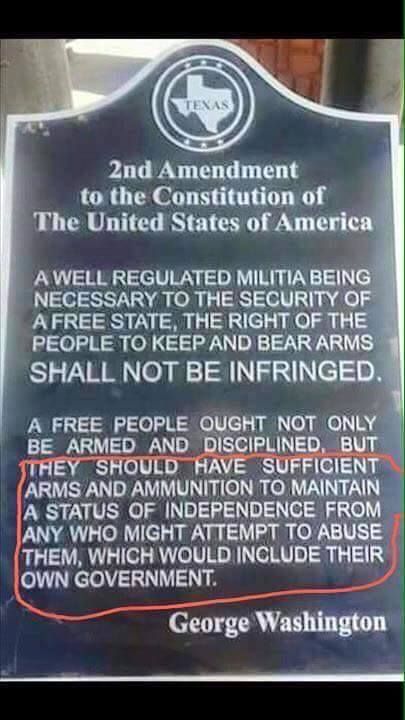
See this meme?

You can find it all over the net. The quote contained in it is extraordinarily popular in right wing circles. This should surprise nobody of course. It has George Washington singing the praises of private gun ownership as a means of preparing the population for possible war with their own government. The price of freedom, it seems to suggest, is the need to be ever vigilant against one’s own government, to be prepared at all times to rebel against that very government.

If you were to boil down the thinking of the Insurrectionists on January 6th, it might well be this quote right here.

There are different variations of the meme, to be sure, but the quote itself is near and dear to right wing America. They share it with each other, and with the rest of us, on a regular basis. I first encountered it when a friend posted it for my benefit on Facebook. I have seen it there many times since. The quote finds its way onto twitter every day. It certainly found its way into Parler a number of times before that crappy service found its way into oblivion. You can find the quote on Instagram. It’s all over Pinterest, compliments on websites like Zazzle and BrainyQuote. It certainly makes its way around Tumblr. You can find this quote on merchandise at various online outlets, …T-Shirts and such. I could go on, but you get the idea. This quote gets around. It’s popular.

I mean, it’s REALLY popular!

And it’s fake.

To be a bit more specific, the first 11 words of this quote are from the fourth paragraph of George Washington’s first address to Congress. Everything after that has been doctored so as to make it into a talking point for gun owner’s rights.

Here is the fake quote:

“A free people ought not only to be armed and disciplined, but they should have sufficient arms and ammunition to maintain a status of independence from any who might abuse them, which would include their own government.”

Here the original:

A free people ought not only to be armed but disciplined; to which end a Uniform and well digested plan is requisite: And their safety and interest require that they should promote such manufacturies, as tend to render them independent on others, for essential, particularly for military supplies.

Another Variation on this Fake Quote

(Emphasis added.)

So, what happens when you call people out on this? Well, sometimes, folks get the point. Some decent people actually take the correction and get on with their lives. More often, they refuse to believe they are wrong. Some just ignore you. Some sources, I suspect, are bots, programed to simply post this and other propaganda over and over without regards to any efforts to engage them. The most common response, I get, however is to tell me that the quote above is actually a paraphrase of something Washington actually said. Some even provide me with a link to the actual speech. (Whether or not they have read the speech is another question.)

In a parallel development, I have noticed a lot of people taking to twitter in recent years to post the actual quote above. This might well be a response to the fact that some of us keep addressing the fake quotes wherever we find it. Realizing they don’t need the fake quote, they use the real thing for pretty much the same political purpose. In their minds, the real thing is still very much a statement about the importance of the Second Amendment. It may not contain an explicit prescription for revolution-readiness, but at least it makes the case for private gun ownership, ad we all know what that means…

Right?

The problem is, it doesn’t.

If you read the rest of Washington’s speech, you can see quite clearly that its overwhelming theme is the exercise of the Federal government’s newly expanded powers. Yes, that’s right, Washington was actively working to expand the powers of the Federal Government, as did many of the founding fathers now celebrated by those whose very definition of evil is encapsulated in the phrase “big government.” One of the powers Washington was most happy to have at his disposal was the ability to outfit a viable military force. THAT is what this paragraph is about. It is nestled in between two other paragraphs that are most explicitly about troops and preparations for war. Keep reading that same speech, and you find Washington speaking quite explicitly about the prospect of war with Indians in the present-day southeast.

Among the many interesting objects, which will engage your attention, that of providing for the common defence will merit particular regard. To be prepared for war is one of the most effectual means of preserving peace.

A free people ought not only to be armed but disciplined; to which end a Uniform and well digested plan is requisite: And their safety and interest require that they should promote such manufactories, as tend to render them independent on others, for essential, particularly for military supplies.

The proper establishment of the Troops which may be deemed indispensible, will be entitled to mature consideration. In the arrangements which may be made respecting it, it will be of importance to conciliate the comfortable support of the Officers and Soldiers with a due regard to œconomy.

What Washington is actually talking about is the ability to field an army. He sees this as an essential exercise of the powers newly granted to the Federal Government under its new Constitution. He is urging Congress to encourage the manufacture of weapons so that the armies of the United States will not have to rely on foreign powers to arm them in the event of any future war.

Just to be clear, the prospect of such future wars certainly does include the possibility of open rebellion, but Washington isn’t arguing that citizens might need to rebel against their own government. If anything, he is mindful of the prospect that he might need to put down such a rebellion. Remember, it was Shays’ Rebellion that triggered the urgent need for a constitutional convention in the first place. Its purpose was to fix perceived weaknesses in the Articles of Confederation, specifically, the inability of the central government under that plan to tax the population directly so as to give it the means of fielding an army capable of putting down such an insurrection when it happens again. That’s right. The trigger for creation of the U.S Constitution was the need to put down rebellions, and Washington himself was fully down with that very agenda. Lest anyone think this might have been idle speculation, one has only to remember the whiskey rebellion.

When private citizens decided to rebel against the Federal government over taxation while Washington, foreshadowing so many of the themes of modern right wing politics, far from backing the rebels, Washington sent troops to put down that very rebellion.

Now there is an interesting detail here insofar as the troops in question took the form of a militia. I reckon some might say, “See! See, that’s what we are talking about,” but of course that ignores the difference between the actually regulated militias of Washington’s day, and the self-appointed weekend warriors who call themselves militias today. More to the point, it ignores the fact that the militia in the Whiskey Rebellion was not defending itself from “their own government”; it was actually serving as the arm of enforcement for that very government. You see, that Constitution whose powers Washington wants to flex here gives Congress authority over the militia, a provision quite controversial at the time, and arguably one of the inspirations for the Second Amendment still in draft form as Washington made this speech. One of the newly expanded powers of the Federal government Washington is actually trying to build upon in this very speech is power to arm and control the militia.

The enumerated powers of Congress includes the following:

To provide for calling forth the Militia to execute the Laws of the Union, suppress Insurrections and repel Invasions;

To provide for organizing, arming, and disciplining, the Militia, and for governing such Part of them as may be employed in the Service of the United States, reserving to the States respectively, the Appointment of the Officers, and the Authority of training the Militia according to the discipline prescribed by Congress;

Hopefully, you caught the part about “suppressing insurrections.”

Because that’s what Washington actually did on his own watch.

This meme would have us believe Washington would side with the rebels. This meme would have us believe that Washington was hyping the virtues of an Amendment not yet ratified as a means of countering the very power he was actually seeking to build in his First Address to Congress.

This meme is a lie.

It is not a paraphrase of Washington’s actual statement, and it is not (as several folks have assured me) an honest description of Washington’s actual views. It is not an honest mistake; it’s not a different point of view.

It is a lie.

***

FYI. The Spurious Quotes page at Mount Vernon certainly includes a brief repudiation of the quote. The text of the speech itself is certainly worth a read.

Share this:

  • Tweet
  • Share on Tumblr
  • Click to print (Opens in new window) Print
  • Click to email a link to a friend (Opens in new window) Email
  • Click to share on Reddit (Opens in new window) Reddit
Like Loading...

Some Damned Infamous Ducks!

08 Monday Feb 2021

Posted by danielwalldammit in Alaska, History, Native American Themes, Politics

≈ 2 Comments

Tags

Alaska, Alaska Natives, Civil Disobedience, Ducks, Economics, Hunting, Indigenous People, Native Americans, Subsistence Hunting

We Americans really love our independence, don’t we?

Or at least the thought of it!

Independence can be measured in any number of different ways, but in American politics, it typically means you earn your keep. Maybe you start a business and make a profit, or maybe you have a job and earn your pay, or maybe you speculate on the stock market (without or without the benefit of insider knowledge) and turn a profit without really contributing much of a product or service. Either way, the point is that we typically define our economic independence in terms the ability to pay our bills without asking for help (or at least not asking for that help through any medium short of the highest paid corporate lobbyists). Anyway, the point is, we pay our own bills right?

This is an incredibly ironic measure of independence.

This measure enables a real-estate tycoon to say that he built a structure when he didn’t lay a single brick. It also enables the average person to find shelter without building a house, to cloth himself without making the fabric or fashioning it into a shirt and pants, and it enables us to feed ourselves with all manner of meats and vegetables that we neither grow nor harvest ourselves. We have no idea where most of these things comes from or how it got to the stores where we bought it, not our food, our tools or any of the essential supplies we used for much of anything. Some folks may know a thing or two about fixing a car or building a table, but the fact remains that most people in the developed world lives our lives surrounded in mystery at the very nature of the stuff we use to get through the day. This we count as independence!

Because we paid for it!

It is ironic.

Contrast this with the indigenous peoples of the Alaska who until relatively recent history would have housed themselves, clothed themselves, and feed themselves. To varying degrees, many still do. In times past, the skills necessary to do so were common knowledge in any of these communities, and those skills turned what non-native Americans have typically called a ‘wilderness’ into a wealth of resources ready and waiting to be transformed into food, clothing, tools, and even housing. Small wonder that people so often described by outsiders as living in poverty would see themselves as wealthy. To someone without the skills to hunt, a caribou on the hoof is nothing until it finds its way into his freezer. To someone with the necessary skills, it is fine just where it is, at least until it is needed.

I do not mean to paint a utopian picture here, not by a log shot, but my point is that this is a very different vision of what it means to be independent. Here, the question is not whether or not you can pay for your stuff but whether or not your stuff becomes yours by your own hand, or at least that of your friends and family.

I also don’t mean to suggest that this is entirely unique to Alaska Natives. I reckon it would be true of indigenous people all over the world, depending to one degree or another on the impact of colonization.

***

One sees this conflict between a world of consumerism and a world of subsistence activities and play out quite regularly in the relations between Alaska Natives communities and outside institutions. Also in cultural conflicts between Alaska Natives and non-natives with or without the involvement of government entities. Sometimes, you have to look carefully to see it; sometimes, it is loud and clear for all to see.

The Barrow “duck-in” is one such time.

This story is told best by Rachel Naninaaq Edwardson, I think, in her documentary, The Duck In. Michael Burwell’s article, Hunger Knows No Law, is also an excellent source. If the quick & dirty version I am about to offer interests you at all, then by all means, check out either or both of these sources.

***

What happened?

In 1916, the United States entered into treaty with Governing governing the hunting of migratory waterfowl. A similar treaty was signed with Mexico in 1937. In 1918, Congress passed passed a law enacting the term of the first treaty into Federal law. This in effect made it illegal to hunt migratory waterfowl in the U.S. from March 1th, to September 1st.

Why is that a problem?

Because that’s when those birds are here on the North Slope of Alaska.

I mean a duck or two may head south a bit late, but no, for the most part, that’s when migratory waterfowl are present in this area. To say that hunting ducks and geese are a substantial part of the native subsistence economy is putting mildly. It does not appear that subsistence hunting was ever contemplated in the treaty negotiations, nor in the Congressional actions which codified the treaties in U.S. law. Both were intended largely as a means of controlling sport hunting, much of which would take place in the lower 48. So, a law passed for the purpose of controlling the leisure activities of weekend warriors who mainly feed themselves store-bought food had effectively banned the hunting activities of people who actually need that meat to get through the year.

Alaska Natives were out of sight and out of mind when the laws were made.

Luckily enough, they were also out of sight and out of mind (for the most part) for many years when responsibility for enforcing these laws fell upon federal officials. Thus selective enforcement helped to correct the errors of selective attention, for a time anyway.

When Alaska became a state in 1959, things started to change.

To make a long story short, state officials decided to enforce the law, even in the North Slope of Alaska. According to Burwell, some of these officials were convinced that the Iñupiat population of the north slope had become less dependent on hunting as local stores made produce available. The prospect that the Iñupiat community might be using the stores in limited ways while seeking to remain self-sufficient in others (and particularly, with respect to food) does not seem to have occurred to them. Resistance, they figured, they could be resolved by educating the population (which reminds me of the Navajo livestock reductions, but that’s a story for another post). In 1961, Wildlife officials began to arrest people caught hunting waterfowl during the proscribed period of time.

As it happens, that was a rough year for the North Slope insofar as the annual whale harvest had yielded only a two catches and other likely sources of game were not yet available.

…just the birds flying overhead.

To make a long story short, one of these agents, Harry Pinkham, emerged from his room at the Top of the World Hotel to find; “every man, woman, and child standing in front of my door with a duck in his hand.” Flustered to find an entire town demanding that they be arrested, he went to the local Magistrate Judge, a native woman, named Sadie Neakok (who provided the quote above). Neakok instructed him to follow the law. In all, 138 hunters self-reported their crimes and Pinkhman ended up confiscating 600 pounds of eider ducks (it took two separate plane trips to transport them out of town). State Senator, Eben Hopson (also a local Iñupiat) wired then Governor Egan to ask for welfare personnel to take care of the children once all the adults were taken into custody. Thus, what wildlife officials had hoped would be a matter of handing out fines and lecturing a few natives quickly escalated into a case threatening to overwhelm state resources.

Nobody actually spent time in jail for this, of course.

Instead wildlife rediscovered the virtues of selective enforcement, providing advanced warning whenever their officials were coming up to the North Slope and staying only for 3 days at a time. With these measures in place and well publicized, they really couldn’t have done much more to help hunters avoid getting caught. In time, of course, the laws and treaties were changed to accommodate the cycles of subsistence hunting.

For the indigenous community of the North Slope, this was a win.

A damned good one!

Don’t get me wrong! Conflicts over subsistence hunting rights are a still common, here and in the rest of Alaska, but in 1961, at least, the Iñupiat community of North Slope successfully fought off a threat to their subsistence activities by means of civil disobedience.

***

One of more interesting things about Rachel Edwardson’s work on this comes at about 16-minute mark in her documentary wherein she includes a series of public statements on the issue, all of which foreground the different political economies in question. Outsiders, of course, assumed that hunting, or at least subsistence hunting, would simply cease at some point along the inevitable march toward civilization. Was it not time, even past time, for folks to simply give up the hunt and buy their food?

“The Eskimos have claimed that the ducks leave their northern area before the legal hunting season opens. They also use such phrases as ‘hunger knows no law’ to justify their taking the ducks illegally. In this age of assimilation, where is the point at which the natives must forfeit must forfeit their old rights in favor of the rights of modern civilization?”

(Anchorage Daily Times, Editorial, June 15, 1961.)

“These people were from established communities where ample food is available. The basic conflict is the desire of the natives to continue certain primitive customs and yet live in civilized communities. All of us, including the Eskimos, must realize that the development of any country in the world brings with it advantages and disadvantages. This is true in any civilization, and it must have become obvious already to many of the native people of Alaska. Sincerely, Ralph A. Duncan, Special Assistant to the President.”

(Extract from Whitehouse Response to the United Presbyterian Church, Barrow Alaska)

Edwardson answers these statements with Eben Hopson’s statements on the subject (from his wire to the Governor, I believe). For his own part, Hopson begins by telling stories about people who feed themselves, whether by hunting or farming. He then turns the whole issue, on its head, he asks if anyone would accept a law forbidding the buying of meat at the store?

“We have survived from this land by hunting, just as any other John Dick and Harry have survived from the land by plowing the fields where they could raise crops. If there was law enacted without your knowledge making it unlawful for you to buy meat at your local store, and you continued to buy it because you needed it, I can see and hear you screaming up and down about that law being unjust, and discriminatory, the minute you found it out. If the meat was a matter of survival for your, would you stop eating meat for 3 months out of the year and wait for some disinterested person to come along and try to amend it for you without having assurance that the problem would even be solved.”

– Eben Hopson, State Senator.

I really don’t think the different visions of independence could be more clear than they appear to be in these letters. Those expecting the indigenous community of the North Slope to simply accept the laws in question clearly envision a future in which “Eskimos” buy their food at the store, just like the rest of us. This of course means that people will also get a job instead of spending their days out hunting or preparing for the hunt. It is a world in which people satisfy their needs by first first earning and then spending money. Those organizing and supporting the duck-in consistently envision a world in which they feed themselves. The modern world complicates both visions, of course, but this was a moment wherein the outside world appears to have forced the issue; as if to say; “Stop hunting and buy your food at the store.”

And the native community said ‘no.’

‘Hell no!’

Share this:

  • Tweet
  • Share on Tumblr
  • Click to print (Opens in new window) Print
  • Click to email a link to a friend (Opens in new window) Email
  • Click to share on Reddit (Opens in new window) Reddit
Like Loading...
← Older posts
Newer posts →

Top Posts & Pages

  • I'll Just Leave This Here
    I'll Just Leave This Here
  • A Joke from a Bygone Era
    A Joke from a Bygone Era
  • An Uncommon Security Guard: Dave Eshelman, AKA 'John Wayne'
    An Uncommon Security Guard: Dave Eshelman, AKA 'John Wayne'
  • Great Movie Villains, Volume IX: That Witch With a Bow!
    Great Movie Villains, Volume IX: That Witch With a Bow!
  • Arts District, Los Angeles
    Arts District, Los Angeles
  • An Ironic Beating
    An Ironic Beating

Topics

  • Alaska
  • Animals
  • Anthropology
  • atheism
  • Bad Photography
  • Books
  • Childhood
  • Education
  • Gaming
  • General
  • History
  • Irritation Meditation
  • Justice
  • Las Vegas
  • Minis
  • Movie Villainy
  • Movies
  • Museums
  • Music
  • Narrative VIolence
  • Native American Themes
  • Philosophy
  • Politics
  • Public History
  • Re-Creations
  • Religion
  • Street Art
  • The Bullet Point Mind
  • Travel
  • Uncategorized
  • Uncommonday
  • White Indians
  • Write Drunk, Edit Stoned

Blogroll

  • American Creation
  • An Historian Goes to the Movies
  • Aunt Phil's Trunk
  • Bob's Blog
  • Dr. Gerald Stein
  • Hinterlogics
  • Ignorance WIthout Arrogance
  • Im-North
  • Insta-North
  • Just a Girl from Homer
  • Multo (Ghost)
  • Native America
  • Norbert Haupt
  • Northwest History
  • Northy Pins
  • Northy-Tok
  • Nunawhaa
  • Religion in American History
  • The History Blog
  • The History Chicks
  • What Do I Know?

Archives

  • December 2023
  • November 2023
  • June 2023
  • April 2023
  • February 2023
  • December 2022
  • November 2022
  • October 2022
  • September 2022
  • August 2022
  • July 2022
  • June 2022
  • April 2022
  • January 2022
  • December 2021
  • November 2021
  • October 2021
  • September 2021
  • August 2021
  • June 2021
  • May 2021
  • March 2021
  • February 2021
  • January 2021
  • December 2020
  • November 2020
  • October 2020
  • September 2020
  • June 2020
  • May 2020
  • March 2020
  • February 2020
  • January 2020
  • December 2019
  • November 2019
  • September 2019
  • August 2019
  • July 2019
  • June 2019
  • May 2019
  • April 2019
  • January 2019
  • December 2018
  • November 2018
  • October 2018
  • September 2018
  • August 2018
  • July 2018
  • June 2018
  • May 2018
  • April 2018
  • March 2018
  • February 2018
  • January 2018
  • December 2017
  • November 2017
  • October 2017
  • September 2017
  • August 2017
  • July 2017
  • June 2017
  • May 2017
  • April 2017
  • March 2017
  • January 2017
  • December 2016
  • November 2016
  • October 2016
  • September 2016
  • August 2016
  • July 2016
  • June 2016
  • May 2016
  • April 2016
  • March 2016
  • February 2016
  • January 2016
  • December 2015
  • November 2015
  • October 2015
  • September 2015
  • August 2015
  • July 2015
  • June 2015
  • May 2015
  • April 2015
  • March 2015
  • January 2015
  • December 2014
  • November 2014
  • October 2014
  • July 2014
  • June 2014
  • May 2014
  • April 2014
  • March 2014
  • February 2014
  • January 2014
  • December 2013
  • November 2013
  • October 2013
  • September 2013
  • August 2013
  • July 2013
  • June 2013
  • May 2013
  • April 2013
  • March 2013
  • February 2013
  • January 2013
  • December 2012
  • November 2012
  • October 2012
  • September 2012
  • August 2012
  • July 2012
  • June 2012
  • May 2012
  • April 2012
  • March 2012
  • January 2012
  • December 2011
  • November 2011
  • October 2011

My Twitter Feed

Follow @Brimshack

RSS Feed

  • RSS - Posts
  • RSS - Comments

Enter your email address to follow this blog and receive notifications of new posts by email.

Join 8,075 other subscribers

Blog at WordPress.com.

  • Subscribe Subscribed
    • northierthanthou
    • Join 8,075 other subscribers
    • Already have a WordPress.com account? Log in now.
    • northierthanthou
    • Subscribe Subscribed
    • Sign up
    • Log in
    • Report this content
    • View site in Reader
    • Manage subscriptions
    • Collapse this bar
 

Loading Comments...
 

    %d