• About

northierthanthou

northierthanthou

Category Archives: Politics

Taking a Knee?

24 Sunday Sep 2017

Posted by danielwalldammit in Politics

≈ 41 Comments

Tags

America, Colin Kaepernick, National Anthem, Patriotism, Police, Race, Racism, USA, Violence

Institute of American Indian Arts (Photo compliments of Moni)

Not everyone really appreciates just how powerful the ritual of standing for the National Anthem really can be. I got a real sense of this when I was 14. My Jr. rifle team won the Wyoming-state BB-Gun finals, which earned our way to the International BB-Gun Championship in Bowling Green, Kentucky. …on July 4th. As the child of a career military officer, I was always happy to stand for the Star-Spangled Banner or to recite the Pledge of Allegiance, but standing there during the final ceremonies, the whole thing took on a whole new layer of meaning for me. That time, I had my heart in my throat. That time, the whole ritual moved me nearly to tears. I loved my country so much, and at that moment, putting my hand over my heart for that beautiful song was absolutely the most perfectly meaningful expression of that love I could possibly imagine doing.

There was something extra meaningful about the whole experience that came with doing it in the context of a sporting event. Granted the International BB-Gun Championships were really more of a national contest with Mexico and Canada thrown into the bargain, but being 14 and all, I was happy to go along with the rationale. In some sense, I was representing the country whose National Anthem we stood for. That gave the whole thing so much more power. The ritual lent extra meaning to the contest, and the contest gave more meaning to the ritual. On that day, for me anyway, the National Anthem was a deeply spiritual act. So, I can definitely understand the power that ritual must carry for many as it is done in sporting events all across the nation.

I can only imagine what the Anthem must mean for professional athletes who stand for the anthem before great audiences in the course of their career, but I do imagine the sense must be a little bit like the one I had at 14. I really cannot imagine what it must mean for servicemen who stand for the Anthem in the service of our country. Full stop. I really cannot imagine what it must mean to them. It must be a very powerful experience. What could one possibly do that would express their love of country more than standing for the Anthem?

…except perhaps taking a knee for it instead.

Seriously! Is it just me? Am I the only one who finds the whole protest oddly dignified, almost deliberate in its respect? Taking a knee could as easily be a gesture of fealty as one of protest. I can think of way more vile ways to disrespect the flag than kneeling respectfully and waiting patiently for the the completion of the Anthem. This protest almost seems like a gesture of respect in itself. Watching Colin Kaepernick and the others take a knee instead of standing, I always get strange sense that this supposedly anti-American gesture of contempt for America is at least a little bit like a gesture of love in itself.

But that’s just my sense of the gesture. Neither the iconography of the protest, nor the love of country are really the point of course, but the real point is hardly one that ought to threaten anyone’s sense of patriotism. Hell, I don’t see any reason why those standing with their hands over their hearts should be the least bit ashamed to do so beside someone who was taking a knee.

Unless of course they chose to ignore the reasons for taking a knee in the first place.

It’s not as though Kaepernick has been silent about his reasons for doing this. It’s not as though he has been just trolling the nation along with those who love it. I don’t see the man laughing at our collective discomfort. This same is true of others who’ve taken up the practice in his absence.

This protest was always about police violence, about the unnecessary deaths of black men at the hands of police, and that’s as good a reason to protest as any that I can think of. It’s the sort of thing people ought to care about, and those who choose to ignore it are far from proving their patriotism. With or without a hand over their hearts, those who insist we ignore the issue demonstrate little love for their nation at all.

It’s important to realize that those who insist on treating the protest as an insult to the nation are far from showing healthy love for it themselves. The likes of Tomi Lahren or the Manchurian Cheeto castigating the protesters for disrespecting the country do little but show how easily love can be confused with abuse. Right wing nationalists love their country in much the same way that an abusive husband loves his wife. Their professions of love always come in the form of demands, demands that others do their bidding. Those talking about how ungrateful (black) celebrities are when they protest demonstrate little but their contempt for the actual successful of African-Americans who have worked every bit as hard for that success as anyone else. And there is something perfectly appropriate about the pledge as they understand it. It is an obligation to the underprivileged among us to shut up and love the nation without complaint. This is not patriotism. It is abuse.

And abuse wrapped in a flag is still abuse.

I am well aware that folks have good reason to be skeptical of those who’ve brought the issue of police violence against minorities to public attention in recent years. Some terrible things have been done in the name of Black Lives Matter and other left wing protesters. I also expect that some of the cases of alleged police abuse reflect instances in which the police in question were doing their job as best they can, their very difficult and very dangerous job. I can definitely understand a desire to support police against undue attacks from radical protests. And yet, I keep coming back to this one question; with all the footage and news reports of various cop shootings, beatings, etc., are there none that merit genuine concern? Are there no instances in which the actions of the police seem excessive? Even when the decision to pull the trigger seems justified in the heat of the moment, are there no questions about how it got to that point? Are none of these worthy of reconsideration? No police practices or policies worthy of reconsideration?

None?

I expect most of us can think of at least a few instances in which the actions of police officers on the street or correctional officers in the prison system are indeed questionable. It is precisely those instances which the right wing response to Black Lives Matter and/or protests like that of Colin Kaepernick are intended to keep from public scrutiny. Th right wing leaders are not saying that we should take care to distinguish actual police abuse from sensationalized instances of cops doing what cops do. What the right wing echo chamber has consistently done throughout the media curve on this issue is to demonize the protesters and insist that we support the police, categorically, across the board, with no damned exceptions. In effect, the likes of Sheriff Clark, Joe Arpaio, or the pathetic traitor who now disrespects the White House with his every breath are demanding that we refuse to distinguish actual police violence from proper execution of the job. These people are not defending good cops. They are defending bad cops. And they have been doing everything in their power to make sure that the rest of us cannot tell the difference.

It’s not a coincidence that the same people who don’t want us to put much scrutiny into the actions of cops on the beat are also big fans of civil asset forfeiture and private prisons. By means of the first, police steal from private citizens. Let me repeat that, by means of civil asset forfeiture, the police steal from private citizens. By means of the second, government cronies steal from the rest of us to line the pockets of those manning these prisons, the same prisons holding countless people on unnecessary drug offenses. Hell, these are the same people who want to arm more of the police with military grade weapons. This too costs money, money spent on both serious crime and frivolous crime (which are often much easier to prosecute). The police state is big business. And Americas right wing hacks do NOT want the rest of us messing that business up. They don’t want the public to sort their crimes from the actions of law enforcement genuinely serving the public interests. They want the public to buy their policies and fund their budgets in the heat of a fever, Hell-bent on getting more law-enforcement, law-enforcement of any kind.

This is why the right wing wants to silence the protesters. This is why the wanna-be dictator in chief is demanding the NFL do something about those taking a knee. It isn’t because those taking a knee at a ball game are unpatriotic. It’s because those demanding their silence are themselves without a public conscience. It is because they are working very hard to make this country more dangerous for all of us, starting those of darker skin.

The right wing response to these protests has been a calculated attempt to turn those standing with their hands over their hearts against those taking a knee. They want those feeling the surge of straight-laced patriotism in all it’s apple-pie glory to mistake public conscience of those those taking a knee for something sinister and disloyal. It is a perversely ironic response to the protests. It simply isn’t those taking a knee here that betray their country.

Quite the contrary!

Share this:

  • Tweet
  • Share on Tumblr
  • Print (Opens in new window) Print
  • Email a link to a friend (Opens in new window) Email
  • Share on Reddit (Opens in new window) Reddit
Like Loading...

Violent Memories and the Civil War Era in the Southwest

20 Sunday Aug 2017

Posted by danielwalldammit in History, Native American Themes, Politics

≈ 17 Comments

Tags

Civil War, History, Kit Carson, Monuments, Navajo, Old West, Santa Fe, Southwest, War

It must have been a couple decades back. I was at a small party in Forth Defiance. Those attending included a number of officials in the Navajo tribal government. Fort Defiance serves as kind of a bedroom community for the capital of the Navajo Nation, so this was hardly unexpected. What none of us expected that evening was a quick lesson that began when our host asked if anyone knew the name of the main street going through the town? No-one did. As it happens, the name was Kit Carson Drive.

Kit CarsonApparently, it still is.

To say that most of the party-goers found this shocking is putting it mildly. It may not be obvious to some of my readers why a room full of Navajos would object to a street named after Kit Carson, but even the most cursory knowledge of their history would make this pretty well obvious.  The man is popularly known as an old western Indian fighter, and as it happens, a good number of the Indians he fought were Navajo.  When General James H. Carleton, the Army Commander for the Territory of New Mexico decided to go to war with the Navajo people, it was Colonel Kit Carson that he sent off to do it. Carson marched through Canyon de Chelly, the heart of Navajo territory, destroying resources (just as Sherman might have) and letting winter bring his enemies in to surrender. This campaign, and the four years of internment at Hwéeldi (Fort Sumner) still constitute the darkest chapter of most historical narratives about the Navajo people. So, you can just imagine what it must have meant for people who can still tell you about relatives lost on the long walk to Fort Sumner to learn that a road right through their community bears the name of the man responsible for their deaths.

Kinda put a damper on the party.

You might think it odd that folks didn’t know the name of the road to begin with, but it’s hardly unusual. Folks don’t pay that much attention to street names out that way. Many of the roads don’t have signs at all, and I don’t recall seeing that particular name on a street sign when I lived out there (though one can certainly be found in Fort Defiance today). This party was the only time anyone ever mentioned it to me.

The old south isn’t the only place in this country with a questionable sense of public history from the Civil War era. Those in the Southwest have less to do with the war between the states than the early stages of the Indian wars which would dominate the interior west for a couple decades. Kit Carson Drive is one of many such examples. The Obelisk in the town square of Santa Fe provides another. It’s had its own share of controversies over the years, not the least of them being this dedication:

20914595_10214035631069907_2575022190736341192_n“To the heroes who have fallen in various battles with savage Indians in the Territory of New Mexico.”

It should come as no surprise that this line acquired its share of critics over the years. It has had some defenders as well, to be sure, but plenty of critics. The sentiments might have seemed appropriate enough to those who erected it in 1868, but in the 1970s, sentiments had changed a bit, as had the political status of some of those ‘savage Indians’ referenced in the piece. So it really should have come as no surprise when calls went out for removal or modification of the monument. Today, at least, it may seem a little surprising to find the monument had Native American defenders, which apparently it did. Attempts were made to put the original wording into it’s proper context, so to speak, preserving it without appearing to endorse it, but some clearly weren’t satisfied with this way of thinking about the issue. Resolution apparently came in the form of a chisel, and the result is a monument with its own fill-in-the-blank question.

20992726_10214035596509043_4949865469052976294_n

It seems, the American public is hashing out a new round of debates over public monuments, particularly those in the South. Some no doubt find the entire debate quite trivial. Who reads the placards on a monument anyway? Of course when people fight over seemingly trivial things, you can bet your ass they aren’t really fighting over the trivial things. It isn’t actually history (much less historical monuments) that has people up in arms over Confederate Statues, just as it wasn’t really history that caused a word to fall off the monument in Santa Fe. Such battles are always about the present. They are about the way that people think and use history to shape the present, and there are usually some very specific present implications in these battles.

People typically see the present interests loud and clear when they confront advocates of social justice. If anyone ever forgets this, the term ‘political correctness’ is right there to remind us that someone (or at least someone on the left) has an agenda. What folks are slower to get, it seems, is the fact that these sorts of gestures are hardly neutral to begin with. There is a reason James W. Loewen devoted a fair portion of his book, Lies Across America, to Confederate monuments, and it wasn’t because these monuments contain sober and thoughtful commentary on the actual history of the region. A statue to a confederate hero isn’t just a reference to history as such; it says something to those who those whose ancestors those heroes fought to keep in bondage. And a monument to heroes who died fighting ‘savage Indians’ may say something noble to those descended from colonists (Spanish or Anglo) in the American southwest; it says something else to those descended from those very ‘savage Indians’.

To be sure, complications abound. Some folks may have ancestors on either end or neither of his memorial demographics, and some people may have no dog in the fight at all. Also ironic usage happens. Not every Native American takes umbrage at the word ‘savage’ just as not every Native American objects to the term ‘Redskins’. But we should be wary of efforts to make these exceptions into the rule. The Washington football team has, for, example paid good money trying to find, cultivate, and promote just about any Native American willing to help foster the notion that the team name reflects anything but a racist stereotype. Were the team name really so bland, one might almost wonder what use it would have for people interested in such a martial sport! And of course we now have the Cheetoh-in-Chief (who has his own bullshit civil war monument) mourning the loss of beautiful artwork and a desecration of history with every Confederate statue that goes down. His language is so flowery and positive. You’d almost think these monuments held no serious political significance in the present age.

Of course the folks delivering the Nazi salute in defense of Robert E. Lee might seem to argue otherwise.

There are people, times, and places who don’t find it necessary to remove or modify monuments to their sordid past. Some of these might not even be terrible people, places, or times. But if the monuments to an abusive past aren’t so toxic, this isn’t simply because potential critics choose to let it slide; it’s because the community as a whole has somehow managed to handle the issues in question. When the dominant voices prove tone-deaf or outright hostile to the interests of those on the wrong-side of monumental history, then we are all a lot less likely to get along. Then statues get pulled down.

…or someone just shows up with a chisel.

***

Just a few pics of Canyon de Chelly (click to embiggen):


19732010_10213608255385782_3134402216345552500_n
20264884_10213790741107811_6139379835115073225_n
20776824_10213976954923040_6197824098058023091_o
20799382_10213964731857471_643789261344359561_n
19554785_10213533887766638_4703562301468482973_n


Share this:

  • Tweet
  • Share on Tumblr
  • Print (Opens in new window) Print
  • Email a link to a friend (Opens in new window) Email
  • Share on Reddit (Opens in new window) Reddit
Like Loading...

Race Card Recursion: A Game of Social (In-)Justice

07 Monday Aug 2017

Posted by danielwalldammit in Politics

≈ 29 Comments

Tags

Cards, discrimination, Equity, Ethnicity, Race, Race card, Racism, Social Justice, Social Justice Warriors

a3wnwcyAWhat is the race card?

Or is that obvious?

Okay, I don’t guess there is much mystery as to the meaning of the phrase ‘race card’. It’s consistently employed as an accusation that someone has used the prospect of racism cynically to their own advantage. Maybe they have accused someone of discrimination who didn’t deserve it, or maybe they are just complaining about some general sense of inequity when (so the thinking goes) they ought to stop playing the victim and do what it takes to succeed in life. Either way, to say that someone has played the ‘race card’ means that they’ve raised the prospective of racial disparity on spurious grounds. It’s as if someone has raised the issue simply because they can.

…a bit like playing a card simply because it’s in your hand.

Okay, so I can certainly think of some times when I believe people have raised the accusation of racial injustice without just cause. I can think of instances in which people I’ve known in real life (or famous people I’ve known about from various media) seem to field the accusation without substantial cause. Of course, it is entirely possible that I may have missed a few things. Being a white guy, raised in lily-white neighborhoods, I lack the immediate personal experience to see a lot of this without reflection (or a patient person willing to explain it to me). Still I can’t help thinking, at least some of the accusations of racism leveled at various parties are indeed unwarranted, More than that, I suspect at least some of them have been made in bad faith, not merely as an error, but a lie.

I reckon this phrase ‘race card’ is as good a way to call attention to that sort of problem as any, at least any that willy fit into a 140 character tweet, (or at least 140 character mind).

Okay…

But if there is a race card, so to speak, then there is also a race card

…card.

Hell, the race card card works as easily as the race card. The mere existence of a body of concerns about race is enough to empower the race card. Recourse to the accusation of racism is enough to give that card all sorts of power. It’s enough to help shameless people exploit the topic. The race card card is no less convenient or easy to use. So long as people have concerns about the credibility of other people’s concerns about racism, cynical abuse of those meta-concerns will always carry a degree of weight And of course the existence of a short-hand phrase to communicate the message makes it all that much easier.

Indeed, a quick trip around the net reveals a number of people who believe (or at least maintain) that the subject of racism can be reduced entirely to cynical use of the race card. The mere mention of the word ‘race card’ seems, to some anyway, sufficient to answer a history of slavery, Indian removal, Chinese exclusion, manifest destiny, segregation, and countless comparable institutions and practices. Whether we are to believe, these things were never really about racism to begin with, or that all this history has been neatly contained somewhere in the past varies from source to source, but the theme is ubiquitous. Countless cultural conservatives would love us to believe that the subject of racism is (now at any rate) simply a liberal contrivance.

If I can agree that people sometimes use the prospect of racial discrimination to gain unwarranted advantages, then I must also insist that people sometimes use the prospect of such a ploy to dismiss legitimate concerns about racial disparities out of hand. You can use the race card to make people think you have been treated unfairly on account of your race, even if you haven’t. But you can also use the prospect of a ‘race card’ to to dismiss perfectly serious concerns about real social inequities. Both ploys seem to work. They seem to work best for different audiences, to be sure, but under the right circumstances, each can be a very effective means of getting undue leverage over others.

So, what sort of card game is this anyway? It ain’t poker! Honestly, I don’t think it’s any game you would play with a conventional deck of cards. I can’t help thinking this is a collectable card game of sorts. I can just imagine the race card saying something like: “+1 versus liberal sympathies. Triggers outrage checks versus conservatives.” As to the race card card, it probably just says it will counter the race card, “but only when used in combination with white privilege.”

The white privilege card doesn’t say anything.

It doesn’t have to.

It goes without saying that similar cards and counter cards exist for gender, religion, sexual preference, and …well, for gender again, and again. Similar cards should probably exist for class and geographical region, but we rarely see them. The ‘Class warfare’ card is a definite exception. It’s perfectly suited to eliminate any defense against assaults by the upper classes. Just put the class warfare card on the table, and you can screw the middle and working classes without any scrutiny, or even to torment the unemployed with a free conscience.

I don’t reckon there is much hope of getting rid of spurious political card games. None of these gambits are going away any time soon. In any event, people talk about the ‘race card’ a lot. By ‘people’ I of course mean ‘social conservatives’. People don’t talk much about the race card card.

I think they should.

Share this:

  • Tweet
  • Share on Tumblr
  • Print (Opens in new window) Print
  • Email a link to a friend (Opens in new window) Email
  • Share on Reddit (Opens in new window) Reddit
Like Loading...

Beatriz Spoilers for Supper

27 Thursday Jul 2017

Posted by danielwalldammit in Movies, Politics

≈ 5 Comments

Tags

Beatriz at Dinner, Donald Trump, Film, Immigration, Inequality, Liberals, Mexico, Movies, Satire

Beatriz (Salma Hayek) is a selfless healer barely making ends meet. When her vehicle breaks down at the home of a wealthy client, Kathy (Connie Britton), she is invited to stay the evening. Kathy and her husband, Grant (David Warshofsky), are holding a dinner party with several rich associates. One of the guests, Douglas Strutt (John Lithgow) turns out to be as insensitive as he is wealthy, which is to say a lot. The plot thickens when Beatriz begins to suspect Strutt may have been the developer who wrecked her home town back in Mexico, thus scattering her family and ultimately triggering her own immigration into the United States. Is she right about Strutt? And if so, what will she do about it?

…especially after she’s had another glass of wine?

I’m supposed to like Beatriz at Dinner. This film has liberal politics written all over it. It expresses views much like my own, and it raises concerns I take very seriously. So, why don’ I Like it?

First and foremost, I don’t like being pandered to. Beatriz might be good politics (which is debatable), but it’s terrible story-telling. The film contains one and only one sympathetic character, Beatriz. The rest of the central characters in this film are there to be despised. Virtually every line they utter is offered, not to help us understand their point of view, but to give us another reason to hate them. Even Kathy’s kind invitation is riddled with hypocrisy. It is less an expression of generosity or friendship than a kind of pretense, one soon blown apart by events unfolding over the course of the evening. Her feigned friendship notwithstanding, Kathy isn’t really prepared to treat Beatriz as an equal, a fact driven home time and again during the film. The other characters never even come that far. They are simply aweful, from beginning to end.

It’s not just that the characters in this film are one dimensional. The entire story is one-dimensional, showing us only enough of the rich white characters to know that they are contemptible. I don’t need to think of capitalists as terrible people to oppose their impact on the global economy. My concerns over the issue do not depend on moral caricatures, and I’m not at all interested in promoting such caricatures, not even in the furtherance of a liberal agenda.

It’s not that I find anything implausible in the notion that an immigrant woman struggling to pay her own bills could be more thoughtful and interesting than a group of rich white people. I just don’t need to be reminded that that is how I am supposed to feel about these characters with virtually every line of the film. Good characters have depth, even those we might regard as villains. They surprise us. They present us with novel thoughts and feelings. This just doesn’t happen at the dinner Beatriz attends. She is decent, perhaps even a little odd at times. The rest are uniformly terrible people, a fact driven home with virtually everything they do.

It would have been nice if Lithgow’s character actually had an insight or two, perhaps even a trace of moral character however flawed it might have been. Instead, he is relentlessly crass, unfeeling, and utterly incapable of compassion. I want to think of this character as over-the-top and completely unrealistic. But of course, the current President of the United States appears to have been written with same pen. So, I guess we can’t dismiss him as completely unrealistic.

Likely, the comparison with Trump is the real point of Lithgow’s character, but if he is Trump, then this is why the movie fails. It fails because its villain isn’t really at all interesting. Just like Trump, Strutt isn’t impressive in any way. He doesn’t have any style. He’s just an ass with more power than he deserves or really knows what to do with. Such people may exist in real life (and apparently they do), but they don’t make particularly good stories. Whether Strutt is an straw man or an accurate portrayal of mindset we can encounter in real life, he is a consistent disappointment. We engage him through Beatriz only to find that there is nothing to him, that there is no there there in his personality. The man has power and wealth and little else to say for himself or his life choices. He’s a bit like the weather, something to be survived, not reasoned with.

But can one survive Strutt? If a men with that kind of power cannot be reasoned with, then how are we to survive them? This I think is the question trying to make its way through the film to its audience. It is an interesting question. Suffice to say that I am not impressed with the film’s own answer to this question.

Strutt poses a threat to humanity itself, at least in the abstract, and more immediately to Beatriz. It isn’t just that his development projects wreck communities and threaten endangered species. Rather, he represents the worst in modern capitalism, complete with all its current threats to the environment and life as we know it. This is clearly how Beatriz sees him. Strutt himself seems aware enough that his actions create hardship for others, but he also regards the decline of life on this planet as a natural process, one which will occur with or without him. Everything is dying, or so he tells Beatriz. There is nothing to be done about it, so one ought to enjoy himself so long as he can. This, he suggests, is precisely what Beatriz herself should do. With that, Strutt reveals the depths of his own depravity and the conflict between Strutt and Beatriz comes to symbolize a conflict between nihilism and the value of life itself.

It’s in this last twist that Beatriz at Dinner nearly becomes interesting. It is established early on that she has a tremendous sense of empathy. She can feel others’ pain. So Strutt’s complete disregard for every living thing thus poses a kind of existential threat to her. She can feel the harm he causes in others, and if there is nothing she can do about it, then what use are her own efforts? She cannot accept Strutt’s crass hedonism as a way of life, but if he and others like him are setting the course of history, then her own values demand a confrontation.

To heal the world, must Beatriz not defeat people like Strutt, and if he (and others like him) cannot be persuaded, is there any alternative but violence? To fall short of that, as the film seems to suggest, is to accept the end of life as we know it. It is to give up on life itself. At least that seems to be the conclusion Beatriz draws from her encounter with Strutt.

Thus we are left with an ending every bit as dismal as the central villain of the film.


Share this:

  • Tweet
  • Share on Tumblr
  • Print (Opens in new window) Print
  • Email a link to a friend (Opens in new window) Email
  • Share on Reddit (Opens in new window) Reddit
Like Loading...

Climate Change and Cthulhu

27 Tuesday Jun 2017

Posted by danielwalldammit in Politics

≈ 56 Comments

Tags

Climate Change, Cthulhu, Donald Trump, Environmentalism, global warming, H.P. Lovecraft, Horror, Koch Brothers, Madness

What could be more evil than working to end all life as we know it? It’s a tough question for me, because I’m not in the habit of using the term ‘evil’ in direct reference to anything that happens in the real world. Mostly, I think of that reluctance as healthy restraint, but perhaps restraint isn’t always that healthy after all. Skepticism sometimes acts as the hand servant to kind of inertia. No need to think or do anything drastic. Let’s wait for the evidence! You can keep saying that until it’s too late. All of which brings me back to the notion of evil, because normal human cognitive bias is one thing and a focused political agenda is quite another. Uncertainty is one thing. When such an agenda imperils life as we know it, it would be a mistake to think of that as just another opinion. It would be a mistake to think of it as anything less than a threat, or to think of that threat in moderate terms.

Don’t get me wrong. Global warming is not the fault of denialists. We in the industrialized world are all contributing to global warming, but some folks are working damned hard to make sure we keep right on doing it, to keep questions about global warming and an effective response off the table, and toprevent all of us from addressing our collective responsibility as we ought to.

We are not supposed to demonize folks we disagree with, right? But there are times when the actual context of real world events finds its parallels in mythology and fiction. I can’t help thinking the issue of global warming has presented us one of those times.

Global warming sounds a lot like the Great Old One sleeping deep in the South Pacific. It’s hard to believe that such a threat could exist, hard to grasp the full significance of the prospect. It’s much more easy to dismiss it as yet another myth, a false god worshiped by fools and primitive peoples. If taken seriously, on the other hand, the thought is maddening. Like Cthulhu waiting in the deep, global warming threatens to devour everything we do and everything we care about. How does one grasp that and then go on about his life? How do you build a bridge knowing it will one day rest unused under a harsh sun? How do you write a book, conscious of the day there will be no-one left to read it? How does anyone look at a child knowing what’s coming without feeling a terrible urge to tears?

What to do about this threat? That’s a damned hard question. For myself, I couldn’t count the number of changes that must happen to combat the coming terror. I couldn’t even count the number of plastics in the room around me, starting with the computer keys I am tapping away at to write this blog post. I certainly couldn’t imagine my travels or my place of residence in the wake of the changes necessary to halt global warming. How would I eat? How would food find its way to me, let alone the millions living in the cities? It’s all way too much. The change is simply not possible!

If the world as we know it must change immediately (more like yesterday) in order to save the world as we know it… well that is a maddening thought indeed! It’s more than a little like saying the end of the world is a virtual certainty.

…and Cthulhu lies waiting beneath the waves.

As maddening as the prospect of doing something about climate change is for me, I think it must be all that much more difficult for those whose world view is entirely defined by the free market. Global warming is not merely a challenge to our future. It is a challenge to our present and repudiation of our past. Global warming refutes the cost/benefit analysis of every single transaction carried out since the fossil fuel revolution. (They all have externalities not yet settled.) It denies the value of progress. It turns the angels of manifest destiny into the harbingers of doom, a prospect once real only to those unfortunate enough to stand in the way of that destiny. Global warming changes everything. It transforms the meaning if history even as it demands a new social order. If we are to ever have a future, that future will not be reckoned as we have reckoned the past. For those deeply committed to a world as a function of supply and demand, it is not merely a daunting call for change; it’s a claim that their own world is an illusion. Faced with such a prospect, I can well understand why some people might think it better to deny the whole thing.

…but toward what end?
If Cthulhu is really sleeping there in the ocean, it won’t help much to pretend he is merely plankton. So what is the end game for climate change denial? You cannot build a better world on the present world order. You cannot even maintain this one. That is the terrible prospect which confronts us all. So, what will actually be accomplished by the billions of dollars poured into the effort to confound the issue and keep serious discussions of climate change off the table? What is to be gained by dismissing the whole thing as a Chinese conspiracy.

The thought that keeps creeping into my skull is this. We won’t experience climate change as a natural disaster. Hell, we aren’t experiencing it that way now. By ‘we’ I mean those of us in the developed world. Sure there are farmers whose crops no longer grow in certain places, and there are people whose homes are washing away, but these are lives lived on the margins of the modern global order, and for most of humanity these are stories about far away people and places. The narratives taking shape in modern media (even those reflecting a ‘liberal’ view on the subject) will reflect global warming in countless subtle forms. It will take the form of stories about rising prices, changes in consumer behavior, shifts in population, perhaps even a wave of refugees here and there. …and of course there will be political disputes over the consequences of all of this.

This is all broad sketches, I know, but my point is that most of us will experience climate change as social upheaval. There will always be a person or a policy between us and the natural phenomenon driving our new hardships. We will always be able to respond to climate change as though it were this or that bastard making our lives more difficult. We may never get a moment where Cthulhu shows his ugly face. It will always be possible to see his terror in the form of someone acting in a way we probably don’t like, maybe even one we are willing to fight about.

…all of which falls well short of dealing with the real issues.

So again, what is the end-game for denialists? I’m not talking about the every day Joe or Jane who isn’t convinced. I am talking about those financing the maze of think tanks and professional pundits, those who long ago transformed climate change from a scientific question to a partizan politics. I am talking about a President who won’t say whether or not he believes in global warming but tells us by his very actions that he does not. For these people, I suspect the payoff is very much what they get out of all their other political activities; it’s a chance to maintain their own status at the top of the current social order. In the context of climate change, this can mean little more than a chance to keep their privilege as long as possible while the rest of society unravels. There is no riding this disaster out of course, but the progeny of the wealthy may well feel its results long after others have died of it.

I keep writing this as though I am talking about future events, but of course the process has already begun. It will get worse, to be sure, hence the relevance of the future tense. But some are already feeling the effects even as others pretend there is no new disaster under the sun. In any event, I can’t help thinking the real benefit to the financiers of climate change denial will be little other than the hope that their children will be among the last to suffer the full effects of climate change.

This too is a Lovecraftian theme.

In effect, the financiers of climate change denial are hoping Cthulhu will eat them last.

GVXZTFi8


(P.S. Thanks to Milady DeBennet for producing the meme for me.)

Share this:

  • Tweet
  • Share on Tumblr
  • Print (Opens in new window) Print
  • Email a link to a friend (Opens in new window) Email
  • Share on Reddit (Opens in new window) Reddit
Like Loading...

The Political Theology of Theodore Nuge

18 Sunday Jun 2017

Posted by danielwalldammit in Politics

≈ 4 Comments

Tags

Character, life, Music, Sarcasm, Satire, Souls, Spirit, Spirituality, Ted Nugent

Not believing in souls myself, perhaps I am a bit naive about the subject. I tend to assume that ensoulment is a pretty sweeping kind of project. Everyone either has one, or they don’t. That’s my usual sense of the issue anyhow.

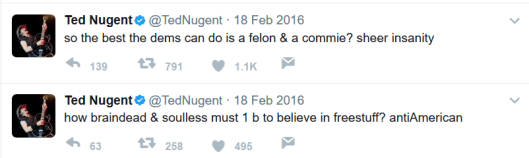
Lately, though, I’ve been reading up on this thing, exploring the works of an obscure theologian (Theodore Nuge) who has a great deal to contribute to our understanding of the matter. You see, it turns out that although people in general may be thought to carry something along the lines of a soul, it turns out that many people are actually without a soul. Seriously! Soullessness, would seem to be a big thing. It’s actually rather common. Just who laks a soul and how they came to lose it, now that is indeed a very interesting question. I’m still learning this subject, though, and the Nuge seems to understand it much better than I do. So, let me share with you just a few of his insights into the nature of souls and soullessness.

***

On the subject of soullessness, Nuge’s most accessible work would seem to have been about a musical exposition once scheduled at a Native American business venture. When the exposition was called off, Nuge is said to have remarked that those responsible lacked proper hygiene, and that they were in fact people without souls. Just how to account for their lack of souls remains a matter of some dispute. Nuge was thought originally to have ascribed this status to them on account of their indigenous nature, though he later suggested the individuals in question had become soullessness on account of political activities. It is possible that Mr. Nuge’s later comments reflected something of a shift in his thinking, however, as the intent of his first comments on the subject would seem to be less than clear. Not everyone agrees with Nuge;s self-exegesis. Subsequent attempts to clarify Nuge’s relationship to the Native American community has been preserved in obscure digital source material.

Screenshot 2017-06-12 17.07.19

Screenshot 2017-06-12 17.08.54

Some scholars find Nuge’s proclamations of affinity for indigenous peoples a bit hollow, given the ease with which he dismissed Native American activists, but we must consider the intersection of indigineity and disensoulment carefully before moving on to the rest of his work. Far from a flippant comment, it would appear that Nuge’s appropriation of indigeneity is actually part of a much larger theme in his works. Even Theodore’s musical performances are said to have incorporated native, or at least faux-native themes. Nuge’s interest in Native American themes would seem to contain a number of clues into his thoughts about disensoulment. Let us consider one of the most interesting features of Nuge’s work, his ideas about spiritual hygiene!

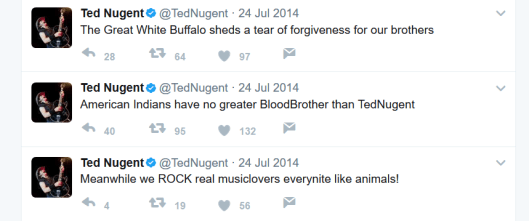
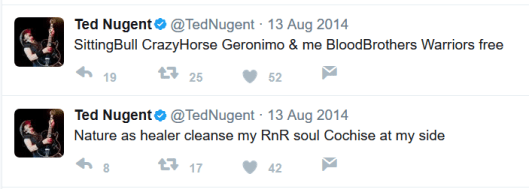
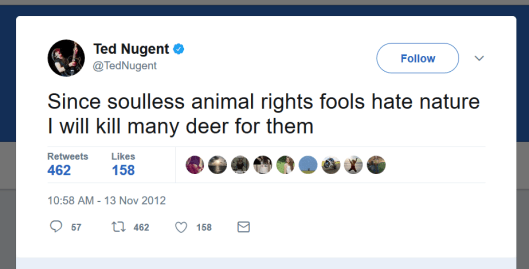
It is not simply the case that can souls be lost, according to Nuge, they can also become quite dirty. Indeed, a soul according to Nuge is in constant need of a bath, except that a literal bath doesn’t seem to do much to cleanse a soul. No, to cleanse one’s soul, a person must go into nature, preferably with the intent of killing something. Consider the following texts:

Screenshot 2017-06-12 16.49.04Screenshot 2017-06-12 16.58.10.2Screenshot 2017-06-12 16.58.30Screenshot 2017-06-12 17.04.24Screenshot 2017-06-12 17.08.33Screenshot 2017-06-12 16.56.19

QED?

Having established that souls can indeed be cleansed by nature, we should perhaps add that they can be be healed by nature as well. So, we might be inclined to think of Nuge’s comments as indicative of a state which is generally inimical to good spiritual well-being, one which is akin to sickness as well as lack of hygiene. Although Nuge himself never committed this notion to a single lexical item, it may be productive for us to adopt a technical term for this state. Let us call it the state of being ‘yucky’!

Now let us move on to the importance of hunting practices. Although Nuge does seem to attribute soul-cleansing and healing power to nature in general, he ascribes its full healing power to the pursuit and killing of animals. Consider the following passages:

Screenshot 2017-06-12 16.48.46Screenshot 2017-06-12 16.51.14.2Screenshot 2017-06-12 16.51.14Screenshot 2017-06-12 16.58.30.2

Last but not least…

Screenshot 2017-06-12 16.58.30.3

So, you can see, there is special cleansing power in the hunting and killing of animals. It’s like the super-soap of soul-cleansing wilderness spirituality. Indeed the very moment of killing an animal would seem to be the best agent for eliminating any yuckiness that has attached to the soul.

With all this attention to hunting, it should be said that there is at least one other soul-cleansing agent in life, at least according to Nuge.  He also finds the power to cleanse a soul in one other thing, music.

Screenshot 2017-06-12 16.49.51

Near as I can tell, these two sources constitute an exhaustive list of soul-cleansing/healing agents in the work of Nuge. If he acknowledges this power in any other activities, I have yet to find a discussion of it in Nuge’s work.

So, what does all this have to do with Native Americans? Well, to answer this we must consider some of the Nuge’s experiments with Native American dress and neo-primitivism! Nuge seems to credit Native Americans (along with sundry friends) with guiding him through the soul-cleansing process. Often, he suggests, they are there with him when the Nuge cleanses his soul by killing animals and/or playing music.

Screenshot 2017-06-12 17.05.30Screenshot 2017-06-12 16.58.10

All of this would seem to add up to a kind of neo-primitive shamanism. Whether hunting or playing his music, the Nuge is connecting with the spiritual power of primitive people, and with the souls of loved ones lost. It is this connection to primitivity which cleanses the soul, either by releasing an arrow in the direction of Bambi, or by whaling away on a guitar. In each case, the sould-cleansing power stems from the return to primitive nature, the escape from civilization into a more basic form of existence.

All of this is quite fascinating, to me anyway, but of course it is merely one half of the coin in Nuge’s work on souls. You could think of it as the heads side of having a soul. The tails side is that you can lose it.

Who doesn’t have a soul? Well,Pimps, whores, and wellfare brats, for one.

2017-06-16 (4).png

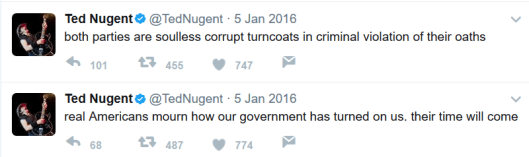
Now that might seem like kind of a random list, but it would seem the Nuge assumes these people share a common political agenda.

2017-06-16 (15)2017-06-16 (18)2017-06-16 (19)

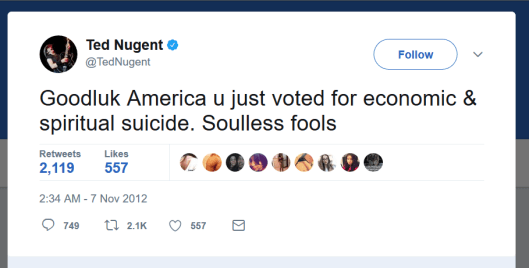
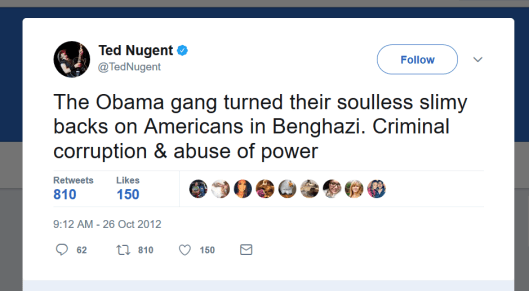
Indeed, Nuge would seem to suggest the success of that political agenda, namely the campaign to elect Barack Obama as President of the U.S. had dire implications for the soul of America itself.

Screenshot 2017-06-12 16.53.21Screenshot 2017-06-12 16.50.21

2017-06-16 (19)

…and of course, this trend only got worse in more recent elections!

Screenshot 2017-06-12 16.52.21Screenshot 2017-06-12 16.54.11

Journalists, it would seem, have no souls.

Screenshot 2017-06-12 17.06.47Screenshot 2017-06-12 17.08.15.2

During the last election, even Fox News seems to have suffered a loss of its soul.

Screenshot 2017-06-12 16.49.28Screenshot 2017-06-12 17.04.38

Some might find it odd to think of a news station as something that could possess a soul in the first place, but this should really come as no surprise. Corporations are people, according to SCOTUS. It shouldn’t really be all that interesting to find out that one of them has a soul.

…or that it lost it.

Other candidates for soullessness?

The Southern Poverty Law Center.

Screenshot 2017-06-12 17.08.15

Those who oppose voter identification.

Screenshot 2017-06-12 16.49.28

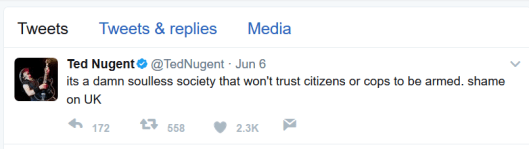
People who disarm citizens and cops.

Screenshot 2017-06-12 16.43.40

Critics of the Nuge.

Screenshot 2017-06-12 17.07.02.png

And of course, animal rights activists.

2017-06-16 (13)

In one of his more ideosyncratic passages, the Nuge even suggests that anyone who doesn’t think Theodore supports ‘allthings LGBT‘. Some might consider this an odd basis for disensoulment as it’s tough to imagine how the very existence of one’s soul could be contingent upon recognition of another person’s, but the more difficult theological questions here probably have to do with the unusual construction of LGBT rights. It way well be that Theodore’s rather ideosyncratic construction of G in particular is the key to the addition of creepery to the status those disensouled on account of their agnosticism regarding Nuge’s political stance on LGBT issues. It’s a very difficult thing. Some say God works in mysteries ways. Nuge talks in them.

So, as you can see the list of people lacking a soul is rather long, according to Theodore Nuge. The list may seem rather haphazard, but a few common themes can certainly be found in his work. Democrats and liberals are two overlapping-but-not-quite-synonymous groups that lack souls, according to Nuge. Also, Media. Given the importance of hunting for spiritual hygiene, it probably makes sense to find that those opposed to hunting lack a soul.

Also, those who don’t Like the Nuge’s music.

Screenshot 2017-06-12 17.09.11

So, what to make of it? As I mentioned before, I am new to the subject of soulology, but on a more serious note, I do think talk of souls can be very meaningful. The question I would ask is what are the metaphors? What does all this talk of souls really mean to those producing it? maybe, we can’t get far if we expect a literal answer, but we get a lot further if we ask what personal values are expressed in such talk.

Nugent’s talk of the soul-cleansing power of nature would make sense to a lot of people. Hell, it makes sense to me. While some might object to the role of hunting in this approach to life, it does express something found in few modern means of interacting with the natural environment. It provides someone with a definite role in nature. A tourist hiking a nature trail is, at best, someone who will take nothing but pictures and leave nothing but footprints. He doesn’t belong in nature and he knows it. A hunter, on the other hand, is part of it. He is, for that purpose anyway, as much a part of nature as the game he tracks. More to the point, he knows it. So, Nugent’s comments on the cleansing of the soul during a hunt may not square with some people’s thoughts about animals, but they certainly do strike me as an authentic description of his personal experience.

What seems most objectionable in all this is the growing sense of personal pettiness in all this talk of souls. How quickly the profundity of nature turns into a spiteful outburst against those who could interfere with it! How easily, Nugent’s personal associations with Native Americans turns to license taken against other Native Americans. Nugent’s talk of soullessness enables him to dismiss an awful lot of people. I don’t believe in a soul myself, but I have to wonder at the soul of someone who does believe in such a thing but seems so ready to say that others don’t have one. It’s a metaphor, of course, but a rather double-edged one at that. Can someone who so often finds no meaningful life in others really find much meaning in his own?

I’m old enough to remember when Ted Nugent was mostly a guitar sound coming through my speakers. Tastes vary, of course, and some of his lyrics are more than a little questionable, but I really did like the sound of that guitar. Listening to it now, I can almost sense that soul-cleansing power Nugent locates in nature and in his music. (Many will disagree, I know) The thing is, after listening to him talk about the soullessness of others, I usually feel like I need some of that power. I just wish he’s produce less of the one and more of the other.

Share this:

  • Tweet
  • Share on Tumblr
  • Print (Opens in new window) Print
  • Email a link to a friend (Opens in new window) Email
  • Share on Reddit (Opens in new window) Reddit
Like Loading...

Kathy Griffin and the Meta-hypocrisy Shuffle

09 Friday Jun 2017

Posted by danielwalldammit in Politics

≈ 10 Comments

Tags

Critical Thinking, Decapitation, Donald Trump, Humor, Hypocrisy, Kathy Griffin, Reflexivity, Rhetoric, Violence

170530144046-kathy-griffin-tyler-shields-exlarge-169

Nope! Not reproducing the actual image.

Just when you thought the whole damned controversy was in your rear-view mirror, along comes some damned blogger to put all the ick right back on the table. Well suck it up, dear reader, cause I got a bloggitation to bloggitize over this.

…okay, please?

We all know the story, right? A little while back, the comedian, Kathy Griffin, posted a picture  of herself holding up the severed head of Donald Trump. Don’t worry, it was fake. Donald survived the whole ordeal, but suffice to say, it was a rather controversial image. Naturally, a great deal of outrage was soon to follow. I have no doubt that a good number of those complaining about her stunt were simply using it as grist for the mill. I also have no doubt that a number of her critics were genuinely appalled by Griffin’s stunt. Which critics fit into which category is another question, and not a very interesting one at that.

What I find especially interesting about this story is the role hypocrisy as a theme in this particular kerfuffle. It’s hardly surprising to see that theme pop up here. Really, it’s just the sort of story that begs for accusations of hypocrisy, and those accusations soon made an appearance. Various parties on the right wing accused ‘lefties’ or ‘liberals’ of hypocrisy for making such a big deal of violence and violent rhetoric on the part of the Trump campaign when we produce violent rhetoric such as that of Griffin. Those of us on the left (myself among them) complained that the right makes hay out of Griffin’s image while condoning the actual violence of people like Montana’s Greg Gianforte or for that matter supporting Donald Trump’s flirtations with mob violence. Of course each side is fully capable of responding to accusations of support for violence (whether tacit or overt) by pointing at still more support for violence on the other side.

…and the internet becomes an angry infinity mirror.

So, what’s interesting about that? It’s the role that accusations of hypocrisy can play in facilitating, …well, hypocrisy. Think of it this way: You see somebody do something outrageous (and by outrageous, I mean something likely to rouse disapproval in the public sphere), and you want to criticize them for it. The problem is, you’ve done something like that yourself in the past, or at least you’ve supported other people who did. This creates a problem in that your own condemnation is likely to come across as an inconsistency. One potential solution to that is to conjure the image of critics who have condemned this behavior before and castigate them for supporting the behavior now. That way, you don’t have to actually put your own cards on the table. You don’t have to actually say that you are now condemning the behavior your once supported. Instead, you just say; “look at the guy who is now supporting behavior he once condemned!”  If you do this right, you can effectively play both sides of the game without anyone noticing. All they see is that you are commenting on someone else who is playing both sides of the field. It’s an exercise in projection of course, and a remarkably effective one at that.  It’s what I like to call the meta-hypocrisy shuffle.

I should add that it isn’t really necessary to point out any actual instances of hypocrisy on the part of any particular person to make this stratagem work. It is often enough to talk about ‘liberals’ or ‘conservatives’ (or any other group) and simply tell the story of how the other side is full of hypocrites. The ploy can be just as effective in this abstract form as it can be with real life examples. Plus, it avoids the inconvenience of having to address the details of anyone’s actual behavior, much less to deal with their own response to your criticism.

So, what am I saying here? I am saying that a lot of people on the right used Kathy Griffin to field an argument about liberal hypocrisy all the while hiding their own hypocrisy on the very same subject. That’s the argument I want to make anyway, but reflexivity being what it is, I must also concede that a lot of liberals did the same. What I don’t have to concede is that all parties involved in the controversy are equally guilty of this vice. Quite a few people on the left really did condemn Griffin’s behavior, and I certainly have known a number of Republicans who have condemned Donald Trump’s more violent rhetoric. (I’d say that’s one of the differences between a ‘conservative’ and a ‘deplorable’.) Griffin did in the end, lose at least one gig (actually several, it seems) over the whole matter. I could only wish the same was true of Donald Trump. Be that as it may, the point is that this trick (and the criticism I make of it) can indeed cut both ways, but that possibility does not mean the cut is equally warranted.

I don’t know how productive a debate would be over which political groups are more consistent on this (or any other) issue, but I do think some individuals at least have managed to show some consistency on the issue. Sadly, they are often tarred with the same hypocritical brush as their flip-flopping allies have been. Again, the story of hypocrisy alone is often sufficient to make the argument stick, sufficient even to the degree that those who are rigorously consistent on an issue may well be accused of hypocrisy by someone who is himself or herself simply doing the meta-hypocrisy shuffle.

It’s worth bearing in mind here that there is at least one angle on such issues that the whole question of hypocrisy doesn’t seem to address, and by this I mean the integrity of a committed partisan. You could take a relentless commitment to one side of a debate as a kind of integrity in itself. You could see the willingness to field arguments in direct contradiction to one’s own personal record as an instance of taking one for the team. Perhaps it is even a kind of courage. If so, that’s a courage I hope never to have, but so be it, the ethic is out there. Some clearly ascribe to it. Most of us, I think, prefer to field arguments that we find personally plausible, and most of us at least try to accomplish some level of consistency in our moral judgements.

Some try harder than others.

One thing worth considering here is the medium that delivers this message. In person, I suspect we are more likely to forgive each other’s inconsistencies, if for no other reason than because we are likely to see them coming from people whose shifting patterns parallel our own. If I contradict myself in the process of complaining verbally about some damned Republican, odds are rather likely that I am talking to somebody who is just as pissed about that damned Republican as I am. Confirmation bias being what it is, they are just as likely to grab the nearest rhetorical hammer, and just as likely to think it oughtta be used to smash him as I am. Likewise, a Republican jabbering on about a liberal is likely to be doing so in the company of other Republicans who also think rathe rpoorly of the bastard. It could be, that I’m missing something here, but I tend to think verbal exchanges make it a bit easier to skate by on this issue, to shift around one’s values without anyone noticing, and more particularly to avoid becoming the target of someone who seeks to hide his own inconsistencies in a story about ours.

Not so, the net.

All sorts of different people read controversial statements on social media, and that includes the guy who likes to complain about your kinda people even as you’re trying to vent spleen about his kind. In some places, like Facebook, I think, folks may make an effort to set aside their grievances and remember that the guy who just posted the outrageous meme will be sitting across from them at Christmas dinner. In other places, like Twitter, each and every comment expressing a different point of view seems to be fair game. What’s worse, the 140 character limit on tweets thins out the context of any statement a great deal, so it’s tough to tell how people generally approach these things. If someone criticizes Kathy Griffin (or doesn’t) only those who follow him carefully will notice whether or not that criticism squares with his general approach to the issues. The temptation is of course to assume the worst, not for the least of reasons being that the worst often seems to be driving the public debate on such media platforms. So, if a given Twitter-Republican really is just as hard on right wingers who make use of violent rhetoric, few of his more liberal readers will ever know. Likewise, a Twitter-Democrat who doesn’t support images like those produced by Kathy Griffin is as easily accused of liberal hypocrisy as any of those who simply laughed and retweeted her without the slightest thought about the matter.

The way Twitter (among others) thins out the context of political rhetoric facilitates a degree of hypocrisy. That same thinness also makes it easier to substitute general stories about this side or that side of a given debate for genuine comments on actual behavior, stories which fill in the details of people’s political orientation without checking those details against their personal history. This I think, makes the meta-hypocrisy shuffle just a little bit easier. You can always pretend the other side flipped first.

…and that makes it a little easier to flip yourself.

Share this:

  • Tweet
  • Share on Tumblr
  • Print (Opens in new window) Print
  • Email a link to a friend (Opens in new window) Email
  • Share on Reddit (Opens in new window) Reddit
Like Loading...

What Donald Trump Can Teach Us About Political Correctness

18 Thursday May 2017

Posted by danielwalldammit in Politics

≈ 29 Comments

Tags

Cultural Consideratism, Culture Wars, Donald Trump, GOP, Multiculturalism, Political Correctness, Prejusice, Republican Party, Russian Connection

I can count on one hand the number of times I’ve heard the phrase “political correctness” used approvingly and without irony. I’ve long since lost track of the number of times I’ve heard it used derisively. I regard it as one of the central ironies of modern politics that it hasn’t been politically correct to be politically correct since the notion first became a household term. This hasn’t stopped people from proudly proclaiming (often to great applause) the brave mantle of ‘Political Incorrectness’. Indeed, countless courageous souls have made sure we all know how little regard they have for political correctness. The near universal disregard for political correctness, as such doesn’t seem to faze its detractors. It pretty well goes without saying that if the subject is political correctness, the correct thing to say is that you’re against it. Do that, and you earn all kinds of points for being a independent minded maverick of sorts.

Just like all other independent mavericky people.

In fact, that story-line is so damned pat, you’d think even the dimmest among us would have second thoughts about it, but I guess not. The narrative is just too damned strong, and the benefits to plotting your politics inside it too great to resist. So, it pretty well goes without saying that anyone worth his salt would proclaim himself to be politically incorrect.

It’s the American thing to do!

Don’t get me wrong. I’ve heard the stories too, the PC-horror stories, I mean. Some of them piss me off too, and some of them are utter bullshit. It’s a big topic, and I could type out a lot of things about it, but for now I want to explore just one particular part of it.

That would be the part where a Presidential candidate and then a President (Donald Trump) would proudly proclaim his own political incorrectness. Among all the many absurdities that fly under the banner of the politically incorrect, there is at least one that is fairly unique to Donald Trump’s use of it. Because if there was anyone that we might expect to be politically correct, that we might actually want to be politically correct, you would think it would be the President of the United States.

Yes, I’m serious.

I realize that in most circles ‘Political correctness’ simply means whatever lefty political agenda people feel like dismissing at the moment, but if you stop and think about the phrase itself for just a minute, you might see some trace of a meaning that isn’t quite confined to that sort of canned polemic. Indeed, there is no particular reason respect for Christian values, honoring the troops, or celebrating a conventional American family would count as any less politically correct than support for gay marriage, celebration of black history month, or avoidance of any number of racial epithets. In principle, right wing causes could as easily count as political correctness as those of the left, and make no mistake about it; they are as likely to produce the sort of toxic pettiness that fill so many of those PC-horror stories people tell sometime between their second and third beers on a Friday night. We seem only use the word for left-wing causes, but there are numerous comparable cause in right wing circles. And if there is any trace of a positive meaning in that phrase, it’s this; that political correctness can mean thinking about the consequences of what you are about to say before you say it, taking into account the feelings of others and their likely reactions to your words before you decide what to say and do. That same notion may produce all sorts of stories about censorship, professional victimhood, and fake outrage. It also produces countless stories generally left untold, those in which someone finds just the right words, shows respect to people she might easily have slighted, or simply handles a tough topic with grace and dignity. We don’t seem to have a label for such stories. That label could as easily be ‘political correctness’ as any of those now provoking outrage in countless gossip circles all across the land.

To be sure, there are distinctions to be made between respect and dignity on the one hand and the pointless pettiness generally associated with stories of political correctness, but those distinctions don’t really fall along a left-right axis, and the phrase itself has never helped anyone to draw those distinctions with any care. Indeed sneering ‘political correctness’ at an issue is little other than an effort to avoid drawing those distinctions with anything approaching thoughtfulness and precision.

If there are those who have used the phrase with more care than i suggest, our current President is not among them. Think back to the infamous moment in which Megan Kelly (perhaps accidentally) separated herself from the right wing faithful, and you can see the character of Donald’s own use of ‘political correctness’. Asked about his frequent use of abusive words against any women who crossed him, Trump responded by saying that he didn’t have time to be politically correct. Of course that was after first trying to pass off the notion that he only denigrates Rosie O’Donnell, but when forced off that gambit, Trump settled on the notion that his lifetime of vicious personal attacks against myriad women was simply failure to obey the dictates of political correctness. Trump wasn’t asking us to reject some far left political agenda; he was asking the American public to accept his own personal vice on grounds that failure to do so would be an instance of political correctness. He was asking us to accept that the most flagrant contempt for common decency was somehow little other than a rejection of left-wing excess.

Here I must say, I couldn’t help but feel a sense of sorrow, sorrow for the death of conservatism as I once knew it. Oh, I don’t count myself as a conservative, not since I was about 18 years old, but I’ve known many conservatives I have admired and respected over the years. They generally vote Republican and I rarely agree with them on much of anything, but if there is one thing that separates the old school conservatives I recall from my youth from the right wing politics of today, it is precisely the effectiveness of Trump’s ploy. There is simply nothing in cultural conservatism that is amenable to the kind of crass treatment Trump has dished out to women over the years. Not his personal attacks on female adversaries, and not asinine talk of sexual conquest. Time was, when conservatives would have been the first to object to such things, and perhaps some still do, but the bulk of the voting base for the Republican party seems to have shifted. Thus conventional respect for human beings in general, and conventional respect for women in particular became a sort of lefty, feminist, oppression, one gloriously vanquished with the promise of a President who couldn’t be pressured to treat a woman with dignity, at least not one marked for conquest, or one who had the audacity to get in his way.

I look back at Trump’s response to Kelly and marvel that anyone could find their way to a rationalization sufficient to support that guy. I also think about the time he stalked Hillary around the debate stage after threatening to lock her up and think the same thing. How did this kind of abuse become acceptable? In particular, how did it become acceptable to cultural conservatives? Near as I can tell, the answer lies in the narrative about political correctness. It recasts common crudeness, even cruelty, as a rejection of a obscure and nefarious political agenda, one no decent American would accept. That narrative alone was sufficient to lure millions of seemingly decent Americans to overlook some of the most brazenly abusive behavior to be displayed in public by a national politician.

It was a defining moment, and one that certainly doesn’t speak well of Trump’s character, or that of anyone who could defend it. It is objectionable in more ways that I could count, even with my shoes off, but the one objection that keeps haunting me is this simple thought; shouldn’t the President of the United States have time for political correctness? Isn’t that part of his job? When he enters into diplomatic negotiations, do we not want the President to be capable of choosing his words carefully? If you set aside the obvious angle of outright lefty-bashing, this is a job which requires all manner of careful judgements about what to say and what not to say, about who will be angry and what will they will do about it.

Only the stakes are much higher!

This is the thing that bothers me most about conventional PC-bashing. It makes a very convenient posture for many who, like Trump, seem think with their tongues. All too often, the notion that one is politically incorrect provides a ready-made excuse for all manner of perfectly conventional indiscretions. Sure, It’s the left wing that asks us to reconsider every day vocabulary for things like race, gender, and sexual orientation (among other things), but it’s not as though we are the only ones with any social sensitivities, and somehow the PC-bashing has became a sort of all-purpose excuse for the generally crass among us, the ones who just can’t be bothered to think before they talk.

People who cannot be bothered to consider how others will feel about their words seldom put much more thought into questions about the truth of those words. It’s one of the reasons why such people can be so damned sensitive themselves to any critical feedback they get. These folks can’t answer the criticisms and they know it, so they’d rather tell a story about the over-sensitivity of others, one which makes their first reflex into an unquestioned truth and the careful consideration of other just so much hogwash. PC-bashing ties this conventionally idiotic behavior to a broad range of set issues and it provides a blank check of sorts to anyone willing to play the role of the tough talking straight shooter.

It may seem that I am stretching the bounds of the concept. Political correctness doesn’t really cover that much of the issue, does it? Yet, I think it’s Trump who stretched the boundaries of the concept so broadly in this election, and not just in characterizing his contempt for women to political incorrectness. He also likened the expectation that people shouldn’t beat up protesters to political correctness. Trump himself has likened countless policy considerations regarding immigration, foreign diplomacy, and criminal law as instances of mere political correctness. And of course, it was Trump’s many sweeping attacks on Mexicans and Muslims that earned him the reputation as a ‘straight shooter’ back in the early days of his campaign. I never understood that. There was nothing straight or honest about Trump’s rhetoric, but so many seemed happy to equate rudeness with honesty that it became the standard media spin for awhile at least. Even Megan Kelly granted him that as she asked her infamous question. She too was willing to grant that Trump’s foolishness and cruelty should count as a kind of honesty. It’s the kind of equation best suited to the narratives of the politically incorrect.

…and it is doublespeak at its most deplorable!

It’s not just that Donald Trump expressed prejudice in his campaign rhetoric. He led with it. Prejudice was literally his first sales pitch. No, he didn’t say that all Mexicans were rapists, as his defenders often remind us, but he did say that Mexico was ‘sending’ its rapists. That wild accusation was not a call for immigration reform then, and it isn’t now. It was a clear and unmistakable signal to the racists in America that he would go after those they hated. How and when, and even why? All that would be made up later, …and so now we now get to see the GOP fiddle with token gestures at wall building. The physical wall that still haunts our policy discussions is merely the obligatory excretion of a rhetorical wall Trump built in that very first moment of his campaign. Through talk of a wall, Trump separated his supporters from the rest of us and polarized the nation as no American politician has done in my own life-time.

Why do we think of Trump’s various immigration restrictions as a ban on Muslims? Because he led with a call to ban entry of Muslims. It was only afterwards that Trump began walking the notion back to the various token policies now trotted before the courts. Ironically, folks now defend these policies by telling us Obama did the same thing (which is a stretch). This after Trump spent his entire campaign telling us how Obama wasn’t doing anything to protect us from terrorists. In any event, the point isn’t that Trump expressed a prejudice or three in the course of a campaign, or even in his Presidency. That would make him a run of the mill politician, perhaps even merely human. Prejudice was the centerpiece of his appeal from the beginning. It still is.

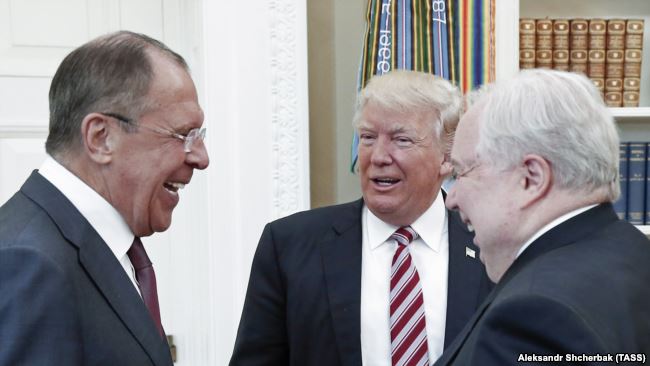
The result has been a non-stop clown show, a constant reminder that Trump doesn’t think before he speaks, writes, or even executive orders. We’ve all watched as his staff struggle to form policies around thoughtless statements and his surrogates have fought to rationalize the completely irrational utterances of the Ego-in-Chief. And this week we learn both that Trump sought to jail his critics in the press and that he shared intelligence secrets with Russian figures all in the space of a couple days. Whatever else this is, it is also the behavior of a man who doesn’t think before he does anything.

…and I can’t help but think all of this brings us right back to Trump’s response to Megan Kelly. He said he didn’t have time to be completely politically correct? In that very statement, Trump effectively told the entire nation that wasn’t then prepared to perform the duties of the President.

He isn’t now either.

Share this:

  • Tweet
  • Share on Tumblr
  • Print (Opens in new window) Print
  • Email a link to a friend (Opens in new window) Email
  • Share on Reddit (Opens in new window) Reddit
Like Loading...

Eye, You, and Donald Trump

26 Sunday Mar 2017

Posted by danielwalldammit in Childhood, Politics

≈ 17 Comments

Tags

Argumentation, Criticism, demagugue, Donald Trump, eye color, Jane Elliot, prejudice, Privilege, Rhetoric

U.S. Republican presidential candidate Donald Trump listens to a question from the audience at one of the New England Council’s “Politics and Eggs” breakfasts in Manchester, New Hampshire November 11, 2015. REUTERS/Brian Snyder – RTS6IWM

I think I found the source for Donald Trump’s approach to public speaking. There is a clear precedent for his technique.

It’s Jane Elliot!

Jane Elliot is of course the Ohio grade-school teacher made famous for a classroom exercise in which she taught her students to discriminate against each other on the basis of eye-color. If you watch her in action, you can see the elements of Donald Trump’s rhetoric style unfolding before you.

It’s funny, because I’ve been thinking for some time that I have never seen anyone lie so readily, so easily, and in the face of such clear counter-evidence. Never have I seen anyone whose praise or whose censure was so obviously a function of his own self-interest. It is as if facts have no bearing on his evaluation of anything or anyone, and the only thing that registers significance in his evaluation of the world around him is what he wants to happen. Those who support his goals are terrific, and those who oppose him are failures, sad. I keep thinking, no-one I know of has ever been so obvious about it. But no. The man has a clear role model. If you watch Elliot teaching her students to mistreat each other, it’s all there. She may have meant her exercise to warn people against this sort of thing, but I can’t help wondering of Trump didn’t watch her at some point and say to himself; “Yep! That’s exactly what I want to be.”

Elliot set out to instill prejudice in her third graders in the space of a single day, and then to reverse that prejudice the following day, before debriefing the lot of them and ending the lesson. She didn’t have a lot of time and she wasn’t the least bit subtle about it.She employed all manner of tactics to communicate contempt for the wrong-eyed children in her classroom.

You might think Elliot’s lessons less relevant to real-world politics, because, well third graders, right? But of course, Donald Trump’s own rhetoric has all the features of grade school communication. Far from a detriment, it turns out childish vocabulary and simplistic arguments are actually one of the keys to his success. With his simple words and constant repetition of basic themes, Trump leaves a very clear impression. It is the single-mindedness of Trump’s presentation that seems to resonate with his supporters, and in that respect, his approach is very much like that of Elliot.

But does the nature of the message matter?

You bet it does.

It’s not just any simplistic message that Trump offers supporters; it is a simplistic message about who is a better person; them or someone else? In this respect, his approach mirrors that of Elliot. It isn’t merely that Trump advances a message of hatred; it is that he presents that hatred in terms of a clear pay-off. You are are better than they are! That is what Trump keeps telling people (whoever you are and whoever they might be). It’s an invitation to enter a world with a clear hierarchy of value, and to enter that world on the value-laden side of that hierarchy. You don’t even need to do anything. You are already better than the many scapegoats he offers you (Muslims, Mexicans, the Media, minority activists, etc.) Trump really doesn’t call on supporters to do much more than vote for him. Their role in his his America is to be the real Americans while the rest of us take our lumps. It’s this message that survives all the messy details. It is a message not the least bit undermined by questions of fact, reason, or even the evidence of the senses. In this respect, Trump is very much like Elliot teaching half of her classroom to think of the other half as lesser people.

When I watch Elliot tell a child (at about 5:20) that a blue-eyed parent would never kick his son while using the apparent claim that a brown-eyed parent had done that very thing, I can’t help but think of Trump’s many anecdotal attacks on immigrants. It shouldn’t take much critical thinking to see past the argument, but is that more important than the invitation to be better than someone else?

Apparently not for a lot of people.

When Elliot begins telling the Brown-eyed children they can’t use the drinking fountain (at around 6:10), and when she restricts their playground privileges, she is effectively telling the blue-eyed children they are special. The things they all used to take for granted now belong only to the blue-eyed children (at least for a day). The pay-off is not substantially different from that enjoyed by an audience assure more of their kind of jobs will be created while watching others threatened by cuts, told their own health-care will be taken care of (somehow) by cutting others loose, and of course their citizenship will not be sullied by the presence of certain kinds of people. (And no legality was NEVER the issue in Trump’s new-fangled Know-nothingism) We on the left haggle over the details of these policies as if they matter. To the average Trump supporter, I do not think they do. He may be right about this or wrong about that, but what matters most to those who support them is that he keeps elevating them above someone else. He does it free of charge. They don’t have to understand anything difficult; they don’t have to work harder (at least he doesn’t say they will); they don’t even have to listen very carefully. Being better in Trump’s world is as simple as saying yes to him and his gold gilded message. In scapegoating enemies domestic and foreign, Trump is telling anyone who cares to accept him that they are special. They get to drink at the fountain. Others don’t.

When Elliot tells her children that the brown-eyed people are slow or stupid, she creates the very facts she purports to describe. Elliot noted (at 13:15) how the student performance rose or fell with the changes in their status during the course of her exercise. There is little to distinguish this from the effects of social stigma and/or poverty on groups for whom prejudice is not simply an exercise. When Trump promotes such distinctions, he generates real harm.

(At about 12:10) “Do blue-eyed people know how to sit in a chair? Very sad. Very very sad.” …this one speaks for itself.

One might think that folks would see past such a thinly disguised gambit. Elliot is working with third graders. Surely, adults would know better!

Evidently not!

In the end, this may not be a question of what people actually think. It’s a question of what narratives they circulate. We keep hearing that Steve Bannon isn’t really an antisemite or even that Donald Trump isn’t personally against homosexuals, Mexicans, women, etc., but the Trump camp and its supporters keeps producing stories denigrating to these groups and anyone who gets in their way. Like Elliot, they may know better, but like Elliot, they do it anyway.

Except for one thing.

There will be no debriefing at the end of Trump’s Presidency. There will be no great learning moment, no sudden transformation of the whole situation into a great learning lesson. Whatever cynical reasons he and his supporters may have for throwing the rest of humanity under the bus, there is little reason to believe it will stop any time soon. The only credible promise this man ever made is that he would hurt people in their name, and for whatever reason, that was reason enough for a number of people last November. We can only hope that enough people come to their senses, and that if and when they do, something can be done about it.

In the interim, the Trump administration continues its own experiment in social control. The continue teaching us to humor this man’s fantasies, and to think of ourselves as better for doing so.

Let us hope the nation as a whole can respond a little more appropriately than Jane Elliot’s third graders!

Share this:

  • Tweet
  • Share on Tumblr
  • Print (Opens in new window) Print
  • Email a link to a friend (Opens in new window) Email
  • Share on Reddit (Opens in new window) Reddit
Like Loading...

A World Without Children, or at Least a Policy Without Them!

13 Monday Mar 2017

Posted by danielwalldammit in Childhood, Philosophy, Politics

≈ 4 Comments

Tags

Healthcare, John Shimkus, Libertarianism, methodological individualism, Obamacare, Politics, prenatal care, solipsism, Trumpcare

Can you imagine a human being, fully formed without also imagining him or her embedded in a network of social relationships? Can you (or anyone) be a person without being among others?

Suffice to say that some people have tried.

This is part of the reason for interest in feral children, and of course we sometimes read of ancient experiments depriving children of exposure to language (or in some cases any human interaction). These experiments wouldn’t get past a human subjects review panel in a modern university, but the stories are certainly interesting. A large part of that interest comes from the prospect of finding a person who became a person without any significant human interaction whatsoever. What kind of person would they be? What kind of language would they have? How would they think? These stories are long on legend and short on data, but it’s not hard to understand why people would want to investigate such things.

…even if only in a story.

The thought experiments of certain social theories are not far off from such stories. So very many people have attempted to imagine the nature of a human isolated from social connections. Chapter XIII in Thomas Hobbes’ book, The Leviathan would be a good example. So, would be the calculations of many rational choice theorists, those attempting to find the self-interest in just about any human interaction. And of course, there are always the masturbatory fantasies of Ayn Rand and her cult of ‘objectivist’ fan-boys. (Honestly, I feel kind of bad mentioning her alongside serious thinkers, even those I disagree with, but with the likes of Paul Ryan and Ran Paul claiming inspiration from Rand, one must admit the woman remains relevant.) What these approaches have in common is a rather atomistic vision of social life. They take an individual human being as a given and problematize questions about how and why that individual human does what he does in relation to others. In effect, they reduce social life to individual psychology; tey reduce social interaction to individual self interest.

The problem in each instance, is that individual psychology is intrinsically social. You can’t be a person without being in relation to someone else, because you can’t become a person without relating to someone else. You wouldn’t survive childhood without someone feeding you, clothing you, keeping you clear of the neighbor’s dog, and giving you the occasional hug. You wouldn’t be who you are if your Mom hadn’t stared into your eyes and smiled at you until you smiled back. You wouldn’t be who you are if somewhere in those early days you didn’t notice that the great-big Mom-face smiled back when you smiled yourself. You figured that out long before you figured out the words for such things, or even the difference between you and the mom-face, or anyone else. And you wouldn’t be who you are if somewhere along the way you hadn’t learned to give a damn about such things.

Even the basic problem of solipsism seems to get this whole thing wrong. We don’t start as an individual and then figure out that others might (or might not) also occupy our world. We don’t figure out how to relate to them long after we’ve decided what we want in life. We don’t decide how to treat other people only after deciding what we want ourselves. We develop our own self-image in relation to those around us, and we base on desires and goals on a sense of the world that is already populated with other human beings, some of which (hopefully) we care about. (Thank you Martin Heidegger!)

All very academic, right? (Well academic, in a loose kinda bloggetty sorta fashion.)

Except, there are moments when theoretical atomism seems to mesh with the more pointed boundaries of compassion and empathy in real life. People don’t lack for reasons not to care about this group or that kinda person. Often as not, people seem to tell us who they do give a damn about in much the same breath as those they don’t. We care about us, but we don’t give a damn about them. What constitutes the difference? Race, religion, nationality, gender, sexual orientation, …you get the idea. Any number of categories will do. It’s a pretty familiar dynamic, one with sometimes startling consequences. Those we make our own, so to speak, we may treat with great care, but those we don’t, we may visit great cruelties upon them, often without a second thought.

It doesn’t help when people looking for reasons to reduce their fucks given for others to zero can make ready use of theories breaking all our social connections up into phantom gestures of self-interest. It doesn’t help when the dominant metaphors of government programs (or the lack thereof) come straight of the sociopathic imagination. Whatever the theoretical (de-)merits of atomistic theories, they become far more critical when they become the actual basis of public policy.

I am of course talking about the free market fundamentalists among us, those who consistently reject the case for public welfare wherever they may find it, or at least whenever it might require collective effort, and especially if it means anything resembling taxes. Time and again, libertarians (and often their more conventional conservative allies) will tell us we mustn’t have this or that program because it will violate the individual rights of tax-payers and produce inefficiencies in the market. If someone poor is to receive aid from the government, someone else must pay it, and that payment will be secured by force. Then we have to deal with all the moral hazards of people changing the rational choices on the basis of programs changing the natural inclinations of supply and demand. These are real problems, to be sure, but for some these problems are also damned convenient excuses for denial of social responsibility. If they have their way, progressive taxation is out. The social safety net is a bad idea (goodbye welfare, medicaid, and medicare, among other thigns). Every regulation is suspect, including those that keep poisons out of the air we breathe and the water we drink. And of course everything from schools to the post office would be better if privatized. Why drive on on a federal highway when you could take a toll road? For such folks, it goes without saying; whatever government can do, private business can do it better.

Why?

Because private business can be described as the actions of private individuals whereas government is of course a collectivist enterprise. To fall into this mindset, we have to ignore the collectivist nature of modern corporations, but hey, if the Supreme Court says they are people, then corporations are people. So, the actions of these incredibly powerful collective entities count as the actions of private individuals in the narratives of free market fundamentalists. We are supposed to believe that single-payer insurance polices are against the free market, but insurance corporations are not. There is a difference, I know, but that difference doesn’t really support the distinctions made in public policy. One is not individual while the other is collectivist One is not a function of free market policy while the other counts as a socialist scheme.

People vary in their source material, educational background, and rhetorical strategies, but somewhere in the din of all this free market noise, I can’t help but hear the echoes of Hobbes and the others. Hell, I can’t help but hear echoes of the Pharaoh Psamtik. He is the source of one of those legendary experiments I mentioned up above. According to Herodotus, Psamtik had two children raised without any communication in order to see what language they would speak. He was disappointed, according to the legend, to find the children grew up speaking Phrygian, but of course they would actually have come out of that experiment speaking nothing at all, and being hardly human. Such an experiment would be a disaster for the children.

Is it really all that different from the social experiments urged by those seeking to deny essential support to future generations? Time and again, the brave heroes of the free market tell us that individuals must rise above their circumstances, as if poor schools, poor healthcare, and poor infrastructure could be resolved by the platitudes of a motivational speaker or the narrative arc of a Horatio Alger novel.The denial of social responsibilities thus comes with a bundle of narrative solutions, all of which work much better for the narrator than they do for any real life protagonists.

These stories particularly don’t work for children. Often as not, children don’t even make it into the narratives of libertarian rhetoric. We get the stories that deny aid to adults (why should I pay for someone who won’t work and might even be taking drugs?), and then someone else has to point out that aid also goes to children.

In the end, I can’t help thinking the failure to account for childhood is the most critical feature of libertarian approaches to policy, but its not just a theoretical failure. It’s also a very critical failure of practice. Just as atomistic theories of individualism could never account for the way one becomes a fully functioning human being, the practitioners of atomistic policy cannot, and will not, account for the needs of children through public policy. They won’t even account for the needs of adult women who produce these children, not in any realistic manner. The wealthy can of course throw money at the problem, and damn the rest of us to Hell anyway, so it seems is the only real answer we will ever get from the free market fundamentalists. Of course, there are other boundaries beyond which social responsibilities can easily be denied.

If the atomistic mindset is inadequate, the consequences of its inadequacies do not fall upon all of us equally. Some need the help more than others, and the denial of it serves some better than others. Whatever the strengths and weakness of free market fundamentalism, it will always have a little extra appeal for those in power.

Some people are just a little more obvious about this than others.

Share this:

  • Tweet
  • Share on Tumblr
  • Print (Opens in new window) Print
  • Email a link to a friend (Opens in new window) Email
  • Share on Reddit (Opens in new window) Reddit
Like Loading...
← Older posts
Newer posts →

Top Posts & Pages

  • Movie Review: The Orator
    Movie Review: The Orator
  • An Uncommon Security Guard: Dave Eshelman, AKA 'John Wayne'
    An Uncommon Security Guard: Dave Eshelman, AKA 'John Wayne'
  • When Sex Falls Out of the Performance
    When Sex Falls Out of the Performance
  • Southern Paiutes as Portrayed in Las Vegas Area Museums.
    Southern Paiutes as Portrayed in Las Vegas Area Museums.
  • Hostiles and Spoilers: A Magic Studi
    Hostiles and Spoilers: A Magic Studi
  • The Erotic Heritage Museum in Las Vegas: A Very NSFW Review
    The Erotic Heritage Museum in Las Vegas: A Very NSFW Review
  • Irony Ain't Erasure, Not Even in a Song
    Irony Ain't Erasure, Not Even in a Song
  • Sweatshops and the Invisible Hand of Satan: A Few Thoughts on Some Not-So-Invisible Fires
    Sweatshops and the Invisible Hand of Satan: A Few Thoughts on Some Not-So-Invisible Fires
  • Three Cool Characters from Anchorage
    Three Cool Characters from Anchorage
  • Thieves Road (A Review)
    Thieves Road (A Review)

Topics

  • Alaska
  • Animals
  • Anthropology
  • atheism
  • Bad Photography
  • Books
  • Childhood
  • Education
  • Gaming
  • General
  • History
  • Irritation Meditation
  • Justice
  • Las Vegas
  • Minis
  • Movie Villainy
  • Movies
  • Museums
  • Music
  • Narrative VIolence
  • Native American Themes
  • Philosophy
  • Politics
  • Public History
  • Re-Creations
  • Religion
  • Street Art
  • The Bullet Point Mind
  • Travel
  • Uncategorized
  • Uncommonday
  • White Indians
  • Write Drunk, Edit Stoned

Blogroll

  • American Creation
  • An Historian Goes to the Movies
  • Aunt Phil's Trunk
  • Bob's Blog
  • Dr. Gerald Stein
  • Hinterlogics
  • Ignorance WIthout Arrogance
  • Im-North
  • Insta-North
  • Just a Girl from Homer
  • Multo (Ghost)
  • Native America
  • Norbert Haupt
  • Northwest History
  • Northy Pins
  • Northy-Tok
  • Nunawhaa
  • Religion in American History
  • The History Blog
  • The History Chicks
  • What Do I Know?

Archives

  • December 2023
  • November 2023
  • June 2023
  • April 2023
  • February 2023
  • December 2022
  • November 2022
  • October 2022
  • September 2022
  • August 2022
  • July 2022
  • June 2022
  • April 2022
  • January 2022
  • December 2021
  • November 2021
  • October 2021
  • September 2021
  • August 2021
  • June 2021
  • May 2021
  • March 2021
  • February 2021
  • January 2021
  • December 2020
  • November 2020
  • October 2020
  • September 2020
  • June 2020
  • May 2020
  • March 2020
  • February 2020
  • January 2020
  • December 2019
  • November 2019
  • September 2019
  • August 2019
  • July 2019
  • June 2019
  • May 2019
  • April 2019
  • January 2019
  • December 2018
  • November 2018
  • October 2018
  • September 2018
  • August 2018
  • July 2018
  • June 2018
  • May 2018
  • April 2018
  • March 2018
  • February 2018
  • January 2018
  • December 2017
  • November 2017
  • October 2017
  • September 2017
  • August 2017
  • July 2017
  • June 2017
  • May 2017
  • April 2017
  • March 2017
  • January 2017
  • December 2016
  • November 2016
  • October 2016
  • September 2016
  • August 2016
  • July 2016
  • June 2016
  • May 2016
  • April 2016
  • March 2016
  • February 2016
  • January 2016
  • December 2015
  • November 2015
  • October 2015
  • September 2015
  • August 2015
  • July 2015
  • June 2015
  • May 2015
  • April 2015
  • March 2015
  • January 2015
  • December 2014
  • November 2014
  • October 2014
  • July 2014
  • June 2014
  • May 2014
  • April 2014
  • March 2014
  • February 2014
  • January 2014
  • December 2013
  • November 2013
  • October 2013
  • September 2013
  • August 2013
  • July 2013
  • June 2013
  • May 2013
  • April 2013
  • March 2013
  • February 2013
  • January 2013
  • December 2012
  • November 2012
  • October 2012
  • September 2012
  • August 2012
  • July 2012
  • June 2012
  • May 2012
  • April 2012
  • March 2012
  • January 2012
  • December 2011
  • November 2011
  • October 2011

My Twitter Feed

Follow @Brimshack

RSS Feed

  • RSS - Posts
  • RSS - Comments

Enter your email address to follow this blog and receive notifications of new posts by email.

Join 8,070 other subscribers

Blog at WordPress.com.

  • Subscribe Subscribed
    • northierthanthou
    • Join 8,070 other subscribers
    • Already have a WordPress.com account? Log in now.
    • northierthanthou
    • Subscribe Subscribed
    • Sign up
    • Log in
    • Report this content
    • View site in Reader
    • Manage subscriptions
    • Collapse this bar
 

Loading Comments...
 

    %d