• About

northierthanthou

northierthanthou

Category Archives: Uncategorized

R.I.P. Fido

20 Monday May 2019

Posted by danielwalldammit in Uncategorized

≈ 12 Comments

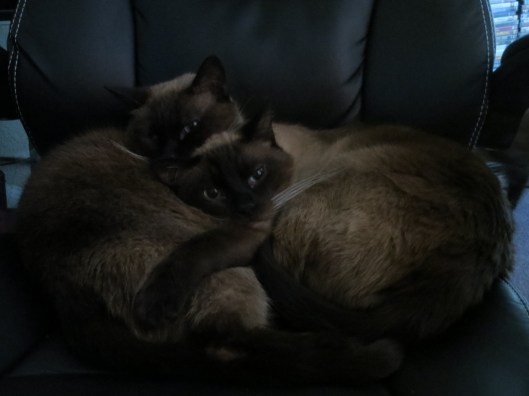
027.JPGThis is Fido (front) and Junkmail (back). They are of course brother and sister and they’ve been together their whole lives. Some cats don’t really seem to care about their siblings, but these two really do.
When they were younger, Fido used to get out of the house a lot. If I left the door open for just a moment, or even a window, Fido would be out in no time. That cat would tear the screens off my windows if he had to. I even got cat proof screens so we could enjoy a breeze without an escape attempt, but Fido just tore the screens out of the frames, at least until I nailed them all in place. Then he found a way out through a hole behind the washing machine, and another in a closet. Fido was always good at getting out of the house.

Really good,

What did Fido do when he got out? Well, sometimes he liked to climb a tree right beside the house, or another one right in front of the house. He’d get up as far as he could and then start crying. Usually he’d come down after awhile. Once or twice I had to come get him. Other times he’d sneak about the neighborhood as I walked around looking for him. Many times, I turned around to see him shooting across the street behind me. I could practically hear him laughing as he did so.

Asshole!

Sometimes Fido would let me catch him. Other times, he’d let me keep trying until I gave up. After an hour or so, I’d find him outside the door waiting for me to let him back in.

The thing is, it was usually Junkie who told me when Fido was out of the house. She did so by mugging me beyond all tolerance, demanding attention, and getting in my face until I ran out of affection and then ran out of patience. More than once, I mumbled at Junkmail; “what the Hell is wrong with you cat!?!”

Then “…oh!”

Junkie always loved Fido.

Today, Fido got out one last time, so to speak. Junkie is mugging me of course, but her brother won’t be coming back, and I think we both know it. Fido has had a rough time lately, and I reckon he has at last found some peace. He was with me for 17 years, I think, and his time in my life was a great treasure. I’m not sure if I was the best mother a cat could have, but Fido was sure as hell the best of cats an adoptive mother could ask for (along with Junkmail and Auto-Kitty of course).

Fido hasn’t been gone long, but I already miss him terribly, as does Junkie.

So long Fido!

I love you.

Share this:

  • Tweet
  • Share on Tumblr
  • Click to print (Opens in new window) Print
  • Click to email a link to a friend (Opens in new window) Email
  • Click to share on Reddit (Opens in new window) Reddit
Like Loading...

When Good Gods Go Bad

12 Wednesday Dec 2018

Posted by danielwalldammit in atheism, Religion, Uncategorized

≈ 13 Comments

Tags

Apologetics, atheism, Emotion, Fiction, God, Hatred, Problem of Evil, religion, Stories

Chick Tracts

The God of Chick Tracts always struck me as something of an asshole.

It’s a common assumption in religious polemics at least, that you can’t really hate someone you don’t believe in. You see this assumption appearing arguments for and against belief in God. Christian apologists often claim that atheists hate God, and that this hatred is proof positive we really know he exists after all. Atheism is little other than rebellion against God, at least according to this view. For our own part, atheists often respond to the accusation that we hate God by pointing out that we actually don’t believe in him. We can’t possible hate God, so the argument runs. We don’t even believe in him. Each of these arguments seem to rest on the assumption that to hate God implies that one must believe in him. At least we we have that in common I suppose, believers and unbelievers. We agree that it doesn’t make sense to hate a being you don’t really believe in.

Except I don’t agree with that either.

To those who insist on this assumption, I have two questions:

Do you watch Game of Thrones?

How do you feel about Joffrey?

Admittedly, this gambit loses a little force when the answer to the first question is ‘no’. Still, t think those familiar with the HBO series or the books it’s based upon will get the point pretty quickly. This hateful little brat prince is hardly unique in fiction. Felix Unger and Frank Burns used to get pretty deep under my skin. I didn’t believe in them either. I certainly don’t believe in Lucy from Peanuts, but when she pulls the football out from under Charlie it makes just wanna reach right into the screen and throttle the little two dimensional mini-troll. Can’t stand the Police Chief in most detective shows or the principle in countless school settings. The list of fictional villains, nitwits, jerks, and outright assholes goes on and on. None of these characters are real. But yeah, I hate them!

(Here, I can practically hear my mother saying; “no, you dislike them intently,” but no, I hate them.)

I really don’t think my feelings about these characters are all that unusual. Joffrey, at least, seems to have inspired quite a few haters out there. Hell, I reckon that’s something else believers and unbelievers can generally agree on. The little bastard was awful. Got off with an easy death!

Anyway, the point is that you can have a strong emotional reaction to a being you know very well isn’t real. People ought to keep that in mind when they opt to battle it out over the existence of God.

I should add that this point can flow in both directions or even (I suppose) at a tangent to the usual stakes. I can love Jesus when he’s preaching tolerance and compassion just as I can be outraged at a God who would tell Abraham to kill his own son. The inconsistently might bother me if I actually believed either story to be true. As it stands  these are just emotional reactions to a being I don’t really think is real, as described by different narrators with different messages at different times in history. Maybe if I expected a degree of literal truth from these stories, I would feel the need to work out my feelings about the big Guy In the Sky, but I don’t. I can accept that stories about this being will trigger different feelings at different times, and no reaction at all in many instances. Consistency might be a desirable property of arguments and theories, but it a square peg to pound in the round hole of emotions.

What makes the difference between a vision of God that inspires me and one that pisses me off may be an interesting question, but the answer to that question is, for me anyway, essentially a function of story-telling.

I suppose a Christian too could acknowledge some role for the story-tellers in his feelings about God in different parts if scripture. There is a certain flat-footed evangelism that runs contrary to such an approach, but not every believer checks their sense at the church door. I’ve known quite a few who could handle such questions with subtlety and care.

I realize this may not be the most serious theme in debates over the existence of God, but it certainly does seem ubiquitous. I think to some degree this is a reflection of the debate-camp subculture that has developed around people interested in haggling out the issue. I’ve certainly engaged in my share of such matters, but one does not live by polemics alone, and not everything that people think or feel about the topic in question comes prefigured for purposes of argumentation. We can argue the rational merits of any given position, but nobody should really be surprised to find that participants in these arguments also have an emotional reaction to the topic.

We’re allowed to be human.

So are they.

***

I know I’ve made this argument before. I just wanted to take another crack at it.

Share this:

  • Tweet
  • Share on Tumblr
  • Click to print (Opens in new window) Print
  • Click to email a link to a friend (Opens in new window) Email
  • Click to share on Reddit (Opens in new window) Reddit
Like Loading...

Black k Klansman

05 Wednesday Dec 2018

Posted by danielwalldammit in Justice, Movies, Politics, Uncategorized

≈ 3 Comments

Tags

Black Klansman, Film, Ku Klux Klan, Movies, Police, Race, Racism, Ron Stalworth, Spike Lee

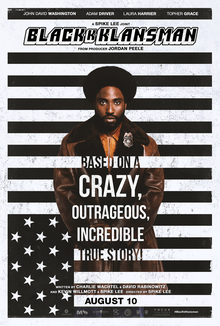
BlacKkKlansman.pngThere are moments (mostly the innocent ones) in Black Klansman where the movie seems to be telling us something about the 70s. There are other moments (as in references to “America First” or allusions to the Trump administration) when the movie is clearly telling us something about today. Most of the time, however, the movie seems to be telling us about both at the same time. What’s missing from this movie is the period in between, a good three or four decades, depending on how you count them, when many of us might have thought race relations were getting better. Perhaps that thought was never more than naiveté, a mere fantasy, but if so the fantasy was certainly a part of the world erased in this film. I’d like to think Spike Lee is wrong to erase those years in this film, but he isn’t.

That erasure, it seems, is precisely the point.

The hope of those intervening years between the end of segregation in America and the present rise of white nationaism is in fact well well represented in Black Klansman. It’s repreented by Ron Stalworth (played by John David Washington), the central character in Black Klansman, a story inspired by events in the career of a real life police officer. We meet Stalworth as he becomes the first black officer on the Colorado Springs police force. It’s a step forward, some might have said back in the day. “Selling out” might be how others would have put it. Stalworth lives in the tension between these two ways of looking at his career, one which envisions police authority as consistent, at least in theory with the possibility or racial justice, and one which sees it as an explicit tool of white supremacy. For his own part, Stalworth is clearly trying to make the former outlook work, but he’s torn from all sides, both by racism within the police force and by those who see police as an essentially racist institution.

To hear him talk, Stalworth could pass for white, which probably says as much about those in the movie (and those of us watching it) who think he sounds white as it does about the man himself. Whatever the reason, this feature of Stalworth’s character has an obvious utility; it will enable him to pass, at least on the phone. Stalworth is also willing to cut his fro if the Police Chief wants him to, but no, that’s not necessary, The Chief likes it. At the same time, Stalworth fights a never ending battle against the casual racism of his fellow officers. What to do about the overt bigots whose racism is far from casual, he isn’t sure, at least not at the outset of the film. Stalworth is picking his battles. Fair enough! But is the trade-off equitable? One gets the impression no-one is quite happy with the arrangement, least of all Stalworth himself.

It’s this awkward effort to find an acceptable accommodation between social justice and institutions which have historically enforced racism that makes Stalworth a great symbol for the intervening years between the seventies and the modern era. He is a back man trying to make America work. for his own people along with the rest of us. Some might consider that a fools errand, but Stalworth lived in an era when it seemed almost possible.

The Police Chief takes Stalworth’s discomfort up a notch by asking him to go undercover to attend a speech by Stokely Carmichael so he can keep track of the radical students who sponsored the event. There Carmichael is known by his new name of Kwame Ture. Ture speaks of police abuse, even the murder of African-Americans. He also urges his audience to prepare for violent revolution. Stalworth is surprised to find that he likes Ture’s speech, and the fact that he likes the speech is a big problem. It’s a problem because Stalwort is there to spy on the man and the black radicals listening to him. From the snadpoint of the police department, he’s not supposed to like the speech at all. From the standpoint of the student radicals, he isn’t supposed to be there at all, at least not for the reasons he has come.

…and certainly not wearing a mic.

It doesn’t help matters that Stalworth knows people in his own police department guilty of the very racism Ture was talking about. It also doesn’t help that he is falling rapidly in love with Patrice Dumas (Laura Harrier), President of the Black Student Union. She is arguably the main subject of his investigation, and she herself certainly would not approve of his undercover work. It REALLY doesn’t help that she was pulled over by racist police officers after the speech and sexually assaulted during the stop, confirming everything Ture said in his speech while underscoring Stalworth’s inability to do anything about it.

So, how is he going to explain Ture’s promotion of revolution to the Police Chief? How will he explain his role in the police department to the love interest who sees police as the enemy? It’s a problem.

All of this comes before Stalworth’s infiltration into the Ku Klux Klan.

If there is any ray of hope to found in these initial scenes, it comes in the form of a night spent dancing in the wake of Ture’s presentation. Whatever Ture’s rhetoric, the radicals who brought him were content to spend the evening peacefully enjoying themselves on the dance floor. This gives Stalworth an angle, so to speak. He decides that these radicals are just talking about the violent revolution. They aren’t actually planning to kill anybody. It’s not the easiest message to sell. The Police Chief doesn’t buy it any more than Patrice and her companions buy the notion that police are meant to serve the community.

If there is a way to make police-work consistent with racial justice, Stalworth hasn’t found it when the larger plot kicks off, when Stalworth stumbles upon the opportunity to open up an investigation into the Klan with the help of Flip Zimmerman (Adam Driver). If the black radicals he’d been investigating at the start of this film weren’t really violent, the Klansman certainly were, at least enough of them to pose a threat. Of course this investigation is the real focus on the film. It’s also where the film departs most from the actual events of the real events in question. The real investigation led to the transfer of Klansmen within the military away from sensitive security positions; the movie investigation leads to a real crime.

What interests me about the story most is the larger racial politics of the film itself, and of the society it comments upon. One gets the impression Stalworth isn’t in the most tenable position to begin with. He knows very well the laws he is charged with enforcing hurt his own people, and he also knows anyone seeking to change that poses a real threat to the institutions he represents. Stalworth is caught in the middle of many forces he cannot controle; he has set himself up for a life-time of pushing back in all directions. The main plot seems almost to rescue him from the ambivalence of his position at the outset of the film.

…which brings us back to the political history of the film. Its final moments aren’t about the tricky life Stalworth has set up for himself so much as the rise of violent white nationalism with the advent of the Trump administration. Here Spike Lee drops the fictional story-line entirely and shows us real footage of  real white nationalists at work today. It’s a fitting shift, of course. Like the Klan in this story, Trump’s America has fallen on the nation like a great big old boot stomp on the many conflicts that used to plague our politics, conflicts that now seem subtle by comparison. Like the Klansmen in this film, the present administration and its supporters aren’t really all that interested in figuring out the details of social justice; they are happy to promote a clear and obvious vision of white supremacy. If the crime Stalworth thwarts in this move is fictional, the threats posed by a political regime wedded to the likes of the Klan is real. If justice eludes us, the present regime certainly ought to inject a degree of clarity into political questions of our own day.

If it isn’t entirely clear how we should handle racism in police practice, the sort of problem Stalworth is dealing with at the beginning of this film, it ought to be very clear that the present President couldn’t care less. Neither could those who support him. If it isn’t entirely clear how the rest of us should live together, it ought to be very clear that a good number of Americans no longer mean to do so at all, and that they have help at the highest levels, help they are using to undermine every means at our disposal for forking out any equitable solutions to the nations problems. The nation as a whole seems ripped away, like Stalworth, from the tricky problems about racial justice. What we have now is a problem much like that he faced in this film; how to stop those consciously working to ensure no such answers will ever be found.


Share this:

  • Tweet
  • Share on Tumblr
  • Click to print (Opens in new window) Print
  • Click to email a link to a friend (Opens in new window) Email
  • Click to share on Reddit (Opens in new window) Reddit
Like Loading...

Requiem for the Number Four

30 Friday Nov 2018

Posted by danielwalldammit in Childhood, Uncategorized

≈ 6 Comments

Tags

Adorable, Awe, Children, Counting, Cute, Family, Four, Numbers, Youtube

I’m sorry, but we have no choice but to forever renounce the number 4. She left us no choice.

The adorableness demands it!

Share this:

  • Tweet
  • Share on Tumblr
  • Click to print (Opens in new window) Print
  • Click to email a link to a friend (Opens in new window) Email
  • Click to share on Reddit (Opens in new window) Reddit
Like Loading...

Image

Just a Thought…

29 Saturday Sep 2018

Tags

Austerity, Budgets, Double Standards, Fiscal Conservatism, Ice Cream, Memes, Militarism, Military-Industrial Complex, War

d3iRCn_y

Share this:

  • Tweet
  • Share on Tumblr
  • Click to print (Opens in new window) Print
  • Click to email a link to a friend (Opens in new window) Email
  • Click to share on Reddit (Opens in new window) Reddit
Like Loading...

Posted by danielwalldammit | Filed under Politics, Uncategorized

≈ 4 Comments

Ah Spring at NARL Can Be So Lovely!

09 Saturday Jun 2018

Posted by danielwalldammit in Alaska, Uncategorized

≈ 5 Comments

Tags

Alaska, Arctic, Midnigt Sun, NARL, Night, Snow, Snow Buntings, Spring, Youtube


…and by ‘lovely’ I mean the sound of the snow buntings that you can almost hear over the wind near the end of this video. The rest of it just makes me feel all somehow.

Share this:

  • Tweet
  • Share on Tumblr
  • Click to print (Opens in new window) Print
  • Click to email a link to a friend (Opens in new window) Email
  • Click to share on Reddit (Opens in new window) Reddit
Like Loading...

Taking a Knee Either Way

05 Tuesday Jun 2018

Posted by danielwalldammit in Politics, Uncategorized

≈ 5 Comments

Tags

Colin Kaepernick, Donald Trump, Fascism, Football, Pledge of Allegiance, Politics, Protest, Star Spangled Banner, Take a Knee

Respect means different things to different people.

More to the point, respect means something very different for those of us in civilian circles than it does for those on active duty in the military. I couldn’t begin to do the latter subject justice, but I will hazard the observation that respect seems to an elaborate theme in military life. It is reflected in a number of practices and ritualized in a number of ways. It forms a prominent them in stories told by soldiers from just about every generation. Those of us who’ve never been there have the luxury of putting respect in the back our minds, We notice outright disrespect when we see it, and we may even notice markedly respectful behavior when we see it, but most of the time, we can let the issue ride, so to speak. The very notion of respect must mean something very different to someone who has to live in a world where rank matters and salutation is obligatory. For them, respect is an affirmative obligation. For the rest of us it is assumed.

I keep this in mind when I hear veteran’s complain about failure to stand for the flag. I also keep it in mind when I hear demagogues working damned hard to put veterans between protesters and the rest of us. It’s a dilemma. I want to respect someone’s service, but I am also keenly aware that the terms of that respect can be a real threat to my freedom and those of my fellow citizens.

There is a reason that militarism is a prominent theme in fascist circles, and it isn’t because those in such circles have any special respect for the military. No. The elaborate ritualism of respect which is such a part of military life is precisely what fascists want from the rest of us. It’s a kind of ethic, they would very much like to see generalized to the rest of the population. This kind of agenda is easily framed in terms of respect forthe military,

The likes of Donald Trump want us to salute just as a soldier would; they want us all to affirm our loyalty to the state, in terms we do not choose, at times and places wherein failure to do so will cost us something, the respect of our peers if not our actual freedom. Herein lies the perverse trick behind the argument that we must all stand for the pledge or the Anthem, that failure to do so amounts to a direct and willful attack on our military and the veterans who have served in it. That messages seeks to impose a dose of military discipline on the rest of us. Those pushing this message are effectively packaging a very real act of aggression against the citizenry as a simple courtesy.

It’s significant that this message comes nw in direct response to protests over the health and welfare of a significant portion of the American public. The protests carried out by so many players taking a knee in the NFL have a significance of their own, and that significance is NOT a willful attack on the military. They are protesting police abuse and violence directed at African-Americans. The protests are aimed at trying to get something done to curb such abuse and give African-Americans (among others) a fighting chance cooperating chance of surviving a traffic stop or just a walk down the street. Putting respect for the military front and center in the response to these protests effectively replaces any dialogue the protesters might hope to generate about civil rights with a debate about respect for the military. It answers a legitimate concern about the rights of American citizens with a demand for express loyalty from those very citizens. It should be said those responding to the protests have been remarkably successful in this regard. We talk less now about police abuse and much more about soldiers and flags.

We can argue about whether or not pressure from the Trump administration to stop protests at football games actually violates the U.S. Constitution, but the central symbolism remains the same. What the Trump administration has effectively done is to say; “fuck your civil rights, give us our due!” In requiring its players to stand for the Anthem, in direct response to such pressures, the NFL has effectively bent its knee, and the end result will be a national gesture of obedience unparalleled in recent years. Whatever else the National Anthem meant before, this coming football season it will also mean obedience.

The message is rendered just a little more toxic when one considers that the Star Spangled Banner contains a passage mocking the hopes of escaping slaves. Folks don’t sing that line anymore, but it certainly does raise questions about what the song really means to various American citizens. Those demanding we all stand and put our hands over our hearts typically envision a pure statement of love for our nation, a nation that serves us all equally, and one whose claims on our loyalty is pretty much the same for all.

And still, the line is there…

A reasonable person might see that line as a problem. A reasonable person might understand how a black football player might not want to pay his respects through a gesture that denigrates his own ancestors. Of course a reasonable person would understand the concerns over police abuse in the first place, and a reasonable person might think that quietly kneeling during the course of the Anthem was a reasonable response to the whole situation.

Downright moderate when you think about it!

Hell, a reasonable person might want to review a few police procedures, not the least of them being the role of civil asset forfeiture in police budgets, and as a source of escalating conflict between police and certain policed populations. A reasonable person might want to review bias (latent or overt) in police actions and see if there is anything more than can be done to ensure that officers treat citizens properly. A reasonable person might want to ask questions about the significance of increasing militarization in police training and equipment purchases (something right wingers were once concerned about, …back when cows were the main issue of the day). A reasonable person might respond to the whole taking-a-knee debacle by trying to do something about the situation that gave rise to the controversy in the first place.

Reasonable people might be interested in such things.

But these are not reasonable times.

And so, here we sit, watching the Manchurian Cheeto move the whole nation a little further down the road to outright fascism, all with the full flag-waving support of good ‘patriotic’ Americans, millions of whom will sit right on their asses drinking beer next season as players are forced to bend the knee by standing for the anthem. These folks will happily remind us that the players are rich, and so they shouldn’t complain, so we are told. They will mock Black Lives Matter, remind us of the worst excesses done in its name, and they will enjoy the hope that the whole thing makes liberals a little less happy. What they won’t do is anything about the abuse of their fellow citizens at the hands of at least some Police

Consumer patriotism isn’t worth the price of the bean dip served with it.

We are often told that we should be mindful that soldiers have fought and died for the freedoms the rest of us enjoy. That’s a far more problematic claim than most seem to think. Our soldiers are as often used to protect financial interests (which may or may not include the welfare of the average citizen) as they are the rights or even the safety of the American population. That’s not there fault (they don’t get to choose when and where they fight), but the American military is far more abused by politicians using it for purposes other than the noble causes making their way into such rhetoric as it is by any protester in any cause out there. That’s something to consider when this thoughtless crap is tossed in the faces of those exercising the very freedoms in question. More to the point, if we are to remember people who fought and died in the name of American freedoms, that memory would surely include an awful lot of activists, protesters just like those people seek to silence with this feigned respect for the military. And its a perverse irony that respect for the one could so easily be used as a means of silencing the other.

…which brings me back to my first point salutation is an obligation for those in the military. For the rest of us, it simply isn’t. Whatever respect we owe those that have served, that respect itself is poorly served when we collectively take on the rituals and the obligations of the military, when we surrender the freedoms that the military has supposedly fault for. Those rights include the right to refrain from public gestures of fealty; they also include the right to walk down the street without fear of assault by law enforcement.

It’s a painful thing to think that some sincere people may be hurt by protests such as those taking a knee. It is at least as painful to think that some very insincere people will get the obedience they demand by manipulating a civilian public’s regard for military service.

At the end of the day, all of this leaves the primary issue untouched. We still have a law enforcement problem in this country. Some folks want to change that.

And some would rather us drink a beer and watch the gladiators salute the emperor before bashing their brains out for our viewing pleasure.


Share this:

  • Tweet
  • Share on Tumblr
  • Click to print (Opens in new window) Print
  • Click to email a link to a friend (Opens in new window) Email
  • Click to share on Reddit (Opens in new window) Reddit
Like Loading...

Film Festival?

01 Friday Jun 2018

Posted by danielwalldammit in Alaska, Movies, Uncategorized

≈ 2 Comments

Tags

Alaska, Fairbanks, Film, Film Festival, Filmmakers, Idie Film, Independent Film, Motif, Movies

Motif Film FreewaySo, a couple of friends and I are putting together a film festival, scheduled for August 3-5 in Fairbanks.  We are interested in all manner of independent submissions, but we are particularly interested in just about anything with a social consciousness, so to speak. If you happen to make films, please consider submitting to the festival. And if you happen to like independent films, then please consider watching a few with us in August.
…and if you don’t know, and haven’t been, yes, Fairbanks is gorgeous in August.

We have the following to say for ourselves…

Films from everywhere and of all genres are welcome. MôTif strives to turn our festival into a platform and outlet for voices fighting to be heard. We also encourage submissions from indigenous filmmakers, filmmakers of color, filmmakers with different abilities, LGBTQQIA filmmakers, female-identified filmmakers, and filmmakers from any other underrepresented group. Please help us spread the word and share this with filmmakers from around the world. You can submit your film through FilmFreeway.

MôTif is a multimedia production company that supports and creates art projects, focusing on the underrepresented and the environment.

We have no limits on how to use art to show untold stories and make ideas come true. Our core goal is to explore solutions and help in the fight to decimate racism, bigotry, poverty, sexism, and climate change through art.

We collaborate with masterly artists to offer innovative services for communities, individuals, and organizations including workshops, event development, performing arts, film, photography and design.

With our mission in mind we want to offer the first ever MôTif Film Festival. We are committed to discover new and diverse voices, with 97% of the films coming directly from the submissions we receive. We strive to turn our festival into a platform of voices that still fight to be heard, that need support, and is an outlet for their stories.

Awards & Prizes

The winners of each category will receive an exclusive handmade trophy created by a local Alaskan artist and business owner of The Monolith Project as well as a certificate.

Total Prize Value (USD): Priceless

Rules & Terms

All submitted films must comply with the Submissions Guidelines including deadlines, exhibition format, entry material, etc.

We do not pay screener fees.

Entrants are responsible for obtaining any necessary licenses, royalties, release forms, clearances, permits necessary to present their work. MôTif Film Festival is not responsible for any claim involving copyright, trademark, credits, or royalty infringement related to the work.


Interested parties can find out more here:

https://filmfreeway.com/MoTifFilmFestival

Share this:

  • Tweet
  • Share on Tumblr
  • Click to print (Opens in new window) Print
  • Click to email a link to a friend (Opens in new window) Email
  • Click to share on Reddit (Opens in new window) Reddit
Like Loading...

In Cheeto We Trust

08 Thursday Feb 2018

Posted by danielwalldammit in Irritation Meditation, Politics, Uncategorized

≈ 17 Comments

Tags

Church and State, Declaration of Independence, Donald Trump, God, In God We Trust, Jesus, National Prayer Breakfast, Pledge of Allegiance, religion

Whenever I’m tempted to simply accept the seemingly innocuous gestures of civil religion here in America, someone or something comes along and reminds me that it simply isn’t safe to do so, that the boundary between church and state is worth defending, and that the potential for compromise on this issue is a well-poisoned well.

Case in point?

This bit of Cheeto-driven drivel, right here!

CheetoBreakfastPrayers

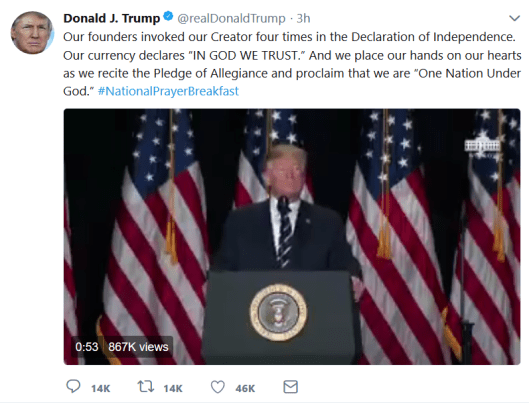
This pathetic tweet is an artifact of the National Prayer Breakfast. It’s an occasion when the President bows to the authority of political Christians, and vouchasafes their victories in the early days of the cold war. Whatever else this event is, it’s a good reminder that the cold war was always about internal politics as much as confrontation with external enemies. It’s also proof that little has changed under the sun (except perhaps the ratio of black carbon in the atmosphere, which is of course a heresy to the breakfasting prayer-mongers Trump spoke with today). Seriously, this event is the legacy of people who wanted Jesus to roll back the institutions of the New Deal, people who wanted to take away the social safety net and leave us all with nothing but Jesus and our own boot straps to help us in times of need. “In God we trust?” The subtext of that message is that government isn’t going to help you all.

That was always the point.

…which is why this message may be particularly relevant coming from an administration Hell-bent on tearing up every government agency that Americans rely on to keep us safe and prosperous. When the Manchurian Cheeto is done, we may well have nothing more than Jesus to keep poisons out of our water supply, remove the Russians from our computers, and hold the crooks at bay in the multinational cartels we now call banks. Jesus is already what the Republicans had offer the people of Flint and Puerto Rico. It’s what they offered to Southern Californians as a good chunk of the state burned down. It’s all we’ll be left with when the political Christians at the National Prayer Breakfast see Donald Trump deliver up the national disaster they’ve been praying for all these decades.

For all their flag-waving and Bible-thumping, those behind the National Prayer Breakfast are neither patriots nor Christians, and they certainly aren’t conservative in any meaningful sense of the word. What they want for this country is a disaster, and Donald Trump is delivering that disaster. He is the answer to their prayers.

The hypocrisy orgy known as the National Prayer Breakfast gives us a lot to gripe about. Donald Trump was fully immersed in the spirit of the occasion. He shared a good number of thoughts about the importance of faith in America, and in the American people. All utter crap of course, but he shared it all just the same.

For purposes of brevity, let’s just stick with the tweet, that portion of the wretched breakfast he chose to put into the only literary form the man and his fan base truly appreciate. He makes three points in this tweet, each of which is supposed to tell us something about the importance of God to the United States of America. Each of these points is damned misleading, which I suppose is a step up from the outright falsehoods we normally fall from this fountain of false facts, fake news, and utter foolishness. Still, a moment on each point will go a long way towards illustrating why Donald Trump is wrong about the role of God in America, and why the political Christians who eat this message up are wrong as well.

The first thing to notice is what is not mentioned in this vapid tweet, and that is the U.S. Constitution. It is the U.S. Constitution, and religion clauses of the First Amendment, that make the role of religion in our government such a hotly debated topic. One of the most fascinating things about those who want us to think of America as a Christian nation is just how hard they work to leave the Constitution out of the discussion. That document doesn’t help them, so they have to work around it. They have just one problem. Simply failing to mention the U.S. Constitution is too obvious. It sets up a great big red flag and invites those of us on the secular end too many obvious entry points to push our own point of view. They can’t just not say anything. That won’t work. So, they typically do what Trump does here. They cite the Declaration instead.

Like Jesus sent to atone for the sins the humanity, The Declaration of Independence serves to atone for the silence of the Constitution on the subject of God. (Yes, the Constitution mentions God in the date. If that impresses, you then I have an acre of arctic ice-pack to sell you.) The Constitution simply doesn’t say what Evangelical Christians want it to say. It does not invoke God as the authority for creation of the U.S. Government. (It locates that authority in the people.) It doesn’t say that you have to be Christian to hold office. (In fact, it expressly forbids such a standard.) And of course it contains a clause holding religion at bay right there alongside the right to practice religion. We can debate the proper interpretation of the establishment clause, but its mere existence is an annoyance to those who would clearly rather live in a theocracy. You can read the Constitution all day, but it won’t give you the license to tie Jesus to our politics that Evangelical Christians want out of the document. So, they typically talk about the Declaration of Independence instead.

Just like the Cheeto-in-Chief did today.

Of course those pushing the America-as-a-Christian-nation theme typically misread the Declaration itself, often confusing this reference to a Creator (written by a man widely regarded as a Deist) with a direct reference to Jesus himself and nearly always confusing this piece of propaganda with a clear plan of government. They ignore the clear parallels to logic of Hobbesian thought and other connections to Enlightenment philosophy in order to cast the language of the Declaration in terms closer to those of scripture. Most importantly, they reverse the point of the argument. Jefferson wasn’t using rights to prove the existence of a creator. He was using a reference to the Creator to explain the existence of rights, and no, there is nothing in the relevant passage of the Declaration that suggests the rights will cease to exist if we take the Creator out of the picture. All of this is lost on those consuming messages like that Trump delivered today at the National Prayer Breakfast. When they reference the Declaration, they see it as an argument for belief in God (which they assume means Jesus), but they are dead wrong in more ways than they could possibly count.

Simply put, the Declaration doesn’t mean what Donald Trump pretends it means. Neither does it mean what the political Christians at the National Prayer Breakfast want it to mean.

I doubt there is much in the Bible that means what they want it to mean either.

Or the Constitution that matter.

The whole shell game is crap!  People ought to stop talking about the Declaration when they mean to address questions about the Constitution, and they ought to stop reading either one as though it was the script for the youth pastor in a particularly uneducated part of the country. Most of us are smarter than that, but that doesn’t stop some people from recycling the same old garbage, which is what Trump did today. The whole con has been painfully obvious for decades. That should be as obvious to Christians as it is to the rest of us.

But not to the political Christians at the National Prayer Breakfast!

As to ‘In God We Trust’? That motto was adopted by the nation in 1956. It was part of the same movement that led to things like the National Prayer Breakfast, which makes it an interesting point for Trump to make. In doing so, he is simultaneously invoking a principle many assume to be a timeless part of American history and also giving a nod to the faithful who know the history of the prayer breakfast, people who understand the aggressiveness of their own political agenda, people who understand how divisive that phrase was always meant to be. It may sound like a nice an unifying message, if that is, you don’t give a damn about those who don’t trust god after all. In effect, the motto says of the rest of us that we aren’t really part of America. We don’t really count.

That is of course precisely the point. Always was.

“One nation, under God?”

Same story. This too was also added in those days shortly after Ike had been reluctantly cajoled into making public professions of faith in the official service of the nation. It too has always served as a clear reminder to the rest of us that we do not really belong. One nation under God? If you don’t believe in God, that little utterance, that bit of prayer stuck into the middle of an oath, gives the lie to the whole charade, it drops you right out of the narrative in the very moment the thoughtless celebrate unity at your expense.

Again, that is the point of the ritual.

So, there we have it, one twisted effort to dodge the Constitution on the subject of church and state, and two tokens of divisiveness wrapped in a cloak of unity. Whether he means it or not, whether Donald Trump is capable of ‘meaning’ anything in the conventional sense of the word, this is the message he offered America’s political Christians today. He endorsed their most aggressive agenda and made a point to isolate their enemies. Small wonder that these folks love him despite his obvious insincerity. Today Donald Trump offered the religious right the power to which they feel entitled, and he did it in precisely the same deceitful tones they have always known and loved. That’s our President; completely without substance, and utterly disingenuous.

The religious right wouldn’t have him any other way!

Share this:

  • Tweet
  • Share on Tumblr
  • Click to print (Opens in new window) Print
  • Click to email a link to a friend (Opens in new window) Email
  • Click to share on Reddit (Opens in new window) Reddit
Like Loading...

Of Ringers and Runts: An Experimental Exercise in Geeketry!

01 Friday Sep 2017

Posted by danielwalldammit in Gaming, Uncategorized

≈ 1 Comment

Tags

D&D, Dungeons and Dragons, Entertainment, Games, Narrative, Role Playing Games, RPGs, Story-Telling, Storytelling

Nerds only now! The rest of you guys just run along…

img450fd49cc8adeI think most of us who play RPGs have had this experience, the one where the game master (GM) brings in a ringer. It may be a non-player character (NPC), or it may be the GM’s own personal player character (PC, which was much more common back in 1st edition, …yes, I’m that old). Either way, the ringer towers over the player characters. He kicks ass while they struggle to make a difference.

One thing that strikes me about this is just how often the players will initially greet the ringer with joy. He or she typically shows up just when the player characters face some challenge they thought surely would prove too much. Suddenly they have a chance after all. With the appearance of a ringer, you can’t help but feel that hope is alive and well again. At least you can feel that way until somewhere during the course of that epic battle when the three orcs your ranger has killed don’t seem all that significant in comparison to the 6 giants, four ogres, and thirteen trolls the ringer has offed while you were struggling with a random goblin. The ringer is always a mixed blessing. He can win the day, but he can also make winning feel an awful lot like losing.

If the ringer is still in the group six games later, then I for one reckon it’s time to leave.

Should a ringer stick around for several sessions, the players begin to feel they are just along for the ride. The ringer can reduce player characters, and with them the players themselves to the role of an audience rather than a participant. It can take the fun out of the story, and it can make you reconsider how you want to spend your Saturday nights.

I think most gamers would say that it’s bad GMing to let a major character overshadow the player characters like that. It’s the job of the GM to challenge the players, not take center stage and enjoy their applause every time he wins the day. This is why so many frown on GM player characters. Game Masters shouldn’t run characters of their own, so the wisdom goes. That’s just asking for abuse. But in my experience, the taboo against GM player characters just contributes to the problem rather than helping to solve it. Almost every ringer that I’ve seen began as an NPC, just another character in the cast. This is what frees the GM to set them up with extra power. Often, the GM doesn’t even plan to keep the ringer around that long. he’s just another character in the overall plot-line, so it’s not big deal if he has a little extra power. The trouble is that GMs do become attached to interesting NPCs, so much so that they look forward to playing them, leveling them up, and watching the kick ass. A GM can feel this way about an NPC just as easily as he (or one of his players) can feel about a player character. In effect, some GMs have player characters, and they don’t even know it.

img452cb6a3c0f00Back in the days of first edition, a GM’s player character was most often rolled up according to the same rules as those of the players. This provided a bit of a check on the whole ringer problem. Abuse could still happen, but there was a bit more of a sense that the GM’s character was supposed to be part of an ensemble. When they come in over-powered to begin with, they inevitably become the star of the show, and the notion that a given character isn’t really a player character can very well serve as the excuse for a GM to field one who simply dwarfs anything the other players can produce.

***

Anyway, ringers are a problem, right? “Don’t do them!” That’s usually a pretty good rule of thumb. So, here is a thought experiment. What if we toss that rule aside? Is it possible to put a ringer in a campaign without ruining everything?

Okay, I know you can do it for a game or two, but what if the ringer was there for the balance of the campaign. Is it possible to do this without ruining the players’ fun?

In essence, this is a question of re-protagonization. In gaming, we often talk about deprotagonization, the process by which a character is made irrelevant to the story-line in a campaign, but what can be done to provide genuine significance to a character living in the shadow of a ringer? That is the question posed by the prospect of gaming (deliberately) with a ringer. It’s a thought experiment of sorts, but hopefully an amusing one.

How to go about it?

***

img450fd04546e89I can think of a few angles. Whether or not they would actually add up to a fun campaign, well that’s an open question! Anyway, here are the guidelines I would use to set up the campaign.

One: Much of the ringer’s activities take place offstage, leaving the player characters free to resolve their own challenges without the help of the big guy. For example, the ringer is a spell caster, and she is performing a complex task inside a building. The players must protect the building themselves. If they fail, her spell is ruined, and the overall plot takes a turn for the worse. What I really like about this example is the characters can fail without this resulting in a total party kill. If they blow it, then the enemy reaches the ringer, and the ringer then enters the fight. This way the PCs will probably live through their failure, but everyone will know the development is bad in the long run, because that spell was important. How? Well that’s a question for a larger plot-line…

Okay, this might be cheating a bit, because a ringer off-stage isn’t all that different from any other background piece of a campaign plot. Arguably, such things are happening just offstage in many campaigns. It’s just not that unusual. The full challenge of making a ringer work would be one of making it work when the ringer is standing right there beside the players, doing things along with them, and providing tangible assistance during the course of events. It could provide an interesting twist for a game or two to let the players cope with the sudden absence of their MVP, but if that’s the campaign, then your campaign doesn’t really have a ringer. That’s ducking the challenge here rather than facing it.

Two: Give the healer an inherently supportive role. What is she good at? She can heal like no-one’s business, or she is really great at support magic. She can make the other characters run faster, hit harder, and otherwise kick ass. If only they were a little better to begin with! (This works particularly well if you combine it with a definite plan for PC growth.)

What I like about this approach is it filters the impact of the ringer through the actions of the PCs. The ringer remains a ringer She can do amazing things, but the PCs will still have to kill the bad guys; they will still have to scale the cliffs, and they will still have to break open the door to the enemy castle. They may get a boost from the ringer, but it’s up to them to make that boost matter. In effect, the ringer becomes their own asset. It is up to them to make her matter.

What doesn’t work about this approach is that it soft-peddles the ringer to the point that she may not seem like a ringer. Fantasy movies and books are full of wise wizards with far more power than the warrior-protagonists which remain the focal point of such stories. Simply put, we care who wields the sword more than we care who keeps him healthy. That’s one of life’s little perversions, but I reckon it’s a common enough feature to storytelling, it doesn’t make much sense to deny it. A real ringer is a ringer than leaves carnage in his wake, not one that brings you back from the dead and gives you an energy drink. Maybe that shouldn’t be the case, but it is.

img4547cd6d641b0Three: Let a player run the ringer. I’ve done this countless times. My old first edition D&D campaign ran for over 20 years. Since we started a new plot-line every year or so, we would often roll one or of the old characters into the new campaign. This often meant that a single player would have a 9th level character or two while everyone else was starting at 1st. It could be fun. We let different players run the ringers in different campaigns, and with multiple characters on the board, no-one got bored. There was always plenty for the other characters to do.

This approach at least takes some of the sting out of the GM bias, but that may be all it accomplishes, and a PC-ringer poses problems of its own. If the ringer-rolling player isn’t present for a game session, then either someone else must run their character (something I don’t like doing), or your ringer is gone. How to explain the absence of the ringer or the player’s how to cope with his absence is sometimes a tricky question. Also, letting a player run the ringer makes it harder to control the relationship between the ringer and the other players. If that player is selfish, then she will deprotagonize the other players, and you can’t do anything about it without taking the player’s ability to run her own character. That’s no fun. It can all workout, but suffice to say that I don’t think this really solves the problems posed by putting a ringer in a campaign.

Four: Make the ringer its own challenge. It doesn’t have to be obvious that the ringer will help with tasks the players have set out to accomplish. Maybe she doesn’t really want to help at all and the players will have to talk her into it. Better still, if they must actively work to keep her on track over the course of the campaign! Is the ringer a drunkard? The players must keep her sober for the big fights. Is she really forgetful or otherwise aloof to the point of becoming utterly unreliable? If the player characters have to make decisions for her, or even role-play the process of guiding her actions, the ringer becomes an extension of the player’s own efforts. What she does is what they get her to do. It may still be her fireball, but at least it will be the players who told her where to place it.

On a side note: it could be interesting to give players powers enabling them to redirect the actions of the ringer. In effect, she becomes a power source, but at least some of her actions are determined by the players.

I think this approach is promising insofar as it gives the player characters some sense of control over the campaign. Still, convincing the hero to do the right thing isn’t quite as much fun as being the one who does it yourself. a fireball rolled up by another character will never be as fun as one you roll up yourself, even if you did talk the other person into casting it. Giving the PCs a care and feeding role to play in managing the ringer helps a bit, but this alone won’t provide a satisfactory solution to the problem.

img4577093b04e3cFive: You can give the player characters independent tasks and even long-term goals that diverge slightly from those of the ringer. Perhaps, the ringer is happy to demolish all the orcs in the northern wastelands, but she isn’t all that concerned about the elven princess the characters want to keep alive. Their challenge thus requires tasks that the ringer won’t help with and their sense of accomplishment will then rest (at least partially) on terms that don’t involve the ringer.

I think this is critical to resolving the problems posed by a ringer. Whatever problems the ringer can be relied upon to help the players solve, the players must face some problems they have to resolve on their own. If these problems can be put in play at the same time, in the same scenario, then so much the better. The ringer is in play on the table, and the player characters must do something for which her help will not be provided. Not only does this go a long way toward resolving the problems posed by a ringer; it can also spice up game combat in general. A battle with a subplot is more interesting than a straight-up fight, and if that sub-plot skews the significance of the characters present, so much the better.

Six: Let the characters progress to a level comparable to that of the ringer. This really is the big one, as far as this challenge is concerned, because it makes the ringer into a challenge that must itself be resolved over the course of the campaign. In effect, this turns the problem posed by a ringer into a source of meaning in itself. To make this work, though, you must risk letting the characters feel the weight of the ringer initially. Let them struggle to matter for challenge or two, then let them solve a problem or three, and finally give them a moment when they see the ringer as an equal rather than a superior.

For an extra twist, let the ringer become an enemy in this final moment, and let the battle with that ringer be the final test of progress. You know you’ve made it when your mentor lies defeated before you! …extra fun if some cryptic prophesy alludes to this early in the campaign.

Extra twist, or not, I think letting the players overcome the difference is the key to making a ringer into a positive force in the campaign. It’s an experience, I recall from my early days in gaming. I spent most of my gaming days playing first edition D&D. It was a consistent expectation back in those days that your character would start as a grunt and grow into power over the course of a campaign. Most importantly, first edition was a definite sense of diminishing returns. You could bring a 1st level character into an 8th level campaign, and by the time the other characters had made 10th, your own character was probably only one or two levels behind them. You weren’t quite even with the others yet, but at that point, you were one of the group, a force to be reckoned with. Watching your significance grow in comparison to the established characters in such a campaign could be a lot of fun. In effect, the over-powered characters provide a base-line from which you gauge your characters progress, effectively making it all that much more obvious than it would be in a campaign where the characters (and their enemies) are both relatively evenly matched.

The sense of character progress is something I missed in 3rd edition. The balance of power in that game didn’t shift much over the course of a game. If one character was 5th level and another 1st, ten games later, then 5th level character was till significantly more powerful than the 1st. You just couldn’t overcome the difference like you could in first edition. It’s one of the things that made the presence of a ringer that much more toxic in 3rd edition, I think. Under normal circumstances, the differences could not be overcome. I miss it. Maybe that’s what has me thinking about ringers.

No, I haven’t played 4th or 5th edition.

SixB: As a further twist on progress, give the ringer an active role in helping the PCs develop and grow. It’s easy enough to role-pay a mentor apprentice relationship, but it’s a little more fun to provide some significance to this in the game-mechanics. IN my home-brew system, I allow characters to share experience points, and I make this more effective under selected conditions, as in cases where the advanced character has specific teaching abilities, or if the characters have entered an established relationship of some kind). I let the players choose these things, of course, but I give these choices weight in character development. This can help to accelerate player character growth relative to the ringer even as it slows the ringer down. Such mechanics can help to facilitate the change in balance for an overall campaign. It’s particularly interesting when the players themselves have a ringer. Letting them decide how to deal with the differences in power-level provides another layer of meaning to the plot, and of course I try to ensure that the rewards for sharing experience and helping younger characters grow will outweigh any costs.

…of course, none of which is going to help any of the poor bastards when it’s time to meet the dragon!

Share this:

  • Tweet
  • Share on Tumblr
  • Click to print (Opens in new window) Print
  • Click to email a link to a friend (Opens in new window) Email
  • Click to share on Reddit (Opens in new window) Reddit
Like Loading...
← Older posts
Newer posts →

Top Posts & Pages

  • Master and Commander Kinda Queered
    Master and Commander Kinda Queered
  • I'll Just Leave This Here
    I'll Just Leave This Here
  • The Hip Show (Guest Post)
    The Hip Show (Guest Post)
  • Road Trip! (Anchorage to Valdez)
    Road Trip! (Anchorage to Valdez)
  • Once Upon a Charlie
    Once Upon a Charlie
  • Movie Review: The Orator
    Movie Review: The Orator
  • An Uncommon Security Guard: Dave Eshelman, AKA 'John Wayne'
    An Uncommon Security Guard: Dave Eshelman, AKA 'John Wayne'
  • Eye, You, and Donald Trump
    Eye, You, and Donald Trump
  • Great Movie Villains, Volume IX: That Witch With a Bow!
    Great Movie Villains, Volume IX: That Witch With a Bow!

Topics

  • Alaska
  • Animals
  • Anthropology
  • atheism
  • Bad Photography
  • Books
  • Childhood
  • Education
  • Gaming
  • General
  • History
  • Irritation Meditation
  • Justice
  • Las Vegas
  • Minis
  • Movie Villainy
  • Movies
  • Museums
  • Music
  • Narrative VIolence
  • Native American Themes
  • Philosophy
  • Politics
  • Public History
  • Re-Creations
  • Religion
  • Street Art
  • The Bullet Point Mind
  • Travel
  • Uncategorized
  • Uncommonday
  • White Indians
  • Write Drunk, Edit Stoned

Blogroll

  • American Creation
  • An Historian Goes to the Movies
  • Aunt Phil's Trunk
  • Bob's Blog
  • Dr. Gerald Stein
  • Hinterlogics
  • Ignorance WIthout Arrogance
  • Im-North
  • Insta-North
  • Just a Girl from Homer
  • Multo (Ghost)
  • Native America
  • Norbert Haupt
  • Northwest History
  • Northy Pins
  • Northy-Tok
  • Nunawhaa
  • Religion in American History
  • The History Blog
  • The History Chicks
  • What Do I Know?

Archives

  • December 2023
  • November 2023
  • June 2023
  • April 2023
  • February 2023
  • December 2022
  • November 2022
  • October 2022
  • September 2022
  • August 2022
  • July 2022
  • June 2022
  • April 2022
  • January 2022
  • December 2021
  • November 2021
  • October 2021
  • September 2021
  • August 2021
  • June 2021
  • May 2021
  • March 2021
  • February 2021
  • January 2021
  • December 2020
  • November 2020
  • October 2020
  • September 2020
  • June 2020
  • May 2020
  • March 2020
  • February 2020
  • January 2020
  • December 2019
  • November 2019
  • September 2019
  • August 2019
  • July 2019
  • June 2019
  • May 2019
  • April 2019
  • January 2019
  • December 2018
  • November 2018
  • October 2018
  • September 2018
  • August 2018
  • July 2018
  • June 2018
  • May 2018
  • April 2018
  • March 2018
  • February 2018
  • January 2018
  • December 2017
  • November 2017
  • October 2017
  • September 2017
  • August 2017
  • July 2017
  • June 2017
  • May 2017
  • April 2017
  • March 2017
  • January 2017
  • December 2016
  • November 2016
  • October 2016
  • September 2016
  • August 2016
  • July 2016
  • June 2016
  • May 2016
  • April 2016
  • March 2016
  • February 2016
  • January 2016
  • December 2015
  • November 2015
  • October 2015
  • September 2015
  • August 2015
  • July 2015
  • June 2015
  • May 2015
  • April 2015
  • March 2015
  • January 2015
  • December 2014
  • November 2014
  • October 2014
  • July 2014
  • June 2014
  • May 2014
  • April 2014
  • March 2014
  • February 2014
  • January 2014
  • December 2013
  • November 2013
  • October 2013
  • September 2013
  • August 2013
  • July 2013
  • June 2013
  • May 2013
  • April 2013
  • March 2013
  • February 2013
  • January 2013
  • December 2012
  • November 2012
  • October 2012
  • September 2012
  • August 2012
  • July 2012
  • June 2012
  • May 2012
  • April 2012
  • March 2012
  • January 2012
  • December 2011
  • November 2011
  • October 2011

My Twitter Feed

Follow @Brimshack

RSS Feed

  • RSS - Posts
  • RSS - Comments

Enter your email address to follow this blog and receive notifications of new posts by email.

Join 8,075 other subscribers

Blog at WordPress.com.

  • Subscribe Subscribed
    • northierthanthou
    • Join 8,075 other subscribers
    • Already have a WordPress.com account? Log in now.
    • northierthanthou
    • Subscribe Subscribed
    • Sign up
    • Log in
    • Report this content
    • View site in Reader
    • Manage subscriptions
    • Collapse this bar
 

Loading Comments...
 

    %d