• About

northierthanthou

northierthanthou

Tag Archives: Rhetoric

Your Lips Say ‘No’, But Your Eyes Say ‘Chicken-Whistle Star-Bullets!’

01 Sunday Dec 2013

Posted by danielwalldammit in atheism, Movies, Religion

≈ 15 Comments

Tags

atheism, Critical Thinking, Debate, Film, Movies, Religulous, Reliion, Rhetoric, Sarcasm

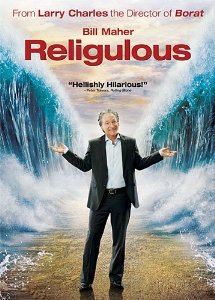
51mGiYaPfqL._SY300_So I finally watched Religulous. I found it a truly underwhelming experience. Honestly, I think I must be over the joys of poking holes in religious thinking. In other news, boxing with Girl Scouts no longer brings me quite the same thrills that it used to.

…at least on Thursdays and Saturdays. It is entirely possible that I may relapse on Tuesdays and Fridays.

Okay, it’s not always that easy, I know; sometimes I meet a religious person with genuinely challenging thoughts, but perhaps that is my point. One can find a pretty broad range of qualities fitting under the heading of ‘religion’, and it can be just a little too easy to look for the easy pickings. Some people treat debunking religion as a sport, and those people rarely seek out the challenging thinkers. No, they hunt the naive in remote and highly uneducated corners of the globe; they sniff out the cooks and the crankcases. I should point out that the sport-debunker isn’t always an atheist, but of course, this time it is.

Religulous is the intellectual equivalent of a canned hunt. In this movie, Bill Maher seeks out and makes a fool of one believer after another and I cannot help but think most of those interviewed have been selected for their capacity to appear nutty to the rest of us. Maher does little to explore the intellectual lives of any of those interviewed in Religulous. His discussions bear a strong-resemblance to a cross-examination in a courtroom (or at least a courtroom drama). Maher’s questions rarely veer far from the effort to produce a contradiction or an implausible claim, and he doesn’t hesitate to interrupt, argue, or insult his subjects at any point in the movie. Not wanting his subjects to go-off half-mocked, Maher includes several segments in which he trashes those already interviewed while driving about, presumably on the way to the next ambush interview. When he does interview intelligent believers, Maher’s sole interest seems to be getting them to help debunk their brethren. The most interesting and complex thinkers in this movie would easily include a number of Priests but they are of interest to Maher only insofar as they help us to dismiss the beliefs of others.

I have to admit, there was a time when I would have been into this. Now, I just find it rather predictable.

…and pointlessly rude.

Ironically, I think Maher’s snide disrespect for his quarry in this film actually blunts the force of his criticism and lets them off the hook. In interviewing John Westcott,  an ex-gay minister, for example, Maher makes a point to suggest the sexuality of the man’s children remains in question. In the commentary track, he further laughs at the irony of a man denying his homosexuality when Maher can tell by his behavior that the man is gay. Personally, I think this underscores the irony of a man proporting to call a believer to task for mistreatment of homosexuality while exhibiting all the insight and sensitivity one might expect to find in the boys locker room of a high school football game. Maher’s games do absolutely nothing to reveal the intellectual dishonesty and outright harmfulness of ex-gay therapies and related ministries. While Maher plays to the cheap seats by making fun of the man and his children, the interview goes nowhere. Maher learns nothing about the minister’s actual point of view, and he does nothing to show us just how harmful these organizations can actually be.

And I wonder if I am supposed to be pleased with this?

Maher is casting religion in a bad light, and in this movie (as in other contexts), he does sometimes score a hit, or even a home-run. I should be able to enjoy this, and I would, if I thought Maher was doing a consistently good job of it, but what bothers me most about this movie is a sneaking suspicion that it isn’t an exercise in healthy skepticism, that in fact Maher is selling a message that doesn’t quite fit the label on the packaging. Shallow as it is, Maher’s engagement with the proponent’s of God-talk is not merely intended to show us how foolish they are. He is building a narrative with assumptions going well beyond the foibles of his hapless quarry.

One particularly telling moment occurs during an interview with a Muslim cleric. the man’s cell phone goes off, and the ringtone is Led Zeppelin’s Kashmir. Maher suggests that this is odd. The prospect that a song called ‘Kashmir’ might strike a cord with a Muslim seems to have completely escaped him. More to the point, he doesn’t ask why the Cleric uses that ringtone or what it means to him. To Maher it seems to be self-evident that the Cleric’s choice of music reveals an inconsistency. He drives this point home further in the commentary track, suggesting that people steeped in outdated beliefs should not get to use modern conveniences.

The mode of engagement used here is consistently that of polemics. Maher wants to poke holes in religion; he doesn’t want to understand anything else about the people he is talking to, or at least he doesn’t want to show us anything else in the final cut of the movie. To describe the end result as superficial would be giving superficial a bad name. But of course there is something a little more insidious at work here. It arises in the notion that religion is simply outdated, that the cleric’s interest in a cell phone is simply incommensurate with religious beliefs. This is old fashioned unilineal evolution, the belief that human history follows a set course. To Maher (and evidently his producer) it goes without saying that religious beliefs are chatter out of place, so to speak, and that history is incomplete so long as these throwbacks remain with us. This is the key to his polemic approach. He wants to show us that religion is stupid, urge us all to leave it all behind, and thereby advance one further step in human history.

In taking this approach, Maher is unfortunately (and ironically) doing a good deal more than debunking the beliefs of his interview subjects; he is advancing a faith of his own, a faith in Progress with a capital ‘P’, and a specific vision of that Progress. The film ends with an emphasis on growing conflicts between Muslims and Christians, and a recurrent expression of fear that these faiths will lead us to nuclear disaster. Maher addresses the claim that these conflicts are really political, and of course it is easy enough for Maher to assert that they are also religious, but of course this is a unique marriage of the fallacies of straw man false alternatives. The question is not which category various conflicts fall into, but rather how politics and religion intersect in actual human history. That is a question Maher is completely unprepared to answer, or even ask. He relies on a stock vision of humanity’s course throughout the film, and herein lies the value of his deceptively simple interview agenda. So long as we are focused on the foibles of the faithful we may not take the time to think critically about Maher’s own millenarian vision of the future.

This is bait & switch.

Maher quite rightly calls some of his interview subjects to task for glossing over the role of faith in political violence, but his refusal to address the politics is itself a telling source of ignorance. He is telling as simple story in which the source of modern evil is found in beliefs and beliefs alone. If only we can deal with the bad beliefs once and for all in the fashion of lunch-room debate tactics, then the world will be a better place.

In advancing this simple message Maher shows us that he has a lot more in common with believers than he would suppose.

71.271549 -156.751450

Share this:

  • Tweet
  • Share on Tumblr
  • Click to print (Opens in new window) Print
  • Click to email a link to a friend (Opens in new window) Email
  • Click to share on Reddit (Opens in new window) Reddit
Like Loading...

A Hyponym Walks into a Bar…

18 Monday Mar 2013

Posted by danielwalldammit in atheism, Philosophy

≈ 27 Comments

Tags

Agnosticism, Apologetics, atheism, Belief, Debate, Hyponym, Philosophy, Rhetoric, Semantics

Here is how I would spend that money!

I could believe in a God of Korean BBQ, yes I could!

I Grumble: I wish I had a nickel for every time a Christian told me that my take on the existence of God isn’t really atheism; it’s agnosticism. No, those nickels wouldn’t make me rich, but they would add up to a nice meal at a decent restaurant, and with enough change to leave a damned good tip.

On one level, this is  interpersonal aggression. If someone can take your identity away (or at least that part of your identity most salient to the topic at hand), then the rest of the discussion is going to suck no matter how well you handle the particulars. It’s the sort of argument that is really about who is in charge.

…and I mean in a right-here-and-now kinda way.

Just like a husband and wife engaged in a two-day spat over which brand of butter would have been a better purchase, atheists and theists (mostly Christians) will tap away on our keyboards well into the wee hours of the morning, all over the question of just what atheism really is and who gets to call themselves an ‘atheist’. It’s almost as though we have that agreement, you know the one about never going to bed with unresolved issues, only we never do get to the make-up sex on this particular topic. We just keep jabbering at each other until the sun rises and it’s time to go to work tired. (Thanks honey!) The bottom line is what ought to be the opening stages of a larger dialogue becomes the overwhelming focus of an exhausting (and often pointless) pseudo-discussion.

On another level, the subject is certainly worth some time. The semantics are tricky here, and one will need to sort the meaningful possibilities out before proceeding to any substantive issues. And Hell, I figure I’ve encountered a genuine concern or three amidst all the bunk believers have thrown at me on this issue over the years. I know I have a few truth-in-advertizing concerns for those calling themselves Christians as well. Plus, I think I’m actually adjusting my views on this one a bit lately. So, I’m going to have a go at this all-too familiar old topic and hope that the results won’t lead to any incidents of self-mutilation.

So, please take a deep breath!

***

The Basics: The problem is this, among the group of people calling themselves atheists, some of us will happily do so without presenting any reason to believe that there are no gods. If pressed on the issue, we will often claim that the burden of proof lies with the believer. Atheism thus represents a stance we will take in the absence of positive reason to believe in God. This approach to atheism is sometimes known as “weak atheism,” as opposed to “strong atheism,” which is generally taken to refer to the stance of someone prepared to argue that no gods exist at all. Some might say that a weak atheist simply doesn’t believe in any gods whereas a strong atheist says there are no gods.

And here is where Theists often cry foul. Isn’t the neutral position really that of agnosticism, they will say, and how can it be that atheists (weak or otherwise) have no burden of proof? Isn’t that unfair?

But of course atheists have a number of arguments in favor of these terms, not the least of them being an analogy to legal reasoning and/or the structure of formal debate organization wherein an affirmative position is often given the burden of proof. If someone is accused of a crime, we do not expect the defense to prove them innocent; we expect the prosecutors to prove them guilty. The problem, as weak atheists often phrase it is that you cannot prove a negative. This isn’t quite true, or even close really; but it does touch on a real problem. Many negatives can be proven true, but many cannot. If for example the original claim to be disproved is too vague, it will be difficult to formulate grounds for proving it false. Making someone responsible for proving a negative thus creates a double-bind of sorts, making the critic responsible for any ambiguities in the position he seeks to criticize.

The weak atheist position construes this debate in terms of a proof that at least one God exists. If the theist can make his case, then great he wins, but if he fails, then we go back to our default judgement that no gods exist.

Theists typically reject these terms of debate, often by suggesting its proponents have mislabeled themselves. ‘Atheism’, they will suggest should be reserved for those prepared to prove god doesn’t exist and those who merely assume he doesn’t in the absence of evidence are better described as ‘agnostics’.

It is actually a rather soft version of agnosticism that theists keep advancing as the proper alternative to the weak atheist position; effectively telling us; “if you don’t know, then leave it at that.” The shoulder-shrug version of agnosticism is not to be confused with hard agnosticism (i.e. the notion that questions about the existence of God are inherently unknowable, in short; “I don’t know, and neither do you”).

Of course soft agnosticism could be a perfectly reasonable description of the absence of affirmative belief, but so would weak atheism. In fact, the two categories could well apply at the same time. …hence the common practice of referring to oneself as an agnostic atheist.

Many do just that.

***

Holy Holistics Batman!  It’s worth considering that such labels go well beyond the stance one takes in a particular debate and extend to questions about behavior, values, etc. Life is full of decisions one has to make in the absence of perfect information, and this is one of them. Sooner or later we have to make decisions predicated on our answer to questions about whether or not God does exist. I will either keep the Sabbath or not; I will either say the Sinner’s Prayer with conviction, or not. I will either covet my neighbor’s hot wife or not. …you get the idea. If the debate over whether or not God exists ends in a stalemate the actual pace of real life decisions does NOT respect that stalemate (and from what I hear, neither will the God of Abraham). Whatever the balance of evidence, one has to make a decision. This is exactly what burdens of proof are about. Assigning a default judgement is a process of deciding what you will do if you do not know the answer to a given question.

The weak atheist position may be frustrating as Hell to theists, but it has the virtue of addressing this question of how one will actually live.

***

Let’s Take a Step Back: There is just one thing about that last twist in the argument above; it isn’t quite a function of logic or reason, …not entirely so anyway. Rather, it is a question of how the merits of a reasoned position will map onto the practical judgements of actual life.

Default judgements lie at the intersection between reason and social interaction, and the question of who has the burden of proof in this debate is just one of the moments when the politics of religion intrudes on the intellectual exercise of reasoning about it. However much the participants may want to imagine themselves capable of resolving the issue on the merits of the case, the prospect looms large that it will still be an open case long after any particular discussion (or even years of study and centuries of dialogue). It would be nice if someone could produce end-game proof one way or another, but the reality is that most of us will end up making our decisions about a range of relevant issues in the wake of a stalemate shaded by a little other than a sense that one side or another has a good point here and a slight advantage there. In short, the debate may never end, but sooner or later we have to declare our own take on the issue. At that moment, when we have to decide in the absence of a clear accounting, the burden of proof may well prove to be the decisive consideration.

And so we haggle about the terms of the debate even to the point of never getting to the debate itself, partly because we know this little technicality is likely to make a difference on down the road a bit.

Whatever else weak atheists are saying, they are also saying “let’s handle this issue one God at a time. You give me one sound case for one God as you define Her, and I’ll give up my position and go with that one God.” This position offers real advantages for both parties, not the least of them being that it bundles all the tricky semantic questions about what one means by ‘God’ into the same package and lets the Theist have first crack at resolving them. The details of the discussion will then be on her terms (or at least about her terms).

This has the advantage of providing for a pretty direct test of that God, at least for those willing to approach the subject by means of reason (which is admittedly a diminishing portion of the population …it having become an article of faith that religion is about faith). In short, this approach to the conversation maximizes the relevance of any conclusions drawn to the actual beliefs of the Theist involved in any particular discussion.

But what about the atheist? For him, this way of modelling the issue really tests a pretty narrow aspect of his professed stance; his ability to present a reasonable objection to one particular approach to belief in one particular god, …at least as argued by one particular person. It leaves his take on any other gods pretty much off the table altogether. And (here is where I am cutting against years of habit) I think there is some justice to the claim that this is something of a dodge.

If someone has concluded that there are no gods, or even that he sees no reason to believe in any, then even this latter version of his stance necessarily goes well beyond the subject of one debate with one believer. It’s a fair question; what about the others? How do you deal with them?

Those professing weak atheism are generally unwilling to enter onto that turf, not the least of reasons being that any attempt to produce an end-game argument on the subject will effectively make them responsible for resolving all he tricky semantic questions while theists stand-by with an easy out. If an atheist attempts to prove that all gods don’t exist; he has to settle on a definition, and he has to do it without a claim that that definition fits the real thing (since he doesn’t think there is a real thing). The mistakes of believers thus become the responsibility of the atheist, and the liar’s paradox then mocks his every move.

And yet, there remains some trace of a legitimate question here. Does the stance of even a weak atheist not go beyond the particular gods of the particular theists with whom he is talking at any given moment? Clearly, he expects to reject any given god with whom he he is confronted at any given time. If that expectation does not yield a direct argument on the topic, is there no accounting for it whatsoever? None?

At the very least we could frame the conclusion that there are no gods as an induction of sorts, derived from our past experiences debating the existence of particular gods with particular people in a variety of different conversations. At some point, one begins to form an expectation, even a tentative conclusion. The judgement is there, and one can even find ways of framing it for purposes of discussion. It’s just that the conversation gets kind of messy if you go this route.

But maybe that’s a mess more of us ought to consider getting into.

***

Let’s Wrap it Up (and it’s About Time!): The issue here isn’t really what kind of atheist are you; it’s what kind of conversation do you want to have? How do you prefer to frame the debate? And the truth is that most of those professing weak atheism do in fact cultivate a number of alternative approaches to the subject; they just don’t recognize them as appropriate answers to questions about the existence of God or gods. This happens precisely because the conversation must at some point cease to be a question of metaphysics and become a question about social practice.

Ultimately, the judgement that there are no gods has less to do with the nature of the universe than the value of certain ways of talking about it. It is a judgement that god-talk never has nor ever will produce a description of a superntural entity that is literally true. On a good day, god-talk might produce inspiring poetry, amazing architecture,  profound moral thoughts, or even deeply moving personal narratives, but it will not produce a plausible case for a supernatural entity. Even the assertion of a weak atheist stance means at least this much; that one does not expect to hear talk of gods produce a believable claim about the existence of such a being. One may prefer to test that one god at a time with the Theist on the hot seat, but those of us claiming the label are certainly communicating something about our expectations regarding the subject at hand.

We can do more than that, and we actually do more than that every time we comment on the realities of religious practice; every time we describe the horrors committed in god’s name or link any poor judgement to the vagaries of religious thought. This sort of talk doesn’t always rise far above the level of gossip (or even outright idiocy), but it often calls attention to real problems. At least part of the rationale for rejecting belief in God is a sense that talk about him is unlikely to produce a claim worth affirming, at least not in its most literal sense. (Some of us may find Martin Luther King Jr.’s words inspiring or even turn the radio up for a religious tune or two, but there is always some sense in which we are not quite down with the whole message.) And herein lies the moment when even a ‘weak atheist’ goes a little beyond the confrontation with any one case for God; he is pronouncing a verdict on a vast range of discourse about gods, and he is telling us that all of it (in his estimation) fails to produce a compelling case for belief in that God. In some instances the God is too vague, in others She is a contradiction, and when a clear and coherent concept does make an appearance it just doesn’t have the ring of truth to it. This is a judgement that goes beyond the test of one particular god belief, and weak atheists make these sorts of judgements on a pretty regular basis.

So, it isn’t really that we have two types of atheists here so much as two (or more) different ways of setting up a discussion with theists over the subject. One typically uses the deductive models of metaphysical reasoning to test one God at a time (preferably that of the particular believer we happen to be talking to). The other typically uses probabalistic reasoning to pass judgement on a range of loosely connected ideas sailing under the rubric of god-talk. In effect, the second approach deals not with God Herself so much as the language in which she is typically presented, and it deals with that subject in terms of summary judgements. There is nothing inherently wrong with this approach, but it’s a bit less rhetorically satisfying, especially when squaring off over the subject with someone who insists that some version of God is real after all.

Most of us are uncomfortable with generalizations, and I think even atheists are oddly attached to the sense of absolute truth that one expects from metaphysical discussion. When we approach the topic that way, we can often say ‘no’ with something approaching certainty. It is the certainty of deductive reasoning and all-or-nothing proofs. Theoretically those are the stakes, the theist too could win one for the Gipper, …or Jesus, I suppose. If these are the stakes, then yes, I think I am still inclined to opt for the weak atheist position. But I do think it is reasonable to expect some accounting for the rejection that goes beyond the god of one particular conversation; that account will of necessity turn into a form of social commentary. And thus my rejection of god turns out to be a rejection of what men say about Her, and on that score perhaps there are sufficient grounds to field an affirmative argument.

About the hyponym? Turns out he’s kinda hyper.

71.271549 -156.751450

Share this:

  • Tweet
  • Share on Tumblr
  • Click to print (Opens in new window) Print
  • Click to email a link to a friend (Opens in new window) Email
  • Click to share on Reddit (Opens in new window) Reddit
Like Loading...

Preaching to the Non-Choir and Slouching Towards an Apologetic Tradition

05 Tuesday Mar 2013

Posted by danielwalldammit in atheism, Philosophy

≈ 20 Comments

Tags

Apologetics, Argumentation, atheism, Friendly Atheist, Internet, Philosophy, Ray Comfort, Rhetoric

http://redwing.hutman.net

http://redwing.hutman.net

What is the difference between a Christian philosopher and a Christian apologist?

Quite simply, marketing.

When I think of a Christian philosopher, I think of someone genuinely engaged in thinking through the issues, someone who makes his bread and butter by addressing alternative viewpoints in a direct and reasonable manner. His career depends on his ability to challenge others with cogent arguments to the topic at hand. He writes and he speaks with an audience in mind that includes non-believers, even dedicated opponents of his own position. Good Christian philosophers give me pause; they make me think twice, and I enjoy reading or listening to their thoughts.

When I think of a Christian apologist, I think of someone whose real audience is already sitting in the church, and they have no intention of going anywhere else on a Sunday. That audience is happy to take in some argument fresh out of a can, telling them why the other guys (people like me) are wrong. They don’t really need convincing, just reassurance, and they certainly won’t be asking any tough questions, at least not without accepting any token answers that may come along. When I think of apologists I think of endless circular arguments and enough straw men to earn a visit from the fire marshal. Apologists can do this, precisely because they are not really making an effort to engage non-believers, they are just making a show of it for the benefit of the faithful.

The philosopher has a potentially hostile audience, and he knows it; the apologist is preaching to the choir, and he knows it too.

When I think of Christian philosophers I think of Alvin Plantinga. When I think of apologists I think of Ray Comfort and his damned banana. (Then I think of Dunning and Kruger, but that’s a rant for a different day.) Don’t get me wrong, there is no hard and fast dividing line between these practices, but one cannott help noticing the differences at the far ends of the continuum. Some folks are making an honest effort to engage people with different views, and some folks are just going through the motions.

An entire industry falls on the less-than-worthy side of that distinction, producing stock arguments for the benefit of believers everywhere. Diehard consumers of this literature often become adept at identifying the issues, naming the conventional arguments, and applying the necessary responses, or at least the labels thereof. Being tone-deaf to the particulars of any given conversation, such folks are happy to point you to a book or even supply a link to some guy who answered your argument (or at least another argument that would fall under the same label). “Just go there and read it and you’ll see…”

Damned irritating is the nicest thing I can say about such people.

But all of this is just background material. What has me thinking about this is the possibility of an emergent apologetics tradition within atheism. Now some might take it for granted that everything I just said about arguments for Christianity would be true of non-believers as well; if one side of a debate is doing it, so a kind of popular wisdom goes, you can sure bet the other side is doing it too. But that just isn’t always the case. (Allow us please the possibility of a different set of vices.) In this instance the difference lies in the relative absence of a viable market for such messages.

…until recently.

For most of my life being an atheist has been a rather lonely experience. Oh sure, I could find lots of people happy to bitch about religion, and plenty more who could tell me (their faces beaming) about the time their minister got mad at them for asking too many questions. But with few exceptions, these same folks stop well short of  denying the existence of God altogether. Most have little better tom say about atheists than they do the preachers of those stories.

http://xkcd.com/774/

http://xkcd.com/774/

Perhaps, my experiences have been atypical, but I don’t think so. Near as I can tell, unbelievers haven’t generally run in crowds all that much, not in the western world at any rate, not the least of reasons being that we have a hard time finding each other.

Had, that is! …had.

The Friendly Atheist, Hemant Mehta, once suggested that the invention of the internet has served to empower atheism in important ways, perhaps even given us an edge over believers in public discourse. I have my reservations over Mehta’s full take on the subject, but there is something about his observations that ring true for me. I do think the net is a bit of a game changer even if the outlook of this new game may be less than clear at this point.

The whole issue reminds me of an evening spent surfing the Apologetics page at Christianforums.com only to find the only other people on there were atheists like me. I challenged one of my fellow heathen to debate me anyway, suggesting we flip a coin to decide who would play the part of a believer, but he just wrote ‘lol’. The internet had no love for an argumentative guy that night. Anyway, that was my first taste of the power of the net to draw the unbelievers out into the open, or at least the virtual equivalent thereof.

I live and work in a remote village in the Bible hat of the country. I’ve met three self-professed atheists (that I know of) since moving here, and that’s three more than I met the dozen or so years I worked on the Navajo Nation. In this respect my experience is clearly not typical, but here is my point, I still count dozens of atheists as my friends, and I can interact with them as often as I want to. I have only to go online. That, for me anyway, is the difference between unbelief with the net and unbelief without it.

And yes, that strikes me as a good thing.

What worries me is the possibility that with this form of empowerment, some of us have picked up a few vices, not the east of them being a penchant for crafting arguments with less probative value than inflammatory potential. You can often do both at the same time, and maybe there is good reason to rally the troops on occasion, but sometimes people do make a choice, even without realizing it. There is something deeply inauthentic about fielding an argument that just doesn’t confront the other side in a meaningful way.

It is concerns about this that have me looking sideways at some of the memes circulating through the unbelieving corners of the net. Don’t get me wrong, I laugh at (and hit the ‘like’ button) on lots of these, but some are just genuinely foolish or outright deceptive. I did find it a little disturbing one day when I realized the front page of the atheist reddit consisted of nothing but memes, and I shudder to think at the 140-bit mindset developing on twitter. One can hope that people are learning and developing more complex messages in other contexts, but the medium of expression does shape content. And I can’t help thinking the sound-bite quality of some internet media will have an impact on the sorts of messages circulating about in them.

But of course I am not simply talking about a non-believing net. Recent years have seen the rise of countless conferences for skepticism, secularism, and non belief. Numerous unbelieving organizations, including a range of student groups have come into being, each pursuing a range of closely related agendas. Once again, there is tremendous potential in this. But at least part of that potential is a capacity for group-think and a chance to build a reputation (perhaps even a career) out of interactions with mostly like-minded people. In itself, that isn’t necessarily a bad thing, but it doesn’t hep if one’s goals are at least partly to engage with others.

The recent Palin-Billboard debacle over at American Atheists would be a nice case-in-point. Everyone makes mistakes, but not everyone puts them on a billboard, or doubles down on the subject when questioned about it (or brags about high standards when finally correcting the mistake). No, not everyone does that, and David Barton is NOT good company folks. But of course the point here is hardly that someone made a mistake and was slow to correct it. The problem is that such behavior becomes much more likely when your bread&butter does not rest so much on your ability to issue a credible challenge to believers as it does on your ability to comfort those already in your own camp.

No, this post is not about being nice, and it’s not about compromise. It’s about taking the time and effort to do more than tell dirty stories about the stupidity of believers, and to field arguments that will do more than make other non-believers feel good. We are all hit or miss on the topic, even with the best of intentions, but some folks may not even be making that effort.

When your intended audience is in your camp, it is amazing how easy it is to field a compelling argument.

But that is a path that leads to Comfort and bananas.

The point here is that those of us who just say ‘no’ to gods can communicate our views more effectively now than ever. We can reach more people and we can insert our views into more conversations than previously possible. It would be a damned shame if these new possibilities were wasted on the production of in-jokes and arguments appealing only to confirmation bias.

I’m not against Schadenfreude either; I don’t much care what people laugh about three beers into a night out with the guys. But one ought to know the difference between a cheap shot and cogent argument. And one ought to be able to sober up when the time comes and field a case for one’s own position, a case that actually moves the conversation with others forward in some meaningful way.

I do think a few folks could work on that a bit.

71.271549 -156.751450

Share this:

  • Tweet
  • Share on Tumblr
  • Click to print (Opens in new window) Print
  • Click to email a link to a friend (Opens in new window) Email
  • Click to share on Reddit (Opens in new window) Reddit
Like Loading...

Hold Your Nose; I’m Going to Talk About ‘#LiberalTips2AvoidRape’

20 Wednesday Feb 2013

Posted by danielwalldammit in Politics

≈ 9 Comments

Tags

Academia, Education, Gun COntrol, Gun Rights, Guns, Joe Salazar, rape, Rhetoric, Twitter

20130219_121710_cd18joe_salazar_200

Joe Salazar
(Image from Denver Post)

Okay, so this hashtag, #LiberalTips2AvoidRape, stood as the top trend on Twitter for much of today. Last I checked, the twitter page for this one contains a mixed bag of comments intended to illustrate the absurdity of Colorado Congressman, Joe, Salazar’s comments on the prospect of allowing guns on college campuses. Net dust-ups being what they are, quite a few folks are happy to fold any manner of insulting reference to liberals in there, and quite a few more folks have revealed (perhaps unintentionally) a trace of a tendency to blame the victim of rape in their approach to the subject. It’s an ugly chapter in a full book of ugly twitterage; y’all can see for yourself if you like:

https://twitter.com/search?q=%23LiberalTips2AvoidRape&src=hash

Yes, those of us on the left have weighed in on the subject as well, not just at Twitter, but also in the mainstream media. The Huffington Post produced a piece on this, and MSNBC couldn’t help noting the irony that a Democrat had just put his foot in his mouth over the topic of rape.

What fascinates me about this issue isn’t the repugnant nature of the humor, or even the views expressed in some of the worst jokes; it’s the degree to which outrage over Salazar’s comments facilitates an interesting shift in the politics of common sense.

College campuses have traditionally been gun-free zones. (I remember this from my old freshman informative speech, which was on gun safety. I was allowed to bring a gun-stalk into class for a prop, just so long as I left the barrel at home.) It does appear that the law in question is a new development in Colorado, but access to guns on campus is definitely not the norm. Much of the American public and much more of us on the left (including a rather large number of folks in academia) see this as a basic common sense policy. Whatever the (de-)merits of gun ownership in the rest of the public, the conventional wisdom has been to keep guns off our campuses. Hell, we don’t even allow them at my college, polar bear alerts notwithstanding.

Okay, so conservatives want to see these policies changed, and many on the right side of the political spectrum have come to see gun-free zones as a terrible sort of policy. It is for them common sense that taking guns away from students, staff, and faculty makes college a more dangerous place. This is for folks on the right simply a common sense issue.

The gun lobby has even produced some reasonable arguments on the topic of safe-zones, in effect showing that a pocket of unarmed citizens in the context of a larger community full of weapons creates unfortunate unintended consequences. But of course much of this argument has focused on K-12 schools, which are smaller, and in many cases lack armed security. Colleges on the other hand typically employ security forces of their own along with a variety of measures such as call-boxes, whistles, etc. So, with or without a personal weapon, a college is not normally the kind of soft target one sees in a public school. Add to this genuine fears about the sorts of dangers armed students may themselves pose to a campus population (just think about well-armed frat brothers!) and you have a range of variables to look at. There is a genuine empirical question as to how all of these considerations stack up.

Are we safer with guns on campus or without them?

That is a fair question, and I can actually see reasonable and honest people coming down on either side of the answer to it. That is also the question Salazar was trying to answer in his speech, trying anyway. Frankly, it looks like he lost his train of thought and kept talking anyway, which was a bad idea. So, he ends up suggesting that safe zones were created to protect women (which is from the standpoint of a woman who wants to protect herself with a gun, …well, getting the problem backwards). Salazar’s argument that a woman might accidentally kill someone who isn’t attacking her is misplaced at best. Concerns over accidental gunfire, mistaken shootings, or crimes of passion, etc. require a much larger scope of considerations. Putting them all on the shoulders of a single woman (hypothetical or otherwise), particularly one in fear of genuine harm is foolishness taken to 11. And to hear Salazar  making this entire case while using a universal ‘you’  throughout the speech (as if he spoke from experience) lends the whole thing a real fingernails-on-chalkboard experience.

All in all, it’s a thoroughly mockable performance. Apparently, the University of Colorado didn’t help matters by publishing some truly awful advice to rape victims on its website. And of course the point of the #LiberalTips2AvoidRape hashtag is to mock Salazar’s performance (and that of the University). …and of course to cash in on the mockery so as to finesse a number of tough questions.

Many of the tweets mocking Salazar seem to miss the basic context of the debate itself, suggesting that he thinks whistles will work most anyplace. He wasn’t. He was talking about whistles on and around a college campus. Others suggest that Salazar wants to disarm women in general, which is just a blatant misrepresentation of Salazar’s actual comments. Salazar’s suggestion that women might not know if they are about to be attacked has been taken as a suggestion that they will not know when they are actually being raped. It would seem that Salazar’s own foolishness makes a good license to add to it with a range of subtle (and not-so-subtle) misrepresentations.

The hashtag serves as an excellent vehicle for abstracting the larger question, and enabling right wing net-warriors to present their own values as the default judgement. Instead of making a case that women would be safer on campus with a gun than simply relying on all the other devices available on campus, one can simply mock Salazar (and liberals in general) for believing that a whistle could stop a rapist.  And if folks would prefer to think of this in terms of an imaginary scenario where no-one else is around, well then, how many folks would check them on the fact. (It doesn’t help that Twitter tends t suspend accounts that engage in direct debate, so mistakes or distortions of this kind typically go unchallenged.) Perhaps this is one of the means by which social media seem to facilitate polarization of the issues. What can you say in a hundred and forty characters that won’t be some variety of ‘y’all suck!’

No, I’m not concerned about about netiquette here. Some people do suck, and I have no problem when folks want to call them out for it. What does concern me is the degree to which this new whipping boy for the right seems to be serving as a short-cut right through an interesting discussion about whether or not we (as a nation) want to open up a variety of safe zones to gun owners. I’m also fascinated by the degree to which the status quo for college campuses has, at least in the minds of the right wing, become a form of lunacy. Why make the case for your own policy preferences when you can simply point at Joe Salazar and watch the left squirm? And through all of this, the bulk of the public will never hear a solid case for the net-effect of changing gun-laws on college campuses.

The prospects for a reasonable discussion of gun-control have never been very good.

Today, they just got a little worse.

71.271549 -156.751450

Share this:

  • Tweet
  • Share on Tumblr
  • Click to print (Opens in new window) Print
  • Click to email a link to a friend (Opens in new window) Email
  • Click to share on Reddit (Opens in new window) Reddit
Like Loading...

Not All Umpty-Bummos are Bammagoons, but all Bammagoons are Surely Gummatistas!

06 Wednesday Feb 2013

Posted by danielwalldammit in Irritation Meditation, Politics, Write Drunk, Edit Stoned

≈ 15 Comments

Tags

Bigotry, Critical Thinking, Gummatistas, Islam, Memes, prejudice, Rhetoric, Terrorism, Umpty-Bummos

3qdrc4Do you remember the first time you heard this little Gem? If you’re like me, you might even remember going on a little mental roller-coaster ride from “Okay, good” to “I guess that’s reasonable” to “no it’s not” to “not even close actually” and then on to “fuck you asshole for saying that shit!” all in the space of less than a second.

Okay, so I take that particular roller coaster ride all the time, but let’s not dwell on that! The point is that this particular line of reasoning has a certain seductive quality to it. If you are lucky, you escape its wiles within a moment; if you are a Fox News Fan, you probably still think it’s gospel.

…which reminds me of a certain meme with temptations of its own. er, cough! cough! It is tempting, …oh so tempting.conservatives

And yet, I hear the voice of Nietzsche calling back to me, reminding me of the dangers of staring into a void, and suddenly I feel naked, and I want to say; “you stop staring back at me you damned void. You just stop that right now!”

And I somehow manage to squirm free.

It was John Stuart Mill, and he did say ‘most’ rather than ‘all’ in that last part, and he definitely meant something different by ‘Conservative’ than I was thinking when I started down this route. …and I’m really not sure if all those caveats help or hurt my case, so we are just moving on now.

Hell, I’m not even sure if the quotation is all that accurate.

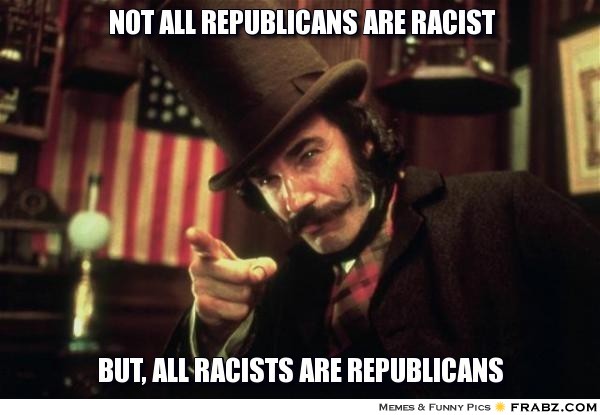
frabz-Not-all-republicans-are-racist-but-all-racists-are-republicans-17a2b9Does this help?

No?

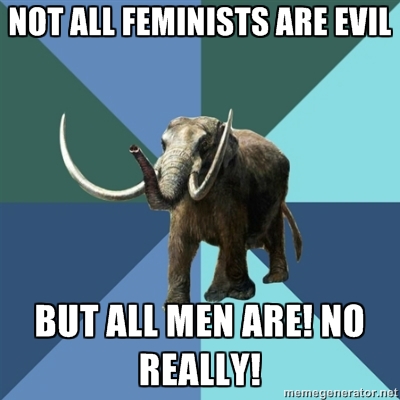
Okay, this post is getting to be a guilty pleasure, I know. But the point is that we can turn this logic around and apply it in all sorts of different directions. If it hasn’t escaped you that I have failed to apply it to my own political camp, well then let’s just treat that as an object lesson in how this particular gambit works. You apply it to your enemies, silly, not your friends.

It does get sillier!

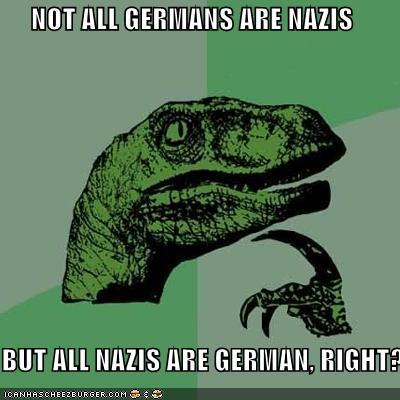
64feda52-bbf8-409a-83db-ddc818661e1fIs this a good question? Um, …no.

Seriously, do I have to provide links to the American Nazi party? Cause I’m not gonna.

No.

Nuh-uh!

You’re just going to have to get the point. And you know, it’s entirely possible that is even the point of this meme (or even the last one), because that damned Nathan Poe dogs my every judgement.

Besides everything else, this one is completely out of date, but what else can you expect from a thinking dinosaur. Not all anachronisms are philosophical lizards, but all… nevermind!

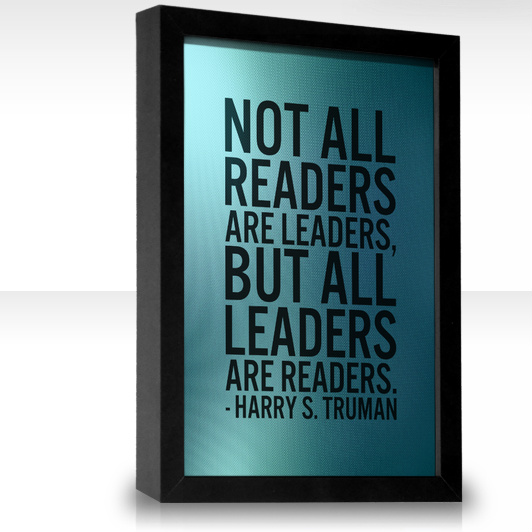
4OLOF57GB5NKD_U1FK00_IL_P_LSMaybe we could take this quotation in a positive direction? This sounds wonderful and warm and smart, and …well I should probably verify the quotation and discern it’s context and what not, but that would take time away from basking in the glow if literositude that this one kindles in my heart. I just want to sit here and think about how leading and reading go together like carrots and cake.

Or Christmas and BB Guns. Or lingerie and a live wallaby.

…I’ve said too much.

25989_482098188503425_1116285728_nBut hey, let’s get even more positive. Boy you just read this one and you can’t help but feel the love. Doesn’t it just make you want to reach down inside your soul and let the good stuff out for a walk in a park called Success.

Seriously folks, you just gotta let your awesome blossom!

That’s all I’m sayin’.

And who the Hell is Mark Gorman?

Okay kids, that was a rhetorical question. I just googled him and the only thing I learned is that I really don’t want to know anything more about him at all. We are moving on again.

MjAxMi04ZGY1ZmQ0ZWEwMTcwMjk5_50cfdcef8a5dcDid I mention that it gets sillier?

No really, it does.

Honestly, I’m not sure what to do with this one. It’s actually rather clever. I might even like it. But I don’t know much about Hentai, or porn, …or one of those anyway.

Not me! Huh uh!

er, not all men watch porn, but… nevermind!

28639618It also gets ickier. Much ickier!

Okay, that one doesn’t even begin to make sense, and I probably should have left  it out. But you know, you turn over a rock and see something gross underneath…

…so, you post it on the internets for all your friends to see,

…and to feel just a little creeped out by the whole thing.

Which is fine with me, actually, I believe in sharing the misery.

…in case you hadn’t noticed.

30448069Alright, this one might be real. At least I can’t think of a counter-example. Seriously, I’ve been trying.

But part of what makes this so fun is that it breaks the mold a little; gender politics aside, this is a nice little exercise in creating an expectation and then violating it. …which is very cool in a joke-I-just-killed-by-explaining-it kinda way, but the point is that the whole meme rests on a manipulation of expectations. You start by repudiating a generalization, thus leading people to expect a smarter wiser replacement and hope they won’t notice that you left them with a whole new pile of dumbitude sitting there in place of the one you repudiated. This one just takes that approach and drives it to Hawaii.

…Yes, I said drives.

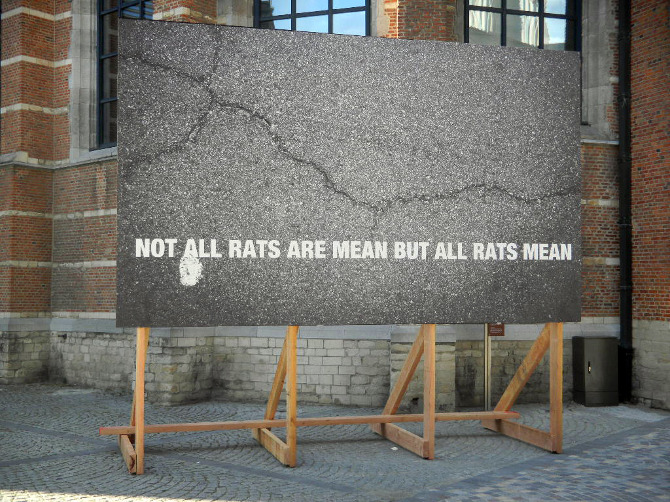
rats1I’m not sure what to make of this one, but I think I might love it.

So anyway, I guess you can file all of this under the category of, “Shit we oughtta know better”

71.271549 -156.751450

Share this:

  • Tweet
  • Share on Tumblr
  • Click to print (Opens in new window) Print
  • Click to email a link to a friend (Opens in new window) Email
  • Click to share on Reddit (Opens in new window) Reddit
Like Loading...

Willy Wonka Gets Wiggy With the Woo! Irritation Meditation Number Three.

18 Friday Jan 2013

Posted by danielwalldammit in atheism, Irritation Meditation

≈ 12 Comments

Tags

atheism, Condescending Wonka, Ethics, God, Memes, Morality, religion, Rhetoric

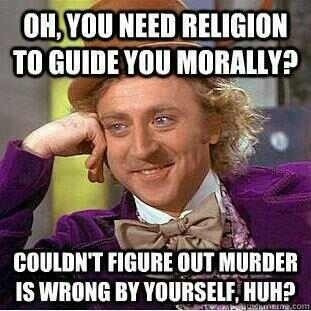
20130118-0632321Okay, I love Condescending Wonka as much as the next connoisseur of sarcasm, but sometimes its difficult to separate the crap he rightfully calls out from the crap he obscures in the process.

Case in point?

Look to your left.

The thing about this gem is that it skewers a pretense for which I have absolutely no sympathy. I’ve been asked far too many times why I don’t commit great acts of cruelty dishonesty, or outright villainy, all on the assumption that failure to believe in God apparently means you are well on your way to doing the worst things imaginable. It’s a pretty common theme in the amateur apologetics camps, and some folks keep coming back to it no matter how often (or how reasonably) you answer their questions.

And yes, the people who insist that all sense of morality goes out the window once you walk away from God scare me, …more than a little bit.

So, I have no sympathy for the mindset mocked by this little meme, none whatsoever.

But Wonka’s argument here is a little troubling in itself, because of course nobody really does figure out that murder is wrong, all by themselves. It might be easier if the category in question were simply ‘killing’, but it isn’t. It’s ‘murder’. And murder is a social construction. (How many people are really against ‘killing’ in all its forms anyway, or even ‘killing sentient creatures.’ No. Most of us are quite willing to kill under the right circumstances, even if we might find it difficult to do so.

Attempted-Murder-500x346If you’ve ever tried to sort the difference between killing that is acceptable from killing that isn’t you can see how very quickly a simple question leads to a very complex maze of possible answers. Issues of self defense, defense of others, and military or police service all skew the simple answer in a variety of ways. Add in possible mercy killings and a mix of government and business polices that lead accidentally or by design to deaths of innocent people in one part of the world or another, the whole damned thing gets that much more messy.

I’m not even suggesting that you can’t sort the mess. What I am saying is that social conventions are a big part of the means by which this mess does get sorted. We don’t figure out that murder is wrong all by ourselves; we learn what murder is from those around us. Others are actively involved in helping is form an orientation towards the prospect of killing another person, helping us decide when and under what circumstances we would be willing to do so.

It’s worth noting that references to God(s) serve as a pretty common part of that social process by which this and other moral questions are sorted out for a lot of people. One could question, as I do, whether or not gods are an essential part5 of that equation, and even conceding the role that gods do play in communicating ethics for many people does not entail belief in the literal existence of any of them. But there is a big difference between suggesting you can be good without God, or even questioning the role of divine entities in ethical lessons and the pretense that it’s all so perfectly obvious you can settle the whole matter all on your own.

It’s a particularly obnoxious fellow that insists we would all go conky-wobble with each other in the absence of God. More reasonable theologians have asked whether or not non-believers can produce an adequate explanation for the ethics that we do have. …I think the answer is yes, but that’s a response to a different kind of discussion. It’s hard to tell what to do when one runs into someone who insists that we are all one god shy of an shoot-out at the K-Mart Corral. Their position is crap, and their arguments are profoundly disturbing.

Still, it isn’t quite true that each of us handles the moral questions of life on the strength of our own individual conscience alone. We get a lot of help from our friends and loved ones.

The answer to both Wonka and the target of his abuse turns out to be the same; it’s more complicated than that.

71.271549 -156.751450

Share this:

  • Tweet
  • Share on Tumblr
  • Click to print (Opens in new window) Print
  • Click to email a link to a friend (Opens in new window) Email
  • Click to share on Reddit (Opens in new window) Reddit
Like Loading...

Apropos of Nothing, The Worst Lecture Ever to be Inflicted on My Delicate Ears

07 Wednesday Nov 2012

Posted by danielwalldammit in Education

≈ 11 Comments

Tags

College, Education, Euphemism, Homosexuality, Language, Linguistics, Race, Rhetoric, Semantics, Sophistry

I’m lucky.

I have very few classroom horror stories from my college days. Of course I remember a lot of petty behavior, some arguable decisions, and I witnessed at least one case of genuine abuse to a classmate, …okay two. But it was pretty rare that I personally felt any significant discomfort as a result of anything the teachers did in the classroom.

My statistics textbook took a Hell of a beating, but that’s a different issue. I liked that teacher. I just hated statistics.

But there was one really awful lecture that I remember in detail. Lucky you, dear reader, because I am going to share the misery.

It was my last semester in college and I was finishing up the credits for a second major, linguistics. In those days, the linguistics program at the University of Nevada, Las Vegas was interdisciplinary. So, I had taken plenty of classes in linguistic anthropology, sociolingistics, psycholinguistics, logic, philosophy of language, etc. …all really great stuff! I enjoyed every minute of it. But that did leave one really huge gap in the knowledge that a guy graduating with a degree in linguistics ought to have. I hadn’t yet taken a full course in grammar. I didn’t even need it to graduate, at least according to the degree requirements, but that didn’t sit right with me. How could I graduate with a degree in this subject without the benefit of a full course in grammar? I’d heard good things about the lady who taught grammar in the English Department, and so I signed up and prepared to get down and dirty in the realm of syntax.

I knew something was wrong when I found a middle-aged man standing at the head of the classroom on the first day. I do remember his name, but let’s just call him Mr. H. Mr. H. passed out index cards and asked all of us to fill in some personal information while he explained that the usual instructor was on sabbatical that semester. He would be teaching the grammar classes.

Okay.

For the next few minutes everything seemed pretty standard. No red flags went up as Mr. H. reviewed the syllabus, and I felt pretty confident I was going to learn a lot in his class. I grew even more pleased when he explained that he would sometimes venture outside the narrow bounds of grammar to discuss other aspects of language use.

It was as though he had promised to have strippers pass candy out during class.

I couldn’t wait for some of those discussions. Luckily I didn’t have to, as Mr. H. proudly announced his first slightly-off-topic lecture for the semester. He wanted to talk about euphemisms.

I was a happy guy.

He began by telling the story of his first job, working in a mom&pop grocery store somewhere in Texas. Mr. H. talked about the time some yankee had come in and asked for some jalapenos, (pronouncing the ‘j’ about like you would ‘jam’). His reply, as Mr. H. explained it was; “Sir I believe the Spanish call them jalapenos (pronouncing the ‘j’ like the ‘h’ in ham).” He then proceeded to explain that this was a terrible thing to do and that no-one should ever make fun of the way anyone else speaks, ever.

I wasn’t entirely sure that he had described an act of mockery, but that was a detail I could easily overlook. On the main point,  the man was preaching to the choir as far as I was concerned. I was really glad I had signed up for the class.

And that’s when things took a bad turn.

Within just a couple minutes of announcing this principle that one shouldn’t make fun of other people’s speech, Mr. H. began to tell us all about the decline of the English language as a result of recent trends. Mr. H. was quite concerned that folks had begun to water the English language down with a variety of euphemisms. It was a terrible situation as our great medium of communication had been harmed a great deal by this trend.

Mr. H. had quite a few examples, but the first one that I can remember was the term ‘African-American’. Mind you, this was 1990 and the battles over political correctness were picking up steam fast. This topic had not yet run its full course in the public sphere; it hadn’t yet bored everyone to tears. My classmates sat on the edge of their seats while Mr. H. proceeded to explain that he had nothing but love for all God’s people, but he didn’t believe in calling people by the wrong word. You had to call people what they were, not what they weren’t. I sat back just a little disappointed and waited for Mr. H. to explain that ‘black’ was the proper name for the people in question.

Instead he proceeded to tell the class that ‘negro’ was what ‘they’ were and that was what folks ought to call them. I sat back up. He had at least surprised me. I had to give him that, but did I hear the man right?

Had I heard correctly? Was he actually skipping right past the common usage I expected of conservatives and moderates to rescue a sordid vocabulary choice out of a distant era?  I listened on as Mr. H. insisted that he meant no disrespect by this term and that it had no insulting implications. ‘Negro” was the right word and nothing else would do. Those using the term ‘African-American’ were engaged in a full-scale assault on the English language, and she suffered terribly at their abusive treatment.

The rest of the class ate this message up. I mean they loved it! For my own part, I dropped right out of that choir he was preaching to.

My concern wasn’t entirely with the politics at hand. I was never fully on board with the PC approach to vocabulary, and I could think of reasonable concerns about a lot of the verbal practices at hand. But Mr. H. wasn’t producing reasonable arguments. In fact, he was demonstrating a level naïveté that I didn’t expect from someone who was about to teach a class in descriptive linguistics. Objections were crowding their way into my thoughts in such numbers I feared my mind might burst if I listened anymore.

– Mr. H’s assertion that there was a right word for this or any other topic and that anything else was poor use stood out like a sore thumb. By ‘sore thumb’, I mean a completely unsupported premise. Worse than that; this assumption flew in the face of pretty much everything lexicographers had to say about the subject. Words had multiple meanings, and topics could be referred to in a variety of different ways. Languages changes! You could argue pros and cons of different word choices, but Mr. H. just insisted there was a right word and the public wasn’t using it anymore. This was a bit like discovering your geography teacher was a flat earther.

– ‘Negro’? Seriously, ‘Negro’?

– Details aside, declensionist narratives about the state of a given language are tired and damned lame. Untold prophets have warned about the decline of English, each with a different sin on their minds, and each cherry-picking the evidence with all the shame of a child stealing fruit from a neighbors tree. In this case, there was the additional absurdity that Mr. H. wanted us to feel for the abuse of the English language even as he minimized concerns about the abuse of actual people. This was personification with an agenda, and that agenda had little room for concerns about folks who really could feel the effects of abuse.

– I really couldn’t square the entire theme of the lecture with the lesson Mr. H. had drawn from his first example. Were we not making fun of the way some folks talked? I suppose he was suggesting that advocates of politically correct speech were making fun of others, but he had gone well past correcting that and right into the realm of mocking their own vocabulary preferences.

– A bit depends on the presentation, but the notion that words like ‘African American’ are euphemisms contains at least one really ugly implication. If a euphemism is a word that makes something ugly sound better than it is, and that did seem to be the way Mr. H. defined it, then what did that say about his thoughts about the people this term was applied to? Was he not suggesting that the right word really did convey something bad. He denied this of course, but that really seemed to be the station to which his particular train of thought had been headed.

All of these thoughts and others crowded into my head and screamed for me to let them out. I couldn’t believe I was hearing this crap from a guy who studied language for a living.

I looked around and I saw over 20 students falling in love with this man.

It’s okay, I thought. I’m here for the lessons on grammar. This doesn’t have to matter. Who knows. Maybe, Mr. H. will respond well to challenging opinions. Should I say something now and see how he responds? But where to start? I thought about whether or not to field an objection as I just sat there and took in the horror show.

The straw that broke this camels back came when Mr. H. took up the use of the term ‘gay’.

Yep. He was against it.

Mr. H. told us that he would never use that word. He went on to explain that he would never condemn a man for being what God made him, but he believed in calling people what they really were. I thought surely that he was going to tell us the proper term was ‘homosexuals’.

But no.

What these people were, Mr. H. informed us was ‘faggots’.

No other word would do.

And Mr. H.’s fan club fell over themselves to show their appreciation for this point. It was quite the surreal experience for me, watching my classmates nod and stare lovingly at this performance. I thought surely I would soon be sick.

At this point, I felt like Mr. H. had enough rope. If I couldn’t hang him with it, I should at least be able to reign in the message a bit. And anyway, I really needed to see how he would respond to disagreement. So, up went my hand. Mr. H. called on me. And I proceeded to ask him if he didn’t think it more appropriate to consider ‘faggot’ a dysphemism (in retrospect, I should have just said ‘insult’). I went on to ask if he didn’t think the English language was growing new insults at about the same pace that it was growing euphemisms, or if he had specific reasons for thinking the one trend was outpacing the other. I think I managed to keep a respectful tone, but I definitely expressed my disagreement.

And the class grew silent.

The man literally scowled at me. In falling tones, Mr. H. asked me for my name. He then proceeded to dig the pile of index cards from the beginning of class out of his shirt pocket and slowly flip through the until he found mine. He then studied my card for a minute or two, all of this in utter silence. No-one said anything.

With a heavy sigh, Mr. H. finally placed the cards back in his pocket and looked back at me. “What I am trying to say is…” He then proceeded to restate his general thesis that English had been watered down through excessive euphemisms. He did this without responding to any of my points at all. It was amazing. There was no reference to anything I had just said, no answers whatsoever to my questions. No counterarguments. Nothing!

Mr. H. then asked me if that message was okay with me.

After a brief pause, I said ‘yes’.

By ‘yes’ I meant that I would be graduating without the benefit of a full course in grammar.

71.271549 -156.751450

Share this:

  • Tweet
  • Share on Tumblr
  • Click to print (Opens in new window) Print
  • Click to email a link to a friend (Opens in new window) Email
  • Click to share on Reddit (Opens in new window) Reddit
Like Loading...

Snakes, Death Panels, and that Damned Kenyan: An Ode to the Power of the Free Market!

12 Friday Oct 2012

Posted by danielwalldammit in Anthropology, Politics

≈ 12 Comments

Tags

Amazon, Anthropology, Economics, Free Market, Healthcare, Libertarianism, Obamacare, Politics, Rhetoric

Steve Sheldon told about a woman giving birth alone on a beach. Something went wrong. A breech birth. The woman was in agony. ‘Help me please! The baby will not come,’ she cried out. The Pirahãs sat passively, some looking tense and some talking normally. ‘I’m dying! This hurts. The baby will not come!’ She screamed. No-one answered. It was late afternoon. Steve started toward her. ‘No! She doesn’t want you. She wants her parents,’ he was told, the implication being clearly that he was not to go to her. But her parents were not around, and no-one else was going to her aid. The evening came and her cries came regularly, but ever more weakly. Finally, they stopped. In the morning Steve learned that she and her baby had died on the beach, unassisted.

Daniel L. Everett uses this passage from Don’t Sleep, There are Snakes to illustrate the ideas of an Amazonian people about personal responsibility and their attitudes towards the suffering of others. In context, this story is a little more subtle than it may appear on this page, because Everett tell us that Pirahã will devote great effort to helping one another under the right circumstances. The point is that under this circumstance, Pirahã did not consider it appropriate to aid the woman in question, even though her need was obvious. It was the sort of trouble that Pirahã felt an individual must face alone, or with the aid of family. Since no family was there to help her, the woman in this story had to face this struggle alone.

I read a lot of stories like this, and some still have the power to shock and anger me. I can think my way to an understanding of the behavior in question, but in some cases (like this one) I lose my interest at least momentarily in learning about the cultural context behind it, and I want desperately to confront those responsible. The image of a woman and her child dying alone on a beach because people would not help her is just too much to bear. How could anyone, ANYONE, countenance such a thing?

It doesn’t help that Everett follows this with another story about an orphan girl he had been nursing back to health from a near coma, that is until her father killed her with the aid of his fellow villagers. To them this was a mercy killing, as Everett tells us. The villagers had become convinced the little girl was too sick to survive. His efforts to nurse her back to health had in their eyes accomplished nothing except to prolong her suffering. So, they killed her. I read that story, and I understand the point, and still stories like this fill me with rage. I want desperately to do something about a death I didn’t witness, to confront people I’ve never met, to stop them, to beat them, to punish them. No explanation will suffice for such things, I sometimes feel, and I cannot imagine living in a world in which I must abide such behavior.

But of course I do live in such a world; we have it right here in America.

Oddly enough these passages have helped me to understand something I have been struggling to grasp since the last election, the old yarn about death panels. Don’t get me wrong. I certainly understand the fear and horror that comes from the notion that some committee may have the power to make life and death decisions for other people. What I could never grasp was just how anyone could be so alarmed at the prospect that such a panel could operate under the auspices of government authority while remaining unconcerned about the reality of such entities in the private sector today. Insurance companies make such decisions every day which effectively sentence people to death or suffering, and this is at best a matter for reform; it is something we have to work on, because maybe there is room for improvement. Yet the mere hint of such a committee operate under the auspices of government authority is enough to render the man responsible for it into something of a vampire.

The case for the existence of Death Panels in Obamacare was never much more than a highly malicious rumor, at least as outlined by Republicans in 2008. Yet people die in America every day because they cannot get coverage for important procedures, or they suffer needlessly from lack of care. Think of dental care alone. For years I struggled to find a safe tooth to use for chewing before I finally got a decent dental package, and now I see friends and family doing the same thing. None of this is necessary. They aren’t screaming down at the river, and perhaps they won’t die, but their suffering is absolutely unnecessary. So much the more so for those who cannot get treatment for serious ailments.

So, how is it that folks could be so accepting of deaths resulting from lack of medical care in the present economy while falling over themselves at dark rumors about Obama’s heath care package? I’ve come to understand this sort of thing as one of the powers of the Free Market.

Yea verily!

“The power of the market!” I often wonder if the people uttering this little mantra recognize its religious overtones. You would swap “Jesus” in there for the market if you like, or perhaps “the mind” if you prefer to think of yourself as “spiritual but not religious.” Either way, it is an expression of wonder at the power of an entity to work miracles. Those uttering this phrase usually mean it to suggest something to the effect that free markets will bring about good things if only they are left to themselves.

My own suggestion is sarcastic, of course, but I do think it is the rhetoric of free markets that works this miracle, perverse as it may be. It is what separates the horrors of some deaths from the natural occurrences of others.

Time and again, one hears folks (and by ‘folks’ I mean ‘Libertarians’) assuring us that government actions aimed at correcting some remedial evil will only create more difficulties in the long run. If wages are too low, raising a minimum wage will only lead to a reduction in jobs, and if banks are charging ridiculous overdraft fees, rules against this can only lead to other fees. To correct such horrors is to fight the tide itself. The course of the market is thus a perfectly natural, inexorable force, and government action to correct it can only lead to greater harms on down the road.

And of course there is a certain degree of evidence to back this up. By a certain degree of evidence, I of course mean scads of economic analysis regarding details such as those above. We can see the adjustments that market values make in the wake of government changes quite regularly, and it isn’t hard to see just how often those adjustments prove the undoing of many well-intentioned policies.

And yet the rhetoric of Free Market Fundamentalism seems to stretch a little beyond this evidence, turning tendencies into laws and social behavior into the tell-tale signs of a god passing in the night. It is not merely that supply and demand react to one another, but that they do so under the command of an entity of sorts, one with great powers. Somewhere along the line, reasonable arguments about the particulars give rise to a mythic narrative, one which simplifies the choices in front of us.

All of this begs the question of just how simple it is to keep government actions out of business. Money, like government office, is a vehicle of power, and there is no inherent reason why we should moralize the one and naturalize the other. But of course that is precisely the point of so much talk about the power of the market; that market will do what it does, and individuals seeking profit will do what they do. Neither morals, nor governments, nor all the devils in Hell will alter the course of self interest. What is left for us to do but acknowledge in stoic terms the limitations of humanity and civic service? …and hence to let things run their course? A virtuous government is thus one that does not interfere. Likewise with virtuous politicians!

And damn those who would trespass against the will of the market.

Thus a man who dies because an insurance company will not pay for an expensive operation has in effect passed away of natural causes, but one who has died because a government panel denied him the operation? Well, his death is the result of arcane forces. Worse still, a life prolonged by such a committee must also be an unnatural event, a form of undeath, sustaining itself by draining the life from others. And if folks stop short of blaming those whose health is the result of government programs, well we can certainly point a finger at the necromancers who created those programs.

Cough, …Obama!

This is the attraction of a narrative that separates the world of power into forms about which we can make decisions of right or wrong and those about which we can only hope to adapt. Government is thus saturated with moral significance; there are good politicians and bad politicians, even evil ones. But market forces? These are as natural as the tide itself. One might as well urge reform on the laws of gravity as hope to change the nature of business.

It is for this same reason that welfare queens elicit so much more effective anger than corrupt bankers. We can understand someone fudging the numbers to make a profit, but a woman who lives off the coercive power of government authority? That is an abomination. Likewise with all manner of horrors resulting from poverty; they are natural. We might shed a tear for those that die of such things, but we expect them to handle it themselves, or to turn to family.

“She doesn’t want you; she wants her parents.”

If you want to help your neighbor, so one hears, then do so with your own money! Give to charity, or pay your brother’s bills, but don’t force others to do the same. But of course the market in its infinite wisdom sets the price for the necessities of life too high for such personal action, at least if one hopes to get ahead in life. And so neither government nor private individuals can really do much about this man’s teeth or that woman’s liver. The result is natural, so the narrative goes, and there is nothing for us to do but go about our lives as people all about us suffer.

We can only hope they will do it in silence, behind a door somewhere, not screaming down at the river.

This is, after all, a nation of civilized people.

71.271549 -156.751450

Share this:

  • Tweet
  • Share on Tumblr
  • Click to print (Opens in new window) Print
  • Click to email a link to a friend (Opens in new window) Email
  • Click to share on Reddit (Opens in new window) Reddit
Like Loading...

Real World Villains, Volume II: Those Damned Poor People! (They are so Envious!)

13 Friday Jan 2012

Posted by danielwalldammit in Politics

≈ 7 Comments

Tags

Envy, Income Gap, Mitt Romney, Politics, Presidential Campaign, Republican Party, Rhetoric

Okay, let’s have a show of hands. All of you that believe that growing interest in the gap between the rich and the poor is just a case of envy raise your hands.

Okay, all of you with your hands raised can go fuck yourself!

Seriously.

This is apparently the position Mitt Romney has recently taken on the issue. It’s a familiar bit of seasoning that certain elements of the Republican party like to add into the mix from time to time. If the difference between the rich and the poor bothers you, then you must be envious of their wealth. Just work a little harder and maybe you too can vacation in the Bahamas! Just add a reference to “Class Warfare” and stir to taste.

What makes this particular flavor of right wing rhetoric so damned vile is that it shows just how much people like Romney and his corporate masters are focused on the lives of the rich. The lives of the poor enter their minds only when cast in terms wealth and privelage.

If your neighbor has a better lawn than you, that is grounds for envy. If he has a faster car, a better boat, a bigger flat screen TV. All of these things are cause for envy. All of these things can lead to jealousy.

Would that the gap between the rich and the poor could be limited to such differences!

But envy does not explain the anguish of those that have lost their homes in the mortgage crisis; it does not explain misery of those working overtime only to find themselves a little further behind at the end of every month. It certainly doesn’t explain the fear of those without health insurance, or those who can hardly put food on the table.

Neither is it envy when someone who cannot afford basic health care,  feed his family, or pay his mortgage recognizes that that his financial limitations are linked in some sense to the spectacular wealth enjoyed by others. When some can afford luxurious vacation homes while others struggle for basic necessities this reflects an essential value judgement. It means that somewhere along the line the community at large (or rather the majority of people in that community) has decided the one is more important than the other, a lot more important. How folks came to that choice, and how they justify it is another question, but it doesn’t take class envy to question its wisdom.

Of course Romney has an explanation for that choice; it is the wisdom of meritocracy, a system that rewards hard working people with great skills and creative energy more than those who don’t. It’s the same talking point that Rick Santorum was flouting a short while ago, and it will of course be standard fair at every Republican fund raiser throughout this election. But seriously, if you actually think the gap between the rich and the poor is a function of merit, then you can go fuck yourself again.

Grow up people!

There is no Santa Clause, the Easter Bunny is road kill, and money does not magically find its way to those that deserve it most, nor does it flee from the grasp of those unworthy of its benefits. The wealthy are not categorically smarter, harder working, or more creative than the rest of the population. That simply does not explain the gap between the rich and the poor and it never will. It is little other than pretense to haul this old yarn out, just another way of suggesting that the poor do not deserve any better than they can earn themselves by working at the same crap jobs that aren’t working for them now and haven’t been for decades. But how dare those ingrates think they are entitled to any better?

The Republican party faithful would have us believe that poverty is a function of poor character, lazy people making bad choices. Now we can just add covetous character to the list of horribles perpetrated by the undeserving poor. That is the theory Romney us pushing.

But it’s a bullshit theory.

The gap between the rich and the poor is not reducible to lazyness, nor is concern over that gap simply a question of wanting nicer things. When Obama or any other politician raises this question (timid as they may be about it), it is not playing to the envy of the poor. It is addressing a real problem, albeit not one that the Republican party seems to recognize anymore (Hell, even Reagan’s trickle down theories would be an improvement over the present sense of entitlement the GOP fosters among the wealthy.)

Landing on the bottom end of the economic spectrum has serious consequences for the lives of those unfortunate enough to do so. To suggest that Romney’s comments trivialize that problem is putting it mildly. To say nothing of the overall consequences for the economy as ever increasing portions of the population find themselves unable to play the role of consumers which our economy requires. Simply put, if the poor get too poor, they won’t buy things from the rich anymore, and that could have serious consequences for those rich folk.

A vacation in the Bahamas ain’t cheap!

If Romney were simply making the case for conservative fiscal policies, then I wouldn’t fault him for that. Hell, I might even agree with him. But pretending that the growing gap between the upper crust of society and those beneath them is not a real matter of concern is well beyond the pale. Even if you only care about the wealthy, the gap between the rich and the poor ought to be a major concern. But there Romney sits, assuring the nation that this issue is nothing but the preoccupation of folks jealous of other people’s toys.

And this supposed to be the reasonable Republican candidate, the sane one. It’s beyond ridiculous.

Of course some might suggest that Romney knows better. Perhaps he would roll up his sleeves when the cameras are off him and get to work on the economy. He seems to suggest as much himself, and one can only hope that when it comes right down to it Mitt Romney will understand the gap between the rich and the poor is a real problem for a lot of Americans. One can also hope that he will realize he is responsible for those other Americans too, the ones he currently dismisses as envious. One can only hope that their welfare will be somewhere in the list of things he cares about (…albeit well below the bottom line for corporate CEOs. Their welfare must of course come first!)

And that is the hope we are left with in reading comments like this; that the presumptive Republican candidate is just playing to the faithful with this talking point, telling them a good reassuring story about their enemies. Why would anyone care about the gap between the rich and the poor? Personal pettiness. That is Romney’s answer. Its useful answer in that it helps to marginalize even the most moderate of liberals.

It’s also a bullshit answer, one that speaks loads about the character of anyone who utters it. …whether they believe it or not.

I really don’t know if Romney would have raised his hand upon reading the first question of my post.

He can fuck himself anyway.

71.271549 -156.751450

Share this:

  • Tweet
  • Share on Tumblr
  • Click to print (Opens in new window) Print
  • Click to email a link to a friend (Opens in new window) Email
  • Click to share on Reddit (Opens in new window) Reddit
Like Loading...
Newer posts →

Top Posts & Pages

  • I'll Just Leave This Here
    I'll Just Leave This Here
  • Movie Review: The Orator
    Movie Review: The Orator
  • An Uncommon Security Guard: Dave Eshelman, AKA 'John Wayne'
    An Uncommon Security Guard: Dave Eshelman, AKA 'John Wayne'
  • Hostiles and Spoilers: A Magic Studi
    Hostiles and Spoilers: A Magic Studi
  • A Joke from a Bygone Era
    A Joke from a Bygone Era
  • An Ironic Beating
    An Ironic Beating
  • An American Flag as a Weapon, Redux.
    An American Flag as a Weapon, Redux.
  • An Irritation Meditation: The Majority Rules Meme
    An Irritation Meditation: The Majority Rules Meme

Topics

  • Alaska
  • Animals
  • Anthropology
  • atheism
  • Bad Photography
  • Books
  • Childhood
  • Education
  • Gaming
  • General
  • History
  • Irritation Meditation
  • Justice
  • Las Vegas
  • Minis
  • Movie Villainy
  • Movies
  • Museums
  • Music
  • Narrative VIolence
  • Native American Themes
  • Philosophy
  • Politics
  • Public History
  • Re-Creations
  • Religion
  • Street Art
  • The Bullet Point Mind
  • Travel
  • Uncategorized
  • Uncommonday
  • White Indians
  • Write Drunk, Edit Stoned

Blogroll

  • American Creation
  • An Historian Goes to the Movies
  • Aunt Phil's Trunk
  • Bob's Blog
  • Dr. Gerald Stein
  • Hinterlogics
  • Ignorance WIthout Arrogance
  • Im-North
  • Insta-North
  • Just a Girl from Homer
  • Multo (Ghost)
  • Native America
  • Norbert Haupt
  • Northwest History
  • Northy Pins
  • Northy-Tok
  • Nunawhaa
  • Religion in American History
  • The History Blog
  • The History Chicks
  • What Do I Know?

Archives

  • December 2023
  • November 2023
  • June 2023
  • April 2023
  • February 2023
  • December 2022
  • November 2022
  • October 2022
  • September 2022
  • August 2022
  • July 2022
  • June 2022
  • April 2022
  • January 2022
  • December 2021
  • November 2021
  • October 2021
  • September 2021
  • August 2021
  • June 2021
  • May 2021
  • March 2021
  • February 2021
  • January 2021
  • December 2020
  • November 2020
  • October 2020
  • September 2020
  • June 2020
  • May 2020
  • March 2020
  • February 2020
  • January 2020
  • December 2019
  • November 2019
  • September 2019
  • August 2019
  • July 2019
  • June 2019
  • May 2019
  • April 2019
  • January 2019
  • December 2018
  • November 2018
  • October 2018
  • September 2018
  • August 2018
  • July 2018
  • June 2018
  • May 2018
  • April 2018
  • March 2018
  • February 2018
  • January 2018
  • December 2017
  • November 2017
  • October 2017
  • September 2017
  • August 2017
  • July 2017
  • June 2017
  • May 2017
  • April 2017
  • March 2017
  • January 2017
  • December 2016
  • November 2016
  • October 2016
  • September 2016
  • August 2016
  • July 2016
  • June 2016
  • May 2016
  • April 2016
  • March 2016
  • February 2016
  • January 2016
  • December 2015
  • November 2015
  • October 2015
  • September 2015
  • August 2015
  • July 2015
  • June 2015
  • May 2015
  • April 2015
  • March 2015
  • January 2015
  • December 2014
  • November 2014
  • October 2014
  • July 2014
  • June 2014
  • May 2014
  • April 2014
  • March 2014
  • February 2014
  • January 2014
  • December 2013
  • November 2013
  • October 2013
  • September 2013
  • August 2013
  • July 2013
  • June 2013
  • May 2013
  • April 2013
  • March 2013
  • February 2013
  • January 2013
  • December 2012
  • November 2012
  • October 2012
  • September 2012
  • August 2012
  • July 2012
  • June 2012
  • May 2012
  • April 2012
  • March 2012
  • January 2012
  • December 2011
  • November 2011
  • October 2011

My Twitter Feed

Follow @Brimshack

RSS Feed

  • RSS - Posts
  • RSS - Comments

Enter your email address to follow this blog and receive notifications of new posts by email.

Join 8,075 other subscribers

Blog at WordPress.com.

  • Subscribe Subscribed
    • northierthanthou
    • Join 8,075 other subscribers
    • Already have a WordPress.com account? Log in now.
    • northierthanthou
    • Subscribe Subscribed
    • Sign up
    • Log in
    • Report this content
    • View site in Reader
    • Manage subscriptions
    • Collapse this bar
 

Loading Comments...
 

    %d