• About

northierthanthou

northierthanthou

Category Archives: Movies

I watch a lot of movies. …a lot more now that it’s 30 below outside.

A Milagro Bagpipe War?

03 Thursday Nov 2016

Posted by danielwalldammit in Movies, Politics

≈ 14 Comments

Tags

Capitalism., Development, Donald Trump, Film, Globalism, Globalization, Milagro Beanfield War, Scotland, You've Been Trumped

mv5bmjizmje3mdcwm15bml5banbnxkftztcwmjk0mjg4ng-_v1_sy1000_cr007071000_al_John Nichols, the author of Milagro Beanfield War once gave the keynote speech at a conference I attended in Colorado. If I recall correctly the name of his presentation was; “Everything I know about the West I Learned in New York.”

…something like that.

Anyway, the point of the speech was that the sort of problems he wrote about in work like Milagro Beanfield War simply weren’t really unique to the western states. They were much the  same as they were anywhere else. Big money can be a terrible danger to small communities. That is as true of an inner city neighborhood facing gentrification as it is a small town in northern New Mexico facing a major development project.

I thought about this last night as I watched You’ve Been Trumped (2011), the story of Donald Trump’s efforts to develop a golf course in the community of Aberdeenshire, Scotland. Conflict between Trump and his team, on the one hand, and a small group of locals who want to hold onto their own homes and their own community provide the central theme of the film. At least one Youtube channel describes this film as a David and Goliath story, which seems fair enough to me. Perhaps, that’s Milagro Beanfield War was too, a David and Goliath Story. The same could be said of Local Hero (a film referenced in You’ve Been Trumped). We could certainly find other such stories if we looked, but whats most striking about this one is that it’s real. Watching the movie, I couldn’t help thinking it was as if someone had taken Nichols book and reworked into a movie script based in Scotland. That someone would have to be Donald Trump himself. It’s almost as if he took that former story of a heartless developer stomping all over a local community and said; “Yep! That villain is what I want to be.” The rest of the plot seems to flow smoothly from there.

Don’t get me wrong. This is not the most balanced documentary I’ve ever seen. If there are arguments in favor of Trump’s development, this film makes little effort to present them. The story-line focuses squarely on the conflicts with those living near Trump’s development project.I do wonder just how representative those individuals may be, and just what the overall balance of support and opposition to Trump may have been in the local community. The movie leaves a definite impression  regarding such matters, but it doesn’t answer them squarely. That said, what this film does show is damning enough in its own terms. Within the narrow scope of Trump’s relationship to those resisting his project, the film reveals enough to condemn the man. Whatever might be said in favor of Trump’s development, the actions covered in this film are truly abysmal in their own right.

It’s fascinating to see how much of the ugliness we’ve seen from this man during his presidential campaign appears in this film from 2011. His abusiveness is on full display as Trump repeatedly describes one hold out (Michael Forbes) as a filthy man living a disgusting life amidst his own trash. His penchant for simply telling the most convenient story regardless of the facts at hand can easily be seen as Trump brags about his wonderful contributions to the environment by stabilizing local dunes even as the film repeatedly shows construction tearing up the land, diverting waterways, and disrupting the natural cycles of the local ecosystem. It’s also present in Trump’s claims to be serving the people of Scotland even as he wages a heavy-handed campaign of harassment against those Scots interfering with his plans for a business clearly aimed at tourists. And of course his easy dismissal of journalism can be seen in his demands for questions from ‘real journalists’ at a press conference, effectively dismissing those who might not support his business. We here in America have seen all this time and again over the last year. The people of Aberdeen had already seen plenty of it by 2011.

Of course others have seen similar treatment in countless places where Donald Trump has done business. This is just one of many instances in which one of Donald Trump’s grand schemes for development fell like a boot-stomp of a local community.

…which brings me to another interesting feature of this film. It helps to illustrate some of the foibles of popular right wing theories about the power-relations between government and big business. As with other populist candidates, much of Donald Trump’s appeal seems to be rooted popular resentment about elites. How such resentment could lead to support for a man who so clearly asserts aristocratic privilege over the mere peasantry is something of a mystery to me. Still, he does draw a great deal of his appeal from messages systematically distorting  the modern political economy all across the media. At least a portion of this can be seen in the movie.

Let us start with libertarianism! This school of thought generally counsels us to avoid government entanglement with business, and with people’s personal lives. In principle this applies to any number of things, but in practice, the message is more likely to carry the day when the issues at stake are progressive taxation, welfare programs, or any number of government regulations tying the hands of big business. It’s a school of thought that consistently tells us we should not look to government to resolve questions of economic inequality. Central to the force of this message is a vision of equity in which government officials treat all people with equal regard and government programs afford equal rights to all of us. You’ve Been Trumped presents us with countless situations in which the Trump organization uses  official power to defeat the mere peasants who stand in his plans. Those people suffer loss of electricity, water, and destruction of their property, to say nothing of a deliberate effort to block their view of the sea for the sake of doing just that. At each stage in this process officials are slow to listen to complains or respond to requests for assistance and quick to enforce rights claimed by Trump. It might be that particular disputes can be sorted out in the courts, but Trump’s organization clearly has the upper hand at stage in this process. The notion that this system is consistent with any formal sense of fairness is at best a laughable proposition.

Libertarians might object that they too wouldn’t support Trump’s use of municipal authorities to abuse local enemies, assuming of course that the abuses shown in this film stand up to critical scrutiny, but that hardly addresses the problem. What this film shows is the leverage that monied interests do get over every level of government authority in existence. It isn’t enough to moralize the issue, to stand on the sidelines and shout; “Hey stop, don’t do that.” The point is that this is exactly what happens when we allow substantial disparities in the distribution of economic resources. Those with more at their disposal WILL use those resources to skew government authority (something Donald Trump appears to have done throughout his long career as a public menace). Despite this fact, libertarian narratives continue to focus on the problems of aid to the poor. They offer no solution whatsoever to the sorts of problems shown in this film, but libertarians continually present themselves as underdogs hard at work fighting against ‘statist’ power. In practice that fight is virtually always a fight to take away what little help and what little protections those in need may have.When an actual aristocrat takes it upon himself to destroy the life of a man he deems to filthy to accord even the most minimal respect, libertarians are simply silent on the matter.

Anti-globalists provide one of the more consistent sources of support for Donald Trump in this election campaign. Alex Jones of Info Wars would have to be counted among his most visible supporters.  He and his own fans often speak of Trump’s detractors as globalists, thus framing the whole election in terms of support for, or opposition globalism. Trump’s support for Brexit, combined with promise to build a wall on the southern U.S. border would seem to have earned him a great deal of points with this crowd. But of course this only counts if you have a really myopic view of globalism. It is one thing to stop people at your borders, which is what Trump is happy to offer the anti-globalist crowd, but of course money and power can easily flow right over those same borders. Yes, Trump has also declared his opposition to a number of international trade deals, but this is a man who has also taken advantage of opportunities on the other side of the border throughout his career. Simply put, big money doesn’t need a special trade deal to take advantage of foreign workers and foreign markets, and this movie illustrates that very clearly. It is Donald Trump’s wealth that enables him to go to a foreign country and simply have his way with a small local community. Nothing in Trump’s political agenda suggest that he intends to stop such things, and a good deal suggests that he intends to continue them.

Trump is happy to control borders, precisely because restricting the movement of workers is critical to optimizing profits under global market conditions. A world in which cheep labor can be found to the left and rich buyers are over to the right is not a bad deal for people like Donald Trump. In this respect, he is the perfect candidate for the anti-globalists. He will make a show of national boundaries, one they can be proud of, but he will never actually challenge the power relations at stake in the global economy. Neither Donald Trump nor Alex Jones really want to see anything truly revolutionary happen there. That might disrupt Jones’ sale of dietary supplements or keep Donald from demolishing coastal communities for his jet-set customers.

In the end, I suppose I shouldn’t be too surprised that Donald Trump could run as a populist candidate. He isn’t the first pampered elitist to pose as the hope of the common man. Still, he does seem to be one of the most clueless, and it does scare me that he could easily become our President. I’m not a fan of Hillary either, to be honest, but I worry that the whole nation may soon hand the keys to a problem child with a history of wrecking most everything he touches. More than that, his candidacy helps to illustrate precisely why the underdog themes of those on the right always ring so hollow for me. Time and again, they consistently seem David for Goliath, or perhaps the David of later years, the one who steals another man’s wife at the height of his own wealth and power for the David of David and Goliath, the one who actually does face down a more powerful opponent. Time and again, the right wing plays the underdog to government power, all the while ignoring real questions about who is really putting one over on whom. It’s a bad habit that some have fallen into. It’s a habit that may soon cost us all.

Just ask the people of Aberdeenshire.


Share this:

  • Tweet
  • Share on Tumblr
  • Click to print (Opens in new window) Print
  • Click to email a link to a friend (Opens in new window) Email
  • Click to share on Reddit (Opens in new window) Reddit
Like Loading...

Route 66 Under the Tires and on the Screen

01 Monday Aug 2016

Posted by danielwalldammit in Bad Photography, Movies

≈ 11 Comments

Tags

Arizona, Cars, Driving, New Mexico, Photography, Road Trip, Route 66, Tourism, Travel

Cars_2006So my girlfriend has this theory that the Pixar movie, Cars, did a lot to help revive the tourist trade along Route 66. I don’t know how serious she is about this theory, but it’s as good an excuse to talk about Route 66 as any, and about Cars, so here goes…

What has Monica talking about Cars? We’ve taken a couple trips along I-40 this summer and last. This year, we’ve taken a few of the detours off I-40 to see what we can find along Route 66. It’s nostalgia for me. I’ve driven large parts of the southwestern route enough to get to know quite a few of the stops quite well. Having someone unfamiliar with it all is interesting though, because I get to see these old sites through her new eyes.

Also she gave me an assignment.

…to watch Cars.

I’ve certainly done worse duty. The movie is cute, perhaps a little too cute. I should probably gruff it off, but I actually enjoyed it. Funny though, I spent the first half of the movie thinking the judge-car (Doc Hudson) sounded an awful lot like Paul Newman. Couldn’t figure out who else it could have been until I mentioned it. Turns out the voice for the car is Paul Newman, and the film turned out to be a little older than I thought.

It’s fitting that Newman would appear in Cars, because I think The Hustler is pretty much the prototype for sports movies. I know, straight pool is a bit of a stretch for a sport, and perhaps a cartoon race-car is an odd subject for a sports film, but I’m sticking to my guns on this one. It’s a story of a prodigy in a competitive field, one who needs to get his priorities straight. That’s almost every sports movie I can think of, and the voice of Fast Eddie Felson (Newman’s character in The Hustler) haunts them all as far as I’m concerned. In this case Fast Eddie’s voice sounds a bit aged, but it’s literally there. And this is certainly a film about a prodigy that needs to get his priorities straight.

…which is an interesting theme through which to explore the relationship between I-40 and Route 66.

***

…er spoilers!

There are no people in this movie; just cars, cars that seem a lot like people. The film’s main character is a race car named Lightning McQueen. Lightning is a talented race-car who is tearing up the tracks during his rookie year on the circuit. He is one of three contenders for the annual Piston Cup award, which would effectively make him the biggest champion of the year. Unfortunately, Lightning’s ego alienates his pit crew and so they leave him just before the final show-down, a race against two great rivals to be held in California. Lightning plans to win the race all by himself, but first he must get to California. For reasons best watched for yourself, Lightning ends up stranded in the tiny southwestern town of Radiator Springs. Having accidentally destroyed the towns main road (a section of Route 66), McQueen finds himself sentenced to repair it before he can go.

Radiator Springs is very much in decline. It had its heyday in the fabled days when Route 66 was alive. The creation of Interstate 40 effectively rerouted the traffic just a few miles off the old route, and in this case, that few miles proved enough to be the undoing of the town. Its inhabitants can only hope to catch the attention of an occasional tourist, but it gets precious few of those.

…even before Lightning comes disastrously to town.

Pressed for time, Lightning struggles first to escape and then to finish the repairs in time to make his final race. In the interim, he must contend with a small cast of character-cars (most of whom were based on actual people living along route 66), including a love interest (a lovely little Porche). He wants out badly, of course, but in time Lightning grows to appreciate the town and its four-wheeled denizens. Having finally grown to appreciate the human side of things, …or at least the personified motor-car variant thereof, Lightning finds himself both a better race-car and a better person car for it. In the end, he doesn’t merely repair the damaged road and make a good showing the race (I’m not going to tell you who won, ha!). Lightning also revitalizes the town, establishing it as a thriving tourist trap with a promising future.

***

So, what does this movie have to say about Route 66? Well, I think one of the best lines about that topic comes from Sally (Lightning’s love interest). She tells Lightning that people moved through the landscape differently when it was Route 66. Asked how, she says:

Well, the road didn’t cut through the land like that interstate. It moved with the land, it rose, it fell, it curved. Cars didn’t drive on it to make great time. They drove on it to have a great time.

So there it is, the claim this movie makes about Route 66. It represents the rich experience that travel can be in direct opposition to a modern strictly utilitarian form of transportation.  The question is which matters more? The experience of traveling across the landscape or simply getting there? This theme smacks of nostalgia, of course, and I can’t help but begin to imagine counter-examples (great road-trips on I-40 or the near certainty that at least some people must have taken to Route 66 for the specific purpose of getting somewhere fast). If there is a concrete difference between the actual roads, it also lies in way the old route goes through small towns while the new one goes around them. Which approach is more welcome may depend a lot on why one is behind the wheel, and how much time one has to get where they mean to go. Still I-40 does nudge things a bit in the direction of getting from point B to point A with a bit more efficiency, and that does come at the cost of seeing a stretch of small-town America.

This nostalgic moment has its own creative force. Many of the small towns along Route 66 have indeed made precisely the transformation depicted in Cars, turning themselves into tourist-traps in the hopes of diverting people off the main highway. As far as I can remember, references to Route 66 have always lured tourists off the main highway along the route, but I can’t help thinking the scale of Route 66 marketing has gone up a notch in the last decade or so. Perhaps Moni is right. Maybe that’s a post-hoc fallacy sweetened with a dose of confirmation bias on my part, but I was rather surprised to see just how much draw some of these towns seem to be getting out of the subject. Whether or not people used to drive Route 66 to have a great time, many do seem to be pulling off onto the small detours now for precisely that reason. No doubt, such traffic brings a few smiles to the faces of locals to match those of those taking in the sites.

Moni and I couldn’t help but notice at least one person who wasn’t so happy about all the traffic. Sitting in gridlock traffic in the middle of downtown Williams, Arizona, neither of us could quite tell what the woman a few cars ahead had been ranting about. The words; “Oh my god, Get out of my fucking way!” clarified things a bit. We watched as a tourist slowly decided to take advice from a green light and the exasperated local finally got around him and made a little headway along main-street. A few minutes later, I heard the same woman shouting “One way street” as she walked along behind a vehicle making a rapid and quite unplanned side-turn.

Yep, there are definitely definite down-sides to tourism.

Didn’t stop Moni and I from taking pictures.

(Click to embiggen; it’s what Fast Eddie Felson would want you to do.)

Seligman *
Seligman *
Williams *
Williams *
Williams again *
Williams again *
Willaims ^
Willaims ^
Nuther Sligman Pic *
Seligman Again *
Seligman Again *
Ruins Somewhere East of Flagstaff
Seligmania *
Seligmania *
Aging Perpendiculars
WIlliams is probably more than a 1 horse town, but it has 1 for sure. *
Seligman Bison *
Seligman Bison *
Ruins East of Flagstaff
Moar Ruins
Moar Ruins
Whole Lotta Ruination Goin On!
Mural Holding Up Well Actually


* Pictures marked with a star came from Moni’s camera. She also helped me find a source or two, and of course it was Moni’s request that we take some of these detours that led to this post in the first place. She also reminded me to give a fuck to a certain quote, so to speak. Moni is solely responsible for the good parts of this post. I of course am the devil messing up the details.

Share this:

  • Tweet
  • Share on Tumblr
  • Click to print (Opens in new window) Print
  • Click to email a link to a friend (Opens in new window) Email
  • Click to share on Reddit (Opens in new window) Reddit
Like Loading...

The Fog of Hedges

05 Tuesday Apr 2016

Posted by danielwalldammit in History, Movies, Politics

≈ 4 Comments

Tags

Atomic Bomb, Documentaries, Euphemism, Firebombing, Language and Culture, Movies, Robert McNamara, The Fog of War, War

thumb_624_default_bigFor me, The Fog of War (2003) is absolutely the gift that keeps on giving. I get more fascinated every time I watch this film. There are so many angles to it, so many sub-themes to explore. Lately, I find myself more and more interested in its language. The Fog of War was directed by Errol Morris (of the Thin Blue Line). It consists of a series of interviews with Robert S. McNamara, a man at the center of conflict throughout much of the twentieth-century. Few people could have provided more direct insight into the thinking behind some of the most terrible decisions of that era. By ‘terrible decisions’ I don’t mean poor choices so much as decisions with so much at stake, one can’t help tremble at the thought of them. That many of these decisions were also (arguably) also poor choices in the other sense, choices that cost the lives of countless people is also a big part of this story.

A lesser man might not struggle with such questions at all, resting certain in whatever rationalizations suited him best. But there McNamara is in the Fog of War, right on screen talking about those very decisions, and trembling at the thought of them, right in front of the camera. For a man with blood on his hands (and frankly, enormous quantities of it), McNamara is remarkably candid. Also remarkably thoughtful. Still, there are moments when his honesty fails him. Limits he doesn’t seem quite willing to cross, and possibilities he clearly doesn’t want to explore. In those moments, the hesitation is all over his language.

It begins in some of the first frames of the movie. McNamara tells us that in the course of his life he has been “part of wars.” Fair enough, one might say, but more fairly still he has been more than part of wars. He has been a driving force in wars, perhaps in some cases against his better judgement, but he has certainly been more than part of wars. The wording is mild, perhaps a simple lead-in, but the phrase just doesn’t do justice to the facts that will follow.

***

The film is punctuated with lessons drawn from McNamara’s experiences. It is Morris that pulls the lessons out of the narrative and presents them as bullet points for our benefit. The first lesson begins with the importance of empathy, not simply as a source of human kindness, but as a method of survival, a means of understanding adversaries. This alone saved the world from total devastation during the Cuban Missile Crisis, according to McNamara. Morris interrupts him to suggest that McNamara left out a few things in his account of the Russian motivations. Perhaps he didn’t like being interrupted. Perhaps, he wasn’t prepared to acknowledge some of the facts at issue. McNamara is reluctant to get into the issue of genuine Russian grievances, but rallies so to speak, even going so far as to add a few facts in their favor. Still, he wavers at the end, not quite able to come clean on his own role in some of those grievances.

Morris: “Also, we had attempted to invade Cuba.

McNamara: Well, with the Bay of Pigs, that undoubtedly influenced their thinking. I think that’s correct, but more importantly, from a Cuban and a Russian point of view, they knew, what in a sense I really didn’t know. We had attempted to assassinate Castro under Eisenhower and under Kennedy, and later under Johnson, and in addition to that, major voices in the U.S. were calling for invasion.

Every time I watch this film, I wonder what that means. In what sense is it that McNamara didn’t know that the U.S. had tried to assassinate Castro? Is this a fatal failure moral courage? Is McNamara simply unable to admit what he knew? Or is this a key to understanding the (dis-)organization of American diplomacy? Is it possible that he was the left hand, only dimly aware of what the right one was up to? Don’t know, but seriously, that’s a Hell of a hedge coming through an otherwise brilliant narrative.

***

McNamara served in the U.S. Air Forces during World War II, serving under General Curtis LeMay. He provided statistical analysis of U.S. bombing missions. I know paperwork, right? But sometimes the pen really is mightier than the sword, or even the canon. Clearly, McNamara’s reports were not simply filed…

McNamara: I was on the island of Guam, in his command, in March of 1945. In that single night, we burned to death a hundred thousand Japanese civilians in Tokyo. Men, Women, and children.

Morris: Were you aware this was going to happen?

McNamara: Well, I was…, I was part of a mechanism that in a sense recommended it.

I analyzed bombing operations and how to make them more efficient, i.e. not more efficient in the sense of killing more, but more efficient in the sense of weakening the adversary. I wrote one report analyzing the efficiency of the B-29 operations. The B-29 could get above the fighter aircraft, and above the air defense, so the loss rate would be much less. The problem was the accuracy was also much less. Now I don’t want to suggest that it was my report that led to, I’ll call it the firebombing. It isn’t that I’m trying to absolve myself of blame for the firebombing. I don’t want to suggest that it was I that put in LeMay’s mind that his operations were totally inefficient and had to be drastically changed, but anyway that’s what he did. He took the B-29s down to 5,000 feet, and he decided to bomb with firebombs.

The first phrasing of interest here is the recommendation. This is a double hedge. McNamara doesn’t take personal responsibility in this statement. He submerges himself in a larger “mechanism,” but that isn’t enough, because that mechanism only recommends the firebombing “in a sense.” McNamara thus starts his answer to Morris two full shields removed from personal responsibility for the firebombings. He then goes onto assure us that the measure of efficiency he used was not simply the number of people killed but the effectiveness of the bombing in weakening the enemy. It is an interesting distinction, albeit one perhaps lost at the moment when the fires reached their victims. That McNamara struggles with this is clear enough throughout this and many other segments of the film. I don’t mean to suggest he is insensitive to the topic. Rather, his struggle seems to suggest the opposite. McNamara hasn’t quite explained his own role adequately to himself, and the result is the final mess of hedging about the question of personal responsibility. He denies it, but he also denies that he denies it. It’s easy enough to point to LeMay, and with good reason; it was LeMay’s decision. Still, I can’t help thinking that answer wasn’t even sufficient for McNamara.

***

Morris: The choice of incendiary bombs, where did that come from?

McNamara: I think the issue is not so much incendiary bombs. I think the issue is in order to win a war should you kill a hundred thousand people in one night, by firebombing or any other way. LeMay’s answer would be clearly ‘yes’. McNamara do you mean to say that instead of killing a hundred thousand, burning to death of a hundred thousand Japanese civilians in that one night, we should have burned to death a lesser number, or none, and then had our soldiers cross the beaches in Tokyo and been slaughtered in the tens of thousands? Is that what you’re proposing? Is that moral? Is that wise?

Why was it necessary to drop the nuclear bomb if LeMay was burning up Japan? And he went on from Tokyo to firebomb other cities. 58% of Yokohama. Yokohama is roughly the size of Cleveland. 58% of Cleveland destroyed. Tokyo is roughly the size of New York. 51% percent of New York destroyed. 99% of the equivalent of Chattanooga, which was Toyama. 40% of the equivalent of Los Angeles, which was Nagoya. This was all done before the dropping of the nuclear bomb, which by the way was dropped by LeMay’s command. Proportionality should be a guideline in war. Killing 50% to 90% of the people of 67 Japanese cities and then bombing them with two nuclear bombs is not proportional, in the minds of some people, to the objectives we were trying to achieve. I don’t fault Truman for dropping the nuclear bomb. The U.S. Japanese war was one of the most brutal wars in all of human history; kamikaze pilots, suicide, unbelievable. What one can criticize is that the human race, prior to that time, and today, has not really grappled with what are, I’ll call it the rules of war. Was there a rule then that said you shouldn’t bomb, shouldn’t kill, shouldn’t burn to death a hundred thousand civilians in a night. LeMay said, if we’d lost the war, we’d all have been prosecuted as war criminals. And I think he’s right. He, and I’d say  I were behaving as war criminals.  LeMay recognized that what he was doing would be thought immoral if his side had lost. But what makes it immoral if your lose and not immoral if you win?

This one of the most fascinating monologues I have yet seen in a film. McNamara seems determined to ensure we understand the full gravity of the situation, almost urging the case against himself and others. He wants us to know this was a terrible decision, perhaps even a crime. And yet, he builds a kind of defense into the narrative. It begins with his refusal to answer the question. He had been asked who was responsible for the decision to use incendiary bombs, thus generating more civilian deaths than conventional ordinance might have. Whatever else, McNamara’s speech here gives us, it does not give us a direct answer to that question.

The narrative also serves to shape questions about McNamara’s own role in the affair in terms of his relationship to his commander. It is LeMay’s thoughts on the subject which control McNamara’s story-line. His own decisions are thus framed in terms of what LeMay might have said in response to any argument against the decision to firebomb the Japanese cities. If McNamara himself might have objected, this story suggests, his concerns would have been simply overruled.

Lastly, McNamara deflects the moral questions onto humanity itself. Nevermind who was responsible for this particular decision. The real question is one that falls to humanity itself. How might humanity have handled such an issue? McNamara seems to suggest, the answer would take the form of a rule of war. The specific feasibility of such rules at that time (or any other) is not so clear, but seems to be how he wants to address the issue. And in the end, this means NOT addressing the issue of just who is responsible for burning all those women and children up during World War II. McNamara wants us to understand it’s a serious issue, but he is at great pains to avoid dealing with it too directly.

***

This may seem like a side-issue, but I can’t help thinking it points to a Hell of a drama in its own right. McNamara’s thoughts on his own family and the impact of his service as Secretary of Defense under President Kennedy contain some interesting hedges of their own.

That’s the way it (his role as Secretary of State) began. You know, there was a traumatic period. My wife probably got ulcers from it, may have even ultimately have died from the stress. My son got ulcers; it was a very traumatic, but they were some of the best years of our lives, and all the members of my family benefited from it. It was terrific.

I can’t help wondering how McNamara could say that his service benefited all members of his family while telling us the job may well have killed his wife. It seems cruel to me, even to point this out, and yet, it seems an important fact. Among the many who suffered through this man’s career, one may well count members of his own family. No doubt, this too has its reasons, reasons he doesn’t owe us, but as much as he gives is damned disturbing. And I wonder if that sort of story isn’t a bit more common than one might suspect.

***

Regarding the build-up of the Vietnam War…

There was a coup in South Vietnam. Diem was overthrown, and he and his brother were killed. I was present with the President when together we received information of that coup. I have never seem him more upset. He totally blanched. President Kennedy and I had tremendous problems with Diem, but My God! He was the authority, he was the head of state, and he was overthrown by a military coup, and Kennedy knew, and I knew, that to some degree the U.S. Government was responsible for that.

Here again, one seems to see McNamara posing as the left hand struggling to understand what the right hand was doing. Government is complex, sure, but I can’t help wondering; if I were in a more polemic mood, might I start a criticism of this war by asking just how in the Hell the CIA could give it’s blessings to a coup the President and his Secretary of Defence didn’t support?

***

Speaking of Vietnam, there is a fascinating moment covering the Gulf of Tonkin incident. Twice in August of 1964, the Destroyer USS Maddox reported attacks from North Vietnamese forces. These attacks have long been disputed, but nevertheless, they provided the rational for a resolution authorizing use of greater force by Lyndon Johnson. McNamara provides his own take on the details. One of the more interesting gems here is an audio-taped recording of a man on the Maddox reporting the attacks. Asked if he is sure that a torpedo had been fired at the ship, he replies in the affirmative; “No doubt about that, …I think.”

***

“What I’m doing is thinking it through with hindsight, but you don’t have hindsight available at the time. I’m very proud of my accomplishments, and I’m very sorry that in the process of accomplishing things, I’ve made errors.”

This line comes toward the end of the film as McNamara is beginning to summarize the whole thing. One might question whether or not ‘errors’ would be the most appropriate word to use for the sense of moral transgression that haunts this film. Perhaps, this may seem unfair. McNamara and those he served with had responsibilities some of us will thankfully never know. Had he done too little, he might well have faced similarly questions about the loss of American lives due to failure of nerve. So, does this render the whole issue a kind of practical calculation, a simple cost-benefit analysis? McNamara seems to have been well trained in such accounting. This might well be his honest sense of the issues. Sill,  one has to wonder at the use of ‘error’ to describe the moral significance of lives lost wasted.

***

What is morally appropriate in a wartime environment? Let me give you an illustration. While I was Secretary, we used what’s called “Agent Orange” in Vietnam, a chemical that strips leaves off of trees. After the war, it is claimed that that was a toxic chemical, and it killed many individuals, soldiers and civilians exposed to it. Were those who issued the approval to use Agent Orange criminals? Were they committing a crime against humanity? Let’s look at the law. Now what kind of law do we have that says these chemicals are acceptable for use in war and these chemicals are not. We don’t have clear definitions of that kind. I never in the world would have authorized an illegal action. I’m not really sure I authorized Agent Orange. I don’t remember it, but it certainly occurred, the use of it occurred while I was Secretary.

What is most striking about this passage is the distance between McNamara and a decision for which he was clearly responsible. McNamara does acknowledge this happened on his watch. And yet he discusses the issue for the most part as though the responsibility must fall on the shoulders of someone else. Again, McNamara seems to look to the laws for answers to these questions, but that too seems to be a bit of a dodge. Does he really need a law to tell him not to poison people?

…also noteworthy here would be the sense that something is odd about the claim that a chemical that strips leaves from plants might be harmful humans. McNamara doesn’t quite acknowledge that it is harmful. He is content to tell us that “it is claimed…”

***

Near the end of the film, McNamara relates the story of a protester. His account here is fascinating in many ways. What interests me about it at present is the way he frames the moral questions again in terms of humanity itself. This was a protester who died trying to communicate something to McNamara himself, but McNamara saw the significance of his death in the language of the man’s wife, as a question for all of humanity. Perhaps such questions are well asked of all of humanity, and yet I can’t help thinking that a question asked of all of humanity isn’t really asked of any particular person.

…or perhaps, more to the point, a person weary of answering such questions in his own life, weary of his own answers and the consequences of the answers he has given, might well prefer to have humanity itself grapple with those questions.

Anyway, we’ll leave it with this last quote.

Norman Morrison was a Quaker. He was opposed to war, the violence of war, the killing. He came to the Pentagon, doused himself with gasoline. Burned himself to death below my office. He held a child in his arms, his daughter. Passersby shouted, “Save the child!” He threw the child out of his arms, and the child lived, and is alive today. His wife issued a very moving statement, uh; ‘Human beings must stop killing other human beings.’ And that’s a belief that I shared. I shared it then and I believe it even more strongly today. How much evil must we do in order to do good? We have certain ideals, certain responsibilities. Recognize that at times you will have to engage in evil, but minimize it.

Share this:

  • Tweet
  • Share on Tumblr
  • Click to print (Opens in new window) Print
  • Click to email a link to a friend (Opens in new window) Email
  • Click to share on Reddit (Opens in new window) Reddit
Like Loading...

Libertarian Josey Whales

29 Tuesday Mar 2016

Posted by danielwalldammit in Movies, Politics

≈ 7 Comments

Tags

Clint Eastwood, Cowboys, Film, Free Markets, Libertarianism, Movies, Outlaw Josey Whales, Politics, Westerns

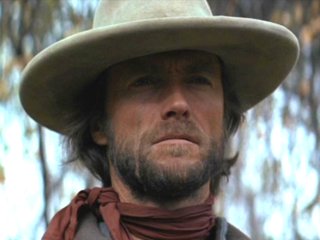
JoseyWDon’t get me wrong. I owe countless hours of entertainment, and many profound lessons learned to Clint Eastwood and his lifetime of utter brilliance. In this post, I will of course repay him by attacking his work on one of my all-time favorite films.

I guess I am feeling lucky.

…or maybe it’s just a blog post, but anyway, that’s not the film I mean to ramble about. I’m thinking about Josey Whales. There is one scene in this film that really bothers me. Maybe it’s meant to. Hell, probably, it’s meant to, but in this case the bother skips out of the bounds of the movie itself and starts to become a real-world bothertation.

I am talking about a scene in which Josey enters a trading post to find two men raping a young Navajo woman right there in the building. He grimaces a bit, and we get the impression he doesn’t really approve, and of course he does what so many of Eastwood’s characters do in this film; he goes on about his business, at least until the men become his business. This character is a reluctant hero after all, not some white-hat good-guy. When the rapists decide to try and take him prisoner, Josey, …uh, …SPOILER ALERT, …shoots them both dead, thus effectively saving the woman from sexual assault even as he saves his own life.

It’s great drama, and one of the things that makes it great is the moral ambiguity of its main character. Would he have helped the young woman if the two men hadn’t gone after him? We might hope so, but the film itself gives us no reason to suspect he would have. What we do know is that he walked right past them, and right past his first chance to help her. The whole scene ends with a disconcerting sense that Josey has put a stop to a number of bad things without ever really making a decision to do so.

It’s good storytelling. Hell, it’s great story-telling. So what’s the problem?

I think of this scene every time I hear of Clint Eastwood’s approach to libertarianism. His take on the subject is often described as “everyone leaves everyone alone” or some variant thereof. I actually rather like this expression, at least for a moment or two whenever I hear it. I can just imagine it being directed at some fussy bastard whose getting into other people’s business, in effect telling them to mind their own. I can get behind that sort of thing, sure I can. But then I find myself thinking that’s not really where this message is going, is it? Not in the grand scheme of things.

Time and again, we see libertarians in league with mainstream conservatives. On the topics of government aid to the poor and interference with the economy their messages are synchronous. On the topic of gender politics, their views clash, and near as I can tell the mainstream conservative themes win-out just about every time. This tells us a lot about the priorities at stake here, and I get damned tired of hearing a message that promises respect for individuals across the board only to see that message work consistently to the benefit of those already powerful at the expense of those struggling just to survive.

…which of course brings us right back to that scene from Josey Whales.

You could think of “everyone leave everyone alone” as a rule that might stop the rapists, albeit, it’s damned weak wording for a crime such as that. More to the point, I can’t help thinking it has more to do with Josey’s initial decision to go about his business, leaving the men free to hurt a young woman in his presence. I can’t help thinking that in that moment, Josey was minding his own business, just as the real Clint Eastwood seems to suggest we should all do.

Of course things work out in the end with Josey Whales, but they work out in the end because that’s the way the story is written. The bad guys go one step too far, thus triggering Josey’s own trigger, and it doesn’t hurt that they are foolish enough to let him get the best of them, just as all the other bad guys in that story do. Evil is vanquished in Josey Whales, but not because anyone has made a conscious choice to oppose it. Indeed, the movie seems rather set against the wisdom of such choices. No, the good that happens in this movie happens as if by accident, as Josey and his companions go about their daily lives, just trying to survive. And so the invisible hand of the writer seems to bring good  things from morally ambiguous behavior, much as the invisible hand of God in free market folklore.

It’s good storytelling, yes, but it’s piss-poor politics.

Share this:

  • Tweet
  • Share on Tumblr
  • Click to print (Opens in new window) Print
  • Click to email a link to a friend (Opens in new window) Email
  • Click to share on Reddit (Opens in new window) Reddit
Like Loading...

The Look of Silence, a Review

29 Friday Jan 2016

Posted by danielwalldammit in Movies, Narrative VIolence, Politics

≈ 6 Comments

Tags

Communism, Documentaries, Film, Indonesia, Joshua Oppenheimer, Movies, The Act of Killing, The Look of Silence, Violence

MV5BOTMwMjI4MjQ3MF5BMl5BanBnXkFtZTgwMjkwOTM2NTE@._V1_SY317_CR0,0,214,317_AL_It’s easy to think of silence as the auditory equivalent to a blank page, a kind of nothing that fits in between the sounds where we actually expect to find meaning. At times, though, silence conveys more than we can hope to cram into the sounds we call words. Joshua Oppenheimer is one person who clearly understands this. His latest film, The Look of Silence explores this topic in one of its more sinister forms. This film is a companion piece to The Act of Killing. Both movies deal with a genocide carried out in 1965 after the government of Indonesia had been taken over by the nation’s military. In the aftermath of this coup anywhere from half a million to a million people were killed. Victims included communists, ethnic Chinese, and those openly critical of the new government. The Act of Killing explored these events through the narratives of killers themselves and the stories they tell about their own actions. In The Look of Silence, Oppenheimer explores the lives of those who survived the massacre, those who lost loved ones in the killings and have since then had to live their lives among those who carried out the killings.

Whatever else silence conveys in this film, it clearly conveys a strong sense of terror, both because the stories it relates are as terrifying as they are real, and because the film-makers exposed themselves to danger in order to get those very stories.

Time and again, we see the main protagonist of the film, Adi Rukun, staring in silence as he listens to the killers of 1965 describing in great detail the horrors they themselves perpetrated in 1965. Sometimes Adi watches the killers telling their stories in video clips. Sometimes, he interviews them himself. Adi’s older brother was one of those killed in 1965. The story of his brother’s killing is among those he learns about over the course of this film.

If there is a plot to The Look of Silence, it is generated from Adi’s own decision to confront the killers, to speak to them himself, to risk engagement on a subject about which he is expected to remain silent. Adi is an Optometrist, and his subjects are aging. An eye exam thus becomes the pretext for one interview after another, each one an opportunity to breach the subject of past horrors. The resulting story is filled with this tension between silence and speech. The possibility that events discussed in the narratives of the killers could well happen again haunts one throughout the film. More to the point, one cannot escape the sense that Adi’s efforts could well make subject him and his own family to such violence. Those he interviews remind him of this frequently over the course of the film. The hints are subtle, but they are real, and they are horrifying.

It seems trite to suggest this, but the silent moments occurring in each interview are as interesting as the words themselves. We learn so much from the killers in this film. They tell us so many things about their past actions and their motivations, and yet each tries to withhold some part of their own stories from Adi and from us. Oppenheimer lets the camera linger in the awkward moments wherein they reconsider their stories and adjust their narratives to new questions and uncomfortable revelations. Always there is Audi, sitting there quietly, courageously choosing his words and listening to their responses. At times he is inscrutable. At others, one can almost feel the tears rising within him. …or the rage. Most often I cannot help thinking it is shame that I see in his face, a kind of deep-seated embarrassment for the murderers and for their inability to face the truth of their own actions.

If this is a story of silence, it isn’t merely the silence of Indonesians that unfolds in this story. American foreign policy is all over the events described in the movie, its long-term significance pervasive not merely in the lives of Indonesians themselves, but also in the consumer culture of Americans.

…in products we’ve all enjoyed in our own lives.

…without every knowing their cost.

Share this:

  • Tweet
  • Share on Tumblr
  • Click to print (Opens in new window) Print
  • Click to email a link to a friend (Opens in new window) Email
  • Click to share on Reddit (Opens in new window) Reddit
Like Loading...

Leo Gets Mauled By a Bear; My Readers Get Mauled By a Spoiler.

14 Thursday Jan 2016

Posted by danielwalldammit in Movies, Native American Themes

≈ 8 Comments

Tags

American Indians, Film, Hugh Glass, Leonardo DiCaprio, Movie Reviews, Movies, Native Americans, The Frontier, The Revenant

220px-The_Revenant_2015_film_posterThe Revenant was cool. In fact it was damned cool!

By ‘damned cool’ I might mean ‘damned hard to watch,’ but then again damned hard to watch can be damned cool. Tastes vary, of course, but watching a CGI brown bear maul Leonardo DiCaprio was well worth the price of admission.

No, I don’t hate DiCaprio. Quite the contrary. It takes some skill to sell that kind of suffering, and he does it damned well.

This is the story of Hugh Glass, a mountain man most famous for surviving an attack by a bear, and (more impressive still) for surviving his subsequent predicament. Left for dead, the man somehow made it roughly 200 miles to safety (mostly by crawling, as I understand it). The real story of Glass is impressive enough as it is, which is one reason writers and movie-makers keep coming back to it. The Revenant weaves its own narratives around the tale of Glass and his trials.

This movie is every bit as bleak and terrible as you might have thought. Images of human suffering abound, and of course the central story here is one about perseverance in the face of tremendous adversity. By perseverance I of course mean suffering. I might even have to write ‘suffering’ in this review a few more times, just to make sure you get the point. There is a lot of suffering in this film. But what does all the suffering add up to?

Therein lies the nitpickery point!

It’s a vision of the frontier as a place filled with violence and pain. That frontier has very little in the way of love, stability, family, or community. The things that connect human beings to one another in meaningful ways have been all but removed from the world of this story. When such connections do appear in this film, they appear to be fragmenting …painfully. Glass, for example, has already lost his Indian wife as the story begins. He will lose his son midway through the story, and he will end the film quite alone.

It isn’t the bear that sets off all this tragedy. It is the leader of an Arikara party who keeps attacking Glass and his companions. This character, we learn, is actually seeking his own daughter, whom he believes to have been captured by Glass’ party. Glass’ doomed wife and son as well as the daughter of the Arikara leader are the only bonds of kinship that I recall from the film, and each is unraveling even as the film begins. We are left with a world in which love itself comes into focus only through the medium of pain.

It’s worth considering for a moment that this kind of world cannot exist over the long duration. There are no births in this world, nor are there the means of nurturing future generations. These are men operating on the fringes of their own communities and/or in the wilderness emerging between them. It comes close to a Hobbesian time of war, or perhaps more appropriately to Frederick Jackson Turner’s frontier as the meeting place between savagery and civilization. Even the Native Americans in this film seem unable to keep a family together. This is the myth of the west taken to 11. It’s a world that must pass, either to complete destruction or eventually into some semblance of social order. It is the latter of course to which this sort of frontier narrative points us, as the frontier anticipates the coming of civilization. For now, we are left to contemplate a world in which few (if any) are born and a good many die every third or fourth scene.

I can’t help but think many will imagine this is the world frontiersman found when they entered the American wilderness, though I’m more inclined to think of it as a world they made by that very entry.

If there is a truly objectionable feature to this narrative theme, it would be the role played by friendly Natives. Some readers may be familiar with the phrase ‘magic negro’, which is usually taken to refer to a stock character used in all-to-many Hollywood films. The magic negro is usually gifted with some mystical power, often a sort of impossible wisdom which he will use to aid the white protagonist in a given story. Just as often, the magic negro will die before the end of the narrative, leaving the great white protagonist to resolve matters using whatever gifts his friend left behind. Suffice to say the magic negro needn’t really be a negro, though it does seem rather commonly to be a minority of some kind. In The Revenant, Glass enjoys the help of not one, not two, but three magic minorities, all Native Americans.

The First (and oddly enough also the last) of these supernatural mentors would be Glass’ wife. Having been slain in a prior event, she continually returns in the form of visions which inspire Glass to continue. Whether these are meant to be real or simply features of his own imagination isn’t really very important. The bottom line is that she is long gone, but she continues to serve as an inspiration to him. She appears at the very end of the film as well, seeming to say goodbye.

The second of these characters would be Glass’ son who remains loyal to him even as his injuries appear to leave Glass without hope of recovery. This loyalty will cost Glass’ son his life, but that in turn will provide Glass with the motivation to survive, to avenge the death of his son.

The third of these magic Indians appears in the form of Pawnee who shares food with Glass, travels with him, and cures him when Glass is overcome with infections. Glass will awaken to find himself well on the road to recovery even as he discovers his Pawnee friend hanging from a tree, leaving him to face yet another terrible challenge quite alone.

Time and again, Glass benefits from Native characters even as they themselves pass away. The death of the magic minority is that much more fitting here insofar as it perpetuates the narratives of western conquest. Native characters may hamper the frontiersman as does the Arikara leader, or they may aid him, as do each of the magic Indians in this film, but it is simply no coincidence that the white protagonist finishes the story on his own.

Does this work? Yes. It’s a Hell of story, and I plan to watch it again. And perhaps it works partly because of the very tropes that have me griping about the story right now. Some may find them extraordinarily compelling even as I find them terribly disappointing. I can’t help but think more interesting stories await the film-maker who learns to take Native characters a bit more seriously.


Share this:

  • Tweet
  • Share on Tumblr
  • Click to print (Opens in new window) Print
  • Click to email a link to a friend (Opens in new window) Email
  • Click to share on Reddit (Opens in new window) Reddit
Like Loading...

The Man With No Game!

02 Saturday Jan 2016

Posted by danielwalldammit in Gaming, Movies, Narrative VIolence

≈ 3 Comments

Tags

Ambiguity, Ambivalence, Clint Eastwood, Morality, Narratives, Role Pllaying games, Stories, Story-Telling, The Man With No Name

Who could forget the man with no name? It’s easily the most memorable character in Clint Eastwood’s acting career. After generations of protagonists so apple-pie obvious in white hats and chaps, always doing the right thing, and always winning in the end, there was something especially compelling about this antihero. You never quite knew what he was going to do. He might save the town, or he might kill everyone. You didn’t really know until right about the same time you learned the outcome of the conflict itself. This vision of moral ambiguity was a wonderful contribution to film.

As a character in a role-playing game, he totally sucks!

To be a little more specific, he makes a terrible player character in an ongoing campaign. The Man With No Name has some potential as an Non Player Character, if the guy running the game uses him well, but in the hands of a player this sort of character can be a terrible buzzkill. That doesn’t stop players from creating characters with similar personae. Time and again players bring such characters to the game table only to they aren’t nearly as interesting as their cinematic counterparts. The difference illustrates a little about storytelling, I think. But of course the issue is larger than the man with no-name. It extends to any number of morally ambiguous characters, characters who inspire fear and hope in roughly equal amounts.

What makes such characters work is the extra tension they provide to the narrative. Instead of just wondering if the hero will beat the bad guys, a morally ambiguous protagonist leaves you wondering if he will even take up the right side of the fight. He might just as easily prove to be the biggest nightmare of the narrative. Done well, such personalities will leave you on the edge of your seat well into the third act, but of course resolution will come in the end. Sooner or later these characters do the right thing, even if reluctantly so, and perhaps with a trace of wrong mixed in with it for bad measure, but they will step up to the challenge and save the day.

The audience needn’t do anything but soak up the story.

And therein lies the difference. Role playing games (or at least the pen&paper variation thereof) are an inherently cooperative enterprise. The players must come to a series of agreements in order to make it work. At minimum this means coming to an understanding of the game rules, but it also requires some agreement on the essential features of the setting as well. Ultimately, the players will need to come to a shared understanding of the plot-line for a campaign. Failing that, an rpg can easily descend into an endless session of bickering over one tiny detail after another. Were things going right, these very details would be the icing on the cake, the features of the story that make it so much more vivid. But when the players aren’t on the same page, such details instead provide fodder for a series of arguments about imaginary things, and being imaginary, those things don’t admit easily of resolution by rational argument. This is of course what makes the old Summoner Geeks parody so brilliant. Most of us who game have been there at one time or another. ….A story that isn’t quite happening, its every detail becoming an excruciating source of pointless conflict.

The morally ambivalent character is just one more variation on this problem. It poses the dilemma of a character who may or may not accept the central plot-lines of the story. More to the point, it poses the challenge of a player who may or may not accept the central challenge of the story. Unlike a movie viewer, the other players must then actively contend with the possibility that his ambiguous loyalties will undermine their own efforts to resolve the central story line. They have to worry if the dark and mysterious character will piss off the one great side character whose help they really need; if he will start a random fight in a bar where they hoped to meet an important contact; or if he might simply wander off when the big battle is about to go down. The possibilities are as countless as they are frustrating. It’s a bit like watching a side-plot to a movie take-over the entire narrative. …except that you’re not simply watching that happen. You are actively trying to resolve the central problem for the storyline and the player running the ambiguous character has just derailed the whole project!

Of course a player running a morally ambivalent character needn’t do this. He can do as the writer of a movie or a book might and choose to let his character do the right thing, so to speak, perhaps grumbling a bit in the process or adopting an ironic reason for doing so. That can be fun. It can actually work.

For about a game or two.

What makes such characters really frustrating is the prospect of dealing with their ambivalence three, four, even ten games into an ongoing campaign. It can actually be kind of fun to figure out a mysterious character in the early stages of a campaign when the story-line is just beginning to emerge. If you are still worried about his likely course of action well into the campaign, and long after the central challenge of the plot has taken shape, the whole act is going to get damned old. Ironically, such characters eventually lose their bad-ass quality and start to seem more like pampered children or special snowflakes.

It isn’t just that such characters are frustrating (though they are). The problem is that the sense of mystery – the dramatic tension that makes them tick – fails over time and they simply become tedious, just one more detail that cannot be settled. Part of what makes ambivalent characters interesting to begin with is a sense of anticipation. What will he do? It’s an interesting question, but this question must eventually be answered to provide a satisfactory theme in a story. If a player leaves his or her character sitting on the fence umpteen plot twists into a narrative, that in itself starts to become the answer to this very question. He’ll stay on that damned fence and make you beg him to help out every damned time something needs doing.

It’s all a bit like watching unrequited love in a sit-com. It’s kinda fun for an episode or three, but it’s a bit old by the second season. By season three it’s a distraction from the cool parts of the series, and by season four it’s the reason you’ve decided to watch something else.

Ultimately, the mystery that makes such characters tick resides in a moment within a plot line, but that moment must eventually pass. A character who doesn’t know what side he’s on well into an ongoing plot becomes a source of irritation. When a player tries to make moral ambiguity a lasting feature of his character, he or she may well end up as a the buzz-kill that ended the campaign.

And the man with no name thus acquires one after all.

It just isn’t a good one.

Share this:

  • Tweet
  • Share on Tumblr
  • Click to print (Opens in new window) Print
  • Click to email a link to a friend (Opens in new window) Email
  • Click to share on Reddit (Opens in new window) Reddit
Like Loading...

So, Adam Sandler, Yeah…

27 Monday Apr 2015

Posted by danielwalldammit in Movies, Native American Themes

≈ 15 Comments

Tags

Adam sandler, American Indians, Film, Humor, Indians, Movies, Racism, Satire, Westerns

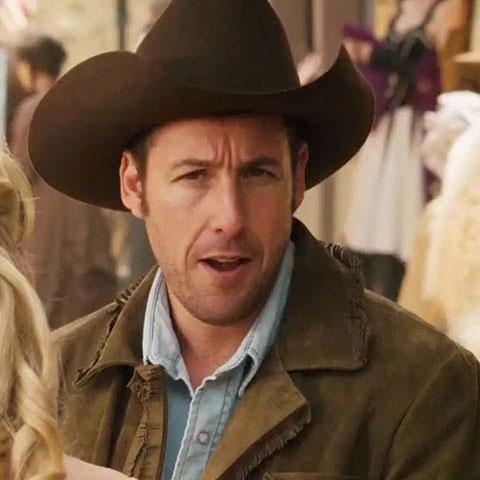
adam-sandlerBy now the story is pretty well known. A number of Native Americans recently walked off the set of an Adam Sandler movie (The Ridiculous Six) citing offensive jokes as the deal-breaker triggering their decision to leave. Most had been cast as extras, but the group also includes a cultural consultant hired for the film. Other sources have detailed the story better than I could, but let’s just get a few of their objections on the table so we all know what we’re talking about:

– The Indians in the movie are supposed to be Apache, but their outfits and material culture generally represented in the film would seem better suited to Comanche (and that not too accurately there either).

– The movie used offensive names for female characters. “No Bra” and “Beaver Breath” come to mind. “Sits-On-Face” was apparently in the script at one point.

– Come to think of it, the movie gives men offensive names too, “Five hairy Moles,” and “One Eyebrow,” for example.

– In the movie a woman is supposed to squat to pee at some point while smoking a peace pipe.

– The extras found a feather arrangement on a teepee inappropriate.

– In the movie, Adam Sandler is supposed to utter the line; “Say honey: how bout after this, we go someplace and I put my pee-pee in your teepee?”

…you get the idea.

I certainly hope that I don’t have to explain why any of this would be offensive. The question is of course what to make of that offense? Someone is almost always the butt of a joke, and so it sometimes seems arbitrary when a particular set of jokes like this one draws a vehement response. Those with little or no connection to the offended group are often that much more mystified, because they simply don’t understand all the implications, and it can be damned tempting to pass the whole thing off as political correctness.

The notion that these extras (and those who support them) are just being too damned sensitive about the whole thing is rolling rather predictably out in various tweets and blog posts. A spokesman for netflicks reportedly characterized the film as ‘broad satire’. Breitbart News carried that theme even further, denying that satire could be disrespect in any context and congratulating the film crew for standing their ground in the face of an overly sensitive group of extras. Sandler’s camp appears to have adopted the stance that his movie is meant to be all in good fun, and that it’s full of low-brow humor to begin with. One of the cast, Vanilla Ice, for example assured us that Sandler is not trying to make something on par with Dances With Wolves. So, it seems we in the public are supposed to give Sandler a pass, because he is just joking.

I’m usually pretty open to raunchy humor, but I find it very hard to imagine a context in which the jokes mentioned above would be anything other than toilet humor fit for a five year old.

…and let’s be clear. there is another context to consider here. For those of us who haven’t seen the film, it’s difficult to assess the context behind the jokes, but for those of us who haven’t lived lives as Native Americans, it’s hard to say what the overall context of life is for determining how these jokes must feel.

Context is a two-way street.

No, actually, it’s more like a giant roundabout with a lot of busy traffic.

The question here is just what makes these jokes funny to begin with (at least for those that find them funny)?  It’s easy enough to say that a name like “Beaver Breath” is just a joke, but is there really any reason to suppose that joke doesn’t turn on a point of prejudice? These names don’t appear to be an in-joke, and they don’t turn any non-native prejudice on its head. They reflect little other than the sensibility of a child snickering at someone different. These jokes turn that difference into an object of brutal and straight-foreword mockery. and there is simply nothing in the accounts given so far to suggest that the target of this humor is anything other than Native American naming practices themselves. If this is satire, it is indistinguishable from racist propoganda.

That the jokes in question may be delivered with a congenial smile doesn’t change the fact that this humor is at face value quite demeaning. Some people don’t even seem to know when they are insulting others; either that or they simply assume the right to do so without being called to account for it.

This is why the claim that The Ridiculous Six is all just satire fails. Oh yes, the movie may well be a satire, but whatever it’s satirizing, there is no reason to believe these jokes aren’t actually directed at the Native American community.

There is nothing in these jokes that suggests familiarity with their own subject matter, much less appreciation for the people close to it. This is why the costumes matter, not because the movie was meant to be historically accurate, but because knowing the difference between Apache dress and Comanche dress might have communicated at the trace of a capacity to give a damn. When such things become too much to ask, the benefit of the doubt slips out the door. And when those who raise the issue, as these extras did, are told by a producer they are being overly sensitive and they should leave, well that pretty well slams the door shut altogether. If there was any chance this humor could have reflected anything other than outright prejudice, the treatment these extras received on the set would appear to have set that prospect to rest.

…which puts the claim that no offense had been intended in this script in an awkward light. It would appear to mean little other than that Native Americans themselves are not supposed to take offense at such things. Sandler and company have produced a highly offensive script, and when called on it, they have done little other than to beg others not to see the plain point of their own jokes. In effect, they have put the responsibility for the insult on those that have called attention to it (which is an awful lot like the strategy taken by Dan Snyder and the Washington football team). in effect, they blame those they insult for knowing they have been insulted. Does that rhetoric sound familiar? It should. This is of course precisely why conservative culture warriors are beginning to weigh in. It isn’t that they don’t know the movie is offensive; the folks at Breitbart for example are defending it precisely because they know that it is.

It’s easy to dismiss Sandler himself. He has often (almost always) presented himself in a rather juvenile manner. His characters are often simpletons, and the humor they produce is accordingly full of foolishness. When this fails, as it often does, Sandler leaves behind more than a trace of disappointment in the jokes. He also leaves us with that slightly creepy feeling that we’ve seen too much of someone’s personal baggage. Still, the man is capable of outstanding humor, often using this very approach. I do recall some brilliant moments in Sandler’s career; Lunch Counter Lady and The Hanakka Song come to mind. I don’t exactly pine for new examples of his work, but I can honestly say that he has brightened my day once or twice over the years. I say this, not because I feel like defending the man at the moment, but because I think it’s important to note that he is at least capable of doing something better than this.

Unfortunately, the man is also capable of turning out utter trash. Case in point, putting a peepee in a woman’s teepee. Try as I might, I cannot find any context in which that line reflects anything but the crudest sensibilities of a petulant child. Reading about this, I can’t help thinking Sandler has gotten entirely too comfortable passing the naughtiest jokes of the playground off as professional comedy. I for one hope that he will take a lesson from his extras, and try once again to produce comedy worth watching.

***

Postscript: I noticed an interesting pattern in this video showing the conversation, the film-makers continually insist that the movie is sympathetic to the Native American characters. Why? Because Adam Sandler’s character loves them.

Speaking of Dances With Wolves…

Suffice to say the notion that respect for Native American characters rests on little other than the values of a non-Native character would be ironic at best.

Actually ‘perverse’ is more like it.

Share this:

  • Tweet
  • Share on Tumblr
  • Click to print (Opens in new window) Print
  • Click to email a link to a friend (Opens in new window) Email
  • Click to share on Reddit (Opens in new window) Reddit
Like Loading...

Uncommonly Slow on the Uptake

30 Monday Mar 2015

Posted by danielwalldammit in Childhood, Movies, Music, Uncommonday

≈ 3 Comments

Tags

Accents, Childhood, Humor, Jokes, Memory, Music, Ringo Star, Television, The Beatles

MV5BMjA4NjkxNzMxNV5BMl5BanBnXkFtZTcwMTM1MDQ3Nw@@._V1_SY317_CR2,0,214,317_AL_Sometimes it takes a moment or three to get a joke. And sometimes it takes about a decade and a half.

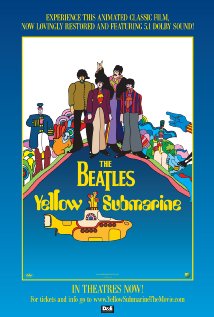
I think I was about 9 when I watched Yellow Submarine. I didn’t know much about the Beatles at the time. I remember a bunch of 45s my older brother kept in a case with a zebra pattern on it, and I remember a walrus picture and the associated lyrics had made quite an impression. Beyond that, …well I was nine!

But there I sat watching Yellow Submarine on TV with my sister and her friends. Blue meanies made a strong impression, as did something about a hole that ended up in Ringo’s pocket. I remember being very confused about that.

I also remember quite a few songs, and then there was a scene where someone tells Ringo not to pull on a lever, and he says “I can’t help it. I’m a born Lever-puller.”

University of Whales I don’t remember, but I read that line and it looks funny.

So, one day I’m lying in bed one morning at the age of 23, and I’m thinking about speaking accents. I do accents sometimes, …terribly. Anyway, I’m thinking of British accents in that half-asleep state that might just as easily slip back into a full dream, and I’m pretty sure I can do Ringo’s accent, and then …

“Ooooooooh! …a born Leever-pooler!”

Guess I can be a little slow sometimes.


Share this:

  • Tweet
  • Share on Tumblr
  • Click to print (Opens in new window) Print
  • Click to email a link to a friend (Opens in new window) Email
  • Click to share on Reddit (Opens in new window) Reddit
Like Loading...

Adam and Eve and the Sewing Needle

29 Sunday Mar 2015

Posted by danielwalldammit in Movies, Native American Themes

≈ 1 Comment

Tags

Adam and Eve, Arctic, Before Tomorrow, Eskimo, Movies, Ray Mala, Savage Innocents, Sin, Trade

p194794_p_v7_aaY’all know the story. The Serpent tempts Eve with an apple, and she in turn tempts Adam with the same. …Okay, some say it’s more likely to be a pomegranate. That’s not the point! In arctic cinema, the temptation is more likely to be a knife or a gun.

…or a sewing needle.

The analogy isn’t perfect, but with Eskimo populations, cinematic stories of a tragic fall from grace certainly do seem to start with the temptations of trade. Much as the fruit of a certain Biblical tree, these trade goods come with a cost, and with a sudden awareness of things that might best be left out of the world altogether. And just as with the story of Adam and Eve, it seems sex is very much at play in these stories.

The movie Before Tomorrow (2009) begins with a story about the Raven, which is certainly a more fitting motif than Genesis for use in an Inuit production, but its implications are no less ominous. This narrative ends badly, as does that of the movie itself. We are then treated to a joyous reunion between friends and family, one of whom carries a brand new knife made of strange materials. It’s extraordinarily sharp and very sturdy. The same guest soon produces an extraordinary set of sewing needles, along with a story of the strangers from whom these items had been obtained. Everyone laughs and marvels at the wonderful goods.

Sadly, it wasn’t simply trade goods these this fellow and his family picked up from the strangers, and the laughter of these opening scenes will lead us only to tears.

…many tears.

But I left out an interesting detail. You see the needles had to be obtained through sex, one night with a young woman for each needle. That was the price, so we are told. This too is cause for laughter and bawdy humor in that happy moment when the characters in Before Tomorrow can still laugh at the whole story and count the encounter with strangers as a blessing of sorts.

Before Tomorrow is an indigenous production. It handles this theme with grace and sensitivity, but of course the scene echoes others that have come before. Few things about the arctic seem to interest movie makers more than Eskimo sexuality, or more particularly those practices giving rise to phrases like ‘Eskimo hospitality’ or ‘Eskimo Brother’. Aware that arctic natives engage in something akin to wife sharing, a number of film-makers have given this theme a prominent place in several productions. The treatment is almost always short on ethnographic detail and long on prurient interests. White Dawn is perhaps the most indulgent of these films, but the theme has a long-standing presence in the history of arctic film. It is commonly bound to the topic of trade.

…and to narratives of the fall.

(Speaking of terrible things, I must warn you that spoilers are coming.)

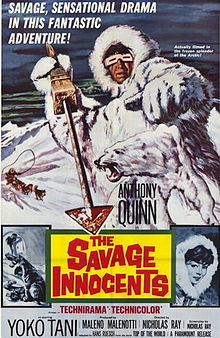
220px-The_Savage_InnocentsIn the year, 1960 (when Anthony Quinn was an Eskimo), his great source of temptation was a gun. I say he was an ‘Eskimo’, because it really wouldn’t be appropriate to saddle any specific people with the cultural baggage of Savage Innocents. a pseudo-documentary narrator notwithstanding, this film is not about any real-world population so much as a certain imaginary people best called to mind by precisely this grotesque term. Like so many films about natives of the Arctic, Savage Innocents really isn’t a film about Inupiaq, Inuit, Yupik, or even Chupik. It is most certainly a film about Eskimos, and that is a topic that has interested movie-makers long before the general public learned to think twice about such vocabulary. Anyway, when Anthony Quinn was an Eskimo, it was his introduction to the gun that kicked off a crises (and hence the story) of Savage Innocents.

For all its crudeness, Savage Innocents does throw a curve ball into my analogy here. Inuk (Quinn) is the one who first falls for this great temptation. Upon learning that white men will trade a gun for a hundred fox furs, he immediately sets about getting one. His wife, Asiak (played by Yoko Tani), will have none of it. She ends up giving away the gun, because she doesn’t want to live on fox meat while Inuk tries to put together enough furs for the bullets to fire it.

That’s a damned sensible Eve if you ask me!

Too bad Asiak is too late in her efforts to get free of the white man’s influence. A visit from a priest goes rather poorly when he refuses the food she and Inuk offer. It goes even more poorly when Inuk and Asiak offer to let the man ‘laugh’ with her (yes that’s an innuendo). When the Priest denounces the offer in the harshest of terms, a foul-tempered Inuk accidentally kills him. (h meant to crack the man’s head a little, inuk will later explain, but the man’s head “cracked a lot.” Legal troubles will soon follow in the form of Peter O’Toole who plays a trooper sent to catch Inuk and bring him back for punishment.

In savage Innocents, it is the gun which gets the action rolling, but it is sex that provides the tragic turn. It’s an interesting variation on a theme, and of course the movie’s title helps to underscore its relevance to stories of the Fall. Inuk and his wife are savages, yes, but they are also innocent (one might even say ‘noble’). Their encounters with the white world bring little other than the threat of guilt. It is the wisdom of this particular Eve that saves them.

But of course all of these plot developments emulate those of the far more famous film, Eskimo, starring Ray Mala. As in Before Tomorrow and Savage Innocents, visitors bring the temptation to our main characters in the form of trade goods acquired from strangers. A sharp knife is the first temptation to make an appearance in this film, followed shortly thereafter by iron sewing needles, and then a gun. Mala and his family are suitably impressed.

220px-Eskimo-FilmPosterMala’s wife, Aba (played by Lotus Long) asks a woman in possession of the sewing needles if she had received them from a ship’s Captain. No, her guest answers; “I was only able to please the man who did the cooking.”

And thus we learn the price that will be paid for these goods. Mala will of course trade many furs for his gun, but he will also have to share his wife with the strangers. Far from accepting this arrangement as the normal course of things, Mala is outraged that the strangers have taken liberties without asking for permission. this is not the sort of spousal sharing that occurs in his own village; it is violation carried out by men with no respect for either Mala or his wife, Aba.

But of course, it gets worse.

What interests me most about this, howeever, is not the he terrible consequences of trade with outsiders; it is the moment of temptation. In Eskimo that temptation plays out much as it does in Genesis. It is Aba who asks Mala to go trade with the strangers.

The white men have iron needles-

One could be even a greater hunter with a gun.

Like Eve tempting Adam with an Apple pomegranate, she urges Mala to begin the quest that will end their simple, happy existence. “The white men have black hearts,” so an elder warns the both of them, and yet Mala agrees to the trip. they will go, he explains, after the long winter night has ended. Aba will herself pay the highest price of the two for this decision, but that too seems rather appropriate for stories of the fall. When such stories approach the status of mythic narratives, at least in the western traditions, women always seem to fall harder than men. Perhaps that is why they are so often portrayed as the ones most responsible for that very fall.

Why we seem to keep telling such stories is another question altogether.

Of course, the story of Adam and Eve is hardly a narrative indigenous to the arctic, but then again, only one of the three stories listed above is an indigenous production. One can almost see the story of Adam and Eve pulling on the the tragic tale in Savage Innocents and Eskimo, even as each movie grapples to one degree or another with the sensibilities of the people it depicts. And yet elements of this trope overlay nicely (though not precisely) with those of Before Tomorrow. In each case, trade with outsiders would seem to constitute the original sin, and in each case sex would appear to be part of the picture.

Sex, occupies a more tempered role in Before Tomorrow than it does in either of the mainstream productions. It’s characters relate the terms of exchange (sex for needles) in matter of fact tones. They laugh yes, but they are not shocked. Perhaps we as the audience are meant to grasp the exploitive nature of the strangers approach to trade, but in Before Tomorrow that is of little consequence. In both Eskimo and Savage Innocents, it is sex itself (or the prospect of it) that triggers the coming hardship. It does so through conscious decisions of the parties involved. In Before Tomorrow, it is something far more subtle, an exchange understood by no-one present in those opening scenes.

It isn’t hard to see a trace of tragedy in the globalization of the Arctic. So, I suppose it should also come as no surprise the onset of trade would provide a ready subject matter for epic narratives about loss of innocence. These stories carry different inflections, but they also carry a few common themes.

…such as , “beware of strangers with really cool sewing needles.”

Share this:

  • Tweet
  • Share on Tumblr
  • Click to print (Opens in new window) Print
  • Click to email a link to a friend (Opens in new window) Email
  • Click to share on Reddit (Opens in new window) Reddit
Like Loading...
← Older posts
Newer posts →

Top Posts & Pages

  • Hostiles and Spoilers: A Magic Studi
    Hostiles and Spoilers: A Magic Studi
  • I'll Just Leave This Here
    I'll Just Leave This Here
  • When Sex Falls Out of the Performance
    When Sex Falls Out of the Performance
  • Southern Paiutes as Portrayed in Las Vegas Area Museums.
    Southern Paiutes as Portrayed in Las Vegas Area Museums.
  • A Godless Reason for the Season
    A Godless Reason for the Season
  • Dancing for the Dead - Movie Review
    Dancing for the Dead - Movie Review
  • The Erotic Heritage Museum in Las Vegas: A Very NSFW Review
    The Erotic Heritage Museum in Las Vegas: A Very NSFW Review
  • The CSS Shenandoah
    The CSS Shenandoah
  • An Uncommon Security Guard: Dave Eshelman, AKA 'John Wayne'
    An Uncommon Security Guard: Dave Eshelman, AKA 'John Wayne'
  • Race Card Recursion: A Game of Social (In-)Justice
    Race Card Recursion: A Game of Social (In-)Justice

Topics

  • Alaska
  • Animals
  • Anthropology
  • atheism
  • Bad Photography
  • Books
  • Childhood
  • Education
  • Gaming
  • General
  • History
  • Irritation Meditation
  • Justice
  • Las Vegas
  • Minis
  • Movie Villainy
  • Movies
  • Museums
  • Music
  • Narrative VIolence
  • Native American Themes
  • Philosophy
  • Politics
  • Public History
  • Re-Creations
  • Religion
  • Street Art
  • The Bullet Point Mind
  • Travel
  • Uncategorized
  • Uncommonday
  • White Indians
  • Write Drunk, Edit Stoned

Blogroll

  • American Creation
  • An Historian Goes to the Movies
  • Aunt Phil's Trunk
  • Bob's Blog
  • Dr. Gerald Stein
  • Hinterlogics
  • Ignorance WIthout Arrogance
  • Im-North
  • Insta-North
  • Just a Girl from Homer
  • Multo (Ghost)
  • Native America
  • Norbert Haupt
  • Northwest History
  • Northy Pins
  • Northy-Tok
  • Nunawhaa
  • Religion in American History
  • The History Blog
  • The History Chicks
  • What Do I Know?

Archives

  • December 2023
  • November 2023
  • June 2023
  • April 2023
  • February 2023
  • December 2022
  • November 2022
  • October 2022
  • September 2022
  • August 2022
  • July 2022
  • June 2022
  • April 2022
  • January 2022
  • December 2021
  • November 2021
  • October 2021
  • September 2021
  • August 2021
  • June 2021
  • May 2021
  • March 2021
  • February 2021
  • January 2021
  • December 2020
  • November 2020
  • October 2020
  • September 2020
  • June 2020
  • May 2020
  • March 2020
  • February 2020
  • January 2020
  • December 2019
  • November 2019
  • September 2019
  • August 2019
  • July 2019
  • June 2019
  • May 2019
  • April 2019
  • January 2019
  • December 2018
  • November 2018
  • October 2018
  • September 2018
  • August 2018
  • July 2018
  • June 2018
  • May 2018
  • April 2018
  • March 2018
  • February 2018
  • January 2018
  • December 2017
  • November 2017
  • October 2017
  • September 2017
  • August 2017
  • July 2017
  • June 2017
  • May 2017
  • April 2017
  • March 2017
  • January 2017
  • December 2016
  • November 2016
  • October 2016
  • September 2016
  • August 2016
  • July 2016
  • June 2016
  • May 2016
  • April 2016
  • March 2016
  • February 2016
  • January 2016
  • December 2015
  • November 2015
  • October 2015
  • September 2015
  • August 2015
  • July 2015
  • June 2015
  • May 2015
  • April 2015
  • March 2015
  • January 2015
  • December 2014
  • November 2014
  • October 2014
  • July 2014
  • June 2014
  • May 2014
  • April 2014
  • March 2014
  • February 2014
  • January 2014
  • December 2013
  • November 2013
  • October 2013
  • September 2013
  • August 2013
  • July 2013
  • June 2013
  • May 2013
  • April 2013
  • March 2013
  • February 2013
  • January 2013
  • December 2012
  • November 2012
  • October 2012
  • September 2012
  • August 2012
  • July 2012
  • June 2012
  • May 2012
  • April 2012
  • March 2012
  • January 2012
  • December 2011
  • November 2011
  • October 2011

My Twitter Feed

Follow @Brimshack

RSS Feed

  • RSS - Posts
  • RSS - Comments

Enter your email address to follow this blog and receive notifications of new posts by email.

Join 8,075 other subscribers

Blog at WordPress.com.

  • Subscribe Subscribed
    • northierthanthou
    • Join 8,075 other subscribers
    • Already have a WordPress.com account? Log in now.
    • northierthanthou
    • Subscribe Subscribed
    • Sign up
    • Log in
    • Report this content
    • View site in Reader
    • Manage subscriptions
    • Collapse this bar
 

Loading Comments...
 

    %d