• About

northierthanthou

northierthanthou

Category Archives: Native American Themes

This is where I talk about Native American themes. No, I’m not Native; I’m just your generic white guy. That said, I have lived and worked in indigenous communities for a significant portion of my life, so I have a few thoughts on the subject. Whether or not they are worth considering depends on who you ask.

Map Ain’t Time Either.

30 Saturday Sep 2017

Posted by danielwalldammit in History, Native American Themes

≈ 9 Comments

Tags

American Indian, Boundaries, Cartography, Distortion, History, Maps, Nations, Native American, Territory
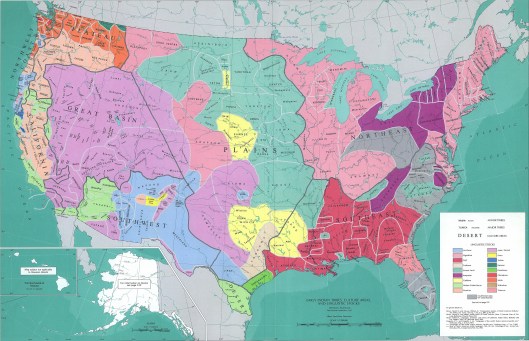
indian_tribesI often see maps of Indian territories pop up on the net. I like them. And then again, I don’t. I’ve seen also some of these same maps in classrooms and academic papers. In such cases, the narrative usually does a bit more to put the visual presentation in context, but on the net, that visual is often all you get.

…along with a couple hashtags, and sometimes a catchy title.

The specific subject matter varies a bit from map to map. Sometimes they purport to show linguistic variation. Sometimes, they show the culture areas used by anthropologists or the general divisions of Native American peoples into related peoples. Mostly, these maps purport to show the specific locations of various tribes.

…whatever that means?

Don’t get me wrong. The basic idea isn’t entirely off base, and it’s a lot better than silence on the topic, but the notion of an Indian tribe carries a lot of baggage, only some of which goes away if we replace the term ‘Indian’ with ‘Native American’. We can also replace ‘tribes’ with ‘nations’ or ‘peoples’.

…we still end up with plenty of baggage.

There really isn’t any vocabulary that just works here. You really have to pick a term, and just bear in mind the distortions it imposes on the subject matter. But my point here today isn’t so much to work over the vocabulary as it is to focus attention on the maps themselves. It’s great to have them, but they too can distort the subject matter, all the more so when the map circulates as a meme-in-in-itelf, so to speak, just an image without a narrative to go with it.

So, what’s the problem?

***

Well, we have a few of them actually. One of the first things going through my own mind is the other half of the contextualization schema. The maps give us a where. That leaves me asking when? These maps purport to show us where different Native American peoples lived, but they rarely give us a strong sense of when they lived there. This goes hand-in-hand with common assumptions about the timelessness of Native American societies. Folks are only too happy to imagine that most Indian peoples had been living in the same place since time immemorial, just waiting for the rest of us to show up and kick-start the history machine. All the timely-changey stuff must have come after Columbus, so the thinking goes. Before that, Indian peoples just stayed put, living in harmony without any real need for big changes like a major population movements.

All of this is of course, nonsense, and I think most people know it is, at least when the question is put to them directly. I repeat, they know it WHEN you put the question to them directly. Until then, I think folks fall quite easily into the assumption that Indian peoples rested in a kind of temporal stasis. Hell, sometimes Native Americans themselves fall into this assumption.Don’t be too surprised. Stereotypes often come in a user-friendly version, an ever-so-inviting role to play, for those who are willing. The noble savage may be a cliché, but it’s not one without its charms, and it’s easily as timeless as any of its less PC counterparts. In any event, folks often seem to imagine Native American societies as timeless communities.

Case in point?

These maps.
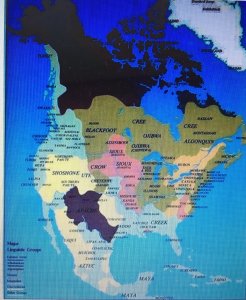
DJdFnI-W4AI9LXEI found this little gem to the left on twitter, at least I believe that’s where I got it. It’s pretty cool, really. It definitely matches my general sense of where various people should be. But then again, my general sense of where everybody should be rests on a skewed timeline. I expect them to be in certain places when the stories I read or tell about them in history class take place. So, if the different natives peoples are in the right place on cue for the historical narratives I expect to feature them, then the map matches my initial expectations, and I end up saying stuff like “it’s pretty cool.” The whole thing almost works, but it doesn’t take too many questions to bust up both those expectations and the maps that go with them.

When did everyone get where they are in the map above? It’s controversial question, and one that I may regret raising here, but still… See the Apacheans down there in the Southwest? You might think they had been there since time immemorial, right? Well the archaeological evidence suggests this isn’t the case. As I recall, the earliest evidence for Diné (Navajo) placement in the four corners area predates the Spanish by a little over a hundred years. They came along with the other Apachean peoples by means of a hotly debated route. Of course archaeological finds happen every day, so the historical evidence may change, and I may have missed a recent find or three, but the point is that these people arrived in the area within comprehensible time frame. This placement on teh map isn’t from time immemorial; it begins at the cusp of the 1400s, give or take a bit, and that enables us to place their entrance into a sequence of events for the region. They were still settling into the total territory on this map when the Spanish began exploring the region, arriving well after their Pueblo neighbors. Knowing that helps to put the map in perspective. Not knowing that invites an a-historical reading of the map.

Now look at the plains. The peoples placed there seem right to me, but it’s worth considering that many of them didn’t get there until well after the beginnings of the colonial period. Specific migration routes and the scale of ground shifted are of course open to debate, but I think it is fair to say that a great deal of the population on this portion of the map filled in after the beginnings of the fur trade, and even more importantly, after the horse began spreading through the plains in the wake of the Pueblo Revolt.

243

From the New Mexico Museum of Art

That would be a war the Indians won folks, not simply a battle. a war. But that’s another rant…

…anyway, the point is that the population of the plains as we now understand it changed a great deal during the colonial period. So, if the southwest takes on roughly the territories represented in the map just ahead of the colonial period, the great plains takes its apparently map-worthy shape during that very period. We can point to a time frame sometime on down the road that reflects this mapping, but by then other things have shifted. Case in point? The eastern seaboard. By the time the plains looks like it does on this map, the settler population is already pushing a lot of people out and away from the coasts. By the time Lakota, Comanche, and Kiowa have reached their positions on this map, the eastern seaboard should already be looking a bit white-washed.

These are just the areas I think I know something about (and admittedly, I am often wrong). The rest of the map is full of movement too. Some areas may be more stable than others. The amount of movement is itself variable.

So, what does the map represent? It really isn’t a clear snapshot of any particular time-frame. We really can’t locate a specific time in which all the territories assigned to various indigenous peoples really were under their control. Rather, it seems to be a representation of the territories controlled by various peoples during something like a period of peak cultural autonomy. …as perceived by white people. In a very real sense, each of these territories is set onto the map in precisely the locations at which we non-natives really became interested in the regions and/or first became aware of the native peoples in question. Fair enough as far as it goes, but to say that this leaves out a lot of information is a Hell of an understatement.

***

Speaking of non-native perceptions. Names are a bit of a problem here as well. I hope it will come as no surprise to learn that many of the names appearing on these maps are not those used by the people to refer to themselves. ‘Navajo’ was for example a Tewa term for open fields. ‘Sioux’ is usually described as a shortened version of an Ojibwa term (it has something to do with snakes). As I recall, there is a competing narrative for that one, but the point is that the name DID NOT come from the Sioux themselves. ‘Eskimo’ was a Montagnais term often translated as ‘raw fish eater’, though it is more likely to have meant ‘snow-shoe netter’. Each of these origin narratives is a complicated story in itself (information is problematic all the way down), but for the present, the point is that the names typically appearing on these maps generally come from the neighbors of the peoples in question. They made their way into the popular lexicon after European colonists asked some other tribe who lives over there. The answers to those questions then made their way into our history books and onto our maps.

tribal_nation_map_custom-973eefab3541e8d2c23056100549ac543e59beee-s1600-c85This is one reason I like this map by Aaron Carapella. He makes an effort to identify the native names for themselves and get them onto the territory. That’s a big improvement. Of course, we still have the timeline problem mentioned above, but at least the names are a bit more authentic. I should add that they are more authentic because they are the names the people in question use for themselves, not because they are ‘original’, as folks sometimes suggest. ‘Original’ alludes to a timeless beginning. Talk of an original name just points us back to the timeline problem, but there is definite value in using the name people prefer to use for themselves. We may have to switch back and forth, or introduce a topic using the more popular names, but working with materials that provides the native terms helps to normalize them.

***

imagesOne additionally interesting feature of Carapella’s maps is the fact that he leaves off the territorial boundaries. The names of each people simply appear on the  map without any clear sense of the boundaries around them. We are left to imagine the full extent of each native territory. This avoids one of the larger problems one commonly finds in maps of Indian territory, their tendency to construe that territory in terms comparable to that of nation states. We all know the convention, color-coded spaces with clear boundaries between them. This conveys both a sense clear boundaries between different Indian peoples and a sense of homogeneity within those boundaries. Every part of Cherokee territory on such a map is just as Cherokeeish as any other part. They are all equally blue, or yellow, or mauve. One gets the sense that someone could pinpoint the exact moment they stepped into (or out of) Cherokee land, or that of any other tribe. We can practically see someone stopping on a dime, just like the cops in an old outlaw trucker movie do when they reach state lines. That’s how modern nation states work. It isn’t clear that this is now native territories work(ed).

It isn’t that native peoples didn’t have territories. They certainly did claim specific lands, and even defend them from others, but this system would have worked without the benefit of a scientific grid defining the exact moment one would step over the line from one territory to the next (much less collection of maps to represent them). Of course, natural features such rivers or mountains, and so forth would be used as reference points, but thus too leaves open questions as to just where the boundary rested. Did a given people claim both sides of a river or just one? The answers would vary. The end result was of course a lot of overlapping claims.

I often wonder if some of these maps could be improved by representing the overlapping territories, Venn diagram-style, at least where such instances do occur, but of course, this leaves open questions about timelines and the adequacy of information as to how the territories on these maps have been assigned to begin with. It’s not as though the historical record is entirely silent on these matters, but there is something about the way these maps fill in the details with a little too much precision. Judgement calls have been made on these maps, and the way they have been made is erased by the nature of the maps.

The problem isn’t really unique to Native American territories, but at least as applied to modern states and nations the techniques used by the map-makers matches those of the powers that be a bit more. People who live in and around important boundaries may or may not live life in a way that bears out the conventions of cartography, but the powers that be will likely support the notion that we can pin-point exactly where one state leaves off and another begins. They will also support the notion that we know exactly who belongs on one side or another, if necessary with guns or walls. The trouble here is that these maps purport to describe the territories of a different world altogether, one which reckons turf a bit differently.

Don’t get me wrong; it’s great to have these maps, but they distort even as they inform. I’m always curious about the prospects of improvement. In the interim, I reckon the best cure for the distortion is to be aware of the problems.

…of which, I hope I have at least scratched the surface.

Sundry Maps (Click to embiggen)…

California Indian Territories
Indian Tribes of the U.S.
Aaron Carapella's map
Aaron Carapella’s map
North American Linguistic territories
Territorial Losses (ironically Native American territories become more clear as they shrink at the onslaught of colonism
Culture Areas Again
Culture Areas Again
Culture Areas
Culture Areas
Nuther Aaron Carapella map
AK Natives
AK Natives

Share this:

  • Tweet
  • Share on Tumblr
  • Click to print (Opens in new window) Print
  • Click to email a link to a friend (Opens in new window) Email
  • Click to share on Reddit (Opens in new window) Reddit
Like Loading...

Moar Rez Murals!

08 Friday Sep 2017

Posted by danielwalldammit in Native American Themes, Street Art

≈ 9 Comments

Tags

Arizona, Art, Murals, Navajo, Navajo Nation, Paintings, Southwest, Street Art, Travel

DJHabIOUQAES0YE

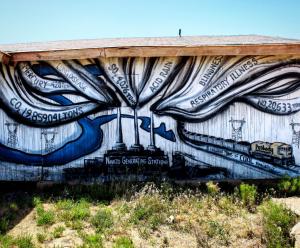
Power Plant

It’s been a very long time since I worked in Navajo country. The last couple years I’ve made a point to take Miladydebennet through a lot of my old haunts, and this summer that meant a trip through the Navajo Nation. It was great to see some of the old sights again, and to see them a little bit through the new eyes of my girlfriend. It was also great to see some new things in the old places. One of my favorite new things (new to me anyway) is the addition of street art all around the rez. These had me smiling all the way from Page to Santa Fe. I had even more reason to smile when I learned one of my former students had been involved in painting one of these murals.

It seems that these have been part of an ongoing project, called Paint the Desert initiated by a doctor who goes by the name, Jetsonorama. You can find a few articles on his project here and here, here, and here. I’ve previously posted some of the murals from along Highway 89, so I was very happy to catch some more this summer.

As always, you may click to embiggen. (In fact, I highly recommend it.)

These were in Kayenta, just south of Monument Valley.

Prayer
Prayer
Kayenta Horses
Kayenta Horses

These paintings were all at the Crossroads Trading Post.

Crossroads Trading Post
CTP Love
CTP Love
Well-Painted Mutton Stand
CTP
CTP
Corn
Corn
Water Rights
Water Rights

Saw this somewhere along the road from Kayenta down to Chinle.

DJHXb6jUMAA_w4D

Windmill

Found this piece on the road between Many Farms and Chinle.

Brotherhood
Brotherhood
Backside
Backside
Abalone Road
Abalone Road
Windmill between Many Farms and Fort Defiance

These (and many more) were all painted along a wall in Fort Defiance. It would have been walking distance from my home for a few years. Kind of a surreal experience to get a soda from the old convenience store and walk around checking this out. Surreal, and very cool.

For me anyway.

Hope y’all enjoy the pictures.

Turning
Turning
Rez-Ball
Rez-Ball
A Bit Eerie
A Bit Eerie
Downright Scary
Downright Scary
Rodeo at Monument Valley
With Jigsaw
With Jigsaw
Flags
Flags
...and a little rider too
…and a little rider too
Code Talkers
Code Talkers

Share this:

  • Tweet
  • Share on Tumblr
  • Click to print (Opens in new window) Print
  • Click to email a link to a friend (Opens in new window) Email
  • Click to share on Reddit (Opens in new window) Reddit
Like Loading...

An Uncommon Liberty

28 Monday Aug 2017

Posted by danielwalldammit in Alaska, Museums, Native American Themes, Re-Creations, Uncommonday

≈ 5 Comments

Tags

Alaska, Cup'ik, Doll, Equity, Museum of the North, Native Americans, New York, Statue of Liberty

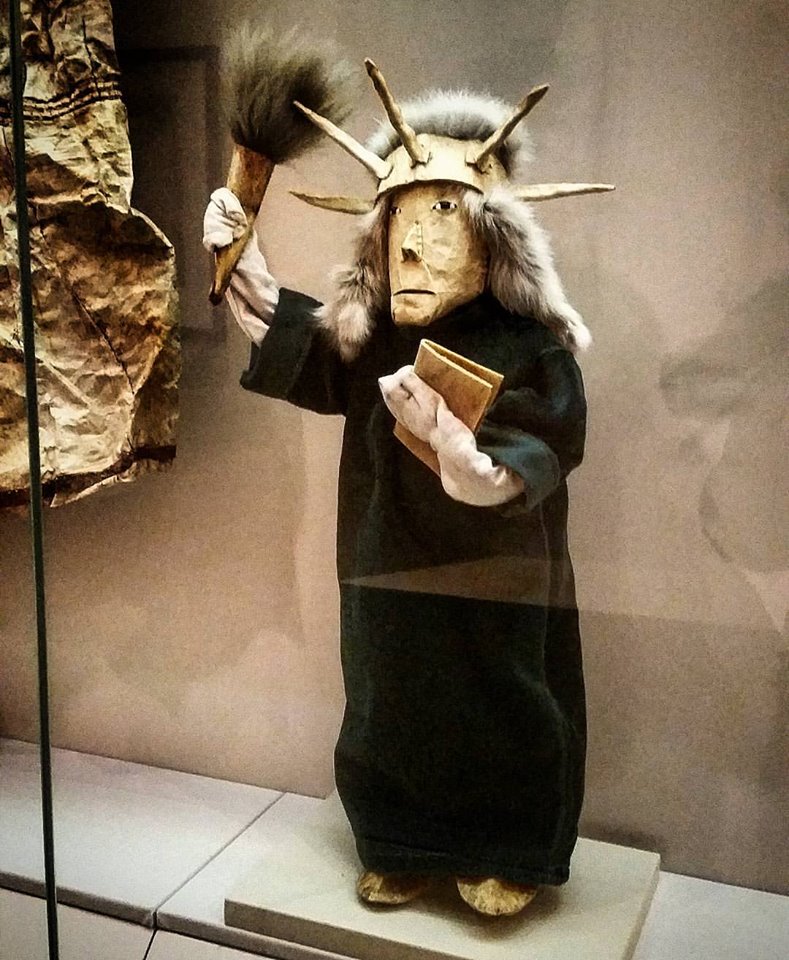
Statue of Liberty Doll Sealskin, velour, cotton, rabbit, simulated sinew, thread, wire, Cup’ik, Maker: Rosalie Paniyak, UA 2001-008-0003

Back in May, I made a stop at the Museum of the North at the University of Alaska, Fairbanks. Lots of interesting stuff in there, but this one piece in particular caught my attention. The information card next to Miss Liberty had a nice note from the museum director. It reads as follows:

“I’m a Native New York who 13 years ago left the big city for the paradise of Alaska. Rosalie Paniyak’s Statue of Liberty doll is, for me, one of the funniest works of art in the entire museum, and the embodiement of what I left and what I have now.

“When I lived in lower Manhattan, my dog and I would walk along the Hudson River.There was Ms. Liberty, tall, strong, and noble, an image that took itself very seriously. Moreover, it welcomed people to a Very Important City.

“Rosalie’s Statue of Liberty is soft, with a face that is anything but dignified. She holds her torch askew. She is the Cup’ik version of an American icon, humorous and irreverent.

“After I enjoy its visual irony, what does this doll say to me? On the lighter side, that New Yorkers’ sense of self-importance is a bit silly. And more seriously, that this privilege of liberty has not always been enjoyed by everyong, such as Native Americans.”

Aldona Jonaitis

Museum Director

Share this:

  • Tweet
  • Share on Tumblr
  • Click to print (Opens in new window) Print
  • Click to email a link to a friend (Opens in new window) Email
  • Click to share on Reddit (Opens in new window) Reddit
Like Loading...

Violent Memories and the Civil War Era in the Southwest

20 Sunday Aug 2017

Posted by danielwalldammit in History, Native American Themes, Politics

≈ 17 Comments

Tags

Civil War, History, Kit Carson, Monuments, Navajo, Old West, Santa Fe, Southwest, War

It must have been a couple decades back. I was at a small party in Forth Defiance. Those attending included a number of officials in the Navajo tribal government. Fort Defiance serves as kind of a bedroom community for the capital of the Navajo Nation, so this was hardly unexpected. What none of us expected that evening was a quick lesson that began when our host asked if anyone knew the name of the main street going through the town? No-one did. As it happens, the name was Kit Carson Drive.

Kit CarsonApparently, it still is.

To say that most of the party-goers found this shocking is putting it mildly. It may not be obvious to some of my readers why a room full of Navajos would object to a street named after Kit Carson, but even the most cursory knowledge of their history would make this pretty well obvious.  The man is popularly known as an old western Indian fighter, and as it happens, a good number of the Indians he fought were Navajo.  When General James H. Carleton, the Army Commander for the Territory of New Mexico decided to go to war with the Navajo people, it was Colonel Kit Carson that he sent off to do it. Carson marched through Canyon de Chelly, the heart of Navajo territory, destroying resources (just as Sherman might have) and letting winter bring his enemies in to surrender. This campaign, and the four years of internment at Hwéeldi (Fort Sumner) still constitute the darkest chapter of most historical narratives about the Navajo people. So, you can just imagine what it must have meant for people who can still tell you about relatives lost on the long walk to Fort Sumner to learn that a road right through their community bears the name of the man responsible for their deaths.

Kinda put a damper on the party.

You might think it odd that folks didn’t know the name of the road to begin with, but it’s hardly unusual. Folks don’t pay that much attention to street names out that way. Many of the roads don’t have signs at all, and I don’t recall seeing that particular name on a street sign when I lived out there (though one can certainly be found in Fort Defiance today). This party was the only time anyone ever mentioned it to me.

The old south isn’t the only place in this country with a questionable sense of public history from the Civil War era. Those in the Southwest have less to do with the war between the states than the early stages of the Indian wars which would dominate the interior west for a couple decades. Kit Carson Drive is one of many such examples. The Obelisk in the town square of Santa Fe provides another. It’s had its own share of controversies over the years, not the least of them being this dedication:

20914595_10214035631069907_2575022190736341192_n“To the heroes who have fallen in various battles with savage Indians in the Territory of New Mexico.”

It should come as no surprise that this line acquired its share of critics over the years. It has had some defenders as well, to be sure, but plenty of critics. The sentiments might have seemed appropriate enough to those who erected it in 1868, but in the 1970s, sentiments had changed a bit, as had the political status of some of those ‘savage Indians’ referenced in the piece. So it really should have come as no surprise when calls went out for removal or modification of the monument. Today, at least, it may seem a little surprising to find the monument had Native American defenders, which apparently it did. Attempts were made to put the original wording into it’s proper context, so to speak, preserving it without appearing to endorse it, but some clearly weren’t satisfied with this way of thinking about the issue. Resolution apparently came in the form of a chisel, and the result is a monument with its own fill-in-the-blank question.

20992726_10214035596509043_4949865469052976294_n

It seems, the American public is hashing out a new round of debates over public monuments, particularly those in the South. Some no doubt find the entire debate quite trivial. Who reads the placards on a monument anyway? Of course when people fight over seemingly trivial things, you can bet your ass they aren’t really fighting over the trivial things. It isn’t actually history (much less historical monuments) that has people up in arms over Confederate Statues, just as it wasn’t really history that caused a word to fall off the monument in Santa Fe. Such battles are always about the present. They are about the way that people think and use history to shape the present, and there are usually some very specific present implications in these battles.

People typically see the present interests loud and clear when they confront advocates of social justice. If anyone ever forgets this, the term ‘political correctness’ is right there to remind us that someone (or at least someone on the left) has an agenda. What folks are slower to get, it seems, is the fact that these sorts of gestures are hardly neutral to begin with. There is a reason James W. Loewen devoted a fair portion of his book, Lies Across America, to Confederate monuments, and it wasn’t because these monuments contain sober and thoughtful commentary on the actual history of the region. A statue to a confederate hero isn’t just a reference to history as such; it says something to those who those whose ancestors those heroes fought to keep in bondage. And a monument to heroes who died fighting ‘savage Indians’ may say something noble to those descended from colonists (Spanish or Anglo) in the American southwest; it says something else to those descended from those very ‘savage Indians’.

To be sure, complications abound. Some folks may have ancestors on either end or neither of his memorial demographics, and some people may have no dog in the fight at all. Also ironic usage happens. Not every Native American takes umbrage at the word ‘savage’ just as not every Native American objects to the term ‘Redskins’. But we should be wary of efforts to make these exceptions into the rule. The Washington football team has, for, example paid good money trying to find, cultivate, and promote just about any Native American willing to help foster the notion that the team name reflects anything but a racist stereotype. Were the team name really so bland, one might almost wonder what use it would have for people interested in such a martial sport! And of course we now have the Cheetoh-in-Chief (who has his own bullshit civil war monument) mourning the loss of beautiful artwork and a desecration of history with every Confederate statue that goes down. His language is so flowery and positive. You’d almost think these monuments held no serious political significance in the present age.

Of course the folks delivering the Nazi salute in defense of Robert E. Lee might seem to argue otherwise.

There are people, times, and places who don’t find it necessary to remove or modify monuments to their sordid past. Some of these might not even be terrible people, places, or times. But if the monuments to an abusive past aren’t so toxic, this isn’t simply because potential critics choose to let it slide; it’s because the community as a whole has somehow managed to handle the issues in question. When the dominant voices prove tone-deaf or outright hostile to the interests of those on the wrong-side of monumental history, then we are all a lot less likely to get along. Then statues get pulled down.

…or someone just shows up with a chisel.

***

Just a few pics of Canyon de Chelly (click to embiggen):


19732010_10213608255385782_3134402216345552500_n
20264884_10213790741107811_6139379835115073225_n
20776824_10213976954923040_6197824098058023091_o
20799382_10213964731857471_643789261344359561_n
19554785_10213533887766638_4703562301468482973_n


Share this:

  • Tweet
  • Share on Tumblr
  • Click to print (Opens in new window) Print
  • Click to email a link to a friend (Opens in new window) Email
  • Click to share on Reddit (Opens in new window) Reddit
Like Loading...

A Rambling Ranty Post about Realisms on the scReen

06 Thursday Jul 2017

Posted by danielwalldammit in Movies, Native American Themes

≈ 14 Comments

Tags

Culture, Fantasy, Fast Runner, game of thrones, George R R Martin, History, Realism, Reality Television, War

Someone I know and love likes to say that Game of Thrones is all fake. It’s fantasy, so there is nothing realistic about it. This same individual (whom I know and love) eats up reality TV like it was candy. I think he knows as well as I do that those shows are often contrived, but that doesn’t stop him from getting really into the moment that alligator is on the hook and the second guy in the boat can’t seem to find his shot. I know as well as he does that Westeros ain’t real, but that doesn’t stop me from worrying about the fate of Jon Snow. Each mode of storytelling works for one of us and not the other.

But what does realism have to do with it? Or anything else for that matter?

***

It’s easier to see the connection for reality TV, not because it’s more real in an objective sense, but because the theme is more central to the genre. Reality television purports to be showing us something about how people in some part of this world really do live. That’s a claim that goes a bit beyond the story-line itself and reaches into the mess of life we sometimes call the real world. That claim constitutes a significant portion of the genre’s appeal. It’s a bit like porn, actually. The dialogue may be utter crap, but somehow the sense that you are seeing something real makes it a little more interesting. At least I think that’s the point, or at least part of it. For myself, I just can’t get into it. Knowing just how much manipulation goes into the stories told in reality television, constitutes a bit of deal-breaker for me. Perhaps I would enjoy it more if I could suspend disbelief and just enjoy the stories, but how does that suspension of disbelief work when a sense of veracity is central to the genre?

…also, there is the expository crutch!

Reality television leans very heavily on the use of exposition. Far too often, for me anyway, they break away from the action to have one of the characters explain events to the audience in their own words. Without these moments we would be missing a lot of the plot-line. Reality television uses these moments to fill in the gaps. It also uses them to tell us what’s at stake in the action, often playing up the drama well beyond any significance we could draw from the events ourselves. …if we don’t get this fish trap to work we’ll starve! We need to fix the oil leak in our car or we’ll freeze to death on this mountain top. That chef needs to change his recipe or the whole business will go under! …you get the idea. They’ll repeat these narratives a few times each episode, just to make sure you get caught up in the point. Maybe, I’m a hard sell, but most of the time I just don’t believe them. More importantly, I find the whole convention damned tedious. When did so much exposition become good writing? I’m guessing that moment in television history came during the early episodes of MTV’s Real World and that first season of Survivor.

Remember Survivor? Remember the hype leading up to the first episode? This was supposed to be about people surviving on their own under primitive conditions. Only they couldn’t! Those guys really couldn’t do much to feed themselves and contribute to their own survival. But they did get just enough food and water from the show producers to survive so long as they didn’t waste their energy trying to survive on their own. So they mostly sat around and bickered with each other. Somewhere in there, I imagine, the production team must have had a collective panic attack. …My God, the whole story just ain’t happening! What do we do? The answer turned out to be high school soap opera, and thus the master script was born for just about every reality television program made ever since.

That’s how I imagine it anyway. It may not be real, but if you had me and five of my friends telling you the story of this blog post, I’ll bet it would pass muster for reality TV.

“…this really is a must write blog post for Dan. He’s at his breaking point.”

“I knew, I had to do post something today. This post was like a dark cloud hanging over my head.”

“If Dan doesn’t finish this post today, I’m pretty sure he’ll be eaten by black bears.”

“I don’t see what the big deal is. Nobody reads blogs anymore anyway.”

I’m voting that last fucker of the island!

***

But let’s come back to the Game of Thrones! I get the concern. It’s fantasy. There are dragons. Magic works (except when it doesn’t), and well, hell, did I mention there are dragons? Clearly, some things about Game of Thrones are not real at all. Still, I think the show has two (maybe three) realisms lacking in many more ‘realistic’ genres.

First and foremost, it’s all the death, the gruesome terrible deaths, the ones that happen to central characters that we all know and love. Love it or hate it, George R.R. Martin’s penchant for killing off key protagonists has long since become the defining feature of the show. For myself, I love it, but there is a certain dwarf that better be in good health at the end of this coming season or I’ll, I’ll, …I don’t know what I’ll do.

Take that Martin!

People ask Martin about this all the time. I’m particularly fond of the answer he once gave The Independent:

“A writer, even a fantasy writer, has an obligation to tell the truth and the truth is, as we say in Game of Thrones, all men must die,” he told Galaxy’s Edge Magazine. “Particularly if you’re writing about war, which is certainly a central subject in Game of Thrones.”

He continued: “We’ve all read this story a million times when a bunch of heroes set out on an adventure and it’s the hero and his best friend and his girlfriend and they go through amazing hair-raising adventures and none of them die. The only ones who die are extras.

“That’s such a cheat. It doesn’t happen that way. They go into battle and their best friend dies or they get horribly wounded. They lose their leg or death comes at them unexpectedly.”

The author goes on to explain, slightly morbidly, that we’re all going to die at some stage as mortality is inevitable. “Once you’ve accepted that you have to include death then you should be honest about death and indicate it can strike down anybody at any time.

“You don’t get to live forever just because you are a cute kid or the hero’s best friend or the hero. Sometimes the hero dies, at least in my books.”

I take that to be a kind of realism. It’s not about authentic costumes or weaponry, or the details of some known historical event. It’s about the human cost of warfare. Martin is known to have patterned his fiction after some real historical conflicts (most notably the War of the Roses), but of course his work remains fiction. Hell, it remains fantasy-fiction. So, we have no baseline from which to compare his description of events to a known fact, at least not any he is obligated to render with accuracy. Still, Martin’s willingness to kill off the characters we care about tells us something about war that many more ‘realistic’ stories keep leaving out.

I would add that it isn’t just Martin’s willingness to kill important characters that sets his stories off from others. It’s his willingness to do it unexpectedly, suddenly, and often without any hint of heroics in the moment of death. Time and again, Game of Thrones invites us to identify with a character, to root for them, only to kill them in the end.

…only to leave us watching as the struggle goes on without those whose story arc had once defined the whole meaning of the show for us.

That is a kind of realism, one largely absent in a good deal of historical fiction.

***

None of this is exactly Italian neorealism. But each of these genres effects a kind of realism amidst a story-line saturated with fiction. Where one purports to show us something akin to lives of people in odd walks of life, another aims to show us how human beings struggle to deal with terrible events. For either to work, something in story-line must resonate for the viewer (or reader).  Each in its own way speaks to a sense of reality, though each also weds that sense of reality to a fabricated universe of its own.

***

Historical accuracy might be thought to present another type of realism, but of course historical films (and even documentaries) are saturated with their own contrivances. The blog, An Historian Goes to the Movies presented a very thoughtful discussion of the subject here, here, and here (and really throughout his entire website). In one of the most interesting passages in this series, he talks about the public’s penchant for scrutinizing the accuracy of material culture and fighting techniques in film while ignoring the historical accuracy of plot points:

I find it very striking that audiences apparently want a sense of accuracy about violence, but not about plot. They cheerfully accept absurd plot developments (like Isabella being way too young and way too far way to have an affair with Wallace), but will complain if the sword fighting looks too fake. (Compare contemporary film violence to that from the 60s, for example, to see just how much effort Hollywood has put into improving the realism of its violence.)

Imagine for a moment a film in which the emphasis was on accuracy of the plot, but not on accuracy of the costuming or weaponry. Picture William Wallace running around in a 20th century British military uniform carrying an AK-47 but engaging in fairly accurate political maneuverings.

Most people would react to that poorly, I suspect, because Hollywood trains us that accuracy means specific things and generally excludes other things. But theatrical and cinematic adaptations of Shakespeare employ this device fairly frequently. Instead of setting his Richard III in the 1480s, like the historical Richard III, or in the 1590s, when the play was first performed, Ian McKellan set his version of the play in the 1930s, depicting Richard as a would-be fascist dictator. A particular favorite detail is the arrangement of 16th century poem “Come Live with Me and Be My Love” as a sort of Swing-era piece. The famous “Now is the winter of our discontent” speech becomes a political speech. It works beautifully, and while the setting isn’t faithful to the play as Shakespeare envisioned it, it works marvelously and offers a wonderful comment on the politics of both the 15th and the 20th centuries while still being true to the spirit of the play. This is a film making careful, clever use of its choices about historical inaccuracy.

Perhaps the most interesting part of this commentary lies in the comparison with Shakespearean theater. While it’s easy to fall into the trap of thinking that the kind of bias he exposes here is just to expected from viewers, the comparison with Shakespeare shows us that it isn’t. There is indeed at least one genre which reverses the emphasis, taking us out of the realm of period dress and sword techniques and inviting us to dwell on the plot-line.

I want to underscore at least one aspect of this question about accurate plot-lines, namely the sense of a character’s world view. Historical plot-lines can be inaccurate for any number of reasons, but one of the most interesting and common inaccuracies would seem to be a penchant for reading modern thought worlds into the motivations of historical characters. In this respect, Mel Gibson is the gift that keeps on giving. Whether it be a southern plantation owner who doesn’t own slaves, or William Wallace crying ‘freedom’ as he is about to die, his historical characters typically speak to the sensibilities of modern peoples more than those of the era in which they purportedly lived. Whatever the (in-)accuracy of his dress or battlefield depictions, Gibson’s characters are often living anachronisms, thinking and behaving in ways that have less to do with the period than the social order of the modern day.

Here is another respect in which I think Game of Thrones is particularly good. For those of us who live in a modern republic, the logic of an aristocracy can seem quite vicious, often unnecessarily so. Why all the fighting? Is it vain ambition? And if these characters must fight for control of their worlds, could they not at least spare the children of their enemies? Even the title of the series points to the answer, but I believe it was Cercei who explained it best.

Again, this is fiction. Hell, it’s fantasy fiction, but it’s fantasy fiction pointing at a kind of world that has existed in human history, one many of us have trouble grasping. It’s a world in which heredity defines power, and even a child with the wrong bloodline is a very real threat to the powers that be. This too is a kind of realism, one which reminds us people in other times and places may not be able to act as we would, even if they wanted to. I admired Eddard Stark’s efforts to show mercy in this scene, and I expect I’m not entirely alone in this. But of course we call know how that turned out. We are 6 seasons into the show, and thus far, I have every reason to believe Cersei was right about this. Not just Certei. Martin too. This is Martin telling us something about the social order of a certain kind of world. His world may be fiction, but others like it would not be, and his story does indeed help to illustrate how those worlds work. Is it realism? Not quite. But you could learn a lot about real worlds from this kind of story.

***

So it seems the attempt to show us how certain people live in certain times and places always reflect the priorities of those who produce them. Are they trying to show us how people dressed, how a certain series of events unfolded, or how people thought about their lives in the context of the times depicted? One could find other priorities in a film, to be sure, but it would be a rare story that didn’t have some serious blind spots.

The funny thing about such blind spots is they can be hard to see at first, but once you find them, they can be equally hard to ignore.

***

Okay, so one of the ways I am cheating my way through this topic, so far, is that I keep picking examples where one can arrive at a reasonably sure sense of what the facts would say about a given issue, what would count as real if we chose to care about it. What about when you don’t know? What is realism when we don’t exactly know what the fact is?

Take the film, Atanarjuat (Fast Runner). Better yet, take the film Reel Injun in which director, Zacharias Kunuk discusses one of the challenges he faced in making Atanarjuat. He wanted to shoot some love scenes, but that raised an interesting question. How would two Inuits living essentially in the pre-contact era have actually made love. He couldn’t very well just have them start sucking face for foreplay, as would be the case in most love scenes, because Inuit in the precontact era didn’t kiss the way people do now. Lots of people have heard of an ‘Eskimo kiss’, which is essentially rubbing noses, or so we are told, but how does that work? Past movies set in the arctic depict this in rather comic terms, which was definitely not what Kunuk was going for. He wanted to portray this as accurately as possible. So, he talked to the elders in his own community and based his own love scenes on their answers.

So, is the ‘Eskimo kiss’ in Atanarjuat accurate? Is it realistic?

It seems rather likely that the answer is ‘yes’, but that isn’t entirely obvious. The elders Kunuk spoke to, might have been wrong. It’s certainly possible. Historical information isn’t carried in the blood, and customs change a great deal over time while people’s ideas about tradition are often rooted in the eras of their own youth. So, it is possible that Kunuk’s elders might have been factually wrong about an Eskimo kiss.

So what if they were?

Worst case scenario, the love scene in Atanarjuat is still the best answer that an Inuit director could come up with after speaking with Inuit elders in preparation for a movie with an Inuit cast and made essentially with an Inuit audience in mind. I can manufacture (as I just did) an objective question that Kunuk might have gotten wrong, but his answer is still the most authoritative I know of. It is certainly the most authoritative answer most of his non-Inuit audience will ever see. Whatever the facts of this topic, Kunuk’s portrayal is still a thoughtful expression of an Inuit perspective about the subject. That has to count for something.

So if someone asks me what is an ‘Eskimo kiss’, how am I going to answer them? I’m going to point them right to Atanarjuat, or maybe to Reel Injun. Of course, I could also say that an ‘Eskimo kiss’ is a silly western caricature of what different Eskimo peoples actually did, but then I’m still going to point them to Fast Runner, because what happens in Fast Runner is STILL the most authoritative answer to that question that I know of, at least on film. In effect, it is the most realistic film portrayal that I’m aware of at present.

The point here in this overly-belabored sub-theme is that realism isn’t always about objective facts. Sometimes it’s about perspective, Sometimes, it’s about the most authentic voice(s) you can find on a subject, the ones whose values and priorities are most relevant to a subject. This is particularly true of movies about exotic peoples, whether they be past civilizations, foreign cultures, or just the guy who does that really odd job. An outsider might manage a perfectly accurate portrayal of the lives of such people, but without some insight into their thinking, what would that be worth? Such insights must involve a native voice at some point. Better still when that voice can actually shape the narrative!

Will such a voice come with its own contrivance?

Of course.

Also, there is no Santa Clause.

Share this:

  • Tweet
  • Share on Tumblr
  • Click to print (Opens in new window) Print
  • Click to email a link to a friend (Opens in new window) Email
  • Click to share on Reddit (Opens in new window) Reddit
Like Loading...

Today’s Pointless Anecdote – A Conversation Between a Gang Leader and His Probation Officer.

27 Thursday Apr 2017

Posted by danielwalldammit in Native American Themes

≈ 6 Comments

Tags

Crime, Gangs, Indian Territory, Interviews, Probation, Research, Resitution, Small Towns, Youth Gangs

In my early 30s, I once found myself conducting interviews with the gang members in a small reservation community. There was only one road into this particular community. It had 2 cops, and believe me, everyone who might pay attention to that sort of thing knew when one of them drove a suspect to the detention facilities out of town, leaving just one officer to keep the peace. Word was that the gang members pretty well ran this town. Word might have exaggerated the issue, but in this case, the claim seemed at least plausible.

I noticed, for example, that the name of a youth gang had been set in white rocks on the hillside on one side of town, accomplishing a pretty fair imitation of the way townships sometimes put their own names up on a hillside.

…only in this case, the name on the hillside was that of the gang.

In the year or so that I spent going into and out of this township, no-one took the gang’s name down. I do think that means something.

Other indications of the relative power (or at least the audacity) of the local gangs could be found. They had burned down the courthouse, and at one point a group of them had gone up to the motor home of a prosecutor and woke him up by shaking it and shouting things. The probation officer for the town had already told me that he was reluctant to file revocation requests in view of the relative power of the gangs. He would do it if given sufficient cause, but perhaps not as readily as he might if he were working under more stable conditions.

The courts and I had made arrangements whereby I could pay someone for setting up interviews with the gang members. We didn’t pay the members themselves, at least not for doing an interview with us, but we did could pay someone for setting up the interview. So, I went straight to the known leader of the local gang and he agreed to set up interviews with several members from his own set. I assume, he kicked some money back his homeboys, but that was all between them.

At some point in the afternoon, the gang leader asked me to give him a ride over to see his probation officer. He had an appointment, after which we could go see if we could find a few more people to interview.

A minute or so after he went in to see his probation officer, they opened the door and asked if I wanted to be present for the meeting. I eagerly agreed and joined them for about a half hour session. What followed was one of the most fascinating discussions I’ve ever had the privilege to witness. I don’t have my old notes with me, so this is not going to be exact, but as best I can remember, this is how the meeting went down.

The main gist of the conversation was a series of questions about whether or not the gang leader was meeting his obligations. He was making his probation meetings, alright, but was he meeting with his substance abuse counselor? Was he making restitution payments?

Perhaps you are wondering how this individual ended up on probation?

Let me tell you!

One night, he and his buddies had shot up a convenience store which happened to be located just on the other side of the reservation line on that road, the only one into and out of town. This was also the only store in the community. It also served as a make-shift bank and a post office. After he and his buddies had fired off all their rounds outside by the gas pumps, the owner (so I’m told) simply walked out with his own gun and held them there till the police arrived. This was what landed the gang leader on probation. Since he had been drunk when he did it, this of course gave his attorney an angle to claim the real problem was alcohol addiction, hence the substance-abuse counseling requirements mentioned earlier. In any event, the restitution money his probation officer wanted would go to this store.

Only the gang leader hadn’t made a payment yet. He dutifully fished a hundred dollar bill out of his pocket and offered it to the probation officer.

“Now you know we only take money orders.” (I’m pretty sure, I got that wording precisely.)

The gang leader shrugged and put the money back. He agreed to go get a money order and bring it back that afternoon.

Dd I mention that store also served as a bit of a make-shift bank?

He would be getting the money order from the very store he had shot up.

Yes, everyone in the room seemed a little amused by this matter, if also a bit nervous about it. It was just one of the facts of life in this very small community. A major city sat within an hour’s drive, but that wasn’t going to happen on this day. The money order would be coming from the local store, and each of us knew it.

What I wasn’t sure about, and perhaps I was the only one who wasn’t, was whether or not the hundred dollar bill had really been a mistake? Or was a ploy, an faux attempt at payment, he knew the probation officer wouldn’t accept. I had my suspicions, but I really couldn’t tell.

Next, the conversation turned toward the subject of gainful employment. The probation officer asked if the gang leader had done anything to secure a job? Had he put in any applications with any businesses? Made any inquiries?

No.

After an awkward pause, the gang leader asked if the probation officer had talked to the manager of the store in question?

It took me a moment to wrap my mind around that one, but this too made sense, in a fashion. There really weren’t a lot of jobs in the area, and everyone would know why this individual was on probation anyway. What little employment was to be had would be government work, and under the circumstances, he wouldn’t be getting any of those jobs. If he was going to get a job, this store was one of the few options viable options in the area. Possibly the only one.

So, the request made sense.

…sort of.

“Yeah,” the probation officer began, then hesitated.

“No?”

“Not just ‘no’.”

All three of us laughed.

(And I’m pretty sure I remember that part of the conversation exactly as well.)

The interview ended with a return to the subject of restitution. The gang leader agreed to go with me right to the local store and get a money order before returning to the probation office. With that, we said our goodbyes and headed out.

As we climbed into the tribal vehicle…

“So, we’re going to the store now?”

“Nah. Let’s go up this way. I’ll get you some more interviews.”

Share this:

  • Tweet
  • Share on Tumblr
  • Click to print (Opens in new window) Print
  • Click to email a link to a friend (Opens in new window) Email
  • Click to share on Reddit (Opens in new window) Reddit
Like Loading...

A Cosmogony of Gambling

17 Tuesday Jan 2017

Posted by danielwalldammit in Native American Themes, Politics

≈ 10 Comments

Tags

American Indian, Cartoons, Casinos, Culture, Gaming, Native American, Navajo, Standing Rock, Vincent Craig

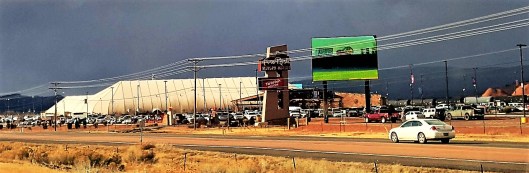
What to make of Indian casinos? I expect a lot of non-natives still don’t quite know how to answer that question. Maybe some Native Americans don’t either. But it’s an interesting question just the same, not the least of reasons being that anyone trying to answer it will have to struggle a bit with the larger questions about the politics of Indian-white relations. Some people handle that better than others of course. I’ve known some folks that seem to think of gambling as a kind of racial entitlement. These same folks don’t seem to think of Las Vegas or Atlantic City as a form of racial entitlement, but all foolishness aside, the topic does raise a number of interesting questions about jurisdiction and the economic impact of gaming in such distinctive communities.

miz3ezrd

The impact of Indian gaming on different tribes isn’t uniform. We’ve all heard the stories of wild success of certain tribes whose members became rich overnight. Most of us have heard speculation about the membership of certain tribes. Our incoming President had some words about Indian casinos back in the day. They weren’t any more thoughtful than the crap he’s spewing now. But of course these wild success stories are hardly typical of the many tribal casinos out there. There have been some disasters, or at least some scandals, as well. I recall once listening to Ron His Horse is Thunder, former Chairman of the Standing Rock Sioux Tribe explain the significance of casinos in his own community. They provided a certain number of jobs, he told us. That was it. No miracle. No disaster. Just a steady livelihood for a certain number of people. That was his experience with Indian gaming. I hope I remember him correctly on this, because I reckon that’s a fairly common account of the issue. But of course all of these stories come with the benefit of hindsight.

It wasn’t too long ago that the entire subject of Indian gaming was uncharted territory, that the mention of reservation casinos raised all sorts of possibilities and few people had any real experience to bring to bear on the issue. It was around that time (the mid 90s) that I arrived in Navajo country. Numerous tribes had casinos at that point. The Navajo Nation was not among them. Some out there wanted casinos. Others didn’t. Folks kept a wary eye on the operations of other tribes, looking for some sign to help assess the prospects for gaming in their own community. In 1997 the Navajo General Council called for a referendum on the prospect of gambling on their lands. It was the second such referendum (a third would follow in 2004). It set the stage for a interesting debate which I followed as best I could.

Today, you can find a few casinos on the borders of the Navajo Nation, but in 1997 the answer was no. In some quarters, it was Hell No. The reasoning still interests me.

gambler10-2-97One of the most fascinating things about the debate over Navajo gambling in 1997 has to do with an aspect of Navajo origin legends. One of the greatest villains in these stories was a character, named Noqoìlpi, The Gambler. You can read more about him by clicking that link I attached to his name, but to put it briefly, this fellow just about wins the world and everyone in it by gambling. Frankly, I think there’s a lesson about the economic effects of modern financialization schemes and the growth of income inequality there in that story (seriously), but I’ll save that for another day. In 1997, the connection drawn by many on the Navajo Nation was a lesson about the evils of opening up casinos on the reservation. Whatever the strengths or weaknesses of this argument, it certainly added a rich layer of meaning to an already interesting subject.

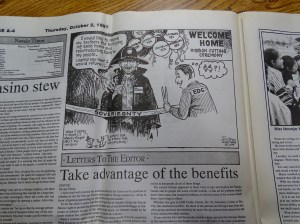
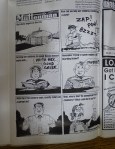
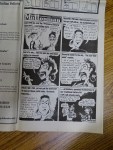
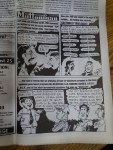
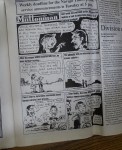
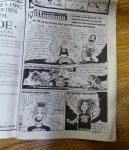
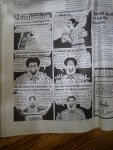
Of those working references to The Gambler into their arguments on the topic of casinos on the Navajo Nation, my favorite was the late Vincent Craig who ran an extended series of Mutton Man cartoons addressing this and several other issues in the Navajo Times. He really blended his own critique of gambling with a broad range of (extremely ironic) social commentary.

It all begins with a culture pill. .

Unfortunately, I don’t think I have copies of all the cartoons he ran on this topic. I don’t know that he got a cartoon in every edition of the Navajo Times, but I definitely have gaps in my own collection. Anyway, I collected enough to get the gist of his argument down. I’ll let Vincent and some of his colleagues tell the story from here.

Vincent Craig’s work (Click to embiggen):

6/5/97
6/26/97
7/10/97

7/17/97
8/7/97
8/14/97

8/21/97
8/28/97
9/4/97

9/11/97
10/9/97
10/23/97

11/13/97
11/30/97
12/4/97

12/11/97

A bit more on the subject, also from the Navajo Times (again, click to embiggen):

8/14/97
8/14/97
11/6/97
11/6/97
7/31/97
7/31/97
10/23/97
10/23/97
10/30/97
10/30/97
10/2/97
10/2/97

Share this:

  • Tweet
  • Share on Tumblr
  • Click to print (Opens in new window) Print
  • Click to email a link to a friend (Opens in new window) Email
  • Click to share on Reddit (Opens in new window) Reddit
Like Loading...

When Culture Appropriates You

04 Wednesday Jan 2017

Posted by danielwalldammit in History, Museums, Native American Themes

≈ 18 Comments

Tags

Art, Diné, Fort Sumner, Hweeldi, indexicality, Mural, Navajo, Shonto Begay, The Long Walk

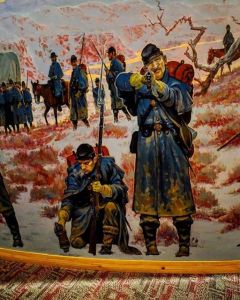
15871703_10211699926478752_5551079935863716489_nTo the left is one of my favorite images from a mural painted by Shonto Begay and Mike Scovel at the Fort Sumner Memorial in New Mexico. What’s to be memorialized at Fort Sumner, you might ask? It was the site of an internment camp, one which held the Navajo people for roughly 4 years (about 1864-1868). It also held Mescalero Apaches, but Begay’s and Scovel’s  mural is about the Navajo end of this story. Specifically, it is about “the long walk” to this place, still called Hwéeldi out in Navajo country.

What fascinates me about the image is a trick of context. It’s just one part of a rather breathtaking piece of art, but to me it’s definitely the most interesting. The larger mural wraps around the wall on both sides of a hallway at the memorial. If you follow the hallway, you come to a small movie theater where you an watch a short film about the long walk and the Navajo experience at Hwéeldi. The images are striking. Devastating. They depict a national disgrace, and in surrounding us with the images, this mural invites us to see that disgrace, not from the standpoint of objective observer, but from the standpoint of someone in the midst of it. Walking down that hallway, one is surrounded on both sides by images of people (Navajos) herded along by soldiers and scouts. The mural depicts a great deal of suffering, and it places that suffering all around us. Begay’s and Scovel’s work denies us the chance to step outside the event and view it as a disinterested party.

But when you come to this image, the immersion takes on a more dramatic significance. Suddenly, it becomes clear why all the solders seem to be facing us. The Navajo figures simply plod along, mostly looking in other directions, but the soldiers, they look right at us as we stand in that hallway.

It’s an interesting effect to begin with, but when you walk down that hallway, at some point that soldier’s rifle is pointed at you. The soldier in that painting doesn’t care who you are, what your ethnicity is. He doesn’t even care what your plans are for later in the day. And as my girlfriend pointed out, his rifle seems to follow your movements a bit, at least for a step or two. (I swear it does!) It’s a rather brilliant move on the part of the artists, because it places his viewers in the scene more effectively than anything else. More than placing the viewers in the scene, it confers a specific role on the viewer, as one of those forced along the walk.

It’s just art of course. We will at some point walk on to other parts of the exhibit, and many of us will no doubt shake off the effect of the image a bit quicker than those whose family histories include stories of those lost along the way. Still it’s an interesting contrast with the many times non-natives have chosen ourselves to assume some aspect of a native identity. Whether playing Indian as school-children, wearing a headdress at some music festival, or aping the Tonto-speak of Indian characters in countless westerns, many of us have done it at one time or another. Hell, some people have made a life out of it! Countless non-Indian actors have played Indians on screen, and countless non-Indian characters have become Indians in the story-arc of a common movie theme. And of course there is the Washington football team! What all of these other examples have in common, is a choice to assume some part of native identity, if only for a moment. They also have in common that the identity assumed creates a positive experience for those choosing it. When we non-natives play at being Indian, we get something out of it. It may not be much, often little more than a momentary source of amusement, but the choice is ours, and when choose it, we do so to our own advantage.

That’s the genius of this particular image. It forces that same transformation on anyone walking through the memorial. For just a moment, it makes us play Indian, and to do so on terms we didn’t choose for ourselves. On terms no-one would choose for themselves! We will survive that moment of course, perhaps even without really learning much from it. Still, it’s an interesting twist in the narrative.

That moment, when the business end of a rifle points you right into the story.

***

Here are a few more images from the mural (click to embiggen)!

15781749_10211678431701396_4152348944393224568_n
dsc03608
dsc03617
dsc03603
dsc03598
dsc03600
dsc03601
15871703_10211699926478752_5551079935863716489_n
dsc03609
dsc03623
dsc03599

Share this:

  • Tweet
  • Share on Tumblr
  • Click to print (Opens in new window) Print
  • Click to email a link to a friend (Opens in new window) Email
  • Click to share on Reddit (Opens in new window) Reddit
Like Loading...

The Difference Between Being Drunk and Being a Drunk

27 Sunday Nov 2016

Posted by danielwalldammit in Native American Themes

≈ 22 Comments

Tags

Acoholism, Alaska, Alcohol, Anchorage, Confirmatin bias, Drinking, Flagstaff, Perception, prejudice

15168788_10211285138429310_1895936641296381200_oI just walked into my hotel. Its almost 3:00am here in Anchorage. I immediately walked into the gift shop and grabbed two sodas, a bag of Cheetos and package of skittles. Perhaps it was my clumsy movements. Perhaps it was the hour. My tunnel-vision stare, perhaps? Either way, I’m sober enough to know the night clerk had me pegged for drunk. He had that particular air of one who is humoring the completely addled for just so long as it takes to get them on their way. Fair enough, I thought. Yes, indeed, I did just close down a bar, and I’m at least 2 sheets (if not 3) to the wind. Perhaps I deserve the condescension.
Fair enough.

I recall once, when I briefly worked at a cabin resort, a particular school teacher used to come and stay with us. She would down a fair bit of wine and then fail to use out one pay-phone correctly. We were in the middle of Oak Creek Canyon, Arizona, and Cell Phones simply didn’t work there, so that pay-phone was her only option. Having been told that the pay-phone wasn’t working, I would ask her what message she received on trying to dial out. If she could remember it accurately, I could tell what the problem was; whether it was her card,  a wrong number, or something else entirely. I knew the messages, and I knew what they meant. What I didn’t know what how to get her to take the message seriously in her state. She would just tell me the card didn’t work. When I asked what the specific wording of the message had been, she would look at me, weaving a little, and say; “It says it didn’t work.” In the end I let her use the house phone, because I just couldn’t unscramble the problem she had without her at least telling me what the message had been. I could clearly see that she thought me an illiterate ass for asking her questions she thought she had already answered. I, for my own part, wondered if should would even understand me when she was sober.

Mutual contempt is a mutal solace, I suppose.

Anyway, I reckon I thought about her much as the man at the hotel desk must have thought about me.

But I’m not just a drunkard! I’m so much more!

So, must many people have thought to themselves as they were treated as just another drunk by someone somewhere. It’s easy to consider yourself worth more than your own slurred speech and your blurred vision, but it’s a bit more difficult to think of a complete stranger who is clearly exhibiting such conditions as anything more than the sum total of his drunken idiocies.

It’s an odd thing. Those of us that do drink are bound to drink to excess at some point in our lives. And drinking in excess, none of us are particularly dignified. Yet some get pass, and others don’t. What makes the difference?

I can think of nights playing beer frizbee in grad school, vomitting in the sink of the basement beneath my friends apartment complex. Or was that another friend that did that? I don’t remember really. It’s been 20+ years and quite a few amber ale’s since that night. Still everyone was a friend there that morning. We were drunk, yes, but we were human. We saw each other home and we called to make sure everyone was okay the next day. We would never have mistaken each other for mere drunks.

My Dad drank a glass or three of Christian Brothers’ Brandy every night since pretty much the age at which I was old enough to notice (Okay, sometimes it was E&J). I never thought of him as a drunk, net even the night that he drove home at the wee hours of the morning and sat in the car inexplicably as I waited for him to come in. I finally went out to find him crying. He’d blown a bit more on the slot machines than either he or Mom normally allowed themselves to do that evening, and it bothered him a great deal. “I think I’m an alcoholic,” he said. I could hardly believe my ears. It was a couple hundred dollars he’d lost that night, hardly enough to blow the mortgage, but Dad was genuinely disturbed by the night’s events. That he’d driven home was another cause for concern, but I never could tell just how far under the influence he had been that night. Perhaps I didn’t want to. I can still count on one hand the number of times I thought my father was actually drunk, and I never thought of him as a drunk, but that night he called it himself. Perhaps, the nightly brandy mattered more than any of us thought it did.

…at least until the next day when the conversation that night was simply forgotten.

Whatever the damage done to our bank accounts, father had worked out a solution. Whatever had frightened him about his own drinking, he had worked out a solution to that too. He was prepared to face the day squarely, and I saw none of the doubt from the night before. I think I talked to him about it, but I don’t remember the details of the conversation. I suspect I was all too happy to find my way past the memory of that night. In fact, I don’t think I ever saw him drunk again.

Though I certainly did see the brandy. Just a glass or two every night.

If I cut my father an ounce of slack, I certainly didn’t cut that same slack for my neighbor. She too had a glass of something on the rocks every night after work. I recall her telling me about how her ex-husband stank of alcohol even when he was sober. She added this to the list of complaints about his abusiveness and general worthlessness. She told me all of this as she drank her own nightly glass of hard liquor, and you bet your ass I noticed. I thought of her as a worthless drunk, someone who buried herself in a glass every night.

Harsh, I know.

A double standard, I also  know.

I knew my father. I knew his goals and his values as well as his frustrations, and I knew his weaknesses as anyone who has ever loved another knew them of those they loved. Falling down drunk, he would always be the man I most admired in life. Of my neighbor, I knew mostly frustrations. I knew her to be a pain in the ass at best and a complete fuck-up at worst. I of course knew this mostly from the talk of my parents, and from my own encounters with her. It was easy to think of her as a mere drunk

I also knew that she had a Masters Degree in Archaeology, that she had raised two daughters despite an ugly divorce and who knows what else the woman had dealt with in her life. I think about that now and realize I should probably have found my way to giving her a little more credit than I did at the time. That she was capable of serious study was a mystery to me, and I never saw any of her struggles with a trace of empathy. She would always be a drunk to my eyes, even if she were sober, and my father never would be, not even when he was in fact quite drunk.

So what makes the difference between a drunk and a person?

I reckon that’s a good deal of the distinction itself, knowing the person in the first place, or at least having enough in common to imagine the person in the first place. Without that, it’s all too easy to think of someone who is actually drunk as someone whose drunkenness is a fairly complete personal account.

My neighbor in Fort Defiance always struck me as a drunk. I could recount the many irritations he inflicted upon me during my time on the Navajo Nation, not the least of them being his threats one afternoon to burn down the house with me in it. I learned of these the next day when his brother forced him to apologize to me. All I had noticed was that he was shouting something at me from outside. I had already written him off that day. Didn’t even realize the drama that was unfolding out there.

That same neighbor once told me that he was going to hitchhike to Flagstaff and get a job. This was well into the morning. He had awoken me on a work night, quite drunk and very depressed, and somewhere in the midst of telling me all his woes, this neighbor announced his great plan for turning his life around. I can’t remember what I said, but apparently I did express some doubt. He was quite offended. Asked what I meant by that,I felt fairly flat-footed for a moment. I fished around in my brain and finally came up with one thing which while very true was not nearly as judgemental as the thought that probably led to the comment in the first place. I knew that strategy wouldn’t have worked for me. I wouldn’t be able to just hitchhike into a town, totally broke, and land a job just like that. So, I said so. My neighbor was happy with that response. He took it as a sign of respect, and in a sense it was, albeit one which was quite consistent with the disrespect that had triggered my skeptical comment to begin with.

I did notice that he never actually hitch-hiked into Flagstaff and got a job.

Neither did I.

Not like that anyway.

I always thought of that neighbor as a drunk. I knew him to be a person, even cared about him, I suppose, but I never quite shook the sense that his life had been claimed by liquor. That neighbor used to sober up from time to time, and then he’d REALLY be a pain the ass. Mostly, he’d need a ride to work, because when he was sober he would inevitably get a job. When his brother (who lived next door) stopped giving him rides, the man would turn to me. I remember one summer, I would return from an effectively 16 hour day, starving, with a couple chapters yet to read so I could teach the next day and sure enough he wanted a ride to work. Oh how I wished his brother would give him a ride.

…or that he would go back to being a drunk.

Now there is a damning thought!

But I had it just the same.

And sadly, that wish did come true.

Damn me anyhow for wishing it!

Years later, I lived in Flagstaff. I used to go to a bar named Charlie’s once every week or two, mostly to watch a bluegrass band named Second Harvest. Loved their music! A friend of a friend once sneered at the place, describing it as a gay bar. I always figured it was a place where gay people would be welcomed, but not so much a dedicated gay bar. Just the same, it was my drinking establishment of choice.

I recall one night watching as a brand-new security guy glowered at two men dancing together. It was a spectacular display. Not them. HIM. The look on his face was one of utter contempt. I could just imagine him thinking of reasons to eject them, reasons he never quite acted upon. He did, however, find cause to eject one elderly Navajo man, an individual who though quite drunk had been sitting harmlessly in a corner. As the ‘drunk’ was escorted out and onto the street, I couldn’t help but wonder at the numerous college students boisterously enjoying their own states of inebriation throughout the bar. Some of them were even native, but they were dressed as college kids. They fit, so to speak. Many of those still in the bar were well past the drunkenness of the man put outside, but they were young and they were middle class.

They weren’t drunks. They were just drunk.

He was a drunk, at least as far as security was concerned that night.

They would probably think of him the same way if he had been sober.

Years earlier, I had already encountered that same privilege one weekend when I was doing research in Farmington, New Mexico. I came out of an Arby’s one afternoon to find an empty six-pack of beer in the back of my ‘tribee’ (tribal vehicle). It was a good thing I noticed before someone else did, but I couldn’t help wondering at the thought process of whoever put it there. Did he think he was going to get a Navajo in trouble? Would he have done it had he realized it was a white guy driving the truck? Or maybe it was someone who noticed the white driver, and thought to generate some trouble for the guy clearly out of place. I believe this was the same weekend a waitress invited me to a bar. She made a point to tell me it was where “our kind of people” hung out. I still wonder if she would have invited me had she knew where I lived, where I worked, or what kind of vehicle I was driving?

On a side note, I once walked into a random bar in Farmington. It was a short walk from my hotel, so I thought I’d skip over and drink a beer or three before going back for the evening. No sooner than I entered when I realized I was the only white guy in there, and several people where staring at me in not so friendly ways. Had I been with someone it would have been different. I would still have been a white guy, yes, but I would have been their white guy. I’d done that once or twice before. It works. In this instance I was alone and feeling very much like an intruder at that particular moment. What was I to do? Try to tell people I’m one of the good guys? Hell, I wouldn’t have listened to me. Why should they?  I also figured if I turned around and headed out immediately that would set off all kinds of red flags. If I stayed too long I figured someone would cause trouble. Maybe I could talk my way out of it; maybe I couldn’t. So, I sat down and ordered one beer.I drank it and left. As I headed out, I could swear I saw the bartender nodding, as if to tell me I played that one right.

Okay, that last story is probably all manner of confirmation bias, but anyway, that’s how I felt at the time. And I’m still feeling a little buzzed, so I’m leaving it on the page, against my better judgement of course.

My better judgement begins on the other end of a long sleep.

I lived briefly on the south-side of Chicago. By briefly, I mean 3 years, minus the summers. In any event, it was long enough to begin to recognize some of the homeless people in the area. Maybe it was my long hair but one fellow always insisted on trying to sell me incense. I bought a pack. (Think I gave it to a friend of mine.) It should come as no surprise of course  that many of these people appeared quite often to be under the influence of something or other. It would be easy to think of them as mere drunks.

One moment stands out particularly in my mind. Some young men in their twenties were talking to one of the homeless individuals. This one was often very drunk. In fact, he was often incapable even of asking for change. When he was that far into his liquor, the man would simply hold out his hand and groan, or mumble something he might have thought of as speech but which no-one but him could really parse. Anyway, the young men, were chatting and laughing. It was almost friendly, but not quite.

One of the young men asked quite loudly; “Do you remember me?”

Swaying a bit, the man slurred out a ‘yes’.

“Who am I.”

His answer? “YOU!”

Now THAT was a mike drop if I ever saw one.

So, what do all these stories add up to? Hell, they probably add up to porridge as far as I can tell. I’ve been drinking. Remember! But if I may take a moment to try and sense the make of the matter, I would guess they start with one obvious fact that drinking begets all manner of foolishness. All manner of terrible things happen once people start tipping those damned bottles. I’m fortunate enough to be one of those people who can stop after 2 or 3 beers and simply call it a night (many can’t), else I might have a lot more interesting stories.

…or perhaps others would have the stories about me.

More to the point, I’m often struck by the perception of drunkenness. Where drunken behavior is concerned, we can tolerate an awful lot from our own kind, however we choose to identify them. Strangers get far less patience. Cross a few social boundaries and the benefit of the doubt wears thin very quickly. Often as not, race and class can provide all the boundary one needs to think of someone not just as a drunk person but as nothing but a drunk, someone whose total value as a human being can be summed up in their smell, their slurred speech, and in whatever other foolishness they have brought with them.

Sometimes, you don’t even need that kind of boundary.

A few hours ago, I sat next to a man about my age, my ethnicity, and near as I can tell about the same economic status as my own. He was eating soup and struggling to get his head under control while the house band at Humpy’s played its last tune of the night. He was chatting quite a bit, though I couldn’t make any sense of it. Nobody else was in ear-shot. I still don’t know is he meant to be talking to me, or if he was talking to an old love, an imaginary adversary, or perhaps even his own guardian angel. Either way I thought of the man as a drunk. He was a bit further into his cups than me, to be sure, but I don’t figure that quite explains the distinction. To me, meeting the man under such circumstances, he was simply a drunk, no more and no less. I on the other hand was just drunk, and there was a difference.

At least until I hit the hotel desk.


Share this:

  • Tweet
  • Share on Tumblr
  • Click to print (Opens in new window) Print
  • Click to email a link to a friend (Opens in new window) Email
  • Click to share on Reddit (Opens in new window) Reddit
Like Loading...

De-Ontologizing a Bear

16 Sunday Oct 2016

Posted by danielwalldammit in Alaska, Animals, Bad Photography, Native American Themes

≈ 16 Comments

Tags

Alaska, Alaska Natives, Anthropology, Food, Hunting, Native Americans, Photography, Travel, Wildlife

student

Still Ontological, I Believe

As I recall, the picture was a selfie. My student was one of many people who come up here from the lower 48 to teach somewhere in the K-12 system. She was taking a course from me to help satisfy her certification requirements to remain in the state system.

…And there she stood in the picture with a polar bear walking along the beach in the background behind her. No, she wasn’t that close. She was fine, but really, it was a fantastic picture. I could imagine her showing it to people and chattering on about it for years to come. I was happy for her, and just a little jealous, but mostly happy for her. It had to have been a cool moment.

…which is what I said.

To my surprise, a frown immediately captured her face and her shoulders slumped as she looked down. For all the coolness of the pic, it was evidently not part of a happy story. She struggled to explain why. It turns out that someone shot the bear mere moments after she had posed for the picture.

No, this is not a story of criminal activity, at least not that I’m aware of. The hunter was an Alaska Native, and yes, they are allowed to take polar bears for subsistence activities. Still, I couldn’t help but feel for the student in this instance. To see a bear go from shared space in a selfie to dead on the beach in a matter of moments must have generated a kind of moral whiplash.

(Clunky metaphor, I know.)

I can’t help thinking the sudden transformation of the bear from a living breathing subject that one might want to share space with in a selfie to a dead animal must have been a bit shocking. I suspect the issue here is more than the sudden death of the bear; it’s this sudden change in the way circumstances invite her to think about him. One minute, she was celebrating the presence of the bear, and the next it was no longer a presence to be celebrated.

Is a bear fit for a selfie? Or is it fit to eat (and perhaps to wear)? You can answer both of these questions with a ‘yes’, but it may be a little disturbing when both answers play out at the same time and in the same place, and most particularly, with the same bear.

I thought about this over the last week or two as a polar bear had been hanging out near the college where I work for several days. Wildlife had to shoo him off a couple times. For those of us at the college, he was both a source of excitement and at least a trace of anxiety. More than a few of us grabbed our cameras, but even as we took pictures, several wondered if he wasn’t a little too close. He wasn’t so close as to generate immediate alarm, but he was close enough to make us all a little more careful as we went outside. In time, we began to worry about his own fate as well. If he didn’t move on soon, would officials end up shooting him?

I don’t know what happened to the bear. I have some ideas as to why he was here, and I believe he moved on eventually, but I don’t know this for a fact. For the present, the possibility itself, that he could have been shot is the interesting point. What would it mean to me, I wondered, if the bear in these pictures had been killed within days (or perhaps hours) of my taking them? It isn’t simply the possibility that he might die on his own. Hell, cycles of life and all that! No, the point is that a picture of a bear that might be killed because he is close enough to take pictures of him makes for something of an ironic photo subject.

The whole thing reminds me of the old bit from Marshall Sahlins on how you tell the difference between an animal you can’t eat and one that you can. Perhaps, I think, taking a picture with a bear is a bit like giving it a name. It’s one way of imparting a sense of personhood to the creature, one way of making it part of the world of lives about which you have some fucks to give. This is especially true if you hope to tell tales of the creature at some later date. I suppose it depends a bit on the picture, just how much the taking of a picture actually imparts meaning to its subject, but a selfie with a bear is probably on the maximum end of the personalizing spectrum. (We put ourselves in pictures with people and creatures, we like, not usually those who loathe or simply don’t care about.) At the other end of this spectrum, I guess we’d have to count most of the pictures taken by trophy hunters over a fresh kill. If trophy pictures impart meaning to the animal, I can’t help thinking it’s one of conquest. In contrast, I reckon most of those taking a picture of a bear want to talk (and think) about their encounter with an exotic living creature. They might want to think of him, for a time at least, as alive and well and going about his business long after the picture-taking two-legged has found its way to warmer homes and (hopefully) eager ears. At the very least, such stories are compromised by the thought that the very encounter that produced an image of the creature in question could also have reduced it to meat headed for the dinner table.

Good to eat and good to selfie, but not at the same time.

So, if the camera ensouls an animal, so to speak, the gun would seem to do just the opposite, at least for some people. Beyond the actual act of killing an animal, the willingness to do so would seem to transform an animal into something less than personal; it shifts from an end in itself to a means of sustenance.

Or does it?

Certainly not for indigenous hunters. If anything, their own traditions are saturated with motifs attributing personhood to animals. Whalers up here consistently speak of the bowhead as giving themselves to the hunters voluntarily, and similar themes can be found in hunting traditions of indigenous peoples around the world. For example, the oral traditions of hunting peoples often contain references to a time when animals spoke as humans do. As often as not, the loss of this quality in such stories will occur by choice, and as often as not that choice is motivated by the needs of human hunters. In some stories, animals may still take human form under designated circumstances. The upshot is a world in which role of animal and hunter is the conscious decision of persons who must be respected if the relationship is to continue.

But I don’t think the notion of hunting as a respectful enterprise is entirely limited to indigenous traditions, or indigenous people in general. Talk of respect is quite common among hunters, all the more so for those who do so as a means of feeding themselves. Animal rights activists may well dismiss this as convenient rhetoric, but the lives of subsistence hunters are far more intimately involved with the cycles of nature and the lives of animals than those of your modern citizen. There is little reason to believe those who invest a significant portion of their thought and their activities on the animal world come away from this with little but a utilitarian sense of those animals. It might be different for commercial hunters, and likewise for a certain scale of commercial farmer, but the people I know up here who feed themselves from the ducks, the geese, the caribou, and yes, the whale, live lives fairly filled  with thoughts about these creatures.

Which brings me back to the shock that shock of becoming an unqitting witness to the harvest of an animal. I reckon, it must be a bit more unsettling to those who’ve never participated in such activities. Folks may know that their beef was once a cow; their bacon was once a pig, and their chicken was once, …um, a chicken, but most have never witnessed (much less contributed to) the process by which the one becomes the other. For the average consumer of market meats, the consumption of animals is easily imagined as an entirely objective process. Vegetarians may escape this tangle of dissonance, but a fair number of those uncomfortable with hunting are fairly caught right up in it. Their discomfort is at least partly a function of seeing (or thinking about) a process which normally occurs out of sight, but which is absolutely essentially to their own sustenance. In contrast, participating in single hunt can be a lasting reminder that the food on your table was once alive. I’m not saying, everyone draws this lesson, but I certainly did (it’s been a log time), and I believe I see similar views in those around me now.

…all of which means, ironically enough, that shooting an animal may not equate to depersonalization after all, at least not for everyone. I reckon, it will always be a bit shocking for those unaccustomed to such activities, and it would be that much more so for anyone unfortunate enough to be sharing a selfie moment with a creature just before seeing it go down, but the real difference in worldview may be less a question of those who appreciate the lives of animals and those who don’t so much as a question of those who remember their own lives come at the expense of others and those for whom that connection is fuzzy at best.

The bear, from a couple weeks back (click to embiggen). He is, I believe, still alive. I’m sorry the pictures aren’t that great. I of course wanted to stay much closer to a door than he was to me.

polar-bear
sleepy-bear
student
bearagain

Share this:

  • Tweet
  • Share on Tumblr
  • Click to print (Opens in new window) Print
  • Click to email a link to a friend (Opens in new window) Email
  • Click to share on Reddit (Opens in new window) Reddit
Like Loading...
← Older posts
Newer posts →

Top Posts & Pages

  • I'll Just Leave This Here
    I'll Just Leave This Here
  • Movie Review: The Orator
    Movie Review: The Orator
  • An Uncommon Security Guard: Dave Eshelman, AKA 'John Wayne'
    An Uncommon Security Guard: Dave Eshelman, AKA 'John Wayne'
  • Hostiles and Spoilers: A Magic Studi
    Hostiles and Spoilers: A Magic Studi
  • A Joke from a Bygone Era
    A Joke from a Bygone Era
  • An Ironic Beating
    An Ironic Beating
  • An American Flag as a Weapon, Redux.
    An American Flag as a Weapon, Redux.
  • An Irritation Meditation: The Majority Rules Meme
    An Irritation Meditation: The Majority Rules Meme

Topics

  • Alaska
  • Animals
  • Anthropology
  • atheism
  • Bad Photography
  • Books
  • Childhood
  • Education
  • Gaming
  • General
  • History
  • Irritation Meditation
  • Justice
  • Las Vegas
  • Minis
  • Movie Villainy
  • Movies
  • Museums
  • Music
  • Narrative VIolence
  • Native American Themes
  • Philosophy
  • Politics
  • Public History
  • Re-Creations
  • Religion
  • Street Art
  • The Bullet Point Mind
  • Travel
  • Uncategorized
  • Uncommonday
  • White Indians
  • Write Drunk, Edit Stoned

Blogroll

  • American Creation
  • An Historian Goes to the Movies
  • Aunt Phil's Trunk
  • Bob's Blog
  • Dr. Gerald Stein
  • Hinterlogics
  • Ignorance WIthout Arrogance
  • Im-North
  • Insta-North
  • Just a Girl from Homer
  • Multo (Ghost)
  • Native America
  • Norbert Haupt
  • Northwest History
  • Northy Pins
  • Northy-Tok
  • Nunawhaa
  • Religion in American History
  • The History Blog
  • The History Chicks
  • What Do I Know?

Archives

  • December 2023
  • November 2023
  • June 2023
  • April 2023
  • February 2023
  • December 2022
  • November 2022
  • October 2022
  • September 2022
  • August 2022
  • July 2022
  • June 2022
  • April 2022
  • January 2022
  • December 2021
  • November 2021
  • October 2021
  • September 2021
  • August 2021
  • June 2021
  • May 2021
  • March 2021
  • February 2021
  • January 2021
  • December 2020
  • November 2020
  • October 2020
  • September 2020
  • June 2020
  • May 2020
  • March 2020
  • February 2020
  • January 2020
  • December 2019
  • November 2019
  • September 2019
  • August 2019
  • July 2019
  • June 2019
  • May 2019
  • April 2019
  • January 2019
  • December 2018
  • November 2018
  • October 2018
  • September 2018
  • August 2018
  • July 2018
  • June 2018
  • May 2018
  • April 2018
  • March 2018
  • February 2018
  • January 2018
  • December 2017
  • November 2017
  • October 2017
  • September 2017
  • August 2017
  • July 2017
  • June 2017
  • May 2017
  • April 2017
  • March 2017
  • January 2017
  • December 2016
  • November 2016
  • October 2016
  • September 2016
  • August 2016
  • July 2016
  • June 2016
  • May 2016
  • April 2016
  • March 2016
  • February 2016
  • January 2016
  • December 2015
  • November 2015
  • October 2015
  • September 2015
  • August 2015
  • July 2015
  • June 2015
  • May 2015
  • April 2015
  • March 2015
  • January 2015
  • December 2014
  • November 2014
  • October 2014
  • July 2014
  • June 2014
  • May 2014
  • April 2014
  • March 2014
  • February 2014
  • January 2014
  • December 2013
  • November 2013
  • October 2013
  • September 2013
  • August 2013
  • July 2013
  • June 2013
  • May 2013
  • April 2013
  • March 2013
  • February 2013
  • January 2013
  • December 2012
  • November 2012
  • October 2012
  • September 2012
  • August 2012
  • July 2012
  • June 2012
  • May 2012
  • April 2012
  • March 2012
  • January 2012
  • December 2011
  • November 2011
  • October 2011

My Twitter Feed

Follow @Brimshack

RSS Feed

  • RSS - Posts
  • RSS - Comments

Enter your email address to follow this blog and receive notifications of new posts by email.

Join 8,075 other subscribers

Blog at WordPress.com.

  • Subscribe Subscribed
    • northierthanthou
    • Join 8,075 other subscribers
    • Already have a WordPress.com account? Log in now.
    • northierthanthou
    • Subscribe Subscribed
    • Sign up
    • Log in
    • Report this content
    • View site in Reader
    • Manage subscriptions
    • Collapse this bar
 

Loading Comments...
 

    %d