• About

northierthanthou

northierthanthou

Category Archives: Native American Themes

This is where I talk about Native American themes. No, I’m not Native; I’m just your generic white guy. That said, I have lived and worked in indigenous communities for a significant portion of my life, so I have a few thoughts on the subject. Whether or not they are worth considering depends on who you ask.

Thoughts on the Cherokee Blood-Feud, or Anthropology is Only Fun Till Someone Puts an Eye Out!

26 Friday Apr 2013

Posted by danielwalldammit in Anthropology, Education, History, Native American Themes

≈ 22 Comments

Tags

Blood Feud, Cherokee, Collectivism, Conflict Resolution, Ethnography, History, Justice, Navajo, War

Three Cherokee

Three Cherokee

…and of course that is when it gets really interesting.

By poking an eye out, I am of course talking about a special sort of moment one gets from time to time in the study of anthropology, at least I do. It’s the sort of moment when some cultural practice causes the hair on the back of your neck stand up and your stomach tries to dig its way to China (or Antarctica, as would be the case here in Barrow). I’m talking about that kind of moment when you encounter something in an ethnography that just seems like too much. So, you sit there and ask yourself, “How in the Hell could that be anything but wrong?” And for a little while anyway, your mind just doesn’t want to travel down that road, the one that leads to understanding the practice in its own context. You’d rather just say ‘no’. Hell, you’d rather shout it at them across the waters, over the mountains, and even if need be through the ages, cause someone needs to say it somehow, “This is just wrong!”

For the students in one of my classes this semester that moment came courtesy of the Cherokee blood feud, and the sticking point was very clearly collective responsibility for murder. Simply put, the feud enabled the clan of a murdered individual to claim revenge against any member of the clan to which the offending party belonged. More than that, the terms of this blood feud obligate people to do so.

But I said ‘murdered’ didn’t I?
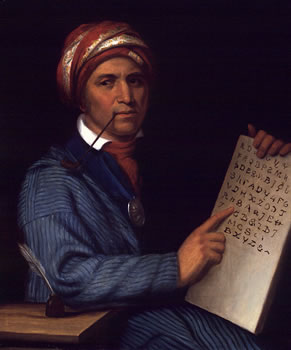
Sequoyah

Sequoyah

That’s not quite right. In the old way, any individual responsible for killing another Cherokee could initiate the obligation to exact revenge, even if the killing was an accident. As our reading described it, a horse borrowed for the day could start trouble by bucking its rider off, thus triggering a feud between the clan of its owner and that of the deceased rider. So pretending for this paragraph anyway that I am Cherokee – I’m not, …not even the ubiquitous Cherokee grandmother every other white guy seems to have been blessed with – but let’s just pretend for a moment. If my brother’s horse spooks and kills a rider, I could be killed in revenge for this event. They do not need to take the offending party (if there even is such a person in this example); they might prefer to kill a different member of my brother’s clan (someone like ME, perhaps). So, I could die because of something my brother did, …even if that was an accident. The article we read even contained an instance in which a killer talked the avenging parties into killing someone else from his own clan.

And yes, this bothered my students. I can’t really blame them, because I can remember my own feelings years ago as I came to grips with this kind of dispute-system. It violates my sense of justice too, or at least the master metaphors through which I and my students typically process this kind of information.

But it’s worse than that!

You see, the point here isn’t merely that people do this, but that this system is actually normative. In a certain time and place, according to a certain cultural order, this is what was SUPPOSED to happen. This is what’s right, at least as the Cherokee once defined it, and that proved more than a little disturbing to my students this semester.

Proper verdicts thunder!

Proper verdicts thunder!

I’m inclined to think the sticking point is an intuitive sense that guilt is an individual responsibility, at least for myself and the students in my classroom last week. Guilt is the medium through which we seem to want to look at deviant behavior, and that concept does not seem to want to travel in large groups; it resides in the soul of a single individual.

Heh, …I said soul, didn’t I?

It is perhaps part of the legacy of historical Christianity under which all moral failings could at one time be construed as defiance of the Lord. Whether one had committed murder, taken to drink, or charged interest on a loan, all of these crimes and others were testimony to personal defiance of the Lord. And of course, much like Santa Clause, He would know!

I’m inclined to think the projection of an omniscient judge and jury played an important role in shaping the concepts of guilt so familiar to people today. One can even see a trace of this mythic imaginary in secularized notions such as crimes against the state (or against society as a whole). Guilt is personal, it is absolute, and it obtains even when the social facts proceed on without taking notice of it. Even the medicalized notions of deviance stemming from the mid to late twentieth-century seem to be largely focused on the individual. The insanity defense is about the capacity of an individual to grasp right or wrong, and it is one individual after another whose failures in life can be described as due to this or that syndrome. When we withhold the pronouncement of guilt on an individual, it is rather often to pronounce sickness upon him instead. Either way, we do not typically assign counseling as a condition of probation for all the members of his extended family.

In short, we care who dunnit. We really care!

Adam and Eve Hide from God

Adam and Eve Hide from God

That of course has less to do with anything inherently wrong with clan-based blood-feuds than it does the cultural logic of western traditions. What pokes my students and I in the eye as we study this custom has less to do with has less to do with Cherokee society than our moral sensibilities. We just can’t fit their approach into our own world, not without feeling a little violated when doing it.

I’ve learned to regard that feeling as evidence that I have just found something worth studying. For some of my students, the problem was collective responsibility, but the real irony here is that we are not really strangers to collective responsibility. Not by a long shot.

It probably won’t help matters much to mention gangs in this regard, though the logic of a gang hit is certainly comparable in some respects (one needn’t get the original culprit, just one of his home-boys). But of course gang members are hardly the only people in modern America to engage in disputation at the level of collective responsibility. We may have fought a war against Saddam Hussein, but in real-world terms that meant killing a lot of Iraqis. The same can be said of the Taliban whose principal cause of war appears to have been sheltering Bin Laden. The story will not change much for any given war; war is by definition a conflict between collective entities. Either way someone is dying because of what some other bastard did, and folks may be sad about it, we might even make a regretful movie or sing a sad song about it, but such is war.
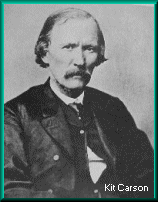
kcarson2In some cases the absurdity of this collective logic creeps through the practice of war more than others. When I used to teach Navajo history, I used to despair that the first of my two textbooks spent far too much time detailing a pattern of raid and retribution between Navajos and the Spanish. Time and again, the book would describe a raid conducted by Navajos followed by a punitive expedition carried out by the Spanish. It’s a pattern that continued clear up through the Mexican period in the Southwest, and further still into the early years of American occupation. And in all these punitive actions, no-one seems to have bothered to ask if the Navajo communities bearing the brunt of the attack had much to do with those who had been doing the raiding. Collective responsibility was simply assumed.

It should be added that Navajos seem to have taken the brunt of the blame for a pattern of raiding that was fairly ubiquitous in the Southwest. They were certainly not the only group conducting such raids, but that is a gripe for another day.
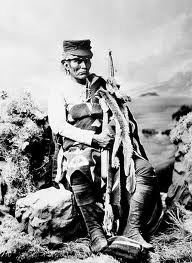
imagesFor their own part Navajos developed an oral tradition describing a very different allocation of responsibility to the specific raiding parties, viewed as irresponsible young men bringing trouble to their own people. This point becomes that much more clear in the wake of the Long Walk and internment at Fort Sumner. This event marks the nadir of most stories about Navajo history, it is story in which Kit Carson ’rounded up’ the vast majority of the Navajo people and took them to a small reservation in Southeastern New Mexico. The next four years (1864-68) were difficult to say the least for Navajos and damned expensive for the U.S. government. In the end they were allowed to return home.
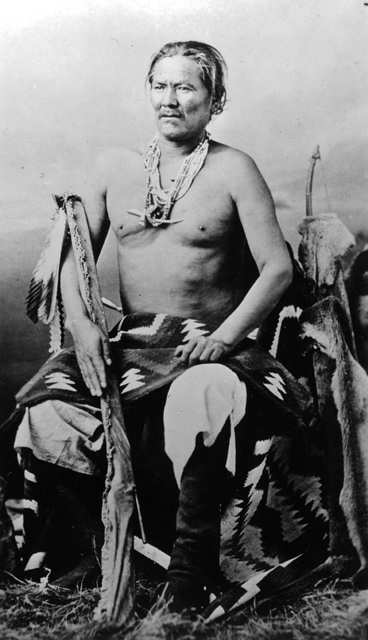
ManuelitoSome have defended Carson’s actions on the grounds that it had at least ended the raiding patterns of the past centuries. What these historians consistently missed was that the raiding patterns continued in the years after fort Sumner. After Fort Sumner, a raid brought Federal troops who went straight to the Navajo police under the leadership of Ganado Mucho or Manuelito. The Navajo police then brought back whatever livestock had been stolen. Before Fort Sumner a Navajo raid was an act of war with collective responsibility applying to the Navajo people as a whole; after Fort Sumner it was a criminal act, the responsibility for which fell on individual shoulders. The difference that makes this distinction had less to do with actions than understandings.

…and in this case that was all the difference in the world.

Perhaps the logic of warfare is too remote for the majority of us in modern America, but there is one respect in which the notion of collective responsibility is absolutely a part of our every day lives, the business of corporations. As some would describe it, the very point of forming a corporation is to re-allocate responsibility for the actions associated with a business concern. Once a source of great controversy, the existence of these collective entities in American business (and that of the world at large) is easily accepted as an accomplished fact.

It is just the way the world works, so common wisdom would have it. We accept that we will not get to talk to the bastard (or bastards) at Bank of America, Wells Fargo, or any other major bank who decided they could reorder your checks from the biggest to the smallest in the event of an overdraft and charge extra fees in the process. We accept that the poor agent who answers our call will be the one to hear whatever we have to say about such an outrage. We accept that CEOs in charge of failing corporations may travel freely on to the next chapter in their bright shining futures, leaving countless lives ruined in their wake. And we accept that (with rare exceptions) lives lost or immiserated by corporations will never result in punishment of those specifically responsible for polluting this river or putting that firebomb of a vehicle on the market.
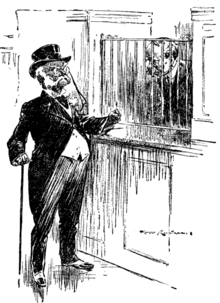
"I warn you, Sir! The discourtesy of this bank is beyond all limits. One word more and I — I withdraw my overdraft!"

“I warn you, Sir! The discourtesy of this bank is beyond all limits. One word more and I — I withdraw my overdraft!”

Of course, there are circumstances in which charges of criminal fraud or negligence may occur, but this would seem to be the rare exception (except perhaps in Island where they actually have the balls to hold white collar criminals accountable for wrecking a national economy) Under normal circumstances, these giant entities screw customers and maim communities with impunity, and there is little one can do about it. The most one might hope to see in the way of justice from such practices will take the form of financial compensation from a corporate entity, the loss shared out through its stock-holders. Those directly responsible for terrible decisions will in most cases never see any significant retribution for the harm they cause to others.

…and the more I think about it, the more this one starts to feel like another poke in the eye.

If collective responsibility is the sticking point in accepting the justice of a clan-based feud system, it is not because collective responsibility escapes us, or perhaps it is because it escapes us when we actually use such an approach in our own lives. The real question is just why do we allow for collective responsibility in warfare and corporate business activities while insisting on individual responsibility for ‘crimes’? I and my students didn’t follow this question, because of course that wasn’t the task at hand, but it’s the sort of thing I hope will hang in their minds long after they have hit send on their final papers. If it’s done right, a good anthropology course should leave students with more than a collection of facts about other people in other times and places, it should also leave them with a new sense of the communities in which they themselves live.

The cognitive poke in the eye is on the house.

***

Three Cherokee are from here. The image of Sequoyah is from the Smithsonian Institution. The image of Kit Carson is from the Kit Carson Museum. Ganado Mucho comes from Navajo People.org. Adam and Eve hiding from God comes from an old engraving by Julius Schnorr von Carolsfeld. I got it from istockphoto. Manuelito comes from a class at ASU. The gavel is from Sara Marberry’s Blog. The Bank Cartoon comes origonally from an entry of Punch Magazine published in 1917, but I got it from Wikipedia.

71.271549 -156.751450

Share this:

  • Tweet
  • Share on Tumblr
  • Click to print (Opens in new window) Print
  • Click to email a link to a friend (Opens in new window) Email
  • Click to share on Reddit (Opens in new window) Reddit
Like Loading...

Indians Through the Eyes of A White Kid: In Which I Wax Nostalgic and Feel Slightly Awkward About the Whole Thing

28 Sunday Oct 2012

Posted by danielwalldammit in Childhood, Native American Themes

≈ 28 Comments

Tags

Childhood, Colorado, Comanche, Indian, Monkey Bars, Native American, Navajo, Pueblo, Stereotype

Having spent most of my career working with Native Americans (and more recently,  Alaska Natives), I’ve often had cause to reflect on the differences between the people I have met as an adult and the ideas circulating about them in the public imagination. Often I find myself thinking about notions of Indian-ness I learned when I was little. What were Indians to me as a child? And how did I arrive at those notions? I don’t know if there is any special insight to be gained here, but I seem to think with a keyboard, so anyway…

What do I remember?

***

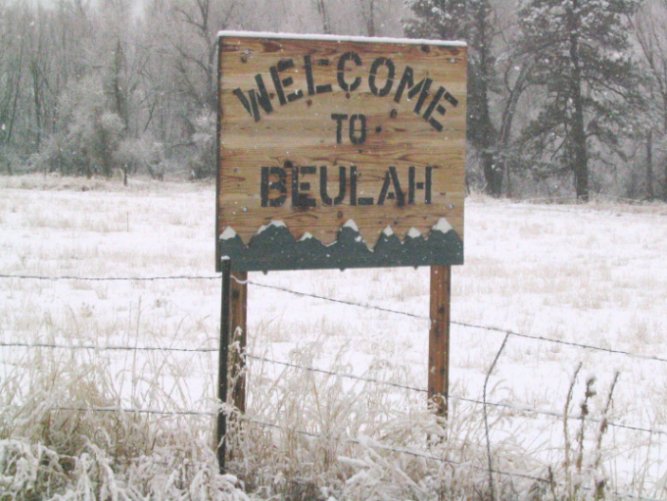
Beulah, CO

I certainly remember cowboys and Indians on the playground in a small school in Southern Colorado. That and army were all I wanted to play (or tackle football – at least until it dawned on me that I sucked at sports). I remember that playing the Indian was somewhat of a social obligation on our playground, because they had to die more than the cowboys; it was expected. You had to take your turn out there storming the monkey bars which served as a fortress from which the playground cowboys picked off playground Indians with relative ease. As I didn’t mind dying on the playground, I did this more than most of my classmates, except for Joe, (I think that was his name). Joe claimed some Arapaho ancestry. He was happy to play an Indian. I don’t remember whether died more than the cowboys, but I sort of hope he didn’t.

A part of me suspects Joe eventually found something else to do on the playground.

Monkey Bars

I must admit that I got frustrated, because certain folks (like …ahem, Scotty and Paul) never seemed to take their turn as an Indian, and they never, NEVER, died when you shot them with an arrow, not even when you snuck-up close on them and got ’em right in the heart.

Cheaters!

***

I recall a number of class projects. Whether it was kindergarten or first grade, I can’t say, but some teacher had us all dress up as Indians once. This meant cutting holes into brown sacks for us to stick our heads and arms through, then cutting up the bottom for fringe. Mostly, I remember the dull scissors that we used to cut through the sacks, and the terrible blister I ended up with between my thumb and index finger.

I was not a huge fan of Indian dress after that assignment.

***

The wampum beads (colored macaroni on a string) went over much better. We wore them as necklaces. I and my classmates were more than happy to play Indian on the playground for awhile after making those. Naturally, we were plains Indians (pasta wampum having a slightly different regional presence than it’s namesake), but well, the important thing is that we fell when the cowboys shot us. That expectation was written in stone. I mean they could miss a time or two, but eventually you had to give it to the cowboy, grab your chest and fall.

Pasta wampum doesn’t hold up well when you fall on it.

***

I remember a trip to Yellowstone National park netted me a headdress, a toy bow and some picture-books filled with spectacular images of plains Indians. I think I played Indian that night until my parents wanted to shoot me for real.

As a side note, I recall that when my classmates started getting guns for Christmas (this was rural Colorado), and I started hinting, Mom and Dad responded to this by getting me a real bow. As if I couldn’t have killed myself with that. …Or for that matter Lawrence what’s-his-name from 6th grade. (In my defense, it was his idea to sit on the fence below and watch as the arrow fell back to earth; it saved time retrieving the thing.)

I still cringe when I think about that one.

***

I remember once while still living in Colorado, the class had to make models of different types of Indian homes. Somehow I got stuck with Navajo. Some friends are gonna kill me for saying that (and well they should) but that was exactly how I felt about it at the time. The ‘real Indians’ as far as I was concerned lived in teepees; I was stuck representing a hogan. At the time, ‘real Indian’ meant for me something like the plains Indians I had seen on TV so many times, usually charging over the hill to be shot down by the cowboys.

My hogans eventually took the form of an egg-shaped panty-hose container covered in something to make it look like mud; two of them of course. (Yes, the container was my Mother’s suggestion.) I wasn’t anymore pleased to have anything to do with panty-hose than I was to be making the homes of a tribe that didn’t appear in any of the movies I had been watching. (Little did I know where so many of the John Wayne films were made, …or how many Navajos I had already seen on film. I certainly didn’t know to call them Diné, nor did I appreciate the fact that I was setting their architecture back a couple hundred years with this mud-covered L’Eggs-model.) The bottom half of the shell seemed about right, but the top shell was way too pointed.

And my classmates made such perfect teepees, too!

I really hated that project.

***

Several years on down the road, another teacher gave out the same assignment, and somehow I ended up with Pueblos this time. I was a little older and a little less disappointed. …a little. I ended up with a gigantic sugar cube structure that didn’t look too bad until we covered it in brown wood-stain. Truth be told, it looked more like a castle than a Pueblo, but I still counted this as an improvement over my panty-hose hogan from previous years. After getting it back from the teacher, this structure made a really nice fort, one which helped to protect many a plastic army soldier from sundry enemies. What WW II-type army soldiers were doing in a castle-pueblo-fortress, I don’t know, but they fought well, let me tell you.

…at least until one of our cats used the box I had put this in as a substitute litter box.

***

I had a sister-in-law for a little while. She was “part native,” as they say. I remember, she had a lot of siblings, and I recall studying them quite carefully to see which ones looked like Indians and which didn’t. I figured you could see the Indian in about half of her siblings, but the other half looked white to me.

Naturally, I was quite confused.

***

I do believe it was my sister-in-law that caught me talking about ‘bad Indians’ one day and schooled me on the subject right quick. This had a pretty strong impact, not the least of reasons being that I liked all the Indians I knew. I liked Joey, I liked my sister-in-law, and as I recall I had a major puppy-crush on one of her little sisters, …possibly two. So, when she told me that Indians weren’t all bad, I was quite willing to believer her.

But that left me with one big problem; how to square this new understanding with all those westerns?

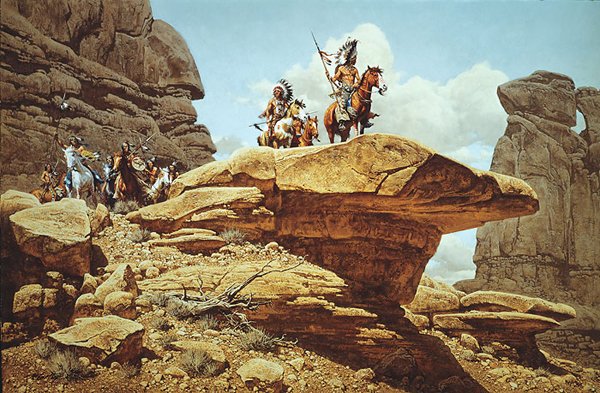
It all came to a head one day as I was looking down at a book illustration. The image is still quite clear in my mind; it depicted a whole bunch of plains Indians mounted on horse-back and charging toward the viewer looking fierce and warlike. Some adult in the household (I believe a guest) asked me what kind of Indians I thought they were. And that created quite a dilemma for me. I still didn’t know one tribe from another, much less how artificial those categories could be. More importantly, I was still stuck on the good Indian/bad Indian thing.

I stared at the image in silence for awhile, and I reasoned to myself that if not all Indians were bad, surely some were. There were bad cowboys and good cowboys in the movies, so why not good Indians and bad Indians? And maybe those bad Indians were the ones I had seen in all the movies. Maybe those were the Indians we had been playing as we stormed the monkey-bar fortress at recess. And if there were bad Indians, I thought, surely these guys (fierce looking as they were) must belong to that group! So, that’s what I said, my tone rising as I spoke; “…bad Indians?” after a bit of a pause, whoever it was offered that perhaps they were Comanche.

Total victory!

Frank C. McCarthy – The Hostiles

As far as I understood it, my theory that there were in fact bad Indians had just been confirmed, and I had just been given a name for at least some of them, Comanche! Comanche were the bad Indians. My sister-in-law and her family and Joey must have been the good ones. The next time I took off after that monkey-bar fortress, I feel quite certain that I counted myself as a ‘Comanche’ rather than a mere ‘Indian’.

Of course someone shot me and I had to fall down dead.

***

Naturally, my perspective on things having to do with Native Americans has changed over the years, not the least of them being my vocabulary preferences. But I often wonder how much of it is due to simply growing up and how much may be due to specific paths I have taken over the years? Most importantly, I find myself wondering how many of the ideas which shaped what an ‘Indian’ was to a little white guy living in Southern Colorado in the 1970s might have been due to the times I lived in? And how much that in itself may have changed?

I guess another way of putting it would be; do Indians still fight cowboys on the playground?

And if so, do the Indians ever win?

***

Many years had passed since all those stories mentioned above when I arrived in Navajo country to receive my first lesson on indigenous perspectives from a native source. My new landlord hadn’t quite cleared out of his place yet, but he had made a fold-out bed available for me. Observing a pile of pillows and blankets arranged in a familiar manner about the bed, I mentioned that his son had built a fort out of it.

A very irritated preschool child quickly emerged from beneath the bed to tell me it was not a fortress.

It was a Pueblo!

71.271549 -156.751450

Share this:

  • Tweet
  • Share on Tumblr
  • Click to print (Opens in new window) Print
  • Click to email a link to a friend (Opens in new window) Email
  • Click to share on Reddit (Opens in new window) Reddit
Like Loading...

Primitive Superstition and Proxy Fundamentalism: Further Reflections on Native American Spirituality

17 Tuesday Jul 2012

Posted by danielwalldammit in Anthropology, atheism, History, Native American Themes, Religion

≈ 15 Comments

Tags

Aborigine, American Indian, atheism, Native American, Oral Tradition, Primitive, Rationality, Science, Superstition

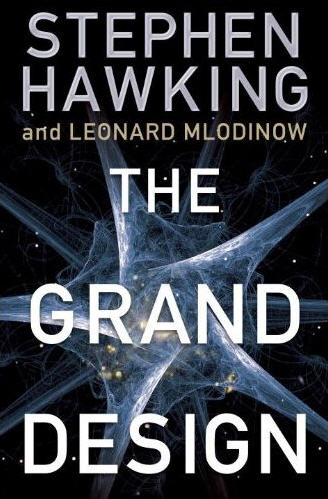
Stephen Hawking and Leonard Moldinow
The Grand Design

It always bends my thoughts a little sideways to hear my fellow unbelievers dismiss Christianity as primitive superstition, but it isn’t Christianity or Christians that I’m worried about (sorry). It’s the ‘primitives’ that concern me.

Having spent most of my career working with indigenous people, people who until recently might well have been dismissed as primitives, I can’t help but bristle a bit when the cultural heritage of my friends and coworkers (or their grandparents) is used as an insult for someone else. More to the point, I can’t help but feel the comparison is deeply misleading, not just as to the nature of ‘primitive’ people and their customs, but as to the whole shape of human history. In the end, references to primitives and/or superstition always strike me as a bit of self-indulgence, or even an ironic expression of faith.

The notion here is that Christianity (and most if not all of the world’s great religions (certainly the Abrahamic faiths) are essentially trying to explain the world about them much as preliterate peoples are presumed to have done in the remote past. Actually, “non-literate” would a better term, but for the present, I am taking the notion of things-primitive to refer to those who haven’t developed writing systems. That’s putting a rather complex topic into a simple formula, but of course this is a blog, not a book, so you are either with me or not at this point; we’ll see what happens. Anyway, the point is that folks comparing Christianity to primitives are essentially suggesting that Adam and Eve, are for example, erroneous attempts to explain human origins much as Australian Aborigines might explain local geography as the concrete result of events in Dreamtime narratives; just as Norseman might explain the shape of a salmon’s tail as a result of Thor’s powerful grip; …and so on. The idea, as I understand it, is to treat religious beliefs as a subset of erroneous explanations for the world around us, explanations that reflect the ignorance of those doing the explaining.

Take for example the following excerpt from Stephen Hawking’s book, The Grand Design (2112):

Ignorance of nature’s ways led people in ancient times to invent gods to lord it over every aspect of human life. There were gods of love and war; of the sun, earth, and sky; of the oceans and rivers; of rain and thunderstorms; even of earthquakes and volcanoes.

Hawking goes on to explain that the development of modern science has displaced such explanations, and as science progresses these sorts of beliefs should essentially fade by the wayside. Thus, we have the germs of a grand historical meta-narrative, one in which humanity tries various means of explaining the world only to commit numerous errors before settling on modern scientific methods.

***

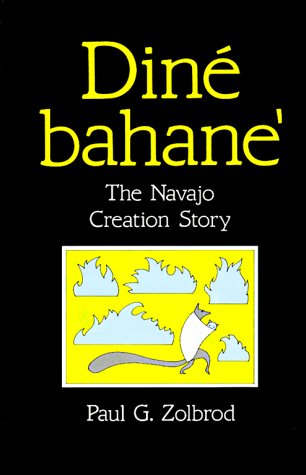
Paul Zolbrod
The Navajo Creation Story

So, what is the problem?

Let me start with an example. When I first headed into Navajo country in 1996, I hired on as a research assistant for a study of local youth gangs. I can’t say that the study yielded much of value, but we did manage to not get anyone killed (…I think). At any rate, one of the items we were supposed to investigate was the question of why gangs had appeared in Navajo country. In the days just before the study kicked up I recall asking an elder that very question. He looked right at me and said; “The separation of the sexes.”

So, what was he talking about?

It was a reference to a specific phase in the Navajo emergence narratives. The most thorough retelling that I’ve looked at would be the book; Diné Bahane’: The Navajo Creation Story by Paul G. Zolbrod. A portion of the narrative has been reproduced here on the website for the Twin Rocks Trading Post, and it’s definitely worth a read, but I’ll paste in a small stretch here. You could just as easily entitle this passage; “Where All The Trouble Began.”

Altse’ hastiin the First Man became a great hunter in the fourth world. So he was able to provide his wife Altse’ asdzaa’ the First Woman with plenty to eat. As a result, she grew very fat. Now one day he brought home a fine, fleshy deer. His wife boiled some of it, and together they had themselves a hearty meal. When she had finished eating, Altse asdzaa’ the First Woman wiped her greasy hands on her sheath.
She belched deeply. And she had this to say:
“Thank you shijoozh my vagina,” she said.
“Thank you for that delicious dinner.”
To which Altse’ hastiin the First Man replied this way:
“Why do you say that?” he replied.
“Why not thank me?
“Was it not I who killed the deer whose flesh you have just feasted on?
“Was it not I who carried it here for you to eat?
“Was it not I who skinned it?
“Who made it ready for you to boil?
“Is nijoozh your vagina the great hunter, that you should thank it and not me?”

To which Altse’ asdzaa’ offered this answer:
“As a matter of fact, she is,” offered she.
“In a manner of speaking it is joosh the vagina who hunts.
“Were it not for joosh you would not have killed that deer.
“Were it not for her you would not have carried it here.
“You would not have skinned it.
“You lazy men would do nothing around here were it not for joosh.
“In truth, joosh the vagina does all the work around here.”
To which Altse’ hastiin the First Man had this to say:
“Then perhaps you women think you can live without us men,” he said.

…and things get worse from there.

Ultimately, the fight between this Ur-couple will lead to the separation of all men and women from one another. The longing that each gender feels for the other will in turn lead them to unnatural sex acts, and these will in turn lead to the birth of monsters (really the story does get quite interesting).

So, what was the elder telling me? On the one hand, he was suggesting that the gangs were themselves the sort of monster that had its ultimate origins in the time of separation, just as had the giant and all the other beasts slain the by Hero Twins later in this same set of legends. On the other hand, he was suggesting something more subtle; he was calling attention to a high divorce rate on the Navajo Nation. In effect, that brief response served to point out not just one but two answers to my question, and to suggest some sort of relationship between them. Either way the separation of men and women from one another was, in this man’s view, the reason that gang violence had begun to appear in Navajo country.

The first of the two answers presented above could be classified as mythology. It is an attempt to explain a known fact by means of a reference to an old (and quite unverifiable) legend. The second approach treats the story in question as an allegory about the importance of marriage, and the elder’s answer becomes a direct social commentary on the relationship between changing family conditions and the rise of gang-related violence in the area. Right or wrong about the issues at hand, this interpretation would suggest the elder had been directing my attention to real world behavior. It would not have been difficult to measure that behavior, and even to formulate strategies for testing the causal connection he had asserted. But the most interesting thing about this whole fashion of speaking is really the interplay between the two forms of explanation. The elder did not choose which approach to communicate; in fact he chose language that suggested both lines of thinking to anyone familiar enough with the issues to know what he was talking about.

***

Standing Rock Sioux Reservation

Standing Rock Sioux Reservation
(September 2011)

So what, right? Thus far, what I have presented is fairly comparable to untold other religious texts. What is the difference, you may ask?

Well, for a start, there is no catechism here. Neither is there any equivalent to the Apostle’s or the Nicene Creed (or any other). Recourse to the emergence narratives presents no set doctrines about which one must agree, nor are there mechanisms for establishing what those would be. Until folks like the early anthropologists make it into the southwest, these stories were not written down at all, and until Zolbrod one could find no single text to unite them all into a single Holy Text. In the old days, as they say, this story might well have been a complete performance in its own right, one told for reasons specific to those present, and adapted a little for that precise purpose. Folks would have understood how this little story related to a number of other stories, but no set canon could be found against which to measure each individual performance or determine its precise meaning. In short, thesignificance of the text above ought to be understood without recourse to any of the mechanisms by which mainstream religions streamline their message and create a uniform set of doctrines.

To understand the elder’s reference one needn’t start by assuming he literally believes in the events described in the narrative above, or even that such a belief is relevant to his answer. One need only recognize that he found the story to be a useful reference point, and that he chose to use that reference point as a means of communicating a sense of the current state of his community.

I think this is the sort of thing John R. Farella must have had in mind when he said in his book, The Main Stalk, that one ought not to assume all natives are fundamentalists. It isn’t even that such folks aren’t out there, but they do not necessarily control the traditions in question. We shouldn’t be too quick to assume that a literal interpretation of things drives every reference to native oral traditions. That is what people raised in the Abrahamic traditions (whether we have accepted those traditions or not) tend to do when encountering the oral traditions of various people around the world, or even when we read ancient texts (such as Genesis) with an eye towards understanding something about the oral traditions incorporated within them.

Understood in these terms, the literal value of mythic events loses a lot of ground to the other implications of the narrative. A god of lightning ceases to be an explanation for lightning, and the lightning becomes a convenient means of letting nature call the name of the god to your mind. References to actual geography in mythic narratives cease to be a means of explaining those geographic features and become a variety of social conventions from territorial claims to moral lessons. The oral traditions become less of an attempt at understanding nature and more of an attempt to use nature as a means of expressing principles of social organization.

***

And where does that leave us?

I think it leaves us without a coherent central theme for the grand meta-narrative. Absent the assumption that every story is supposed to contribute to a single coherent theory (much less the assumption that that theory is a truth the recognition of which all mankind is obligated to acknowledge), we lose any clear reason to treat such stories as pre-scientific explanations of the world around us.

No, this does not mean we must accept any and all religious assertions after first checking to make sure they are offered in a less than literal spirit. What it does mean is that we lose one religious tenant to which not-a-few atheists seem quite prone, namely belief in uni-lineal Progress with a capital P. We lose that tenant, both as a short-cut to understanding the past of humanity, and as a promise of future success.

This does not mean giving up reason as a value, just letting go of the illusion that this value is the axis mundi around which all of human history turns.

Hawking is perfectly right to insist on the superiority of scientific approaches to explaining the world; he is wrong to think that explanation is the key to all those other traditions now conveniently (if quite inaccurately) summarized as a god of this and a god of that.

If there is an explanatory feature to religious tradition, it is largely a function of the means by which religions derive actual doctrine from such narratives and demand that others acknowledge the truth of those doctrines. In this respect the Abrahamic traditions do not merely carry forward the problems of earlier, so-called primitive, traditions. Instead they bring with them a brand new sort of problem, an effort to realign all the creativity one finds in oral tradition with a single obligatory and highly inflexible paradigm. We ought not to be too quick to let the God of Abraham share the blame for this problem with the figures of oral tradition from around the rest of the world. Nor should we be too quick to assume the course of history has been driven first and foremost by the values of scientists and philosophers.

71.271549 -156.751450

Share this:

  • Tweet
  • Share on Tumblr
  • Click to print (Opens in new window) Print
  • Click to email a link to a friend (Opens in new window) Email
  • Click to share on Reddit (Opens in new window) Reddit
Like Loading...

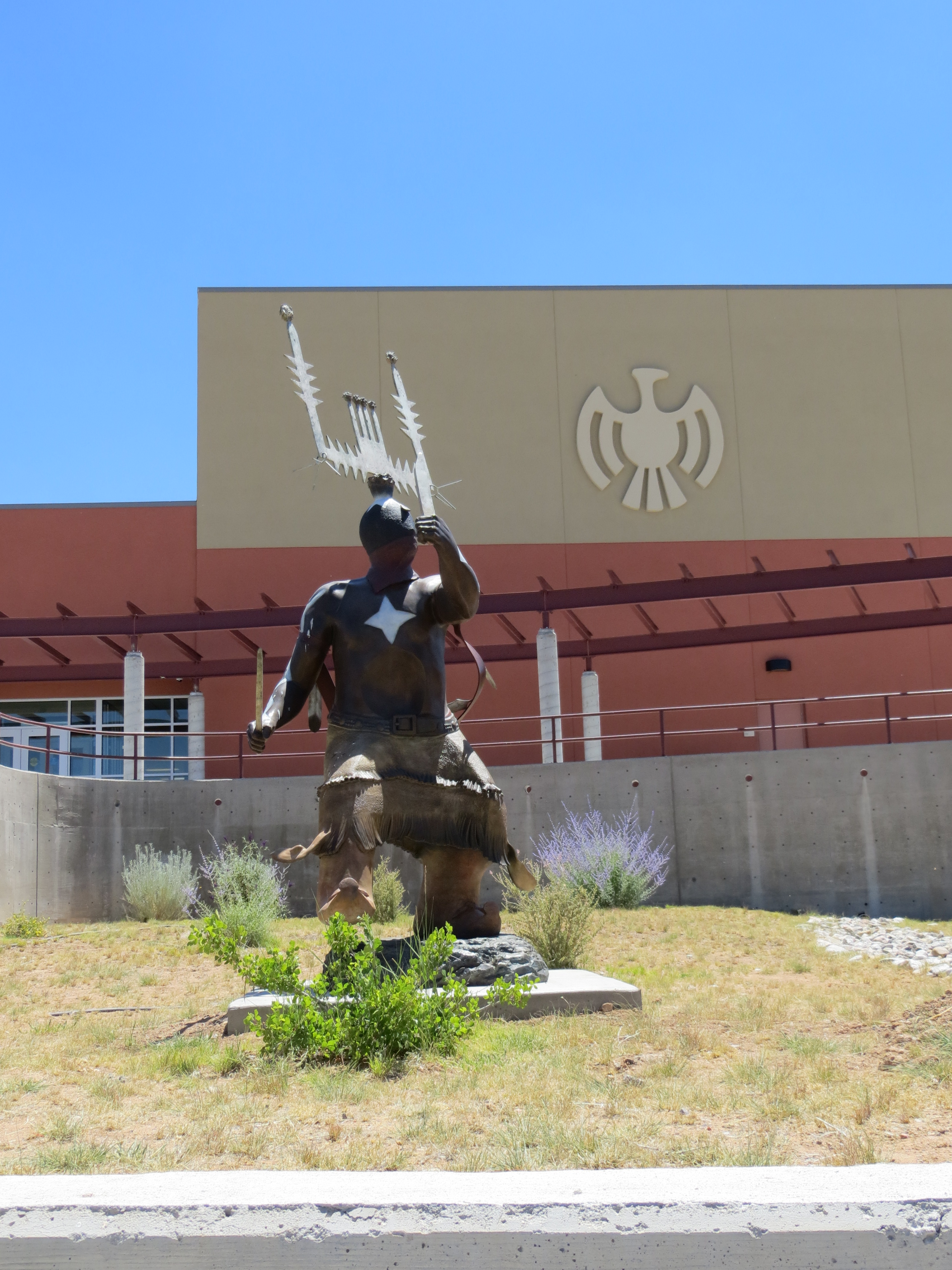
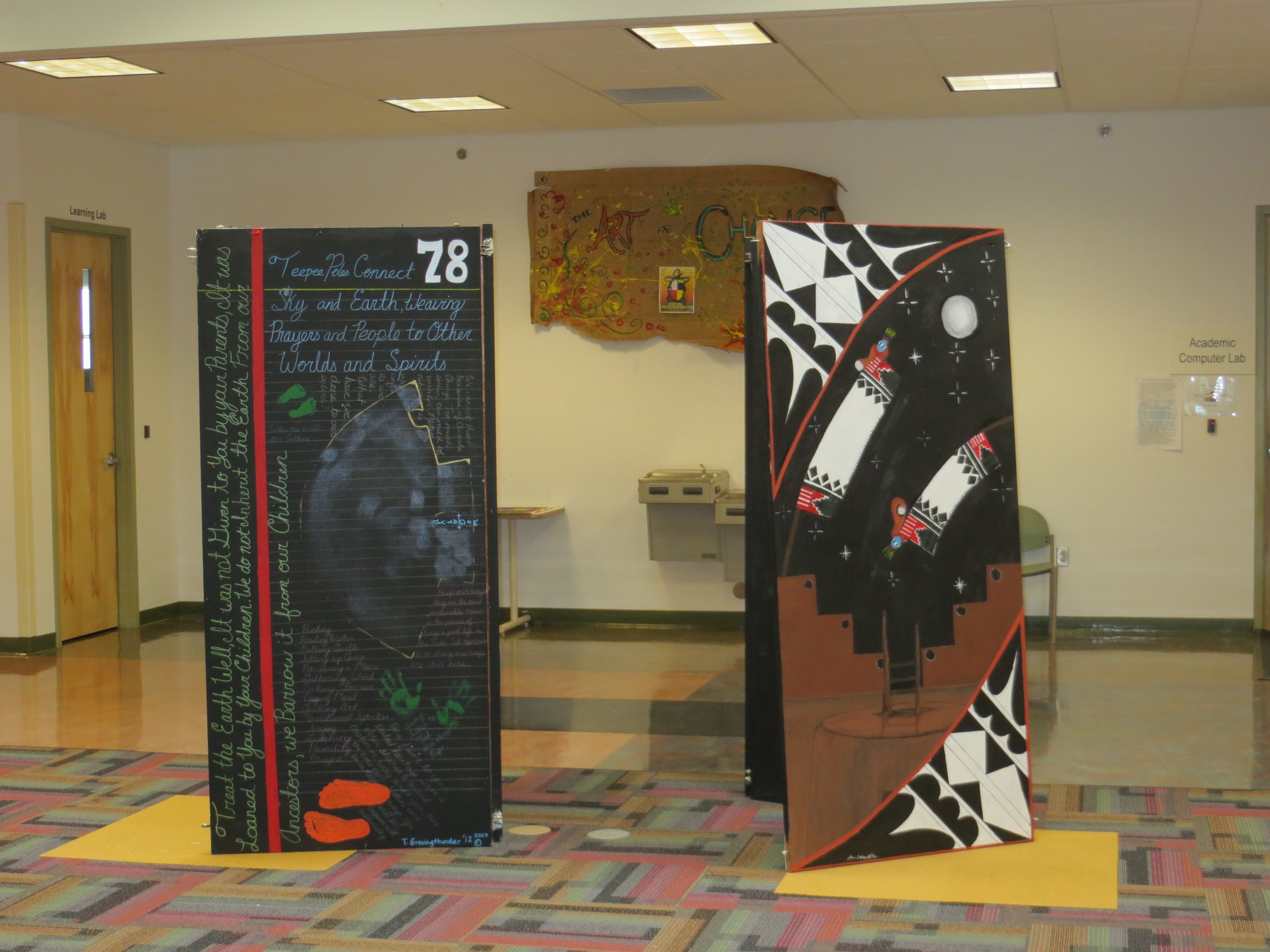
Gallery – Institute of American Indian Arts in Santa Fe, New Mexico

28 Thursday Jun 2012

Posted by danielwalldammit in Bad Photography, Education, Native American Themes, Street Art

≈ 28 Comments

Tags

American Indian, Art, Education, Institute of American Indian Arts, Native American, Photography, Photos, Santa Fe, Southwest

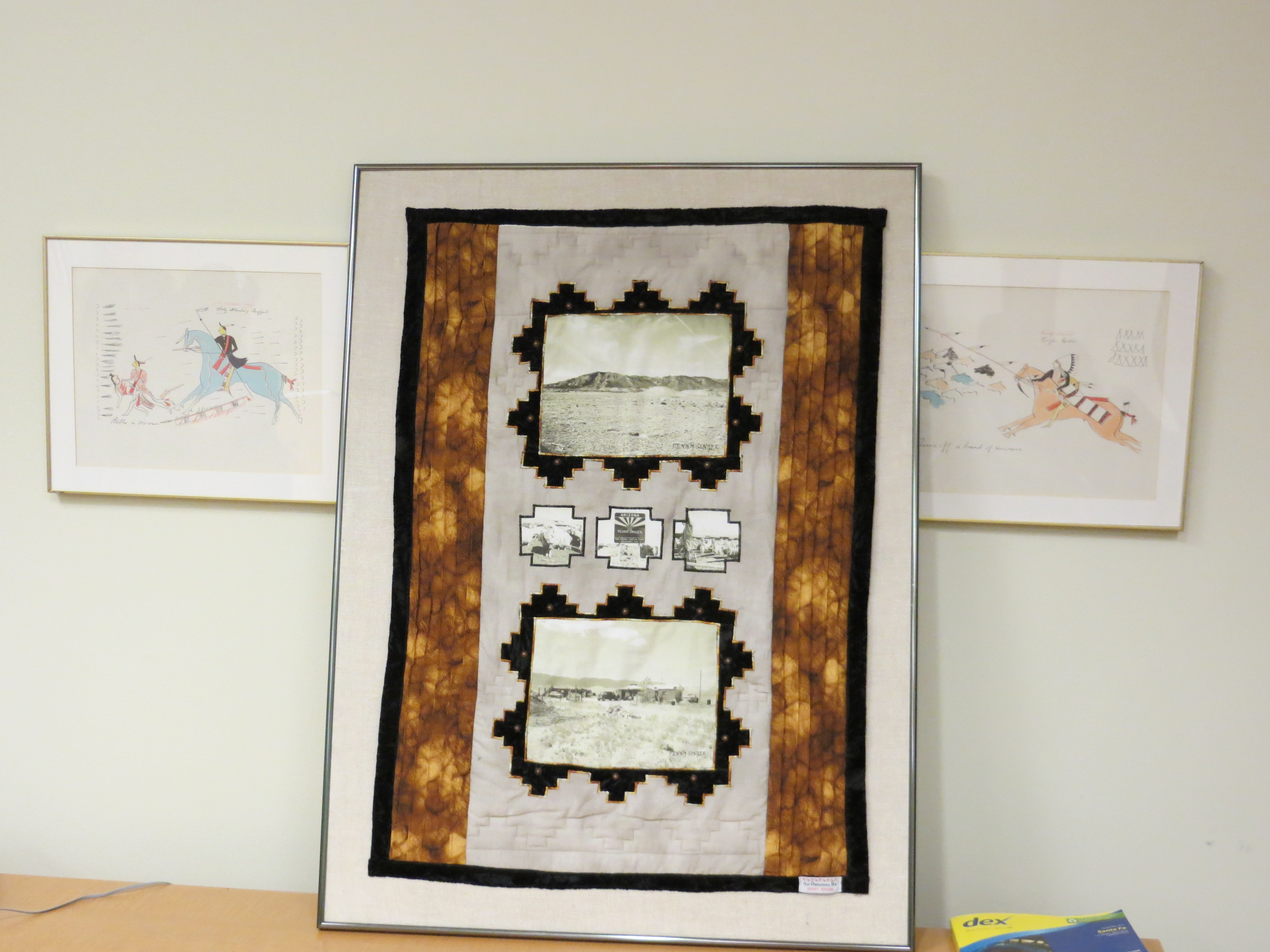
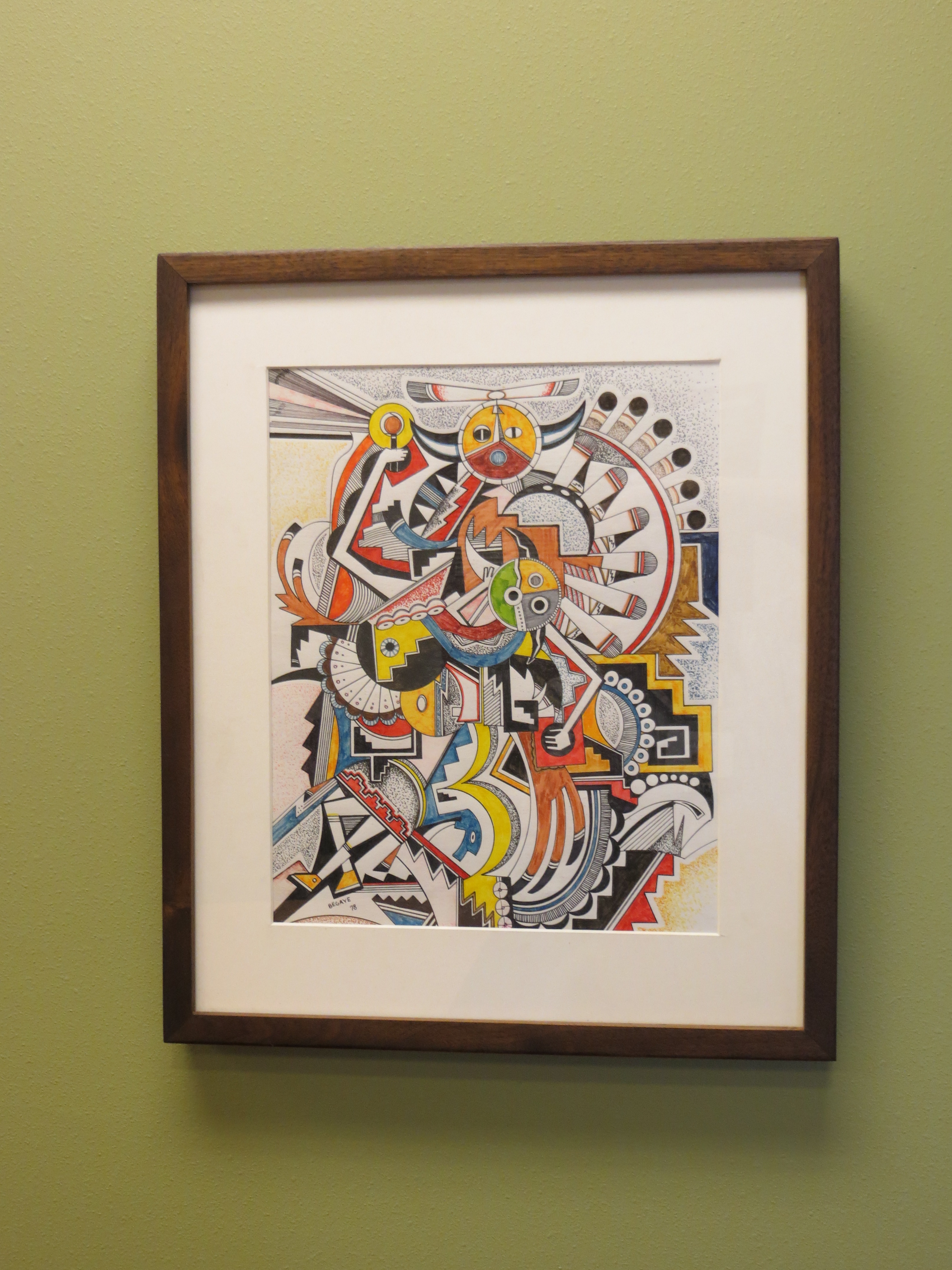
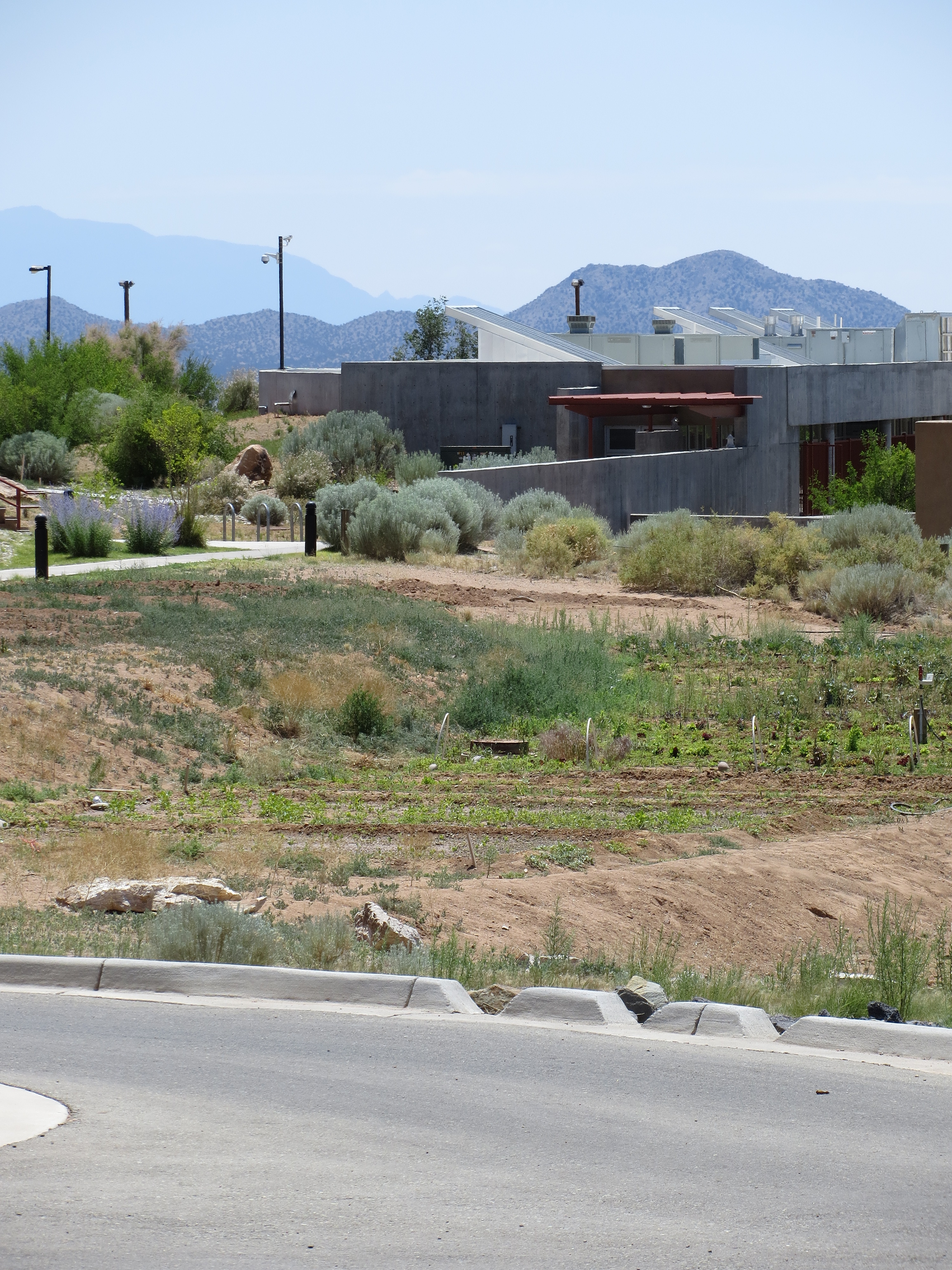
So, I just got back to Vegas after spending a few days in Santa Fe. I was there to visit the Institute of American Indian Arts (IAIA) along with some folks from my own institution and about 5 other tribal colleges. IAIA is a 4-year tribal college, and they have an awful lot going for them. The trip also included a visit to Taos Pueblo, several excursions into downtown, and a trip out to some interesting rock formations. For the present, I thought I would just put up a gallery of the lovely IAIA campus.

Students were gone for the summer, and a number of displays had been pulled down, but the campus still has an amazing variety of art projects. They also have a digital dome, the worlds only fully articulating dome. It hangs from four chains which can be raised or lowered to change the angle of the display. …and yes, students get to use it.

Seriously, there are few institutions in this world about which I can’t think of anything critical to say. In fact, right now I think the list may have one entry.

The Institute for American Indian Arts
Dance Circle, They hold various outdoor functions here (including a Powwow in May)
The IAIA Dance Circle from above.

IAIA Sculpture 1, Bison
IAIA Sculpture 2.
IAIA Windchimes

IAIA, Sculpture 4
IAIA, Sculpture 5

IAIA, Sculpture 6
I don’t know the story behind this one. Something tells me it’s a good one.
IAIA, Exterior Mural 1

IAIA, Exterior Mural 2
IAIA. The couches in the student Learning center beckon students to places where the can get help. …it’s a devious kindness that lies in wait here.
IAIA, Interior Mural 1

IAIA, Sundry art 1
IAIA, Sundry Art 2
IAIA, Sundry Art 3

IAIA, Interior Sculpture 1
IAIA, Display 1
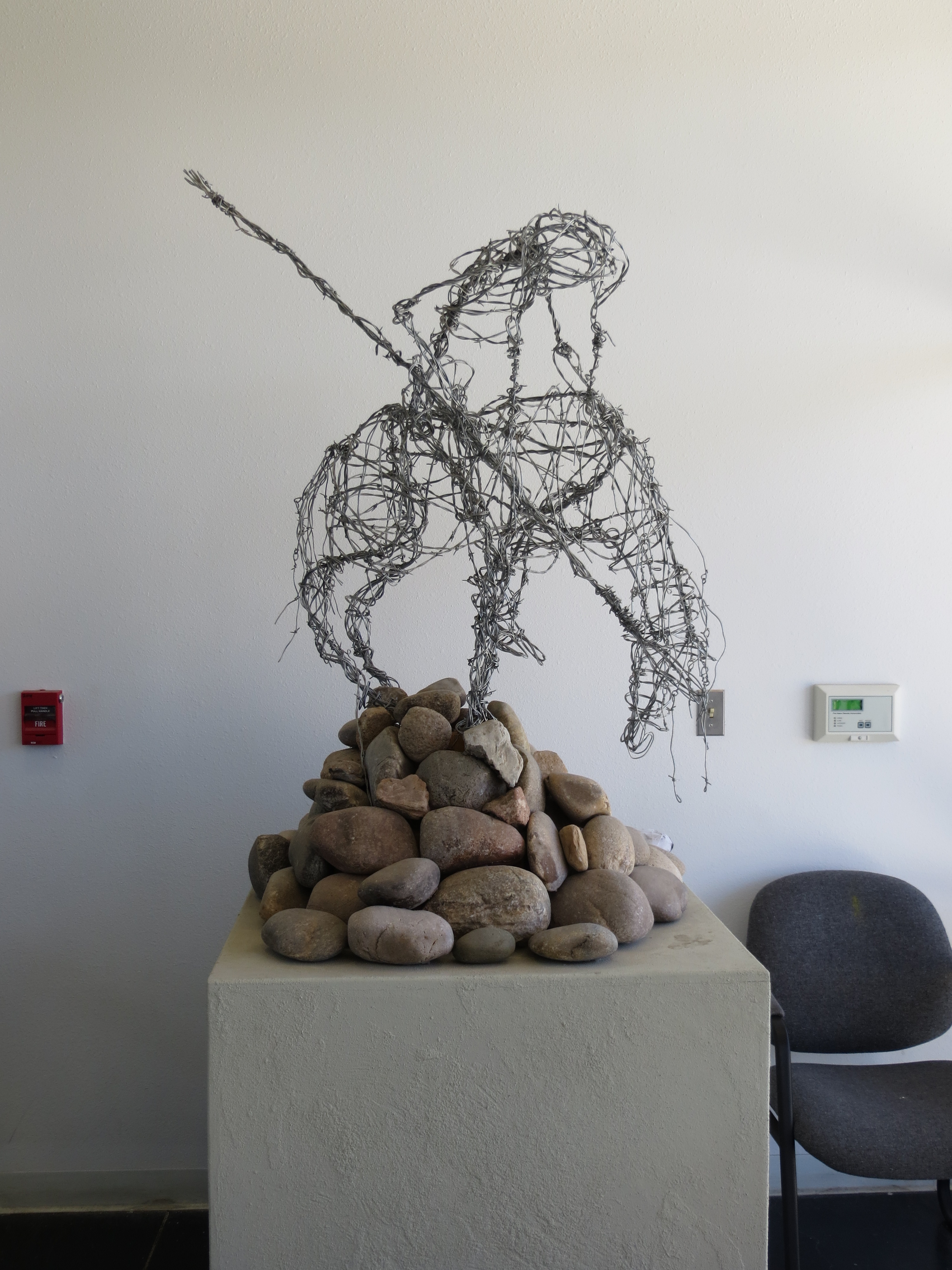
IAIA, Interior Sculpture 2 (This appears to be a play on an old cliche, the image of a dying Indian)

IAIA, Decoration in an Office Window
IAIA, Interior Mural 2
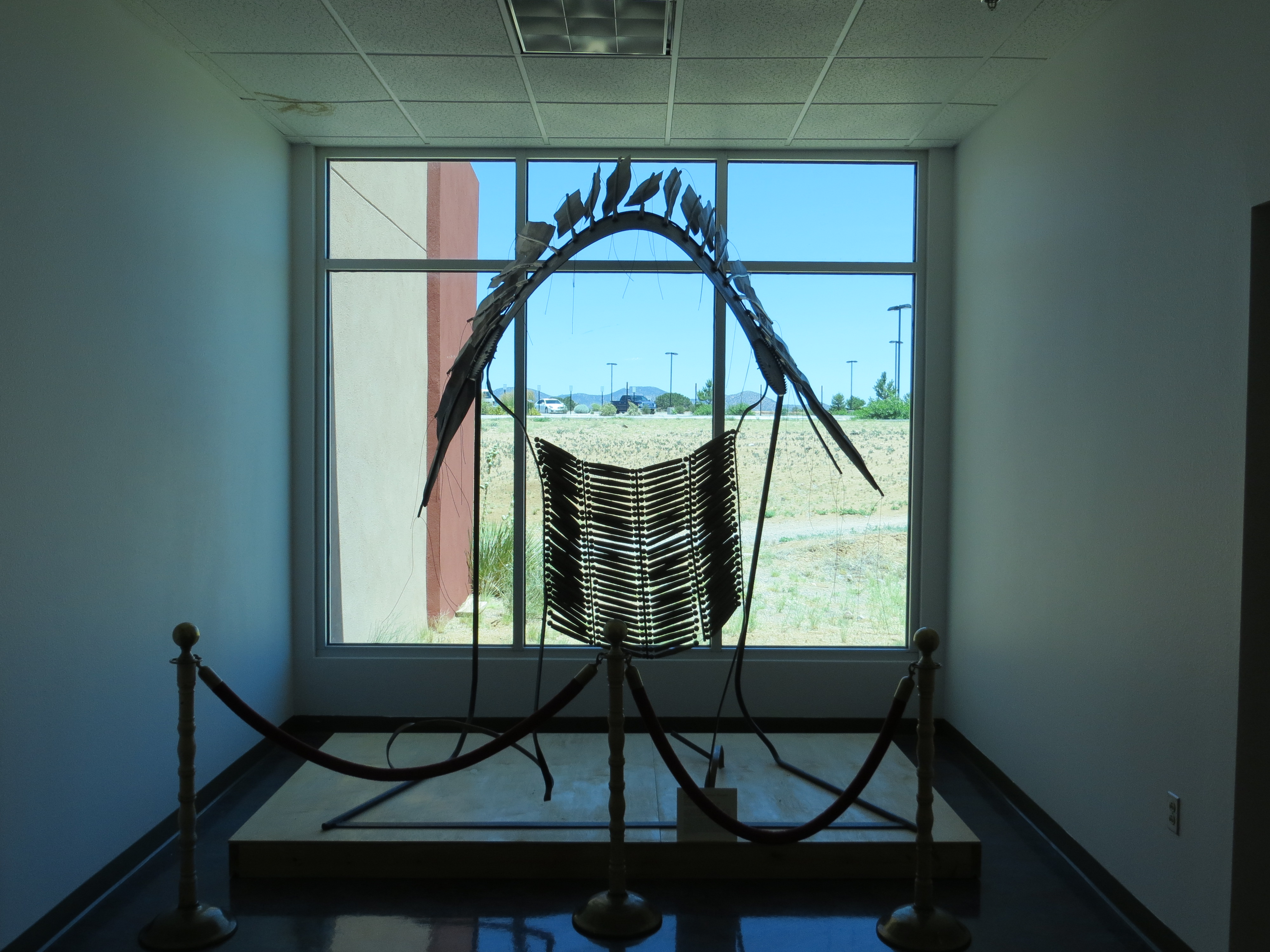
IAIA, Interior Sculpture 2 (It’s a Headdress)

IAIA, Interior Mural 3
IAIA, Ethnobotany Display
IAIA, Museum Collections 1 (Storage)

IAIA, Museum Collections 2 (Storage)
IAIA, Museum Collections 3 (Storage)
IAIA, Museum Collections 4 (Storage)

IAIA, Museum Collections 5 (Storage)
IAIA, Museum Collections 6 (Storage)
IAIA, Museum Display 1

IAIA, Museum Display 2
(Digital Dome
IAIA, Digital Dome
IAIA, We all have our battles

IAIA, Metalsmithing Teacher’s Office
IAIA, Sundry Art 4
IAIA, Sundry Art 5

IAIA Display 2
Corner Murals
IAIA, Interior Mural 4

IAIA, Exterior Sculpture 8
IAIA, Sidewalk Art
IAIA, Sidewalk Art 2

IAIA, Landscaping
IAIA, Just Cool!
IAIA, Conference Room and Student Art 1

IAIA, Conference Room and Student Art 2
IAIA, Conference Room and Student Art 3
Conference Room and Student Art 4

Lobby
IAIA, The Garden. They use some of this in the cafeteria, which is by the way the most awesome food I have had in a college cafeteria.

71.271549 -156.751450

Share this:

  • Tweet
  • Share on Tumblr
  • Click to print (Opens in new window) Print
  • Click to email a link to a friend (Opens in new window) Email
  • Click to share on Reddit (Opens in new window) Reddit
Like Loading...

The Stars and Stripes in Two Takes

28 Thursday Jun 2012

Posted by danielwalldammit in History, Native American Themes, Politics

≈ 18 Comments

Tags

American Indian, Flag, Jingoism, Native American, Patriotism, Rodeo, Star Spangled Banner, Taos

Entrance of the Flag

July 4th came a little early for me this year, or at least I found the American flag playing an unexpectedly prominent role in my weekend. The first occasion to think about the Stars and Stripes occurred at the Rodeo de Santa Fe on Saturday.

We arrived just a few minutes before the announcer asked the crowd to rise for “the most beautiful flag in the world.” He went on to tell us that people in other parts of the world look to it as a symbol of freedom. In just a few moments, a young lady with a beautiful voice begin to sing the National Anthem, but I have to admit I was already out of the moment. There was something about the tone of the introduction that had me a little on edge.

The announcer presented himself well and genuinely enhanced the overall experience of the rodeo, but I personally like my patriotism without a dose of jingoism. Hell, I could live with the description of the Star Spangled Banner as the most beautiful flag in the world. People in other nations might say the same of theirs, but if patriotic sentiments made their appearances solely in such expressions, then all my concerns about the matter could be resolved with a wink and a chuckle.

No harm – no foul, as far as I’m concerned. But of course, that wasn’t all…

When I heard this same announcer say; “(America) love it or leave it,” I have to admit I was genuinely displeased. That is the sort of chip-on-the-shoulder patriotism that I can do without. Granted, this sort of expression was not entirely to be unexpected at a rodeo, an event that out-Americans apple pie. But perhaps that was the problem; this little bit of verbal shadow boxing was quite unnecessary. It’s one thing to get aggressive when facing opposition, but when you’re doing your own thing amongst folks with a similar outlook, and its going well, and people are enjoying themselves, I can’t help thinking that a simple invitation to find some positive value in the flag and the nation would be the way to go.

The thing that really caught my attention was the claim that others around the world look to the American flag as a symbol of freedom. To be fair, I expect some do, but I also expect some don’t. Standing there waiting for the national anthem to begin, I couldn’t help wondering how far I would have to go to find someone who might find the flag just a little ominous.

As it turns out, I did not have to go far at all.

The next day, I found myself standing with a group of friends and coworkers in the Catholic Church at Taos Pueblo. The gentlemen showing us around the Pueblo called attention to the clothing upon the saints at the head of the church. He told us it wasn’t modesty that required the clothing; it was there to cover burn marks, burn marks dating back to first days of American presence in New Mexico. To his ancestors, the Star Spangled Banner had first appeared as a symbol of occupation. To say that this occupation had been traumatic would be putting it mildly.

The Taos Revolt of 1847 carried all the horrors one might expect from a local outbreak of violence. The first Governor of New Mexico died horribly in the early stages of the revolt, as did many others who took office under the new territorial government. For the residents of Taos the revolt ended with the shelling of their church and the killing of around 150 rebels. A number of executions would soon follow.

One needn’t feign naïveté about the role of any participants in the brutal events of that conflict, or any other. We needn’t believe in the moral superiority of any participants in that war. It is enough to understand that the events of 1847 have left their mark on the Pueblo, quite literally in fact. It is there in the relics of the contemporary church, and it is there in the ruins of the old church still standing in the village. It should also come as no surprise to find that such events might color the meaning of the flag to residents of the Pueblo.

I don’t mean to suggest that the meaning of the flag can be reduced to violence and oppression, and I really don’t think that is what our host in Taos meant to suggest either. His story was enough to remind us of the power that symbol and the nation behind it have to inflict harm on others, and to suggest that the consequences of such harm can be far more reaching than people often imagine. I think there is a lot of room for patriotism in places where such stories are told, but I do wonder if there is any room for those stories (or folks who care about them) in places where people are reminded that they must love America or leave it

There ought to be.

***

Cameras are strictly forbidden at Taos Pueblo which is why none appear in this post. For a quick brush-up on the Taos Revolt, I consulted a piece by the state Historian of New Mexico, William H. Wroth.

71.271549 -156.751450

Share this:

  • Tweet
  • Share on Tumblr
  • Click to print (Opens in new window) Print
  • Click to email a link to a friend (Opens in new window) Email
  • Click to share on Reddit (Opens in new window) Reddit
Like Loading...

The Spirit Always Grows Deeper On the Other Side of the Fence

23 Wednesday May 2012

Posted by danielwalldammit in Native American Themes, Religion

≈ 15 Comments

Tags

American Indian, Indian, Native American, Navajo, New Age, religion, Spirituality, Tourism

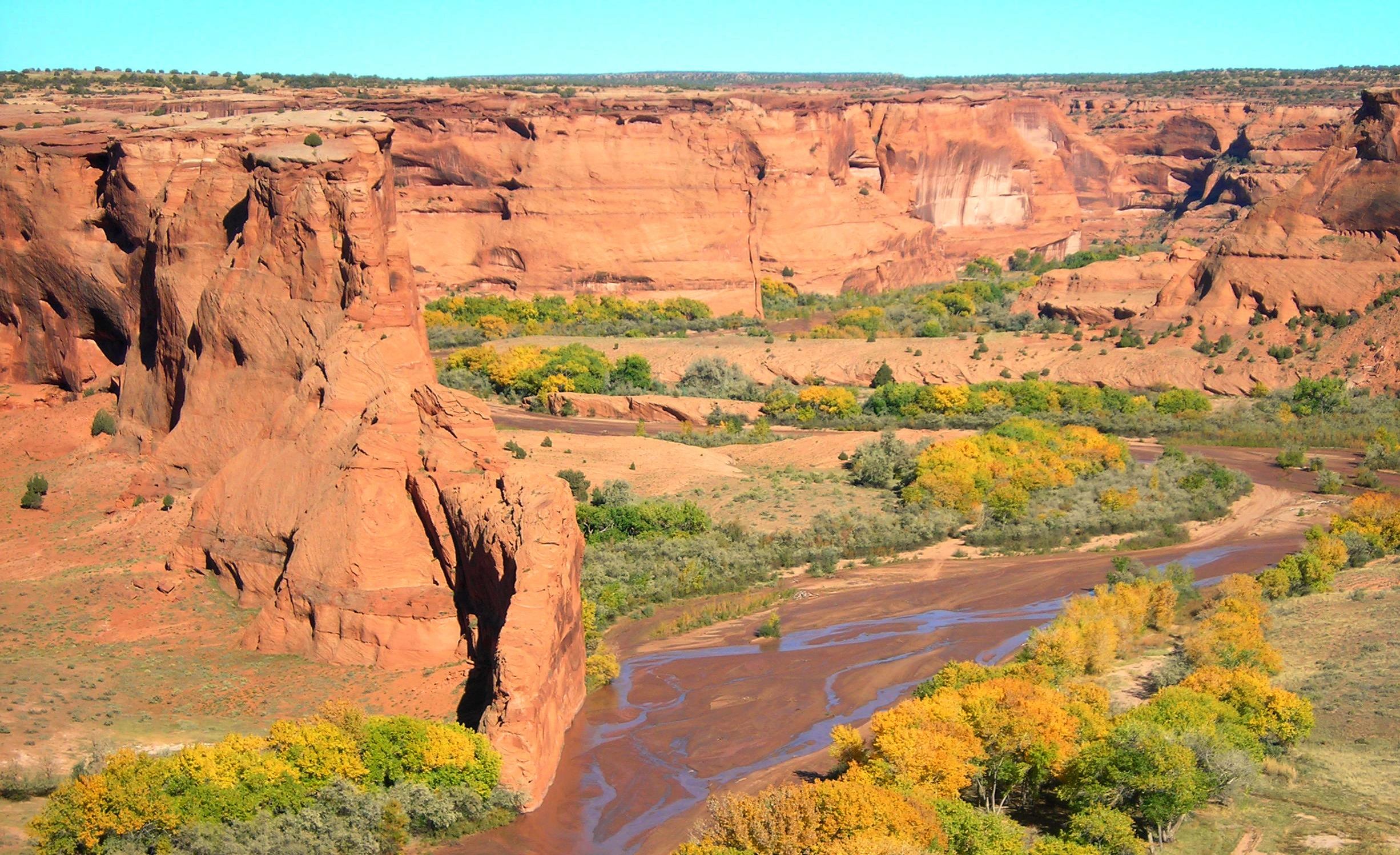
Canyon de Chelly national Monument (Chinle)

It had been a very long drive into work that week, not the least of reasons being a heavy snow storm that descended upon the central Navajo Nation just as I got into the area. I didn’t expect to see my landlady in the office, but there she was. She and I normally passed each other going both ways of our weekly commutes, and upon seeing her I assumed she had been trapped in town by the snowstorm. Would I be on the floor that night? …or asleep in the office? Not to worry, my landlady and her 4-wheel drive were on the way out of town, but she wanted me to know that I would have company that night after all.

I cocked an eyebrow and waited to learn more.

It turns out she had picked up a guy on the side of the road near Chinle. She didn’t know much about him, except that he was a bilagáana (a white guy) and he had come out to the reservation looking for native wisdom. She had blessed him with his first taste of that wisdom by getting him in out of the cold. She added that she thought he was sick. So, I taught my class that evening and headed over to the house wondering what (or rather whom) I would find.

I’ve long since forgotten the man’s name, but he was indeed sick. A doctor had apparently told my guest that his Prostate Cancer could not be treated. So, he had come to Navajo country in the hopes that a Medicine Man could accomplish something that modern science could not. My guest didn’t elaborate much on his condition, though his frequent trips to the bathroom might have testified in some sense to the diagnosis. He was French, as I recall. I don’t think he ate at all that night, nor did he accept an invitation to breakfast.

The house contained two quite decent beds, but no central heating. So, my guest slept on the floor that night and I slept on the couch, thus putting us both near the coal-burning stove. In the morning, he pulled out his tarot cards and tried to get a sense of what the day had in store for him. The man offered to do a reading for me, but I declined. It had been a long time since I had left that sort of thing behind, and I didn’t want it back in my life, not even as a sort of social experiment. Instead, the man explained what each card meant as he drew it during his own reading. There was some good and some bad, and as one might expect, a lot of wiggle room on the particulars.

Although I asked, the man never really told me whether or not he was looking for someone in particular. I suspect he thought the practical problem of finding a Medicine Man willing to help him would resolve itself, perhaps with the aid of his cards or some comparable means of divination.

I don’t think my guest ever asked me for anything, nor did he accept anything I offered. The storm had broken late that evening, and his reading had been promising. So, the man opened the door to find a truly beautiful morning. Soon, he was on his way.

***

It is hard to explain just how out-of-place my guest for the evening had been. The man would have had far more luck turning south and heading into Sedona. Perhaps one of the more shady medicine-men would have sold him a quick Blessing-Way, but the real thing, so to speak, is a family affair. It would take friends and relatives to put together the resources, to aid in the ceremonies, and to help in the long rites. The proper healing from a local perspective might have taken several nights on end with several participants needed to make all this work. The logic of the system is as much social as it is metaphysical. Repayment for all of this effort would take the form of similar service when those same people needed help in various forms over the course of their lives.

This man didn’t really fit into the scenario he was trying to bring about. It wasn’t just the clumsy eclecticism of tarot cards and native healers that seemed off to me. On a much more profound level, my guest had come seeking a personal experience; its social implications were simply beyond him. With enough goodwill, folks could of course devise a work-around, but how likely was it that anyone would give him the chance? To say nothing of the odds that any of it would work!

Who knows?

I could easily hope that my guest for that evening found what he was looking for and flourishes today, living evidence that my sense of both metaphysics and indigenous culture are dead wrong on all counts.

It was desperation, not malice, that brought this man to Navajo country, and yet his failure to appreciate the social setting was part of a much larger problem. I often wonder just what is it about other people’s rituals and beliefs that makes them so attractive to those on a spiritual quest, even with personal health hanging in the balance? Among other things, this question always comes to mind when I think of that particular night in Chinle. Once that question takes hold of my thoughts, I cannot help but to want to follow it down a few similar paths.

***

I’m not altogether unfamiliar with the sort of thinking my guest brought with him that night. I remember reading about the ascended spiritual masters (Kuthumi, Maitreya, St. Germaine, etc.) in my grandmother’s old Theosophy books. The masters dwelt on this earth, at least when they wanted to, or so I read. The home of the masters, so the story goes, rested in the remotest parts of Tibet. I suppose that when the books had been written, this seemed an adequate explanation for the seeming impossibility of finding the masters by normal means. It took meditation to bridge the distance.

I remember sitting in on a séance as a child in the early 70s, one in which I and several family members received the names of our spirit guides. I remember the name of my “Indian guide.” It was “White Thumb.” With the name of “Wee One,” my “Joy Guide” also seemed to bring to mind an Indian, albeit a little one, perhaps an invisible playmate, …very useful to a kid living on a ranch inconveniently far from my classmates. I wasn’t half as interested in any of my other guides as I was in these two.

I also remember that the name of my father’s Indian guide had been of the South Asian variety. I cringe at the explanation, …this was a higher form of Indian guide, so he was told. I cringed again many years later when a family friend dismissed questions about the authenticity of sweat baths run by non-Indian practitioners. She assured me that she and her spiritual mentors were engaged in practices far more advanced than anything Native Americans had actually done. And of course I thought about all of this when I learned about the tragedy of a sweat bath lead by James Arther Ray. I wonder if he too was engaged in practices far more advanced than those of the Indian peoples from whom he borrowed piecemeal?

I remember a woman at a Native American Studies conference who once asked me if I was following the “Red Road,” a question so loaded with cultural baggage I couldn’t begin to unpack it in time to give an adequate response. I expect the woman must have found me quite a disappointment.

But Spiritual appropriation isn’t just limited to Native American traditions. I recall with great pleasure reading Karma Cola long before I headed out to the rez. Gita Mehta’s brutal observations on the antics of spiritual tourists in India touch upon issues quite familiar to those observing how Native traditions fare in New Age circles. Many of the characters she describes in Karma Cola appear quite as hapless as my guest sitting there reading tarot cards on his way to find a Medicine Man. Few seem quite so innocent or nearly as sympathetic.

Mehta has been rightly criticized for focusing on the negatives. So many claim to have found something of value in Eastern traditions. What personal pettiness it must take to deny or to minimize this! And yet the specter of people on a personal quest, proceeding oblivious to the social context in which they operate rings true for me. Whatever folks may have found in these strange, foreign, traditions, it seems a safe bet to suggest that they commonly miss much more.

What bothers me most is that the part spiritual tourists miss may well be the most important piece of the story, the part which anchors all that spiritual talk to an established community. I cannot help but wonder if the quest to learn someone else’s spirituality isn’t rather commonly an effort to escape that very thing!

Those traveling (literally or metaphorically) through another people universe are freed from much of the social context in which the symbols and ideas they seek to learn acquire meaning. They can learn how to perform a ritual, or even what it’s iconography means in some idealized sense, but they are freed from the tedium by which that ritual is connected to countless aspects of daily existence. Most importantly, spiritual tourists are free to fill in the gaps of their understanding as they see fit, unencumbered by multiple sources of information, some of which will surely disagree. What spiritual tourists acquire is a radically simplified version of some other world view, all the easier to tweak it to their own tastes. Perhaps some people need this; perhaps some even do great things with the opportunity. Either way, the point stands. Something highly important is lost in translation.

For some at least, the chance to strip a practice of its social context and rebuild it as they see fit is precisely the pay-off for embarking on a trip into unknown spiritual territory. There may be good reasons for doing that, but how often do people even realize that is what they are doing?

71.271549 -156.751450

Share this:

  • Tweet
  • Share on Tumblr
  • Click to print (Opens in new window) Print
  • Click to email a link to a friend (Opens in new window) Email
  • Click to share on Reddit (Opens in new window) Reddit
Like Loading...

Native American Ceremonies and the Meaning of ‘Religion’: Unpacking the Semantic Baggage, …Well at Least the Carry-On

03 Thursday May 2012

Posted by danielwalldammit in atheism, Native American Themes, Religion

≈ 37 Comments

Tags

atheism, Belief, Ceremonialism, Christian Forums, History, Indian, Native American, Navajo, religion, Semantics

Hogan

Not everyone has a religion!

More to the point at hand, the term seems to be an awfully bad fit for a lot of the things it is commonly used to describe.

When I was teaching on the Navajo Nation, I used to illustrate this by asking my students; when you hold a healing ceremony, who comes? The answer was always something to the effect of the community itself, friends, relatives, etc. What happens if you don’t believe in the effectiveness of the ceremony? Frankly, I don’t think the question came up very often, at least not in the context of deciding who belonged at the ceremony, but I did once meet a woman who had effectively answered it. A born again Christian, she stayed at the main house during the chants and entered the Hogan to help serve food during the breaks. She thus met her family obligations without implicating herself in a ceremony that was anathema to her own beliefs.

When I asked my students who goes to a church, the answer was invariably something along the lines of its members, believers, etc. Catholics go to a Catholic Church, Baptists to a Baptist Church, and so on. Of course this doesn’t mean that others aren’t welcome at a given church, but there is a distinct sense that the church exists for those that adhere to its doctrines. Those testing the waters will be expected to make a choice at some time.

Which brings me to another point, a religion can be modeled as a debate stance. Who belongs to a church? In many cases, we can literally trot out a range of statements and ask people whether or not they will vouch for the truth of those claims. “God Exists.” “Jesus rose from the dead.” You get the idea. Say ‘yes’ to the right statements, affirm one’s beliefs that they are true, and you are in the club. Say no, and you are out. Whatever else is happening here, it is a process of segregating folks according to an imagined argument within a larger community.

Sandpainting

When I used to post on christianforums.com (CF), this was explicit policy for many years. Those who affirmed the Nicene Creed (or perhaps the Apostle’s Creed) could count themselves as Christian and post in the Christians-only sections. Those of us who could not were asked to restrict our posts to the open-debate areas. The policy varied in its details from time to time, and as I recall it changed rather dramatically a few years back, but when I was there at least CF policy fits the model I am proposing, membership in the faith, as it was defined on CF could be determined by one’s willingness to back a series of truth-claims.

So, what is the difference?

I’m about to paint it in pretty broad strokes, but I’ll warrant the paint gets more or less within the proper lines.

A religion is defined in terms of beliefs which consist of the willingness to vouch for the truth of a claim. A native ceremonial system is defined in terms of community membership and participation. Of course there is considerable overlap between the two. People expressed a number of beliefs connected with Navajo ceremonies, and churches can be remarkable community institutions. But as with any other questions of value, it is the priorities that count. Failure to vouch for essential doctrine gets you out of a church. It doesn’t get you out of a Navajo ceremony, at least it didn’t when I was there.

So, what is going on here? I would suggest, the point of the ceremony is at least partly to unite the community, to get them all involved in something of great importance to the community at large (the health of its members in the Navajo case). What is the point of the religion? Well it is at least partly to distinguish a select membership from some larger community. A religion isn’t simply about what group you belong to; it is about what separates you from those others. What a native ceremonial system unites, a religion divides.

Some might find that shocking, or at least counter-intuitive. Often when religious debates get rather heated, someone will lament the divisiveness of the issue and give a variant of the “can’t we all just get along” speech. The sentiments are noble enough, but I often wonder how many times people can see the process of division before it sinks in; that is what is SUPPOSED to happen.

Rainbow Bridge (Sacred Site)

Of course both ceremonial systems and religions unite as well as divide, but they do so on different parameters. The ceremonial system unites people along the lines of an established community, it gives people who share in a range of political and economic interactions a means of emphasizing their connections. A religion carves off a notch of those people and sets them in ideological opposition to others in their community.

So, this is my particular take on a running theme in Native American studies, the unfitness of “religion” to the understanding of Native American practices commonly described using precisely that term. The problem was particularly critical to the workings of a Federal law passed in 1978, The American Indian Religious Freedom Act, which I happened to study for a bit. The law had a rocky history from the start, and at least in the early 90s (when I studied the matter) an awful lot of people were disappointed in its application to real life.

It was easy enough to say that various indigenous practices raised a lot of First Amendment issues. (Well at least it was in 1978; the prior history of willful abuse is dismal, and a topic for another post.) But actually extending Free Exercise protections to Native American “religious” practices proved very difficult. How do you protect the right to prayer when that might mean a lot more than a moment of silence or even a few words spoken in a certain posture? What do you do about ritual paraphernalia at border crossings? How about odd dress in schools or prisons? How do you deal with strange substances? Nevermind peyote; a simple smudge-pot can really screw up a paradigm! …and (this was the real sticking point) what do you do about access to sacred sites on public lands, especially sites that might not be so sacred anymore if someone builds a road or a fast food restaurant in the vicinity?

See, the problem was that native “religious” practices simply didn’t fit into the niche already carved out for religions within the American political economy. So, time and again, when Native Americans sought to enjoy their religious freedom, they found some official or judge who couldn’t (or wouldn’t) grant that protection. The necessary relief always seemed to be too much to ask, and the resulting case-law was dismal to say the least.

So, what was the problem? At least some folks figured it lay with the key term “religion.” It just didn’t fit. The practices in question may have included enough of what people call ‘religion’ to get the issue on the table, but they weren’t restricted to quite the semantic domain one normally expects of things described using that term. The contents Native American “religions” thus tended to spill over into other social terrain. Where western religions had learned to reside in the spaces between other public matters, their Native American analogs didn’t even come close.

So, if the term “religion” doesn’t fit, what does?

It really is difficult to answer that question. We can of course use the term “religion” anyway, but the warrant for its use is analogical, and my point is the analogy breaks down, often in really inconvenient ways. A common practice is to talk about native “spirituality,” but the chief benefits of “spirituality” seem to be that the term means just about anything you want it to mean, which is not an argument in its favor.

My own solution is to focus on the ceremonial practices. As the community-building functions of those ceremonies take priority over the argument-framing functions, those practices naturally stretch into social interactions well beyond those of religions. Of course this way of talking about the issue involves a judgement about priorities; it is a claim about what matters most. So, I won’t be too offended if someone opts to go another route.

Yes, I will. Let’s fight about it!

Anyway, what interests me about this is that it is the other half of a coin to my own situation when it comes to the subject. Religion obviously doesn’t do much for me, and as my last post ought to have established, I obviously think there is something about religion that is NOT part of my life and thinking. What that is, is another question, and admittedly a satirical post isn’t really going to nail it down. So, I am trying think my way through that issue (for the umpteenth time) by looking at people who may have a similar problem.

…and by “similar” I probably mean “opposite.”

If I as an atheist lack something falling under the heading of ‘religion’, the people I am talking about seem to have a surplus of it. Where the term denotes something I don’t want in my life, it denotes something that falls well short of what they want in their own lives. Where use of the word “religion” commits me to too much, it commits them to too little.

Either way, we have a problem.

***

The Hogan picture comes from the website, Virtual Tourist. It is part of the Navajo Museum and Visitor’s center in Window Rock, AZ. The sandpainting is from navajopeople.org which includes a nice description of its symbolism and ritual significance. The picture of Rainbow Bridge comes from Destination360. It was the subject of sacred site litigation in Badoni v. Higginson, one of many sacred sites litigated in the 70s and 80s.

71.271549 -156.751450

Share this:

  • Tweet
  • Share on Tumblr
  • Click to print (Opens in new window) Print
  • Click to email a link to a friend (Opens in new window) Email
  • Click to share on Reddit (Opens in new window) Reddit
Like Loading...

Ten Little White Indians, Final Volume! (Spoilers Already Spoiled!)

28 Saturday Apr 2012

Posted by danielwalldammit in Movies, Native American Themes, White Indians

≈ 13 Comments

Tags

American Indian, Avatar, Dances With Wolves, Film, Graham Greene, Kevin Costner, Lakota, Last Samurai, Movies, Pawnee, Stereotypes

Bet y’all didn’t notice!

I am one short on my promise of 10 Little White Indians. Well, it turns out that my three-part series on White Indians has four parts, and there is surely a good Monty Python reference in there somewhere, but maybe we’ll save that for another day

***

Let us start with a brief consideration of the near misses.

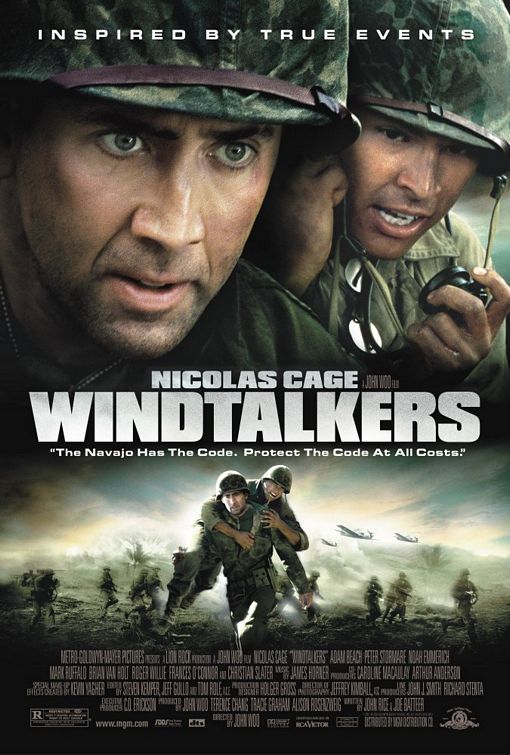
Wind talkers

WIND TALKERS (2002): I remember when this movie was on its way to the theaters, rumor had it that the flick was about the Navajo Code Talkers. Working as I did then on the Navajo Nation, I was (like a lot of my students and colleagues) really excited to see this part of American history portrayed on screen. My enthusiasm waned considerably when I realized it wasn’t about a Code Talker so much as a white guy who might have to kill a Code Talker if things took a turn for the worse. I don’t think I was the only one who sank in my seat when I realized where this was going.

…not quite a white Indian, but definitely the same sort of bait&switch one normally gets with this theme.

The Last (White) Samurai

THE LAST SAMURAI (2003): Don’t act surprised. You know this movie is about a white Indian. I mean, the Indians are Japanese, but let’s not get too worked up about the details. It’s the same story, just transplanted to a different setting. Tom cruise goes to live with a strange and seemingly savage people. He comes to know their ways and love them. Finally, he leads them in a battle to revitalize the way of life that is so brilliant, it needs an outsider to save it.

What separates this from A Man Called Horse? Geography.

Avatar

AVATAR (2009): I owe this reference to simplycarola as she mentioned it in another discussion. But the story of a human who enters an alien world filled with nature-loving creatures is just too much to pass up. Jake Sully, our hero, in this film struggles to survive among these savages, finds them wonderful, and leads them in war against his own people. Yes, this is a white Indian on another planet. …and the ease with which ‘white’ transits into ‘human’ while the role normally reserved for Native Americans morphs into an altogether alien species, …well that takes icky to infinity!

***

Okay, so what about it? Why does it matter that Hollywood makes so many stories about white Indians?

Truth be told, I don’t see anything wrong with this kind of story. In fact, the subject of white Indians (or any other non-Indians going native) is fertile ground for storytelling. The problem lies rather in the way this persistent theme seems to marks an inability to venture into stories about Indians themselves, a sort of hesitance at the threshold of another interesting subject. We want to know about Lakota, about Cheyenne, about all of these people! But in the end it seems that they prove too strange, their world too foreign to deal with on its own terms, so we end up with a story about someone else, someone who knew them.

That is the problem; in at least some of these cases, the white Indian is a confession of sorts, an admission that certain movie-makers, and perhaps certain audiences are not quite up to the subject at hand.

Non-Natives seem to better appreciate film depictions of Native Americans if we get to see that depiction through the lens of another non-Native. That in itself certainly isn’t a crime, but it does skew the details of the story in odd ways. The frequency with which the white guy gets the red girl is a bit disturbing, as is the myopic celebration of a romance in the midst of a world that is rapidly falling apart around the fair Indian maiden. Are we really supposed to be happy for the hero that he gets the girl, devastated though she must be? And doesn’t the loss of her family and her people merit a little more than a brief moment of regret. Hell, I can’t help wondering if her story isn’t clearly the more dramatic one in every single one of these films. That the Indian maiden is so often portrayed as a kind of princess should drive the irony meter all the way to 11.

And then of course there are the men who come to lead their adopted native communities. It isn’t enough to imagine one’s white self as an Indian, one has to be their leader too! The characters have to out-Indian the Indians (or in the case of Tom Cruise’s, out-samurai the samurai). As far as self-indulgence goes, I have to admit this theme makes me a little ill.

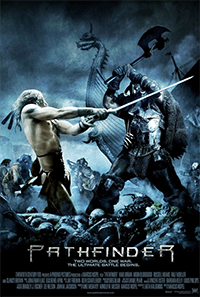
It’s not that these movies are terrible. Okay, some are. (Pathfinder was dreadful!) Others are really quite wonderful.

And some are both at the same time.

***

Dances With Wolves

Which brings us to the 10th and final white Indian. You guessed it, DANCES WITH WOLVES (1990). The narrative is familiar to most by now. This is the story of a white Indian made larger than life and then some. Disturbed by his experiences in the Civil war, John J. Dunbar (Kevin Costner) asks for a post on the frontier and soon finds himself quite alone on the great plains.

In time, Dunbar will befriend a local band of Lakota. He will hunt buffalo with them, help to defend them against Pawnee raiders, and fall in love. His love interest (“Stands-with-a-Fist” played by Mary McDonnell) is herself a white woman, adopted by kicking Bird (Graham Greene), the village Medicine Man. Dunbar soon finds himself on the Indian side of hostilities with the U.S. Army. It is a role he embraces willingly.

There is no happy ending here. Realizing that his presence puts the people in danger, Dunbar leaves with Stands-with-a-Fist, and the movie ends with an epilogue telling us that the Sioux were subjugated 13 years later.

…ouch!

Kicking Bird Takes a Look

This movie has all the elements one might expect from a story about a white Indian, and it presents those elements in truly majestic fashion. The Buffalo-hunting scene alone is enough to warrant at least three viewings of this wonderful movie. And the Indian characters around Dunbar come through with a richness seldom seen in Hollywood productions. Greene proved himself to be especially brilliant.

But Dances With Wolves also has all the vices of a movie about white Indians. Dunbar’s girl is not quite an Indian princess. At least the facts of her life story seem to complicate that theme, but then again she is still the daughter of the most prominent Indian in the story, and Stands-with-a-Fist is fully assimilated when Dunbar finds her. White or not, she occupies the role of an Indian princess to a T (…or maybe a P), helping us to tread old ground in this awful movie.

Stands With a Fist

Do I need to comment on Dunbar’s role as a leader in the battle scenes? He never quite becomes a chief, but Dunbar rallies the troops (…pardon me, warriors) to great effect during a battle scene with the Pawnee. If he lacks a crown (or rather a feather), it is clear enough that Dunbar has already begun to assume the role of a war chief when the final plot twists interrupt his happy ending. As far as the out-Indianing-the-Indians theme goes, Dances With Wolves would have to be considered among the worst offenders.

But of course this magnificent film is best remembered for its nuanced treatment of Indian characters. The film rightfully received much praise for getting past stern warriors and stoic expressions to show us real people with complicated lives and rich personalities living in that Lakota camp. Dances With Wolves did a lot to dispel the Hollywood Stereotypes and introduce people to a fuller sense of the humanity in Indian peoples.

…unless, of course you are a Pawnee. If you are Pawnee, this movie takes all those stereotypes and dumps them right on your shoulders. Don’t get me wrong. Dances With Wolves does not make any overt statement that Pawnee are evil; it just consistently portrays them as the aggressors in every major conflict of the film. (The historical irony is, well a topic for another post.) It is Pawnee that orphaned Stands-with-a-Fist, and it is Pawnee that attack the Lakota village forcing Dunbar to become the white Indian hero that he was meant to be. The closest we get to any indication that Pawnee might not be a uniformly homicidal indigenous nation is a line from one Pawnee warrior questioning the wisdom of his aggressive leader. That one moment, aside, Pawnee appear largely to exist in this movie for the sole purpose of making other people miserable.

In its treatment of Pawnee, Dances With Wolves carries forward a Hollywood tradition. It seems that so many films sympathetic to Indians deal with Cheyenne or Lakota, indigenous peoples that went to war with the Pawnee. Not surprisingly, Pawnee come out bad in the resulting narratives. Even Jack Crabb didn’t have much use for them, as he told us. But if Little Big Man’s treatment of the subject was nuanced, qualified through use of an obvious frame, the treatment in Dances With Wolves seems flat-footed. One cannot help but to think that we are invited to think of Pawnee as the bad Indians in this awful movie just as its main character would.

After all, we do need some sort of villain don’t we?

And here is where I come to wonder about the real significance of Dances With Wolves. I remember the rave-reviews when it came out. I remember the gushing praise from folks happy to finally have a movie that portrays Indians in a positive light. And I wonder how the Hell so many people could have forgotten about Little Big Man? The stereotypes had already been kicked around quite a bit back in that old flick. So, why didn’t people remember the last time someone went out of their way to introduce us to the rich characters living in those tepees? Why did the stereotypes need a fresh thrashing in 1990?

Dances With Wolves

It might well be that those characters faded with time, and what we were left with was the story of the white guy who lived among them.

And therein lies the problem. However wonderful the part, a supporting role is still a supporting role. And that can be a wonderful thing. But one must remember the difference.

When done well, stories about white Indians may give us a glimpse of life in Native American communities, but that glimpse is always filtered through the significance of a character whose role in that world is tenuous at best. At their worst, such films celebrate Native themes only to subordinate them with a (hopefully unintended) message of white dominance. Even at their best, however, one should always remember the real subjects of the story-line are NOT the indigenous people. Whether the treatment of Native American subjects in such films is sympathetic or hostile, nuanced or  crass; either way the treatment is filtered through the eyes of the white characters.

The limitation is rather signifcicant.

71.271549 -156.751450

Share this:

  • Tweet
  • Share on Tumblr
  • Click to print (Opens in new window) Print
  • Click to email a link to a friend (Opens in new window) Email
  • Click to share on Reddit (Opens in new window) Reddit
Like Loading...

Ten Little White Indians, Volume III (Despite the Spoilers, These Heroes All Get the Girl)

25 Wednesday Apr 2012

Posted by danielwalldammit in Movies, Native American Themes, White Indians

≈ 9 Comments

Tags

Black Robe, Film, Indian, Last of Mohicans, Movie, Native American, Pathfinder, Russell Means, Sterotype, Wes Studi

Pathfinder

Pathfinder

We need a guide to help us through this next installment of Ten Little White Indians. for that purpose, we will turn to PATHFINDER: THE LEGEND OF THE GHOST WARRIOR (2007). Our main character is the sole survivor of a Viking expedition to Vinland sometime before the Columbian exchange. He is discovered as a young boy of about 12 following a battle with the hated dragon warriors (as the vikings are known in the movie). The Wampanoag who take out hero in call him ‘Ghost’, in an obvious reference to his pale skin.

Some years later, we find Ghost (played by Karl Urban) struggling for acceptance and pining for the daughter (‘Starfire’ played by Moon Bloodgood) of a nearby chief called ‘Pathfinder’ (played by Russell Means, yes THAT Russell Means). It is worth noting that Ghost retains possession of a sword from his old father, and he practices with it regularly.

A Budding Romance

Yes, that is a possible Pocahontas theme brewing here again. (You noticed it, didn’t you, my dear reader)

Enter a new band of Vikings, and the plot begins to thicken. They soon slaughter Ghost’s adopted people and upon capturing him, subject Ghost to a duel. See now that is why you needed to know about the whole sword thing, because Ghost acquits himself surprisingly well in the fight. After taking an eye from his opponent, Ghost manages to escape by sledding down the mountain on a shield. He then hides for a while before heading to Pathfinder’s village to warn the of the coming danger.

Let us fast-forward a bit.  In time the Vikings kill Pathfinder (who later appears as a vision of sorts at a key moment in the story). They capture Starfire and force Ghost to help them find the other village, but our hero tricks them and ultimately defeats their leader, Gunnar, leaving him mortally wounded and dangling from the edge of a cliff. Gunnar begs Ghost to grant him an honorable death. Knowing that Ghost is himself of Viking descent, he explains that death by the sword is the only honorable end for their kind.

Big mistake!

Ghost promptly disavows his viking kindred and sends Gunnar down the cliff instead. Do I need to mention that he gets the girl in the end?

Full on Pocahontas-meme for the win!

***

Black Robe

So, let’s stay in the whole Northeastern part of America for a while and fast forward some more, all the way to the 1630s. Made in 1991, this next movie follows the story of a Jesuit Priest, Father LaForge, or ‘BLACK ROBE‘ as his native companions refer to him. LaForge (played by Lothaire Bluteau) sets out on a mission to the Hurons, but of course this story isn’t really about his interaction with the Hurons. No, it is about his travels with the Algonquans who have agreed to take him up the St. Lawrence River to the Huron mission. He is further accompanied by one other Frenchmen, Daniel (played by Aden Young).

Daniel is the white Indian in this story.

Daniel and LaForge will be escorted to the Huron missions by Chomina (played by August Shellenberg).  his wife (played by Tantoo Cardinal), and their daughter Annuka (played by Sandrine Holt) as well as a small band of relations. They have agreed to take LaForge to the Huron Mission in exchange for a number of trade goods (knives, axes, and such). The journey will take them through dangerous territory well away from their normal hunting grounds, a fact which displeases a number of traveling companions, and eats away at the morale of the party.

Did you notice that Chomina has a daughter?

Annuka (Holt)

Father laForge is definitely not a white Indian. He is here to change people, not to be changed by them. LaForge makes little effort to learn the customs of his companions. He knows their language of course, but he is never quite comfortable with it, and that is his strong suit. In all other respects, he finds nearly every aspect of life among the Algonquans awkward at best, but more often painful and terrifying. This makes the presence of Daniel all the more comforting, because the young Daniel takes to life among their new companions like a fish to water. He masters their language, and learns their customs readily. He is a blessing to LaForge on this long and strenuous journey.

Oh wait a minute, no he isn’t!

I’m sorry, what I mean to say is that Daniel WOULD have been a comfort to LaForge were it not for all those facts I just mentioned, …and the fact that Daniel scores up a relationship with Annuka early in the trip. Daniel’s ability to immerse himself in Algonquin culture serves only to intensify LaForge’s loneliness. Because of course if there is anything worse than being alone it is being abandoned, which is exactly how Father LaForge feels watching Daniel carry on with Annuka and move easily among the people with whom they are traveling.

LaForge feels even more alienated when Daniel actually does abandon him. faced with increasing doubts about LaForge’s character, the dangers ahead, and the wisdom of bypassing better hunting grounds, the entire band convinces Chomina to leave Black Robe behind. So, they present Daniel and LaForge with a duck as a farewell gift. There is a brief tense moment where it is unclear what the two of them will do to survive. Daniel quickly resolves this dilemma by taking off after Chomina’s band (and more importantly Annuka), leaving Black Robe alone in the forest with a dead duck. To say that his chances are slim is putting it mildly.

Don’t worry though, Chomina has a change of heart and returns along with a portion of his traveling party, and of course, Daniel. He announces his decision with the words; “I may be stupid, but I promised Champlain I would take the Black Robe to the mission.” Those who evidently thought him stupid exist stage left and make no further appearances in the story.

But Chomina and company, at least do return for black Robe.

Happy ending?

Not a chance.

An Iroquois war party quickly pairs the whole party down to the central characters (LaForge, Chomina, Annuka, Daniel, and one other child). Subjected to torture, the survivors escape (minus the child), though Chomina soon dies of his wounds. In the end, LaForge travels on to the mission while Annuka and Daniel head off into the wilderness.

So, this time the white Indian gets the girl, but the girl loses her whole family in the process. Good fun eh?

***

By the Way, I am skipping a really interesting theme about a prophetic dream and the symbolism of death. Want to know more about it? You know what to do.

***

Chingachgook (Means)

Speaking of Russell Means, he plays a key part in this next story too. Better yet, he carries a really cool weapon, a club-shaped a bit like a rifle-stock, throughout the movie. As I recall, Means maintains that these clubs are actually nutcrackers played up for purposes of Hollywood movies and white fantasies. …but I’m off on a tangent, the point of departure for which is well on down the road. …I just like cool clubs.

Anyway, let’s talk about the LAST OF MOHICANS (1992), a big screen adaptation of the famous novel by James Fennimore Cooper. This film depicts the struggles of Hawkeye (played by Daniel Day Lewis) during the early days of the French and Indian War. Hawkeye is our white Indian. Adopted by a Mohican leader, Chingachgook (Russell Means), Hawkeye’s mastery of Indian customs and hunting techniques is established early in the movie as he hunts with his adopted father and brother, Uncus (played by Eric Schweig).

Last of Mohicans

But let’s skip for a moment to the villain of this story, Magua (played by Wes Studi), or as I like to call him, “the true hero of this terrible tragedy.” You see Magua enters the story as a native scout for British forces on the colonial frontier. He agrees to escort Major Duncan Heyward and two women, Cora and Alice Munro (played by Madaleine Stow and Jodhi May). They are the daughters of Colonel Edmund Monro (played by …oh, who cares?) on a trip to Fort William Henry.

Magua betrays the expedition, leading a Huron attack (which results in the slaughter of countless British soldiers). And with that, the principle villain of the movie is just getting started. He later cuts the heart out of Colonel Monro, but not before promising to kill both of his daughters, thus erasing Monro’s seed from the earth itself. How’s that for a villainous plan?

You see it turns out that Magua’s own village had once been attacked by Moro’s troops, resulting in the deaths of his own children and the capture of his wife.

Did I mention that Magua kicks ass?

Magua (Studi)

Okay, well I suppose we are meant to be rooting for Hawkeye and his adopted family as they rescue Duncan Heyward and the girls during the battle that results from Magua’s most excellent betrayal. When the British and the French make peace, at least for the interim, Magua presses his personal war against the Monro clan by leading an attack on retreating British forces. He and his Huron warriors eventually captures Duncan and the two girls, but his Monrocidal goals are frustrated when Hawkeye arrives to negotiate a deal with the village leader. Cora is to be burned alive, Alice is to be made Magua’s wife (a decision he appears to accept). Hawkeye asks to take Cora’s place, but Duncan tricks the Huron into taking him instead, thus letting Hawkeye and Cora (who are by now a budding love interest) escape to live happily ever after.

…well, except they just can’t let Duncan die like that.

Hawkeye proves his name fitting by shooting Duncan from the edge of the village just before the flames overtake him and then flees with Cora. Magua follows with a number of warriors. Inexplicably they bring Alice along for the chase. In an effort to get Alice, Uncas then proceeds to fight his way through a number of Huron warriors walking single file along a majestic cliff-side. Unfortunately, Uncas proves no match for Magua, and his body soon goes over the cliff-side. Facing Magua’s outstretched hand, Alice instead jumps to her own death.

That’s when Chingachgook steps in and goes head-to-head with Magua making very short work of the villain. This time, it is Magua’s lifeless body that hits the ground.

The movie ends with a final prayer by Chingachgook, who now proclaims himself the last of the Mohicans.

Cora (Stowe)

And Once Again, the white Indian gets the girl, …who has lost her entire family in the process.

Only this time, it isn’t the chief’s daughter.

She isn’t even native!

Wild, isn’t it?

71.271549 -156.751450

Share this:

  • Tweet
  • Share on Tumblr
  • Click to print (Opens in new window) Print
  • Click to email a link to a friend (Opens in new window) Email
  • Click to share on Reddit (Opens in new window) Reddit
Like Loading...

Ten Little White Indians, Volume II (Spoilers Abound!)

21 Saturday Apr 2012

Posted by danielwalldammit in Movies, Native American Themes, White Indians

≈ 9 Comments

Tags

A Man Called Horse, Eskimo, Grey Owl, Hollywood, Indian, Innuit, Native American, Richard Harris, Stereotypes, White Dawn

It is time for another trip through the world of the white Indian. In today’s installment we will meet three very different white Indians with three very different stories and three very different fates.

A Man Called Horse

Let us begin this installment with the quintessential white Indian of the 1970s. In A MAN CALLED HORSE (1970), Richard Harris plays an Englishman named John Morgan. Captured by a Sioux-speaking tribe known as the Yellow Hand, he is humiliated and used as a horse (hence the name). But Morgan proves himself an able warrior, and quickly gains the respect of his captors. More than that, he becomes a war chief, leading them to victory against the Shoshone.

The movie seems to take its portrayal of Native American culture quite seriously, perhaps a little too seriously. The film wants desperately to show us how things really were, but its portrayal is far too filled with sensationalism to provide any real insight into anything Native American customs. In fact, of all the white Indians of movie history, this one seems to irk people the most.

Initiation

In the most striking scene of the movie, Morgan is initiated into the Yellow Hand by means of a sun-vow. His chest is pierced, talons are fastened to the wounds, and he is suspended from the top of a Medicine Lodge. Upon waking, Morgan will soon make-love to the daughter of the chief (thus playing out yet another cliché – Pocahontas anybody?).

Loosely based on a Mandan variant of the Sun Dance ceremony, this scene was sufficiently close to home that many found its portrayal on the big screen quite offensive. In A man Called Horse, the logic of the ritual does less to tell us about the lives of the people with whom Morgan is living than it does to signal his great triumph, his transition from a mere beast of burden to a full member of the community (…one who is eligible to make love to the beautiful Indian princess. …yes, I said ‘princess,’ …and yes, I know how ridiculous that is.)

But wait!

Seriously, wait!

Return of a Man Called Horse

We must also account for THE RETURN OF A MAN CALLED HORSE (1976). Yes, that’s right. This movie has a sequel (two of them in fact, but I will spare you an account of the third; it isn’t even interesting in a disgusting way). In The Return of a Man Called Horse we find Morgan back at home in England, …and hating it. Surrounded by artifacts of his time among the Sioux, Morgan longs to rejoin the Yellow Hand.

When Morgan does return to his adopted people, he quickly discovers that they have fallen on hard times. Under attack from white trappers with Indian allies of their own, the Yellow hand are in sore need of great leadership. Luckily, Morgan is there to aid them. With their very own great white Indian now back among them, Morgan’s friends now find their courage. Naturally, the revival begins with a sun dance.

I have to confess that when I first saw these movies I enjoyed them a great deal. Mind you, I was a teenager. It took a few years before the arrogance of the message sunk in. Unable to fend for themselves, the Yellow Hand must have a white man come and rally them to perform one of the most sacred of their own ceremonies. That’s right; in this movie Lakota need a white guy to perform their own sacred rituals. I would say that it gets worse from there, but ‘pathetic’ is probably a better word for it.

***

Grey Owl

Back when I was teaching in Navajo country, one of my classes swore up and down that GREY OWL (1998) was a good movie. I went to a video store (yes kids, that’s how we used to do it) and looked at this, and looked at it some more, and …just couldn’t bring myself to do it. I mean Pierce Brosnan as an Indian? I just could not wrap my mind around it. But my dear reader, I realized as soon as I started this blog series that I would have to venture onto that dangerous terrain. And last night, I finally watched this movie.

Just for you.

Okay, it wasn’t as bad as I thought it would be. I really should have trusted my students. It was at least entertaining. I must give it that much.

This movie is about a real historical personage, Archie Grey Owl (1888-1938). When we first meet him, Grey Owl is entertaining tourists with Indian dances and serving as a hunting guide in the Canadian wilderness. His skills in trapping and hunting are unmatched, and his presentation of Indian customs comes across as both authentic and entertaining.

The Real Grey Owl

When Archie falls for a young Mohawk woman named Pony, his life begins to change dramatically. He gives up trapping after she adopts two beaver orphaned by his own traps and the tough old trapper finds himself unable to resist their charms. Facing ruin, Archie opts to write a book about the forests and the need for conservation. This becomes the first of many publications and speaking engagements. All seems to be going well.

…except that Grey Owl seems a little testy at times. He is nervous when told that newspaper reporters are looking  to write stories about him, and inconsistencies begin to creep into his story. Why does he dye his hair? And was it his father that was Scottish and his mother Apache, or was it the reverse? Pressed on details, he becomes angry. No-one questions his adoption by a local Ojibwa community, but it becomes increasingly clear that something is wrong when Grey Owl reluctantly sets out for a 3 month tour of England. It is the chance of a lifetime. Why the hesitation?

We soon learn the answer.

While in England, amidst all the hoopla of a speaking tour which includes a performance for the King, Archie Grey Owl takes a small side-trip to a residential neighborhood he seems to know well. It turns out that he is actually Archibald Belaney, an Englishman himself. …a full-blooded Englishman, as it were, with no Apache relatives at all. Archie has a tense but pleasant meeting with the two aunts that raised him and takes a quick look in his old room where it immediately becomes apparent that his love of all things Indian had been well established as a young child.

When Archie returns home, he is invited to a great powwow where he is asked to meet with a gathering of chiefs. Only then does he confess his origins to Pony. Naturally, she forgives him.

Which leaves the gathering of chiefs…

Unable to back out of meeting them, Grey Owl enters the gathering of chiefs to a rather awkward and tense moment. Can he fool them? Well it turns out the answer is ‘no’. Everybody in the whole lodge laughs at Grey Owl’s deception. But all is not lost, and a Sioux chief finally explains; “Men become what they dream. You have dreamed well.”

And so the white Indian of this story receives the ultimate stamp of native approval. Even his fraudulence is blessed by the old Sioux chief.

***

White dawn

And then of course there are white Eskimos, even black ones. WHITE DAWN (1974) begins with a maritime disaster leaving a whaling crew stranded on the ice flows off Eastern Canada. Three survivors (Louis Gosset Jr. as ‘Portagee’, Timothy Bottoms as ‘Daggett’, and Warren Oates as ‘Billy’) will eventually be rescued by Inuit who take them in, nurture them, feed them, and accept them as part of the community.

One might expect people in such a position to show gratitude. Well they don’t, at least not all of them. Billy (Warrent Oates) is particularly contemptuous of his benefactors, insulting and exploiting them at every opportunity. Daggett (Timothy Bottoms) appears to accept his new community. In time, he has essentially gone native, or at least he tries to. If there is a definite white Indian in his story, it is Daggett. Portagee (Louis Gossett Jr.) seems content to follow the path of least resistance, and given Billy’s aggressiveness, that means Portagee will often serve as an accomplice in destructive activities. Daggett may mean well, but he simply does not put up enough of a fight to reign in his companions.

The generosity of the Inuit people plays a key role in this movie. Not only do the Inuit share their food and lodging with these desperate strangers, the men also share their wives. This allusion to yet another cliché (“Eskimo hospitality”) receives a lot of screen time in the movie. I would hardly suggest that the movie portrays the actual customs of spousal exchange accurately (it doesn’t), but for purposes of plot development it is perhaps more important to note that the three castaways misinterpret the custom as it is understood by the Inuit characters of the movie.

A Little Wrestling Match

The Inuit men of this movie share their wives as a gesture of hospitality; they do not mean to give their wives up. In time, Billy and Portagee come to see the women as theirs for the taking. For his own part, Daggett falls in love with a beautiful young wife of community elder (yes, there is that Pocahontas theme again). As the story unfolds, each of the three men becomes more presumptuous in their approach to the women of the community.

And I suppose I should say here that the movie does very little to shed any light on the motives of the women themselves for having sex with any of thee men. Daggett’s love interest appears responsive. The women are otherwise little more than pawns in a game that takes little notice of their own preferences.

Billy is the driving force for much of the movie’s action, initiating one after another disruptive scheme. He is greedy, malicious, and completely unprincipled. Most importantly, Billy convinces both Daggett and Portagee to steal the community stores of fish and set sail in a small native boat. When this attempt to get home ends in yet another crash, the Inuit will once again come to the rescue. And all three must now live with the community made hungry by their theft of food supplies.

When Billy’s shenanigans finally result in the accidental death of a young woman, the community takes action. Tricked into accepting mittens with no thumbs from the remaining young women of the village, Billy and Portagee are unable to defend themselves when attacked by the men of the village. There is a moment when it seems that Daggett will be spared, but that ends abruptly with an arrow to the belly.

And of course it is the death of Daggett which is most interesting here. He is the white Indian of the bunch. …or the white Eskimo as the case may be. It would be easy to think the Inuit had killed him unnecessarily. After all, he was a decent guy. Absent Billy and Portagee, one cannot help but to hope that Daggett would immerse himself in the community and live as they do. Who knows? perhaps he would even get the girl!

White Dawn

But of course that girl is why Daggett must die. Where Billy and Portagee use the Inuit women in the cheapest sense of the word, Daggett has claimed the love of another man’s wife. For all its sincerity, Daggett’s presumption reaches a scale well beyond that of his companions. He wants to keep the girl, but of course she is not his for the taking.

And thus ends the white Indian of White Dawn!

71.271549 -156.751450

Share this:

  • Tweet
  • Share on Tumblr
  • Click to print (Opens in new window) Print
  • Click to email a link to a friend (Opens in new window) Email
  • Click to share on Reddit (Opens in new window) Reddit
Like Loading...
← Older posts
Newer posts →

Top Posts & Pages

  • I'll Just Leave This Here
    I'll Just Leave This Here
  • Ten Little White Indians, Volume II (Spoilers Abound!)
    Ten Little White Indians, Volume II (Spoilers Abound!)
  • Recollections of WIPCE 2014
    Recollections of WIPCE 2014
  • Paul Newman IS Homo Economicus: A Spoiler-Filled Review of Hud.
    Paul Newman IS Homo Economicus: A Spoiler-Filled Review of Hud.
  • An American Flag as a Weapon, Redux.
    An American Flag as a Weapon, Redux.
  • An Irritation Meditation: The Majority Rules Meme
    An Irritation Meditation: The Majority Rules Meme
  • Fake Patriots and Fake George Washington Quotes
    Fake Patriots and Fake George Washington Quotes
  • When Sex Falls Out of the Performance
    When Sex Falls Out of the Performance
  • Movie Review: The Orator
    Movie Review: The Orator
  • An Uncommon Security Guard: Dave Eshelman, AKA 'John Wayne'
    An Uncommon Security Guard: Dave Eshelman, AKA 'John Wayne'

Topics

  • Alaska
  • Animals
  • Anthropology
  • atheism
  • Bad Photography
  • Books
  • Childhood
  • Education
  • Gaming
  • General
  • History
  • Irritation Meditation
  • Justice
  • Las Vegas
  • Minis
  • Movie Villainy
  • Movies
  • Museums
  • Music
  • Narrative VIolence
  • Native American Themes
  • Philosophy
  • Politics
  • Public History
  • Re-Creations
  • Religion
  • Street Art
  • The Bullet Point Mind
  • Travel
  • Uncategorized
  • Uncommonday
  • White Indians
  • Write Drunk, Edit Stoned

Blogroll

  • American Creation
  • An Historian Goes to the Movies
  • Aunt Phil's Trunk
  • Bob's Blog
  • Dr. Gerald Stein
  • Hinterlogics
  • Ignorance WIthout Arrogance
  • Im-North
  • Insta-North
  • Just a Girl from Homer
  • Multo (Ghost)
  • Native America
  • Norbert Haupt
  • Northwest History
  • Northy Pins
  • Northy-Tok
  • Nunawhaa
  • Religion in American History
  • The History Blog
  • The History Chicks
  • What Do I Know?

Archives

  • December 2023
  • November 2023
  • June 2023
  • April 2023
  • February 2023
  • December 2022
  • November 2022
  • October 2022
  • September 2022
  • August 2022
  • July 2022
  • June 2022
  • April 2022
  • January 2022
  • December 2021
  • November 2021
  • October 2021
  • September 2021
  • August 2021
  • June 2021
  • May 2021
  • March 2021
  • February 2021
  • January 2021
  • December 2020
  • November 2020
  • October 2020
  • September 2020
  • June 2020
  • May 2020
  • March 2020
  • February 2020
  • January 2020
  • December 2019
  • November 2019
  • September 2019
  • August 2019
  • July 2019
  • June 2019
  • May 2019
  • April 2019
  • January 2019
  • December 2018
  • November 2018
  • October 2018
  • September 2018
  • August 2018
  • July 2018
  • June 2018
  • May 2018
  • April 2018
  • March 2018
  • February 2018
  • January 2018
  • December 2017
  • November 2017
  • October 2017
  • September 2017
  • August 2017
  • July 2017
  • June 2017
  • May 2017
  • April 2017
  • March 2017
  • January 2017
  • December 2016
  • November 2016
  • October 2016
  • September 2016
  • August 2016
  • July 2016
  • June 2016
  • May 2016
  • April 2016
  • March 2016
  • February 2016
  • January 2016
  • December 2015
  • November 2015
  • October 2015
  • September 2015
  • August 2015
  • July 2015
  • June 2015
  • May 2015
  • April 2015
  • March 2015
  • January 2015
  • December 2014
  • November 2014
  • October 2014
  • July 2014
  • June 2014
  • May 2014
  • April 2014
  • March 2014
  • February 2014
  • January 2014
  • December 2013
  • November 2013
  • October 2013
  • September 2013
  • August 2013
  • July 2013
  • June 2013
  • May 2013
  • April 2013
  • March 2013
  • February 2013
  • January 2013
  • December 2012
  • November 2012
  • October 2012
  • September 2012
  • August 2012
  • July 2012
  • June 2012
  • May 2012
  • April 2012
  • March 2012
  • January 2012
  • December 2011
  • November 2011
  • October 2011

My Twitter Feed

Follow @Brimshack

RSS Feed

  • RSS - Posts
  • RSS - Comments

Enter your email address to follow this blog and receive notifications of new posts by email.

Join 8,075 other subscribers

Blog at WordPress.com.

  • Subscribe Subscribed
    • northierthanthou
    • Join 8,075 other subscribers
    • Already have a WordPress.com account? Log in now.
    • northierthanthou
    • Subscribe Subscribed
    • Sign up
    • Log in
    • Report this content
    • View site in Reader
    • Manage subscriptions
    • Collapse this bar
 

Loading Comments...
 

    %d