• About

northierthanthou

northierthanthou

Category Archives: Uncategorized

Irony Failure and the Success of Tradition

03 Tuesday May 2016

Posted by danielwalldammit in Alaska, Native American Themes, Uncategorized

≈ 3 Comments

Tags

Alaska Natives, Culture, Hunting, Irony, Native American, Subsistence, Technology, Tradition, Whaling

Landing a Whale in the Fall

Landing a Whale in the Fall

When I first got into Navajo country (many years ago) my old boss used to laugh and say that Ricola was traditional Navajo medicine. I remember him singing the name lightly as he got out a piece. No, he wasn’t suggesting that Navajos had invented Ricola. As I recall, his throat used to get scratchy during all-night chants. His remedy of choice, Ricola, helped him get through the long evenings with his voice intact. His phrasing was intentionally ironic, of course, but my old boss had in fact made this commercial medicine part of his own traditional regimin.

You can find that sort of irony in all sorts of traditional indigenous activities.  It can produce the sort of wry humor of my old boss and his cough medicine, or it can give rise to deep suspicions. A lot depends on who is calling attention to the irony. The issue often comes up in my classes here on the north slope of Alaska where the dominant traditional themes are associated with hunting and whaling. The indigenous peoples of Alaska retain substantial rights to subsistence activities which include the taking game. That they frequently use modern technology in doing so hasn’t escaped notice, but what of it? That’s an interesting question.

The issue popped up a number of years back when the New York Times published a piece on the Fall whale hunt here in Barrow. Its title put the between technology and tradition front and center:

With Powerboat and Forklift, a Sacred Whale Hunt Endures

If the purpose of this rather clever juxtaposition wasn’t clear enough at the outset, one didn’t have to read far into the piece to see the point driven home rather clearly. In the very first sentence, its authors (William Yardley and Erik Olden) declare that “The ancient whale hunt is not so ancient anymore.” They go on to quote whalers themselves saying things such as “Ah the traditional loader” and “ah the, the traditional forklift.” And with that introduction, the authors go on to explore the paradox of traditional activities carried out with modern technology.

Suffice to say, many in Barrow were not amused.

Edward Itta, former Mayor of the North Slope, published his own response in the Alaska Dispatch News (ADN), suggesting that the authors had failed to grasp the cultural context in which indigenous whaling takes place. A subsequent ADN article focusing on Wainwright took the time to castigate Yardly and Olden for focusing on the nature of Fall whaling instead of Spring when whalers use walrus skinned boats. Yardley and Olsen too had commented this fact, but the point was easily lost in the overall narrative highlighting the use of technology in whaling practice.

I keep coming back to this piece, because the questions raised in that article keep coming back to me. Often it’s a student new to the region who fields the question in one form or another, is it still traditional if people can use modern technology? I struggle to get across the best answer I can. I can point folks to Iñupiat who can answer the question much more authoritatively than I can, but frankly, I think there is a reason I get these questions. As another outsider, I suppose, I may be thought a safe person to ask. I reckon they figure I won’t get mad.

…and I won’t.

This does strike me as an honest question, at least in the sense that those asking it usually seem to be sincere. Just the same, measuring legitimacy of native traditions by the use or absence of modern technology does skew the issue in some very toxic ways.

On one level, I find myself wondering if the Amish haven’t become the paradigm case for traditional anything in the minds of so many people. I reckon it’s up to Iñupiat to define their own traditions as they see fit, and to the best of my knowledge, there just isn’t anything in there against using the most productive technology available. The tradition is taking a whale, not doing it with a particularly pristine kind of harpoon, much less butchering it using only native equipment. The notion that using technology constitutes a failure of authenticity is an assumption coming from outsider.

It isn’t a particularly helpful assumption at that.

Which brings me back to the jokes at the beginning of that old New York Times piece. I can’t help wondering if the authors might have gotten the point of the humor wrong. Hell, it might have been their editor who skewed the whole piece, I don’t know, but in its final form that article clearly takes each of those jokes to be an admission of sorts, a subtle concession to the inauthenticity of the activities in question.

I read those with echoes of my own boss singing ‘Ricola’ in the back of my head.

It seems at least as likely that the point of the humor had something to do with the adaptability of tradition. The question may not have been, is this really traditional, but rather how could it be otherwise?

IMG_20160419_120130

Not Yet (Nalukataq)

What makes whaling traditional? Yardley and Olsen touched on this when they noted the distribution of boiled muktuk (edible blubber and skin) to those present as the whale was butchered.

Much of the community comes to watch as a whale is burchered. More to the point, much of the community pitches in to help. Even more have helped in one manner or another to provide support for the whaling crews during the course of preparations. Where possible, employers grant leave to those engaged in whaling, and teachers accept absences during whaling season. We’ll work it out later. You would be hard pressed to find a resident of the North Slope who doesn’t provide some sort of support to whaling activities, even if it’s just acceptance of the way the whaling season restructures all of our other activities. Whaling is a community affair, and its impact on the community re-enforces numerous personal relationships.

The tradition is also found in freezers throughout the North Slope, many of which contain muktuk and other delicacies received as gifts from the whalers. It can be seen when a successful crew serves a meal to any who come by their home, and you can see it again during Nalukataq (a Spring festival) when pretty much anyone can walk into a the festival square, sit down, and receive all manner of food from these very same crews. What makes whaling matter is the way that it shapes relations between people all over the north slope, and in that respect it continues many of the same patterns that predate the presence of outsiders like me who ask too many questions, and sometimes fail to learn the answers. If we’re looking for the traditional components of whaling, this is where you will find them.

This social emphasis too is complicated as Hell, but it’s actually relevant. We can ask, for example, how the use of technology ties subsistence activities to modern markets, how use of a snow-machine instead of a dog team changes the work regime for participants in whaling and hunting. We can ask how the presence of grocery stores changes everything, and how the jobs needed to earn money for modern goods and services change the lives of people all over the North Slope. The answers to such questions might also leave us with a less of pristine sense of what tradition means in subsistence activities, but they point to a different sense of the problems at stake in these issues and a different sense of the threats to community practice.

IMG_20160305_095525

Nalukataq II

Simply pointing at a forklift is a bit of a gotcha game. Unfortunately, it’s a game played all too often by outsiders looking at indigenous hunting practices. More and more, I find myself thinking the game begins when people look in the wrong place to understand these practices. They come and they watch the whalers at work on the ice or harvesting a catch on the beach.

Where they ought to be looking is in those freezers.

…okay folks, don’t come up here and literally look in people’s freezers.

My point is that people who want to understand the significance of whaling or any other aspect of traditional subsistence need to look at the way the work and the results are shared. They need to look at the festivals, the potlucks, the serving events around town, or simply at the moments when someone walks up and hands someone else a helping of food. That’s where the tradition is held together, and that is precisely why the damned forklift was traditional after all.

Just like the Ricola my old boss used to love.

R-i-c-o-l-a !!!

Share this:

  • Tweet
  • Share on Tumblr
  • Click to print (Opens in new window) Print
  • Click to email a link to a friend (Opens in new window) Email
  • Click to share on Reddit (Opens in new window) Reddit
Like Loading...

A Map is Not a Territory. …and Sometimes It’s Not Even a Map!

01 Sunday May 2016

Posted by danielwalldammit in Native American Themes, Uncategorized

≈ 10 Comments

Tags

Arizona, Cartography, Diné College, Frybread, Maps, Native Americans, Navajo Community College, Travel, Tsaile

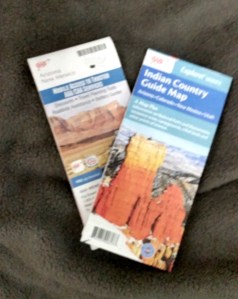
IntroIf you are traveling around the four-corners, you might think your best bet for a map would be one covering one or more of those states.
That seems right, doesn’t it?

Don’t give me any flack about phones and GPS systems. I’m old damn it! I use maps.

Well, it turns out my friend Ken Ascher also uses maps, and he just gave me a quick lesson in how to choose the right map. …at least for the four corners area. You see, he was looking to find Tsaile, which happens to the location of the main campus of Diné College where I used to work.

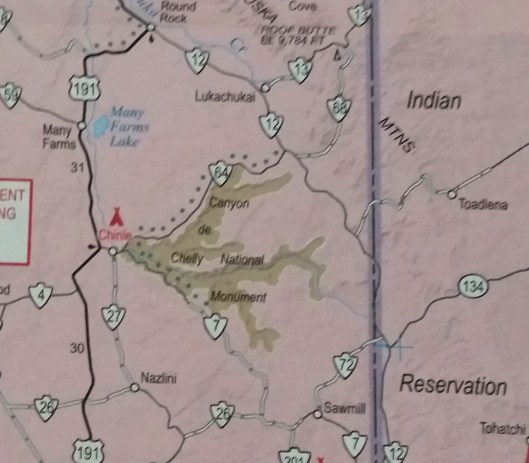
Ken got a AAA map for Arizona and New Mexico and looked and looked. This (just below) is what he saw. You can look and look yourself, but you won’t find it. Tsaile just isn’t on that map. Oh, the little part of the map that I included in that picture does indeed cover the territory that includes the little community of Tsaile, but no, you cannot find Tsaile on that particular map.

Statemaps

You can stop looking now, it’s not there.

Seriously, stop!

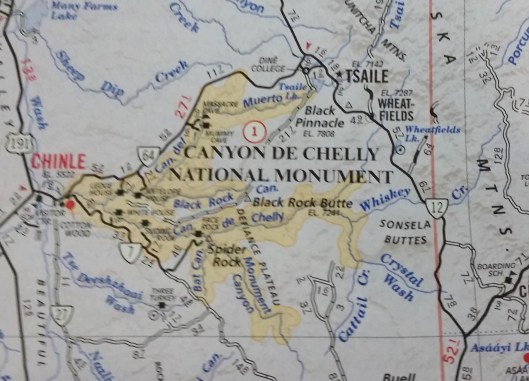
Luckily, it turns out that AAA has a different map for “Indian Country” in all four of the four corners states. It isn’t as detailed, but its purpose is to highlight the features of Indian territory. And thus Tsaile makes an appearance on this map (near the upper right hand corner). Yes, it does. See, it’s right there.

Indian Country.2

Having seen it here in the “Indian Country” map, you can even pop your eyes back up to the map above and see where Tsaile should have been. No, it’s still not there. You can see where it should be, but it’s not there.

The issue doesn’t seem to be resolution. The Arizona and New Mexico map has a higher resolution than the one for Indian country. I somehow doubt that anyone hatched a plot to hide Tsaile from Ken. My guess, is that the criteria for selecting what to put on each map simply differs, and that the difference was enough to make Tsaile disappear (along with quite a few other things, actually). Luckily Ken found the other map and then found his way to Tsaile.

Okay, so this probably isn’t one of the greater injustices to occur in the all-too sordid history of Indian-white relations, but surely there must be a moral somewhere in this story. It might be just to remember that you can get a separate map for Indian country if your traveling through the area. It could also be that you should get as many maps as you can possibly find, so that you can check them all. Hell, it might even be that you should use your telephone GPS, but that way lies madness!

Frankly, I think the moral of the story is that I’m out of ice-cream, which may seem irrelevant to you, but you aren’t the one jonesing for it right now.

That aside, I’m going for the “get the Indian Territory map if that’s where you’re going” moral to this story. If you want to find your way around the reservations in the four corners, you’re going to want that map.

And with that I’m off to dream of ice-cream.

…or better yet frybread!

I miss frybread.

Share this:

  • Tweet
  • Share on Tumblr
  • Click to print (Opens in new window) Print
  • Click to email a link to a friend (Opens in new window) Email
  • Click to share on Reddit (Opens in new window) Reddit
Like Loading...

“The Faith of Christopher Hitchens” …In Which I Read Snake Oil

21 Thursday Apr 2016

Posted by danielwalldammit in atheism, Books, Religion, Uncategorized

≈ 21 Comments

Tags

Anthony Flew, Apologetics, atheism, Charles Darwin, Christianity, Christopher Hitchens, Death, Faith, Larry Alex Taunton

I’m starting to wonder if it isn’t the fate of prominent atheists to end up with Christian apologists for spokesmen. Okay, I don’t literally believe in fate (either), but let’s just say the pattern is starting to look a little too common.

Yesterday, I came across this charming little tweet from professional bigot, Matt Barber.

MattBarber3

Barber’s link connects us to an article discussing an account of Hitchens’s personal life, as related in The Faith of Christopher Hitchens by Larry Alex Taunton. Who is Taunton? He is one of the Christian apologists whom Hitchens debated in his later years. According to Taunton, the two had become close friends in those years, close enough for him to be present throughout much of Hitchens’s struggle with terminal cancer. According to Taunton, Hitchens gave serious thought to converting in those years. Taunton doesn’t say that Hitchens did convert, but he spends virtually the entire book exploring the possibility that Hitchens might have. The author of the article in Barber’s link, Al Perretta, contributes his own 2 cents by telling us that Hitchens own preemptive remarks about the possibility of a deathbed conversion indicate just how much he was thinking about it. If Taunton is content to imply the possibility, Perretta wants to make damned sure we get the hint. And then of course, we have the likes of Matt Barber who sees in the whole thing an opportunity to taunt unbelievers.

It’s a bit like a game of telephone. What Hitchens actually said and thought in private moments before his death we will never know, but we do get to see how Taunton’s account of it takes on ever more polemic significance as others proceed to recount the story. Honestly, I don’t doubt that Taunton and Hitchens were close friends, but I do think Taunton serves his friend poorly by using him in this manner. Damned poorly! Taunton may think his efforts restrained, even respectful, but he has made Hitchens into a commodity of sorts, a chip those in his own camp will now use shamelessly to promote their own views. Whatever respect Taunton may think he has paid Hitchens in writing this, it’s fairly gone by the time we get to the likes of Barber. I somehow doubt Barber will prove to be unusual.

The story is hardly without precedent!

***

I remember when Anthony Flew changed his views on the existence of God. As an active participant in Christian Forums, I lost track of the number of times someone came into the open debate forums to announce Flew’s ‘conversion’. More than a few would-be apologists really seemed to think this odd sort of authority argument would (or should have) swayed a number of unbelievers. A popular atheist had changed his mind. Shouldn’t we do the same?

The full story in Flew’s case would prove far more complicated than the conversion narrative continually promoted by Christian apologists. It doesn’t appear that Flew ever came to believe in the God of Abraham, though he did seem to adopt a Deist position on the existence of God, but this distinction was often lost in the words of sundry believers proclaiming the miracle of Flew’s conversion. Questions remain to this day about just how much some of Flew’s final work, There is a God,  really is the work of Flew and how much of it is really the work of Christian apologists. It’s difficult to avoid the conclusion that something was wrong in Flew’s very public change of position. Flew, a lifelong atheist thus spent his final days voiced, as it were by Christian apologists, his final position on the existence of God communicated by others, many of whom were all to happy to treat Flew’s newfound Deism as a victory for Christianity itself.

Had the Anthony Flew whose writings we all knew become a Christian, he certainly would have made a far more eloquent Christian than his latter-day friends made him out to be.

This sort of response may seem harsh, even disrespectful, but Flew’s final days certainly produced a number of red flags. We don’t normally learn the views of professional philosophers from their long-time debate opponents, and a  professional philosopher writes his own material. For reasons which may or may not be understandable, this did not happen in There is a God, and it isn’t entirely clear that he understood the full contents of that work. Whether or not Flew was clear about what he was doing in those final days, most of us will never know. That many in the Christian community were all-too happy to milk Flew’s shift of position for all it was worth and more is plain to see. Flew’s “conversion” left us all with more of a scandal to ponder than a novel argument on the age-old topic.

As with many public debates, I often found the terms of this one rather oddly skewed. I have often wondered if it is really appropriate to call the mere decision to believe in God a ‘conversion’. When people convert to a faith, they do a lot more than simply change their mind about the truth of a claim. They say prayers. They go to church. The embrace doctrines. They nest, as it were, in their new worldview. For his part, Flew seems simply to have decided that a God of some sort was an essential part of any explanation for the world as we know it. Yet, Christians still proclaim the truth of Flew’s conversion, seemingly immune to the fact that he didn’t end up in their camp either.

***

…and of course there is always Lady Hope!

My first exposure to this story came in some college classroom, a history class I believe. We were discussing Charles Darwin when someone interjected the comment that he had recanted toward the end of his life. The comment hadn’t been at all relevant to the discussion, and the instructor simply didn’t bite. So, we were back on topic in no time, and I found myself wondering what little story I had missed.

That little story was the story of Elizabeth Cotton, or ‘Lady Hope’ as she was called. She claimed to have spoken to Darwin near the end of his life wherein she found him reading Hebrews. Darwin expressed regrets about his scientific publications according to Cotton and discussed plans for holding a congregation in his summer house. If her account is true, then Cotton appears to be the only person to whom Darwin expressed these views. He didn’t tell them to his wife, a devout believer who might well have been quite relieved to hear of his newfound faith. Neither did he communicate them to any of his children or colleagues. But he did communicate these views to Elizabeth Cotton, according to Cotton anyway, and this fact was interesting enough to earn her a little bit of fame among Christian speakers near the end of the 19th century.

***

So, you see this latest bit about Hitchens is hardly without precedent. It seems that when unbelievers become believers, Christian apologists are often the first to know. Hell, sometimes they are the last to know as well. And sometimes they are the only ones to know at all.

I gather the rest of us are supposed to take their account on faith.

***

FaithofHitchensSo, how does Taunton pay his respects to his former friend? Consider the quotes he uses to open the earliest chapters of his book:


“Men despise religion; they hate it, and fear that it is true.” – Blaise Pascal.

“You will always be fond of me. I represent to you all the sins have you never had the courage to commit.” – Oscar Wilde.

“Education without values, as useful as it is, seems rather to make man a more clever devil.” – C.S. Lewis

“God hath given you one face, and you make yourself another.” Shakespeare.

…you get the idea.

These are the pithy little one liners that Taunton uses to frame each of his opening chapters. Yes, the point of each quote is every bit as obvious as it may seem.You might expect a book about a deceased friend to use quotations illustrating something admirable about him, even to outline qualities one might find worthy of praise. Taunton is of course using these quotes to take Hitchens apart.

In “A Requiem for Unbelief,” Taunton relates his personal history with Hitchens and explains his decision to write the book. He describes Hitchens’s life as one of rebellion against God (thus establishing from the beginning a narrative that refuses to take Hitchens’s atheism seriously). Taunton also describes Hitchen?” With this remarkably disrespectful tribute to an old friend, it is no surprise that Taunton would lead the chapter with a quote suggesting that people such as Hitchens must know deep down that he is wrong.

The notion that atheists really believe in God after all is a pretty common theme among Christian apologists. Taunton clearly means to use Hitchens’s life to provide an example of this, an anecdote to show us what so many apologists take for granted, that deep down the most strident atheist is really a frustrated believer of some sort. Thus, Taunton transforms Hitchens’s life into contemptuous dismissal of the very views Hitchens proclaimed throughout that very life. Hitchens didn’t really mean what he said, so Taunton would have us believe, and no-one knows this better than Taunton.

Next Taunton proceeds to tell us that Hitchens’s atheism is rooted in youthful rebellion (hence the line about courage to commit sin) and goes on to explain that Hitchens’s love of learning was little more than an effort to improve his skills in verbal sparring (hence the suggestion that an education was wasted on him). He then borrows from Hitchens’s own allusion to ‘keeping two books’, so to speak, to set aside virtually everything Hitchens ever said in public. Taunton extends this metaphor to suggest quite simply that Hitchens’s public atheism was a false front and that he held other thoughts in private. Who would know those private thoughts?

Taunton, of course!

Taunton’s friendship with Hitchens thus becomes an interesting authority claim, a basis from which to shred everything Hitchens told us about his own life and thought.

…and if your getting a little ill at this point, then I’m right there with you.

This is not the sort of book one writes about a friend. It isn’t even the sort of book one writes about a respected opponent. It is the sort of book one writes about an individual one has already dismissed. It is also the sort of book one writes about a bit of personal capital, an investment ripe for returns. In these opening chapters, Taunton sheds sleight on Hitchens character at every turn. The exercise is as crass as it is dishonest.

Toward the middle of the book Taunton’s narrative softens, but why shouldn’t it? He has already dismissed everything Hitchens ever fought for with a few condescending narrative themes. Having established the sad truth about Hitchens’s personal motivations, Taunton can afford to be more subtle in the later chapters. Following 9-11, Taunton wants us to believe Hitchens embarked on a long trajectory toward faith in God. He began to struggle with moral principles and to explore scripture. This, Taunton seems to suggest was the root of their friendship, and the basis for their many private conversations about Christianity.

Taunton recounts many of these discussions in extravagant detail. One could perhaps wonder how he remembers those details so vividly, but I’m more interested in the transition from argument to story-line. The conversations with Hitchens that Taunton describes are full of disputation, point and counter-point. They are discussions in which two men contest with each other over what is and what isn’t true. But of course, these arguments come to us within the larger frame of a story told by Taunton himself. Not surprisingly, the course of each argument flows nicely into the story-line Taunton has chosen to provide us. It is a story-line that resolves each of the disputes quite unsurprisingly in Taunton’s favor.

Taunton’s single-minded handling of the issue is hardly subtle. He consistently gives himself the final word and of course Hitchens concedes a number of things to Taunton, but only in these private conversations. Hitchens accepts arguments without rejoinder, at least in the chapters of Taunton’s book, and he takes correction without rebuke. The final chapters of this work are a record of debates clearly dominated by Taunton, at least according to Taunton himself. And of course each of these arguments provides another step in the story of  Hitchens’s transformation toward a believing Christian. Taunton stops short of claiming the transformation actually occurred, though he wants us to believe it may well have, that Hitchens might have made it to the one true faith as Taunton understands it. Hell, Taunton even assures us that Hitchens would never have converted to Catholicism. If he converted, Taunton would have us believe, it must have been to the right kind of Christianity.

If Hitchens never said anything about his conversion, what are we to make of that? Perhaps it means he didn’t convert at all, but perhaps, the story-line here seems to suggest, it is because he can’t. Hitchens was too committed to his own public personae, or so Taunton would have us believe. he couldn’t afford to tell us if he really believed in God after all. He was already too invested in a godless public personae. So, Hitchens couldn’t tell us how he really felt.

What are we to expect of a man who kept two books?

One of the more striking features of Taunton’s narrative is the pe-emptive arguments he lays out in the course of the book. Hitchens lack of an explicit statement of faith is easily explained by his allusions to keeping two-books of his own life. Will atheists object to this account? Well of course, but that is just because we are fighting over Hitchens body, as Taunton describes the issue. Atheists skeptical of claims that Hitchens either embraced Christianity or came damned close to it are just too busy keeping score. It’s hard to imagine a more blatant example of projection than that, but it seems to be par for the course in this book.

Taunton seems to regard his friendship with Hitchens as unimaginable in the eyes of many, especially in the eyes of unbelievers. That he also takes Hitchens’s willingness to become friends with a Christian to be evidence of interest in conversion suggests that if anyone has trouble wrapping his mind around such a friendship it is Taunton himself.

It seems clear enough that Taunton doesn’t really take the possibility of a meaningful life as an atheist seriously. We can’t even tell a child from a piglet, as he suggests. Our worldview denies the possibility of meaningful moral scruples, according to Taunton. So, if he encounters an unbeliever with a profound sense of moral values – if Taunton allows himself to see this in such a person – it can only mean one thing, that that atheist isn’t really an atheist after all. He is a Christian waiting to get out. Short of an actual conversion, this is the best Hitchens could ever be to Taunton. And so Taunton’s own inability to imagine his own friendship becomes proof positive that his friend’s character must really be as Taunton would make of it.

***

Hitchens, it would seem, wasn’t really an unbeliever, and the only people who know it are the Christians whose faith he denounced publicly throughout his entire life. All in all, it’s a pretty shameless production. Once again, we find an unbeliever really does believe in God after all, or very nearly so. The trouble is that he only told a believer about all of this, at least according to the believer.

Taunton may think this is a novel story.

I think it’s a rather tiresome cliché.


Share this:

  • Tweet
  • Share on Tumblr
  • Click to print (Opens in new window) Print
  • Click to email a link to a friend (Opens in new window) Email
  • Click to share on Reddit (Opens in new window) Reddit
Like Loading...

Rapture Blister Burn …Spoiler Alert!

18 Monday Apr 2016

Posted by danielwalldammit in Alaska, Politics, Uncategorized

≈ 2 Comments

Tags

Alaska, Anchorage, Betty Friedan, Feminism, Gina Gionfriddo, Phyllis Schlafly, Play, Rapture Blister Burn, Theater

RBBPamphlet

Catherine Croll (Anna Wyndham) writes about violent pornography. She’s a well known feminist and a successful scholar. So, what is she doing singing the praises of Phyllis Schlafly?

Well it seems that something is missing from Catherine’s life, and that something is the family that conservative anti-feminist Schlafly warned women about so many decades past. Coming home to help her ailing mother, Catherine finds herself living near her college boy-friend, Don Harper (played by Frank Delaney) and his wife. Don’s wife is Catherine’s own former friend and roommate, Gwen (Shelly Wozniak). The two of them have two children. Catherine can see that they are struggling, and yet she can’t help but envy them. Seeing them makes her rethink some of her own life choices, and a part of her wishes she could exchange her life for Gwen’s. Impossible, right?

But what if it isn’t?

As it turns out, Gwen has second thoughts about her own life, and Don? Well, Don still fancies Catherine. So, it just may be that she can have him after all. It may well be that she can step right into Gwen’s life as Gwen runs off to pursue an advanced degree of her own.

Yep! The ghost of Trading Places haunts this play. It does indeed.

***

20160415_101933There isn’t a lot of live theater on the North Slope of Alaska. No, there isn’t. Heck, there isn’t a lot of movie theater on the North Slope. Nope! Hell, there isn’t even a lot of television theater in my own home. (Okay, that’s my own choice, but still!). So, I often check to see if anything is playing at a local theater when I’m in Anchorage. This time the answer was yes, at Cyrano’s, and my schedule didn’t even stop me. So, there I sat watching the opening scenes of this play and realizing for the first time what it was about.

The play is Rapture Blister Burn, written by Gina Gionfriddo and directed by Krista M. Schwarting. It’s been playing at Cyrano’s since April 1st and it’ll continue running through the 24th. If you’re in the area, and if the F-word doesn’t scare you, it’s definitely worth seeing.

So anyway, there I sat, watching as a series of inter-related stories began to unfold on the small stage in front of me. Much of the action takes place in a class Catherine teaches during the summer. Put together at the last minute, the class ends up with exactly two students, Gwen, and a young college student named Avery (Olivia Shrum). When Catherine’s mother, Alice (Sharon Harrison) joins the conversation, the result is three generations of women gathered together to discuss feminist theory. We are soon treated to a quick and dirty version of Betty Friedan’s critique of domesticity, followed shortly thereafter by an account of Schlafly’s critique of feminism. Throughout this, the focus of discussion remains squarely on the trade-off between family life and a career as each of the characters weighs in on the (dis-)advantages of each.

20160414_201115I’m not normally a fan of explicit theory in a story-line. I always want to ask the writer to write an essay if that’s what they really want to do. In this case, however, all this theory really is part of a story. The real question here is how the women use these theories to make sense of their own lives and to communicate with one another about the decisions each of them face. We are asked to consider the theories, yes, but we are also invited to think about what each theory means to the characters invoking them.

Oddly enough, it is Gwen (the stay at home mother) who champions Friedan and Catherine (the single woman with a successful career) who keeps telling us that Schlafly “had a point.” Avery and Alice are there largely to provide a running commentary as each of the two main participants struggle to rework their own life stories in light of the course material.  This is very much a story about women in their middle-ages, women with enough life behind them to have a few regrets and with enough ahead of them to feel a trace of hope.

I would be remiss if I didn’t take a moment to say how much fun the dialogue can be in this play. each of the characters comes into her own at some point in the story. Even Don has his moments, but for my money Avery has the best lines. Perhaps, it’s just the wicked joy that Shrum seems to take in playing her. At any rate, she had me laughing. But then they all did at one time or another.

Catherine’s praise for Schlafly is ironic, of course. We are supposed to understand this is a heresy of sorts, and yet it’s a heresy born of a deeply personal dilemma. For all her success, Catherine is clearly not happy, and she sees in Gwen’s family something that is missing in her own life. She will of course get a chance to test this theory. She will get Don back, if only briefly. She will get a chance to take care of Gwen’s youngest child, and she will see this arrangement all fall apart before the end of the summer. Gwen will give up grad school and return home. Don will prove himself unwilling to keep up with a successful spouse and opt for the comfortable life he has already made for himself, leaving Catherine with little to do but take up her promising career once again and plow through her successful life without a steady relationship.

It is perhaps not such a bad fate for Catherine, so it would seem. She is free despite herself. In the end, we are told Schlafly was right, though perhaps the lonely fate of a successful feminist is not so bad after all.

***

I’m back in the North Slope now and still wondering what it was I watched. I find myself in the ever so odd position of feeling a bit out-cyniced. That doesn’t often happen to me. There is a story in here about families. It’s not a very pretty one. Don and Gwen are pathetic. They had created a family out of their own personal failures, and in the course of the story, they recreated it when their newfound courage failed them once again. Catherine and Avery are the only ones who walk away from the story with anything like a future, but they do so with little hope for families of their own. In Catherine’s case, at least, that is a genuine loss. She did want to have her cake and eat it too, and in this case she just isn’t going to get to do that.

So, how do I feel about this? It depends on the stories of the moral.

The play is at its strongest if we minimize the lesson. This can be a story about how life has a way of refuting our theories and foiling our choices. As a story about middle-aged people, this is also a story about how decisions once meant to create a life become the source of limitations inhibiting our lives. We see in this story how Catherine once sacrificed a relationship for a career only to find (too late) the choice cost her more than she imagined. Don and Gwen both chose a family life over career ambitions only to find their own family languishing in the lack of professional rewards. Each of these characters seems to find the down-side of their past decisions a bit more significant than they once imagined. It’s an excellent story about the many ways that simply being human can damned well get in the way of trying to be something else. That’s a lesson I can identify with.

As specific statement about feminism, I can’t help thinking the play is a bit more objectionable. It’s view of family life is especially grim, perhaps unfairly so. (By perhaps, I probably mean something more like “almost certainly.”) What the play says about career women seems still more egregious. It asks us to accept that this one woman, Catherine, must choose between a family and a career, and of course the real problem here is just how much we may generalize about her dilemma. That is where I find myself wanting to back out of the premise.

It isn’t just that I think Catherine should have her cake and eat it too. I could swear that I know women who have done precisely that. I’ve dated women who’ve done that. Hell, I’ve worked with and/or for women who have raised families and enjoyed successful careers. I don’t doubt the stress of doing both may have made misery of their lives on at least a few occasions, and I don’t doubt the cost of trying to do both falls harder on women than it does men. I don’t even doubt that in some individual cases, handling both becomes too much, but my point is that women have done it.

Of course, I can accept the premise that trying to have both isn’t working for a single character in a wonderful little play. But I can’t help thinking the story isn’t just about her. There is a reason, she and the others spend so much time telling us about feminist theory, and it isn’t because this is only a particular story of a particular woman and her particular set of friends.

Which brings us to yet another story. Whatever else this play is about, it definitely contains a story about feminism. But in this respect it is NOT a story about middle-aged women at all. It is a story about elderly and deceased women. I can’t help wondering at the focus on Friedan and Schlafly. These are the iconic figures that haunt the tales told by the characters in this story, the figures who have shaped the stories of those characters. Their choices have thus been framed in terms of gender politics as they were defined quite some time ago. I’m a little out of my element here, but I feel safe in suggesting other theorists might have provided these characters with an entirely different set of questions to struggle with. This is an interesting story, but I suspect one that missed a few options in the telling.

By ‘missed’ I might mean ‘denied’.

***

(Whenever I’m a Cyrano’s I can’t help wishing I’d been around for a few of these plays. …Jihad Jones?)

?
?
?
?
?
?
?
?
?
?

Share this:

  • Tweet
  • Share on Tumblr
  • Click to print (Opens in new window) Print
  • Click to email a link to a friend (Opens in new window) Email
  • Click to share on Reddit (Opens in new window) Reddit
Like Loading...
Newer posts →

Top Posts & Pages

  • Movie Review: The Orator
    Movie Review: The Orator
  • I'll Just Leave This Here
    I'll Just Leave This Here
  • An Uncommon Security Guard: Dave Eshelman, AKA 'John Wayne'
    An Uncommon Security Guard: Dave Eshelman, AKA 'John Wayne'
  • Hostiles and Spoilers: A Magic Studi
    Hostiles and Spoilers: A Magic Studi
  • A Joke from a Bygone Era
    A Joke from a Bygone Era
  • An Ironic Beating
    An Ironic Beating
  • Paul Newman IS Homo Economicus: A Spoiler-Filled Review of Hud.
    Paul Newman IS Homo Economicus: A Spoiler-Filled Review of Hud.
  • Ten Little White Indians, Volume II (Spoilers Abound!)
    Ten Little White Indians, Volume II (Spoilers Abound!)
  • An American Flag as a Weapon, Redux.
    An American Flag as a Weapon, Redux.
  • An Irritation Meditation: The Majority Rules Meme
    An Irritation Meditation: The Majority Rules Meme

Topics

  • Alaska
  • Animals
  • Anthropology
  • atheism
  • Bad Photography
  • Books
  • Childhood
  • Education
  • Gaming
  • General
  • History
  • Irritation Meditation
  • Justice
  • Las Vegas
  • Minis
  • Movie Villainy
  • Movies
  • Museums
  • Music
  • Narrative VIolence
  • Native American Themes
  • Philosophy
  • Politics
  • Public History
  • Re-Creations
  • Religion
  • Street Art
  • The Bullet Point Mind
  • Travel
  • Uncategorized
  • Uncommonday
  • White Indians
  • Write Drunk, Edit Stoned

Blogroll

  • American Creation
  • An Historian Goes to the Movies
  • Aunt Phil's Trunk
  • Bob's Blog
  • Dr. Gerald Stein
  • Hinterlogics
  • Ignorance WIthout Arrogance
  • Im-North
  • Insta-North
  • Just a Girl from Homer
  • Multo (Ghost)
  • Native America
  • Norbert Haupt
  • Northwest History
  • Northy Pins
  • Northy-Tok
  • Nunawhaa
  • Religion in American History
  • The History Blog
  • The History Chicks
  • What Do I Know?

Archives

  • December 2023
  • November 2023
  • June 2023
  • April 2023
  • February 2023
  • December 2022
  • November 2022
  • October 2022
  • September 2022
  • August 2022
  • July 2022
  • June 2022
  • April 2022
  • January 2022
  • December 2021
  • November 2021
  • October 2021
  • September 2021
  • August 2021
  • June 2021
  • May 2021
  • March 2021
  • February 2021
  • January 2021
  • December 2020
  • November 2020
  • October 2020
  • September 2020
  • June 2020
  • May 2020
  • March 2020
  • February 2020
  • January 2020
  • December 2019
  • November 2019
  • September 2019
  • August 2019
  • July 2019
  • June 2019
  • May 2019
  • April 2019
  • January 2019
  • December 2018
  • November 2018
  • October 2018
  • September 2018
  • August 2018
  • July 2018
  • June 2018
  • May 2018
  • April 2018
  • March 2018
  • February 2018
  • January 2018
  • December 2017
  • November 2017
  • October 2017
  • September 2017
  • August 2017
  • July 2017
  • June 2017
  • May 2017
  • April 2017
  • March 2017
  • January 2017
  • December 2016
  • November 2016
  • October 2016
  • September 2016
  • August 2016
  • July 2016
  • June 2016
  • May 2016
  • April 2016
  • March 2016
  • February 2016
  • January 2016
  • December 2015
  • November 2015
  • October 2015
  • September 2015
  • August 2015
  • July 2015
  • June 2015
  • May 2015
  • April 2015
  • March 2015
  • January 2015
  • December 2014
  • November 2014
  • October 2014
  • July 2014
  • June 2014
  • May 2014
  • April 2014
  • March 2014
  • February 2014
  • January 2014
  • December 2013
  • November 2013
  • October 2013
  • September 2013
  • August 2013
  • July 2013
  • June 2013
  • May 2013
  • April 2013
  • March 2013
  • February 2013
  • January 2013
  • December 2012
  • November 2012
  • October 2012
  • September 2012
  • August 2012
  • July 2012
  • June 2012
  • May 2012
  • April 2012
  • March 2012
  • January 2012
  • December 2011
  • November 2011
  • October 2011

My Twitter Feed

Follow @Brimshack

RSS Feed

  • RSS - Posts
  • RSS - Comments

Enter your email address to follow this blog and receive notifications of new posts by email.

Join 8,075 other subscribers

Blog at WordPress.com.

  • Subscribe Subscribed
    • northierthanthou
    • Join 8,075 other subscribers
    • Already have a WordPress.com account? Log in now.
    • northierthanthou
    • Subscribe Subscribed
    • Sign up
    • Log in
    • Report this content
    • View site in Reader
    • Manage subscriptions
    • Collapse this bar
 

Loading Comments...
 

    %d