• About

northierthanthou

northierthanthou

Tag Archives: Taos

Religious Freedom and a Great Big Church!

17 Wednesday Mar 2021

Posted by danielwalldammit in Native American Themes, Politics, Religion

≈ 4 Comments

Tags

Blue Lake, Congress, First Amendment, free exercise, religion, Religious Crimes Codes, religious freedom, Taos, Taos Pueblo

What does religious freedom look like today?

Apparently it’s a wedding cake, or more to the point, the absence thereof.

Today, religious freedom is a-cakeism.

For some folks anyway!

Religious freedom has meant different things to different people at different times.

Let me tell you about a time when religious freedom looked like a lake!

I don’t have a picture of the lake. I don’t even have a picture of the absence of it, because the lake is real; I just can’t go to it. Most of us can’t go to it. That’s religious freedom.

At least it does to the people of Taos Pueblo.

What I am talking about here is a landmark piece of legislation, known as the Blue Lake Amendments, which was signed into law by Richard Nixon in 1970. The law returned Blue Lake, along with its watershed to the people of Taos Pueblo, in effect placing roughly 48,000 acres under trust title for the benefit of the Pueblo. This rationale for doing this was explicit; this was done because it was deemed the only effective means of protecting the religious freedom of Taos Pueblo and its people.

That’s right!

Congress placed 48,000 acres of land under trust title because doing so was necessary for the protection of religious freedom.

***

To fully appreciate this, you have two wrap your minds around two things (at least by my reckoning);

  1. it isn’t clear that Native American peoples practice ‘religion,’ or at least that this term with all its Euro-American baggage can be applied to any aspect of Native American society without distorting a few things in the process.
  1. Prior to 1970, Native Americans simply did not enjoy religious freedoms, and the elders of Taos Pueblo had been especially targeted for abuse on the basis of religious practices.

Is that a contradiction?

To say that Native Americans don’t necessarily have religions, then to say that their religious practices have been attacked?

Perhaps.

But only because language is a tricky thing.

***
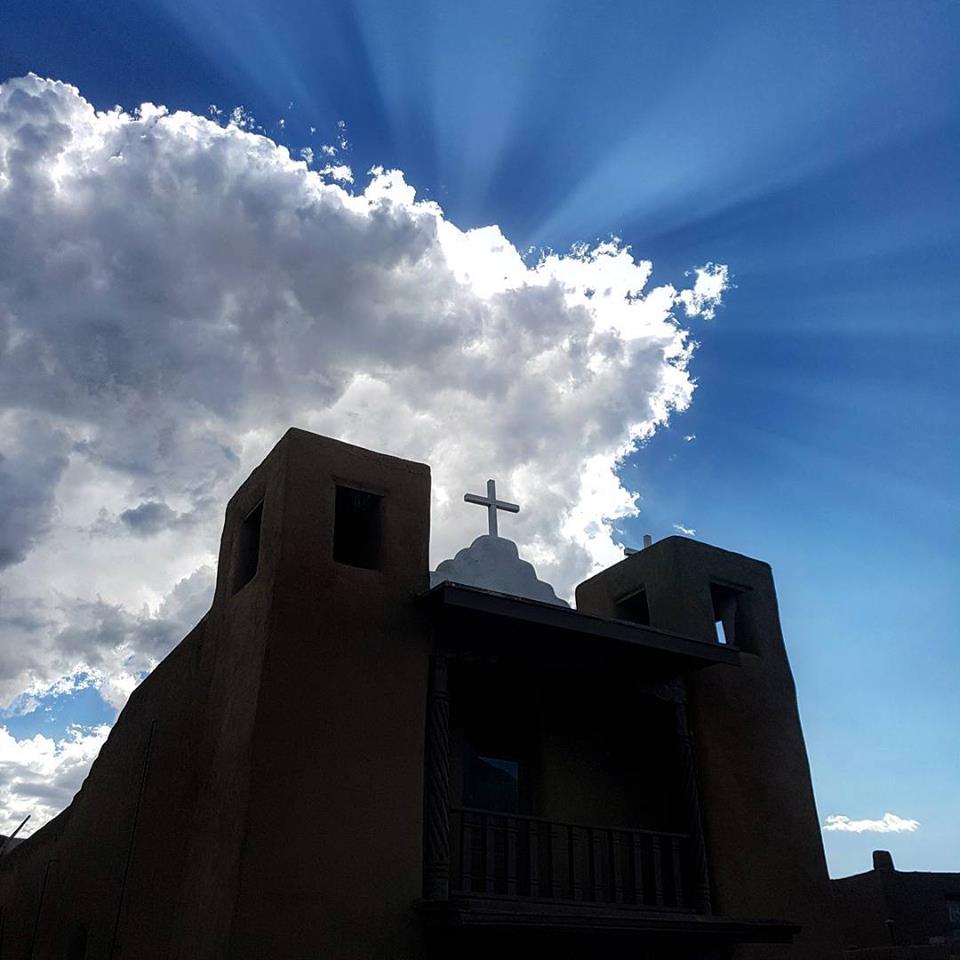
The current church at Taos

The first point is a question of social morphology, i.e. the language we use to chop up society into meaningful chunks of related activities. As it has typically been defined in western traditions, religion is a function of what you believe. Your membership in a given faith is a function of your decision to affirm or deny its tenets, and you religious practice is largely a function of prayer. Church may be a good place for prayer, but prayer is something you can do yourself.

As to the role of priests, mileage varies.

My point is simply that the concept of religious freedom has developed in a tradition in which religion is defined largely in individualistic terms. We can see how religion influences art, education, politics, and so on, but we can usually find some means of separating what counts as religion from what counts as the rest. It’s a lot harder to do this with Native American societies in which ceremonial participation was typically a function of community membership. Rather than helping Lutherans distinguish themselves from Methodists, etc. these ceremonial systems were historically much better suited to uniting communities, at least for a moment of social interaction. The practices in question are accordingly ubiquitous. Native ceremonial themes pop up in their politics, their art, their kinship, their hunting and farming techniques, etc. This is why the establishment clause was omitted from the Indian Civil Rights Act. It’s also why the word ‘sacred’ has become a highly over-used buzz-term in Indian-white relations. It’s short-hand for “this is important,” and for; “You guys probably wouldn’t understand.”

I think you could honestly say that Native American societies do contain almost everything we typically convey with the term ‘religion.’ What I don’t think we can say is that they isolate those elements of religious meaning from other aspects of their social life. This makes it kind of difficult to think about religious freedom in the context of Native American social practice.

Course it helps if you try.

***

North side of the Pueblo

Which brings us to point number two, which is that for most of United States history, you’d be hard pressed to find anyone who thought about any aspect of Native American life in terms of religious freedom. Few in Native American circles seemed to try the argument, and fewer still outside those circles were prepared to respect those freedoms, or even to recognize them as such. When the office of Indian affairs turned its attention to cultural warfare instead of literal shooting wars, one of the first things they did was to formulate the religious crimes codes outlining punishments for Native American religious practice. This was all part of the effort to ‘kill the Indian’ in order to ‘save the man,’ so to speak, but for the present, the point is that government officials deliberately sought to punish Native Americans for practicing heir own religions. They even used the word ‘religion.’

The word ‘freedom’ didn’t enter into it.

It’s hard to say just how much these rules were enforced. It fell upon indigenous judges to do this, and it should surprise no one if more than a few of those judges found reasons not to. What we can say is that Taos felt the sting of these codes well into the twentieth-century, In the 1920s, Commissioner of Indian Affairs, Charles Burke had a number of Taos elders locked up on the authority of the Religious Crimes Codes. He was particularly outraged that they had taken children out of the schools for purpose of training in the ceremonial kivas.

Somewhere between the 1920s and 1970, the political climate in America had changed sufficiently that same government which had once locked up Taos elders for practicing their faith (and in particular, for teaching it to their children) was now prepared to protect the religious freedom fof Taos people, even to the extent of making claims on a rather large tract of land.

***

What happened?

Significant changes in Federal Indian policy combined with shifts in the national culture may have helped the case for return of Blue Lake, but much of the credit would have to go to the Taos people themselves. Their own response to conflict over the lake forged much of the logic for return of Blue Lake to their land base. Arguably, their decisions also transformed the way that native and non-native alike came to view a range of issues now commonly thought of as involving matters of religious freedom.

***

Flowing down from Blue lake itself, this stream cuts through the center of town

The trouble began in 1906, when…

No, it began before that.

The trouble began with the Treaty of Guadalupe Hidalgo in 1848. This treaty concludes the Mexican-American war. Its terms include cession of lands to the United States, including present-day New Mexico, and it also includes guarantees that pueblo land grants within New Mexico would be recognized and protected by the United States. Unfortunately, Blue Lake was not in the land grant for Taos, a fact which had never been much of an issue under Spanish or Mexican occupation. As Americans began settling into the area, the lack of title would soon become a problem.

This brings us back to 1906.

In 1906, the Federal government placed Blue lake and the surrounding lands under the control of the Forest Service. Today, some will tell you this is when the trouble began. Interestingly enough, this wasn’t seen as trouble at the time. An informal understanding with administrators in the Forest Service served for a time to help protect the lake from outside encroachment. It wasn’t until later, with changes in local administration, that this legal status became a problem.

What made it a problem?

It was a problem that the forest service clear-cut a section of land within the watershed.

It was a problem that they stocked the lake with game fish for sport fishing.

It was a problem that they built a cabin by the lake.

It was a problem when they allowed visitors into the area.

None of these things were consistent with the Pueblo’s own use of the lake which was largely centered around ceremonial practices carried out at the lake at specific times of the year. The Forest Service was implementing its own multiple use policies and planning long-term harvesting of the trees, consistent with the conservationist policies of the era. Such practices threatened the pristine environment critical to the significance of the lake in Taoseño cosmology. These changes were already too much. Who knows what could happen next? So, the Pueblo began to seek return of Blue Lake.

The campaign to secure return of Blue Lake was a long haul. It took many twists and turns, not the least of them being an effort to bargain with the Pueblo Lands Board (in effect, conceding interest in lands held by non-native squatters in exchange for a recommendation that Blue Lake be returned, …the concession was accepted; the recommendation was not made). Somewhere along the line, there was a cooperative agreement with the Forest Service, but that didn’t work out. When the Pueblo won a case before the Indian Claims Commission, they side-stepped the financial compensation to which they would be entitled, seeking instead to secure the return of Blue Lake and its watershed. This was not within the mandate of the claims commission, so the Pueblo turned to Congress.

This is where the argument for religious freedom came in.

(Believe me, I am skipping a lot of great detail here.)

In their dealings with Congress, lawyers working for the tribe began making arguments for the return of Blue Lake based on an explicit appeal to the principle of religious freedom. The people of the Taos Pueblo needed exclusive access to the lake and its watershed to perform the rituals central to their religious practice. It was, so the argument went, their church. Even the need to explain all this placed a double-bind on the tribe, however, because much of the religious symbolism of the lake and the ritual performed there was secret, being known only to leadership in the kiva societies. As each of these societies was responsible for different aspects of the ceremonial system, this meant nobody within the Pueblo had full knowledge the matter themselves, let alone some outsider. Explaining the details of the ceremonial sustem to outsiders would violate their religious interests as effectively as preventing access to the lake. This was a problem that cut both directions. If providing this information was a threat to the religious freedom of the Pueblo, failure to do so was a problem for Congress. They had to be sure they were acting on good faith claims. The solution took the form of outside experts. Anthropologist John Bodine, was particularly helpful in outlining the significance of the lake for the Taos people to the satisfaction of Congress.

To be clear, this was a hard sell. Some folks balked at the notion of 48,000 acre church, let alone one that could not be fully explained to outsiders. Additional concerns were raised about other indigenous peoples with sacred sites of their own. What sort of precedent would this set? All of these questions and more stem from the uneven fit between indigenous ceremonial systems and mainstream American ideas about religious freedom, but how was Taos to answer them? How was Congress? A court might have addressed these issues differently. A court would have had to demonstrate its fairness to an opposing legal team, and a court would have had to think quite seriously about that legal precedent they were setting for future cases. But this was Congress, and Congress could set aside 48,000 acres without answering to an appeal or spelling out a precedent for the future. As a legislative body, Congress had more options than a court would, and that meant it could accept the argument for religious freedom as the basis for a one-time decision.

One-time deal, or not, Blue Lake was a precedent in the moral sense. It established the principle that Native Americans were entitled to religious freedom, and if their traditions were more difficult to address within the context of American legal system, this was no longer an excuse for ignoring them altogether. Congress would later pass The American Indian religious Freedom Act (AIRFA), affirming the principle of religious freedom for Native Americans and arguably mandating that federal officials take that freedom into account in their own policies. This didn’t always go as planned. Courts had a way of finding against native claimants throughout the 70s and 80s, a pattern which included several cases involving sacred sites, and of course Scalia took a wrecking ball to the whole damned free exercise clause in the Smith peyote decision. Compliance with the AIRFA by federal agencies has been a mixed bag. Yet, even these mixed results are a marked improvement over previous eras. Lest this seem like faint praise, one has only to remember the crimes codes and the fact that it was once official U.S. policy that Native Americans could be locked up for practicing their own ceremonies. Today, the notion that Native Americans are entitled to religious freedom, just like the rest of us, is now commonly accepted as a given.

It was Taos Pueblo that brought made this possible.

***

What does a sacred site look like?

In this instance, it looks like a lake that most of us will never see.

That is a kind of religious freedom.

***

A note on sources: At one time or another, I read everything I could on this topic, but that’s ancient personal history. I wrote this mostly from memory, and from an old grad school paper, but my old files aren’t with me. As far as I am aware, the best single source to get a relatively complete version of this story here was written by R.C. Gordon-McCutchan, Taos Indians and the Battle for Blue Lake.

Regarding the pictures, I am still nervous about them. It wasn’t that long ago that visitors to Taos Pueblo were expected to refrain from taking them. A few years back, I remember being told we could take them for personal use, and the last couple times I visited, we were simply allowed to take pictures with no restrictions mentioned. I think I still refrained from taking any pics for at least one visit, and finally snapped a few pics. It is a really beautiful place though, and if it is now okay with the Pueblo, as I believe it is, I thought I’d like to share the few images posted here.

Share this:

  • Tweet
  • Share on Tumblr
  • Click to print (Opens in new window) Print
  • Click to email a link to a friend (Opens in new window) Email
  • Click to share on Reddit (Opens in new window) Reddit
Like Loading...

A Wondrous Road Trip!

23 Tuesday Jan 2018

Posted by danielwalldammit in Bad Photography, Travel

≈ 5 Comments

Tags

California, New Mexico, Road Trip, Route 66, Santa Fe, Summer, Taos, Travel, Wonder Woman

26907655_10215389345631925_8037646231883862717_n

Just south of Taos

It was the summer of Wonder Woman. I mean, I know she was in the theaters this last summer, and I certainly enjoyed the movie, but that’s not what I’m talking about. She was in our car. Wonder woman, I mean. She was in our car.

Yep!

We were wondering what that strange sound was coming from the back. We didn’t hear it often, at first anyway, but it was just an odd sound. Were the Jarritos bouncing up against the Mexi-cokes? Maybe something was falling out of the luggage? No, not that over and over like that, and it doesn’t sound like bottles. Neither Moni nor I could quite place it. And then an impression started to form, but it just couldn’t be right. I thought perhaps all those years of role-playing geeketry were playing havoc with my ears, because I couldn’t possibly be hearing it right. Still, the more I listened, the more convinced I became.

“Is that a sword?”

“It does sound like a sword, yes.”

Hearing Moni confirm my seemingly-impossible impression was a little reassuring. It was also a little disturbing. Why in the hell would the sounds of sword fighting be coming from the back of our vehicle? And then Moni remembered the costume. I had bought her a Wonder Woman costume for super-hero day at her gym. It came with a plastic sword and that sword made sounds whenever you moved it around. We meant to give it to one of of her nieces or nephews, but I guess we never got around to it. Instead, the noisy blade was buried somewhere in the back beneath a pile of luggage, snacketry, random shoes, and countless things we probably didn’t need. Evidently, the sword had room to juggle. So, Wonder Woman had room to fight in the back of our vehicle.

No matter! We would dig her out soon enough.

I think we first noticed the sound on a trip to Sequoia National Park. We could still hear Wonder Woman doing battle after a diversion to Monterey, another trip to Sacramento and San Francisco, several small trips around Los Angeles, a road trip to Santa Fe by way of the Navajo Nation, at least three trips back to to Taos Pueblo through Espaniola, one to Bandelier, one to Kasha Katuwe, and one each to Santa Ana Pueblo and Cochiti. We never did find her, or if we did, we missed the chance to find her a new home. Hell, she was still fighting her foes when we made it finally back to California at the end of the summer.

We actually did make an effort to find Wonder, but we were thwarted by the piles of unnecessary baggage. So, Wonder Woman spent the summer with us. She protected us from evils all across the southwest, and even scolded us when we did wrong. She could be kinda bossy that way, but otherwise, I must admit the living weapon herself was actually pretty good company.

Presumably, her sword is in storage now.

It’s been a little over six months now, so I guess it’s time to share some pics from our road trip, the one Moni and I took with Wonder Woman.


I’ve already blogged about a few of these things, but I do plan to produce at least one more post about the street art in San Francisco. I’ve posted about the Institute of American Indian Arts before, and about Santa Fe. These are definitely favorite stops of mine. Here are a few pics (click to embiggen)!

Moni's Nephews in the Kiva at Old Pecos
Moni’s Nephews in the Kiva at Old Pecos
Little Sister isn't impressed with the Quinceañera pics
Little Sister isn’t impressed with the Quinceañera pics
Institute of American Indian Arts
Bandelier
Bandelier
We need one of these trucks here in Barrow before the next 30 days of night
Restaurant in Taos
Restaurant in Taos
Just south of Taos
Just south of Taos
Church at Taos Pueblo
Institute of American Indian Arts
Old Pecos Pueblo
Old Pecos Pueblo
Near Bandelier
Near Bandelier
Whaling Wall in San Francisco
Old Pecos Pueblo
Old Pecos Pueblo
Pecos
Pecos
Tragedy at La Brea Tar Pits
Muckrock Mural at Taos
Somewhere in Northern California
Window Rock, AZ (I used to work a short stroll from here)
Bandelier
Bandelier
Santa Fe
Santa Fe
Three Amigos?
Three Amigos?
Fat Man replica at Los Alamos
Horseshoe Bend
Horseshoe Bend
Taos Pueblo
Taos Pueblo
San Dimas
San Dimas
Santa Fe
Santa Fe
Kiva at Old Pecos Pueblo
San Francisco
San Francisco
The Institute of American Indian Arts
Somewhere in Los Angeles
Madrid, New Mexico
Madrid, New Mexico
Getting some shade near Horseshoe Bend
This guy was bathing in a fountain at Window Rock, Navajo Nation
Note the building from another pic
Face off!
Face off!
Women's Building in the Mission District in San Francisco
Women’s Building in the Mission District in San Francisco
Yeah...
Yeah…
San Francisco
San Francisco
Horseshoe Bend on the Colorado River
Moni and Annie at Harvey Milk's old haunt
Moni and Annie at Harvey Milk’s old haunt
Seems to be a car show in town (San Dimas)
Coastline near Monterey
Stump in Sequoia
Stump in Sequoia
Big Stump
Big Stump
I think Moni wanted to drop me off here, not sure why
Pomona
Pomona
26239122_10215319195278210_5540301171360502791_n
San Juan, Fiesta
San Juan, Fiesta
Thai Restaurant in San Francisco (I think this was our waiter)
The Ned Hatathli Center at Diné College
San Francisco Mural
San Francisco Mural
This Guy lives near Williams, ARizona


Share this:

  • Tweet
  • Share on Tumblr
  • Click to print (Opens in new window) Print
  • Click to email a link to a friend (Opens in new window) Email
  • Click to share on Reddit (Opens in new window) Reddit
Like Loading...

The Stars and Stripes in Two Takes

28 Thursday Jun 2012

Posted by danielwalldammit in History, Native American Themes, Politics

≈ 18 Comments

Tags

American Indian, Flag, Jingoism, Native American, Patriotism, Rodeo, Star Spangled Banner, Taos

Entrance of the Flag

July 4th came a little early for me this year, or at least I found the American flag playing an unexpectedly prominent role in my weekend. The first occasion to think about the Stars and Stripes occurred at the Rodeo de Santa Fe on Saturday.

We arrived just a few minutes before the announcer asked the crowd to rise for “the most beautiful flag in the world.” He went on to tell us that people in other parts of the world look to it as a symbol of freedom. In just a few moments, a young lady with a beautiful voice begin to sing the National Anthem, but I have to admit I was already out of the moment. There was something about the tone of the introduction that had me a little on edge.

The announcer presented himself well and genuinely enhanced the overall experience of the rodeo, but I personally like my patriotism without a dose of jingoism. Hell, I could live with the description of the Star Spangled Banner as the most beautiful flag in the world. People in other nations might say the same of theirs, but if patriotic sentiments made their appearances solely in such expressions, then all my concerns about the matter could be resolved with a wink and a chuckle.

No harm – no foul, as far as I’m concerned. But of course, that wasn’t all…

When I heard this same announcer say; “(America) love it or leave it,” I have to admit I was genuinely displeased. That is the sort of chip-on-the-shoulder patriotism that I can do without. Granted, this sort of expression was not entirely to be unexpected at a rodeo, an event that out-Americans apple pie. But perhaps that was the problem; this little bit of verbal shadow boxing was quite unnecessary. It’s one thing to get aggressive when facing opposition, but when you’re doing your own thing amongst folks with a similar outlook, and its going well, and people are enjoying themselves, I can’t help thinking that a simple invitation to find some positive value in the flag and the nation would be the way to go.

The thing that really caught my attention was the claim that others around the world look to the American flag as a symbol of freedom. To be fair, I expect some do, but I also expect some don’t. Standing there waiting for the national anthem to begin, I couldn’t help wondering how far I would have to go to find someone who might find the flag just a little ominous.

As it turns out, I did not have to go far at all.

The next day, I found myself standing with a group of friends and coworkers in the Catholic Church at Taos Pueblo. The gentlemen showing us around the Pueblo called attention to the clothing upon the saints at the head of the church. He told us it wasn’t modesty that required the clothing; it was there to cover burn marks, burn marks dating back to first days of American presence in New Mexico. To his ancestors, the Star Spangled Banner had first appeared as a symbol of occupation. To say that this occupation had been traumatic would be putting it mildly.

The Taos Revolt of 1847 carried all the horrors one might expect from a local outbreak of violence. The first Governor of New Mexico died horribly in the early stages of the revolt, as did many others who took office under the new territorial government. For the residents of Taos the revolt ended with the shelling of their church and the killing of around 150 rebels. A number of executions would soon follow.

One needn’t feign naïveté about the role of any participants in the brutal events of that conflict, or any other. We needn’t believe in the moral superiority of any participants in that war. It is enough to understand that the events of 1847 have left their mark on the Pueblo, quite literally in fact. It is there in the relics of the contemporary church, and it is there in the ruins of the old church still standing in the village. It should also come as no surprise to find that such events might color the meaning of the flag to residents of the Pueblo.

I don’t mean to suggest that the meaning of the flag can be reduced to violence and oppression, and I really don’t think that is what our host in Taos meant to suggest either. His story was enough to remind us of the power that symbol and the nation behind it have to inflict harm on others, and to suggest that the consequences of such harm can be far more reaching than people often imagine. I think there is a lot of room for patriotism in places where such stories are told, but I do wonder if there is any room for those stories (or folks who care about them) in places where people are reminded that they must love America or leave it

There ought to be.

***

Cameras are strictly forbidden at Taos Pueblo which is why none appear in this post. For a quick brush-up on the Taos Revolt, I consulted a piece by the state Historian of New Mexico, William H. Wroth.

71.271549
-156.751450

Share this:

  • Tweet
  • Share on Tumblr
  • Click to print (Opens in new window) Print
  • Click to email a link to a friend (Opens in new window) Email
  • Click to share on Reddit (Opens in new window) Reddit
Like Loading...

Top Posts & Pages

  • Master and Commander Kinda Queered
    Master and Commander Kinda Queered
  • I'll Just Leave This Here
    I'll Just Leave This Here
  • Uncommonly Slow on the Uptake
    Uncommonly Slow on the Uptake
  • A Joke from a Bygone Era
    A Joke from a Bygone Era
  • Uncommonday Morning Blues - Ian Anderson Learns to Play the Flute
    Uncommonday Morning Blues - Ian Anderson Learns to Play the Flute
  • An Uncommon Security Guard: Dave Eshelman, AKA 'John Wayne'
    An Uncommon Security Guard: Dave Eshelman, AKA 'John Wayne'
  • When Sex Falls Out of the Performance
    When Sex Falls Out of the Performance
  • What are the Necessities of Life?
    What are the Necessities of Life?
  • An Uncommon Request
    An Uncommon Request
  • The Murals of Española
    The Murals of Española

Topics

  • Alaska
  • Animals
  • Anthropology
  • atheism
  • Bad Photography
  • Books
  • Childhood
  • Education
  • Gaming
  • General
  • History
  • Irritation Meditation
  • Justice
  • Las Vegas
  • Minis
  • Movie Villainy
  • Movies
  • Museums
  • Music
  • Narrative VIolence
  • Native American Themes
  • Philosophy
  • Politics
  • Public History
  • Re-Creations
  • Religion
  • Street Art
  • The Bullet Point Mind
  • Travel
  • Uncategorized
  • Uncommonday
  • White Indians
  • Write Drunk, Edit Stoned

Blogroll

  • American Creation
  • An Historian Goes to the Movies
  • Aunt Phil's Trunk
  • Bob's Blog
  • Dr. Gerald Stein
  • Hinterlogics
  • Ignorance WIthout Arrogance
  • Im-North
  • Insta-North
  • Just a Girl from Homer
  • Multo (Ghost)
  • Native America
  • Norbert Haupt
  • Northwest History
  • Northy Pins
  • Northy-Tok
  • Nunawhaa
  • Religion in American History
  • The History Blog
  • The History Chicks
  • What Do I Know?

Archives

  • December 2023
  • November 2023
  • June 2023
  • April 2023
  • February 2023
  • December 2022
  • November 2022
  • October 2022
  • September 2022
  • August 2022
  • July 2022
  • June 2022
  • April 2022
  • January 2022
  • December 2021
  • November 2021
  • October 2021
  • September 2021
  • August 2021
  • June 2021
  • May 2021
  • March 2021
  • February 2021
  • January 2021
  • December 2020
  • November 2020
  • October 2020
  • September 2020
  • June 2020
  • May 2020
  • March 2020
  • February 2020
  • January 2020
  • December 2019
  • November 2019
  • September 2019
  • August 2019
  • July 2019
  • June 2019
  • May 2019
  • April 2019
  • January 2019
  • December 2018
  • November 2018
  • October 2018
  • September 2018
  • August 2018
  • July 2018
  • June 2018
  • May 2018
  • April 2018
  • March 2018
  • February 2018
  • January 2018
  • December 2017
  • November 2017
  • October 2017
  • September 2017
  • August 2017
  • July 2017
  • June 2017
  • May 2017
  • April 2017
  • March 2017
  • January 2017
  • December 2016
  • November 2016
  • October 2016
  • September 2016
  • August 2016
  • July 2016
  • June 2016
  • May 2016
  • April 2016
  • March 2016
  • February 2016
  • January 2016
  • December 2015
  • November 2015
  • October 2015
  • September 2015
  • August 2015
  • July 2015
  • June 2015
  • May 2015
  • April 2015
  • March 2015
  • January 2015
  • December 2014
  • November 2014
  • October 2014
  • July 2014
  • June 2014
  • May 2014
  • April 2014
  • March 2014
  • February 2014
  • January 2014
  • December 2013
  • November 2013
  • October 2013
  • September 2013
  • August 2013
  • July 2013
  • June 2013
  • May 2013
  • April 2013
  • March 2013
  • February 2013
  • January 2013
  • December 2012
  • November 2012
  • October 2012
  • September 2012
  • August 2012
  • July 2012
  • June 2012
  • May 2012
  • April 2012
  • March 2012
  • January 2012
  • December 2011
  • November 2011
  • October 2011

My Twitter Feed

Follow @Brimshack

RSS Feed

  • RSS - Posts
  • RSS - Comments

Enter your email address to follow this blog and receive notifications of new posts by email.

Join 8,076 other subscribers

Blog at WordPress.com.

  • Subscribe Subscribed
    • northierthanthou
    • Join 8,076 other subscribers
    • Already have a WordPress.com account? Log in now.
    • northierthanthou
    • Subscribe Subscribed
    • Sign up
    • Log in
    • Report this content
    • View site in Reader
    • Manage subscriptions
    • Collapse this bar
 

Loading Comments...
 

    %d