• About

northierthanthou

northierthanthou

Author Archives: danielwalldammit

Ten Little White Indians, Volume II (Spoilers Abound!)

21 Saturday Apr 2012

Posted by danielwalldammit in Movies, Native American Themes, White Indians

≈ 9 Comments

Tags

A Man Called Horse, Eskimo, Grey Owl, Hollywood, Indian, Innuit, Native American, Richard Harris, Stereotypes, White Dawn

It is time for another trip through the world of the white Indian. In today’s installment we will meet three very different white Indians with three very different stories and three very different fates.
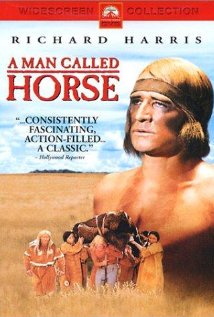
A Man Called Horse

Let us begin this installment with the quintessential white Indian of the 1970s. In A MAN CALLED HORSE (1970), Richard Harris plays an Englishman named John Morgan. Captured by a Sioux-speaking tribe known as the Yellow Hand, he is humiliated and used as a horse (hence the name). But Morgan proves himself an able warrior, and quickly gains the respect of his captors. More than that, he becomes a war chief, leading them to victory against the Shoshone.

The movie seems to take its portrayal of Native American culture quite seriously, perhaps a little too seriously. The film wants desperately to show us how things really were, but its portrayal is far too filled with sensationalism to provide any real insight into anything Native American customs. In fact, of all the white Indians of movie history, this one seems to irk people the most.

Initiation

In the most striking scene of the movie, Morgan is initiated into the Yellow Hand by means of a sun-vow. His chest is pierced, talons are fastened to the wounds, and he is suspended from the top of a Medicine Lodge. Upon waking, Morgan will soon make-love to the daughter of the chief (thus playing out yet another cliché – Pocahontas anybody?).

Loosely based on a Mandan variant of the Sun Dance ceremony, this scene was sufficiently close to home that many found its portrayal on the big screen quite offensive. In A man Called Horse, the logic of the ritual does less to tell us about the lives of the people with whom Morgan is living than it does to signal his great triumph, his transition from a mere beast of burden to a full member of the community (…one who is eligible to make love to the beautiful Indian princess. …yes, I said ‘princess,’ …and yes, I know how ridiculous that is.)

But wait!

Seriously, wait!
Return of a Man Called Horse

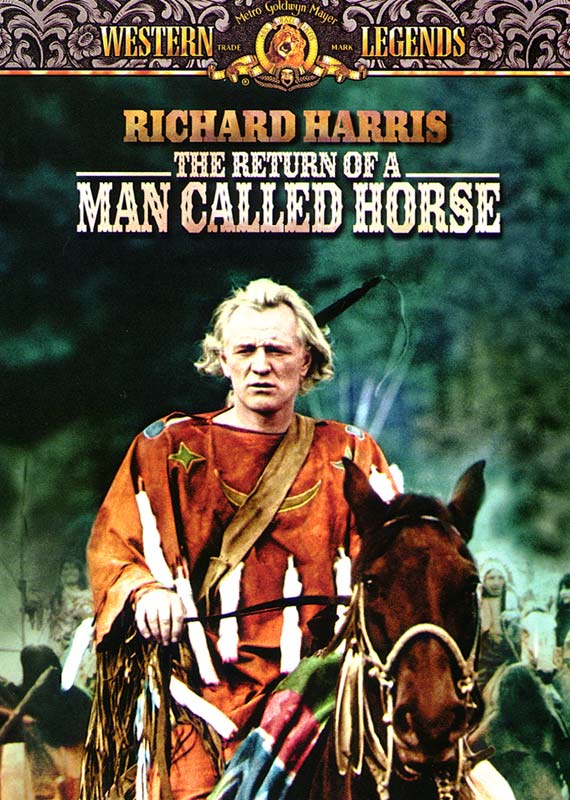
We must also account for THE RETURN OF A MAN CALLED HORSE (1976). Yes, that’s right. This movie has a sequel (two of them in fact, but I will spare you an account of the third; it isn’t even interesting in a disgusting way). In The Return of a Man Called Horse we find Morgan back at home in England, …and hating it. Surrounded by artifacts of his time among the Sioux, Morgan longs to rejoin the Yellow Hand.

When Morgan does return to his adopted people, he quickly discovers that they have fallen on hard times. Under attack from white trappers with Indian allies of their own, the Yellow hand are in sore need of great leadership. Luckily, Morgan is there to aid them. With their very own great white Indian now back among them, Morgan’s friends now find their courage. Naturally, the revival begins with a sun dance.

I have to confess that when I first saw these movies I enjoyed them a great deal. Mind you, I was a teenager. It took a few years before the arrogance of the message sunk in. Unable to fend for themselves, the Yellow Hand must have a white man come and rally them to perform one of the most sacred of their own ceremonies. That’s right; in this movie Lakota need a white guy to perform their own sacred rituals. I would say that it gets worse from there, but ‘pathetic’ is probably a better word for it.

***

Grey Owl

Back when I was teaching in Navajo country, one of my classes swore up and down that GREY OWL (1998) was a good movie. I went to a video store (yes kids, that’s how we used to do it) and looked at this, and looked at it some more, and …just couldn’t bring myself to do it. I mean Pierce Brosnan as an Indian? I just could not wrap my mind around it. But my dear reader, I realized as soon as I started this blog series that I would have to venture onto that dangerous terrain. And last night, I finally watched this movie.

Just for you.

Okay, it wasn’t as bad as I thought it would be. I really should have trusted my students. It was at least entertaining. I must give it that much.

This movie is about a real historical personage, Archie Grey Owl (1888-1938). When we first meet him, Grey Owl is entertaining tourists with Indian dances and serving as a hunting guide in the Canadian wilderness. His skills in trapping and hunting are unmatched, and his presentation of Indian customs comes across as both authentic and entertaining.

The Real Grey Owl

When Archie falls for a young Mohawk woman named Pony, his life begins to change dramatically. He gives up trapping after she adopts two beaver orphaned by his own traps and the tough old trapper finds himself unable to resist their charms. Facing ruin, Archie opts to write a book about the forests and the need for conservation. This becomes the first of many publications and speaking engagements. All seems to be going well.

…except that Grey Owl seems a little testy at times. He is nervous when told that newspaper reporters are looking  to write stories about him, and inconsistencies begin to creep into his story. Why does he dye his hair? And was it his father that was Scottish and his mother Apache, or was it the reverse? Pressed on details, he becomes angry. No-one questions his adoption by a local Ojibwa community, but it becomes increasingly clear that something is wrong when Grey Owl reluctantly sets out for a 3 month tour of England. It is the chance of a lifetime. Why the hesitation?

We soon learn the answer.

While in England, amidst all the hoopla of a speaking tour which includes a performance for the King, Archie Grey Owl takes a small side-trip to a residential neighborhood he seems to know well. It turns out that he is actually Archibald Belaney, an Englishman himself. …a full-blooded Englishman, as it were, with no Apache relatives at all. Archie has a tense but pleasant meeting with the two aunts that raised him and takes a quick look in his old room where it immediately becomes apparent that his love of all things Indian had been well established as a young child.

When Archie returns home, he is invited to a great powwow where he is asked to meet with a gathering of chiefs. Only then does he confess his origins to Pony. Naturally, she forgives him.

Which leaves the gathering of chiefs…

Unable to back out of meeting them, Grey Owl enters the gathering of chiefs to a rather awkward and tense moment. Can he fool them? Well it turns out the answer is ‘no’. Everybody in the whole lodge laughs at Grey Owl’s deception. But all is not lost, and a Sioux chief finally explains; “Men become what they dream. You have dreamed well.”

And so the white Indian of this story receives the ultimate stamp of native approval. Even his fraudulence is blessed by the old Sioux chief.

***

White dawn

And then of course there are white Eskimos, even black ones. WHITE DAWN (1974) begins with a maritime disaster leaving a whaling crew stranded on the ice flows off Eastern Canada. Three survivors (Louis Gosset Jr. as ‘Portagee’, Timothy Bottoms as ‘Daggett’, and Warren Oates as ‘Billy’) will eventually be rescued by Inuit who take them in, nurture them, feed them, and accept them as part of the community.

One might expect people in such a position to show gratitude. Well they don’t, at least not all of them. Billy (Warrent Oates) is particularly contemptuous of his benefactors, insulting and exploiting them at every opportunity. Daggett (Timothy Bottoms) appears to accept his new community. In time, he has essentially gone native, or at least he tries to. If there is a definite white Indian in his story, it is Daggett. Portagee (Louis Gossett Jr.) seems content to follow the path of least resistance, and given Billy’s aggressiveness, that means Portagee will often serve as an accomplice in destructive activities. Daggett may mean well, but he simply does not put up enough of a fight to reign in his companions.

The generosity of the Inuit people plays a key role in this movie. Not only do the Inuit share their food and lodging with these desperate strangers, the men also share their wives. This allusion to yet another cliché (“Eskimo hospitality”) receives a lot of screen time in the movie. I would hardly suggest that the movie portrays the actual customs of spousal exchange accurately (it doesn’t), but for purposes of plot development it is perhaps more important to note that the three castaways misinterpret the custom as it is understood by the Inuit characters of the movie.
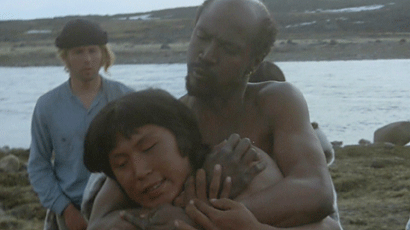
A Little Wrestling Match

The Inuit men of this movie share their wives as a gesture of hospitality; they do not mean to give their wives up. In time, Billy and Portagee come to see the women as theirs for the taking. For his own part, Daggett falls in love with a beautiful young wife of community elder (yes, there is that Pocahontas theme again). As the story unfolds, each of the three men becomes more presumptuous in their approach to the women of the community.

And I suppose I should say here that the movie does very little to shed any light on the motives of the women themselves for having sex with any of thee men. Daggett’s love interest appears responsive. The women are otherwise little more than pawns in a game that takes little notice of their own preferences.

Billy is the driving force for much of the movie’s action, initiating one after another disruptive scheme. He is greedy, malicious, and completely unprincipled. Most importantly, Billy convinces both Daggett and Portagee to steal the community stores of fish and set sail in a small native boat. When this attempt to get home ends in yet another crash, the Inuit will once again come to the rescue. And all three must now live with the community made hungry by their theft of food supplies.

When Billy’s shenanigans finally result in the accidental death of a young woman, the community takes action. Tricked into accepting mittens with no thumbs from the remaining young women of the village, Billy and Portagee are unable to defend themselves when attacked by the men of the village. There is a moment when it seems that Daggett will be spared, but that ends abruptly with an arrow to the belly.

And of course it is the death of Daggett which is most interesting here. He is the white Indian of the bunch. …or the white Eskimo as the case may be. It would be easy to think the Inuit had killed him unnecessarily. After all, he was a decent guy. Absent Billy and Portagee, one cannot help but to hope that Daggett would immerse himself in the community and live as they do. Who knows? perhaps he would even get the girl!

White Dawn

But of course that girl is why Daggett must die. Where Billy and Portagee use the Inuit women in the cheapest sense of the word, Daggett has claimed the love of another man’s wife. For all its sincerity, Daggett’s presumption reaches a scale well beyond that of his companions. He wants to keep the girl, but of course she is not his for the taking.

And thus ends the white Indian of White Dawn!

71.271549 -156.751450

Share this:

  • Tweet
  • Share on Tumblr
  • Print (Opens in new window) Print
  • Email a link to a friend (Opens in new window) Email
  • Share on Reddit (Opens in new window) Reddit
Like Loading...

Ten Little White Indians: Reflections on a Hollywood Cliché

18 Wednesday Apr 2012

Posted by danielwalldammit in History, Movies, Native American Themes, White Indians

≈ 24 Comments

Tags

Dance Me Outside, Film, History, Holywood, Hombre, Indian, Little Big Man, Movies, Native American, Stereotypes, White Indians

Let’s talk about American Indians!

Better yet, let’s talk about Indians in the movies!

You ever notice how many movies about Indians are really movies about white people? More specifically, many stories about Indians are actually about white people who live among them. Such characters are often called “white Indians” in the literature. They are certainly a worthy subject in their own right, but Hollywood seems quite dependent on these characters in its treatment of Native American subjects. The white character provides a lens through which non-natives can observe native culture. It is a role that we can identify with, even as we are shown a world perhaps foreign to us (assuming the film actually does attempt to show us something about the lives of Native Americans, which is not always the case).

It’s an old cliché, often tiresome, and in some respects outright pernicious, but I must admit that a couple of these characters actually resonate for me. At other times, it tempts my lunch to return to the free air about me. At the very least, I think one ought to be clear about the subject matter. All too often these films about non-natives are pitched to the public as films about the lives and customs of Native Americans. Even if this is just a difference in emphasis, the emphasis is often highly significant.

So, let’s see a few examples, shall we?

***

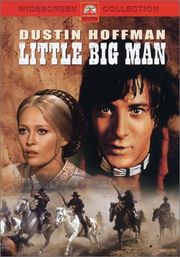
Little Big Man

We shall begin with an old favorite of mine, LITTLE BIG MAN. This is the story of Jack Crabb, supposedly the sole white survivor of the Battle of Little Bighorn. We meet jack in an old folks home as a man well over a hundred years old. Visited by an anthropologist, Jack is angered at the suggestion that was an old Indian fighter and proceeds to tell his life story with a tape recorder rolling.

It turns out that Jack had been adopted by Cheyenne (whom he refers to as “Human Beings” throughout the narrative) after his family was slaughtered by Pawnee. During the course of his life, Jack returns to white society for a time and experiences life as a religious youth, a con artist, a “gun fighter,” a drunkard, and even a mule skinner. But Jack returns to the Human Beings several times during the course of the movie, even taking a wife (eventually four) and living among them. Jack explains that he reckoned he would stay there and live among Human Beings for the rest of his life, right there on the Washita River.

And for those that know a little about the history of Indian-white relations, the appearance of Custer will be no surprise. For me at least, the scenes that follow are quite difficult to watch. It is in revenge for this attack, that Jack Crabb ultimately plots to lead Custer into a trap, tricking him as it were into attacking the Indian village at Little Bighorn.

Little Big man was the first major motion picture in decades to take an explicitly pro-Indian stance on the history of the west. It is almost too late to capture the full shock value of its portrayal. The movie and television audiences of the 1970s had seen many depictions of Indian savagery. To see the U.S. cavalry shooting women and children in cold blood was a straight-forward reversal of the prevailing expectations of the time.

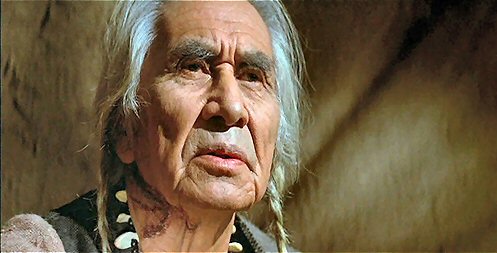
More than that, Little Big Man is filled with vibrant Cheyenne characters, not least of them being Old Medicine Lodge (played by chief Dan George). The characters are even allowed to occupy social roles defined at least partly by Cheyenne cultural patterns. (We are for example introduced to a contrary and a hee-man-eh.) Crabb himself manages to occupy the role of the White Indian without crowding the Native American characters into the background. He is accepted among the Human Beings, not because he is a great warrior (not really, at any rate), but because he has a knack for survival. Crabb bumbles his way through life, understanding a lot about what goes on around him, but without ever really taking control of his own fate.

Chief Dan George

But what has always struck me as the true genius of this movie is that having done far more than normal for the times, it makes no real claims to historical accuracy. Jack Crabb is essentially telling us a tall tale, and his own biases provide the filter through which each event is portrayed. One gets the impression that Crabb’s story must approximate the actual truth (he simply knows too much to have made everything up), but if we believe him a number of the particulars, we have certainly gone well beyond the boundaries of fact when he takes credit for the slaughter of Custer.

But who could fault Crabb for stretching the truth. We can only love him for somehow surviving the real events of his life whatever they may have been, and for sharing a perspective on events which was at that time completely novel to the motion picture industry of that day.

***

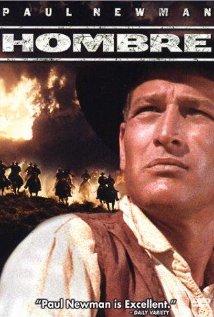
Hombre

Did you know that Paul Newman once played an Apache? …well, sort of. In HOMBRE, Newman plays John Russell, a white man raised among the Apache. Old pictures of Apaches fill the screen during the opening credits, and soon we are treated to an image of Newman dressed as an Apache.

Hombre

Russel and two Apache companions have been earning a living by capturing wild horses to be sold to the stage-coach line. They learn that a railroad will soon replace the stage-coach line, and horses will no longer be needed.

Russell learns that he has inherited a boarding house from his original family. He returns to civilization and sells the house before heading back west aboard a stage-coach.

Newman in Hombre

When the stage-coach is robbed, it is Russell (with his superior survival instincts) who keeps the other passengers alive, their prejudice against him notwithstanding. In time, Russell learns that the robbers are after money meant for the San Carlos Apache reservation. It had been stolen by a fellow passenger. Russell’s treatment of his companions is harsh, bordering on cruel, which seems fitting enough given their own attitudes towards him. In the end, Russell will sacrifice himself to save a woman who would not share the stage-coach with him. He asks only that the money should be taken to the people for whom it was intended.

The movie ends with a vintage photograph. It contains the image of a white boy surrounded by Apache children of his own age.

***

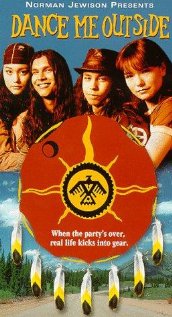
Dance Me Outside

DANCE ME OUTSIDE: This movie is not on the whole about a white Indian. I include it in this list, because it has an absolutely wonderful scene which serves to comment on the whole phenomenon. For reasons which we need not get into here, the main characters, Silas crow and Frank Fencepost (both Anishinabe), are asked to keep Robert McVey, a white in-law, busy while his wife is off doing something important. Unable to think of anything else to do, and really unhappy about spending the night in his rather lame company, Silas and Frank decide to initiate him into the tribe. What follows is a hilariously improvised ceremony. The scene could easily have been painful to watch, but there is something about the way the white character embraces the ceremony which comes across as endearing. It is as though he has simply chosen to accept the ritual for whatever it is. The man commits so completely to the absurd little made-up ritual that his own sincerity (absurd as it is) seems to redeem the whole event. In the end, he earns a grudging respect from Silas and Frank, not for being a properly initiated member of the tribe, but for simply being human, foibles and all.

Silas and Frank

What I particularly like about this scene is the sense of compassion behind the treatment of this subject. This movie takes the piss out the old white Indian cliché as well as anyone has, but it does it without rancor. The white character is mocked, yes, but he is mocked with a gentle touch. Dance me outside is an obscure movie, and I must say that it has a kind of after-school special quality to it. Still it’s a wonderful tale well told.

***

That’s it for now. There will be two more volumes in this one.

***

Okay, no I can’t let my readers off that easy. These movies are actually pretty good, so I’m afraid you haven’t got the full cringe-worthyness of this subject. So, let’s have a listen shall we?

…okay, I know. That was unnecessary. I’m a bad man, and I’m sorry.

…sort of.

71.271549 -156.751450

Share this:

  • Tweet
  • Share on Tumblr
  • Print (Opens in new window) Print
  • Email a link to a friend (Opens in new window) Email
  • Share on Reddit (Opens in new window) Reddit
Like Loading...

Real World Villains, Volume III: Those Troublesome Alaska Natives!

15 Sunday Apr 2012

Posted by danielwalldammit in Alaska, History, Justice, Native American Themes, Politics

≈ 15 Comments

Tags

Alaska, Alaska Natives, Alberta Schenck, civil Rights, Duck-In, Ducks, Elizabeth Peratrovitch, Hunting, Inupiat, Subsistence

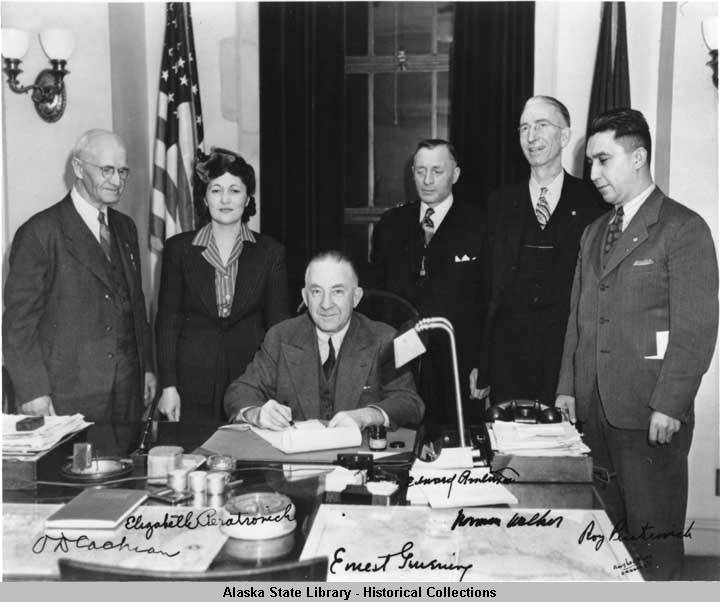
Governor Gruening Signs the Anti-Discrimination Act of 1945

“What the Hell is a duck in?”

That must have been my first response to one of the stories I want to write about today. Hopefully, I didn’t say it out loud, but the duck-in is one of many historical narratives that has changed my sense of the political landscape since coming to Alaska.

Yes, I’m still a lefty. I said “changed” not “destroyed.”

And like many a lefty, I spend a fair amount of time thinking about civil rights issue. You know, Martin Luther King, the Freedom Rides, Brown vs. Board of Education, …all good stuff!

Since coming to Alaska, I have been blessed to learn about several new and unexpected additions to the list of civil rights struggles, some with clear parallels to those taking place outside Alaska.

Somewhere in my list of my thoughts about nuclear power, I now add the struggle over Project Chariot. Next to the relocation of Japanese in World War II, I now have a definite place for the story of Anangan (Aleutian) relocation. And of course the big story up here, at least in my mental timeline would certainly be passage of the Alaska Native Lands Claims Act.

But I don’t want to talk about any of those things today.

No, what interests me at the moment is a range of smaller battles, and the story of those who fought them. I’m talking about battles like the one fought by Alberta Schenck.

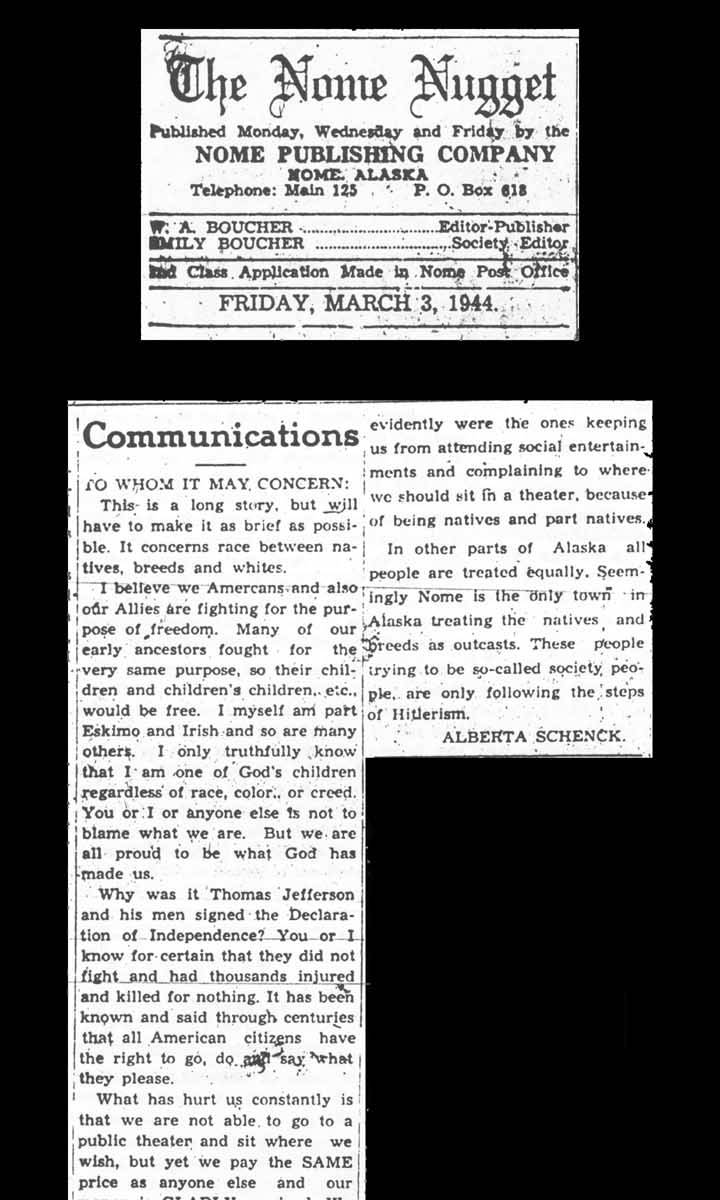
Alberta Schenck Letter

Who is Alberta Schenck? Well, she was the best kind of troublemaker. As a girl of mixed heritage (her mother was Inupiat and her father was white), Schenck faced discrimination against Alaska Natives and “half breeds” on several occasions. At the age of 16, she wrote this letter to the editor of the Nome Nugget, protesting the segregated seating of natives and whites at a local movie house, known as the Dream Theater. To say that the significance of her protest stretched beyond the specific policies of that specific theater would be an understatement.

It’s worth noting that Schenck herself worked at Dream Theater, at least she did until the letter was published. She later returned to that very theater on a date with a white army sergeant. After refusing to leave her seat, the Chief of Police for the city of Nome physically removed Schenck from her seat and she spent the night in jail.

Outrage over Schenck’s arrest helped eventually to fuel for passage of the Anti-Dicrimnatory act of 1945. She was subsequently elected Queen of Nome during the Spring Carnival of that year. This was in 1944, 11 years before Rosa Parks picked her fight with the city of Montgomery Alabama. …well before the sit-ins, or the freedom rides.

And then of course there is Elizabeth Peratrovitch, a Tlingit Native whose testimony before the territorial senate helped to secure the final passage of the Anti-Discriminatory Act, mentioned above. She said a lot of things in that testimony, but this particular line is particularly memorable:

I would not have expected that I, who am barely out of savagery, would have to remind gentlemen with five thousand years of recorded civilization behind them, of our Bill of Rights.

With actions like those of Alberta Schenck and testimony such as that of Elizabeth Peratrovich, the territory finally passed a law banning such acts of discrimination.

I should add that the law did not merely eliminate discriminatory policies at the government level; it forbade discrimination by private businesses. Opponents of the bill had argued, as many do today, that government had no role to play in limiting the choices of private businessmen. Fortunately, that argument lost in 1945, as it did in 1964, and as it should today. Those who imagine it is enough to keep government policies free of racial bias have seriously underestimated the impact of private discrimination. Here as elsewhere the individual decisions of private businesses were the centerpiece of segregation.

But my all time favorite story about civil disobedience in the great state of Alaska would have to be the “Duck in.” This narrative begins in 1918 with a treaty between the United States, Canada, and Mexico. Under this treaty, the U.S. agreed to ban the taking of migratory waterfowl from the period between March 10th and September 1st.

So what’s the trouble? That is the ONLY time that migratory waterfowl can be found on the North Slope of Alaska. For a people very much dependent on subsistence hunting for their survival, the terms of this treaty removed a critical resource from the Spring and Summer menu.

The issue does not appear to have been much of a problem, at least not until Alaska became a state and began to enforce Federal laws with greater diligence. Then Fish and Wildlife officers began arresting people and confiscating their weapons, and their catch.

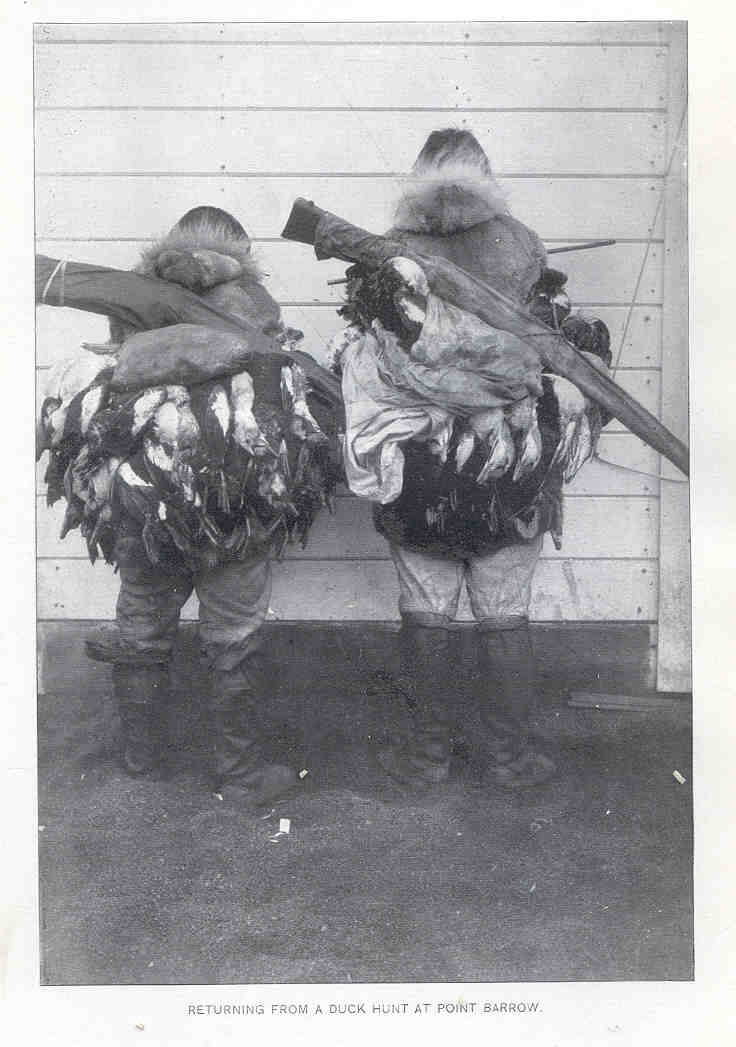
Duck Hunters at Point Barrow

How did the Inupiat population of Barrow respond to the arrest of people in their own community? How did they deal with a game warden in town to enforce the hunting regulations?

Well, they were very cooperative.

He found about a hundred and fifty Barrow residents outside his hotel room one day, each with a duck in hand. He didn’t have enough forms to process all the arrests, so Barrow Magistrate Sadie Neakok advised him to record the names on extra paper and attach them to the main form. And thus, everyone with a duck got counted.

Subsequent to this, State Senator, Eben Hopson, sent a request to then Governor, William Egan, asking that welfare officials be sent to help take care of all the children whose parents would be locked up due to enforcement of the law.

…and Fish and Wildlife simply stopped enforcing the regulations.

That’s called a ‘win’ folks!

*********************

Okay, that’s it, just a few of my favorite stories about troublesome Alaska Natives. I haven’t covered any of this with sufficient detail to do justice to these stories, so I’ll just briefly mention some better sources:

Rachel Naninaaq Edwardson produced a wonderful documentary on the Duck In. It is available through the North Slope Borough School District.

Wikipedia does seem to have a page on Elizabeth Peratrovitch. , and she is mentioned in quite a few additional sources. This one from Alaschool.org has a pretty thorough discussion of her contributions to the state of Alaska.

Numerous references to Alberta Schenck may be found in sundry parts of the net. Her memorial website would be a good place to start.

One good reading on the subject of discrimination would be an article by Terrence M. Cole, “Jim Crow in Alaska: The Passage of the Alaska Equal Rights act of 1945,” in Stephen W. Haycox and Mary Childers Mangusso (eds.) An Alaska Anthology: Interpreting the Past, (Seattle and London. University of Washington Press, 1996) pp 314-335.

The Images of Governor Gruening signing the Anti-discriminatory Act, Elizabeth Peratrovich, and Alberta Schenck’s letter are from Alaska’s Digital Archives. The image of Duck Hunters came from the Marine Image Bank of the Digital Collections at the University of Washington.

71.271549 -156.751450

Share this:

  • Tweet
  • Share on Tumblr
  • Print (Opens in new window) Print
  • Email a link to a friend (Opens in new window) Email
  • Share on Reddit (Opens in new window) Reddit
Like Loading...

The Grey – Movie Review (Yeah Spoilers)

14 Saturday Apr 2012

Posted by danielwalldammit in Alaska, Movies

≈ 5 Comments

Tags

Alaska, Entertainment, Film, Liam Neeson, Movies, Prudhoe Bay, The Grey, Wolves

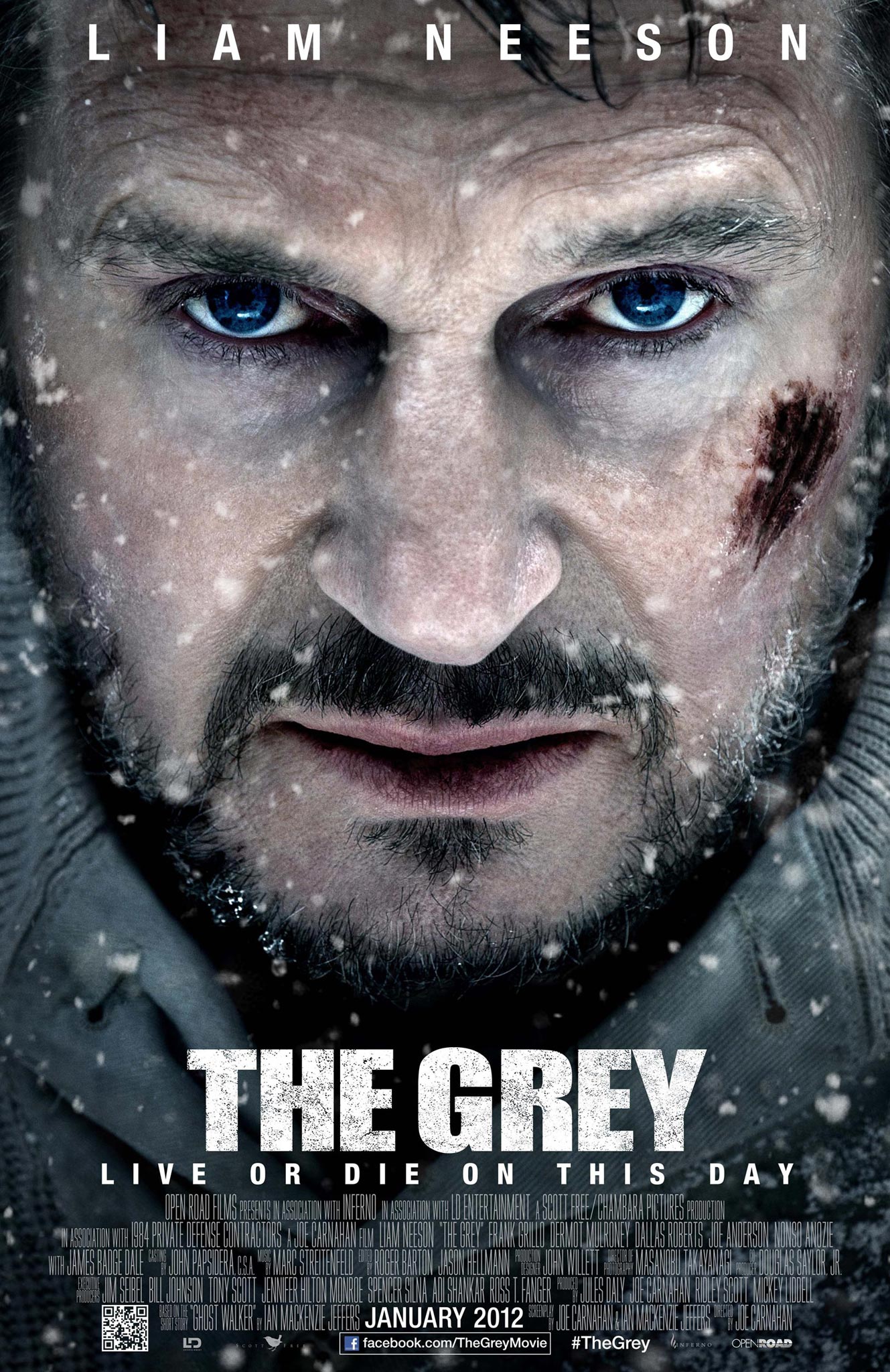
In The Grey, Liam Neeson along with a small cast of characters survive a plane crash in remote parts of Alaska. The crash is, well, …the first of their challenges.

I saw this movie in a theater in Anchorage. I had just come off a flight very much like the one portrayed in the film, and I was killing time during the layover before a second round of middle-seat torment, when someone suggested watching this movie. It sounded like a good way to kill some time.

It wasn’t.

Don’t get me wrong. Liam Neeson turned in a fine performance, as did the rest of the cast. Do I need to say that he was compelling? Do I have to tell you that he made the character come alive? Let’s just take that as a given, and add that the rest of the cast also turned in excellent performances. Really, I have no qualms about the acting.

The problem I have with this movie is the story itself. The damned plot reminded me of chalk boards at nearly every turn.

Chalk boards and fingernails that is.

We could start with its portrayal the sort of people who work in the oil fields of Alaska. Neeson’s character, John Ottway tells us early on that he is a hired killer of sorts, working in the oil fields of Alaska. He then goes on to describe the oil-field workers as a mindless, hard-drinking and violent lot, prone to criminal actions. There is little in the opening scenes to suggest that Ottway’s comments are intended as anything less than the truth, at least as this movie envisions it.

Having shared an airplane with workers from Prudhoe Bay several times, I couldn’t help but cringe. I kept thinking about a long discussion I had on one flight with mechanic headed home to Texas. He spoke with me about his faith in the Baha’i church and a range of experiences working in different parts of the world. Did this movie do him justice? Not by a long shot, nor I suspect did it do justice for the rest of the workers at these fields.

Mind you, I am happy to go with a bit of slanderous fiction if we can then get along with a plausible storyline. I could just accept the movie’s take as a given and put it behind me. I could.

But let’s just return to the, “hired killer” theme. Who or what does Ottway kill?

Wolves.

Yes, Ottway kills wolves for a living, as is established in an early scene when we see him bring a lone wolf down with one well-placed shot, just in the nick of time. This would be a lone wolf that moved from stalking to charging multiple oil workers. The movie offers no explanation for the conduct of this wolf, giving the impression that this sort of thing is par for the course.

The Grey does give us a moving little moment where Ottway lays his hand reassuringly on the wolf as it dies. (Yes, that’s right, he touched the dying wolf as it died. …cause that’s what you do with a wounded and dying wolf. …Yep.)

And I should add that this scene is one of the more realistic moments in the films lupine antics. To say that the wolves of this film do not much act like the real thing is putting it mildly, unless of course you mean the Dire Wolves from Dungeons and Dragons. These wolves are smarter, meaner, more persistent, and just generally more bad-ass than any wolves in the known world, …Tolkein novels and role-playing games aside, I mean. Yes, I do think this movie depicts the Dire Wolves of D&D quite accurately.

Which is of course the major basis for the plot. First the plane crashes, and then a pack of Dire Wolves hunts the survivors for the rest of the movie, picking them off one by one.

If you’ve read my blog, you probably think I rooted for the wolves throughout the movie.

I did.

The trouble is that for all their extraordinary powers, these magical wolves take an awful long time to finish off their human quarry. And just when I was getting to the point where I thought the last bunch off heroes might actually make it (or perish in one merciful slaughter), the movie finds a new tone of nails-on-chalkboard resonance to strike. You see, it wasn’t enough to hit me with condescending portrayals of oil workers pit up against magical uber-wolves from fantasy land. No, this movie had one more means of tormenting yours truly.

It found my true weakness.

With but three survivors left, one of them finally gives up. The character, John Diaz, a particularly rough and tumble fellow decides he simply cannot go on. Now this might seem plausible, because of course he is hungry, cold, and tired at this point (much as I was sitting in that theater in Anchorage), but that would be far too predictable an excuse to lay down and die. No, it turns out that Diaz, the problem child of survivor group, has finally seen the error of his. He realizes how beautiful the countryside is, and realizes that the rest of his miserable life has been wasted all along. So, Diaz tells the other two to go on. And Ottway? Ottway understands and accepts this decision. This really belongs in an Iron John book. They leave Diaz sitting by a rover waiting for the wolves to get him, but not before some very meaningful moments of male-bonding occur.

At this point of the movie, I think I was genuinely squirming in my seat. In fact I am squirming now, just thinking of it.

So, I will just take a moment to mention some of the more interesting features of the movie. Ottway has a number of flashbacks during the course of the movie, consistently returning to a past relationship with a beautiful woman. These moments do serve to set up an interesting aspect of the film narrative; it is the reason he now works in the oil fields, and it is the source of his outlook and (ironically) his leadership qualities. Sadly, this theme never develops into its full potential.

I should also say that there is a drowning scene in this movie that is quite well done, a bit reminiscent of an old Paul Newman film, Sometimes a Great Notion. What makes it so interesting. Well you will have to brave the wolves to find out, because I’m not going to give this one away.

Well that’s it. I could go on, but, …no, I can’t. The memory of this movie is too much for me. I really don’t feel well at all right now. I look outside my window at the beautiful Alaskan scenery, and I realize that I just cannot go back to this movie review. You my dear reader should go on without me. Maybe you can make safely it to the next blog on your own. Just click the link to the Bill Hess Blog and you’ll be safe.

I’ll just sit here and let the chalkboard-sounds and the wolves get me.

Go!

Just go!

71.271549 -156.751450

Share this:

  • Tweet
  • Share on Tumblr
  • Print (Opens in new window) Print
  • Email a link to a friend (Opens in new window) Email
  • Share on Reddit (Opens in new window) Reddit
Like Loading...

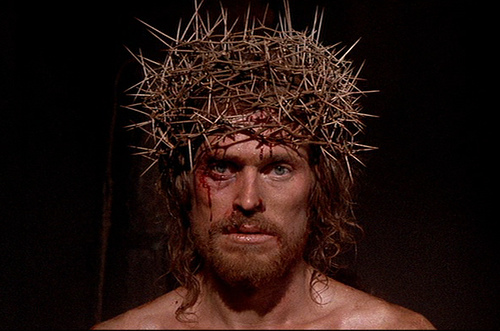
Special Easter Edition Movie Villain: Jesus Christ!

08 Sunday Apr 2012

Posted by danielwalldammit in Movie Villainy, Movies, Religion

≈ 20 Comments

Tags

Blasphemy, Easter, Film, Jesus Christ, Jesus Christ Superstar, Movie Villainy, Movies, religion, The Greatest Story Ever Told, The Passion

Can you see it my Brothers?

Can you see the truth of what I am saying?

Because not everyone can see this. Some consider the topic just too boring to bother with. They’d rather watch a slasher flick. Others are too busy with their prayers. Jesus is too beautiful to them, too noble, too good, too strong, too gentle, too much of a blank check upon the bank account of all things warm and wonderful.

They cannot see it. But Jesus can be downright terrifying.

The Prince of Peace makes an awesome movie villain.

Just ask the merchants in the temple! Yes, that would be the one Jesus trashed, because apparently commerce is supposed to be a bad thing. Just a temper tantrum, you say? Well tell that to someone whose entire livelihood has just been trashed by a madman. A madman who threatens to destroy the very temple of God Himself.

Do not think, he didn’t warn us my friends. Jesus told everyone about his nefarious plans. He told us that he came bringing a sword. He told us that he came to destroy our families. He told us that we would have to forsake everything we know and love to join his kingdom.

And I ask you, what sort of dark kingdom begins with the abandonment of one’s own family?

Let us not even mention the practice of necromancy! Well, okay, yes, let’s go there. Do not imagine that little girl was the only time this fisher of men came to practice the dark arts. On this matter (and many others), the dear Lord is definitely a repeat offender. Seriously, when in the Hell does someone raise the dead and NOT end up as the principle villain of the story? Oh I’m not talking about accidentally awakening a Mummy. That gets you an hour of running and a hero status when you finally beat the bad guy back into the ground. No, I am talking about the deliberate act of pulling a dead man out of the grave and setting him back to walking about the earth. And Jesus did it at least twice!

There is a reason the name of Frankenstein fills us with terror, but Jesus gets a free pass on this one, does he?

And then of course of course there is his skillful use and disposal of Judas. Even as the man betrays Jesus with a kiss, Jesus himself has willed the whole thing to happen, …from the moment of creation, so some folks say. And thus does Judas play into the great cosmic scheme, a lamb for the sins of man. But who is the real sacrifice here? And how wicked is the villain that has chosen a single man for the greatest crime of all history? How wicked is the puppet-master who could bring his chosen victim to accept eternal damnation …with a kiss?

How did he do it? Well great movie villains work in mysterious ways.

Not even the Cylons of the new Battlestar Gallactica series could manipulate humans with such ease and skill. Neither Darth Vader, nor Sauron, nor Scorpius from Farscape have ever had such an elusive evil plan! Professor Moriarty could only dream of such eloquence. Christopher Walken was never so creepy in all his career! And the Devil in all his movie incarnations has never, NEVER, been so menacing.

The question you have to ask is just why everyone found this fellow so frightening to begin with? Why is that this Jesus must die?

Must die!

Must die!

Must die!

The Romans, The Pharisees, even apparently the average man on the street came to call for the blood of the lamb.

So we are told anyway!

But were they really so short-sighted, so bloodthirsty as to want the death of a miracle worker and healer? Or did they know something the rest of us seem to have forgotten? Did they see into the depths of the darkness? Did they know just how terrible this villain really was?

It’s a damn good question, I tell you.

Note: The original version of this post included a lot of links to various movies. I really was talking about Jesus as a movie character and using the videos to illustrate the point. Anyway, dead links happen. So, I took most of them down. Left up Judas, cause, yeah.


71.271549 -156.751450

Share this:

  • Tweet
  • Share on Tumblr
  • Print (Opens in new window) Print
  • Email a link to a friend (Opens in new window) Email
  • Share on Reddit (Opens in new window) Reddit
Like Loading...

AHAH!!! …(Yawn.): Glenn Beck & Company Nearly Savage a Liberal News Source, …Almost, …Kinda, um, zzzzzzzzzzz…

23 Friday Mar 2012

Posted by danielwalldammit in Politics

≈ 15 Comments

Tags

Ambiguity, Festering Bloodfart, Glenn Beck, Politics, Polling, President Obama, Republicans

First I must confess that I was reading Glenn Beck’s website. …I’ve done dumber things in my life. I just can’t think what they would be.

So, somewhere amid all the rancid piles of smegma that accumulate about his website, I stumbled across something called the Stu Blog, and in this Blog I found this wonderful little headline:

“The majority of people who believe Obama is a Muslim are not Republicans”

“Really?” I thought to myself. “I have to check this out!”

And thus I opened the article

The piece begins by talking about recent polls conducted in Alabama and Mississippi, polls showing (as Stu puts it) that; “a lot of Republicans in Alabama and Mississippi think President Barack Obama is a Muslim.” He faults Democrats and MSNBC for publicizing these polls. Stu dismisses these as biased polls and says we need a more neutral source on the issue. Next, he turns to a national poll conducted by Pew in 2010. Hence, we get the following paragraph:

Pew asked 2,811 people about Barack Obama’s religion. Approximately 536 of them incorrectly said he was a Muslim. Of those 536 people, 261 of them were Republicans, 275 were not. In other words, about 51% of those who believe Obama is Muslim are outside the Republican party.

So, you see, the title (piss-poor wording and all) is technically right. The Pew study does show that Republicans fail to constitute a majority of those believing President Obama is a Muslim.

But, I wonder, just what are the odds that any other political party has a higher representation?

None.

The poll results are right here.

Note that the highest percentage of people believing Obama is a Muslim are, according to that poll, conservative Republicans. Do they constitute a majority of the total population believing Obama is a Muslim? No.

So, if you add BOTH the Democrats who believe this to the independents who believe it, then those two together beat the Republicans by 14 people out of over 500. So one could not in fact say that Republicans constitute a majority of those believing Obama is a Muslim. One would have to be content to say that they are the largest group in that total population. But one could not say that they constituted a “majority.”

Which I suppose is the second most underwhelming fact of the day. The first being that Glenn Beck is a festering blood-fart. (Stu Burguiere is merely an emergent anal fistula.)

…and I really need to surf smarter corners of the net.

Photo by Gage Skidmore.

71.271549 -156.751450

Share this:

  • Tweet
  • Share on Tumblr
  • Print (Opens in new window) Print
  • Email a link to a friend (Opens in new window) Email
  • Share on Reddit (Opens in new window) Reddit
Like Loading...

Jesus and Religion: A Distinction in Search of a Difference

21 Wednesday Mar 2012

Posted by danielwalldammit in Religion

≈ 19 Comments

Tags

Circular Reasoning, Distinction, Faith, Jesus, Jesus versus Religion, religion, Spirituality

This poet (whose name is apparently Jefferson Bethke) loves Jesus and hates religion. In fact, he literally resents it.

(Sigh!)

Okay, so how do you tell the two apart, Jesus and religion? That is a tricky question, all the more so because the terms normally seem to travel in each others’ company, so to speak.

Luckily, the poet offers the helpful suggestion that:

One is the work of God, the one is a man-made invention.

One is the cure, the other is the infection.

Religion says “do.” Jesus says “done.”

Religion says “slave.” Jesus says “son.”

Religion puts you in bondage, but Jesus sets you free.

Religion makes you blind, but Jesus makes you see.

And that is why religion and Jesus are two different clans.

Religion is man searching for God, Christianity is God searching for man.

Listening to the poet rattle through these distinctions, one cannot help but think that a lot is riding on the matter. But of course all of these individual distinctions assume we already know the difference between the two; they comment on the difference as though it were already clear.

The poet is talking about things that seem to go together in the collective understanding of “religion.” One might, for example, describe as religious some of the arguments once made in favor of slavery as well as those advanced by Abolitionists against it, thus putting the “religion” of common parlance on both sides of the poets juxtaposition. Likewise, talk of Jesus is normally expected from those engaged in one particular religion.

But of course the poet here assures us that these are really two different things, even that talk of Jesus is (or at least should be) wholly different from religion. He divvies up a range of themes normally associated with religion, carefully placing them in different piles, so to speak. All the good themes that make us smile go in the “Jesus” pile and the bad ones end up in the “religion” pile. Yet, he provides no independent means of telling us which goes where. At the end of the day, the difference between the two is little more than the collective contents of the two piles.

To say that this is circular reasoning is putting it mildly. Who wouldn’t prefer the Jesus of this video to the religion?

Seriously, who would not prefer freedom to bondage, son to slave, sight to blindness, or a cure to an infection?

And if the answer is “no-one” or even “almost no-one,” then who keeps producing all the bad things, the ones that seem to go in the “religion” pile? Does the poet in this video imagine that it is people who have consciously chosen them?

Or is it just possible that it is people who thought they were actually choosing Jesus?

The internal logic of this kind of rhetoric always fascinates me. Some of the poets distinctions (such as that between man looking for God and God looking for man) are too fantastic to construe in terms of a specific moral choice. Others are downright intuitive. The notion for example that religion makes you blind whereas Jesus makes you see is wonderfully vivid.

On hearing the claim that religion makes you blind, one cannot help but to imagine some form of religiously motivated bigotry. We want to say, “Yes, I know exactly what you mean!” The second phrase must arouse similarly vivid thoughts for most believers. How easily might one imagine a moment when thoughts of Jesus could have inspired one to overcome a prejudice! That particular pair of options must arouse thoughts of a real difference.But of course the important question is whether or not there is anything about Jesus (or more importantly references to, thoughts about, belief or faith in…Jesus) that guarantee the one and precludes the other.

It’s a valiant effort.

It is tempting to go along with the poet on all of this. When I see him separating the good from the bad, I could almost choose to join in, to help sort everything into the right piles. It would be lovely to affirm the wisdom of this poet and all the others who assure us that “religion” is distinct from faith in God or a personal relationship with Jesus. I could almost stand with those who say they are “spiritual but not religious.” Hell, even without faith in God I can affirm the value of many things associated with Jesus’ name. Wouldn’t it be wonderful if those good things really were of a wholly different order than those bad ones. …if the difference between Martin Luther King and Fred Phelps were as easy as telling the difference between which of two words to use, “religion” or any of its better dressed counter-parts.

And yet the question remains, when people talk of Jesus, what distinguishes the good from the bad?

This poet offers no answer to that question, though he seems to think otherwise. And in that respect, he has one foot firmly planted in the “religion” pile.

71.271549 -156.751450

Share this:

  • Tweet
  • Share on Tumblr
  • Print (Opens in new window) Print
  • Email a link to a friend (Opens in new window) Email
  • Share on Reddit (Opens in new window) Reddit
Like Loading...

Great Movie Villains Volume VI: The Baudelaire Brats (Yeah – Spoilers!)

16 Friday Mar 2012

Posted by danielwalldammit in Movie Villainy, Movies

≈ 6 Comments

Tags

Film, Lemony Snickets, Movies, Story-Telling, Villains

Violet, Klaus, and Sunny. Remember those names. And should these “children” ever show up at your door…

Run like Hell!

These are not really children. They are demons. Just ask their beloved uncle, Count Olaf. A Series of Unfortunate Events, my ass! The terrors of this story-line are precisely what happens when the world is thrown out of balance, which is exactly what happens whenever these kids enter the story.

The Baudelaire children are way too smart for their own good, solving problems children aren’t suppose to solve, and generally proving themselves smarter than the adults around them at every turn. Even the world which they inhabit seems somehow way too interesting and way too clever for a children’s movie. And you may think that is hardly their fault, but you would be wrong to think that.

Just ask Violet!!!

You see the whole point of a children’s movie isn’t to tell a story that children will find entertaining; it is to tell a story that adults like to think children will find entertaining. The children in such movies have faults we can live with; they might like candy a little too much or want to stay up a little too late. But they are not too cool for the whole school.

Not so, the Baudelaire Brats! They are smart. They are savvy.

Shame on them!

A good child would accept without question the wisdom of the adult world, but these little demons notice things. Oh yes they do. And they exchange knowing looks.

More a living shark than a little girl, the youngest (Sunny) is a true freak of nature. The middle brat reads incessantly. Like some sort of uber-nerd who won’t settle for throwing the class average, Klaus consumes whole libraries and then uses the knowledge contained therein to crush his enemies and bring about their downfall. Worse yet, Violet is a devious inventor. Give her a ribbon and a few trinkets and she will fashion for you a gadget to solve whatever problems you may have.

So, where did she get the ribbon, you may ask?

Could it be ….Satan!?!

You bet your sweet ass it was Satan that gave this little girl her powers. When Robert Johnson went down to the crossroads all those long years ago, he took the spirit of this sweet little girl with him and she sowed the fate of her family that very evening.

Small wonder that the children lost their parents. Why did that happen you may ask? And we are supposed to believe it had something to do with a giant magnifying glass? Not a chance, baby! The fate of their folks had been sealed down at the crossroads. You know it, I know it. Robert Johnson knows it and so does Eric Clapton. Most importantly, Violet sure as HELL knows it. So, let’s not hear of any more great mystery deaths okay. The Devil torched the Baudelaire house when he came to reclaim is due. Her parents were just collateral damage.

And that was just the start of it. Are we supposed to believe that the deaths of Uncle Montgomery and Aunt Josephine are mere accidents? With Uncle Montgomery being so brave and Aunt Josephine so careful, do you really think they could be offed so easily as this movie suggests? I don’t think so. And don’t even try to tell me it was Count Olaf that killed them. No, it was their love that condemned them.

Their love for these demon-children.

Anyone could see those deaths coming. When children are too smart for their own good, bad things happen to those that care for them. It’s as obvious as sending someone else down to the planet with Mr. Spock, Bones, and Captain Kirk. These characters were dead from the moment they opened their doors to the Baudelaire children. Blaming Uncle Olaf is like condemning a gun for serving as the instrument of a murder.

It should come as no surprise that the film culminates in a blasphemous attack on the institution of marriage. Violet rejects her marriage to Uncle Olaf just as she rejects every other good wholesome value that may fall in her path. What’s next? A pact with the ACLU?

I wouldn’t put it past her.

And then of course we get the final insult. These characters somehow contrived to avoid parts 2 and 3 of the trilogy altogether. Yes, that’s right, the actors who played the children are now well into adulthood, thus forever ending the hopes of a sequel. Don’t think it’s an accident either. Only the likes of the Baudelaire children could have foiled plans for a sequel by aging out of the narrative, letting the real world stand in the way of a good story.

Devil children, I tell you!

I know damned well that Count Olaf would have gotten them in the end. Cheated, he is, out of his money, just as we were all cheated out of a righteous and proper ending. We will not be seeing a Lemony Snickets Two and Three, and that is indeed a crime for which the Baudelaire Brats should be condemned for all time. They have cheated all of us out of this ending, I tell you.

Just like Uncle Olaf, we are all cheated.

Cheated!!!!

71.271549 -156.751450

Share this:

  • Tweet
  • Share on Tumblr
  • Print (Opens in new window) Print
  • Email a link to a friend (Opens in new window) Email
  • Share on Reddit (Opens in new window) Reddit
Like Loading...

Special Sarcasm-Free Saturday: Three Indigenous Films (in Ascending Order of Coolness)

13 Tuesday Mar 2012

Posted by danielwalldammit in Movies

≈ 4 Comments

Tags

Aborigine, Atanarjuat, Entertainment, Ethnography, Film, Indigenous Peoples, Inuit, Massai, Movies, Ten Canoes, The Rain Warriors

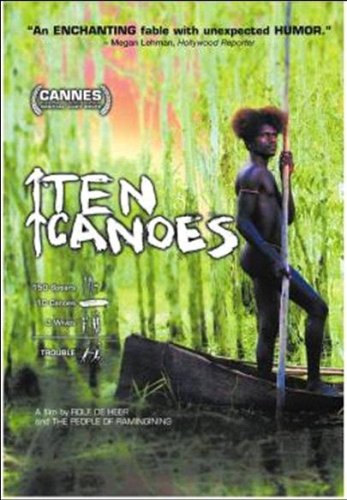
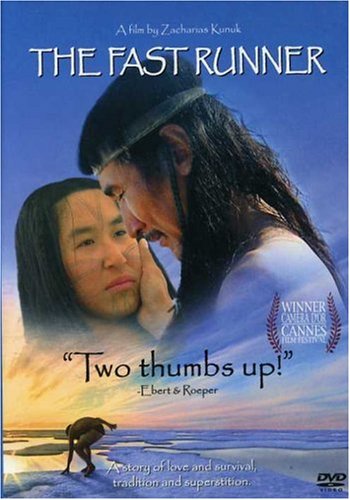
Okay, I know it’s not actually Saturday, but I wanted the alliteration. I’ll try to stick to the Sarcasm-Free theme though, which should be easy enough, because I actually like today’s subject. Yes, I actually like some things. Honest! Case in point, here is a batch of my favorite movies. They are not documentaries. Each tells a fictional story, but each sets that story squarely in a distinctive “tribal” setting. Each is carried out in the native language of its setting, and each uses native actors. The authenticity of each depiction varies (and that is always a tricky question no matter how it’s handled). Suffice to say that in each of these cases, there seems enough to get my attention, and each tells an interesting story in its own right. We can begin this tour in Africa with a movie called The Rain Warriors (2005). The story follows a group of young Massai warriors as they embark on a quest to slay the incarnation of a deity. Yes, I said “deity,” but it’s worse than that, really. The deity has taken on the form of a lion, and killing this lion-deity is the price it will take to bring rain back to the region, thus saving their people from starvation. In the process, this young group of warriors will also have to prove that they are ready to become men. Given the role of Age-sets in Massai life, it is interesting enough to see a coming of age n this setting, but some reviewers have suggested the plot is a bit too romantic to be taken too seriously. It is difficult to say how much of this premise is genuinely rooted in Massai thought and how much is the projection of its French Director, Pascal Plisson, but the same could be said said about some serious scholarship on the very same subject. In the end, what I like most about this movie is the juxtaposition of the classic coming-of-age theme with the role of warriors. It is a simple paradox. The main characters face life and death challenges, the sort of challenges that separate the men from the boys, so to speak. …and yet, the main characters are boys, a fact which they demonstrate often enough during the course of the story, and sometimes with dire consequences. This feature of the movie isn’t just interesting story-telling. It a truth of actual warfare, that it is often carried out by youth. With so little to separate them from the activities of childhood, these characters must somehow find within themselves the courage and judgement to make adulthood possible. Watching this movie reminded me of the First chapter of Slaughterhouse Five and Vonnegut’s comparison of his own wartime experience to the Children’s Crusade. Add this touching theme to the unique flavor of the cultural setting, and we have a worthwhile sitting. But don’t try to eat dinner while you watch this movie. …unless, you speak Massai. It sucks to read subtitles in between bites of a taco. I’ve tried. Sailing a ways out to sea, we come to the movie, Ten Canoes (2006). This movie is set in the wetlands of Arnhem Land in Australia. With its two European Directors, this movie too has its non-native input, but the team makes a serious effort to produce an authentically indigenous story. (And this is an interesting story in itself, as made clear in the extras provided in the movie.) The most interesting thing about this film (to me anyway) is the double framing of the story. We begin with a humorous narrative by David Gulpilil whom you may recognize from Rabbit Proof Fence, Cocodile Dundee, or The Proposition (to name just a few of his credits). This story sets the stage for another one (depicted in black and white) about a group of men cutting canoes to go hunting birds in the wetlands. One of the men, Dayindi, is envious of his older brother’s wives, or at least one of them (if you get the drift). he also thinks it unfair that he should have no wives while older men in his community should have so many. Responding to his younger kin, his brother, Minygululu, tells Dayindi the story of an ancester similarly stressed by thoughts of his own brother’s wives. This latter story is depicted in full color. So, we have a story within a story within a story. If that doesn’t make your sense of awesome blossom, then you can go suck a carrot! Without giving too much away, the framing infuses the movie with a meaning well beyond each of the individual narratives. Gulpilil’s opening comments help to set in perspective the nature of life itself and the ties between people and their land in Aboriginal thought. The middle narrative sets up a moral dilemma which will generate not one but two separate plot-lines. The conclusion of Minygululu’s narrative then turns out to be an answer to Dayindi’s own dilemma. Its significance for the opening narrative is a little less clear, but that just leaves us with something to think about. And a reason to watch this movie yet again. And Finally we have Atanarjuat, or The Fast Runner (2001). This movie is set in Canada, or more properly Igloolik. It’s cast speaks Inuktitut throughout the film. To say that this is an Inuit production would be putting it mildly. The plot for the movie is derived from (and largely faithful to) an Inuit story. It’s directer, cast, and crew, are all Inuit. (Okay, maybe not everyone on the crew, but you get the idea.) And just to be clear about this, the intended audience appears to be Inuit as well. (To say that Inupiat seem to like this film too is putting it mildly.) True to the nature of native story-telling, the film wastes little time explaining the cultural landscape, or establishing the setting in which its characters live. The movie is made for those who know the setting and will recognize its central characters and themes. It gets right into the plot, relating the central challenge of Atanarjuat and his family, a powerful curse which is to haunt his family throughout the story. The curse which begins the story is placed on Atanarjuat’s father, leading the family to experience great hardship. In time Atanarjuat and his brother grow strong and prove themselves capable hunters. Atanarjuat himself vies with a rival, Oki, for the the affection of a beautiful young woman, Atuat. The twists are turns in this story are many and varied (I cannot do justice to them), leading eventually to the scene which provides this film with its English title. Attacked in his sleep, Atanarjuat flees naked across the sea ice, chased by three spear-wielding foes. And here, let us take a moment to acknowledge the lead actor in this production, Natar Ungalaaq, for the bad-ass that he is. The man did in fact run naked across the ice during this production. yes, he had some fake feet made, but they didn’t last long, and otherwise he was naked. How cold was it? When he was naked? Well, here’s a clue, the ocean underneath him was frozen! Bad ass. BAD ASS! There is an interesting twist at the end of this movie, which I will not relate here. Suffice to say that there is at least one respect in which the film deviates from the traditional narrative, It was a conscious choice and one that substantially changes the meaning of the story, hopefully rendering it more salient to modern life. To learn what I am talking about, you are just going to have to watch the movie. Okay, this may not be entirely free of sarcasm, but then again it isn’t really Saturday either. What did you expect? Postcript: I have heard good things about The Orator (2011), a Samoan film which is unfortunately difficult to get in the U.S. and more difficult still here at the top of the world. Luckily, a copy has been floating around here in Barrow and I am hoping to get my hands on it soon.

71.271549 -156.751450

Share this:

  • Tweet
  • Share on Tumblr
  • Print (Opens in new window) Print
  • Email a link to a friend (Opens in new window) Email
  • Share on Reddit (Opens in new window) Reddit
Like Loading...

Remember Kids! False Equivalence is a Way of Life

09 Friday Mar 2012

Posted by danielwalldammit in Politics

≈ 22 Comments

Tags

Bill Maher, False Equivalence, Politics, Rush Limbaugh, Sandra Fluke, Sarah Palin

As the Limbaugh-Fluke flap dies out, the right wing blogosphere has fielded a number of diversion tactics, not the least of them being the good old fashioned tu quoque argument that liberals do it too. They have fielded several examples of putatively equivalent behavior, but Bill Maher’s comments about Sarah Palin seem to get the most mileage. He has used quite a few derogatory terms to describe Palin, several of which have sexist overtones every bit as vile as those of Limbaugh.

So, is there a difference? Well, yes.

Sarah Palin has a history of persistent dishonesty, malice, and utter stupidity, all committed in the public eye. Called out for her short-comings, Palin has consistently doubled down, blamed others for her failings, and produced one excuse after another for conduct that falls well short of basic human decency. Yet the pseudo-conservative machine that is Limbaugh, Fox News, and right wing radio supports her anyway.

Somewhere in the time since Palin first became a candidate for Vice President of the United States the public criticism ceased to be about demonstrating her faults and became an effort to shame her and her supporters for ignoring (and even celebrating) those faults. Insulting Palin may not be admirable behavior, and it certainly isn’t an adequate solution to the problem posed by a political base completely devoid of judgement. But the transformation of public criticism into outright abuse didn’t happen on day one, or even day three of her candidacy. It happened over time and in direct response to an extensive record of shoddy behavior on her own part.

Fluke, one the other hand, gave testimony in one (unofficial) public hearing. This and this alone was enough to warrant the attacks made on her character and (more importantly) a very deliberate misrepresentation of her actual testimony.

Furthermore, Rush Limbaugh did not merely call Fluke a slut, he supported that insult with false claims about her testimony and her actual sex life. His use of the terms “slut” and “prostitute” served not merely to indicate Rush’s contempt for the woman in question, but to promote a calculated misrepresentation of her politics and her behavior.

At the end of the day, Fluke wasn’t attacked for anything she actually said or did, but for a fantasy scenario having little to do with anything she actually said or did.

In short, Palin has become an object of ridicule, not because she is conservative (she isn’t), but because she has proven herself to be incompetent and shameless. Fluke became an object of ridicule for no reason other than that she was on the other side of this issue long enough to get public attention.

If neither attack is acceptable, each plays a very different role in the current discourse. Take away the insults to Palin and we still need a means of characterizing the public behavior of a person who has proven herself to be utterly irresponsible. Take away the insults to Fluke and we may just begin to evaluate her actual testimony.

That is one very considerable difference.

71.271549 -156.751450

Share this:

  • Tweet
  • Share on Tumblr
  • Print (Opens in new window) Print
  • Email a link to a friend (Opens in new window) Email
  • Share on Reddit (Opens in new window) Reddit
Like Loading...
← Older posts
Newer posts →

Top Posts & Pages

  • Hostiles and Spoilers: A Magic Studi
    Hostiles and Spoilers: A Magic Studi
  • An Uncommon Security Guard: Dave Eshelman, AKA 'John Wayne'
    An Uncommon Security Guard: Dave Eshelman, AKA 'John Wayne'
  • When Sex Falls Out of the Performance
    When Sex Falls Out of the Performance
  • Arctic Graffiti!
    Arctic Graffiti!
  • The Grey - Movie Review (Yeah Spoilers)
    The Grey - Movie Review (Yeah Spoilers)
  • A Little Monday Mischief
    A Little Monday Mischief
  • The Prayer of an Atheist
    The Prayer of an Atheist
  • The Ocean in a Surprisingly Liquid State
    The Ocean in a Surprisingly Liquid State
  • Screw Wednesday; I'm Doing a Wordless Saturday!
    Screw Wednesday; I'm Doing a Wordless Saturday!
  • Memo to Coach Everyman
    Memo to Coach Everyman

Topics

  • Alaska
  • Animals
  • Anthropology
  • atheism
  • Bad Photography
  • Books
  • Childhood
  • Education
  • Gaming
  • General
  • History
  • Irritation Meditation
  • Justice
  • Las Vegas
  • Minis
  • Movie Villainy
  • Movies
  • Museums
  • Music
  • Narrative VIolence
  • Native American Themes
  • Philosophy
  • Politics
  • Public History
  • Re-Creations
  • Religion
  • Street Art
  • The Bullet Point Mind
  • Travel
  • Uncategorized
  • Uncommonday
  • White Indians
  • Write Drunk, Edit Stoned

Blogroll

  • American Creation
  • An Historian Goes to the Movies
  • Aunt Phil's Trunk
  • Bob's Blog
  • Dr. Gerald Stein
  • Hinterlogics
  • Ignorance WIthout Arrogance
  • Im-North
  • Insta-North
  • Just a Girl from Homer
  • Multo (Ghost)
  • Native America
  • Norbert Haupt
  • Northwest History
  • Northy Pins
  • Northy-Tok
  • Nunawhaa
  • Religion in American History
  • The History Blog
  • The History Chicks
  • What Do I Know?

Archives

  • December 2023
  • November 2023
  • June 2023
  • April 2023
  • February 2023
  • December 2022
  • November 2022
  • October 2022
  • September 2022
  • August 2022
  • July 2022
  • June 2022
  • April 2022
  • January 2022
  • December 2021
  • November 2021
  • October 2021
  • September 2021
  • August 2021
  • June 2021
  • May 2021
  • March 2021
  • February 2021
  • January 2021
  • December 2020
  • November 2020
  • October 2020
  • September 2020
  • June 2020
  • May 2020
  • March 2020
  • February 2020
  • January 2020
  • December 2019
  • November 2019
  • September 2019
  • August 2019
  • July 2019
  • June 2019
  • May 2019
  • April 2019
  • January 2019
  • December 2018
  • November 2018
  • October 2018
  • September 2018
  • August 2018
  • July 2018
  • June 2018
  • May 2018
  • April 2018
  • March 2018
  • February 2018
  • January 2018
  • December 2017
  • November 2017
  • October 2017
  • September 2017
  • August 2017
  • July 2017
  • June 2017
  • May 2017
  • April 2017
  • March 2017
  • January 2017
  • December 2016
  • November 2016
  • October 2016
  • September 2016
  • August 2016
  • July 2016
  • June 2016
  • May 2016
  • April 2016
  • March 2016
  • February 2016
  • January 2016
  • December 2015
  • November 2015
  • October 2015
  • September 2015
  • August 2015
  • July 2015
  • June 2015
  • May 2015
  • April 2015
  • March 2015
  • January 2015
  • December 2014
  • November 2014
  • October 2014
  • July 2014
  • June 2014
  • May 2014
  • April 2014
  • March 2014
  • February 2014
  • January 2014
  • December 2013
  • November 2013
  • October 2013
  • September 2013
  • August 2013
  • July 2013
  • June 2013
  • May 2013
  • April 2013
  • March 2013
  • February 2013
  • January 2013
  • December 2012
  • November 2012
  • October 2012
  • September 2012
  • August 2012
  • July 2012
  • June 2012
  • May 2012
  • April 2012
  • March 2012
  • January 2012
  • December 2011
  • November 2011
  • October 2011

My Twitter Feed

Follow @Brimshack

RSS Feed

  • RSS - Posts
  • RSS - Comments

Enter your email address to follow this blog and receive notifications of new posts by email.

Join 8,068 other subscribers

Blog at WordPress.com.

  • Subscribe Subscribed
    • northierthanthou
    • Join 8,068 other subscribers
    • Already have a WordPress.com account? Log in now.
    • northierthanthou
    • Subscribe Subscribed
    • Sign up
    • Log in
    • Report this content
    • View site in Reader
    • Manage subscriptions
    • Collapse this bar
 

Loading Comments...
 

    %d