In 1893, Frederick Jackson Turner published his famous paper, “The Significance of the Frontier in American history.” In it, Turner bucked the prevailing historical wisdom of the day to say that American history was in fact quite distinct from that of Europe, and that this was due to the existence of the frontier. The opportunity to move freely into unoccupied land, and the struggle with nature to carve civilization out of that land, that wilderness, gave America and Americans a unique character.
…according to Turner, at any rate.
Suffice to say, the Turner thesis caught on, not just in the historical professions, but also throughout American popular culture. One can hardly imagine western fiction without it, or even the lyrics of mainstream country music. So, when I say, according to Turner, I of course mean, “and a whole lot of other people right along with him.” The Turner thesis has become so ubiquitous it would be hard to find a single genre of artistic expression or a vein of American politics it has not influenced, or for that matter a person who doesn’t invoke its themes from time to time.
To say that all of this is problematic is putting it rather mildly, and countless books have been written exploring the many problems of the frontier thesis, just as countless books have been written applying it to various aspects of American history.
Needless to say, Native Americans have come up a few times, particularly in reference to that notion of free and unoccupied land so central to the frontier thesis. We’ll save that for another post.
…or maybe 10 other posts.
One of the most interesting problems with the frontier thesis has to do with the timing. See, most people would reckon that the frontier was basically closed by 1893, not too long before that, to be sure, but by most accounts, it was certainly closed by 1893. So, if that frontier is what makes America and Americans unique, then what do we make of everything that comes after its closure? If the frontier was the driving force in American history, then what is significant about America and Americans long after the became an ex frontier?
To raise the question in a more practical tone; if the original is already gone, then can we find another? What is the new frontier?
Yes, that question has been asked many times by many people.
Various answers have been offered.
Of course.
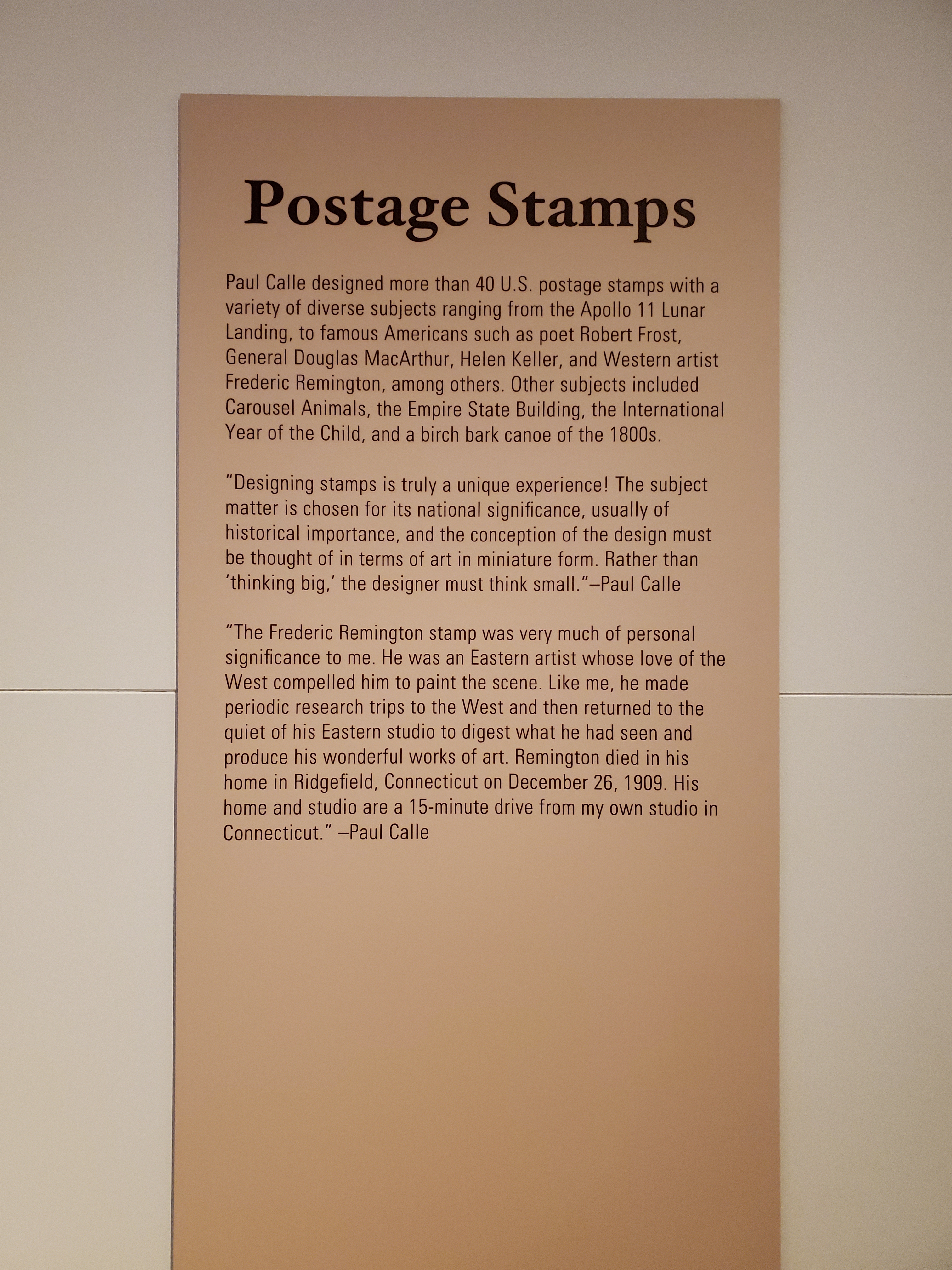
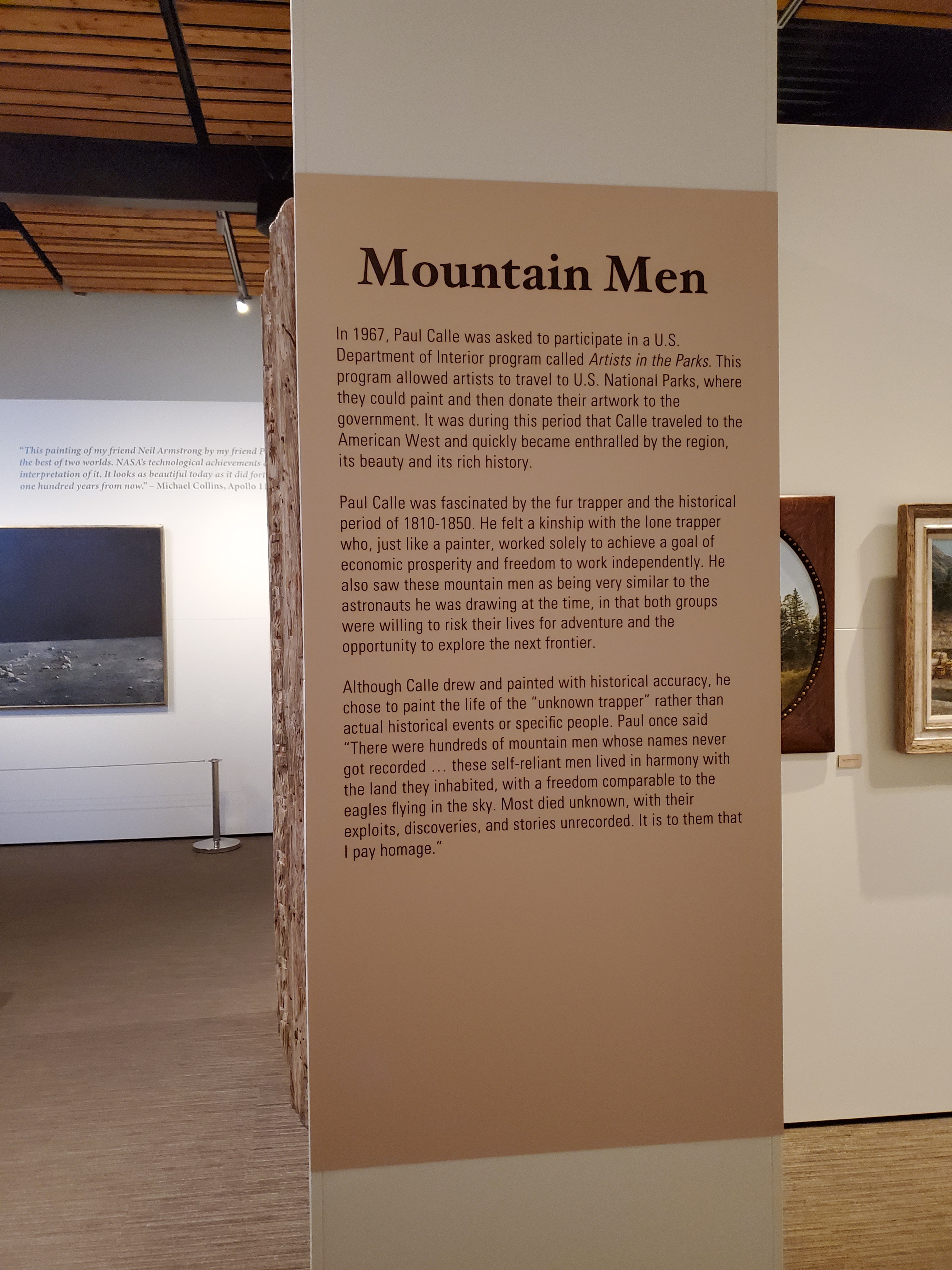
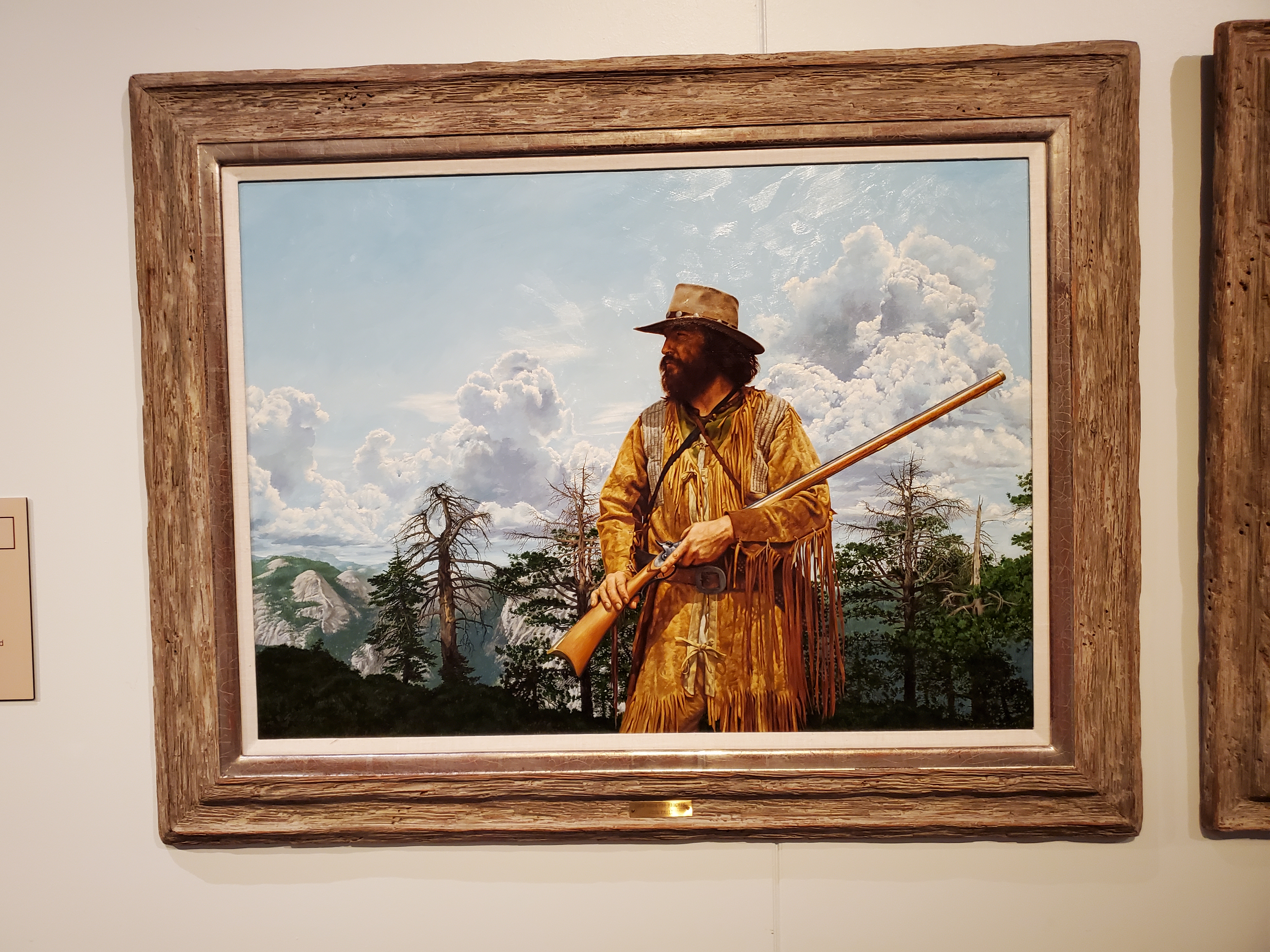
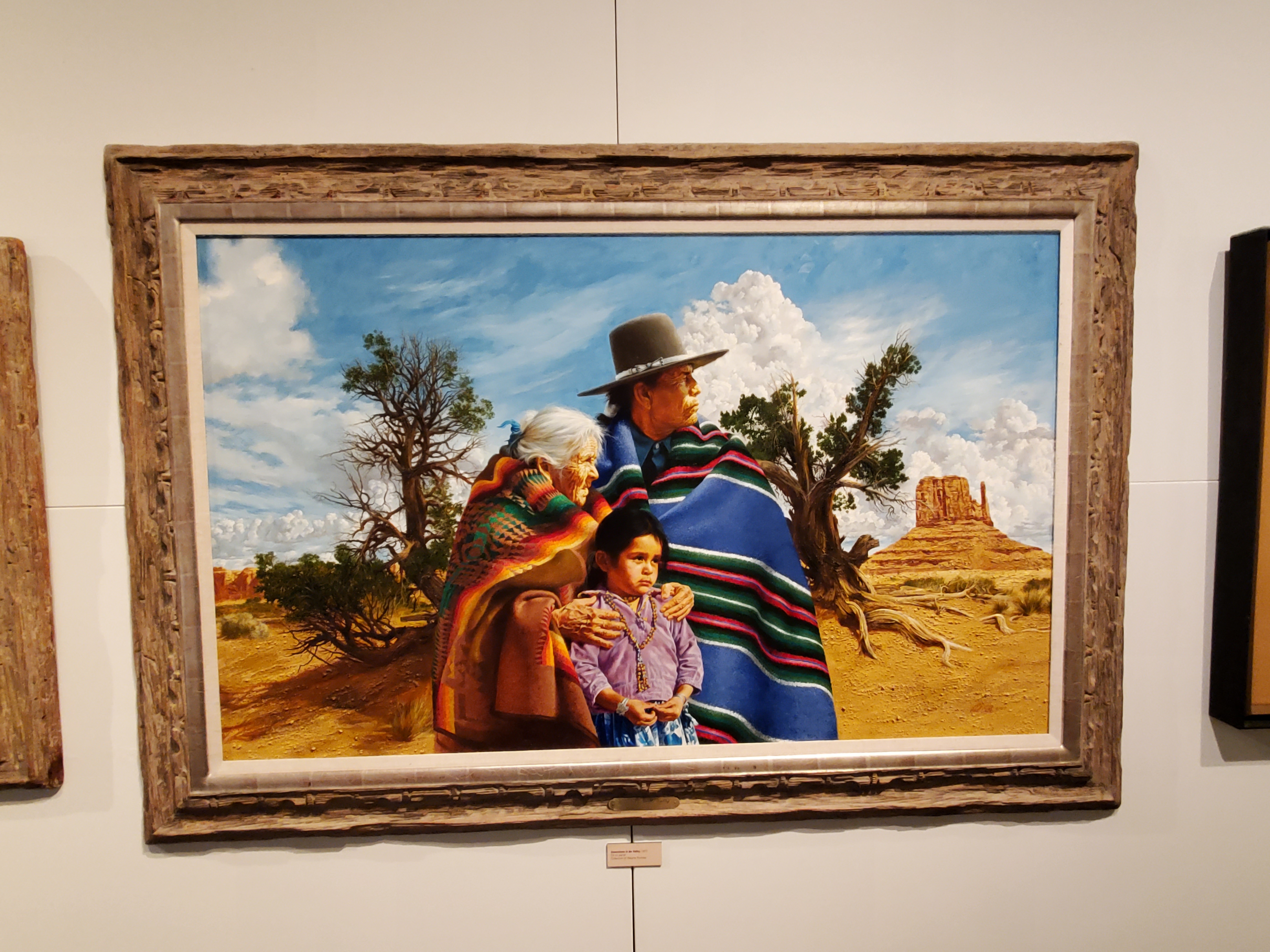
What has me thinking about all this today is a recent visit to a museum, The Spirit of the West Museum in Scottsdale, Arizona. More specifically, I am thinking of one of the exhibits on the second floor of this museum. It is entitled, “From the Mountains to the Moon,” exploring the life work of the artist Paul Calle. The man was an amazing artist, and the exhibit carries a good deal of his work, much of which deals with themes quite closely connected to the frontier, but what specifically gives the exhibit its title is the contrast between his many paintings of mountain men, and his depiction of the Astronaut, Neil Armstrong, taking man’s first step onto the moon. This might seem a Hell of a leap, from Mountain Men to the moon, but of course, there are certain elements of continuity.
You can see these traces of continuity in at least two of the paintings in this exhibit, along with the narratives attached to them. The first of these is entitled “The Great Moment.” It is most remarkable for its presence in an exhibit otherwise filled with western Americana (and a few other things to be sure), but the mere presence of this great painting alongside so many depictions of mountain men, Indians, and western landscape creates an interesting juxtaposition. It is enough to get someone asking, how and why did this piece get here?
“The Great Moment”
“This painting of my friend Neil Armstrong by my friend Paul Calle combines for me the best of two worlds. NASA’s technological achievements and an artist’s exquisite interpretation of it. It looks as beautiful today as it did forty years ago, and it will one hundred years from now.” – Michael Collins, Apollo 11, Command Module Pilot
So, how and why did that painting get here?
Well, the best explanation can be found alongside one of Calle’s more typical pieces.
John Colter
“I have always liked the image of mountain man John Colter his moccassin clad foot first stepping on the newly fallen snow of the Yellowstone Valley to the Moon boot of Neil Armstrong stepping in the dust of the Moon’s surface at the Sea of Tranquility. Two worlds apart, yet each of a new frontier. – Paul Calle
Captain Kirk could not have said it better himself.
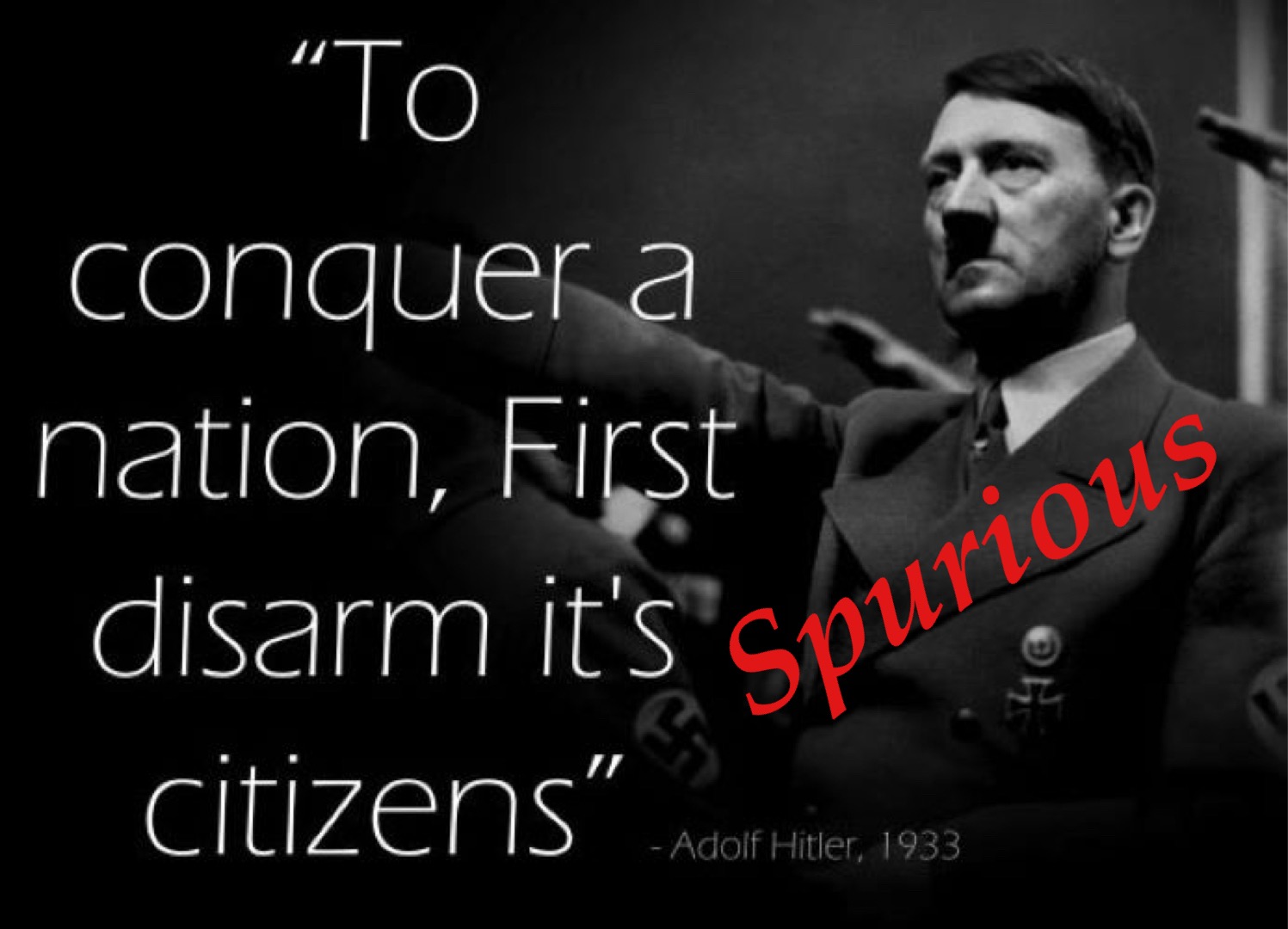
The notion that gun control was the key to Hitler’s tyranny (and in particular to the holocaust) has become a standard talking point among gun rights activists. To say that this is utter and complete bullshit is an insult to bullshit, which somehow ought to be accorded more dignity than this perfectly idiotic and highly deceitful bit of right wing rhetoric. It is, among other things, an effort to co-opt the story of an atrocity for the convenience of an interest group defined largely by those in positions of relative social power, and frankly, one that has historically included a rather large number of Nazi sympathizers. Simply put, those harping the notion that gun control is the gateway to the holocaust includes far too many people who face no such threats themselves, consistently show little to no concern for those that do, and who frequently express views which would put them closer to the guard towers of than the inside of any concentration camps.
There is nothing about this game that merits respect.
Nothing!
For the present, however, I wish only to remark upon one thing; a funny little made-up quote that features prominently in the babblerized politics of the gun lobby. Yes, it’s the quote of the meme to the left, which isn’t really all that funny after all, I suppose.
Except that there is no evidence that Hitler ever said it.
Of course, quote mining is a childish and deceitful enterprise to begin with. A single line here or there, presented entirely devoid of context, is no basis for drawing conclusions about anything. So, even when the quote is accurate, those passing these contextomies around like the tokens in a collectible card game are certainly not doing anything of merit.
But the whole pathetic project does get a lot worse when the quote itself is fake.
Excuse me, …spurious.
Oddly enough, Snopes thinks they have a candidate for something that comes close to this quotation, so they give it a mixed rating, saying that the claim that he said this is partially true. I think they are being overly generous, frankly, but anyway…
“The most foolish mistake we could possibly make would be to allow the subjugated races to possess arms. History shows that all conquerors who have allowed their subjugated races to carry arms have prepared their own downfall by so doing. Indeed, I would go so far as to say that the supply of arms to the underdogs is a sine qua non for the overthrow of any sovereignty. So let’s not have any native militia or native police.”
Of course, this passage does not match the wording of the quote in question, and those spreading that quote are not content to frame it as a paraphrase, so we probably shouldn’t let people get by with pretending to have an exact quote only to fall back on the pretense that it was only intended as a paraphrase.
It’s probably less helpful when someone else has to make that argument for them.
Anyway…
Snopes goes on to say that if you interpret “conquer a nation” in the spurious quote to mean making yourself a dictator over that nation, then sure, this actual quote from the actual Hitler would not fit the bill, because it is actually about the need to disarm peoples subjected by foreign conquest (eastern Europeans in this case).
If on the other hand, the phrase “conquer a nation” is taken to mean actually conquering another nation, then this quote might fit the bill after all because that is exactly what Hitler is talking about in the passage from the Table Talks volume.
The problem here is that the right wing use of this meme assumes the former definition, because the gun rights crowd is consistently using it as a means of commenting on domestic gun control. As always, the constant equation between gun control and disarmament is one of the central lies perpetuated by the gun lobby, but putting that aside, this quote doesn’t work at all if Hitler is really talking about how he means to treat subjugated populations of foreign countries, which Hitler is clearly doing in the table-talk passage. So, even if we grant the possibility that the quote could serve as a kind of paraphrase of the Table Talk passage, then the result is a passage that has no relevance to its present use by gun rights advocates.
So, even this bit of nothing much doesn’t mean what some folks might want it to mean.
Hitler simply didn’t say what some folks keep telling us he did.
At least, there is no reason to believe that he did.
Of course this is just scraping the surface of the garbage-heap that the present-day understanding of Nazi history among America’s ever-more fascist Republican base. Those closer America’s right wing gets to going full Nazi themselves, the more effort they put into redefining fascist policies and distorting the history so many of them now choose to emulate. Hell, I remember Glenn Beck once suggesting that empathy was the first step to the Nazi atrocities. If there was a time when America’s ‘conservatives’ would have known better, I can’t help thinking it is long since past. All of which is to say nothing of the not-even-post-hoc fallacy that goes with talk of a certain supposed gun control law, the Germans passed in 1938. In any event, the quote pictured above is fake.
We celebrate, William Seward, the man who arranged the purchase of Alaska from Russia here in Alaska. We celebrate this man on the anniversary of the signing of the deal he made with Russia.
Not everyone celebrates this date, of course. Some folks question whether or not the Russians could have sold all that land, much of which they were nowhere near controlling in the first place. But in the logic of collective fictions like nation states, it would seem the move has stuck, to to speak. There are those who mourn the consequences, and I’m told some folks in Russia still wonder how the Hell that happened themselves. At the end of the day, this still ends up being a day off work.
Okay, I am still working today, but since a lot of my coworkers aren’t, that means fewer meetings and I can focus on the things I want to, which is a kind of holiday for me. Also, it means I have a little time to knock out a quick blog post.
About Seward!
I’m told the rest of America was doubtful about this purchase at the time it was made.
Something about “Seward’s Icebox” or “Seward’s folly?”
Then again, some folks make way too much of a political cartoon; others have never figured out the difference between a catchy byline and the substance of an editorial. Writers took their shots and indulged in snarky quips back in the day just as they do now. It doesn’t mean they didn’t see the potential. The historian Richard Welch did a pretty good job of showing that public opinion was nowhere near as negative at the time of purchase as people typically assume. Still, it takes a touch of conflict to draw people into a story and the notion that Seward saw something in this state the rest of the country didn’t sure makes for an interesting first act. I suppose the third act in that version of story is statehood.
Or maybe the opening of a Walmart.
Or a Fred Meyers.
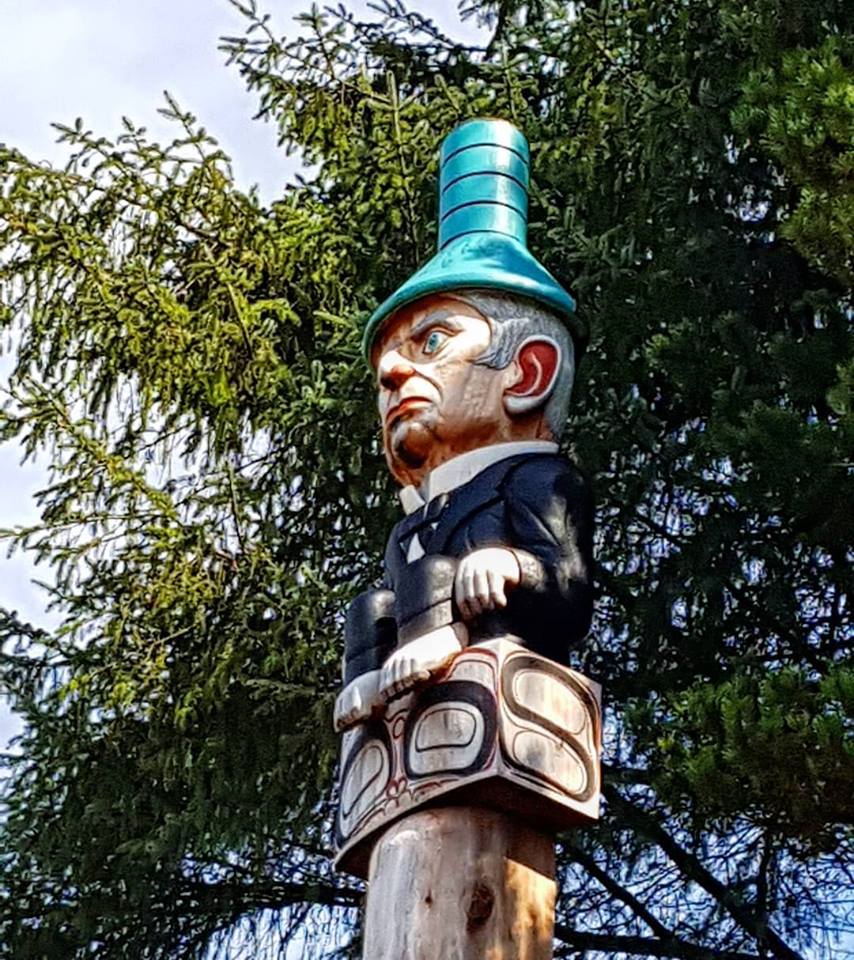
There are plenty of other ways of telling stories about the purchase of Alaska. One of my favorites can be seen in the Saxman Totem Park, just south of Ketchikan.
I posted a picture of it last year, right about this time.
…probably not a coincidence.
Seward Shaming Pole, 3rd Edition
Okay, so this pole may not be exactly about the purchase of Alaska, but it’s certainly purchase-adjacent. As to Seward’s Day, it’s right on point.
This is known as the Seward Shaming Pole. In fact it’s the third version of that pole, as the first two have succumbed to weather and termites. This version of the pole was completed just a few short years ago (2017). You can google up the earlier versions. As I understand it this one has its critics among the locals owing to the absence of certain features included in the earlier versions. I’m told a coat of white paint on the face was among the expected features. I only have this by word of mouth, so I’m not entirely certain what to make of it, but the differences do seem quite significant. In any event, this is the current version of the infamous Seward Shaming Pole.
What makes it a shaming pole?
Convention of course!
By ‘convention’ I mean the conventions of the Tlingit people. You might think of his piece as fitting into the totem pole genre within their own cultural order.
Hints that this particular pole is meant to shame rather than honor its subject are contained in the box upon which the figure of Seward sits and the red in his ears. (That red stood out more in previous versions.)
The red, I’m told signifies embarrassment.
The box?
Well that is loot!
Specifically, that is loot packed away in a bentwood box, one of the varieties of artwork thriving in the northwest coast cultural complex. In any event, the point is to suggest that Seward took a pile of loot off with him in the wake of a visit to the region.
How did he get the loot?
It was gifted to him in a potlatch ceremony, another of the cultural practices common to the southeast cultural region of Alaska.
So, what makes these gifts loot?
Because Seward never threw a potlatch of his own to compliment the one thrown for him.
To say that this is unacceptable is putting it mildly.
Emily Moore tells the story better than I could, but the essential details are this. William Seward came to visit the region in 1869. He was welcomed with a potlatch by Chief Ebbits of Tongass Village. As a leader of the Taant’a kwáan Teikweidí clan, Ebbits welcomed Seward according to local custom, granting to Seward the honors due to a another great leader. A feast was give in Seward’s honor and gifts were given to him. Then Seward went on his way.
It’s the going-on-his-way part that is a problem here.
The trouble is that a potlatch is not normally a one time affair. It is a gesture in an ongoing relationship. Once given, it is expected that a complimentary feast will be given to reciprocate the first. Doing so is a matter of obligation, and failure to do so leaves an imbalance in the relationship. It’s tough to tell what Seward may have thought himself, but for their own part Chief Ebbits and his clan most likely felt they were initiating a permanent relationship. When neither Seward nor any of his family ever showed up to answer the honor given to him, this cast the entire relationship in a negative light.
As this particular potlatch was given in honor of Seward’s role in leadership of the United States, the failure in this instance represents more than Seward’s own failure, it is a failure of the United States to acknowledge to live up to its obligations to Tongass Village and to the Tlingit people.
Some might be inclined to extend that out to Alaska Natives in general.
This is the history commemorated in that pole.
In another sense, this is direct commentary on that question about how two nations could swap lands neither one much to do with. If the purchase of Alaska is a done deal, so to speak, it is a deal done by two nation-states. The pole is a reminder of those not present when the deal was made, those whose own acceptance of the deal we celebrate today has been taken for granted all-too-often by the nation which acquired Alaska by means of it.
But Tom Horn and George Armstrong Custer definitely died for your sins.
If you are American anyway.
Tom Horn definitely died for your sins.
SPOILER ALERT!
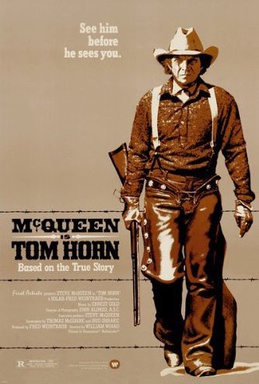
I am, of course, talking about an old Steve McQueen movie. I might also be talking about the real Tom Horn whose life and death inspired the movie, but I’m definitely talking about the Tom Horn of that movie.
This is one of the last films that Steve McQueen did. He was reportedly short of breath during filming, a symptom of the cancer that would soon take his life. It’s hard to escape the parallel between this story about the final days of a frontier legend and the final days of a Hollywood legend. It may be hindsight, but something of the tone of this film suggests a sadness not entirely contained within the plot of the film itself.
The real Tom Horn was tried in 1902 and sentenced to death for the murder of a Willie Nickell, the 14-year old son of a sheep rancher. Questioned while drunk, Horn reportedly confessed to the murder, saying; “(it was) best shot that (he) ever made and the dirtiest trick that (he) had ever done.” Suffice to say that many have questioned the validity of the trial, and of Horn’s drunken confession. Suffice it also to say, that few have questioned whether or not Tom Horn was guilty of murder, but many do question whether or not Horn was guilty of THIS murder.
In his life, Horn had served as a scout in the Apache wars. An ill-fated attempt at ranching afterwards had left him broke and bitter. Cattle thieves had taken the bulk of his stock. Horn spent the much of his life in subsequent years serving as a cattle detective. By all accounts, his ‘detective work’ was often a cover for the hired murder. Whether or not Horn’s murders were restricted to cattle thieves or other criminals, we will never really know. The range wars of the old west claimed the lives of innocent and guilty alike, and Tom Horn had been a willing participant in several of them, yet THIS trial and THIS killing is still a controversy.
The question of whether or not Willie Nickell was one of those murdered by Horn is one of the great legends of the old west. That this question is framed in relation to the final days of the old western period (or perhaps even a little after that period had ended) makes the story a bit more poignant. It makes the story about Tom Horn’s execution for what may or may not have been his final crime a question about what the old west actually means in American history. It makes of his trial an occasion to ponder the significance of the frontier in American history.
McQueen’s version of Tom Horn has the confession reading a little different. He has Horn saying that IF, he had shot the McNickell boy, that WOULD HAVE BEEN the best shot he ever made, and the dirtiest trick he had ever done. The account provided in court is, according to this version of the story, a sleazy twist his actual words, one arranged in an effort to railroad Horn to the gallows. Like the actual controversy itself, however, McQueen’s Horn stops well short of saying he had never committed a murder.
McQueen’s Horn refuses to defend himself from the actual charge at the trial. Asked whether or not he committed the murder in question, Horn replies that he won’t give the court the satisfaction of a direct answer. He knows the fix is in, arranged by the same people who who had arranged for his services as a cattle detective, and he simply will not humor the court by pretending his answer matters.
Now, whether you shoot me, or hang me, or take my horse and rifle, one reason is as good as another. I believe that, I really do. That’s my last word on this matter.
The problem from the perspective of McQueen’s Horn isn’t whether or not he actually killed the child. It is that his trial is no more about justice for the murder sheep-herder’s son than the murder of the sheep-herder’s son had been in the first place. Both are about the needs of the cattle industry, and in a larger sense, the needs of the establishment now growing in the frontier he had once known. Horn’s coming execution is as much a function of financial interests as any of the killings he had carried out in the name of those very same interests. His killings had once been effective in removing obstacles to big ranchers, and now they were an embarrassment, even a scandal. In the larger story of the American west, by 1902, so had all the killings carried out by men like Horn.
Just as the sheep-herder’s son, Horn himself had to go. Whether he had killed the boy or not, his own execution was, in effect, a murder arranged by cattle interests.
Horn understood murder.
He was fine with murder.
Even his own.
In this account, Tom Horn, and so many like him, are the civilizing agents of the west. Their rough lives, their conflicts, even their outright murders, all committed on the mythic frontier, are what made present-day American society possible. We in the present-day share in their crimes to the extent that we enjoy the fruits of their violence, and while we may balk at this or that terrible act, we are who we are now and live how we live now because of those very acts. America is what it is because of murderers like him.
Horn’s execution is thus a kind of final, necessary crime, one carried out by faceless men, acting in concert to erase the violence which made their success possible, the violence which made America possible. Professional killers like Horn, once the rock-stars of their day, were now an uncomfortable presence, and a reminder of uncomfortable truths. Like Jesus going to the cross voluntarily, Horn accepts his hanging, because that is how it must be. His crimes were necessary, so to speak, but so is his execution.
We cannot have the likes of Tom Horn living on into the modern era, reminding us every day that cruel men once killed children on behalf of the upright citizens of our great country.
I know it seems odd to think of a hired murderer as a Christ-like figure, to think of him as the savior of the American people, but to me it seems a bit more fitting than the Prince of Peace. Time and again, it’s been murderers that saved our nation. They have saved us from real enemies, to be sure, and they have saved us from innocent people who merely stood in our way. We don’t always know the difference, because we really don’t want to, and that is why the Tom Horn of this movie has to die.
Confined to the frontiers of our nation, men like Tom Horn even save us from thinking too much about the whole thing.
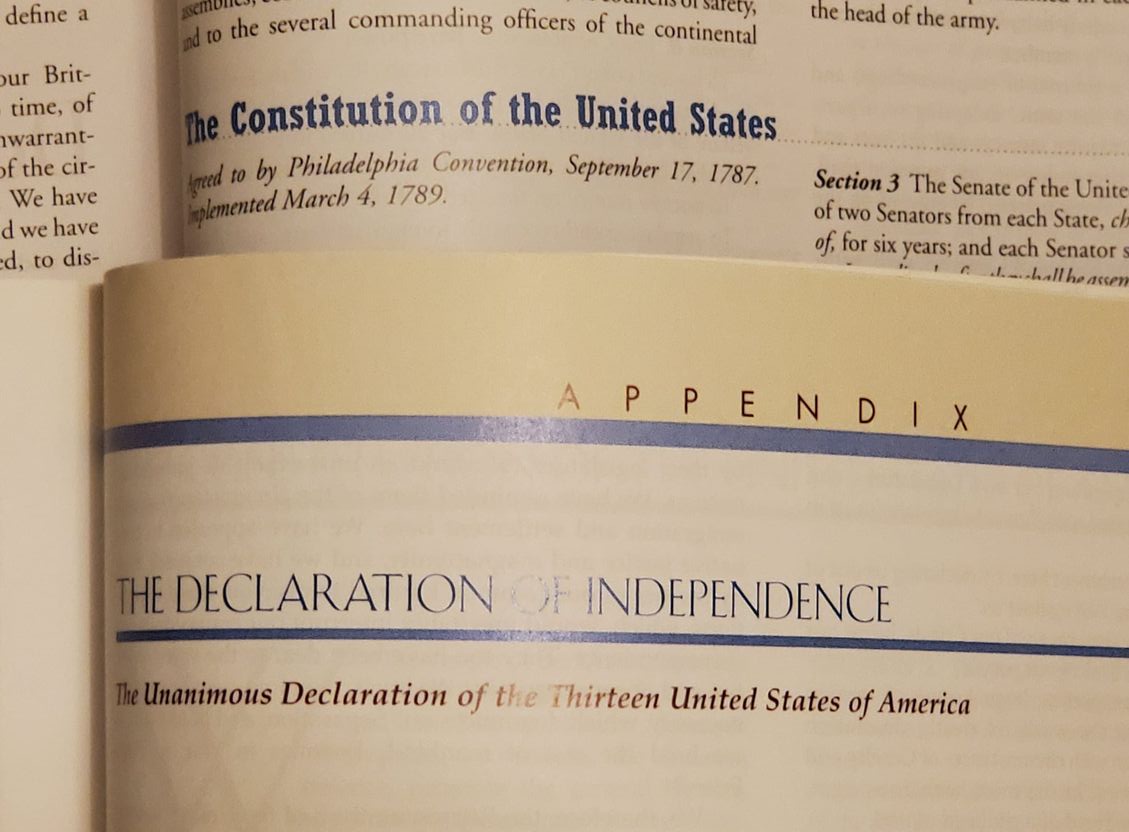
Have you ever had anyone cite the following words from the “Constitution?”
We hold these truths to be self-evident, that all men are created equal, that they are endowed by their Creator with certain unalienable Rights, that among these are Life, Liberty and the pursuit of Happiness.–That to secure these rights, Governments are instituted among Men, deriving their just powers from the consent of the governed…
To be fair, I have seen people on both the left and the right make this mistake.
Some in the middle too!
Also, to be fair, the left, the middle, and the right are not equally invested in the mistake.
***
When the left confuses this passage from the Declaration with the U.S. Constitution, they are generally aiming at a point not altogether different from that of the preamble to the U.S. Constitution.
We the People of the United States, in Order to form a more perfect Union, establish Justice, insure domestic Tranquility, provide for the common defence, promote the general Welfare, and secure the Blessings of Liberty to ourselves and our Posterity, do ordain and establish this Constitution for the United States of America.
Lefties confusing the passage from the Declaration with the U.S. Constitution are trying to establish the importance of rights in the formation of government. Whether these rights are best thought of as ‘individual rights,’ ‘human rights,’ ‘civil rights,’ or even ‘natural rights’ is a rather more complicated question. The left and the right differ on that one, but most will find rights of some kind to be at issue in the nature of American government. Suffice to say the Declaration is content to describe them as ‘inalienable,’ which was enough to put them on the table in 1776. I have yet to see anyone on the left misquote this passage for any reason other than to establish the importance of our rights to the formation of the U.S. Government.
Perhaps, people can be excused for confusing the two passages, at least insofar as they both evoke the importance of government in facilitating the happiness of human beings (ignoring for the moment the gender politics of the passages in question). If there is any difference between the two passages, it lies in the agency involved. The Declaration is a little bit ambiguous as to who creates the governments ‘among men,’ but it does mention a ‘Creator’ as the source of inalienable rights. God is not mentioned in the preamble to the U.S. Constitution; it lays the responsibility for creation of the new government squarely at the feet of the people.
…which is where we get the biggest difference between the left and the right on the misreading of the passage from the Declaration.
***
When the right mistakes the Declaration for the Constitution, they are generally trying to tell us that the passage in question establishes the importance of God in our Constitution. Cultural conservatives will often tell us that God is mentioned in the actual Constitution. The only actual reference to God in the Constitution would be found in the date of its signatures wherein the document says;
done in Convention by the Unanimous Consent of the States present the Seventeenth Day of September in the Year of our Lord one thousand seven hundred and Eighty seven and of the Independance of the United States of America the Twelfth In witness whereof We have hereunto subscribed our Name
That reference isn’t much to hang your hat on.
Those simply telling us that God is mentioned in the Constitution are most likely thinking about that passage from the Declaration of Independence, which they have confused with the Constitution itself. In their imagination, and that of other confused Americans, the second paragraph of the Declaration is also the Constitution. The two documents are one in the same.
We might even call that document the ‘Declastution!’
When cultural conservatives confuse this passage with the Constitution, they are working a very particular angle. Their point is not the existence of rights (individual, civil, natural, or human); it is the existence of God. What they are trying to show us is that belief in God (or more specifically; belief in Jesus) is essential to the founder’s vision of American government. They wish to instill in American government (and by extension American law) an explicit homage to God in some official or quasi-official form. They like having Him on our money and in our pledge, and they like prayer in public schools and in public meetings, and many will happily seek additional entanglements between religion and government when and where they can get it. To them, the establishment clause of the Constitution is a narrow principle that prevents little more than explicitly sectarian policies (if it prevents even that). A general acknowledgement of God [or the Judeo Christian God (or, frankly; …Jesus)] in the official policies of the U.S. government is to them quite consistent with the Constitution, even required by it.
How do they know it is required?
Because that is how Jefferson wrote it.
Simply put, because the Declastution derives our rights from God, so conservative thinking goes, everything else that follows must hinge on the existence of God. Take away God and we have no rights and hence no government, and no ice-cream for desert, dammit, just go to bed!
(Sorry. I get carried away sometimes.)
Simply put; when the right confuses these two documents, they do so with a purpose.
Now the argument in question doesn’t always begin with a confusion of documents. Another common approach is to tell us that the Declaration is actually the ‘foundation’ of our government, and that everything about the U.S., including the Constitution itself is built upon that foundation. Over-used architectural metaphors aside, the point is to read the Constitution in light of the Declaration. We take the principles from the Declaration, as these guys understand them, and we apply them to the Constitution, so if God is mentioned the in Declaration, then he is implied in the Constitution, right?
Right?
Even if the Constitution itself says very clearly that the authority upon which our government rests derives from the people!
Anyway, that seems to be the point.
***
There are a couple problems with this, of course, and probably a couple more. These include the following:
1: Jefferson is the main author of the Declaration, and his own views on God are far from straight forward. He is often described as a Deist, though this might be a bit strong; he certainly was not an orthodox Christian. It is my understanding that he stopped short of denying the possibility of miracles outright (though he was sufficiently uncomfortable with the idea of miracles to remove them from his own account of the life of Jesus). So, what does the term ‘Creator’ mean in this passage? What could it have meant to Jefferson when he wrote it? There is little reason to believe Jefferson was talking about Jesus. Had he been referring to Jesus, there is still less reason to believe he would have had anything in mind like the present-day Christian understanding of their Lord and Savior.
2) More to the point, this is a political document, not a theological tract. Hell, it’s a propaganda piece! In writing it, Jefferson is committing an act of treason and trying to get enough support to survive the consequences of his own actions. He wants and needs to reach every colonist he can get to support the cause of separation from England. “Creator” is a nice way to reach Christians, Jews, Unitarians, and even the most strident of Deists without inviting any real cause for disagreement between them. I reckon, a few other beliefs could be read into that reference too, but I suspect Jefferson was more interested in reaching people in that range. Simply put, Jefferson wasn’t trying to separate the believers from the unbelievers with that reference, not by a long shot. What today’s Christians are doing when they read this document as an explicitly Christian (or Judeo-Christian) tract is to turn a document aimed at appealing to a broad range of religious views into an instrument for narrowing the range of views relevant to contemporary American politics.
Their fight was not Jefferson’s.
Far from it!
3) Finally, did I mention that this was a political document?
Cause its a political document.
Really, it is a political document!
The point of the passage in question is not to prove that God exists or even that belief in God, or subservience to God (or a Creator of any kind) is essential for public life. No, the point of the passage in question to establish the existence of rights, and from there to explain the existence of government as an expression of those rights and an instrument for satisfying them. This of course stands in stark contrast to the “divine right of kings,” which was still very influential in the merry Motherland. Jefferson’s point is not that God exists; it is that rights exist. God (or more importantly, a ‘Creator’) in this passage is merely a premise used to arrive at his political conclusions. Really, it isn’t all that clear that this Creator is all that essential to the premise anyway. Hobbes does a pretty good job of making a similar argument without giving a central role to such an entity. Jefferson’s begins with the assumption that people have rights. That they get them from a Creator is not entirely critical to the argument at hand; the point is that they have rights, and that these rights are the foundation of government.
…a theory of government in direct contrast to the notion that God himself had put the King of England in charge of the British people. The Divine Right of Kings, as James had espoused it, placed the authority for government authority on God, just as modern Christians would have it, whereas both the Declaration and the Constitution set the people up as the source of authority for government power. If God plays any role in this under the narrative contained in the Declaration, it is largely theoretical. Even that is missing from the Constitution.
Irony of ironies then that conservative Christians wish to read the Declaration as an effort to place God at the center of American government.
Not just ironic.
Perversely so!
***
It is no accident that cultural conservatives would wish to base their case for theocracy on the Declaration rather than the Constitution. The Declaration gives them foot in the door, at least if you don’t read it all that carefully. The Constitution doesn’t even give them that much.
The Declastution was born out of the need to ignore the difference.
***
I suppose the Declastution will live on in American politics for some time to come. People will continue to cite the Declaration while calling it the Constitution, and red the Declaration which they read as though it were a Baptist prayer book, but none of this has much to do with the meaning of the documents in question. It’s a kind of shell game the right wing likes to play with themselves, and with the rest of us.
They aren’t playing this shell game because they are interested in what either document has to say.
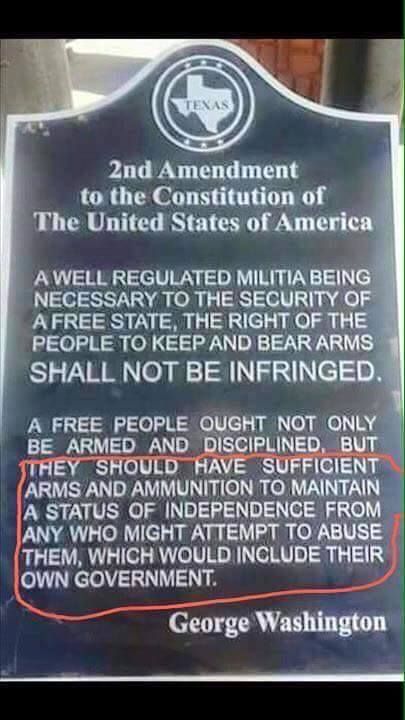
You can find it all over the net. The quote contained in it is extraordinarily popular in right wing circles. This should surprise nobody of course. It has George Washington singing the praises of private gun ownership as a means of preparing the population for possible war with their own government. The price of freedom, it seems to suggest, is the need to be ever vigilant against one’s own government, to be prepared at all times to rebel against that very government.
If you were to boil down the thinking of the Insurrectionists on January 6th, it might well be this quote right here.
There are different variations of the meme, to be sure, but the quote itself is near and dear to right wing America. They share it with each other, and with the rest of us, on a regular basis. I first encountered it when a friend posted it for my benefit on Facebook. I have seen it there many times since. The quote finds its way onto twitter every day. It certainly found its way into Parler a number of times before that crappy service found its way into oblivion. You can find the quote on Instagram. It’s all over Pinterest, compliments on websites like Zazzle and BrainyQuote. It certainly makes its way around Tumblr. You can find this quote on merchandise at various online outlets, …T-Shirts and such. I could go on, but you get the idea. This quote gets around. It’s popular.
I mean, it’s REALLY popular!
And it’s fake.
To be a bit more specific, the first 11 words of this quote are from the fourth paragraph of George Washington’s first address to Congress. Everything after that has been doctored so as to make it into a talking point for gun owner’s rights.
Here is the fake quote:
“A free people ought not only to be armed and disciplined, but they should have sufficient arms and ammunition to maintain a status of independence from any who might abuse them, which would include their own government.”
Here the original:
A free people ought not only to be armed but disciplined; to which end a Uniform and well digested plan is requisite: And their safety and interest require that they should promote such manufacturies, as tend to render them independent on others, for essential, particularly for military supplies.
Another Variation on this Fake Quote
(Emphasis added.)
So, what happens when you call people out on this? Well, sometimes, folks get the point. Some decent people actually take the correction and get on with their lives. More often, they refuse to believe they are wrong. Some just ignore you. Some sources, I suspect, are bots, programed to simply post this and other propaganda over and over without regards to any efforts to engage them. The most common response, I get, however is to tell me that the quote above is actually a paraphrase of something Washington actually said. Some even provide me with a link to the actual speech. (Whether or not they have read the speech is another question.)
In a parallel development, I have noticed a lot of people taking to twitter in recent years to post the actual quote above. This might well be a response to the fact that some of us keep addressing the fake quotes wherever we find it. Realizing they don’t need the fake quote, they use the real thing for pretty much the same political purpose. In their minds, the real thing is still very much a statement about the importance of the Second Amendment. It may not contain an explicit prescription for revolution-readiness, but at least it makes the case for private gun ownership, ad we all know what that means…
Right?
The problem is, it doesn’t.
If you read the rest of Washington’s speech, you can see quite clearly that its overwhelming theme is the exercise of the Federal government’s newly expanded powers. Yes, that’s right, Washington was actively working to expand the powers of the Federal Government, as did many of the founding fathers now celebrated by those whose very definition of evil is encapsulated in the phrase “big government.” One of the powers Washington was most happy to have at his disposal was the ability to outfit a viable military force. THAT is what this paragraph is about. It is nestled in between two other paragraphs that are most explicitly about troops and preparations for war. Keep reading that same speech, and you find Washington speaking quite explicitly about the prospect of war with Indians in the present-day southeast.
Among the many interesting objects, which will engage your attention, that of providing for the common defence will merit particular regard. To be prepared for war is one of the most effectual means of preserving peace.
A free people ought not only to be armed but disciplined; to which end a Uniform and well digested plan is requisite: And their safety and interest require that they should promote such manufactories, as tend to render them independent on others, for essential, particularly for military supplies.
The proper establishment of the Troops which may be deemed indispensible, will be entitled to mature consideration. In the arrangements which may be made respecting it, it will be of importance to conciliate the comfortable support of the Officers and Soldiers with a due regard to œconomy.
What Washington is actually talking about is the ability to field an army. He sees this as an essential exercise of the powers newly granted to the Federal Government under its new Constitution. He is urging Congress to encourage the manufacture of weapons so that the armies of the United States will not have to rely on foreign powers to arm them in the event of any future war.
Just to be clear, the prospect of such future wars certainly does include the possibility of open rebellion, but Washington isn’t arguing that citizens might need to rebel against their own government. If anything, he is mindful of the prospect that he might need to put down such a rebellion. Remember, it was Shays’ Rebellion that triggered the urgent need for a constitutional convention in the first place. Its purpose was to fix perceived weaknesses in the Articles of Confederation, specifically, the inability of the central government under that plan to tax the population directly so as to give it the means of fielding an army capable of putting down such an insurrection when it happens again. That’s right. The trigger for creation of the U.S Constitution was the need to put down rebellions, and Washington himself was fully down with that very agenda. Lest anyone think this might have been idle speculation, one has only to remember the whiskey rebellion.
When private citizens decided to rebel against the Federal government over taxation while Washington, foreshadowing so many of the themes of modern right wing politics, far from backing the rebels, Washington sent troops to put down that very rebellion.
Now there is an interesting detail here insofar as the troops in question took the form of a militia. I reckon some might say, “See! See, that’s what we are talking about,” but of course that ignores the difference between the actually regulated militias of Washington’s day, and the self-appointed weekend warriors who call themselves militias today. More to the point, it ignores the fact that the militia in the Whiskey Rebellion was not defending itself from “their own government”; it was actually serving as the arm of enforcement for that very government. You see, that Constitution whose powers Washington wants to flex here gives Congress authority over the militia, a provision quite controversial at the time, and arguably one of the inspirations for the Second Amendment still in draft form as Washington made this speech. One of the newly expanded powers of the Federal government Washington is actually trying to build upon in this very speech is power to arm and control the militia.
The enumerated powers of Congress includes the following:
To provide for calling forth the Militia to execute the Laws of the Union, suppress Insurrections and repel Invasions;
To provide for organizing, arming, and disciplining, the Militia, and for governing such Part of them as may be employed in the Service of the United States, reserving to the States respectively, the Appointment of the Officers, and the Authority of training the Militia according to the discipline prescribed by Congress;
Hopefully, you caught the part about “suppressing insurrections.”
Because that’s what Washington actually did on his own watch.
This meme would have us believe Washington would side with the rebels. This meme would have us believe that Washington was hyping the virtues of an Amendment not yet ratified as a means of countering the very power he was actually seeking to build in his First Address to Congress.
This meme is a lie.
It is not a paraphrase of Washington’s actual statement, and it is not (as several folks have assured me) an honest description of Washington’s actual views. It is not an honest mistake; it’s not a different point of view.
We Americans really love our independence, don’t we?
Or at least the thought of it!
Independence can be measured in any number of different ways, but in American politics, it typically means you earn your keep. Maybe you start a business and make a profit, or maybe you have a job and earn your pay, or maybe you speculate on the stock market (without or without the benefit of insider knowledge) and turn a profit without really contributing much of a product or service. Either way, the point is that we typically define our economic independence in terms the ability to pay our bills without asking for help (or at least not asking for that help through any medium short of the highest paid corporate lobbyists). Anyway, the point is, we pay our own bills right?
This is an incredibly ironic measure of independence.
This measure enables a real-estate tycoon to say that he built a structure when he didn’t lay a single brick. It also enables the average person to find shelter without building a house, to cloth himself without making the fabric or fashioning it into a shirt and pants, and it enables us to feed ourselves with all manner of meats and vegetables that we neither grow nor harvest ourselves. We have no idea where most of these things comes from or how it got to the stores where we bought it, not our food, our tools or any of the essential supplies we used for much of anything. Some folks may know a thing or two about fixing a car or building a table, but the fact remains that most people in the developed world lives our lives surrounded in mystery at the very nature of the stuff we use to get through the day. This we count as independence!
Because we paid for it!
It is ironic.
Contrast this with the indigenous peoples of the Alaska who until relatively recent history would have housed themselves, clothed themselves, and feed themselves. To varying degrees, many still do. In times past, the skills necessary to do so were common knowledge in any of these communities, and those skills turned what non-native Americans have typically called a ‘wilderness’ into a wealth of resources ready and waiting to be transformed into food, clothing, tools, and even housing. Small wonder that people so often described by outsiders as living in poverty would see themselves as wealthy. To someone without the skills to hunt, a caribou on the hoof is nothing until it finds its way into his freezer. To someone with the necessary skills, it is fine just where it is, at least until it is needed.
I do not mean to paint a utopian picture here, not by a log shot, but my point is that this is a very different vision of what it means to be independent. Here, the question is not whether or not you can pay for your stuff but whether or not your stuff becomes yours by your own hand, or at least that of your friends and family.
I also don’t mean to suggest that this is entirely unique to Alaska Natives. I reckon it would be true of indigenous people all over the world, depending to one degree or another on the impact of colonization.
***
One sees this conflict between a world of consumerism and a world of subsistence activities and play out quite regularly in the relations between Alaska Natives communities and outside institutions. Also in cultural conflicts between Alaska Natives and non-natives with or without the involvement of government entities. Sometimes, you have to look carefully to see it; sometimes, it is loud and clear for all to see.
The Barrow “duck-in” is one such time.
This story is told best by Rachel Naninaaq Edwardson, I think, in her documentary, The Duck In. Michael Burwell’s article, Hunger Knows No Law, is also an excellent source. If the quick & dirty version I am about to offer interests you at all, then by all means, check out either or both of these sources.
***
What happened?
In 1916, the United States entered into treaty with Governing governing the hunting of migratory waterfowl. A similar treaty was signed with Mexico in 1937. In 1918, Congress passed passed a law enacting the term of the first treaty into Federal law. This in effect made it illegal to hunt migratory waterfowl in the U.S. from March 1th, to September 1st.
Why is that a problem?
Because that’s when those birds are here on the North Slope of Alaska.
I mean a duck or two may head south a bit late, but no, for the most part, that’s when migratory waterfowl are present in this area. To say that hunting ducks and geese are a substantial part of the native subsistence economy is putting mildly. It does not appear that subsistence hunting was ever contemplated in the treaty negotiations, nor in the Congressional actions which codified the treaties in U.S. law. Both were intended largely as a means of controlling sport hunting, much of which would take place in the lower 48. So, a law passed for the purpose of controlling the leisure activities of weekend warriors who mainly feed themselves store-bought food had effectively banned the hunting activities of people who actually need that meat to get through the year.
Alaska Natives were out of sight and out of mind when the laws were made.
Luckily enough, they were also out of sight and out of mind (for the most part) for many years when responsibility for enforcing these laws fell upon federal officials. Thus selective enforcement helped to correct the errors of selective attention, for a time anyway.
When Alaska became a state in 1959, things started to change.
To make a long story short, state officials decided to enforce the law, even in the North Slope of Alaska. According to Burwell, some of these officials were convinced that the Iñupiat population of the north slope had become less dependent on hunting as local stores made produce available. The prospect that the Iñupiat community might be using the stores in limited ways while seeking to remain self-sufficient in others (and particularly, with respect to food) does not seem to have occurred to them. Resistance, they figured, they could be resolved by educating the population (which reminds me of the Navajo livestock reductions, but that’s a story for another post). In 1961, Wildlife officials began to arrest people caught hunting waterfowl during the proscribed period of time.
As it happens, that was a rough year for the North Slope insofar as the annual whale harvest had yielded only a two catches and other likely sources of game were not yet available.
…just the birds flying overhead.
To make a long story short, one of these agents, Harry Pinkham, emerged from his room at the Top of the World Hotel to find; “every man, woman, and child standing in front of my door with a duck in his hand.” Flustered to find an entire town demanding that they be arrested, he went to the local Magistrate Judge, a native woman, named Sadie Neakok (who provided the quote above). Neakok instructed him to follow the law. In all, 138 hunters self-reported their crimes and Pinkhman ended up confiscating 600 pounds of eider ducks (it took two separate plane trips to transport them out of town). State Senator, Eben Hopson (also a local Iñupiat) wired then Governor Egan to ask for welfare personnel to take care of the children once all the adults were taken into custody. Thus, what wildlife officials had hoped would be a matter of handing out fines and lecturing a few natives quickly escalated into a case threatening to overwhelm state resources.
Nobody actually spent time in jail for this, of course.
Instead wildlife rediscovered the virtues of selective enforcement, providing advanced warning whenever their officials were coming up to the North Slope and staying only for 3 days at a time. With these measures in place and well publicized, they really couldn’t have done much more to help hunters avoid getting caught. In time, of course, the laws and treaties were changed to accommodate the cycles of subsistence hunting.
For the indigenous community of the North Slope, this was a win.
A damned good one!
Don’t get me wrong! Conflicts over subsistence hunting rights are a still common, here and in the rest of Alaska, but in 1961, at least, the Iñupiat community of North Slope successfully fought off a threat to their subsistence activities by means of civil disobedience.
***
One of more interesting things about Rachel Edwardson’s work on this comes at about 16-minute mark in her documentary wherein she includes a series of public statements on the issue, all of which foreground the different political economies in question. Outsiders, of course, assumed that hunting, or at least subsistence hunting, would simply cease at some point along the inevitable march toward civilization. Was it not time, even past time, for folks to simply give up the hunt and buy their food?
“The Eskimos have claimed that the ducks leave their northern area before the legal hunting season opens. They also use such phrases as ‘hunger knows no law’ to justify their taking the ducks illegally. In this age of assimilation, where is the point at which the natives must forfeit must forfeit their old rights in favor of the rights of modern civilization?”
(Anchorage Daily Times, Editorial, June 15, 1961.)
“These people were from established communities where ample food is available. The basic conflict is the desire of the natives to continue certain primitive customs and yet live in civilized communities. All of us, including the Eskimos, must realize that the development of any country in the world brings with it advantages and disadvantages. This is true in any civilization, and it must have become obvious already to many of the native people of Alaska. Sincerely, Ralph A. Duncan, Special Assistant to the President.”
(Extract from Whitehouse Response to the United Presbyterian Church, Barrow Alaska)
Edwardson answers these statements with Eben Hopson’s statements on the subject (from his wire to the Governor, I believe). For his own part, Hopson begins by telling stories about people who feed themselves, whether by hunting or farming. He then turns the whole issue, on its head, he asks if anyone would accept a law forbidding the buying of meat at the store?
“We have survived from this land by hunting, just as any other John Dick and Harry have survived from the land by plowing the fields where they could raise crops. If there was law enacted without your knowledge making it unlawful for you to buy meat at your local store, and you continued to buy it because you needed it, I can see and hear you screaming up and down about that law being unjust, and discriminatory, the minute you found it out. If the meat was a matter of survival for your, would you stop eating meat for 3 months out of the year and wait for some disinterested person to come along and try to amend it for you without having assurance that the problem would even be solved.”
– Eben Hopson, State Senator.
I really don’t think the different visions of independence could be more clear than they appear to be in these letters. Those expecting the indigenous community of the North Slope to simply accept the laws in question clearly envision a future in which “Eskimos” buy their food at the store, just like the rest of us. This of course means that people will also get a job instead of spending their days out hunting or preparing for the hunt. It is a world in which people satisfy their needs by first first earning and then spending money. Those organizing and supporting the duck-in consistently envision a world in which they feed themselves. The modern world complicates both visions, of course, but this was a moment wherein the outside world appears to have forced the issue; as if to say; “Stop hunting and buy your food at the store.”
It occurred during the civil war at a battle in Raymond, Mississippi. Apparently, a minie ball (a conical-shaped bullet commonly used in the era) passed through a Confederate soldier’s testicles and then lodged itself in a young woman’s own private parts. Though, still a virgin, she later gave birth to a baby boy, apparently impregnated by the minie ball carrying the young man’s seed along with it.
Okay, but by “apparently,” I of course mean “not at all.”
This did not happen.
Not really!
Photo of Legrand G. Capers found in Wikipedia
The fact that this didn’t happen didn’t stop an army surgeon by the name of L.G. Capers from reporting on the incident as though it really did. He describes in detail coming upon a soldier staggering toward him before collapsing as a woman began screaming from the house in which he planned to conduct field operations. He treated both parties, or so he says. Later, Capers writes that he returned six months later to find the young woman pregnant though her hymen remained intact. A month or so later, he also delivered the baby, still confused about her story. After piecing the events together later, Capers says he found the soldier and explained the child to him. Of course the young man did the honorable thing, and the doctor reported visiting the lovely couple many years later to find them living happily together with 3 children.
All of this was published in a journal known as the American Medical Weekly in 1874. It was later republished in a British Medical Journal, the Lancet, and a few subsequent publications (whose editors should probably have known better) have presented the story as medical facts. Author Tony Horowitz tells us that at least one museum in Vicksburg Virginia related the story without comment as of his research for book, Confederates in the Attic, published in 1999. (The story appears on pages 199-200). Though the American Medical Journal later published a clarification explaining that the whole account had all been a joke, it seems there are always a few folks determined to take it seriously.
Also, aside from the source being a known spoof, apparently, this is a medical impossibility.
This time, by “apparently,” I mean “absolutely.”
What has me thinking about this today is Horowitz’s account. As he put it, the original account was intended as a spoof of other wildly exaggerated stories circulated by medical doctors in the wake of the civil war. If nothing else could have tipped a reader off as to nature of this tall-tale, the fact that Capers reported later removing a mini-ball from the child’s own testicles should probably have been the final “gotcha” moment of the story. Tall tales often have this, a final twist so improbable as to effectively communicate to anyone who might still be wondering that the whole thing was just an elaborate joke. This, if nothing else, ought to have tipped readers off then and now as to the nature of the Capers’ clever little yarn. Note to mention, the correction published published by the same journal.
Apparently, some people would rather believe the story anyway.
And by “apparently,” this time I just mean “apparently.”
***
All of which brings to mind a principle coined by an old net-friend of mine, Nathan Poe. Frustrated with debating young-earth creationists on Christian forums, Poe once quipped; “Without a winking smiley or other blatant display of humor, it is utterly impossible to parody a Creationist in such a way that someone won’t mistake for the genuine article.” In other words, you can’t make a satirical statement sufficiently outrageous to out-absurd the very people he was arguing with. But of course Christian fundamentalists are not the only bunch with a few loose canons in their midst, as others have pointed out. So, the principle has been generalized since its original formulation to apply to a broad range of topics about which satire might be mistaken for the real thing, not the least of reasons being that someone is usually just as extreme as any parody their critics might make-up to poke fun at them.
Apparently, that was also true in 1874.
***
This story was only a couple pages out of Confederates in the Attic, but I highly recommend the book as a whole. Great read! There are some other good sources on the internet. Wiki has a decent page on Capers, and of course that contains many good links in itself. Mark Powell’s write-up is useful and fun to read. Of course, Snopes has a good page on it as well, complete with many of the relevant primary documents.
Right wing patriots love their country in much the same way that an abusive spouse loves his wife.
“I love you baby, now do what I say or else!”
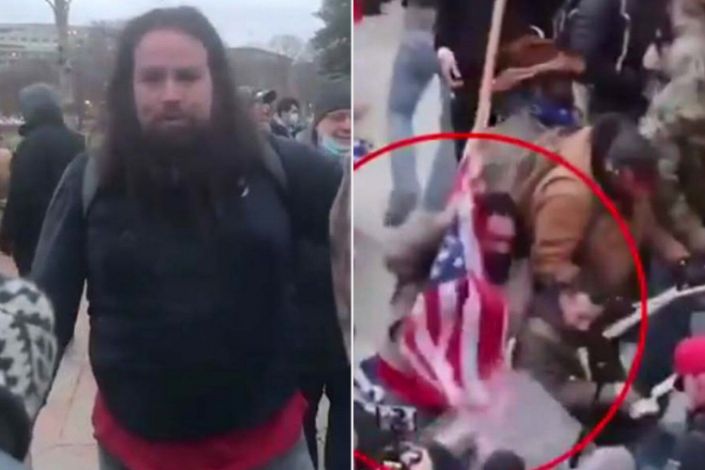
When one of those participating in the riots on the 6th picked up a flag used it to beat an officer, that struck me as rather par for the course. Independent of all the other crap perpetrated by those engaged in this insurrection, Francis Stager’s choice of a weapon might have seemed ironic to some, but for me it actually seemed rather telling. An American flag used as a weapon makes a fitting symbol for right wing politics.
It makes a fitting symbol of right wing patriotism.
Peter Stager beat Capitol Police Officer with American Flag
Credit: FBI
This morning I started thinking about another image of a flag used as a weapon.
Was it the hard had riot of the Nixon era?
No.
After digging around a bit, I fount it. This iconic photo, “The Soiling of Old Glory,” captures a moment in the busing riots of 1976. This time the flag wielder was a student upset that his friends would be bused away in an effort to desegregate the schools. His target wasn’t a cop, it was a random African-American.
Luckily, he missed!
I don’t know if Joseph Rakes, the flag-wielding student, fits the right wing stereotype quite so well as Francis Stager, but the meaning of the moment seems comparable enough. As does the outrageous nature of the action. You’d be hard-pressed to avoid seeing in either conflict some sense of the defense of privilege; harder to still to find any meaningful excuse for the decision to turn the arguments of the day into a physical assault against a momentarily defenseless victim. Whatever the cop might have done in some other context, he was hopelessly outnumbered when Stager attacked him. Ted Landsmark, the black man in the 76 photo hadn’t done a damned thing; he too was hopelessly outnumbered and already realing from another blow. Neither deserved to be attacked with a deadly weapon.
Not any weapon.
Still, the weapon in each of these cases does seem to make a statement.
“Are white South African or Mississippi sharecropper, or Mississippi sheriff, or a Frenchman driven out of Algeria, all have, at bottom, a system of reality which compels them to, for example, in the case of the French exile from Algeria, to offend French reasons from having ruled Algeria. The Mississippi or Alabama sheriff, who really does believe, when he’s facing a Negro boy or girl, that this woman, this man, this child must be insane to attack the system to which he owes his entire identity.”
God damn that James Baldwin!
He was right about far too many things.
He was right about them in 1965, and speaking as he was in 1965, he is just as right about them today, damn it anyhow. It’s enough to make a white guy raised on stories of progress feel all somehow!
This Baldwinization of Lovecraft effectively transforms the literary themes of a known racist into a meditation on the nature of racism in American history. You can see Lovecraft in the monsters. You can see Baldwin in the protagonists.
YEAH SPOILERS!
Lest one miss the connection to Baldwin’s speech in 1965, one has only to think about a few more of his words;
“We talk about integration in America as though it was some great new conundrum. The problem in America is that we’ve been integrated for a very long time. Put me next to any African and you will see what I mean. My grandmother was not a rapist.”
Now just think about the plot-line for the male lead in Lovecraft country, a back man (Atticus Freeman – played by Jonathan Majors) turns out to be an heir of a rich white explorer. Far from being a blessing, this proves to be a terrible curse.
Lovecraft Country, is James Baldwin’s critique of American racism transformed into a horror story. Just how much of a transformation that took is another question. It should come as no surprise to find Jordan Peele listed as one of the show’s producers. It wouldn’t be the first time, he mapped the patterns of racism directly onto a horror story and left some of us more than a little disturbed at how easy and obvious the connection turned out to be. It’s also fitting that Lovecraft, in particular, would be the vehicle for this narrative, not just because of the delicious irony, but because so much of Lovecraftian horror resides in the prospect of insanity. In Lovecraft, this horror is about the encounter with horrors such as C’thulhu, in the consequence of knowing one day a monstrous God will destroy everything and there is nothing we can do about it. In Baldwin, this insanity the consequences of racism. It is about the perception of whites threatened by those challenging racism, and about the impact of racism itself on the minds of white people struggling to rationalize our own privilege. As Baldwin suggests, white privilege leads us to think of those who challenge it as insane, and yet that same same privilege cannot skew the reality of those who benefit from it. Racism, as Baldwin describes it, does merely enable one segment of society to oppress another; it twists the minds of each into a distorted of reality.
“I suggest that what has happened to white Southerners is in some ways, after all, much worse than what has happened to Negroes there because Sheriff Clark in Selma, Alabama, cannot be considered – you know, no one can be dismissed as a total monster. I’m sure he loves his wife, his children. I’m sure, you know, he likes to get drunk. You know, after all, one’s got to assume he is visibly a man like me. But he doesn’t know what drives him to use the club, to menace with the gun and to use the cattle prod. Something awful must have happened to a human being to be able to put a cattle prod against a woman’s breasts, for example. What happens to the woman is ghastly. What happens to the man who does it is in some ways much, much worse.”
You can see the psychological impact of racism all over Lovecraft country. The horrors faced by the central characters in this story are consistently brought to them by white people. For their own part, the world of the white characters in this series appears to be quite insane.
But of course!
How could the white characters in this world not prove insane. They are on the back end of the cattle prod, so to speak, and that, as Baldwin warns us, has its own hazards.
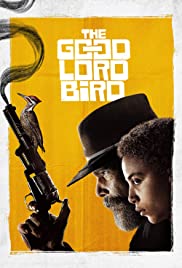
This same theme, the psychological effect of racism, also plays out in yet another contemporary series, The Good Lord Bird. Ostensibly a story about John Brown, the series turns into a meditation on the insanity of slavery, and in particular of its effect on those who benefit from it. There are few well-grounded characters in this story. Most of them are slaves. Even Frederick Douglas comes across as a man spoiled by privilege, one whose sense of reality is distorted by his own fame as an abolitionist, and whose commitments to the abolition of slavery are compromised by that very fame. To say nothing of John Brown himself! As he is portrayed in this series, Brown is an absolute lunatic. We love him, of course, at least in the end, but there is little question about his sanity. He doesn’t have it. No. To find a sensible character in this story, one has to look with the characters held in bondage. The slaves in this story are the only characters with the good sense to look after themselves. The rest are either too busy defending slavery and exploiting it or spiraling into ever more crazy schemes for opposing it. For those held in bondage, slavery in the Good Lord Bird is a force which keeps subjected to it well grounded; it is a force which sends those free of it into ever more bizarre flights of fancy.
The Good Lord Bird follows the story of an adolescent boy, Henry Shackleford (played by Joshua Caleb Johnson). Henry is labeled a girl by John Brown himself and Christened with a new nickname, ‘Onion’. When Brown proves incapable of correction, Henry simply accepts his new identity and thus becomes ‘Onion’ for the rest of the series. Henry knows who he is of course, but this is what it takes to get along in a world driven mad by people high on the privilege of freedom denied to others.
There is something especially interesting about the insanity of Brown and Douglas in the Good Lord Bird. It is as though the series producers believe you would have to be a little crazy to cut so far against the grain of the society in which you live, to seek to act effectively in opposition to slavery, to actually do what it takes to end it. Brown is typically regarded as something of a lunatic or a fanatic in history. (As I recall, this was one of the gripes mentioned by James Loewen in Lies My Teachers Told Me.) But how does one oppose an institution as powerful as slavery without becoming a lunatic or a fanatic. You can mumble, “oh that’s wrong,” or speak of some day overcoming the institution, but systemic oppression is not so fragile as to be threatened by expressions of passive regret. To actually confront the institution is to wage war against so many other things right along with it, even to risk bringing about harm to many people. That would of course include friends, and family, and even those one might seek to help in the end. You’d have to be a little crazy to want to do such a thing. Ethan Hawke is a lot crazy as John Brown in this series, and (for some of us anyway) it is a truly lovable performance.
James Baldwin reminds us that it shouldn’t surprise anyone to see a man confronting slavery treated as a crazy person, not at the time, not the history books, and not now on screen.
Damn that Baldwin!
His ghost is writing scripts for cable television.
But of course Baldwin wrote one other script with his speech back in Cambridge. He wrote the script for his debate opponent. You see, Baldwin was there in Cambridge on that day in 1965 to debate William F. Buckley, Jr. The topic for the debate was the proposition; “The American dream is at the expense of the negro.” Baldwin was to take the affirmative and Buckley was there to oppose it.
Two things are particularly striking about this debate: the absolute brilliance of Baldwin’s own speech, and the utterly pathetic response that Buckley makes to it.
It’s worth noting that two separate publications haunt the debate. (See, I haven’t given up the horror references.)
The first of these writings was an article published in 1957 by William F, Buckley entitled “Why the South Must Prevail.” In this publication, Buckley, argued in defense of segregation, suggesting that white southerners needed to maintain segregated institutions and reserve power to whites until such a time as African-Americans (‘negroes’ in Buckley’s article) would prove worthy of it. Now some have suggested Buckley had changed his mind by 1965, but at least in this debate the difference is little more than a courteous veneer. Buckley was always capable of being courteous (though Gore Vidal might have thought otherwise); he was always capable of putting a polite face on his life-log defense of elitism and privilege. The second of these publications was book Baldwin had published in in 1963, The Fire Next Time, which is said to contain a warning that violence could well be the result of continued injustice. Buckley would have described it as a threat. Buckley’s article is the reason he was invited to debate Baldwin. Baldwin’s book is the key to Buckley’s response.
That and Baldwin’s tip that opposing racism must seem like insanity to those whose identity is tied to it.
It’s worth noting that Baldwin makes a point of personalizing the issue of race in his own speech. He claims that he built the infrastructure of the American south, that he himself is the subject of discrimination and racist policies. In effect he makes of himself an indexical icon (as my old professor would have put it), through which to contemplate all of the implications of racism. This offends Buckley a great (as it often seems to offend many today to hear that racism has a negative impact on persons of color). So, Buckley’s first move is to deny it. He suggests that he is going to treat Baldwin as though he were white, and that he will do so, because Baldwin’s race is irrelevant to the matter at hand. He does this in order to deny Baldwin the protections afforded to him as a public speaker making use of a negro identity.
And thus, Buckley’s own speech begins in a world where in Baldwin’s race is irrelevant to the topic of racism; a world in which being black is a privilege, one to which Baldwin is not actually entitled.
But that’s not insane is it?
(Of course it is.)
It gets worse from there!
Buckley does not defend segregation here, nor racism. Instead he dissembles his way through the topic, describing segregation as a ‘dastardly situation’, mocking the excessive concern about racism in American Universities, and suggesting in the end that it is negroes themselves that have failed to advance themselves as a people. In Buckley’s narrative, Segregation appears to be a ghost in the machine, a presence over which no-one takes responsibility, except as it seems, those oppressed by it. If only those gosh-darned negroes and their rotten liberal friends could just get over the whole thing and get on with their lives! As Buckley would have it, the only reason racism is still with us, is because it lives in the efforts of those actively opposing it. You can hear people saying similar things, today of course. It’s just a little more jarring to see someone saying this in the very era in which buses were burned, bombs, were set off, and children spat upon while going to school, all over the topic of racism. …but wait! Dammit! It’s just as jarring to hear it in the era when cops put a knee to man’s neck in broad daylight and on camera, when the Republican Party actively works to deny African-Americans the right to vote, and when white supremacists openly mix their own flags and symbols with those of mainstream American politics.
Shit!
That Baldwin guy just keeps getting righter and righterer!
It’s almost like he’s had some personal experiences with racism or something.
Dammit!
And what about this segregation anyway!?! Buckley’s vision of segregation is a monster worthy of Lovecraft country, one which somehow appears to the majority of us only in hindsight, but which haunts the lives of those afflicted with it. One must think those who complain of racism terribly insane to be afflicted by a demon that exists only in their own politics! Buckley certainly seems to think so. Those telling us “liberalism is a mental illness” today surely do, but of course the brunt of their criticism falls less on liberals than on those in need of remediation. We get insulted; they get to go on living with the with the demon folks like Buckley and his modern descendants will neither claim as their own nor confront in any meaningful way. Buckley did a lot to set ‘conservative’ politics on this course through his publication, National Review. That his vapid waffling response to racism could be considered intellectualism, as it has for so many calling themselves ‘conservative’ has always been a mystery to me. Buckley, never really had anything to say about anything, but he could sure as Hell take more words to say nothing than most any other public figure in modern history. Most particularly, he had nothing meaningful to say about racism or segregation in response to Baldwin.
Buckley concludes his meandering speech by warning Baldwin and those who sympathize with him of an apocalyptic scenario worthy of modern horror films. If, Buckley suggests, folks such as Baldwin insist that the American dream itself is antithetical to the justice which they seek, then he and others who love their country will be forced to fight over it, “on the beaches,” so to speak. Oddly enough, they would be doing so, even for for the benefit of the negro himself, as Buckley would have us believe.
Thus, Buckley ends his speech by imagining, not how segregation might be ended, but how the call for it threatens everything he loves, and how the defense of segregation under the pretense of basic patriotism is in the end, all for the benefit of those oppressed by it.
As beautiful as Baldwin’s speech was, Buckley’s own efforts are sickening.
What’s worse! This debate hasn’t moved a whole Hell of a lot since 1965. In this Debate, Baldwin struggled not to impress the audience with the notion that racism is wrong, but to get people to give a damn about it, to act meaningfully against it. For his part, Buckley struggles to hide it, and to hide the degree to which racism was always central to the world he defended throughout his life. Buckley has a lot in common with an awful lot of people today.
Small wonder that the script for this debate can still be found on your cable television networks.
***
Those present voted 544 to 164 in favor of Baldwin as the winner of the debate. For his part Buckley, bragged that he “didn’t give them a goddamned inch,” or something to that effect.


















 northierthanthou