• About

northierthanthou

northierthanthou

Category Archives: Politics

Get ready to crack heads; cause shit gets real here, yo!

…or something like that.

Us and Our Spoiler Alerts

18 Tuesday Jun 2019

Posted by danielwalldammit in Justice, Movies, Politics

≈ 4 Comments

Tags

Children, Film, Girl, Horror, Inequality, Jordan Peele, Movies, Poverty, Us

Us_(2019)_theatrical_posterSeriously, if you ever plan to watch the movie, Us, give this post a skip, because I’m about to drop the mother of all spoilers.

…

…

…

No really!

…

…

…

Go away!

If you ever plan to watch the movie, go away!

…

…

…

I’m doing this for your own good, go away!

…er, I mean; Get Out!

…

…

…

Okay, so this movie packs a whole lotta creepy into one punch. That’s no surprise of course. Anybody who’d seen Get Out should have known what was coming. Us, seemed oddly more subtle to me. Oh it wasn’t hard to see the social commentary encoded in the plot, but the specific details of the message didn’t map quite so easily onto those of the plot, at least not for me.

…until the very end.

I watched this film quite shortly after it came out, and the final moments are still under my skin. I suppose I should have seen it coming, but I didn’t. That final reveal does change everything.It’s all kind of disturbing.

…and it leaves me with this one question; which is more disturbing?

The thought that a young girl could be stolen from her life with all its wonderful possibilities and thrown into a living Hell?

or

The thought that somebody might have come to enjoy a rich and full life by throwing another little girl into that very Hell?

Because we do the latter every day.

We all do.

Share this:

  • Tweet
  • Share on Tumblr
  • Click to print (Opens in new window) Print
  • Click to email a link to a friend (Opens in new window) Email
  • Click to share on Reddit (Opens in new window) Reddit
Like Loading...

Spurious Responses

01 Saturday Jun 2019

Posted by danielwalldammit in History, Politics

≈ 10 Comments

Tags

Critical Thinking, Defensiveness, History, Internet, Pinterest, Quotes, Rationalization, spam, Spurious Quotes

totallyreallincolnnailsitBeen thinking a bit lately about THIS old post?

It’s still an interest of mine.

So, I sometimes make a point to call out the spurious quotes thriving all over the net these days. It’s not the most noble of personal callings, I know, but I noticed a long time ago that the information correcting some of this stuff isn’t often found in the same electronic neighborhood as the political pornography in which these bullshit quotes normally reside. So, I reckon it ain’t the least useful thing a guy could do with a spare 15 minutes or so to introduce the author of an un-sourced quote to a well reasoned debunkitation.

I’m often fascinated by the responses I get.

***

I was quite interested when Pinterest suspended my account for a few weeks, …I think over this. I could be wrong, but I do think this pastime is what did it.

The thing is, you can find the same spurious quotes in countless memes all over Pinterest. It’s just so damned easy to spread information when all it takes is the click of one ‘save’ button. The net is full of ccrap, I know, but the political hashtags at Pinterest are a particularly bullshit rich environment.

I can say it in a few different ways, but what needs to be said in response to these fake quotes is usually pretty simple, and I can’t help thinking a good link to Mount Vernon or Monticello.org ought to find itself somewhere in the response. The link alone really ought to suffice. The trouble is that these misquote-laden memes are distributed through a variety of different accounts on Pinterest. If I’m posting a lot of links to the same page correcting them, then of course I am the spammer.

Oops!

Don’t get me wrong, the principle in question makes a kind of sense, as does its application. You don’t want someone posting the same link over and over again on a social media platform, but it does create an ironic outcome. In this instance, at least, it seems that’s a lot easier to spread disinformation than it is to counter it.

Oh well!

***

Before moving onto the more personal responses I’ve gotten over the years, I must admit that my own tone here varies. If I think the person passing along a fake quote has done so accidentally, I try to just call attention to the problem. Hell, I reckon I’ve probably made this mistake myself once or twice. It ain’t no hanging matter; I just want to correct a (hopefully honest) mistake. If, on the other hand, the fake quote is accompanied by narratives about how teachers, media, and liberals are too damned deceitful to share the ‘truth’ of the quote, I must admit, my own response is likely to come with a little sarcasm on the top. There are of course other signs of bad faith that I typically meet with a more combative tone.

Sometimes I’m nicer about this than others.

Also, sometimes, I just ask people for a source to see what they come up with.

Anyway…

***

Oh yeah, my first post on this topic, the one about Abe Lincoln, has a couple rich responses of its own. Still kinda chuckle about those.

***

By far and away,, the most interesting response I get is the occasional effort to document the quote by linking me to the ‘spurious quotes’ pages at Monticello or Mount Vernon. Seriously, this has happened a few times.

“Did you read it?” I ask.

At least once, someone realized their mistake at that point and owned up to it. She gets props for doing the right thing.

Once I was assured by someone that clearly hadn’t read the material that he totally had read every word of it. He also assured me that he understood what ‘spurious’ means. Yep! Definitely! We went a few rounds on that, before he dropped out of the conversation. A ‘block’ button may have been pushed. I dunno…

Others simply stopped responding immediately.

Someone else told me I was being rude.

…which was of course true.

***

Several people have tried to tell me that the quote in question may have been undocumented, but that it accurately reflected what the person to whom it was attributed really did believe. I got this at least once with a popular bastardization of George Washington’s first address to Congress.

…right after I had explained in detail exactly how the quote misrepresented him.

It seems that to some people making this argument these quotes are a kind of Kantian thing-in-itself (a truth truth-in-itself?). The truth as they envision it rests over and above the facts, even the facts of its own expression. If you can’t find one clear expression of that truth in the messy real-world of the historical record, that doesn’t matter, because we know the truth and the source to whom it has been attributed must have known it. So they might as well have said it.

It’s all true anyway, so what’s the problem?

This is one of the more disturbing responses I get, because it reveals an air tight echo chamber in the thinking of the person in question. They love America’s founding fathers and they love their guns and such, and two things they love must love each other, and so when the real-world George Washington doesn’t live up to their masturbatory fantasies, well then, they can just speak up and say what he woulda said anyway.

The rationale also works for any number of subjects certain people feel America’s founding fathers must certainly have loved every but as much as they do.

…even if those founders didn’t actually say so.

Not much to be done about folks who reason like that.

***

Another common response is to ask how I know the quote isn’t real.

…and that’s one of those moments when I remember why burdens of proof matter.

***

A related tactic is to assure me that the quote is real and tell me to do my own research. Faced with credible sources that claim the quotes can’t be found in any known archives, those using this tactic assure me that the quote is real and that we skeptics really ought to work harder.

…which brings to mind words like ‘gaslighting’, ‘trolling’, ‘asshole’, and a  quick end to the conversation.

***

Sometimes people complain that my efforts to check them reveal a character flaw on my own part. Don’t I have anything better to do?

No such questions seem to have been asked about the time it takes the individuals in question to pass along a spurious quote. But of course, we all have much more important things to do when the one we are presently engaged in turns out to be a little frustrating. It’s human nature.

***

Probably the most common response I get to declare the source of the quote irrelevant. It’s the idea that matters, I am told, and surely that idea is true. So, it doesn’t matter if Thomas Jefferson or Benjamin Franklin or any other made up source didn’t really say what they were supposed to have said. That’s not the point. The point is it’s true.

I must say that it’s an interesting coincidence that so many timeless truths that could come from any source really, seem so often to be attributed to sources of great political value. It’s also an interesting coincidence that so many of them seem quite useful to specific political agendas today, agendas which often sail under the banner of faithfulness to American principles and respect for the wishes of America’s founding fathers. It’s really quite convenient that so many questionable quotes would seem to provide the politics of the people in question with the authority of a voice from the founding fathers. The sources really don’t matter, so it seems, not after the source has been debunked.

Perhaps I could be excused for thinking the source mattered, at least a little, before that source came into question.

What I always find most interesting about this tactic is how seamless the transition is from presenting an undocumented quote to declaring the named source irrelevant to its content. People employing this tactic rarely take so much as a moment to acknowledge their error. Often they avoid conceding the point altogether as they shift from a historical claim about who said what to a kind of Platonic reasoning in which the idea itself is all that really matters.

And thus a person wholly unconcerned with the falsehood of a factual claim suddenly becomes the priest of a timeless truth.

***

Oh yeah, some people don’t respond at all. Some just keep right on producing the bullshit quotes too. This is particularly true of some websites like BrainyQuote. It’s also true of some dedicated ideological warriors. They just keep right on posting the fake quotes long after a reasonable person might have at least quietly deleted the material from a blog or a social media account.

***

There is one response that gets me every time, and that’s the one where somebody simply acknowledges the mistake. Often this is followed by a ‘thank you’. Maybe they take down the quote. Maybe they just let their acknowledgement of the correction stand for itself in the discussion. Either way, it’s a class move.

These days, such responses surprise me a little more than they ought to.

…and that’s kinda sad.

***

I suppose it doesn’t really surprise me that people would respond defensively to such things. People don’t usually like to be corrected. I know I don’t. And of course, any of us could get things like this wrong. That’s not terrible. It’s human. Still, some of these rationalizations do seem to give you a peak behind the curtain, so to speak, into the mind of someone for whom due diligence is simply unthinkable. They must be right one way or another, so they seem to think.

…even if they are wrong!


Share this:

  • Tweet
  • Share on Tumblr
  • Click to print (Opens in new window) Print
  • Click to email a link to a friend (Opens in new window) Email
  • Click to share on Reddit (Opens in new window) Reddit
Like Loading...

Candace Owens in Context

10 Wednesday Apr 2019

Posted by danielwalldammit in History, Politics

≈ 5 Comments

Tags

Candace Owns, Charlie Kirk, History, Hitler, prejudice, Racism, Ted Lieu, Turning Point USA, White Nationalism

…been awhile!

imagesSo what has me thinking with my keyboard again after such a long absence from the blog? It’s the latest dust-up over Candace Owens’ comments on Hitler. Owens was recently called to testify as a witness for congressional hearings on the topic of hate crimes by white nationalists. Expressing contempt over the decision to bring her in for such testimony, Ted Lieu opted to play ‘the first 30 seconds’ of comments she once made on the subject of Adolf Hitler. He then moved on to ask another witness about the significance of those comments, leaving Owens without a chance to respond and the rest of us without much sense for the context in which her comments had originally been made. Given the chance to respond shortly thereafter, Owens charged asserted that Lieu had assumed African Americans wouldn’t look into the matter further, suggesting she had been taken out of context.

…and the fight was quickly farmed out to various social media platforms.

Such is modern politics!

First let me say that this was not one of Lieu’s finer moments. It’s hard to get past the sense that he left out critical information about the context of Owen’s remarks or the sense of unfairness that goes with attacking someone in their own presence without giving them a chance to respond. I can think of all sorts of reasons why he might have chosen to do this, and yes, I want to support his efforts here, but this falls short of certain minimum standards that ought to guide someone’s conduct. Lieu can do better than this. He normally does.

That said, I can certainly empathize with Lieu’s unflattering take on Owens’ credibility. She is not an expert in politics, crime, or anything else coming up in that hearing. It’s tough to say just how we came to the point where Candace Owens counts as having something important to say at a congressional hearing on racially motivated hate crimes.

Answering that question was actually the first thing Owens herself addressed at the hearings. Why was she there? She told us. Her answer just wasn’t all that helpful. What Owens said was that she has herself been the target of racially motivated hate crimes. She said this in order to establish a personal connection to the issue, then went on to talk about anything but that very issue. The rest of Owens’ opening remarks were spent reminding us that words like ‘racism’ meant something in the context of segregation in the old Democratic South while the real threats to African-Americans today come from Democratic policies purportedly aimed at helping them. In short, Owens was there to minimize the significance of racially motivated hate crimes against minorities and shift the discussion to something that might embarrass the Democrats.

You can see all of this for yourself in the video from C-SPAN presented below. Owens’ opening statement begins at around 47:40 and ends at 53:42. Lieu’s remarks begin at around 2:33:14 and end at 2:38:27. Owens reply occurs between 2:38:50 and 2: 40:38.

https://www.c-span.org/video/?459662-1/house-judiciary-committee-holds-hearing-hate-crimes

Much of the subsequent discussion has focused on the question of whether or not Lieu misrepresented Owens in suggesting that she had tried to legitimize Hitler. For her own part, Owens told the committee that she had done no such thing, that she had in fact been trying to suggest that Hitler wasn’t really a nationalist. “A nationalist,” Owens, tells us, “would not kill their own people.”

So what did Owens actually say at the event in question? Her comments can be found here from around 38:45 to around 40:55.

So, did Lieu misrepresent Owens?

Only if we allow the context to swallow the text entirely, and even then, only if we don’t think very hard about that context itself.

What do I mean?

We can start by looking at aspects of the message that appear to support the claim that Owens was defending Hitler. Here it is!

But if Hitler just wanted to make Germany great and have things run well, OK, fine. The problem is that he wanted, he had dreams outside of Germany. He wanted to globalize.

Owens’ and her own defenders have reassured us that these remarks were made in an effort to distinguish Hitler’s actions from those of a proper nationalist. On one level, this is fair enough. That clearly is Owens’ main point, and her remarks are in fact consistent with that point.W should not lose sight of the larger goal of Owens’ remarks even as we ask ourselves why she chose to pursue them using the particular set of claims she did on that day.

The problem is that point isn’t inconsistent with a defense of Hitler, half-assed though it may have been. The odd description of Hitler as someone who might have “just wanted to make Germany great and have things run well” does suggest a sympathetic understanding of Hitler’s motives at least insofar as they applied to Germany.  Adding to that, the sense that Hitler’s actions only become a problem when he goes global and you have a point that does more than distinguish Hitler’s politics from those of an idealized nationalism; you end up with a point that suggests his internal policies were in themselves just fine, that his politics becomes a problem at precisely the when when those politics cross the border. While we shouldn’t lose sight of the fact that Owens is indeed trying to distinguish Hitler from nationalism as she would have it understood, her actual argument leaves plenty of reason to believe that she is in fact sympathetic to aspects of Hitler’s agenda.

Simply put, Owens’ speaks approvingly of Hitler’s domestic agenda, condemning him only when his ambitions cross the border. In subsequent remarks, she may have acknowledged his murderous actions, but in the immediate context of her remarks at the time, Owens shows no awareness of anything worth condemning in Hitler’s domestic policies? Does she think his crimes began on the other side of the border? Does Owens think Hitler did nothing wrong inside of Germany?

In effect, Owens was praising Hitler with faint damn.

All of this brings us to a much larger point; why was Owens trying to distinguish nationalism from the actions of Adolf Hitler in the first place? The simple answer is because that is something key parties in right wing politics want to do at this point in history. Owens is not the only person pushing the idea that nationalism isn’t always a terrible thing. Charlie Kirk’s own comments in that clip push that very theme. It’s a talking point that someone in right wing circles has clearly seen fit to push onto the public stage and the folks at the event in question were hitting their marks quite nicely on this talking point.

…Owens included.

The goal in this agenda is of course to distinguish nationalist politics from the horrors of the Nazi regime and leave us with a reassuring notion that nationalists just want secure borders and lower crime rates in the nations wherein they live, etc. They aren’t, we are supposed to believe, the kind of folks to exterminate 11 million people. No, that was just the Nazis, and they were actually globalists not real nationalists. Real nationalists, true nationalists, would never do that!

The problem of course is that this is utter bullshit, and the reason it’s bullshit is exactly the reason for the hearing Owens had come to troll. Nationalist movements always bring with them a degree of violence, xenophobia, and terrorism, and that means people get hurt at the border. It means they get hurt on the other side of the border. It means they get hurt well inside the border.

…and, yes, nationalists do kill their own people. Hell, they do it all the time!

Also, oh yes, nationalists always seem to have global ambitions as well. You can see this, not only in Hitler’s own plans, but also in Trump’s many ties to Russia, to Saudia Arabia, and to countless other international entities. Hell, you can even see it in Owens and Kirk going to England to help promote nationalist politics across the pond. If what makes a nationalist is a politics that stops at the borders, then Hitler may not be a true nationalist, ok, but then neither is Owens, neither is Kirk, and neither is the Manchurian Cheeto.

Few movements have ever gone global quite like the wave of nationalism presently sweeping the (ahem!) globe and drawing shameless opportunists like Owens into the picture. Her efforts to distinguish the politics of Nazi Germany from the kind of nationalism she herself promotes is little other than a parlor trick. She is telling us to ignore the genocidal maniac behind the curtain even as we look right at him. For that matter, she is also asking us to ignore the countless nationalists who dragged Europe into World War I, because frankly Nazis aren’t the only nationalists to leave a body count behind them. There is a reason ‘nationalism’ has been a dirty word in politics for some time, and that reason isn’t something Owens has even begun to address with her half-assed efforts to address the issue. She may not want us to think there is any connection between nationalism and crime, but her efforts to distract us from that connection are the very problem with her remarks on this subject.

In short, Owens’ own agenda is in fact a lot closer to that of Hitler than she wants us to believe. That’s why her critique of the man falls well short of anything a thoughtful person would produce, even on the spur of the moment.

Should we pay attention to the context of Owen’s comments?

Oh Hell yes!

It is that very context that condemns her.

Share this:

  • Tweet
  • Share on Tumblr
  • Click to print (Opens in new window) Print
  • Click to email a link to a friend (Opens in new window) Email
  • Click to share on Reddit (Opens in new window) Reddit
Like Loading...

Donald Trump Speaking Power to Truth

08 Tuesday Jan 2019

Posted by danielwalldammit in Justice, Politics

≈ 14 Comments

Tags

Donald Trump, human rights, Immigration, Race, Racism, Refugees

You know what might have worked? For me anyway. If a report had been made in the wake of a comprehensive immigration review, or just a comprehensive review of border security. If that report had included the unlikely recommendation that a wall be stretched across the entire border, or (more likely) if such a review had recommended renovations to existing stretches of wall, or even adding more wall in selected locations. Hell, I could imagine a wall helping to prevent accidental deaths among other things. I know there are people who advocate completely open borders, but I’m not one of them, and I don’t think the vast majority of modern liberals take such a view either. If such a report had come out, and Donald Trump had said he wanted to implement the changes recommended in that report, that might have worked. A lot depends on the details, but I could see myself supporting such measures.

But that is not what happened.

What happened was the semi-conscious anal fistula that currently occupies the White House came down that damned escalator and gave a shout out to all the white supremacists in the nation. He made a point to tell them he was on their side. It’s a point he has come back to time and time again. Whenever that flaming wank-maggot needs to feel a little better about himself, he stirs the racist pot by coming back to immigration and hitting that subject with a bigger dumber hammer.

Donald Trump didn’t advocate immigration reform. He hasn’t restricted his attacks on immigrants to those who come here illegally, and he certainly hasn’t made any effort to ensure that his policies will actually help, even to curtail illegal immigration, which was on the decline before he took office to begin with. He hasn’t even made responsible use of the resources already at his disposal  His brinksmanship on the issue has included the demonization of all immigrants (including legal immigrants and genuine refugees), the demonization of Muslims in general, the orchestrated kidnapping of children, active promotion of immigrant caravans (only to use those very caravans to trigger riots at the border).

There are legitimate concerns about immigration, and about border security. If you think those concerns have anything to do with Donald Trump’s approach to the subject, then I have a degree from Trump University to sell you.

So here we are, waiting for Trump’s big speech at the border. He will do what he always does, which is to speak power to truth and wait for the engines of bigotry to make his malicious fairy tales into an accomplished fact. The deplorables will do what they always do which is to try and read more reasonable themes into his bullshit on the one hand, and then use his claims to press the the boundaries of bigotry on the other. If Trump supporters have their way, the utter bullshit that is every word seeping from the mouth of this festering bloodfart will one day pass for truth.

It isn’t. It never will be.

As sure as the sun rises this coming speech will be lies piled on top of more lies. We’ll be lucky if it doesn’t turn out to be the modern American version of the Reichstag Fire Decree.

Share this:

  • Tweet
  • Share on Tumblr
  • Click to print (Opens in new window) Print
  • Click to email a link to a friend (Opens in new window) Email
  • Click to share on Reddit (Opens in new window) Reddit
Like Loading...

The End of Everything at the Anchorage Museum

31 Monday Dec 2018

Posted by danielwalldammit in Alaska, Politics

≈ 4 Comments

Tags

Alaska, Anchorage, Art, Bigotry, Museum, Painting, prejudice, Racism, Stereotypes

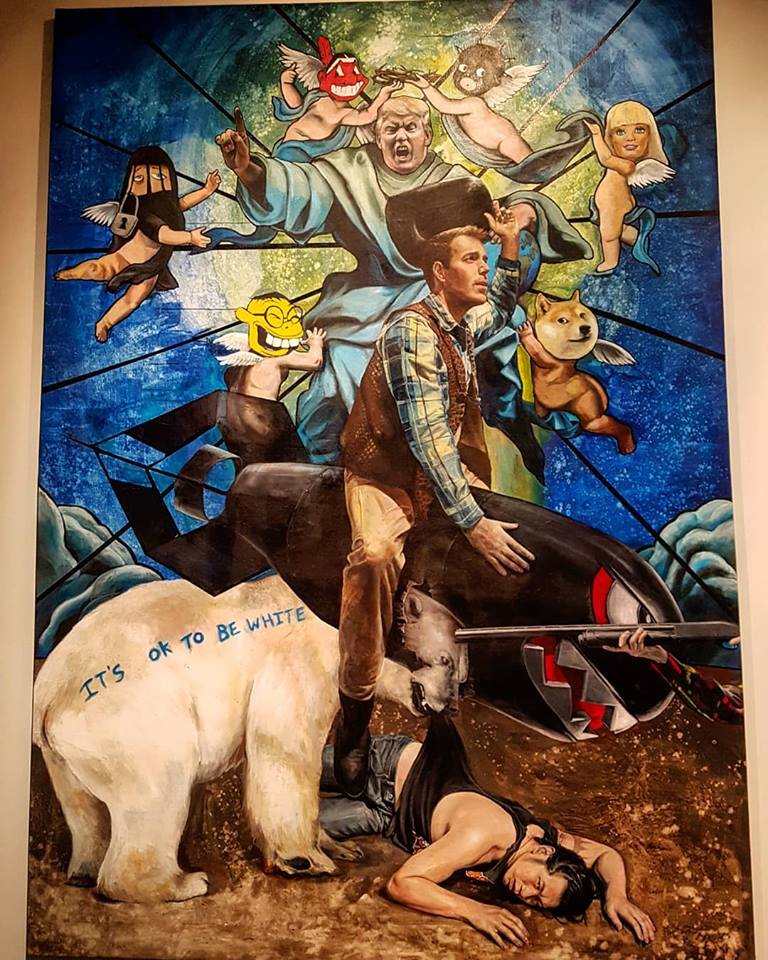
The End of Everything

I thought I’d share this little gem currently on display in the Anchorage Museum. It’s called “The End of Everything” by Thomas Chung. I’m sorry, the photo-quality is really crap. Just thought the content was worth sharing despite that. Anyway, here is what Chung has to say about it:

“The painting explores why we may, at times, dehumanize others. It reflects our current political times, which are brewing with hatred and conflict. The cowboy character riding the bomb represents the male American ideal, while the cherubs represent the many living forms of bigotry from the past and present. The graffiti on the polar bear comes from posters repeatedly disseminated around the University of Alakas Anchorage’s campus this year by white supremacists as part of a larger campaign.”

Share this:

  • Tweet
  • Share on Tumblr
  • Click to print (Opens in new window) Print
  • Click to email a link to a friend (Opens in new window) Email
  • Click to share on Reddit (Opens in new window) Reddit
Like Loading...

Black k Klansman

05 Wednesday Dec 2018

Posted by danielwalldammit in Justice, Movies, Politics, Uncategorized

≈ 3 Comments

Tags

Black Klansman, Film, Ku Klux Klan, Movies, Police, Race, Racism, Ron Stalworth, Spike Lee

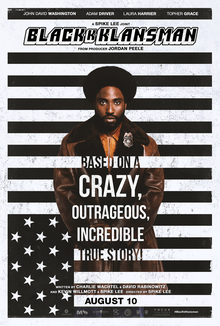
BlacKkKlansman.pngThere are moments (mostly the innocent ones) in Black Klansman where the movie seems to be telling us something about the 70s. There are other moments (as in references to “America First” or allusions to the Trump administration) when the movie is clearly telling us something about today. Most of the time, however, the movie seems to be telling us about both at the same time. What’s missing from this movie is the period in between, a good three or four decades, depending on how you count them, when many of us might have thought race relations were getting better. Perhaps that thought was never more than naiveté, a mere fantasy, but if so the fantasy was certainly a part of the world erased in this film. I’d like to think Spike Lee is wrong to erase those years in this film, but he isn’t.

That erasure, it seems, is precisely the point.

The hope of those intervening years between the end of segregation in America and the present rise of white nationaism is in fact well well represented in Black Klansman. It’s repreented by Ron Stalworth (played by John David Washington), the central character in Black Klansman, a story inspired by events in the career of a real life police officer. We meet Stalworth as he becomes the first black officer on the Colorado Springs police force. It’s a step forward, some might have said back in the day. “Selling out” might be how others would have put it. Stalworth lives in the tension between these two ways of looking at his career, one which envisions police authority as consistent, at least in theory with the possibility or racial justice, and one which sees it as an explicit tool of white supremacy. For his own part, Stalworth is clearly trying to make the former outlook work, but he’s torn from all sides, both by racism within the police force and by those who see police as an essentially racist institution.

To hear him talk, Stalworth could pass for white, which probably says as much about those in the movie (and those of us watching it) who think he sounds white as it does about the man himself. Whatever the reason, this feature of Stalworth’s character has an obvious utility; it will enable him to pass, at least on the phone. Stalworth is also willing to cut his fro if the Police Chief wants him to, but no, that’s not necessary, The Chief likes it. At the same time, Stalworth fights a never ending battle against the casual racism of his fellow officers. What to do about the overt bigots whose racism is far from casual, he isn’t sure, at least not at the outset of the film. Stalworth is picking his battles. Fair enough! But is the trade-off equitable? One gets the impression no-one is quite happy with the arrangement, least of all Stalworth himself.

It’s this awkward effort to find an acceptable accommodation between social justice and institutions which have historically enforced racism that makes Stalworth a great symbol for the intervening years between the seventies and the modern era. He is a back man trying to make America work. for his own people along with the rest of us. Some might consider that a fools errand, but Stalworth lived in an era when it seemed almost possible.

The Police Chief takes Stalworth’s discomfort up a notch by asking him to go undercover to attend a speech by Stokely Carmichael so he can keep track of the radical students who sponsored the event. There Carmichael is known by his new name of Kwame Ture. Ture speaks of police abuse, even the murder of African-Americans. He also urges his audience to prepare for violent revolution. Stalworth is surprised to find that he likes Ture’s speech, and the fact that he likes the speech is a big problem. It’s a problem because Stalwort is there to spy on the man and the black radicals listening to him. From the snadpoint of the police department, he’s not supposed to like the speech at all. From the standpoint of the student radicals, he isn’t supposed to be there at all, at least not for the reasons he has come.

…and certainly not wearing a mic.

It doesn’t help matters that Stalworth knows people in his own police department guilty of the very racism Ture was talking about. It also doesn’t help that he is falling rapidly in love with Patrice Dumas (Laura Harrier), President of the Black Student Union. She is arguably the main subject of his investigation, and she herself certainly would not approve of his undercover work. It REALLY doesn’t help that she was pulled over by racist police officers after the speech and sexually assaulted during the stop, confirming everything Ture said in his speech while underscoring Stalworth’s inability to do anything about it.

So, how is he going to explain Ture’s promotion of revolution to the Police Chief? How will he explain his role in the police department to the love interest who sees police as the enemy? It’s a problem.

All of this comes before Stalworth’s infiltration into the Ku Klux Klan.

If there is any ray of hope to found in these initial scenes, it comes in the form of a night spent dancing in the wake of Ture’s presentation. Whatever Ture’s rhetoric, the radicals who brought him were content to spend the evening peacefully enjoying themselves on the dance floor. This gives Stalworth an angle, so to speak. He decides that these radicals are just talking about the violent revolution. They aren’t actually planning to kill anybody. It’s not the easiest message to sell. The Police Chief doesn’t buy it any more than Patrice and her companions buy the notion that police are meant to serve the community.

If there is a way to make police-work consistent with racial justice, Stalworth hasn’t found it when the larger plot kicks off, when Stalworth stumbles upon the opportunity to open up an investigation into the Klan with the help of Flip Zimmerman (Adam Driver). If the black radicals he’d been investigating at the start of this film weren’t really violent, the Klansman certainly were, at least enough of them to pose a threat. Of course this investigation is the real focus on the film. It’s also where the film departs most from the actual events of the real events in question. The real investigation led to the transfer of Klansmen within the military away from sensitive security positions; the movie investigation leads to a real crime.

What interests me about the story most is the larger racial politics of the film itself, and of the society it comments upon. One gets the impression Stalworth isn’t in the most tenable position to begin with. He knows very well the laws he is charged with enforcing hurt his own people, and he also knows anyone seeking to change that poses a real threat to the institutions he represents. Stalworth is caught in the middle of many forces he cannot controle; he has set himself up for a life-time of pushing back in all directions. The main plot seems almost to rescue him from the ambivalence of his position at the outset of the film.

…which brings us back to the political history of the film. Its final moments aren’t about the tricky life Stalworth has set up for himself so much as the rise of violent white nationalism with the advent of the Trump administration. Here Spike Lee drops the fictional story-line entirely and shows us real footage of  real white nationalists at work today. It’s a fitting shift, of course. Like the Klan in this story, Trump’s America has fallen on the nation like a great big old boot stomp on the many conflicts that used to plague our politics, conflicts that now seem subtle by comparison. Like the Klansmen in this film, the present administration and its supporters aren’t really all that interested in figuring out the details of social justice; they are happy to promote a clear and obvious vision of white supremacy. If the crime Stalworth thwarts in this move is fictional, the threats posed by a political regime wedded to the likes of the Klan is real. If justice eludes us, the present regime certainly ought to inject a degree of clarity into political questions of our own day.

If it isn’t entirely clear how we should handle racism in police practice, the sort of problem Stalworth is dealing with at the beginning of this film, it ought to be very clear that the present President couldn’t care less. Neither could those who support him. If it isn’t entirely clear how the rest of us should live together, it ought to be very clear that a good number of Americans no longer mean to do so at all, and that they have help at the highest levels, help they are using to undermine every means at our disposal for forking out any equitable solutions to the nations problems. The nation as a whole seems ripped away, like Stalworth, from the tricky problems about racial justice. What we have now is a problem much like that he faced in this film; how to stop those consciously working to ensure no such answers will ever be found.


Share this:

  • Tweet
  • Share on Tumblr
  • Click to print (Opens in new window) Print
  • Click to email a link to a friend (Opens in new window) Email
  • Click to share on Reddit (Opens in new window) Reddit
Like Loading...

Special Spooky Halloween Post: When a Hungry Historical Context Gobbles Up Your Text

31 Wednesday Oct 2018

Posted by danielwalldammit in History, Justice, Politics

≈ 5 Comments

Tags

Birthright Citizenship, Citizenship, Donald Trump, Immigration, Neo-Confederates, Politics, Reconstruction, The Fourteenth Amendment, U.S. Constitution

45282907_10217765362510862_2935286808793055232_oOkay, so by now everyone knows, right? Donald Trump has recently said he wants to change the Fourteenth Amendment so as to eliminate birthright citizenship, and he wants to do it without another amendment. The problem according to the idiot in the White House is that some scholars (he assures us) say the prevailing interpretation of the Fourteenth Amendment is just wrong. Changing it, according to this view, is not a case of rewriting the rules so much as it is a case of just changing the way we interpret them. Therefore, the Cheeto and its enablers think he can do this with just an executive order. Nevermind that Obama’s use of executive orders was proof positive that he himself was a demon from a special Muslim Hell sent to personally devour the Constitution right along with all the babies and pizzas ever served in Tea Party Hell, Donald Trump is thinking he’s just gonna do it.

And the deplorables sing, doot, doot doot, da doot, doot doot doot…

***

Some folks tell me that this is a distraction from bomb scares and right wing shooters, or maybe some other legal decision that Donald is going to quietly sign into being while we stand aghast at the orange Hell that has become of our sweet country, but then again, maybe some of those are distractions from this, or maybe someone is distracting us from a election. I dunno. I give up on trying to sort out what’s supposed to be a distraction from what. The problem with all the distraction talk is it assumes that Donald and the deplorables are focused enough to have clear priorities in the first place. That notion is about as plausible as a degree from Trump University.

***

But all of this does raise an interesting question; what is the case for saying the 14th Amendment doesn’t actually make the children of foreign nationals into U.S. citizens if they born on U.S. soil?

Let’s start with the text itself. Section 1 of the Fourteenth Amendment reads as follows:

All persons born or naturalized in the United States, and subject to the jurisdiction thereof, are citizens of the United States and of the State wherein they reside. No State shall make or enforce any law which shall abridge the privileges or immunities of citizens of the United States; nor shall any State deprive any person of life, liberty, or property, without due process of law; nor deny to any person within its jurisdiction the equal protection of the laws.

The first line contains the case for birthright citizenship, and that case is commonly accepted by most people with any professional responsibility to handle such matters or argue them in a courtroom.

So, why would anyone think they are wrong?

***

The quick and dirty version of this argument is to simply say that this doesn’t apply to foreigners, because they are loyal to another country and another set of laws, so they aren’t subject to the jurisdiction of the U.S.

The quick and dirty version of this argument is also very stupid, but yes, I have met people who make precisely that argument, as stated above, and without adding anything else to the argument.

Anyway, the quick and dirty response to the quick and dirty version of this argument is to point out that foreign nationals, undocumented immigrants, modern secessionists, and full-on fugitives from the law are all subject to U.S. law whether they like it or not. If that’s just a matter of opinion, it’s an opinion likely shared by those with the power to make it so.

***

The quick and dirtier argument is that the 14th Amendment was written to protect the freedman from Jim Crow laws passed in the wake of the civil war. — You know what, let’s all just take a moment here to appreciate the fact that those now reminding us of this fact as a means of denying citizenship to Latinos contain a lot of the same neo-Confederates whose sympathies clearly aren’t with those recently freed slaves anyway, …or their descendants. The 14th Amendment has always been a great big thorn in the side of the bigots who want to resurrect the old South. There is a clear pattern here, and it sure as Hell isn’t defined by careful attention to historical facts and details of Constitutional law. — Anyway, the point in this quick and dirtier version of the argument against birthright citizenship is that the law was always mean to protect a specific class of people, newly freed slaves, and that our nation’s present habit of applying it to just about anyone born in our country extends the application of that law beyond its original purpose.

And here, history gobbles up law. Context eats text, and the whole nation let’s out a big fat bigoted burp in celebration.

…if Donnie and the deplorables get their way anyway.

The problem here is that the context doesn’t in itself elucidate the text, it just gobbles it up. (Yep, I’m sticking with that imagery.) If you go back up and read the text above, it simply doesn’t say; “Hey southerners, black people are citizens, so stop treating them like shit!” No, it doesn’t. Instead, it presents us with a perfectly general principle, and that principle is not limited in scope to the specific historical context in which it was written. Those who wrote it could well have defined its scope more narrowly if they wanted to. They didn’t.

Far from helping us to understand the meaning of the text, this pseudo-historicism invites us to ignore the text on account of an historical factoid.

Neo-confederates iz the cwaziest peopowz!

So, the quick and dirtier argument is also stupid, but I really must insist, I have met people who have made precisely this argument, without adding anything else to it. It’s unimpressive. It really isn’t all that clear that Donald Trump or the vast majority of his supporters have anything more going for them than this simple sleight-of-hand gimmick, not withstanding that we can all see them palming the cards even as they congratulate themselves on a winning hand.

***

But is there more to it?

Yeah, well, kinda. If you aren’t too particular, there is an argument to be made that goes a little beyond this kind of idiocy. It takes us back to the clause “and subject to the jurisdiction thereof.” Some folks would have us believe that there is specific reason to think this clause was not intended by those who wrote it, debated it, and voted on it to apply to foreign nationals. If that’s the case, they maintain, the children of those nationals would not be made citizens by simple birth here in the U.S.

What is that reason?

Well it isn’t a question of legal versus illegal immigration, because America wasn’t really trying to control immigration at that point in our history. So, don’t let any deplorables take you down that dumb-ass dead-end either.

No, the argument rests on the possibility that the framers, so to speak, of the Fourteenth Amendment specifically said that its protections did not apply to non-nationals. If we can find people involved in writing the law who said it shouldn’t apply to foreign nationals, so the argument goes, then we should assume that the phrase invoking jurisdiction was always meant to exclude them. The Supreme Court has already ruled that children of legal immigrants are entitled to birthright citizenship under the 14th Amendment, and no doubt the anti-birthers consider that a mistake, but more importantly, they will insist the court has never applied this standard to the children of illegal immigrants.

…which once again, is a distinction that wasn’t made when the 14th Amendment was drafted and ratified.

That really should be QED right there, but these are strange days indeed, so I guess we’ll have to go a couple extra rounds on the topic.

***

One of the most idiotic versions of this argument comes from a misquoting of the principle author of the 14th Amendment Senator Jacob Howard who stated:

…[E]very person born within the limits of the United State, and subject to their jurisdiction, is by virtue of natural law and national law a citizen of the United States. This will not, of course, include persons born in the United States who are foreigners, aliens, who belong to the families of ambassadors or foreign ministers accredited to the government of the United States, but will include every other class of person

Those using this passage to argue against birthright citizenship typically make one minor alteration the text. They add an ‘or’ before the clause saying “who belong to the families of ambassadors…” This transforms the original text, taking what is in effect an elaboration on a single concept and makes it something of a list. The ambassadors become one more class of people in addition to aliens, whereas the original text is simply spelling out the same concept with a variety of different phrases. Michael Anton, a former aid in the Trump administration pulled this stunt. He still insists that the ‘or’ just spells out the actual intent better for the audience. He is lying of course.

Yes, lying.

***

The argument isn’t always made on such disingenuous grounds. Not surprisingly, the Congressional debates over the 14th Amendment contain an extensive discussion of the range of people covered under the provision. There were many questions about how this might or might not apply to Indians, and in particular to Indians who retained connections to their own tribal communities. There were questions about how it might apply to Chinese immigrants and gypsies, etc.

Far from a clear concept, citizenship itself emerges as a tangled mess of a idea in these discussions. One gets a general sense that while many of the participants assumed that anyone in the United States was entitled to the legal protections in the Bill of Rights (which puts them at odds with much of the right wing today), they also recognized that the right to vote among other things was in fact limited to people who were not loyal to a foreign nation. They also distinguished the basic rights that might go with simply living in America from the right to hold property and/or the obligation to serve in the military if drafted, and all of this was discussed under the banner of ‘citizenship’. One gets the impression that those debating the 14th Amendment weren’t all that certain as to just what citizenship entailed. A few had definite opinions to be sure, but as a group, they are not all on the same page.

***

The whole issue is further complicated by the precedent set by the Civil Rights Act of 1866 which contains explicit language excluding those loyal to a different nation, and an assumption by some participants that the 14th Amendment really does the same thing. In effect, people looking at two different documents containing very different language seemed to treat them as though they meant the same thing.

…which is a problem.

Here is the relevant text from the Civil Rights Act with the relevant section in bold:

To protect all Persons in the United States in their Civil Rights, and furnish the Means of their Vindication

Be it enacted by the Senate and House of Representatives of the United States of America in Congress assembled,

That all persons born in the United States and not subject to any foreign power, excluding Indians not taxed, are hereby declared to be citizens of the United States; and such citizens, of every race and color, without regard to any previous condition of slavery or involuntary servitude, except as a punishment for crime whereof the party shall have been duly convicted, shall have the same right, in every State and Territory in the United States, to make and enforce contracts, to sue, be parties, and give evidence, inherit, purchase, lease, sell, hold, and convey real and personal property, and to full and equal benefit of all laws and proceedings for the security of person and property, as is enjoyed by white citizens, and shall be subject to like punishment, pains, and penalties, and to none other, any law, statute, ordinance, regulation, or custom, to the contrary notwithstanding.

You can see that this doesn’t match the text of the 14th Amendment. Simply put; those who now assume that the 14th Amendment was always intended to exclude children of foreign nationals born in the United States would be right if they were talking about the Civil Rights Act. When talking about the 14th Amendment, however, they are talking about a very different text, and the relevant clause is simply lacking. Instead, such people must look for commentary from supporters in the Congressional record or some source of comparable value.

***

When they aren’t deliberately misrepresenting Jacob Howard, opponents of birthright citizenship usually reference Sen. Lyman Trumbull of Illinois, who maintains in the Congressional Record that the passage only applies to ‘complete’ citizens of the U.S. and goes on to argue that Navajos, for example are not complete citizens because, being still separate in some sense from the rest of the  U.S., they do not vote and maintain their own separate jurisdiction.

(Don’t get your hopes up, racists! This fact has changed.)

Of course one problem with the Navajo example is that it applies to people who actively maintain a separate jurisdiction within the U.S., thus being yet another instance of the degree to which the legal framework for Indian tribes emerges haphazardly within the case history of the Supreme Court. The role that Indian tribal governments play in the legal framework of the United States has never been clear, and that has always complicated the rights of the nation’s indigenous peoples. So, the example is troublesome, to say the least.That said, the example is hardly beside the point. A good portion of the discussion about exemptions to the jurisdiction of the U.S. is driven by the very explicit question of whether or not it would make the entire native population into citizens. Those using comments about that debate are in fact exploiting the vagaries of of Federal Indian law to generalize an exemption from citizenship for non-nationals.

Yes, that’s right. People who want to keep Latinos from becoming American citizens are trying to remind us that the 14th Amendment was only supposed to protect blacks (another group these bigots are not too fond of), and they are resting their argument on efforts to keep Native Americans from voting.

Irony abounds. At last it would, if it weren’t dead already.

***

How Trumbuell’s point relates to the children of foreign nationals is another question. But if we take Trumbull’s claims in terms of the most general implications possible, the notion here is that full citizenship includes those who can vote and who re subject to the draft, etc., not those who, while entitled to protections of citizens, remain separate from the general population. Again, he is talking about the members Indian tribes, and again, this sense of the issue would match the text of the Civil Right Act; it does not match the text of the 14th Amendment.

The distinction between full citizenship and something slightly less did not escape these people; it is all over their discussion, and yet they did not write it into the text of the 14th Amendment. So, what do Trumbull’s comments amount to? Likely as not, a degree of confusion on his part, but those who use him to suggest a new reading of the 14th Amendment do more to show us that people don’t always understand the rules they advocate than they do to show us that the rule in question was clearly meant to exclude the children of foreign nationals.

***

This is one of the big problems with Constitutional originalism; its advocates continually present us with a case for following the rules as America’s founders (or at least those framing particular laws and constitutional provisions) would have understood them, but the understanding of such people is often as shifty as that of anyone we know today. This is one of the reasons we write things down folks; to fix what we mean in a static form, so that you can’t just keep changing your mind. Constitutional originalism effectively enables modern legal scholars to take that fixity out of the equation and cherry pick the past for the most convenient quotes possible. In this case it substitutes a general sense of how some proponents of the 14th Amendment might have understood it at the time (at least when debating the rights of Indian peoples), for the language of the text itself. When the language contradicts its interpretation by their preferred historical sources, they urge us to go with the sources instead of the text.

In effect, those reading birthright citizenship out of the 14th Amendment seek to see the text of the amendment itself swallowed up in a historical narrative. That this narrative itself is quite debatable is an objection in itself, but as a contextualization strategy for reading the 14th Amendment, it is utter bullshit.

This is a version of context suitable for Halloween, because this kind of context swallows up the very text it is intended to shed light on. No, these people aren’t upholding great constitutional principles, no matter how much they would wish we believed that; they are simply weaponizing obscure historical details, and they are doing so for the clear purpose of hurting some of the most powerless people on U.S. soil, the children of undocumented immigrants.

Of course the central irony here is that those pushing a reading of the 14th Amendment that excludes birthright citizenship are not acting in the spirit of the provision in any sense. Whatever else may be said of the 14th Amendment, it was certainly meant to protect people badly in need of help from the violence of racists intent on oppressing them. Historical obfuscation aside, those pushing this narrative today are seeking to empower racists Hell-bent on scapegoating immigrants from Latin America for our nations many problems. As much as these people may tell stories of standing up to great bastions of power and fighting a liberal establishment, these people really are punching down. They are punching down with a vengeance, and summoning a vision of historical context well suited to that purpose. Their argument fails as a point of principle. As a political agenda, it’s monstrous.

…and as far as Halloween monsters go, this one is pretty lame.

Share this:

  • Tweet
  • Share on Tumblr
  • Click to print (Opens in new window) Print
  • Click to email a link to a friend (Opens in new window) Email
  • Click to share on Reddit (Opens in new window) Reddit
Like Loading...

Kavanaugh, Young and Old

01 Monday Oct 2018

Posted by danielwalldammit in atheism, Justice, Politics, Religion

≈ 28 Comments

Tags

Biography, Brett Kavanaugh, Hypocrisy, Inconsistency, Morality, religion, SCOTUS, Sex, Time

270px-Brett_Kavanaugh_Yale_Yearbook_(cropped)330px-Judge_Brett_Kavanaugh

Is it still hypocrisy if your contradictions are separated from one another by decades of your own life? If a moment of ‘yes’ and another moment of ‘no’ have enough time between them, does that mean your off the hook for the difference between them? Could life changing decisions be sufficient to ensue the past doesn’t count against the present? Might someone be excused for having it both ways if they do so in very different chapters of their own biography? Alternatively, supposing time and transformation could be enough to excuse great inconsistencies, might other matters prove sufficient to counteract them? Is it at least possible that time makes the difference in some instances and not others?

It’s common enough to hold moral contradictions against people; it’s also common enough to excuse them when the contradictions can be explained as a clear change of heart. But what if that change is a little too pat? What if it follows a course that’s just a little too obvious?

I am of course thinking about Brett Kavanaugh.

Again.

Watching Brett Kavanaugh struggle to explain his conduct in high school to an audience tasked with judging his fitness for office, I couldn’t help thinking about this very question. If his appointment is confirmed, Kavanaugh will take his place among the many conservative Catholics to hold a position on the Supreme Court of the United States. He will take his place in a judicial voting block that has consistently re-enforced the authority of the state over moral and spiritual matters and the role of Christianity in defining that authority. We can expect him to minimize gay rights and to hammer the final nail in the coffin for women’s reproductive rights as we know them today. If Kavanaugh takes a seat on that court, this will happen regardless of any transformations coming to Congress, even regardless of any possible changes in the White House. This man is poised to impose the moral order of a conservative Christian world view on us all, all of which makes it more than a little ironic to see Kavanaugh sitting there trying to explain the sins of his youth, the very sins he was once proud to proclaim.

I really do wonder what the teenage Kavanaugh would make of the old man now denying all the sexual conquests he was so proud to put in his yearbook?

To say that Kavanaugh partied a lot is to completely miss the point. His high school yearbook alone gives us plenty of evidence that Kavanaugh didn’t just drink and have sex, but that he approached these activities in terms of a toxic masculinity all-too pervasive in some circles. Kavanaugh may have told the world that he refrained some sex until well after high school, but in his yearbook, he wanted the world to know that he’d gotten laid. The story he told in that yearbook didn’t merely recount a sexual encounter, it did so in a manner degrading to the young woman in question. This isn’t merely the excess of a boy enjoying his own life; it’s the cruelty of a young man for whom at least a part of that joy seems to have come from his ability to hurt others, to dominate them.

The problem is plain enough. This is a man who will assert moral authority over our own lives. Make no mistake, that is what he has been put foreword to do! He will assert this authority amidst a number of important questions about his own personal morality.

At least one important defense of Kavanaugh’s character has been the notion that this occurred so long ago that it just isn’t relevant now. Is it really fair, his defenders ask, to impose consequences on the career of a man for things he did so many years ago? There is of course a trace of irony here in that Kavanaugh will almost certainly use the power of the Supreme Court to impose consequences well into the distant future on women for things they’ve done (or in some cases, things done to them) early in life. That’s a problem for Kavanaugh and those who support him. One of many.

The question I mean to raise here is this; is really a clean break here?

If Kavanaugh really had made a clean break with his predatory past, (and let’s be clear, the conduct contained in the yearbook alone is sufficiently predatory in itself to raise questions about his character), …if Kavanaugh really had made such a clean break with his past, then I for one would expect a more honest account for it in the present. When Kavanaugh pretends that his reference to Renate Alumnus was a gesture of respect (a gesture that neither he nor his buddies bothered to convey directly to her), he is lying. When Kavanaugh pretended the notion that this was a reference to sexual conquest is all in the minds of left-wing critics, he dismisses her own reaction to those very words. When he suggested this was all in the imagination of sick critics on the left, he implicated her own reaction to his words. He blamed her too for getting the actual point of his yearbook entry. In effect, Kavanaugh’s testimony in the hearing last Thursday carries foreword the very cruelty that put those words in his yearbook to begin with. When Kavanaugh feigns disgust at the imagination of senators questioning him about the meaning of this and other comments in his yearbook, Kavanaugh shows us that he isn’t at all prepared to own up to the man he once was. Which is one very good reason to question the notion that he is now someone very different.

A different man wouldn’t be afraid to own up to the actions of a childish former self, but a man still caught up in that very childish mindset might.

Of course we can see already ties to the Kavanaugh we see today in the one that wrote all those things in his yearbook. That wasn’t just a young man looking to have fun; that was a rich kid and a star athlete who attended Georgetown Prep, and who would later attend Yale as a legacy student. This kid had a Hell of a head-start in the world and he knew it. You can’t tell me the kid then sowing his oats and bragging about it in his yearbook didn’t have some sense of the future that lay before him, some sense of the role that his faith would play in that future and the potential power that lay within his grasp. Kavanaugh was going places, and his role in the Catholic Church would play a strong role in getting him to those places.

If Kavanaugh really did go to church back in 1982, as he assured us all during the hearing he did, he doesn’t seem to have made much of an effort to live the life envisioned in that church. Still, he had the good sense not to burn his bridges. That faith would serve him well one day, even if he wasn’t all that worried about it while working his way through those 100 kegs he also bragged about.

I can’t say how much of this Kavanaugh consciously thought out, but it’s an awfully common story-line. It’s taken for granted at some ages that some people will not live the life of the faith they profess, and that others won’t expect them to. It’s taken for granted that some people needn’t show common decency to others, let alone great piety, but that doesn’t stop them from endorsing either virtue when doing so won’t obligate them in any real manner. The day sometimes comes when such folks put away their excesses and take up a more conventional role in society, perhaps even a powerful one. In Kavanaugh’s case, this has meant (and will continue to mean) that he will enforce the terms of his own faith on others. It would be easy enough to say that he simply changed; decent enough to say that we should give him the benefit of the doubt as to the matter. And yet, the story remains just a little too pat. A little too convenient.

…and the inconsistently just a little too meaningful.

It would be one thing if the difference between the teenage version of Kavanaugh and the middle-aged man of today held no common thread between them. But is it really that hard to see in a boy who regards a sexual encounter as cause to humiliate the woman he had it with and one who would tell women everywhere that they must simply live with the consequences of their own sexual activity? Is it really that hard to see the connection between a young man for whom an accident of his birth played a key role in his education and one who would insist we should end affirmative action out of concerns over its fairness? Is it really too hard to see in a young man who brags up his party-life the same sense of entitlement shown in an older man who would lie to Congress about his role in the Bush administration or refuse to answer the questions of the opposition party at his most recent hearing? Is it so hard to see the sense of untouchable self-worth in both actions?

Kavanaugh may not be the party boy of his of yearbook, but his sense of his own power doesn’t seem to have much changed. He is still an elitist, and he is still happy to impose his will on others. If conventional (Catholic) morality now guides his actions more than it did back in his high school days, that morality is also now far more critical to the power he would wield over others. What Kavanaugh might once have taken through his own physical strength, he now takes by right of high office and pretense of moral purpose.

In the end, this isn’t even a story about hypocrisy; it is a story about a life blessed with privilege, and a man fully prepared to abuse it.

***

Both pictures were taken from the Wikopeadia page on Kavanaugh, 10/1/18:  https://en.wikipedia.org/wiki/Brett_Kavanaugh

Share this:

  • Tweet
  • Share on Tumblr
  • Click to print (Opens in new window) Print
  • Click to email a link to a friend (Opens in new window) Email
  • Click to share on Reddit (Opens in new window) Reddit
Like Loading...

Image

Just a Thought…

29 Saturday Sep 2018

Tags

Austerity, Budgets, Double Standards, Fiscal Conservatism, Ice Cream, Memes, Militarism, Military-Industrial Complex, War

d3iRCn_y

Share this:

  • Tweet
  • Share on Tumblr
  • Click to print (Opens in new window) Print
  • Click to email a link to a friend (Opens in new window) Email
  • Click to share on Reddit (Opens in new window) Reddit
Like Loading...

Posted by danielwalldammit | Filed under Politics, Uncategorized

≈ 4 Comments

Just Say ‘No’ to Kavanaugh!

28 Friday Sep 2018

Posted by danielwalldammit in Justice, Politics

≈ 12 Comments

Tags

Brett Kavanaugh, Congress, Democrats, GOP, Merrick Garland, Republicans, SCOTUS, Sexual Assault, Supreme Court

X1rEUuwxIs Brett Kavanaugh guilty of sexual assault?

I don’t know.

I just watched an entire day of Senate Testimony on that very topic and I still don’t know one way or the other.

Should Brett Kavanaugh be on the U.S. Supreme Court?

No.

If ever I had any doubts as to that judgement, today’s testimony was certainly enough to alleviate them. Of course, the man is a real threat to liberal politics, and I knew that before today. With a Republican President (even a complete lunatic of a Republican President), I would expect no less. But being opposed to someone’s politics, and thinking them unqualified for office aren’t exactly the same thing. After watching him today, however, I am convinced this man has neither the character nor the professionalism that one ought to expect of a Supreme Court Justice, regardless of his political persuasion.

Why?

Well, let me tell ya!

First, let me say that there are a couple variants of political hard-ball to which I do not really object, at least not on principle. Frankly, I think the Democrats would be well within their rights to reject any and all nominees the Trump administration puts forward at this point. The Republican Party made it damned clear that they weren’t going to work with Democrats when Barack Obama was in power, and I see no reason why the Democrats should be any more accommodating now that the Republicans dominate every branch of government. With a Supreme Court already tilted far to the right, this next appointment could well close quite a few doors for liberals and even moderates well into the foreseeable future. So, if Democrats want to fight about it, I’m on board to support them. Their prospects for victory are another question. What tactics are permissible, or even practical? That too is another question.

So, if the Democrats had wanted to just say ‘no’ and stick with that without even providing an argument on the merits of this particular nominee, that would be fine by me. The problem is of course, that they don’t presently have the numbers to win such a battle. The Republicans will beat them in a vote, and there is only so much you can do with procedural gambits. Even the filibuster will only accomplish just so much these days.

So, what’s to stop the Republicans from just ramming the whole nomination through? Apparently nothing. And why not? I may not like it. Other liberals may not like it. By I’m not sure they owe us any real seat at the table. As I mentioned, I think it’s Republicans that broke the goodwill necessary to negotiate these things in good faith, but the fact is that no such good faith exists at this time. Republicans and Democrats are no longer simply parties likely to disagree; they are enemies Hell-bent on each others’ destruction. There is no use crying about it or pretending otherwise. The bottom line is neither side here can be expected to make any effort to work with the other. Democrats were bound to say ‘Hell no’ going into this, and Republicans were bound to say “go fuck yourselves!” Anyone who was surprised by the vicious nature of this process has not been paying attention.

Our country is broken, folks. That’s a fact.

So how did things stand going into this? Right wingers assure us that Kavanaugh is an upstanding jurist with impeccable credentials. Having spent the last decade as a circuit court Judge, Kavanaugh is certainly qualified to handle important questions of constitutional law. Critics point to history of political extremism, much of it stemming from his work on the Starr investigation and later in the Bush administration. Kavanaugh may be an accomplished Judge, but he is also a judge with a history of highly partisan brinksmanship behind him.

One of the more serious (and odd) questions about Kavanaugh’s fitness to serve as a judge stems from his purchase of baseball tickets which led him to amass anywhere from $60,000-$200,000 in debt, which was paid off quite suddenly and without any clear explanation as to how. (It’s not likely the money could have come from his own salary.) That’s hardly enough evidence to convict the man of a crime, but it’s certainly cause for concern about the ability of a judge to do his job without undue influence by outside parties.

…outside creditors?

Perhaps the most serious questions about Kavanaugh’s professional conduct stem from the 2004 and 2006 confirmation hearings in which critics allege Kavanaugh misled the Senate on his role in the hiring process for several parties, and in the adoption of warrantless wiretapping procedures after 9-11. In the confirmation hearings of the time, Kavanaugh adopted the practice is answering questions about his involvement in these politically touchy matters with hedging statements about whether or not he ‘handled’ a case or took a lead role, etc. He may or may not have maintained this word-game consistently throughout the process, but it certainly had the effect of misleading the Senate into the impression the he played little or no role in decisions over which subsequent revelations have shown clear involvement on his part.  Whether or not this amounts to perjury, depends on who you ask. However you might answer that question, it certainly reveals a pattern of deceitful conduct in the confirmation process, and that alone could be a deal breaker for some folks thinking about his present nomination.

It should be.

And then there are the allegations of sexual misconduct.

Pardon me, predatory sexual misconduct.

It’s important to remember that Kavanaugh is not merely accused of doing something sexually inappropriate; he is accused to doing so against the will of the women involved. Whether or not there is any evidence to support these accusations, it is important to recognize the gravity of the accusations themselves. Kavanaugh is accused to consciously and willfully hurting the women in question, not merely getting fresh, but of taking steps to thwart their efforts to fend him off. That’s not just inappropriate; its predatory.

For purposes of brevity (lost hope that that is) I shall stick with the one accusation at issue in today’s hearings. This accusation comes from Christine Blasey Ford, who maintains that Kavanaugh and a friend, Mark Judge, pulled her into a room during a party back in high school, closed and locked the door, and sexually assaulted her. (More detail is just a google away.)

Many find Ford’s accusation in itself troublesome, partly because of the length of time between the event in question and the moment at which she went public, and partly because Senator Diane Feinstein had been aware of it for sometime before presenting it to the committee reviewing Kavanaugh’s nomination. Why did Feinstein wait so long? Many feel it was because this is an obvious ploy to delay the Senate’s confirmation vote. She maintains that Ford had asked her to keep the accusation confidential until the late date. So, which is it? Both is certainly an option. As to the length of time it took Ford to come forward, this does put a Hell of a strain on the effort to establish the facts of the case. Nevethertheless efforts to cast this delay as obvious proof that Ford is lying fall flat. Far from unusual, such delays are common among subject to sexual abuse. They often face serious backlash and stigma, and the accused often go unpunished. Not surprisingly, such victims often try to live with it themselves. This sort of thing may throw a wrench in the conceits of critical thinker hoping to sort the whole matter out with an honest debate, but it remains the task of committees like this to do their best.

It is worth bearing in mind that this is not a criminal trial. Kavanaugh will not go to prison on account of today’s events, but he might lose a job over it (maybe two). The question here is not whether or not he has been proven guilty beyond reasonable doubt. Quite the contrary; it is whether or not the Senate can say with confidence that he belongs on the highest court in the land.

Watching today’s hearing, I saw little in the way of objective evidence telling us whether or not Kavanaugh did the things Ford said he did. There are several angles that could be taken to find out more, one of them of course being the possibility of asking the FBI to investigate the charges. Other options may exist, to be sure, but that is one with a degree of promise, not because the FBI will make any decisions on the matter, but because they can help to sort out many of the details at issue in the case. In any event, that would take some time. How much time, nobody can say, but it’s a fair bet they wouldn’t have a decision ready by tomorrow, which is when the Senate plans to vote on the matter. In the interim, there just isn’t much factual information to go on, certainly none that points conclusively one way or another.

This is certainly a problem. It may even be a problem for which Ford and/or Feinstein bear some responsibility. Were this a criminal trial, it would probably be enough of a problem to get the whole case tossed out, but this is not a trial, it is a political decision, and that decision is about whether or not Kavanaugh is worthy of a seat on the court.

Luckily, today’s proceedings did give us plenty of information to help answer that question. Simply put, Kavanaugh’s approach to the hearing was beyond reprehensible. No, I am not talking about his anger. It might be fair to suggest a nominee for such a high position ought to be more composed than he was, but I think the nature of the accusations make an emotional response understandable. There may even have been an element of an conscious choice to it, one perhaps urged by the idiots currently occupying the White House. Still, I think it best to give Kavanaugh the benefit of the doubt as to his emotions. No. What bothers me isn’t his combativeness it’s the pattern of deceit he revealed in his answers to the Democratic Senators.

First, there is the whole matter of whether or not Kavanaugh would support asking the FBI to investigate the case. Asked this question repeatedly, Kavanaugh dodged it every time. He blamed the Democrats for delaying the investigation themselves. He lectured people on the limits of such an investigation as if literally every person in the room and a good number of us watching on television didn’t already know those limitations. He tried all manner of ways to explain why such a request might not be necessary. What he didn’t do, couldn’t bring himself to do, was simply answer the question. Hell, I could have done it for him; “No sir. I want this over. The vote is scheduled for tomorrow, and I want this concluded at that time. Full stop.” …I really think that was the answer (unless the real answer had something to do with fears of what the FBI could find). However he might have explained his response, Kavanaugh’s failure to answer a simple yes or no question is a index of insincerity.

Kavanaugh’s refusal to support inclusion of Mark Judge directly in the hearings was similarly evasive. Kavanaugh kept telling us that Judge had already spoken on the matter, but a simple question from Leahy very quickly demonstrated the value of questioning Judge directly in a hearing. Neither Kavanaugh, nor the Republican Senators ever acknowledged this fact, and their excuses grew increasingly disingenuous over the course of the hearing.

Kavanaugh was also asked to explain several comments in his High School, yearbook. Here is a copy of the text as produced by Vox.com (the relevant quotes are in red):

Varsity Football 3, 4; J. V. Football 2; Freshman Football 1; Varsity Basketball 3, 4 (Captain); Frosh Basketball (Captain); J. V. Basketball (Captain); Varsity Spring Track 3; Little Hoya 3, 4*** Landon Rocks and Bowling Alley Assault — What a Night; Georgetown vs. Louisville — Who Won That Game Anyway?; Extinguisher; Summer of ‘82 — Total Spins (Rehobeth 10, 9…); Orioles vs. Red Sox — Who Won, Anyway?; Keg City Club (Treasurer) — 100 Kegs or Bust; [redacted] — I Survived the FFFFFFFourth of July; Renate Alumnius; Malibu Fan Club; Ow, Neatness 2, 3; Devil’s Triangle; Down Geezer, Easy, Spike, How ya’ doin’, Errr Ah; Rehobeth Police Fan Club (with Shorty); St. Michael’s…This is a Whack; [redacted] Fan Club; Judge — Have You Boofed Yet?; Beach Week Ralph Club — Biggest Contributor; [redacted] — Tainted Whack; [redacted]; Beach Week 3-107th Street; Those Prep Guys are the Biggest…; GONZAGA YOU’RE LUCKY.

Michael Avenatti suggests that the FFFFFFourth reference is slang for “Find them, French them, Feel them, Finger them, F*ck them, Forget them.”

Others have suggested that the Devil’s Triangle was a reference to sex involving two boys and a girl.

Some have suggested that boofing is either sex in general or anal sex in particular.

According to Kavanaugh, the first was a joke about the way a friend pronounced the F-word, the second is a drinking game like quarters, and the third refers to farting. If Kavanaugh is telling the truth, these comments might be crude, but they are essentially consistent with his own self-presentation as a man who retained his virginity for several years after high school. If he is wrong, then these are lies, as is his earlier effort to present himself as a virgin at the time this was published.

More importantly, Kavanaugh’s response to the phrase “Renate Alumnius” suggests genuine malice. In today’s hearing, he suggested that this was merely a way to show that he and his classmates wanted to include a young lady, Renate Schroeder (now Renate Schroeder Dolphin) from a nearby school in their yearbook. In was not, he stated, a reference to sexual conquest as others have suggested. The problem is that she herself was unaware of these comments made by Kavanaugh and several of his male classmates. If the point was to include her, they forgot the most important part, which was actually talking about it with her. Still more to the point, when she herself learned about this, Renate was angry (even withdrawing her name from the list of 65 women supporting his character in the wake of Ford’s accusations). When Senator Blumenthal asked Kavanaugh about Dolphin’s reaction in today’s hearing, Kavanaugh feigned outrage, suggesting that Blumenthal was inappropriately sexualizing the comment.

That Dolphin herself interpreted the comment in question to be a sexual reference is clear enough from her own comments on the matter, but Kavanaugh pretends the implication has been fabricated by others. And thus he projects his own thinking in the yearbook onto those trying to call him out for it.

If the other denials are lies, Kavanaugh’s response to questions about Renate Dolphin amount to gaslighting.

Then of course, there is Kavanaugh’s repeated claims that all four people who were supposedly present at the party in Ford’s accusation have said it didn’t happen. At some point in the hearing, Kavanaugh was content to suggest that they didn’t remember it, which would be accurate, but by the end of the hearing, he kept telling everyone that the others had said it didn’t happen. ‘That didn’t happen’ and ‘I don’t remember it’ are not the same thing. There is a world of difference between those two claims, and I for one would expect anyone on the United States Supreme Court to know the difference between them. If this was a conscious deceit, then it was one worthy of a slow-witted sophomore; it isn’t a gambit worthy of an accomplished judge.

So there it is!

This is an awful lot of deceit for someone looking to be named a judge for life, let alone a justice on the highest court of the land. In the heat of the arguments, questions about these claims might have seemed a little suspicious, but upon reflection, they become a lot more important. Like Kavanaugh’s comments in his 2004 and 2006 confirmation hearings, his responses demonstrate a consistent effort to mislead the Senate regarding the matters at hand. Some of these deceits simply aren’t even necessary, or at least they wouldn’t have been if Kavanaugh hadn’t committed himself to a certain narrative about his sexual history. Whatever his reasons for producing them, these lies tell us a great deal about Kavanaugh’s character and his approach to legal matters.

Contrast this with Christine Blasey Ford, who conducted herself admirably throughout the hearing. She too had trouble handling her emotions, but she sure as Hell did a better job of it than Kavanaugh. Rachel Mitchel, the prosecutor who questioned Ford in this hearing brought out some inconsistencies in Ford’s overall story (her fear of flying, for example), but none of these proved central to the claims at hand. Significantly, Ford answered the questions in a straight-forward manner, conceded points and even corrected errors herself. We can say of Ford that she doesn’t have a lot of evidence proving that her accusations are true. What we can’t say of Ford is that she lied her way through the hearing.  Kavanaugh definitely did. So, if I have nothing else to go on than the credibility of the two people in question, then I know damned well which one to go with. Simply put, Ford proved herself to be a more trustworthy witness.

Would I want to see a man locked up with so little to go on?

No.

Am I comfortable denying someone a seat on the Supreme Court on that basis alone.

Hell yes!

At the end of the day, this confirmation hearing still leaves us with an image of a political process so broken it taints everyone who touches it. Today’s hearing was a disaster. Something about America just doesn’t work anymore, and this hearing (like the other disaster unfolding in the White House) is just one symptom of it. But if we Americans really must charge right off a cliff, as we seem to be doing these days, then let us do it without this particular judge!

Kavanaugh does not belong on the Supreme Court. He doesn’t belong on a Circuit Court Either.


Share this:

  • Tweet
  • Share on Tumblr
  • Click to print (Opens in new window) Print
  • Click to email a link to a friend (Opens in new window) Email
  • Click to share on Reddit (Opens in new window) Reddit
Like Loading...
← Older posts
Newer posts →

Top Posts & Pages

  • Movie Review: The Orator
    Movie Review: The Orator
  • I'll Just Leave This Here
    I'll Just Leave This Here
  • An Uncommon Security Guard: Dave Eshelman, AKA 'John Wayne'
    An Uncommon Security Guard: Dave Eshelman, AKA 'John Wayne'
  • Hostiles and Spoilers: A Magic Studi
    Hostiles and Spoilers: A Magic Studi
  • A Joke from a Bygone Era
    A Joke from a Bygone Era
  • An Ironic Beating
    An Ironic Beating
  • Paul Newman IS Homo Economicus: A Spoiler-Filled Review of Hud.
    Paul Newman IS Homo Economicus: A Spoiler-Filled Review of Hud.
  • Ten Little White Indians, Volume II (Spoilers Abound!)
    Ten Little White Indians, Volume II (Spoilers Abound!)
  • An American Flag as a Weapon, Redux.
    An American Flag as a Weapon, Redux.
  • An Irritation Meditation: The Majority Rules Meme
    An Irritation Meditation: The Majority Rules Meme

Topics

  • Alaska
  • Animals
  • Anthropology
  • atheism
  • Bad Photography
  • Books
  • Childhood
  • Education
  • Gaming
  • General
  • History
  • Irritation Meditation
  • Justice
  • Las Vegas
  • Minis
  • Movie Villainy
  • Movies
  • Museums
  • Music
  • Narrative VIolence
  • Native American Themes
  • Philosophy
  • Politics
  • Public History
  • Re-Creations
  • Religion
  • Street Art
  • The Bullet Point Mind
  • Travel
  • Uncategorized
  • Uncommonday
  • White Indians
  • Write Drunk, Edit Stoned

Blogroll

  • American Creation
  • An Historian Goes to the Movies
  • Aunt Phil's Trunk
  • Bob's Blog
  • Dr. Gerald Stein
  • Hinterlogics
  • Ignorance WIthout Arrogance
  • Im-North
  • Insta-North
  • Just a Girl from Homer
  • Multo (Ghost)
  • Native America
  • Norbert Haupt
  • Northwest History
  • Northy Pins
  • Northy-Tok
  • Nunawhaa
  • Religion in American History
  • The History Blog
  • The History Chicks
  • What Do I Know?

Archives

  • December 2023
  • November 2023
  • June 2023
  • April 2023
  • February 2023
  • December 2022
  • November 2022
  • October 2022
  • September 2022
  • August 2022
  • July 2022
  • June 2022
  • April 2022
  • January 2022
  • December 2021
  • November 2021
  • October 2021
  • September 2021
  • August 2021
  • June 2021
  • May 2021
  • March 2021
  • February 2021
  • January 2021
  • December 2020
  • November 2020
  • October 2020
  • September 2020
  • June 2020
  • May 2020
  • March 2020
  • February 2020
  • January 2020
  • December 2019
  • November 2019
  • September 2019
  • August 2019
  • July 2019
  • June 2019
  • May 2019
  • April 2019
  • January 2019
  • December 2018
  • November 2018
  • October 2018
  • September 2018
  • August 2018
  • July 2018
  • June 2018
  • May 2018
  • April 2018
  • March 2018
  • February 2018
  • January 2018
  • December 2017
  • November 2017
  • October 2017
  • September 2017
  • August 2017
  • July 2017
  • June 2017
  • May 2017
  • April 2017
  • March 2017
  • January 2017
  • December 2016
  • November 2016
  • October 2016
  • September 2016
  • August 2016
  • July 2016
  • June 2016
  • May 2016
  • April 2016
  • March 2016
  • February 2016
  • January 2016
  • December 2015
  • November 2015
  • October 2015
  • September 2015
  • August 2015
  • July 2015
  • June 2015
  • May 2015
  • April 2015
  • March 2015
  • January 2015
  • December 2014
  • November 2014
  • October 2014
  • July 2014
  • June 2014
  • May 2014
  • April 2014
  • March 2014
  • February 2014
  • January 2014
  • December 2013
  • November 2013
  • October 2013
  • September 2013
  • August 2013
  • July 2013
  • June 2013
  • May 2013
  • April 2013
  • March 2013
  • February 2013
  • January 2013
  • December 2012
  • November 2012
  • October 2012
  • September 2012
  • August 2012
  • July 2012
  • June 2012
  • May 2012
  • April 2012
  • March 2012
  • January 2012
  • December 2011
  • November 2011
  • October 2011

My Twitter Feed

Follow @Brimshack

RSS Feed

  • RSS - Posts
  • RSS - Comments

Enter your email address to follow this blog and receive notifications of new posts by email.

Join 8,075 other subscribers

Blog at WordPress.com.

  • Subscribe Subscribed
    • northierthanthou
    • Join 8,075 other subscribers
    • Already have a WordPress.com account? Log in now.
    • northierthanthou
    • Subscribe Subscribed
    • Sign up
    • Log in
    • Report this content
    • View site in Reader
    • Manage subscriptions
    • Collapse this bar
 

Loading Comments...
 

    %d