• About

northierthanthou

northierthanthou

Category Archives: Politics

When Truth Can’t Handle You!

06 Monday Mar 2017

Posted by danielwalldammit in Movies, Politics

≈ 8 Comments

Tags

A Few Good Men, Argumentation, Deceit, Dishonesty, Honesty, Jack Nicholson, Lying, Quotes, Rhetoric

“You can’t handle the truth!”

It’s a popular response in political debate, and it’s easy to see why. It’s a powerful denunciation (delivered in the midst of an amazing performance), a line that serves both to deny someone the right to an honest answer and to place responsibility for that denial on those to whom the truth is denied. It’s the sort of response one could follow with a mic drop. Really it is.

What people seem to forget is that this is a line issued by a character who really is lying in defense of a crime he really did commit. When you keep that in mind, it puts efforts to use the line in real life in a whole new perspective.

Share this:

  • Tweet
  • Share on Tumblr
  • Print (Opens in new window) Print
  • Email a link to a friend (Opens in new window) Email
  • Share on Reddit (Opens in new window) Reddit
Like Loading...

A Cosmogony of Gambling

17 Tuesday Jan 2017

Posted by danielwalldammit in Native American Themes, Politics

≈ 10 Comments

Tags

American Indian, Cartoons, Casinos, Culture, Gaming, Native American, Navajo, Standing Rock, Vincent Craig

What to make of Indian casinos? I expect a lot of non-natives still don’t quite know how to answer that question. Maybe some Native Americans don’t either. But it’s an interesting question just the same, not the least of reasons being that anyone trying to answer it will have to struggle a bit with the larger questions about the politics of Indian-white relations. Some people handle that better than others of course. I’ve known some folks that seem to think of gambling as a kind of racial entitlement. These same folks don’t seem to think of Las Vegas or Atlantic City as a form of racial entitlement, but all foolishness aside, the topic does raise a number of interesting questions about jurisdiction and the economic impact of gaming in such distinctive communities.

miz3ezrd

The impact of Indian gaming on different tribes isn’t uniform. We’ve all heard the stories of wild success of certain tribes whose members became rich overnight. Most of us have heard speculation about the membership of certain tribes. Our incoming President had some words about Indian casinos back in the day. They weren’t any more thoughtful than the crap he’s spewing now. But of course these wild success stories are hardly typical of the many tribal casinos out there. There have been some disasters, or at least some scandals, as well. I recall once listening to Ron His Horse is Thunder, former Chairman of the Standing Rock Sioux Tribe explain the significance of casinos in his own community. They provided a certain number of jobs, he told us. That was it. No miracle. No disaster. Just a steady livelihood for a certain number of people. That was his experience with Indian gaming. I hope I remember him correctly on this, because I reckon that’s a fairly common account of the issue. But of course all of these stories come with the benefit of hindsight.

It wasn’t too long ago that the entire subject of Indian gaming was uncharted territory, that the mention of reservation casinos raised all sorts of possibilities and few people had any real experience to bring to bear on the issue. It was around that time (the mid 90s) that I arrived in Navajo country. Numerous tribes had casinos at that point. The Navajo Nation was not among them. Some out there wanted casinos. Others didn’t. Folks kept a wary eye on the operations of other tribes, looking for some sign to help assess the prospects for gaming in their own community. In 1997 the Navajo General Council called for a referendum on the prospect of gambling on their lands. It was the second such referendum (a third would follow in 2004). It set the stage for a interesting debate which I followed as best I could.

Today, you can find a few casinos on the borders of the Navajo Nation, but in 1997 the answer was no. In some quarters, it was Hell No. The reasoning still interests me.

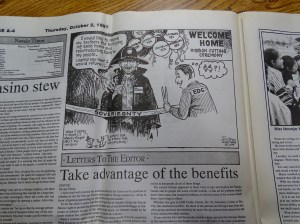
gambler10-2-97One of the most fascinating things about the debate over Navajo gambling in 1997 has to do with an aspect of Navajo origin legends. One of the greatest villains in these stories was a character, named Noqoìlpi, The Gambler. You can read more about him by clicking that link I attached to his name, but to put it briefly, this fellow just about wins the world and everyone in it by gambling. Frankly, I think there’s a lesson about the economic effects of modern financialization schemes and the growth of income inequality there in that story (seriously), but I’ll save that for another day. In 1997, the connection drawn by many on the Navajo Nation was a lesson about the evils of opening up casinos on the reservation. Whatever the strengths or weaknesses of this argument, it certainly added a rich layer of meaning to an already interesting subject.

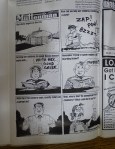
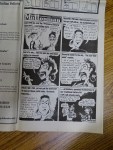
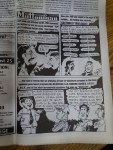
Of those working references to The Gambler into their arguments on the topic of casinos on the Navajo Nation, my favorite was the late Vincent Craig who ran an extended series of Mutton Man cartoons addressing this and several other issues in the Navajo Times. He really blended his own critique of gambling with a broad range of (extremely ironic) social commentary.

It all begins with a culture pill. .

Unfortunately, I don’t think I have copies of all the cartoons he ran on this topic. I don’t know that he got a cartoon in every edition of the Navajo Times, but I definitely have gaps in my own collection. Anyway, I collected enough to get the gist of his argument down. I’ll let Vincent and some of his colleagues tell the story from here.

Vincent Craig’s work (Click to embiggen):

6/5/97
6/26/97
7/10/97

7/17/97
8/7/97
8/14/97

8/21/97
8/28/97
9/4/97

9/11/97
10/9/97
10/23/97

11/13/97
11/30/97
12/4/97

12/11/97

A bit more on the subject, also from the Navajo Times (again, click to embiggen):

8/14/97
8/14/97
11/6/97
11/6/97
7/31/97
7/31/97
10/23/97
10/23/97
10/30/97
10/30/97
10/2/97
10/2/97

Share this:

  • Tweet
  • Share on Tumblr
  • Print (Opens in new window) Print
  • Email a link to a friend (Opens in new window) Email
  • Share on Reddit (Opens in new window) Reddit
Like Loading...

A Milagro Bagpipe War?

03 Thursday Nov 2016

Posted by danielwalldammit in Movies, Politics

≈ 14 Comments

Tags

Capitalism., Development, Donald Trump, Film, Globalism, Globalization, Milagro Beanfield War, Scotland, You've Been Trumped

mv5bmjizmje3mdcwm15bml5banbnxkftztcwmjk0mjg4ng-_v1_sy1000_cr007071000_al_John Nichols, the author of Milagro Beanfield War once gave the keynote speech at a conference I attended in Colorado. If I recall correctly the name of his presentation was; “Everything I know about the West I Learned in New York.”

…something like that.

Anyway, the point of the speech was that the sort of problems he wrote about in work like Milagro Beanfield War simply weren’t really unique to the western states. They were much the  same as they were anywhere else. Big money can be a terrible danger to small communities. That is as true of an inner city neighborhood facing gentrification as it is a small town in northern New Mexico facing a major development project.

I thought about this last night as I watched You’ve Been Trumped (2011), the story of Donald Trump’s efforts to develop a golf course in the community of Aberdeenshire, Scotland. Conflict between Trump and his team, on the one hand, and a small group of locals who want to hold onto their own homes and their own community provide the central theme of the film. At least one Youtube channel describes this film as a David and Goliath story, which seems fair enough to me. Perhaps, that’s Milagro Beanfield War was too, a David and Goliath Story. The same could be said of Local Hero (a film referenced in You’ve Been Trumped). We could certainly find other such stories if we looked, but whats most striking about this one is that it’s real. Watching the movie, I couldn’t help thinking it was as if someone had taken Nichols book and reworked into a movie script based in Scotland. That someone would have to be Donald Trump himself. It’s almost as if he took that former story of a heartless developer stomping all over a local community and said; “Yep! That villain is what I want to be.” The rest of the plot seems to flow smoothly from there.

Don’t get me wrong. This is not the most balanced documentary I’ve ever seen. If there are arguments in favor of Trump’s development, this film makes little effort to present them. The story-line focuses squarely on the conflicts with those living near Trump’s development project.I do wonder just how representative those individuals may be, and just what the overall balance of support and opposition to Trump may have been in the local community. The movie leaves a definite impression  regarding such matters, but it doesn’t answer them squarely. That said, what this film does show is damning enough in its own terms. Within the narrow scope of Trump’s relationship to those resisting his project, the film reveals enough to condemn the man. Whatever might be said in favor of Trump’s development, the actions covered in this film are truly abysmal in their own right.

It’s fascinating to see how much of the ugliness we’ve seen from this man during his presidential campaign appears in this film from 2011. His abusiveness is on full display as Trump repeatedly describes one hold out (Michael Forbes) as a filthy man living a disgusting life amidst his own trash. His penchant for simply telling the most convenient story regardless of the facts at hand can easily be seen as Trump brags about his wonderful contributions to the environment by stabilizing local dunes even as the film repeatedly shows construction tearing up the land, diverting waterways, and disrupting the natural cycles of the local ecosystem. It’s also present in Trump’s claims to be serving the people of Scotland even as he wages a heavy-handed campaign of harassment against those Scots interfering with his plans for a business clearly aimed at tourists. And of course his easy dismissal of journalism can be seen in his demands for questions from ‘real journalists’ at a press conference, effectively dismissing those who might not support his business. We here in America have seen all this time and again over the last year. The people of Aberdeen had already seen plenty of it by 2011.

Of course others have seen similar treatment in countless places where Donald Trump has done business. This is just one of many instances in which one of Donald Trump’s grand schemes for development fell like a boot-stomp of a local community.

…which brings me to another interesting feature of this film. It helps to illustrate some of the foibles of popular right wing theories about the power-relations between government and big business. As with other populist candidates, much of Donald Trump’s appeal seems to be rooted popular resentment about elites. How such resentment could lead to support for a man who so clearly asserts aristocratic privilege over the mere peasantry is something of a mystery to me. Still, he does draw a great deal of his appeal from messages systematically distorting  the modern political economy all across the media. At least a portion of this can be seen in the movie.

Let us start with libertarianism! This school of thought generally counsels us to avoid government entanglement with business, and with people’s personal lives. In principle this applies to any number of things, but in practice, the message is more likely to carry the day when the issues at stake are progressive taxation, welfare programs, or any number of government regulations tying the hands of big business. It’s a school of thought that consistently tells us we should not look to government to resolve questions of economic inequality. Central to the force of this message is a vision of equity in which government officials treat all people with equal regard and government programs afford equal rights to all of us. You’ve Been Trumped presents us with countless situations in which the Trump organization uses  official power to defeat the mere peasants who stand in his plans. Those people suffer loss of electricity, water, and destruction of their property, to say nothing of a deliberate effort to block their view of the sea for the sake of doing just that. At each stage in this process officials are slow to listen to complains or respond to requests for assistance and quick to enforce rights claimed by Trump. It might be that particular disputes can be sorted out in the courts, but Trump’s organization clearly has the upper hand at stage in this process. The notion that this system is consistent with any formal sense of fairness is at best a laughable proposition.

Libertarians might object that they too wouldn’t support Trump’s use of municipal authorities to abuse local enemies, assuming of course that the abuses shown in this film stand up to critical scrutiny, but that hardly addresses the problem. What this film shows is the leverage that monied interests do get over every level of government authority in existence. It isn’t enough to moralize the issue, to stand on the sidelines and shout; “Hey stop, don’t do that.” The point is that this is exactly what happens when we allow substantial disparities in the distribution of economic resources. Those with more at their disposal WILL use those resources to skew government authority (something Donald Trump appears to have done throughout his long career as a public menace). Despite this fact, libertarian narratives continue to focus on the problems of aid to the poor. They offer no solution whatsoever to the sorts of problems shown in this film, but libertarians continually present themselves as underdogs hard at work fighting against ‘statist’ power. In practice that fight is virtually always a fight to take away what little help and what little protections those in need may have.When an actual aristocrat takes it upon himself to destroy the life of a man he deems to filthy to accord even the most minimal respect, libertarians are simply silent on the matter.

Anti-globalists provide one of the more consistent sources of support for Donald Trump in this election campaign. Alex Jones of Info Wars would have to be counted among his most visible supporters.  He and his own fans often speak of Trump’s detractors as globalists, thus framing the whole election in terms of support for, or opposition globalism. Trump’s support for Brexit, combined with promise to build a wall on the southern U.S. border would seem to have earned him a great deal of points with this crowd. But of course this only counts if you have a really myopic view of globalism. It is one thing to stop people at your borders, which is what Trump is happy to offer the anti-globalist crowd, but of course money and power can easily flow right over those same borders. Yes, Trump has also declared his opposition to a number of international trade deals, but this is a man who has also taken advantage of opportunities on the other side of the border throughout his career. Simply put, big money doesn’t need a special trade deal to take advantage of foreign workers and foreign markets, and this movie illustrates that very clearly. It is Donald Trump’s wealth that enables him to go to a foreign country and simply have his way with a small local community. Nothing in Trump’s political agenda suggest that he intends to stop such things, and a good deal suggests that he intends to continue them.

Trump is happy to control borders, precisely because restricting the movement of workers is critical to optimizing profits under global market conditions. A world in which cheep labor can be found to the left and rich buyers are over to the right is not a bad deal for people like Donald Trump. In this respect, he is the perfect candidate for the anti-globalists. He will make a show of national boundaries, one they can be proud of, but he will never actually challenge the power relations at stake in the global economy. Neither Donald Trump nor Alex Jones really want to see anything truly revolutionary happen there. That might disrupt Jones’ sale of dietary supplements or keep Donald from demolishing coastal communities for his jet-set customers.

In the end, I suppose I shouldn’t be too surprised that Donald Trump could run as a populist candidate. He isn’t the first pampered elitist to pose as the hope of the common man. Still, he does seem to be one of the most clueless, and it does scare me that he could easily become our President. I’m not a fan of Hillary either, to be honest, but I worry that the whole nation may soon hand the keys to a problem child with a history of wrecking most everything he touches. More than that, his candidacy helps to illustrate precisely why the underdog themes of those on the right always ring so hollow for me. Time and again, they consistently seem David for Goliath, or perhaps the David of later years, the one who steals another man’s wife at the height of his own wealth and power for the David of David and Goliath, the one who actually does face down a more powerful opponent. Time and again, the right wing plays the underdog to government power, all the while ignoring real questions about who is really putting one over on whom. It’s a bad habit that some have fallen into. It’s a habit that may soon cost us all.

Just ask the people of Aberdeenshire.


Share this:

  • Tweet
  • Share on Tumblr
  • Print (Opens in new window) Print
  • Email a link to a friend (Opens in new window) Email
  • Share on Reddit (Opens in new window) Reddit
Like Loading...

Utqiagvik By Any Other Denali

17 Monday Oct 2016

Posted by danielwalldammit in Alaska, Politics

≈ 17 Comments

Tags

Barrow, Denali, Inupiaq, Language, Names, North Slope of Alaska, Political Correctness, Social Justice, Utkiagvik

barriow-signI live in Barrow, Alaska.

Wait a minute. No I don’t.

I live in Utqiagvik, Alaska.

It turns out that the town of Barrow has elected to change its name to Utqiagvik, or at least we have initiated the process for making this change.

Okay. It’ll take a day or three to get used to, and I can certainly understand some of the reasons for opposing it, but on the whole the recent name change of the town where I live is fine by me. It’s a native designation for a primarily native community. I’m not that involved in local politics, but suffice to say that this is a local decision I am happy to live with.

Thinking about it, a little bit, I am reminded of the way people responded to a similar change of names. It was a little over a year ago that President Obama announced the decision to change the name of Mt. McKinley to Denali. I recall immediately realizing that this would have little impact on the lives of Alaskans. To us, that was the name of the mountain, Denali, full stop. My favorite anecdote about that change came from a guy on Twitter who related the story of how he learned Denali was Mt. McKinley when he moved to the lower 48 and people began asking about it. He had lived in central Alaska for a couple years, and nobody that he noticed had ever called it Mt. McKinley. So, he simply hadn’t made the connection until non-Alaskans began talking to him about it. For myself, the only reason I knew it was Mt. McKinley was because one of the many pilots who called attention to Denali as we flew over actually bothered to mention that it was called Mt. McKinley in the lower 48. If I hadn’t heard that, I might not have made the connection myself. To me, it’s Denali. It’s been Denali since I moved up here, and near as I can tell that’s what the mountain is to Alaskans in general. Sure, there are some other native groups with names of their own for the mountain, but to most Alaskans it is Denali. So, that change shouldn’t have been all that controversial.

…or so one might think!

It wasn’t really all that surprising, but it was certainly worthy of an eye-roll to find how many people viewed the move as an instance of political correctness. Obama was, in their view, caving to the social justice warriors of the world and adopting a new term just to placate Alaska Natives. We all knew it was really Mt. McKinley, so the argument seemed to run, at least it should have been, and it was damned silly to find this mountain whose name we already know getting its named changed just to keep some odd group happy. Yawn! Heard that story from lots of folks who’ve never seen Denali, much less talked to Alaskans about it.

I suppose it wouldn’t occur to some folks that the indigenous people in the area might have thought the same thing when the mountain was renamed in honor of one of the nation’s caretaker Presidents. It certainly didn’t occur to some people that the name change might have had overwhelming support throughout the state at large, a marked preference for both native and non-native alike.

There was, as it happens a political angle to this. President Obama was then preparing a visit to Native Alaskan communities even as Shell Oil was preparing to drill in the arctic; the renaming might very well have served to provide a token gesture of good will in advance of a potentially divisive moment of history. But if this is a problem, it was a problem of timing and ulterior motives. As regards the merits of the name change itself? No, that’s not a problem at all. Not here.

So the renaming of Denali  was for me one of those moments when PC-bashing rhetoric revealed its true colors as a form of political correctness in itself, and those complaining about the name change found themselves triggered, so to speak, by a symbolic issue of little genuine significance to themselves.

So, I wondered…

I wondered what certain ‘conservative’ voices might make of this recent name change? It seems an innocent enough question, doesn’t it? Ah, but in this case an ‘innocent question’ is another phrase for ‘damned morbid curiosity.’ That’s the only reason I can think why I would have found myself scanning the comments section at World Net Daily. I know. It’s a bit like scavenging a garbage dump except I can think of legitimate reasons to look through a garbage dump. As to looking at the comments on World Net Daily, I have only the aforementioned excuse, and it’s not a very good one at that.

Like any other miserable person, I am apparently interested in some company, so let me share with you what I found. The article itself was just a stub and a link to a piece from Alaska Dispatch News, but the comments? Oh, the comments!

Let’s see…

Well, don’t get to used to it, before long they’ll be telling us the muslims were there first.

Um, no. But it is fascinating that a perfectly real question about a community that really was here first would be so easily dismissed with a story about one that clearly wasn’t.

How many Inupiak actually lived in “Utqiagvik” prior to its being named Barrow? I would venture even fewer than lived in Iqaluit (which is in Nunavut) prior to its being named Frobisher Bay (which was its name until 1987).

Basically, this was copied from the 1987 Canuck folly of renaming Frobisher Bay as “Iqaluit”.

A bit more detailed than the other folks weighing in on the subject, which is it least interesting. I really can’t tell why the number of Inupiaq who lived here prior to contact is relevant to the current name. Likewise, it isn’t entirely clear why the renaming of Frobisher Bay is a problem. That name change too is not what this individul would like to see, that’s clear enough, but he never does present a clear reason to believe his preferences should weigh more than the preferences of either community. …or that they should weigh anything at all, really.

Oh no… not another passport stamp within our own country !!!

HE IS COMING……………..

Passport? Do we need passports now? I don’t think so. It is interesting though to think that the name of our little town could trigger the second coming? At least I think that’s what the writer is referring to. So, I guess Jesus doesn’t think much of indigenous names. Unless he does. Seriously I suspect the many churches of Utqiagvik are filled with Native people who may have prayed for this very thing, or given prayers of thanks afterwards. I could be wrong of course. Honestly, I don’t know what happens in churches on Sunday, but still. Seriously? He’s coming? Over this!?!

“To [rename Barrow] would acknowledge, honor and be a reclamation of our beautiful language which is moribund.”

Their “beautiful language” is dying is because to embrace that culture is a sure-fire way to wind up spending the rest of your life performing the Inupiaq equivalent of burger flipping. The young just aren’t interested and are leaving for better, easier lives, hence the moribund language.

Okay, this is an interesting narrative. To say that it affirms a kind of cultural imperialism would be putting it mildly, but it’s an oddly caricatured version of the local job market. Simply put, the North Slope of Alaska does not seem to be lacking for jobs, and in particular it does not seem to be lacking for jobs in which speaking Inupiaq would be anything less than a plus. Speaking Inupiaq alone could be an issue, but English + Inupiaq? That’s a damned pay raise right there! If people are leaving that’s not it. If the language is floundering, that’s not why.

A barrow by any other name….

Hm…

Dog gone it !! I missed Indigenous People’s Day again.

So somebody doesn’t give a fuck about indigenous people? Well fuck his fucks anyway.

Re: BARROW, ALASKA, CHANGES ITS NAME … TO ‘UTQIAGVIK’
‘It reclaims our beautiful Inupiaq language’
———————-
If memory serves me the people of Alaska recently voted to call Mount McKinley by its original Native-American name.

More than half the US states have Native-American names and there is a reason for that. Native Americans may have fought each other, as well as Europeans, but the Europeans admired Indian bravery and kept most of the Indian names of places for that reason.

Interesting. I don’t think warrior heritage is really the issue in either of these cases, but this does strike me as a reasonable effort to understand what’s going on. It’s nice to see that reasonable happens from time to time, even in odd places.

Well, if I ever have to go to Barrow/Utqiagvik I’ll have to visit the travel agency to book a flight. They’ll never understand what the hell I’m saying over the phone.

Okay.

Unpronounceable Utqiagvik is so…so…PC!

Always amusing to see someone who has ideas about what other people should be calling themselves complain about their political correctness. And seriously, it’s really not that hard to pronounce. I mean, the ‘g’s around here are not like English ‘g’s but no-one has been executed for mispronouncing a ‘g’ in at least 5 years. Say it like it looks and no-one is going to bug you about it.

Now, knowing we are meant to have a republic, this is one of the few democracy style political decisions I can live with. Doesn’t bother me one bit to have a community decide on a name change…even if I have no hope of pronouncing it in this lifetime.

Nice to see a conservative voice in the comments at WND for a change.

WHAT-I-VIK!???

Utki… Oh that was a rhetorical question, wasn’t it?

I guess we can call it The City Formerly Known as Barrow.

…or we can call it Utqiagvik.

We could have its name as ‘UTQIAGVIK’, but since this name seems to be unpronounceable or sounds and looks almost random to most people, I think nearly everyone will continue to call the town “Barrow”. Thanks, though.

Reply 1: It looks like a name some negro might give to their child.

Reply 1a: …could be an Icelandic volcano name

On the first comment here, I find the authorial ‘we’ interesting. If ‘nearly everyone’ is nearly everyone that lives elsewhere, then I suspect nearly everyone here won’t much give a damn. If nearly everyone were here, then well I suspect the vote would have been different.

On the first reply to that comment, I’m guessing this is one of those folks mystified by the way some people keep calling him ‘racist’, but I’m sure I would have no idea why that would be the case.

On the second reply to that particulatr comment, I suppose it could, and that would be cool.

I went on a one night trip to Barrow um Utqiagvik back in 1993. Alcohol was prohibited but there was a speakeasy just a snowball throw away from the law enforcement building. I went on a school bus tour and the driver narrated. It was great. There was an italian restaurant that had excellent food. It was an expensive trip but worth it.

Right on!

Disgusting! We brought these people civilization, yet they still want to celebrate their savage ways

Reply 1:  Maybe they didn’t want to be brought into anything! Maybe they just wanted too be left *** alone.

Reply 2: Barrow had Eskimos. They were peaceful until corrupted by alcohol. The noble savages lived in the south and they too became corrupted after being turned on to petrol and alcohol too. The white man did it.

Reply 2a: All the white man did was give them God, civilization, and stopped them from warring among themselves over sparse resources.

Reply2a1: The black man and woman are the start of humanity.

Reply2a2: One more IDIOT that does not know their history the white man sold alcohol to the Indians in the lower 48 and in Alaska also….

Reply 2a3: When before that, they had only Peyote and Mescaline. Fine hallucinogens indeed. Good Grief.

Reply 2a4: I know the white man introduced them to alcohol. The point is that the indian moral character was so weak that their way of life collapsed because of it, so big government has to give them land and take care of them like orphan children

It’s always nice to see bigotry drop the white robes and show its face in the light of day, or at least the internet equivalent. That would certainly cover the first comment. What’s fascinating to me though about this exchange is the use of peyote and mescaline to undermine respect for Inupiat. Those plants are not found in the arctic, so this person is clearly treating the indigenous people of the Americas as one homogeneous group. That he also doesn’t seem to understand much about native use of these hallucinogens is of course par for the course. The mere presence of drugs in the Americas is, for him, sufficient cause to comment on the moral character of all of them.

…and we’re back to naked bigotry, bigotry that’s still going strong at the end of the thread.

Also find it fascinating that such folks could consider themselves conservative. There is simply nothing in conservatism that should contribute to such naked bigotry. And still…

Why don’t they just piut up a blank sign, since the enlightened indigenous people of Alaska had no writen language….or an alphabet for that matter?

I normally make it a point not to use people’s spelling and grammar against them, but I can’t help feeling amused at the difficulties this fellow has writing about the inferiority of those without a written language. I also find it fascinating to see someone hold the lack of a written language against any population. Suffice to say that Inupiaq is written now (hence the ability to write the name, Utqiagvik), and there isn’t much reason to hold it against Inupiat that they learned writing from someone else. …just like most of the peoples of Europe did at one point or another.

How about “Freezeyourassoff”?

Point taken.

been to Barrow, it’s a dump

Reply 1 – So is Detroit

Reply 2 – But it was fun for me. I visit the hood while there but the hooligans were safe. I ate fried chicken at the supermarket and while there checked out the prices of food items. Triple in cost! The beach I went to was cold but nice. It was fun for the one night I stayed.

Your face is a dump!

From now on people will say “so, you’re from Unpronounceable, Alaska”

Reply – Or, gesundheit.

Touché and thank you.

More PCBS

Pure projection.

Weird.

Reply 1 : How do you pronounce this new name!!????

Reply 1a: I guess the Alaska Dispatch News never expected to get national coverage of this story. Either that, or it never occurred to the writer and editor that few people outside of the area would have the first clue how to pronounce the new name.

Reply 1b: oot-GHAR-vik

Reply 1b1: Thank you!

Reply 1c: Utqiagvik… pronounced just as how it looks.

Reply 1c1: It looks pretty messed up.

Reply 1c2: The same forward and backward … at least when I say it.

Reply 1c3: Haha, Okay! That makes my day. I can chuckle all day now.

Us Americans are so darn monolinguistic.

Fantastic.

Reply 1c4: “Us Americans are so darn monolinguistic.”

I’ll bet the Romans were too when they were the dominant world power. And very likely whoever comes after us will be as well.

It’s ridiculous to suggest that people should learn a second language “just because” or that not doing so makes one small-minded. It’s about as intelligent as mocking someone because they can’t play more than one musical instrument.

But no doubt it makes you feel somehow more enlightened to make such comments.

And there it is, the right wing reaction to another name change occurring in Alaska. Its an interesting mix of outright racism and the usual complaints about short-sighted thinking associated with political correctness. Some of these folks have very specific objections, and those very specific objections often seem to turn on value judgements the authors take as obvious. In the end, it does appear that respect for native communities simply isn’t very high on the priorities of a good portion of these critics. At least a couple of these guys would appear to object to that value in itself. Others clearly think other things should come first. But what strikes me most about the whole thing is the ease with which this crowd picks apart a local issue in terms of national priorities and ideological assumptions.

I keep coming back to the one person who voiced the notion that the preferences of a local community ought to control the choice of its own name. All other issues aside, I can’t help thinking that’s the winning argument in this case. It strikes me as the sort of argument I would expect a conservative to make on the subject, and this one more reason why the right wing stance in America’s culture wars always seems so disingenuous to me. For all the fretting and fuming over left wing excess in these conflicts, it is as often as not the right wing that seeks to impose national agenda to the issue at hand.

…and proceeds to tell us it is someone else that is politically correct.

Share this:

  • Tweet
  • Share on Tumblr
  • Print (Opens in new window) Print
  • Email a link to a friend (Opens in new window) Email
  • Share on Reddit (Opens in new window) Reddit
Like Loading...

Triggers

27 Tuesday Sep 2016

Posted by danielwalldammit in Justice, Politics

≈ 10 Comments

Tags

College, Cruelty, Culture Wars, Right Wing Politics, Sensitivity, Social Justice, Social Jutice Warriors, Trigger Warnings, Triggers

The first time I recall reading a trigger warning it was in the off-topic sub-forum on a gaming discussion board. If I remember correctly, it was in the title for a thread about sexual abuse. That usage struck me then, as it does now, as a perfectly appropriate warning to some that the ensuing discussion was going to cover issues which some might find intensely stressful. I also understood the likely reason for this to be that some people might have had direct personal experience with the realities of such abuse. It has ever since struck me as a reasonable and positive thing to provide that warning in advance. It also serves as a good reminder to the rest of us that something we may regard as grist for the mill could have serious personal significance for others. I know that reminder has helped me to appreciate the weight of some issues. I can’t say that I’m always happy with my performance in dealing with these things, but I do think I handle these issues with more care now than I did in earlier days, and I credit that first encounter with a trigger warning with producing the difference.

Within a couple years on that same discussion the trigger warnings in the off-topic forum had multiplied beyond my wildest imagination. Countless variations of trigger warnings could be found in the title of one thread after another. I found it increasingly difficult to take them seriously, not because I couldn’t imagine someone getting upset at this or that topic, but because there comes a point where the likelihood that someone will become upset ceases to be a function of the topic and becomes an abstract possibility that is simply always there. People get upset, but it isn’t always because the discussion at hand is intrinsically dangerous subject matter. As I read the increasingly common little warning symbols, placed conveniently in square brackets, I couldn’t help but think the point was far more likely to be a statement about the values of the person employing the hashtag. Right wingers like to call this ‘virtue signaling’, and I don’t necessarily dispute the appropriateness of the label, though I do suspect the convenience of that buzz-term is a vice of its own. Whatever the purpose of the growing trigger-warning craze, I couldn’t help thinking then, as I do now, that the concept is subject to inflationary pressures.

As in, increased usage leads to decreased significance.

Where do you draw the line? I don’t know, but somewhere between a trigger warning fr sexual abuse and the many seemingly trivial uses I have seen over the years, the significance of these warnings does seem to change. Moreover, the expectation that someone ought to use trigger warnings, or that they must use them introduces a level of coercive authority into the equation. It wasn’t that long ago that a Dean at the University of Chicago denounced trigger warnings. In so doing, he clearly took them to be a mechanism for silencing those with whom one disagrees. But what about those who choose to use such warnings, some argued. Is that not permitted? And thus the renunciation of authority came  itself to be viewed as an assertion of authority, one itself worthy of denial. Who is oppressing whom and how is, it turns out, a bit more complicated than some would have it.

I guess I’m enough of an old fashioned liberal to want to have my free speech and use it too. I don’t like seeing efforts to silence speakers at public universities in the name of safe spaces, and that isn’t because I’m a fan of people like Milo Yiannopoulos. What I really don’t like is watching the careers people like that flourish as a direct result of the explosive outrage they specialize in …triggering. People like that have nothing to say, and they need the spectacle of outrage to provide the illusion of substance. I’d rather answer them. I would rather make the case against them, at least when that case can be made without fear and intimidation coming from the other side. I have seen right wingers drown out their critics, and I wouldn’t tolerate it. Lately though, a number of right wing sources have come to relish moments in which the left appears to be doing the same thing.

…is doing the same thing.

That too should not be tolerated, not the least of reasons being that it’s exactly what some of these hacks want from us.

This brings me back to the whole inflationary pressures thing. If the left wing over-uses trigger warnings, I think the same can be said of the right.

…well the ‘trigger’ part anyway, not so much the ‘warning’ part.

Time and again, I see folks respond to an argument for social justice by claiming its proponent has been triggered. Hell, I’ve gotten the response myself a time or ten, sometimes when I am more amused than agry. It’s fascinating to me, to see this cry of victory. As often as not, the signs of stress just aren’t there, or if they are, they are present to exactly the degree that one might expect from anyone else upon expressing disagreement. Yet, those proclaiming their opponents have been ‘triggered’ seem to hope those opponents are wallowing in distress, or at least they seem to enjoy pretending that is the case.

This is of course the hope of a troll, and it isn’t much worthy of anyone who claims to be advancing a serious point of view on any subject. But I suppose it does help to confound the issues, to ensure that no-one ever does take a trigger warning seriously. Still, I can’t help thinking for some it appears to be an end in itself, the prospect of making someone else feel bad.

If the notion of a trigger has lost some of its value in overuse by those on the left, it’s losing even more value as playground conservatives transform the term into a trophy of sorts. If they have their way, the public will be incapable of distinguishing between the psychological traumas experienced by some when dealing with sensitive issues and the irritation others feel upon realizing someone is wrong on the internet. This isn’t really conservatism, of course. There is nothing conservative about mocking women over their looks, disabled persons, victims of crime, or even minorities for pleading their own case in the public eye. Conservative politics may be resistant to a number of efforts at correcting social harms, but the growing orgy of right wing schadenfreude is an altogether different animal. Some people really do hope to inflict suffering on others.

To them a trigger warning is a symbol of hope.

It’s a hope I would see them denied.

Share this:

  • Tweet
  • Share on Tumblr
  • Print (Opens in new window) Print
  • Email a link to a friend (Opens in new window) Email
  • Share on Reddit (Opens in new window) Reddit
Like Loading...

And Context Wept: Islam and its Net-Critics

11 Sunday Sep 2016

Posted by danielwalldammit in Politics, Religion

≈ 8 Comments

Tags

Criticism, Internet, Islam, Islamaphobia, Muslims, prejudice, Regressive Left, Rhetoric, Twitter

Let’s say I post a criticism is Islam (or of some Muslims) somewhere on the net. What is the most likely impact of this action? I know. Crickets chirping, right? But let’s think about the possibilities. Even if it is an e-drop in the digital ocean, I, like others who add their comments to countless social media accounts are trying to communicate something to someone. That may or may not happen, but as it is the point of posting in the first place, it’s worth thinking about it. So, my question is, what kind of impact will my criticism have?

If I say something about the mistreatment of women or homosexuals in Islamic countries, will my words have any positive impact on the lives of vulnerable people in places like Saudi Arabia, Iran, or those living in ISIS controlled territories? Or will my criticism simply add to the din of anti-Muslim rhetoric in the west? Will I in some small way help to ease the pressure on those oppressed by Muslim strictures? Or will I in some equally small way help others to make a case for bombing runs abroad and discriminatory policies at home? If I complain that Muslim women are oppressed through the need to wear a burqa, will this help to give some poor lady the right to bare her face in public? Or will my comment be just another insult to Muslims in general, even the women wearing those burqas? If I complain about female circumcision, will I help to spare woman this procedure, or will my comments serve simply denigrate those who have already had it? If I simply disagree with something Muslims believe, will my comments to that effect give them something to think about? Or will they just add to the stigmas already placed upon Muslims now living in the west? Might my comments (whatever the specifics) help to inspire some nutcase to go scapegoat a random Muslim on some random street corner in America?

And by random Muslim, I could well mean a Sikh, not because I’m unaware of the difference, but because those inspired to such random violence generally don’t.

Could my criticism have more impact on the lives of Muslims actually living in the west? Perhaps. But what would that impact be? Will I inspire people in a predominantly Muslim community to be more accepting of some of some of their own members? Will I make them a little less likely to entertain acts of terrorism? Is that even a real concern, much less a real hope? Or will my criticism simply provide one more signal that the western world is truly hostile to their own ways? Will I give them one more reason to insulate themselves against the rest of us, and live apart even as they live nearby?

I can do some things to increase or decrease the likelihood of positive impact. I can study-up to make sure I have a reasonable point, or I can pass along a meme with a real gotcha kinda gut-punch? If I choose the former route, what then? A reasonable criticism presupposes a basis for constructive dialogue, even a willingness to listen to the response. Sitting up here on the northern edge of northiness, I’m not sure I have such a basis for constructive dialogue, and I suspect your average Muslim (whether living in the  West or otherwise) will have even less reason to give a damn that some random guy has a bone to pick with his or her religion. There may be inroads to make such conversations possible, but they don’t begin with the criticism. They don’t begin with me sitting down and saying; “I’m gonna take Islam down a notch today.”

I write this because some people seem to think criticism of Islam is a moral obligation. They can often point to bad things happening in Muslim circles, and I can often agree that some of those things really are bad. But how the Hell do I express concerns about things without making life more miserable for the countless Muslims here or abroad who just want to get through their day?

Much as I do.

It’s not at all uncommon to see net-warriors goading certain parties to be more critical of Islam. This is often coupled with an effort to minimize criticism of some other interest. Evangelical Christians, for example, will sometimes complain of atheists that we criticize Christianity while ignoring Islam. (A common gambit here is to suggest that we are too scared to criticize Islam. …chicken if you don’t, so to speak.) Voices within the right wing echo chamber frequently ask why the left complains of homophobia in their own circles when the executioners of ISIS literally throw gay men from rooftops. The answer frequently strikes me as obvious. No-one from ISIS gives a damn what I type. The far right here in America probably doesn’t either, but they are a lot closer to it than anyone living in ISIS-controlled regions of the world. Net battles are all sound and fury, this is true, but there is a lot more cause for hope when speaking to people with more cultural baggage in common and less political baggage piled up between them.

I used to hear and read similar games played on the subject of communism. Some folks would wonder out loud how the American left could be so critical of our own nation when we have so little to say about the crimes of the Russians. Why didn’t we protest their policies, I recall a few folks saying. I always thought the answer was damned obvious. The

The political context of such conflicts simply don’t give us a clear line from a criticism to a positive outcome or even a constructive dialogue. More to the point, the criticisms themselves suffer in this case from a lack of attention to context. It isn’t just that Muslims are unlikely to listen to a random criticism from a random non-Muslim; that criticism is unlikely to be worthy of consideration in the first place, still less so if it is made under the illusion that the value of such a criticism could be determined in the abstract.

All in all, it’s a pretty childish game, I am talking about, but it’s one that seems to have extra traction as applied to Islam. The right wing has done a good job of generalizing the sense of war in our present age. In the days immediately following 9-11, George Bush was careful to tell the public that we were not at war with Islam or with Muslims in general. That didn’t ensure authorities would treat Muslims with anything near the respect deserved by any human being or even with the respect that should simply go with due process, but at least the man did make an effort to define America’s wars (reckless as they were) in ways that didn’t make innocent Americans into the enemy. The right wing echo chamber has been working damned hard to change that in the years sense then. Whether it was the fight over the so-called Mosque at ground zero or the constant drum-beat of professional bigots such as Pamella Geller, Ann Coulter, or virtually the entire Fox News Network, they consistently nudged the nation (and the world) toward a vision of one grand apocalyptic battle between the western world and the Islamic World. To be sure, there are voices within the Islamic world that agree with them on the terms of this war, but the mating calls of violent people will always resonant with those of their own enemies. The bottom line is that an awful lot of people see Islam itself as a force to be reckoned with, an enemy to be defeated with rockets abroad and with rhetoric at home.

This situation has the effect of skewing a number of general conflicts between Islam and its would-be critics. The philosophical arguments fielded against Islam by atheists, Christians, and others take on the significance of a political agenda. Sam Harris, for example, has suggested that 9-11 inspired him to become a vocal atheist. At the end of the day, atheists and Christians will have our disagreements with Muslims. If there have ever been paths to constructive dialogue between these communities, the notion that violence rests on the consequences doesn’t help much. Too often those of us on the other end forget just how much of that violence falls on Muslim communities. As the question is framed in popular culture, it is almost always about what they might do to us. What we have done to them never really seems to be on the table. Muslim and an atheist (or a Christian) could theoretically have a thoughtful discussion about their beliefs. Such debates are not the norm.

It wasn’t too log ago that I encountered a white nationalist on twitter claiming that Islam was a virus. He didn’t want that virus to infect the western world, and so his tweets on the subject moved back and forth between the notion that Islam itself was a virus and the notion that Muslims were the virus, that they must be kept out of western nations. To say that this was dehumanizing rhetoric would be putting it mildly. I have always regarded the dangers of comparing people to diseases (mental or otherwise) as one of the legitimate lessons of Nazi history. What surprised me about this example was the number of people who joined the conversation in order to defend the notion that Islam was a mental illness. Their interest in the argument, of course, stemmed from Richard Dawkins notion of religion as a kind of mental virus. That the specific comments in question were nowhere near so abstract was lost on the majority of those chiming in to defend the man’s comments. That the man producing them was a committed white nationalist was also lost on his many defenders. And thus a group of philosophy dude-bros came to the aid of an outright bigot without ever realizing the point at hand was more than a theoretical matter about the nature of religion.

Sometimes a philosophical discussion is anything but.

A second, and perhaps more serious problem lies in the nature of human rights abuses carried out by Islamic regimes or by militants under the expectation that such regimes will protect them. These deserve a response of some kind, but the countless war-mongers  spreading news of every atrocity ever committed in the name of Allah certainly aren’t doing anything to promote respect for human rights. (Honestly, I think some folks suffer from terrorist-envy.) I often pass along what I take to be credible news accounts of atrocities, and I am happy to support the efforts of organizations such as Amnesty International or other such organizations working to prevent human rights abuses. That may sound weak, but at least it doesn’t strike me as adding fuel to a fire. If there are better ways to address such atrocities, ways that don’t amount to promoting violence and prejudice in their own right, then I am open to reading about them.

All of this may be much ado about less than nothing. Someone wrong on the net and all, but to degree that any of these criticisms matter, my point is that telling the world you don’t like Islam isn’t all that helpful. Being helpful at this point in history is a little more difficult than usual, but a good number of people could stand to try a little harder.

Cue comments about the “regressive left” in 3, 2, 1…

Share this:

  • Tweet
  • Share on Tumblr
  • Print (Opens in new window) Print
  • Email a link to a friend (Opens in new window) Email
  • Share on Reddit (Opens in new window) Reddit
Like Loading...

When Trolling Douchebags

01 Thursday Sep 2016

Posted by danielwalldammit in Politics, Write Drunk, Edit Stoned

≈ 22 Comments

Tags

Critical Thinking, Donald Trump, Douchebag, Election, Ethics, Friedrich Nietzsche, Internet, Melania Trump, Misogyny

trumpcrop5“When trolling douchebags, take care not to become a douche yourself.”

I’m pretty sure that’s a direct quote from Friedrich Nietzsche. I’m almost certain my man Friedrich was talking about Trump when he wrote that. He was trying to tell us to be careful how we criticize Trump, because Trump is full of idiot and when you argue with idiot, you get idiot sauce all over you.

Make a note of that Hillary!

“Cereal?” You may be asking, but I can assure you that Nietzsche was totally cereal with all of this stuff, cause the man was a totally cereal kind of guy.

…at least about how you should argue with Trump. Or with the idiots who support his Trumpery badness.

Nietzsche’s point of course was that you really should watch what you say about Melania Trump. I know this, because I asked him. I asked Nietzsche straight up. I said; “what do you mean dude?” And he told me I shouldn’t really call him dude. He said Zarathustra would not approve. He then told me the whole damned quote was actually about Melania Trump. He wanted us to know that people should watch what they say about her.

“Surely, you don’t mean,” I said to Nietzsche, “that we can’t criticize her for plagiarizing Michelle Obama in her speech at the GOP convention.”

“No, that’s fair game,” he said. “You can totally criticize her for plagiarism. You can even take a few extra digs for saying she wrote it herself just before blaming the fact that she didn’t write it herself on the ghost who didn’t write it herself either. Damned ghosts anyhow! You just can’t trust a ghost to write new stuff you can take credit for these days. Rich folks ought to be able to take credit for the work of others. It’s the American way!”

I thought he had a point.

Nietzsche added, that you could probably criticize Malania and the whole Trump camp for pretending Obamas are the Devil himself when they actually seem to find some merit in what at least one of them does.

I asked Nietzsche if the devil has multiple personalities. He said only when he’s from Kenya. That’s all Nietzsche was wiling to say about that subject, so we moved on.

I asked the old philosopher if we could criticize Melania for saying she graduated from a place that never spat a degree her direction. He said, surely we could. I also asked Nietzsche if we could raise questions about her immigration status when she came to the country. He told me that was probably okay, but it would really depend on the questions. Did we really want to encourage Trumpery people to think of immigration as a bad thing? I agreed that might not be wise.

“So what’s the big deal anyway?” I asked the old curmudgeon. “What is it we are not supposed to say about Melania?”

“Oh, you can say anything you want.” Nietzsche assured me. “Without gods, everything is totally cool.”

“So then what’s the problem?” I asked again. “Can we go after Mrs. Douchebag or not?”

“Of course you can, but if you go about it wrong, you will become a douche yourself. You’ll be talking along, or tapping away at your keyboard and suddenly your mouth and your fingers will be the mouth and fingers of a douchebag. If you’re cool with that, then it’s all good. But if you don’t want to become a douchebag, then you should watch what you type about Melania.”

I told Nietzsche that I really didn’t want the mouth and fingers of a douchebag.

“Well, then take care of what you type!”

“Okay!” I was getting a little exasperated at this point. I mean, Nietzsche may not be a systematic philosopher, but this was a little cryptic even for the proto-gonz himself. “What exactly is it that I might not want to type about Malania.”

“Don’t slut-shame!” he said. “That way lies douchetude.”

“Cereal?”

“Totally cereal!”

I have to admit, I was a little taken aback by this whole thing. I mean, I really didn’t expect a conversation with Nietzsche in the first place, but nobody really expects that. What I really didn’t expect was that slut-shaming would be his biggest concern about election politics in the U.S. Maybe that wasn’t his biggest concern, but that’s what he chose to tell me at any rate. It really seemed to be the main point of the conversation.

“Why?” Nietzsche asked, “Why would you go after her anyway? Hasn’t the man himself given you enough cause for complaint to fill countless servers with perfectly sound criticisms? Does the image of Trump himself not make you want to claw your own eyes away from your face? Does his voice not make traitors of any ears foolish enough to pass along the sound of it? When you have Trump University, why would you bother about Melania’s degree? When you have Trump saying stupid things on a daily basis, why would you care if Melania chooses to channel Michelle like some drunken psychic who mistakes a radio for a ghost? Sure, you can make some good points about Melania, but the real story is always going to be the festering bloodfart beside her. Why on earth would anyone take the time to score a little field-goal against Melania, when you could score a game-winning touch-down against Trump himself? He’s the candidate for POTUS, and he is way worse than his wife will ever be? He’s worse than anyone’s wife will ever be. Hell, the Donald is worse than worse. He’s a singularity of worsitude? There is absolutely no reason to cap on Melania when her husband himself is such a bundle of dumbfuckery that the heavens themselves have been screaming “you’re fired” ever since his campaign announcement. Seriously, you have to ask yourself, why anyone with that much material on the Donald would instead choose to go after his wife? That just smacks of misogyny.  I’m saying that, and I’m a notorious misogynist.”

“That’s true,” I said. “Your writing about women is pretty bad. And when did you start using football metaphors?”

“When you decided to write me into this damned blog post.”

He had a point.

I’ll spare you the rest of the conversation. Nietzsche was getting a little belligerent at that point. Also his Superbowl predictions seem a little far-fetched to me. Really, you just don’t want to know.

My main point, Nietzsche main point, is that one ought to think twice about attacking Trump through the use of Melania’s nudie pics. It’s become a rather common game on certain social media circles. Some people like to circulate racy photos of Melania Trump along with a comment or two about how she could be our First lady. Yesterday the hashtag #TrumpsMexicoTripSayings even had someone suggesting a donkey show for Melania, thus mixing racism with misogyny. It’s an ugly argument, and one that doesn’t do a damned thing to show just how bad Trump would be as a President.

The problem here isn’t really fairness to Trump, or even Melania. Neither Melania nor Donald will suffer much as a result of such idiocy, and these memes aren’t going to cost him the election, but the notion that a woman deserves punishment for her own sexuality is toxic as Hell. It does hurt people. Maybe not the wives of billionaires, but it hurts people just the same. An objection to commercial nudity is also pretty damned hypocritical when coming from people who consume such images themselves, all the more so for those spreading such images while criticizing Mrs. Trump for appearing in them.

With enough mental gymnastics, you could probably concoct a respectable-sounding argument about the topic, but at the end of the day, you are still using a woman’s body to attack her man. That way does lie douchebaggery. Nietzsche is right about that.

So, anyway, that’s what Friedrich Nietzsche has to say about this election. I asked him if I could share his thoughts on the subject. He said I could, but only if I did so by means of a completely ridiculous literary device.

Share this:

  • Tweet
  • Share on Tumblr
  • Print (Opens in new window) Print
  • Email a link to a friend (Opens in new window) Email
  • Share on Reddit (Opens in new window) Reddit
Like Loading...

A Tyrant On Either Side of the Gun Sights

10 Wednesday Aug 2016

Posted by danielwalldammit in Politics

≈ 13 Comments

Tags

Donald Trump, GOP, Gun Rights, Guns, National Rifle Association, NRA, Politics, Right Wing, Second Amendment

Meguns&JudPriestshirt

Budding Young Amo-sexual (Embarrassing, I know)

I was about 15 or 16 when my father cancelled our membership in the National Rifle Association (NRA). Money was tight back then, but Dad said that wasn’t entirely the issue. He was also fed up with their politics.

I was mortified.

The old “If guns are outlawed” sticker was then sitting on the bumper of my first car (which wasn’t yet running), and a stack of hunting and shooting magazines rested on a shelf in my bedroom. My private arsenal had already outgrown the gun-case. At the time, there just wasn’t much about the NRA that I didn’t like. Oh sure I’d noticed a myopic one-sidedness to some of the articles in those magazines, but for the most part, I was down for the main agenda. Dad never did explain to me what had bothered him about the NRA back then (the early 80s). I reckon he was just hoping I would grow a dose of moderation at some point. This was hardly the only obsession that could have given him cause for such concerns.

I guess Dad got his way on this one at least. My views on guns and gun control are complex. ‘Ambivalent’ may be a better word. My take on the legal issues doesn’t map well onto either the left or the right on the actual issue of gun ownership. I’m open to gun control, but skeptical of its impact (at least one any scale that’s practically possible in the present political climate). It hasn’t escaped my notice that I live in a region where firearms can be damned useful. (By way of illustration, one of my students took a job collecting plant samples this summer. Part of her training including a day or so learning how to handle a firearm. In the land of polar bears, a gun can be an essential part of scientific research.) I’ve also got a lot of friends and neighbors who feed themselves by use of firearms, and I’m not in the habit of turning down a good bowl of tutu (caribou) stew. The bottom line is that I won’t be campaigning for full disarmament anytime soon. Few do, really, but if complete disarmament is your bandwagon, then I am definitely not on board.

There is one other bandwagon I’m not climbing aboard any time soon, and that is the one run by the NRA. Any latent interest I might have had in that organization slipped away during the Clinton administration. The television ads from that era telling us that every honest gun owner ought to be a member didn’t exactly inspire me to get out my checkbook. Hearing countless people spouting their fears about ‘thuh guvment’ was enough to send shivers up my spine and put a large dose of queazy in the pit of my stomach. I recall “Impeach Clinton” bumper stickers within the first few months of his first administration. In time his critics would find reasons. In the interim, suddenly Bill Clinton was the source of the New World Order, notwithstanding Bush Senior’s use of the  phrase to sell Desert Storm. Within the space of a single election, Clinton became the source of all that was wrong with the world. Seeing the same people who had supported centralization of power throughout the Reagan and Bush administrations suddenly play underdog against government authority was more than a little disconcerting.

It got a lot more disconcerting after the Oklahoma City bombing.

You can’t run a direct line of reasoning from Charlton Heston’s “take my gun from my cold dead hands” speech to that bombing, no, but these two notes fit in the same damned tune. The right wing now sings a constant chorus of ‘don’t tread on me’ messages, and most of them serve simultaneously to valorize the weekend warrior games of countless over-gown boys and to demonize the best efforts of anyone involved in pretty much any kind public service. Hating the government is a popular sport in what passes for ‘conservative’ circles these days. The problem is you can’t shoot at the government and you can’t bomb the government. Hell, you can’t even shout at the government. You can only do these things to real people, people who work for the government, and the trouble with demonizing that government is its a damned effective way to demonize real people. It’s a damned effective way to justify hurting real people. An awful lot of people died in Oklahoma City because someone decided to strike a blow against the government, and his ideas about that government had an awful lot in common with those pushed by the NRA for a couple decades now. Is the one the cause of the other? Maybe not, but it’s a damned reckless message just the same.

What I specifically object to is the scorched earth tactics that the NRA keeps producing. Talking of Second Amendment solutions and other confrontations with the government may sound like the words of brave people put-upon by dark forces and powerful institutions, but they are also clear and obvious efforts to intimidate the rest of us. While other interest groups go to the voting booths, hire lawyers to plead their case, or sometimes take to the streets with a sign or three, elements of the gun rights crowd keep threatening to use their guns under some unspecified conditions. It’s easy enough to imagine the scenario without its details. They will fight back against tyranny, of course; that’s what these people keep telling us. The problem of course is that tyranny may very well be a few unwelcome regulations and the tyrant may well be (as it was in Oklahoma City) ordinary people just trying to do their damned jobs.

Don’t get me wrong. For better or for worse, the Second Amendment is part of American government. There are certainly arguments to be made about its proper scope, and still other arguments to be made about the effectiveness of various gun control measures, but there is no excuse for the constant litany of violent fantasies surrounding firearms ownership. An awful lot of people keep telling us they and their guns are the best protection from government overreach, and every time I see or hear this message I find myself hoping for protection from precisely the folks producing it. I realize echos of this message come to us from the days of America’s founding fathers, but those echos have been twisted by ideology, augmented by fraudulent representations, and generally milked for everything they could possibly be worth. In the end, it isn’t America’s founders that keep this threat of violence alive in America’s politics today. It is the words and deeds of shameless people.

…which of course brings us to the latest twist in Donald Trump’s campaign. These are his words on the subject:

Hillary wants to abolish, essentially abolish the second amendment. By the way, and if she gets to pick, if she gets to pick her judges, nothing you can do folks, although the second amendment people, maybe there is, I don’t know.

To say these remarks have sparked outrage is putting it mildly, but let’s be clear. This is not an obvious call for gun owners to assassinate Hillary Clinton. It isn’t even a clear call for armed rebellion in the case that Hillary wins the election. There isn’t really anything clear about this message at all, but then again there wouldn’t be.

It’s Trump, remember?

He and clarity have never really been on speaking terms.

What this rhetoric ALSO isn’t is a responsible case for the Second Amendment. To begin with, the claim that Hillary Clinton wants to abolish the Second Amendment is hardly supported by the evidence. She favors a variety of gun control measures, yes. This does not mean she wishes to abolish the Second Amendment after all. It’s a straw Hillary that Trump is talking about, not the real one.

It’s really not clear how the straw Hillary who wants to abolish the Second Amendment altogether would even go about it, but it actually is clear that she couldn’t do it just by appointing a few judges. That move is neither sufficient nor necessary to do away with the Second Amendment (in principle or practice).

Hillary may well support gun control measures that many gun owners wouldn’t want to see passed. She may even advocate measures that ought not to be passed by any objective measure of their merits. Gun control measures, perfectly sound or bat-shit crazy, do NOT add up to the abolition of the Second Amendment. And let’s be clear, even Scalia, in the infamous Heller decision suggested that some regulations could be consistent with the existence of the Second Amendment, a Second Amendment he construed explicitly (and quite controversially as an individual right).

Simply put, regulations are on the table with or without Hillary as POTUS. Also the Second Amendment remains on the table with or without Hillary as POTUS. Far from the dooms-day scenario Trump trots out in this speech, another Presidential Clinton is at best/worst just another twist in the long case history of the Aecond Amendment. It’s not the end of the Second Amendment or civilization itself. So, yes, Trump is exaggerating, which is putting it mildly.

That exaggeration is not simply a mistake. Realizing just how badly Trump is exaggerating the prospect of a Presidential Hillary helps us understand how to take the comment that Second Amendment people might be able to do something about her after all. These Second Amendment people would be acting in a fantasy world in which a President, and a President alone is enough to render the legal landscape hopeless. If Trump is really suggesting something as mild as voting or rallying to his cause, then there is no need to raise the specter of a gun-grabbing apocalypse in preparation for it. His wording is ambiguous of course, but it’s the ambiguity of plausible deniability. And when speaking to millions, some of whom are clearly quite excitable, Trump’s message will take on many meanings. He knows that. The man is not THAT stupid. Many, perhaps most will take his words to mean something as radical as it takes to say something really rude to a cotton-picking liberal, but some will take them far worse. Some folks are quite prepared to kick their John Wayne fantasies into high gear. A responsible candidate knows this, and a responsible candidate doesn’t rouse his support base, or any subsection of it to the brink of violence.

Trump does.

He has been doing this throughout his campaign. I know of no other candidate in recent memory who has deliberately provoked violence at his own rallies, always falling short of directly calling for it, but often coming as close as one might without explicitly endorsing it.

During the primary season, the actual violence at campaign rallies clearly worked in Trump’s favor. What began as a series of news stories about Trump’s own supporters beating various protestors transitioned seamlessly into a series of stories about protestors engaged in all manner of violence against Trump’s own supporters.

Trump’s fighting words couldn’t help but fall on angry ears for his critics. Many of us have responded with such radical actions as a contemptuous tweet or a few minutes of outraged gripetude, but some took it further. Some engaged in genuine violence. The pay-off for Trump was obvious enough as he and his supporters played the victim and cast his critics as those with no respect for civil society.

What better context for Trump to present himself as the law-and order candidate!?!

A responsible candidate would have asked his supporters to step back and let security handle matters. If Trump said such things on some occasions, on others he talked about how those beaten deserved it, suggested he would pay for the lawyers of those beating protesters, and otherwise said a number of things encouraging the violence in his own supporters. and to provoke violence against his opponents.

Simply put, violence has worked well for Trump. He provoked it to his benefit in the primaries, and it should come as no surprise that he continues to do so in the present general election cycle. He started the general election by fantasizing about hitting his critics at the Democratic National Convention. You can see it in this passage. It isn’t until the very end that we come to realize he is talking about something other than outright violence, and you come to that only after indulging in a long violent fantasy.

The things that were said about me, I mean, should I go through some of the names? I, You know what I wanted to, I wanted to hit a couple of those speakers so hard, I would have hit them, no-no, I was gonna hit them so, I was all set, and then I got a call from a highly respected governor, ‘how’s it going Donald?’ I said; “well it’s going good, but they are really saying bad things about me. I’m gonna hit them so hard, I was gonna hit one guy in particular, a very little guy, I was gonna hit this guy so hard his head would spin, he wouldn’t know what the Hell happened, and, he came out of nowhere, he came out of nowhere; they made deals with me, ‘would you help me this; would you make this deal and solve the problem.?’ I solved the problem. I do a great job. I was going to hit a number of those speakers so hard their heads would spin. They’d never recover. And that’s what I did with a a lot of, that’s why I still don’t have certain people endorsing me. They still haven’t recovered.

It could be an accident of course. And elves could bake chocolate cookies under a full moon. This is a conscious effort on Trump’s part. Just as above, this is a message calculated to stimulate violence. It is ambiguous enough to evade responsibility for that violence, but it’s evocative enough to encourage it just the same.

And so here we are, at a new low point in American politics, at least in my own memory, a Presidential candidate stirring up violence in the service of his own campaign. It says a lot about Trump’s character that he is willing to do this to get the position. It says a lot about how he plans to run the country, and what it says about those plans is damned frightening. We can add his penchant for promoting violence to Trump’s sustained and very deliberate courtship of white nationalists throughout his campaign. This man has already done irreparable harm to the nation, and it’s hard to imagine what good things he could possibly do as President to overcome the harm he is clearly willing to do in the service of becoming President. More likely, he will just go on hurting people and encouraging his supporters to do the same.

Today’s message is distinctive insofar as it’s a clear and definitive marriage of two trends within the current GOP. On the one hand, we have Trump’s general efforts to wind up the nation to state of hysteria, to create the sense that America rests on the brink of social breakdown. On the other we have the long-standing right-wing message of violent opposition to government authority, one rooted in a myopic devotion to a single civil right. It’s marriage made in Hell, or at least a cheesy overpriced hotel equivalent thereof. Donald Trump is a huckster. That much should be clear to pretty much anyone this side of a mental ward. But he’s a huckster with a heart full of bile.

Share this:

  • Tweet
  • Share on Tumblr
  • Print (Opens in new window) Print
  • Email a link to a friend (Opens in new window) Email
  • Share on Reddit (Opens in new window) Reddit
Like Loading...

Creeditize it! …or Don’t.

21 Saturday May 2016

Posted by danielwalldammit in atheism, Native American Themes, Politics, Religion

≈ 4 Comments

Tags

College, Creed, Dogma, Education, GOP, Islam, Moderation, religious freedom, U.S. Constitution

US-ConstitutionLast week a man named Trebor Gordon, Pastor for the Harris County GOP, tried to block a Muslim, Syed Ali, from serving as a precinct chair for the Republican Party in Harris County, Texas.  As reported in Gawker, Gordon objected on the  grounds that Islam is not consistent with the principles of Republican Party politics.

A video of Gordon’s efforts can also be found on Youtube. Gordon’s argument, as quoted in Gawker is as follows:

If you believe that a person can practice Islam and agree to the foundational principles of the Republican Party, it’s not right. It’s not true. It can’t happen. There are things on our platform that he and his beliefs are total opposite.

“There are things on our platform,” Gordon went on to say, that he (Syed Ali) is, he and his beliefs are in total opposite.”

You may suspect this is the beginning of a GOP-bashing rant. Well, not today. I actually found the response to Gordon’s efforts rather encouraging (especially that of Dave Smith). Granted, I would love to live in a world where people just don’t act like he does, but in the real world, I take it as a good sign that the Gordon was voted down, by other members of the local GOP mind you. It’s a welcome reminder that there are sane and responsible people in the GOP. On this count, at least, I think they done right.

What fascinates me about this incident is something about the particular argument Gordon used. Well, actually two things. First, I’m always fascinated by the use of architectural metaphors in ideological matters, particularly in the rhetoric of conservative Christians. They will often tell us that atheists lack a moral foundation for our behavior. They will also speak quite often of Christianity (or belief in God in general) as providing the foundations (or alternatively, the ‘foundational principles’) of our country. There are of course endless permutations to this theme, and they are all highly problematic.

On one level I get it. These metaphors do communicate a sense that the ‘foundational’ beliefs or values in question are in some sense more important than others, or that the other beliefs and practices are in some sense dependent on the foundational ones. If you like the First Amendment, this argument seems to suggest, that part of our government comes (in some way) from Christianity. I get that much at least, so the trope isn’t entirely opaque, but I do think it’s rather telling that so much of this rhetoric takes place within the scope of this particular metaphor. I also think it’s quite telling that people making such arguments are often ill-prepared to flesh out the metaphor in literal terms. The same person who is quite sure that Christian values and beliefs are the foundation of our republic is often at great pains to explain what those values are and just how they actually generate the rest of the features of the republic at large. Take a way the architectural metaphor, and an awful lot of these folks struggle mightily to flesh out the details of their argument.

…or even to deal with them in any way whatsoever!

Now Gordon isn’t talking about America as a whole in that speech. The foundation he references in that speech is something belonging to the Republican party. Still, I do think it worthwhile to note that he has fallen into the pattern of a much broader fashion of speaking about religious and political ideas. To say that he leans a bit heavily on the architectural metaphor is putting it mildly. It is Smith that references the relevant features of the U.S. Constitution (namely the proscription against religious tests). Gordon has only his talk of foundations. THAT is exactly what I am talking about. The rhetoric of foundations consistently helped people to side-steps relevant details rather than to illuminate them.

…which brings me to a second and (to me) much more important aspect of Gordon’s approach to the issue. He has effectively taken the GOP platform to function as a creed of sorts. It isn’t enough to actively support that platform, according to Gordon. One must not, so it seems, hold views in opposition (or even potentially in opposition) to that platform. All of which is a very interesting way to speak of a party platform.

By ‘interesting’, I might mean ‘ridiculous’.

A party platform is itself the outcome of a political process. It has winners and losers even within the party, and many of those who lose out on battles over the construction of that platform can be expected to go on and support the party anyway. That’s how the process works.One doesn’t normally turn around and use that platform as a plank-by-plank litmus test of acceptable beliefs for party members, even party leadership. Creeds are used in precisely that manner to define membership in a religious community. Party platforms are not.

A party platform may represent the goals of a party in its relation to the outside world, but one wouldn’t normally assume that it represents the precise views of each member. To be fair, Gordon isn’t simply suggesting that a Muslim will be in disagreement with one or two items on that menu. He seems to be suggesting that a Muslim must be in disagreement on some very important points. What are those points? Well that takes us back to the whole ‘foundation’ metaphor.

An additional problem here would lie in the abstract nature of the argument. Gordon isn’t asking whether or not this particular Muslim, Syed Ali, is opposed to the key tenets of the party platform. He is arguing that a Muslim must do so. It’s in their nature, so it seems, or perhaps it’s in the nature of their professed beliefs.

It’s a kind of theology by proxy, an all-too-common one at that. Folks often assume they can draw inferences for believers (or even non-believers) on the basis of an assumed premise or two. This type of argument parallels the reductio ad absurdum, but it fails insofar as it ignores the embedded nature of the beliefs in question. A reducto ad absurdum can show us the inconsistency of combining different beliefs, but it can’t tell us much about how any particular individual relates to the people and institutions around him. Gordon isn’t arguing against Islam in general. He is arguing against a specific Muslim, and that makes the specific views and behavior of that specific Muslim directly relevant to the issue at hand. But Gordon doesn’t addres what Ali actually thinks. It is enough to know that he is Muslim. To call this approach dehumanizing is putting it mildly.

***

…which illustrates another point. People tend to turn mission statements, party platforms, etc. into creeds precisely when they don’t like the people they assume to be unable to vouch for the creed in question. I used to see this when I was a participant at Christian Forums where the members were at times expected to vouch for the Nicene creed and/or the Apostles Creed if they were to be considered Christian. Among other things, being recognized as Christian provided access to large parts of the forum denied to non-believers (who were largely confined to ‘open debate’ sections of the forum). I never had much problem with this as I just say ‘no’ to gods, but I lost track of the number of liberal Christian friends who had to explain countless times how their actions or beliefs could be squared with the creed(s). That conservative Christians did accept the creed, even though their own actions and statements could as easily be taken to suggest otherwise seemed to go without question. In the case of Christian Forums, where a creed was an explicit part of the forum policy, that policy provided endless grounds for personal back-biting and mean-spirited bickering, almost always at the expense of those more socially vulnerable than theologically off-base. Seeing the number of people hurt by that process did a lot to confirm my suspicions about how ugly religion could get. It also helped me to see that the problem had less to do with what people believe than how questions about beliefs are handled with in a larger community.

***

I wish I could say that secular folk are immune to this kind of behavior, but I can’t. I once joined a secular forum in which I had to press a button vouching for the fact that I didn’t believe in a god. After some hesitation, I pressed the button. After all, I don’t believe in a god, but I always regarded the policy as remarkably petty and quite dogmatic in nature. It was an ironic dogma to be sure, but I reckon when you start deciding who is and who is out of the club on the basis of what they do or don’t believe, you are well into dogmatic territory whatever the content of the beliefs in question. I had similar views when the old Internet Infidels website decided to allow believers to act as moderators. (I was a low-level moderator on that website at the time.) Many objected to the move on the grounds that a believer couldn’t possibly agree with everything in the mission statement for the site. I found myself thinking, “neither do I.” Simply speaking, there were a couple items on the mission statement that I didn’t agree with. I joined because of teh ones I did agree with, and (more importantly) because I wanted to help facilitate the discussions then taking place on that forum. No-one had asked me if I agreed with each item on that mission statement, and no-one had done this for the rest of the staff either. So, the argument that a believer couldn’t serve as a moderator for the site always struck me as an odd misunderstanding of the nature of both forum moderation and mission statements. It also struck me as an ugly double standard.  Making these arguments in public debates on the matter didn’t exactly make me popular, but I always found it odd that so many critical thinkers were apparently quite comfortable with the assumption that everyone on staff had to agree with every point in the mission statement.

Textbook dogma!

***

In life offline, one of my more frustrating experiences with policy-driven dogma came while I worked at Diné College (a tribal college) on the Navajo Nation. Faculty were expected to adopt an educational model known as Diné Educational Philosophy (DEP). It was a fairly elaborate theory, requiring us to divide our lessons up into four steps (generally portrayed as four individual quadrants of a circle), each of which was thereby linked to some aspect of Navajo cosmology. It was easy enough to do this, of course, and some of the Navajo faculty could do this brilliantly (and authentically). The rest of us, were doing it by the numbers of course, and the students knew it. I still recall the day one of my more traditional students shrunk in his seat as I drew a circle on the board and raised the topic. “Please don’t!” was all he said. He was absolutely right to do so. The man had been enthusiastic just moments before, but moments before I had been talking American history. Now I was speaking about Navajo philosophy and that was a subject he didn’t need to hear about from a white guy. It might have been my job to address the issue, but that didn’t make the moment any less ridiculous.

One of the more frustrating things about DEP was that its proponents often described western educational theory as top down and western religion as dogmatic. It seemed to be a forgone conclusion that Navajo thinking wasn’t any of these things. There was certainly some justice to this. After all, it was the white people that brought missionaries to the reservation and at one time instituted educational policies amounting to little more than government enforced kidnapping. There were so many respects in which I could see Navajo approaches to education were more flexible and less dogmatic than mainstream approaches; they just weren’t respects that had much to do with the official policies of the college. An educational policy incorporating explicit ceremonial themes mandated by administration, taught to faculty (who were mostly outsiders) and then imposed on students in the classroom was by definition a top down approach, and when that policy (along with its ceremonial themes) becomes obligatory, it is a dogma. If I was ever prone to think otherwise, I lost any grounds for doubt one day in a meeting as two of the Navajo faculty argued over the specific implications of a corn stock metaphor in DEP. One of them, I thought quite sensibly suggested that there was room for different approaches to the subject. The other insisted that we all must be on the same page when it came to that theory. The rest of us, being white, had little to do but wait to see how the indigenous faculty sorted the matter out.

I don’t mean to suggest that all the classes at Diné College were taught according to a set dogma. I do mean to suggest that this was official policy, yes, but that’s one of the beauties of actual human behavior. Sometimes the practice is way better than the theory behind it. People pursued a wide variety of approaches in the classroom, and (at least when I was there) many of those approaches simply didn’t match the vision enshrined in that narrow policy. My own approach was a bit more Socratic. I adapted my lessons to the classroom by asking my students how things worked in their world; they told me, and I worked their answers into the lessons. My students’ mileage will vary, of course, but I at least found that process to be interesting and rewarding. The official policy of the college didn’t help much.

***

So anyway, my point is that people often turn a range of bureaucratic communications into an obligatory set of doctrines. Mission statements, party platforms, educational procedures aren’t necessarily things that should call for total agreement from those working with them. They outline goals.  People in an organization can generally be expected to work toward the goals in such documents, but the notion that someone must agree with every point in such a document is an odd (if rather frequent) inference. Those taking such an approach often do a great deal of harm in so doing, and I generally make it a point to oppose them whenever and wherever possible.

***

Bringing the issue back to the relationship between Islam and American politics, I think Gordon’s approach touches on a particularly disturbing example of this sort of behavior. It has become relatively common to hear that Islam is not consistent with the U.S. Constitution. Ben Carson seems to have used this as an argument against allowing a Muslim to become president. Others have used this as an argument against allowing Muslim refugees into the country (or into western nations in general) and/or against the notion that Muslims are protected under the free exercise clause of the First Amendment. The thinking here seems to be that aspects of Islamic doctrine are inconsistent with basic principles of American government (including perhaps the establishment clause). Those pushing this argument will often produce texts from the Quran or related documents suggesting obligations contrary to American law and/or the Constitution itself. But of course that misses the point. The Constitution protects the right to believe any number of things, including those contrary to the constitution itself. It even protects a range of practices, at least those consistent with the constitution itself and the social arrangements made under its authority. That there are limits to these protections is clear enough, but those limits simply do NOT become an excuse to deny people protections altogether.

And of course once again, this approach amounts to a kind of fundamentalism by proxy. I have no count that there are Muslims who want to do things contrary to the law and the constitution. I also have no doubt there are Muslims who respect the law at least as much as the rest of us. How do you tell the difference? I reckon the answer to that question depend on what they say and do, not what a critic can spin off a cherry-picked line or two from the Quran for purpose of fielding an argument. In any event, the possibility that someone may believe (or want) something contrary to the Constitution simply isn’t an excuse for excluding them once and for all from the entire body of constitutional protections.

(Were it otherwise, Gordon might be in trouble!)

The notion that people must demonstrate consistency between their beliefs and the provisions of the U.S. Constitution is (once again) how people treat a creed, not a plan of government. The Constitution too, it would seem, is among the many things people tend to treat as a Creed even though they shouldn’t.

Share this:

  • Tweet
  • Share on Tumblr
  • Print (Opens in new window) Print
  • Email a link to a friend (Opens in new window) Email
  • Share on Reddit (Opens in new window) Reddit
Like Loading...

Of Trumps and Truth, and Another Look at that Megyn Kelly Incident

15 Sunday May 2016

Posted by danielwalldammit in Politics

≈ 5 Comments

Tags

Deceit, Donald Trump, epistemology, GOP, Honesty, Media, Straight Shooter, Trump, Truth

Cersei-and-Joffrey-Baratheon-cersei-lannister-29431496-800-450When I think of Donald Trump and his campaign for President, it always takes me back to one of the early scenes in Game of Thrones. It’s one of the few moments in that series where Geofrey Lannister proved himself almost human. In the scene, he and his mother Cercei were discussing a fight he’d had a young commoner. He’d come off rather badly, but still Geoffrey’s mother, Cercei, praised him for bravery that he didn’t show and recounted heroic deeds that he didn’t perform. Just this once (it’s the only time that I can recall), the little monster displayed a trace of honesty and corrected her on the facts of the matter. For just a moment, it seemed to matter to Geoffrey that he hadn’t actually lived up to the narratives his family were spinning about him.

Cercei’s reply?

Some day you’ll sit on the throne and the truth will be what you make it.

I always imagine Donald Trump as a man who learned that very lesson somewhere in the course of his life and took it very much to heart.

***

One of the most fascinating (and infuriating) things about Trump is the way he approaches questions of veracity. More fascinating still, the question of just why his fans support that approach. It’s easy enough to call the man a liar (and he’s certainly given plenty of cause), but it’s closer to the case to suggest that he keeps turning questions of truth on their head (perhaps in part by ignoring them). What is truth to this man? The answer to that question certainly isn’t what it is to the rest of us. And I still think Cercei’s quote is a good start on an answer.

One of the most frustrating things about Trump, for me at least, is his penchant for resolving complex problems and answering serious criticisms by simply declaring the case to be whatever he needs (or simply wants) it to be. Are there substantial reasons to believe he disrespects women? He simply tells us he always treats women with respect. Do his comments about Mexicans or Muslims reflect hatred and promote bigotry? He simply tells us he loves them and treats them well. Time and again, Trump answers serious questions simply by telling us the most convenient thing necessary to promote his own interests. Time and again, his claims are clearly counterfactual.

…and time and again, I hear Cercei telling us that truth is what a prince makes of it.

So many things about this quote seems so relevant, not the least of them being the image of a pampered aristocrat assuming the reins of power. It isn’t merely that Trump seems immune to basic fact checking or clear cases of debunkitation; he seems almost consciously to expect that the grounds of veracity itself will shift right along with his narratives. He has enough power to simply make some narratives stick, and he knows it. In time, his narratives (however disingenuous) may well become the standard by which other facts are assessed. So, he just presses onward. What counts as true is what he will make of it.

The notion that truth could be constituted in the exercise of power might seem a grad school cliché, but seldom do we see it in such a crass form, so naked, so obvious, and so orange.

***

Early in the campaign, Trump acquired a reputation as a ‘straight shooter’. Fans described him as a no nonsense guy who tells it like it is. All the tropes of tough love and brutal honesty were conferred on the gilded prince of kitch, which is of course at least as maddening as Trump’s antics themselves. Despite all the prevarication and notwithstanding countless instances of demonstrable falsehoods, one of Trump’s best qualities, according to his many fans, would seem to be honesty.

Does Cercei have an evil laugh? She must, because I could swear that I hear it right now.

She had to be laughing during Trump’s infamous exchange with Megyn Kelly. That’s worth a second look. Here it is, as taken from a transcript provided by Time Magazine.

KELLY: Mr. Trump, one of the things people love about you is you speak your mind and you don’t use a politician’s filter. However, that is not without its downsides, in particular, when it comes to women.

You’ve called women you don’t like “fat pigs, dogs, slobs, and disgusting animals.”

(LAUGHTER)

Your Twitter account…

TRUMP: Only Rosie O’Donnell.

(LAUGHTER)

KELLY: No, it wasn’t.

(APPLAUSE)

Your Twitter account…

(APPLAUSE)

TRUMP: Thank you.

KELLY: For the record, it was well beyond Rosie O’Donnell.

TRUMP: Yes, I’m sure it was.

KELLY: Your Twitter account has several disparaging comments about women’s looks. You once told a contestant on Celebrity Apprentice it would be a pretty picture to see her on her knees. Does that sound to you like the temperament of a man we should elect as president, and how will you answer the charge from Hillary Clinton, who was likely to be the Democratic nominee, that you are part of the war on women?

TRUMP: I think the big problem this country has is being politically correct.

(APPLAUSE)

I’ve been challenged by so many people, and I don’t frankly have time for total political correctness. And to be honest with you, this country doesn’t have time either. This country is in big trouble. We don’t win anymore. We lose to China. We lose to Mexico both in trade and at the border. We lose to everybody.

And frankly, what I say, and oftentimes it’s fun, it’s kidding. We have a good time. What I say is what I say. And honestly Megyn, if you don’t like it, I’m sorry. I’ve been very nice to you, although I could probably maybe not be, based on the way you have treated me. But I wouldn’t do that.

(APPLAUSE)

This exchange is fascinating, not because it’s intrinsically interesting, but because the narratives it spawned seem so very implausible on the face of it. Trump was insulted, and on his behalf Trump’s followers were also insulted. And thus Megyn Kelly became a right wing pariah for some time, which is hilarious, even if it is only a temporary problem. She became a traitor to countless right wing faithful, most of whom had sung her praises right up until that very moment. Yet, she was absolutely right? Trump himself bungled his answer, and that too seemed to count against Kelly. She had been the source of a genuine mistake on Trump’s part, and that was unforgivable. Like the Stark girls witnessing Geoffrey Lannister’s cowardice, Kelly had borne witness to something common men and women are not supposed to see.

Fire the witch!

What always fascinated me about this, is the fact that Kelly doesn’t appear to have set out for Trump’s blood in the outset. I find myself wondering if she couldn’t possibly have more to help Trump out with this question? First, she began by repeating the straight-shooter theme, thus paying the man a rather undeserved compliment and all-but answering the question for him. And then of course there is the whole ‘war on women’ theme, as if Trump’s personal rudeness had anything to do with the GOP’s campaign to restrict the rights of women in both the workplace and the field of health-care. It was a straw-man of course, and one Kelly skillfully placed in the mouth of Hillary Clinton. As tough questions go, this was a slow pitch straight up the middle, but it was too much for Trump.

And thus Kelly became a Pariah.

It doesn’t get much sillier than that. I can’t help wondering at her own internal monologue as she proceeded to spank Trump for his initial response. I can’t help but wonder if the word ‘child’ flashed through her mind as it did for so many others. And of course with Trump’s knee-jerk response he proved himself unworthy of her initial praise. His first reaction in this (as with so many other instances) had been to lie, and thus he was caught like a child with his hand in the cookie jar, telling us all it was just Rosie O’Donnell.

Did this shake the faith of Trump fans? Far from it! Well, it did shake their faith in Megyn Kelly and Fox News. They had stood for a moment as witnesses to the foibles of Prince Trump. Whatever facts or reasons Kelly might have had, they pointed only to her own disloyalty. The truth would be what Donald made of it, and it simply wasn’t Kelly’s role to stand against that.

***

donald-trump-mug_5fea106e0eb494469a75e60d8f2b18ea.nbcnews-fp-320-320For months after this dust-up, Trump, his campaign, and his fans simply kept telling us what a straight-foreword kinda guy he is. After awhile, you have to realize this isn’t simply a mistake, but it’s a damned odd epistemology. What counts as truth in this narrative is a willingness to tell someone something they don’t want to hear. It’s a common yarn that the “politically correct” left simply cannot handle the truth, as they say, and that the many epithets and racial slurs of right wing politics are a just brutal truth shouted in the face of milquetoast morons well deserving of any discomfort the whole affair may bring about.

The problem of course is that all this begs the question; is the source of discomfort really anything like truth? I for one can think of a few instances in which left wingers (or anyone for that matter) have thrown their weight behind some falsehood I wouldn’t mind seeing burst like a bubble cuddling up to a nice sharp needle. I can also think of a few times the left wing viewed seemed damned accurate to me, and all the cries of ‘political correctness” never did a damned thing to demonstrate otherwise. More to the point, the rhetoric of PC-bashing makes the particulars quite irrelevant, especially wielded as Trump does in his encounter with Kelly. PC-bashing makes of the entire range of left-wing politics nothing but a white lie, one just begging for that damned needle.

…and of course in Trump’s case ‘political correctness’ would eventually come to include things like not beating protesters. That might seem a novel use of the phrase, but of course making truth is hard, and sometimes it must be made at the expense of someone else’s nose.

Brutal honesty is understandable, but all-too-often brutal honesty is all brutal and no honesty. In support of this, Trump’s comments about women would be ‘exhibit A’ as far as I’m concerned. And yet countless Trump supporters seem not only to accept his deceits; they actually seem to count these deceits as evidence of his honesty. Honesty is functionally equivalent for rudeness in this story-line. What counts as truth is the ability to make liberals uncomfortable. If our discomfort is caused by counterfactual claims or clear errors in reasoning, well then those too seem to count as victories in the service of a higher truth. For truth is what Trump will make of it, and that truth is meant to make some of us miserable.

***

…which brings me to another feature of Trump’s relationship to honesty, that which makes his product irresistible, a sense of shared guilt. If you are like me, you can’t really bring yourself to believe that Trump’s fans actually believe the nonsense he spouts. Time and again, his reflex is to make a claim so obviously false it seeming doesn’t even seem count as a lie. Whatever else it is, is anybody’s guess. (We would need John Miller to explain it to us.) Time and again it seems painfully clear that anyone past preschool should see clearly that Trump is lying. But his fans still support him. It boggles the mind.

But only if you take the whole charade at face value.

They key to understanding Trump’s appeal, I think, is to understand that his supporters don’t really believe his crap anymore than the rest of us do. They simply see themselves as in on the con. If Trump is deceiving anyone it isn’t his followers, so the thinking goes. It’s someone else, someone square enough to take him seriously, to ask if his claims are actually true.

…someone like Megyn Kelly, who was, if only for a moment, foolish enough to think that when Trump said that he only insults Rosie O’Donnell, he actually meant that he only insults Rosie O’Donnell. Anyone with half an ounce of wit would have simply laughed and accepted this answer, knowing full well that it wasn’t literally true. After all, Trump had offered Kelly a perfectly standard whipping girl in place of an honest answer. Conservatives everywhere know that Rosie O’Donnell is fair game for any kind of abuse they care to heap on her, and the abuse of Rosie O’Donnell is a perfectly acceptable substitute for any answer to any more serious question, at least in front of the cameras.

That’s just how the game is played!

A moment of Rosie-bashing should have been enough. It would have been enough, except that for just that particular moment in recent history Kelly wasn’t hip to the con. No-one really expected Kelly, the audience, or anyone else to actually believe that Trump reserves all his misogyny for Rosie O’Donnell, but if Kelly is going to blow the con like that, she can’t really be in the fold.

This, I think is the key to understanding Trump’s reputation for honesty. It resides in a sense of truth as shared conspiracy. Those in the know cannot be expected to describe it accurately. That’s not what people in the know actually do. To speak the truth in itself would be an act of betrayal. And those who balk at the claims of Trump and his camp demonstrate only their own ignorance with every refutation they produce. Only a square would think it mattered that Trump’s claims were false, and only a complete square would make the effort to demonstrate this.

All of which brings us back to that wall Trump keeps telling us about. Is it important? Yes, but not because he actually means to build it. Maybe he will and maybe he won’t. It really doesn’t matter, because as an immigration policy, a wall isn’t much. But it’s a damned important symbol, and Trump supporters know this. Trump’s wall is the ultimate in us versus them politics. This is what makes it a powerful symbol. With his wall, Trump demonstrated an absolute willingness to separate the people who count from those that don’t, which is what garnered him the support of so many who count as conservative in Today’s politics.

…all of which is kind of standard.

But what escaped my notice at first is just how much that wall suggests a kind of epistemology. It isn’t just the benefits of being American that will be locked up behind that wall. It is the truth itself. One might think that one of the hallmarks of truth would be it’s capacity to overcome boundaries, to enable people who disagree to check each others’ claims and arrive at a common sense of what is and what isn’t the case. This at least is what sometimes happens in the course of a reasonable argument. But that isn’t the vision of truth driving the Trump camp. No, their Truth is not shared. It too is locked up behind that wall, and it isn’t shared with the rest of us.

First rule of fight club and all that.

Truth in the Trump machine reside in the boldness of his lies. In the cockiness of claims that couldn’t possibly be accurate. Every time the rest of us struggle to decide where to begin with Trump’s latest round of hogwash, his fans see only a knowing wink, another reassurance that he knows what they know, and that we never will.

Which raises the question of just who really is in on the con? So many of Trump’s supporters count him as a hero for the common man. What counts as a common man? Well it isn’t a liberal. It isn’t a Mexican. It isn’t a Muslim. It may or may not include other minorities, but certainly not any rude enough to stand up for their own rights. Join Black Lives Matter and you are definitely out of the club. Trump himself may make personal exceptions for certain folks (like the London Mayor), but that is the privilege of a Prince, to make exceptions to his own rules. But the real question is whether or not the working class will get a share of whatever benefits Trump hopes to hoard behind his walls. He keeps promising more jobs, and that promise may seem empty, but in the interim he has plenty of scapegoats to offer. And of course those scapegoats remain in the dark. It’s one of the most tangible signs of Trump’s loyalty to his own followers, his honesty, so to speak, his willingness to lie to (and about) the rest of us.

Truth is what Trump will make of it, and that Truth will come at the expense of a lot of people.

I expect some will be very surprised to find themselves on the wrong side of that wall.


Share this:

  • Tweet
  • Share on Tumblr
  • Print (Opens in new window) Print
  • Email a link to a friend (Opens in new window) Email
  • Share on Reddit (Opens in new window) Reddit
Like Loading...
← Older posts
Newer posts →

Top Posts & Pages

  • Movie Review: The Orator
    Movie Review: The Orator
  • An Uncommon Security Guard: Dave Eshelman, AKA 'John Wayne'
    An Uncommon Security Guard: Dave Eshelman, AKA 'John Wayne'
  • When Sex Falls Out of the Performance
    When Sex Falls Out of the Performance
  • Hostiles and Spoilers: A Magic Studi
    Hostiles and Spoilers: A Magic Studi
  • Southern Paiutes as Portrayed in Las Vegas Area Museums.
    Southern Paiutes as Portrayed in Las Vegas Area Museums.
  • Barrow on the Big Screen, A Little at a Time
    Barrow on the Big Screen, A Little at a Time
  • Uncommonday Morning Blues - Ian Anderson Learns to Play the Flute
    Uncommonday Morning Blues - Ian Anderson Learns to Play the Flute
  • On Chick Tracts
    On Chick Tracts
  • When Culture Appropriates You
    When Culture Appropriates You
  • Kavanaugh, Young and Old
    Kavanaugh, Young and Old

Topics

  • Alaska
  • Animals
  • Anthropology
  • atheism
  • Bad Photography
  • Books
  • Childhood
  • Education
  • Gaming
  • General
  • History
  • Irritation Meditation
  • Justice
  • Las Vegas
  • Minis
  • Movie Villainy
  • Movies
  • Museums
  • Music
  • Narrative VIolence
  • Native American Themes
  • Philosophy
  • Politics
  • Public History
  • Re-Creations
  • Religion
  • Street Art
  • The Bullet Point Mind
  • Travel
  • Uncategorized
  • Uncommonday
  • White Indians
  • Write Drunk, Edit Stoned

Blogroll

  • American Creation
  • An Historian Goes to the Movies
  • Aunt Phil's Trunk
  • Bob's Blog
  • Dr. Gerald Stein
  • Hinterlogics
  • Ignorance WIthout Arrogance
  • Im-North
  • Insta-North
  • Just a Girl from Homer
  • Multo (Ghost)
  • Native America
  • Norbert Haupt
  • Northwest History
  • Northy Pins
  • Northy-Tok
  • Nunawhaa
  • Religion in American History
  • The History Blog
  • The History Chicks
  • What Do I Know?

Archives

  • December 2023
  • November 2023
  • June 2023
  • April 2023
  • February 2023
  • December 2022
  • November 2022
  • October 2022
  • September 2022
  • August 2022
  • July 2022
  • June 2022
  • April 2022
  • January 2022
  • December 2021
  • November 2021
  • October 2021
  • September 2021
  • August 2021
  • June 2021
  • May 2021
  • March 2021
  • February 2021
  • January 2021
  • December 2020
  • November 2020
  • October 2020
  • September 2020
  • June 2020
  • May 2020
  • March 2020
  • February 2020
  • January 2020
  • December 2019
  • November 2019
  • September 2019
  • August 2019
  • July 2019
  • June 2019
  • May 2019
  • April 2019
  • January 2019
  • December 2018
  • November 2018
  • October 2018
  • September 2018
  • August 2018
  • July 2018
  • June 2018
  • May 2018
  • April 2018
  • March 2018
  • February 2018
  • January 2018
  • December 2017
  • November 2017
  • October 2017
  • September 2017
  • August 2017
  • July 2017
  • June 2017
  • May 2017
  • April 2017
  • March 2017
  • January 2017
  • December 2016
  • November 2016
  • October 2016
  • September 2016
  • August 2016
  • July 2016
  • June 2016
  • May 2016
  • April 2016
  • March 2016
  • February 2016
  • January 2016
  • December 2015
  • November 2015
  • October 2015
  • September 2015
  • August 2015
  • July 2015
  • June 2015
  • May 2015
  • April 2015
  • March 2015
  • January 2015
  • December 2014
  • November 2014
  • October 2014
  • July 2014
  • June 2014
  • May 2014
  • April 2014
  • March 2014
  • February 2014
  • January 2014
  • December 2013
  • November 2013
  • October 2013
  • September 2013
  • August 2013
  • July 2013
  • June 2013
  • May 2013
  • April 2013
  • March 2013
  • February 2013
  • January 2013
  • December 2012
  • November 2012
  • October 2012
  • September 2012
  • August 2012
  • July 2012
  • June 2012
  • May 2012
  • April 2012
  • March 2012
  • January 2012
  • December 2011
  • November 2011
  • October 2011

My Twitter Feed

Follow @Brimshack

RSS Feed

  • RSS - Posts
  • RSS - Comments

Enter your email address to follow this blog and receive notifications of new posts by email.

Join 8,070 other subscribers

Blog at WordPress.com.

  • Subscribe Subscribed
    • northierthanthou
    • Join 8,070 other subscribers
    • Already have a WordPress.com account? Log in now.
    • northierthanthou
    • Subscribe Subscribed
    • Sign up
    • Log in
    • Report this content
    • View site in Reader
    • Manage subscriptions
    • Collapse this bar
 

Loading Comments...
 

    %d