In Cheeto We Trust

Tags

, , , , , , , ,

Whenever I’m tempted to simply accept the seemingly innocuous gestures of civil religion here in America, someone or something comes along and reminds me that it simply isn’t safe to do so, that the boundary between church and state is worth defending, and that the potential for compromise on this issue is a well-poisoned well.

Case in point?

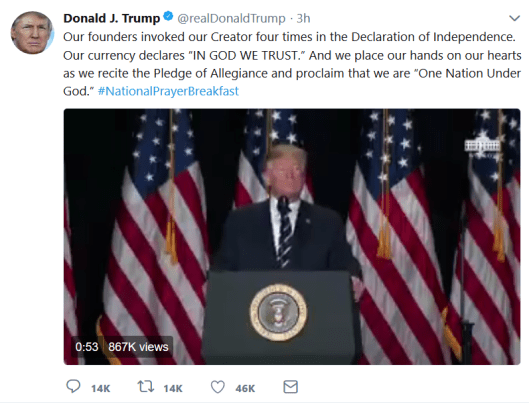
This bit of Cheeto-driven drivel, right here!

CheetoBreakfastPrayers

This pathetic tweet is an artifact of the National Prayer Breakfast. It’s an occasion when the President bows to the authority of political Christians, and vouchasafes their victories in the early days of the cold war. Whatever else this event is, it’s a good reminder that the cold war was always about internal politics as much as confrontation with external enemies. It’s also proof that little has changed under the sun (except perhaps the ratio of black carbon in the atmosphere, which is of course a heresy to the breakfasting prayer-mongers Trump spoke with today). Seriously, this event is the legacy of people who wanted Jesus to roll back the institutions of the New Deal, people who wanted to take away the social safety net and leave us all with nothing but Jesus and our own boot straps to help us in times of need. “In God we trust?” The subtext of that message is that government isn’t going to help you all.

That was always the point.

…which is why this message may be particularly relevant coming from an administration Hell-bent on tearing up every government agency that Americans rely on to keep us safe and prosperous. When the Manchurian Cheeto is done, we may well have nothing more than Jesus to keep poisons out of our water supply, remove the Russians from our computers, and hold the crooks at bay in the multinational cartels we now call banks. Jesus is already what the Republicans had offer the people of Flint and Puerto Rico. It’s what they offered to Southern Californians as a good chunk of the state burned down. It’s all we’ll be left with when the political Christians at the National Prayer Breakfast see Donald Trump deliver up the national disaster they’ve been praying for all these decades.

For all their flag-waving and Bible-thumping, those behind the National Prayer Breakfast are neither patriots nor Christians, and they certainly aren’t conservative in any meaningful sense of the word. What they want for this country is a disaster, and Donald Trump is delivering that disaster. He is the answer to their prayers.

The hypocrisy orgy known as the National Prayer Breakfast gives us a lot to gripe about. Donald Trump was fully immersed in the spirit of the occasion. He shared a good number of thoughts about the importance of faith in America, and in the American people. All utter crap of course, but he shared it all just the same.

For purposes of brevity, let’s just stick with the tweet, that portion of the wretched breakfast he chose to put into the only literary form the man and his fan base truly appreciate. He makes three points in this tweet, each of which is supposed to tell us something about the importance of God to the United States of America. Each of these points is damned misleading, which I suppose is a step up from the outright falsehoods we normally fall from this fountain of false facts, fake news, and utter foolishness. Still, a moment on each point will go a long way towards illustrating why Donald Trump is wrong about the role of God in America, and why the political Christians who eat this message up are wrong as well.

The first thing to notice is what is not mentioned in this vapid tweet, and that is the U.S. Constitution. It is the U.S. Constitution, and religion clauses of the First Amendment, that make the role of religion in our government such a hotly debated topic. One of the most fascinating things about those who want us to think of America as a Christian nation is just how hard they work to leave the Constitution out of the discussion. That document doesn’t help them, so they have to work around it. They have just one problem. Simply failing to mention the U.S. Constitution is too obvious. It sets up a great big red flag and invites those of us on the secular end too many obvious entry points to push our own point of view. They can’t just not say anything. That won’t work. So, they typically do what Trump does here. They cite the Declaration instead.

Like Jesus sent to atone for the sins the humanity, The Declaration of Independence serves to atone for the silence of the Constitution on the subject of God. (Yes, the Constitution mentions God in the date. If that impresses, you then I have an acre of arctic ice-pack to sell you.) The Constitution simply doesn’t say what Evangelical Christians want it to say. It does not invoke God as the authority for creation of the U.S. Government. (It locates that authority in the people.) It doesn’t say that you have to be Christian to hold office. (In fact, it expressly forbids such a standard.) And of course it contains a clause holding religion at bay right there alongside the right to practice religion. We can debate the proper interpretation of the establishment clause, but its mere existence is an annoyance to those who would clearly rather live in a theocracy. You can read the Constitution all day, but it won’t give you the license to tie Jesus to our politics that Evangelical Christians want out of the document. So, they typically talk about the Declaration of Independence instead.

Just like the Cheeto-in-Chief did today.

Of course those pushing the America-as-a-Christian-nation theme typically misread the Declaration itself, often confusing this reference to a Creator (written by a man widely regarded as a Deist) with a direct reference to Jesus himself and nearly always confusing this piece of propaganda with a clear plan of government. They ignore the clear parallels to logic of Hobbesian thought and other connections to Enlightenment philosophy in order to cast the language of the Declaration in terms closer to those of scripture. Most importantly, they reverse the point of the argument. Jefferson wasn’t using rights to prove the existence of a creator. He was using a reference to the Creator to explain the existence of rights, and no, there is nothing in the relevant passage of the Declaration that suggests the rights will cease to exist if we take the Creator out of the picture. All of this is lost on those consuming messages like that Trump delivered today at the National Prayer Breakfast. When they reference the Declaration, they see it as an argument for belief in God (which they assume means Jesus), but they are dead wrong in more ways than they could possibly count.

Simply put, the Declaration doesn’t mean what Donald Trump pretends it means. Neither does it mean what the political Christians at the National Prayer Breakfast want it to mean.

I doubt there is much in the Bible that means what they want it to mean either.

Or the Constitution that matter.

The whole shell game is crap!  People ought to stop talking about the Declaration when they mean to address questions about the Constitution, and they ought to stop reading either one as though it was the script for the youth pastor in a particularly uneducated part of the country. Most of us are smarter than that, but that doesn’t stop some people from recycling the same old garbage, which is what Trump did today. The whole con has been painfully obvious for decades. That should be as obvious to Christians as it is to the rest of us.

But not to the political Christians at the National Prayer Breakfast!

As to ‘In God We Trust’? That motto was adopted by the nation in 1956. It was part of the same movement that led to things like the National Prayer Breakfast, which makes it an interesting point for Trump to make. In doing so, he is simultaneously invoking a principle many assume to be a timeless part of American history and also giving a nod to the faithful who know the history of the prayer breakfast, people who understand the aggressiveness of their own political agenda, people who understand how divisive that phrase was always meant to be. It may sound like a nice an unifying message, if that is, you don’t give a damn about those who don’t trust god after all. In effect, the motto says of the rest of us that we aren’t really part of America. We don’t really count.

That is of course precisely the point. Always was.

“One nation, under God?”

Same story. This too was also added in those days shortly after Ike had been reluctantly cajoled into making public professions of faith in the official service of the nation. It too has always served as a clear reminder to the rest of us that we do not really belong. One nation under God? If you don’t believe in God, that little utterance, that bit of prayer stuck into the middle of an oath, gives the lie to the whole charade, it drops you right out of the narrative in the very moment the thoughtless celebrate unity at your expense.

Again, that is the point of the ritual.

So, there we have it, one twisted effort to dodge the Constitution on the subject of church and state, and two tokens of divisiveness wrapped in a cloak of unity. Whether he means it or not, whether Donald Trump is capable of ‘meaning’ anything in the conventional sense of the word, this is the message he offered America’s political Christians today. He endorsed their most aggressive agenda and made a point to isolate their enemies. Small wonder that these folks love him despite his obvious insincerity. Today Donald Trump offered the religious right the power to which they feel entitled, and he did it in precisely the same deceitful tones they have always known and loved. That’s our President; completely without substance, and utterly disingenuous.

The religious right wouldn’t have him any other way!

Repellent Utopias and the Case Against Black History Month

Tags

, , , , , , ,

Do we really need a Black History Month?

It’s a common question. It might be a little more common coming from white folks like me, but I’ve certainly heard it from some African-Americans as well. A couple years back, for example, Stacey Dash weighed in on the subject for the benefit of the Fox viewer base. I hear views like that of Dash often enough. So, I blogged my own two cents worth of a response here. It was a short post, and rather sarcastic to be sure, but I still think that post about captures my sense of the issue. (Also it was an excuse to get a Leyla McCalla song onto my blog, which has to be a good thing.) Today, I thought it might be worth spelling out the point a little more directly.

Dash’s comments are hardly unusual. Time and again, you’ll hear someone gripe about the Latin American Music Awards, the Miss Black America Pageant, the existence of Black Entertainment Television, or any number of just-for-the-minority occasions, awards, and honors. In some cases, it’s hard to escape the impression that those making these comments just don’t like the ethnic groups in question and want them to go away. I somehow doubt that’s what Stacy Dash has in mind, but she’s probably not the sole example. Not every objection to minority-specific recognition can be fully understood as a conscious defense of white privilege.

As to latent prejudice, even against one’s own people, the jury is still out.

The most interesting case against such minority-focused honors, for me anyway, seems to to be the argument that they should not be necessary, and that minority-focused recognition is contrary to the spirit of a more unbiased community. Why set aside a specific month for black history, so the argument goes, when we should be incorporating elements of black history throughout the curriculum? Why have special awards for minorities when we should be including those minorities fully in the mainstream awards? Some might even suspect that Black History Month works to put the topic in a ghetto, so to speak, giving us leave to ignore the subject matter throughout the rest of the year. It may or may not work like that, but there does seem to be a certain merit to the notion that what we really out to be doing is ensuring that minorities are recognized when they ought to be recognized on a day-to-day basis, all year. Wouldn’t this be better than trying to set aside specific moments when this or that minority gets a spot of time under the spotlight?

Dash’s comments, like those of many who generate this argument, make a seamless transition from opposition to segregation to opposition to Black History Month, Black Entertainment Television, etc. Some of us might think these horribles (the segregation system of old versus Black History Month today) would weigh a little differently on the scale of man’s inhumanity to man, but that’s raising a question narratives like this simply don’t address. It’s a point of principle, Dash seems to suggest, and the same principle that forbids the one should forbid the other. Hence, the absence of minority-specific recognition becomes the price of freedom from segregation with all of the horrible things that that go with it. Shouldn’t we just approach these subjects in a color-blind way, she argue, and not show any preference at all?

Maybe it’s just my inner redneck, or at least my outer whiteness, but I have to admit this argument has a certain appeal for me. The appeal isn’t entirely self-serving. Sure, there is the notion that life might be simpler without having to deal with a specific month where folks pester me about covering African-Americans in my classes. That might be convenient. But along with that goes the notion that I really should sit down and work really hard to ensure that I am covering the subject adequately all year. Then I should do the same thing for Latinos, Native Americans, Women, the LGBT+ community, and any range of underprivileged peoples who may get squeezed out of the history books and the history lessons in one way or another. Theoretically, at any rate, these kinds of responses shouldn’t lead us to forget minorities; they should lead us to distribute credit more evenly, allocating it to minorities when they’ve earned it, or when the story demands it, just as we supposedly do to those in the majority. Doing that right would not be easy. In fact, it would be damned hard.

…and by ‘damned hard’ I mean, ‘probably not going to happen’.

The plan runs aground on the limitations of human nature. We don’t really have a universal standard for any kind of recognition, not beauty pageants, music or acting awards, journalism, or anything else for that matter. Certainly not history! We all look at questions of merit through the lens of our personal experiences, values, cultural background, etc. Thomas Jefferson doesn’t simply have a privileged role in our history books for reasons of abstract merit. Like it or not, he is also there for his contribution to institutions of white dominance. Frederick Douglas didn’t simply get into the history books because he reached some imaginary threshold of significance that deserves a paragraph or maybe even a page in a textbook. He got there because he made contributions to the present conditions of African Americans. His role in our history books is itself a function of special interests, and that should be neither surprising nor all that objectionable. It’s just how this works!

All of these stories are filtered through the lens of interests shaped by issues like race and gender today. Those who rise to the top of the mainstream narratives typically have some real advantages in the competition for our collective attention. They benefit from personal and institutional bias. Some of these biases are obvious, and some of them are subtle, but the point is that bias is bound to creep into decisions about who does and doesn’t have merit. This is as true of a historical personage as it is an artist or a contestant today.

When I try to put together the materials for a history class, I make any decisions about what to include, what to emphasize, and how to explain things to my students through the lens of my own personal experiences. Those include years of life in lily white neighborhoods talking to other middle class white people. They also include years of exposure to minority subjects in college classes and even more years working in Indian country and then the arctic. Plenty of my influences point me to the dead-white male version of history; others lead me to open that story up and include lots of other people. Whether or not the one is enough to counter-balance the others is always an open question.

My answer is better on some days than others.

Under the circumstances, I don’t think it’s such a bad thing to be reminded for one month out of every year that I might have missed something. There may be some stories about Aftican-Americans that I could and should get to my students somehow. I can’t say that the results always get into the February part of the curriculum, but I have certainly added African-American subject matter to my American history classes during the month of February. I don’t ignore these stories the rest of the year either, but the reminder certainly does nudge me toward a better balance.

More to the point, correcting bias isn’t simply a zen kinda thing. You can’t just sit there and be non-biased. As least I can’t. I’m human. My brain is subject to the same cognitive biases that I see quite readily in so many other people. So, if I just follow my first instincts (or even my first thoughts) on the subject of what to teach, I’m going to miss some things. I’m going to miss some people. I could wish otherwise, but it’s going to happen. So, somewhere in that process, I figure it’s worth it take a little time to think consciously and deliberately about those peoples who tend not to make it into the standard dead-white male narratives that still dominate so much of our common historical narratives. Whatever else, Black History Month does, it forces the issue, and it sets a number of teachers who might otherwise proceed blissfully onward to spend some time asking whether they’ve done enough.

The world would of course be better off if we didn’t need to go through such a process in the first place, if we could all be relied upon to handle minority subjects smoothly and evenly on the first pass.

But we don’t live in that world.

We never will.

Which brings me back to the imagination behind Stacy Dash’s opposition to Black History Month. The ideal she cites is compelling enough. It’s easy to say that we would all be better off without these special moments set aside for recognition of selected groups, but that only works if we imagine away the biases that make them necessary. The problem here is the notion that the ideal in this case will be achieved by eschewing the pro-minority agendas first. We may or may not get around to any sense of larger equality in due time, so the thinking goes, but as a point of personal integrity, we should all give up any effort to assign recognition to specific minorities before we can really expect movement on the larger issues. We have to forget Black History Month before we can be sufficiently color-blind to stop leaving black people out of our regular history lessons.

But that larger equality never comes. Like the communist state or the free market of Libertarian mythology, this world without prejudice just hangs out there somewhere in the ether. We can talk about it. We can imagine we are moving towards it, but it will never get here. In the interim, supposedly, the price of moving toward this ideal will be paid by those already on the short end of the stick. The first step toward that equality will be a sacrifice of what few breaks some folks have managed to gain at one point or another. The rest will come later. The big moment when we all judge each other by the content of our character sits somewhere on the other side of the moment we stop taking an extra beat to see who might have presently been left behind. But we’ll get there. Don’t worry!

…and the check is in the mail.

Foggy Day at NARL

Tags

, , , , , , , ,

As I walked to work this morning, it suddenly dawned on me that the fog had given us a rather pretty day. So, yeah, this is basically a random video taken a few steps outside our home.

P.S.: NARL stands for the old Naval Arctic Research Laboratories.


A Wondrous Road Trip!

Tags

, , , , , , , ,

26907655_10215389345631925_8037646231883862717_n

Just south of Taos

It was the summer of Wonder Woman. I mean, I know she was in the theaters this last summer, and I certainly enjoyed the movie, but that’s not what I’m talking about. She was in our car. Wonder woman, I mean. She was in our car.

Yep!

We were wondering what that strange sound was coming from the back. We didn’t hear it often, at first anyway, but it was just an odd sound. Were the Jarritos bouncing up against the Mexi-cokes? Maybe something was falling out of the luggage? No, not that over and over like that, and it doesn’t sound like bottles. Neither Moni nor I could quite place it. And then an impression started to form, but it just couldn’t be right. I thought perhaps all those years of role-playing geeketry were playing havoc with my ears, because I couldn’t possibly be hearing it right. Still, the more I listened, the more convinced I became.

“Is that a sword?”

“It does sound like a sword, yes.”

Hearing Moni confirm my seemingly-impossible impression was a little reassuring. It was also a little disturbing. Why in the hell would the sounds of sword fighting be coming from the back of our vehicle? And then Moni remembered the costume. I had bought her a Wonder Woman costume for super-hero day at her gym. It came with a plastic sword and that sword made sounds whenever you moved it around. We meant to give it to one of of her nieces or nephews, but I guess we never got around to it. Instead, the noisy blade was buried somewhere in the back beneath a pile of luggage, snacketry, random shoes, and countless things we probably didn’t need. Evidently, the sword had room to juggle. So, Wonder Woman had room to fight in the back of our vehicle.

No matter! We would dig her out soon enough.

I think we first noticed the sound on a trip to Sequoia National Park. We could still hear Wonder Woman doing battle after a diversion to Monterey, another trip to Sacramento and San Francisco, several small trips around Los Angeles, a road trip to Santa Fe by way of the Navajo Nation, at least three trips back to to Taos Pueblo through Espaniola, one to Bandelier, one to Kasha Katuwe, and one each to Santa Ana Pueblo and Cochiti. We never did find her, or if we did, we missed the chance to find her a new home. Hell, she was still fighting her foes when we made it finally back to California at the end of the summer.

We actually did make an effort to find Wonder, but we were thwarted by the piles of unnecessary baggage. So, Wonder Woman spent the summer with us. She protected us from evils all across the southwest, and even scolded us when we did wrong. She could be kinda bossy that way, but otherwise, I must admit the living weapon herself was actually pretty good company.

Presumably, her sword is in storage now.

It’s been a little over six months now, so I guess it’s time to share some pics from our road trip, the one Moni and I took with Wonder Woman.


I’ve already blogged about a few of these things, but I do plan to produce at least one more post about the street art in San Francisco. I’ve posted about the Institute of American Indian Arts before, and about Santa Fe. These are definitely favorite stops of mine. Here are a few pics (click to embiggen)!


May Conservatives Remember you Fondly!

Tags

, , , , , , , ,

26239122_10215319195278210_5540301171360502791_nMy title may seem like an oddly partisan blessing, but it’s more of a partisan curse. It’s not the worst form of damnation you could wish upon a person, but for some folks it oughtta be bad enough.

The curse is real though.

This happens.

Civil Rights activists must have felt the sting of this curse this last weekend as right wing America did its best to distinguish Colin Kaepernick from Martin Luther King, Jr. It seems, their efforts had been necessitated by publican of an image linking Kaepernick, Michael Bennett and Martin Luther King, all kneeling together. Outraged to see Kaepernick and MLK connected, plenty of folks took to the net to tell us Bennet and Kaepernick shouldn’t be put on the same level as MLK. Beyond that, cultural conservatives assured us that MLK was selfless and that Kaepernick is simply out for himself, that King was a patriot whereas Kaepernick hates America, and that MLK preached unity whereas Kaepernick is being deliberately divisive.

Heard that last one a lot this weekend.

I’m not old enough to remember MLK’s activism in its day, but I am old enough to remember cultural conservatives attitudes towards him before he became a national holiday, before you could find roads named after him all over America, before admiration or MLK became a forgone conclusion. And of course before conservatives began to claim him as one of their own. We heard many of the same things about Martin Luther King back then that are said of Colin Kaepernick today. Lots of folks were not so impressed with his patriotism. As to divisiveness? Hell, he could be so lucky as to be described as merely divisive! I grew up hearing stories about how MLK and other civil rights leaders were just trying to cause trouble, simply drawing attention to themselves. Things were getting better, plenty of people assured me. Those activists were simply making things so much worse. Divisive? Hell, MLK that would have been an improvement over the things said of him at some of the dinner tables I’ve attended.

It’s a poetic injustice, really, seeing Martin Luther King transformed into a means of silencing black activists. He’s been held over the heads of the Black Lives Matter movement for some time now, and thrown in the face of just about any African-American deemed a little too disruptive by conservatives, especially by those conservatives moderate enough to think of they’ve learned the lessons of the civil rights movement. Gone are the days when cultural conservatives would spit ‘commie’ after hearing the name of Martin Luther King. Now, being more comfortable with his legacy, they spit his name at any black activists they find more threatening today.

That’s gotta be a special kind of Hell, to be used against those who carry on your legacy? If so, it’s a special Hell reserved for people who’ve earned a lot better.

What I think a lot of moderate conservatives and a good deal of middle-of-the-road America likes about MLK is the notion that we should be color blind. Some folks may even mean it. Others just like the prospects of using this principle against social justice warriors, affirmative action programs, and any number of left wing causes that ask us to take difference into account. Yet, the message of equality changes a great deal when it’s employed in this manner. When King delivered his “I have a dream” message, equality was message flying in the face of white privilege. If you’ll pardon the cliche, it really was a way of speaking truth to power. Today that message is used to speak power to truth. It is a call to ignore real differences in opportunity, to silence those in need of help, and to preemptively dismiss any political agenda aimed at helping the underprivileged. There is something genuinely vicious about the way cultural conservatives have turned King’s message on its head and turned him into a weapon well-suited to re-enforcing comfort and privilege.

It’s enough to make you lose your lunch.

***

Sadly, this isn’t an uncommon thing. It seems that those leaning to the right have a general tendency to remember some lefty figures fondly, but only after forgetting the lefty part. How many people have complained about the politics in Roger Waters concerts over the years? Some folks may have specific complaints about aspects of Waters’ politics, but a fair number seem genuinely shocked to find political content in Animals or The Wall.

Maybe they were just too stoned to listen the first time.

I know. Pink Floyd lyrics may not warrant the same admiration as the life of Martin Luther King, but in a sense that impression too illustrates the point. Just as with Kaepernick and questions about whether he should be on the same par as MLK, the veneration of MLK here misses the mark. When someone advocates on behalf of those in need, or confronts those who abuse power, should we really be all that concerned about how they compare to other heroes? Or should we be more concerned about how their politics contributes to something of value?

Yes, that was a rhetorical question.

***

And then of course, there were those people shocked and outraged to find Coretta Scott King. As George W. Bush attended her funeral, some thought it inappropriate for those honoring her legacy to speak out against the Iraq. And thus his decision to honor her, became her limitation, or rather the limitation on what could be said in her honor while he was present. I get it. It’s a little rude to criticize the President when he’s sitting right there, especially knowing that he doesn’t have to be. But you know what’s more rude? Expecting the funeral of an activist with a life-long commitment to non-violence to pass by without any comments on the greatest war of the day.

In America, even our conservatives are happy to celebrate liberal activists.

Once they and their own learn to be quiet about it.

“We love you, shhhhhhh…”

A Nap, a Few Maps and a History Lesson

Tags

, , , , , , , ,

26196006_10215261765482501_7040755654098787263_n

Vintage

Compliments of a late night layover, my girlfriend and I were recently treated to a little lesson on the history of Anchorage. We were looking for a quiet place to grab a nap before an early morning flight back up to the ice-box when I noticed this series of posters on the history and geography of Anchorage.

These can be found on the second floor of the Ted Stevens International Airport, which seems to be an area reserved for office space. There really isn’t a lot of foot traffic along that area, which is part of why Moni and I were there to begin with. Anyway, I’m guessing the public doesn’t see these all that much. If they are published elsewhere, I’m not aware of it.

The logo on the lower-right hand corner suggests that these were prepared for the Anchorage Centennial in 2015. I don’t have anything in particular to add to these visuals. A lot of information has been crammed into each of the posters, but the context is pretty sparse. Still, it’s kind of an interesting glimpse into the city and its past. So, I’ll just leave these pics here.

You may click to embiggen, which is particularly helpful if you want to read them. I tried to at least ensure that the main text was legible here on the blog, but if you want to read some of the small text, you might try downloading it so you can magnify it.

Meow Says the Wolf

Tags

, , , , , , , ,

26047434_10154931395015706_3812321740213932580_n

I told Danielito, his name is ‘Bob’ for the balance of our visit. I was Daniel first.

I could easily wish the crowds away, but that would be foolish. They are a big part of the experience here at Meow Wolf. Mere moments after entering the fun house, our party is already separated into at least 3 separate groups. Moni is nearby, but I’m not sure where. Her sister and I are together. She is nervous and worried the place will be scary. I’m not entirely re-assuring. We catch a glimpse of her two kids. They rush on by as their mother tries to call them back.

It’s no use going after them. Did they go up into the tree house, or over to the musical mastodon? Perhaps into the fish-tank? We’ll find them eventually, but not by looking. No matter. One is old enough. The other has been here before. They will take care of each other. So, we let them have their fun.

I’m recovering from a bad flu, so I tire easily. Luckily, there are places to sit and watch the people. This is my second time at Meow Wolf, so I am happy to take my time; happier still to rest when I can. A woman walks by urging her child to stay nearby. A few minutes later she walks by again, alone.

“Baby, where are you?”

I get up to help her look for the child and instead find myself helping a couple women trying to connect a completely different child with his parents. They are on it; I’m just trying to see if I can help, but it’s difficult. You’re never more than one room away from getting completely lost in this place. Give yourself time and you’ll find your way back to the main entrance. But how to search more than one room without losing these two and their momentary ward?

A solution takes the form of a stumbling old man in mad scientist garb. I’ve seen him before. He gets lost in corners and regularly stands motionless for odd periods of time. Soon after meeting the women, our shambling scientist becomes a competent staff member with an intercom and a clear set of procedures. Unfortunately, the first step (getting the kid’s name and that of his parents) doesn’t seem to be getting anywhere. The kid is just too disoriented to answer even these questions. Another child is screaming in my ear. It’s disconcerting, but this child is already in her own mother’s arms, so that’s probably a good sign. Still those are blood-curdling screams for such a little girl. What has her so scared?

“I don’t want to leave!”

Ah, …got it!

The girl keeps screaming that she doesn’t want to leave. She screams this as though her life depended on it. Nearby, the once-shambling scientist calls three names into his head set. He is well on his way to solving the problem.  I wander off to find something new. I’m told there have been some changes to a few rooms, and the people scrambling about me add a whole other layer of new things to see.

A young woman opens up a closet, then stands in awe as people behind wait for the moment to pass. Others charge into rooms and devour them. An elderly woman has trouble navigating a narrow staircase. The crowds wait patiently. There is plenty to see. Just about every where you look, there is something odd to see, something weird to wonder about. Kids open the drawers and study their contents. A middle aged man yanks out a drawer a little too far and spends the next few minutes putting its spilled contents back. Some tap on shiny mushrooms, hoping to know what sound they will make. You can play a piano, an odd piano, or even a lazer-lyre.


I found myself in the entrance to the place, a large area resembling a classic suburban home. It is two stories tall, filled with all the usual features of a middle-class home; a kitchen, a living room, a study, several bedrooms, a nice bathroom, and so on. There are also a few things you don’t find in most middle class homes. A few inter-dimensional portholes, lots of odd scenes. You can find the beginnings of a narrative here in this home. Notes and booklets scattered throughout the rooms allude to scientific experiments gone wrong, perhaps a bit of a cult gone wronger.

I sit here and watch the crowd. Within minutes a little girl asks if she can sit on my lap. She is adorable, but her mother isn’t having any of it. That’s understandable, of course, but I have to wonder. I’m no Santa Clause. Is there something about this place that softens my resting-bastard-face? The next little girl seems to want my attention to. Her parents shuffle the family by without any event.

Perhaps they just want to sit down?

I free up the chair.

Standing on a narrow bridge a woman turns towards me saying; “that’s just the weirdest thing I…” It’s at that point, she realizes I’m not the person she thought she was talking to. It’s understandable. At one point, I mistake a woman for a manikin. In my defense, she wasn’t moving. I find another mad scientist repairing a refrigerator door. That may seem an odd job for a scientist, but in his defense, not every fridge serves as a porthole into another dimension. The condiment rack on the door of this porthole is loose, and there is no telling what that could mean!

I bump into Moni and her family a couple times. All are happy. The kids are positively glowing.

Just like some of the exhibits.

Other things, you may hear in this place?

“This is the most ridiculous thing.”

“Don’t go in there!”

“Oh, oh, oh!”

“that’s how we came in”

“we came in through the fireplace?”

“How do you suppose that kid got stuck in the toilet?”

“What’s the big deal about this place? …Oh, I see.”


***

Meow Wolf is the brain-child of George R.R. Martin. Yes that George R.R. Martin! It’s an artist collective and a non-profit located on the south-side of Santa Fe, New Mexico. What they’ve created here could be described as a fun house, but that doesn’t even begin to do the place justice. Suffice to say that a lot of very creative people have invested a lot of brilliant thought into this project, and the results are spectacular. I reckon it can be a little stressful for the parents, but they will live through the experience, and so will their kids (who will no doubt keep the memories well into their own grey years). For the rest of us, I expect the key to this experience is opening ourselves to its disorienting qualities. You may think for a moment that you are beginning to figure something out, or that you know what’s around the corner to the left, but don’t be surprised if you are wrong. No matter! If you can make sense of this place, you are probably doing it wrong.

Thanks to Moni and her family who have contributed pics and suggestions. As usual, you may click to embiggen.

Alex Jones and the Weaponization of Christmas (An Irritation Meditation)

Tags

, , , , , , , ,

Surfing the net can be a lot like turning over rocks in the countryside. Every now and then you find something underneath a rock (or a link) so disgusting you just can’t pull your eyes off it. Case in point? This little bit of filth from Info Wars.

To begin with, let me apologize for bringing this shitgasm into the lives of you, my readers. I am sorry.

Alex Jones and his bunch are a special kind of putrid, but sadly, they are a special kind of putrid with a lot more influence than they deserve. So, I reckon it’s worth keeping track of their antics.

…regretful though that task may be.

There is a lot of crap in this video, but what got my attention here is the opening pitch.

“The Southern Poverty Law Center has designated anyone hash-tagging ‘Merry Christmas’, ‘Christmas Eve’, ‘Christmas’, or ‘Jesus’ a far right wing extremist.”

Sounds pretty shocking doesn’t it? What could possibly lead the folks at Info Wars to such an impluasible conclusion? As they go on to explain in the video, the Southern Poverty Law (SPLC) has been tracking these hashtags in their hate tracker. What is the hate tracker? Well let’s take that information directly from the SPLC.

Screenshot 2017-12-28 13.22.50

So, there it is. The hate tracker tracks trends in right wing activity on twitter. It is not a statement about the meaning of any of these terms, nor is it a theoretical account of the trends it identifies. It isn’t even the result of a conscious effort to call attention to specific terms, or the specific use of them in right wing circles. If a hashtag trends in the activities of right wing extremists, it will come up on the tracker.

Simply put, the hate tracker picked up a lot of Christmas tweetage among the right wingers. What that means is an entirely different question. One thing it doesn’t mean is that anyone who uses these terms is a right wing extremist. No, the SPLC was not saying that, and the hackwits at Info Wars know this.

Both the Info Wars video and the Breitbart article on this subject do present a (more or less) accurate account of this in the meat of their stories. The trick here is the mismatch between that substance and the labeling. The folks at Info Wars know very well how the hate tracker works, and they account for it, but then they draw a conclusion totally unsupported by the facts they themselves provide. They are hoping you won’t remember the details, but that you will remember the pitch line they used to start the story. They are hoping you will come away from this thinking that a prominent liberal source has tried to label all talk of Jesus and Christmas as right wing extremism. This is simply not true.

It’s a bit after the bell, but this video is one more shot in the fake war on Christmas. More to the point, it is part of an ongoing effort to weaponize Christmas, to recast the celebration of Christmas as an explicitly political act, a defiance of liberal politics. IN effect, it is an attempt to make the celebration of Christmas into a partisan gesture, one which will divide Americans still further, and pointlessly so.

It may well be that the hashtag trends noted by the SPLC are also part of that effort to weaponize Christmas. Certainly, there have been a lot of people using ‘Merry Christmas’ to say something more like ‘fuck you liberals’, and at least a few of them have been doing this on the net. I expect right wing extremists also wish people Merry Christmas for conventional reasons, like actually wanting them to have a merry Christmas, but I reckon at least a few of those hits the SPLC caught in their tracker were conscious efforts to carry on the war on the eve of Christmas itself. Either way, the Info Wars piece is a conscious effort to spin that narrative up a notch, to pretend that liberals have declared Christmas itself a hateful expression.

The problem is of course that they are lying.

The real question is why? Why tell this particular lie? What does it get the people at Info Wars? I get that the SPLC has its own set of biases, but no, they are NOT trying to crush Christianity. Neither are they trying to steal the Christmas presents out from under your tree. This conscious demonization of the SPLC simply isn’t about correcting bias it’s about enshrining it. It’s about making sure that people do not make careful distinctions between actual hate groups and mere conservatives, or for that matter ordinary Americans of any political stripe. Info Wars wants the public to think the SPLC cannot tell the difference ordinary well-wishing and a racist political agenda. The problem of course is that the SPLC can and does make such distinctions all the time. Alex Jones and his merry band of festering bloodfarts, on the other hand, would love to be thought of as conservative, even patriotic. They would love to have their own brand of lunacy pass for good old fashioned conservative politics, and they would love to have the right wing fanatics who make up their customer base thought of as ordinary people. If they can muddle the distinction themselves, then they can pass all manner of lunatic ideas under the banner of basic American values. That’s their pay-off.

There is always a pay-off for this kind of political charade. For Trump, the War on Christmas was just another effort to brand something (Christmas) to which he contributes absolutely nothing. For the likes of Bill O’Reilly, it was grist for a combative mill that helped keep his ratings high. For Info Wars and Breitbart, it’s the hope for legitimacy. It is an effort by those on the lunatic fringe to pass themselves off as legitimate, to pretend that the ideologically committed racists who regularly consume their products are just ordinary Americans who love Christmas. In effect, they are telling the public that the SPLC and liberals in general cannot tell the difference between a conservative and a deplorable. But we can.

Yes, there is a difference.

If You Threw California?

Tags

, , , , , , , ,

I don’t like the shape of Illinois. I don’t know why, and I don’t mean anything against Illinoisians, but there is just something about the shape of that state that just seems wrong to me. Chicago lake is kinda cool, but that’s just the upper corner. Anyway, I don’t like the shape of Illinois. I just don’t.

I don’t dislike the shape of Illinois nearly as much as the shape of Wisconsin though. In fact, I feel kinda guilty about Wisconsin. Looking at that state makes me feel kind of like a bully. It’s strange, because I don’t think I’ve ever really been mean to Wisconsin. Still, I do feel I owe the state an apology. Something about the shape of it makes me feel that way. I don’t know why.

Texas? Now Texas has an interesting shape. You can find all sorts of stories in it’s shape. Those stories may feature men in cowboy hats, but I swear you can see them in the lines that define its perimeter. You can try and tell me I’m wrong, but pardner, you should probably smile when you do.

Nevada seems like one day it oughtta just slide right on through.

If you threw California just right, would it curve around and come back to you?

Alaska is a fist with the pinky extended. I live on the knuckle of the thumb.

I can’t help but think you could pick Virginia up and use it like a club or a baseball bat.

Both Dakotas, Nebraska, and Kansas, the whole lot of them need butter and syrup. A side of bacon would be nice, but at I don’t see it on the table.

Louisiana is a mug, but I only drink from it on Christmas.

Idaho has diminishing expectations. Either that, or it belongs on a lab beside a fat beaker and a consistently skinny test tube. It’s the odd one that you only use for certain special experiments (probably involving potatoes).

Colorado really ain’t all that hip, but if you lay the state out flat, parts of it do get high.

Utah has a nice place for your thumb and a good broad surface to mix all your pigments.

Washington and Oregon both look like airports to me.

West Virginia doesn’t look all that west to me. Not even close.

You could pick the whole country up by Florida, but if that’s what you’re going to do, I really think you should crook your pinky. Also, sip slowly. Don’t gulp.

Mississippi? Precisely!

I swear Oklahoma has been playing a prank on Texas forever. It’s not really that funny Oklahoma. Seriously, just give it a rest!

I’m pretty sure that Tennessee is a shard of flint. I think I read about it in a story about Thor and some Giant.

New Jersey is all over Pennsylvania. No means No, new Jersey. Not cool!

Massachusetts? No. MassachYOUsettes!

Maine is how that rain in Spain stays in the plain.

Connecticut the end off and that’s how the Island Rhode off.

I did not Michigan. I didn’t even Mish the first time!

New York is always bigger than I expect it to be. I try to remember that it’s bigger  than I think, but then I still end up realizing it’s bigger than that even.

I can never find Missouri on a map. Someone always has to show me.

Maryland doesn’t exist. It’s just a conspiracy.

You say Ohio; I say goodbyo.

Goodbyo!

***

(I realize this is an incomplete list, but others could probably riff off the other states better than I can, and besides, this really isn’t the most serious of posts. Except for throwing California. I feel quite certain, it would come back. Yes, it would.)

White Privilege? Let Me Whitesplain it to Ya!

Tags

, , , , , , , ,

If white privilege is a problem, then it stands to reason that I can only see that problem through the lens of white privilege, and if whitesplaining is a problem, then any account I might give of it carries a real danger of becoming yet another instance of whitesplaining. I don’t always handle these issues well. (Seriously, I think about some of my past comments and cringe.) It’s a tricky issue. Still, I don’t think it’s one I can avoid any more than the next guy or gal with a keyboard and a penchant for social commentary, and I will make one (possibly gratuitous) assumption here, which is that there must be some reasonable way for a guy like me to approach the subject. Whether or not I find that approach in this post?

Well, let’s see…

What has me thinking about this? Well I just happened upon a Youtube clip from another white guy who took it upon himself to present a reasonable approach to this issue. Suffice to say, that I don’t think he managed it, and again, I don’t know that I’ll do much better myself. Still, I think the problems with his approach make a nice springboard for tackling the issue.

…or at least for addressing some of the problems frequently arising when those of us on the pale end of the privilege spectrum try to address the issue.

The video in question was produced by Eric Post, a military veteran also famous for this response to a flag burning protest. He has other posts, but these two seem to particularly resonate with the sentiments of quite a few people. In both cases, Post adopts what seems to be a fairly reasonable response to a (probably left-wing) challenge to the social order. In both cases, Post seems to dismiss the challenge altogether. He prefers constructive engagement to insults and (thankfully) violence, but the impact of both these videos would seem to be a clear rejection of the concerns and problems in question. It’s tempting to see his approach as positive, given the man’s general tone, but I think the most important thing here is to pay attention to the story he is telling. In both cases, he generates a rather one-sided narrative, and in both cases the appearance of reasonability provides him with a moral high ground denied to those he claims to be responding to.

Anyway, here is the video:


The first thing I want address here is the way Post frames the problem, the context he generates within which to discuss the issue. We don’t encounter the case for white privilege here in any direct sense. What we get in the video is Post telling us a story about a black guy who said something to him about ‘white privilege’. What we learn of the black man’s thoughts on the subject is what Post chooses to tell us. So, his own white privilege here gets a solid boost from the privilege he acquires as the narrator of this story. But how reliable is Post as a narrator? For all we know, he made the whole thing up, though I think it more likely he is taking more subtle liberties with the story-line.

As Post would have it, this is the story of him setting a man straight on the issue before they hug it out and wind up with a hopeful ending. That’s the kind of ending I would expect from a Disney movie or a television sitcom. Most verbal confrontations don’t follow such a neat pattern. People interrupt each other. In the rush of rapidly phrased arguments, points don’t quite get made the way you would want to make them. The other guy scores a good point or three as well, and some really important stuff just gets dropped while tangents take people into all manner of foolish places. Moreover, there is always a genuine prospect that each side in an argument will just end up talking past the other without engaging them in any meaningful way. The prospect that Post really did just have a nice conversation with a guy who took all his points with grace, and without rejoinder, before agreeing with him in the end strikes me as about as likely as any other happily-ever-after ending in any other story. Suffice to say that he’s asking his viewers to take an awful lot on faith.

It’s a bit much to ask.

More to the point, consider the nature of the encounter. This began at least as a petty insult, followed by at least the beginnings of a pissing contest (Post does tell us he got in the guy’s face). So, right away, the case for the existence of white privilege gets off to poor footing in this video. It enters the story as petty insult, an expression of personal animosity cast at a complete stranger. In effect, the issue emerges here as a sort of game piece played in a petty conflict over personal status.

Social justice, this ain’t.

Now, I have no doubt there are people who would do that, people for whom ‘white privilege’ is little more than an insult to be thrown at random white people, or at least those of us who get in their way. Whether or not Post’s account of the man’s behavior is accurate is one thing, but I think I’ve met a few people like that myself. The thing is that I’ve also met folks for whom this issue is NOT about humiliating anybody, and for whom this issue is an important obstacle to social justice.

… or as I like to call it, justice.

The notion of ‘white privilege’ connects to a broad range of other controversial topics associated with social justice, inequality, and all manner of things deep and divisive. I probably won’t be solving any of them in this blog post, and wouldn’t expect Post to solve them in his short video, but perhaps, that’s the problem. Post does solve these issues, or at least he pretends to solve them insofar as he explains them away and replaces the whole issue with a quick motivational lesson shaped for the benefit of black people and liberals everywhere. This would be an impressive accomplishment, but it isn’t, because the problems he pretend to solve never amount to much more than a dirty story about an asshole he met on the street. If this isn’t a straw man, it’s certainly a whipping boy. Just an easy set up easily smacked down, and narrative easily applied to all those complex issues Post hasn’t really addressed at all.

The problem here isn’t entirely contained in the video. If folks would treat this as a random encounter with a random jerk whose particular flavor of jerkitude just happened to be racial politics, then perhaps we could file the whole thing under guilty pleasures of little or no consequence. But that isn’t happening. No, this is one of many videos out there which  circulate around the net under the guise of substantive commentary about the notion of white privilege. A white guy whitesplains away the whole issue through a dirty story about an asshole he met on the street and a good chunk of the internet says ‘huzzah’!

This isn’t solution. It’s avoidance.

So, how does Post dispense with the issue? He begins by telling us he has had some problems of his own in life, and yes, these do seem like serious problems. He goes on to lecture the man from his story on the need to be realistic about his job prospects and to educate himself properly for the kind of job he hopes to do. In effect, Post is saying that white privilege is a myth, and that the difference between a successful person and an unsuccessful one is a function of the effort they put into life.

As an answer to the problem of white privilege, this seems to be equal parts straw man and false dichotomy. Simply put, success isn’t either race or effort. It’s a function of both (and a lot of other things).  If the black man in Post’s story is wrong, then so is Post, bearing in mind, of course that this whole thing is Post’s story. In effect, it is a story about the choice between two different kinds of mistake, and that is all that Post seems capable of understanding about the matter.

This brings us back to the concept of ‘white privilege’ itself. What does the phrase mean? I’ve heard people use it in at least three different ways. Some clearly use the phrase to suggest that white people are categorically better off than others, that we all have a better shot at success (through no credit of our own) simply by being white. This approach would seem to dismiss the significance of any mere white-people-problems and sweep any advantages enjoyed by any particular non-whites under the rug. If mileage may vary, this way of talking about white privilege doesn’t acknowledge any variance outside the boundaries of a clear case that some people (white ones) have it better than all the others. I don’t think this way of talking about the issue stands up to scrutiny all that well, but it’s a sense of the phrase that is well suited to insult contests and generally morbid reflections about personal status, hence it’s appearance in Post’s story, and hence the ease with which he dispatches it.

A second approach would be to suggest that white people enjoy an advantage on account of being white. How this particular privilege stacks up against the other advantages and disadvantages that individuals experience in life is another question altogether. One needn’t deny that white people have our own problems or that some individual minorities may have some clear benefits in their own personal lives. Hell, we don’t even need to deny that there may be contexts in which being a member of a minority could actually be an advantage. It is enough to say that being white can help out in some ways. This approach seems more reasonable, but it achieves the reasonability at the expense of weakening the proposition quite a bit. It’s particularly attractive to white liberals such as myself, who may want to acknowledge privilege while minimizing its importance in our lives. “…yeah, I caught a break by being white, but let me tell you about this other personal hardship, and look at you, you got all this.”

…which is why most who talk about white privilege would step the whole thing up a notch and insist that in the grand scheme of things whiteness weighs rather heavily against those other factors. It still may be that particular white people have real problems and particular non-white people may have real privileges of their own, but in the grand scheme of things race is more likely than not to play a significant role in determining one’s status in life. In other words, whiteness may be one of many variables, but it is often the decisive variable in getting a job, getting a house, talking to a police officer, or any number of things that affect peoples wealth and well-being (not to mention their lives). This third approach is, I think the more serious of the three. It isn’t really all that different from the second approach, except insofar as it insists on the relative importance of whiteness in relation to other variables.

Suffice to say that Post’s argument wouldn’t touch either of the last two approaches to the subject of ‘white privilege’. Whether real or imagined, his adversary in the story isn’t up to the task of clarifying the issue, or if the real person did do that, suffice to say that it didn’t make it into Post’s own version of the story. It couldn’t, because Post’s story was always a story about a pissing contest, about a conflict over personal dignity. The antagonist in Post’s story was never going to accomplish anything more than gain a smug sense of satisfaction out of his insult, and so nothing rides on the ‘white privilege’ message but personal vindictiveness. Post is the only one with a dignified goal in the story, and that is true regardless of the (de-)merits of anyone’s thoughts about white privilege.

The reasonability with which Post approaches the issue is illusory; it’s simply a function of the story-line. Notice how he takes it upon himself to lecture the other man about the nature of taxes. Because of course the man he is talking to wouldn’t understand that his government check is paid for by private citizens. This is a common theme among ‘conservatives’ and radical right wingers these days. They like to imagine liberals and minorities in the form of the unemployed demanding government aid. The prospect that a gainfully employed person might advocate the social safety net is a possibility increasingly escaping their own narratives about government and economics. This story facilitates that trend by telling us about an individual who literally occupies that very place in life, and of course it compounds that narrative by enabling Post to explain the nature of taxes to the man as though he’d never thought about it himself. Post is reasonable in the story, because that’s how he tells the story, but in effect it is a story about a black man who doesn’t understand his own situation at all. The cherry on top of this condescending pie is the fact that it’s a white guy explaining it all; in effect whitesplaining white privilege to the clueless minority who hasn’t the faintest idea how to take care of himself.

Of course it is possible that the whole encounter is real and that Post’s account of it is essentially accurate, but once again we have to consider the larger presentation. What makes this video powerful is precisely the way it fits in with the larger narratives of right politics in America. Post winds up the theme by telling the man (or telling us that he told the man) to stop lying to himself. In telling the narrated man to stop lying to himself about his own welfare, Post is effectively telling anyone who supports aid to the poor and/or concerns about social justice to stop lying to ourselves. In effect, this is but another story about lazy minorities who blame others for their own lack of effort along with the foolishness of anyone who would humor them. Reasonable tone aside, Post is pushing an explicitly racist message here.

Which brings me to another point, a larger one about the nature of privilege. One of the reasons the notion of  ‘white privilege’ is so threatening to so many is because it undermines the meaning of success in a meritocracy. It runs contrary to the norms about success and failure in both mainstream liberalism and conservatism Whatever any of us has in America, we typically want to believe we have earned it. That goes without saying. It’s what the money in our bank accounts a little more meaningful than they would be for practical reasons. It’s what makes the houses we live in personal statements and the televisions we watch measures of personal merit. We have these things because we earned them.

But what if we haven’t?

What if our success (in whatever way we define it) is due in part to some break we didn’t earn? That’s a damning prospect. It stings a little, even for hose not so very adverse to messages about social justice. But for the true believers in their own success, for the fundamentalists of the free market this is outright heresy. We cannot admit of anything like white privilege or any number of social factors that might play a significant role in determining our lot in life. For the true believers amongst us, that way lies madness! Hence, the initial problem of this story!

…not the insult.

…the car.

Post begins this story, sitting (as many of his posts do) in a car, telling us about his favorite car. Presumably, he is proud of his seat in this car. Presumably, he feels he has earned that seat. I don’t think that’s an accident. Whatever the significance of white privilege for African-Americans or any other minority, in this story, it is the threat to the moral significance of a nice car that is really at stake.

This is the real threat to acknowledging white privilege. for Post. It could mean, he hasn’t really earned that car, or perhaps anything else in life.The issue isn’t whether or not white privilege can explain any measure of social inequality, it is whether or not it leaves intact the moral value of consumer products.

So, it’s rather fitting that Post takes time to provide the man in his story with a kind of motivational lesson. According to Post, the central lie that both he and the man in his story were told (by whom he doesn’t say) is the notion that one must work to achieve happiness. The truth, he says is just the reverse. In this respect, he isn’t all that far from the Puritans of old, worrying about the apparent elect (also a class defined in part by worldly possessions in elation to some imagined moral characteristic). Post is just one among many to suggest that wealth is somehow a function of character.

The problem of course is that it’s not that simple. Personal resilience can explain a lot, but it doesn’t explain everything. Time and again, studies have shown that minorities and women (among other groups) face real obstacles to success in the work place, the housing market, and any number of contexts affecting their economic well-being. Some flourish anyway, and that’s a damned good things. But it’s an insidious logic that turns this into an argument to be used against those that don’t. It’s all well and good to tell people they should do whatever it takes to overcome those obstacles in their personal lives (although doing so often assumes an air of unearned authority on the topic), but I can’t help feeling that one of the many things people ought to do toward overcoming those obstacles is address them on a larger scale. This doesn’t mean spitting insults at white people who drive nice cars, but it does mean challenging white privilege as it plays out in various contexts of modern life.

And no, that doesn’t mean anybody should be ashamed of any privilege they may enjoy in life. It does mean we ought to be careful how we use it. If Post, for example, really does help an unemployed black man get ahead in life, I’d say that’s a damned good use of his own position. Putting out a video demeaning to the status of minorities for the benefit of right-wing consumers isn’t. I’m not suggesting that those of us born into any kind of privilege ought to spend every moment of every waking day trying to figure out how to make it right for others, but we ought to be open at least to the prospect that there are real problems with the way identity shapes the prospects for success in life. Perhaps, we ought also to look for ways to change that.

It isn’t the universe, as Post suggests, whose justice is at stake; it is the communities in which we live. The universe may not owe anyone, but for those of us living in societies committed at least to equality in rights (if not wealth), I reckon we do owe others an even chance at earning a living.

Far from denying the importance of hard work and honest sweat; the point is to ensure that such things really do matter.

For everyone.