The Dumbitude is in the Details

Tags

, , , , , , , ,

It’s always fascinating to see the slippage commonly coming between a story and its headline, and again between a headline and a social media message about it. The hackwits at Fox News are always happy to provide examples of this sort of thing. Last week I couldn’t help but gripe about their misrepresentation of a major story on twitter. Today, the angle isn’t all that clear, but sloppy slippage is a habit that seems to serve them well.

What got my attention a few minutes ago was this tweet:

FoxbonnieClyde

So, I see this and I am thinking; Really? I always thought Bonnie and Clyde were in their car when they were shot. Or was that just the movie? No, I’m pretty sure they were in their car. So, when was this? Just before they got in? How long before… No, this says the pic was taken right before they were shot. But…

…and thus I clicked the link (which is admittedly to say that I fricking fell for this click-bait bullshit. Still kicking myself over that.)

So, anyway, and at the expense of providing a link to a common source of right wing propaganda, here is the story.

The opening passages of this story are fascinating in much the same sense that grading a freshman essay is often fascinating. By ‘fascinating’ I of course mean saddening. It’s not just the brief, blurby, writing style that jumps out at me. (Seriously, this is clearly written for people with the attention span of not-even-gerbils.) What really irks with a vengeance here is the complete inability to stick to a consistent account of the story.

Check it out!

BonClydestory

Mini-paragraph 2 says the photo was taken ‘days before’ Bonnie and Clyde were shot down. Mini paragraph 3 says ‘shortly before’. I guess ‘days before’ could count as ‘shortly before’, at least if you aren’t paying attention enough to wonder why they are re-framing the time-scale in the very next sentence. Most sensible people would think that was at least a little odd. And most sensible people would think that change of wording does shift the meaning, at least a little bit. Either way, it would certainly be a stretch to say that ‘days before’ counts as ‘right before’ or ‘moments before’, as indicated on the Fox News twitter account.

So why do this? It really doesn’t seem like deliberate spin. It seems more like a short attention span. Perhaps, it’s a habit of a mind accustomed to spinning an inch into a mile every chance it gets. These micro-shifts in meaning can be damned useful if you are spinning a story with a purpose. A mountain is easily reduced to a molehill with a little crafty word choice. The folks at Fox News are well accomplished at this technique. Still, it’s a little odd to see this much slippage crowded into such a small and simple account. The only clear pay-off in this particular instance is the added dramatic value of the click-bait, but even that doesn’t explain the shear quantity of equivocation in the Fox account. The story itself uses two different time-frames, and that shift isn’t explained by the desire to generate click-bait. Neither does the use of two different time-frames on the twitter account. A subtle shift is one thing, but these guys are all over the place. I find myself wondering if they folks can stick to a simple account even when they don’t have an axe to grind on the story.

Seriously, I can’t figure out how this will help to advance the war on the poor. Neither will it enable the Manchurian Man-Child to gin up a war to help keep all our minds off the Mueller investigation. I can’t even tell how this proves Hillary killed Han Solo in the living room with a candle stick. It’s not all that agenda driven. It’s just drivel-driven. it’s also a hell of a way to hack up a simple story.

…idiots!

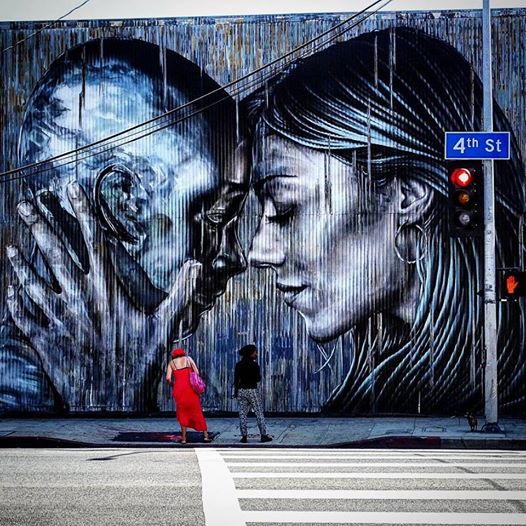
Arts District, Los Angeles

Tags

, , , , , , , ,

20046668_10213715189019056_3737017398696896189_nLong before Moni and I took to the road to spend this last July in New Mexico, I spent a couple months with her and her family down in San Dimas, California.

I’m usually a little lost in big cities. Vegas would be an exception, because it was once home, but usually cities make me a little uncomfortable. You see more people in 5 minutes down there in L.A. than you will up here in months on the North Slope (and that’s just on a quick trip to Target). I find it all just a little bit disconcerting.

Still, the big cities do have their strong points…

Oh yes, they do!

(click to embiggen!)

Credible Story Not Required

Tags

, , , , , , , ,

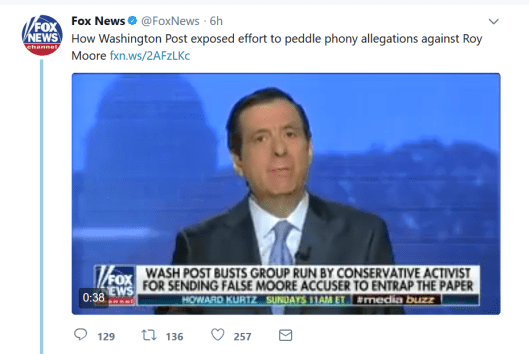
If you have been following the news, you’ve probably heard that fake journalist James O’Keefe and his organization, Project Veritas, have been out spreading the stupid again. Apparently, they approached the Washington Post with a fake story about Roy Moore molesting yet another underage girl. The goal here was clearly to poison the well for all those women who have already come foreword (and perhaps any who might be thinking about it) by showing just how easy it is to get fake accusations into the media. One clearly fake accusation would, so they clearly hoped, go a long way to dilute the impact of any standing accusations from credible sources.

Only the Washington Post was wise to the con and busted them good.

So, you might wonder, how the right wing propagandists might deal with this set-back? How would they handle the apparently loss of this narrative?

Fox and Moore

Apparently the folks handling the Twitter account at Fox News deal with it by telling the same story anyway.

(Too bad the guy posting the story and the one posting the blurb in the video aren’t on the same page. Still, the disconnect between the actual story and the tweet is pretty damned telling.)

The Murals of Española

Tags

, , , , , , , ,

22426453_10214539482825886_622094195494757406_oRegular readers may have noticed already, but when I (and now Moni too) experience a bout of southiness, we frequently do this somewhere in the southwest. Santa Fe is a common destination. We mostly travel through nearby Española on our way up to Taos, Pueblo, but this last summer, we also traveled through on our way up to Ghost Ranch, and that meant going though more of the town. The murals were very cool!

Moni gets mad at me when she sees these, because she doesn’t remember many of them. I think she was on the phone while I ran loose with a camera.

So, brought to you with just a trade of schadenfreude, the murals of Española!

(Click to embiggen)


You Otter See the Whales in Sitka

Tags

, , , , , , , ,

23154906_10214694818949192_3124333924529284067_oSo, I flew out from Barrow a couple weeks back to spend a few days at a conference (Whalefest) in Sitka. I don’t get to spend much time in southwest Alaska. When I fly out, I generally go through Anchorage and then down to the lower 48. I can visit the villages of the Northslope about as often as I care to, and I can often spend extra time in Fairbanks or Anchorage, but a chance to veer off into the southeast is a rare treat.

To say that Sitka is beautiful is putting it more than a little mildly. It really is gorgeous. In the end I found myself plotting various schemes to stay longer, or to come back. Moni couldn’t be talked into spending Thanksgiving down that way, something sensible about money and inconvenient flight times, but I’d still give up a turkey for a few free days in this town, preferably while the humpback whales are still in town.

Which reminds me, whalefest did (oddly enough) include a chance to go on a whale-watching cruise. Grumbly me, wasn’t all that eager to get on a whale-watching boat. I get seasick easily and the last time I did that with my family in Hawaii, we barely saw a tail come up out of the water. This time was different, though, remarkably different!

So, yeah, that was cool!

DSC04103My accommodations were at the old Sheldon Jackson College. The campus itself was beautiful. I wandered into the Sheldon Jackson Museum a couple times and found myself spending way more time in there than I originally planned. I also got to the totem park (otherwise known as the Sitka National Historic Park. I definitely needed more time in both those spots.


The conference itself was a fascinating mix of presentations on a diverse range of subjects. Oh yes, whales were the dominant theme, but speakers also addressed issues such as climate change, biology of other sea mammals, and sundry things-oceanic. The keynote speaker, Jacquelyn Gill, gave a wonderful talk on climate change and extinction, or rather persistence.

At some point I took a longish walk and found myself watching a sea otter playing in the harbor. It’s an oddly calming thing, just snapping amateurish pictures of an otter, waiting for him to do something interesting, like bring up another shellfish.

…just like the last one.

Damned cute, these little buggers!

It hasn’t escaped me that this is the Alaska that most people think of when I tell them I live in this state. They imagine trees and mountains, and moose, and bears, and all-manner of different forms of wildlife. My own experience of the state is very different, but that’s to be expected. Alaska is a whole buncha cool states.

Ah well, I really must get back to Sitka some time.

And to Whalefest!

Anyway, click to embiggen!

Fundamentalism by Proxy and the Guilting of the Godly

Tags

, , , , , , , ,

A general suspicion of religion comes to mind easily enough. Hell, even religious people frequently exhibit this suspicion (tempered as it is with whatever thoughts they’ve assembled into their own beliefs). There is something about the whole range of religious beliefs as such that invites a degree of doubt, even contempt. It would be easy to believe religion could be refuted.

Easy.

Just like nailing jelly to a wall.

What makes this seemingly easy task so frustrating is the sense that any generalization one might make about religion will most certainly have its counterexamples, and most of these exceptions are anything but marginal. Even belief in God or gods which seems such a no-brainer falls apart when we consider various branches of Buddhism. Belief in the supernatural is rather complicated by those who think of spirits as part of the natural world. Some of us may regard the notion of spirits in a mountain top as falling outside the natural world, but it doesn’t really work to maintain that belief in a supernatural world is a defining feature of religion if that belief itself isn’t all that universal. The particulars just don’t rescue the narrative. …and so-on with any other effort to sweep the lot of religious beliefs into the same been-there-refuted-that bin. What is religion? Hard to say. Harder still if you’re answering that question in the midst of a polemic moment.

Luckily, this problem is easily solved by focusing on one set of religious traditions instead of trying to drop a truth bomb on the lot of them. Can’t nail down every faith out there with one stroke of the hammer? No problem. Just pick one. Specificity will save us all!

…except that it won’t.

Let’s say you think the God of Abraham is a right cruel bastard, and so that’s your main objection to the whole of Christianity (along with Islam and Judaism). You can even throw in a few scriptures to back this up (cause that seems to be how the Biblical game is played), and we non-believers are often happy to play along, arguendo, so to speak. The godless corners of the net are filled with various references to God’s more dickish behavior, all documented nicely in the ‘Good Book’, and wielded well, these can form the basis for reasonably compelling arguments. We can even extend the critique into any number of horrible things Christians have done in the name of the great big bastard in the sky. We can work up a real parade or horribles and say ‘that’s it1’ That’s why the God of Abraham isn’t welcome in our lives and our thoughts. We can do this. Hell, I have done it. I”ve made this argument quite a few times since going godless many decades ago. And I will say, that I think this approach can be used to skewer a particular brand of believer, one I’m pretty sure I’ve met in person more than a few times.

But what about those Christians who seem to find in the Bible a story of hope, love, and kindness? No, I don’t mean the footnote kind of godly affection that accompanies homophobic politics, paternalistic family norms, or just plain idiotic theodicies. I mean the kind of compassion that actually does put some believers in the streets fighting for the rights of others and defending the dignity of all manner of people. Those Christians do exist and they have their scriptures too, their theories, their angle on God, the universe, and even that annoying wasp nest under the front porch.

What are we to make of these Christians?

The Christian left was once a powerful force in American life, and we could do worse than to see it rise again. Don’t get me wrong; at his best Jesus is an ambiguous story for me, and not one containing a lot of factual weight, but if i was to pick a fight it wouldn’t be with the peace-love-dove set of Christians. When it comes to the things that matter most to me, I am as likely as not going to count them as allies. Damned good ones at that!

For the present, though, the question is what to make of the Christians who don’t fit the yer-a-jerk-and-so-is-yourGod narrative? How do we sort their significance in relation to the buggers who actually make life hard for those ‘sinner’s they claim to love after all. If the notion that God and his fan club are all a bunch of jerks is your go-to argument when explaining active resistance to religion, then these guys are actually kind of a problem.

…which is ironic to say the least.

A believer may have an out for this problem. She can tell us one version of Christianity (presumably her own) is genuine and the other is just bullshit. How we may ask? And scripture, she may answer, which theoretically means the whole issue stands or falls on those passages Christians are find if quoting at each other and the rest of us. A believer can insist that the right answer is contained in those scriptures (or something else in her faith), and that the rest is simply noise. Whether she is right or not about the nature of that correct view is another question, but so long as someone affirms a particular faith, this approach isn’t glaringly inconsistent. But as a man who denies the authority of scripture (among other religious authorities) I’m not really in a position to do that. Sure, I can formulate ideas as to whether or not any given interpretation of scripture is plausible given the text and its historical significance, but I can find no authority with which to say anyone oughtta give a damn about that assessment.

More than that, I see no reason to believe there is any consistency to scripture with which to settle questions about what is and what isn’t a truly Christian take on the subject. Really, I think it far more likely, that the whole mess of scripture really is just that full of contradiction because what the hell else would you expect if a giant text cobbled together from a vast range of different authors writing at different times and places?

…which reminds me of one of those teachable moments a high school student once handed me. (In this case, I was the teachee.) I can’t remember how the subject came up, but I asked an orthodox Jewish kid something about how he viewed some particular theme in the Bible. He responded by telling me that there is no ‘the Bible’. To him, that phrase denoted an odd collection of texts, some of which might bear some relation to those his own people valued and some clearly didn’t, but the notion that the whole collection could be meaningfully referenced as though it were a single book seemed rather foreign to him.

It should have been foreign to me too.

We unbelievers give up far too much ground by speaking about ‘the Bible’ in this way.

This is of course a very incomplete account of the variation, even within Christianity. The whole mess gets meta-messy when we start adding differences of opinion as to whether or not scripture is the sole source of authority on what is right and what isn’t. What do we make of those who recognize the authority of the Pope? …of the Mormon Prophets? …or even the notion that one must be filled with the Holy Spirit to interpret scripture properly? All of these can turn the tables on any attempt to arrive at a fixed notion of just what it is we are rejecting when we say ‘no’ no God.

In any event, I see no reason to believe we can find a consistent message in the myriad scriptures folks are prone to cite in the effort to decide what a Christian ought to believe. For me, there is no ought to the matter. There is only what different believers do in fact believe and the mix of reasons and choices that go into their professions of belief. (Hell, I’m not even sure how much to make of beliefs, to be honest. What counts as doctrine on Wednesday is easily forgotten on Thursday. …on Friday it r-emerges as the subject of debate.) Anyway, I don’t see any hope of resolving questions about which is the true nature of Christianity.

…or of Islam.

…or Buddhism.

…or even pastafarianism for that matter.

I’m not saying the critique of Christian cruelty is a straw man. I am saying its relevance to any given believer depends on assumptions any given Christian may or may not hold.

This is often frustrating for an unbeliever. We have the goods on Tom and Jack, so to speak, so it just seems unfair to let Alice and Eric slide on account of a few disclaimers. But of course mere disclaimers aren’t the issue. It’s the very real possibility that someone’s faith may genuinely differ from that for which we have a ready critique. Of course we can ask any number of questions to see if someone really does envision Christianity in positive terms (as opposed to those who merely parrot the rhetoric of love and compassion all the while wielding the Prince of Peace like a well-balanced weapon, but at the end of the day? Some folks escape the criticism. Some folks really do seem to see in Christ a message that genuinely inspires love and compassion.

So what’s a godless bastard to do?

Unfortunately, I think the temptation exists to force the issue, to pretend we have some way of sorting the real thing from the imitation believer after all. It should come as no surprise that this rhetorical strategy usually means declaring the least defensible version of Christianity that we can imagine to be the real thing. All other variations, and in particular the more palatable variations on belief are then the product of personal whim. The kind Christian, so this narrative goes, is the one who really hasn’t read her Bible. She is the one who hasn’t really thought her doctrines through to their logical conclusions. I expect this kind of narrative from conservative Christians, but it’s a little more odd to hear it coming from the godless. It’s odd, yes, but it’s not rare. Unbelievers often take the view that Christians liberal in theology and politics aren’t the real ones.  Thus, we turn virtues into vices and snub allies away into likely resentment. (Who could blame them?) At worst, the effort to delegitimize moderate or liberal believers may well nudge one or three of them the other direction. It’s a kind of proxy-fundamentalism, a refusal to acknowledge the legitimacy of people whose views don’t fit the vision of Christianity we mean to attack.

A variation of this approach can be seen in the oft-repeated refrain that the only real Muslims are the militants. Those Muslims (indeed, the vast majority) who seem to get along with the rest of us haven’t got their own faith right, so the argument goes. And thus peaceful Muslims and violent extremists all falter beneath the weight of the same criticism. We can treat every Muslim as a would-be terrorist, so it seems, because those who haven’t come around to it simply aren’t doing their religion right.

Once again this approach assumes an objective limit on the range of legitimate variation within the faith in question. And once again, no such objective limit exists. You can haul out whatever quotes you want in support of it, but once again, the significance of those quotes rests on a number of assumptions, assumptions that just aren’t uniform throughout the Muslim world. So, why advocate for the bastards when we could support decent folks who just want to get through the day.

There is simply no way around it. If ever there was a term for which ‘family resemblance’ provided a more suitable account of its meaning I don’t know what that is (maybe ‘culture’). Religion as a whole can take many different forms, as can just about every individual religion. We can respond to each individual variant as we like, but there is no use shoring up the authority of those who serve as the main targets of our criticism. We certainly shouldn’t be helping the greatest assholes in God’s many fan clubs to marginalize decent people. The plasticity of religion is itself a potential objection in itself, at least to those who think it a bastion of objective morality, but that too is just another subset of believers out there. My point is simply that the variation is there, and that those of us who say ‘no’ shouldn’t be too quick to add our own voices to those seeking to impose orthodoxy on the faithful.

Taking off from Barrow.

Tags

, , , , , , , ,

Apprapos of nothing, but I flew out of Barrow this Wednesday. I’m in Sitka for a conference (Whalefest). I’ll have more on that later, but for the moment, I thought I’d leave this little video of the up-and-away. The ocean back home is still in liquid form right now (or at least it was when we took-off), but it sure does look a little frosty around the edges.

Yep, that’s all folks.

A Helpful Message that Ain’t

Tags

, , , , , , , ,

Sure am glad I noticed this safety warning.

…while driving down the road in the middle of a snow storm.

Thank you anonymous person behind this message. Without your efforts, I never would have taken my eyes off the road to find out what necessitated this urgent warning ..known that I should not take my eyes off the road while driving.

The Message in Itself

Tags

, , , , , , , ,

22289655_10214460105521503_5202000297869750410_o

From the Mission District in San Francisco

I’m beginning to think that left wing politics is the object of a higher grasp, so to speak, or at least that this is how it must appear to its critics. There are those, of course, who simply reject left wing politics outright. Hell, there are those for whom scorn of left wing politics is a favorite sport. But what really fascinates me about the response to various left wing messages are the number of people who can’t quite bring themselves to say ‘no’ outright. Instead, they have all sorts of advice for the lefties among us. You’d almost think these critics were down to help, assuming of course that help means something else.

And by ‘something else’, I mean, something other than anything actually requested at any particular time. The ‘else’ in this case is that ineffable thing in itself. Whatever thing a lefty actually wants to see done today, whatever case he makes for it, whatever she does to draw attention to that case, well that thing that is surely out of the question. But something else? Some other request or demand, made by some other person in some other way…

I expect the folks in the not-your-mascot movement could write a book about all the helpful suggestions they’ve gotten over the years. Instead of protesting a football mascot or opposing a team name, so the thinking goes, y’all should be fixing the reservations, feeding the hungry in Native American communities, and just generally doing practical things to help indigenous people. Rarely do those offering such advice take stock of the actual efforts of such activists to help out their communities, and these critics don’t seem at all impressed by the many Native American activists who say that issues like derogatory sports teams may have something to do with the larger problems facing their people. No, the response is as simple as it is common. Stop protesting and go do something more helpful.

I hope I’ll be excused for suspecting that the ‘stop protesting’ is a little more important to those offering such advice than the “go do something more important.”

Those taking a knee at football games have certainly received similar advice. People just want to watch the game, so they are told. This isn’t the right time to protest, and when the National Anthem is playing, well then, that CERTAINLY isn’t the right time to protest! Anyway, this is all much too divisive. You’ll only alienate people. The players protesting are rich and pampered anyway, so what do they have to protest? If they want to help out more, then they should donate money and do charity work in their own communities.

You read all this stuff, and you might be tempted to think some of these critics aren’t open to concerns about possible police abuse at all, but surely that isn’t the case! Those criticizing protesters couldn’t be more clear about their willingness to consider the issue.

On another day.

In another context.

With a different messenger.

After that messenger has done a certain number of other things to earn their respect.

On this last point, you might be tempted to suggest that people like Colin Kaepernick have indeed given to charity and actively worked to help those in need, but of course this is missing the point. Clearly, he and those with him need to do more. If they do more, then people will listen to them.

Yep!

…just not during the Anthem.

Every major mass-shooting seems to trigger a wave of similar advice. Don’t politicize this! It’s too soon! Now is not the time to raise questions about gun control. Nope! Not now. Not yet.

…maybe later.

So, it seems that America might one day have a serious talk about gun control. It will have to be scheduled during an intermission of indeterminate length between actual mass shootings. This will of course require the cooperation of mass shooters, because they will have to create a pause in the carnage of sufficient length to allow the keepers of the conversation to make the call. It’s not clear just how long we must all wait between shootings, but presumably when the time frame is reached, the keepers of the conversation will proclaim the moment and we can begin to deal with the issues in a serious manner. Surely, they will tell us, when it is time! This whole too-soon thing couldn’t just be a stalling tactic. They will tell us when it is time. Until then, well, it is just to soon.

Hell, it’s too soon to ask if it’s to soon.

Shame on you for wondering about it!

Of course, one might be excused for thinking that the moment any of these conversations could take place (when the issues aren’t in the news and at events people aren’t paying attention to) would in effect constitute precisely the sort of time when the public finds the whole topic easiest to ignore, but such thoughts are far too cynical! Surely, all this advice is sincere. Surely, all these people telling us its the wrong time and the wrong message mean what they say.  If only the right version of any of these messages reached their ears and eyes, they would happily consider the whole thing.

But that never seems to happen!

The actual left wing politics that we see in America is just just a little too human to be worthy of consideration. The real message, the ones so many keep saying they would consider, always seem to rest out there somewhere in the world of possibility, just a bit beyond the grasp of mere mortals. If only we could ever confront that message in itself, the real message, the properly timed message, phrased in just the right way, and put forward by the right person with just the right presentation to be worthy of consideration. Hell, I don’t know that the left wing messages could or even should win out in such an event (a lot depends on the particulars), but that’s rather academic at this point, because the time is not yet right. Under the right conditions, so it would seem, we could at least consider those lefty messages. Until then? Well, we all seem to have better things to do.

You know, like sitting on our couches watching other people do stuff.

And drinking beer.

Map Ain’t Time Either.

Tags

, , , , , , , ,

indian_tribesI often see maps of Indian territories pop up on the net. I like them. And then again, I don’t. I’ve seen also some of these same maps in classrooms and academic papers. In such cases, the narrative usually does a bit more to put the visual presentation in context, but on the net, that visual is often all you get.

…along with a couple hashtags, and sometimes a catchy title.

The specific subject matter varies a bit from map to map. Sometimes they purport to show linguistic variation. Sometimes, they show the culture areas used by anthropologists or the general divisions of Native American peoples into related peoples. Mostly, these maps purport to show the specific locations of various tribes.

…whatever that means?

Don’t get me wrong. The basic idea isn’t entirely off base, and it’s a lot better than silence on the topic, but the notion of an Indian tribe carries a lot of baggage, only some of which goes away if we replace the term ‘Indian’ with ‘Native American’. We can also replace ‘tribes’ with ‘nations’ or ‘peoples’.

…we still end up with plenty of baggage.

There really isn’t any vocabulary that just works here. You really have to pick a term, and just bear in mind the distortions it imposes on the subject matter. But my point here today isn’t so much to work over the vocabulary as it is to focus attention on the maps themselves. It’s great to have them, but they too can distort the subject matter, all the more so when the map circulates as a meme-in-in-itelf, so to speak, just an image without a narrative to go with it.

So, what’s the problem?

***

Well, we have a few of them actually. One of the first things going through my own mind is the other half of the contextualization schema. The maps give us a where. That leaves me asking when? These maps purport to show us where different Native American peoples lived, but they rarely give us a strong sense of when they lived there. This goes hand-in-hand with common assumptions about the timelessness of Native American societies. Folks are only too happy to imagine that most Indian peoples had been living in the same place since time immemorial, just waiting for the rest of us to show up and kick-start the history machine. All the timely-changey stuff must have come after Columbus, so the thinking goes. Before that, Indian peoples just stayed put, living in harmony without any real need for big changes like a major population movements.

All of this is of course, nonsense, and I think most people know it is, at least when the question is put to them directly. I repeat, they know it WHEN you put the question to them directly. Until then, I think folks fall quite easily into the assumption that Indian peoples rested in a kind of temporal stasis. Hell, sometimes Native Americans themselves fall into this assumption.Don’t be too surprised. Stereotypes often come in a user-friendly version, an ever-so-inviting role to play, for those who are willing. The noble savage may be a cliché, but it’s not one without its charms, and it’s easily as timeless as any of its less PC counterparts. In any event, folks often seem to imagine Native American societies as timeless communities.

Case in point?

These maps.

DJdFnI-W4AI9LXEI found this little gem to the left on twitter, at least I believe that’s where I got it. It’s pretty cool, really. It definitely matches my general sense of where various people should be. But then again, my general sense of where everybody should be rests on a skewed timeline. I expect them to be in certain places when the stories I read or tell about them in history class take place. So, if the different natives peoples are in the right place on cue for the historical narratives I expect to feature them, then the map matches my initial expectations, and I end up saying stuff like “it’s pretty cool.” The whole thing almost works, but it doesn’t take too many questions to bust up both those expectations and the maps that go with them.

When did everyone get where they are in the map above? It’s controversial question, and one that I may regret raising here, but still… See the Apacheans down there in the Southwest? You might think they had been there since time immemorial, right? Well the archaeological evidence suggests this isn’t the case. As I recall, the earliest evidence for Diné (Navajo) placement in the four corners area predates the Spanish by a little over a hundred years. They came along with the other Apachean peoples by means of a hotly debated route. Of course archaeological finds happen every day, so the historical evidence may change, and I may have missed a recent find or three, but the point is that these people arrived in the area within comprehensible time frame. This placement on teh map isn’t from time immemorial; it begins at the cusp of the 1400s, give or take a bit, and that enables us to place their entrance into a sequence of events for the region. They were still settling into the total territory on this map when the Spanish began exploring the region, arriving well after their Pueblo neighbors. Knowing that helps to put the map in perspective. Not knowing that invites an a-historical reading of the map.

Now look at the plains. The peoples placed there seem right to me, but it’s worth considering that many of them didn’t get there until well after the beginnings of the colonial period. Specific migration routes and the scale of ground shifted are of course open to debate, but I think it is fair to say that a great deal of the population on this portion of the map filled in after the beginnings of the fur trade, and even more importantly, after the horse began spreading through the plains in the wake of the Pueblo Revolt.

243

From the New Mexico Museum of Art

That would be a war the Indians won folks, not simply a battle. a war. But that’s another rant…

…anyway, the point is that the population of the plains as we now understand it changed a great deal during the colonial period. So, if the southwest takes on roughly the territories represented in the map just ahead of the colonial period, the great plains takes its apparently map-worthy shape during that very period. We can point to a time frame sometime on down the road that reflects this mapping, but by then other things have shifted. Case in point? The eastern seaboard. By the time the plains looks like it does on this map, the settler population is already pushing a lot of people out and away from the coasts. By the time Lakota, Comanche, and Kiowa have reached their positions on this map, the eastern seaboard should already be looking a bit white-washed.

These are just the areas I think I know something about (and admittedly, I am often wrong). The rest of the map is full of movement too. Some areas may be more stable than others. The amount of movement is itself variable.

So, what does the map represent? It really isn’t a clear snapshot of any particular time-frame. We really can’t locate a specific time in which all the territories assigned to various indigenous peoples really were under their control. Rather, it seems to be a representation of the territories controlled by various peoples during something like a period of peak cultural autonomy. …as perceived by white people. In a very real sense, each of these territories is set onto the map in precisely the locations at which we non-natives really became interested in the regions and/or first became aware of the native peoples in question. Fair enough as far as it goes, but to say that this leaves out a lot of information is a Hell of an understatement.

***

Speaking of non-native perceptions. Names are a bit of a problem here as well. I hope it will come as no surprise to learn that many of the names appearing on these maps are not those used by the people to refer to themselves. ‘Navajo’ was for example a Tewa term for open fields. ‘Sioux’ is usually described as a shortened version of an Ojibwa term (it has something to do with snakes). As I recall, there is a competing narrative for that one, but the point is that the name DID NOT come from the Sioux themselves. ‘Eskimo’ was a Montagnais term often translated as ‘raw fish eater’, though it is more likely to have meant ‘snow-shoe netter’. Each of these origin narratives is a complicated story in itself (information is problematic all the way down), but for the present, the point is that the names typically appearing on these maps generally come from the neighbors of the peoples in question. They made their way into the popular lexicon after European colonists asked some other tribe who lives over there. The answers to those questions then made their way into our history books and onto our maps.

tribal_nation_map_custom-973eefab3541e8d2c23056100549ac543e59beee-s1600-c85This is one reason I like this map by Aaron Carapella. He makes an effort to identify the native names for themselves and get them onto the territory. That’s a big improvement. Of course, we still have the timeline problem mentioned above, but at least the names are a bit more authentic. I should add that they are more authentic because they are the names the people in question use for themselves, not because they are ‘original’, as folks sometimes suggest. ‘Original’ alludes to a timeless beginning. Talk of an original name just points us back to the timeline problem, but there is definite value in using the name people prefer to use for themselves. We may have to switch back and forth, or introduce a topic using the more popular names, but working with materials that provides the native terms helps to normalize them.

***

imagesOne additionally interesting feature of Carapella’s maps is the fact that he leaves off the territorial boundaries. The names of each people simply appear on the  map without any clear sense of the boundaries around them. We are left to imagine the full extent of each native territory. This avoids one of the larger problems one commonly finds in maps of Indian territory, their tendency to construe that territory in terms comparable to that of nation states. We all know the convention, color-coded spaces with clear boundaries between them. This conveys both a sense clear boundaries between different Indian peoples and a sense of homogeneity within those boundaries. Every part of Cherokee territory on such a map is just as Cherokeeish as any other part. They are all equally blue, or yellow, or mauve. One gets the sense that someone could pinpoint the exact moment they stepped into (or out of) Cherokee land, or that of any other tribe. We can practically see someone stopping on a dime, just like the cops in an old outlaw trucker movie do when they reach state lines. That’s how modern nation states work. It isn’t clear that this is now native territories work(ed).

It isn’t that native peoples didn’t have territories. They certainly did claim specific lands, and even defend them from others, but this system would have worked without the benefit of a scientific grid defining the exact moment one would step over the line from one territory to the next (much less collection of maps to represent them). Of course, natural features such rivers or mountains, and so forth would be used as reference points, but thus too leaves open questions as to just where the boundary rested. Did a given people claim both sides of a river or just one? The answers would vary. The end result was of course a lot of overlapping claims.

I often wonder if some of these maps could be improved by representing the overlapping territories, Venn diagram-style, at least where such instances do occur, but of course, this leaves open questions about timelines and the adequacy of information as to how the territories on these maps have been assigned to begin with. It’s not as though the historical record is entirely silent on these matters, but there is something about the way these maps fill in the details with a little too much precision. Judgement calls have been made on these maps, and the way they have been made is erased by the nature of the maps.

The problem isn’t really unique to Native American territories, but at least as applied to modern states and nations the techniques used by the map-makers matches those of the powers that be a bit more. People who live in and around important boundaries may or may not live life in a way that bears out the conventions of cartography, but the powers that be will likely support the notion that we can pin-point exactly where one state leaves off and another begins. They will also support the notion that we know exactly who belongs on one side or another, if necessary with guns or walls. The trouble here is that these maps purport to describe the territories of a different world altogether, one which reckons turf a bit differently.

Don’t get me wrong; it’s great to have these maps, but they distort even as they inform. I’m always curious about the prospects of improvement. In the interim, I reckon the best cure for the distortion is to be aware of the problems.

…of which, I hope I have at least scratched the surface.

Sundry Maps (Click to embiggen)…