• About

northierthanthou

northierthanthou

Tag Archives: American Indian

Quanah Parker, Progress, and the Lack Thereof, …Christmas and Torture!

18 Sunday Dec 2011

Posted by danielwalldammit in Books, History, Native American Themes

≈ 2 Comments

Tags

American Indian, American West, Comanche, Cruelty, Native American, Progress, Quanah Parker, Texas, Torture
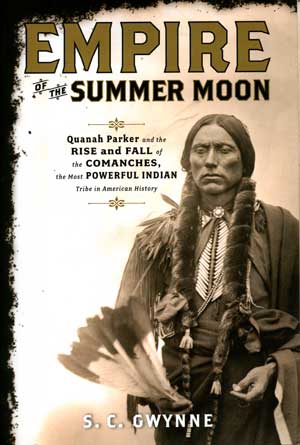
There is always one! One book in the airport bookstore that looks like something I might actually want to read. This time it was “Empire of the Summer Moon: Quanah Parker and the Rise and Fall of the Comanches, the Most Powerful Indian Tribe in American History,” by S.C. Gwynne (Scribner, 2011).

Mind you, the title alone carries at least one red flag. Were the Comanche really the “most powerful Indian tribe in American history?” Reading the book, I began to wonder if there was ever a raid, or a battle, or a tribe that didn’t strike the author as “the most’ or “the greatest” something?  Seriously, this book, has the most superlatives contained in any volume published in this century. (Okay, not really, but it has enough of them that it looked kind of fun. So, I thought I’d try it.) But faced with 16 hours in the hands of the airlines (the most air-time ever… Okay I’ll stop, really, I will), it just looked like the kind of fun-read that might do the trick for all those hours imitating a sardine. So, I bought it and put my larger, more theoretical, volume on the back burner, at least until Quanah could be “tamed,’ as I thought surely the book would put it.

I was not disappointed.

It is certainly an enjoyable yarn, and I learned a few things while reading it, but excessive superlatives aside, there are also a number of factual problems in the book. Gwynne, for example credits Spanish failure to protect the Pueblos with the cause of the Pueblo Revolt of 1680. This is simple confirmation bias. It ties their story more closely to the one Gwynne is telling. But it’s outright fiction. The Pueblo’s rebelled against the Spanish because what the Spanish were doing to them, not because of what the Spanish were not doing for them. Other critics have raised similar objections to other parts of the book, but I’m not really interested in picking apart the details.

What does strike me about this work is its use of a familiar spin. Gwynne is a firm believer in the march of progress, and he does not hesitate to frame the Comanche squarely in this larger story. Channeling Frederick Jackson Turner, Gwynne is telling the tale of the clash between savagery and civilization at the edge of the frontier. And Comanche play a damned familiar role in that story.

It is not really that Gwynne describes the horrors of Comanche raiding in vivid detail, or that he recounts the torture and execution of white captives in numerous chapters. I don’t need sugar-coating in my history books, nor do I need constant reassurance that an author is not a racist. But “progress” is a faith I can do without, and this book would have been much better without it.

Simply put, Gwynne sees Comanche’s as exemplars of a more primitive life-way than Europeans, or even a number of other Indian peoples. His reasons are familiar; they are hunter-gatherers, which sets them apart from and well behind the progress of agricultural societies, from the Pueblos to the Spaniards, …maybe even the Texans. To Gwynn, the cruelties that Comanche’s inflicted on their enemies stem from their lack of progress in comparison to Agricultural tribes such as those found in Mexico.

If the irony of that comparison doesn’t scream in your ears, then perhaps we could take a little time to discuss the history of Central American civilization. …Well some other time, anyway.

On some level, I cannot help but think Gwynne must know better. He certainly does not hesitate to tell us about the atrocities committed by other peoples, including Texans. At times, he seems quite prepared to concede all the facts which should suggest a degree of moral parity. Yet Gwynne sees a difference between the cruelties of commanches and those of other people.

Gwynne has at least the beginnings of an explanation for the difference. He maintains that other peoples consistently show some level of condemnation for the act of torture. Such brutal violence may be carried out by civilizations as modern as our own, but Gwynne seems to suggest, we at least know it is wrong. The Comanche however, revel in it. And that makes all the difference in the world to Gwynne. It is the difference between a “savage,” a “low barbarian,” and someone from a civilization.

So, apparently, cognitive dissonance is a virtue. If you have to torture someone, then you should at least have the decency to feel bad about it.

But I cannot help thinking we can do better than that! We can relegate the job to soldiers serving on some far-flung corner of the world, and if those soldiers should fail to be just as violant as we wish them to be (no more and no less), or should they fail to cover up any actual cruelties they might commit, then perhaps we can just disown them. If nothing else fails, we can at least wring our hands about it, schedule a few talking heads to debate it on the news channels, and sweat a lot over the whole thing. Because knowing at least that torture is wrong sets us apart from those that do not, or so it would seem

In torture, as in Christmas gifts, it is apparently the thought that counts.

It is an interesting question, just how it is that societies allocate boundaries within which cruelty becomes objectionable, and how do they square those boundaries with the interests of military defense, …or outright conquest? Both of these are damned tough problem to sort out, and woe be unto those who end up on the wrong side of the sorting, at least when someone with a camera-phone is around to record it!

The story of Quanah Parker would not be a bad spring board for addressing questions about the cultural construction of violence. It certainly provides enough fodder to get the issue squarely on the table, but of course all this falls by the wayside when the author has recourse to a convenient explanation with a lot of cultural force behind it. The Comanche’s are cruel because they are savage. Others are cruel because their civilization has yet to be perfected.

Problem solved!

This probably is not the best place to try to refute the notion of progress. Suffice to say, that I consider it largely a dead issue, at least as applied to the history of Indian-white relations, and certainly in reference to the comparison between hunter-gathering economies and those of settled agriculturists. Hell, the critique of this notion has been done and redone for a couple of generations of scholarship now. Were I to come across a learned article purporting to refute the notion of progress, I would no doubt feel sympathy for the dead horse that was about to be kicked. And yet, in this book, I find that dead horse alive and grazing in the pastures of every airport in the country.

When the average American reads about Comanche history for the next few months anyway, there is a damned good chance they will read it in this book. They will learn a lot to be sure, much of it reasonably accurate, informative, and interesting. And they will also read in that book yet another chapter in the myth of the progress of civilization.

It is just a little depressing.

71.271549 -156.751450

Share this:

  • Tweet
  • Share on Tumblr
  • Click to print (Opens in new window) Print
  • Click to email a link to a friend (Opens in new window) Email
  • Click to share on Reddit (Opens in new window) Reddit
Like Loading...

California Admitted as a Free State, …Oh Wait!

16 Wednesday Nov 2011

Posted by danielwalldammit in Education, History, Native American Themes, Politics

≈ 5 Comments

Tags

American Indian, California, Civil War, History, Narrative, Native American, Semantics, Slavery, Story-Telling, teaching

Okay, so we just started a section on slavery and the civil war in my American history class. One thing that always irritates me here, or maybe it just amuses me, I don’t know… Anyway, I think about it whenever I cover this subject. Every textbook I have ever used on American history explains that California was admitted as a free state under the terms of the Compromise of 1850.

So, what’s the problem?

The problem is a little known law passed in California that very year, ostensibly for the protection of Indians. The law imposes a $50.00 fine on anyone forcing an Indian to work against his will. So, that should be good, right?

Actually, no.

The law also contains the following provisions:

When an Indian is convicted of an offence before a Justice of the Peace punishable by a fine, any white person may, by consent of the Justice, give bond for said Indian, conditioned for the payment of said fine and costs, and in such case the Indian shall be compelled to work for the person so bailing, until he has discharged or cancelled the fine assessed against him…

and

Any Indian able to work and support himself in some honest calling, not having wherewithal to maintain himself, who shall be found loitering and strolling about, or frequenting public places where liquors are sold, begging, or leading an immoral and profligate course of life, shall be liable to be arrested on the complaint of any resident citizen of the county, and brought before any Justice of the Peace of the proper county, Mayor or Recorder of any incorporated town or city, who shall examine said accused Indian, and hear the testimony in relation thereto, and if said Justice, Mayor or Recorder shall be satisfied that he is a vagrant, as above set forth, he shall make out a warrant under his hand and seal, authorizing and requiring the officer having him in charge or custody, to hire out such vagrant within twenty four hours to the best bidder, by public notice given as he shall direct, for the highest price that can be had, for any term not exceeding four months; and such vagrant shall be subject to and governed by the provisions of this Act, regulating guardians and minors, during the time for which he has been so hired.

Oh there is a lot more to the act, and plenty of reassuring clauses that appear to keep people from exploiting natives, but it should not take a lot of imagination to read between the lines here and see how this story actually went down. To say that this law opened up the native labor-market to exploitation would be putting it mildly. …too mildly.

In essence, the law made it illegal to enslave an Indian, at least on one’s own initiative, but if someone was caught being an Indian on a city street, the city could bond him over to you for a price. Oh yes, folks would have to go through the trouble of slighting the moral integrity of the Indian first, but how difficult do you think it would be to find a white guy willing to do that?

Not very.

It’s not the most efficient form of slavery one could devise, but it is slavery non-the-less, and that is why it always bugs me to see textbook after textbook announce that California was admitted to the Union as a free state under the terms of the compromise of 1850.

…in the very year they created a legal procedure for enslaving Indians.

Oh I get it; this kind of issue simply falls outside the scope of the narrative in question. It was not even on the horizons of those debating the major issues of the day in Congress. So, if one is recounting the events leading up to the Civil War, then this piece of information does not really change that story much. Neither does the existence of a viable slave-trade in the interior Southwest. If one is focused on the question of slavery as it was framed in the national politics of the day, then yes, California was certainly admitted as a free state.

Or is that the problem, the terms of that debate?

The bottom line is that ‘slavery’ is just a word, and you can choose to use it or not as easily as you can any other term regardless of the realities of the labor conditions in question. So, historians can skate right past these instances of captive labor (much as the great figures of the era did in their own approach to the issue) while focusing on the institutional forms of slavery that were the main issues of the day. But of course that same sleight of hand is necessary to cap off the story of the Civil War in the standard way, describing it as bringing about the end of slavery in America.

To give closure to the issue of slavery in our national storyline, one has to ignore the use of debt-peonage in conjunction with Jim Crow Laws, or at least classify them as a whole new kind of problem. Using the word “slavery” in the chapters leading up the Civil War and dropping it afterwards creates the illusion that the new social problems are significantly different than the old ones. This approach suggests that the problems associated with slavery were somehow resolved with the closing chapters of Reconstruction, perhaps not to the satisfaction of all concerned, but resolved nonetheless. And Jim Crow then becomes a whole different kind of problem, as do a host of similar practices.

Just like the California Law for the protection of the Indian.

***

Note: The law can be found in the California Statutes from 1850. It is also included in the primary documents for the following textbook:

Albert L. Hurtado, Peter Iverson. Major Problems in American Indian History: Documents and Essays. Second Edition. (Houghton Mifflin, 2001).

71.271549 -156.751450

Share this:

  • Tweet
  • Share on Tumblr
  • Click to print (Opens in new window) Print
  • Click to email a link to a friend (Opens in new window) Email
  • Click to share on Reddit (Opens in new window) Reddit
Like Loading...

Alaska Federation of Natives, 2011

28 Friday Oct 2011

Posted by danielwalldammit in Alaska, Native American Themes, Politics

≈ Leave a comment

Tags

Activism, Alaska, American Indian, Anchorage, Elections, Indigenous, Joe Miller, Lisa Murkowski, Native American, Politics, Tea Party

The Alaska Federation of Natives held its annual meeting in Anchorage this last week (October 20-22). This is a big event and it’s filled with enough stories to fill many a blog. What grabbed my attention this year was the participation of Senator Lisa Murkowski.  Watching the first of two presentations she was to give at this year’s convention, brought to mind two other moments.

First, there was last year’s meeting of the AFN, held in Fairbanks. Senator Murkowski spoke then as well. At that time, she was a write-in candidate for her own office. Her principal opposition, Joe Miller, had secured the Republican nomination for Murkowski’s position. A Tea Party favorite, Miller had been openly critical of Alaska’s tribal corporations. Faced with a near certain Republican victory, Alaska’s Native leadership threw its weight behind Murkowski. Lost in the shuffle, the Democratic nominee, Scott McAdams, struggled to keep in the race.

The Alaska Federation of Natives endorsed Murkowski and she spoke at their convention. Denied the chance to debate Murkowski in a public forum, or to speak on their own, McAdams and Joe Miller made appearances on the floor of the convention. If McAdams received little in the way of attention, Miller must have received a very chilly reception.

A year later, Senator Murkowski took to the podium again, this time at the Dena’ina Civic and Convention center appropriately enough, the very location at which she announced her write-in candidacy. This year, Murkowski took to the floor once during the convention itself, and once again at the closing banquet, both times the substance of her speech was an expression of thanks. If Murkowski’s gratitude was apparent, so was the pride of AFN leadership. They had played a substantial role in getting her back into office, and this year’s AFN proved to be an opportune moment to trumpet that victory.

The second thing on my mind proved to be a very different kind of moment in the politics of indigenous affairs. In early February, 1998, then President of the Navajo Nation, Albert Hale, threatened to shut down the roads passing through Navajo lands. Doing so, he suggested would help to teach non-natives to respect the sovereignty of the Navajo Nation

The immediate response to Hale’s threat was fascinating. Non-Indians wrote all manner of letters to various local newspapers, most of them angry. On the one hand, much of the criticism seemed understandable. Hale hadn’t really put any specific issue on the table, so no-one knew really what he wanted out of the move. (Some of the more cynical among us might have believed it was to draw attention away from an ethics investigation which soon led to Hale’s ouster.) But something more interested proved to be happening in those letters; an awful lot of non-natives were learning the hard way that Indian people’s still held a measure of power in the United States. For all the poverty and corruption one can find in Indian country, for all the problems that tribal leadership seemed unable to resolve, there were at least a few things that they could still do. And one of those things was to make it a lot more difficult to drive through parts of the Southwest.

This is where the other letters from that time come in, the ones from the Navajo people. Many were less than pleased with Hale’s gambit themselves. I was living in Fort Defiance at the time and I recall quite well the shaking heads and office gossip. This was not the way to do things, at least according to the folks I knew.  What use is sovereignty if it only means shutting down roads, some seemed to say? It would be far better, so the argument went, to build a road, or at least to repair the roads already there.  A gesture intended to show the power and force of the Navajo Nation, Hale’s threats seemed only to underscore the relative weakness of Navajo leadership.

I couldn’t help but think about Albert Hale’s road-gambit as I saw Lisa Murkowski speak at AFN.  The basis for the comparison sis simple enough. To me, Hale’s move had always been something of a low-moment in Native American politics, but now I was watching a high one, at least as measured by raw political power. This was Native Alaskans doing what Hale had failed to do back in 1998, they were actually building something.  Now as it happens, it wasn’t a road that Alaskan natives built here, it was a political base capable of affecting a major election, but that election itself is precisely what it will take to get the roads built in Alaska’s Native communities.  Faced with a threat from an outside source, The Alaska Federation of Natives did what it took to ensure that their own interests were protected.

Such victories are hardly new for the Alaska Federation of Natives, but perhaps that is my point. In a world where native politics is so often relegated to symbolic victories, this organization stands out as one of the major players in Alaskan politics. The theme for this meeting of the AFN was “Strength in Unity,” and what better proof could its leaders offer than the re-election of Murkowski to the U.S. Senate. Here at least, Native Leaders had demonstrated with perfect clarity that they were a force to be reckoned with.

Share this:

  • Tweet
  • Share on Tumblr
  • Click to print (Opens in new window) Print
  • Click to email a link to a friend (Opens in new window) Email
  • Click to share on Reddit (Opens in new window) Reddit
Like Loading...
Newer posts →

Top Posts & Pages

  • I'll Just Leave This Here
    I'll Just Leave This Here
  • An Uncommon Security Guard: Dave Eshelman, AKA 'John Wayne'
    An Uncommon Security Guard: Dave Eshelman, AKA 'John Wayne'
  • Arts District, Los Angeles
    Arts District, Los Angeles
  • A Joke from a Bygone Era
    A Joke from a Bygone Era
  • Great Movie Villains, Volume IX: That Witch With a Bow!
    Great Movie Villains, Volume IX: That Witch With a Bow!

Topics

  • Alaska
  • Animals
  • Anthropology
  • atheism
  • Bad Photography
  • Books
  • Childhood
  • Education
  • Gaming
  • General
  • History
  • Irritation Meditation
  • Justice
  • Las Vegas
  • Minis
  • Movie Villainy
  • Movies
  • Museums
  • Music
  • Narrative VIolence
  • Native American Themes
  • Philosophy
  • Politics
  • Public History
  • Re-Creations
  • Religion
  • Street Art
  • The Bullet Point Mind
  • Travel
  • Uncategorized
  • Uncommonday
  • White Indians
  • Write Drunk, Edit Stoned

Blogroll

  • American Creation
  • An Historian Goes to the Movies
  • Aunt Phil's Trunk
  • Bob's Blog
  • Dr. Gerald Stein
  • Hinterlogics
  • Ignorance WIthout Arrogance
  • Im-North
  • Insta-North
  • Just a Girl from Homer
  • Multo (Ghost)
  • Native America
  • Norbert Haupt
  • Northwest History
  • Northy Pins
  • Northy-Tok
  • Nunawhaa
  • Religion in American History
  • The History Blog
  • The History Chicks
  • What Do I Know?

Archives

  • December 2023
  • November 2023
  • June 2023
  • April 2023
  • February 2023
  • December 2022
  • November 2022
  • October 2022
  • September 2022
  • August 2022
  • July 2022
  • June 2022
  • April 2022
  • January 2022
  • December 2021
  • November 2021
  • October 2021
  • September 2021
  • August 2021
  • June 2021
  • May 2021
  • March 2021
  • February 2021
  • January 2021
  • December 2020
  • November 2020
  • October 2020
  • September 2020
  • June 2020
  • May 2020
  • March 2020
  • February 2020
  • January 2020
  • December 2019
  • November 2019
  • September 2019
  • August 2019
  • July 2019
  • June 2019
  • May 2019
  • April 2019
  • January 2019
  • December 2018
  • November 2018
  • October 2018
  • September 2018
  • August 2018
  • July 2018
  • June 2018
  • May 2018
  • April 2018
  • March 2018
  • February 2018
  • January 2018
  • December 2017
  • November 2017
  • October 2017
  • September 2017
  • August 2017
  • July 2017
  • June 2017
  • May 2017
  • April 2017
  • March 2017
  • January 2017
  • December 2016
  • November 2016
  • October 2016
  • September 2016
  • August 2016
  • July 2016
  • June 2016
  • May 2016
  • April 2016
  • March 2016
  • February 2016
  • January 2016
  • December 2015
  • November 2015
  • October 2015
  • September 2015
  • August 2015
  • July 2015
  • June 2015
  • May 2015
  • April 2015
  • March 2015
  • January 2015
  • December 2014
  • November 2014
  • October 2014
  • July 2014
  • June 2014
  • May 2014
  • April 2014
  • March 2014
  • February 2014
  • January 2014
  • December 2013
  • November 2013
  • October 2013
  • September 2013
  • August 2013
  • July 2013
  • June 2013
  • May 2013
  • April 2013
  • March 2013
  • February 2013
  • January 2013
  • December 2012
  • November 2012
  • October 2012
  • September 2012
  • August 2012
  • July 2012
  • June 2012
  • May 2012
  • April 2012
  • March 2012
  • January 2012
  • December 2011
  • November 2011
  • October 2011

My Twitter Feed

Follow @Brimshack

RSS Feed

  • RSS - Posts
  • RSS - Comments

Enter your email address to follow this blog and receive notifications of new posts by email.

Join 8,075 other subscribers

Blog at WordPress.com.

  • Subscribe Subscribed
    • northierthanthou
    • Join 8,075 other subscribers
    • Already have a WordPress.com account? Log in now.
    • northierthanthou
    • Subscribe Subscribed
    • Sign up
    • Log in
    • Report this content
    • View site in Reader
    • Manage subscriptions
    • Collapse this bar
 

Loading Comments...
 

    %d