
Tags
atheism, Belief, Ceremonialism, Christian Forums, History, Indian, Native American, Navajo, religion, Semantics

Hogan
Not everyone has a religion!
More to the point at hand, the term seems to be an awfully bad fit for a lot of the things it is commonly used to describe.
When I was teaching on the Navajo Nation, I used to illustrate this by asking my students; when you hold a healing ceremony, who comes? The answer was always something to the effect of the community itself, friends, relatives, etc. What happens if you don’t believe in the effectiveness of the ceremony? Frankly, I don’t think the question came up very often, at least not in the context of deciding who belonged at the ceremony, but I did once meet a woman who had effectively answered it. A born again Christian, she stayed at the main house during the chants and entered the Hogan to help serve food during the breaks. She thus met her family obligations without implicating herself in a ceremony that was anathema to her own beliefs.
When I asked my students who goes to a church, the answer was invariably something along the lines of its members, believers, etc. Catholics go to a Catholic Church, Baptists to a Baptist Church, and so on. Of course this doesn’t mean that others aren’t welcome at a given church, but there is a distinct sense that the church exists for those that adhere to its doctrines. Those testing the waters will be expected to make a choice at some time.
Which brings me to another point, a religion can be modeled as a debate stance. Who belongs to a church? In many cases, we can literally trot out a range of statements and ask people whether or not they will vouch for the truth of those claims. “God Exists.” “Jesus rose from the dead.” You get the idea. Say ‘yes’ to the right statements, affirm one’s beliefs that they are true, and you are in the club. Say no, and you are out. Whatever else is happening here, it is a process of segregating folks according to an imagined argument within a larger community.

Sandpainting
When I used to post on christianforums.com (CF), this was explicit policy for many years. Those who affirmed the Nicene Creed (or perhaps the Apostle’s Creed) could count themselves as Christian and post in the Christians-only sections. Those of us who could not were asked to restrict our posts to the open-debate areas. The policy varied in its details from time to time, and as I recall it changed rather dramatically a few years back, but when I was there at least CF policy fits the model I am proposing, membership in the faith, as it was defined on CF could be determined by one’s willingness to back a series of truth-claims.
So, what is the difference?
I’m about to paint it in pretty broad strokes, but I’ll warrant the paint gets more or less within the proper lines.
A religion is defined in terms of beliefs which consist of the willingness to vouch for the truth of a claim. A native ceremonial system is defined in terms of community membership and participation. Of course there is considerable overlap between the two. People expressed a number of beliefs connected with Navajo ceremonies, and churches can be remarkable community institutions. But as with any other questions of value, it is the priorities that count. Failure to vouch for essential doctrine gets you out of a church. It doesn’t get you out of a Navajo ceremony, at least it didn’t when I was there.
So, what is going on here? I would suggest, the point of the ceremony is at least partly to unite the community, to get them all involved in something of great importance to the community at large (the health of its members in the Navajo case). What is the point of the religion? Well it is at least partly to distinguish a select membership from some larger community. A religion isn’t simply about what group you belong to; it is about what separates you from those others. What a native ceremonial system unites, a religion divides.
Some might find that shocking, or at least counter-intuitive. Often when religious debates get rather heated, someone will lament the divisiveness of the issue and give a variant of the “can’t we all just get along” speech. The sentiments are noble enough, but I often wonder how many times people can see the process of division before it sinks in; that is what is SUPPOSED to happen.
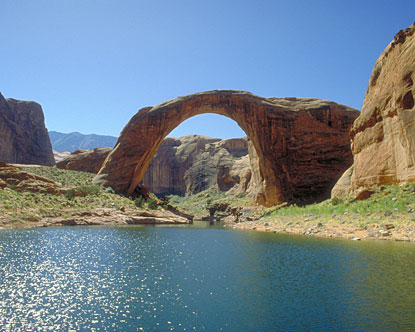
Rainbow Bridge (Sacred Site)
Of course both ceremonial systems and religions unite as well as divide, but they do so on different parameters. The ceremonial system unites people along the lines of an established community, it gives people who share in a range of political and economic interactions a means of emphasizing their connections. A religion carves off a notch of those people and sets them in ideological opposition to others in their community.
So, this is my particular take on a running theme in Native American studies, the unfitness of “religion” to the understanding of Native American practices commonly described using precisely that term. The problem was particularly critical to the workings of a Federal law passed in 1978, The American Indian Religious Freedom Act, which I happened to study for a bit. The law had a rocky history from the start, and at least in the early 90s (when I studied the matter) an awful lot of people were disappointed in its application to real life.
It was easy enough to say that various indigenous practices raised a lot of First Amendment issues. (Well at least it was in 1978; the prior history of willful abuse is dismal, and a topic for another post.) But actually extending Free Exercise protections to Native American “religious” practices proved very difficult. How do you protect the right to prayer when that might mean a lot more than a moment of silence or even a few words spoken in a certain posture? What do you do about ritual paraphernalia at border crossings? How about odd dress in schools or prisons? How do you deal with strange substances? Nevermind peyote; a simple smudge-pot can really screw up a paradigm! …and (this was the real sticking point) what do you do about access to sacred sites on public lands, especially sites that might not be so sacred anymore if someone builds a road or a fast food restaurant in the vicinity?
See, the problem was that native “religious” practices simply didn’t fit into the niche already carved out for religions within the American political economy. So, time and again, when Native Americans sought to enjoy their religious freedom, they found some official or judge who couldn’t (or wouldn’t) grant that protection. The necessary relief always seemed to be too much to ask, and the resulting case-law was dismal to say the least.
So, what was the problem? At least some folks figured it lay with the key term “religion.” It just didn’t fit. The practices in question may have included enough of what people call ‘religion’ to get the issue on the table, but they weren’t restricted to quite the semantic domain one normally expects of things described using that term. The contents Native American “religions” thus tended to spill over into other social terrain. Where western religions had learned to reside in the spaces between other public matters, their Native American analogs didn’t even come close.
So, if the term “religion” doesn’t fit, what does?
It really is difficult to answer that question. We can of course use the term “religion” anyway, but the warrant for its use is analogical, and my point is the analogy breaks down, often in really inconvenient ways. A common practice is to talk about native “spirituality,” but the chief benefits of “spirituality” seem to be that the term means just about anything you want it to mean, which is not an argument in its favor.
My own solution is to focus on the ceremonial practices. As the community-building functions of those ceremonies take priority over the argument-framing functions, those practices naturally stretch into social interactions well beyond those of religions. Of course this way of talking about the issue involves a judgement about priorities; it is a claim about what matters most. So, I won’t be too offended if someone opts to go another route.
Yes, I will. Let’s fight about it!
Anyway, what interests me about this is that it is the other half of a coin to my own situation when it comes to the subject. Religion obviously doesn’t do much for me, and as my last post ought to have established, I obviously think there is something about religion that is NOT part of my life and thinking. What that is, is another question, and admittedly a satirical post isn’t really going to nail it down. So, I am trying think my way through that issue (for the umpteenth time) by looking at people who may have a similar problem.
…and by “similar” I probably mean “opposite.”
If I as an atheist lack something falling under the heading of ‘religion’, the people I am talking about seem to have a surplus of it. Where the term denotes something I don’t want in my life, it denotes something that falls well short of what they want in their own lives. Where use of the word “religion” commits me to too much, it commits them to too little.
Either way, we have a problem.
***
The Hogan picture comes from the website, Virtual Tourist. It is part of the Navajo Museum and Visitor’s center in Window Rock, AZ. The sandpainting is from navajopeople.org which includes a nice description of its symbolism and ritual significance. The picture of Rainbow Bridge comes from Destination360. It was the subject of sacred site litigation in Badoni v. Higginson, one of many sacred sites litigated in the 70s and 80s.

 northierthanthou