 How do you adapt course material to the cultural context of a tribal college? I have had enough conversations about that topic in the last couple days to last me a little while. Whether any of them will help or not is of course an open question, but for the moment, I have a little time to reflect on the matter.
It feels like I am never on the same page with others when the topic comes up. Most of the cultural materials I have seen have been saturated with over-extended metaphors, clunky diagrams with over-simplified cultural motifs all over them, and deep philosophical discussions on the English gloss of some native term. When such materials show up, I always feel some trepidation. When such materials show up, I can’t help but want to step outside and get a breath of fresh air.
It’s no big deal, really. I get that feeling in most meetings sooner or later. Why should those aimed at indigenizing education be any different!
But seriously, before moving on I suppose I should say that my ‘exhibit A’ for how not to to an indigenous educational policy would be Diné Educational Philosophy, at least as it was taught when I was at Diné College. At the heart of this policy was a grand metaphor in which call lessons could be divided into four stages of learning, each of which corresponded to four stages of life development, which in turn corresponded to the four cardinal directions, and from there the metaphors multiplied as various aspects of Navajo cosmology could be mapped onto this four-part division. I should say that the whole thing always fascinated me, and there are a lot of interesting details about it that just are not going to make it into this blog piece. In practice, it was an awful clunky system.
Mind you, it was college policy that all classes had to incorporate a methodology based on this metaphor into each of our classes. New full-time instructors took classes in the subject (unless it conflicted with our schedules) and part-time instructors had a training day on it (or at least they were supposed to). So what most of us did was to draw a circle on the board, divide it into a four-piece pie, attach the requisite metaphors, and get on with what we would have been doing anyway. To say that this paint-by-numbers approach to an indigenous education was less than helpful would be putting it mildly. As often as not, it was the more “traditional” students who were displeased to see one of those circles go up on the board at the beginning of a lesson.
So, leaving my past frustrations aside, how would I prefer to approach this? I’m still relatively new to the North slope, so my learning curve is still pretty steep. And tonight, I think I may have just had a mini epiphany, the kind that advances the process for me. It came while reading the blog, “Stop and Smell the Lichen,” written by Rainey Hopson, a woman living in Anaktuvuk pass.
A wonderful piece entitled, “A Good Person,” had the following observations about how one judges character in a small village:
In the village you know everyone, and everyone knows you. You know their secrets and their deeds of kindness. You know wether they are kind to the elder that needed help walking on slippery ice. You know every mean word that they ever said. You know the bad as well as the good. You always act as politely as you can, because you know you will have to deal with this person for the rest of your life, wether you like them or not. You know, after years of interaction and observing a persons actions wether they are good or not, wether you can trust them for certain things, wether or not this person speaks with authority and knowledge. We see each other as permanent beings in our life, and the job and the money and the physical objects as fleeting insubstantial things. A very different view. A different set of scales.”
There is a lot to think about in this piece, but what turned my head back to the subject of adapting lessons to the cultural context of teaching native students was the realization that this is a critical difference between the great city of Barrow (with its enormous population of around 4,000 people) and the smaller villages with populations in the low hundreds.
To someone living in a modern city, much less a metropolitan center, the difference must seem negligible. Living in a town of four thousand and isolated from any major cities by hundreds of miles of tundra must seem to pose many of the same challenges as living in one with a few hundred people. But there are critical differences.
Barrow does have a small town feel. But here it is still possible, even for long-time residents, to see people one does not yet know, or to choose whether one wishes to deal with at least some people. If the population is small, it is not so small as to render relationships entirely inevitable as the village relationships Mrs. Hopson describes in the passage above. Small wonder that our “village students” often seem to have trouble adapting to life in the big city of Barrow, or (more to the point, perhaps) to life away from home.
Thinking about this, I made a small connection to just one lesson in one of the classes that I teach, an introductory course on cultural anthropology. What part of my anthropology class did I connect to this piece? Well life in the Amazonian rainforest of course.My textbook for that class contains an extensive discussion of the limits of leadership by personal credibility. When leaders lack coercive authority, the ability to influence others depends on the ability to form direct personal relationships with them. Some anthropologists have attempted to put a number on the possibilities, an objective limit to the number of people whose actions you can guide without the ability to issue an order, point to a rule, or hand out a set punishment.
What is the magic number? Pssh! Don’t believe everything I tell you!
…Okay, if you insist. To say this is an oversimplification is an an understatement dipped in some damned weak sauce, but anyway, the limit is somewhere in the low hundreds.
It occurred to me that the difference between the smaller villages and Barrow falls somewhere in the vicinity of that same set of limitations. Whatever the number in question, the point is that there is some point at which a population becomes too big to ensure significant personal interactions with someone in any given household, and THAT means real differences in the social organization of the community. What Rainey Hopson described in her blog is a quality of social life that is present in the smaller of the North Slope. If the Amazonian specialists covered in my anthropology texts are to be believed, it also exists (or existed) in a number of Amazonian societies.
So, in reading Mrs. Hopson’s blog I had a little ‘aha!’ moment about a connection between something my students have not experienced at all (life in an Amazonian village) and something they with which they will most likely have some familiarity. Even those students who have not lived in the villages will likely be familiar with the difference. They will know there is a difference, and those that have lived here all their lives will have formed ideas about that difference. This means that I can use the comparison as a jumping off point for exploring a range of related issues. I can now use the bridge between these topics as a means of helping students understand he foreign topics of Amazonian villagers and in turn use the study of those Amazonian villages as a jumping off point for discussions of local living conditions.
So, now I have a link between something I will teach at least once a year (and the truth is it will come up in other classes). The question is what to do with it? Some might view this as an opportunity to create a lesson plan, some set exercise in which students will be invited to meditate on the linkage. And such a lesson may or may not be a good thing. To me, however, that is not really the point.
For myself, I will address this point in as many different ways as I can in my different classes, asking students a variety of questions, and working to see just how far I can push the connection, just how much it can explain, and where else might the topic lea.
The point is that I need more moments like that, more links between the familiar pieces of life here on the North Slope, and various strange topics that I cover in my classes (many of which are as foreign to my life experiences as to those of my students).
And that is where my revulsion at so much prefabricated cultural literacy comes in. It is a simple question of where you want to put your effort. If I’m a new teacher, just in from off-slope, I don’t need an exercise or a diagram that will draw this connection for me. …one that I can use in my classroom with or without understanding the point at hand myself. I don’t need a master mataphore in which to plug all my regular lessons. What I need to help me do my job is a venue wherein I can learn as much as possible about life here in this area, where I can talk to people from the local communities about things relevant to my teaching responsibilities. What I need is something that helps me form personal relationships with the right folks, learn the right information from them, and put that information into practice in my courses.
And here is where so many educators in this area miss the boat, because it is simply easier (and perhaps more effective when dealing with accreditation agencies) to produce formulaic educational materials than it is to build learning environments. It is easier to dictate cultural content to instructors than it is to facilitate learning that will enable an educator to draw connections between their subject and the cultural environment in which they work.
This is how I actually approached my classes at Diné College, and it is how I hope to approach them here; learning as much as I can about the cultural setting and engaging my native students in dialogue about the issues that affect their lives here.
If circles go on the board, hopefully, it won’t be because they have become a procedural requirement.
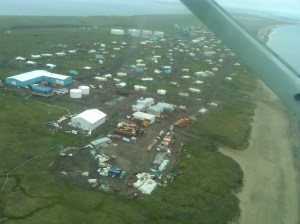
Note: The photo is a picture of the village of Wainwright, AK. The Anthropology text mentioned above is John H. Bodley. Cultural Anthropology: Tribes, States, and the Global System. Fourth Edition. (Boston: McGraw Hill) 2005. Rainey Hopson’s blog is called; “Stop and Smell the Lichen.”
http://www.salmonberryblood.blogspot.com/
71.271549
-156.751450

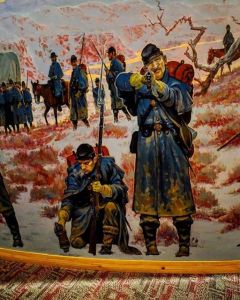 To the left is one of my favorite images from a mural painted by Shonto Begay and Mike Scovel at the Fort Sumner Memorial in New Mexico. What’s to be memorialized at Fort Sumner, you might ask? It was the site of an internment camp, one which held the Navajo people for roughly 4 years (about 1864-1868). It also held Mescalero Apaches, but Begay’s and Scovel’s mural is about the Navajo end of this story. Specifically, it is about “the long walk” to this place, still called Hwéeldi out in Navajo country.


 northierthanthou