Tags
Alaska, Anchorage, Fog, Photography, Photos, Pictures, Reflection, Sunlight, Winter

………………….(Click to Embiggen!)
.

21 Saturday Dec 2013
Posted in Bad Photography
Tags
Alaska, Anchorage, Fog, Photography, Photos, Pictures, Reflection, Sunlight, Winter
………………….(Click to Embiggen!)
.

18 Wednesday Dec 2013
Posted in Alaska, Bad Photography
Tags
Alaska, Anchorage, Creek, Fishing, Photography, Ship Creek, Tourism, Trail, Travel

Sometimes I get lucky.
Ship Creek Trail near downtown Anchorage is always good for a nice walk, even in the winter. It’s at least a little odd, because there are always factories and warehouses just beyond the trees, and of course downtown is never far away, but the trees and the water work their magic quite wonderfully.
In the summer a small shack sells fishing gear near the bottom of the trail, and a good day will see plenty of people hoping to catch something, or perhaps to just pass a little time with a rod in hand. Alongside the shack, one finds an upscale restaurant on a low bridge, all of this under an overpass. The end result is an oddly rustic (almost rural) scene nestled snug into a concrete frame. The restaurant is only open for 3-months of the year
I’ve wandered down this route a time or three now and managed to get a few decent pictures. So, let’s see…
(If you click it, it will grow!)
Ship Creek in August













Ship Creek in December








16 Monday Dec 2013
Posted in Music, Uncommonday
Tags
Bales of Cocaine, Cocaine, Jim Heath, Music, Rock&Roll, Rockabilly, Texas, The Reverend Horton Heat
What the Hell is a Rockabilly band doing claiming the Cramps as a major influence, opening for Ministry, and working with Paul Leary of the Butthole Surfers? None of these things would seem to add up to that 1950s nostalgia that always comes to mind when I hear the word ‘rockabilly’. And in the case of the Reverend Horton Heat, they really don’t. No, this band is its own kind of monster, and I love them for it. Their work often goes to 11, but for this Monday, let’s just take a minute to listen to this wholesome-sounding tribute to a bit of Texas folklore.

15 Sunday Dec 2013
Tags
Aisha Harris, Christmas, Fox News, Irony, Megyn Kelly, Reza Aslan, Santa Clause, Satire, Slate Magazine

This illustration by Mark Stamaty appeared in Aisha Harris’ original article for Slate.
What so many in the right wing echo chamber do not seem to get is that Satire does not begin the moment you are called out for making an ass of yourself. You cannot simply toss bigoted statements about the airwaves and play the irony card whenever someone says no to your bigotry. Jokes are meant to be funny the first time around, not simply when the whole world finds your position too stupid to take seriously. Even when the humor is intended one always has to content with the with-me or at-me question. And if the point of your joke is to make fun of someone’s race, gender or sexual orientation, all the laughter in the world will not let you off the hook. Humor is NOT a get-out-of-trouble-free card, especially for those who simply weren’t joking to begin with.
Granted, satire can be a tricky game to play (just ask Sarah Silverman), but an ironic intention doesn’t usually materialize out of thin air. We can generally spot some sign of it in the original moment, so to speak, or at least we should recognize that irony when it is pointed out later.
This is what makes Megyn Kelly’s I-was-joking defense of her comments on Santa’s race so ridiculous. In case you’ve been comatose for the last day or three I’ll let Kelly tell you the story, but let me just say one thing first, watch closely for the light-hearted tone of her original comments. In this clip, she tells us that her comments about Santa were meant as a joke, then plays the original clip. When the original clip comes up, let’s watch closely and maybe we can find the signals of humorous intent:
Did you see the humor? Did you hear that light-hearted tone in her treatment of the subject?
Okay neither did I.
There was nothing funny about the original segment, and that is not changed by Kelly’s forced humor in subsequent statements. She wants us to believe she was joking, but dammit, a joke doesn’t look like that, and it doesn’t sound like that. What is hilarious about this pathetic defense of Kelly’s own racism is that the very video clip she plays ought to be a positive refutaion that her own attempt to recast the moment as humor. Everything from her tone of voice in that original clip to her body posture and the complete lack of humor in all of those present should suggest that she (as the others) were taking the issue VERY seriously. …even too seriously. There is nothing in Kelly’s words that suggests any intent to undercut the seriousness of her claims; she does nothing to show us that she didn’t mean exactly what she said. Everything about he original clip suggests that she meant to be taken seriously.
It’s all just a little funnier when you realize that the original article written by Aisha Harris for slate magazine was in fact offered in a satirical tone, as Kelly herself (now) concedes. So, the bottom line is that Kelly and company read a satirical piece about a real issue (racial identification with a major holiday figure), took it as a serious threat to their own racial politics, and proceeded to pronounce, ex cathedra, that one ought not to mess with Santa’s racial identity, because he is white.
He just is.
Just like Jesus.
John Stewart and his guest (Jessica Williams)are spot-on as usual. To watch that, click here.
So irony is playing quite a shell game with us here. It is present in the piece Kelly was talking about altogether absent in her initial comments on the subject, and present only as an effort to save face in her attempt to address the controversy. …which is unintentionally ironic in the extreme. Is this irony fail or irony jackpot? I really can’t say.
Maybe it’s both.
Don’t read the comments of her twitter defenders by the way. …I mean it don’t! You’ll lose faith in humanity, or at least I did, which is odd considering that I didn’t think I really had any faith in humanity before this, but anyway…
Kelly does have one defender worth considering, though his defense is flawed as Hell. Reza Aslan a Professor of Creative Writing and historian of religion at the University of California, Riverside, tells us that Kelly was actually right about something, sort of. He tells us that she was right about Christ, but not Jesus. Jesus, Aslan tells us was the historical person in question. Jesus would most certainly not count as a white person, as Aslan tells us, but Christ, the cultural construction of Jesus as a God is most certainly white. So, Aslan is trying to tell us that the vision of Christ near and dear to Kelly is certainly white whereas the historical reality of any person whose life might have served as the inspiration for that vision is not.
Okay that’s interesting. It just isn’t all that helpful.
See the problem is that Kelly was not just telling us that Jesus is white as he is imagined in western religious traditions; she was telling us that he really was white. Hell she still hasn’t quite wrapped her mind around the fact that he most certainly wasn’t but apparently she has learned enough to concede that the matter is open to question.
It isn’t.
The bottom line is that Aslan is introducing a distinction that his subject matter does not make which is ironic. More ironic still, Aslan is using this highly flexible manner of speaking about Jesus to defend someone who was most emphatically denying any flexibility to the notion of Jesus whatsoever. She wasn’t telling us that Jesus was white to her and a number of others; she was telling us that it was wrong to think of Jesus as anything but white.
This is the sort of thing that has always bothered me about the study of comparative religion. Too often it seems to amount to a claim that religious faith in general is a good thing even if any particular faith is problematic. I can accept that religious institutions may produce a wide range of wonderfully positive values but I expect those fall in an undefined array of social benefits whereas those who study comparative religion often seem to want to locate them in religiosity itself. It’s an ironic form of apologetics that always seems to stop just short of a literal defense. But that’s just my general beef with the academic field of religious studies; it bears a strong resemblance to Aslan’s effort to rescue some value in Kelly’s views even as he acknowledges their inaccuracy as applied to actual history. The trouble is that Kelly herself isn’t really cooperating with his analysis. She was talking about the history even as she was also talking about the religious imaginary.
And that brings us back to Kelly’s disingenuous attempt to hide her bigotry under the guise of humor. She wants to remind us that both she and Harris acknowledged the same thing, that Santa and Jesus has historically been thought of as white but of course this would h=be a half truth if it were even a little truth. Kelly misses the alternative visions that are in fact out there. More to the point, she is opposed to those alternatives.
Make no mistake Kelly was telling us to say no to anything but a white Jesus and Santa, and she was not joking.
I think I prefer to say no to racism.

12 Thursday Dec 2013
Tags
Economics, Equity, fairness, Free Market, Libertarianism, Monopoly, Poverty, The Landlord's Game
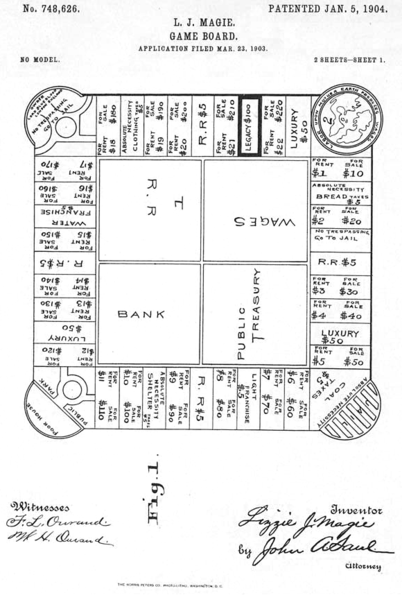 Poetic injustice!
The forerunner to monopoly was intended to demonstrate the evils of …well, monopoly. It was particularly intended to show the long-term consequences of private land ownership in America, and one of the games more interesting features included an option to pay rent into a community pot instead of private landowners. Needless to say, that is not the game we play today.
If Elizabeth Magie intended the Landlord’s Game to illustrate the evils of a real estate market, the end result of her efforts has been a century of people celebrating that very thing. When all the dice of rolled and all the mice have been moved, the end result of this game is one player joyously happy with his acquisition of everything in sight. Far from mourning their own financial tragedy, the losers are often eager to start again, each hoping be the bad-ass rich-guy the next time around.
Christopher Ketcham detailed the evolution of Magie’s creation into the modern game of Monopoly last year. As Ketcham makes very clear, the modern version of Monopoly celebrates precisely what The Landlord’s game decries, but that is not merely something as simple as the ‘free market’ or ‘capitalism’; it is rather the defeat of the market by the development of propertied interests:
A few weeks before the tournament, I’d had a conversation with Richard Marinaccio, the 2009 U.S. national Monopoly champion. “Monopoly players around the kitchen table”—which is to say, most people—“think the game is all about accumulation,” he said. “You know, making a lot of money. But the real object is to bankrupt your opponents as quickly as possible. To have just enough so that everybody else has nothing.” In this view, Monopoly is not about unleashing creativity and innovation among many competing parties, nor is it about opening markets and expanding trade or creating wealth through hard work and enlightened self-interest, the virtues Adam Smith thought of as the invisible hands that would produce a dynamic and prosperous society. It’s about shutting down the marketplace. All the players have to do is sit on their land and wait for the suckers to roll the dice.
Smith described such monopolist rent-seekers, who in his day were typified by the landed gentry of England, as the great parasites in the capitalist order. They avoided productive labor, innovated nothing, created nothing—the land was already there—and made a great deal of money while bleeding those who had to pay rent. The initial phase of competition in Monopoly, the free-trade phase that happens to be the most exciting part of the game to watch, is really about ending free trade and nixing competition in order to replace it with rent-seeking.
What strikes me most about the passage above is just how much more subtle it is than common notions of equity guiding popular (and particularly conservative) media. Today’s defenders of the free market are tone deaf to any real difference between the creative bargaining characterizing the early phase of a Monopoly game from the rent-vacuuming process that comes to define its actual victory. I cannot help but wonder if this isn’t to some degree because much of Libertarian thought is actually a defense Aristocracy, a calculated holding action against anyone who might have noticed the game in America (and the world) has long entered the phase at which a final outcome is clear so to speak. The creative possibilities which may have defined the early growth of market economies have long since given way to a process wherein we all simply watch the wealthy take their profits.
…from us.
When I hear people defending the free market, I see little sense for such distinctions. Too often, such folks advance a vision of equity summed up in the phrase “equal at the starting gate.’ It is a mantra used most often to hold off affirmative action, progression taxation, and any number of attempts to help those on the losing end of the market, and it is a mantra that reassures us of the basic fairness of equal treatment under the law. It is a mantra that calls to mind that early moments in a monopoly game; the ones in which ever player can still imagine the possibilities, still see themselves as a potential winner.
The phrase “equal at the starting gate” could only apply to the outset of something, but in economics, there simply is no starting gate. The production of inequality is always an ongoing process into which each of us is dropped and out of which each of us will be taken without any real resolution of the game, so to speak.
This is one respect in which the game of Monopoly absolutely fails to illustrate the nature of capitalism; it doesn’t show people living with the consequences of inequality. It doesn’t emulate a life lived in the red so much as the struggle to achieve a life lived in the black (preferably including Park Place). Perhaps that is one reason for the success of monopoly; whatever its original intent, it has proven to be time-honored promotional piece for the social orders embodied in modern capitalism. For a little while, anyone with a few good die rolls and a smart purchase can be captain of commerce, and to most people that sounds pretty cool.
In real life, we don’t get to start over. We just keep right on playing long after some folks have bought up the world around us, and the frustration of paying fees with every step you take and falling further behind with every turn becomes for many a forgone conclusion. That sense that comes toward the end of a losing game, the moment you realize that your money will be going to another player until it’s over thus becomes an absolute reality from the cradle to the grave, …just add the urgency of food, medical bills, and any hope of accomplishing anything before death itself tells you it’s time to leave the table.
But of course the game goes on.
And the child of yesterday’s winner does not start with the same bank as those who lost to him. Indeed generations upon generations simply keep building up their leverage over the total market and those who start with nothing can count on little comfort from rules that supposedly treat them just the same as the guy with all the cash. In the real world, we do not begin with equal cash and equal opportunities. In the real world player A begins with millions and player B begins with a few thousand Player C starts in debt, and Player D has a few hundred.
There now start rolling the dice!
 But the prospect of using Monopoly to comment on economic realities remains interesting, if only as a thought experiment. To model the actual market, we have to add a few other quirks to our Monopoly Game.
Let us take out Millionaire (Player A), name him Joe (Donald would be just too obvious!). Our several thousand-air, we shall call Anne (Player B). The poor chap who started in debt (player C) we shall call Ralph, and the almost-lucky gal with a few hundred we will call Marcy (Player D).
The first thing we have to do is connect the differences in wealth to differences in the health and education of the participants. For this purpose, we’ll will show Ralph and Marcy only about half the rules. The rest they will half to figure out the hard way. It is tempting to model inadequate health care by making Ralph sit on a thumb-tack and forcing Marcy to slam a couple of Long Island Ice Teas just before the start of the game, but that would be just cruel. So let’s just go with the incomplete rule thing. Now when our less privileged players make mistakes on account of their lack of knowledge, Joe will no doubt make fun of them, or at least laugh when his smart-assed buddy Rush makes fun of them from a spot across the room. Anne may not be so mean, but both she and Joe will no doubt count their mistakes against them when Marcy and Ralph end up doing poorly. To complete the analogy here, let us just imagine that Joe’s friend Billy will sit through the whole game provide a full-time commentary on just how bad Marcy and Ralph are at the game. Billy is of course quite the wit.
…is friends usually just call him ‘Fox’.
But it’s worse than that, because of course all of this assumes that the rules are set in stone. Not a chance! No the rules of play are constantly evolving. We have to model that somehow, and we want to be totally fair about it, so each of the players gets to vote on a single rule change every so often (say after each player has taken a turn). Of course a democratic rule process would make each of their votes count equally, but we have to find some way to model the impact of the media and campaign finances, personal connections, etc. So, we’ll just say that you can get an extra vote for every $250.00 you put back in the bank. Marcy and Ralph will soon have a host of rules working against them, and they will no doubt complain about the unfairness of each such rule, at which point Billy will call them ‘special interests’, and another commentator named Antonin will be happy to explain that the rule-making process must be allowed to continue unfettered by anyone pretentious enough to think she might know fair from figs.
I suppose we should add another spectator named John who will be happy to tell Anne that she shouldn’t help Marcy out; that would be enabling bad play.
If we want to get really serious about this, then we have to find a way to replicate the laws of supply and demand, making the property values shift up and down depending on the interests of the players, but our game of 4 makes that a little hard to do. Plus, we have to questions of elasticity, and, well… nevermind. This is over-extending the metaphor.
But of course I am loading the comparison up in favor of a morality tale in which Ralph and Marcy get screwed by the system. To be fair, they should enjoy a range of public utilities police, fire departments, education (however inadequate). All of these provisions may be skewed to favor Joe and Anne yes, but they do exist, and we may add to them a certain range of welfare provisions designed explicitly for the purpose of keeping Marcy and Ralph in the game. But maybe that is the real point of this meditation, because such measures are precisely the features of our real economy most commonly attacked in the name of the game rule vision of fairness. Why should Joe have to pay for Ralph’s laziness? And why shouldn’t Anne and Joe get a better education (a more complete set of rules) if they can pay for it? And so on…
Any attempt to help the unfortunate would seem to run up against a vision of fairness as a procedural matter, as a set of rules which must treat everyone equally, and I can’t help but think an awful lot of people are using games such as monopoly as a source-model for their thinking of such issues. A significant portion of the general public seems to begrudge the provisions for public welfare, the few things that might give Ralph and Anne a chance. Let’s be honest I do not mean a chance to become wealthy, to win at the game so to speak. If there ever was a time when the free market afforded the poor (or even the middle class) a meaningful chance to move up in status, that time is well past. Barring the lotteries of celebrity fame what we are talking about is a chance to live one’s own lives with a measure of dignity, perhaps to own one’s own home and to control one’s own life.
…or simply to receive adequate healthcare.
We can talk about the pros and cons of any number of policies, but those debates are always skewed by the voice of those who would have us believe in the essential fairness of the game, so to speak. Such voices are quick to point out the unfair edge that any attempt to help Marcy and Ralph will give them, but they are damned slow to acknowledge the unfair edge that the game itself gives to Joe and Anne.
And of course the worst thing about all of this is the notion that it is all just a game, that our economy is here to help us sort the winners from the losers.
…as if the sorting were not itself an act of violence.

09 Monday Dec 2013
Posted in Bad Photography, Uncommonday
Tags
Alaska, Houston, Houston Alaska, Pie, Pond, Road Trip, Sculpture, Skeeter, Small Town

.
This summer, I drove all the way from Anchorage to Houston.
It took about an hour.
.
.
I missed the main residential district, but I did stop to enjoy an apple pie in a lovely restaurant by a beautiful pond. Anyway, this is my second Houston. I think I like it.
…or at least its pies and its ponds.







05 Thursday Dec 2013
Posted in Religion
Tags
Authority, Cultural Conservatism, Dictionary, Language, Rhetoric, Semantics, Semiotics, Vocabulary, Words

Consulting Lexi-Kitties
I am continually amazed at the faith some conservative Christians place in the authoritative pronouncements of a single ancient book. No, not that one. I am talking about the dictionary.
…pardon me, ‘thuh dictionary’.
I have long since lost track of the number of times someone has told me what this or that word means according to ‘thuh dictionary’. It could be any word, but frankly, the most common ones to land me in front of the court of lexicography are ‘homophobia’ and ‘atheism’. Significantly, I don’t think many of the people who launch into this sort of dictionary-whinging gambit have even looked up the words they hold court over. If you ask them which dictionary, they will often tell you ‘Websters’, as if that meant a damned thing!
Dictionary-Whinging (Sorta verb-like, but more gerundy) Pronounce the g like a j, dammit. It means being a jerk, but a certain kind of jerk. …a jerk with or over a dictionary.
Sometimes folks will invoke the power of ‘Merriam-Webster‘. This at least is a real entity, a branch of Encyclopaedia Britannica, so that will at least tell us something about the source, but it doesn’t do much to pin down the book in question. As to the name ‘Webster’s’? That is in the public domain. Anybody can publish a Webster’s Dictionary. You, me, the homeless guy down the street could write out a couple definitions and call it a “Webster’s Dictionary” Hell I could translate my cats noises and call it a Webster’s Dictionary.
In fact, let’s do that!
WEBSTER’S COLLEGIATE DICTIONARY OF ARCTIC CATISMS
Compilerized and Authoritated by Daniel S. Dammit
July or maybe December, 2013.
Editorial Staff: Fido, Junkmail, and Auto-Kitty
Mrrour: Pet. (e.g. ‘Pet me please!’)
Me’a’our: Pet, used with a sense of urgency (e.g. ‘pet me now dammit!’)
Mmmmmeuurrrrrr: Pet, used in a polite way (e.g. “If you have a moment, could you please pet me, …and perhaps change teh literbox. …no hurry.”)
Meow: Ironic Usage. It means; “I don’t actually sound like this human. You are imagining things.”
Meeeh!: Head-Butt (e.g. I’m lonely, human. Please head-butt me this very instant.”)
There. That’s my Webster’s Dictionary. Suck it Lexi-Judges! You have to use that now when you interpret cat. I has spoken.
(Aside over. We now bring you back to your regularly scheduled, cat-free, post.)
The bottom line is that a significant portion of people citing the authority of ‘Webster’s’ are simply bluffing. They haven’t looked anything up, much less thought about it. I guess they figure the meaning of the words in question is so obvious to anyone but the idiot they are talking to (which if often me) that there is no real need to consult the authority of the imaginary lexical-judge; it goes without saying that this good Justice will back their own understanding. I guess the spirit-filled just know what thuh dictionary would say.
It seems to me that some people look upon a dictionary as a judge of sorts, or maybe a legislature, both if they get their way, but most of these folks are happy to admit that ‘thuh dictionary’ is not an executioner. No, that is a role they hope to play themselves.
One thing I find quite amusing about all of this feigned dictionary-deference is that it always works best with the really bad dictionaries. You see a good dictionary will include a number of entries spelling out a variety of different uses of a given term, but the ideal dictionary for the the lexical authoritarian contains just one reference for every word. So, on the off chance that he actually bothers to look anything up, our dictionary-whinging fellow is not going to want to bother with anything resembling choice. He wants a single entry, and (Webster’s willing) he will present that single entry as clear and convincing proof that the word in question has just that one proper meaning. …thus effectively turning the weaknesses of an incomplete dictionary into a virtue. For these purposes Dictionary.com will serve the vocabulary fascists much better than the Oxford English Dictionary. Webster’s Third New International would be right out, …at least it would be if such folks knew enough about dictionaries to realize what that infamous source of lexical permissiveness contains.
Which brings me to a second point of amusement about the art of dictionary-whinging. Its practitioners seldom (perhaps never) understand how dictionaries are actually made. They haven’t studied lexicography, and they haven’t even read the methodology section of any given dictionary. Most, probably don’t even know that such a section exists; it fits in those automatically skipped pages at the beginning of the book they aren’t actually reading anyway. These folks certainly haven’t read Samuel Johnson’s preface to his Dictionary of the English language or any other thoughtful discussion of the topic. If they did, the first thing they would find is that lexicographers generally don’t work the way they think they do, and they don’t intend their dictionaries to be used the way they think they do.
Now let me give you a minute to parse all the ‘they’s of the last sentence. Wait a minute! I sense a new volume of Webster’s coming. Here it is:
WEBSTER’S NEW NOT-SO-COLLEGIATE DICTIONARY OF DANOLOGICAL THEM-ITUDE
Compiled on a Lark, 2013
They: Them.
They2: Those people.
They3: Them other guys.
They4: They (like I sad …dammit!)
They5: I obviously don’t get laid often enough.
Anyway, my point is that with the possible exception of early editions of the American Heritage Dictionary, lexicographers are not legislating and they are not adjudicating language. They are informing us about common usage. In short, their approach is descriptive rather than prescriptive. This is exactly NOT the approach that those seeking to use dictionaries authoritatively would wish it to be.
To put it another way the judge in this instances refuses to do his job as the dictionary-whinging bastards of this world would have him do it. What dictionary-makers consistently seek to do is provide us with a responsible account of the way language is actually spoken and the meanings of words that people speaking a given language actually use. What the dictionary-whinging types consistently want is an authoritative pronouncement delivered from on-high about just what meanings we SHOULD be attaching to any given word. They want the dictionary to tell us how to use language.
That really should be end-game folks. When the judge doesn’t adjudicate; it oughtta be case-dismissed, but that is almost never the case. Pretty much every one hitting me over the head with an imaginary Websters will just go right on doing it after they have just been shown that their weapon of choice is not really meant to be used that way.
Dunning and Kruger should demand that such folks return their effect with interest.
My rant began with a reference to religious folks though, didn’t it? Okay, it did. To be fair, this is a post I dropped several months ago and just picked back up. The sticking point was just that. Do I really want to talk about the general misuse of imaginary lexical authority? Or do I want to explore the specific role of such practices in the thinking of pious people. Tonight, my solution is this. I will make just one point about the religious variation, and that is this:
It is sort of fitting to find that people who wish to approach life as though it must be lived according to a specific set of directives from on-high would replicate that model in their approach to language. This is the prescriptive life well lived. They find an ought-to in every decision and an essential meaning in every word, all hard-wired right into the universe itself. Actual language use then becomes a set of cases fitting clearly into categories of right and wrong, just as anything else one might do in a world defined by an ultimate Legislator. The deus ex machina that some folks look for in a dictionary is thus pretty much the same one they commonly proclaim outright in their other book-weapon of choice.
So much for the arbitrary nature of the sign!

02 Monday Dec 2013
Posted in History, Native American Themes, Uncommonday
Tags
American Indians, Anheuser-Busch, Cassilly Adams, Custer's Last Fight, Custer's Last Stand, George Armstrong Custer, History, Little Big Horn, Native Americans, Sioux

(Click to embiggen)
This painting is one of the reasons Custer is still remembered as a hero in some quarters. To quote a fellow-blogger:
In 1884, eight years after George Armstrong Custer’s death, the Anheuser-Busch brewing company commissioned an original oil painting, Custer’s Last Fight, by Cassilly Adams. It was reproduced as a lithograph by F. Otto Becker in 1889 and distributed as an advertising poster by Anheuser-Busch. This depiction of the Battle Of the Little Bighorn undoubtedly hung in more saloons than any image before or since, and fixed the iconography of Custer’s last moments in the national imagination.
I am told the image represents the terrain at Little Big Horn reasonably well, though some question its depiction of the soldier’s uniforms, the lack of guns among the Sioux, and of course Custer’s heroic posture in those final moments is open to more than a little doubt. What makes this image a truly golden bit of absurdity, however, would have to be the Indian shields.
…just a little off.

hm…
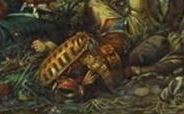
hmmm again!

Ahem!

01 Sunday Dec 2013
Tags
atheism, Critical Thinking, Debate, Film, Movies, Religulous, Reliion, Rhetoric, Sarcasm
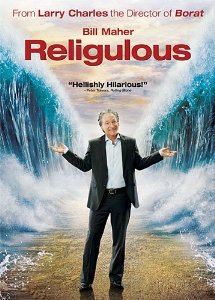 So I finally watched Religulous. I found it a truly underwhelming experience. Honestly, I think I must be over the joys of poking holes in religious thinking. In other news, boxing with Girl Scouts no longer brings me quite the same thrills that it used to.
…at least on Thursdays and Saturdays. It is entirely possible that I may relapse on Tuesdays and Fridays.
Okay, it’s not always that easy, I know; sometimes I meet a religious person with genuinely challenging thoughts, but perhaps that is my point. One can find a pretty broad range of qualities fitting under the heading of ‘religion’, and it can be just a little too easy to look for the easy pickings. Some people treat debunking religion as a sport, and those people rarely seek out the challenging thinkers. No, they hunt the naive in remote and highly uneducated corners of the globe; they sniff out the cooks and the crankcases. I should point out that the sport-debunker isn’t always an atheist, but of course, this time it is.
Religulous is the intellectual equivalent of a canned hunt. In this movie, Bill Maher seeks out and makes a fool of one believer after another and I cannot help but think most of those interviewed have been selected for their capacity to appear nutty to the rest of us. Maher does little to explore the intellectual lives of any of those interviewed in Religulous. His discussions bear a strong-resemblance to a cross-examination in a courtroom (or at least a courtroom drama). Maher’s questions rarely veer far from the effort to produce a contradiction or an implausible claim, and he doesn’t hesitate to interrupt, argue, or insult his subjects at any point in the movie. Not wanting his subjects to go-off half-mocked, Maher includes several segments in which he trashes those already interviewed while driving about, presumably on the way to the next ambush interview. When he does interview intelligent believers, Maher’s sole interest seems to be getting them to help debunk their brethren. The most interesting and complex thinkers in this movie would easily include a number of Priests but they are of interest to Maher only insofar as they help us to dismiss the beliefs of others.
I have to admit, there was a time when I would have been into this. Now, I just find it rather predictable.
…and pointlessly rude.
Ironically, I think Maher’s snide disrespect for his quarry in this film actually blunts the force of his criticism and lets them off the hook. In interviewing John Westcott, an ex-gay minister, for example, Maher makes a point to suggest the sexuality of the man’s children remains in question. In the commentary track, he further laughs at the irony of a man denying his homosexuality when Maher can tell by his behavior that the man is gay. Personally, I think this underscores the irony of a man proporting to call a believer to task for mistreatment of homosexuality while exhibiting all the insight and sensitivity one might expect to find in the boys locker room of a high school football game. Maher’s games do absolutely nothing to reveal the intellectual dishonesty and outright harmfulness of ex-gay therapies and related ministries. While Maher plays to the cheap seats by making fun of the man and his children, the interview goes nowhere. Maher learns nothing about the minister’s actual point of view, and he does nothing to show us just how harmful these organizations can actually be.
And I wonder if I am supposed to be pleased with this?
Maher is casting religion in a bad light, and in this movie (as in other contexts), he does sometimes score a hit, or even a home-run. I should be able to enjoy this, and I would, if I thought Maher was doing a consistently good job of it, but what bothers me most about this movie is a sneaking suspicion that it isn’t an exercise in healthy skepticism, that in fact Maher is selling a message that doesn’t quite fit the label on the packaging. Shallow as it is, Maher’s engagement with the proponent’s of God-talk is not merely intended to show us how foolish they are. He is building a narrative with assumptions going well beyond the foibles of his hapless quarry.
One particularly telling moment occurs during an interview with a Muslim cleric. the man’s cell phone goes off, and the ringtone is Led Zeppelin’s Kashmir. Maher suggests that this is odd. The prospect that a song called ‘Kashmir’ might strike a cord with a Muslim seems to have completely escaped him. More to the point, he doesn’t ask why the Cleric uses that ringtone or what it means to him. To Maher it seems to be self-evident that the Cleric’s choice of music reveals an inconsistency. He drives this point home further in the commentary track, suggesting that people steeped in outdated beliefs should not get to use modern conveniences.
The mode of engagement used here is consistently that of polemics. Maher wants to poke holes in religion; he doesn’t want to understand anything else about the people he is talking to, or at least he doesn’t want to show us anything else in the final cut of the movie. To describe the end result as superficial would be giving superficial a bad name. But of course there is something a little more insidious at work here. It arises in the notion that religion is simply outdated, that the cleric’s interest in a cell phone is simply incommensurate with religious beliefs. This is old fashioned unilineal evolution, the belief that human history follows a set course. To Maher (and evidently his producer) it goes without saying that religious beliefs are chatter out of place, so to speak, and that history is incomplete so long as these throwbacks remain with us. This is the key to his polemic approach. He wants to show us that religion is stupid, urge us all to leave it all behind, and thereby advance one further step in human history.
In taking this approach, Maher is unfortunately (and ironically) doing a good deal more than debunking the beliefs of his interview subjects; he is advancing a faith of his own, a faith in Progress with a capital ‘P’, and a specific vision of that Progress. The film ends with an emphasis on growing conflicts between Muslims and Christians, and a recurrent expression of fear that these faiths will lead us to nuclear disaster. Maher addresses the claim that these conflicts are really political, and of course it is easy enough for Maher to assert that they are also religious, but of course this is a unique marriage of the fallacies of straw man false alternatives. The question is not which category various conflicts fall into, but rather how politics and religion intersect in actual human history. That is a question Maher is completely unprepared to answer, or even ask. He relies on a stock vision of humanity’s course throughout the film, and herein lies the value of his deceptively simple interview agenda. So long as we are focused on the foibles of the faithful we may not take the time to think critically about Maher’s own millenarian vision of the future.
This is bait & switch.
Maher quite rightly calls some of his interview subjects to task for glossing over the role of faith in political violence, but his refusal to address the politics is itself a telling source of ignorance. He is telling as simple story in which the source of modern evil is found in beliefs and beliefs alone. If only we can deal with the bad beliefs once and for all in the fashion of lunch-room debate tactics, then the world will be a better place.
In advancing this simple message Maher shows us that he has a lot more in common with believers than he would suppose.

25 Monday Nov 2013
Posted in Anthropology, Uncommonday
Tags
Anthropology, Cricket, Cultural Change, Cultural Diffusion, Culture, Maasai, Sports, Trobiand Islands
Just what ain’t Cricket? I really wouldn’t know the answer to that question, but I am occasionally quite amused to find out just what is cricket, or at least who has learned to play and how they play it. More than most of the big world sports, it seems that cricket lends itself to regional variation, and there are some really interesting variations out there. I’m not a very sporty guy, but I’m thinking Kilikiti Estonian style out on the lagoon for Piuraagiaqta.
Oh yes!
Kilikiti (Samoan Cricket).
This Masai team appears to play a pretty standard version of the game, but you wouldn’t know it from their uniforms.
And heading back out into the Pacific, we get Trobriand Cricket.
This is how they do it in Estonia.
 northierthanthou