• About

northierthanthou

northierthanthou

Author Archives: danielwalldammit

Time Heals All Wounds …Unless it Doesn’t

10 Monday Jun 2013

Posted by danielwalldammit in History, Narrative VIolence, Native American Themes

≈ 40 Comments

Tags

Accidental Racist, American Indians, History, Holocaust, Memory, Native Americans, The Long Walk, Time, Tragedy
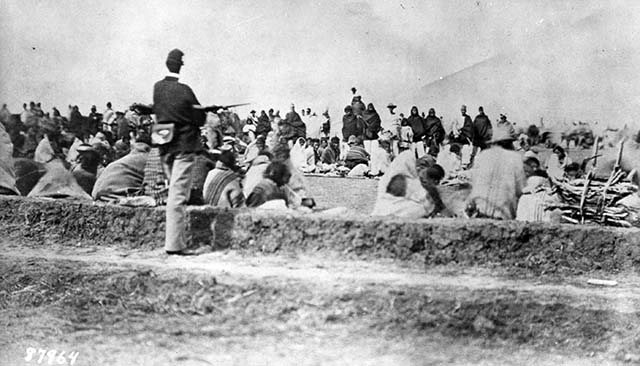
http://www.newmexicohistory.org/filedetails.php?fileID=494

http://www.newmexicohistory.org

A career in Native American studies makes you the grammatical equivalent of a time machine. No sooner do people learn where you work, what you study, or what specific things you happen to be working on than they suddenly switch to past tense. Often this will be accompanied by sad tones and slightly downcast eyes. Seriously, I’ve lost track of the number of times a few comments from me have led people to great moments of reflection about “what we have done to them.”

These moments of introspective time-travel usually leave me with a bit of motion sickness. See, the thing is that people go back to the past like this when I am actually talking about perfectly contemporary issues. When I worked on the Navajo Nation, simply telling folks what I do for a living was often enough to send their souls searching through history for resolution of collective sins, real or imagined. In most cases I don’t think folks had any real sense of the specifics in question, no real idea of just what Anglos had done to Navajos, for example. In most cases, I suspect the sudden trip to the past tense was filled with thoughts of generic cowboys and even more generic Indians, …who probably looked more like Lakota than Navajos anyway. In any event, the problem is simple enough; for far too many people Native Americans simply belong in the past.

…and yes, I do wonder just how often Native Americans get this? Perhaps it’s a white thing after all. I don’t remember getting this effect in the presence of natives, just when it’s me talking to my own, so to speak.

Anyway, I figure it makes it a Hell of a lot easier to be sorry about something if it happened a few generations back. Try to talk to people about issues such as uranium poisoning, forced relocation, or any number of contemporary issues, and they are less certain that what ‘we’ are doing to ‘them’ isn’t somehow justified, or at least necessary, or at least.

But folks are happy to talk about Custer.

Wasn’t he a bastard!?!

Rarely do I get the sense that this sort of time warp is meant to provide historical perspective; often it strikes me as just one more way of changing the subject.

Of course somber regrets for crimes long forgotten are only the nice-guy half of this coin. Flip the quarter over and you get a range of narratives effectively using time to disclaim responsibility for these same crimes, perhaps even a comment to the effect that it’s best for Native Americans to put the past behind them. Occasionally people will actually tell me that reservations or casinos, etc. are attempts to pay for what ‘our ancestors’ did, and of course the point is always to suggest that such concessions are unfair to the rest of us here in the present.

And no, this time-to-forget theme is not limited to Native Americans. One has only to suffer his way through “The Accidental Racist” to hear Brad Paisley play precisely this shell game with history. I don’t have the stomach to parse the details of this terrible tune, but let’s just say that Brad is apparently paying for the mistakes of a southern past, and L.L. Cool Jay is happy to let bygones be bygones.

…Seriously, both of them should have known better.

It’s funny those who support the rebel flag are always prepared to discuss its significance in the civil war. Rarely do they want to comment on its use in opposition to the civil rights movement.  History textbooks probably don’t make this much easier, telling us that slavery ended with the close of the civil war. Sure they note the existence of debt peonage and Jim Crow Laws, etc., but that is a more complex story. The morality tale for most people ends at Appomattox. I suspect it is the story of slavery that many will imagine when they ask why African-Americans have trouble putting the past behind them. The notion that some folks can still remember when there was real danger in looking a white person in the eye just seems to escape a lot of people.

…most of them white.

But what’s past isn’t equally past for all people. I learned this very clearly out in Navajo country. The nadir or their historical narratives begins with the story of the Long Walk. In 1864 Kit Carson burned marched through Navajo country, burned their crops and destroyed their homes. He then waited for winter to bring them to him.

It worked.

The result was 4 years of internment at a place called Fort Sumner in Southeastern New Mexico. Many of those who started the “Long Walk” to Fort Sumner didn’t make it to the end.

When my friends, students, and coworkers told me their stories about the long walk, what struck me most about their narratives was the way they always began.  They almost always began with a clear reference to some family member. These weren’t simply stories about something that happened to their ancestors; they were stories about the death of a Great Aunt or the trials of a Great Great Grandmother. People telling me these stories consistently anchored narratives of the long walk in their own relationship to one of those who had been through it. These were not stories about an event over a hundred years ago; they were intensely personal stories of family tragedy.

I’ve heard similar stories, …from my high school history teacher, for example. A native of Georgia, her account of Sherman’s march included a great grandmother’s efforts to save a family heirloom (she stuck it on a wall in the hopes Union troops wouldn’t notice). When I taught briefly at a Jewish private school in Houston, I heard such stories from survivors of the Holocaust. More importantly, my students heard those stories. They hear them every year, directly from the survivors, and in countless other contexts throughout the year. I’ve heard such tragic narratives from Inupiat speaking about the horrors of influenza epidemics brought by whalers and the trials of the boarding schools. Exposure to virgin soil epidemics is hardly ancient history on the North slope, and most any native can tell you about some elder who was punished for speaking her own language at the schools. What all these narratives have in common isn’t simply tragedy; it’s direct personal connection to the suffering.

Of course, the suffering in some of those stories is greater than that in others.

People don’t just forget these sorts of events. They keep them alive; they keep them personal. The suffering becomes part of the meaning of history, and part of the personal identity of those that have been through it, of their children, and their children’s children.

Whether or not such stories should be kept alive in that way is a whole other question, and a rather ironic one at that. The suggestion that people subjected to injustice ought somehow to simply move on has more than a trace of might-makes-right in it. It is an attempt to suggest that certain horrors are simply an accomplished fact, as are the long-term consequences of those horrors; land lost, buildings and nations built for the benefit of someone else, and whole scores of missing family – aunts and uncles not present and cousins never born, all of it, so the argument goes is just a done deal. Yet some people say that it would be best to just move on; accept all of this and focus on the future.

Best for whom?

Your land is ours now, but let’s not dwell on how that happened. Your grandmother’s language is gone now, but let’s not think too much about that. Cities wrecked? Whole populations wiped out? What’s past is past, so some say; let’s look to the future.

But if the long-term consequences of such atrocities might be thought an accomplished fact, then so are the bitter narratives.

…and the bitterness itself.

It seems those with such tragedy in their past rarely (if ever) take such advice. They remember! They remember with a passion. Here we have at least a trace of poetic justice. It seems to me quite fitting that those hoping the descendants of tragedy would accept the consequences and simply move on should run square up against one other uncomfortable and very stubborn fact, namely that folks just don’t forget such things.

They really don’t.

71.271549 -156.751450

Share this:

  • Tweet
  • Share on Tumblr
  • Print (Opens in new window) Print
  • Email a link to a friend (Opens in new window) Email
  • Share on Reddit (Opens in new window) Reddit
Like Loading...

Wandering in Place

05 Wednesday Jun 2013

Posted by danielwalldammit in Write Drunk, Edit Stoned

≈ 29 Comments

Tags

Blogging, Creative Writing, Dead-Air, Genres, Nonsense, Stream of Consciousness, Writer's Block

Fido hiding with my thoughts

Fido must be hiding with my thoughts. Little bastard, bring me my thoughts back!

There once was a boy named Dan. He sat down in front of his computer and thought real hard. But on this day, he had nothing really to say. Dan thought, and he frowned, and he even tapped out a word or two, but nothing much came to mind. The big bad delete button ate all his work. Dan pouted and said; “foo on you, bad button.” But the bad delete button just laughed and told Dan it was his own fault.

Silly Dan. Only a Dummy-Butt sits at a computer with nothing to say.

The blank page mocked Mr. Dammit as he sat in silence contemplating this new quandary. Where had the words made off to? China-town? The casino down by the back alley? Perhaps they were sitting right now with a hot dame having a laugh on Dan’s behalf? There may have been a million stale stories to tell in this sinful city, but not one of them planned on spending a moment in this blogger’s thick skull, not today. What happened, Mr. Dammit wondered? And why in the Hell had he taken to referring to himself in the third person?

Three clues presented themselves to Mr. Dammit’s attention, a giant sucking sound somewhere in his head, or perhaps his heart, a sick feeling in his gut, and silly succotash filling the veranda with purple sounds and pie-happy smiles just like it was Thursday. Dan wasn’t entirely sure about the third clue, but he was pretty sure that it meant something.

Perhaps that something was an iconic relationship to the thoughtful imaginary which in its apparent absence effectively alluded to the very discursive framework which had given rise to its formation, completely over-determining the salient features of this particular subjectivity so as to elide the general significance of the mundane and occlude the purple succotash in a manner consonant with racist/sexist/heterosexist/picodegalloist ontologies firmly rooted in the praxis of neo-corporatist brownie projection.

Dan thought real hard. What was the line?

“You put hot butter on your brownie and you be havin’ a party in your mouth.”

Her breathing quickened as she responded; “will juicy flavors rave all over my taste buds?”

“They will indeed, baby,” he stood over her XXXXXXXXXXXXXXXXXXX

XXXXXXXXX XXXXXXXXXXXXXXX well, XXXX XXXXXX XXXXX XXXX yes, yes! XXXXXXX XXXX XXXXX YES!!!!

XXXXXX XX XXXX but never in these pants XXXXXXX XX XXXXXXXXXX XXX XXXX

…sadly, these memories did little to help Dan find a thought worth inflicting on his own computer. Strangely, his fingers moved without thought across the keyboard anyway. Words appeared as ghosts upon his screen, words lacking thought, like bodies without a soul. The irony, Dan thought, the irony!

Irony Hell!

Irony is a fricking hot-buttered brownie.

71.271549 -156.751450

Share this:

  • Tweet
  • Share on Tumblr
  • Print (Opens in new window) Print
  • Email a link to a friend (Opens in new window) Email
  • Share on Reddit (Opens in new window) Reddit
Like Loading...

The Village of Wainwright, Alaska

26 Sunday May 2013

Posted by danielwalldammit in Alaska, Bad Photography

≈ 41 Comments

Tags

Alaska, Boats, Flying, Ocean, Photography, Photos, Pics, Wainwright

Wainwright Street

Wainwright Street

As I’m away from the North Slope at the moment, I find myself looking at photos and such. This afternoon, I am looking at pictures of pictures of the village of Wainwright. I have been there a couple times, in the late summers of 2011 and 2012.

Wainwright is located on the coast (of course). It has a population of a little over 500, but the first time I visited the place I could have sworn it was a ghost town. I literally couldn’t see anyone on the streets. I learned later that folks were probably out hunting, and in any event people began to show up on the streets that afternoon.

I always think it’s fun to just zoom out from these little maps one click at a time. If it doesn’t show, then hit refresh.

.

You may of course click on a pic to embiggen it.

Bush planes, you never know who or what will be in the next seat.
Wainwright from above.
Wainwright Street

Another Street Scne
Church
Old Boat

Driftwood in the rain.
I was looking for walruses, worried about bears, and this is what I actually found
Another Old Boat

Boats eye view
Old House
A Dew Liine defense station

Yep, that was my ride home.
Apparently, the school is a rug free zone.
Patriotic Dumpster

Edited Sign
Serpentine Dumpster
Dumpster Gotsa Tude!

Coast
Looking the other way up the coast.
Tundra from the flight in.

…and of course the flight out (not the best video, but it’s kinda neat to see the tundra from above).

71.271549 -156.751450

Share this:

  • Tweet
  • Share on Tumblr
  • Print (Opens in new window) Print
  • Email a link to a friend (Opens in new window) Email
  • Share on Reddit (Opens in new window) Reddit
Like Loading...

A Magic Box With Many Great Messages

25 Saturday May 2013

Posted by danielwalldammit in Write Drunk, Edit Stoned

≈ 9 Comments

Tags

Commercials, Cooking Shows, Cop Shows, Lucifer's Friend, Reality Television, Ride in the Sky, Spare Time, Survivor, Television

Apparently, my inner child is a little girl

Apparently, my inner child is a little girl

Blessed are the demons in the flat box. Long have I lived without them, but now I sit once more at the feet of their nefarious lessons. They bring me great wisdom. And they bring me reality.

Shall I share that reality with you?

The lessons of the demon-box are many, but today I have learned it takes 3 booms to bang a stump, but afterward you get to piss on it. Just do it quick, because…

Winter is coming!

Food is always better somewhere else, even when that someplace else was where you once were and you didn’t notice while you were there. It’s too late though, don’t bother going back, because the outstanding diners will just be wherever you are whenever you ain’t. Accepting this fact is the beginning of wisdom.

Eric Holder gets a gas face, dammit!

Sit-com humor is largely a function of empathy. When the magic audience in the box laughs, we laugh with them. I can’t think of any other reason we would be laughing at this shit.

Okay 30-Rock gets a pass, and I actually saw an SNL skit that wasn’t entirely bad. There is a medical show that doesn’t make me want to claw my eyes out. The demons show me mercy through these brief moments of respite.

Apparently, there are trees and mountains in Alaska. They are just hiding from me.

Life is always about survival, or at least Survivor. You may think that you are cooking a meal worthy of a four-star restaurant, but no, the real point is that Bubba and Judy want you to vote Latisha off, but she’s ready to make a deal, just like swimming for big sister, and living on a deserted island. You think it’s about securing protein and building a shelter so you don’t die? No, the real danger is that Lori and Jake have formed a team and they are looking at you funny. That is the great trope of life. The greatest of life or death struggles are, at bottom, a sort of popularity contest.

Weddings are bad! …okay, we knew this, but now it’s confirmed.

Iced coffee earns you Sparkles.

Game of Thrones isn’t on nearly enough.

The cameras on a cop’s dash cam are not to be trusted. When the narrator tells me the cop quickly pushes a civilian out of the way of a crash, the camera shows me  the crash ending just before he can get started. When the narrator tells me a perpetrator is attacking the cop, I see a man clearly trying to walk away. I am convinced the magic of these cameras is powerful beyond belief.

Storage units and the people who buy stuff in them are… zzzzzzz. Who would have thunk it?

I sure hope my tiny speaker recharges soon, because I think I’d rather listen to the music demons. Speaking of which…

71.271549 -156.751450

Share this:

  • Tweet
  • Share on Tumblr
  • Print (Opens in new window) Print
  • Email a link to a friend (Opens in new window) Email
  • Share on Reddit (Opens in new window) Reddit
Like Loading...

Slavery: Still Sexy After All These Years! (Or Yes Quentin, There is a Reason it’s Called an ‘Exploitation’ Flick)

23 Thursday May 2013

Posted by danielwalldammit in History, Movies

≈ 16 Comments

Tags

Django Unchained, Fiction, Film, History, Movies, Quentin Tarantino, Race, Sex, Slavery

imagesJust what is the relationship between the events occurring inside a film and those occurring the world in which we live? I will not say the ‘real world’, because of course part of the problem here is that the ‘worlds’ in which we live are saturated by myriad narratives, preconceptions, and cultural artifacts which shape our understanding of events in ways few of us can fully understand. So, when we see something happening in a movie, it is important to grasp that this too is one more of those narratives, one more thing that shapes the meaning of events in own own lives. Just how it does that, well now that is a tricky question.

It’s a difficult question with a number of plausible answers, but I think we can rule out one answer at least, the one that says; ‘nothing’. Quentin Tarantino would seem to disagree, at least he does when he’s angry and dodging interesting interview questions. In a now infamous rant, Tarantino took the position that there was no relationship between on-screen violence and real world violence, refusing even to elaborate on this position or to explain his reasons for taking it.

(Oh yeah, SPOILERS!)

To be fair, it was the interviewer, Krishnan Guru-Murthy, that fielded the stance in a sort of complex question (at 4:30 in the clip below), but for all his belligerence Tarantino does not disavow the position attributed to him. Guru-Murthy claims that his own research has produced little in the way of an explanation from Tarantino, just a consistent repetition of this stance. It’s a common enough claim in any event, often serving as a defense mechanism, both for those that create guilty pleasures and those of us who enjoy them (and yes, I do count myself among the guilty). So long as there is no relationship between fantasy violence and real-world violence, one is free to explore the one while taking no responsibility for the other.

But of course the world isn’t that simple, and as Guru-Murthy also points out, Tarantino was happy to link his latest film to the serious issues of slavery, even taking taking credit for starting a dialogue about that subject. He also takes credit for the cathartic violence he puts on screen, but has little to say about the ‘real’ violence perpetrated by the villains against their slaves on that very same screen. But are we really to believe Tarantino means us to feel emotional investment for Django’s acts of revenge while sitting guiltless through the torture and slaughter of innocents throughout the film? Does the elaborate detail of ‘Mandingo fighting’, the ‘hot box’, and the vicious execution of a slave torn apart by dogs leave the viewer without any sense of complicity for the “brutality of the violence of the day?”

Tarantino’s own writing belies this approach. His villains are too clever, their speeches too fascinating, their point of view far too prominent in these moments to dismiss. The victims of this violence remain largely silent. We know that the Mandingo fighters suffer and regret what they are forced to do, we know that Django’s love interest is defiant, and that she suffered greatly for it, and we know that the man torn apart by dogs could not bear to fight again; none of these characters really say much in the movie. They do not introduce interesting plot twists; they do not dazzle us with fascinating speeches. They suffer just as we would expect them to, providing us with no insights at all into the world in which they live.

Those that inform us about this movie are the killers. DiCaprio’s Calvin Candie explains quite clearly what he expects of his slaves before setting the dogs loose. Dr. King Schultz (played brilliantly by Christoph Waltz) introduces us to the fascinating world of bounty hunter, one who would see a man shot in front of his child but who balks at seeing another torn apart by dogs. And of course we understand Django’s motives; his goals are the driving force of the movie; it is his killings which provide us with the final pay-off, the glorious conclusion of the film.

It is consistently the logic of those enacting violence which Tarantino fleshes out for us in this film, and as always, he does it ever so well. The victims are there to suffer, and to provide a pretext for the ‘cathartic’ violence that is to come. In short, Django consistently draws us into the viewpoint of the killer; the movie does this when the killer is a villain, and it does it again when he is a hero. This is the myth of redemptive violence presented in a special way that allows us to have our cake and eat it too. We can enjoy Dicaprio’s sadism just as we will enjoy his downfall. If there is a moment of regret in a scene, or a brief period in which we might wish for the suffering to simply stop, well that moment passes in due time, transformed as it were into the rationale for yet another killing. In Django, we understand the killers, the victims are simply silent.

But villains gotta be villainous, don’t they?

Of course they do, but what is lacking in Django is a genuine counter-balance, any real sense of what is at stake in this story for anyone who is not a killer. When our principal reward at the end of the story is the death of the bad guy (DiCaprio or Jackson, …or so many others), we are never far from the mindset of the killer. In the end, Django leaves a wanted man, accepting this fate without so much as the blink of an eye, his wife drawing a rifle as they ride off from the scene. Two lives now wholly engulfed in violence. If this is a victory, it is at least partially a victory for the world of villainy.

…which brings us back to the initial question, just how does this story relate to the realities of violence in everyday life? I honestly enjoyed much of this movie, as I did with Inglorious Bastards. (Yeah, I know about the spelling, take that Quentin!) But I always feel a little uncomfortable with Tarantino films, precisely because I can’t escape the feeling that I am witnessing something a little creepy; it’s a bit like watching a teenager doing something truly inappropriate in public. Whether it is sheer joy with which Tarantino employs the n-word just a little more than his faux-realism rationale would warrant, or the raw celebration of violence which is present in every film he makes, I cannot help but to think the limitations of Tarantino’s stories are the limitations of the world in which he lives, the world of narratives informing his sense of sense of the world off-screen. And I cannot help but think he is inviting us to normalize those limitations and accept a world of cartoonish violence as a moral standard of sorts.

It is not as though the world lacks for people who think this way off-screen.

One can see it in that interview above as well, when Tarantino tells us that Django deals with the ‘Auschwitzian’ characteristics of slavery. (I guess it’s a word now, …why not?) Honestly, I don’t know what he meant by saying that Americans have dealt with the Native American holocaust, but he clearly seems to think this movie is saying something about the realities of slavery, so much so that when people talk about the film, Tarantino takes that in itself to be a meaningful dialogue about slavery. And yet there is little about this film that could shed light on the nature of slavery as an historical institution.

Tarantino’s choice of comparison is telling, because the story of Auschwitz is largely the story of cruelty for the sake of cruelty, and this is Tarantino’s vision of slavery itself. In one of the most interesting (and insightful) speeches of the film, Dr. Shultz tells us quite frankly that he deals in dead bodies while slavers deal in live bodies; bother are economic institutions. So, why then do slaves first make an appearance in this film walking a great distance barefoot in the cold? Sure, one could probably come up with a plausible explanation based on historical possibilities. But the more plausible answer is that Tarantino wanted to show us the raw cruelty of the institution. More to the point, he did not wish so much to tel us something about slavery as to use slavery as a pretext for telling us something about cruelty. Tarantino presents this story of raw cruelty for us again in the sadistic foremen whom Django will kill part way through the movie, and again in the institution of Mandingo fighting. He presents it in virtually everything that DiCaprio’s character and Samuel Jackson’s character say and do. In this film slavery is not an economic enterprise, it is the conspicuous consumption of sadists, an extravagance of cruelty for the sake of cruelty.

One should add that it is a highly sexualized cruelty that one sees in this film. While Tarantino denies that rape appears in the film, its presence in the narrative is prominent. Django is quick to tell us that his wife will be used as a comfort woman, a prospect apparently confirmed by the words of another villain later in the film. Throughout the plantations in this film, black women appear in full southern dress, lounging about, the clear implication being that they are there for the pleasure of the owners. And of course when Django is captured, it is his genitalia which first get the attention of his would-be tormenters. The slaves portrayed in this film exist largely for the purpose of providing the villains with cheap thrills. And while this sort of thing was certainly not absent in the real history, its significance has completely eclipsed those of plantation agriculture in Tarantino’s narrative.

Slavery insofar as it appears in this movie, is little other than a sadistic fantasy. It is a source of pleasure for the villains, and fleeting moments of pain for the victims about whom we learn so very little. And perhaps we could sweep all of this under the rug and just call it entertainment were it not for one thing; Tarantino himself wants to tell us this movie is about slavery.

A part of me wants to say that it simply isn’t.

But of course that too would be inaccurate. The movie is about a vision of slavery bearing little resemblance to the actual institution, but perhaps one with a disturbing resemblance to Tarantino’s own thoughts about race, violence and sexuality. More disturbing still is the very real possibility that this film tells us still more about the general public’s understanding of the relationship between these features of American society.

***

I suppose all of this brings us full circle to the cathartic violence that Tarantino is talking about. On one level, that would be cathartic violence against the perpetrators of slavery as Tarantino envisions it. On another level, if I am right that Tarantino is getting off on the sadistic possibilities available in a world of slavery, that he is inviting his audience to enjoy the same possibilities, then the catharsis is perhaps a bit more personal. It is the moment in which one erases his or her investment in the sadistic themes presented here through the actions and words of the villains. It is a moment in which one finally rejects the villain despite his cleverness, and perhaps it is a moment in which one rejects one of the ills of history (at least insofar as it is almost dealt with in the form of that villain). The destruction of the villain thus becomes our own ritual purification.

I have my doubts as to where that leaves us in the end.

71.271549 -156.751450

Share this:

  • Tweet
  • Share on Tumblr
  • Print (Opens in new window) Print
  • Email a link to a friend (Opens in new window) Email
  • Share on Reddit (Opens in new window) Reddit
Like Loading...

A Couple More Murals and a Squirrel from Denver, no the one is not a Self Portrait

19 Sunday May 2013

Posted by danielwalldammit in Bad Photography, Street Art

≈ 13 Comments

Tags

Ar, Colorado, Denver, Photography, Photos, Pics, Street Art, Travel

I call them Love and Peace

I call them Love and Peace

As it happens Denver becomes Vegas and my mind is still on a few things. One of them was an angry squirrel (evidently I was supposed to donate peanuts or something). I really miss the mild temperatures, because Vegas has grown more cruel since I moved to Alaska. Denver was perfect; Vegas is sweltering. Seriously, could someone please turn down the sun?

In any event, I am not well away from the Rocky Mountains and looking over my cache of photos. I thought I’d post a few fun ones, mostly street art. The parks and the mountains were gorgeous. It’s also funny how fascinating trees become when you don’t see them for half the year, but I’ll spare the bulk of these photos. Mostly, you get the art.

Never did get a chance to order from Sexy Pizza.

…dammit!

Here we go… (Click to embiggen!)

Hello!
He was a bit angry as my Squirrel etiquette was lacking (no food)
Top of the World

3-Stories of Mural
Car Mural
Japanese Restaurant

Don’t drink and squid!
Gypsy Place
Sunlight, Trees, and Puddles

Street Art Taken to 11
Escher-Bumper!
Um…

The wacky guys at Whole Foods!
Vines on the front.
Patriotic Mural

School Mural
School Mural 2
School 3

Alley Art
Alley Art 2

Christmas theme?
Lovely Lady!
Diggin it!

er…
I call them Love and Peace
Long View

Happy Fellow
Everyone has critics!
Lotta pastels

Central Theme
Tree and a Mural
Earth Face

Purple Place at Twilight
Mountains
Some day I will get a good pic of this damned horse.

71.271549 -156.751450

Share this:

  • Tweet
  • Share on Tumblr
  • Print (Opens in new window) Print
  • Email a link to a friend (Opens in new window) Email
  • Share on Reddit (Opens in new window) Reddit
Like Loading...

Tu Quoque as a Modus Operandi: Rush Limbaugh Doing What He Does Best

12 Sunday May 2013

Posted by danielwalldammit in Politics

≈ 22 Comments

Tags

Deceit, Hawaii 5-0, Hypocrisy, Kidnapping, Narrative, Politics, Propaganda, Rush Limbaugh

rushcigarWhen you catch the other guy doing something wrong, most folks would say that’s an opportunity of sorts, an opportunity to correct them. For some though, it’s license. This is the basis for much of Rush Limbaugh’s schtick. His narratives rarely stray far from the Libs-do-it-too theme. He is particularly fond of saying that he is only “illustrating absurdity with the absurd”, which is a fancy way of saying that his cheap shots are really attempts to undermine some parallel logic on the part of his political enemies. Were such moments carefully tacked to some particular piece of liberal rhetoric, this might be a plausible angle, but this just isn’t generally the case.

If Rush Limbaugh is satire, then it is a particularly adolescent form of satire. Whether or not he is just kidding depends a lot on how much backlash he gets, and whether or not he and his fans feel like distancing themselves from a given comment. All to often, his cheap shots become gospel to a significant segment of the pseudo-conservative public. His game becomes satire precisely when Limbaugh is forced to deal with the absence of a rational case for his position.

Case in point, many people still seem to think Sandra Fluke testified about her own sexual activities and/or that she wanted the public to pay for her contraceptives. She didn’t.

But that’s a different rant. What has my attention today is a rather different gambit, Limbaugh’s efforts to spin the captivity and sexual abuse of three young women in Cleveland Ohio into a diatribe against the welfare state. Media Matters ran a story about Limbaugh’s comments here. The audio is painful to anyone with an ounce of sense, but it’s what I will be commenting on, so my apologies…

Limbaugh’s narrative is slick as Hell. He doesn’t assert that the Cleveland kidnapping has anything directly to do with welfare opportunism; he simply uses the coincidence of an episode of Hawaii 5-0 to field the story. The potential effectiveness of this meme is readily apparent, welfare as a subsidy for kidnappers, the mere thought of it may do more to combat aid to the poor than a thousand stories about the dreaded welfare mother. Limbaugh doesn’t need to assert the truth of his narrative; it is enough to generate the association. Much as he has done with one outrageous suggestion after another, Limbaugh settles for insinuation.

Limbaugh will of course cry foul (or ‘drive-by media’) if people call him on the claim, because of course he never quite made it. But that is a skillful propagandist for you. Long after his audience has forgotten the details of his particular presentation, they will remember the narrative he presented for them. The power of that narrative is what will matter in the long run, and neither the facts of the case, nor the logic of Limbaugh’s half-assed argument will matter in the long run.

But what really interests me is the disclaimer; “I couldn’t help but make the connection. I mean if everybody else in the low-information crowd is gonna use what happens on TV for reality, why can’t I?”

‘Low-information crowd’ is of course a reference to ‘low information voters’ which is how the right wing echo-chamber has taken to referring to liberals. That this summary judgement is utter nonsense has little to do with its value in pseudo-conservative rhetoric, and Limbaugh must know that his own less-than-impressive fan-base will love to think of their enemies as ill-informed. Of course this remark adds another ingredient to that theme, suggesting that liberals rely too much on TV for their information. He doesn’t need a reason to believe this is true, and neither will his fans. It is enough to assert it.

But all of this is the powdered sugar on the brownie, so to peak. The real work of this disclaimer is the suggestion that if there is anything wrong with using a TV show to interpret a news story about which Limbaugh admits himself to be ignorant, well then that fault lies with his liberal opponents. They are the ones who do this for real, Limbaugh is merely showing us how silly they are. This gambit is a tu quoque fallacy at best, or in terms with a little more widespread usage, it is two-wrongs-make-a-right. I think teh average third grader can understand the problem with this gambit, but it’s pretty much standard operational procedure for Limbaugh.

The particular particular utility of this you-do-it-too gambit lies in its conjunction with the inability to field a hard claim in this instance (and so many others). Limbaugh has no evidence that this kidnapping is a welfare scam; he just wants people to associate the two themes, preferably without thinking too much about the details. A quick they-do-it-too serves both to relieve him of responsibility for checking the facts before spouting off about them, and to shift responsibility for his own sleazy gambit to others. If it is shocking that Limbaugh would make (or almost make) such a wildly outrageous claim without any evidence, well then that is all the fault of liberals, because Limbaugh is only satirizing their behavior.

…except it isn’t.

This is Limbaugh advancing a narrative, and past experience has shown it is an effective strategy. Time and again Limbaugh’s fans have adopted his narratives as gospel truth long after the facts should have led any reasonable person to conclude otherwise. There is no satire in the successful propagation of such lies. The tu quoque gambit is there simply to cover his tracks in the event that the backlash proves too strong. When the public tires of answering this kind of idiocy, Rush and his fans stick to their guns.

This is not mere entertainment, and it is not satire. It is a propagandist doing what he does best, which is to deceive the public. The man has made quite a career out of it.

It is the career of a con artist.

71.271549 -156.751450

Share this:

  • Tweet
  • Share on Tumblr
  • Print (Opens in new window) Print
  • Email a link to a friend (Opens in new window) Email
  • Share on Reddit (Opens in new window) Reddit
Like Loading...

Today’s Pointless Yarn: A Rude Awakening and an Odd Dream

10 Friday May 2013

Posted by danielwalldammit in Childhood

≈ 5 Comments

Tags

1970s, Apple Valley, California, Childhood, Concussions, Dreams, Head Injuries, Skateboarding, Victorville

alphbet

Looks different but the drainage is still there

I remember waking eager in anticipation one night. I think I was about twelve  at the time, and we were living in Southern California. A friend had invited me to go skateboarding at a local drainage ditch just out behind the Alpha Beta (about half way between Apple Valley and Victorville). This was a perfect half pipe, and a nice down-hill at that. My friend was a far better skater, and so this was also a chance to pick up a trick or two, and enjoy a day on my board. Plus, it was a rare sociable moment in the life of a young hermit. I was really looking forward to this day. The only problem was it was night-time.

This confused me.

I was pretty sure I had had a full night of sleep, and this didn’t seem like the darkness just before morning. It really seemed like the darkness just before you go to sleep and stay that way for the night. Luckily my Mom entered the room shortly after I sat up and asked me how I felt. I was eager to go skateboarding, but a little confused about the time.

…and about the dream I had, the one where I had already gotten up and gone skateboarding. Then my friends kept pestering me to call home, and I didn’t know why, but in this dream they seemed to think I should get ahold of my parents for some reason.

People talk a lot about making your dreams come true. I don’t think this is what they typically mean by it. At any rate, I got a cool new phrase out of the whole experience, “post cerebral concussion syndrome.”

71.271549 -156.751450

Share this:

  • Tweet
  • Share on Tumblr
  • Print (Opens in new window) Print
  • Email a link to a friend (Opens in new window) Email
  • Share on Reddit (Opens in new window) Reddit
Like Loading...

Spring in Barrow and the Sudden Onset of Southitation!

07 Tuesday May 2013

Posted by danielwalldammit in Alaska, Bad Photography

≈ 31 Comments

Tags

Barrow, Denver, Ice, Ocean, Photos, Pics, Spring, Travel

Sun Dogs 2

Sun Dogs 2

The last couple weeks have been a bit of a blur, what with the end of the semester, several work-related projects, and plenty of random events.

The ocean has been unusually interesting this Spring. By ‘unusually interesting’ I mean ‘rather disturbing’. As mentioned in a previous post, the ice pack had shorn off rather early this year and very close to the shore. That isn’t entirely unheard of, but it is very unusual. It’s particularly problematic for the whaling crews as they hunt from the ice in the Spring. It didn’t take too long for the ice to flow back in and begin bonding with the shore-fast. It even piled up a bit at the meeting point, but the overall effect was a little thin. And by ‘thin’ I mean ‘dangerous’. I understand the ice was still fairly solid out North toward the point, but all-in-all folks seemed a little hesitant this year. As I left Barrow, the whaling crews had begun the hunt, and people were out on the ice.I can only hope they stay safe.

…and bring home the muktuk.

One day, I saw the most amazing ice-bow. It lasted only a minute or so, and I didn’t have my camera or my phone, …cause I suck. But I took my camera the next day when a sun halo came out, complete with a pair of perfect sun dogs. I caught those pics from the school van.

So, here I sit on the 14th floor of an apartment complex in Denver. I’ve finally slept off the jet lag, and I’m starting to think about stuff to do for the day. My head is still in Barrow, not the least of reasons being that I brought unfinished work with me. I miss my cats, but I’m waiting for someone wonderful.

Civilization is beginning to seep into my thick skull, and I’m taking in the new setting. I’ve seen more people in the last day than I have all winter. Plus a fly! I saw a fly. It flew right past me, as if to say; “yes Dan, we still exist.” I don’t miss bugs, really I don’t.

On the other, hand last night’s chicken satay was amazing.

Ice Build Up
Build-Up Close-Up
I seem to be really fascinated with this one.)

Ice and Open Water
Ocean
The Ice returneth!

More Ice
This was the ice a couple days before I left.

This slogan was big on the North Slope in the days of the Duck In

Sun Dog
Sun Dogs 2
Sun Dogs 3

The Sun at 10:30pm. By the end of this month, it will cease to set.

Barrow Graveyard
The place was messier than usual toward the end, but the kitties didn’t seem to mind

Denver
The View from Above
Koi

71.271549 -156.751450

Share this:

  • Tweet
  • Share on Tumblr
  • Print (Opens in new window) Print
  • Email a link to a friend (Opens in new window) Email
  • Share on Reddit (Opens in new window) Reddit
Like Loading...

Kivgiq II: The Box Drum Dance

05 Sunday May 2013

Posted by danielwalldammit in Alaska, Native American Themes

≈ 6 Comments

Tags

Alaska, Barrow, Celebration, Dance, Drumming, Festival, Inupiat, Kivgiq, New year

As I mentioned in the last post, my favorite dance at Kivgiq is the Box Drum Dance. As it happens, I got a decent set of videos from a performance of the Barrow Dancers. By ‘decent’ I of course mean for a random guy sitting in the stands with an okay sorta camera. This stuff ain’t gonna make the Home Video Hall of fame. But the subject speaks for itself. The first video is the Box Drum Dance. Unfortunately, I botched the second film, so one key dance is missing. It’s a damned shame too, because it’s an interesting dance. But immediately following that missing dance, there are usually a series of performances usually described as fun dances. I got those.

I wouldn’t pretend to know enough about this dance to describe it accurately. So, I will instead include a link to a wonderful page on the topic.

http://www.nativetech.org/inupiat/pullinginnewyearbody.html

Anyway, here are the videos.

.

100

100

.

101

101

.

102

102

.

103

103

.

104

104

.

105

105

.

108

108

71.271549 -156.751450

Share this:

  • Tweet
  • Share on Tumblr
  • Print (Opens in new window) Print
  • Email a link to a friend (Opens in new window) Email
  • Share on Reddit (Opens in new window) Reddit
Like Loading...
← Older posts
Newer posts →

Top Posts & Pages

  • An Uncommon Security Guard: Dave Eshelman, AKA 'John Wayne'
    An Uncommon Security Guard: Dave Eshelman, AKA 'John Wayne'
  • Hostiles and Spoilers: A Magic Studi
    Hostiles and Spoilers: A Magic Studi
  • The Village of Wainwright, Alaska
    The Village of Wainwright, Alaska
  • Jesus and Religion: A Distinction in Search of a Difference
    Jesus and Religion: A Distinction in Search of a Difference
  • Negligence as Principle
    Negligence as Principle
  • Uncharitable Thoughts About the Principle of Charity
    Uncharitable Thoughts About the Principle of Charity
  • When Sex Falls Out of the Performance
    When Sex Falls Out of the Performance
  • Mother Earth, the Invisible Hand, and a Few Eider Ducks
    Mother Earth, the Invisible Hand, and a Few Eider Ducks
  • Libertarians on the Prairie - A Reviewish Bit of Bloggetry
    Libertarians on the Prairie - A Reviewish Bit of Bloggetry
  • About
    About

Topics

  • Alaska
  • Animals
  • Anthropology
  • atheism
  • Bad Photography
  • Books
  • Childhood
  • Education
  • Gaming
  • General
  • History
  • Irritation Meditation
  • Justice
  • Las Vegas
  • Minis
  • Movie Villainy
  • Movies
  • Museums
  • Music
  • Narrative VIolence
  • Native American Themes
  • Philosophy
  • Politics
  • Public History
  • Re-Creations
  • Religion
  • Street Art
  • The Bullet Point Mind
  • Travel
  • Uncategorized
  • Uncommonday
  • White Indians
  • Write Drunk, Edit Stoned

Blogroll

  • American Creation
  • An Historian Goes to the Movies
  • Aunt Phil's Trunk
  • Bob's Blog
  • Dr. Gerald Stein
  • Hinterlogics
  • Ignorance WIthout Arrogance
  • Im-North
  • Insta-North
  • Just a Girl from Homer
  • Multo (Ghost)
  • Native America
  • Norbert Haupt
  • Northwest History
  • Northy Pins
  • Northy-Tok
  • Nunawhaa
  • Religion in American History
  • The History Blog
  • The History Chicks
  • What Do I Know?

Archives

  • December 2023
  • November 2023
  • June 2023
  • April 2023
  • February 2023
  • December 2022
  • November 2022
  • October 2022
  • September 2022
  • August 2022
  • July 2022
  • June 2022
  • April 2022
  • January 2022
  • December 2021
  • November 2021
  • October 2021
  • September 2021
  • August 2021
  • June 2021
  • May 2021
  • March 2021
  • February 2021
  • January 2021
  • December 2020
  • November 2020
  • October 2020
  • September 2020
  • June 2020
  • May 2020
  • March 2020
  • February 2020
  • January 2020
  • December 2019
  • November 2019
  • September 2019
  • August 2019
  • July 2019
  • June 2019
  • May 2019
  • April 2019
  • January 2019
  • December 2018
  • November 2018
  • October 2018
  • September 2018
  • August 2018
  • July 2018
  • June 2018
  • May 2018
  • April 2018
  • March 2018
  • February 2018
  • January 2018
  • December 2017
  • November 2017
  • October 2017
  • September 2017
  • August 2017
  • July 2017
  • June 2017
  • May 2017
  • April 2017
  • March 2017
  • January 2017
  • December 2016
  • November 2016
  • October 2016
  • September 2016
  • August 2016
  • July 2016
  • June 2016
  • May 2016
  • April 2016
  • March 2016
  • February 2016
  • January 2016
  • December 2015
  • November 2015
  • October 2015
  • September 2015
  • August 2015
  • July 2015
  • June 2015
  • May 2015
  • April 2015
  • March 2015
  • January 2015
  • December 2014
  • November 2014
  • October 2014
  • July 2014
  • June 2014
  • May 2014
  • April 2014
  • March 2014
  • February 2014
  • January 2014
  • December 2013
  • November 2013
  • October 2013
  • September 2013
  • August 2013
  • July 2013
  • June 2013
  • May 2013
  • April 2013
  • March 2013
  • February 2013
  • January 2013
  • December 2012
  • November 2012
  • October 2012
  • September 2012
  • August 2012
  • July 2012
  • June 2012
  • May 2012
  • April 2012
  • March 2012
  • January 2012
  • December 2011
  • November 2011
  • October 2011

My Twitter Feed

Follow @Brimshack

RSS Feed

  • RSS - Posts
  • RSS - Comments

Enter your email address to follow this blog and receive notifications of new posts by email.

Join 8,068 other subscribers

Blog at WordPress.com.

  • Subscribe Subscribed
    • northierthanthou
    • Join 8,068 other subscribers
    • Already have a WordPress.com account? Log in now.
    • northierthanthou
    • Subscribe Subscribed
    • Sign up
    • Log in
    • Report this content
    • View site in Reader
    • Manage subscriptions
    • Collapse this bar
 

Loading Comments...
 

    %d