We can breathe a little easier here in America, because you won’t find this filthy bastard on our shores. His name is Hans, and he was last seen haunting the frozen fjords of Norway. It’s a good thing too. Let the vikings have him! We don’t want that kind of trouble here.
Don’t be fooled by clever disguises. It ain’t bears this man is hunting (though that is what he would have us believe). No, it’s trolls. That’s, right. Hans hunts trolls.
Now you might have thought, as I did, that trolls don’t actually exist. And that is just what the documentary film crew that made this movie thought too. But they found out for themselves just how wrong they could be. These things actually do exist, and they live in the mountains and forests of Norway.
And this dirty son-of-a-bitch kills them.
Now you would think a species so rare as to be regarded by most folks as mythical would be something you’d want to preserve and protect, but no, not this man, nor the Norwegian Troll Security Service (TSS). It seems the government of Norway hires him to slay any trolls that venture near civilization. Sometimes they even send him into troll territory where Hans engages in murder on a scale worthy of a war crimes trial.
All of this is top secret of course.
So, how do we know about it? Hans lured a team of college film students into joining him on his quest to commit cryptocidal atrocities. Oh he pretended that he didn’t want them to follow him at first, but at a critical moment Hans shouted the word ‘troll’ and ran away.He then let the poor innocent babes wheedle the truth out of him. It isn’t often that such violent men resort to passive aggressive manipulation, but apparently Hans knows no shame, not even that of a serial murderer.
This is Hans
As with so many violent criminals, it seems that Hans longs to share the guilt of his awful deeds. Like a master assassin teaching his tricks to apprentice killers, Hans shows the college kids how to track trolls, find them in their lairs, and even kill them. Hans even takes care to introduce them to a scientist who explains in excruciating detail just how painful the troll hunter’s murderous methods really can be. Everyone knows that light kills trolls. What they don’t know is just how much the troll suffers when it hits him. At least until this terrible man, Hans, shares the insight with his chosen band of accomplices.
Of course there is flaw in Hans’ plan.
The government of Norway doesn’t want anyone filming trolls, much less its hired thug doing their dirty work for them. What exactly happened to the film crew, no-one will ever know. You see the video tape of their documentary just showed up, but no-one really knows what happened to the college kids who made it.
Nor does anyone really know the current whereabouts of Hans.
Now some might say that this film bears a striking resemblance to the Blair Witch Project, and some might even say that film was fake. But then again some people serve mild salsa to dinner guests or sell crack to innocent children. Remember that when some pimply faced snot-fer-brained kid tries to wax skeptical on you about this film. Some folks don’t even think jackalopes are real. Try telling that to any small game hunter in Wyoming!
Anyway, the point is that this isn’t just any movie. It’s just the tip of the mixed metaphor, and the truth is staring us all right in the face. It’s out there somewhere dammit.
…armed with UV rays.
So, I take back what I wrote earlier; we are not really all that safe here in America. People everywhere should be afraid of this terrible bastard. Hans could be anywhere at this point, and who knows how many people he has with him now. I think everyone should watch this documentary and take good care to commit this man’s face to memory. Lean his tactics and his habits, and be on the look-out.
The fate of Chupacabra and the Jersey Devil may well depend on it.
Of all the Old Testament stories in my old Cartoon Bible, the one that made the greatest impression on me as a child was the story the Abraham and Isaac. It’s a pretty terrible thing for a 6 year old to contemplate, the specter of a loving father prepared to kill his own child. I was supposed to be impressed with the faith of Abraham and the mercy of the Lord. Instead I shuddered to think of a father willing to do such a thing and a God for whom that would count as a virtue. I had never been taught to fear the Lord, as they say, but I certainly began to wonder if I should fear Him upon reading that scripture. More to the point, I wondered if I should fear my own father?
Significantly, it was my own father that I turned to for questions about the meaning of that Bible. I don’t recall exactly what Dad had to say about that passage, though I want to think that he might have called into question its particular vision of God. There are of course plenty of wonderful messages to be found in (or read into) the story of Abraham, but there is at least one message that I could never reconcile with my own sense of right and wrong, with my own sense of what family should be to one another. It was never Abraham’s faith that impressed me. Rather, it was his faithlessness; his betrayal of his son.
Of course Abraham didn’t actually kill his son, an Angel of the Lord stayed his hand. Still, I couldn’t help but imagine looking into my own father’s eyes and knowing that he was prepared to do such a thing. How could anything be right in the world after a moment such as that?
And how could anything be right in a world where its creator could want such a moment? At 46, the moral universe of that lesson still terrifies me, all the more so, because there are people who reside within it, even if their God does not.
It doesn’t appear that I am alone in this. The late Christopher Hitchens raised this objection several times, most notably in his book, God is not Great. But of course Hitchens is hardly the first public figure to underscore the trace of terror in this narrative. The story of Abraham and Isaac has darkened more than a few moments of artistic expression.
The sinister vision of Abraham appears in Leonard Cohen’s Story of Isaac, and of course in the opening lines of Dylan’s Highway 61. The sculptor George Segal deemed it a fitting symbol for a memorial to the Kent State Shootings (though Kent state University rejected his work, which is why it now rests at Princeton University). I’m also reminded of a rather bad movie with an interesting twist. In The Rapture, Mimi Rogers plays Sharon, a mother commanded by God to kill her own daughter in order to achieve Heaven. Having complied with His commands, she cannot bring herself to enter Heaven. Perhaps she too thought that nothing could ever be right again after crossing such a threshold.
My favorite use of the Abrahamic trope comes from Wilfred Owen who used it to comment on the horrors of World War I. His poem is called The Parable of the Old Man and the Young:
Then Abram bound the youth with belts and straps,
And builded parapets and trenches there,
And stretchèd forth the knife to slay his son.
When lo! an angel called him out of heaven,
Saying, Lay not thy hand upon the lad,
Neither do anything to him, thy son.
Behold! Caught in a thicket by its horns,
A Ram. Offer the Ram of Pride instead.
But the old man would not so, but slew his son,
And half the seed of Europe, one by one.
It would be a mistake to see in all these narratives the sort of polemics Hitchens had in mind, but they do speak to an element of meaning that cannot quite be reduced to the faith of Abraham or the mercy of God. There is something truly disconcerting about the command given to Abraham. Still more so his willingness to follow it. In the story of Abraham, if only for a moment, faith becomes a source of terror. I expect that for most believers the moment passes.
For some of us it never does.
Kurt Vonnegut may have struggled with that moment more than any of us. It haunts the opening chapter of Slaughterhouse Five, though Vonnegut took his point of departure from a different passage. It was the story of Sodom and Gomorrah that seemed to ask too much of Vonnegut.
And Lot’s wife, of course, was told not to look back where all those people and their homes had been. But she did look back, and I love her for that, because it was so human. So she was turned to a pillar of salt. So it goes.
It shouldn’t take much imagination to understand why Vonnegut of all people would identify with Lot’s wife. …to see how he could find in her a fitting symbol of something human, something often lost by demands of faith and loyalty. It was typical of Vonnegut that he didn’t quite field a direct objection to the Biblical narrative. He doesn’t deny the moral order of God’s commands (or even those of the Allied Air Command in his own day). He doesn’t even say that she was right and God was wrong. He simply embraces the moment when Lot’s wife does look back, and in doing so Vonnegut reaffirms the value of all the lives buried in that Biblical tale, …and of course those consumed in the fires of Dresden.
Gods do what they will, so it seems. There is little that mortals can do about it, but the God Abraham has always demanded just a little more. He has always demanded that we love him for it, that we condemn his victims along with him, and that we think of his acts of terror as positive moral actions.
And sometimes that is just too much.
For me that line is crossed in at least one more sort of story, one which brings us full circle to the relationship between father and child.
The concern is illustrated wonderfully in is a scene from the movie Black Robe wherein a missionary (Father LaForge, played by Lothaire Bluteau) tries to convert an Algonquian-speaking native (Chomina, played by August Schellenberg) to the Christian faith just before the man dies. Desperate to save his companion’s soul, Laforge offers Chomina the promise of eternal life in Heaven. But of course LaForge must admit that none of the Chomina’s heathen relations will be with him in this eternal life. Neither Chomina’s wife, nor his parents, nor even his youngest child will be there to meet him in Heaven, because they died without accepting the faith.
It would be easy to under-estimate the power Chomina’s response to LaForge in that movie, but it has always seemed to me a very compelling argument. It works for me, not because of fictional characters with fictional relations, but because of real people in my own life. I am well aware that some (perhaps many) of those I have known and loved passed away without reconciling themselves to terms of sundry Christian teachings. What must be done of course varies from church to church, but in each case where the price of heaven is conversion, I know of specific people who failed to make that choice in terms described by one or all of these churches. Faced with the prospect of conversion and its benefits myself, I can honestly say that the choice strikes me as a betrayal.
Do I belong in this heaven, while my father does not? And will I enjoy paradise while others that I loved rot in graves, burn in eternal fires, or simply waste away in outer darkness?
If there is a God in heaven that would have this, then I will say ‘no’ to Him.
I have very few classroom horror stories from my college days. Of course I remember a lot of petty behavior, some arguable decisions, and I witnessed at least one case of genuine abuse to a classmate, …okay two. But it was pretty rare that I personally felt any significant discomfort as a result of anything the teachers did in the classroom.
My statistics textbook took a Hell of a beating, but that’s a different issue. I liked that teacher. I just hated statistics.
But there was one really awful lecture that I remember in detail. Lucky you, dear reader, because I am going to share the misery.
It was my last semester in college and I was finishing up the credits for a second major, linguistics. In those days, the linguistics program at the University of Nevada, Las Vegas was interdisciplinary. So, I had taken plenty of classes in linguistic anthropology, sociolingistics, psycholinguistics, logic, philosophy of language, etc. …all really great stuff! I enjoyed every minute of it. But that did leave one really huge gap in the knowledge that a guy graduating with a degree in linguistics ought to have. I hadn’t yet taken a full course in grammar. I didn’t even need it to graduate, at least according to the degree requirements, but that didn’t sit right with me. How could I graduate with a degree in this subject without the benefit of a full course in grammar? I’d heard good things about the lady who taught grammar in the English Department, and so I signed up and prepared to get down and dirty in the realm of syntax.
I knew something was wrong when I found a middle-aged man standing at the head of the classroom on the first day. I do remember his name, but let’s just call him Mr. H. Mr. H. passed out index cards and asked all of us to fill in some personal information while he explained that the usual instructor was on sabbatical that semester. He would be teaching the grammar classes.
Okay.
For the next few minutes everything seemed pretty standard. No red flags went up as Mr. H. reviewed the syllabus, and I felt pretty confident I was going to learn a lot in his class. I grew even more pleased when he explained that he would sometimes venture outside the narrow bounds of grammar to discuss other aspects of language use.
It was as though he had promised to have strippers pass candy out during class.
I couldn’t wait for some of those discussions. Luckily I didn’t have to, as Mr. H. proudly announced his first slightly-off-topic lecture for the semester. He wanted to talk about euphemisms.
I was a happy guy.
He began by telling the story of his first job, working in a mom&pop grocery store somewhere in Texas. Mr. H. talked about the time some yankee had come in and asked for some jalapenos, (pronouncing the ‘j’ about like you would ‘jam’). His reply, as Mr. H. explained it was; “Sir I believe the Spanish call them jalapenos (pronouncing the ‘j’ like the ‘h’ in ham).” He then proceeded to explain that this was a terrible thing to do and that no-one should ever make fun of the way anyone else speaks, ever.
I wasn’t entirely sure that he had described an act of mockery, but that was a detail I could easily overlook. On the main point, the man was preaching to the choir as far as I was concerned. I was really glad I had signed up for the class.
And that’s when things took a bad turn.
Within just a couple minutes of announcing this principle that one shouldn’t make fun of other people’s speech, Mr. H. began to tell us all about the decline of the English language as a result of recent trends. Mr. H. was quite concerned that folks had begun to water the English language down with a variety of euphemisms. It was a terrible situation as our great medium of communication had been harmed a great deal by this trend.
Mr. H. had quite a few examples, but the first one that I can remember was the term ‘African-American’. Mind you, this was 1990 and the battles over political correctness were picking up steam fast. This topic had not yet run its full course in the public sphere; it hadn’t yet bored everyone to tears. My classmates sat on the edge of their seats while Mr. H. proceeded to explain that he had nothing but love for all God’s people, but he didn’t believe in calling people by the wrong word. You had to call people what they were, not what they weren’t. I sat back just a little disappointed and waited for Mr. H. to explain that ‘black’ was the proper name for the people in question.
Instead he proceeded to tell the class that ‘negro’ was what ‘they’ were and that was what folks ought to call them. I sat back up. He had at least surprised me. I had to give him that, but did I hear the man right?
Had I heard correctly? Was he actually skipping right past the common usage I expected of conservatives and moderates to rescue a sordid vocabulary choice out of a distant era? I listened on as Mr. H. insisted that he meant no disrespect by this term and that it had no insulting implications. ‘Negro” was the right word and nothing else would do. Those using the term ‘African-American’ were engaged in a full-scale assault on the English language, and she suffered terribly at their abusive treatment.
The rest of the class ate this message up. I mean they loved it! For my own part, I dropped right out of that choir he was preaching to.
My concern wasn’t entirely with the politics at hand. I was never fully on board with the PC approach to vocabulary, and I could think of reasonable concerns about a lot of the verbal practices at hand. But Mr. H. wasn’t producing reasonable arguments. In fact, he was demonstrating a levelnaïveté that I didn’t expect from someone who was about to teach a class in descriptive linguistics. Objections were crowding their way into my thoughts in such numbers I feared my mind might burst if I listened anymore.
– Mr. H’s assertion that there was a right word for this or any other topic and that anything else was poor use stood out like a sore thumb. By ‘sore thumb’, I mean a completely unsupported premise. Worse than that; this assumption flew in the face of pretty much everything lexicographers had to say about the subject. Words had multiple meanings, and topics could be referred to in a variety of different ways. Languages changes! You could argue pros and cons of different word choices, but Mr. H. just insisted there was a right word and the public wasn’t using it anymore. This was a bit like discovering your geography teacher was a flat earther.
– ‘Negro’? Seriously, ‘Negro’?
– Details aside, declensionist narratives about the state of a given language are tired and damned lame. Untold prophets have warned about the decline of English, each with a different sin on their minds, and each cherry-picking the evidence with all the shame of a child stealing fruit from a neighbors tree. In this case, there was the additional absurdity that Mr. H. wanted us to feel for the abuse of the English language even as he minimized concerns about the abuse of actual people. This was personification with an agenda, and that agenda had little room for concerns about folks who really could feel the effects of abuse.
– I really couldn’t square the entire theme of the lecture with the lesson Mr. H. had drawn from his first example. Were we not making fun of the way some folks talked? I suppose he was suggesting that advocates of politically correct speech were making fun of others, but he had gone well past correcting that and right into the realm of mocking their own vocabulary preferences.
– A bit depends on the presentation, but the notion that words like ‘African American’ are euphemisms contains at least one really ugly implication. If a euphemism is a word that makes something ugly sound better than it is, and that did seem to be the way Mr. H. defined it, then what did that say about his thoughts about the people this term was applied to? Was he not suggesting that the right word really did convey something bad. He denied this of course, but that really seemed to be the station to which his particular train of thought had been headed.
All of these thoughts and others crowded into my head and screamed for me to let them out. I couldn’t believe I was hearing this crap from a guy who studied language for a living.
I looked around and I saw over 20 students falling in love with this man.
It’s okay, I thought. I’m here for the lessons on grammar. This doesn’t have to matter. Who knows. Maybe, Mr. H. will respond well to challenging opinions. Should I say something now and see how he responds? But where to start? I thought about whether or not to field an objection as I just sat there and took in the horror show.
The straw that broke this camels back came when Mr. H. took up the use of the term ‘gay’.
Yep. He was against it.
Mr. H. told us that he would never use that word. He went on to explain that he would never condemn a man for being what God made him, but he believed in calling people what they really were. I thought surely that he was going to tell us the proper term was ‘homosexuals’.
But no.
What these people were, Mr. H. informed us was ‘faggots’.
No other word would do.
And Mr. H.’s fan club fell over themselves to show their appreciation for this point. It was quite the surreal experience for me, watching my classmates nod and stare lovingly at this performance. I thought surely I would soon be sick.
At this point, I felt like Mr. H. had enough rope. If I couldn’t hang him with it, I should at least be able to reign in the message a bit. And anyway, I really needed to see how he would respond to disagreement. So, up went my hand. Mr. H. called on me. And I proceeded to ask him if he didn’t think it more appropriate to consider ‘faggot’ a dysphemism (in retrospect, I should have just said ‘insult’). I went on to ask if he didn’t think the English language was growing new insults at about the same pace that it was growing euphemisms, or if he had specific reasons for thinking the one trend was outpacing the other. I think I managed to keep a respectful tone, but I definitely expressed my disagreement.
And the class grew silent.
The man literally scowled at me. In falling tones, Mr. H. asked me for my name. He then proceeded to dig the pile of index cards from the beginning of class out of his shirt pocket and slowly flip through the until he found mine. He then studied my card for a minute or two, all of this in utter silence. No-one said anything.
With a heavy sigh, Mr. H. finally placed the cards back in his pocket and looked back at me. “What I am trying to say is…” He then proceeded to restate his general thesis that English had been watered down through excessive euphemisms. He did this without responding to any of my points at all. It was amazing. There was no reference to anything I had just said, no answers whatsoever to my questions. No counterarguments. Nothing!
Mr. H. then asked me if that message was okay with me.
After a brief pause, I said ‘yes’.
By ‘yes’ I meant that I would be graduating without the benefit of a full course in grammar.
Sometimes idealization strengthens a value; sometimes it destroys it. The trick is to know the difference.
It gets more difficult to tell the difference when a value becomes central to one’s own life, or if it has become a commonplace theme in the community around her. Failure to follow a given value can become so unthinkable that dissonance reduction strategies simply overtake the effort to apply it to the miscellaneous judgement calls of daily life.
At the extreme end of caring about something, defense mechanisms become so strong that the rhetoric of rationalization simply eclipses the discourse needed to plan effective action. Thus, love becomes a foreign notion to much of Christianity, Reason and Logic brand-names jealously guarded by unbelievers, and self-reliance the hallmark of Americans themselves as dependent on others as any people ever were. In like manner, racism becomes unthinkable to liberals, notwithstanding the prominence of racial categories in our policies, and patriotism goes without saying to conservatives, even when they attack their own nation (literally or metaphorically). It is easy enough to see that talking-up a value doesn’t always mean living up to it; but things are worse than that. Talking up a value can sometimes chase any meaningful effort to put it into practice right out of the building.
***
I used to think about this a lot when I worked in Navajo country. Out there the value term with the most weight to it was hózhǫ́. This is usually translated as something like ‘balance’ or ‘harmony,’ and for many this is enough to tie the notion to themes better suited to American pop-Buddhism and New Age thought. In contrast to bilagáanas, diné (Navajos) were non-confrontational, at least according to common folk-wisdom on the subject.But it wasn’t merely outsiders that approached the concept in these terms; Navajos themselves sometimes use this approach to explain themselves to others.
This theme always troubled me, because it sure as Hell didn’t describe the people I knew and worked with. Sure I had seen plenty of situations in which I had seen diné show notable restraint or reluctance to engage in confrontation. But I had seen some spectacular confrontations in my days out there. More to the point, it had always seemed to me that conflict rested just under the surface of pretty much every item of business occurring in that area. The question it seems to me is not whether Navajos engage in conflict more or less than the average Bilagáana (white person); but rather under what circumstances will each do so and for what purposes. I think the answer to this question is different for Navajo than it is for Anglos, but I also think this requires a lot more subtlety than the oppositional stereotypes generally allow.
I had a boss out there who used to tell me that the sort of balance implied in the concept of hózhǫ́actually entailed a trace of conflict. Conflict too had its value in this ideal, he seemed to be telling me, and so it too had its place in the balance people strove to attain. So, I shouldn’t have been surprised to find a layer of conflict in the workings of folks who embraced this value. But sometimes I am a damned slow student. Years after I had moved on from that job, I think I finally got this lesson. I got the point while reading up on Henry Kissenger. Thinking of hózhǫ́ as a kind of Realpolitik is of course little more than replacing one metaphor for another, but I continue to think it is a helpful correction to the cosmic muffin concepts that saturated so much of the public discussion of hózhǫ́, at least when the rest of the conversation occurred in English. Even still, the distance between this value and the practices of those who hold it dear is vast, so vast that it seems often to escape the ability of folks to conceptualize the matter.
Which I suppose puts diné on par with the rest of us.
***
It used to drive me to tears, back during my brief stint as a moderator on the Internet Infidels message boards, when I would see some fellow heathen lecturing a Christian on the virtues of reason and rationality. Okay, this didn’t always bother me, but it drove me nuts those specific moments when the Christian was doing a damned good job of reasoning about the particular issue and the unbeliever not so much
Yes, that does happen.
I wouldn’t count myself an Atheist if I didn’t think that ultimately the most reasonable thing to do about gods is to just say ‘no’ to them. But the backing of reason needs to be earned in the details of a discussion, and which side will earn it is back on the table every time you decide to take up the subject. Like it or not, in some conversations about religious matters, it is in fact the believer that is doing a better job of reasoning. That really shouldn’t surprise anyone whose sense of human nature hasn’t been completely overdetermined by their sense of the battle lines in question. Yet in such moments, when the compelling argument just isn’t coming, leave it to the rotten-hearted to simply claim the cultural capital of a free thinking rational person and remind the believer that she isn’t in the club, so to speak.
That is the sort of hypocrisy I suppose I should expect in any camp, including my own, but it doesn’t make seeing it any easier. Take any given value, and you will always see a sort of tension between its motivating characteristics, the oughtness it urges on us, and its currency for those with some claim to that value. Ideally, one could expect those claiming the virtue of reason to be those who actually live up to it, but ideological movements and philosophical orientations also generate a degree of association with a given virtue. And for some, that is enough. They are more rationale by virtue of their allegiances; and little else need be said about the matter.
***
Likewise I will never accept the excuses that conservative Christians make for opposition to homosexuality. It is common enough to hear from folks that their stance on the topic is taken out of love, that they have gay friends, and that they are merely following the word of the Lord on this. (I’ll skip the example of the lady who re-assured me that she had nothing personal against gay people, because she loved Will & Grace. …okay, I didn’t quite skip it, but, well, …I can’t help myself sometimes.) Conservative Christians often cry foul when their position is described as hateful, insisting that we take their own motivations into account.
In my book, you measure goodwill by the way people treat others; and efforts to deprive gay lesbian folks of the right to marry, to adopt, or to security in the workplace make for a straight forward case of malice. Even without these concrete harms, the high suicide rates for those of homosexual orientation speak to the high costs that some folks pay for unwarranted stigma placed on certain sexual preferences. Against all this and more, the oft-repeated claims that one can oppose homosexuality while keeping to the admonition to love others starts to ring a bit hollow. The approach taken by conservative Christians against homosexuality makes of ‘love’ a mere footnote, an intellectual exercise in resolving an apparent inconsistency. It falls well short of living up to a virtue which could well be the shining light of Christian faith.
***
What has me thinking about this is a recent encounter with one of the ways this sort of problem is commonly expressed in ordinary language. I can’t think of any other way to put it, so I will just call it ‘vacuous Idealization’. What I mean to get at by coining this monstrous bit if vocabulary is a variety of rhetoric that cancels a value in practice by elevating it to a level of abstraction which is utterly meaningless.
Take for example ‘true love,’ which we are often assured isn’t selfish at all. But that’s not all that true love isn’t. It also isn’t carnal, and it isn’t fleeting. It really isn’t harmful to the one who is loved, and it most certainly isn’t conditional. True love doesn’t keep track of the time, and it doesn’t care how much money you have or how tall you are. True love is timeless, and true love is, …blech! I can’t go on.
By the time we get done with all the things true love isn’t, I can’t help wondering if anything is left in the category at all. And that I suspect is the point of ‘true love’; it is actually an empty set, with no concrete members no associated concepts to define it. Instead we get the illusion that true love has been defined by taking ordinary instances of perfectly human (and rather flawed) love and negating each of the flaws. We are left to believe that we still know what we are talking about when all of the frailties of human relationships have been tossed in the trash of love that is merely real, as opposed to that which is true, …pardon me True.
I call Shenanigans!
Real love looks nothing like this True love that people talk about. You notice when she gets in bed without brushing her teeth. And yes Real Love hopes that her relatives will take care of her when she needs them. Real love may not care how tall you are, but she’s damned glad you don’t have any really ugly birthmarks. And if real love hasn’t made a point of principle out of your race, your nationality, your political party or your religion, then she certainly does have a way of finding people most when they travel in the same circles she does. Real love comes and goes (dammit anyhow) sometimes without warning and without leaving behind any explanation for her visit, or her departure. And sad to say, real love does have her contingencies, much as we might wish otherwise. Real love always comes with the blemishes, and the do matter, and they don’t go away.
True love is little other than the hope of some ineffable residue left when we’ve taken out all the things that come with Real love in our actual lives. But that is a hope hung on an imaginary hook. If you take away enough of the things that come with real love, you end up with nothing at all. Sadly, I am inclined to think that may be the point of this kind of rhetoric. By stripping out the foibles of real human relationships and the attitudes that go with them, one ends up with a value that is whatever you will make of it. It is something that will never happen, a virtue no-one will ever realize, nor will they ever have to.
And being thus emptied of its meaning, True Love is the perfect predicate for an imaginary subject, to wit, “God is love!”
***
On a side note, and I will just throw it out there, I do think this is one the reasons those who emphasize the divinity of Jesus most seem least likely to emulate his actions and teachings. If he is a human, with real human foibles, then the stories told about him offer a real example of how one ought to live. If he is a God, though, well then who could hope to live up to that example?
Yes, I get that this is generally thought to be a paradox in that Jesus is commonly supposed to be both. And yet it is the nature of such enigma that one can only meaningfully speak of, or think about, one of its axes at any given moment. You can say of a paradox that it is both x and y, but you cannot grasp both at the same time. And of course believers do typically come with a marked preference.
***
In like manner, I think people often approach issues of objectivity in the most self-defeating manner. It is common enough to speak of a knowing subject and known object when framing different questions about how knowledge works. There is nothing particularly wrong with this, providing one understands the two as part of a relationship of sorts. Once folks start talking about the possibility that a claim could belong entirely to one or the other, the whole model gets rather misleading.
To put it another way, I think we can speak meaningfully about objective features in knowledge, or even of greater or lesser degrees of objectivity, but if objectivity is defined as the total absence of subjective input, well then that is epistemological failure on the horizon. Bringing this a little closer to actual contexts of reasoning, I often hear (or read) commentary in which people compare reasoning with emotion or logic with rhetoric, etc., the implication being that one must choose one over the other. In the popular imagination good reasoning does not appeal to emotion, and rhetoric is always a bad.
But of course the point of much good reasoning is rhetorical; it is an attempt to convince someone of something. Far from requiring an absence of emotion, this kind of project is often enhanced by a display of emotion. If you want people to care about something, then you ought to show them that you do too. Fail to do that and watch them doodle as you talk.
The bottom line here is that the quest for objectivity becomes mysticism when it is conceived in terms of purity. If the practice of careful judgement requires an absence of subjectivity, emotion, or conscious efforts at persuasion, then careful judgement resides in a world we have never been and never will be. In fact, we don’t have the faintest idea how to get there, because the very notion is simply nonsense.
***
On a related note, let us consider the notion of Truth with a capital T. I’ve long since lost track of the number of times I have been told that truth is unattainable, or heard questions such as ‘what is truth’ framed as though it were something ‘out there’, so to speak. Not surprisingly, this approach has the effect of rendering meaningless the mundane truths of daily life. Against the promise of this cosmic Truth, no mere fact could possibly hope to hold our attention. And so the quest for Truth so often becomes an escape from truths.
Countless sophomoric essays have been written about the unattainability of this grand truth …Truth. It sits like the Kantian thing-in-itself well beyond our mere mortal efforts to find it. Many are the ways people have found to explain our failure to find this elusive entity, hiding somewhere in the mountains of philosophical goodness. But the details are un-necessary, because the failure of this quest begins with the framing of the question.
We use the concept of truth (or falsehood) on a daily basis to help us distinguish between claims we agree with and those we don’t. There is a lot of room for disagreement over the nature of that process, and it’s a damned interesting question, but if any theory of truth doesn’t address that sort of process then it is already headed down the wrong path from the outset.
Ultimately, questions about truth are less a matter of discovering a fact in the myriad lands of facts about the world around us, than it is a question of figuring out what means to say that something is true (and how that possibility relates its alternatives). Questions of truth value often involve great concepts and momentous philosophical questions, but they also occur in the context of topics of little importance, some of them being outright dull. I know that I consider it true that the Dr. Pepper I am drinking is too warm and false that the weather is nice outside. (I live in the arctic; what did you expect?) Any theory about the nature of truth that separates it entirely from such mundane matters is less a theory about truth than a hijacking of the notion for some other purpose.
What is Truth?
If you really must go on a quest to discover the answer to this question, then don’t let that quest
***
On a related note, and because it fits the pattern, could someone please tell the boys from Chicago what time it is. It is a good song, but seriously, does anyone really know what time it is?
YES!
We know what time it is, because time is not a thing to be known independent of human reckoning. If the conventions of human discourse say it is 5:30pm, Alaskan Standard Time, then it is 5:30pm, Alaskan Standard Time.
To make the question more complicated than that is not a quest for something profound; it is a dramatic self-indulgence.
Yes, I’m a lot of fun at parties too.
***
And with that the rant is nearing its end. If you are still reading this, then you have more patience than I do, and I apologize for tramping through matters both sacred and profane as well as a good many points in between. But of course that is my point, so to speak, that in effect the two extremes may at times prove to be one in the same. When a value becomes too important, even to conceive the possibility of transgressing against it, then people remove it from conscious thought in ways that parallel the treatment of things they abhor. Such sacred values can cease to be an effective means of motivating people, precisely because they mean too much to allow for the full range of human possibilities. Worse yet, people sometimes seem to take a value down this road for the very purpose of cancelling its bearing on daily life. Either way my point is that you should be careful about just how much you care about such things, because somewhere past “a lot” lies “Fuhgetaboutit!
Having spent most of my career working with Native Americans (and more recently, Alaska Natives), I’ve often had cause to reflect on the differences between the people I have met as an adult and the ideas circulating about them in the public imagination. Often I find myself thinking about notions of Indian-ness I learned when I was little. What were Indians to me as a child? And how did I arrive at those notions? I don’t know if there is any special insight to be gained here, but I seem to think with a keyboard, so anyway…
What do I remember?
***
Beulah, CO
I certainly remember cowboys and Indians on the playground in a small school in Southern Colorado. That and army were all I wanted to play (or tackle football – at least until it dawned on me that I sucked at sports). I remember that playing the Indian was somewhat of a social obligation on our playground, because they had to die more than the cowboys; it was expected. You had to take your turn out there storming the monkey bars which served as a fortress from which the playground cowboys picked off playground Indians with relative ease. As I didn’t mind dying on the playground, I did this more than most of my classmates, except for Joe, (I think that was his name). Joe claimed some Arapaho ancestry. He was happy to play an Indian. I don’t remember whether died more than the cowboys, but I sort of hope he didn’t.
A part of me suspects Joe eventually found something else to do on the playground.
Monkey Bars
I must admit that I got frustrated, because certain folks (like …ahem, Scotty and Paul) never seemed to take their turn as an Indian, and they never, NEVER, died when you shot them with an arrow, not even when you snuck-up close on them and got ’em right in the heart.
Cheaters!
***
I recall a number of class projects. Whether it was kindergarten or first grade, I can’t say, but some teacher had us all dress up as Indians once. This meant cutting holes into brown sacks for us to stick our heads and arms through, then cutting up the bottom for fringe. Mostly, I remember the dull scissors that we used to cut through the sacks, and the terrible blister I ended up with between my thumb and index finger.
I was not a huge fan of Indian dress after that assignment.
***
The wampum beads (colored macaroni on a string) went over much better. We wore them as necklaces. I and my classmates were more than happy to play Indian on the playground for awhile after making those. Naturally, we were plains Indians (pasta wampum having a slightly different regional presence than it’s namesake), but well, the important thing is that we fell when the cowboys shot us. That expectation was written in stone. I mean they could miss a time or two, but eventually you had to give it to the cowboy, grab your chest and fall.
Pasta wampum doesn’t hold up well when you fall on it.
***
I remember a trip to Yellowstone National park netted me a headdress, a toy bow and some picture-books filled with spectacular images of plains Indians. I think I played Indian that night until my parents wanted to shoot me for real.
As a side note, I recall that when my classmates started getting guns for Christmas (this was rural Colorado), and I started hinting, Mom and Dad responded to this by getting me a real bow. As if I couldn’t have killed myself with that. …Or for that matter Lawrence what’s-his-name from 6th grade. (In my defense, it was his idea to sit on the fence below and watch as the arrow fell back to earth; it saved time retrieving the thing.)
I still cringe when I think about that one.
***
I remember once while still living in Colorado, the class had to make models of different types of Indian homes. Somehow I got stuck with Navajo. Some friends are gonna kill me for saying that (and well they should) but that was exactly how I felt about it at the time. The ‘real Indians’ as far as I was concerned lived in teepees; I was stuck representing a hogan. At the time, ‘real Indian’ meant for me something like the plains Indians I had seen on TV so many times, usually charging over the hill to be shot down by the cowboys.
My hogans eventually took the form of an egg-shaped panty-hose container covered in something to make it look like mud; two of them of course. (Yes, the container was my Mother’s suggestion.) I wasn’t anymore pleased to have anything to do with panty-hose than I was to be making the homes of a tribe that didn’t appear in any of the movies I had been watching. (Little did I know where so many of the John Wayne films were made, …or how many Navajos I had already seen on film. I certainly didn’t know to call them Diné, nor did I appreciate the fact that I was setting their architecture back a couple hundred years with this mud-covered L’Eggs-model.) The bottom half of the shell seemed about right, but the top shell was way too pointed.
And my classmates made such perfect teepees, too!
I really hated that project.
***
Several years on down the road, another teacher gave out the same assignment, and somehow I ended up with Pueblos this time. I was a little older and a little less disappointed. …a little. I ended up with a gigantic sugar cube structure that didn’t look too bad until we covered it in brown wood-stain. Truth be told, it looked more like a castle than a Pueblo, but I still counted this as an improvement over my panty-hose hogan from previous years. After getting it back from the teacher, this structure made a really nice fort, one which helped to protect many a plastic army soldier from sundry enemies. What WW II-type army soldiers were doing in a castle-pueblo-fortress, I don’t know, but they fought well, let me tell you.
…at least until one of our cats used the box I had put this in as a substitute litter box.
***
I had a sister-in-law for a little while. She was “part native,” as they say. I remember, she had a lot of siblings, and I recall studying them quite carefully to see which ones looked like Indians and which didn’t. I figured you could see the Indian in about half of her siblings, but the other half looked white to me.
Naturally, I was quite confused.
***
I do believe it was my sister-in-law that caught me talking about ‘bad Indians’ one day and schooled me on the subject right quick. This had a pretty strong impact, not the least of reasons being that I liked all the Indians I knew. I liked Joey, I liked my sister-in-law, and as I recall I had a major puppy-crush on one of her little sisters, …possibly two. So, when she told me that Indians weren’t all bad, I was quite willing to believer her.
But that left me with one big problem; how to square this new understanding with all those westerns?
It all came to a head one day as I was looking down at a book illustration. The image is still quite clear in my mind; it depicted a whole bunch of plains Indians mounted on horse-back and charging toward the viewer looking fierce and warlike. Some adult in the household (I believe a guest) asked me what kind of Indians I thought they were. And that created quite a dilemma for me. I still didn’t know one tribe from another, much less how artificial those categories could be. More importantly, I was still stuck on the good Indian/bad Indian thing.
I stared at the image in silence for awhile, and I reasoned to myself that if not all Indians were bad, surely some were. There were bad cowboys and good cowboys in the movies, so why not good Indians and bad Indians? And maybe those bad Indians were the ones I had seen in all the movies. Maybe those were the Indians we had been playing as we stormed the monkey-bar fortress at recess. And if there were bad Indians, I thought, surely these guys (fierce looking as they were) must belong to that group! So, that’s what I said, my tone rising as I spoke; “…bad Indians?” after a bit of a pause, whoever it was offered that perhaps they were Comanche.
Total victory!
Frank C. McCarthy – The Hostiles
As far as I understood it, my theory that there were in fact bad Indians had just been confirmed, and I had just been given a name for at least some of them, Comanche! Comanche were the bad Indians. My sister-in-law and her family and Joey must have been the good ones. The next time I took off after that monkey-bar fortress, I feel quite certain that I counted myself as a ‘Comanche’ rather than a mere ‘Indian’.
Of course someone shot me and I had to fall down dead.
***
Naturally, my perspective on things having to do with Native Americans has changed over the years, not the least of them being my vocabulary preferences. But I often wonder how much of it is due to simply growing up and how much may be due to specific paths I have taken over the years? Most importantly, I find myself wondering how many of the ideas which shaped what an ‘Indian’ was to a little white guy living in Southern Colorado in the 1970s might have been due to the times I lived in? And how much that in itself may have changed?
I guess another way of putting it would be; do Indians still fight cowboys on the playground?
And if so, do the Indians ever win?
***
Many years had passed since all those stories mentioned above when I arrived in Navajo country to receive my first lesson on indigenous perspectives from a native source. My new landlord hadn’t quite cleared out of his place yet, but he had made a fold-out bed available for me. Observing a pile of pillows and blankets arranged in a familiar manner about the bed, I mentioned that his son had built a fort out of it.
A very irritated preschool child quickly emerged from beneath the bed to tell me it was not a fortress.
Today we have a Guest Post from a friend of mine, Nancy Sypniewski. I met Nancy when when she began doing volunteer work at an animal shelter where I served as PR, but calling her a volunteer doesn’t even come close to suggesting her full value to the shelter. She was amazing. And she was also amazing to talk to. I recently asked Nancy to share one of her stories for the Blog, and she has graciously agreed.
I don’t know if Nancy will have time to come back and answer any questions, but I wanted to include this story, because it deals with a subject I think about a great deal, teaching something in a cross-cultural setting. The story dates back to a training exercise from her days in the tech industry.
Nancy Sypniewski
We were working in South Africa. Our job was to implement a computer system that would automate the inventory of the power utility. This was back in the day of mainframe computers and big unfriendly user terminals. We first had to understand their business, determine the best method to automate their inventory, modify the “best fit” computer system, convert their existing data, thoroughly test both the modified system and converted data, develop and test customized training materials, and then finally train the people who would be using the system. These steps took thousands of man hours and multiple years.
We were finally ready to start developing our training materials. We were reminded that our audience would be tribesmen, mostly Zulu and Sutu. These men would arrive in the morning wearing a loin cloth and sandals, they would change into company provided blue jumpsuits and steel toe shoes, and then back into their tribal clothing before heading home at the end of the day. It was imperative that our training materials be full of simple language, pictures and diagrams, not because these men were of low intelligence, quite the contrary, the issue was language – English was often the 3rd, 4th or even 5th language they had learned.
Training day arrived. Our instructor had the students lay their arms across the keyboard and watch the letters appear on their terminal screen for every key they had touched. The room was filled with awe. The instructor then told the students to “Hit the key with C L E A R printed on it.” Each and every student did just that, they hit the key with the solid blast of their closed fist, causing many of the keys to pop off and fly all over the classroom. Needless to say, the students jumped up and frantically gathered the keys, now totally afraid of the new “machines” they had just destroyed. We assured them that all could be easily fixed and sent them into the break room for early tea and cookies.
Within about 20 minutes we had popped the keys back onto the keyboards and were ready to resume class. Since I had been with most of the students multiple times over the years and was a familiar face, it was decided that I would restart the class and give reassurances.
I asked that they restart the exercise by laying their arms across their keyboards while watching the letters appear as before. I then carefully said “Now, I want you to depress the key with C L E A R printed on it.” Everyone hesitated. Just then, a man in the front row raised his hand. I asked him what he wanted and he said, “Madame, I do not know what to say to make the key sad.” Luckily, everyone laughed and we had learned the lesson of careful word selection. After that, we always reminded one another to never use a $10 word when a $1 word would would do a better job.
Unfortunately most of the guests at the haunted house survived
So, a year ago yesterday, I grumbled something like “What the Hell” and dragged out my debit card to sign up for the WordPress service. A year ago today I hit the “publish” button for the first time. I wasn’t at all sure what I had in mind or even if I would keep it up, but like I said at the time, “What the Hell!”
Being as it’s my bloggoversary, I suppose this is a good day to let my rambling mind able freely about the experience.
This has been something of a guilty pleasure for me, because I can always think of a hundred things I should be doing instead of writing something for this blog, but I wanted some place to spill the thoughts out of my skull and make them someone else’s problem.
See how I love my readers!
That is how it usually works by the way. I wake up in the morning after thinking about something for a few days and I have the general outlines of the essay in mind, maybe even a few specific sentences I want to write. When the specific wording for a full paragraph comes to mind I go nuts until I can type it out. I think it’s been that way since college, though I haven’t actually written essays like this since sometime around graduate school. My brain just works that way. I feel like I have sorted something out if I can express it in the form of an essay or a short speech. But for sometime before the blog I hadn’t been expressing a lot of my thoughts in any tangible format, and I decided I wanted a place to do that.
This is how I answered those all-important blogger questions what do you want to say and who do you want to reach? For me the answer really is whatever is on my mind and to whomever is odd enough to want to suffer through it. In the beginning, I sort of thought the blog would evolve to a more specific purpose. I thought that might be something quasi-journalistic about Alaska (you can see that approach in one or two REALLY DULL posts at the beginning), or maybe I thought I would just focus on the film reviews and celebrations of movie-villainy. (Come to think of it; I really need to celebrate another great villain soon.) In the end, I didn’t do either.
I remember thinking about the writing style a bit. Did I want to use foul language a little, a lot, or not at all? Did I want to eliminate contractions and/or slang? Did I want to include scholarly citations? A lot was settled less by conscious choice than by what seemed best on the page. I soon found the contractions rolled off my keyboard quite easily and more than once the more lengthy version a word of ruined the text. So, I went with the contractions. The question of foul language was soon settled with my first post about Mitt Romney. I didn’t just use foul language in that piece, I swore at a portion of my readership. And thus was my c lost! As to citations, I list my sources, but I don’t dig through my books to add more, nor do I consult MLA, Chicago, or APA styles. As much as possible, I prefer to supply a link. The bottom line is that I settled into an informal style
I have to admit that it took me awhile to get the technical stuff down. My tremendous knowledge of computers gives me three strategies for dealing with technical issues.
1) I occasionally sacrifice something of value to the demons in the screen. If they are happy they will keep my Dell running. If they are not, then I will suffer great hardship.
2) I keep something expendable near the computer.
3) If all else fails I shout at the top of my lungs, threaten the computer demons, and break the expendable object in full view of the computer screen. Someone once asked me how this was working out for me, and I had to admit the computer was still a bit uncooperative, but at least the neighbor kids generally stayed out of my yard.
…that was back when I had a yard.
Anyway, my approach to interface-diplomacy might explain why it wasn’t until December that I really worked out the gadgets on WordPress and produced a viable website. That’s also when I began using the tag words, registered with a few search engines, and even learned how to surf WordPress for sites with related content.
I have let the blog slide completely at least twice, from November to December of last year, and then again from January through early March. I don’t think I’d had a thousand unique hits when last March rolled around, but I did notice a little spike of about a dozen hits that occurred for no reason that month, and that was enough to inspire me to make one more try. It was around that time that I hit my stride, such as it is, and the blog has been going reasonably well ever since.
I try to post something once a week, and I try to keep each post to one or two basic points. My list of drafts is filled with pieces too long and over-complex. Some will be finished, some will be chopped up and used for smaller posts, and many will be deleted outright. The bottom line is that the piece needs to be done in an hour or three; if it isn’t, then something is wrong.
I’m not always happy with what I’ve written, but I hit the submit button if I think I’ve done something right. Often I am at least a little wary of something else about a given post, something I’ve done wrong or not done at all. The piece about which I am least comfortable would be my post on ‘primitive superstition’. That phrase bleeds prejudice from every syllable, and I can think of a dozen ways to take it down. I tried only one of them. I had a very specific point in mind for that post, and I think I made that point, but much of what I didn’t say in that post may be more important than what I did say, especially to those under the gun, so to speak, when that prejudice is hauled out and used by those who mean it. My critique there is woefully incomplete, to say the least, even if my point is worth making. So, I cringe a little at that one an I smile when I read it.
I do that a lot when I read this blog.
You may not believe this, but my editing skills are vastly improved. Even a few years ago, I could hardly write a paragraph without some typo, brain fart, or horrible error that makes me want to hide under a rock. Now I am down to one or two of those per post. And I am still amazed at what I find in stuff I wrote months ago. Still, I’ve resolved to do my best and live with the results.
There is truth in typos.
The most interesting part of the whole thing for me has been reading the comments. My biggest failure has been my inability to respond to them in a timely fashion, and I am very conscious of the fact that some of my favorite comments have gone unanswered.Every now and then I comb through the blog and try to catch some of the missed gems, but I haven’t done that in awhile.
What an ass!
Seriously, I have had the pleasure of meeting several wonderful people on this blog, and I need to do a better job of keeping in dialogue with them.
In case anyone is wondering, yes I did fork over the cash for a renewal fee, so the Northy page will continue for at least another year.
Steve Sheldon told about a woman giving birth alone on a beach. Something went wrong. A breech birth. The woman was in agony. ‘Help me please! The baby will not come,’ she cried out. The Pirahãs sat passively, some looking tense and some talking normally. ‘I’m dying! This hurts. The baby will not come!’ She screamed. No-one answered. It was late afternoon. Steve started toward her. ‘No! She doesn’t want you. She wants her parents,’ he was told, the implication being clearly that he was not to go to her. But her parents were not around, and no-one else was going to her aid. The evening came and her cries came regularly, but ever more weakly. Finally, they stopped. In the morning Steve learned that she and her baby had died on the beach, unassisted.
Daniel L. Everett uses this passage from Don’t Sleep, There are Snakes to illustrate the ideas of an Amazonian people about personal responsibility and their attitudes towards the suffering of others. In context, this story is a little more subtle than it may appear on this page, because Everett tell us that Pirahã will devote great effort to helping one another under the right circumstances. The point is that under this circumstance, Pirahã did not consider it appropriate to aid the woman in question, even though her need was obvious. It was the sort of trouble that Pirahã felt an individual must face alone, or with the aid of family. Since no family was there to help her, the woman in this story had to face this struggle alone.
I read a lot of stories like this, and some still have the power to shock and anger me. I can think my way to an understanding of the behavior in question, but in some cases (like this one) I lose my interest at least momentarily in learning about the cultural context behind it, and I want desperately to confront those responsible. The image of a woman and her child dying alone on a beach because people would not help her is just too much to bear. How could anyone, ANYONE, countenance such a thing?
It doesn’t help that Everett follows this with another story about an orphan girl he had been nursing back to health from a near coma, that is until her father killed her with the aid of his fellow villagers. To them this was a mercy killing, as Everett tells us. The villagers had become convinced the little girl was too sick to survive. His efforts to nurse her back to health had in their eyes accomplished nothing except to prolong her suffering. So, they killed her. I read that story, and I understand the point, and still stories like this fill me with rage. I want desperately to do something about a death I didn’t witness, to confront people I’ve never met, to stop them, to beat them, to punish them. No explanation will suffice for such things, I sometimes feel, and I cannot imagine living in a world in which I must abide such behavior.
But of course I do live in such a world; we have it right here in America.
Oddly enough these passages have helped me to understand something I have been struggling to grasp since the last election, the old yarn about death panels. Don’t get me wrong. I certainly understand the fear and horror that comes from the notion that some committee may have the power to make life and death decisions for other people. What I could never grasp was just how anyone could be so alarmed at the prospect that such a panel could operate under the auspices of government authority while remaining unconcerned about the reality of such entities in the private sector today. Insurance companies make such decisions every day which effectively sentence people to death or suffering, and this is at best a matter for reform; it is something we have to work on, because maybe there is room for improvement. Yet the mere hint of such a committee operate under the auspices of government authority is enough to render the man responsible for it into something of a vampire.
The case for the existence of Death Panels in Obamacare was never much more than a highly malicious rumor, at least as outlined by Republicans in 2008. Yet people die in America every day because they cannot get coverage for important procedures, or they suffer needlessly from lack of care. Think of dental care alone. For years I struggled to find a safe tooth to use for chewing before I finally got a decent dental package, and now I see friends and family doing the same thing. None of this is necessary. They aren’t screaming down at the river, and perhaps they won’t die, but their suffering is absolutely unnecessary. So much the more so for those who cannot get treatment for serious ailments.
So, how is it that folks could be so accepting of deaths resulting from lack of medical care in the present economy while falling over themselves at dark rumors about Obama’s heath care package? I’ve come to understand this sort of thing as one of the powers of the Free Market.
Yea verily!
“The power of the market!” I often wonder if the people uttering this little mantra recognize its religious overtones. You would swap “Jesus” in there for the market if you like, or perhaps “the mind” if you prefer to think of yourself as “spiritual but not religious.” Either way, it is an expression of wonder at the power of an entity to work miracles. Those uttering this phrase usually mean it to suggest something to the effect that free markets will bring about good things if only they are left to themselves.
My own suggestion is sarcastic, of course, but I do think it is the rhetoric of free markets that works this miracle, perverse as it may be. It is what separates the horrors of some deaths from the natural occurrences of others.
Time and again, one hears folks (and by ‘folks’ I mean ‘Libertarians’) assuring us that government actions aimed at correcting some remedial evil will only create more difficulties in the long run. If wages are too low, raising a minimum wage will only lead to a reduction in jobs, and if banks are charging ridiculous overdraft fees, rules against this can only lead to other fees. To correct such horrors is to fight the tide itself. The course of the market is thus a perfectly natural, inexorable force, and government action to correct it can only lead to greater harms on down the road.
And of course there is a certain degree of evidence to back this up. By a certain degree of evidence, I of course mean scads of economic analysis regarding details such as those above. We can see the adjustments that market values make in the wake of government changes quite regularly, and it isn’t hard to see just how often those adjustments prove the undoing of many well-intentioned policies.
And yet the rhetoric of Free Market Fundamentalism seems to stretch a little beyond this evidence, turning tendencies into laws and social behavior into the tell-tale signs of a god passing in the night. It is not merely that supply and demand react to one another, but that they do so under the command of an entity of sorts, one with great powers. Somewhere along the line, reasonable arguments about the particulars give rise to a mythic narrative, one which simplifies the choices in front of us.
All of this begs the question of just how simple it is to keep government actions out of business. Money, like government office, is a vehicle of power, and there is no inherent reason why we should moralize the one and naturalize the other. But of course that is precisely the point of so much talk about the power of the market; that market will do what it does, and individuals seeking profit will do what they do. Neither morals, nor governments, nor all the devils in Hell will alter the course of self interest. What is left for us to do but acknowledge in stoic terms the limitations of humanity and civic service? …and hence to let things run their course? A virtuous government is thus one that does not interfere. Likewise with virtuous politicians!
And damn those who would trespass against the will of the market.
Thus a man who dies because an insurance company will not pay for an expensive operation has in effect passed away of natural causes, but one who has died because a government panel denied him the operation? Well, his death is the result of arcane forces. Worse still, a life prolonged by such a committee must also be an unnatural event, a form of undeath, sustaining itself by draining the life from others. And if folks stop short of blaming those whose health is the result of government programs, well we can certainly point a finger at the necromancers who created those programs.
Cough, …Obama!
This is the attraction of a narrative that separates the world of power into forms about which we can make decisions of right or wrong and those about which we can only hope to adapt. Government is thus saturated with moral significance; there are good politicians and bad politicians, even evil ones. But market forces? These are as natural as the tide itself. One might as well urge reform on the laws of gravity as hope to change the nature of business.
It is for this same reason that welfare queens elicit so much more effective anger than corrupt bankers. We can understand someone fudging the numbers to make a profit, but a woman who lives off the coercive power of government authority? That is an abomination. Likewise with all manner of horrors resulting from poverty; they are natural. We might shed a tear for those that die of such things, but we expect them to handle it themselves, or to turn to family.
“She doesn’t want you; she wants her parents.”
If you want to help your neighbor, so one hears, then do so with your own money! Give to charity, or pay your brother’s bills, but don’t force others to do the same. But of course the market in its infinite wisdom sets the price for the necessities of life too high for such personal action, at least if one hopes to get ahead in life. And so neither government nor private individuals can really do much about this man’s teeth or that woman’s liver. The result is natural, so the narrative goes, and there is nothing for us to do but go about our lives as people all about us suffer.
We can only hope they will do it in silence, behind a door somewhere, not screaming down at the river.
Sometimes texts and utterances become what they purport to describe. Case in point? This little meditation on the spiritual meaning of suffering, An Attempt to Explain Christianity to Atheists In a Manner That Might Not Freak Them Out by The Bad Catholic at Patheos.com. Well, it certainly became a source of suffering for me (and apparently for P.Z. Myers of Pharyngula), and I suspect not a few others trying to sift through the article for one reason or another. Whether or not the article succeeds in becoming meaningful is another question.
Honestly, the whole thing is a Gish Gallop for me, from the scholastic presentation to the major assumptions of the argument and the vocabulary its author uses. Were I to attempt a refutation, I wouldn’t know where to start. If this was an attempt (as the author suggests) to speak to atheists, I can’t help but think it is an utter failure (or perhaps an ironic joke). If its author ever seriously had an unbelieving audience in mind, then he has done just about as much as he could to avoid communicating with that audience.
There is however one thing about this piece that does catch my attention; its final paragraph (emphasis added):
This changes everything: To see the child with leukemia is to see Christ suffering in that child, suffering to bring the world back to Perfection. To experience agony is to cry out with the strain of lifting this fallen world to Paradise. We are called to recognize this, and to actualize this. This is why I am a Christian.
I say this bit catches my attention, because I find it genuinely disturbing. I also recognize it (or something like it) from a number of previous conversations with believers, many of whom have advanced the argument that life is somehow less meaningful without God. They don’t always state their position in such stark terms, but I do think the view is common enough to rise above the idiosyncracies of this particular article. So, it is perhaps worth a comment or two.
Kitch-Christ: The true meaning of suffering?
The claim that Bad Catholic makes, that to see a child suffering is to see Christ suffering within her is thoroughly dehumanizing, because it relegates the suffering of the child to a secondary role. What is moving about the suffering of a child is not her own suffering but that of Christ. The meaning of suffering has, according to Bad Catholic, less to do with the pain of particular persons than the cosmic struggle of a heroic Jesus trying to lift the fallen world into paradise. I am not even sure if it is the crucified Christ we are supposed to see in this girl. Rather, I think we are supposed to see in the eyes of a child suffering the muscular Jesus of the Lord’s Gym lifting his heavy cross up to save the world. Her suffering is meaningful precisely because of the meaning that Christ gives it.
No.
Not just ‘no’, but Hell no!
And if you want to write about a deficiency of meaning in the world then you have one right there. Never mind a world without God; how about one in which you cannot see the most compelling moments of human suffering because of the big giant Jesus standing in your way!
If the suffering of people right in front of you requires a theory making it about something else altogether, or rather someone else, then your faith does not augment the meaning of suffering; it detracts from it. And the theory that was supposed to deepen our understanding of suffering has instead blunted its very force. It is not the suffering of the little girl that matters; it is not her loss of hope, or her agony, or her tears; it is that of someone else.
As I read this utter crap, I can’t help but to be struck by a quote the Bad Catholic keeps at the top of his webpage. It is attributed to G.K. Chesterton; “Let your religion be less of a theory and more of a love affair.” I can’t help but think this wonderful little quote might well have forestalled this miserable exercise in tortured logic and pathetic indifference to the actual condition of suffering in another living being.
Perhaps one ought to let his sense of other living things be less a theory and more of a love affair.
The meaning of human suffering is immediate. This is no less true of others than it is for ourselves. I for one do not need to see Jesus Christ or any other supernatural entity to give a damn about the suffering of another human being, or even that of an animal.
This may seem ironic, but among the topics generally falling under the purview of logic and/or critical thinking is a little gem called the “principle of charity.” Simply put, this entails an obligation to interpret any given argument in the strongest sense possible, consistent with its actual wording. In other words, when you come to one of those moments where you could think of more than one way to take what someone else is saying, pick the one that gives them the strongest case possible. You don’t have to rewrite an argument for someone, or pretend you don’t see obvious flaws, but when there are genuine questions about the intent of an author, opt for the interpretation that gives him a fighting chance.
Then give him a hug.
This isn’t really about being nice. One of the most important reasons for applying the principle of charity is that it helps to ensure your own analysis will not be wasted. If you take advantage of some ambiguity in the text of an argument and spin it into something utterly foolish, then your own evaluation of that argument becomes all that much more trivial. If you are in actual dialogue with someone, then it’s easy enough for the other guy to simply restate his argument, filling in the gaps so as to avoid whatever silliness you have read into his claims. By sticking with the strongest version of an argument, you an help to ensue that you really are evaluating a case worth considering.
And then it’s open season!
I’ve often had occasion to reconsider this approach to critical thinking, not the least of reasons being that there seem to exist a rather large number of occasions when folks don’t want to use it. And by ‘folks’ in this instance, I mean “me too!” Whether reading or listening to an argument, sometimes I just don’t feel all that charitable. More to the point, sometimes, I think there are substantial reasons to set the principle aside.
I first noticed this, sitting in an anthropology class, listening to a critical theorist shred some text I have long since forgotten. Simply put, the principle of charity was quite lacking in that analysis, as it was with many similar texts I had been reading in that program. This was no accident. Where my critical thinking teachers had been preparing me for open dialogue with people with whom I might disagree, the critical theorists I had begun to read were far more interested in exploring the role of a given text in promoting power relations within a larger social context. Where the one approach talked about what a text might mean, the other talked about what it did in fact mean, at least under the prevailing circumstances.
And it occurs to me that I did this sort of thing myself in my post on the California law for the protection of the Indian, …i.e. the Law that enslaved Indians in California even as that very state entered the union as a “Free state.” The text is not an argument, but it raises many of the questions I am talking about here. The text sets up a range of legal mechanisms which include indentured servitude as a possible alternative to incarceration. Bearing, in mind the principle of charity, one could ask if it is really fair to think of this law as a means of establishing slavery? You have to read between the lines, or you have to know some facts about the politics which produced it and guided its implementation. Once, you do know these things, the answer very quickly becomes ‘yes’.
And herein lies the crux of the problem. Application of the principle of charity means setting aside important questions about the actual impact of an argument in order to engage in dialogue with its proponents. This begs the question of whether or not you want such a dialogue in the first place (or whether or not it is even possible). And sometimes, the answer to that question is just ‘no’.
Case in point? Let’s look at this moment of Mitt Romney fame.
Now I know you think I’m going to attack him, and the truth is that I probably am, but not until after I am done defending him.
…I know; it confuses me too.
The common take on this topic is that Romney was echoing the sentiments of Citizens United v. Federal Election Commission (2010), namely the principle that corporations possess many if not all of the same rights as people. The notion that corporations are fictional people is hardly new to the political landscape. My Constitutional History Teacher was quite clear about that matter back in 1992, long before the current outrage, but for various reasons which needn’t concern us here, Citizens United brought about a frightful new firestorm of controversy over the notion, and that was fresh in a lot of people’s minds when Romney made this speech. Add to this a general sense that the Republican party is responsible for the relevant composition of the Supreme Court and for backing its rationale, and you have a ready-made battle just waiting for someone to drop in with the perfect phrasing
But is that what Romney was actually trying to tell his audience? If you look at the video, he was in the midst of making a very different point at the time, namely the fact that someone will have to bear the cost of raising taxes. Urged to levy the tax on corporations, Romney adds quickly that corporations are people. So, the question is this; was he affirming the legal rights of corporations, as per Citizens United, or was Romney trying to suggest that any costs applied to corporations will be paid by people somewhere in the marketplace (investors, employees, or even customers)? Although the categorical language suggests the former, Romney’s subsequent comments suggest the latter. The video itself doesn’t really yield a clear answer, and it is entirely possible that both lines of thought came together in one big mutant two-headed reason with no clear notion of the relationship between its sources.
At some point you have to make a choice as to the meaning of his comment.
If it’s the former choice, then well, go get him Lizzy Warren! And I must admit to a certain soft-spot for this inquiry as to the kind of person that a modern corporation would be, if indeed it were a person. But if Romney really was trying to tell us that costs accrued to corporations are ultimately borne out by people, then he is right.
Broken clocks, and all that!
Hell, there really isn’t much to gainsay that proposition that people will ultimately pay for costs imposed on corporations. There is a lot room for debate about how that works (or doesn’t) and whether or not it adds up to the kind of policies Romney wants to advocate. But that is a debate in which those of us on the left have as much responsibility to chase the devil through the details as Romney and the conservatives.
It’s a lot easier to tell Romney that corporations aren’t really people.
And here is where questions about the willingness to grant someone the Principle of Charity shade into larger questions about whether or not one wishes meaningful dialogue with them to begin with. If you really are exploring an issue with someone, and if they are approaching it in the same spirit, then the effort to assess their views in the strongest light possible facilitates that discussion. If no such goodwill exists, then extending the benefit of the doubt can cost more than its worth.
If the target audience for a debate is more responsive to cheap shots and sound bites, then failure to respond on that level begins to look a lot less like the responsible (grown-up) approach to a discussion and a lot more like failure on the horizon, all the more so if the point of the debate is really is to win something (a legal case or an election for example). If the other guy is just being a jerk, then you can always walk away. But if that jerk is trying to take something of value, then it may well be time to roll up your sleeves and pull out that roll of dimes hidden in your pocket.
Metaphorically speaking, of course.
So, do you really want to have a thoughtful discussion, or do you just want to kick the other guy’s ass? I know the Dudley Dialogue-Right in me wants to say “let’s have that thoughtful discussion,” but years of figurative blunt head trauma combine with political realism to say that sometimes the answer is just ‘no’.
Sometimes the answer is ‘no’, because the larger social context removes all doubt as to intent (the California example); sometimes it’s ‘no’ because the expectations of dialogue are essentially “no quarter given” (Romney?); and sometimes the answer is ‘no’, because you just don’t want to grant any legitimacy to the other side. This is why responsible scholars rarely debate holocaust revisionists, flat-earthers, or creation science hacks. It’s why feminists often give Men’s Rights Activists the face-palm instead of an argument, and its one of the reasons that both sides of the recent debate over Atheism-Plus have done a wonderful job of talking right past one another (just to name a couple netroversies currently bubbling over in sundry parts of the blogosphere). It’s also why you should never read the comments on any article posted anywhere (except here). And of course it’s why only a fool would debate anyone with a 160 character limit on each tweet.
…okay guilty as charged on that last one, but the point stands.
There are of course many ways in which one can shut off meaningful dialogue with others, but at least one of them occurs when you are no longer willing to give someone the benefit of the doubt. One takes their statements at face value and fills in the ambiguities according to a standard script; the possibility that the other guy may have something more interesting in mind is simply not worth the effort to give him a chance. This isn’t the kind of approach folks normally recommend, but it is the kind many of us engage in at one time or another. Combine this with the increasing role of discursive minimalism in public discourse and we have an ever increasing premium on short snide answers to arguments that never really came into their own to begin with.
There is no clear formula here; no objective test to distinguish those who have earned the benefit of the doubt from those who haven’t. While it can be particularly satisfying to see someone you think unworthy of debate forced to talk to the hand, it is equally frustrating when you are looking at that palm yourself. When neither side of a given debate seems capable of engaging the other in meaningful discussion, the results range from entertaining to downright tragic, often within the space of a single paragraph.
I certainly don’t have any great notions about how to make the call, but I do find it a interesting feature of public debate.

 We can breathe a little easier here in America, because you won’t find this filthy bastard on our shores. His name is Hans, and he was last seen haunting the frozen fjords of Norway. It’s a good thing too. Let the vikings have him! We don’t want that kind of trouble here.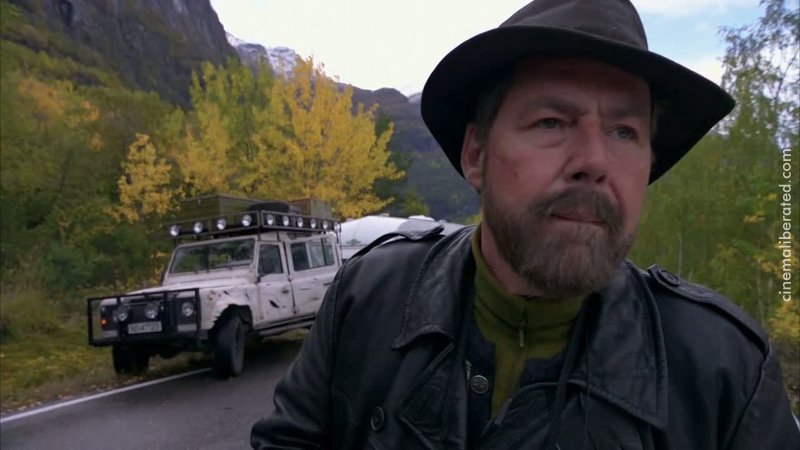




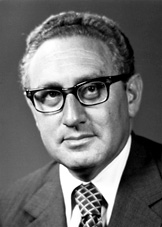






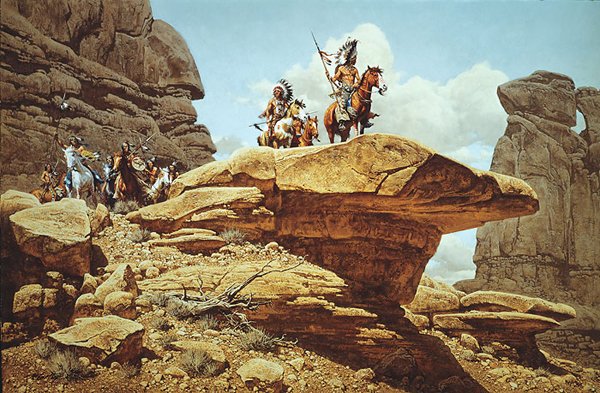




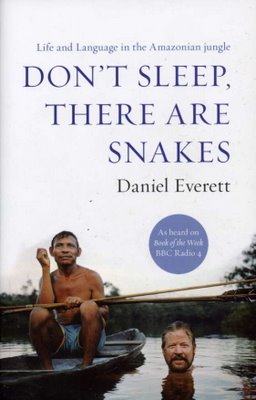








 northierthanthou