• About

northierthanthou

northierthanthou

Category Archives: Native American Themes

This is where I talk about Native American themes. No, I’m not Native; I’m just your generic white guy. That said, I have lived and worked in indigenous communities for a significant portion of my life, so I have a few thoughts on the subject. Whether or not they are worth considering depends on who you ask.

Mother Earth, the Invisible Hand, and a Few Eider Ducks

23 Friday Sep 2016

Posted by danielwalldammit in Native American Themes, Philosophy, Religion

≈ 7 Comments

Tags

Canada, Climate Change, Inuit, Markets, Metaphor, Mother Earth, People of a Feather, Primal Gaia, Science

standingtallI’ve been thinking lately about the notion of Mother Earth (or Primal Gaia). She figures rather prominently in a lot of the literature I read back in grad school, and I frequently have occasion to revisit some of that material with my students. What has me thinking about this lately is a few discussions on the topic of climate change initiated by a colleague of mine. So, like I said, …I’ve been thinking about her lately.

To say that I find it hard to believe in such an entity is putting it mildly. I don’t literally believe that the earth itself has a will of its own. Even still, I can’t help thinking the notion of Mother Earth has a lot going for it. Near as I can tell, talk of Mother Earth conveys two things about the environment that are all easily lost in Her absence.

The first entailment is a sense of dialogue (or perhaps dialectic) in nature. So long as we think of the world around us in terms of objective data it becomes that much easier to anticipate the consequences of our own actions in terms of an essentially cause and effect sequence. We may recognize that some of the effects of our actions escape us at the moment, but that just doesn’t stop folks from thinking of their actions in terms of a discrete cause and effect sequence based on our present understanding of the world at hand. If I do x, the result is y. That seems to be how people think about objects.

Not other people!

Subjects.

People (and most living things) can be predictable, to sure, but they are never entirely so. My cat is meowing at me as I type this. I expect she will bring me a toy to play in a moment. That’s what I expect her to do, but she may surprise me. Likewise, I may surprise her. Maybe this time I won’t stop typing and toss the toy about for her to chase it. Likewise, my students may not do the assignments I give them; my boss may not count my workload as I expected; and the folks at Amazon may not package my latest order of chili paste as they have so many times in the past. Living things…

hunter(Pardon me. I’ll be back in a moment.)

…

..

.

Anyway!

As I was saying, living things always seem to add something else to the mix when they react to our own behavior. Sometimes, they even start things of their own accord. Therein lies one of the real advantages to thinking of the environment in terms like those suggested by terms like “Mother Earth.” It gets us out of the habit of thinking that we know exactly what She is going to do. …of thinking that the concrete effects we hope to bring about with any given action ever come close to a thorough account of our impact on the world around us. I can think my way to this bit of humility, but talk of Mother Earth suggests that notion from the very outset. If I think of the earth as a living thing, I don’t have to remind myself that burning carbon-based fuels may have unintended consequences. I can be sure of it. In this context and others, I can be sure that Mother Earth will always add something to the mix when she responds to me and others.

Oh sure, we can conceive of particular things in terms of fairly discrete cause&effect relationships. If I leave a Cocacola outside, it’s going to freeze and burst. Hit a ball with a bat and it will fly away.Better yet, hit a cue ball low with a well-chalked cue-stick and it will (hopefully) spin backwards after contacting the object ball. These are things we can imagine in relatively specific terms. But as our account of the object world expands, as we approach aggregate subject matter such as an ecological niche or regional environments, our ability to conceive of things in such neat terms starts to fall apart. Which is precisely what makes the notion of Earth as a subject in Her own right becomes a rather tempting option.

But I did say that the notion of Mother Earth conveys at least two things about the physical environment, didn’t I? Well the second is pretty simple. Thinking of earth as our Mother effectively conveys a sense of nurturing. More to the point, it conveys a sense that we are the ones being nurtured, and that we are dependent on her. Since She is a person, rather than a thing, or even a collection of things, this means we are dependent on Her good will.

The upshot of all this is a kind a moral responsibility, a sense that life itself entails a moral responsibility to earn the good will of the world that makes our lives possible. We could get to that sense of moral responsibility in other ways (even stewardship, perhaps), but I don’t know of any ideas that convey it quite so effectively as notions like those of Mother Earth or Primal Gaia.

For me , at least, She may be little but a metaphor, but for a metaphor, Mother Earth can be damned compelling.

***

featherSo, what has me thinking about this tonight? A film called People of a Feather. This documentary follows the efforts of an Inuit community dwelling on the shores of Hudson Bay (near the Belcher Islands)as to learn why the local population of Eider ducks is in serious decline. Following substantial die-offs in the 1990s, they asked the Canadian Wildlife Service for help in determining the cause. What they got in the way of help was Joel Heath, an ecologist who documented his years of research in this film.

This is a gorgeous film. Heath’s underwater footage of Eider ducks swimming about in search of shellfish is absolutely spectacular.  He also spends a good deal of time documenting the lives of local Inuit and filming the cycles of surface ice on Hudson’s Bay. One of the things I like most about this film is the way Heath leaves much of the detail without comments. He simply lets his camera linger on the scene and leaves us to piece together the details for ourselves. If Heath has done his job well, and he has, the footage alone is often enough to tell a story in its own right.

What the film does take the time to explain is just what is happening to stress the Eider ducks in this region of Hudson Bay. It’s worth knowing at the outset that these ducks do not migrate. Instead, they spend the winter along small patches of open water called Polynyas. The problem of course is that something is happening to the Polynyas. They have become significantly more unstable in the 2000s, effectively leaving the ducks without a dependable means of surviving the winters.

So, why is this happening? The simple answer is that the hydro-electrical systems used to heat the major cities of Canada have altered the currents (along with the salinity) of the bay. The Hydro-electric dams in the region typically release large amounts of fresh water into the bay during the winter, effectively reversing the normal cycles of activity. The increasing instability of the polynyas may be just the tip of the iceberg here (ironic metaphor, I know). Heath’s work, and that of his Inuit friends thus raises questions about the total long range-impact of the power-grids used to support the mainstream communities of Canada. As people who rely on the natural cycles of the region to support themselves, the Inuit who initiated this research are felling the effects more directly than those living in the cities, but this is small comfort to anyone contemplating the long-term consequences of changes in the water system of the region. In effect, the eider ducks may have been a bit of a miner’s canary. Things are happening in the area that no-one really anticipated, and the questions are how much change will the hydro-electric systems brings about? How much will they be allowed to bring about? Are there alternatives?

People of a Feather doesn’t really answer these questions, though Heath does outline a few brief policy considerations as the credits roll. What makes this film great, however, is his patient development of the problem itself, and in particular his ability to help us understand just what this problem means to the Inuit living the area, Inuit who (it must be emphasized) saw fit to initiate the study itself and provided active support throughout its development.

This is one of those times when indigenous people got the details right. It’s a story of indigenous people working closely with scientists to address an important question about the natural environment. I’m reminded of similar efforts to improve the accuracy of whale counts along the coast of the North Slope here in Barrow. When scientists and Inupiat whalers disagreed about the number of bowhead whales in local waters , both groups devised new means of counting the whales. Turns out the Inupiat were right. (You can read about it in The Whale and the Super Computer by Charles Wohlforth.) Simply put, it pays to listen when indigenous communities raise concerns about what’s happening in the local environment. They don’t just give us grand abstractions like Mother Earth and poetic themes for movies, poems, and pastel-laden paintings. Sometimes, they really do provide the best resources for understanding particular things.

That said, I do find myself wondering about the story-line presented in People of a Feather. It’s not the most heavy-handed narrative, to be sure, but in this film it would be fair to suggest the hydro-electric dams appear to be the source of evil, so to speak. That isn’t because the people producing them mean to hurt anyone. It really isn’t. Rather, the problem is an unintended consequence of their function, a consequence felt most particularly by an indigenous population whose livelihood is determined as much by the natural cycles of Hudson’s Bay as it is by those of the modern market. Which reminds me of other narratives that could be told of this same issue, narratives about progress and development, of carving a civilization out of the frozen wilderness. These are the narratives that will be more familiar to people living closer to those power grids, and to most I suspect that will read this blog post.  In these narratives, the dams are good thing, almost a miracle, one that makes possible the lives of countless people. We could probably even point to a few benefits enjoyed by those in various indigenous communities. Those connections are there. How we sort the details, and what people want to do about them is another question. My point is that these grand narratives tend to predetermine the significance of the facts. It may not even be that the policy-considerations demand a choice of one value or another, but in the stories people tell about this such an issue the choice is often already made by time the plot starts to quicken.

…which may be the reason this film has me thinking about Mother Earth. This is one more instance in which something people didn’t anticipate turned out to be critical to the lives of some people (and some ducks). It’s also one case in which people have begun to sort those consequences out, just as we hope to be doing with issues like global, ocean acidification, and so many other issues in which the natural environment as a whole seems to be threatened, and along with it, us. Yet our understanding of these issues is always playing catch-up to the processes we’ve initiated, and frankly, it isn’t clear that this understanding is catching up fast enough. It’s enough to make us wish we had a way of talking about these issues that reminded us from the outset of just how much we don’t know about the impact of humans on the environment.

The temptation to call for Mother aside, it’s worth noting that comparable metaphors typically guide popular thinking (and policy) on the subject as it stands. Here I am speaking of the invisible hand of the market. Hell, the very notion of a market is a bit of a metaphor, an image that transforms known tendencies, tendencies with variable strength and effective) into a kind of thing that we can depend on. Do people in cold climates want a means of keeping warm? Supply will rise to meet the demand. The market will sort its way to a kind of equilibrium. One could easily apply such thinking to the process which puts all those dams on Hudson’s Bay to begin with, and it would help us to understand a few things. But this thinking too relies on the turn of a metaphor, and it too seems to distorts the facts in a few subtle ways.

One of the most interesting things about the invisible hand of the market deity is just how effectively it can be used to remind us of just how little we know about the economic impact of government policies. Time and again, market theorists remind us that each and every regulation (such as laws mitigating fresh water release in the Canadian hydro-electic system) will have unanticipated consequences. Time and again, free market fundamentalists will tell us to be wary of efforts to correct social ills. We may just make them worse! They are right, of course, except on the main point, because those truly devoted to this metaphor consistently tell us to let the market work itself out. It’s easy to think of this as a kind of humility, a recognition that being mere mortals, human beings cannot anticipate all the consequences of our own actions. The problem of course is that free market fundamentalists will only carry this logic as far as the market itself. How those unintended consequences will affect the balance of human relations to the environment is typically beyond the scope of their reckoning. Any humility we may learn from tales of the invisible hand seems ironically to leave us with an odd certainty in its own right, a mandate to leave unquestioned most anything done in the name of profit. For a lesson in humility, this takes us to a place that looks awful lot like hubris.

Stories of the invisible hand bid us to exercise caution less the market come back to bite us for every effort to legislate our way to a better world. They don’t do much to address the externalities piling up in the environment around us. In vie of these externalities, it is becoming increasingly clear that just about every cost-benefit analysis ever computed in human history has fallen short of a proper reckoning. I don’t see an adequate account of this coming from those devoted to the image of the invisible hand. If such is to be had, it will either come from painstaking empirical research, or from the language of another metaphor entirely.

***

…a trailer for you!

Share this:

  • Tweet
  • Share on Tumblr
  • Click to print (Opens in new window) Print
  • Click to email a link to a friend (Opens in new window) Email
  • Click to share on Reddit (Opens in new window) Reddit
Like Loading...

Rural Murals

22 Friday Jul 2016

Posted by danielwalldammit in Bad Photography, Native American Themes, Street Art

≈ 18 Comments

Tags

Arizona, Art, Murals, Native American, Navajo, Road Trip, Southwest, Street Art, Travel


Buffalo

Look closely

Just drove north of Flagstaff along Highway 89 up to Kanab. I used to commute from Flagstaff up to Tuba City for work, so a stretch of this was very familiar to me. I was pleasantly surprised to see one new element along the road, a certain amount of street art.

The subject matter is rather distinctive, but I can’t help thinking one of the best things about this material is the background.

An elderly Navajo working one of the craft stands told me there were a couple different people in the area putting these up. I don’t know much more.

Thought I’d share.

(Click to embiggen!)


Red backgrouind
Red backgrouind
"Off the goat" reads a popular T-Shirt (in part).
“Off the goat” reads a popular T-Shirt (in part).
Stencil
Stencil
Backside
Backside
Nuther Look
Nuther Look
Love this one
Love this one
Under a Navajo Nation Flag
First one I saw
First one I saw
Pink
Pink
Dimples
Dimples


P.S. My girlfriend tells me I’m not supposed to include the pictures of the child and a goat on account of she accidentally picked up a black ant taking pictures of those herself. We ejected the hitchhiker on the outskirts of Page. A little Hydrocortisol and a couple Advil had us on our way. The cycle of pain may continue once she realizes what I did here.  I’m not a praying man, but your kind thoughts would be appreciated.

Share this:

  • Tweet
  • Share on Tumblr
  • Click to print (Opens in new window) Print
  • Click to email a link to a friend (Opens in new window) Email
  • Click to share on Reddit (Opens in new window) Reddit
Like Loading...

Southern Paiutes as Portrayed in Las Vegas Area Museums.

17 Sunday Jul 2016

Posted by danielwalldammit in History, Las Vegas, Museums, Native American Themes

≈ Leave a comment

Tags

Clarke County Museum, Las Vegas, Mormon Fort, Museums, Native Americans, Nevada, Paiute, Paiutes, Springs Preserve

Paiutedisplay

Clark County Museum

One of the dominant themes in Vegas area museums would have to be the struggle with nature. By ‘nature’ I of course mean the desert. It’s kind of fascinating to me as parallel themes dominate literature and cinema dealing with the arctic. It’s a pretty straight-forward notion in either event. Extreme environments help to frame a basic man-against-nature story-line, which is a common enough theme in fiction as well as some historical narratives, even a good number of anthropological works.

Where the arctic narratives focus on cold and the lack of food, Vegas area narratives focus on heat and lack of food & water. Both themes definitely have a little space reserved for the indigenous peoples of the region. “How did THEY survive?” would seem to be a common question, one which segways easily into stories about how WE survive now. The part about how WE survive typically morphs into a larger narrative about thriving civilization. Okay, so the North Slope of Alaska may be a little soft on the civilization theme, not that that’s ever stopped a runaway narrative, but more to the point, in Vegas that narrative steams full bore ahead to land us in a world of casinos, mobsters, and showgirls.

…but those narratives often start with Paiutes.

Okay, so sometimes these narratives start with older Puebloan societies or even Paleo-Indians, but even then the stories quicken with the arrival of Paiutes into the area. These were the indigenous community of Las Vegas when Europeans arrived, so they figure more prominently in plot-lines anticipating those casinos and showgirls. Not surprisingly, the Vegas area museums often use the presence of Paiutes in the valley to frame general questions about survival in the desert, questions that will then play well into later developments in the area. Their own modest use of the area sets the stage in these stories for the mega-resorts of today. And if that seems an odd contrast, that is precisely the point. A miracle in the desert, so to speak. It’s all the more miraculous if we catch a glimpse of its modest beginnings.

SouthernPaiute

A Convenience Store (Not

Of course, American stories of progress often treat Native Americans as just one more feature of nature standing in the way of progress, but I honestly think most of these museums try to handle things a little better than that. Still, there is a bit of slippage here and there. Anyway, the topic is worth a little time on my keyboard, so let’s just get on with it, shall we?

***

What first got me interested in this was a visit to the Mormon Fort, a state park commemorating the first Anglo-American settlement in the Vegas Valley. It contains a number of exhibits, one of which enables you to watch a video recounting the history of Vegas from the creation of the fort itself up through to the development boom of the 1980s (about the time my own family moved into the area). It’s the story of a city built in the midst of a hot desert, and that story begins with the discovery of two springs by European explorers.

As with other such discoveries, it turns out someone was already there. According to one of my old anthropology professors, Martha C. Knack, the Vegas Valley was already home to about a 150 Paiutes with a variety of related communities nearby. It was at these Springs, a kind of Oasis in the middle of the hot desert, that the story of Las Vegas begins.

This story takes off when Brigham Young sends a small group of missionaries to build at Fort at the Springs to serve as a weigh station on the way to Southern California. According to the video, local Paiutes had used the Springs for irrigation projects, so there is little doubt as to a native presence at the Springs. Still, when those first missionaries up and leave, the video suggests that their major accomplishment was to prove that people could make a permanent settlement in the area.

…which of course leaves me wondering what about the Paiute? Hadn’t they already proved that?

This may not be as egregious as it sounds. I could well see white folks at the time thinking of it in that light, biased as it is, so I could see the point of calling attention to this perspective. Still, the commentary in the video is as invested in the bias as any Anglo-American might have been at the time the missionaries left, and so the resulting narrative does seem to erase the Paiute. There is enough information about the local Paiute around the rest of Mormon Fort and even in the video itself to contradict that kind of thinking, but the story-line has its own impact.

Could be worse, could be better.

Mostly, it could be better.

***

That said, the Mormon Fort is a great place in its own right. If you’re in the area, and have a little pocket change left, I would definitely go check it out.

***

I found a couple of interesting origin-narratives for the local Paiute, one at the Clark County Museum and one at the Springs Preserve. Each of these are Coyote stories, so it goes without saying that something is going to go terribly  wrong in them. That’s how trickster narratives work. Each presents the choice of a Paiute homeland as something of an accident. At the Springs Preserve, this accident seems to suggest that Paiute ended up in the wrong place. Coyote opened the basket early (somewhere between Las Vegas and Moapa). The Clark County variant suggests that people had already been escaping and heading in different directions, and Coyote closed the sack before carrying it a ways further and pouring out those who would become Paiute. Whether this means they ended up where they were supposed to go or not, I can’t tell from the source at the museum.

I’ve presented both of these stories directly below (a video and a picture). Of course this kind of presentation strips a lot of the context out of each narrative, but I think a bit of the flavor in such stories does come through. I find myself thinking of the accident in terms of the arid setting, as if it were meant to explain how Paiute ended up in such a dry location with its sparse resources. Still, I’m not sure how much of that would have been the point of the Paiute story and how much of that may be the rest of the presentations in which they occur. With so much of each exhibit devoted to explaining how these people survived in the local desert, it seems easy to think of this as the point of the accident, that Paiute weren’t really meant to be here, but perhaps just me. Either way, I can’t help thinking it’s an interesting way of thinking about how one’s people ended up where they are. Mistakes happen. Sometimes a mistake mean you ruin lunch, put up a video with bad sound quality, or end up with a low grade on a test.

…and sometimes a mistake create a world to live in.

Sackofalltribes

***

Now the Springs Preserve is interesting in itself. This place is huge, and after four visits, I’m pretty sure I haven’t seen everything. It contains the Nevada State Museum and the Origin Museum as well as a number of outdoor exhibits (one of which is the Paiute village where I recorded the origin story above). That story is one of several narratives relating to Paiutes that you can find in the Springs Preserve. The Origin Museum contains a couple more videos. One appears to be a straight-foreword history of Las Vegas beginning with the arrival of Native Americans in the area. It further mentions the brief history of interaction (including conflict) between whites and natives. A second, more dramatic video (set up in a stand of artificial tulies) appears to depict a Paiute elder greeting us (the visitors) as if she were meeting non-natives for the first time. She is friendly, of course, and explains a thing or two about her people’s survival strategies, but the video ends on a dark turn. She sees change coming, and it seems to fair to suggest this is an allusion to the hazards of contact and colonization.

Neither of these videos goes into much detail about the troubled relations between Paiute and non-natives, but each mentions them. Where the first is dry and a little up-beat, the second is cryptic and disturbing.

A quick listen to the Coyote narrative always seems to put things in perspective for me. Odd, I know to want to follow modern history with an origin narrative, but I doubt Coyote would object.

Oh, the videos!

.


***

The Springs Preserve also contains a history of Las Vegas as portrayed in paintings by the artist Roy Purcell. The only explicit mention of natives I recall seeing in this exhibit is a reference to Spanish raids on local Indians. That’s pretty much it. It’s an interesting history. I at least would have found it a bit more interesting if it had a place for the indigenous population. His website suggests that Purcell is working on Native American subjects now. This sounds promising.

No pictures are allowed in the Purcell exhibit, so I haven’t anything to show for that part of the Springs Preserve.

***

The Nevada State Museum (also in the Springs Preserve) doesn’t seem as focused on questions of subsistence, but it does have a few interesting pieces on indigenous peoples of the area. A life-size photo of Sarah Winnemucca had me wondering if she wasn’t a bit south of her usual residence. My personal fussiness aside, she certainly deserves a place in the Nevada STATE Museum. The museum also includes a video presentation in which a modern actress interprets some of her words for visitors at the Museum. Similar videos provide a glimpse of Wovoka’s prophesies, and a woman whose name translates to Little Willow teaches us a bit about basket-making. Please accept my apologies for the poor quality of the audios. To get the full experience, you’ll just have to go to the Museum.

.

.


***

CnNS4cNUMAELRKRThere is one other thing I really must say about the Nevada State Museum, and that it that it seems to contain the White Tree of Gondor. Oh, they call it a Great Basin Bristle Cone Pine, but I know the White Tree of Gondor when I see it. You can’t fool me!

I know, this has nothing to do with Paiutes, but seriously, I think the White Tree of Gondor deserves at least a mention. Don’t you?

***

I’ve written about the Atomic Testing Museum before, and I don’t have a lot to add here, except to note that the museum does reference the indigenous populations of the testing zones. It’s a smallish display by comparison, focusing primarily on cultural preservation. By some accounts Newe Segobia is the most bombed nation in the world, but that story falls a bit North of this post. It’s worth noting though, the general tenor of the Museum’s approach to Native Americans. They want us to know they are trying to do the right thing, but their treatment of the issue doesn’t really escape the largely pro-testing narratives of the museum as a whole.

Let me conclude with a smattering of selected photos from the museums. As always, you may click to embiggen.

Paiute Village in the Springs Preserve
Springs Preserve (Origen Museum)
Mormon Fort describes pre-contact use of the Springs area for crops
Display in the Mormon Fort
Very cool diorama in the Mormon Fort
White Tree of Gondor, ...duh!
White Tree of Gondor, …duh!
Sarah Winnemucca at the Nevada State Museum
Atomic Testing MUseum
Atomic Testing Museum
Clark County Museum
Clark County Museum
Clark County Museum
Clark County Museum
Clark County Museum
Clark County Museum
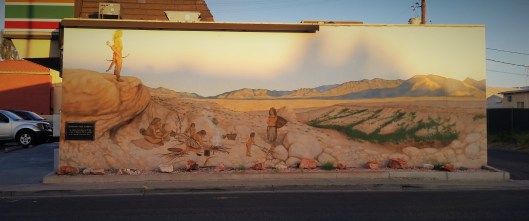
This mural depicts Southern Paiute. Yes, it's on the side of a 7-11. I don't know what to make of that.
This mural depicts Southern Paiute. Yes, it’s on the side of a 7-11. I don’t know what to make of that.
Close-up
Close-up

Share this:

  • Tweet
  • Share on Tumblr
  • Click to print (Opens in new window) Print
  • Click to email a link to a friend (Opens in new window) Email
  • Click to share on Reddit (Opens in new window) Reddit
Like Loading...

Thieves Road (A Review)

28 Tuesday Jun 2016

Posted by danielwalldammit in Books, History, Native American Themes

≈ 15 Comments

Tags

Black Hills, Custer, George Armstrong Custer, Gold, Lakota, Little Big Horn, Native Americans, The West, Western History

Thieves RoadAside from being my birthday, last Saturday (June 25th) was the anniversary of Custer’s Last Stand. So, I suppose it’s fitting that I finished a book about the man that afternoon. A 336 page volume written by Terry Mort, it’s called Thieves Road: The Black Hills Betrayal and Custer’s Path to Little Bighorn (Prometheus Books, 2015). No, the book doesn’t cover the events at Little Bighorn. As the subtitle suggest, this book is about Custer’s expedition to the Black Hills, which is to say that this book is about the reconnaissance expedition that lead to the war that lead to Little Bighorn. Officially the expedition had been tasked with helping to establish a Fort in Sioux territory. Unofficially, they were looking for gold. The discovery of that gold would lead to the Great Sioux War of 1876 (and among other things the death of Custer and his men). This particular expedition is a subject I’ve wanted to know more about for sometime, so I was happy to pick this one up.

I’ve written about Custer before, minor tangents here and here, and of course he is the principle villain in the movie Little Big Man, which is an all-time favorite of mine. So, anyway, this isn’t the first time things-Custerly have made their way into my blog. All references to significance of the date aside, it probably won’t be the last either.

Anyway…

For me, the most interesting part of the book would have to be Mort’s efforts to connect this expedition to the larger political economies of the gilded age. All-too-often people (even historians who should know better) speak and write about the the events of western history as though their significance could be understood entirely within the confines of life out on the frontier. We may appreciate that immigration is pushing folks out there or that the civil war affected the availability of troops, and so on, but rarely does anyone make a serious effort to elaborate on the connection between events occurring out west and the larger patterns of U.S. and world history. Mort is definitely an exception to this pattern.

Mort links the effort to find gold in the  Black Hills to the financing of the civil war (in particular the need to pay off war bonds in gold currency), to the failures of the Northern Pacific Railway (due in part to fears over Indian raids … fears ironically triggered by Custer’s own reports), and by a cascading series of bank failures stemming from post-war sales of Yankee wheat to Britain (a problem for Russian nobles). If all of that sounds interesting to you, then well, …you know what to do.

I am less impressed with Mort’s approach to activities of Lakota (Sioux) and Cheyenne during these events. He doesn’t embrace stereotypes, but his account of Native American lives never strays far from them. In fact, much of Mort’s approach to native culture and native actions in the days leading up to the Great Sioux War consists of a rather incomplete critique of the very stereotypes held by whites of the day (particularly those in western states). He gives us just enough to appreciate that those stereotypes are not accurate, but not enough to outgrow them altogether.

What makes this problem particularly interesting to me is Mort’s claim that the Lakota did not really want peace, at least not a lasting and general peace with everyone around them. This, according to Mort, would have left Lakota men without any means of proving themselves. In Lakota society, according to Mort, one became a man primarily through honors that had to be earned in warfare. Significantly, it is this incentive to raiding that provides the critical moment in history as far as Mort is concerned, because it was Sioux raids that provided the reason Custer’s expedition was authorized as a means of establishing a fort in Sioux territory (p.296). It was Custer, according to Mort that chose to combine this expedition with a search for gold, and it was of course the discovery of that very gold that lead to the Great Sioux War.

Don’t get me wrong. Mort’s treatment of the Sioux is very respectful, but respectful and a buck will buy you a beer. The question here is whether or not his treatment is actually fair to them, and frankly I don’t think it is. Mort places the ultimate responsibility for the coming war on their shoulders, and specifically on their interest in perpetuating war for its own sake. The critical moment in history, the moment when things could have gone some other way, is thus one determined by the Sioux themselves. To be sure, Mort has a lot to say about the decisions of any number of parties in events leading up to this war, but the foibles of non-natives are largely those of individuals in his treatment, and I at least cannot help but sense a kind of fatalism in the overall story. However Custer might stumble, his direction seems a foregone conclusion. This is not simply because we know the end of this particular story; it’s a sense that the U.S. would inevitably go after the Black Hills. It’s just what we do, apparently, at least when vast stretches of land lay in the hands of people like the Lakota and the Cheyenne.

The historical moment that settled everything was, as Mort understands it, the one in which young Indian men took to leaving the agencies in the summer and engaging in raids before coming back to those same agencies for the winter. For all we can say about the vagaries of finance, the consequences of greed, or the recklessness of Custer’s particular quest for fame and fortune, in the final analysis, the cause of the coming war at the close of the book is a feature of Lakota society.

…not ours.

To say that I am uncomfortable with this is putting it mildly. I suspect others might choose to pick apart the centrality of warfare among Sioux and Cheyenne. For myself, I am more concerned at the failure to find comparable incentive to warfare in other circles, particularly in those of American society itself. Lakota are not the only society that has struggled with the question of what to do with young and violent men, nor would they be the first (or last) to answer that question by sending such men off to visit their violence on someone else. The honors accorded to warriors can be seen all across popular U.S. media, both in Custer’s day and our own. If an eagle feather might be thought a cause of war to a Lakota, can a medal be any less for a U.S. soldier? If such honors may be thought the reason nations go to war, is this any less true of the U.S. army than it is for indigenous peoples?

Of course, we normally account for the warfare of nation-states by looking at the larger political and economic forces guiding hands of key decision-makers not the ambitions of particular warriors, and Mort does that very well for both the Indian and white side of this story. Yet, he sees in the actions of native warriors a sort of cultural pathology that seems absent in his treatment of U.S. soldiers.

It’s clear enough that Custer sought honors comparable to those of Sioux warriors, as Mort himself points out, but the cultural significance of those honors doesn’t seem as fatal in Mort’s treatment (except perhaps for Custer and his troops). Of course not every American male goes to war whereas such conduct would be far more normative in Lakota society, so perhaps there are some dissimilarities. Yet the same markets that provide for diversification of labor also create the need for resources that send particular troops to particular paces (like the Black Hills) even as others stay home. Mort himself does a great job of explaining exactly how that happened in this instance. So, if it is fair to say of the Sioux that they didn’t want a lasting or general peace, I think that is every bit as true of the U.S. (then and now). We may not all be warriors, but in a nation like the U.S. that simply isn’t how things work. We have the likes of Custer to secure needed resources for us.

As Vine Deloria might have reminded us, Custer died for our sins.

Share this:

  • Tweet
  • Share on Tumblr
  • Click to print (Opens in new window) Print
  • Click to email a link to a friend (Opens in new window) Email
  • Click to share on Reddit (Opens in new window) Reddit
Like Loading...

Creeditize it! …or Don’t.

21 Saturday May 2016

Posted by danielwalldammit in atheism, Native American Themes, Politics, Religion

≈ 4 Comments

Tags

College, Creed, Dogma, Education, GOP, Islam, Moderation, religious freedom, U.S. Constitution

US-ConstitutionLast week a man named Trebor Gordon, Pastor for the Harris County GOP, tried to block a Muslim, Syed Ali, from serving as a precinct chair for the Republican Party in Harris County, Texas.  As reported in Gawker, Gordon objected on the  grounds that Islam is not consistent with the principles of Republican Party politics.

A video of Gordon’s efforts can also be found on Youtube. Gordon’s argument, as quoted in Gawker is as follows:

If you believe that a person can practice Islam and agree to the foundational principles of the Republican Party, it’s not right. It’s not true. It can’t happen. There are things on our platform that he and his beliefs are total opposite.

“There are things on our platform,” Gordon went on to say, that he (Syed Ali) is, he and his beliefs are in total opposite.”

You may suspect this is the beginning of a GOP-bashing rant. Well, not today. I actually found the response to Gordon’s efforts rather encouraging (especially that of Dave Smith). Granted, I would love to live in a world where people just don’t act like he does, but in the real world, I take it as a good sign that the Gordon was voted down, by other members of the local GOP mind you. It’s a welcome reminder that there are sane and responsible people in the GOP. On this count, at least, I think they done right.

What fascinates me about this incident is something about the particular argument Gordon used. Well, actually two things. First, I’m always fascinated by the use of architectural metaphors in ideological matters, particularly in the rhetoric of conservative Christians. They will often tell us that atheists lack a moral foundation for our behavior. They will also speak quite often of Christianity (or belief in God in general) as providing the foundations (or alternatively, the ‘foundational principles’) of our country. There are of course endless permutations to this theme, and they are all highly problematic.

On one level I get it. These metaphors do communicate a sense that the ‘foundational’ beliefs or values in question are in some sense more important than others, or that the other beliefs and practices are in some sense dependent on the foundational ones. If you like the First Amendment, this argument seems to suggest, that part of our government comes (in some way) from Christianity. I get that much at least, so the trope isn’t entirely opaque, but I do think it’s rather telling that so much of this rhetoric takes place within the scope of this particular metaphor. I also think it’s quite telling that people making such arguments are often ill-prepared to flesh out the metaphor in literal terms. The same person who is quite sure that Christian values and beliefs are the foundation of our republic is often at great pains to explain what those values are and just how they actually generate the rest of the features of the republic at large. Take a way the architectural metaphor, and an awful lot of these folks struggle mightily to flesh out the details of their argument.

…or even to deal with them in any way whatsoever!

Now Gordon isn’t talking about America as a whole in that speech. The foundation he references in that speech is something belonging to the Republican party. Still, I do think it worthwhile to note that he has fallen into the pattern of a much broader fashion of speaking about religious and political ideas. To say that he leans a bit heavily on the architectural metaphor is putting it mildly. It is Smith that references the relevant features of the U.S. Constitution (namely the proscription against religious tests). Gordon has only his talk of foundations. THAT is exactly what I am talking about. The rhetoric of foundations consistently helped people to side-steps relevant details rather than to illuminate them.

…which brings me to a second and (to me) much more important aspect of Gordon’s approach to the issue. He has effectively taken the GOP platform to function as a creed of sorts. It isn’t enough to actively support that platform, according to Gordon. One must not, so it seems, hold views in opposition (or even potentially in opposition) to that platform. All of which is a very interesting way to speak of a party platform.

By ‘interesting’, I might mean ‘ridiculous’.

A party platform is itself the outcome of a political process. It has winners and losers even within the party, and many of those who lose out on battles over the construction of that platform can be expected to go on and support the party anyway. That’s how the process works.One doesn’t normally turn around and use that platform as a plank-by-plank litmus test of acceptable beliefs for party members, even party leadership. Creeds are used in precisely that manner to define membership in a religious community. Party platforms are not.

A party platform may represent the goals of a party in its relation to the outside world, but one wouldn’t normally assume that it represents the precise views of each member. To be fair, Gordon isn’t simply suggesting that a Muslim will be in disagreement with one or two items on that menu. He seems to be suggesting that a Muslim must be in disagreement on some very important points. What are those points? Well that takes us back to the whole ‘foundation’ metaphor.

An additional problem here would lie in the abstract nature of the argument. Gordon isn’t asking whether or not this particular Muslim, Syed Ali, is opposed to the key tenets of the party platform. He is arguing that a Muslim must do so. It’s in their nature, so it seems, or perhaps it’s in the nature of their professed beliefs.

It’s a kind of theology by proxy, an all-too-common one at that. Folks often assume they can draw inferences for believers (or even non-believers) on the basis of an assumed premise or two. This type of argument parallels the reductio ad absurdum, but it fails insofar as it ignores the embedded nature of the beliefs in question. A reducto ad absurdum can show us the inconsistency of combining different beliefs, but it can’t tell us much about how any particular individual relates to the people and institutions around him. Gordon isn’t arguing against Islam in general. He is arguing against a specific Muslim, and that makes the specific views and behavior of that specific Muslim directly relevant to the issue at hand. But Gordon doesn’t addres what Ali actually thinks. It is enough to know that he is Muslim. To call this approach dehumanizing is putting it mildly.

***

…which illustrates another point. People tend to turn mission statements, party platforms, etc. into creeds precisely when they don’t like the people they assume to be unable to vouch for the creed in question. I used to see this when I was a participant at Christian Forums where the members were at times expected to vouch for the Nicene creed and/or the Apostles Creed if they were to be considered Christian. Among other things, being recognized as Christian provided access to large parts of the forum denied to non-believers (who were largely confined to ‘open debate’ sections of the forum). I never had much problem with this as I just say ‘no’ to gods, but I lost track of the number of liberal Christian friends who had to explain countless times how their actions or beliefs could be squared with the creed(s). That conservative Christians did accept the creed, even though their own actions and statements could as easily be taken to suggest otherwise seemed to go without question. In the case of Christian Forums, where a creed was an explicit part of the forum policy, that policy provided endless grounds for personal back-biting and mean-spirited bickering, almost always at the expense of those more socially vulnerable than theologically off-base. Seeing the number of people hurt by that process did a lot to confirm my suspicions about how ugly religion could get. It also helped me to see that the problem had less to do with what people believe than how questions about beliefs are handled with in a larger community.

***

I wish I could say that secular folk are immune to this kind of behavior, but I can’t. I once joined a secular forum in which I had to press a button vouching for the fact that I didn’t believe in a god. After some hesitation, I pressed the button. After all, I don’t believe in a god, but I always regarded the policy as remarkably petty and quite dogmatic in nature. It was an ironic dogma to be sure, but I reckon when you start deciding who is and who is out of the club on the basis of what they do or don’t believe, you are well into dogmatic territory whatever the content of the beliefs in question. I had similar views when the old Internet Infidels website decided to allow believers to act as moderators. (I was a low-level moderator on that website at the time.) Many objected to the move on the grounds that a believer couldn’t possibly agree with everything in the mission statement for the site. I found myself thinking, “neither do I.” Simply speaking, there were a couple items on the mission statement that I didn’t agree with. I joined because of teh ones I did agree with, and (more importantly) because I wanted to help facilitate the discussions then taking place on that forum. No-one had asked me if I agreed with each item on that mission statement, and no-one had done this for the rest of the staff either. So, the argument that a believer couldn’t serve as a moderator for the site always struck me as an odd misunderstanding of the nature of both forum moderation and mission statements. It also struck me as an ugly double standard.  Making these arguments in public debates on the matter didn’t exactly make me popular, but I always found it odd that so many critical thinkers were apparently quite comfortable with the assumption that everyone on staff had to agree with every point in the mission statement.

Textbook dogma!

***

In life offline, one of my more frustrating experiences with policy-driven dogma came while I worked at Diné College (a tribal college) on the Navajo Nation. Faculty were expected to adopt an educational model known as Diné Educational Philosophy (DEP). It was a fairly elaborate theory, requiring us to divide our lessons up into four steps (generally portrayed as four individual quadrants of a circle), each of which was thereby linked to some aspect of Navajo cosmology. It was easy enough to do this, of course, and some of the Navajo faculty could do this brilliantly (and authentically). The rest of us, were doing it by the numbers of course, and the students knew it. I still recall the day one of my more traditional students shrunk in his seat as I drew a circle on the board and raised the topic. “Please don’t!” was all he said. He was absolutely right to do so. The man had been enthusiastic just moments before, but moments before I had been talking American history. Now I was speaking about Navajo philosophy and that was a subject he didn’t need to hear about from a white guy. It might have been my job to address the issue, but that didn’t make the moment any less ridiculous.

One of the more frustrating things about DEP was that its proponents often described western educational theory as top down and western religion as dogmatic. It seemed to be a forgone conclusion that Navajo thinking wasn’t any of these things. There was certainly some justice to this. After all, it was the white people that brought missionaries to the reservation and at one time instituted educational policies amounting to little more than government enforced kidnapping. There were so many respects in which I could see Navajo approaches to education were more flexible and less dogmatic than mainstream approaches; they just weren’t respects that had much to do with the official policies of the college. An educational policy incorporating explicit ceremonial themes mandated by administration, taught to faculty (who were mostly outsiders) and then imposed on students in the classroom was by definition a top down approach, and when that policy (along with its ceremonial themes) becomes obligatory, it is a dogma. If I was ever prone to think otherwise, I lost any grounds for doubt one day in a meeting as two of the Navajo faculty argued over the specific implications of a corn stock metaphor in DEP. One of them, I thought quite sensibly suggested that there was room for different approaches to the subject. The other insisted that we all must be on the same page when it came to that theory. The rest of us, being white, had little to do but wait to see how the indigenous faculty sorted the matter out.

I don’t mean to suggest that all the classes at Diné College were taught according to a set dogma. I do mean to suggest that this was official policy, yes, but that’s one of the beauties of actual human behavior. Sometimes the practice is way better than the theory behind it. People pursued a wide variety of approaches in the classroom, and (at least when I was there) many of those approaches simply didn’t match the vision enshrined in that narrow policy. My own approach was a bit more Socratic. I adapted my lessons to the classroom by asking my students how things worked in their world; they told me, and I worked their answers into the lessons. My students’ mileage will vary, of course, but I at least found that process to be interesting and rewarding. The official policy of the college didn’t help much.

***

So anyway, my point is that people often turn a range of bureaucratic communications into an obligatory set of doctrines. Mission statements, party platforms, educational procedures aren’t necessarily things that should call for total agreement from those working with them. They outline goals.  People in an organization can generally be expected to work toward the goals in such documents, but the notion that someone must agree with every point in such a document is an odd (if rather frequent) inference. Those taking such an approach often do a great deal of harm in so doing, and I generally make it a point to oppose them whenever and wherever possible.

***

Bringing the issue back to the relationship between Islam and American politics, I think Gordon’s approach touches on a particularly disturbing example of this sort of behavior. It has become relatively common to hear that Islam is not consistent with the U.S. Constitution. Ben Carson seems to have used this as an argument against allowing a Muslim to become president. Others have used this as an argument against allowing Muslim refugees into the country (or into western nations in general) and/or against the notion that Muslims are protected under the free exercise clause of the First Amendment. The thinking here seems to be that aspects of Islamic doctrine are inconsistent with basic principles of American government (including perhaps the establishment clause). Those pushing this argument will often produce texts from the Quran or related documents suggesting obligations contrary to American law and/or the Constitution itself. But of course that misses the point. The Constitution protects the right to believe any number of things, including those contrary to the constitution itself. It even protects a range of practices, at least those consistent with the constitution itself and the social arrangements made under its authority. That there are limits to these protections is clear enough, but those limits simply do NOT become an excuse to deny people protections altogether.

And of course once again, this approach amounts to a kind of fundamentalism by proxy. I have no count that there are Muslims who want to do things contrary to the law and the constitution. I also have no doubt there are Muslims who respect the law at least as much as the rest of us. How do you tell the difference? I reckon the answer to that question depend on what they say and do, not what a critic can spin off a cherry-picked line or two from the Quran for purpose of fielding an argument. In any event, the possibility that someone may believe (or want) something contrary to the Constitution simply isn’t an excuse for excluding them once and for all from the entire body of constitutional protections.

(Were it otherwise, Gordon might be in trouble!)

The notion that people must demonstrate consistency between their beliefs and the provisions of the U.S. Constitution is (once again) how people treat a creed, not a plan of government. The Constitution too, it would seem, is among the many things people tend to treat as a Creed even though they shouldn’t.

Share this:

  • Tweet
  • Share on Tumblr
  • Click to print (Opens in new window) Print
  • Click to email a link to a friend (Opens in new window) Email
  • Click to share on Reddit (Opens in new window) Reddit
Like Loading...

Irony Failure and the Success of Tradition

03 Tuesday May 2016

Posted by danielwalldammit in Alaska, Native American Themes, Uncategorized

≈ 3 Comments

Tags

Alaska Natives, Culture, Hunting, Irony, Native American, Subsistence, Technology, Tradition, Whaling

Landing a Whale in the Fall

Landing a Whale in the Fall

When I first got into Navajo country (many years ago) my old boss used to laugh and say that Ricola was traditional Navajo medicine. I remember him singing the name lightly as he got out a piece. No, he wasn’t suggesting that Navajos had invented Ricola. As I recall, his throat used to get scratchy during all-night chants. His remedy of choice, Ricola, helped him get through the long evenings with his voice intact. His phrasing was intentionally ironic, of course, but my old boss had in fact made this commercial medicine part of his own traditional regimin.

You can find that sort of irony in all sorts of traditional indigenous activities.  It can produce the sort of wry humor of my old boss and his cough medicine, or it can give rise to deep suspicions. A lot depends on who is calling attention to the irony. The issue often comes up in my classes here on the north slope of Alaska where the dominant traditional themes are associated with hunting and whaling. The indigenous peoples of Alaska retain substantial rights to subsistence activities which include the taking game. That they frequently use modern technology in doing so hasn’t escaped notice, but what of it? That’s an interesting question.

The issue popped up a number of years back when the New York Times published a piece on the Fall whale hunt here in Barrow. Its title put the between technology and tradition front and center:

With Powerboat and Forklift, a Sacred Whale Hunt Endures

If the purpose of this rather clever juxtaposition wasn’t clear enough at the outset, one didn’t have to read far into the piece to see the point driven home rather clearly. In the very first sentence, its authors (William Yardley and Erik Olden) declare that “The ancient whale hunt is not so ancient anymore.” They go on to quote whalers themselves saying things such as “Ah the traditional loader” and “ah the, the traditional forklift.” And with that introduction, the authors go on to explore the paradox of traditional activities carried out with modern technology.

Suffice to say, many in Barrow were not amused.

Edward Itta, former Mayor of the North Slope, published his own response in the Alaska Dispatch News (ADN), suggesting that the authors had failed to grasp the cultural context in which indigenous whaling takes place. A subsequent ADN article focusing on Wainwright took the time to castigate Yardly and Olden for focusing on the nature of Fall whaling instead of Spring when whalers use walrus skinned boats. Yardley and Olsen too had commented this fact, but the point was easily lost in the overall narrative highlighting the use of technology in whaling practice.

I keep coming back to this piece, because the questions raised in that article keep coming back to me. Often it’s a student new to the region who fields the question in one form or another, is it still traditional if people can use modern technology? I struggle to get across the best answer I can. I can point folks to Iñupiat who can answer the question much more authoritatively than I can, but frankly, I think there is a reason I get these questions. As another outsider, I suppose, I may be thought a safe person to ask. I reckon they figure I won’t get mad.

…and I won’t.

This does strike me as an honest question, at least in the sense that those asking it usually seem to be sincere. Just the same, measuring legitimacy of native traditions by the use or absence of modern technology does skew the issue in some very toxic ways.

On one level, I find myself wondering if the Amish haven’t become the paradigm case for traditional anything in the minds of so many people. I reckon it’s up to Iñupiat to define their own traditions as they see fit, and to the best of my knowledge, there just isn’t anything in there against using the most productive technology available. The tradition is taking a whale, not doing it with a particularly pristine kind of harpoon, much less butchering it using only native equipment. The notion that using technology constitutes a failure of authenticity is an assumption coming from outsider.

It isn’t a particularly helpful assumption at that.

Which brings me back to the jokes at the beginning of that old New York Times piece. I can’t help wondering if the authors might have gotten the point of the humor wrong. Hell, it might have been their editor who skewed the whole piece, I don’t know, but in its final form that article clearly takes each of those jokes to be an admission of sorts, a subtle concession to the inauthenticity of the activities in question.

I read those with echoes of my own boss singing ‘Ricola’ in the back of my head.

It seems at least as likely that the point of the humor had something to do with the adaptability of tradition. The question may not have been, is this really traditional, but rather how could it be otherwise?

IMG_20160419_120130

Not Yet (Nalukataq)

What makes whaling traditional? Yardley and Olsen touched on this when they noted the distribution of boiled muktuk (edible blubber and skin) to those present as the whale was butchered.

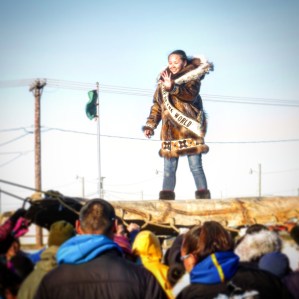
Much of the community comes to watch as a whale is burchered. More to the point, much of the community pitches in to help. Even more have helped in one manner or another to provide support for the whaling crews during the course of preparations. Where possible, employers grant leave to those engaged in whaling, and teachers accept absences during whaling season. We’ll work it out later. You would be hard pressed to find a resident of the North Slope who doesn’t provide some sort of support to whaling activities, even if it’s just acceptance of the way the whaling season restructures all of our other activities. Whaling is a community affair, and its impact on the community re-enforces numerous personal relationships.

The tradition is also found in freezers throughout the North Slope, many of which contain muktuk and other delicacies received as gifts from the whalers. It can be seen when a successful crew serves a meal to any who come by their home, and you can see it again during Nalukataq (a Spring festival) when pretty much anyone can walk into a the festival square, sit down, and receive all manner of food from these very same crews. What makes whaling matter is the way that it shapes relations between people all over the north slope, and in that respect it continues many of the same patterns that predate the presence of outsiders like me who ask too many questions, and sometimes fail to learn the answers. If we’re looking for the traditional components of whaling, this is where you will find them.

This social emphasis too is complicated as Hell, but it’s actually relevant. We can ask, for example, how the use of technology ties subsistence activities to modern markets, how use of a snow-machine instead of a dog team changes the work regime for participants in whaling and hunting. We can ask how the presence of grocery stores changes everything, and how the jobs needed to earn money for modern goods and services change the lives of people all over the North Slope. The answers to such questions might also leave us with a less of pristine sense of what tradition means in subsistence activities, but they point to a different sense of the problems at stake in these issues and a different sense of the threats to community practice.

IMG_20160305_095525

Nalukataq II

Simply pointing at a forklift is a bit of a gotcha game. Unfortunately, it’s a game played all too often by outsiders looking at indigenous hunting practices. More and more, I find myself thinking the game begins when people look in the wrong place to understand these practices. They come and they watch the whalers at work on the ice or harvesting a catch on the beach.

Where they ought to be looking is in those freezers.

…okay folks, don’t come up here and literally look in people’s freezers.

My point is that people who want to understand the significance of whaling or any other aspect of traditional subsistence need to look at the way the work and the results are shared. They need to look at the festivals, the potlucks, the serving events around town, or simply at the moments when someone walks up and hands someone else a helping of food. That’s where the tradition is held together, and that is precisely why the damned forklift was traditional after all.

Just like the Ricola my old boss used to love.

R-i-c-o-l-a !!!

Share this:

  • Tweet
  • Share on Tumblr
  • Click to print (Opens in new window) Print
  • Click to email a link to a friend (Opens in new window) Email
  • Click to share on Reddit (Opens in new window) Reddit
Like Loading...

A Map is Not a Territory. …and Sometimes It’s Not Even a Map!

01 Sunday May 2016

Posted by danielwalldammit in Native American Themes, Uncategorized

≈ 10 Comments

Tags

Arizona, Cartography, Diné College, Frybread, Maps, Native Americans, Navajo Community College, Travel, Tsaile

IntroIf you are traveling around the four-corners, you might think your best bet for a map would be one covering one or more of those states.
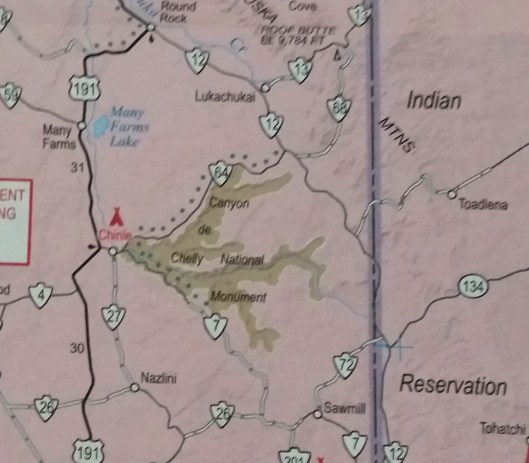
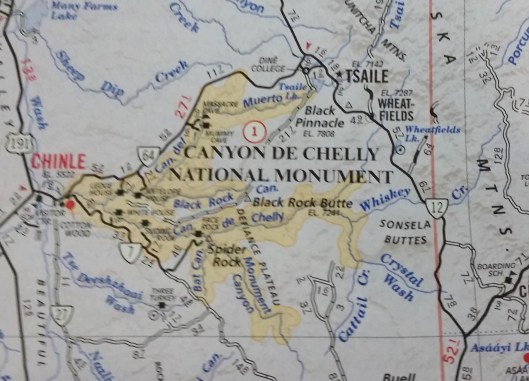
That seems right, doesn’t it?

Don’t give me any flack about phones and GPS systems. I’m old damn it! I use maps.

Well, it turns out my friend Ken Ascher also uses maps, and he just gave me a quick lesson in how to choose the right map. …at least for the four corners area. You see, he was looking to find Tsaile, which happens to the location of the main campus of Diné College where I used to work.

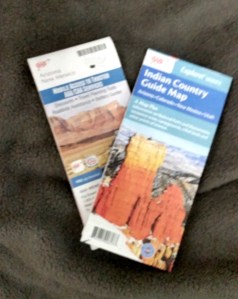
Ken got a AAA map for Arizona and New Mexico and looked and looked. This (just below) is what he saw. You can look and look yourself, but you won’t find it. Tsaile just isn’t on that map. Oh, the little part of the map that I included in that picture does indeed cover the territory that includes the little community of Tsaile, but no, you cannot find Tsaile on that particular map.

Statemaps

You can stop looking now, it’s not there.

Seriously, stop!

Luckily, it turns out that AAA has a different map for “Indian Country” in all four of the four corners states. It isn’t as detailed, but its purpose is to highlight the features of Indian territory. And thus Tsaile makes an appearance on this map (near the upper right hand corner). Yes, it does. See, it’s right there.

Indian Country.2

Having seen it here in the “Indian Country” map, you can even pop your eyes back up to the map above and see where Tsaile should have been. No, it’s still not there. You can see where it should be, but it’s not there.

The issue doesn’t seem to be resolution. The Arizona and New Mexico map has a higher resolution than the one for Indian country. I somehow doubt that anyone hatched a plot to hide Tsaile from Ken. My guess, is that the criteria for selecting what to put on each map simply differs, and that the difference was enough to make Tsaile disappear (along with quite a few other things, actually). Luckily Ken found the other map and then found his way to Tsaile.

Okay, so this probably isn’t one of the greater injustices to occur in the all-too sordid history of Indian-white relations, but surely there must be a moral somewhere in this story. It might be just to remember that you can get a separate map for Indian country if your traveling through the area. It could also be that you should get as many maps as you can possibly find, so that you can check them all. Hell, it might even be that you should use your telephone GPS, but that way lies madness!

Frankly, I think the moral of the story is that I’m out of ice-cream, which may seem irrelevant to you, but you aren’t the one jonesing for it right now.

That aside, I’m going for the “get the Indian Territory map if that’s where you’re going” moral to this story. If you want to find your way around the reservations in the four corners, you’re going to want that map.

And with that I’m off to dream of ice-cream.

…or better yet frybread!

I miss frybread.

Share this:

  • Tweet
  • Share on Tumblr
  • Click to print (Opens in new window) Print
  • Click to email a link to a friend (Opens in new window) Email
  • Click to share on Reddit (Opens in new window) Reddit
Like Loading...

Decalogic Schmecalogic!

08 Monday Feb 2016

Posted by danielwalldammit in atheism, Native American Themes, Philosophy, Write Drunk, Edit Stoned

≈ 6 Comments

Tags

atheism, Charlton Heston, Christianity, Decalogues., Memes, Morality, Native Americans, religion, Ten Commandments

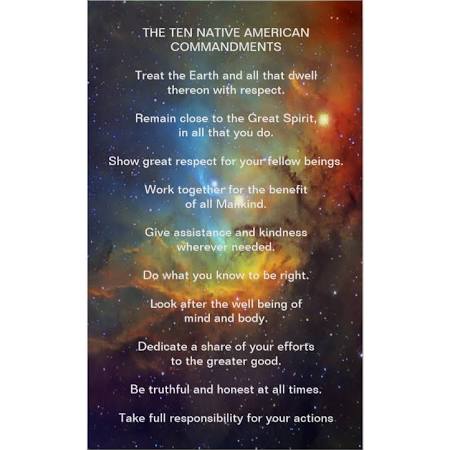
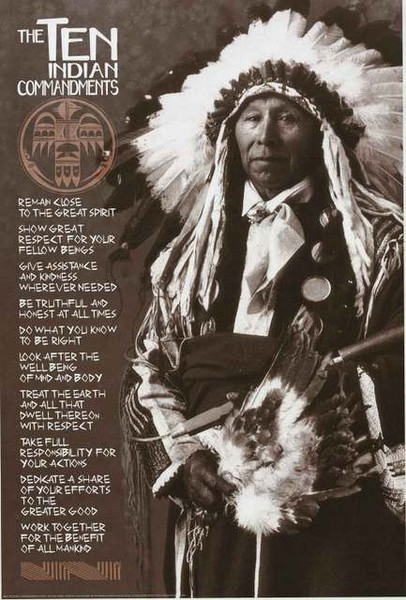
shoppingMaybe you’ve seen it yourself. One of the many pieces of spirit-kitch floating about the net these days is a little gem called The Native American Ten Commandments. It might as easily be labelled an Indian Ten Commandments, or even the Native American Indian Ten Commandments.

…cause extra syllables make it all better.

Either way it’s just the sort of thing that goes with overly staged old photos or pastel-tinged paintings involving beautiful people and lots of feathers. To the left, you can see a poster version of the list. It is short on feathers, but totally cosmic, cause, well, Indians are good for that sort of thing.

…of course.

pst2831ntvam_grandeThat’s just one version of the native decalogue. Here is another! The list looks about the same, but the order seems to be different. Apparently, the order of this list isn’t as important to the Great Spirit as it is to the God of Abraham. I know, I know. Some of you are already saying these are the same thing.

Well maybe.

But seriously, I don’t think so.

See, one of the many things that I typically admire about indigenous peoples is that they aren’t the sort of people who normally produce this sort of nonsense.

…or at least they weren’t historically. (Progress ruins just about everything.)

So what’s wrong with a decalogue of commandery goodness? Well we could start with the commandment theme. It contains a whole host of culture-specific assumptions about ethics most of which seem screamingly out of place here, not the least of them being that ideas about how one ought to behave come from some being of cosmic authority. This is one of many respects in which the politics of kings comes screaming through the metaphors of modern Christianity. Ten commandments construe morality in terms of fealty to a liege-lord who gets to tell us how to behave. Whatever else the Lord is, he’s also a Lord, which is to say neither a Democrat nor a Republican. He tells us what to do, and doing His will is what defines our own morality. That is the logic of the Ten Commandments. This logic gets softened a bit in the Native American variant. We don’t exactly know who is commanding us. It might not even be the great spirit. One imagines, perhaps an elder who wishes us to show respect for the Great Spirit, which is at least a little more egalitarian than a God who  starts his list of does and don’ts with a demand that we pay more attention to him than anyone else. So, yeah, it’s a little more egalitarian.

A little!

Tossing the commandment format out altogether would be a lot more egalitarian.

…and as far as I can tell, a lot more authentic. Maybe I’m missing something, like the history behind this particular decalogue. I wonder who produced it, and just what they hoped to accomplish with it. Suffice to say, it doesn’t strike me as having much connection to the traditions of any particular Native American people. It’s language and its metaphors are those of a generic pan-Indian culture, and in this case a pan-Indian culture as envisioned from the viewpoint of an outsider.

indexDo I object to the principles at stake here? Not particularly. Some of them sound rather cool. It’s the total package that sets off the red flags for me, not the least of reasons being its rather non-native packaging. What bothers me about this is the fact that some people don’t approach ethics in terms of a list of rules, much less imagine them to be the product of a cosmic legislator. The Native American decalogue invites us all to appreciate a kind of difference, but imposes an artificial similarity on the subject even as it pretends to acknowledge that difference.

And why ten? Seriously, can’t your ethics come in five or eights, or maybe even thirty-twos. Actually, I’m not a huge fan of listey philosophicals in general. The numbers always seem arbitrary, and along with that goes a lot of potential for contradiction, and very little potential for substantive understanding. It’s the matter-of-fact nature of such lists that seems to me an invitation to the most mechanical of moral sensibilities.

If there is a good place for such lists, I suspect it’s in less cosmic subject matters. They seem quite appropriate for a professional code of ethics, not the least of reasons that folks don’t usually expect a professional code of ethics to be complete. If your morality is dictated entirely by your job, then most folks would say you work to much. Then we just say; “Thou shalt get a life!”

…and thou better get on it, dammit!

Yes, I know I’m misusing ‘thou’. It’s not the worst thing I will do all day, not even in this post. Trust me!

commandments-colour-smallAnyway, I don’t really mean to pick on native Americans here. They aren’t the only ones to fall for the lure of the decalogue (or perhaps to have someone else fall for it on their behalf). Apparently, there is a Ten Commandments of Colour Theory. Ted Talks seem to have their own, ..um, TED Commandments. Unnamed sources tell me there is a Ten Commandments of Journalism. Actors have their own Ten Commandments. So do bartenders. I would not have guessed, but it appears that even Propagandists have Ten Commandments. Even Nudists have Ten Commandments. Writers have one just for social networking. Is there a secret to a successful marriage? Yep, ten of them. Typography has its own decalogue. Apparently millennials have their own Ten Commandments. Following these Ten Commandments will lead to weight loss. …surely. Computer programmers have a decalogue, though presumably they will work on it sometime next week.

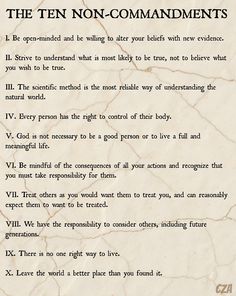
5f3129f4f2e3c4dfde49270fbb5646ccAs I understand it, a list of Ten Commandments for Atheists has been floating around for awhile, though I assume the commandery parts of these Commandments is meant to be taken with a grain of salt. Actually, it seems there are a few decalogues for non-believers out there. Richard Dawkins seems to have produce one such list in The God Delusion. Penn Jillette has one too. I don’t remember reading it, but I’m told Bertrand Russell produced such a list long before him. Hitchens has his own list, so now his face appears on memes beside such a list. The guy at Daylight Atheism on Patheos blogs is not to be outdone. Oh look! The Atheism Reddit seems to have a Ten Commandments.

h9r6qCh…it looks like someone else made that up.

…probably not a fan of the atheist reddit.

Hey, there is a Ten Commandments of Logic! Hm…

There is a Ten Commandments for Musicians. Better yet, Captain Beefheart once produced a Ten Commandments for Guitar Playing. Classical Musicians have their own Ten Commandments. Drummers have a list of Ten Commandments, but honestly, I think they have machines for that now.

How many commandments do RPG Gamers have? Ten. It appears that Gamemasters have ten of their own. Do game designers have ten commandments? Of course. But there is a different one for educational game designers. There is even a Ten Commandments specifically for video game menus. Game Inventors have one of their own.

Do Republicans have their own Ten Commandments? Yes, but apparently they didn’t write it. Or this one. Liberals don’t seem to have written theirs either.  Elizabeth Warren once issued 11 Commandments for Progressives, cause apparently one of them is breaking the frame. Mostly, Republicans and Democrats argue about the Ten Commandments, but let’s not get into that.

…today anyway.

ac95140ca7e38d9210cf7a63357977b6I can only hope that I’ve broken at least three of them, but you can damned well bet that there is a Ten Commandments for bloggers. Actually, there seems to be two of them. No, Three. Make that four. Okay, five. Six? Okay, that’s really enough. No really, stop it! Seriously, stop it! I said STOP!

Someone here says that cats have a Ten Commandments, but they only follow it when they feel like it. Dogs have their own take on the Ten Commandments. I would look for a Ten Commandments of tropical fish, but I imagine it would just go like; “1) Gloop, 2) gloop, gloop.” Horses have a Ten Commandments. There is a Ten Commandments for pets in general.

Oh Hell, I haven’t even got to all the interesting or well known decalogues! This could take all day. …maybe even ten of them. But you get the idea. What’s fascinating about the proliferation of decalogetry, at least to me, is the seeming arbitraryness of the whole thing. Even within the Abrahamioc religions, the Ten Commandments have less to do with actual scripture than pop-Christianity. Compared to its source material, the Ten Commandments are simplified and trimmed of questionable content (one might even say that ‘politically correct’, but of course that phrase is only to be used in attacking liberals). Still, the notion caught on, and caught on so well it just keeps generating itself, time and again. Some of its children are meant to be taken more seriously than others, but an awful lot of people seem to fall quite easily into the notion that ethics begins with a list of ten principle to be declared into existence by someone (with or without the authority to do so).

imagestyIn fact, maybe I’ll have a go at it myself:

The Ten Commandments of Decalogue Building

1: The Number of Commandments Shall be Ten.

2. Ten shall be the number of the commandments.

3) Thou shalt not have 11 Commandments, nor 9, except that…

4 – No Monty Python References!

5 ~ Numbers 2 through 5 are bullshit. Start over!

2b -> …or not to be. That is the question.

3b, Okay, I’ll let you get by with that one.

4b That which is numbered shall be commandments. Simple oughts and issez shall not count in the counting except insofar as one reconstructs them into shalls and shall nots, or even to fuck offs.

5c = No, not fuck-offs, dammit. Do this right!

6 This is hard.

6.2 –You’re wasting time. Do that one over!

6.3 …Okay, …No matter the subject, all that is deemed worthy of the counting shall end in an exclamation mark

6.4 …

6.5 !

7)) All commandments are to be read in the voice of Charlton Heston. Of course!

8:: The decalogue will not be televised.

  • 9 You’re off topic again.

(10) I really can’t do this.

11 Cause my rules go to 11.

Share this:

  • Tweet
  • Share on Tumblr
  • Click to print (Opens in new window) Print
  • Click to email a link to a friend (Opens in new window) Email
  • Click to share on Reddit (Opens in new window) Reddit
Like Loading...

Leo Gets Mauled By a Bear; My Readers Get Mauled By a Spoiler.

14 Thursday Jan 2016

Posted by danielwalldammit in Movies, Native American Themes

≈ 8 Comments

Tags

American Indians, Film, Hugh Glass, Leonardo DiCaprio, Movie Reviews, Movies, Native Americans, The Frontier, The Revenant

220px-The_Revenant_2015_film_posterThe Revenant was cool. In fact it was damned cool!

By ‘damned cool’ I might mean ‘damned hard to watch,’ but then again damned hard to watch can be damned cool. Tastes vary, of course, but watching a CGI brown bear maul Leonardo DiCaprio was well worth the price of admission.

No, I don’t hate DiCaprio. Quite the contrary. It takes some skill to sell that kind of suffering, and he does it damned well.

This is the story of Hugh Glass, a mountain man most famous for surviving an attack by a bear, and (more impressive still) for surviving his subsequent predicament. Left for dead, the man somehow made it roughly 200 miles to safety (mostly by crawling, as I understand it). The real story of Glass is impressive enough as it is, which is one reason writers and movie-makers keep coming back to it. The Revenant weaves its own narratives around the tale of Glass and his trials.

This movie is every bit as bleak and terrible as you might have thought. Images of human suffering abound, and of course the central story here is one about perseverance in the face of tremendous adversity. By perseverance I of course mean suffering. I might even have to write ‘suffering’ in this review a few more times, just to make sure you get the point. There is a lot of suffering in this film. But what does all the suffering add up to?

Therein lies the nitpickery point!

It’s a vision of the frontier as a place filled with violence and pain. That frontier has very little in the way of love, stability, family, or community. The things that connect human beings to one another in meaningful ways have been all but removed from the world of this story. When such connections do appear in this film, they appear to be fragmenting …painfully. Glass, for example, has already lost his Indian wife as the story begins. He will lose his son midway through the story, and he will end the film quite alone.

It isn’t the bear that sets off all this tragedy. It is the leader of an Arikara party who keeps attacking Glass and his companions. This character, we learn, is actually seeking his own daughter, whom he believes to have been captured by Glass’ party. Glass’ doomed wife and son as well as the daughter of the Arikara leader are the only bonds of kinship that I recall from the film, and each is unraveling even as the film begins. We are left with a world in which love itself comes into focus only through the medium of pain.

It’s worth considering for a moment that this kind of world cannot exist over the long duration. There are no births in this world, nor are there the means of nurturing future generations. These are men operating on the fringes of their own communities and/or in the wilderness emerging between them. It comes close to a Hobbesian time of war, or perhaps more appropriately to Frederick Jackson Turner’s frontier as the meeting place between savagery and civilization. Even the Native Americans in this film seem unable to keep a family together. This is the myth of the west taken to 11. It’s a world that must pass, either to complete destruction or eventually into some semblance of social order. It is the latter of course to which this sort of frontier narrative points us, as the frontier anticipates the coming of civilization. For now, we are left to contemplate a world in which few (if any) are born and a good many die every third or fourth scene.

I can’t help but think many will imagine this is the world frontiersman found when they entered the American wilderness, though I’m more inclined to think of it as a world they made by that very entry.

If there is a truly objectionable feature to this narrative theme, it would be the role played by friendly Natives. Some readers may be familiar with the phrase ‘magic negro’, which is usually taken to refer to a stock character used in all-to-many Hollywood films. The magic negro is usually gifted with some mystical power, often a sort of impossible wisdom which he will use to aid the white protagonist in a given story. Just as often, the magic negro will die before the end of the narrative, leaving the great white protagonist to resolve matters using whatever gifts his friend left behind. Suffice to say the magic negro needn’t really be a negro, though it does seem rather commonly to be a minority of some kind. In The Revenant, Glass enjoys the help of not one, not two, but three magic minorities, all Native Americans.

The First (and oddly enough also the last) of these supernatural mentors would be Glass’ wife. Having been slain in a prior event, she continually returns in the form of visions which inspire Glass to continue. Whether these are meant to be real or simply features of his own imagination isn’t really very important. The bottom line is that she is long gone, but she continues to serve as an inspiration to him. She appears at the very end of the film as well, seeming to say goodbye.

The second of these characters would be Glass’ son who remains loyal to him even as his injuries appear to leave Glass without hope of recovery. This loyalty will cost Glass’ son his life, but that in turn will provide Glass with the motivation to survive, to avenge the death of his son.

The third of these magic Indians appears in the form of Pawnee who shares food with Glass, travels with him, and cures him when Glass is overcome with infections. Glass will awaken to find himself well on the road to recovery even as he discovers his Pawnee friend hanging from a tree, leaving him to face yet another terrible challenge quite alone.

Time and again, Glass benefits from Native characters even as they themselves pass away. The death of the magic minority is that much more fitting here insofar as it perpetuates the narratives of western conquest. Native characters may hamper the frontiersman as does the Arikara leader, or they may aid him, as do each of the magic Indians in this film, but it is simply no coincidence that the white protagonist finishes the story on his own.

Does this work? Yes. It’s a Hell of story, and I plan to watch it again. And perhaps it works partly because of the very tropes that have me griping about the story right now. Some may find them extraordinarily compelling even as I find them terribly disappointing. I can’t help but think more interesting stories await the film-maker who learns to take Native characters a bit more seriously.


Share this:

  • Tweet
  • Share on Tumblr
  • Click to print (Opens in new window) Print
  • Click to email a link to a friend (Opens in new window) Email
  • Click to share on Reddit (Opens in new window) Reddit
Like Loading...

Recollections of WIPCE 2014

07 Thursday May 2015

Posted by danielwalldammit in Bad Photography, Native American Themes, Street Art

≈ 4 Comments

Tags

American Indians, Art, Conferences, Hawaii, Indigenous Issues, Street Art, Time, WIPCE, World Indigenous Peoples Conference on Education

IMG_1010closeupIt was almost a year ago that I attended the World Indigenous Peoples Conference on Education, held on the campus of Kapiʻolani Community College in Oahu.

This was a beautiful but rather surreal experience for a number of reasons. First and most obvious, the muggy heat of Oahu was a bit much for me after a winter in the arctic. …not so much that I wouldn’t want to go again, but, yes there was a day or two that had me longing for the air conditioning of my room. Second, I haven’t attended many academic conferences for some time. So, it felt odd to be back in that mix and listening to the sort of papers I remember from days long past and ambitions long since set aside. As usual, the panels were a fair mix of dull to amazing with plenty of kinda-both happening as well, which is exactly as I would expect it to be.

I remember sitting in one of the conference panels and thinking something about the whole conference really bothered me. At first, I couldn’t quite put my finger on it, but then I realized how much of a hassle it had been moving from one panel to the next. Everyone had been rushing around pretty quickly. They were not quite pushy, but folks had definitely been moving with a purpose, …almost a vengeance. It wasn’t just that this was unpleasant, which would make it a lot like a lot of other conferences. What bothered me was just how uncharacteristic it felt, given the participants. What had bothered me, I realized, was that I wasn’t really accustomed to seeing indigenous people proceeding with such reckless abandon through a schedule. That’s when it donned on me that we were not on Indian time. We weren’t even close. The panels for this conference had been scheduled so tight, you had to leave early or arrive late to a panel in most cases. Being good scholars, people were getting the job done, but the end result was an indigenous gathering with a sense of time better suited to caricatures of German culture than Native anything. This is what had seemed incongruous to me, and I couldn’t help but chuckle when I realized it.

Hell, in Barrow, we don’t even think of it as a native thing, because the rest of us are the same way. What sociolinguists call “Indian time”, we would call “Barrow Time” up here. If an event begins at 8, that’s means 9ish, and even then, don’t be surprised if things actually start around 10. But Barrow Time isn’t just a sense that start times are iffy; it’s also a sense that the people present count more than the clocks. Events proceed when a certain critical mass of people have arrived, said their greetings and settled in comfortably.

…and that’s when we’re in a hurry.

The bottom line is that this conference did NOT have the usual leisurely pace that I’ve grown to expect from indigenous communities. I suppose this could have been a reflection of the limited samples I’ve experienced in my own lifetime. I still think it far more likely that the difference in behavior could be attributed the conference schedule. Left to their own devices, I can’t help thinking some of these folks would have proceeded much more slowly, a lot more deliberately, and in the process gotten to know each other a bit better.

It was outside on the campus of the college where the tone of the conference seemed most fitting, what with people milling around, chatting, and taking in the entertainment. This is where each of the communities present really represented themselves best. At one point, there was a mini-powwow out on the grass, and of course the Maori kept storming the stage to perform a haka. A Sami lady sang a lovely song in the opening ceremonies, but I’m a right bastard for leaving my camera in its case at that particular moment. Ainu held a wonderful round dance toward the end of the conference, and you can almost tell how great it was from the film. …almost.

At some point I snuck downtown to capture some of the street art. A trip to  Punahou School and a visit with a friend out on the coast rounded out he trip nicely. Anyway, here are some photos and videos.

Unfortunately, I only captured a small portion of the performances. A lot of coolness just didn’t quite make it through my lens. I thought I’d share what I can here now, because some of it really was kind of fun.

(You may click to embiggen)

Let’s start with a few general pictures.

random Bird
Unfortunate Eel (Lucky Fisherman Not Pictured)
Sunset II

Sunset

A Small Selection of Performers.

A Sami Guy taking a picture
Hawaiian Dancers III
Hawaiian Dancers

I can’t remember the island these guys are from. Their dance was really cool.
Unidentified Dancer
Ainu

Hawaiian Dancers II
Hawaiian Dancer IV
Australian Youth Group

Street Art!

Mural
Mural II
Close-Up

Close-Up II
Mural III
Mural IV

Mural V
Mural VI
Cloe-Up III

Close-Up V
Mural VII
Mural VIII

Mural IX
Mural X
Mural XI

Mural XII
Mural XIII
Close-Up VI

Close-Up VII

Maori Haka

A Youth group from Australia. (As I recall this dance had to do with the introduction of European honey-bees into Australia. …the most salient difference between them and the local variety being the presence of a barbed stinger.)

Hula Dancers.

Let’s finish it off with that round dance I mentioned earlier.

Share this:

  • Tweet
  • Share on Tumblr
  • Click to print (Opens in new window) Print
  • Click to email a link to a friend (Opens in new window) Email
  • Click to share on Reddit (Opens in new window) Reddit
Like Loading...
← Older posts
Newer posts →

Top Posts & Pages

  • Movie Review: The Orator
    Movie Review: The Orator
  • I'll Just Leave This Here
    I'll Just Leave This Here
  • An Uncommon Security Guard: Dave Eshelman, AKA 'John Wayne'
    An Uncommon Security Guard: Dave Eshelman, AKA 'John Wayne'
  • Hostiles and Spoilers: A Magic Studi
    Hostiles and Spoilers: A Magic Studi
  • A Joke from a Bygone Era
    A Joke from a Bygone Era
  • An Ironic Beating
    An Ironic Beating
  • An American Flag as a Weapon, Redux.
    An American Flag as a Weapon, Redux.
  • Fake Patriots and Fake George Washington Quotes
    Fake Patriots and Fake George Washington Quotes
  • An Irritation Meditation: The Majority Rules Meme
    An Irritation Meditation: The Majority Rules Meme

Topics

  • Alaska
  • Animals
  • Anthropology
  • atheism
  • Bad Photography
  • Books
  • Childhood
  • Education
  • Gaming
  • General
  • History
  • Irritation Meditation
  • Justice
  • Las Vegas
  • Minis
  • Movie Villainy
  • Movies
  • Museums
  • Music
  • Narrative VIolence
  • Native American Themes
  • Philosophy
  • Politics
  • Public History
  • Re-Creations
  • Religion
  • Street Art
  • The Bullet Point Mind
  • Travel
  • Uncategorized
  • Uncommonday
  • White Indians
  • Write Drunk, Edit Stoned

Blogroll

  • American Creation
  • An Historian Goes to the Movies
  • Aunt Phil's Trunk
  • Bob's Blog
  • Dr. Gerald Stein
  • Hinterlogics
  • Ignorance WIthout Arrogance
  • Im-North
  • Insta-North
  • Just a Girl from Homer
  • Multo (Ghost)
  • Native America
  • Norbert Haupt
  • Northwest History
  • Northy Pins
  • Northy-Tok
  • Nunawhaa
  • Religion in American History
  • The History Blog
  • The History Chicks
  • What Do I Know?

Archives

  • December 2023
  • November 2023
  • June 2023
  • April 2023
  • February 2023
  • December 2022
  • November 2022
  • October 2022
  • September 2022
  • August 2022
  • July 2022
  • June 2022
  • April 2022
  • January 2022
  • December 2021
  • November 2021
  • October 2021
  • September 2021
  • August 2021
  • June 2021
  • May 2021
  • March 2021
  • February 2021
  • January 2021
  • December 2020
  • November 2020
  • October 2020
  • September 2020
  • June 2020
  • May 2020
  • March 2020
  • February 2020
  • January 2020
  • December 2019
  • November 2019
  • September 2019
  • August 2019
  • July 2019
  • June 2019
  • May 2019
  • April 2019
  • January 2019
  • December 2018
  • November 2018
  • October 2018
  • September 2018
  • August 2018
  • July 2018
  • June 2018
  • May 2018
  • April 2018
  • March 2018
  • February 2018
  • January 2018
  • December 2017
  • November 2017
  • October 2017
  • September 2017
  • August 2017
  • July 2017
  • June 2017
  • May 2017
  • April 2017
  • March 2017
  • January 2017
  • December 2016
  • November 2016
  • October 2016
  • September 2016
  • August 2016
  • July 2016
  • June 2016
  • May 2016
  • April 2016
  • March 2016
  • February 2016
  • January 2016
  • December 2015
  • November 2015
  • October 2015
  • September 2015
  • August 2015
  • July 2015
  • June 2015
  • May 2015
  • April 2015
  • March 2015
  • January 2015
  • December 2014
  • November 2014
  • October 2014
  • July 2014
  • June 2014
  • May 2014
  • April 2014
  • March 2014
  • February 2014
  • January 2014
  • December 2013
  • November 2013
  • October 2013
  • September 2013
  • August 2013
  • July 2013
  • June 2013
  • May 2013
  • April 2013
  • March 2013
  • February 2013
  • January 2013
  • December 2012
  • November 2012
  • October 2012
  • September 2012
  • August 2012
  • July 2012
  • June 2012
  • May 2012
  • April 2012
  • March 2012
  • January 2012
  • December 2011
  • November 2011
  • October 2011

My Twitter Feed

Follow @Brimshack

RSS Feed

  • RSS - Posts
  • RSS - Comments

Enter your email address to follow this blog and receive notifications of new posts by email.

Join 8,075 other subscribers

Blog at WordPress.com.

  • Subscribe Subscribed
    • northierthanthou
    • Join 8,075 other subscribers
    • Already have a WordPress.com account? Log in now.
    • northierthanthou
    • Subscribe Subscribed
    • Sign up
    • Log in
    • Report this content
    • View site in Reader
    • Manage subscriptions
    • Collapse this bar
 

Loading Comments...
 

    %d