• About

northierthanthou

northierthanthou

Category Archives: Politics

A Bitter Thought

21 Tuesday Aug 2018

Posted by danielwalldammit in Narrative VIolence, Politics

≈ 5 Comments

Tags

Atrocity, Facism, History, MAGA, Martin Niemöller, Nazis, Persecution, Terror, Violence

We all know the famous quote from Martin Niemöller:

First they came for the communists, and I did not speak out—
Because I was not a communist.

Then they came for the trade unionists, and I did not speak out—
Because I was not a trade unionist.

Then they came for the Jews, and I did not speak out—
Because I was not a Jew.

Then they came for me—and there was no one left to speak for me.

It’s a great quote of course, one that invites us all to slip right into the role of the narrator, to imagine ourselves in Niemöller’s place. To make us think about how we ought to speak out early. But of course, Niemöller didn’t, not until it was too late, and neither did so many others, ever.

One question that’s been on my mind a lot though lately; the ones who come for people, what if they never came for you?

Or anyone like you?

What if the wrong people never made it out of those camps, not in enough numbers to get anyone’s attention?

What if there was no foreign power interested in stopping them? At least none capable of it! No enemy troops to escort you and your neighbors through the killing grounds? To make you handle the nameless bodies? Or tell you what was done in your name? To make you see it or smell it?

What if those people, the ones who come, never bit off more than they could chew? What if they never gave you a reason to rethink your silence?

What if you were never the one who needed someone to speak out?

What sort of stories might you tell then?

Share this:

  • Tweet
  • Share on Tumblr
  • Print (Opens in new window) Print
  • Email a link to a friend (Opens in new window) Email
  • Share on Reddit (Opens in new window) Reddit
Like Loading...

Libertarians on the Prairie – A Reviewish Bit of Bloggetry

24 Tuesday Jul 2018

Posted by danielwalldammit in Books, History, Politics

≈ 10 Comments

Tags

Book Review, Books, Christine Woodside, Individualism, Laura Ingalls Wilder, Libertarianism, Little House on the Prairie, Rose Wilder Lane, The Frontier

Libertarians on the Prairie

Libertarians on the Prairie

Back in college, I remember a few of my professors speaking ironically about the image of Little House on the Prairie. That the story didn’t exactly match the realities of western expansion was pretty much a forgone conclusion at the time, but I don’t recall anyone going into depth as to the nature of the problems or the reasons this popular story might not have gone so consistently in a suspicious direction.

As a kid, I certainly liked the show.

Hell, I loved it!

I actually remember the very first episode of Little House on the Prairie. I remember liking the characters immediately. I wanted them to succeed. I REALLY wanted to know if they could make that farm work. As the closing credits rolled, I remember, I couldn’t wait to see the next episode.

A whole week! How would I make it!?!

In the coming years, I watched a fair portion of the Little House television series. I can’t say that I ever got around to reading any of the books. It’s funny to think about it though, because those books have had an impact on my life and my thinking – filtered a bit through other media. When a series of books seeps that deep into the popular culture, it leaves an impression on everyone, even those who don’t seek it out. I figure that is why some of my old professors made a point to reference Little House while setting up lessons on western history. It isn’t that they had a specific point to make about the series or the books, but they new that story would be hanging there in the back of our minds. Whatever they meant to say themselves about the subject, these teachers knew they would have to reckon with the themes of the series in one form or another.

Typically, the comments in question took the form of an oblique reference to myths of the old west. The rugged individualism of the old west was a common target of abuse, and the Little House series had always put that theme front and center. Life on the frontier wasn’t really like it had been portrayed in Little House. Saying so wasn’t really necessary for most of us, but it was often a convenient (and amusing) way of sliding into a lecture about what the professors thought might be a little closer to the truth,

What I didn’t know then, not as a kid, and not later on as a college student, was that the tension between the presentation in Little House and the realities of frontier life was a lot more focused than these random comments would seem to suggest. The Little House books didn’t just happen to emphasize themes of rugged individualism, and my professors weren’t simply giving vent to some vague sense that the stories had oversimplified the matter. The original Little House books contained a very clear expression of libertarian views, and my professors were in fact trying to counter that explicit message in order to clear the way for whatever they themselves wanted to teach us. Far from an innocent theme and a series of off-hand rejoinders, the rugged individualism of the Little House books (and later the series) constituted an explicit ideological statement about the way people ought to live. I think some of those old professors knew very well about the connection between libertarianism the Little House narratives; others may have simply been irked at the persistence of themes they regarded a naieve. Either way, the story of that Little House on the Prairie was always political statement, a statement meant to tell us as much about the perils of Roosevelt’s New Deal policies or the depravity of the Great Society as anything that may or may not have happened on any particular prairie. The Little House story wasn’t just a story about the frontier; it was attack on a good deal of the the modern world. What I was hearing in class was at least partly a response from those that had noticed.

The key to this story is the realization that Laura Ingalls Wilder did not write the Little House books alone. They were a product of her collaboration with her daughter, Rose Wilder Lane, one of the great matriarchs of libertarian literature. It had always been acknowledged that Rose typed up Laura’s handwritten manuscripts, and of course that she had done a little editing in the process, but it turns out there was a good deal more to the story. The death of Rose in 1968 freed up the correspondence between the two of them, and along with that, the various drafts of Little House books exchanged between them over the years. Those familiar with these documents realized very quickly that Rose contributed a great deal more than her typing skills and light editing to the process. She was an active collaborator from the very beginning.

The collaboration between Laura Ingalls and her daughter is the subject of Libertarians on the Prairie, by Christine Woodside. I first heard about the book on an episode of  Edward T.Odonell‘s podcast, In the Past Lane, wherein Woodside appeared as a guest. With a little travel on my agenda for this summer, I figured this was the perfect volume to help me get from Barrow Alaska to Billings Montana.

I was not disappointed.

This book is no hack job. Woodside is clearly a lifelong fan of the Little House series, and she clearly admires the work both women put into this series. Peering behind the curtain, so to speak, doesn’t seem to have dampened her enthusiasm. Woodside takes pains to reveal a good deal that Little House fans may find uncomfortable, but she also takes pains to praise Ingalls and Wilder on a number of points. Her work is critical, but not unsympathetic.

Woodside does an excellent job of sorting out the process that went into writing the Little House books. Of course, she is hardly working with a complete record, so she can’t piece together every detail of the process, but Woodside manages to support a number of interesting conclusions about it. She presents Laura as a story-teller with a gift for detail and a vivid memory without which the books could never have been written. It was Rose, according to Woodside, who provided the overall structure of these narratives, and shaped the line by line text enough to help bring that structure out in the final works. In doing so, Rose actively steered the narratives in a direction consistent with her own emerging interest in libertarian politics. If Rose was leaning toward such thought at the beginning of the books, she was fully committed to them by the end of the series, a phase in which Woodside tells us Laura had surrendered more control over the final copies to her daughter. Significantly, Rose omitted from the books a number of stories that would have undermined the central message of rugged individualism, even as she sometimes inserted into the work pointed stories of events her mother hadn’t written herself. The resulting narrative contains more than the occasional embellishment; it actively misrepresents the facts of Laura Ingalls’ early life, and it does so in the service of a specific political message.

Woodside is careful to point out that the books were not simply propaganda. If Rose steered the Little House series in the direction of libertarian thought, it was because that was precisely how she came herself to view the world. It seems unlikely that Laura would have objected to the larger themes of Rose’s politics. Neither were fans of the New Deal; each was increasingly skeptical of government authority (and in fact, their own collaboration had emerged partly out of an effort to commit tax fraud). There is evidence that Laura and Rose sometimes argued over details to be included in their stories, and Rose clearly took a more strident position than Laura had, at least in her written work, but it seems that both women shared a number of assumptions about the importance of hard work and limited government. These assumptions made it into the books. They also made it into the series.

So what of it?

We could haggle over the details. Where the Little House narrative has the Ingalls family working hard to get money for that Laura’s sister, Mary, can attend a school for the blind, we know that in fact the school was funded by the Dakota Territorial Government. We know that the family generally settled closer to other people than they have been portrayed in the Little House books, and we even know that major events in their lives (such as a year in town) were omitted from the stories Laura and Rose chose to tell. Their eviction from Indian territory was played up for the purpose of inserting an anti-government message (which is ironic as Hell given the role the military played in freeing up such lands to begin with). We could go on…

These facts do matter, and Woodside provide a brief list of such details near the end of her book, but the larger issue is a bit murkier.

It may well be that the Little House books contain a very pointed message, and that message may be squarely in tune with libertarian thought, but it would not be true to say that the appeal of these stories is limited to such circles. You don’t have to be a libertarian (much less a Libertarian) to enjoy the Little House stories. Hell, I have little patience for that school of thought myself. That didn’t stop me from watching (and enjoying) an episode or two after reading this book. Their appeal goes beyond the narrow confines of free market fundamentalism, touching upon narratives of American exceptionalism with a much broader appeal in the popular culture of our nation.

It goes without saying; the spirit of Frederick Jackson Turner haunts the Little House narrative. Indeed, the series seems taylor-made to illustrate the Turner-thesis, presenting us with a living, breathing, example of a family struggling against the forces of nature at the meeting point between savagery and civilization. It was the frontier, according to Turner, that made this country unique. That is a message fraught will all manner of perilous implications, but it’s also a message that resonated with generations of historians, and with generations of writers, television and movie-makers, and even musicians. It may even have resonated with a few children reading the Little House books or watching Ma and Pa Ingalls on television. It probably even resonates with a few people who should know better. People who do know better.

Simply put, the story doesn’t become less interesting just because you know it’s fiction. It doesn’t necessarily become less interesting when you realize just how sideways the whole story spun from the realities of life for the Ingalls, or for anyone else on or near that frontier. The story-line itself is just so ingrained in the American imagination. It, like so many other myths, will outlast countless debunkings, even this one.

…which brings us back to the whole ‘what does it matter’ question.

In blending the central themes of libertarian thought with the larger myths of the American frontier, the Little House books effectively provided an exceptionally powerful re-enforcement to those themes. If we can all believe that ma and Pa Ingalls were able to survive along with their little girls out there mostly alone on the frontier, then we can believe Americans with televisions, and credit cards, and cell phones certainly ought to make it on their own too. If we can forget all the ways that frontier families derived help from friends and family, and from government policies, then we can also forget why we have social security, bank regulations, an EPA, Medicare and food stamps. Some of us may think these things are important, but a good number of very powerful people don’t care about these things, and those people are uniquely situated in today’s political environment to do away with them.

They might even tell us it was all about making American great again!


Share this:

  • Tweet
  • Share on Tumblr
  • Print (Opens in new window) Print
  • Email a link to a friend (Opens in new window) Email
  • Share on Reddit (Opens in new window) Reddit
Like Loading...

Memo to Coach Everyman

09 Monday Jul 2018

Posted by danielwalldammit in Politics

≈ 5 Comments

Tags

Christianity, Conservative Christianity, Donald Trump, Humor, Jim Jordan, Locker Room Talk, Political Correctness, Satire, School

To: Coach Everyman

From: Principal Stiffton, Everytown Public High School, USA

Re: Locker Room Talk

I wanted to follow up on our conversation earlier this afternoon and share with you a few of the parental concerns brought to my attention earlier this week. I have already spoken to the parties in question. I have tried to assure them that the conversations occurring in our locker room are much as they would be for any other intermural sports teams in the country. Unfortunately, several parties are simply not satisfied. They seem quite certain that our games have become the site for talk they regard they regard as dangerous and possibly harmful to the moral development of their young children. No. They don’t actually want you to do anything about it. They just want to make sure these conversations are limited to the context of the locker room.

The sexual content, you already know about, but again, I must tell you that none of the parties in question have called for any investigations. We don’t need to know if any of the activities your football players bragged about during the post-homecoming celebrations actually did take place. The parents are actually quite relieved to find that such specific sexual activities were not discussed in the context of Sex Ed classes. Please discontinue any ongoing inquiries regarding specific allegations made about or by your players. What happens in the locker room, according to these parents, should stay in the locker room.

A couple of new concerns have been raised. Mr. and Mrs. Smith are apparently quite convinced that you have been holding seminars on global warming during the pregame briefings. I really tried to assure them that you are only a part-time science teacher and that you would of course reserve such discussions for the classroom. On the contrary, the Smiths insisted that such conversations were fine so long as they occurred only during the weigh-ins for the wrestling team. In fact, they only brought it up to assure me that this was the perfect place for such matters. The other concerned parents all assured me that they were in agreement with the Smiths.

Actually, “agreeance” was the term the parents used, and one of the words in “Climate Change” was consistently replaced with some form of scatological reference. Nevertheless, all the parents in question found the topic quite appropriate for the locker room. They just don’t want you to bring the subject up in any of your actual courses.

Many of the concerned parents had much the same views regarding the subject of evolution. You may answer any of the questions Billy Johnson asks about that subject you like, they assure me, providing you limit your answers to the half-time pep talks occurring during the basketball games. If other students must hear the answers to these questions, our parents parents insist it must not be in any actual classroom. Also, they would prefer that you leave textbooks out of it. If any literature must be consulted, it should be op-ed pieces authored by economist and sundry pundits. You may present all sides of the issue, of course, but our parents would very much prefer that you keep the science out of it, and that you limit these talks to the locker room. We don’t want anymore incidents like the graph you presented in home-room last week.

You needn’t worry yourself about the subjects of genocide, slavery, or imperialism. It is quite all right if the baseball team discuss these things during practice, or more specifically, before and after practice. The group of concerned parents just wanted me to make sure these conversations were not coming up in the history classes. I will speak with Mrs. Jones about this; she has been warned twice already, and I am really getting quite frustrated with her over the whole thing, but that is no concern of yours. To the best of my knowledge, our parents have no concerns regarding your own role in the whole ‘structural racism’ incident. I told them that you would never encourage students to use such words off the field or outside the locker room, and they have accepted my word on the matter.

Asked if they had any concerns about Russian meddling in American elections, the gutting of environmental regulations, understaffing at the state department or the establishment of internment camps on U.S. soil, none of the parents in question seemed to know what I was talking about. I don’t believe any of them have been in a locker room within the last few months, and they do not seem to have encountered the subjects in any of their chosen news sources. Suffice to say that our parents have no concerns about any of these subjects. Your players are free to bring up any of these matters during the course of game preparations. You might ask them not to raise any of these topics in any of their classes, however, and perhaps to avoid discussing them with any of the adults in their families. I think morning calisthenics will offer you the perfect opportunity to warn your players about such matters, but the time and place for that discussion is entirely up to you.

This is really the extent of the matter as far as I understand it. Again, please cease any active investigations into the rumors you have been hearing and do make a point to help the students understand what should and shouldn’t be shared with their parents. Some of the things we talk about in school just isn’t fit for fragile ears. In any event, please remember that what is said in the locker room must stay in the locker room.

That is all.

Share this:

  • Tweet
  • Share on Tumblr
  • Print (Opens in new window) Print
  • Email a link to a friend (Opens in new window) Email
  • Share on Reddit (Opens in new window) Reddit
Like Loading...

A Very Soylent Spoiler Alert

16 Saturday Jun 2018

Posted by danielwalldammit in Movies, Politics

≈ 7 Comments

Tags

Cannibalism, Charlton Heston, Climate Change, Dystopia, Environment, Escatology, Film, Movies, Soylent Green

51E+WFShw9L._SY445_Soylent Green is people!

Yeah we all know that.

Or do we?

I’m sorry, I meant to say; “spoiler alert!”

Anyway, yeah, Soylent Green is people, but the thing is that’s not really what the movie is about, is it? The Movie, Soylent Green, is about the death of the oceans. It’s about the end of life as we know it, or rather the moment in history just before the end of life as we know it. In that moment, as the food sources dwindle down to nothing, human beings begin to cannibalize each other on a scale never before seen in human history.

By ‘human beings’, I of course mean, the powers that be. It is a murky blend of corporate and government power that begins to market human flesh in the form of flavorless green protein wafers. Some might have found it odd to see cannibalism playing out under the auspices of capitalism. The former is a quintessentially primitive practice; the latter is all about of progress.

Right?

When Charleston Heston ends the film screaming “Soylent Green is people,” at least a little of the horror in that moment has always been the realization that the engines of progress have somehow brought humanity to embrace one of the greatest horrors of the primitive world.

It’s fiction, of course, but then again so is the story of progress, and so are a lot of those stories about ‘primitive’ cannibals.

Still it’s a little disconcerting to think that we are already in the timeline of Soylent Green. Yes, that’s right. Way back in 1973, 2018 was the very distant future, distant enough to project upon it all the dystopian horrors you might care to imagine.

For those who haven’t seen this old gem, the main plot has us following a police investigation in a world wracked by overcrowding, starvation, and of course food riots. People live on the streets or the staircases of apartment buildings, guarded by armed men, and…

…and seriously, SPOILER ALERT!!!

…and all these people rely upon one corporation (The Soylent Corporation) for food in the form of artificial wafers, color coded for different kinds of nutritional value. As the story begins to take shape, Soylent has just brought a new wafer into its product line, and yes, it’s green.

…but that’s not too important yet.

The main story-line has us following a murder mystery as Police Detective, Frank Thorn (played by Charlton Heston) investigates the murder of a wealthy and powerful man with the assistance of an aging police analyst named Sol Roth (played by Edward G. Robinson). It turned out the victim had in his possession a report, a large tomb purporting to be an oceanographic survey conducted by the Soylent Corporation over the years 2015-2019. Through careful study and corroboration with his own colleagues, Sol comes to realize the report contains a bombshell. The oceans are dying, irrevocably losing the capacity to produce even the algae used in Soylent wafers. This knowledge is what got the wealthy victim murdered in the first place, but not before he lost all hope and gave up living in the first place. The man, so we are told, was not himself in those final days.

Realizing himself that humanity is doomed, and nearing the end of his own life in this miserable world, Sol himself elects to ‘go home’, which is to say that he reports to a facility where people assist him in committing suicide, treating him to a lovely planetarium display featuring all the sights and sounds of nature as he drifts off into oblivion. Thorn arrives too late to save Sol, but not too late to force his way into the facility and watch the display while speaking with Sol in his last moments. Thorn is shocked by the sight of fields and trees, and animals, even as he learns about the end of the world’s food supply, such as it is. He learns of earth’s former glory even as he comes to grips with its coming end. It’s a maddening thought.

But what to do about it?

Thorn begins by trying to learn a little more about the operations at Soylent. After sneaking into the vehicles transporting Sol and the other dead away the facility, Heston comes to realize the bodies are being processed into the creation of green wafers, thus explaining how the Soylent corporation could come up with a brand new and improved food staple even as humanity’s food supply runs out once and for all. Thus, the infamous line, “Soylent Green is people.”

…oh yeah, there are fights and shootings along the way.

So, yes, Soylent Green is people, but there is a reason it’s people. It’s people because people are the only edible resource left.

Faced with diminishing resources, the powers that be have turned to their own population to reproduce their world, at least for whatever time they may be able to keep this up.

I remember watching this as a kid. Those final moments were pretty shocking back in the early seventies. I remember wondering what would happen in the wake of the credits Would people respond to Heston’s character and shut down the Soylent factories? And if they did, what next? This was a story about the end of everything, and the great crime that echoes through its final moments isn’t going to change that. Perhaps the cannibalism could be stopped, but not the disaster that produced it. It’s a maddening thought, the end of humanity, one next to which the crimes of the Soylent corporation seem to pale in comparison.

What shocks me about the whole story-line now is just how much it pales in comparison to the reality in which we live. We’ve already got our own Soylent report, a whole bunch of them in fact. Scientists have been delivering news quite comparable to that of the Soylent Oceanographic Survey for decades now. Most seem to hold out at least some hope that the disaster in question could be averted, but the scale of tragedy envisioned in climate change is quite comparable to that envisioned in the movie Soylent Green. What is the result? Life goes on.

Somehow, the possibility that all life as we know it could be about to end hasn’t generated sufficient public resolve even to attempt a serious solution. Some folks, such as our Tang-Colored Denialist-in-Chief, seem Hell-bent on making sure the whole disaster comes sooner rather than later, even hiding the facts by suppressing scientific findings on the subject, but the fact is that we are all implicated in this story-line. We are all contributing to the disaster. We can point to certain villains who don’t even want us thinking about this issue, much less attempting to tackle it, but in the end, it is humanity as a whole (or at least the more developed nations within it) that is proceeding full steam ahead.

It’s as though Heston’s cries didn’t even lead to an investigation of the Soylent factories. We all heard him, and then we just kept munching away at the quaint little green wafers that give us so much more energy than the red ones or the white ones and even the purple ones.

It’s one of the things that fascinates me about climate change. Somehow this real-world threat to life as we know it carries with it far less force than the comparable horrors of fiction. We can can appreciate the threat of The Thing or the Body-Snatchers. We can even hope that somehow Heston’s cries will bring an end to the Soylent factories. We can pull for the good guys to save the day in these stories, But when credible sources tell us that all life as we know it could come about as a result of our own actions, we ponder it while and then drive to the store.

Don’t get me wrong. Far from being an exception, I count myself among the worst offenders.

This is perhaps one of the interesting features of story-telling, that it enables us to envision solutions which would escape us in real life. Indeed, stories enable us to conceptualize problems we might not even acknowledge in real life. Our world may not contain vampires, for example, at least in the sense that we cannot find real creatures who suck the blood of others in order to sustain immortal life, but we can certainly find people whose success came at the expense of those around them. We can even find people who seem inexplicably to relish the experience of wasting other peoples time and energy in sundry ways. Deal with someone like that long enough, and you might just be tempted to see in vampire stories a real truth about real people. It wouldn’t be unfair to say of such people, I think, that they prosper, much as vampires do, by draining the life energy of those around them. In the real world, one resolves such problems (if possible) by getting such people out of your life (a peoplectomy as one of my old friends used to put it), but of course this is difficult and messy and the people in question simply move on to screw up other people’s lives when we finally get them out of our own. In a story? In story, you can drive a stake through the heart of the damned vampire. You can actually destroy them in the third act. Ironically enough, the vampires of stories may be easier to defeat than some of the bastards we meet in real life. We can’t drive a stake through the heart of toxic people in the real world, but we an sure as Hell do it with the ones we find in our stories.

Perhaps it is the same with the prospect of an anthropogenic apocalypse. It really is a systemic problem. We all know what we do that contributes to that problem, but refraining as an individual from consumption of oil products is like taking your own drop out of a crashing wave. Well it would be if you could even do it, but most of us really can’t. Most of us couldn’t even eat were it not for the fossil fuels that bring our future meals to the grocery stores. Even if we walked to our breakfast cereal, we would find that or cereal flew and trucked its way to us. The problem is simply too big for any one person to resolve on his own. But what are the odds of finding a collective resolution to the matter? The horror is beyond our reckoning. So, we enjoy zombie stories or watch Bruce Willis save us from an asteroid. (That was him, wasn’t it?) We can hope Will Smith’s blood will save mankind or we can grip our seats and wait quietly in the hopes that John Krasinski figures out how to beat those new sound-killing creatures. The end of the world is just easier to beat in a story.

…except, in Soylent Green, it really isn’t.

Perhaps, this is because the source of the apocalypse in Soylent Green isn’t a monster; it’s us, which is a little too close to the realities already taking shape in 1973. (They are more real now.) Either way the real tragedy coming for those characters is still coming for them regardless of the results of Thorn’s final revelation. This horror is closer to that of Cthulhu than it is to the simple zombies or mean-spirited sound-sniffers. This horror is a certain doom. The people in Thorn’s world may or may not be able to stop Soylent from serving other folks up in bite-sized snacks, but (at least in the terms of the story-line) they are not going to solve the problem of hunger. They are all doomed.

To appreciate the doom one has only to consider the death of Sol at the end of the film. This, it turns out, would be the last scene ever shot with Edward G. Robinson. He died of cancer a short time after shooting wrapped on Soylent Green, giving his death scene an odd real-life significance for those involved in production. Watching this film, or any other apocalyptic fantasy, I can’t help wondering if humanity itself doesn’t find itself experiencing a similar sort of parallelism. We can appreciate all manner of stories about the end of life as we know it, but more and more, I at least watch such stories with a faint sense that they are a little less far fetched than I’d prefer to imagine.

We can wonder if the characters in Soylent Green will heed Thorn’s warning.

But that is missing the point.


Share this:

  • Tweet
  • Share on Tumblr
  • Print (Opens in new window) Print
  • Email a link to a friend (Opens in new window) Email
  • Share on Reddit (Opens in new window) Reddit
Like Loading...

Taking a Knee Either Way

05 Tuesday Jun 2018

Posted by danielwalldammit in Politics, Uncategorized

≈ 5 Comments

Tags

Colin Kaepernick, Donald Trump, Fascism, Football, Pledge of Allegiance, Politics, Protest, Star Spangled Banner, Take a Knee

Respect means different things to different people.

More to the point, respect means something very different for those of us in civilian circles than it does for those on active duty in the military. I couldn’t begin to do the latter subject justice, but I will hazard the observation that respect seems to an elaborate theme in military life. It is reflected in a number of practices and ritualized in a number of ways. It forms a prominent them in stories told by soldiers from just about every generation. Those of us who’ve never been there have the luxury of putting respect in the back our minds, We notice outright disrespect when we see it, and we may even notice markedly respectful behavior when we see it, but most of the time, we can let the issue ride, so to speak. The very notion of respect must mean something very different to someone who has to live in a world where rank matters and salutation is obligatory. For them, respect is an affirmative obligation. For the rest of us it is assumed.

I keep this in mind when I hear veteran’s complain about failure to stand for the flag. I also keep it in mind when I hear demagogues working damned hard to put veterans between protesters and the rest of us. It’s a dilemma. I want to respect someone’s service, but I am also keenly aware that the terms of that respect can be a real threat to my freedom and those of my fellow citizens.

There is a reason that militarism is a prominent theme in fascist circles, and it isn’t because those in such circles have any special respect for the military. No. The elaborate ritualism of respect which is such a part of military life is precisely what fascists want from the rest of us. It’s a kind of ethic, they would very much like to see generalized to the rest of the population. This kind of agenda is easily framed in terms of respect forthe military,

The likes of Donald Trump want us to salute just as a soldier would; they want us all to affirm our loyalty to the state, in terms we do not choose, at times and places wherein failure to do so will cost us something, the respect of our peers if not our actual freedom. Herein lies the perverse trick behind the argument that we must all stand for the pledge or the Anthem, that failure to do so amounts to a direct and willful attack on our military and the veterans who have served in it. That messages seeks to impose a dose of military discipline on the rest of us. Those pushing this message are effectively packaging a very real act of aggression against the citizenry as a simple courtesy.

It’s significant that this message comes nw in direct response to protests over the health and welfare of a significant portion of the American public. The protests carried out by so many players taking a knee in the NFL have a significance of their own, and that significance is NOT a willful attack on the military. They are protesting police abuse and violence directed at African-Americans. The protests are aimed at trying to get something done to curb such abuse and give African-Americans (among others) a fighting chance cooperating chance of surviving a traffic stop or just a walk down the street. Putting respect for the military front and center in the response to these protests effectively replaces any dialogue the protesters might hope to generate about civil rights with a debate about respect for the military. It answers a legitimate concern about the rights of American citizens with a demand for express loyalty from those very citizens. It should be said those responding to the protests have been remarkably successful in this regard. We talk less now about police abuse and much more about soldiers and flags.

We can argue about whether or not pressure from the Trump administration to stop protests at football games actually violates the U.S. Constitution, but the central symbolism remains the same. What the Trump administration has effectively done is to say; “fuck your civil rights, give us our due!” In requiring its players to stand for the Anthem, in direct response to such pressures, the NFL has effectively bent its knee, and the end result will be a national gesture of obedience unparalleled in recent years. Whatever else the National Anthem meant before, this coming football season it will also mean obedience.

The message is rendered just a little more toxic when one considers that the Star Spangled Banner contains a passage mocking the hopes of escaping slaves. Folks don’t sing that line anymore, but it certainly does raise questions about what the song really means to various American citizens. Those demanding we all stand and put our hands over our hearts typically envision a pure statement of love for our nation, a nation that serves us all equally, and one whose claims on our loyalty is pretty much the same for all.

And still, the line is there…

A reasonable person might see that line as a problem. A reasonable person might understand how a black football player might not want to pay his respects through a gesture that denigrates his own ancestors. Of course a reasonable person would understand the concerns over police abuse in the first place, and a reasonable person might think that quietly kneeling during the course of the Anthem was a reasonable response to the whole situation.

Downright moderate when you think about it!

Hell, a reasonable person might want to review a few police procedures, not the least of them being the role of civil asset forfeiture in police budgets, and as a source of escalating conflict between police and certain policed populations. A reasonable person might want to review bias (latent or overt) in police actions and see if there is anything more than can be done to ensure that officers treat citizens properly. A reasonable person might want to ask questions about the significance of increasing militarization in police training and equipment purchases (something right wingers were once concerned about, …back when cows were the main issue of the day). A reasonable person might respond to the whole taking-a-knee debacle by trying to do something about the situation that gave rise to the controversy in the first place.

Reasonable people might be interested in such things.

But these are not reasonable times.

And so, here we sit, watching the Manchurian Cheeto move the whole nation a little further down the road to outright fascism, all with the full flag-waving support of good ‘patriotic’ Americans, millions of whom will sit right on their asses drinking beer next season as players are forced to bend the knee by standing for the anthem. These folks will happily remind us that the players are rich, and so they shouldn’t complain, so we are told. They will mock Black Lives Matter, remind us of the worst excesses done in its name, and they will enjoy the hope that the whole thing makes liberals a little less happy. What they won’t do is anything about the abuse of their fellow citizens at the hands of at least some Police

Consumer patriotism isn’t worth the price of the bean dip served with it.

We are often told that we should be mindful that soldiers have fought and died for the freedoms the rest of us enjoy. That’s a far more problematic claim than most seem to think. Our soldiers are as often used to protect financial interests (which may or may not include the welfare of the average citizen) as they are the rights or even the safety of the American population. That’s not there fault (they don’t get to choose when and where they fight), but the American military is far more abused by politicians using it for purposes other than the noble causes making their way into such rhetoric as it is by any protester in any cause out there. That’s something to consider when this thoughtless crap is tossed in the faces of those exercising the very freedoms in question. More to the point, if we are to remember people who fought and died in the name of American freedoms, that memory would surely include an awful lot of activists, protesters just like those people seek to silence with this feigned respect for the military. And its a perverse irony that respect for the one could so easily be used as a means of silencing the other.

…which brings me back to my first point salutation is an obligation for those in the military. For the rest of us, it simply isn’t. Whatever respect we owe those that have served, that respect itself is poorly served when we collectively take on the rituals and the obligations of the military, when we surrender the freedoms that the military has supposedly fault for. Those rights include the right to refrain from public gestures of fealty; they also include the right to walk down the street without fear of assault by law enforcement.

It’s a painful thing to think that some sincere people may be hurt by protests such as those taking a knee. It is at least as painful to think that some very insincere people will get the obedience they demand by manipulating a civilian public’s regard for military service.

At the end of the day, all of this leaves the primary issue untouched. We still have a law enforcement problem in this country. Some folks want to change that.

And some would rather us drink a beer and watch the gladiators salute the emperor before bashing their brains out for our viewing pleasure.


Share this:

  • Tweet
  • Share on Tumblr
  • Print (Opens in new window) Print
  • Email a link to a friend (Opens in new window) Email
  • Share on Reddit (Opens in new window) Reddit
Like Loading...

Trumpetry and the Damning Defense of Roseanne

31 Thursday May 2018

Posted by danielwalldammit in Politics

≈ 8 Comments

Tags

Bill Maher, Deplorables, Disabilities, Donald Trump, Racism, Rhetoric, Roseanne Barr, Serge Kovaleski, Valerie Jarrett

I’m often amused at the things that people say in defense of Donald Trump and his supporters. Okay, I’m as likely to be outraged as I am amused, and often I manage to be both, but for the moment, let’s concentrate on the amusing part.

Plenty of time to be outraged later. We get new reasons with each passing moment of the Orange Reich!

One of the most amusing twists in the defending-Donald game has always been the angle many deplorables took on the Serge Kovaleski incident. This would be the disabled reporter that Donald Trump once mocked at one of his rallies. Trump supporters have long since settled on a standard line of defense against this criticism. They will say that Trump’s decision to effect the speech and physical demeanor of a disabled person is actually a common bit that he runs on lots of people. They can even provide evidence for this in the form of several video clips in which Donald Trump mocks a variety of people in a similar way. So, the argument runs that Trump was not really mocking Kovaleski for being handicapped, because he actually mocks lots of people (including those who don’t appear to be handicapped) by pretending that they are handicapped.

…which would of course make him as juvenile as he is cruel.

This whole line of reasoning is a REALLY fascinating defense of Trump, because it amounts to the claim that Donald Trump actually makes fun of disabled people all the time. How this is supposed to prove he wasn’t mocking the particular individual, Serge Kovaleski, for being disabled is beyond me, though perhaps the notion here is that Donald Trump wasn’t consciously making fun of Serge for being disabled, because Donald Trump wouldn’t have been happy to mock him in the same way whether he was disabled or not.

It’s a particularly damning defense.

Seriously, how pathetic is that? That the best thing you can think to say about a man is that he wasn’t making fun of a particular disabled person, because he actually does that all the time.

…also, there is the whole matter of Donald telling us we should see the man before embarking on the whole charade. A reasonable person might take that as an indication that the coming display was a bit more than a coincidence, that it was perhaps meant to illustrate something about his actual demeanor of the person in question. A reasonable person might take it that way.

Not a deplorable.

But anyway, I really do think the most amusing thing about this really is the notion that it’s somehow better if this is a standard act in Trump’s bag of tricks. Of course this is also one of the most sad things about Trump and the politics of trumpetry; the normalization of things that ought to be outrageous. This particular defense doesn’t just ask us to let the whole thing go, it asks us to think of it as a normal thing, an acceptable mode of public engagement for a major politician.

…and thus the movement to make America great again serves in practice to make it a more pathetic place.

***

The nation recently got a whole new dose of that pathetic quality from Roseanne Barr, who, as we all know by now, recently chose to mock an advisor from the Obama administration in racist terms. Valerie Jarrett had her time in the cross-hairs of right wing hacks quite some time ago, and apparently, she is still a favorite target abuse among those whose pornography consists of mocking all things connected to Obama. At any rate, Roseanne chose to suggest that Jarrett was the product of a union between the Planet of the Apes and the Muslim Brotherhood.

There is of course a lot wrong with Roseanne’s joke, but the thing that most seem to have focused on was the racist imagery. The equation of African-Americans with apes has long been one of the major themes of racism, and that theme flourished in political-pornography aimed at the Obama family. Given Jarrett’s own African-American ancestry, it’s not hard to see where Roseanne was going with this.

We all know the fall-out by now. Barr’s show has been cancelled. She apologized. She also made excuses, and she now seems to believe she’s been mistreated. And so on…

One of the more pathetic angles in this already pathetic story is the effort to equate Roseanne’s behavior with that of various left-wing personalities. Much like the right wing response to the Kovaleski incident, those attempting to defend Roseanne show little but their own lack of concern with the very themes in question.

Several have tried pointing to Cathy Griffin, asking why the left didn’t condemn her for posing with a fake severed head. Why doesn’t this work? Among other things, because a lot of people on the left really did condemn Griffin’s gag. Right wingers keep pretending this isn’t so, but it is.

Then of course, there are a variety of people (among them Bill Maher, Keith Olbermann, and Joy Behar) who have said horribly mean things about Donald Trump over the years. Bill Maher, in particular, has been singled out, because he has apparently compared Donald Trump to an Orangutan. No matter how you slice this, it still comes up as pathetic whataboutism, but what’s particularly pathetic about this argument is that it misses the point. Calling someone an orangutan is rude, but calling an African-American woman an ape carries specific racist overtones. Does that seem like a double standard? Perhaps it does if you just ignore the entire history of racism. At the end the day, this argument proves little except that Roseanne’s defenders (who are at this point essentially Trump’s defenders) do not see racism as a problem. To them, Roseanne’s gaff was simply rudeness, nothing more.

Now add Samantha Bee into this mix. What did she do? She called Ivanka Trump a ‘c*nt’. This is at least a little bit more of a concern insofar as that particular term is perhaps the most derogatory insult you can use in American English, and that fact alone suggests use of the term may not be the most helpful thing someone can do if they care about the status of women in American society. Still, does it rise to the level of toxicity one finds in racial stereotypes equating African-Americans with apes? No. Not even close. Once again, the argument proves very little, other than that those fielding it don’t really have a problem with racist imagery at all. To them, this is a battle over rudeness, which is why the efforts they keep making to field a charge of hypocrisy against those on the left focus on rudeness more than social justice. They keep trying to accuse the left of violating its own principles, but they consistently mistake what those princples happen to be.

Of course this is just another example of the meta-hypocrisy shuffle. The right wing is fielding the charge of hypocrisy in order to cover up their own hypocrisy. While we debate whether or not any particular comic can say this or that rude thing, Trump’s defenders celebrate him for that very quality.

…but perhaps, this is fitting after all.

The king (and that is what Trump is to his supporters, not a President, a king) is entitled to certain privileges. Perhaps being able to insult people as he sees fit is, in the mind of the deplorables, simply one of the great privileges to which a man of his stature is entitled. What makes Donald Trump great in their eyes is precisely what would make anyone else terrible.

There are many reasons to reject the kind of rhetoric, not the least of them being the obvious foibles of what aboutism, or false equivalence, or the tu quoque fallacy, or any number of idiotic twists in this hollow game. Yet, the most disturbing thing about these arguments would remain just how little appreciation those making these arguments seem to show for the toxic impact of racism in America. Each of these defenses shows us mainly that those making them do NOT see racism as a serious problem.

…which is why I say this is a damning defense of Roseanne.

Of course the real question here is who will be damned by it? Those making these arguments reveal their own racism in making them, but if they succeed in transforming the issue into one of mere rudeness, then the public at large loses. If these idiots succeed, then we damn ourselves to a world in which Roseanne’s joke is just another form of edgy comedy.

It isn’t!

Share this:

  • Tweet
  • Share on Tumblr
  • Print (Opens in new window) Print
  • Email a link to a friend (Opens in new window) Email
  • Share on Reddit (Opens in new window) Reddit
Like Loading...

An Uncommon Rosie

18 Friday May 2018

Posted by danielwalldammit in Alaska, History, Politics, Uncommonday

≈ 3 Comments

Tags

Alaska Natives, Anachorage Museum, Art, civil Rights, Decolonization, Elizabeth Peratrovich, History, Museum, Unsettled

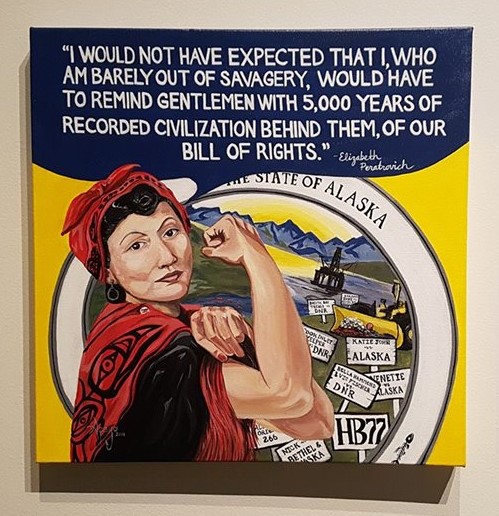
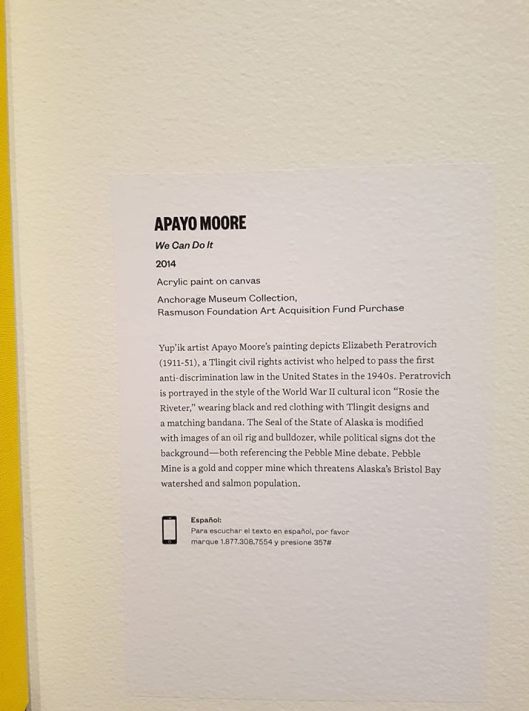
Rosie - Copy2Rosie the Riveter is one of those proverbial gifts that just keeps on giving. So, was Elizabeth Peratrovich. She would have been a contemporary of the many women who inspired this icon, which makes it just a little more interesting to see her standing in here for the women (whose real name was Naomi Parker) most of us envision when thinking about Rosie. This poster is part of the Unsettled exhibition currently showing at the Anchorage Museum.

Elizabeth was a major figure in the movement to combat discrimination against Alaska Natives in the 1940s. She is memorialized every February 16th, the day in which the Alaska Territorial Government signed the Anti-discrimination Act 0f 1945 into law. You can learn more about her work on civil rights at Alaskool.org. The quote featured in this poster is commonly thought to have been part of her testimony at the Alaska Territorial Legislature during hearings over the Anti-Discrimination Act. It isn’t entirely clear whether or not these were her exact words, though it probably says something about her actual testimony that it has become something of a legend in itself. The wit would certainly be right at home with other things that Elizabeth clearly did say.

Seriously, the woman kicked ass!

Apayo Moore, the artist behind this particular piece has the following to say bout it:

32838106_10216397714880526_2160255119801712640_n

Share this:

  • Tweet
  • Share on Tumblr
  • Print (Opens in new window) Print
  • Email a link to a friend (Opens in new window) Email
  • Share on Reddit (Opens in new window) Reddit
Like Loading...

Hypocrisy Howled at the Wolf

30 Monday Apr 2018

Posted by danielwalldammit in Politics

≈ 9 Comments

Tags

Comedy, Donald Trump, Humor, Media, Michelle Wolf, Politics, Sarah Huckabee Sanders, The White House, White House Correspondents Dinner

imagesThe second most memorable thing Michelle Wolf said at the White House Correspondents’ Dinner was that; “people are saying America is more divided than ever.”
Okay, at face value, the line itself isn’t all that memorable, but her speech and the reaction to it fairly illustrate the very point, which is memorable in my book. When a line from a speech captures that much of its own context, that will get my attention every time.

Listening to Wolf’s jokes, I find myself wondering if we could really expect people to take some of these jokes in good fun? It isn’t always clear from the content, but the stone faces scattered among those smiling and laughing tell a pretty clear tale. For some at least, these were not jokes; they were attacks. From her deadpan list of inconveniences ending with; “Trump is President; it’s not ideal,” to the suggestion that Kellyanne Conway should be struck and pinned underneath a falling tree, it’s easy enough to understand why someone might not want to roll with the punches here. Sure, someone could laugh it off, but it would be just as reasonable to take these as indications of genuine contempt. We could pick away at this or that point, but the reality is that the room was already saturated with divisions far too great for people to come together in laughter.

That’s the nature of humor though; it’s almost always at the expense of someone else. So, it’s always fair to ask ‘with me’ or ‘at me’? In this case, a fair portion of the right wingers present (and many who weren’t) clearly figured it was the latter. Of course they tend to assume this about much of the media and the entertainment industries as well. With increasing frequency, they would be right about that, but there is certainly the trace of a self-confirming prophesy to all of this media and Hollywood bashing. They don’t seem to notice when their favorite scapegoats aren’t following the script. Wolf took some serious shots at the media too, pointing out that they are largely responsible for Trump’s success, but today the right wing has bundled her up with that very media and used the dinner as yet another example of an ‘elitist’ culture holding them in contempt.

Some of us on the left might be tempted to suggest that the best fix for this problem is for today’s right wing politicians to try to be less contemptible. And of course the contempt is mutual; it has been for as long as I can remember. With countless ‘conservatives’ still telling stories about a socialist Muslim from Kenya, I have a hard time swallowing the notion that those of us on the left ought to rein it in, and lest anyone suggest this is merely the fringe of right wing politics, let me remind you that one of those fringe lunatics in the birther movement is in the White House right now.

..placed there by a wave of contempt for liberalism.

That contempt for liberalism is so strong it seems hard to escape the notion that Trump was placed in the White House, not because anyone seriously thought he was going to make America great again, but rather because they hoped he would break America as we currently know it. Even now, his cabinet is undoing over a century of work to protect America from threats to our safety, both domestic and foreign. Even now, Americans in Puerto Rico are still struggling to recover from a natural disaster, and from the willful neglect of an administration happy to kill Americans when he is offended by one of their leaders. We can debate whether or not Trump will ever do anything positive for this country, but there is little doubt that he is willing and capable of hurting a lot of people.

He was placed in office for precisely that reason.

…all of which makes it a little difficult to look at a speech such as that given by Michelle Wolf and say let’s cry foul this time. No, this, THIS, was going to far!

Bullshit!

Still, the hypocrisy of the other guy isn’t much of an excuse for any we produce ourselves. Is there a serious argument to be made here? The main focus of scrutiny in this case seems to have fallen on Wolf’s comments about Sarah Huckabee Sanders. What did she say about Sanders?

Every time Sarah steps up to the podium, I get excited because I’m not really sure what we’re going to get: you know, a press briefing, a bunch of lies or divided into softball teams. “It’s shirts and skins, and this time, don’t be such a little b—-, Jim Acosta.”

I actually really like Sarah. I think she’s very resourceful. Like, she burns facts, and then she uses the ash to create a perfect smoky eye. Like, maybe she’s born with it; maybe it’s lies.

It’s probably lies.

And I’m never really sure what to call Sarah Huckabee Sanders. You know, is it Sarah Sanders? Is Sarah Huckabee Sanders? Is it Cousin Huckabee? Is it Auntie Huckabee Sanders? Like, what’s Uncle Tom but for white women who disappoint other white women? Oh, I know: Aunt Coulter.

People have been saying this amounts to making fun of Sanders’ appearance. Others have been saying, no it isn’t. And yes, the battle lines are pretty predictable on this one. The issue is already touchy, because a lot of folks have already taken some seriously cheap shots at Huckabee’s looks. What Wolf said is really mild in comparison to some of the comments and memes out there. In fact, she doesn’t appear to be commenting at all on Sanders’ actual body or face. The main joke here isn’t even about Sanders’ looks; it’s about her mistreatment of the press, and the fundamental dishonesty with which she has approached her work in this administration. In the process of making this perfectly valid, and perfectly relevant point about Sanders’ work, Wolf worked in a comment about Sanders’ eye shadow. That comment has become the focus of virtually all subsequent commentary on the dinner.

So, was this a comment about Sanders appearance?

I can think of two reasons to say ‘yes’ in answer to that question. 1) Sarah’s eyes have often been primary a focus of many of the cheap shots taken at her. So, when Michelle Wolf talks about Sanders’ eye shadow, she is hitting a theme well-primed by many others. If Wolf is actually commenting on eye shadow instead of Sanders’ actual eyes, then that’s a thin layer of powder away from a very common and very cheap shot. 2) More importantly, a comment about dress or make-up is already a comment about someone’s looks, and women in the public arena get dragged on that topic far more than men. Far from trivial, this is one of the double standards that makes it much harder for women to succeed in public life than men. Working that angle doesn’t just hurt Sanders; it hurts women in general.

If Wolf’s comment doesn’t measure up to the low standards of filth spilling from the mouth of Donald Trump over the years, it certainly doesn’t measure up to the high standard many on the left (and in particular feminists) have been trying to promote for about as long as I can recall. I don’t know that Wolf has ever committed to such standards, but the fact remains, she could do better. Hell, she was doing better! She was doing better in that very point. Sarah Huckabee Sanders is a professional liar. That was the point of the very joke in question, and everybody knows it. THAT point remains sound, regardless of the cheap shot Wolf unfortunately bundled into it.

Some of us could wish that Wolf had left her brief foray into physical commentary out of her speech, but it’s there. I can’t help thinking that brief moment of self indulgence was a god-send to America’s right wing, because that’s been the very means they’ve used to draw attention from the rest of the Wolf’s criticism, criticism which is very richly deserved. While the denizens of echo chamber do the meta-hypocrisy shuffle, hiding their own double standards behind an accusation of the same, they have successfully shifted the narrative about this speech away from the many horribles now nurtured by the outright fascism which has taken over the Republican Party, horribles Wolf was right to call out.

Horribles like Sanders’ many lies.

It may well be that the whole country has reached a point where we can no longer expect Americans of different political orientations to sit peacefully together and laugh at the same jokes, but no, both parties are not equally responsible for helping us reach that point. With a President actively and openly supporting white nationalists while Democrats continue to embrace more moderate conservative policies, I don’t see how anyone could seriously embrace the ‘both sides’ narratives out there.

I don’t really blame right wingers for not wanting to sit through a performance like that of Wolf. I blame them very much for bringing us to that point. The Republican Party didn’t have to put a living joke in the White House; they didn’t have to support a man so corrupt and so incompetent that every spokesperson for him has had to bend over backwards lying for him only to find the man debunking their own spin even as they spin it. They didn’t have to make themselves so contemptible.

But they are.

The Republican Party of today is not conservative; it is not patriotic; and it is certainly not Christian. It’s leadership is none of the things they pretend to be, and they all know it. This is why they cannot abide humor like that of Wolf. This is why Donald Trump wasn’t even there, and this is why others walked out. They cannot abide an honest stand-up routine, any more than they can abide a competent journalist. And this is why they want to focus on that one joke; to keep our minds off Trump himself (and Pence, and Sanders, and all the rest of the circus) and to lay the grounds for retaliation against future critics.

Oh, I did say that the line about Americans being more divided than ever was the second most memorable thing Wolf said in her speech. So, what was more important than that?

Flint still doesn’t have clean water.


Share this:

  • Tweet
  • Share on Tumblr
  • Print (Opens in new window) Print
  • Email a link to a friend (Opens in new window) Email
  • Share on Reddit (Opens in new window) Reddit
Like Loading...

Epithets and Implicatures, and History as Damage Control

19 Thursday Apr 2018

Posted by danielwalldammit in Native American Themes, Politics, White Indians

≈ 1 Comment

Tags

Football, Indian Mascots, Ives Goddard, Native Americans, Race, Redskins, Sports, Sports Mascots, Washington redskins

I haven’t been monitoring the controversy about the Washington football team that closely for awhile now, but the topic hasn’t entirely escaped my attention. This morning, I took a moment to scan the old Redskinsfacts website, which is a case-study in double-speak if there ever was one. That hasn’t changed.

…either.

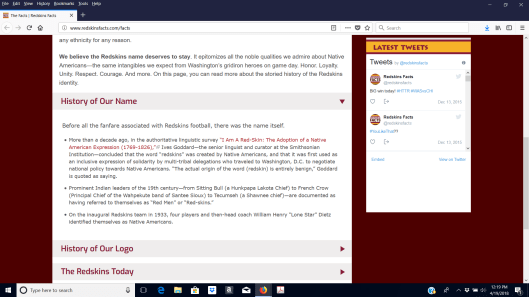
One thing I find fascinating and revolting in equal measures is the way the site uses the work of a linguist, Ives Goddard, in defense of the team’s name, If you click on the option to “Get the facts” on the home page of the “Redskins Facts” website, you will be taken to another page telling you about the history of the name. Near as I can tell, that page hasn’t changed in awhile. Here is a screenshot of that history as it is now on 4/19/18:

Screenshot 2018-04-19 12.19.54

With just three items, this is a brief history to be sure, but the omissions aren’t entirely a function of brevity. What they leave out here is every bit as important as what they choose to tell us. Taking their bullet points in reverse order:

Notice they tell us that when the team came into being four players and the head coach “identified themselves as Native Americans.” This wording was carefully chosen to promote a common team legend without actually claiming that legend is true. Defenders of the team name commonly tell us that the team was named after a Native American (William “Lone Star” Dietz). It’s not at all clear that the team name was ever meant to honor him, but more importantly, Dietz’s claims to Native American heritage are questionable at best, having come under intense scrutiny when Dietz stood trial for evading the draft during World War I. The folks at Redskinsfacts.com know very well that team fans team defenders still cite the story of Lonestar Dietz in defense of the team name. Telling us that Dietz claimed a Native American identity enables them to promote that story without actually making any false claims on the topic themselves. So, I guess it’s not an outright lie. More like, a cowardly equivocation.

The second bullet point in this ‘history’ is simply off topic (and rather vague). That prominent native leadership of the 19th century, have referred to themselves as ‘redskins’ does not establish that the term is not now or at any other time free of pejorative implications. Resting as it does in this simple, narrative the claim that some of them have done so does nothing to tell us how they felt about the term or why they came to use it. It doesn’t even enable us to sort which ones called themselves ‘red men’ and which ones called themselves ‘redskins’. It doesn’t address problems of translation. It really doesn’t establish anything except for the sloppy thought process of the website administrator. He’d have to answer a few questions before we could even get to the ‘so what?’ part of the conversation. Or we could just skip to the chase, I suppose.

So what?

The first point in the pseudo-history of the team name is the one that interests me the most. Defenders of the name will often cite Goddard’s article as proof that the term in question is not an insult. (Seriously, I’ve long since lost track of the number of people that have done this,) I always ask them if they have actually read the article. Often that seems to be the end of the conversation. When these folks do tell me they’ve read the article, I ask them if they’ve read the last line in the article. To date, none have answered that question. So, what is the last line in Goddard’s article?

The descent of this word into obloquy is a phenomenon of more recent times.

My point is of course that Goddard didn’t write an article telling us that the term in question is not an insult. He wrote an article telling us that it did not begin as an insult, which is an entirely different claim. It isn’t entirely clear from Goddard’s piece just how he would account for the present significance of the term, but he is very clear on the fact that his own work does not actually address that question. So, the article should leave us with a full stop right around the 1830s. Goddard helps us to understand the use of the term up to that point, and he doesn’t have much to say about anything after that.

Goddard’s work is interesting for a number of reasons, but it doesn’t tell us much about what the term means today, or even what it meant by the end of the 19th century. He does take issue with the claims of at least some modern activists, Susan Shown Harjo being among them, but he himself points out that rejecting her claims about the origin of the term does not prove that many Native Americans find the term objectionable in the present time (p.1). I think Goddard does a pretty good job of showing that Harjo and others have been wrong about the origins of the term, leaving the rest of the case against the team name largely untouched by his article. The correction seems a bit one-sided to me, but at least Goddard has been clear about the limits of his own work on the subject. If he has published anything addressing the later history of the term or correcting any of team’s misuse of his work, I am not aware of it. (If anyone does know of such a response, I would very much appreciate a reference.)

So, why is Goddard’s work the first thing Redskinsfacts.com cites in their history of the term? Well they have to know that many people equate the origin of a term (or at least our earliest known account of it) with its contemporary meaning. This is called the etymological fallacy, and it’s an extraordinarily common mistake. So, they don’t really have to tell us the article proves the term is innocent; the folks at Redskinsfacts.com know very well that is what many of their fans will take away from their reference to the article. Citing Goddard and providing a link to his work enables them to strengthen the impression that the team name is innocent without actually going so far as to say that’s what Goddard has shown. They invite their readers to indulge in an etymological fallacy, just as they invite us to think of Lonestar Dietz as a Native American when he was likely an outright fraud. It’s fascinating to see how the site avoids making the false claims in question, even as they invite readers to infer those very claims from the one they do make.

Don’t get me wrong. This isn’t even the worst of it. Defense of the Washington football team has produced all manner of horribles over the years. This isn’t even the worst of it.

Still, it’s pretty damned deceitful.

And cowardly.

Share this:

  • Tweet
  • Share on Tumblr
  • Print (Opens in new window) Print
  • Email a link to a friend (Opens in new window) Email
  • Share on Reddit (Opens in new window) Reddit
Like Loading...

Also Not a Contest: Slavery

29 Thursday Mar 2018

Posted by danielwalldammit in History, Justice, Politics

≈ 7 Comments

Tags

Alt Right, Indentured Servitude, Ireland, Irish Slavery, Labor, Race, Racism, Slavery, Trans-Atrlantic Slave Trade

It’s always been odd to me, seeing how the history of American slavery makes some of my fellow white people uncomfortable. You can see their discomfort in the various ways folks try to minimize the significance of slavery. Sometimes, it’s enough to put slavery in the past, to grant that it was an horrible crime, but to imagine that crime taking place so far in the remote past and so completely resolved with the official end of slavery in that remote past as to be completely free of any political implications today. It’s a bit like the gambit, folks often play with the history of Indian-white relations – all the horrors of the past can be acknowledged, at least in the abstract, so long as you can contain their significance within the history books (and preferably kept well away from any of the more recent chapters). At other times, folks seem to come up with more elaborate schemes to pare down the topic of slavery until it fits into their personal comfort zones.

When I was in college, this kind of pop-racism generally took the form of an argument that Africans started slavery. They did it too, maybe even first, so the argument would go, and of course there was (and is) an element of truth to these claims, but it’s a truth poorly served by its rhetorical packaging. It would be fair to say that slavery existed in Africa (as it did Europe, and indeed most of the world) prior to the founding of the Trans-Atlantic slave trade. Just how much those prior-forms of slavery explain the booming industry that would come is another question. All too often I used to hear people pushing this narrative and think they wanted far too much from the point than it would bear. What they wanted was a kind of absolution, a story that diminished the responsibility of Euro-American peoples for the tragedy of the slave trade. At the very least, they wanted to share the blame with some other groups.

And I always wondered why some of these people seemed to feel personally implicated in the matter? What do you get out of this, I would find myself asking? How does it help you if this story goes to the discredit of someone else’s ancestors? The answer, I think, is (predictably enough) racism. For those who see the world through the lens of race, the disgrace of their ancestors is a disgrace to them personally, and a case against the moral character of their own kind is a direct personal attack. I think this is also the key to common refrains about ‘white guilt’ and ‘liberal guilt’. I’ve never seen liberal politics as an expression of personal shame, but I do think some of our critics are incapable of seeing liberal politics in any other terms.  Such people cannot right the wrongs of the past or work to overcome inequalities in the present; they must instead demolish their own consciousness of those wrongs and rationalize any inequalities they see in the present. It’s the just world hypothesis at work in a racist mind.

In recent years, the pop-racist response to the history of American slavery seems to have evolved a bit. The latest trend seems to be countering stories about the enslavement of Africans with those about the enslavement of Irish men and women, but I should say the trend isn’t even that focused. Time and again you can see people show up with stories about Irish slavery in response to contemporary concerns about African-Americans. Write a blog post or tweet a quick message about police abuse of African-Americans in the present-day and somebody may well just show up to tell you about the history of Irish slavery. It’s as if the prospect of Irish slavery isn’t just a stock answer to any questions about the enslavement of Africans; some folks find it useful as an answer to questions about literally any injustice experienced by African-Americans today. Once again, there is a grain of truth to the narrative, and once again, those producing it clearly want more from the story than the facts of the matter will furnish them.

What proponents of the Irish slavery narratives are talking about is the practice of sending Irish men and women to the Americas under terms imposing temporary servitude upon them. Most of these were indentured servants who agreed to a term of service in exchange for passage, but at least some were prisoners whose terms of service were imposed upon them as a means of punishment.

Okay, so we know all this.

There was a time when perfectly liberal college professors were happy to spell out the horrible conditions of indentured servitude, along with the abuse of Irish in this and other contexts. I used to work with a professor who made quite a point to ensure students learned just how terribly indentured servants could be treated. None of this was part of a racist agenda, and none of it was leveraged against the history of the trans-Atlantic slave trade. Far from fielding a rationale for minimizing the horrors of that slave trade, this was like the opening chapter of a long sequence on the horrors of the full slave trade that would come. Acknowledging both horrors (and many others) used to work just fine.

But that was then, this is now.

What is new? On the surface, what is new here is the use of the word ‘slavery’ to describe what was done to the Irish, but here as always the devil resides in the details. No, I am not linking to any of this literature, but proponents of the Irish slave narrative have worked hard to embellish every embelishible point; inflating numbers, adding stories about the defilement of white women forced to breed with African men, and of course complaining that liberals have hidden the trials of the Irish while pushing the trans-Atlantic narrative in order to keep African-Americans at the forefront of identity politics. With support from racist corners of the internet, some maintain the Irish story is greater in all respects. Who would deny it? Only a liberal, right?

Okay, I deny it.

More importantly, so do vast majority of historians doing work on the subject. Scholars have questioned many of the details put forward in the Irish slave narrative, but the central theme seems to be this, that at its heart, the Irish story really is a story about indentured servitude. Indentured servitude was by no means a benign institution, but it simply isn’t comparable to the chattel slavery associated with the trans-Atlantic slave trade. Most simply would not use the term ‘slavery’ at all to describe indentured servitude, even when it is imposed as a criminal sanction. And of course a good deal of the push-back of these narratives consists of efforts to unmask the clearly racist agendas of key proponents. This isn’t just a mistake, it’s a mistake a lot of committed white racists want people to make.

…which leaves me feeling all somehow.

I’m happy as Hell to see the comparison between indentured servitude and the trans-Atlantic slave trade shredded, and then shredded again. What does somewhat concern me is the equation of ‘slavery’ with the specific form of chattel slavery that took place in the trans-Atlantic trade. Simply put, we do commonly use the word ‘slavery’ in contexts that do not compare in the numbers or the horrors of that specific history. History books often speak of slaves in ancient civilizations many of which fell into that status through financial ruin, or debt. The literature on Indian-white relations is full of stories of ‘slaves’ captured and trade about through raiding practices, and of course the Spanish systems of the encomienda were never described as slavery. When in 1850 California passed a law enabling others to press California Natives into forced labor, that law was actually written up as if it were meant to protect those very Natives. And of course the system of debt peonage found in the post-war south (among many other places) could in practice pass for slavery.

Hell, that was often the point!

…to say nothing of the use of prison systems for purposes of reducing free blacks to forced laborers under the pretext of punishment for crimes, real or imagined.

The subject of slavery has always been broader than the specific history of the trans-Atlantic slave trade. We should not allow malicious people to equate every instance of forced labor with the scale of atrocity behind that trade, but neither should we restrict our own use of the word ‘slavery’ to that very trade. Abusive labor practices shade easily into forced labor, and once that threshold is crossed, real atrocities become much easier.

What specifically doesn’t work about Irish slave narratives is the direct comparison with the trans-Atlantic slave trade. It doesn’t match the scale of atrocity in that trade, either in numbers, or in the quality of treatment for the majority of those involved. This doesn’t mean that indentured servants, Irish or otherwise, were treated well, and it certainly doesn’t mean that people captured or pressed into forced labor in other times and places shouldn’t be a concern. What it does mean is that we shouldn’t let people use the suffering of their own ancestors as a means of diverting attention from that of others.


Share this:

  • Tweet
  • Share on Tumblr
  • Print (Opens in new window) Print
  • Email a link to a friend (Opens in new window) Email
  • Share on Reddit (Opens in new window) Reddit
Like Loading...
← Older posts
Newer posts →

Top Posts & Pages

  • Movie Review: The Orator
    Movie Review: The Orator
  • An Uncommon Security Guard: Dave Eshelman, AKA 'John Wayne'
    An Uncommon Security Guard: Dave Eshelman, AKA 'John Wayne'
  • When Sex Falls Out of the Performance
    When Sex Falls Out of the Performance
  • Hostiles and Spoilers: A Magic Studi
    Hostiles and Spoilers: A Magic Studi
  • Southern Paiutes as Portrayed in Las Vegas Area Museums.
    Southern Paiutes as Portrayed in Las Vegas Area Museums.
  • Barrow on the Big Screen, A Little at a Time
    Barrow on the Big Screen, A Little at a Time
  • Uncommonday Morning Blues - Ian Anderson Learns to Play the Flute
    Uncommonday Morning Blues - Ian Anderson Learns to Play the Flute
  • On Chick Tracts
    On Chick Tracts
  • When Culture Appropriates You
    When Culture Appropriates You
  • Kavanaugh, Young and Old
    Kavanaugh, Young and Old

Topics

  • Alaska
  • Animals
  • Anthropology
  • atheism
  • Bad Photography
  • Books
  • Childhood
  • Education
  • Gaming
  • General
  • History
  • Irritation Meditation
  • Justice
  • Las Vegas
  • Minis
  • Movie Villainy
  • Movies
  • Museums
  • Music
  • Narrative VIolence
  • Native American Themes
  • Philosophy
  • Politics
  • Public History
  • Re-Creations
  • Religion
  • Street Art
  • The Bullet Point Mind
  • Travel
  • Uncategorized
  • Uncommonday
  • White Indians
  • Write Drunk, Edit Stoned

Blogroll

  • American Creation
  • An Historian Goes to the Movies
  • Aunt Phil's Trunk
  • Bob's Blog
  • Dr. Gerald Stein
  • Hinterlogics
  • Ignorance WIthout Arrogance
  • Im-North
  • Insta-North
  • Just a Girl from Homer
  • Multo (Ghost)
  • Native America
  • Norbert Haupt
  • Northwest History
  • Northy Pins
  • Northy-Tok
  • Nunawhaa
  • Religion in American History
  • The History Blog
  • The History Chicks
  • What Do I Know?

Archives

  • December 2023
  • November 2023
  • June 2023
  • April 2023
  • February 2023
  • December 2022
  • November 2022
  • October 2022
  • September 2022
  • August 2022
  • July 2022
  • June 2022
  • April 2022
  • January 2022
  • December 2021
  • November 2021
  • October 2021
  • September 2021
  • August 2021
  • June 2021
  • May 2021
  • March 2021
  • February 2021
  • January 2021
  • December 2020
  • November 2020
  • October 2020
  • September 2020
  • June 2020
  • May 2020
  • March 2020
  • February 2020
  • January 2020
  • December 2019
  • November 2019
  • September 2019
  • August 2019
  • July 2019
  • June 2019
  • May 2019
  • April 2019
  • January 2019
  • December 2018
  • November 2018
  • October 2018
  • September 2018
  • August 2018
  • July 2018
  • June 2018
  • May 2018
  • April 2018
  • March 2018
  • February 2018
  • January 2018
  • December 2017
  • November 2017
  • October 2017
  • September 2017
  • August 2017
  • July 2017
  • June 2017
  • May 2017
  • April 2017
  • March 2017
  • January 2017
  • December 2016
  • November 2016
  • October 2016
  • September 2016
  • August 2016
  • July 2016
  • June 2016
  • May 2016
  • April 2016
  • March 2016
  • February 2016
  • January 2016
  • December 2015
  • November 2015
  • October 2015
  • September 2015
  • August 2015
  • July 2015
  • June 2015
  • May 2015
  • April 2015
  • March 2015
  • January 2015
  • December 2014
  • November 2014
  • October 2014
  • July 2014
  • June 2014
  • May 2014
  • April 2014
  • March 2014
  • February 2014
  • January 2014
  • December 2013
  • November 2013
  • October 2013
  • September 2013
  • August 2013
  • July 2013
  • June 2013
  • May 2013
  • April 2013
  • March 2013
  • February 2013
  • January 2013
  • December 2012
  • November 2012
  • October 2012
  • September 2012
  • August 2012
  • July 2012
  • June 2012
  • May 2012
  • April 2012
  • March 2012
  • January 2012
  • December 2011
  • November 2011
  • October 2011

My Twitter Feed

Follow @Brimshack

RSS Feed

  • RSS - Posts
  • RSS - Comments

Enter your email address to follow this blog and receive notifications of new posts by email.

Join 8,070 other subscribers

Blog at WordPress.com.

  • Subscribe Subscribed
    • northierthanthou
    • Join 8,070 other subscribers
    • Already have a WordPress.com account? Log in now.
    • northierthanthou
    • Subscribe Subscribed
    • Sign up
    • Log in
    • Report this content
    • View site in Reader
    • Manage subscriptions
    • Collapse this bar
 

Loading Comments...
 

    %d