
• About

northierthanthou

northierthanthou

Tag Archives: America

Lefty Love of Country: A Few Self-Indulgent Comments

04 Thursday Jul 2013

Posted by danielwalldammit in Politics

≈ 9 Comments

Tags

Ambivalence, America, Jingosim, July 4th, Nationalism, Patriotism, United States

036Do you love your country?

For some folks that must be an easy one to answer. For at least a few of us it is a bit more difficult, not the least of reasons for this being the hint of blackmail in the question. Few things will chase off ones affections quite so effectively as the feeling that one is being bullied into it.

It hasn’t always been that difficult.

I remember a particular July 4th (1980, I think) when it was particularly easy for me to say how I felt about my country. I and my rifle team were representing the state of Wyoming at the Daisy International BB-Gun championships in Bowling Green, Kentucky. (As I recall, teams came from 48 states plus Mexico and Japan, …hence the “International” part of a primarily American contest.)

Those that have read my comments about the rights of gun-owners (or at least about some of the crap–rhetoric produced in support of those rights), might wonder just what I was doing at such an event, let me just say that I was a very different person at 14. I should add that the NRA was also a very different organization at the time.

If your guessing that a double-dose of God and country were part of that ideology, then you are guessing right. With the whole shooting contest falling on Independence Day, you can imagine what the night’s festivities were like. The fireworks were spectacular, and spectacularly close. Bits and pieces fell on us as we looked up in the sky. But long before that bit came the Star Spangled Banner. Standing there, with my hand on my heart, representing my state, I couldn’t have loved my country anymore without causing something to pop.

That was many years before college, before reading certain books, before meeting certain people, before I developed a grasp of the news, and well before I had come to see Ronald Reagan as anything but the best damned President ever to eat a jelly bean in the Oval Office.

It was also well before anyone had ever suggested that a dirty commie like me ought to go live in someplace like China.

Faced with that one, I always wanted to respond with something along these lines; “I live in a Constitutional Democracy where I get to say what I want about m government; if that doesn’t sit well with you, then why don’t you leave!?!” That probably wouldn’t have been the most constructive thing to say, but it would have felt good. …I honestly don’t remember if I ever actually said that, or even if I had many real chances to. I just remember that it was always the response that jumped to mind in the face of the love-it-or-leave-it gambit.

What my pet response does reveal is a conventionally liberal sense of patriotism, a notion that for all it’s problems, American government embodies some principles worth keeping, principles that may help us sort the problems for that matter. The point of this line of thinking was at least partly to take (or perhaps to take back) ownership of the values turned against me (and others) in such rhetoric. It was also, at least partly the emotional response of someone who actually did love his country, perhaps even enough to simply lash out when called on the issue.

***

Which reminds me, somewhere the Lakota writer, Vine Deloria Jr. once wrote that one of the ironies of American patriotism was that it could be expressed both by waving a flag and by burning it. …Deloria could be a very wise man, indeed.

***

I don’t know that I fully embrace that conventional liberal account of this country anymore. The classic themes of liberal politics now compete with criticisms far more sweeping than that, a sense that some of our nation’s problems are beyond the scope of its present virtues. This is perhaps one reason why my July 4th posts are typically filled with self-reflection rather than unabashed celebration.

…although I really just don’t do unabashed celebration.

In the end, I would have to say that I do love my country. I love my country in much the same way that I love my family. Growing up, it is easy to believe in the exceptionalism of one’s own kin, to think of them as standing a head taller than others in one form or another. When you are a child, it is easy to think of the differences between other families one’s own as confessions of sorts on their, each deviance from one’s own model being a flaw in the make-up of other families.

There comes a day (let us hope) when the illusion falls away and one comes to realize that his own father is not necessarily the wisest, bravest, and strongest man that ever lived, that Mother’s love is not quite as pure as a field of fresh snow, and that one’s siblings are not truly unique in their virtues. There comes a time, when one learns to see in the flaws and personal squabbles of his family a fatal case against its superiority. Each of your kin has their merits and their flaws, but what neither you nor any member of your family can really claim is an exalted place above the world of others. And for most of us (again, …let us hope) one goes on loving his family long after realizing this.

You go on loving your family, not because you are deluded about their special qualities, but because they are yours. You feel their heartaches in your own chest, their victories in your own smile, and their frustrations in your own pulse. So too with one’s country. Much as a running feud with a sibling, complaints against your country become yet another source of connection to it, and if you allow this to happen, one which ties your aspirations to the welfare of the nation.

I should add I don’t see anything particularly noble in this sense of affection. I certainly don’t see it as obligatory, and bear no ill-will against those that don’t feel it. I won’t be sneering at those for whom this ambling excuse for a post doesn’t resonate. It’s just my own sense of how I feel about my country. I do love it, not because I think it’s exceptional, but because it is mine.

71.271549 -156.751450

Share this:

  • Tweet
  • Share on Tumblr
  • Click to print (Opens in new window) Print
  • Click to email a link to a friend (Opens in new window) Email
  • Click to share on Reddit (Opens in new window) Reddit
Like Loading...

Allegiance to God and Country, …and to Anachronisms Aplenty!

16 Wednesday Jan 2013

Posted by danielwalldammit in Politics, Religion

≈ 5 Comments

Tags

America, Anachronism, Aristocracy, Christianity, Civil Religion, Democracy, Metaphors, Politics, religion

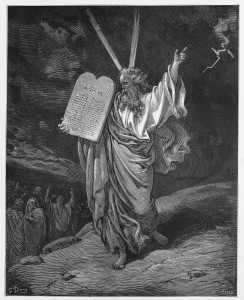
Moses1-244x300One hears it all the time; the notion that religion ought to be kept out of politics. I’m torn by the suggestion, because it is commonly used in response to the politics of conservative Christians, …and I have little sympathy for their politics. But the fact is, that just isn’t where I would draw the battle lines. If most people frown at the likes of Pat Robertson or Rick Warren, I suspect they are frowning for reasons that differ significantly from my own.

Religion IS politics as far as I am concerned; it’s bad politics, but politics just the same. I don’t quite mean to suggest that religion is simply a crass tool by which some folks seek to enhance their own power and influence.

….seriously, I don’t QUITE mean to say that.

…at least not as a general rule.

No. What I am suggesting is that religion consistently presents folks with a vision of order in the cosmos. That vision answers questions about how one ought to behave, yes, but it also contains answers to questions about the nature of authority and the social expectations that go with it. These traditions may tell us about Heaven and Hell, Karma, etc. all visions of a cosmic order, but they also tell us a little about how one ought to treat others, assess other people’s character, and what we may fairly do in response to the virtues or vices of those around us. The notion that all of this is supposed to stop short of addressing real political questions strikes me as a rather improbable.

…it’s also unreasonable.

To put it in more concrete terms, it makes sense to me that someone who believes in the Ten Commandments would (when stepping into the voting booth) bear in mind the likelihood that a political candidate was going to follow them as well. It makes sense to me that folks would bear such things in mind when making in countless other decisions of a political nature.

Which is part of what makes the role of religion in American government (and perhaps other settings as well) so completely absurd. On the one hand, religious teachings are all about precisely the sort of questions that one must address in politics; on the other, it is separate from and distinct from those institutions, limited in some respect by the establishment clause and re-enforced by the free exercise clause. Religion has a potentially absolute absolute claim on every aspect of life, and yet while protecting the rights of believers, we expect them to stop short of weighing in on the most important questions of the day. The whole situation is at least a little odd, to say the least.

Far from the natural order of things, this feature of American politics rests in our Constitution and popular culture like a fault line running through a population trying its best to ignore it and get on with life.

…which I think is the real reason people want to keep religion out of politics. If they can keep folks from putting the two topics together in the same conversation, then they can avoid dealing with a mountain of contradictions even Mohammed would be hard pressed to move about.

The history of religion certainly doesn’t teach us to expect its proponents to stop short of political commentary. The God of Abraham in particular has played an overtly political role in each of his major religions. It is only with the decline of ancient empires that Christianity and Islam have come to be defined as something distinct from politics. Each of these traditions became mere ‘religions’ when the moral order they espoused lost its connections to the political order in which they once flourished. Institutions that we think of today as religion were once unashamedly political. Few if any thought twice about it.

What distinguishes religious traditions from those of modern politics is less of an ontological divide than a range of social conventions, not the least of them being a clear discordance between the visions of authority contained in each. Indeed, the notions are so far apart that people often fail to recognize them as different answers to the same question. The end result is a rather marked failure to notice something very interesting about the relationship between religion and politics in modern life. You see, there is something highly ironic (and more than a little tragic) about the sensibilities of those who speak of a Lord in world wherein we elect a President (or, for that matter, a Congressman or a Parliamentian).

And this is what I mean by a fault line that the public does its damnedest to ignore. Most people don’t even pause to think about this, but the notion of a ‘Lord’ has not always been so divorced from the social order. The language about which one spoke of God was not always so completely severed from the language about which one thought about their own government. There was a time when that term, ‘Lord’, would have pointed not merely to a benign old man in the sky, but also to the nobility of Europe. The implication was neither accidental, nor trivial. Indeed, the point of such language was to draw a clear parallel between the loyalties that men owed to each other (or more to the point, that commoners owed to the aristocracy) and those that they owed to the keeper of cosmic justice. A reference to the ‘Lord’ would have meant for many in past times a role reflected in both their religious discourse and in the social realities of their daily lives.

How weird it must be to live in a world in which one answers to a Lord in Heaven but votes for politicians down here! At least it would be weird if we paid more attention to the way either of these institutions actually handle questions about how people ought to behave.

But of course the problem is not merely a function of this one word. When Conservative Christians speak of power, they almost invariably invoke a range of metaphors ill-fitted to the realities of a republican style government. They speak of God as a sovereign, all the while operating in a public life wherein the people are assumed to be sovereign. They speak of the Ten Commandments in a world wherein laws are deemed in some sense to be created by the people (albeit indirectly). And how strange that we (and by ‘we’ I mean mainly Christians) want Children to pledge allegiance to one nation (under God or not), as if such an oath had much bearing on modern notions of citizenship! It cannot mean nothing that people who live in a participatory democracy envision so much of their lives through the language of aristocracy.

Does this mean that Conservative Christians do not understand democracy?

No it doesn’t.

…at least  not in principle, but I can think of a few folks!

It does suggest a certain tension between the nature of authority some folks encounter on Sunday and those they are called upon to use in the voting booth. This sort of tension might even have some positive benefits, though I suspect that would require people to be more aware of the difference than they generally seem to be. It probably should not surprise us too much when the language of one sphere creeps into that of another. I think we can see this in the way that many conservative Christians speak of the founding fathers in reference to a broad range of constitutional questions. So much the more so on litmus test politics such as gay rights which so many use to discern the loyalties of those around us.

I could field a number of polemics at this point, but perhaps that is not really where I want to go with this. The divergence between modern visions of political authority and the archaic language with which conservative Christians approach that same subject is an interesting point in itself. What to make of it is another question. And of course this returns us to the original question of whether or not one can reasonably expect religious leaders to keep their noses out of politics.

If I am reading the popular culture correctly, I think most people expect a natural division between these spheres of social (and political) life, as if some great natural boundary separates them. For my own part, I think it’s little other than history. Indeed, I don’t think the term ‘religion’ denotes a clear and well defined body of institutions, beliefs, or practices, certainly not any that fall neatly outside the boundaries of political life. As it happens, the modern world has developed a range of political expectations which simply differ from those of the institutions we now call religion. That difference does not lie in the nature of the institutions in questions, it lies in the particular approach that each takes to the deeper moral questions of social life.

What keeps conservative Christianity from enjoying a more direct role in American political life is its political anachronism. It’s vision of authority is not (thankfully) that of our own government.

71.271549 -156.751450

Share this:

  • Tweet
  • Share on Tumblr
  • Click to print (Opens in new window) Print
  • Click to email a link to a friend (Opens in new window) Email
  • Click to share on Reddit (Opens in new window) Reddit
Like Loading...

Myth-Busting For Fun and Frustration: A History Lesson that Just Didn’t Take

05 Wednesday Sep 2012

Posted by danielwalldammit in Education, History

≈ 12 Comments

Tags

America, American History, Cognitive Bias, Education, History, Myth, Myth-Busting, Note-taking, Puritans, Study-Habits, teaching

I still remember my first real object-lesson in teaching. I had just started as a teaching assistant and they had me working in a class on early American History. The professor spent a good deal of time on the Puritan colonists that semester. By “spent a good deal of time on” I mean he railed on about this particular subject for hours while we slowly fell behind the syllabus, …which was fine with me actually, but quite a few students balked at this approach.

The professor did his best to debunk one common misconception about the Puritans; the notion that they came to America for religious liberty. In his view, it would have been more fair to describe the Puritans as coming to America because their efforts to oppress others had been thwarted in England and Holland. He could go on in great detail about various things they did which were wholly inconsistent with the notion of religious freedom. The very idea was as foreign to them as it was to any of their supposed oppressors.

This message found its way into several lectures that semester. The textbook was a little less emphatic on the subject, but it certainly did nothing to undermine the message my Professor had been working so hard to get across. Whenever I had a chance to talk to the students I was right on the message. Hell I loved that argument, and I was happy to have a go at it whenever I got a chance. With three separate sources providing re-enforcement for the same message, I was pretty confident that it would get through. If the students in that course had learned nothing else, surely I thought they would have learned that the Puritans did not really come to America seeking anything we would recognize as religious liberty.

So, you can imagine my surprise when well over half the class turned in midterm exams with essays going on at length about how the Puritans had come here to find religious liberty and establish democracy!  I actually had to ask the instructor to go over the subject one more time, just for me, because I was convinced I must have misunderstood something. But no, his take on the subject was exactly as I had remembered it.

I looked for signs of conscious disagreement. Were these students showing spine? Could they be fighting back (I hoped)? No. I didn’t see that either; no-one fielded a counter to the specific points made in class. Not one essay fielded any new ideas or information. They were simply repeating the same platitudes the teacher had been at pains to refute as if they had no reason to suspect anything was wrong with those notions. Near as I could tell, these students were telling a story they simply took for granted, a story the truth of which they had no call to question at ll. It wasn’t absenteeism either; many of those hitting this theme had been present virtually every day of class. Judging by the essays, only a handful of the seventy or so students in that class had picked up on the actual lesson. Most were completely unaware that they were telling us the exact opposite of what we had been telling them for over a month.

Why?

It was a complete mystery to me, but I red-inked the Hell out of the tests, assigned grades with a touch of mercy, and we both set about explaining the subject one more time.

Over the next few weeks I came up with a theory. I never had a chance to test this explanation, but it remains my guess as to how the whole thing happened. I watched carefully to see how the students were taking notes, and in most cases the pattern was pretty clear. When the instructor announced the general topic for a stretch of his lectures, the students I could see wrote down down that topic and then sat back to listen to what he had to say about it (or perhaps to drift off to think of something else while appearing as though they were listening). As each each major sub-theme came down, they would write down a single word or phrase underneath the major topic and continue listening. The end-result was something that looked a lot like the outline for a speech or paper. So, when it came time to study for the midterm, a lot of the notebooks must have ended up with a section that looked something like this:

Puritans

– Religious Freedom

– Democracy

Assuming I am right about the note-taking, I can just see the students looking down at their notes when it came time to study for that exam and seeing a simple list of topics. Lacking any of the details from the actual lecture, the students must have simply filled in the gaps with their own preconceptions about the topic, preconceptions that had been re-enforced by years of K-12 lessons and countless pop-cultural references.

All the instructor had managed for all his railing against the notion was to underscore the importance of the very message he had set out to refute. All I had done was to help him underscore that very message.

I try keep this in mind whenever I feel like indulging in a spat of myth-busting.

71.271549 -156.751450

Share this:

  • Tweet
  • Share on Tumblr
  • Click to print (Opens in new window) Print
  • Click to email a link to a friend (Opens in new window) Email
  • Click to share on Reddit (Opens in new window) Reddit
Like Loading...
Newer posts →

Top Posts & Pages

  • I'll Just Leave This Here
    I'll Just Leave This Here
  • Master and Commander Kinda Queered
    Master and Commander Kinda Queered
  • The Hip Show (Guest Post)
    The Hip Show (Guest Post)
  • Once Upon a Charlie
    Once Upon a Charlie
  • Movie Review: The Orator
    Movie Review: The Orator
  • An Uncommon Security Guard: Dave Eshelman, AKA 'John Wayne'
    An Uncommon Security Guard: Dave Eshelman, AKA 'John Wayne'
  • Eye, You, and Donald Trump
    Eye, You, and Donald Trump
  • Road Trip! (Anchorage to Valdez)
    Road Trip! (Anchorage to Valdez)
  • Great Movie Villains, Volume IX: That Witch With a Bow!
    Great Movie Villains, Volume IX: That Witch With a Bow!

Topics

  • Alaska
  • Animals
  • Anthropology
  • atheism
  • Bad Photography
  • Books
  • Childhood
  • Education
  • Gaming
  • General
  • History
  • Irritation Meditation
  • Justice
  • Las Vegas
  • Minis
  • Movie Villainy
  • Movies
  • Museums
  • Music
  • Narrative VIolence
  • Native American Themes
  • Philosophy
  • Politics
  • Public History
  • Re-Creations
  • Religion
  • Street Art
  • The Bullet Point Mind
  • Travel
  • Uncategorized
  • Uncommonday
  • White Indians
  • Write Drunk, Edit Stoned

Blogroll

  • American Creation
  • An Historian Goes to the Movies
  • Aunt Phil's Trunk
  • Bob's Blog
  • Dr. Gerald Stein
  • Hinterlogics
  • Ignorance WIthout Arrogance
  • Im-North
  • Insta-North
  • Just a Girl from Homer
  • Multo (Ghost)
  • Native America
  • Norbert Haupt
  • Northwest History
  • Northy Pins
  • Northy-Tok
  • Nunawhaa
  • Religion in American History
  • The History Blog
  • The History Chicks
  • What Do I Know?

Archives

  • December 2023
  • November 2023
  • June 2023
  • April 2023
  • February 2023
  • December 2022
  • November 2022
  • October 2022
  • September 2022
  • August 2022
  • July 2022
  • June 2022
  • April 2022
  • January 2022
  • December 2021
  • November 2021
  • October 2021
  • September 2021
  • August 2021
  • June 2021
  • May 2021
  • March 2021
  • February 2021
  • January 2021
  • December 2020
  • November 2020
  • October 2020
  • September 2020
  • June 2020
  • May 2020
  • March 2020
  • February 2020
  • January 2020
  • December 2019
  • November 2019
  • September 2019
  • August 2019
  • July 2019
  • June 2019
  • May 2019
  • April 2019
  • January 2019
  • December 2018
  • November 2018
  • October 2018
  • September 2018
  • August 2018
  • July 2018
  • June 2018
  • May 2018
  • April 2018
  • March 2018
  • February 2018
  • January 2018
  • December 2017
  • November 2017
  • October 2017
  • September 2017
  • August 2017
  • July 2017
  • June 2017
  • May 2017
  • April 2017
  • March 2017
  • January 2017
  • December 2016
  • November 2016
  • October 2016
  • September 2016
  • August 2016
  • July 2016
  • June 2016
  • May 2016
  • April 2016
  • March 2016
  • February 2016
  • January 2016
  • December 2015
  • November 2015
  • October 2015
  • September 2015
  • August 2015
  • July 2015
  • June 2015
  • May 2015
  • April 2015
  • March 2015
  • January 2015
  • December 2014
  • November 2014
  • October 2014
  • July 2014
  • June 2014
  • May 2014
  • April 2014
  • March 2014
  • February 2014
  • January 2014
  • December 2013
  • November 2013
  • October 2013
  • September 2013
  • August 2013
  • July 2013
  • June 2013
  • May 2013
  • April 2013
  • March 2013
  • February 2013
  • January 2013
  • December 2012
  • November 2012
  • October 2012
  • September 2012
  • August 2012
  • July 2012
  • June 2012
  • May 2012
  • April 2012
  • March 2012
  • January 2012
  • December 2011
  • November 2011
  • October 2011

My Twitter Feed

Follow @Brimshack

RSS Feed

  • RSS - Posts
  • RSS - Comments

Enter your email address to follow this blog and receive notifications of new posts by email.

Join 8,075 other subscribers

Blog at WordPress.com.

  • Subscribe Subscribed
    • northierthanthou
    • Join 8,075 other subscribers
    • Already have a WordPress.com account? Log in now.
    • northierthanthou
    • Subscribe Subscribed
    • Sign up
    • Log in
    • Report this content
    • View site in Reader
    • Manage subscriptions
    • Collapse this bar
 

Loading Comments...
 

    %d