As far as irritation goes, this one comes close to being a mere amusement. I am talking about a challenge issued by The Atheist Advocate, the terms of which are fairly well explained by the illustration here, and I have to admit it’s tempting to just get behind this one. Seriously, I can almost go along with it.
…almost.
If only I had a nickel for all the times I have seen Christians complain about petty grievances or pass along outright falsehoods about this or that attack on their faith, well I could certainly afford another nice meal on that change. Hell, the non-existent war on Christmas alone ought to earn some believers a permanent subscription to “Cry Wolf Daily” (which actually wouldn’t be a bad blog project, come to think of it). Anyway, the point is that it gets damned tiresome to hear a dominant religious majority whine about how religious minorities are oppressing them.
But of course it isn’t really a dominant majority that spreads these cries of repression. Rather it is a small and highly vocal group of political Christians who would like very much to define repression of their beliefs so broadly as to include the failure to bow to their every Goddamned whim.
Taken at face value, I can’t help thinking this little gambit doesn’t quite rise above the difficulties it seeks to address. This whole thing really strikes me as something of a contest over First World Problems. One would hate to run into the occasional lunatic that might make either of these T-Shirts cause for real violence. …or the occasional workplace bigot that might actually use less violent means of putting someone from the wrong camp in their place. In any event, I expect most folks here in America would probably face little other than an uncomfortable conversation or three over wearing either of these shirts. There are some definite regional exceptions to be sure (cough! …deep South! …midwest!), but for the most part I think we are talking about a war of words.
Yes, I do figure those wearing an ‘atheist’ T-Shirt will have quite a few more of those unpleasant conversations than those wearing a ‘Christian’ T-Shirt, but I am open to the possibility that I am wrong about that, and I certainly wouldn’t estimate the flack for wearing the Christian shirt to be zero. Oddly enough, I expect some of the grief given to both Christians and atheists over this sort of thing could come from the same sources. An awful lot of people seem to want to have their sin and get to heaven too, so to speak, and they can be equally testy with religious fundamentalists and non-believers alike. This ‘moderate’ bunch can be especially testy if they believe someone else has brought the issue to the table and tried to force the question, …say by advertizing their (non-)beliefs in public.
That said, yes, I do think Christians are more likely to get a free pass on public expressions of their views f for no other reasn than that they have had their foot in that door for longer than those of us in the just-say-no camp. What strikes me as far more important is the fact that the list of people who have found out what ‘persecution really is’ would be unlikely to include anyone whose main worry of the day is what people will say about an ugly T-Shirt. There are people out there who face real consequences because of their belief-stances, and both atheists and theists are among them. That list also includes plenty of people who face real suffering as a result of things over which they have absolutely no control whatsoever. So, I think people should count themselves blessed if they live somewhere that you could actually play this game and expect life to continue in the wake of it.
As a general rule, I think anyone who wants others to appreciate the struggles they face could do better than to start by trivializing those of others people. I also think we would all be better served if folks spent less time claiming the title of most-repressed and more time thinking about what constitutes reasonable treatment of those with whom we disagree.
Oddly enough I’m not really opposed to the challenge, per se, just a certain over-billing of its significance. Still, if this leads a few of the more self-important Christians to rethink their narratives of martyrdom, then perhaps it’s a good thing. If it leads some people of either camp (or any other) to think carefully about their own bully-triggers and what we can do to help those under the gun for such things, so much the better.
I could believe in a God of Korean BBQ, yes I could!
I Grumble: I wish I had a nickel for every time a Christian told me that my take on the existence of God isn’t really atheism; it’s agnosticism. No, those nickels wouldn’t make me rich, but they would add up to a nice meal at a decent restaurant, and with enough change to leave a damned good tip.
On one level, this is interpersonal aggression. If someone can take your identity away (or at least that part of your identity most salient to the topic at hand), then the rest of the discussion is going to suck no matter how well you handle the particulars. It’s the sort of argument that is really about who is in charge.
…and I mean in a right-here-and-now kinda way.
Just like a husband and wife engaged in a two-day spat over which brand of butter would have been a better purchase, atheists and theists (mostly Christians) will tap away on our keyboards well into the wee hours of the morning, all over the question of just what atheism really is and who gets to call themselves an ‘atheist’. It’s almost as though we have that agreement, you know the one about never going to bed with unresolved issues, only we never do get to the make-up sex on this particular topic. We just keep jabbering at each other until the sun rises and it’s time to go to work tired. (Thanks honey!) The bottom line is what ought to be the opening stages of a larger dialogue becomes the overwhelming focus of an exhausting (and often pointless) pseudo-discussion.
On another level, the subject is certainly worth some time. The semantics are tricky here, and one will need to sort the meaningful possibilities out before proceeding to any substantive issues. And Hell, I figure I’ve encountered a genuine concern or three amidst all the bunk believers have thrown at me on this issue over the years. I know I have a few truth-in-advertizing concerns for those calling themselves Christians as well. Plus, I think I’m actually adjusting my views on this one a bit lately. So, I’m going to have a go at this all-too familiar old topic and hope that the results won’t lead to any incidents of self-mutilation.
So, please take a deep breath!
***
The Basics: The problem is this, among the group of people calling themselves atheists, some of us will happily do so without presenting any reason to believe that there are no gods. If pressed on the issue, we will often claim that the burden of proof lies with the believer. Atheism thus represents a stance we will take in the absence of positive reason to believe in God. This approach to atheism is sometimes known as “weak atheism,” as opposed to “strong atheism,” which is generally taken to refer to the stance of someone prepared to argue that no gods exist at all. Some might say that a weak atheist simply doesn’t believe in any gods whereas a strong atheist says there are no gods.
And here is where Theists often cry foul. Isn’t the neutral position really that of agnosticism, they will say, and how can it be that atheists (weak or otherwise) have no burden of proof? Isn’t that unfair?
But of course atheists have a number of arguments in favor of these terms, not the least of them being an analogy to legal reasoning and/or the structure of formal debate organization wherein an affirmative position is often given the burden of proof. If someone is accused of a crime, we do not expect the defense to prove them innocent; we expect the prosecutors to prove them guilty. The problem, as weak atheists often phrase it is that you cannot prove a negative. This isn’t quite true, or even close really; but it does touch on a real problem. Many negatives can be proven true, but many cannot. If for example the original claim to be disproved is too vague, it will be difficult to formulate grounds for proving it false. Making someone responsible for proving a negative thus creates a double-bind of sorts, making the critic responsible for any ambiguities in the position he seeks to criticize.
The weak atheist position construes this debate in terms of a proof that at least one God exists. If the theist can make his case, then great he wins, but if he fails, then we go back to our default judgement that no gods exist.
Theists typically reject these terms of debate, often by suggesting its proponents have mislabeled themselves. ‘Atheism’, they will suggest should be reserved for those prepared to prove god doesn’t exist and those who merely assume he doesn’t in the absence of evidence are better described as ‘agnostics’.
It is actually a rather soft version of agnosticism that theists keep advancing as the proper alternative to the weak atheist position; effectively telling us; “if you don’t know, then leave it at that.” The shoulder-shrug version of agnosticism is not to be confused with hard agnosticism (i.e. the notion that questions about the existence of God are inherently unknowable, in short; “I don’t know, and neither do you”).
Of course soft agnosticism could be a perfectly reasonable description of the absence of affirmative belief, but so would weak atheism. In fact, the two categories could well apply at the same time. …hence the common practice of referring to oneself as an agnostic atheist.
Many do just that.
***
Holy Holistics Batman! It’s worth considering that such labels go well beyond the stance one takes in a particular debate and extend to questions about behavior, values, etc. Life is full of decisions one has to make in the absence of perfect information, and this is one of them. Sooner or later we have to make decisions predicated on our answer to questions about whether or not God does exist. I will either keep the Sabbath or not; I will either say the Sinner’s Prayer with conviction, or not. I will either covet my neighbor’s hot wife or not. …you get the idea. If the debate over whether or not God exists ends in a stalemate the actual pace of real life decisions does NOT respect that stalemate (and from what I hear, neither will the God of Abraham). Whatever the balance of evidence, one has to make a decision. This is exactly what burdens of proof are about. Assigning a default judgement is a process of deciding what you will do if you do not know the answer to a given question.
The weak atheist position may be frustrating as Hell to theists, but it has the virtue of addressing this question of how one will actually live.
***
Let’s Take a Step Back: There is just one thing about that last twist in the argument above; it isn’t quite a function of logic or reason, …not entirely so anyway. Rather, it is a question of how the merits of a reasoned position will map onto the practical judgements of actual life.
Default judgements lie at the intersection between reason and social interaction, and the question of who has the burden of proof in this debate is just one of the moments when the politics of religion intrudes on the intellectual exercise of reasoning about it. However much the participants may want to imagine themselves capable of resolving the issue on the merits of the case, the prospect looms large that it will still be an open case long after any particular discussion (or even years of study and centuries of dialogue). It would be nice if someone could produce end-game proof one way or another, but the reality is that most of us will end up making our decisions about a range of relevant issues in the wake of a stalemate shaded by a little other than a sense that one side or another has a good point here and a slight advantage there. In short, the debate may never end, but sooner or later we have to declare our own take on the issue. At that moment, when we have to decide in the absence of a clear accounting, the burden of proof may well prove to be the decisive consideration.
And so we haggle about the terms of the debate even to the point of never getting to the debate itself, partly because we know this little technicality is likely to make a difference on down the road a bit.
Whatever else weak atheists are saying, they are also saying “let’s handle this issue one God at a time. You give me one sound case for one God as you define Her, and I’ll give up my position and go with that one God.” This position offers real advantages for both parties, not the least of them being that it bundles all the tricky semantic questions about what one means by ‘God’ into the same package and lets the Theist have first crack at resolving them. The details of the discussion will then be on her terms (or at least about her terms).
This has the advantage of providing for a pretty direct test of that God, at least for those willing to approach the subject by means of reason (which is admittedly a diminishing portion of the population …it having become an article of faith that religion is about faith). In short, this approach to the conversation maximizes the relevance of any conclusions drawn to the actual beliefs of the Theist involved in any particular discussion.
But what about the atheist? For him, this way of modelling the issue really tests a pretty narrow aspect of his professed stance; his ability to present a reasonable objection to one particular approach to belief in one particular god, …at least as argued by one particular person. It leaves his take on any other gods pretty much off the table altogether. And (here is where I am cutting against years of habit) I think there is some justice to the claim that this is something of a dodge.
If someone has concluded that there are no gods, or even that he sees no reason to believe in any, then even this latter version of his stance necessarily goes well beyond the subject of one debate with one believer. It’s a fair question; what about the others? How do you deal with them?
Those professing weak atheism are generally unwilling to enter onto that turf, not the least of reasons being that any attempt to produce an end-game argument on the subject will effectively make them responsible for resolving all he tricky semantic questions while theists stand-by with an easy out. If an atheist attempts to prove that all gods don’t exist; he has to settle on a definition, and he has to do it without a claim that that definition fits the real thing (since he doesn’t think there is a real thing). The mistakes of believers thus become the responsibility of the atheist, and the liar’s paradox then mocks his every move.
And yet, there remains some trace of a legitimate question here. Does the stance of even a weak atheist not go beyond the particular gods of the particular theists with whom he is talking at any given moment? Clearly, he expects to reject any given god with whom he he is confronted at any given time. If that expectation does not yield a direct argument on the topic, is there no accounting for it whatsoever? None?
At the very least we could frame the conclusion that there are no gods as an induction of sorts, derived from our past experiences debating the existence of particular gods with particular people in a variety of different conversations. At some point, one begins to form an expectation, even a tentative conclusion. The judgement is there, and one can even find ways of framing it for purposes of discussion. It’s just that the conversation gets kind of messy if you go this route.
But maybe that’s a mess more of us ought to consider getting into.
***
Let’s Wrap it Up (and it’s About Time!): The issue here isn’t really what kind of atheist are you; it’s what kind of conversation do you want to have? How do you prefer to frame the debate? And the truth is that most of those professing weak atheism do in fact cultivate a number of alternative approaches to the subject; they just don’t recognize them as appropriate answers to questions about the existence of God or gods. This happens precisely because the conversation must at some point cease to be a question of metaphysics and become a question about social practice.
Ultimately, the judgement that there are no gods has less to do with the nature of the universe than the value of certain ways of talking about it. It is a judgement that god-talk never has nor ever will produce a description of a superntural entity that is literally true. On a good day, god-talk might produce inspiring poetry, amazing architecture, profound moral thoughts, or even deeply moving personal narratives, but it will not produce a plausible case for a supernatural entity. Even the assertion of a weak atheist stance means at least this much; that one does not expect to hear talk of gods produce a believable claim about the existence of such a being. One may prefer to test that one god at a time with the Theist on the hot seat, but those of us claiming the label are certainly communicating something about our expectations regarding the subject at hand.
We can do more than that, and we actually do more than that every time we comment on the realities of religious practice; every time we describe the horrors committed in god’s name or link any poor judgement to the vagaries of religious thought. This sort of talk doesn’t always rise far above the level of gossip (or even outright idiocy), but it often calls attention to real problems. At least part of the rationale for rejecting belief in God is a sense that talk about him is unlikely to produce a claim worth affirming, at least not in its most literal sense. (Some of us may find Martin Luther King Jr.’s words inspiring or even turn the radio up for a religious tune or two, but there is always some sense in which we are not quite down with the whole message.) And herein lies the moment when even a ‘weak atheist’ goes a little beyond the confrontation with any one case for God; he is pronouncing a verdict on a vast range of discourse about gods, and he is telling us that all of it (in his estimation) fails to produce a compelling case for belief in that God. In some instances the God is too vague, in others She is a contradiction, and when a clear and coherent concept does make an appearance it just doesn’t have the ring of truth to it. This is a judgement that goes beyond the test of one particular god belief, and weak atheists make these sorts of judgements on a pretty regular basis.
So, it isn’t really that we have two types of atheists here so much as two (or more) different ways of setting up a discussion with theists over the subject. One typically uses the deductive models of metaphysical reasoning to test one God at a time (preferably that of the particular believer we happen to be talking to). The other typically uses probabalistic reasoning to pass judgement on a range of loosely connected ideas sailing under the rubric of god-talk. In effect, the second approach deals not with God Herself so much as the language in which she is typically presented, and it deals with that subject in terms of summary judgements. There is nothing inherently wrong with this approach, but it’s a bit less rhetorically satisfying, especially when squaring off over the subject with someone who insists that some version of God is real after all.
Most of us are uncomfortable with generalizations, and I think even atheists are oddly attached to the sense of absolute truth that one expects from metaphysical discussion. When we approach the topic that way, we can often say ‘no’ with something approaching certainty. It is the certainty of deductive reasoning and all-or-nothing proofs. Theoretically those are the stakes, the theist too could win one for the Gipper, …or Jesus, I suppose. If these are the stakes, then yes, I think I am still inclined to opt for the weak atheist position. But I do think it is reasonable to expect some accounting for the rejection that goes beyond the god of one particular conversation; that account will of necessity turn into a form of social commentary. And thus my rejection of god turns out to be a rejection of what men say about Her, and on that score perhaps there are sufficient grounds to field an affirmative argument.
What is the difference between a Christian philosopher and a Christian apologist?
Quite simply, marketing.
When I think of a Christian philosopher, I think of someone genuinely engaged in thinking through the issues, someone who makes his bread and butter by addressing alternative viewpoints in a direct and reasonable manner. His career depends on his ability to challenge others with cogent arguments to the topic at hand. He writes and he speaks with an audience in mind that includes non-believers, even dedicated opponents of his own position. Good Christian philosophers give me pause; they make me think twice, and I enjoy reading or listening to their thoughts.
When I think of a Christian apologist, I think of someone whose real audience is already sitting in the church, and they have no intention of going anywhere else on a Sunday. That audience is happy to take in some argument fresh out of a can, telling them why the other guys (people like me) are wrong. They don’t really need convincing, just reassurance, and they certainly won’t be asking any tough questions, at least not without accepting any token answers that may come along. When I think of apologists I think of endless circular arguments and enough straw men to earn a visit from the fire marshal. Apologists can do this, precisely because they are not really making an effort to engage non-believers, they are just making a show of it for the benefit of the faithful.
The philosopher has a potentially hostile audience, and he knows it; the apologist is preaching to the choir, and he knows it too.
When I think of Christian philosophers I think of Alvin Plantinga. When I think of apologists I think of Ray Comfort and his damned banana. (Then I think of Dunning and Kruger, but that’s a rant for a different day.) Don’t get me wrong, there is no hard and fast dividing line between these practices, but one cannott help noticing the differences at the far ends of the continuum. Some folks are making an honest effort to engage people with different views, and some folks are just going through the motions.
An entire industry falls on the less-than-worthy side of that distinction, producing stock arguments for the benefit of believers everywhere. Diehard consumers of this literature often become adept at identifying the issues, naming the conventional arguments, and applying the necessary responses, or at least the labels thereof. Being tone-deaf to the particulars of any given conversation, such folks are happy to point you to a book or even supply a link to some guy who answered your argument (or at least another argument that would fall under the same label). “Just go there and read it and you’ll see…”
Damned irritating is the nicest thing I can say about such people.
But all of this is just background material. What has me thinking about this is the possibility of an emergent apologetics tradition within atheism. Now some might take it for granted that everything I just said about arguments for Christianity would be true of non-believers as well; if one side of a debate is doing it, so a kind of popular wisdom goes, you can sure bet the other side is doing it too. But that just isn’t always the case. (Allow us please the possibility of a different set of vices.) In this instance the difference lies in the relative absence of a viable market for such messages.
…until recently.
For most of my life being an atheist has been a rather lonely experience. Oh sure, I could find lots of people happy to bitch about religion, and plenty more who could tell me (their faces beaming) about the time their minister got mad at them for asking too many questions. But with few exceptions, these same folks stop well short of denying the existence of God altogether. Most have little better tom say about atheists than they do the preachers of those stories.
Perhaps, my experiences have been atypical, but I don’t think so. Near as I can tell, unbelievers haven’t generally run in crowds all that much, not in the western world at any rate, not the least of reasons being that we have a hard time finding each other.
Had, that is! …had.
The Friendly Atheist, Hemant Mehta, once suggested that the invention of the internet has served to empower atheism in important ways, perhaps even given us an edge over believers in public discourse. I have my reservations over Mehta’s full take on the subject, but there is something about his observations that ring true for me. I do think the net is a bit of a game changer even if the outlook of this new game may be less than clear at this point.
The whole issue reminds me of an evening spent surfing the Apologetics page at Christianforums.com only to find the only other people on there were atheists like me. I challenged one of my fellow heathen to debate me anyway, suggesting we flip a coin to decide who would play the part of a believer, but he just wrote ‘lol’. The internet had no love for an argumentative guy that night. Anyway, that was my first taste of the power of the net to draw the unbelievers out into the open, or at least the virtual equivalent thereof.
I live and work in a remote village in the Bible hat of the country. I’ve met three self-professed atheists (that I know of) since moving here, and that’s three more than I met the dozen or so years I worked on the Navajo Nation. In this respect my experience is clearly not typical, but here is my point, I still count dozens of atheists as my friends, and I can interact with them as often as I want to. I have only to go online. That, for me anyway, is the difference between unbelief with the net and unbelief without it.
And yes, that strikes me as a good thing.
What worries me is the possibility that with this form of empowerment, some of us have picked up a few vices, not the east of them being a penchant for crafting arguments with less probative value than inflammatory potential. You can often do both at the same time, and maybe there is good reason to rally the troops on occasion, but sometimes people do make a choice, even without realizing it. There is something deeply inauthentic about fielding an argument that just doesn’t confront the other side in a meaningful way.
It is concerns about this that have me looking sideways at some of the memes circulating through the unbelieving corners of the net. Don’t get me wrong, I laugh at (and hit the ‘like’ button) on lots of these, but some are just genuinely foolish or outright deceptive. I did find it a little disturbing one day when I realized the front page of the atheist reddit consisted of nothing but memes, and I shudder to think at the 140-bit mindset developing on twitter. One can hope that people are learning and developing more complex messages in other contexts, but the medium of expression does shape content. And I can’t help thinking the sound-bite quality of some internet media will have an impact on the sorts of messages circulating about in them.
But of course I am not simply talking about a non-believing net. Recent years have seen the rise of countless conferences for skepticism, secularism, and non belief. Numerous unbelieving organizations, including a range of student groups have come into being, each pursuing a range of closely related agendas. Once again, there is tremendous potential in this. But at least part of that potential is a capacity for group-think and a chance to build a reputation (perhaps even a career) out of interactions with mostly like-minded people. In itself, that isn’t necessarily a bad thing, but it doesn’t hep if one’s goals are at least partly to engage with others.
The recent Palin-Billboard debacle over at American Atheists would be a nice case-in-point. Everyone makes mistakes, but not everyone puts them on a billboard, or doubles down on the subject when questioned about it (or brags about high standards when finally correcting the mistake). No, not everyone does that, and David Barton is NOT good company folks. But of course the point here is hardly that someone made a mistake and was slow to correct it. The problem is that such behavior becomes much more likely when your bread&butter does not rest so much on your ability to issue a credible challenge to believers as it does on your ability to comfort those already in your own camp.
No, this post is not about being nice, and it’s not about compromise. It’s about taking the time and effort to do more than tell dirty stories about the stupidity of believers, and to field arguments that will do more than make other non-believers feel good. We are all hit or miss on the topic, even with the best of intentions, but some folks may not even be making that effort.
When your intended audience is in your camp, it is amazing how easy it is to field a compelling argument.
But that is a path that leads to Comfort and bananas.
The point here is that those of us who just say ‘no’ to gods can communicate our views more effectively now than ever. We can reach more people and we can insert our views into more conversations than previously possible. It would be a damned shame if these new possibilities were wasted on the production of in-jokes and arguments appealing only to confirmation bias.
I’m not against Schadenfreude either; I don’t much care what people laugh about three beers into a night out with the guys. But one ought to know the difference between a cheap shot and cogent argument. And one ought to be able to sober up when the time comes and field a case for one’s own position, a case that actually moves the conversation with others forward in some meaningful way.
I found this piece on Stumbleupon, I believe. As far as Memes go, I actually kind of like this one. And by ‘kind of” I mean ‘really’ …kind of.
You see, I look at this meme, and a part of me wants to shout; “Yeah Boyeeee!” (…preferably in the face of some believer who has just suggested one of the alternatives). It’s damned frustrating to deal with that kind of commentary. You know how it goes; “The only reason you don’t believe is blah blah, blah…” …Blech! Seriously I’ve heard that line way too many times (and apparently so did someone else). So, it’s nice to see a bold affirmation that one’s own judgement really is the basis of, …well, ones own judgement!
…as opposed to some dismissive third person narrative.
Still, I wonder, would this look any different from any other religious perspective? If I asked for ‘Reasons I believe in God’, used the exact same sentence for the red color, and then made just a few strategic changes to the decoy list (Peer Pressure, Social Conformity, Afraid of Death, Raised That Way, Mental Disturbance, Haven’t Really Thought About It), I imagine we could present this to a few believers and generate exactly the same sense of vindication that I feel looking at this meme right now. “Damned right,” I can just hear them saying about that red line. …some might even add a “Praise Jesus!” or something like that, but my mind’s ear just doesn’t really want to go there.
Seriously, …yuck!
My point is of course that trivializing generalizations are a stick in the side of lots of folks, not just atheists. This is just the tip of the iceberg, a larger problem looms beneath the surface. And no, I didn’t just choose that image, because I live in Alaska; I actually thought about it and decided that it would be the best metaphor I could… well, anyway… the point is that this is part of a larger problem.
In the classic formulation of the problem, humans seem to possess a nearly universal tendency to explain other people’s actions (particularly those we don’t like) as a function of some consistent feature of their own personality while explaining our own actions in terms of situational factors. This tendency has generally been described as the Fundamental Attribution Error, or alternatively, as a function of Actor-Obeserver Asymmetry. What does this mean? Well, it means the reason you didn’t pay your bill on time this month is because of those unexpected medical expenses, the repair bill for the car, and well, it was little Johnny’s birthday, and you had to get him something… (You know the story). The reason your friend didn’t pay you the money he owes you? Well, he’s just a lazy bastard!
Okay, so that’s classical attribution theory, at least if you add a little salt to the vocabulary. Recent studies have shown that this basic contrast between situational versus dispositional explanations doesn’t quite explain the full range of data on this topic. Not to worry, a replacement theory is available, and it seems to illustrate the same point, albeit with a little less flair. The folk-conceptual theory approaches this same phenomenon by suggesting that people apply a range of different folk models to explain their own behavior and those around them. Depending on just how much one identifies with a person whose behavior they seek to explain, he/she is likely to adopt radically different descriptions of the behavior in question. One of the variables, for example is a difference between offering a reason for a behavior as its explanation and offering a history of reasoning as its explanation.
Case in point?
Saying; “I don’t believe in the Christian God, because the problem of evil renders this notion incoherent,” or conversely, saying; “I believe in God, because aspects of DNA coding appear to be irreducibly complex, and hence they require more of an explanation than chance evolution could provide.” What both of these explanations for a belief have in common is that each serves to explain a belief and at the same time to advance an active case for it. Conversely, saying “That guy Johnny, well he believes what he believes, because he has a deep fear of death (or Hell).” This latter sort of explanation describes a stage in a causal chain of behavior, one which doesn’t actively make much of a case for Johnny’s beliefs. In fact, the explanation undermines his credibility. The bottom line here is that we are looking at two different types of explanation, and the choice of which type to offer depends an awful lot on the disposition of the speaker towards the behavior/belief in question.
People thus have different ways of explaining behavior that they value and behavior that they don’t, and those differences serve more to shift the narrative around our feet than they do to set up a straight-forward evaluation of the issue. I really do think this is the key to the problem addressed in that meme above. People use dismissive explanations for beliefs they don’t identify with while presenting the reasons for beliefs they do identify with in terms of their own judgements.
You can see this consistently in the sphere of religious and philosophical discussions wherein you and I can supply all manner of thoughtful reasons for the judgements we’ve made, but that guy over there? Well, you know where he was raised and how his parents are! And all those people in the church on the corner? Well, they just have to believe in something; it fills a void somehow; they really are just brained washed aren’t they!?!
…and so on.
I’m including you in the good and thoughtful narrative of course, dear reader, but that’s just because you are reading my blog. When you’re gone I’m going to tell my other friend that you just had a traumatic experience.
😛
The bottom line is that it’s difficult to disentangle the full range of human motivation, and when we do this for religion, the tendency is to do it in a way that privileges one’s own judgement while trivializing that of others. Folks we identify with can enjoy praise by association, and those that we don’t, well damn them anyhow, right? They really need to learn to think for themselves!
So, why do I like this meme? Well, it took me down that path just now, and lucky you, I brought you along for the ride. I guess this is yet another instance of ‘liking’ something not quite meaning that I agree with it.
This meme is a good answer to half of the actor-observer bias.
…and it’s a damned good illustration of the other half.
I suppose that is something of a win-win situation.
Okay, I love Condescending Wonka as much as the next connoisseur of sarcasm, but sometimes its difficult to separate the crap he rightfully calls out from the crap he obscures in the process.
Case in point?
Look to your left.
The thing about this gem is that it skewers a pretense for which I have absolutely no sympathy. I’ve been asked far too many times why I don’t commit great acts of cruelty dishonesty, or outright villainy, all on the assumption that failure to believe in God apparently means you are well on your way to doing the worst things imaginable. It’s a pretty common theme in the amateur apologetics camps, and some folks keep coming back to it no matter how often (or how reasonably) you answer their questions.
And yes, the people who insist that all sense of morality goes out the window once you walk away from God scare me, …more than a little bit.
So, I have no sympathy for the mindset mocked by this little meme, none whatsoever.
But Wonka’s argument here is a little troubling in itself, because of course nobody really does figure out that murder is wrong, all by themselves. It might be easier if the category in question were simply ‘killing’, but it isn’t. It’s ‘murder’. And murder is a social construction. (How many people are really against ‘killing’ in all its forms anyway, or even ‘killing sentient creatures.’ No. Most of us are quite willing to kill under the right circumstances, even if we might find it difficult to do so.
If you’ve ever tried to sort the difference between killing that is acceptable from killing that isn’t you can see how very quickly a simple question leads to a very complex maze of possible answers. Issues of self defense, defense of others, and military or police service all skew the simple answer in a variety of ways. Add in possible mercy killings and a mix of government and business polices that lead accidentally or by design to deaths of innocent people in one part of the world or another, the whole damned thing gets that much more messy.
I’m not even suggesting that you can’t sort the mess. What I am saying is that social conventions are a big part of the means by which this mess does get sorted. We don’t figure out that murder is wrong all by ourselves; we learn what murder is from those around us. Others are actively involved in helping is form an orientation towards the prospect of killing another person, helping us decide when and under what circumstances we would be willing to do so.
It’s worth noting that references to God(s) serve as a pretty common part of that social process by which this and other moral questions are sorted out for a lot of people. One could question, as I do, whether or not gods are an essential part5 of that equation, and even conceding the role that gods do play in communicating ethics for many people does not entail belief in the literal existence of any of them. But there is a big difference between suggesting you can be good without God, or even questioning the role of divine entities in ethical lessons and the pretense that it’s all so perfectly obvious you can settle the whole matter all on your own.
It’s a particularly obnoxious fellow that insists we would all go conky-wobble with each other in the absence of God. More reasonable theologians have asked whether or not non-believers can produce an adequate explanation for the ethics that we do have. …I think the answer is yes, but that’s a response to a different kind of discussion. It’s hard to tell what to do when one runs into someone who insists that we are all one god shy of an shoot-out at the K-Mart Corral. Their position is crap, and their arguments are profoundly disturbing.
Still, it isn’t quite true that each of us handles the moral questions of life on the strength of our own individual conscience alone. We get a lot of help from our friends and loved ones.
The answer to both Wonka and the target of his abuse turns out to be the same; it’s more complicated than that.
I enjoy a good meme as much as the next guy, but sometimes it’s a guilty pleasure. Other times, it’s just damned irritating to see what passes for smartitude in various corners of the net. Case in point?
This little bit of net-douchery. It certainly does sell a seductive message. What thinking person couldn’t identify with that sense of standing alone against a crowd of idiots, all bent on some tragically wrong-headed notion with all the certainty of gravity. And who among us who has gone that far hasn’t indulged in the thought that all those in the crowd weren’t just a bunch of gullible morons, no more and no less?
Could it be that simple?
Well, it appears that whoever put this meme together thinks it is, or at least he wants the rest of us to think so. But it’s all just a little too self-indulgent for my tastes.
I have no problem with the first sentence… Wait a minute? Yes, I do.
Oh, I certainly agree that the notion that majority rule does not make the majority right. But does this point really need to be made? Why say it? I’m not entirely too sure how many people really believe that majority consensus constitutes objective truth, though it’s a common enough claim in the heat of an argument. This is an interesting problem itself, mapping the relationship between specific claims onto something like a belief, …pardon me, Belief. It isn’t at all clear that there are a lot of people out there who think that majoritarian principles constitute a procedure for getting at the truth. At the very least, I think it is safe to say that the number of people using ad populum arguments far exceeds the number of people prepared to vouch for the existence of some epistemological principle that justifies them. So, the first statement strikes me as a bit of grandstanding.
If only it were limited to that.
That first sentence serves also to engage in a little bit of cognitive priming. Having suggested what majority rules do NOT mean, the meme proceeds blissfully onward to tell us what majority rules DO mean. Apparently, it means that the majority are gullible.
And if you bang your head against a table enough times, perhaps that inference will seem plausible. Alternatively, you could visit the atheist reddit and keep reading bullshit like this one until it starts to pass for normal.
Bashing your skull against a solid object / reading the atheist reddit
Tomaeto / Tomahto!
It would seem that the author of this bit hoped we would be so happy to reject the epistemological certitude of majority rule that we wouldn’t notice he had slipped en entry of his own into the competition for supreme foolishness on this subject. Even if we assume that the majority in this fantasy scenario is in fact gullible, it is by no means clear that the one leads to the other in any substantive manner.
But of course the meme gets a lot of mileage out of the expectations of its intended audience. Many of the atheists encountering this meme will be only to happy to think of believers as gullible, all the more so when they are depicted as a formless mass of people menacing the lone nay-sayer in the image. Poor guy! Who wouldn’t be happy to think ill of the collective bunch of bullies in that caricature? So, it’s easy to give the inference a pass, to accept the logic because we are easily tempted to agree with its conclusion.
It should also be said that many of us unbelievers will identify with the feeling of being alone against a tide of believers, though I suspect quite a few believers could point to similar experiences. But of course underdog elitism is far less effective when you let too many people in the kennel of kicked puppies. Far more satisfying to pretend the experience is unique to one’s own kind.
And herein lies the real danger of preaching to the choir, as this meme does. It suggests that the real difference between the believer and the non-believer is an innate quality, something we don’t really have to work at. Whether that quality is intelligence or moral courage, or both, the meme presents a just-so explanation of the difference between believers and non-believers. They are gullible and we are not. Yippee! We are in the good camp
Damned flattering!
…and also very convenient.
But here is where the medium does not fit the message. If there is something of moral courage, intelligence, and honesty in the position of the non-believer, it is not present in the smug assertion of some monopoly over these qualities. These qualities are not present in the asinine assertion that all of these qualities are miraculously absent in the multitude of believers. These qualities are present in the slow, patient process of sorting claims against evidence and logical support, of constructive dialogue and small careful adjustments to one’s views on this and myriad other subjects. They are present in anyone who is willing and prepared to engage in that sort of process, regardless of what side of the line they fall on for this particular question. And they are present in messages that open up such dialogue and invite others to come and play in the sandbox of reason, so to speak.
These qualities are not present in self-congratulatory sound bites that invite us to point and laugh at the other guys.
The first sin was not the eating of an apple (or even a pomegranate). No, it began when mankind (or at least Eve) gave an ear to the Serpent, or so the story goes, at least according to my old Bible-as-Literature prof. I try to keep that in mind whenever I find myself cast in the role of that Serpent, or at least one of his servants.
I am speaking of course of those moments when someone tells me that I worship Satan, or that I serve him. It is common enough to see this charge leveled at atheists, at least on the net. I doubt its occurrence is limited to that context.
I must say that it took me some time to wrap my mind around the concept. You might think it would be a little difficult to worship an entity in which you don’t believe. I certainly did. But it turns out to be remarkably easy to serve him, he does all the work for you, even without letting you know about it. I have been reassured many times that my actions serve the dark lord, regardless of my own conscious intent. I have also been told that deep down I know this to be the case, whether I will admit it or not. It’s always fascinating to find out what I know and what I believe, especially when it has the makings of a good horror story.
Just think of it; you have two competing stories!
– On the one hand, I would like to think of my story as one of a sincere guy tapping away at the keyboard in the hopes that he can present a reasonable case for a position that he thinks is correct. In the end maybe I can teach something to someone, or perhaps learn something from a well-reasoned response. We could call this the intellectual exchange model of the disc… hey you! Wake up, dammit!
– Okay, on the other hand, you have a minion of Lucifer operating under the auspices of the Dark Lord himself to invest ordinary binary code with the force of evil and send it out to work its insidious wonders on unsuspecting believers. The argument itself is hardly important; it serves as a vehicle for some sort of insidious power.
Honestly, it doesn’t take much effort to figure out which is the more interesting story. (Sigh!) And if you too count yourself as a vocal non-believer, this whole thing probably rings a bell or three in your own experience.
In truth, there is little one could do to answer such a claim, that one serves Satan, because of course every answer you give would be subject to the same suspicion. This is why I am inclined to think of the story of Adam and Eve here. …and of the Serpent. The trouble really does begin for that narrative in the decision to listen to that serpent as it is an act of disloyalty to God. To speak with His enemy at all is itself unthinkable! Subsequent troubles could hardly be surprising; they are the narrative consequence of willfully opening oneself to an evil message. If that’s the way some believers see the input of atheists, then that doesn’t bode well for anything along the lines of, um, constructive dialogue.
I do think this is the model behind the charge that atheists serve Satan. It not merely some bit of empirical confusion about what we do and don’t believe, so much as it is a warning about the nature of any message we happen to carry. That is precisely the point of casting atheists in the role of Satan’s servants; it is in effect to construe our every word and deed as an evil which one ought not to give reasonable consideration. It isn’t really even the metaphysics of this proposition that matters; it’s the pragmatics. Simply put, the moral of the story is don’t listen to anyone who casts any sort of doubt on God.
I have tried myself and seen others attempt a range of different responses to this kind of charge, but lately I am inclined to accept it.
I’ll be your huckleberry.
I don’t mean to say that I actually intend harm to others, but I am simply done trying to convince certain parties that I (or other atheists) can be good without God. If these are the terms, then I sometimes want to say ‘so be it’. I will not give those who make such accusations the satisfaction of trying to plead innocence from the bottom of a poisoned well.
The whole accusation smacks of manipulation of course, but it is not merely manipulation, because some people actually do seem to believe it, or at least they say that they do. In its own right, this sort of charge is actually a fascinating example of the limitations of reasoning.
Another of my old professors, Maurice Finnochiaro, used to talk about the study of argumentation as an historical phenomenon. He was interested in meta-argumentation, arguments about arguments. And in its own way this little gift of frustration for an unbeliever is in fact an argument about an argument. It is a clear and concise statement about the prospects for constructive discussion, albeit a rather pessimistic one.
The viewpoint in question is very much informed by the outlook of Spiritual Warfare. It reflects a range of suppositions about the spiritual powers at play in the world. It is the same sort of thinking that finds Satanic messages in so many rock&roll lyrics, Devil Worshipers in Day-care centers everywhere, and demons in Hentai images. It is the same thinking that leads to talk of protecting baby-Christians (those new in the faith) from exposure to other views, and it is the same sort of thinking that plays havoc with the lives of homosexuals in Uganda and other places where some Charismatic Christians go to press for policies they could never manage in the west. But seriously, my list of horribles aside, the point is that there is a body of religious tenets behind the sort of charge that atheists serve Satan. If we are inconvenienced by the whole thing, chances are we should count our blessings.
…though we won’t actually want to call them ‘blessings’ of course.
But the charge of Satanic worship, absurd though it may be to the mind of an unbeliever is a good reminder of the reflexive nature of reasoning. It would be a swell world for rationalists if we could divide all the ideas of humanity up into those about which we reason and then a separate list of ideas about how to reason about the items on the first list. It would be swell if that second set rested safely outside the scope of disagreement, a sort of neutral arbiter in our disputes. But it just doesn’t work like that. And in this as in any other debate, one must remember that among our disagreements we often also differ on the significance of the disagreements themselves. In other words, part of the argument is also always about the nature of argumentation itself.
Sometimes we are fortunate enough to discuss (or even debate) people with whom we share enough assumptions about the nature of reasoning to proceed with a constructive discussion, even in the face of vast disagreements over issues like belief in God. Folks may not flip their whole belief orientation on the basis of a single conversation (or even thirty of them), but sometimes we shift a little, modify an assumption, or even simply come to appreciate the aesthetics of a well argued point from the other side. Such discussions can be rewarding and pleasant exchanges, …if that is, one starts with a range of assumptions that makes it possible.
Some people just don’t make those same assumptions. When someone says that atheists serve Satan, they are sending a very clear signal that they are not down for the discussion, at least on any terms which would give an unbeliever a chance. To do so would already be a betrayal of their faith, and a mistake exposing them to tremendous evil (evil carried by you and I, my unbelieving friends). It is also a signal that the clear significance of your words (to that person) lies not in the quality of your reasoning so much as an impersonal force over which you may not have conscious control. That force will be the focus of the accuser, not the cogency of any argument you make.
Of all the Old Testament stories in my old Cartoon Bible, the one that made the greatest impression on me as a child was the story the Abraham and Isaac. It’s a pretty terrible thing for a 6 year old to contemplate, the specter of a loving father prepared to kill his own child. I was supposed to be impressed with the faith of Abraham and the mercy of the Lord. Instead I shuddered to think of a father willing to do such a thing and a God for whom that would count as a virtue. I had never been taught to fear the Lord, as they say, but I certainly began to wonder if I should fear Him upon reading that scripture. More to the point, I wondered if I should fear my own father?
Significantly, it was my own father that I turned to for questions about the meaning of that Bible. I don’t recall exactly what Dad had to say about that passage, though I want to think that he might have called into question its particular vision of God. There are of course plenty of wonderful messages to be found in (or read into) the story of Abraham, but there is at least one message that I could never reconcile with my own sense of right and wrong, with my own sense of what family should be to one another. It was never Abraham’s faith that impressed me. Rather, it was his faithlessness; his betrayal of his son.
Of course Abraham didn’t actually kill his son, an Angel of the Lord stayed his hand. Still, I couldn’t help but imagine looking into my own father’s eyes and knowing that he was prepared to do such a thing. How could anything be right in the world after a moment such as that?
And how could anything be right in a world where its creator could want such a moment? At 46, the moral universe of that lesson still terrifies me, all the more so, because there are people who reside within it, even if their God does not.
It doesn’t appear that I am alone in this. The late Christopher Hitchens raised this objection several times, most notably in his book, God is not Great. But of course Hitchens is hardly the first public figure to underscore the trace of terror in this narrative. The story of Abraham and Isaac has darkened more than a few moments of artistic expression.
The sinister vision of Abraham appears in Leonard Cohen’s Story of Isaac, and of course in the opening lines of Dylan’s Highway 61. The sculptor George Segal deemed it a fitting symbol for a memorial to the Kent State Shootings (though Kent state University rejected his work, which is why it now rests at Princeton University). I’m also reminded of a rather bad movie with an interesting twist. In The Rapture, Mimi Rogers plays Sharon, a mother commanded by God to kill her own daughter in order to achieve Heaven. Having complied with His commands, she cannot bring herself to enter Heaven. Perhaps she too thought that nothing could ever be right again after crossing such a threshold.
My favorite use of the Abrahamic trope comes from Wilfred Owen who used it to comment on the horrors of World War I. His poem is called The Parable of the Old Man and the Young:
Then Abram bound the youth with belts and straps,
And builded parapets and trenches there,
And stretchèd forth the knife to slay his son.
When lo! an angel called him out of heaven,
Saying, Lay not thy hand upon the lad,
Neither do anything to him, thy son.
Behold! Caught in a thicket by its horns,
A Ram. Offer the Ram of Pride instead.
But the old man would not so, but slew his son,
And half the seed of Europe, one by one.
It would be a mistake to see in all these narratives the sort of polemics Hitchens had in mind, but they do speak to an element of meaning that cannot quite be reduced to the faith of Abraham or the mercy of God. There is something truly disconcerting about the command given to Abraham. Still more so his willingness to follow it. In the story of Abraham, if only for a moment, faith becomes a source of terror. I expect that for most believers the moment passes.
For some of us it never does.
Kurt Vonnegut may have struggled with that moment more than any of us. It haunts the opening chapter of Slaughterhouse Five, though Vonnegut took his point of departure from a different passage. It was the story of Sodom and Gomorrah that seemed to ask too much of Vonnegut.
And Lot’s wife, of course, was told not to look back where all those people and their homes had been. But she did look back, and I love her for that, because it was so human. So she was turned to a pillar of salt. So it goes.
It shouldn’t take much imagination to understand why Vonnegut of all people would identify with Lot’s wife. …to see how he could find in her a fitting symbol of something human, something often lost by demands of faith and loyalty. It was typical of Vonnegut that he didn’t quite field a direct objection to the Biblical narrative. He doesn’t deny the moral order of God’s commands (or even those of the Allied Air Command in his own day). He doesn’t even say that she was right and God was wrong. He simply embraces the moment when Lot’s wife does look back, and in doing so Vonnegut reaffirms the value of all the lives buried in that Biblical tale, …and of course those consumed in the fires of Dresden.
Gods do what they will, so it seems. There is little that mortals can do about it, but the God Abraham has always demanded just a little more. He has always demanded that we love him for it, that we condemn his victims along with him, and that we think of his acts of terror as positive moral actions.
And sometimes that is just too much.
For me that line is crossed in at least one more sort of story, one which brings us full circle to the relationship between father and child.
The concern is illustrated wonderfully in is a scene from the movie Black Robe wherein a missionary (Father LaForge, played by Lothaire Bluteau) tries to convert an Algonquian-speaking native (Chomina, played by August Schellenberg) to the Christian faith just before the man dies. Desperate to save his companion’s soul, Laforge offers Chomina the promise of eternal life in Heaven. But of course LaForge must admit that none of the Chomina’s heathen relations will be with him in this eternal life. Neither Chomina’s wife, nor his parents, nor even his youngest child will be there to meet him in Heaven, because they died without accepting the faith.
It would be easy to under-estimate the power Chomina’s response to LaForge in that movie, but it has always seemed to me a very compelling argument. It works for me, not because of fictional characters with fictional relations, but because of real people in my own life. I am well aware that some (perhaps many) of those I have known and loved passed away without reconciling themselves to terms of sundry Christian teachings. What must be done of course varies from church to church, but in each case where the price of heaven is conversion, I know of specific people who failed to make that choice in terms described by one or all of these churches. Faced with the prospect of conversion and its benefits myself, I can honestly say that the choice strikes me as a betrayal.
Do I belong in this heaven, while my father does not? And will I enjoy paradise while others that I loved rot in graves, burn in eternal fires, or simply waste away in outer darkness?
If there is a God in heaven that would have this, then I will say ‘no’ to Him.
Sometimes idealization strengthens a value; sometimes it destroys it. The trick is to know the difference.
It gets more difficult to tell the difference when a value becomes central to one’s own life, or if it has become a commonplace theme in the community around her. Failure to follow a given value can become so unthinkable that dissonance reduction strategies simply overtake the effort to apply it to the miscellaneous judgement calls of daily life.
At the extreme end of caring about something, defense mechanisms become so strong that the rhetoric of rationalization simply eclipses the discourse needed to plan effective action. Thus, love becomes a foreign notion to much of Christianity, Reason and Logic brand-names jealously guarded by unbelievers, and self-reliance the hallmark of Americans themselves as dependent on others as any people ever were. In like manner, racism becomes unthinkable to liberals, notwithstanding the prominence of racial categories in our policies, and patriotism goes without saying to conservatives, even when they attack their own nation (literally or metaphorically). It is easy enough to see that talking-up a value doesn’t always mean living up to it; but things are worse than that. Talking up a value can sometimes chase any meaningful effort to put it into practice right out of the building.
***
I used to think about this a lot when I worked in Navajo country. Out there the value term with the most weight to it was hózhǫ́. This is usually translated as something like ‘balance’ or ‘harmony,’ and for many this is enough to tie the notion to themes better suited to American pop-Buddhism and New Age thought. In contrast to bilagáanas, diné (Navajos) were non-confrontational, at least according to common folk-wisdom on the subject.But it wasn’t merely outsiders that approached the concept in these terms; Navajos themselves sometimes use this approach to explain themselves to others.
This theme always troubled me, because it sure as Hell didn’t describe the people I knew and worked with. Sure I had seen plenty of situations in which I had seen diné show notable restraint or reluctance to engage in confrontation. But I had seen some spectacular confrontations in my days out there. More to the point, it had always seemed to me that conflict rested just under the surface of pretty much every item of business occurring in that area. The question it seems to me is not whether Navajos engage in conflict more or less than the average Bilagáana (white person); but rather under what circumstances will each do so and for what purposes. I think the answer to this question is different for Navajo than it is for Anglos, but I also think this requires a lot more subtlety than the oppositional stereotypes generally allow.
I had a boss out there who used to tell me that the sort of balance implied in the concept of hózhǫ́actually entailed a trace of conflict. Conflict too had its value in this ideal, he seemed to be telling me, and so it too had its place in the balance people strove to attain. So, I shouldn’t have been surprised to find a layer of conflict in the workings of folks who embraced this value. But sometimes I am a damned slow student. Years after I had moved on from that job, I think I finally got this lesson. I got the point while reading up on Henry Kissenger. Thinking of hózhǫ́ as a kind of Realpolitik is of course little more than replacing one metaphor for another, but I continue to think it is a helpful correction to the cosmic muffin concepts that saturated so much of the public discussion of hózhǫ́, at least when the rest of the conversation occurred in English. Even still, the distance between this value and the practices of those who hold it dear is vast, so vast that it seems often to escape the ability of folks to conceptualize the matter.
Which I suppose puts diné on par with the rest of us.
***
It used to drive me to tears, back during my brief stint as a moderator on the Internet Infidels message boards, when I would see some fellow heathen lecturing a Christian on the virtues of reason and rationality. Okay, this didn’t always bother me, but it drove me nuts those specific moments when the Christian was doing a damned good job of reasoning about the particular issue and the unbeliever not so much
Yes, that does happen.
I wouldn’t count myself an Atheist if I didn’t think that ultimately the most reasonable thing to do about gods is to just say ‘no’ to them. But the backing of reason needs to be earned in the details of a discussion, and which side will earn it is back on the table every time you decide to take up the subject. Like it or not, in some conversations about religious matters, it is in fact the believer that is doing a better job of reasoning. That really shouldn’t surprise anyone whose sense of human nature hasn’t been completely overdetermined by their sense of the battle lines in question. Yet in such moments, when the compelling argument just isn’t coming, leave it to the rotten-hearted to simply claim the cultural capital of a free thinking rational person and remind the believer that she isn’t in the club, so to speak.
That is the sort of hypocrisy I suppose I should expect in any camp, including my own, but it doesn’t make seeing it any easier. Take any given value, and you will always see a sort of tension between its motivating characteristics, the oughtness it urges on us, and its currency for those with some claim to that value. Ideally, one could expect those claiming the virtue of reason to be those who actually live up to it, but ideological movements and philosophical orientations also generate a degree of association with a given virtue. And for some, that is enough. They are more rationale by virtue of their allegiances; and little else need be said about the matter.
***
Likewise I will never accept the excuses that conservative Christians make for opposition to homosexuality. It is common enough to hear from folks that their stance on the topic is taken out of love, that they have gay friends, and that they are merely following the word of the Lord on this. (I’ll skip the example of the lady who re-assured me that she had nothing personal against gay people, because she loved Will & Grace. …okay, I didn’t quite skip it, but, well, …I can’t help myself sometimes.) Conservative Christians often cry foul when their position is described as hateful, insisting that we take their own motivations into account.
In my book, you measure goodwill by the way people treat others; and efforts to deprive gay lesbian folks of the right to marry, to adopt, or to security in the workplace make for a straight forward case of malice. Even without these concrete harms, the high suicide rates for those of homosexual orientation speak to the high costs that some folks pay for unwarranted stigma placed on certain sexual preferences. Against all this and more, the oft-repeated claims that one can oppose homosexuality while keeping to the admonition to love others starts to ring a bit hollow. The approach taken by conservative Christians against homosexuality makes of ‘love’ a mere footnote, an intellectual exercise in resolving an apparent inconsistency. It falls well short of living up to a virtue which could well be the shining light of Christian faith.
***
What has me thinking about this is a recent encounter with one of the ways this sort of problem is commonly expressed in ordinary language. I can’t think of any other way to put it, so I will just call it ‘vacuous Idealization’. What I mean to get at by coining this monstrous bit if vocabulary is a variety of rhetoric that cancels a value in practice by elevating it to a level of abstraction which is utterly meaningless.
Take for example ‘true love,’ which we are often assured isn’t selfish at all. But that’s not all that true love isn’t. It also isn’t carnal, and it isn’t fleeting. It really isn’t harmful to the one who is loved, and it most certainly isn’t conditional. True love doesn’t keep track of the time, and it doesn’t care how much money you have or how tall you are. True love is timeless, and true love is, …blech! I can’t go on.
By the time we get done with all the things true love isn’t, I can’t help wondering if anything is left in the category at all. And that I suspect is the point of ‘true love’; it is actually an empty set, with no concrete members no associated concepts to define it. Instead we get the illusion that true love has been defined by taking ordinary instances of perfectly human (and rather flawed) love and negating each of the flaws. We are left to believe that we still know what we are talking about when all of the frailties of human relationships have been tossed in the trash of love that is merely real, as opposed to that which is true, …pardon me True.
I call Shenanigans!
Real love looks nothing like this True love that people talk about. You notice when she gets in bed without brushing her teeth. And yes Real Love hopes that her relatives will take care of her when she needs them. Real love may not care how tall you are, but she’s damned glad you don’t have any really ugly birthmarks. And if real love hasn’t made a point of principle out of your race, your nationality, your political party or your religion, then she certainly does have a way of finding people most when they travel in the same circles she does. Real love comes and goes (dammit anyhow) sometimes without warning and without leaving behind any explanation for her visit, or her departure. And sad to say, real love does have her contingencies, much as we might wish otherwise. Real love always comes with the blemishes, and the do matter, and they don’t go away.
True love is little other than the hope of some ineffable residue left when we’ve taken out all the things that come with Real love in our actual lives. But that is a hope hung on an imaginary hook. If you take away enough of the things that come with real love, you end up with nothing at all. Sadly, I am inclined to think that may be the point of this kind of rhetoric. By stripping out the foibles of real human relationships and the attitudes that go with them, one ends up with a value that is whatever you will make of it. It is something that will never happen, a virtue no-one will ever realize, nor will they ever have to.
And being thus emptied of its meaning, True Love is the perfect predicate for an imaginary subject, to wit, “God is love!”
***
On a side note, and I will just throw it out there, I do think this is one the reasons those who emphasize the divinity of Jesus most seem least likely to emulate his actions and teachings. If he is a human, with real human foibles, then the stories told about him offer a real example of how one ought to live. If he is a God, though, well then who could hope to live up to that example?
Yes, I get that this is generally thought to be a paradox in that Jesus is commonly supposed to be both. And yet it is the nature of such enigma that one can only meaningfully speak of, or think about, one of its axes at any given moment. You can say of a paradox that it is both x and y, but you cannot grasp both at the same time. And of course believers do typically come with a marked preference.
***
In like manner, I think people often approach issues of objectivity in the most self-defeating manner. It is common enough to speak of a knowing subject and known object when framing different questions about how knowledge works. There is nothing particularly wrong with this, providing one understands the two as part of a relationship of sorts. Once folks start talking about the possibility that a claim could belong entirely to one or the other, the whole model gets rather misleading.
To put it another way, I think we can speak meaningfully about objective features in knowledge, or even of greater or lesser degrees of objectivity, but if objectivity is defined as the total absence of subjective input, well then that is epistemological failure on the horizon. Bringing this a little closer to actual contexts of reasoning, I often hear (or read) commentary in which people compare reasoning with emotion or logic with rhetoric, etc., the implication being that one must choose one over the other. In the popular imagination good reasoning does not appeal to emotion, and rhetoric is always a bad.
But of course the point of much good reasoning is rhetorical; it is an attempt to convince someone of something. Far from requiring an absence of emotion, this kind of project is often enhanced by a display of emotion. If you want people to care about something, then you ought to show them that you do too. Fail to do that and watch them doodle as you talk.
The bottom line here is that the quest for objectivity becomes mysticism when it is conceived in terms of purity. If the practice of careful judgement requires an absence of subjectivity, emotion, or conscious efforts at persuasion, then careful judgement resides in a world we have never been and never will be. In fact, we don’t have the faintest idea how to get there, because the very notion is simply nonsense.
***
On a related note, let us consider the notion of Truth with a capital T. I’ve long since lost track of the number of times I have been told that truth is unattainable, or heard questions such as ‘what is truth’ framed as though it were something ‘out there’, so to speak. Not surprisingly, this approach has the effect of rendering meaningless the mundane truths of daily life. Against the promise of this cosmic Truth, no mere fact could possibly hope to hold our attention. And so the quest for Truth so often becomes an escape from truths.
Countless sophomoric essays have been written about the unattainability of this grand truth …Truth. It sits like the Kantian thing-in-itself well beyond our mere mortal efforts to find it. Many are the ways people have found to explain our failure to find this elusive entity, hiding somewhere in the mountains of philosophical goodness. But the details are un-necessary, because the failure of this quest begins with the framing of the question.
We use the concept of truth (or falsehood) on a daily basis to help us distinguish between claims we agree with and those we don’t. There is a lot of room for disagreement over the nature of that process, and it’s a damned interesting question, but if any theory of truth doesn’t address that sort of process then it is already headed down the wrong path from the outset.
Ultimately, questions about truth are less a matter of discovering a fact in the myriad lands of facts about the world around us, than it is a question of figuring out what means to say that something is true (and how that possibility relates its alternatives). Questions of truth value often involve great concepts and momentous philosophical questions, but they also occur in the context of topics of little importance, some of them being outright dull. I know that I consider it true that the Dr. Pepper I am drinking is too warm and false that the weather is nice outside. (I live in the arctic; what did you expect?) Any theory about the nature of truth that separates it entirely from such mundane matters is less a theory about truth than a hijacking of the notion for some other purpose.
What is Truth?
If you really must go on a quest to discover the answer to this question, then don’t let that quest
***
On a related note, and because it fits the pattern, could someone please tell the boys from Chicago what time it is. It is a good song, but seriously, does anyone really know what time it is?
YES!
We know what time it is, because time is not a thing to be known independent of human reckoning. If the conventions of human discourse say it is 5:30pm, Alaskan Standard Time, then it is 5:30pm, Alaskan Standard Time.
To make the question more complicated than that is not a quest for something profound; it is a dramatic self-indulgence.
Yes, I’m a lot of fun at parties too.
***
And with that the rant is nearing its end. If you are still reading this, then you have more patience than I do, and I apologize for tramping through matters both sacred and profane as well as a good many points in between. But of course that is my point, so to speak, that in effect the two extremes may at times prove to be one in the same. When a value becomes too important, even to conceive the possibility of transgressing against it, then people remove it from conscious thought in ways that parallel the treatment of things they abhor. Such sacred values can cease to be an effective means of motivating people, precisely because they mean too much to allow for the full range of human possibilities. Worse yet, people sometimes seem to take a value down this road for the very purpose of cancelling its bearing on daily life. Either way my point is that you should be careful about just how much you care about such things, because somewhere past “a lot” lies “Fuhgetaboutit!
Sometimes texts and utterances become what they purport to describe. Case in point? This little meditation on the spiritual meaning of suffering, An Attempt to Explain Christianity to Atheists In a Manner That Might Not Freak Them Out by The Bad Catholic at Patheos.com. Well, it certainly became a source of suffering for me (and apparently for P.Z. Myers of Pharyngula), and I suspect not a few others trying to sift through the article for one reason or another. Whether or not the article succeeds in becoming meaningful is another question.
Honestly, the whole thing is a Gish Gallop for me, from the scholastic presentation to the major assumptions of the argument and the vocabulary its author uses. Were I to attempt a refutation, I wouldn’t know where to start. If this was an attempt (as the author suggests) to speak to atheists, I can’t help but think it is an utter failure (or perhaps an ironic joke). If its author ever seriously had an unbelieving audience in mind, then he has done just about as much as he could to avoid communicating with that audience.
There is however one thing about this piece that does catch my attention; its final paragraph (emphasis added):
This changes everything: To see the child with leukemia is to see Christ suffering in that child, suffering to bring the world back to Perfection. To experience agony is to cry out with the strain of lifting this fallen world to Paradise. We are called to recognize this, and to actualize this. This is why I am a Christian.
I say this bit catches my attention, because I find it genuinely disturbing. I also recognize it (or something like it) from a number of previous conversations with believers, many of whom have advanced the argument that life is somehow less meaningful without God. They don’t always state their position in such stark terms, but I do think the view is common enough to rise above the idiosyncracies of this particular article. So, it is perhaps worth a comment or two.
Kitch-Christ: The true meaning of suffering?
The claim that Bad Catholic makes, that to see a child suffering is to see Christ suffering within her is thoroughly dehumanizing, because it relegates the suffering of the child to a secondary role. What is moving about the suffering of a child is not her own suffering but that of Christ. The meaning of suffering has, according to Bad Catholic, less to do with the pain of particular persons than the cosmic struggle of a heroic Jesus trying to lift the fallen world into paradise. I am not even sure if it is the crucified Christ we are supposed to see in this girl. Rather, I think we are supposed to see in the eyes of a child suffering the muscular Jesus of the Lord’s Gym lifting his heavy cross up to save the world. Her suffering is meaningful precisely because of the meaning that Christ gives it.
No.
Not just ‘no’, but Hell no!
And if you want to write about a deficiency of meaning in the world then you have one right there. Never mind a world without God; how about one in which you cannot see the most compelling moments of human suffering because of the big giant Jesus standing in your way!
If the suffering of people right in front of you requires a theory making it about something else altogether, or rather someone else, then your faith does not augment the meaning of suffering; it detracts from it. And the theory that was supposed to deepen our understanding of suffering has instead blunted its very force. It is not the suffering of the little girl that matters; it is not her loss of hope, or her agony, or her tears; it is that of someone else.
As I read this utter crap, I can’t help but to be struck by a quote the Bad Catholic keeps at the top of his webpage. It is attributed to G.K. Chesterton; “Let your religion be less of a theory and more of a love affair.” I can’t help but think this wonderful little quote might well have forestalled this miserable exercise in tortured logic and pathetic indifference to the actual condition of suffering in another living being.
Perhaps one ought to let his sense of other living things be less a theory and more of a love affair.
The meaning of human suffering is immediate. This is no less true of others than it is for ourselves. I for one do not need to see Jesus Christ or any other supernatural entity to give a damn about the suffering of another human being, or even that of an animal.

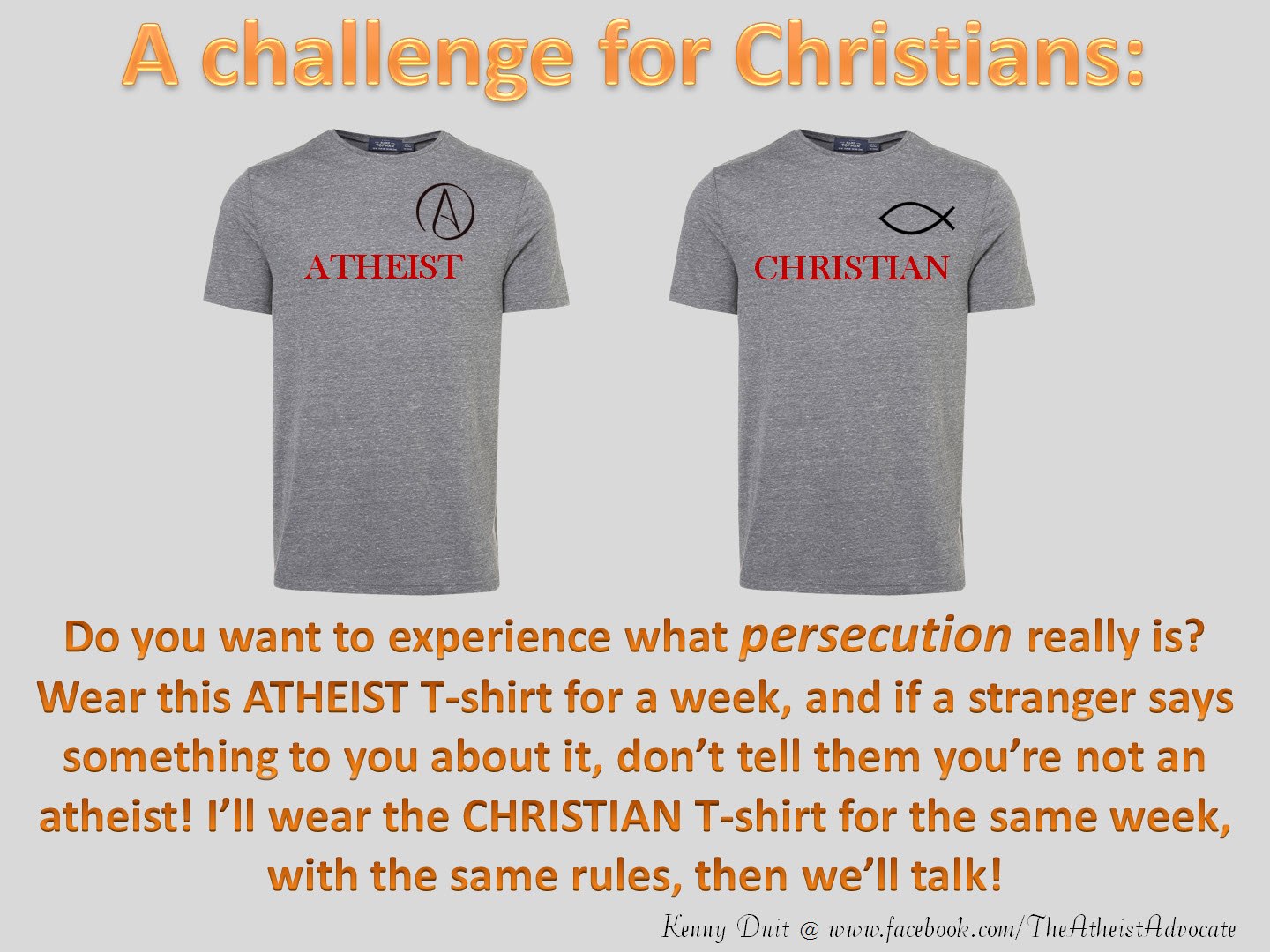 As far as irritation goes, this one comes close to being a mere amusement. I am talking about a challenge issued by The Atheist Advocate, the terms of which are fairly well explained by the illustration here, and I have to admit it’s tempting to just get behind this one. Seriously, I can almost go along with it.


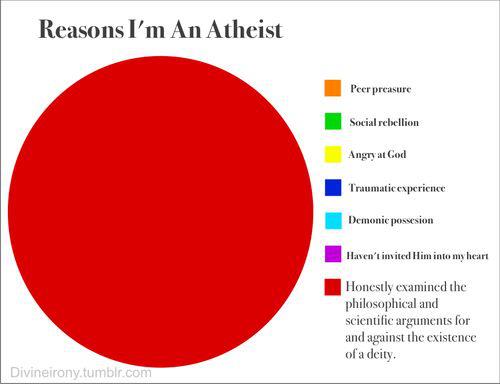

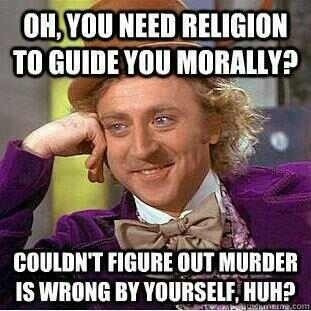












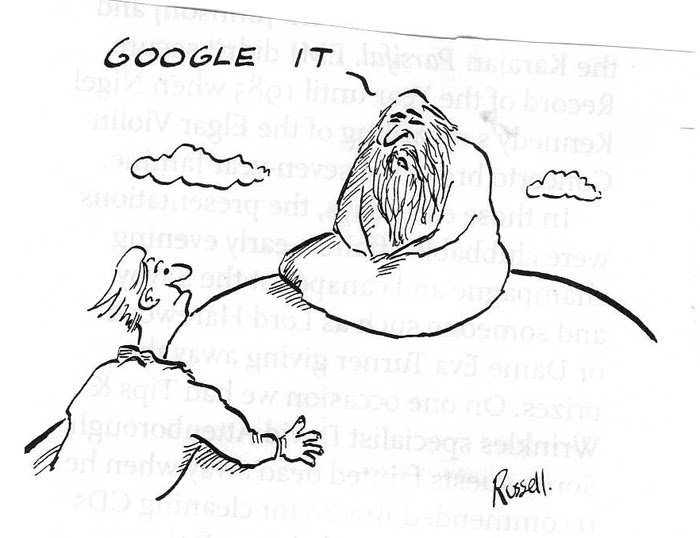




 northierthanthou