• About

northierthanthou

northierthanthou

Tag Archives: God

Of Loyalties and Lords and Faith as a Horror Show

13 Tuesday Nov 2012

Posted by danielwalldammit in atheism, Childhood, Religion

≈ 21 Comments

Tags

Abraham, atheism, Christianity, Christopher Hitchens, God, Heaven, Sacrifice, The Bible

Kent State Memorial
(Rejected)

Of all the Old Testament stories in my old Cartoon Bible, the one that made the greatest impression on me as a child was the story the Abraham and Isaac. It’s a pretty terrible thing for a 6 year old to contemplate, the specter of  a loving father prepared to kill his own child. I was supposed to be impressed with the faith of Abraham and the mercy of the Lord. Instead I shuddered to think of a father willing to do such a thing and a God for whom that would count as a virtue. I had never been taught to fear the Lord, as they say, but I certainly began to wonder if I should fear Him upon reading that scripture. More to the point, I wondered if I should fear my own father?

Significantly, it was my own father that I turned to for questions about the meaning of that Bible. I don’t recall exactly what Dad had to say about that passage, though I want to think that he might have called into question its particular vision of God. There are of course plenty of wonderful messages to be found in (or read into) the story of Abraham, but there is at least one message that I could never reconcile with my own sense of right and wrong, with my own sense of what family should be to one another. It was never Abraham’s faith that impressed me. Rather, it was his faithlessness; his betrayal of his son.

Of course Abraham didn’t actually kill his son, an Angel of the Lord stayed his hand. Still, I couldn’t help but imagine looking into my own father’s eyes and knowing that he was prepared to do such a thing. How could anything be right in the world after a moment such as that?

And how could anything be right in a world where its creator could want such a moment? At 46, the moral universe of that lesson still terrifies me, all the more so, because there are people who reside within it, even if their God does not.

It doesn’t appear that I am alone in this. The late Christopher Hitchens raised this objection several times, most notably in his book, God is not Great. But of course Hitchens is hardly the first public figure to underscore the trace of terror in this narrative. The story of Abraham and Isaac has darkened more than a few moments of artistic expression.

The sinister vision of Abraham appears in Leonard Cohen’s Story of Isaac, and of course in the opening lines of Dylan’s Highway 61. The sculptor George Segal deemed it a fitting symbol for a memorial to the Kent State Shootings (though Kent state University rejected his work, which is why it now rests at Princeton University). I’m also reminded of a rather bad movie with an interesting twist. In The Rapture, Mimi Rogers plays Sharon, a mother commanded by God to kill her own daughter in order to achieve Heaven. Having complied with His commands, she cannot bring herself to enter Heaven. Perhaps she too thought that nothing could ever be right again after crossing such a threshold.

My favorite use of the Abrahamic trope comes from Wilfred Owen who used it to comment on the horrors of World War I. His poem is called The Parable of the Old Man and the Young:

Then Abram bound the youth with belts and straps,

And builded parapets and trenches there,

And stretchèd forth the knife to slay his son.

When lo! an angel called him out of heaven,

Saying, Lay not thy hand upon the lad,

Neither do anything to him, thy son.

Behold! Caught in a thicket by its horns,

A Ram. Offer the Ram of Pride instead.

But the old man would not so, but slew his son,

And half the seed of Europe, one by one.

It would be a mistake to see in all these narratives the sort of polemics Hitchens had in mind, but they do speak to an element of meaning that cannot quite be reduced to the faith of Abraham or the mercy of God. There is something truly disconcerting about the command given to Abraham. Still more so his willingness to follow it. In the story of Abraham, if only for a moment, faith becomes a source of terror. I expect that for most believers the moment passes.

For some of us it never does.

Kurt Vonnegut may have struggled with that moment more than any of us. It haunts the opening chapter of Slaughterhouse Five, though Vonnegut took his point of departure from a different passage. It was the story of Sodom and Gomorrah that seemed to ask too much of Vonnegut.

And Lot’s wife, of course, was told not to look back where all those people and their homes had been. But she did look back, and I love her for that, because it was so human. So she was turned to a pillar of salt. So it goes.

It shouldn’t take much imagination to understand why Vonnegut of all people would identify with Lot’s wife. …to see how he could find in her a fitting symbol of something human, something often lost by demands of faith and loyalty. It was typical of Vonnegut that he didn’t quite field a direct objection to the Biblical narrative. He doesn’t deny the moral order of God’s commands (or even those of the Allied Air Command in his own day). He doesn’t even say that she was right and God was wrong. He simply embraces the moment when Lot’s wife does look back, and in doing so Vonnegut reaffirms the value of all the lives buried in that Biblical tale, …and of course those consumed in the fires of Dresden.

Gods do what they will, so it seems. There is little that mortals can do about it, but the God Abraham has always demanded just a little more. He has always demanded that we love him for it, that we condemn his victims along with him, and that we think of his acts of terror as positive moral actions.

And sometimes that is just too much.

For me that line is crossed in at least one more sort of story, one which brings us full circle to the relationship between father and child.

The concern is illustrated wonderfully in is a scene from the movie Black Robe wherein a missionary (Father LaForge, played by Lothaire Bluteau)  tries to convert an Algonquian-speaking native (Chomina, played by August Schellenberg) to the Christian faith just before the man dies. Desperate to save his companion’s soul, Laforge offers Chomina the promise of eternal life in Heaven. But of course LaForge must admit that none of the Chomina’s heathen relations will be with him in this eternal life. Neither Chomina’s wife, nor his parents, nor even his youngest child will be there to meet him in Heaven, because they died without accepting the faith.

It would be easy to under-estimate the power Chomina’s response to LaForge in that movie, but it has always seemed to me a very compelling argument. It works for me, not because of fictional characters with fictional relations, but because of real people in my own life. I am well aware that some (perhaps many) of those I have known and loved passed away without reconciling themselves to terms of sundry Christian teachings. What must be done of course varies from church to church, but in each case where the price of heaven is conversion, I know of specific people who failed to make that choice in terms described by one or all of these churches. Faced with the prospect of conversion and its benefits myself, I can honestly say that the choice strikes me as a betrayal.

Do I belong in this heaven, while my father does not? And will I enjoy paradise while others that I loved rot in graves, burn in eternal fires, or simply waste away in outer darkness?

If there is a God in heaven that would have this, then I will say ‘no’ to Him.

He is asking for too much.

71.271549 -156.751450

Share this:

  • Tweet
  • Share on Tumblr
  • Click to print (Opens in new window) Print
  • Click to email a link to a friend (Opens in new window) Email
  • Click to share on Reddit (Opens in new window) Reddit
Like Loading...

Meeting Your Maker in a Ridley Scott Movie: Once Again As Farce (Spoilers)

12 Tuesday Jun 2012

Posted by danielwalldammit in Movies, Religion

≈ 16 Comments

Tags

Blade Runner, Faith, Film, God, Movies, Origins, Prometheus, religion, Ridley Scott, Science

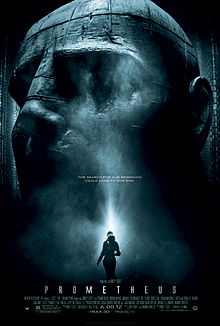
Prometheus

Prometheus opens with great promise delivered on a grand scale. It is a quest to find the origins of life on earth, a journey to meet our makers. I had entered the theater primed with expectation (the promos for this film were brilliant), and upon learning where the story would take us, I smiled and settled into my seat. Seriously, I couldn’t wait to see what new directions Ridley Scott might take with this wonderful theme.

Sadly, the answer was right into the ground.

Because the big crash of a spaceship at the end of this flick was the perfect metaphor for the movie as a whole. It was just one big train space-ship wreck.

…complete with main characters running directly away from the rolling wheel-like space ship instead of jumping to the side. Yes, they actually did that. Seriously, how does a movie studio spend so many millions of dollars on special effects and star power only to miss the fact that they put a Loony Tunes gag in the middle of the dramatic climax of the story? Or do they just think we are that stupid?

Maybe we are. …Damn!

Don’t get me wrong. I like really cool special effects as much as the next guy. But I also like an interesting story. Is it really too much to ask that they appear in the same film?

Ridley Scott has produced such films! Alien was such a film. More to the point, Blade Runner was such a film. And one of the best things about Blade Runner was its use of the very same theme.

Blade Runner

Blade Runner was a classic Philip K. Dick story. Few authors could make something so fantastic speak to people in such personal ways, and Ridley Scott transmitted that to the screen brilliantly. Do you remember Roy’s encounter with his maker? Do you remember watching as this replicant interrogates his very creator, trying desperately to wheedle extra time out of the very man who had chosen to the hour of Roy’s demise? And do you remember how easily the story acquired its deeper significance, that moment when a simple plot point about a creature trying to extend its life acquired philosophical significance?

For all his artificial nature, Roy stood before his maker asking questions about the very meaning of mortality. They were questions we could all recognize. Questions that touched deeply on what it means to be human, what it means to live for only a little while.

And in that moment when the character of Roy stands before his maker and demands to know the reason for his imminent death, he became so very human.

…still more so in the moment of his passing:

What makes Roy’s story so compelling is not merely that we can see the metaphor, but that the metaphor is used to tell us something about our own humanity. It is not merely the loss of personal life that Roy mourns. It is also the passing of his experiences into oblivion, experiences that could be of real value to someone. He is a remarkable character, to be sure, and the world will lose something as he passes.

…just as it does with the passing of each of our loved ones.

…just as it will for each and every one of us.

Roy

Roy meets his maker to confront his own mortality, and he takes us along for the ride. We are there, not just to witness the action, but to share in the meaning of that encounter. …perhaps even to share in the crime of deicide when Roy executes his own verdict on his maker.

And what of Prometheus?

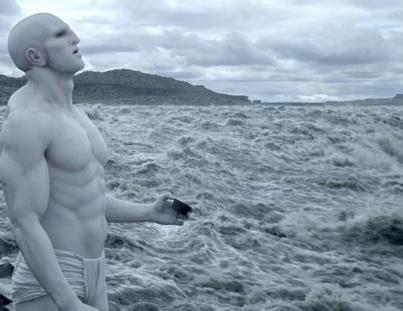
Grandfather?

As Roger Ebert tells us, Prometheus raises questions about the origin of human life, presenting us with a version of the panspermia hypothesis in which all of life on earth is begun through the apparent suicide of a pale muscular alien. In the opening scenes that alien appears alone on a barren plant, his spaceship leaving without him. With all the solemnity of a priest performing a great ritual, the alien consumes a mysterious substance, and it ravishes his body. As the mysterious alien falls into a rushing river, his body disintegrates, releasing the seeds of life into a new world.

Was this earth, as Roger Ebert suggests? Ridley Scott tells us that it could be any planet, but of course the point of the scene is to raise the possibility. This might have been how life on earth started, so we are asked to believe. More to the point, it may well be how life on planet earth will begin anew, if the “engineers” as these aliens are called, should choose to return.

That is the possibility uncovered by our main characters in Prometheus. They set out in a quest to find the engineers, to speak with our very creators only to find them bent on our destruction. And thus the a question about the origin of life on earth transforms into a question about the possibility of its imminent demise. The two questions are really the same, because each is essentially a question about the motives of the engineers.

Why?

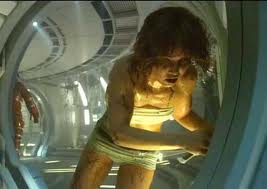
Shaw

This SHOULD have been a brilliant movie. What makes it so sad is the inattention to narrative detail. The scientists do not act like scientists, especially the geologist who’s rabid anti-intellectualism belies his choice of career. Seriously, didn’t someone on set know that geology is a science? But of course this is a side character, and his flaws are forgivable. What of the main characters?

Three people drive the quest to find the engineers in Prometheus. Two archaeologists, Elizabeth Shaw and Charlie Holloway (played by Noomi Rapace and Logan Marshall Green) initiate the quest to find the engineers as a result of the result of their own findings. Holloway is so intent on speaking with the engineers that he engages in reckless actions upon landing. Believing the engineers to be dead, he drowns his sorrows in a bottle. I suppose we are meant to appreciate the irony of a scholar lamenting the greatest archeological find in the history of the field, but I for one could not get past the absurdity of it. Shaw could almost have served as a voice of reason were it not for her complete irrelevance in the lead-up to the final conflict. No-one listens to her (least of all her husband and partner Holloway), right up until she ends up as the sole human survivor of the expedition.

…which is to say that no-one ever listens to her.

And then of course there is Peter Weyland (played by Guy Pearce). A wealthy old man facing the end of his own life, Weyland funds the expedition for the sole purpose of extending his life. How he came to the conclusion that the engineers would extend his life is beyond me? I think it was beyond the writers themselves? Whatever its origins, Weyland holds onto this assumption despite all evidence to the contrary. Long after it has been made clear that the engineers bear no goodwill towards their creation, Weyland chooses to speak with one of them. It was a foolish mistake.

…and it was his last one.

And here we have the crux of the problem.This movie doesn’t really raise any questions about the origins of life at all. The prospect that life on earth might have its origins in the stars is simply a premise designed to kick-start the action. Nothing about the unfolding action sheds any light on the significance of that premise, nor does it begin share that significance with anyone in the audience.

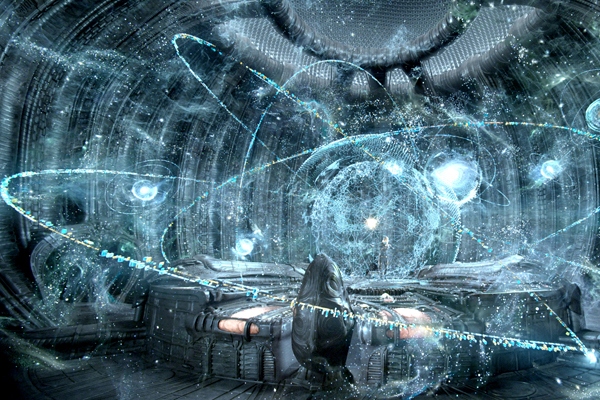
Space Lab

The central meaning of the encounter with the engineers rests on the irrational presuppositions of Holloway, Shaw, and Weyland. Each of them has loaded the event with significance particular to their own stories, their reasons for doing so barely explored in the course of the film. This sort of approach might have worked with some earnest character development, but Prometheus was too busy wowing us with majestic visuals and sudden moments of terror. In the end, this film attaches no genuine meaning to the event at all.

And so the encounter with the makers of humanity does not quite resonate the way it could have. The encounter with the engineers is an intrinsically interesting moment, one spoiled terribly by the lack of a meaningful storyline to carry us through it. Unlike Roy, these characters bring no great questions to their creator; seeking instead to learn whatever he chooses tell them. But he tells them nothing, electing instead to begin smashing up its creation.

…which actually sums up this movie pretty well.

***

I have to thank my friend Michael Kucan for helping me to remember some of the more irritating details of this movie. I would also like to recommend aknittysociety blog, which contains a wonderful analysis of race and gender in Prometheus. I should also say that in my thoughts about Blade Runner were rather strongly influenced by entry in Roger Ebert’s Journal, I Remember You.

71.271549 -156.751450

Share this:

  • Tweet
  • Share on Tumblr
  • Click to print (Opens in new window) Print
  • Click to email a link to a friend (Opens in new window) Email
  • Click to share on Reddit (Opens in new window) Reddit
Like Loading...

Auto-Kitty Says ‘Meow’: What she Means is that Belief is not a Choice

16 Wednesday May 2012

Posted by danielwalldammit in atheism, Religion

≈ 39 Comments

Tags

Agnosticism, Animals, atheism, Belief, epistemology, God, Kitty, Philosophy, religion, The Rugburns

Auto-Kitty
(not a Siamese)

Is belief a choice?

I don’t think so.

It is certainly common enough to speak of belief as a choice, but could I choose to believe that I was not sitting in a chair right now? (I am.) Could I choose to believe that the music playing at this moment (Sky-Fucking-Line-of-Toronto) had been recorded by The Kinks? (It was The Rugburns.) Could I choose to believe that my cat, Auto-Kitty (pictured to the left) is a Siamese? (She is of course a Tortie.)

Mind you, I am not asking if I could tell you that Auto-Kitty is a Siamese. I most certainly could. I am not asking if I could play some special word-game in approaching the subject and define ‘Siamese’ in such a manner as to include cats with a tortoise-shell coat. I am not even asking whether or not I could embark on some long-term project to convince myself that my little Auto-Kitty was really a Siamese. …though I really don’t think I could do that either. No, I am asking whether or not I could choose to believe, right here and now, that a cat I know to be something other than a Siamese was in fact (using a conventional understanding of the term) actually a Siamese?

The answer is ‘no’.

I think it is safe to say, dear reader, that we could come up with a range of similar propositions for you, claims that you could not choose to believe, at least not without a complex long-term brain-washing process to get you there. You could probably assert these claims, but you could not actually believe them.

So, there is at least one respect in which belief appears to present a limit to our choices. Somewhere in the question of what one believes, we all encounter an emergent property which is beyond the control of our immediate will. …Okay, at least the vast majority of us do.

No, it is not my intention to suggest that we have no choice at all with respect to beliefs, but rather to suggest that the choices must in some respect live with this emergent property, the one which defies our power to shape it at will. Truth be told I think we could probably put a range of different propositions on a scale of sorts. Auto-Kitty’s non-Siamese status is, for me at least at maximum (or near maximum) resistance to the whims of my personal belief. For you, perhaps, taking my word for it, there is perhaps cause for doubt about the matter, and it might be reasonable to say that one’s response to doubt involves a degree of choice.

More to the point at hand, we could perhaps find a range of propositions about subjects inherently difficult to resolve, full of ambiguity, and perhaps even loaded with more heuristic than factual value. One might get to say that he or she has a bit more choice in such matters. But I still think it is worth knowing that somewhere in our mental landscape, we normally encounter a limitation, a point of resistance to the free play of our choices.

I should add that I do think personality is another variable. Some people seem far more capable of choosing what to believe than others. I should also add that in at least one respect this is far from a virtue.

So what?

Well, what I am getting at is a trace of the larger question of Beliefs with a capital B. I don’t mean beliefs such as; What color is the chair? What kind of cat is that? or Is there too much chili paste in the chicken red curry? No, I mean questions like; Do you believe in God? How about reincarnation? karma? …The Holy Trinity? …you get the idea. Because people often speak of these beliefs as a choice.

The notion that belief in god is a choice is a particularly common fashion of speaking, and that fashion of speaking can be very misleading. It makes of belief a moral decision, and side-steps the epistemological questions about that belief in favor of arguments from consequantialism. One must, according to this approach, choose whether or not to accept or reject God, all of which actually begs the question of whether or not She actually exists.

But I don’t wish to go too far down this particular road at the moment. I am more interested in fleshing out how the issue affects self-presentation in matters of belief.

Okay, I am thinking about how this affects me!

You see, I often think back to these days of my own deconversion, and I realize that I have become accustomed to speaking of the process in unnecessarily mystical terms. I sometimes say that “I lost belief in God at around the age of 18,” or I may explain that “I chose to reject religion at that age.” Perhaps I will say that “I lost my faith,” and so on.

I don’t think this language is at all unusual, but the more I think about it the more I realize that they are not accurate descriptions of what happened at that time in my life at all. It would be far closer to the truth to say that I never really had faith at all. It would be more precise to say that I could find no aspect of my thought process which has ever answered to the concept of ‘faith’ as it is normally used in connection to belief in God.

Still further, I think it would be more accurate to say that I never really believed in God. Oh, I wanted to! As a young teen I REALLY wanted God in my life. I read. I prayed. I meditated. I studied. I did everything I could to ‘find God’ as they say, and the truth is that I just never did. I found a great deal of speech about him, but that speech never resonated with me on any personal level, nor did it point to anything in the objective world that struck me as a good candidate for a deity. When the day came that I finally came to see myself as an unbeliever, it was less a rejection of some viable notion than it was a concession that no such concept could be found in my mental landscape.

It was less a choice to reject belief than an acknowledgement of a mental state over which I did not really have a choice.

This was about the age of 18 or 19, and by that time I had come to know a number of approaches to the subject of God and religion. But these were always bracketed concepts in my own mind. They were ideas that someone else believed in, definitions of God that fit someone else’s beliefs, …or at least their claims. When I embraced my role as an unbeliever, the decision changed absolutely nothing about my beliefs. It was a change in my self-presentation, a decision about how best to describe the beliefs (or the lack thereof) that I already had.

For me at least, I could no more choose to believe in God than I could choose to believe that Auto-Kitty is a Siamese. I could say that God exists of course, but short of equivocation, I could not mean it.

I could deflect the question and say that I do not know whether or not God exists. Better yet, I could grunt and change the subject.

I could choose to put forward a variety of labels for my thoughts on the subject. So, for example, I could probably describe myself as either an ‘atheist’, an ‘agnostic’, or even an ‘agnostic atheist’. I could add the qualifiers ‘weak’ before ‘atheist’ or ‘soft’ before ‘agnostic’, or I could leave them off according to taste. Any of these approaches would be an equally accurate description of my take on the matter of God. I am somewhat inclined to believe that the label ‘non-cognitivism’ would work as well, though I would have to read-up a bit more on that approach to the issue before deciding once and for all on the label. But let us be clear, what I am choosing here is a label and a certain amount of baggage that goes with that label. What I am not choosing is what I will or won’t actually believe.

I have a little more wiggle room on the issue of surety. I could say that I am certain on the matter or that I am open to the possibility that a god does exist. The cognitive hazards of container metaphors aside, both of these could be a reasonably accurate description of my attitude on any given day.  Choosing one or the other term would in a sense help to make the issue normative; it would give me an incentive to try for the attitude I had adopted as a self-description, and to avoid the other. Either way, I do feel like I have a little more choice in the degree of certainty I wish present my approach to this issue to others.

Indeed, I have lots of choices about the way I package my lack of belief and explain it to others. I also have lots of choices about what my (non-)beliefs mean to me and how they will shape my actions in the future.

What I do not have a choice about is what I actually believe on the subject. Somewhere in there, the power of choice simply escapes me.

***

Okay, I lied about what Auto-Kitty was trying to say in the title. What she was actually trying to tell you with that little meow of hers is that in the picture above, she is more comfortable than you or I or any other person in the whole of human history will ever be. She just wanted you to know that.

71.271549 -156.751450

Share this:

  • Tweet
  • Share on Tumblr
  • Click to print (Opens in new window) Print
  • Click to email a link to a friend (Opens in new window) Email
  • Click to share on Reddit (Opens in new window) Reddit
Like Loading...
Newer posts →

Top Posts & Pages

  • Master and Commander Kinda Queered
    Master and Commander Kinda Queered
  • I'll Just Leave This Here
    I'll Just Leave This Here
  • Uncommonly Slow on the Uptake
    Uncommonly Slow on the Uptake
  • A Joke from a Bygone Era
    A Joke from a Bygone Era
  • Uncommonday Morning Blues - Ian Anderson Learns to Play the Flute
    Uncommonday Morning Blues - Ian Anderson Learns to Play the Flute
  • When Sex Falls Out of the Performance
    When Sex Falls Out of the Performance
  • An Uncommon Security Guard: Dave Eshelman, AKA 'John Wayne'
    An Uncommon Security Guard: Dave Eshelman, AKA 'John Wayne'
  • What are the Necessities of Life?
    What are the Necessities of Life?
  • The Murals of Española
    The Murals of Española
  • An Uncommon Request
    An Uncommon Request

Topics

  • Alaska
  • Animals
  • Anthropology
  • atheism
  • Bad Photography
  • Books
  • Childhood
  • Education
  • Gaming
  • General
  • History
  • Irritation Meditation
  • Justice
  • Las Vegas
  • Minis
  • Movie Villainy
  • Movies
  • Museums
  • Music
  • Narrative VIolence
  • Native American Themes
  • Philosophy
  • Politics
  • Public History
  • Re-Creations
  • Religion
  • Street Art
  • The Bullet Point Mind
  • Travel
  • Uncategorized
  • Uncommonday
  • White Indians
  • Write Drunk, Edit Stoned

Blogroll

  • American Creation
  • An Historian Goes to the Movies
  • Aunt Phil's Trunk
  • Bob's Blog
  • Dr. Gerald Stein
  • Hinterlogics
  • Ignorance WIthout Arrogance
  • Im-North
  • Insta-North
  • Just a Girl from Homer
  • Multo (Ghost)
  • Native America
  • Norbert Haupt
  • Northwest History
  • Northy Pins
  • Northy-Tok
  • Nunawhaa
  • Religion in American History
  • The History Blog
  • The History Chicks
  • What Do I Know?

Archives

  • December 2023
  • November 2023
  • June 2023
  • April 2023
  • February 2023
  • December 2022
  • November 2022
  • October 2022
  • September 2022
  • August 2022
  • July 2022
  • June 2022
  • April 2022
  • January 2022
  • December 2021
  • November 2021
  • October 2021
  • September 2021
  • August 2021
  • June 2021
  • May 2021
  • March 2021
  • February 2021
  • January 2021
  • December 2020
  • November 2020
  • October 2020
  • September 2020
  • June 2020
  • May 2020
  • March 2020
  • February 2020
  • January 2020
  • December 2019
  • November 2019
  • September 2019
  • August 2019
  • July 2019
  • June 2019
  • May 2019
  • April 2019
  • January 2019
  • December 2018
  • November 2018
  • October 2018
  • September 2018
  • August 2018
  • July 2018
  • June 2018
  • May 2018
  • April 2018
  • March 2018
  • February 2018
  • January 2018
  • December 2017
  • November 2017
  • October 2017
  • September 2017
  • August 2017
  • July 2017
  • June 2017
  • May 2017
  • April 2017
  • March 2017
  • January 2017
  • December 2016
  • November 2016
  • October 2016
  • September 2016
  • August 2016
  • July 2016
  • June 2016
  • May 2016
  • April 2016
  • March 2016
  • February 2016
  • January 2016
  • December 2015
  • November 2015
  • October 2015
  • September 2015
  • August 2015
  • July 2015
  • June 2015
  • May 2015
  • April 2015
  • March 2015
  • January 2015
  • December 2014
  • November 2014
  • October 2014
  • July 2014
  • June 2014
  • May 2014
  • April 2014
  • March 2014
  • February 2014
  • January 2014
  • December 2013
  • November 2013
  • October 2013
  • September 2013
  • August 2013
  • July 2013
  • June 2013
  • May 2013
  • April 2013
  • March 2013
  • February 2013
  • January 2013
  • December 2012
  • November 2012
  • October 2012
  • September 2012
  • August 2012
  • July 2012
  • June 2012
  • May 2012
  • April 2012
  • March 2012
  • January 2012
  • December 2011
  • November 2011
  • October 2011

My Twitter Feed

Follow @Brimshack

RSS Feed

  • RSS - Posts
  • RSS - Comments

Enter your email address to follow this blog and receive notifications of new posts by email.

Join 8,076 other subscribers

Blog at WordPress.com.

  • Subscribe Subscribed
    • northierthanthou
    • Join 8,076 other subscribers
    • Already have a WordPress.com account? Log in now.
    • northierthanthou
    • Subscribe Subscribed
    • Sign up
    • Log in
    • Report this content
    • View site in Reader
    • Manage subscriptions
    • Collapse this bar
 

Loading Comments...
 

    %d