• About

northierthanthou

northierthanthou

Tag Archives: Politics

A Tyrant On Either Side of the Gun Sights

10 Wednesday Aug 2016

Posted by danielwalldammit in Politics

≈ 13 Comments

Tags

Donald Trump, GOP, Gun Rights, Guns, National Rifle Association, NRA, Politics, Right Wing, Second Amendment

Meguns&JudPriestshirt

Budding Young Amo-sexual (Embarrassing, I know)

I was about 15 or 16 when my father cancelled our membership in the National Rifle Association (NRA). Money was tight back then, but Dad said that wasn’t entirely the issue. He was also fed up with their politics.

I was mortified.

The old “If guns are outlawed” sticker was then sitting on the bumper of my first car (which wasn’t yet running), and a stack of hunting and shooting magazines rested on a shelf in my bedroom. My private arsenal had already outgrown the gun-case. At the time, there just wasn’t much about the NRA that I didn’t like. Oh sure I’d noticed a myopic one-sidedness to some of the articles in those magazines, but for the most part, I was down for the main agenda. Dad never did explain to me what had bothered him about the NRA back then (the early 80s). I reckon he was just hoping I would grow a dose of moderation at some point. This was hardly the only obsession that could have given him cause for such concerns.

I guess Dad got his way on this one at least. My views on guns and gun control are complex. ‘Ambivalent’ may be a better word. My take on the legal issues doesn’t map well onto either the left or the right on the actual issue of gun ownership. I’m open to gun control, but skeptical of its impact (at least one any scale that’s practically possible in the present political climate). It hasn’t escaped my notice that I live in a region where firearms can be damned useful. (By way of illustration, one of my students took a job collecting plant samples this summer. Part of her training including a day or so learning how to handle a firearm. In the land of polar bears, a gun can be an essential part of scientific research.) I’ve also got a lot of friends and neighbors who feed themselves by use of firearms, and I’m not in the habit of turning down a good bowl of tutu (caribou) stew. The bottom line is that I won’t be campaigning for full disarmament anytime soon. Few do, really, but if complete disarmament is your bandwagon, then I am definitely not on board.

There is one other bandwagon I’m not climbing aboard any time soon, and that is the one run by the NRA. Any latent interest I might have had in that organization slipped away during the Clinton administration. The television ads from that era telling us that every honest gun owner ought to be a member didn’t exactly inspire me to get out my checkbook. Hearing countless people spouting their fears about ‘thuh guvment’ was enough to send shivers up my spine and put a large dose of queazy in the pit of my stomach. I recall “Impeach Clinton” bumper stickers within the first few months of his first administration. In time his critics would find reasons. In the interim, suddenly Bill Clinton was the source of the New World Order, notwithstanding Bush Senior’s use of the  phrase to sell Desert Storm. Within the space of a single election, Clinton became the source of all that was wrong with the world. Seeing the same people who had supported centralization of power throughout the Reagan and Bush administrations suddenly play underdog against government authority was more than a little disconcerting.

It got a lot more disconcerting after the Oklahoma City bombing.

You can’t run a direct line of reasoning from Charlton Heston’s “take my gun from my cold dead hands” speech to that bombing, no, but these two notes fit in the same damned tune. The right wing now sings a constant chorus of ‘don’t tread on me’ messages, and most of them serve simultaneously to valorize the weekend warrior games of countless over-gown boys and to demonize the best efforts of anyone involved in pretty much any kind public service. Hating the government is a popular sport in what passes for ‘conservative’ circles these days. The problem is you can’t shoot at the government and you can’t bomb the government. Hell, you can’t even shout at the government. You can only do these things to real people, people who work for the government, and the trouble with demonizing that government is its a damned effective way to demonize real people. It’s a damned effective way to justify hurting real people. An awful lot of people died in Oklahoma City because someone decided to strike a blow against the government, and his ideas about that government had an awful lot in common with those pushed by the NRA for a couple decades now. Is the one the cause of the other? Maybe not, but it’s a damned reckless message just the same.

What I specifically object to is the scorched earth tactics that the NRA keeps producing. Talking of Second Amendment solutions and other confrontations with the government may sound like the words of brave people put-upon by dark forces and powerful institutions, but they are also clear and obvious efforts to intimidate the rest of us. While other interest groups go to the voting booths, hire lawyers to plead their case, or sometimes take to the streets with a sign or three, elements of the gun rights crowd keep threatening to use their guns under some unspecified conditions. It’s easy enough to imagine the scenario without its details. They will fight back against tyranny, of course; that’s what these people keep telling us. The problem of course is that tyranny may very well be a few unwelcome regulations and the tyrant may well be (as it was in Oklahoma City) ordinary people just trying to do their damned jobs.

Don’t get me wrong. For better or for worse, the Second Amendment is part of American government. There are certainly arguments to be made about its proper scope, and still other arguments to be made about the effectiveness of various gun control measures, but there is no excuse for the constant litany of violent fantasies surrounding firearms ownership. An awful lot of people keep telling us they and their guns are the best protection from government overreach, and every time I see or hear this message I find myself hoping for protection from precisely the folks producing it. I realize echos of this message come to us from the days of America’s founding fathers, but those echos have been twisted by ideology, augmented by fraudulent representations, and generally milked for everything they could possibly be worth. In the end, it isn’t America’s founders that keep this threat of violence alive in America’s politics today. It is the words and deeds of shameless people.

…which of course brings us to the latest twist in Donald Trump’s campaign. These are his words on the subject:

Hillary wants to abolish, essentially abolish the second amendment. By the way, and if she gets to pick, if she gets to pick her judges, nothing you can do folks, although the second amendment people, maybe there is, I don’t know.

To say these remarks have sparked outrage is putting it mildly, but let’s be clear. This is not an obvious call for gun owners to assassinate Hillary Clinton. It isn’t even a clear call for armed rebellion in the case that Hillary wins the election. There isn’t really anything clear about this message at all, but then again there wouldn’t be.

It’s Trump, remember?

He and clarity have never really been on speaking terms.

What this rhetoric ALSO isn’t is a responsible case for the Second Amendment. To begin with, the claim that Hillary Clinton wants to abolish the Second Amendment is hardly supported by the evidence. She favors a variety of gun control measures, yes. This does not mean she wishes to abolish the Second Amendment after all. It’s a straw Hillary that Trump is talking about, not the real one.

It’s really not clear how the straw Hillary who wants to abolish the Second Amendment altogether would even go about it, but it actually is clear that she couldn’t do it just by appointing a few judges. That move is neither sufficient nor necessary to do away with the Second Amendment (in principle or practice).

Hillary may well support gun control measures that many gun owners wouldn’t want to see passed. She may even advocate measures that ought not to be passed by any objective measure of their merits. Gun control measures, perfectly sound or bat-shit crazy, do NOT add up to the abolition of the Second Amendment. And let’s be clear, even Scalia, in the infamous Heller decision suggested that some regulations could be consistent with the existence of the Second Amendment, a Second Amendment he construed explicitly (and quite controversially as an individual right).

Simply put, regulations are on the table with or without Hillary as POTUS. Also the Second Amendment remains on the table with or without Hillary as POTUS. Far from the dooms-day scenario Trump trots out in this speech, another Presidential Clinton is at best/worst just another twist in the long case history of the Aecond Amendment. It’s not the end of the Second Amendment or civilization itself. So, yes, Trump is exaggerating, which is putting it mildly.

That exaggeration is not simply a mistake. Realizing just how badly Trump is exaggerating the prospect of a Presidential Hillary helps us understand how to take the comment that Second Amendment people might be able to do something about her after all. These Second Amendment people would be acting in a fantasy world in which a President, and a President alone is enough to render the legal landscape hopeless. If Trump is really suggesting something as mild as voting or rallying to his cause, then there is no need to raise the specter of a gun-grabbing apocalypse in preparation for it. His wording is ambiguous of course, but it’s the ambiguity of plausible deniability. And when speaking to millions, some of whom are clearly quite excitable, Trump’s message will take on many meanings. He knows that. The man is not THAT stupid. Many, perhaps most will take his words to mean something as radical as it takes to say something really rude to a cotton-picking liberal, but some will take them far worse. Some folks are quite prepared to kick their John Wayne fantasies into high gear. A responsible candidate knows this, and a responsible candidate doesn’t rouse his support base, or any subsection of it to the brink of violence.

Trump does.

He has been doing this throughout his campaign. I know of no other candidate in recent memory who has deliberately provoked violence at his own rallies, always falling short of directly calling for it, but often coming as close as one might without explicitly endorsing it.

During the primary season, the actual violence at campaign rallies clearly worked in Trump’s favor. What began as a series of news stories about Trump’s own supporters beating various protestors transitioned seamlessly into a series of stories about protestors engaged in all manner of violence against Trump’s own supporters.

Trump’s fighting words couldn’t help but fall on angry ears for his critics. Many of us have responded with such radical actions as a contemptuous tweet or a few minutes of outraged gripetude, but some took it further. Some engaged in genuine violence. The pay-off for Trump was obvious enough as he and his supporters played the victim and cast his critics as those with no respect for civil society.

What better context for Trump to present himself as the law-and order candidate!?!

A responsible candidate would have asked his supporters to step back and let security handle matters. If Trump said such things on some occasions, on others he talked about how those beaten deserved it, suggested he would pay for the lawyers of those beating protesters, and otherwise said a number of things encouraging the violence in his own supporters. and to provoke violence against his opponents.

Simply put, violence has worked well for Trump. He provoked it to his benefit in the primaries, and it should come as no surprise that he continues to do so in the present general election cycle. He started the general election by fantasizing about hitting his critics at the Democratic National Convention. You can see it in this passage. It isn’t until the very end that we come to realize he is talking about something other than outright violence, and you come to that only after indulging in a long violent fantasy.

The things that were said about me, I mean, should I go through some of the names? I, You know what I wanted to, I wanted to hit a couple of those speakers so hard, I would have hit them, no-no, I was gonna hit them so, I was all set, and then I got a call from a highly respected governor, ‘how’s it going Donald?’ I said; “well it’s going good, but they are really saying bad things about me. I’m gonna hit them so hard, I was gonna hit one guy in particular, a very little guy, I was gonna hit this guy so hard his head would spin, he wouldn’t know what the Hell happened, and, he came out of nowhere, he came out of nowhere; they made deals with me, ‘would you help me this; would you make this deal and solve the problem.?’ I solved the problem. I do a great job. I was going to hit a number of those speakers so hard their heads would spin. They’d never recover. And that’s what I did with a a lot of, that’s why I still don’t have certain people endorsing me. They still haven’t recovered.

It could be an accident of course. And elves could bake chocolate cookies under a full moon. This is a conscious effort on Trump’s part. Just as above, this is a message calculated to stimulate violence. It is ambiguous enough to evade responsibility for that violence, but it’s evocative enough to encourage it just the same.

And so here we are, at a new low point in American politics, at least in my own memory, a Presidential candidate stirring up violence in the service of his own campaign. It says a lot about Trump’s character that he is willing to do this to get the position. It says a lot about how he plans to run the country, and what it says about those plans is damned frightening. We can add his penchant for promoting violence to Trump’s sustained and very deliberate courtship of white nationalists throughout his campaign. This man has already done irreparable harm to the nation, and it’s hard to imagine what good things he could possibly do as President to overcome the harm he is clearly willing to do in the service of becoming President. More likely, he will just go on hurting people and encouraging his supporters to do the same.

Today’s message is distinctive insofar as it’s a clear and definitive marriage of two trends within the current GOP. On the one hand, we have Trump’s general efforts to wind up the nation to state of hysteria, to create the sense that America rests on the brink of social breakdown. On the other we have the long-standing right-wing message of violent opposition to government authority, one rooted in a myopic devotion to a single civil right. It’s marriage made in Hell, or at least a cheesy overpriced hotel equivalent thereof. Donald Trump is a huckster. That much should be clear to pretty much anyone this side of a mental ward. But he’s a huckster with a heart full of bile.

Share this:

  • Tweet
  • Share on Tumblr
  • Click to print (Opens in new window) Print
  • Click to email a link to a friend (Opens in new window) Email
  • Click to share on Reddit (Opens in new window) Reddit
Like Loading...

Libertarian Josey Whales

29 Tuesday Mar 2016

Posted by danielwalldammit in Movies, Politics

≈ 7 Comments

Tags

Clint Eastwood, Cowboys, Film, Free Markets, Libertarianism, Movies, Outlaw Josey Whales, Politics, Westerns

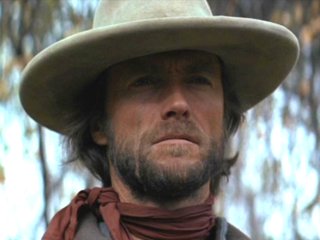
JoseyWDon’t get me wrong. I owe countless hours of entertainment, and many profound lessons learned to Clint Eastwood and his lifetime of utter brilliance. In this post, I will of course repay him by attacking his work on one of my all-time favorite films.
I guess I am feeling lucky.

…or maybe it’s just a blog post, but anyway, that’s not the film I mean to ramble about. I’m thinking about Josey Whales. There is one scene in this film that really bothers me. Maybe it’s meant to. Hell, probably, it’s meant to, but in this case the bother skips out of the bounds of the movie itself and starts to become a real-world bothertation.

I am talking about a scene in which Josey enters a trading post to find two men raping a young Navajo woman right there in the building. He grimaces a bit, and we get the impression he doesn’t really approve, and of course he does what so many of Eastwood’s characters do in this film; he goes on about his business, at least until the men become his business. This character is a reluctant hero after all, not some white-hat good-guy. When the rapists decide to try and take him prisoner, Josey, …uh, …SPOILER ALERT, …shoots them both dead, thus effectively saving the woman from sexual assault even as he saves his own life.

It’s great drama, and one of the things that makes it great is the moral ambiguity of its main character. Would he have helped the young woman if the two men hadn’t gone after him? We might hope so, but the film itself gives us no reason to suspect he would have. What we do know is that he walked right past them, and right past his first chance to help her. The whole scene ends with a disconcerting sense that Josey has put a stop to a number of bad things without ever really making a decision to do so.

It’s good storytelling. Hell, it’s great story-telling. So what’s the problem?

I think of this scene every time I hear of Clint Eastwood’s approach to libertarianism. His take on the subject is often described as “everyone leaves everyone alone” or some variant thereof. I actually rather like this expression, at least for a moment or two whenever I hear it. I can just imagine it being directed at some fussy bastard whose getting into other people’s business, in effect telling them to mind their own. I can get behind that sort of thing, sure I can. But then I find myself thinking that’s not really where this message is going, is it? Not in the grand scheme of things.

Time and again, we see libertarians in league with mainstream conservatives. On the topics of government aid to the poor and interference with the economy their messages are synchronous. On the topic of gender politics, their views clash, and near as I can tell the mainstream conservative themes win-out just about every time. This tells us a lot about the priorities at stake here, and I get damned tired of hearing a message that promises respect for individuals across the board only to see that message work consistently to the benefit of those already powerful at the expense of those struggling just to survive.

…which of course brings us right back to that scene from Josey Whales.

You could think of “everyone leave everyone alone” as a rule that might stop the rapists, albeit, it’s damned weak wording for a crime such as that. More to the point, I can’t help thinking it has more to do with Josey’s initial decision to go about his business, leaving the men free to hurt a young woman in his presence. I can’t help thinking that in that moment, Josey was minding his own business, just as the real Clint Eastwood seems to suggest we should all do.

Of course things work out in the end with Josey Whales, but they work out in the end because that’s the way the story is written. The bad guys go one step too far, thus triggering Josey’s own trigger, and it doesn’t hurt that they are foolish enough to let him get the best of them, just as all the other bad guys in that story do. Evil is vanquished in Josey Whales, but not because anyone has made a conscious choice to oppose it. Indeed, the movie seems rather set against the wisdom of such choices. No, the good that happens in this movie happens as if by accident, as Josey and his companions go about their daily lives, just trying to survive. And so the invisible hand of the writer seems to bring good  things from morally ambiguous behavior, much as the invisible hand of God in free market folklore.

It’s good storytelling, yes, but it’s piss-poor politics.

Share this:

  • Tweet
  • Share on Tumblr
  • Click to print (Opens in new window) Print
  • Click to email a link to a friend (Opens in new window) Email
  • Click to share on Reddit (Opens in new window) Reddit
Like Loading...

Argumentation and its Narrative Payoff

23 Tuesday Feb 2016

Posted by danielwalldammit in Philosophy

≈ 2 Comments

Tags

Argumentation, Comedy, Language, Logic, Myth, Politics, religion, Rhetoric, Speech Genres

ARnold ConanIt’s been a long time since I read Lakoff and Johnson’s book Metaphors We Live By, but I was recently thinking the internet has surely added a lot of good material for some of its central themes. The the notion of argumentation as warfare comes to mind. In that book, they advanced the notion that a lot of the metaphors people use for argumentation are those associated with warfare and violence in general. This is certainly born out by a number of things you can see on the net.

To see what people say about argumentation on the internet, it would seem that the world of debate is tremendously violent. Everywhere one looks, one finds destruction in the wake of a rhetorical flourish. Case in point? “Pres Obama Brilliantly Destroys a Loaded FOXNews Question” in this clip. Go Bama! But wait a minute? Is that an accomplishment? How do you destroy a question anyway? Loaded or unloaded, do you bash them? Crush them? Hit them with a mega-devestating incinerator photon torpedawhomper Bomb? Not to worry, cause our man Obama gets some here. He totally destroys Trump in this speech. In this video a “60 Minutes Host Destroys Barack Obama On Syria.” “Dawkins destroys Muslim Morality” in this video. But don’t look now! “Rupert Sheldrake Destroys Dawkins Dillusion in Banned TED-x Talk.” …er (sic). Apparently the author of this book is content to merely “refute” him. (Merciful soul!) Bill Nye destroyed Ken Ham. Ken Ham took the Science guy down with him. …totally destroyed. Sam Harris kicks ass here. Ben Carson “demolishes liberalism entirely in this clip from The View.   Hillary Clinton destroys things too! Oh no, Rand Paul destroyed her! He destroyed Donald Trump too! But wait a minute! Donald Trump destroyed Paul. Mutual destruction, just what I like to see in the GOP.

But wait!

Hold the phone.

In this video Cenk Uygur “destroys, degrades, demolishes, desecrates Antonin Scalia.”

Destruction, degradation, demolition, AND  desecration? That’s it. Uyguyr wins the prize. he can just drop the mic now. He totally wins the violence as war meme for the day. Apparently the man is a veritable engine of rhetorical terror. Behold his verbal prowess and tremble!

***

Okay, so I know how to belabor a point, right? Well, I’m just getting started really, so please bear with me. The point here is NOT that argumentation is really a form of warfare, but rather that many of the ideas we attach to argumentation are derived from the world of violence. The metaphors we use when talking about argumentation are, as Lakoff and Johnson pointed out, borrowed from the world of war. We could use other metaphors, and sometimes we do, but when we approach this subject for some reason or another violence just keeps pushing its way to the front of our tropic tool-kit. And really, what else would we expect Violence to do? He’s a pushy bastard. That’s why we call him Violence.

What has me thinking about this today isn’t really the metaphors, per se; it’s the stories used in this case to convey them. Each of the links above provides a little mini narrative describing some argument as though it were a decisive victory in battle. Reading the links in question, we can practically hear the words of Arnold Schwarzenegger as Conan echoing in the background.

To crush your enemies, to see them driven before you, and to hear the lamentations of their women.

Is this what every arguing argutizer really has in mind all along, an effort to achieve a victory so complete he can hear the lamentations of the women mourning his poor vanquished victim?

Perhaps.

But of course we want other things too. We want to show that we are smart. We want others to see our point, perhaps even to accept some truth that we regard as important. Sometimes we may want to learn ourselves, perhaps fleshing out our ideas in the effort to present them to others. We might even hope to learn more from another party by pushing them a little, getting them out of their comfort zone in the hopes that what they then tell us will be a little more worth listening to than what they say when the world feels like a warm moist hug.

Sometimes an argument leaves us with a narrative about conquest and destruction. That’s fair to say. But sometimes it leaves us with narratives about personal transformation, mural respect, learning, realization, …and, oh the fluffy! It burns!!! I’m really uncomfortable pleading the merits of such wholesome and earnest values, but honestly, they too play a large role in the construction of argumentation. Often these values are the more serious reasons for engaging in argumentation. Officially they are the reason we produce arguments in the classroom, for example, though someone might be excused for thinking the real reasons may at times be closer to those of argumentation as warfare. (I’m reminded of references to the ‘silverbacks’ in scholarly halls, people who contribute great thoughts to be sure, but also folks who are prone to pounding their chests and roaring at others whenever they feel the need.) One often feels a certain tension between these motivations, at least I do.

Increasingly I am inclined to think of the tension between different rhetorical styles in terms of the narratives folks hope to tell about the arguments in question. Whether successful or not, at some point an argument passes into discursive history. It then rests in the background of subsequent discourse, taking on the form of the texts, ideas, quotes, and general resources others may use to communicate. They may recount an argument (or perhaps resurrect it in dead horse form just for the purpose of kicketation). As often as not, arguments make their appearance in later discourse in the form of stories like those referenced above. We talk about how Chomsky blew Skinner away on the nature of language (or perhaps he didn’t). We speak of the conflict (‘shedding more heat than light’ as one of my professors put it) between Masrahl Sahlins and Gananath Obeyesekere. Sometimes we simply say that one theory replaced another or that a given approach has become the standard in the field. Whatever else happens in such commentary, it transforms the point of an argument into a moment in a narrative. In many cases, I’ll warrant, this is hoped-for pay-off in producing an argument, that it will pass into the positive themes of a story. Maybe that story will be about how Bob kicked Joey’s ass on a random topic, or maybe it will be a story about how this or that idea came to be the dominant approach to a given subject.

Dominant? I’m back in the language of violence again. er, …perhaps the received wisdom in a given field? Anyway…

My point is that much of what people do in the course of pursuing an argument can be thought of as an effort, not simply to prove the truth of a claim as logicians might tell us, but to lay the groundwork for any number of stories one would hope to see told at some later time. Why do I think this is important? Not so much because it helps us understand the production of any particular argument, and certainly not because it helps us grasp the nature of academic argumentation (or any argumentation conforming to the normative ideals of my logic texts). What strikes me as important about this is that it helps to understand conflict with argumentative styles falling outside those norms. It helps precisely because it denies the centrality of those norms and reminds us that the effort to provide an objective case for the truth of a claim is just one of the many reasons someone might field an argument. He could also do so because he wants to hear the lamentations of your women.

I’m still belaboring the point, aren’t I? Thus far, it feels like I am painting too much in broad strokes, but wait! Oh! There’s another good metaphor for argumentation. Painting!!! Wouldn’t rhetoric be that much more colorful and that much less painful if we could construe arguments in terms of visual media? To make it work though, it needs to be generative. We need to be able to spell out the details of argumentation in painterly terms. Perhaps we could a prepare the canvas in reference to issues of context or outline a theory. Hey! We do ‘outline’ theories. We also sketch out the details of a position, make too fine a point of some things, and even speak of prevarication as erasure. Argumentation as art works. …but apparently not as often as warfare.

Artsy asides notwithstanding, what has me up at this undogly hour is the prospect of looking at the transition from an argument to a narrative in more detail. What happens when a genre defined in terms of premises and conclusions passes into the form of a genre defined by characters, plots, and events? What happens when relevance and logical support is transformed into dramatic tension? Are there regular patterns? If so, can they help us understand some of the details happening on either end of that transition?

There is plenty of interesting material out there. Election year political debates are a great example of this. Candidates do not approach these debates as an academic might. They are not trying to prove a point so much as provide an audience with a reason to vote in a certain way. The candidate with the most compelling argument for a given policy may not be the one who impresses voters the most. A large part of what determines this will be the way the arguments play in subsequent speech. A candidate, for example, who handles the details of a legal issue thoroughly may find himself resonating far less effectively than one who fielded a better sound bite in the same debate.

Obvious example is obvious.

Less obvious material? Internet trolls could perhaps provide us with a fair number of examples, but I think pure trolling is just the tip of the ice-berg. That kid who was too busy laughing at your avatar pic to care that your argument was sound will probably be as proud to tell the story of the encounter as you are, perhaps more so. Likewise the old fart who, hey that’s me! (Nevermind that example, we’re moving on…) If I’m ever tempted to use the phrase ‘social justice warrior’ in contempt it’s when I meet someone who seems more intent on claiming moral high ground over certain issues than addressing any number of objective concerns. You could absolutely prove a point to such a person and the only story they will tell about you is that you proved yourself to be a bad person for doing it. But of course one also encounters plenty of people happy to sneer and smirk at the the discomfort of others, especially anyone stupid enough to give a damn about the underprivileged. To let such a person know that you care about any given issue is little other than to tell them how to hurt you. They too will tell a tale about any argument you have with them. Your own tears (real or imagined) will figure prominently in the stories they hope to tell about you.

Such games aren’t limited to the net, of course, but the anonymity of online discussion seems to bring it all out so much more. It’s part of a general pattern of behavior one sees in public disagreements, especially those involving people from very different walks of life. All too often both parties in an argument will come away thinking they have won. In each case, what they actually come away with is a story that relates their victory. It would be easy to think this is because people simply don’t see their own errors, to think that only one of the stories about a given argument would be authentic, but that’s not usually the case. As often as not, the difference occurs because each side had a different sense of the win-loss conditions to begin with.

Yes, the notion of ‘winning’ an argument is already a problem.

The problem isn’t always that other speaking styles compete with those we might think of as more sound argumentative practice. Sometimes the alternative approaches are genuinely interesting in themselves. For example, sometimes an argument is encased in a legendary narrative, which of course makes possible a kind of indirection or an argument by allusion. One may simply refer to the story as a means of suggesting an argument about real world matters. My favorite example of this remains the separation of men and women in Navajo lore, though I suppose one can also see it in conventions of scriptural quotation among Christians (where it almost always takes on the quality of an authority argument). In each of these cases, the significance of an argument appears to be filtered through the significance of a set narrative that defines and shapes its meaning in ways you couldn’t get from a direct analysis of the argument itself. That argument appears as a brief moment in a stream of storytelling, and for some at least its possible significance will always be tied to that very narrative.

When I used to post on Christian Forums, I recall a number of instances in which the arguments of atheists were described in terms of malevolent supernatural power. Realizing I was among the demons described in these narratives, I couldn’t help but feel a sense of anger and irritation. I also found it fascinating. These were people who measured arguments in terms of spiritual warfare. They measured such arguments in terms of powers not premises and faith instead of relevance. This is argumentation as war, to be sure, but in this case, it’s a war between demons and angels. Where I might havedescribed an argument on that forum in terms of proof and evidence, to the practitioners of spiritual warfare those same arguments became stories of a struggle with evil. In the abstract, that isn’t really too surprising, but I must say that it was odd to see just how that general theme played out in the details.

The Storify app would seem to be relevant to my thoughts at the moment? …Still not gonna use it!

Comedy strikes me as a particularly perplexing example of this problem. Stand-up comics produce arguments all the time, but of course their primary job is still to make people laugh. Often we laugh because the argument seems to make a good point in a clever and interesting way. At other times we may laugh because the argument is clearly absurd or irrelevant. The shear audacity of an obvious fallacy can be damned humorous if one isn’t expected to take it seriously. In such performances, our priorities shift and we may approve arguments which might otherwise seem foolish or genuinely asinine.

My tendency in such cases has always been to assume the comic doesn’t really mean it, but as I get older (and as some of my favorite comics do the same) I find at times these jokes are meant more seriously than I might have hoped. Victoria Jackson would be one particularly morbid example of this problem. What might have been a funny act, at least to some, appears less an less to be an act at all. Honestly, I think the same of Ted Nugent. I know he’s not a comic, but in his old television appearances I can’t help thinking his tone was tongue in cheek, that he at least realized he was taking some liberties with reason. I don’t see that when he speaks anymore. I see the same reckless leaps of lack-logic in Nugent’s speech, but he no longer seems to be in on his own joke. Its as if his reasoning has become so committed to the service of a personal narrative that it couldn’t matter anymore when he is wrong, not even enough for a wink.

How did I get onto Nugent?

Nevermind that!

My point is that in comedy argumentation and jokes are bound up together in interesting ways. Which takes priority over which just isn’t always that clear. Sometimes the strength of an argument carries the joke itself, and sometimes it’s the lack of that strength that makes us laugh. So, which is it in any given case? That’s not easy to tell. The guy laughing beside you may be thinking ‘that is so true’ even as you are busting a gut because it’s completely ridiculous. In either event, we are less likely to evaluate the work of a comedian in terms of the cogency of his reasoning or the truth of his assumptions than the cleverness of his words, his timing, projection, etc. With some clear exceptions, we can see this in the stories people tell about the work of comics.

On the other hand, the work of a good comic does bring us back to the argument as war metaphor. If an act is done right, we might well say of the comic that he killed it! I wonder if stand-up comics ever want to crush their audiences, to see those who came to a show driven before them, and to hear the lamentations of their women?

I’ve probably overdone that line, haven’t I?

Yes, I have.


Share this:

  • Tweet
  • Share on Tumblr
  • Click to print (Opens in new window) Print
  • Click to email a link to a friend (Opens in new window) Email
  • Click to share on Reddit (Opens in new window) Reddit
Like Loading...

Ask Not What the Alibi Buddy Says About You!

04 Tuesday Aug 2015

Posted by danielwalldammit in Philosophy, Politics

≈ 6 Comments

Tags

Bigotry, Excuses, Homophobia, Politics, prejudice, Racism, Rhetoric, Sexism

possible sighting?

possible sighting?

We’ve all heard about the alibi buddy. He’s that gay guy whose best friends with the man telling you he’s against gay rights. He’s also the black guy who hangs out with the fellow bashing African-Americans. He’s the Muslim who totally agrees with all of someone’s generalizations about Muslims, Arabs, and even Sikhs, cause that’s close enough, right? And of course he’s the Mexican drinking buddy to the guy telling you all about those damned immigrants, …er illegal immigrants, just the illegal ones, I mean. Cause we all know that people who bash immigrants are very precise about their concerns, and they never-ever cap on legal immigrants in any way! (Alibi buddy would probably tell us that if he were here.)

Does anybody else have any questions about this buddy, the one we never seem to meet? For that, matter, does anyone have questions for him? Who is he? Where does he live? Or does he really exist when the conversation is over? He might just be a kind of Berkleyian presence, only there when you’re in the room. I can’t be the only person to question if his reality outlives the moment. You gotta wonder if his friend even remembers him when the conversation is over and he doesn’t need an alibi anymore.

But it’s worse than that, I reckon, cause the alibi buddy ain’t there when you’re in the room either. So, this alibi guy is really weird, you know. He is and he ain’t, but he’s both of these (and neither) only when you’re in the room talking to the guy who has something bad to say about some group which totally includes the alibi buddy.

Which is confusing, I know.

Is or ain’t though, I’m convinced the alibi buddy is a singularity. I know, I know, the empirical evidence doesn’t say one way or another. It could be that all these people are talking about a whole bunch of different guys. It could even be that each community has its own ur-alibi, so to speak, a kind of minority spirit-keeper. There could be just that one guy who is friends with all the people capping on African-Americans, another one for Asians, and of course one sinister bastard for all the left-handed people. I mean it could well be that each disenfranchised group has its own alibi spirit who exists for the sole purpose of licensing friends to talk bad about them. On the face of it, this is at least possible.

…as is the existence of vast hoards of minorities living somewhere else, all of whom sent their trusted friends to say bad things about them.

…in good faith.

Still, the alibi buddy is just too perfect isn’t he? Always friends with someone who needs him, but never really there to answer any serious questions. Can that kind of perfection really be divisible. I think not. So, I really do think there is just one alibi-buddy for all the trash-talking not-really-bigots out there. You know it makes sense. There is just one alibi-buddy, one gay-Jewish-Afro-Asiatic Mexi-black man with a lisp. The alibi-buddy is is no Doubt a number of other things besides that, but really, he can only not be in the room for just so many reasons. So, we can probably rule out a few things. Alibi buddy isn’t white; I think we can all agree on that. He also isn’t straight. I would say that he isn’t a guy, but I can’t help thinking a woman would have the good sense to show up to set us straight.

The alibi buddy never does that, does he? No.

There is just one alibi buddy for all the people talking about him, and he is never really here to tell us how he feels about the issues. Evidently, he has a number of friends and they are all strikingly adversarial to the poor alibi buddy and his kin, but apparently he loves them anyway. Alibi buddy must be a very patient guy.

I say that, but I don’t really know for certain, which is frustrating, because I really would like to ask him something.  I’d like to ask him if he knows how his friends are talking about him? Does he know that his friend wants to make sure he can’t get married? Does he know his other friend wants him to go home (and I don’t mean Ohio)? That his drinking buddy thinks he’s unqualified and terrible at his job? I mean seriously, if his friends are any measure of alibi-buddy’s life, that poor guy doesn’t need anymore enemies!

Now I ask you; is this anyway to treat a singular entity capable of such miraculous patience? His friends always seem to want us to care about what alibi buddy thinks, …of them anyway. Just once, I wish someone would think of him and his feelings. As much as I’d like to know what he really has to say about all this, the question has always really been just what do his friends say about him.

…and the answer to that question is never all that pretty.

Share this:

  • Tweet
  • Share on Tumblr
  • Click to print (Opens in new window) Print
  • Click to email a link to a friend (Opens in new window) Email
  • Click to share on Reddit (Opens in new window) Reddit
Like Loading...

Guest Post – On the Anniversary of the Murrieta Protests

01 Wednesday Jul 2015

Posted by danielwalldammit in Childhood, Politics

≈ 8 Comments

Tags

California, Children, Immigration, Justice, Murrieta, Politics, Race, Racism, Social Justice

unnamedNote: My friend Monica had some experience with the children bused in at Murrieta California. I asked her to write something about the events as she remembered them, and thankfully she sent the following. I’ve edited it a bit, but for the most part I’ve tried to preserve the tone of her own writing. I think she has a very interesting story to tell.

I hope you agree.

* * * * *

It’s been a year since America, and the rest of the world, got to know Murrieta, CA. It wasn’t a pretty sight.

In the months prior, the United States had been overwhelmed with a  tide of Central American children and minors entering illegally. Parents desperate enough were sending their children alone to the US in the hopes they would be granted asylum. Encouraged by false promises from smugglers who painted these amazing stories of how in North America they keep the kids and help them build a better life.

There is a glitch in America’s immigration system that makes staying in the USA rather easy.  Smugglers knew about it. When the United States gets Mexican immigrants trying to cross the border illegally, they get deported almost immediately. The same can not be done with Central American immigrants who get detained, processed and eventually released in the US, sometimes with family members, friends, etc. After that, they get a month notice to appear at an immigration office. This almost never actually happens and immigrants simply start a living without documents in the US.  This is the source of the chaos we all saw last year.

Most of these little immigrants were detained in Texas, but their facilities were just overloaded. Texas needed help from other states in processing the rising number of minors. One of the States that were willing to help was California and the kids were sent in buses to different counties to be processed.

Enter Murrieta.

Word got out that kids were being transported there and a group of people started organizing to make sure “illegal aliens” were turned away. Sadly, the whole world got to know Murrieta through the protests. When the buses arrived, the protesters blocked the way screaming at the buses full of kids who didn’t quite understand what was going on.  People held nasty signs and kept screaming at the kids.  I got to watch all of this on TV, I could see the kids’ faces full of terror, and crying and it broke my heart.  I can’t understand how people can be that vile to children.  When some of the protesters were interviewed, it was clear to me that they didn’t really understand why the kids were there. They wanted them out of town.

I went to bed that night and all I could think of was the kids’ faces looking through the window at the people shouting; “DEPORT, DEPORT !” Some of the protesters kept screaming that they wanted an America without people coming over and take away their rights. It wasn’t clear to me which rights they were referring to, or how children were taking them. These kids just needed to be processed and, sadly, send back to their crime ridden country.

The next morning I woke up and I started searching for more news about this. The buses had been turned around and redirected to different places.  I went to work and while I was driving, I kept thinking how the kids must feel. They were alone, their parents had left them by themselves and I was sure they were scared. When I got to work, the news kept showing the confrontation between angry protesters and pro-immigration activists. Ironically, by blocking the entrance to the town, the protesters effectively delayed the deportation process and obstructed law enforcement (a crime in itself).

I found out some of these kids had been abused by drug criminals/thugs in their own country. Most of these crimes never get reported for the fear of retaliation. I found out the majority of these kids were from Honduras, a country that has the world’s highest murder rate. Others were from some of the poorer rural areas of Guatemala and El Salvador.

Their story touched me.

I have been living in the USA for 27 yrs but I haven’t lost my accent, so I have encountered racism quite a few times.  I imagined how the kids must have felt after seeing people shout and spit at them (people were spitting at the buses).

Local municipalities and churches sent word requesting the public’s help. Families that could host some of these kids for a few days while they were being processed, mostly seeking bilingual people so that it could help the kids feel at ease. I called the place where they had a group of these kids in Fontana, CA. and offered my house to a couple of children. They took my number down and they called me the next day. They had 3 siblings from Honduras who they didn’t want to separate and wanted to see if we were willing to take them. I said yes immediately.  Even though I wasn’t sure if I was able to afford it, I thought since my family is big as it is 3 little kids wouldn’t make much of a difference.

The next day, my son and I went to pick up the children. When I saw the kids I broke down crying. They look exhausted, hungry, and scared. At first they were hesitant when I started talking to them, so we stayed around the place a little longer until they seemed a bit more comfortable with us. We have a spare room, so they were going to be able to sleep together. The kids’ ages were 4, 6 and 7. The little girl was the oldest.

That day we got home, we fed them and showered them. The next day we took them to the park where they, being kids, enjoyed running up and down a little hill. The 4 yr old kept asking me when he was going to see his mom. You could see his little face getting sad every time he talked about her. I told him; “soon.” Then he hugged me with a very tight embrace. It was so hard for me to hold back my tears. I didn’t want him to see me cry. I watched them in awe holding hands, the little girl acting protective with their younger siblings.  When we got home, she began to feel more comfortable with us, so she started sharing stories of her town. She talked about how at night, they are supposed to lock all the windows with a big pole, so no one is able to open them from the outside. She also talked about food. She kept telling us how she felt so full now and that sometimes the 4 year old is the only one who eats a second meal a day because he needs it, so he can grow tall and strong. You could see the 4 year old’s face blushing as if feeling ashamed he has to eat a bit more than his siblings.

The 6 year old wasn’t talking as much as his sister. Out of the 3, he looked more frail. I knew he needed more time to feel comfortable at my house.  I spared them from any type of images on the TV about the nasty confrontations still going on between activists and protesters.

That night, I asked the kids if they wanted to do something in particular, since I had to take a week off from work I was able to spend more time with them. The 7 year old looked at me and with the reddest face possible she asked if we could drive by Disneyland, they wanted to find out how it looked. That comment touched me so deeply. I knew even though she was so young, she was aware that it would cost money they didn’t have. So she was settling for just the option to look at Disneyland from the outside. I told them we could, as long as they were able to go to bed earlier. The 6 year old jumped and went straight to my son and hugged him so hard and said; “thank you.” It was hard to keep our eyes dry in front of them.

The next morning the subtle noises from their bedroom woke me up, it was only 7am and the 7 y/o had already made their bed and was trying to comb her little brother’s hair. I just didn’t know how to react, I’m not used to kids being that independent at such a young age, so I told her I would finish it. The 6 year old was particularly chatty this time, and he was telling us he is used to get up at 5am every day to go with his dad to get fresh made bread so his mom can prepare some sort of sandwiches that she sells in the corner. And by the time they get back, it’s time for them to go school.

I just didn’t know what to say. I finished combing his brother’s hair and I asked them if I could hug the 3 of them and they answered me with a big hug. I was able to score tickets for them for Disneyland and they were laughing in excitement.  I would never forget the look on their little faces as they were handed their entry ticket.  Needless to say it was a long day for me, but the perfect day for them.  We exited the park around 10 pm, and we had to make a short walk to the car. My son took us through a short cut across the parking lot, and I noticed the 7 year old stopped cold. I asked what was wrong and she pointed at some tourist buses parked in the front. She asked me if I was going to leave them there. I assured her we were not and they looked at me and smile and held my hand tighter.

On our way back, the 3 of them were trying to sing different Disney songs and kept talking about every single thing they got to see.  I only kept thinking how difficult it would be for them the day they had to leave. That thought almost made me regret having signed up for this.

The next day the children woke up later than usual and went down to have breakfast. I just kept admiring that little 7 year old acting like a little mother to her 4 year old brother. It’s difficult to imagine all the things they have seen in their short lives. As breakfast progressed, they kept getting more and more comfortable, so much so that the 6 year old started talking about the day they were in the bus. He told us people kept hitting the bus and throwing things at it. One of the officers inside told them to sing songs, but his little brother at some point got so scared that he peed on his pants. The 4 year old got really offended and started to cry out of embarrassment. I told him it was normal to be scared once in a while and hugged him. The 7 year old kept quiet but got up to hug his little brother. I asked her if she had been scared too and she said that they were sitting down resting their heads on their laps, but the shouting and the hitting on the bus made most of them cry. The 6 year old told us that when they got down from the bus, they had to cover their heads with a little blanket so the mean people would not see them. The 4 year old kept hugging me but started asking for his mom. I promised him they would see her soon. In the meantime, I was trying my best not to cry with them.

I tried to change the subject because I wanted them to just be happy at the moment and forget about the atrocities going on, but the 6 year old kept talking. He was telling me that a friend of the family had this magazine with him one day, and that is where they saw pictures of Disneyland. He said that when the friend left the magazine unattended, he ripped the page that featured the Castle and placed it under one of the beds in their little house. The 7 year old interrupted him saying that it was that day when they went outside to play ball in front of the house, when a car pulled over across he street. Their parents had taught  them to come inside the house or to hide under a parked car when they thought something bad was happening. So when they saw the car coming to a screeching halt, they instinctively dropped to the ground and moved to the nearest parked car for cover. She said she was holding the 4 year old’s hand but she decided to cover his eyes instead. A guy jumped from the car holding some sort of a rifle and went inside the little house, it didn’t take long when he came out dragging a young man, who according to the 7 year old, was about 17/18 years old. Outside they kept shouting at each other while the siblings were moving underneath the car, when all of a sudden the teen tried to run away and the guy with the rifle just shot him. the shooter went to say something to him and started to kick him. Then, he just got into his car and drove away leaving the young  man there dying. Neighbors started gathering and called an ambulance, but she says they sometimes don’t even come and people have to ask around for help.  Their mother had already run outside looking for them and when she saw them, she took them inside the house.  She told me that while they were hiding, all that she could think about was the magazine with the pictures of the Castle and people smiling. That is why when their parents told them they were gonna send them to America, they thought about Disneyland.

My son asked if the children knew if any of their friends had been sent to America as well, and the 6 year old said that he didn’t think so, because in order to come you have to work really hard to save money. The 7 year old said she used to help cleaning a house for some lady who owns a store next to the school. I asked her about her house-cleaning duties because I couldn’t think of a 7 year old working as a maid. It was just too much. She said that she had to sweep the whole house, make the beds and gather all the dirty clothes and put them inside a tub with soapy water. But that was only after school, because before school she helps her mom making the sandwiches she sells in the corner.

I just had to ask them how was the trip coming to America. They said they took a bus for days, and that a lady had been with them all the way until they arrived to Mexico. Once they got to Mexico, the smugglers moved them to a van with another group of people and left them at a warehouse for a few days. The 4 year old was quick to point out he didn’t like that, the warehouse had roaches that would crawled on top of them at night and also, they forgot to bring food one whole day so they decided to sleep most of the day instead.  The 7 year old said she felt like crying most of the time, but she didn’t want to make her siblings cry more, because they were scared.

All I could think of was the people from Murrieta, how deplorable that adults would willingly scare these little kids that have been through enough, they’ve suffered enough trauma.

The smuggler came back the next morning and took one group to a van and they had to wait a little bit for him to come back for them, when he came back he had sandwiches and juices, he gave them to them and told them to be ready because they were the next group to leave. They devoured the sandwiches and grabbed the bag with clothes, then walked with the smuggler to the van.

In the van, the smuggler kept giving them instructions. He told them that once they crossed to America, a border patrol would find them and they would help them.  The 6 year old kept complaining with his sister about being warm, they had to wear two layers of clothing because they weren’t allowed to carry much inside their bags.

The smuggler took them to the edge of a river (which I’m assuming is the Rio Grande) and told them he had a raft hidden there that would take them across. So they got into the raft and in no time were across the river where another guy helped them get out and told them which path to follow. He said they shouldn’t worry because the border patrol would look for them and help them.  The children told me they walked quite a bit until a border patrol saw them and the kids ran towards it. They said it was much better after the patrol took them to the building because they weren’t cold or hungry. They were able to take a shower and change clothes.  The next day the officials explained they would load the children into a bus because they were going to California (Murrieta).

I asked the kids if they had any family here because I found it more troublesome that their parents would just send them without any adults waiting for them. They said they had an uncle here, but they don’t remember his address. They only had his phone number, which the border patrol took away. The patrol assured the kids they were contacting him.

After this, I decided to take the children to a park, that whole conversation had left me flabbergasted.  I got to keep them for 2 more days before I had to report back with them, it was extremely difficult saying goodbye to them. They all cried while we were hugging.

I wasn’t allowed to keep any personal information from them, so after I left them there, I had no way to contact them again.  I’d like to think that they made it to his uncle and that they are receiving all the help they desperately need.

All this situation is disgraceful. These are tiny people who depend on us, adults, to take care of them. It’s unbelievable to think that people would turn their backs on the children and also intimidate them so much. Kids don’t understand about borders laws; deportation. All they know is that they are going to a safer place where they don’t have to worry about being hurt. Apathy is going to hurt us more than we think.

About a month after they left, I read about a group of kids being murdered after they had been sent back to Honduras.  My heart sunk.  I just wish we’d lived in a world where kids didn’t have to suffer like this.

Share this:

  • Tweet
  • Share on Tumblr
  • Click to print (Opens in new window) Print
  • Click to email a link to a friend (Opens in new window) Email
  • Click to share on Reddit (Opens in new window) Reddit
Like Loading...

Underdogs All the Way Up!

13 Friday Mar 2015

Posted by danielwalldammit in Alaska, Native American Themes, Politics

≈ 6 Comments

Tags

Authority, Education, Political Correctness, Politics, Popular Culture, Rhetoric, scape-goating, Social Justice, Underdog

???????????????????????????????

Sled dogs waiting patiently

So, I am enjoying the Alaska Native Studies conference in Fairbanks last weekend, and one of the many things that keeps catching my attention is a persistent use of outside authority for a kind of whipping boy. I hear about how ‘the media’ portrays Alaska natives and minorities i general. I hear complaints about The Federal Government, academia, and ‘the system’ in general. Different people have thought these phrases through to different degrees, so the quality of the references vary from the completely vacuous posture to reasonably well defined concerns.

Meh, nothing particularly new under the sun (unless it’s a rather Northy start for the Iditarod which began right in front of the Hotel I was staying at this year, …a couple hours after I flew out. …dammit!) I haven’t attended many academic conferences in the last decade or so, but this is hardly new to me. I just have to cast my mind back a bit to remember how often I used to hear this theme in the old days of my grad work.

…or I could just remember the last time I visited more conservative friends and family down South. They too like to complain about the Federal Government. They too like to complain about academia. (Oh yes they do!) And they too can sometimes be heard to talk disparagingly of something called ‘the system.’

I am keenly aware of the fact that these groups often argue for radically different political goals, but I am rather struck by the fact that they do so using remarkably similar narratives. Each seems rather consistently to present themselves as countering the effects of some overarching authority that resides somewhere out there, so to speak. But this is hardly unusual. In America, at least, most people seem to frame their politics in populist terms. That includes the most well-funded of incumbent political candidates and their supporters. It also includes people arguing for the clear and forceful exercise of political authority just as it includes those arguing against such authority, and it includes all manner of politics falling somewhere in between. It isn’t just that we can’t always tell who is exercising authority and who is objecting to it. What strikes me about this is the fact that the common preference lies on the down-side of the equation. It seems as though everyone wants to be the underdog, and you could take a lantern about in the day looking for someone who will happily cop to playing the man to all his low-brow critics.

In the culture wars lefties typically presented themselves as countering long-term abuse of authority by privileged parties; their right wing opponents bash PC politics and the liberal establishment that tells them what to do and what to say. Evangelical Christians complain of persecution in schools and other government institutions even as secularists fight against believer-bias in those same institutions. And how many religions count oppression somewhere in their founding narratives? (Probably as many as appear in each others’ oppression narratives, I should think.) Climate scientists struggle against well-funded corporations to counter the effects of powers both political and mechanical even as climate skeptics buck the authority of a plot to spread government authority. Some folks will burn a flag to protest the authority of government. Others will wave it to flaunt their patriotism in the face of ‘elitists’ who don’t like it. Even Hollywood actors sneer at the culture of Hollywood, and the educational reformers who crash upon the curriculum in waves of paperwork and conference panels always seem to see themselves as flying in the face of some institutional conventions. Retention and Persistence specialists complain about professor-sages who just want to pronounce wisdom to their students from a lectern and those same professors complain of reformers using administrative leverage to force dubious changes and undermine academic freedom. Advocates of gay marriage often appeal to personal freedom even as its opponents appeal to personal freedom to disregard such marriages.

Indie this and Indie that! (Just cross-apply this theme to movies, music, fashion designers, writers, and Hell, most likely fish-tank designers at this point. I wonder if guppies complain of pretentious betas while zebra fish moan about the abuse of authority of neon tetras.)

…okay, the fish tank bit was probably a bit of a stretch, but hey I’m trying to buck a system here!

Some of these narratives are more authentic than others, and I certainly don’t mean to suggest that all these agendas are really of equal value, but I am interested in the way so many different political views (some of them diametrically opposed) seem to vie for the moral low-ground. It really is fascinating to see just how ubiquitous the underdog status seems to be in contemporary political rhetoric. Sure, those with political power will exercise it, but you’d be hard pressed to find anyone who frames a political agenda in terms of a straight forward claim to authority and an equally straight forward intention to use it. Even those with tremendous power seem to present their exercise of that authority to some other regime at power.

When at last we meet the Man so to speak, he usually tells us that he is new to the job and only there to finally undue the damage done by the real Man, the guy with all the power who is only just out of office (and probably lurking somewhere nearby). That other man, the real man, is the real bastard. He has power even when he doesn’t, and it’s his abuse of that power that necessitates the use of power by real people in charge of real institutions.

…who always seem to be underdogs despite themselves.

I sometimes wonder at this vacuum into which all authority seems to escape. Is it purely a function of rhetoric? To listen to folks, the real power always seems to lie somewhere else. And yet it must really exist or all this rhetoric is hot air. And of course we do encounter power and authority in our daily lives, but its presence is almost always akin to a force of nature. It is a fact with which we must contend even if we cannot find a cogent case for it. And when one looks for that case, so often we find only a case against some other use of power.

Could it be that all this obligatory underdogging be a product of cognitive bias? Is it easier to see authority in others and damned hard to feel the power of authority when it’s in your own hands? There is often (perhaps always) a little bluff in the exercise of authority, a little sense that its successful use depends on the willingness of others to accept it.

I once TAed for a professor who liked to mock his own authority. The students were not reassured by his self-deprecating humor. He might have hoped to communicate that he didn’t take himself too seriously, but what his students heard was that he didn’t take his position seriously, and most particularly, that he didn’t take seriously the responsibilities of that position and the limitations of his authority. This was underdog failure at its finest and most cringe-worthy.

And I suppose this is what bothers me the most about it all. I can’t help but see in the collective impact of all this underdogging something a bit like the students saw in that professor a marked inability to grapple with the authority that people actually do have and very clearly will use. We can’t all be under-doggier than the next guy. Or if we can, then perhaps it says something rather sad and ironic about the value of low-brow politics. For one reason or another, it is often more effective to position oneself as the underdog than the authority.

And if you can get by with wielding authority while pretending to be that underdog?

Well, ain’t that just the cat’s pajamas!


Share this:

  • Tweet
  • Share on Tumblr
  • Click to print (Opens in new window) Print
  • Click to email a link to a friend (Opens in new window) Email
  • Click to share on Reddit (Opens in new window) Reddit
Like Loading...

Pay No Attention to the Abe in the Corner!

07 Sunday Dec 2014

Posted by danielwalldammit in History, Politics

≈ 14 Comments

Tags

America, Critical Thinking, Founding Fathers, Government, Guns, Internet, Memes, Politics, Satire

One of the most beautiful gifts of the internet is the ability to learn at a glance the wisdom of America’s founding fathers. In fact, one can often find these pearls of wisdom beautifully packaged in nice visuals. They are perfect for a tweet or a quick illustration, and so very informative. Most of all, they are ever so conveniently one quick google away.

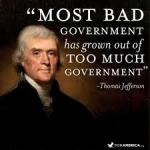
Take for instance the warning these men left for us regarding the evils of big government! Thomas Jefferson is particularly valuable in this regard. Why you could almost imagine him to be commenting directly on current affairs couldn’t you? Isn’t Tom just swell?

(You may as usual click to embiggen any of these quotations)


Thomas Jefferson was particularly keen on the importance of political dissent.

SpuriousTommyDissents

Thinking along similar lines, our founding fathers spoke directly to the issue of gun control. I mean, these comments are just so perfect. You’d almost think some of these quotes had been written by folks working for the NRA. Check it out!


More than that! Our great founders were no friends of the nanny state. They were quite clear that people shouldn’t expect too much from government. It’s there to give everyone a chance, but folks really shouldn’t expect any more than that. You read some of these things, and you can’t help thinking it’s almost as if they were actually thinking about the New Deal.  I guess these guys were just prescient or something.


James Madison wouldn’t have any truck with this notion of a living constitution. He’d school the modern liberals right quick about that nonsense!

SpuriousMadisonisanoriginalist

On religion, let me tell you, the founders of our great nation were clear about the importance of the Christian faith!


Oddly, the founders were also pretty damned clear about the evils of Christianity. Apparently, they had strong views on that too.

…It’s just a little strange.


I know this is getting to be a tiresome theme in this post, but the wisdom of Thomas Jefferson is not to be outdone. At times, he could almost seem to be a contemporary motivational speaker. Watch out Tony Robbins!


Not to be outdone, even George Washington carved his legacy into this little gem about taking responsibility for one’s personal mistakes.

SpuriousGeorgedon'ttaknoeexcuses

Honestly, the wisdom of the founding fathers would seem to be amazing at times. Sometimes their prescience is uncanny. It’s an amazing thing to see just how well-suited their statements can be to present-day matters. Luckily, that wisdom was not limited to the original founders. It was around in the civil war era too. Could anyone possibly be more on the mark than Abraham Lincoln?

TotallyRealLincolnnailsit

Seriously!

Listen to Abe folks.

Share this:

  • Tweet
  • Share on Tumblr
  • Click to print (Opens in new window) Print
  • Click to email a link to a friend (Opens in new window) Email
  • Click to share on Reddit (Opens in new window) Reddit
Like Loading...

A Rambling Little Bit About the Consolations of Free Market Fundamentalism

14 Friday Nov 2014

Posted by danielwalldammit in Politics

≈ 7 Comments

Tags

Founding Fathers, Free Market, GOP, Ideology, Just World Hypothesis, Libertarianism, Politics, religion

hqdefaultAt what point does hope of success in world of rigged economic competition become indistinguishable from belief in the rewards of heaven? At what point does hope for a better life in this world become no more meaningful than hope for a better life in the next?

We’ve all heard the old historical narratives about medieval peasants living in the hope of an afterlife. The point of that narrative is usually some sort of contrast with a more open society, one in which upward social mobility is actually possible in THIS life. It’s a tidy narrative, perhaps a bit to tidy.

How many Americans, I wonder, will live their entire lives in trailer courts and small apartments, all the while counting themselves so much better off than those peasants?

Because opportunity!

Hell! Who could fault anyone for living with hope? Assuming of course that hope doesn’t interfere with their sense of reality, I sure wouldn’t. Unfortunately, the American dream is slipping further and further from our grasp. Ironically, the more distant that dream gets the harder some people fight to hold on to the illusion that it’s still a viable prospect in our current social order.

Heaven forbid a national healthcare system! Damn the welfare queens! The Hell with minimum wage, and let’s privatize Social Security!

I get why some of the economic elites would make such noises, but the every day believer in the free market is often a mystery to me? It seems that such people don’t just want success; they want it on terms which make it incredibly unlikely to ever happen. And in the meantime they reject all manner of public assistance, much of it critical to their own health and welfare. It isn’t even enough to survive; one must survive under the present terms.

In this religion, ‘socialism’ is the Devil, and one of its magic powers is an ever broadening semantic domain. It is increasingly the root evil behind social institutions that have stabilized the American economy for nearly a century. But what makes this rather a-historical devil so powerful in the minds of the average trailer-court Republican? I can’t help thinking it’s in some sense an affront to the just world hypothesis, that vague sense that the world is basically good. If that world is good, then any righteous American ought to be able to make it on his own, so the thinking appears to go. In the end it’s the promise of a certain type of success these folks cling to so desperately, one which is no less fantastic than any waiting beyond the Pearly Gates. The success they hope for is not just paid bills and a good meal on the table; it’s a success that vouches for their own moral superiority, and it is a success promised only in a world that will separate the righteous from the unworthy. It is a success held in the minds of the faithful with all the power and desperation that one could ever find among the faithful of any church. Only a dark force would suggest that this hoped for scenario wasn’t actually going to happen, and only such a dark force could be blamed for the reason it hasn’t so far. The only reason the system hasn’t worked up to this point is that someone, some dark power, has compromised the system. And so people falling further and further behind the great contest for sucess they believe in so much work ever so hard to remove one more piece of the safety net that keeps them in the game at all.

…and in some instances, keeps them alive.

What has me thinking about this was a recent reminder that ‘Democracy’ was one of the great fears plaguing some of our nation’s founding fathers. The fear that the masses would, if given the chance, vote away the privileges of the wealthy and redistribute that very wealth was quite real for the likes of John Adams or even James Madison. I wonder if these men could ever have envisioned a nation of people so content to wait for their boat to come in, so pleased to work away their lives in the hope that the labor would somehow return far more than it ever had before.

If and when the ‘job makers’ ever deem it the right time!

It’s no small wonder that so many who believe in the promise of eternal heaven would also believe in that of Free Markets. It seems that the gods of each work in mysterious ways.

But one day!

Share this:

  • Tweet
  • Share on Tumblr
  • Click to print (Opens in new window) Print
  • Click to email a link to a friend (Opens in new window) Email
  • Click to share on Reddit (Opens in new window) Reddit
Like Loading...

Move Over Charlie Sheen; Rand Paul is the Vatican Assassin Now

04 Friday Oct 2013

Posted by danielwalldammit in Politics, Write Drunk, Edit Stoned

≈ 11 Comments

Tags

Charlie Sheen, GOP, Government Shut-down, Hypocrisy, Obamacare, Politics, Rand Paul, Randy Neugebauer, Todd Rokita

Official PortraitThat’s right Charlie, you’ve been replaced by the great Libertarian Hope, Rand Paul. Sources have it that Paul is working on bringing the parties together and working out a deal on the government shutdown thing. I know, I know, this shutdown hasn’t personally hurt Sean Hannity or Rush Limbaugh, so it’s all canned corn on a Tuesday, but bear with me here, because I herar that somebody somewhere might actually be a little more month-to-month than a highly successful carnival barker. So, give peace a chance eh?

Course Paul is also looking forward to winning the whole conflict.

Hm…

Now ordinary folks might think that was a contradiction of sorts, or at least an ill-timed loss of good publicity, from Politico no less! You might think the devil is in the details here, something about which parties Paul was trying to bring together, but folks only get that impression because they are using the wrong kinda logic. If you think about it, making peace with your enemies and beating them at the same time is pure fricking win! Seriously, how on earth do you beat that? Making peace and vanquishing your enemies at one and the same time. It’s absolutely win, I tell you. In fact it’s the kind of win worthy of you know who?

charlie-sheen-sfSpanBut only when he’s in his manic phase.

Which is sorta where some people have been for a long time now, Just ask Michelle, Glenn, and Sarah. These folks will find their depressive moments in another life, or lives, so to speak. …preferably those of other people. But seriously, I’m not even sure that the Sheen-meister himself could wrap his mind around the full genius of the tea-minded people and their leaderlings, at least not without a good supply of coke and a few hot girlfriends. He might just have to take drastic measures to help us find a wisp of wisdom in this cloud of swamp gas.

But Hell, Randy Neugebauer can dig it right now. Neugebauer can take a rainbow, mix it up with love and make the whole world take the blame. …or at least one low-level employee.

I know what you’re thinking; it’s politics right? And politics ain’t fun, and politics means everyone is dirty, or at least all of them folks that do politics, ad care about politics, and certainly those idiots that think it matters what side you are on, because who can be damned if it’s worth sorting Jack from Jill or pie from a pill? Cause screw the lot of them right?

Y’all just don’t appreciate genuine super-hero powers when you see them. A man of Neugebauer’s brilliance could wash his hands of anything. Hell, he could probably fix Fukashima. Radiation? Bah! Let him hold a press-conference in an arcade, and the the whole world’s goat will be good and scaped at the price of a few glow-in-the-dark teenagers.

Damned kids anyway!

That’s two Vatican Assassins if you’re counting, and no, Charlie ain’t one of them, not right now, or so I’m told. He ain’t two either, but I hear tell he might be better than bunting on a good gumbo day. You just gotta know how to listen with your nose, I tell you. The whole tune sounds just like apple pie cooling in a window, at least it would if you talk to the right red district representative. So, don’t be discouraged folks. Just let this good bunko-billy mansplain it to ya!

Still don’t understand?

Well you’re very pretty, but honey, you just ain’t a Vatican Assassin.

We are in desperate need of you Charlie.

Please help us to understand!

71.271549 -156.751450

Share this:

  • Tweet
  • Share on Tumblr
  • Click to print (Opens in new window) Print
  • Click to email a link to a friend (Opens in new window) Email
  • Click to share on Reddit (Opens in new window) Reddit
Like Loading...

Irritation Meditation Number Whatever: I Love the Smell of New Propaganda in the Morning!

02 Monday Sep 2013

Posted by danielwalldammit in Irritation Meditation, Politics

≈ 14 Comments

Tags

Capital Day, Capitalism., Economics, Foundation for Economic Education, Justice, Labor Day, Larry Reed, Libertarianism, Politics, Propagada

tumblr_msikmn9yWU1saikk3o1_500So, here I am surfing along the wifi challenged net of my lovely hotel room and what do I find in between 404 notices? Well it appears to be the latest talking point from the right wing echo chamber; a snappy little infographic promoting the virtues of a national day devoted to the celebration of Capital!

It seems that labor and capital both need each other, at least according to this catchy little visual. So, in the interests of fairness, we really ought to have a national Capital Day, at least if we are going to have a national Labor Day. And if we can’t have that, well then we should at least celebrate them together.

I mean it’s only fair!

I found this on Tumblr, a account for The Bill of Rights Institute, … so, Koch Brothers, yep! The visual has the stamp of FEE on it, which leads us easily enough to the Foundation for Economic Education, an unsurprisingly Libertarian bastion of economic chatter, and once there it doesn’t take long to find a whole article (penned by none other than the President of the foundation, Lawrence Reed)  touting this movement to counter-balance the celebration of labor with that of capital.

Now to be fair, Lawrence does tell us he will be celebrating Labor Day. Apparently, that’s okay, just as long as we don’t dip into any lefty labor union kinda thinking. Good workers know their place, and their place is working for capital! …without complaints and collective bargaining power. And of course Reed does want to reassure us that he is NOT engaging in class warfare, no. He loves labor. Hell, workers too can become capitalists if they save and invest.

I wonder what Reed thinks the average worker has to invest in today’s climate?

Apparently, we aren’t supposed to think of capital as something deployed only by bankers, because of course workers COULD invest in stock themselves. And in the classic tone-deaf stylings that have become the hallmark of libertarian thought, that little bit of formal equivalence is supposed to help us forget the massive difference between the economic power of the investing classes and those who might have a chunk of their fragile retirement fund riding on the fate of a corporation or two.

I could wonder a lot of things about the fairy-tale land of free market fundamentalism this preacher sells from his think-tank pulpit, but for the present it is enough to meditate on the vision of fairness he has in mind here. It is somehow unfair, he and the folks at FEE seem to be suggesting, that Americans should think about labor and not give a happy nod to capital as well. I wonder where that sense of fairness can be found when paychecks are measured against dividends, personal bankruptcies to corporate bailouts, and second homes to rental properties? I wonder where that sense of fairness is when people like Donald Trump talk about building this or that casino with hardly a nod to those who actually did the dirty work? I wonder where that emphasis on interdependence can be found when folks talk about ‘job creators’ as though they were the unmoved movers of the economic world? And I wonder where all this painfully important need for balanced credit falls when we measure the access of workers to the ear of public officials against that of capitalists? Today, it seems we must be reminded that workers and capitalists work hand-in-hand; on most days that same vision of cooperation is deemed to mean every-man-for-himself, and shame on those who fall short at the end of the month.

No doubt the fine folks at FEE will protest (as Libertarians often do) that they are against sundry special treatments for big business as well. And I suppose, one can indeed imagine a world in which the libertarian scheme of things offers a fair chance to everyone and a better more efficient economy for all. That world is every bit as real as the communist state. In the world we live in though, Libertarian intervention always seems so much more focused on the denial of benefits to the lower classes. Bail out a corporation and they will tell you that sucks and things are not supposed to work that way. Offer health care to the working poor and they will burn the country down around our ears if that’s what it takes to stop you.

And just as a small petty footnote in economic history, they may even find a way to begrudge working men and women a single day of acknowledgement.

71.271549 -156.751450

Share this:

  • Tweet
  • Share on Tumblr
  • Click to print (Opens in new window) Print
  • Click to email a link to a friend (Opens in new window) Email
  • Click to share on Reddit (Opens in new window) Reddit
Like Loading...
← Older posts
Newer posts →

Top Posts & Pages

  • Master and Commander Kinda Queered
    Master and Commander Kinda Queered
  • A Joke from a Bygone Era
    A Joke from a Bygone Era
  • Uncommonday Morning Blues - Ian Anderson Learns to Play the Flute
    Uncommonday Morning Blues - Ian Anderson Learns to Play the Flute
  • Uncommonly Slow on the Uptake
    Uncommonly Slow on the Uptake
  • When Sex Falls Out of the Performance
    When Sex Falls Out of the Performance
  • An Uncommon Security Guard: Dave Eshelman, AKA 'John Wayne'
    An Uncommon Security Guard: Dave Eshelman, AKA 'John Wayne'
  • I'll Just Leave This Here
    I'll Just Leave This Here
  • An Uncommon Request
    An Uncommon Request
  • The Murals of Española
    The Murals of Española
  • Malaglutit: A Review
    Malaglutit: A Review

Topics

  • Alaska
  • Animals
  • Anthropology
  • atheism
  • Bad Photography
  • Books
  • Childhood
  • Education
  • Gaming
  • General
  • History
  • Irritation Meditation
  • Justice
  • Las Vegas
  • Minis
  • Movie Villainy
  • Movies
  • Museums
  • Music
  • Narrative VIolence
  • Native American Themes
  • Philosophy
  • Politics
  • Public History
  • Re-Creations
  • Religion
  • Street Art
  • The Bullet Point Mind
  • Travel
  • Uncategorized
  • Uncommonday
  • White Indians
  • Write Drunk, Edit Stoned

Blogroll

  • American Creation
  • An Historian Goes to the Movies
  • Aunt Phil's Trunk
  • Bob's Blog
  • Dr. Gerald Stein
  • Hinterlogics
  • Ignorance WIthout Arrogance
  • Im-North
  • Insta-North
  • Just a Girl from Homer
  • Multo (Ghost)
  • Native America
  • Norbert Haupt
  • Northwest History
  • Northy Pins
  • Northy-Tok
  • Nunawhaa
  • Religion in American History
  • The History Blog
  • The History Chicks
  • What Do I Know?

Archives

  • December 2023
  • November 2023
  • June 2023
  • April 2023
  • February 2023
  • December 2022
  • November 2022
  • October 2022
  • September 2022
  • August 2022
  • July 2022
  • June 2022
  • April 2022
  • January 2022
  • December 2021
  • November 2021
  • October 2021
  • September 2021
  • August 2021
  • June 2021
  • May 2021
  • March 2021
  • February 2021
  • January 2021
  • December 2020
  • November 2020
  • October 2020
  • September 2020
  • June 2020
  • May 2020
  • March 2020
  • February 2020
  • January 2020
  • December 2019
  • November 2019
  • September 2019
  • August 2019
  • July 2019
  • June 2019
  • May 2019
  • April 2019
  • January 2019
  • December 2018
  • November 2018
  • October 2018
  • September 2018
  • August 2018
  • July 2018
  • June 2018
  • May 2018
  • April 2018
  • March 2018
  • February 2018
  • January 2018
  • December 2017
  • November 2017
  • October 2017
  • September 2017
  • August 2017
  • July 2017
  • June 2017
  • May 2017
  • April 2017
  • March 2017
  • January 2017
  • December 2016
  • November 2016
  • October 2016
  • September 2016
  • August 2016
  • July 2016
  • June 2016
  • May 2016
  • April 2016
  • March 2016
  • February 2016
  • January 2016
  • December 2015
  • November 2015
  • October 2015
  • September 2015
  • August 2015
  • July 2015
  • June 2015
  • May 2015
  • April 2015
  • March 2015
  • January 2015
  • December 2014
  • November 2014
  • October 2014
  • July 2014
  • June 2014
  • May 2014
  • April 2014
  • March 2014
  • February 2014
  • January 2014
  • December 2013
  • November 2013
  • October 2013
  • September 2013
  • August 2013
  • July 2013
  • June 2013
  • May 2013
  • April 2013
  • March 2013
  • February 2013
  • January 2013
  • December 2012
  • November 2012
  • October 2012
  • September 2012
  • August 2012
  • July 2012
  • June 2012
  • May 2012
  • April 2012
  • March 2012
  • January 2012
  • December 2011
  • November 2011
  • October 2011

My Twitter Feed

Follow @Brimshack

RSS Feed

  • RSS - Posts
  • RSS - Comments

Enter your email address to follow this blog and receive notifications of new posts by email.

Join 8,076 other subscribers

Blog at WordPress.com.

  • Subscribe Subscribed
    • northierthanthou
    • Join 8,076 other subscribers
    • Already have a WordPress.com account? Log in now.
    • northierthanthou
    • Subscribe Subscribed
    • Sign up
    • Log in
    • Report this content
    • View site in Reader
    • Manage subscriptions
    • Collapse this bar
 

Loading Comments...
 

    %d