• About

northierthanthou

northierthanthou

Tag Archives: Sex

The Erotic Heritage Museum in Las Vegas: A Very NSFW Review

29 Saturday Jun 2013

Posted by danielwalldammit in Las Vegas, Museums

≈ 24 Comments

Tags

Education, Erotic, Erotic Heritage Museum, Gender, Institute for the Advanced Study of Human sexualit, Las Vegas, Museums, Pornography, Sex

050There is a certain kind of pornography that presents itself as a documentary film. It’s been awhile since I’ve watched one of these mondo films, but let’s just say that I learned things about lesbians from that flick that would, …well, probably surprise a lot of lesbians.

…yep.

The Erotic Heritage Museum reminds me a bit of such movies. Oh, I didn’t notice any outright disinformation, but it has that same odd fusion of license and libido, the same sense that an excuse no longer necessary has been turned into its own kink. It’s not just sex, it’s education.

…only it isn’t.

It’s is a damned shame, because a serious effort would have been interesting.

Let’s just take a tour, shall we?

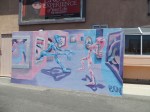
I first noticed the museum in my quest for street art, and I must say that I like a number of the murals on the buildings exterior. Here, at least I have to give the place props for creativity. It is interesting that they had to cover the nipples on a couple of these pieces, as if that would really reduce the funkination passers by will witness upon even the most casual viewing. But of course the letter of the law can be as dull as it is senseless, and the girls had to be covered. …a little.

(Embiggen, …if you dare!)

Couple murals near the back door. …or is it the front door?
Apt poster
Window Manikins

Interesting Mural
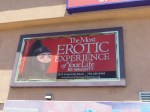
Quite the Promise
The Grope

Elegant Curves
Youngish
Creepy Sexy

Well Hung, but what is he?
Beautiful and faceless
Naked and shy, …yep!

censored
Kinda posty-porn
Diggin the dumpster wall

Bored Manikins

Once inside, things get a little more interesting, or perhaps a little less, depending on your sense of perspective. One enters into a gift shop, which itself contains two private library collections and an Erotic Wedding chapel. They haven’t quite worked out access to the libraries, so that’s an interesting though currently unfulfilling part of the experience. One might even call it tantalizing! The staff is friendly and helpful, and they seem prepared to emphasize either the educational or the titillating aspects of the museum, perhaps shifting their approach according to the tastes of the customers.

The museum is curated by the Institute for the Advanced Study of Human Sexuality, an unaccredited institution based in San Francisco, California.

According to the Museum’s “About us” page, it is the creation of the Rev. Ted McIlvenna and Harry Mohney, founder of Déjà Vu, a highly successful chain of strip clubs. Money is also a longtime friend and associate of Larry Flynt, of Hustler Magazine fame. His role in creating the museum helps to explain the degree to which ‘erotic heritage’ seems to mean ‘mainstream pornography’ in much of the museum’s presentation. In and of itself, this needn’t be a problem. Located as it is on Industrial Ave., the museum would be a fine fit with much of the adult businesses in the area. And why shouldn’t it be? The problem as I see it is the pretense to commenting on larger issues, only to deliver a sort of ode to the adult entertainment industry. Take for example the following quote from the Museum’s website:

The EHM houses more than 17,000 square feet of permanent and featured exhibits designed to preserve wonders of the erotic imagination as depicted through the artistic expression of acts of sex and love. It is dedicated to the belief that sexual pleasure and fun are natural aspects of the human experience, that such pleasure must be made available to all, and that our individual sexuality belongs to each of us.

The Museum is dedicated to the preservation of great erotic heritage that is typically undervalued, yet is of tremendous importance. The EHM is owned and managed by the Exodus Trust, a non-profit California Trust that has as its sole purpose to perform educational, scientific and literary functions relating to sexual, emotional, mental and physical health. Historical and contemporary erotic materials donated to the Exodus Trust are tax deductible as charitable donations in accordance with federal law. For more information regarding charitable donations, please visit our DONATE page.

What fascinates me about this text is tension between a vision of sexuality as a natural part of life and one which must be shared. …the latter part strikes me as a bit of a euphemism, because I don’t think they are talking about the kind of sharing between a man and a woman in their own bedroom, or even of a man and a man, or a woman and a woman, or two men with 4 women in front of twenty others for that matter. No, the point of the sharing is in this instance the creation of some medium by which this sexuality can be exchanged, and somewhere in here that in itself gives way to the commodification of sexuality. Hence, the broad beautiful mandate for sharing of sexual freedom becomes a function of market values, and the themes explored in that sexuality quickly become a function of ownership and corporate capital.

Of course such commodification happens all around, and I’m not particularly shocked to find it happening with sexuality. But let’s just say that a little self-awareness helps, and when folks promise a museum dedicated to sexuality at large, it is little irritating to find that they have little to say about sex occurring outside of a men’s magazine or a xxx movie theater.

That said, let’s have a look at the Gift Shop (Click to embiggen):

Wedding Chapel
Institute
The staff are not normally dressed like this.

Yep!
Actually digging this.
This reminds me of a story from Richard Drinnon’s book on the Metaphysics of Indian hating. It’s not a very pleasant story.

Okay, I know it’s an alarm, but after all that cognitive priming…
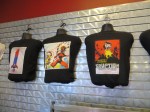
Pornalized Clothing!
Okay, I actually like some of these prints.

Poster
Inside the dicks!
Sacrilegious Supper

After paying a very reasonable $10.00 entrance fee, one moves through a simulated red light district on the way to the main gallery. The red light district falls completely flat for me. Simply put, a red light district is not a red light district without people. All the store fronts and simulated sex businesses in the world will never convey the sense of such a place, and so this part of the museum more than any other simply fails on all levels.

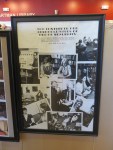
I would add that the big poster on First Amendment issues is simply too high to be read in the dark, at least by people without superior cat-eye magic-vision. So, that too is lost on the customer. It’s place in the museum is also at least a little odd. Of course the connection comes from the tension between erotic expression and censorship. This is not entirely limited to the porn industry, though they have played a key role in defending such expression. The bottom line here is that there is certainly a place for this content in a discussion of erotic expression, but one has to wonder if the context for it has been well framed, especially when posters like this one are just dropped into a collection that is otherwise on the surface at least a-political. One has to wonder if the rhetoric of free speech hasn’t become an essential part of sexuality for the museum’s curators and staff. …as opposed to a historically situated feature of sexuality as filtered through the conflict between the particular powers of the industrialized West.

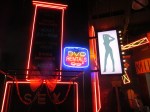
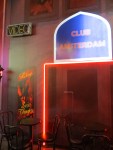
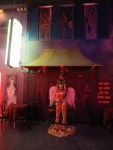
In any event, this is the red light district:

He has a tie
Red Light
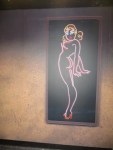
Neon Girl

Red Light again
Moar Red Light!
Red Light Again

Okay, this is funny.
First Amendment

The main room actually comes in two floors, both essentially arranged into one large round presentation floor. The top floor is a private collection, and I don’t have any pictures of its content. The bottom floor has an amazing quantity of interesting materials. Unfortunately, the arrangement leaves a lot to be desired. Many of the more exotic items are left almost entirely without explanation, while images associated with the mainstream porn industry and its political battles dominate the outer walls.

For example, we get very little information about sundry deflowering devices scattered throughout display cases, but the sections describing developments in pornography get much fuller treatment, as do numerous celebrity sex scandals. So, a practice that the average customer will not understand without some presentation to put it in context gets nothing in the way of an explanation while stories many of us have seen before get plenty of coverage. This works fine if the point of museum is to promote the pornography industry; it does not work at all when the declared point of the museum is something much broader and more enlightening.

And here, we have an interesting question, what does all the exotic cultural material mean to the average customer as opposed to those for whom these items were originally developed? Indeed, just how sexual is all this sexual memorabilia in its original context? How does a customer interpret an African deflowering device, for example, in the absence of any reason to believe it isn’t just another sex toy?  I can’t help but think that – presented as it is, with so little explanation – the sole lesson that many customers will take away from the ethnographic materials will be that other peoples are damned kinky. There just isn’t enough context to compete with the sexual background of the museum itself and the likely skewing off all things by an emergent narrative emphasizing sex and strangeness.

…it’s a bit like looking through old copies of national Geographic just to see pictures of the naked natives.

Note the uninformative caption
Statuette
Okay, this was all created by one guy, as I recall.

Erotic Art
REALLY uninformative caption card.
Interesting Statuettes

An Old Deflowering Device
Damned Disappointing

Could we be just a little more specific?
Red Tip
Forever fucking!

Interesting Barrels
Japanese Deflowering Instrument
Indian deflowering Instrument

More from Japan
Reproduction
Not sure what “primitive” means here, or what the scare quotes mean in this instance

Sexy Figurines
African fan
Sex

Some of more the playful aspects of the exhibit are quite wonderful. The million penny penis is pure gold! …or, copper, really, but the point is, I approve! The bathroom with all its graffiti (pens are provided) is at least a little interesting, but honestly it looks like it’s time to paint it over and let people start again. Other amusing displays certainly can be found, but they are jammed together in such a haphazard fashion, and with so little explanation, that is can be really difficult to make heads or tails of what one is looking at.

Strangely, a number of displays are given to various sexual scandals, and the treatment is (ironically) quite punitive. It makes sense of course for those interested in free sexual expression to feel a little vindicated when various anti-porn crusaders or seemingly repressed right wing cultural warriors get caught with their pants down (sometimes quite literally), but some of the folks appearing on the wall of shame just don’t fit that most. More importantly, at least some level, one ought to appreciate that this is to be expected. Rather than ‘haha’ might one say “welcome back to humanity?”

In any event, the museum never does give us any context in which to elevate the “Wall of Shame” beyond the level of pointing and laughing. That doesn’t strike me as worthy of a museum, and if I am going to laugh, I would rather laugh at a penny penis than people proving themselves all-to-human, …even those who may have wished otherwise.

Wall of Shame
Clergy
Celebrity

Other

So, once again the museum presents an odd blending of politics and sexuality, one if which the curators seem to have let the one skew their sense of the other a bit too much in my estimation. In any event, here is the bulk of the first floor stuff (if you click on the pictures, they get bigger, …really!)

The Sister’s of Perpetual Indulgence are definitely worth a google.
Art and Larry Flynt
Free Speech Coalition

Hidden Narrative
I wish I could remember where this was, but it’s unfortunate.
Does the world really need another derivative decalog?

Chicken Ranch
Does anyone else remember that awful song?
Personally, I prefer… nevermind.

Y’all should go over to A Knitt Societ and ask Sarah if she has anymore pictures of this display.
Information Panels
They actually had quite a few gag-stills from movies

Okay, this is at least interesting
…alright
Flyntobelia

Erotic Art
Erotic Art II
Sundry Sexy Stuff

I wonder if the designer was aware of the torture device he was emulating?
Moar sex Stuff)
You might wonder what some of that stuff had to do with women’s health…

Ah here is the health content.
Just a little disturbing.
More venting about scandals

Hustler
Million Penny Penis
Stuff

Moar Stuff
All Hail Flynt!
Transgendered folks

Actually, I would have loved to have seen a lot of of this kind of stuff.
Old Devices
You needed a closer look, didn’t you?

They had a few more of these old devices, and the info. on them wasn’t terrible.
On the way to the bathroom
bathroom

Before signing off, I want to say thank you to Sarah from the blog, A Knitty Society. She and her husband accompanied me through the museum. I very much enjoyed discussing the materials with them, and I look forward to reading her own post on the museum. Y’all should definitely check out her blog.

And let’s finish with a bit of zoological interest:

Animal Penises)
Raccoon Penis
These are common sources of artwork up North

I suppose I should add that I actually think there is a lot of potential in this museum, which is what makes its present state all that much more disappointing. The staff certainly have a diverse range of talents, and they have a fantastic collection of interesting materials on display. What no-one seems to have done at the Erotic Heritage Museum is thought through the kind of effect the want to produce and just how much the museum is intended to promote education as opposed to titillation. Frankly, I think they could manage both a lot better than they presently have. One has only to get past the point where a momentary glimpse of things-sexual is enough to satisfy the mind and the libido all by itself. All of this stuff has context; the folks at this museum really ought to provide that.

71.271549 -156.751450

Share this:

  • Tweet
  • Share on Tumblr
  • Click to print (Opens in new window) Print
  • Click to email a link to a friend (Opens in new window) Email
  • Click to share on Reddit (Opens in new window) Reddit
Like Loading...

Slavery: Still Sexy After All These Years! (Or Yes Quentin, There is a Reason it’s Called an ‘Exploitation’ Flick)

23 Thursday May 2013

Posted by danielwalldammit in History, Movies

≈ 16 Comments

Tags

Django Unchained, Fiction, Film, History, Movies, Quentin Tarantino, Race, Sex, Slavery

imagesJust what is the relationship between the events occurring inside a film and those occurring the world in which we live? I will not say the ‘real world’, because of course part of the problem here is that the ‘worlds’ in which we live are saturated by myriad narratives, preconceptions, and cultural artifacts which shape our understanding of events in ways few of us can fully understand. So, when we see something happening in a movie, it is important to grasp that this too is one more of those narratives, one more thing that shapes the meaning of events in own own lives. Just how it does that, well now that is a tricky question.

It’s a difficult question with a number of plausible answers, but I think we can rule out one answer at least, the one that says; ‘nothing’. Quentin Tarantino would seem to disagree, at least he does when he’s angry and dodging interesting interview questions. In a now infamous rant, Tarantino took the position that there was no relationship between on-screen violence and real world violence, refusing even to elaborate on this position or to explain his reasons for taking it.

(Oh yeah, SPOILERS!)

To be fair, it was the interviewer, Krishnan Guru-Murthy, that fielded the stance in a sort of complex question (at 4:30 in the clip below), but for all his belligerence Tarantino does not disavow the position attributed to him. Guru-Murthy claims that his own research has produced little in the way of an explanation from Tarantino, just a consistent repetition of this stance. It’s a common enough claim in any event, often serving as a defense mechanism, both for those that create guilty pleasures and those of us who enjoy them (and yes, I do count myself among the guilty). So long as there is no relationship between fantasy violence and real-world violence, one is free to explore the one while taking no responsibility for the other.

But of course the world isn’t that simple, and as Guru-Murthy also points out, Tarantino was happy to link his latest film to the serious issues of slavery, even taking taking credit for starting a dialogue about that subject. He also takes credit for the cathartic violence he puts on screen, but has little to say about the ‘real’ violence perpetrated by the villains against their slaves on that very same screen. But are we really to believe Tarantino means us to feel emotional investment for Django’s acts of revenge while sitting guiltless through the torture and slaughter of innocents throughout the film? Does the elaborate detail of ‘Mandingo fighting’, the ‘hot box’, and the vicious execution of a slave torn apart by dogs leave the viewer without any sense of complicity for the “brutality of the violence of the day?”

Tarantino’s own writing belies this approach. His villains are too clever, their speeches too fascinating, their point of view far too prominent in these moments to dismiss. The victims of this violence remain largely silent. We know that the Mandingo fighters suffer and regret what they are forced to do, we know that Django’s love interest is defiant, and that she suffered greatly for it, and we know that the man torn apart by dogs could not bear to fight again; none of these characters really say much in the movie. They do not introduce interesting plot twists; they do not dazzle us with fascinating speeches. They suffer just as we would expect them to, providing us with no insights at all into the world in which they live.

Those that inform us about this movie are the killers. DiCaprio’s Calvin Candie explains quite clearly what he expects of his slaves before setting the dogs loose. Dr. King Schultz (played brilliantly by Christoph Waltz) introduces us to the fascinating world of bounty hunter, one who would see a man shot in front of his child but who balks at seeing another torn apart by dogs. And of course we understand Django’s motives; his goals are the driving force of the movie; it is his killings which provide us with the final pay-off, the glorious conclusion of the film.

It is consistently the logic of those enacting violence which Tarantino fleshes out for us in this film, and as always, he does it ever so well. The victims are there to suffer, and to provide a pretext for the ‘cathartic’ violence that is to come. In short, Django consistently draws us into the viewpoint of the killer; the movie does this when the killer is a villain, and it does it again when he is a hero. This is the myth of redemptive violence presented in a special way that allows us to have our cake and eat it too. We can enjoy Dicaprio’s sadism just as we will enjoy his downfall. If there is a moment of regret in a scene, or a brief period in which we might wish for the suffering to simply stop, well that moment passes in due time, transformed as it were into the rationale for yet another killing. In Django, we understand the killers, the victims are simply silent.

But villains gotta be villainous, don’t they?

Of course they do, but what is lacking in Django is a genuine counter-balance, any real sense of what is at stake in this story for anyone who is not a killer. When our principal reward at the end of the story is the death of the bad guy (DiCaprio or Jackson, …or so many others), we are never far from the mindset of the killer. In the end, Django leaves a wanted man, accepting this fate without so much as the blink of an eye, his wife drawing a rifle as they ride off from the scene. Two lives now wholly engulfed in violence. If this is a victory, it is at least partially a victory for the world of villainy.

…which brings us back to the initial question, just how does this story relate to the realities of violence in everyday life? I honestly enjoyed much of this movie, as I did with Inglorious Bastards. (Yeah, I know about the spelling, take that Quentin!) But I always feel a little uncomfortable with Tarantino films, precisely because I can’t escape the feeling that I am witnessing something a little creepy; it’s a bit like watching a teenager doing something truly inappropriate in public. Whether it is sheer joy with which Tarantino employs the n-word just a little more than his faux-realism rationale would warrant, or the raw celebration of violence which is present in every film he makes, I cannot help but to think the limitations of Tarantino’s stories are the limitations of the world in which he lives, the world of narratives informing his sense of sense of the world off-screen. And I cannot help but think he is inviting us to normalize those limitations and accept a world of cartoonish violence as a moral standard of sorts.

It is not as though the world lacks for people who think this way off-screen.

One can see it in that interview above as well, when Tarantino tells us that Django deals with the ‘Auschwitzian’ characteristics of slavery. (I guess it’s a word now, …why not?) Honestly, I don’t know what he meant by saying that Americans have dealt with the Native American holocaust, but he clearly seems to think this movie is saying something about the realities of slavery, so much so that when people talk about the film, Tarantino takes that in itself to be a meaningful dialogue about slavery. And yet there is little about this film that could shed light on the nature of slavery as an historical institution.

Tarantino’s choice of comparison is telling, because the story of Auschwitz is largely the story of cruelty for the sake of cruelty, and this is Tarantino’s vision of slavery itself. In one of the most interesting (and insightful) speeches of the film, Dr. Shultz tells us quite frankly that he deals in dead bodies while slavers deal in live bodies; bother are economic institutions. So, why then do slaves first make an appearance in this film walking a great distance barefoot in the cold? Sure, one could probably come up with a plausible explanation based on historical possibilities. But the more plausible answer is that Tarantino wanted to show us the raw cruelty of the institution. More to the point, he did not wish so much to tel us something about slavery as to use slavery as a pretext for telling us something about cruelty. Tarantino presents this story of raw cruelty for us again in the sadistic foremen whom Django will kill part way through the movie, and again in the institution of Mandingo fighting. He presents it in virtually everything that DiCaprio’s character and Samuel Jackson’s character say and do. In this film slavery is not an economic enterprise, it is the conspicuous consumption of sadists, an extravagance of cruelty for the sake of cruelty.

One should add that it is a highly sexualized cruelty that one sees in this film. While Tarantino denies that rape appears in the film, its presence in the narrative is prominent. Django is quick to tell us that his wife will be used as a comfort woman, a prospect apparently confirmed by the words of another villain later in the film. Throughout the plantations in this film, black women appear in full southern dress, lounging about, the clear implication being that they are there for the pleasure of the owners. And of course when Django is captured, it is his genitalia which first get the attention of his would-be tormenters. The slaves portrayed in this film exist largely for the purpose of providing the villains with cheap thrills. And while this sort of thing was certainly not absent in the real history, its significance has completely eclipsed those of plantation agriculture in Tarantino’s narrative.

Slavery insofar as it appears in this movie, is little other than a sadistic fantasy. It is a source of pleasure for the villains, and fleeting moments of pain for the victims about whom we learn so very little. And perhaps we could sweep all of this under the rug and just call it entertainment were it not for one thing; Tarantino himself wants to tell us this movie is about slavery.

A part of me wants to say that it simply isn’t.

But of course that too would be inaccurate. The movie is about a vision of slavery bearing little resemblance to the actual institution, but perhaps one with a disturbing resemblance to Tarantino’s own thoughts about race, violence and sexuality. More disturbing still is the very real possibility that this film tells us still more about the general public’s understanding of the relationship between these features of American society.

***

I suppose all of this brings us full circle to the cathartic violence that Tarantino is talking about. On one level, that would be cathartic violence against the perpetrators of slavery as Tarantino envisions it. On another level, if I am right that Tarantino is getting off on the sadistic possibilities available in a world of slavery, that he is inviting his audience to enjoy the same possibilities, then the catharsis is perhaps a bit more personal. It is the moment in which one erases his or her investment in the sadistic themes presented here through the actions and words of the villains. It is a moment in which one finally rejects the villain despite his cleverness, and perhaps it is a moment in which one rejects one of the ills of history (at least insofar as it is almost dealt with in the form of that villain). The destruction of the villain thus becomes our own ritual purification.

I have my doubts as to where that leaves us in the end.

71.271549 -156.751450

Share this:

  • Tweet
  • Share on Tumblr
  • Click to print (Opens in new window) Print
  • Click to email a link to a friend (Opens in new window) Email
  • Click to share on Reddit (Opens in new window) Reddit
Like Loading...

Won’t Someone Please Think of the Children? …No Really!

29 Wednesday Aug 2012

Posted by danielwalldammit in General

≈ 20 Comments

Tags

Advertising, Candy, Capitalism., Cluelessnes, Conservatives, Hegemony, Irony, Republican Party, Sex, Skittles

Sometimes you just get a wonderful glimpse into the priorities that guide people’s decisions. Take for example this campaign from One Million Moms. They want people to take action against this ad:

Now frankly, I can’t make up my mind whether or not the ad is post-modern brilliance, or a broccoli fart filtered through used bong water (though I am leaning a bit towards the latter), but the Million Moms are screaming bloody murder. They have posted the following diatribe against this travesty of marketing brilliance, …er, bullshit:

We are not sure of Skittles’ thought process behind their new ad, but if they are attempting to offend customers, they have succeeded. Skittles’ newest “Walrus” commercial includes a teen girl making out with a walrus. The two are on a sofa in an apartment kissing on the mouth when her shocked roommate walks in on them. Parents find this type of advertising inappropriate and unnecessary. Does Skittles’ have our children’s best interest in mind? Skittles candies are for all ages, but their target market is children.

Skittles Marketing Team may have thought this was humorous, but not only is it disgusting, it is taking lightly the act of bestiality. Let Skittles know their new ad is irresponsible.

What interests me most about this whole screed, is the rhetorical question. “Does Skittles’ have our children’s best interest in mind?”

I don’t suppose it has occurred to any of the One Million Moms that the purpose of the ad is to sell CANDY to their children.

And I’ll leave it at that.

***

Special thanks to Jessica Bluemke. It was her guest post on The Friendly Atheist where I first stumbled across this little gem of …something.

71.271549 -156.751450

Share this:

  • Tweet
  • Share on Tumblr
  • Click to print (Opens in new window) Print
  • Click to email a link to a friend (Opens in new window) Email
  • Click to share on Reddit (Opens in new window) Reddit
Like Loading...

Dancing for the Dead – Movie Review

30 Monday Apr 2012

Posted by danielwalldammit in Anthropology, Movies

≈ 10 Comments

Tags

Anthroplogy, Death, Documentary, Film, Funerals, Masculinity, Nudity, Sex, Stripping, Taiwan

See this is what I love about anthropology!

It usually begins with one of those WTF moments when you first encounter something so bizarre that you have no context for it, no place in your world where it could possibly fit. If it was fiction, you’d tell the writer to come up with something more plausible. But it isn’t fiction. It’s actually part of someone’s life, a piece of their world. And that fact means you can learn more about it.

…which is when things get interesting.

The last time I was blessed to get one of those WTF moments occurred when DANCING FOR THE DEAD showed up in a random web search on my computer screen. This documentary, produced by Marc Moskowitz of the University of South Carolina, explores the practice of hiring funeral strippers in Taiwan.

Yes, you read that right.

Funeral Strippers.

And if the very thought of hiring a stripper for a funeral has you standing a little left of your own mind, then you had the same reaction I did. Which is exactly what makes the process of learning about this all that much more interesting. One wonders (or at least I did), in what social context would this sort of practice become a common occurrence?

Dancing for the Dead

At 38 minutes, the film itself only begins to sketch out the contours of an answer to that question. It doesn’t much dwell on the lurid details of stripping (and the film does not feature actual topless performers or full nudity). Instead, Moskowitz uses a variety of interviews in combination with documentary footage to illustrate the role that stripping has come to play in Taiwanese communities.

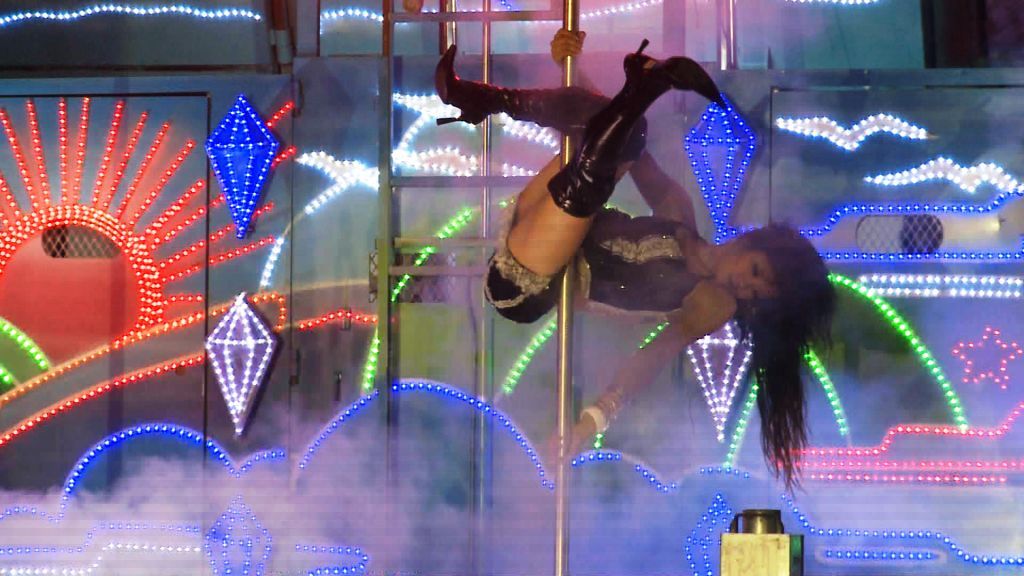
As it happens, these performers fit rather well into an elaborate set of public funeral practices, the purpose of which includes entertainment for the dead and some lesser deities as well as relatives of the deceased. The performance may also convey a sense of tribute to the virility of the departed. As with other public events, a successful funeral in Taiwan must achieve a certain quality of intensity. They have a word for it, ‘renau’, which is commonly translated as ‘hot and loud’.  Relatives thus employ funeral strippers as part of a larger public presentation meant to honor the departed by helping to make their send-off hot and loud.

Dancing for the Dead

The women dance on special trucks, known as Electric Flower Cars (EFCs), which travel with the funeral processions. The walls and ceilings of an AFC fold out to become elaborate stages which can be found at a range celebrations including religious processions. Electric Flower Car performers are especially popular during Ghost Month, a period when the spirits of the deceased are said to mingle with the living.

Funeral strippers are not without their critics in Taiwan, and Electric Flower Car performances have been subjected to troublesome legal restrictions. But of course the condemnation of EFCs carries a familiar double standard. With sex pervasive throughout the advertizing world (in Taiwan as well as America and virtually the entire global market), the EFCs have somehow crossed a line not fully explicable in terms of their own performances.

Dancing for the Dead

But that is a post for another day. For now, let me just say how happy I am to have stumbled across this little gem. I may not have met any of them, much less seen a live performance, but my mental landscape now includes a place for Electric Flower Car performers.

…and I can’t help but to think that my world is a richer place for their inclusion within it.

***

I have to admit this subject is a little out of my area, so I’m trying to give it a light touch. Moskowitz tells the story far better than I ever could, and his film is available on Amazon.com. So, if by some chance, you feel the need to know more, …well then, you know what to do.

Still photos are from the official website for the film. For those interested, a very interesting interview with Moskowitz may be found here.

71.271549 -156.751450

Share this:

  • Tweet
  • Share on Tumblr
  • Click to print (Opens in new window) Print
  • Click to email a link to a friend (Opens in new window) Email
  • Click to share on Reddit (Opens in new window) Reddit
Like Loading...
Newer posts →

Top Posts & Pages

  • I'll Just Leave This Here
    I'll Just Leave This Here
  • Master and Commander Kinda Queered
    Master and Commander Kinda Queered
  • The Hip Show (Guest Post)
    The Hip Show (Guest Post)
  • Once Upon a Charlie
    Once Upon a Charlie
  • Movie Review: The Orator
    Movie Review: The Orator
  • An Uncommon Security Guard: Dave Eshelman, AKA 'John Wayne'
    An Uncommon Security Guard: Dave Eshelman, AKA 'John Wayne'
  • Eye, You, and Donald Trump
    Eye, You, and Donald Trump
  • Road Trip! (Anchorage to Valdez)
    Road Trip! (Anchorage to Valdez)
  • Great Movie Villains, Volume IX: That Witch With a Bow!
    Great Movie Villains, Volume IX: That Witch With a Bow!

Topics

  • Alaska
  • Animals
  • Anthropology
  • atheism
  • Bad Photography
  • Books
  • Childhood
  • Education
  • Gaming
  • General
  • History
  • Irritation Meditation
  • Justice
  • Las Vegas
  • Minis
  • Movie Villainy
  • Movies
  • Museums
  • Music
  • Narrative VIolence
  • Native American Themes
  • Philosophy
  • Politics
  • Public History
  • Re-Creations
  • Religion
  • Street Art
  • The Bullet Point Mind
  • Travel
  • Uncategorized
  • Uncommonday
  • White Indians
  • Write Drunk, Edit Stoned

Blogroll

  • American Creation
  • An Historian Goes to the Movies
  • Aunt Phil's Trunk
  • Bob's Blog
  • Dr. Gerald Stein
  • Hinterlogics
  • Ignorance WIthout Arrogance
  • Im-North
  • Insta-North
  • Just a Girl from Homer
  • Multo (Ghost)
  • Native America
  • Norbert Haupt
  • Northwest History
  • Northy Pins
  • Northy-Tok
  • Nunawhaa
  • Religion in American History
  • The History Blog
  • The History Chicks
  • What Do I Know?

Archives

  • December 2023
  • November 2023
  • June 2023
  • April 2023
  • February 2023
  • December 2022
  • November 2022
  • October 2022
  • September 2022
  • August 2022
  • July 2022
  • June 2022
  • April 2022
  • January 2022
  • December 2021
  • November 2021
  • October 2021
  • September 2021
  • August 2021
  • June 2021
  • May 2021
  • March 2021
  • February 2021
  • January 2021
  • December 2020
  • November 2020
  • October 2020
  • September 2020
  • June 2020
  • May 2020
  • March 2020
  • February 2020
  • January 2020
  • December 2019
  • November 2019
  • September 2019
  • August 2019
  • July 2019
  • June 2019
  • May 2019
  • April 2019
  • January 2019
  • December 2018
  • November 2018
  • October 2018
  • September 2018
  • August 2018
  • July 2018
  • June 2018
  • May 2018
  • April 2018
  • March 2018
  • February 2018
  • January 2018
  • December 2017
  • November 2017
  • October 2017
  • September 2017
  • August 2017
  • July 2017
  • June 2017
  • May 2017
  • April 2017
  • March 2017
  • January 2017
  • December 2016
  • November 2016
  • October 2016
  • September 2016
  • August 2016
  • July 2016
  • June 2016
  • May 2016
  • April 2016
  • March 2016
  • February 2016
  • January 2016
  • December 2015
  • November 2015
  • October 2015
  • September 2015
  • August 2015
  • July 2015
  • June 2015
  • May 2015
  • April 2015
  • March 2015
  • January 2015
  • December 2014
  • November 2014
  • October 2014
  • July 2014
  • June 2014
  • May 2014
  • April 2014
  • March 2014
  • February 2014
  • January 2014
  • December 2013
  • November 2013
  • October 2013
  • September 2013
  • August 2013
  • July 2013
  • June 2013
  • May 2013
  • April 2013
  • March 2013
  • February 2013
  • January 2013
  • December 2012
  • November 2012
  • October 2012
  • September 2012
  • August 2012
  • July 2012
  • June 2012
  • May 2012
  • April 2012
  • March 2012
  • January 2012
  • December 2011
  • November 2011
  • October 2011

My Twitter Feed

Follow @Brimshack

RSS Feed

  • RSS - Posts
  • RSS - Comments

Enter your email address to follow this blog and receive notifications of new posts by email.

Join 8,075 other subscribers

Blog at WordPress.com.

  • Subscribe Subscribed
    • northierthanthou
    • Join 8,075 other subscribers
    • Already have a WordPress.com account? Log in now.
    • northierthanthou
    • Subscribe Subscribed
    • Sign up
    • Log in
    • Report this content
    • View site in Reader
    • Manage subscriptions
    • Collapse this bar
 

Loading Comments...
 

    %d