This last summer, I spent a little time in Polson, Montana. As my wife was busy at a conference at Salish Kootenai College, I had time to kill. So, naturally, I found my way to The Miracle of America Museum. As might be expected from the title, this was a rather conservative institution, and its massive collections certainly reflected this outlook; old fashioned Americana interspersed with plenty of military hardware, and of course a couple UFOs. There was certainly plenty to see.
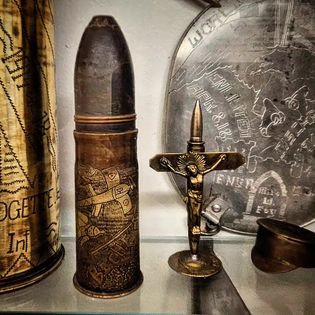
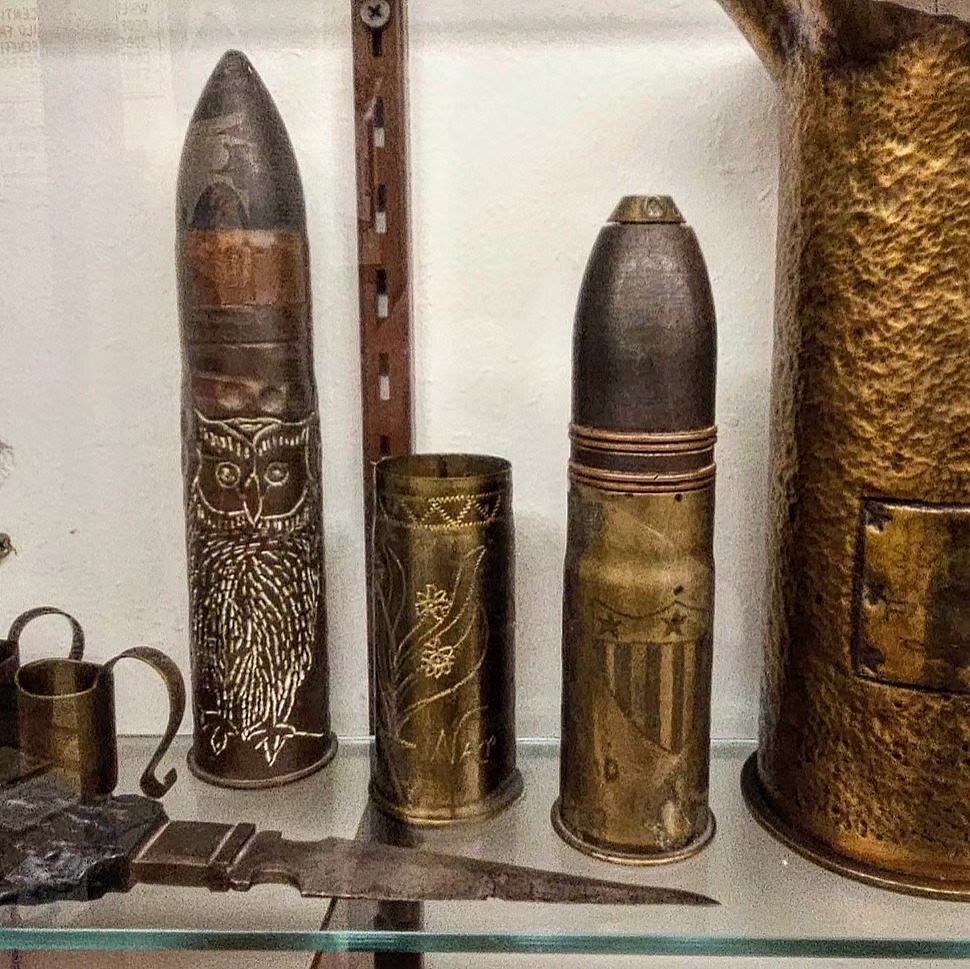
One thing that definitely caught eye was a small display of trench art not far from the entrance to the museum. “Trench Art” got its name from the shear quantity of such art produced by soldiers in World War I, but that hasn’t stopped folks from applying the label to art made during other wars. What makes something trench art is the fact that soldiers are making it during their time down range. What makes it interesting is the frequency with which it is made using materials clearly manufactured for the purpose of fighting war.
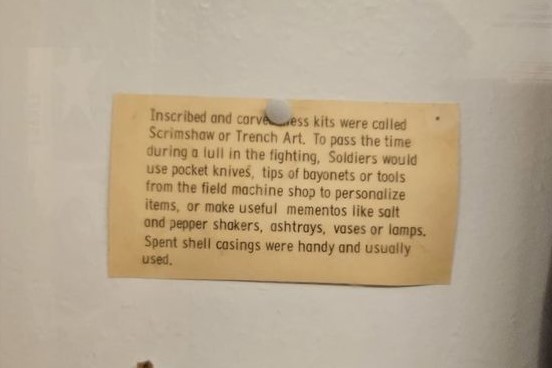
Here is what the museum has to say about it:
“Inscribed and carved mess kits were called scrimshaw or Trench Art. To pass the time during a lull in the fighting, soldiers would use pocket knives, tips of bayonets or tools from the field machine ship to personalize items, or make useful mementos like salt and pepper shakers, ashtrays, vases or lamps. Spent shell casings were handy and usually used.”
Some folks would put that on April 9th, 1865, when the battle of Appomattox Courthouse (Virginia) concluded with Lee’s surrender. (Presumably, the last shot would have been fired a little before the surrender, but at any rate, you can see why this moment might be a good candidate for the end of hostilities.) On the other hand, Lee’s surrender left a number of other Confederate forces in the field and still quite willing to fight. Some folks thought the last shot was fired a little later on, in Waynesville, North Carolina on May 6th, 1865. Of course the battle of Palmito Ranch (Texas) comes after that (May 12, 1865), which leads some to name that as the last battle of the civil war. Apparently, there was a small battle in Eufaula, Alabama, on May 19th of 1865 which certainly beats all of the above. If we are looking for an official end of the war, we could put it at May 5th when Confederate President, Jefferson Davis, officially disbanded the Confederate government or on May 10th when Davis was captured, putting to rest any hopes that he might somehow carry on after all. One might say that nothing after that counts. Just don’t tell that to Frank and Jesse James who seemed to view themselves as continuing the struggle well into what most would think a completely different story altogether. We could probably find a few other outlaws who might have told similar accounts of their actions. Sticking with official military forces, it’s worth noting that the last Confederate General to surrender was Stand Watie, who surrendered on June 23, 1865. Just how much fighting he and his men were doing in those last few days, I must confess I do not know. And then of course, there is the Confederate canon ball that exploded in Fort Macon, NC in the winter of 1942, putting an American soldier in the hospital for a couple days. Does that count? I’m gonna say ‘no’, but I do wonder what those who fired that shot might think to find out they scored a hit so many years afterwards. Clearly, there are a lot of candidates for the last shot of that war.
***
Turns out it isn’t easy to wrap up a war!
I’m half-tempted to say the last shot of the civil war (so far) is the one that killed Ashli Babbitt on January 6th of this year, but that’s a whole other write-up.
***
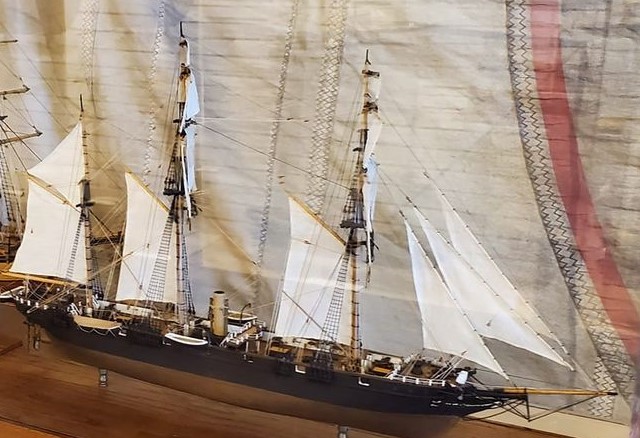
Part of the Shenandoah exhibit at the Alaska Veterans Museum in Anchorage
So, what was the last shot of the civil war?
It really depends on what you choose to count as the last shot.
The key word there is ‘choose’.
***
Let me tell you about my favorite candidate for the last shot fired in the civil war!
It took place on June 22, 1865, in the Bering Sea. It would have been one of two warning shots fired by C.S.S. Shenandoah in the general direction of the Sophia Thornton, a whaling ship out to harvest bowheads in arctic waters. The shot had its intended effect, bringing the Sophia Thornton to a stop so this Confederate Commerce raider could loot and burn it to the waterline before they moved on to plunder other ships in the Yankee whaling fleet.
What makes this the last shot?
Well it is the last shot fired by troops acting under a flag of either belligerent in what they believe to be an action authorized by their own government in pursuit of the war. Why is that the important criteria? Well it just is, dammit! (Jesse and Frank can suck an egg.) I have spoken!
The Shenandoah would go on to plunder additional ships over the next couple days, but she didn’t need to fire any more warning shots. In time she would head south in hopes of launching an attack on San Francisco. One final capture along the way proved sufficient to furnish proof of the war’s end, thus bringing to a close this one last chapter of the Civil War.
.Almost the close anyway.
The Shenandoah made its way to England before surrendering, a trip which was certainly an ordeal in itself. And then of course there were the Alabama Claims, a lawsuit in which the Shenandoah figured rather prominently.
Maybe that’s when the story ends?
Or maybe not.
See?
It’s damned hard to wrap up a war.
Or even a story about one chapter in a war.
***
Route of the Shenandoah (Alaska Veterans Museum in Anchorage)
What I love about this story is that it helps me connect the Civil War to the history of Alaska. It might seem like a footnote in the story of either Alaska or the Civil War, but it’s one of a few such footnotes that helps me connect the Civil War to students often prone to think of that war as a story for those that live in the lower 48. What I also love about this story is it keeps getting richer every time I come back to it.
Of course the story of the Shenandoah is not really just one story.
It’s a whole bunch of stories.
It’s a story about international relations. It’s a story of asymmetric warfare. It’s a story about whales and whalers. It’s a story about race and racism. It’s a story about law and violence, and the use of law as an instrument of violence. It’s probably a few other stories as well, but these are the themes this story usually takes takes on when I tell it.
***
First a few basic facts, which I probably should have mentioned way back in the first or second paragraph here, but anyway, you’re getting them now.
The Shenandoah began as a merchant vessel and troop transport, named the Sea King. She set sail from England in August of 1863 and finally surrendered to the British government in November of 1865. She first rendezvoused with another ship called the Lauren just off the coast of Madeira where she was outfitted with guns and other equipment necessary for work as a commerce raider. The Shenandoah was Captained by Lieutenant James Waddell, an officer in the Confederate Navy. Additional Confederate military provided the bulk of the ship’s officers, but the rest of her crew was initially unaware of the true purpose of their voyage. At Maderia, that crew was given the option to stay aboard and help on her actual mission (for a share of the loot), or to return home aboard the Lauren in the event that work in borderline piracy was not to their tastes. In time, the Shenandoah would flesh out her crew by adding sailors from the very ships she plundered. Apparently, it was not unusual for men to volunteer in such cases. Neither was it all that rare for the crew of a commerce raider to push the issue.
And by “push the issue” I might mean torture.
The Shenandoah carried 8 total canons of various sizes, not enough to make her a formidable warship, but enough to make resistance from a merchant vessel a losing proposition. She was equipped with a full set of masts with which to catch the winds as well as an auxiliary steam engine to get her moving when the winds weren’t so kind. She could make headway against the wind, but she could also take full advantage of favorable winds. Commerce raiders needed enough speed to catch their prey and outrun a full warship, and they needed just enough weaponry to defeat their civilian prey, or (more importantly) to convince their prey that surrender was the best course of action. By these standards, the Shenandoah was well suited to her task, at least when she finally got all the necessary materials.
Her first few captures, it seems, were secured through a bit of a bluff as her canons lacked the proper rope and tackle system to reload. Also, she didn’t really have enough crew. Once these problems were resolved, she was good to go!
***
International relations: The first chapters of any book about the Shenandoah are inevitably chapters of political intrigue. The ship was born in England, but of course that was politically impossible. England was officially neutral in the American Civil War, and so they couldn’t possibly allow the Confederates to purchase a ship meant for war from one of their ports. This is why her first stop was made off the shores of Madeira. She had been purchased by Confederate agents, aided by the complicity of British officials, setting sail without weapons of war and barely escaping British waters ahead of Yankee diplomatic efforts to shut down the voyage.
The official neutrality of Britain in regards to the Shenandoah would plague her voyage as the Shenandoah had to look for neutral ports or hide her true purpose when stopping anywhere at any port under a British flag. (This problem nearly ended her voyage in Melbourne.)
Britain’s official neutrality and unofficial complicity of course played a role in the decision to surrender in London. Other options were considered, of course, but surrendering to the United States was pretty much out of the question. The legality of commerce raiding is questionable enough under any circumstances. It gets a lot more questionable when your side loses, and continuing the raids a couple months past the end of hostilities might be a good way to earn your way right into a hang-man’s noose. Under the circumstances, a neutral nation seemed like the best place to bring the voyage to a close.
The C.S.S. Alabama (Complements of the Maritime Museum of San Diego)
Britain’s complicity in this story would be revisited in the Alabama Claims, an international dispute resolved in 1872. In this case, the American government sought damages from Britain for allowing construction and purchase of 5 Confederate warships in their own waters. The Alabama was the most important of these vessels, but the Shenandoah certainly played a role. The Alabama claims ended when Britain paid the U.S. 15.5 million to cover the damages caused by ships such as the Shenandoah, thus setting the stage for international arbitration and eventually to things such as the Hague, the League of Nations, and the World Court.
…all of which states’ rights activists in the modern world might well consider examples of that Goddamned globalism!
(and thus the struggle continues…)
***
Asymmetric Warfare: How do you defeat an enemy that has more troops, more weapons, more industry, and more of pretty much everything necessary to fight a war? Well, to make a long story short, you might want to fight dirty. At least, that seems to a common response. That’s at least part of the story here. The Union established clear dominance over the Confederacy early in the Civil War and used a blockade to cut off much needed supplies coming in from other nations. The Confederacy thus relied on blockade runners to get supplies for the war, and on commerce raiders which served two purposes; they could weaken the Union financially, and they could draw warships away from the blockade as they were diverted to pursuit of the raiders. The Shenandoah falls into this category as it was tasked with wrecking havoc on the Yankee whaling fleet, then concentrated in arctic waters. It was part of a strategy born of desperation, but it’s also part of a strategy that works. …to a degree at any rate. It certainly works better than direct engagement with superior naval forces.
Ironically, the United States had a chance to prevent this sort of thing shortly before the Civil War as different European nations had put together an international agreement discouraging such practices. Realizing that it’s own navy was little match for its European counterparts, the United States declined to join the agreement, thus preserving the option to use such tactics in the event of a war with Nation’s like Britain or France (see Chaffin, pages 15-16). The civil war thus brought an unexpected twist of fate insofar as the Union found itself then facing down a weaker enemy with every reason to take advantage of this very option.
Suffice to say this would not be the last time, the United States would play Goliath to someone else’s David on the international stage.
***
Whales and Whaling: Upon encountering the first of Shenandoah’s prey in northern waters, The Abigail, Captain Waddell is said to have told its captain that the Confederacy had entered into a treaty with the whales (Chaffin, 231). It’s a clever line, one of several exchanged between the two men, but it doesn’t seem so frivolous in retrospect. At least some sources (Barr, Dunham), credit the Shenandoah with helping to reduce the Yankee whaling fleet which had only been working northern waters in search of the Bowhead population for a couple decades. She caused enough damage to change the way that insurance companies weighed the risks of covering a whaling expedition (Dunham). This wasn’t the only development shifting the economics of whaling at the time, but a plausible case can be made that the Shenandoah played a role in slowing down the whaling fleet. Waddell might well have thought himself to be telling little more than an amusing joke, but the Shenandoah may well have contributed to the welfare of the Bowhead population.
For Waddell’s allies at least, the impact of the Shenandoah were to last for some time after the close of its voyage and the war in which its crew served.
***
Race and Racism: One of the more interesting details of this story, at least to me, is the fact that the Shenandoah carried at least four African-American crew members (Chaffin, 360). One might wonder why an African-American would serve aboard a Confederate ship (a commerce raider or otherwise), and some of the sources which mention them do little to help explain this. Chaffin, however makes it clear that some of these men were put under heavy pressure, shackled, triced and threatened by Waddell who made it a point to tell one of them at least that blacks were the cause of the war. Mistreatment of these men continued well after their enlistment onto the crew. That one of them, John Williams, would escape during the ship’s stay in Melbourne would of course come as no surprise.
It would be easy enough to miss this. Just a few more sailors. These ones happen to be black, nothing to see here! Of course one can find denials of (and justifications for) their mistreatment in the comments of the ship’s officers. In the end, however, the story of the Shenandoah contains at least enough information to remind us that, at its heart, the Civil War is about a regime of forced labor defined in racial terms. To be sure, other sailors were pressed into service aboard the Shenandoah, but the treatment given to black sailors pressed into service does appear to have been significantly more abusive than that of their white counterparts.
Which really should not be surprising in the least!
***
Ahem, …Tricing consisted of hanging a prisoner for a period of time by their hands (or even their thumbs), often stretching them sufficiently to prevent their feet from supporting their full weight. This was done in conjunction with shackling prisoners and simply keeping in them in the same pen that was used to house animals carried for food.
***
Law and Violence: One of the more fascinating things about this story is the relative lack of overt violence in the capture of ships. For an act of war, this was generally carried out without any direct attacks on anyone. The ships captured by the Shenandoah were simply convinced to stop with a warning shot or two, after which the Shenandoah would send over a boarding crew to bring back the Captain of the vessel they had captured along with the ship’s records. These would then be inspected to ensure that the ship did indeed belong to Yankees, or at least that its cargo was owned by Yankees, after which the captured vessel would be looted, it’s officers, passengers and crew stowed aboard the Shenandoah itself, and then it would be burned. Some of these prisoners were treated as guests; others as prisoners. And (as mentioned) some signed onto service aboard the Shenandoah.
Prisoners were released in port.
What fascinates me about this is the legalism of the process. The officers aboard the Shenandoah were quite concerned to ensure that their prizes were legal, so to speak, even if the legitimacy of the legality was hardly something they could take for granted. They did not wish to plunder a ship from a neutral party, though; that at least would be more trouble than it was worth. So, the process was uniform, almost bureaucratic. They even enjoyed the option to require a ship to turn itself in at the nearest neutral port, effectively holding it for ransom, but doing so on little more than a written promise made under great duress.
The real violence in this story occurred primarily in the relationships between officers and crew or prisoners. Their actual naval engagements may have been a tad emotional, but they were largely legalistic affairs.
So much for the life of pirates!
Of course the men of the Shenandoah were not pirates. They were commerce raiders operating under orders from the Confederate government. This would distinguish them from buccaneers (private ships granted letters of marque from a government) or pirates who operated on their own without license from any government. The legitimacy of commerce raiding and letters of marque was always dubious, and it was coming more and more into dispute by the outset of the Civil War. In the end, their penchant for dotting legal Is and crossing legal Ts left them without much of a case to make when they finally realized the war was over. Things might have been different had the Confederacy won the war, but then again, they might also have been different if the Union had captured the Shenandoah. As it stands, they spent the final leg of their voyage trying to evade Yankee warships and get back to England where they might at least fall under the control and ostensibly neutral party.
***
Well, that’s it. Are you still here? Bet you thought this would be over long ago, didn’t you?
Like I said; it’s tough to end a war.
Or a story about the end of a war.
I really did warn you.
***
Bookish Things!
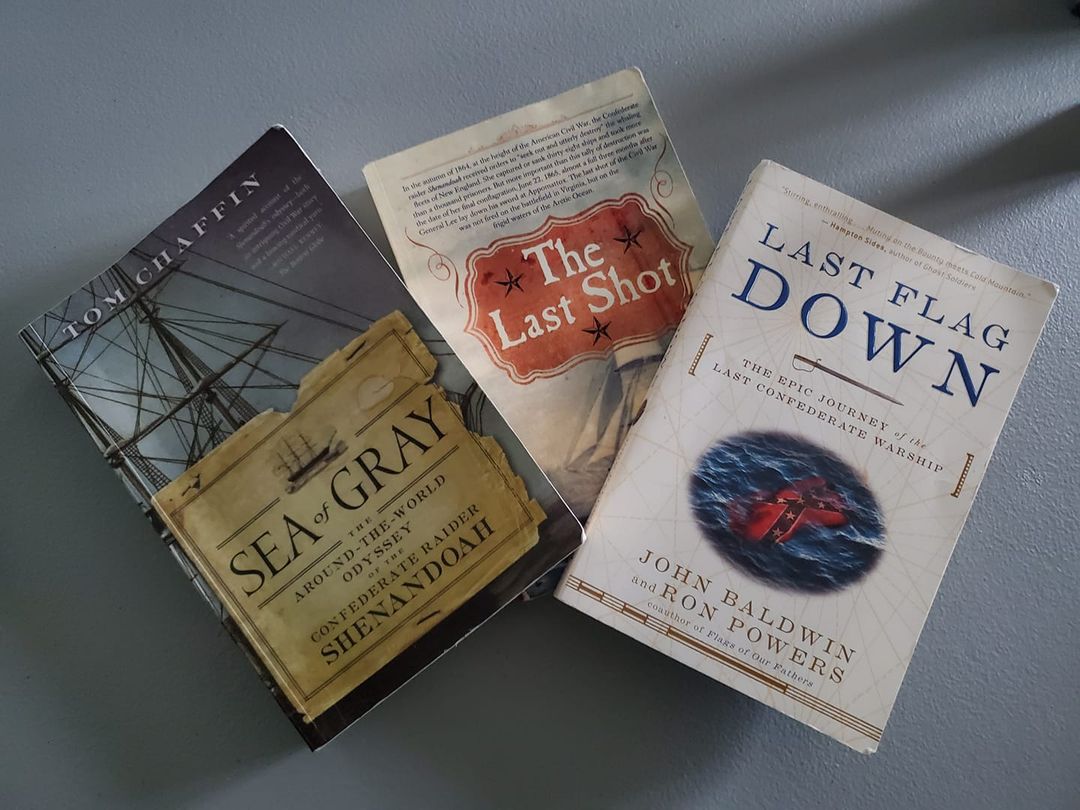
John Baldwin, Last Flag Down. (A monograph on the voyage of the Shenandoah)
Brad Barr talk in 2017. (It’s an interesting talk in which Barr argues that the greatest significance of the Shenandoah’s voyage was its impact on the practice of whaling.)
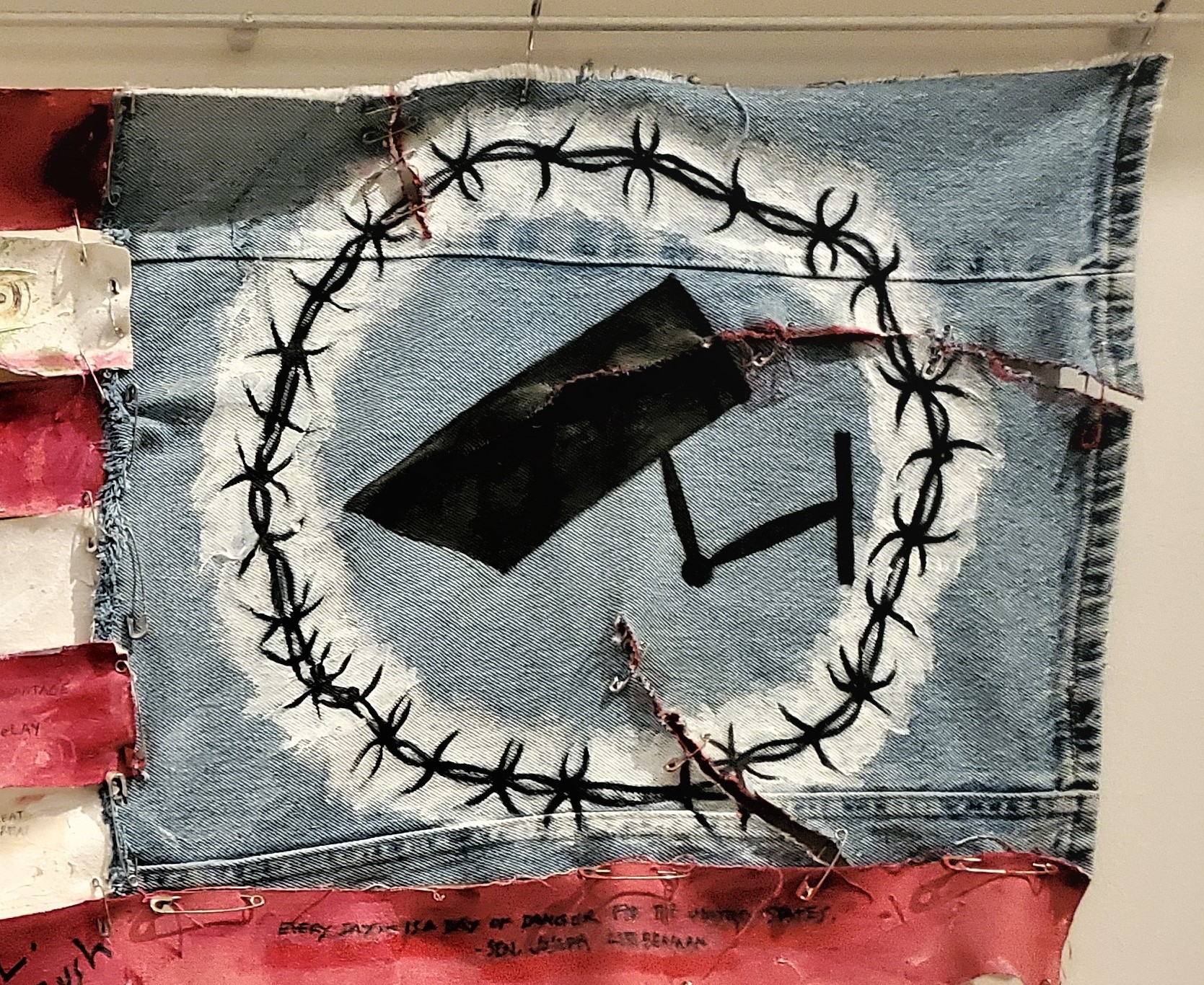
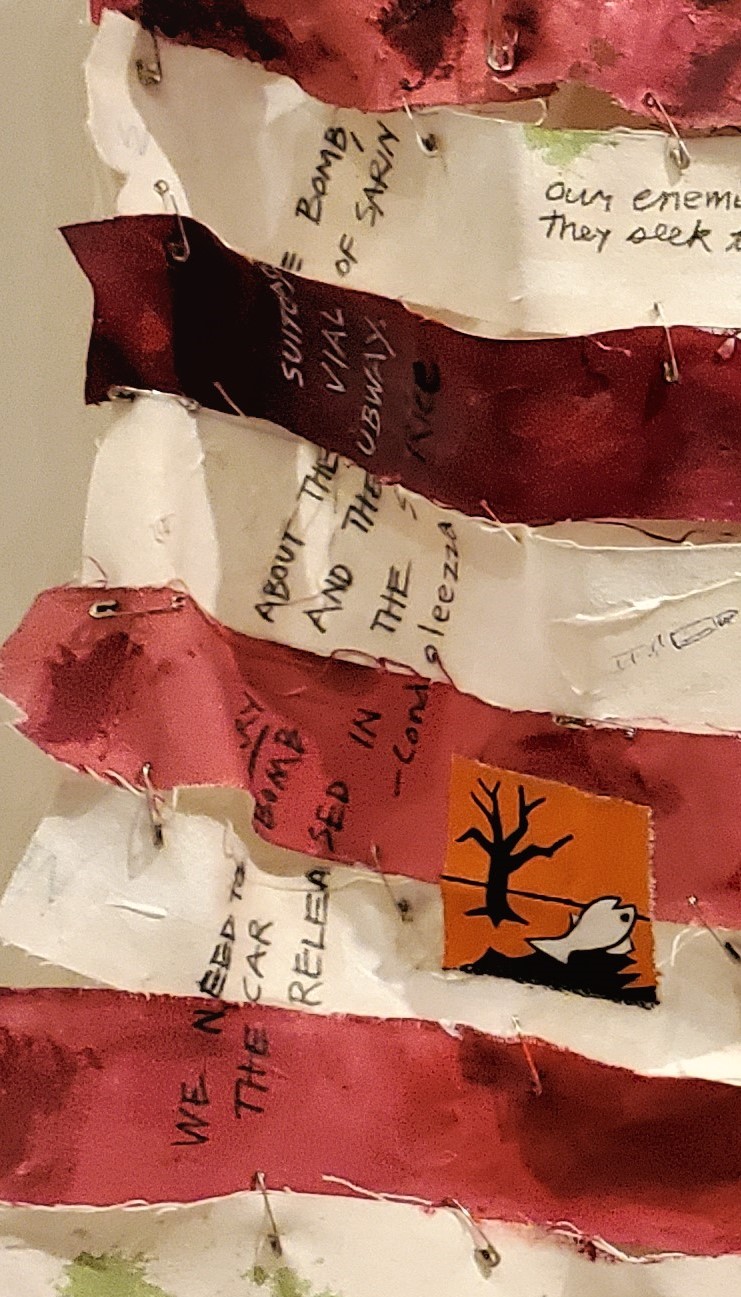
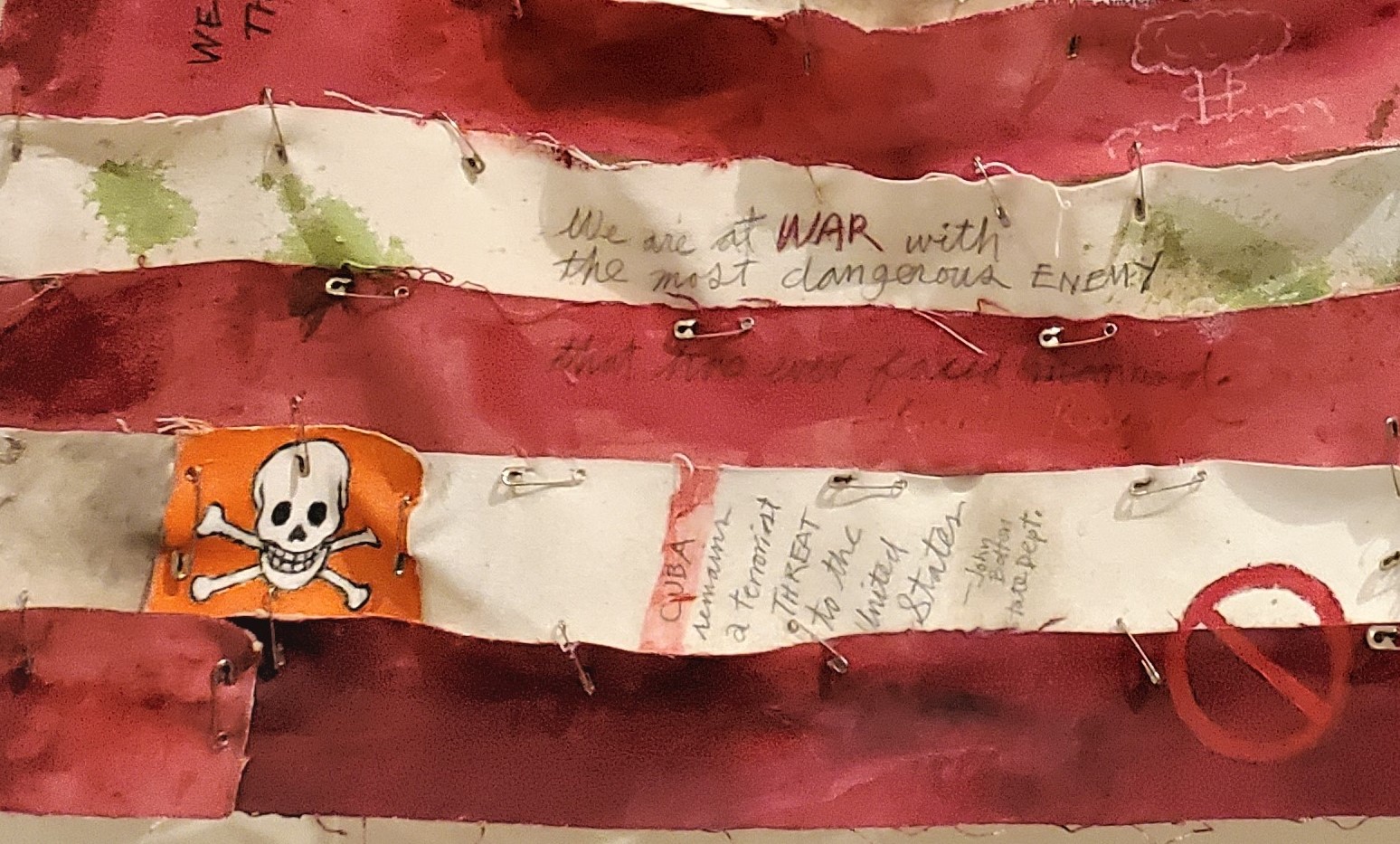
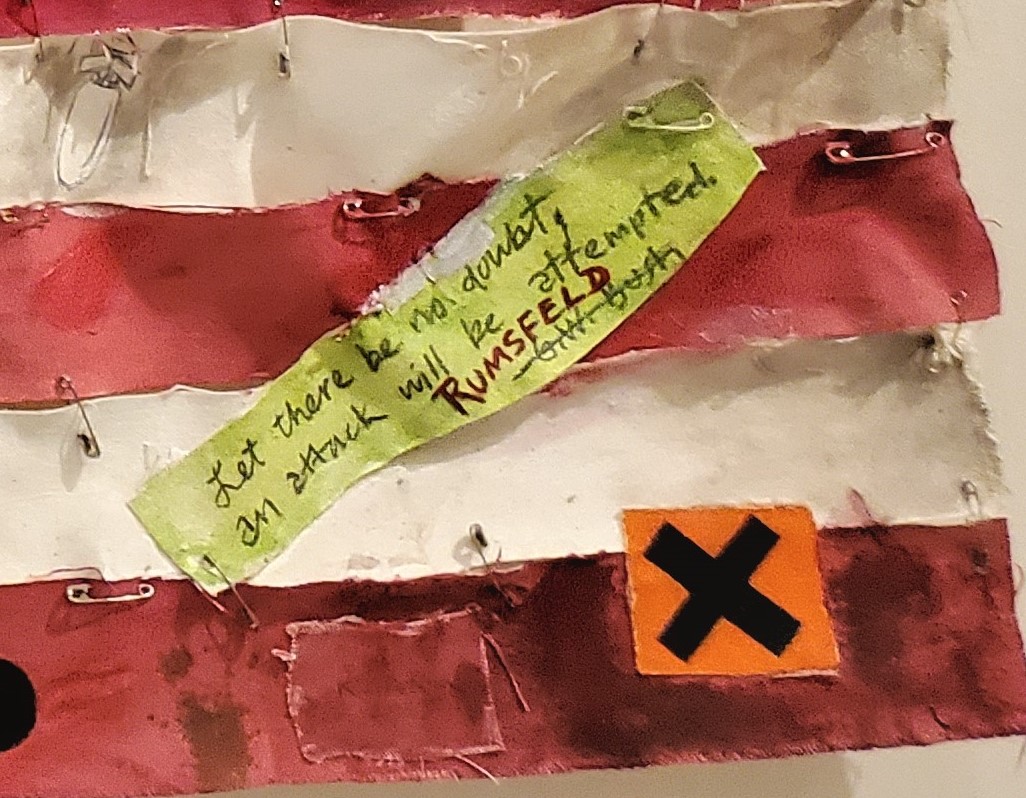
“When I first viewed Ken DeRoux’s ‘Be Afraid,’ it was wrapped up around a cardboard cylinder with bubble wrap, evoking the qualities of both protection and vulnerability I associate with art. As I watched it unfurl, I saw each ‘stripe’ with its symbols or partial quotation revealed as carefully as it was doubtlessly assembled.
“You are seeing it suspended, specifically by safety pins. From an artist who devotes himself to the language of representation – light, shadow, horizon, perspective – I assume purpose for each element of this work.
“Suspend your evaluation for a moment while we look at the language of representation. This is not a flag, it is a banner. Specifically, it is a confederation of ‘banners’ in the newspaper sense of lead quotations. This is cloth, not tapestry. There is no weaving or even binding of the images; they are held together in loose collage by the beautifully ironic safety pins.
“The left edge of the banner is significantly more irregular than the right, suggesting the effects that wind has on a deployed banner. That, in conjunction with the purposeful irregularities in the body of the banner, is effective in portraying an image of embattlement.
“I don’t look at art to ‘figure it out.’ So I don’t pretend that subtle observations were intended by the artist except to the extent that he certainly expected observations. Here are a few observations. The largest quotation, and one of the two written bottom to top as opposed to left to right, is from Condolezza Rice. I suspect the reason for her prominence is that her quote is far more specific in items to fear than the generalized warnings of the other figures. In that sense, her observation has the stark qualities of a symbol, most of which appear at the periphery of the banner. By the way, the only other citation written vertically is also from the State Department. Is this because the execution of foreign policy must take a different, more specific direction than the more generalized ‘slogans’ of elected officials?
I am fascinated by the safety pins. Is our ‘safety’ only possible by considering the compilation of these warnings and symbols? Is our ‘safety’ the coming together symbolized by the clear visual reference to the American flag – the symbol of our Union? On the other hand, do the safety pins represent the current status of our union as a people, as in ‘only held together by safety pins?’
“Despite the title of the work, the symbols do not appear to be aimed at fear. They seem almost cartoon like, as does the sole terrorist figure. It seems to be more a work of inquiry than intimidation, to the point that the title ‘Be Afraid’ could as easily be “Be Aware.’
“The prediction is that this work will be controversial. I think it will be conversational if we enjoin one another to hold our evaluation until we are done thinking.”
My father served in three wars. He didn’t see action until Korea and Vietnam, but like so many young men from his generation, on graduating from high school, Dad signed up for service in World War II. He spent the balance of that war as as an airplane mechanic working on Corsairs.
Dad had plenty of war stories to share at the dinner table. He had more stories from boot camp, then anything else, which is saying something, because his actual war stories were pretty amazing. Of course, Dad spared us the worst of it. Being the youngest, I was probably spared more detail than my siblings (though I did know what every one of the weapons in my green soldier pack could do by the age of five).
Sometimes, Dad would just tell jokes. Jokes he and his buddies had swapped over the years. I remember one of them. It seems so corny now, but I used to laugh and laugh. It was definitely my favorite. I’m sure, a lot will be lost in translation here, but I’ll try to convey it as best I can.
***
A young recruit shows up to boot camp late. He goes to get his gun and the man in charge tells him, he’s too late. They are all out. Not knowing what else to do, the man breaks off the end of a broom stick and says; “See here kid, whenever they tell you to shoot, you just point this stick at the target and yell “Bangity-bang-bang!”
Kid says ‘okay’, but what about a bayonet?
Guy takes one straw from the end and ties it to the end of the stick and says; “Okay, so whenever they tell you to stab something, you just point the stick like so and yell “stabbity-stab-stab!”
So the kid goes all the way through boot camp that way. He thinks he might have the idea, but he’s really hoping he’ll get the real thing soon.
Only he doesn’t. The kid’s unit gets rushed out for the invasion, and he gets all the way to Normandy and he’s still got his broom-stick in place of a gun. The kid tries to tell somebody, but they just push him into the landing craft. He actually storms the beach with a broomstick in his hand.
And then he sees a German (Dad, might have used a different word), and he doesn’t know what to do. the German is shooting at him. So, in desperation, the kid points the stick and says; “bangity-bang-bang!”
And the German dies.
Kid can’t believe it! But he’s surrounded by Germans, so he tries it again; “bangity-bang-bang!”
The next one goes right down.
So, the kid just keeps doing it; “bangity-bang-bang! bangity-bang-bang! bangity-bang-bang! bangity-bang-bang!”
…and the German soldiers go down every time.
He storms a German machine gun nest and kills a bunch of them saying “bangity-bang-bang!” Then one charges at him. He doesn’t know what else to do so he points the end of the broom-stick at him and yells; “stabbity-stab-stab!” The guy falls right down.
So the kid just keeps going, all through D-Day; “bangity-bang-bang! bangity-bang-bang! bangity-bang-bang! bangity-bang-bang!”
And the Germans just keep right on falling down.
Except this one big guy.
That one German just keeps coming.
The kid points his stick and shouts; “bangity-bang-bang!”
The German keeps coming.
The kid points the stick at him up close and yells; “stabbity-stab-stab!”
And the German just walks right over him.
And as he does, the kid hears “tankity-tank-tank!”
It must have been a couple decades back. I was at a small party in Forth Defiance. Those attending included a number of officials in the Navajo tribal government. Fort Defiance serves as kind of a bedroom community for the capital of the Navajo Nation, so this was hardly unexpected. What none of us expected that evening was a quick lesson that began when our host asked if anyone knew the name of the main street going through the town? No-one did. As it happens, the name was Kit Carson Drive.
Apparently, it still is.
To say that most of the party-goers found this shocking is putting it mildly. It may not be obvious to some of my readers why a room full of Navajos would object to a street named after Kit Carson, but even the most cursory knowledge of their history would make this pretty well obvious. The man is popularly known as an old western Indian fighter, and as it happens, a good number of the Indians he fought were Navajo. When General James H. Carleton, the Army Commander for the Territory of New Mexico decided to go to war with the Navajo people, it was Colonel Kit Carson that he sent off to do it. Carson marched through Canyon de Chelly, the heart of Navajo territory, destroying resources (just as Sherman might have) and letting winter bring his enemies in to surrender. This campaign, and the four years of internment at Hwéeldi (Fort Sumner) still constitute the darkest chapter of most historical narratives about the Navajo people. So, you can just imagine what it must have meant for people who can still tell you about relatives lost on the long walk to Fort Sumner to learn that a road right through their community bears the name of the man responsible for their deaths.
Kinda put a damper on the party.
You might think it odd that folks didn’t know the name of the road to begin with, but it’s hardly unusual. Folks don’t pay that much attention to street names out that way. Many of the roads don’t have signs at all, and I don’t recall seeing that particular name on a street sign when I lived out there (though one can certainly be found in Fort Defiance today). This party was the only time anyone ever mentioned it to me.
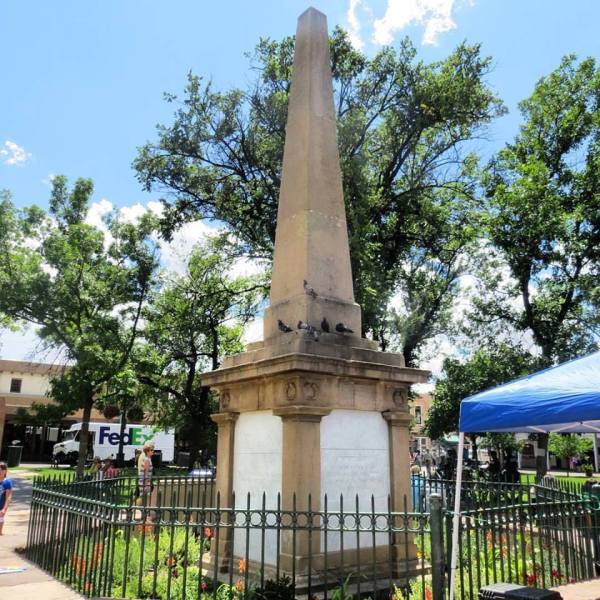
The old south isn’t the only place in this country with a questionable sense of public history from the Civil War era. Those in the Southwest have less to do with the war between the states than the early stages of the Indian wars which would dominate the interior west for a couple decades. Kit Carson Drive is one of many such examples. The Obelisk in the town square of Santa Fe provides another. It’s had its own share of controversies over the years, not the least of them being this dedication:
“To the heroes who have fallen in various battles with savage Indians in the Territory of New Mexico.”
It should come as no surprise that this line acquired its share of critics over the years. It has had some defenders as well, to be sure, but plenty of critics. The sentiments might have seemed appropriate enough to those who erected it in 1868, but in the 1970s, sentiments had changed a bit, as had the political status of some of those ‘savage Indians’ referenced in the piece. So it really should have come as no surprise when calls went out for removal or modification of the monument. Today, at least, it may seem a little surprising to find the monument had Native American defenders, which apparently it did. Attempts were made to put the original wording into it’s proper context, so to speak, preserving it without appearing to endorse it, but some clearly weren’t satisfied with this way of thinking about the issue. Resolution apparently came in the form of a chisel, and the result is a monument with its own fill-in-the-blank question.
It seems, the American public is hashing out a new round of debates over public monuments, particularly those in the South. Some no doubt find the entire debate quite trivial. Who reads the placards on a monument anyway? Of course when people fight over seemingly trivial things, you can bet your ass they aren’t really fighting over the trivial things. It isn’t actually history (much less historical monuments) that has people up in arms over Confederate Statues, just as it wasn’t really history that caused a word to fall off the monument in Santa Fe. Such battles are always about the present. They are about the way that people think and use history to shape the present, and there are usually some very specific present implications in these battles.
People typically see the present interests loud and clear when they confront advocates of social justice. If anyone ever forgets this, the term ‘political correctness’ is right there to remind us that someone (or at least someone on the left) has an agenda. What folks are slower to get, it seems, is the fact that these sorts of gestures are hardly neutral to begin with. There is a reason James W. Loewen devoted a fair portion of his book, Lies Across America, to Confederate monuments, and it wasn’t because these monuments contain sober and thoughtful commentary on the actual history of the region. A statue to a confederate hero isn’t just a reference to history as such; it says something to those who those whose ancestors those heroes fought to keep in bondage. And a monument to heroes who died fighting ‘savage Indians’ may say something noble to those descended from colonists (Spanish or Anglo) in the American southwest; it says something else to those descended from those very ‘savage Indians’.
To be sure, complications abound. Some folks may have ancestors on either end or neither of his memorial demographics, and some people may have no dog in the fight at all. Also ironic usage happens. Not every Native American takes umbrage at the word ‘savage’ just as not every Native American objects to the term ‘Redskins’. But we should be wary of efforts to make these exceptions into the rule. The Washington football team has, for, example paid good money trying to find, cultivate, and promote just about any Native American willing to help foster the notion that the team name reflects anything but a racist stereotype. Were the team name really so bland, one might almost wonder what use it would have for people interested in such a martial sport! And of course we now have the Cheetoh-in-Chief (who has his own bullshit civil war monument) mourning the loss of beautiful artwork and a desecration of history with every Confederate statue that goes down. His language is so flowery and positive. You’d almost think these monuments held no serious political significance in the present age.
Of course the folks delivering the Nazi salute in defense of Robert E. Lee might seem to argue otherwise.
There are people, times, and places who don’t find it necessary to remove or modify monuments to their sordid past. Some of these might not even be terrible people, places, or times. But if the monuments to an abusive past aren’t so toxic, this isn’t simply because potential critics choose to let it slide; it’s because the community as a whole has somehow managed to handle the issues in question. When the dominant voices prove tone-deaf or outright hostile to the interests of those on the wrong-side of monumental history, then we are all a lot less likely to get along. Then statues get pulled down.
…or someone just shows up with a chisel.
***
Just a few pics of Canyon de Chelly (click to embiggen):
Someone I know and love likes to say that Game of Thrones is all fake. It’s fantasy, so there is nothing realistic about it. This same individual (whom I know and love) eats up reality TV like it was candy. I think he knows as well as I do that those shows are often contrived, but that doesn’t stop him from getting really into the moment that alligator is on the hook and the second guy in the boat can’t seem to find his shot. I know as well as he does that Westeros ain’t real, but that doesn’t stop me from worrying about the fate of Jon Snow. Each mode of storytelling works for one of us and not the other.
But what does realism have to do with it? Or anything else for that matter?
***
It’s easier to see the connection for reality TV, not because it’s more real in an objective sense, but because the theme is more central to the genre. Reality television purports to be showing us something about how people in some part of this world really do live. That’s a claim that goes a bit beyond the story-line itself and reaches into the mess of life we sometimes call the real world. That claim constitutes a significant portion of the genre’s appeal. It’s a bit like porn, actually. The dialogue may be utter crap, but somehow the sense that you are seeing something real makes it a little more interesting. At least I think that’s the point, or at least part of it. For myself, I just can’t get into it. Knowing just how much manipulation goes into the stories told in reality television, constitutes a bit of deal-breaker for me. Perhaps I would enjoy it more if I could suspend disbelief and just enjoy the stories, but how does that suspension of disbelief work when a sense of veracity is central to the genre?
…also, there is the expository crutch!
Reality television leans very heavily on the use of exposition. Far too often, for me anyway, they break away from the action to have one of the characters explain events to the audience in their own words. Without these moments we would be missing a lot of the plot-line. Reality television uses these moments to fill in the gaps. It also uses them to tell us what’s at stake in the action, often playing up the drama well beyond any significance we could draw from the events ourselves. …if we don’t get this fish trap to work we’ll starve! We need to fix the oil leak in our car or we’ll freeze to death on this mountain top. That chef needs to change his recipe or the whole business will go under! …you get the idea. They’ll repeat these narratives a few times each episode, just to make sure you get caught up in the point. Maybe, I’m a hard sell, but most of the time I just don’t believe them. More importantly, I find the whole convention damned tedious. When did so much exposition become good writing? I’m guessing that moment in television history came during the early episodes of MTV’s Real World and that first season of Survivor.
Remember Survivor? Remember the hype leading up to the first episode? This was supposed to be about people surviving on their own under primitive conditions. Only they couldn’t! Those guys really couldn’t do much to feed themselves and contribute to their own survival. But they did get just enough food and water from the show producers to survive so long as they didn’t waste their energy trying to survive on their own. So they mostly sat around and bickered with each other. Somewhere in there, I imagine, the production team must have had a collective panic attack. …My God, the whole story just ain’t happening! What do we do? The answer turned out to be high school soap opera, and thus the master script was born for just about every reality television program made ever since.
That’s how I imagine it anyway. It may not be real, but if you had me and five of my friends telling you the story of this blog post, I’ll bet it would pass muster for reality TV.
“…this really is a must write blog post for Dan. He’s at his breaking point.”
“I knew, I had to do post something today. This post was like a dark cloud hanging over my head.”
“If Dan doesn’t finish this post today, I’m pretty sure he’ll be eaten by black bears.”
“I don’t see what the big deal is. Nobody reads blogs anymore anyway.”
I’m voting that last fucker of the island!
***
But let’s come back to the Game of Thrones! I get the concern. It’s fantasy. There are dragons. Magic works (except when it doesn’t), and well, hell, did I mention there are dragons? Clearly, some things about Game of Thrones are not real at all. Still, I think the show has two (maybe three) realisms lacking in many more ‘realistic’ genres.
First and foremost, it’s all the death, the gruesome terrible deaths, the ones that happen to central characters that we all know and love. Love it or hate it, George R.R. Martin’s penchant for killing off key protagonists has long since become the defining feature of the show. For myself, I love it, but there is a certain dwarf that better be in good health at the end of this coming season or I’ll, I’ll, …I don’t know what I’ll do.
Take that Martin!
People ask Martin about this all the time. I’m particularly fond of the answer he once gave The Independent:
“A writer, even a fantasy writer, has an obligation to tell the truth and the truth is, as we say in Game of Thrones, all men must die,” he told Galaxy’s Edge Magazine. “Particularly if you’re writing about war, which is certainly a central subject in Game of Thrones.”
He continued: “We’ve all read this story a million times when a bunch of heroes set out on an adventure and it’s the hero and his best friend and his girlfriend and they go through amazing hair-raising adventures and none of them die. The only ones who die are extras.
“That’s such a cheat. It doesn’t happen that way. They go into battle and their best friend dies or they get horribly wounded. They lose their leg or death comes at them unexpectedly.”
The author goes on to explain, slightly morbidly, that we’re all going to die at some stage as mortality is inevitable. “Once you’ve accepted that you have to include death then you should be honest about death and indicate it can strike down anybody at any time.
“You don’t get to live forever just because you are a cute kid or the hero’s best friend or the hero. Sometimes the hero dies, at least in my books.”
I take that to be a kind of realism. It’s not about authentic costumes or weaponry, or the details of some known historical event. It’s about the human cost of warfare. Martin is known to have patterned his fiction after some real historical conflicts (most notably the War of the Roses), but of course his work remains fiction. Hell, it remains fantasy-fiction. So, we have no baseline from which to compare his description of events to a known fact, at least not any he is obligated to render with accuracy. Still, Martin’s willingness to kill off the characters we care about tells us something about war that many more ‘realistic’ stories keep leaving out.
I would add that it isn’t just Martin’s willingness to kill important characters that sets his stories off from others. It’s his willingness to do it unexpectedly, suddenly, and often without any hint of heroics in the moment of death. Time and again, Game of Thrones invites us to identify with a character, to root for them, only to kill them in the end.
…only to leave us watching as the struggle goes on without those whose story arc had once defined the whole meaning of the show for us.
That is a kind of realism, one largely absent in a good deal of historical fiction.
***
None of this is exactly Italian neorealism. But each of these genres effects a kind of realism amidst a story-line saturated with fiction. Where one purports to show us something akin to lives of people in odd walks of life, another aims to show us how human beings struggle to deal with terrible events. For either to work, something in story-line must resonate for the viewer (or reader). Each in its own way speaks to a sense of reality, though each also weds that sense of reality to a fabricated universe of its own.
***
Historical accuracy might be thought to present another type of realism, but of course historical films (and even documentaries) are saturated with their own contrivances. The blog, An Historian Goes to the Movies presented a very thoughtful discussion of the subject here, here, and here (and really throughout his entire website). In one of the most interesting passages in this series, he talks about the public’s penchant for scrutinizing the accuracy of material culture and fighting techniques in film while ignoring the historical accuracy of plot points:
I find it very striking that audiences apparently want a sense of accuracy about violence, but not about plot. They cheerfully accept absurd plot developments (like Isabella being way too young and way too far way to have an affair with Wallace), but will complain if the sword fighting looks too fake. (Compare contemporary film violence to that from the 60s, for example, to see just how much effort Hollywood has put into improving the realism of its violence.)
Imagine for a moment a film in which the emphasis was on accuracy of the plot, but not on accuracy of the costuming or weaponry. Picture William Wallace running around in a 20th century British military uniform carrying an AK-47 but engaging in fairly accurate political maneuverings.
Most people would react to that poorly, I suspect, because Hollywood trains us that accuracy means specific things and generally excludes other things. But theatrical and cinematic adaptations of Shakespeare employ this device fairly frequently. Instead of setting his Richard III in the 1480s, like the historical Richard III, or in the 1590s, when the play was first performed, Ian McKellan set his version of the play in the 1930s, depicting Richard as a would-be fascist dictator. A particular favorite detail is the arrangement of 16th century poem “Come Live with Me and Be My Love” as a sort of Swing-era piece. The famous “Now is the winter of our discontent” speech becomes a political speech. It works beautifully, and while the setting isn’t faithful to the play as Shakespeare envisioned it, it works marvelously and offers a wonderful comment on the politics of both the 15th and the 20th centuries while still being true to the spirit of the play. This is a film making careful, clever use of its choices about historical inaccuracy.
Perhaps the most interesting part of this commentary lies in the comparison with Shakespearean theater. While it’s easy to fall into the trap of thinking that the kind of bias he exposes here is just to expected from viewers, the comparison with Shakespeare shows us that it isn’t. There is indeed at least one genre which reverses the emphasis, taking us out of the realm of period dress and sword techniques and inviting us to dwell on the plot-line.
I want to underscore at least one aspect of this question about accurate plot-lines, namely the sense of a character’s world view. Historical plot-lines can be inaccurate for any number of reasons, but one of the most interesting and common inaccuracies would seem to be a penchant for reading modern thought worlds into the motivations of historical characters. In this respect, Mel Gibson is the gift that keeps on giving. Whether it be a southern plantation owner who doesn’t own slaves, or William Wallace crying ‘freedom’ as he is about to die, his historical characters typically speak to the sensibilities of modern peoples more than those of the era in which they purportedly lived. Whatever the (in-)accuracy of his dress or battlefield depictions, Gibson’s characters are often living anachronisms, thinking and behaving in ways that have less to do with the period than the social order of the modern day.
Here is another respect in which I think Game of Thrones is particularly good. For those of us who live in a modern republic, the logic of an aristocracy can seem quite vicious, often unnecessarily so. Why all the fighting? Is it vain ambition? And if these characters must fight for control of their worlds, could they not at least spare the children of their enemies? Even the title of the series points to the answer, but I believe it was Cercei who explained it best.
Again, this is fiction. Hell, it’s fantasy fiction, but it’s fantasy fiction pointing at a kind of world that has existed in human history, one many of us have trouble grasping. It’s a world in which heredity defines power, and even a child with the wrong bloodline is a very real threat to the powers that be. This too is a kind of realism, one which reminds us people in other times and places may not be able to act as we would, even if they wanted to. I admired Eddard Stark’s efforts to show mercy in this scene, and I expect I’m not entirely alone in this. But of course we call know how that turned out. We are 6 seasons into the show, and thus far, I have every reason to believe Cersei was right about this. Not just Certei. Martin too. This is Martin telling us something about the social order of a certain kind of world. His world may be fiction, but others like it would not be, and his story does indeed help to illustrate how those worlds work. Is it realism? Not quite. But you could learn a lot about real worlds from this kind of story.
***
So it seems the attempt to show us how certain people live in certain times and places always reflect the priorities of those who produce them. Are they trying to show us how people dressed, how a certain series of events unfolded, or how people thought about their lives in the context of the times depicted? One could find other priorities in a film, to be sure, but it would be a rare story that didn’t have some serious blind spots.
The funny thing about such blind spots is they can be hard to see at first, but once you find them, they can be equally hard to ignore.
***
Okay, so one of the ways I am cheating my way through this topic, so far, is that I keep picking examples where one can arrive at a reasonably sure sense of what the facts would say about a given issue, what would count as real if we chose to care about it. What about when you don’t know? What is realism when we don’t exactly know what the fact is?
Take the film, Atanarjuat (Fast Runner). Better yet, take the film Reel Injun in which director, Zacharias Kunuk discusses one of the challenges he faced in making Atanarjuat. He wanted to shoot some love scenes, but that raised an interesting question. How would two Inuits living essentially in the pre-contact era have actually made love. He couldn’t very well just have them start sucking face for foreplay, as would be the case in most love scenes, because Inuit in the precontact era didn’t kiss the way people do now. Lots of people have heard of an ‘Eskimo kiss’, which is essentially rubbing noses, or so we are told, but how does that work? Past movies set in the arctic depict this in rather comic terms, which was definitely not what Kunuk was going for. He wanted to portray this as accurately as possible. So, he talked to the elders in his own community and based his own love scenes on their answers.
So, is the ‘Eskimo kiss’ in Atanarjuat accurate? Is it realistic?
It seems rather likely that the answer is ‘yes’, but that isn’t entirely obvious. The elders Kunuk spoke to, might have been wrong. It’s certainly possible. Historical information isn’t carried in the blood, and customs change a great deal over time while people’s ideas about tradition are often rooted in the eras of their own youth. So, it is possible that Kunuk’s elders might have been factually wrong about an Eskimo kiss.
So what if they were?
Worst case scenario, the love scene in Atanarjuat is still the best answer that an Inuit director could come up with after speaking with Inuit elders in preparation for a movie with an Inuit cast and made essentially with an Inuit audience in mind. I can manufacture (as I just did) an objective question that Kunuk might have gotten wrong, but his answer is still the most authoritative I know of. It is certainly the most authoritative answer most of his non-Inuit audience will ever see. Whatever the facts of this topic, Kunuk’s portrayal is still a thoughtful expression of an Inuit perspective about the subject. That has to count for something.
So if someone asks me what is an ‘Eskimo kiss’, how am I going to answer them? I’m going to point them right to Atanarjuat, or maybe to Reel Injun. Of course, I could also say that an ‘Eskimo kiss’ is a silly western caricature of what different Eskimo peoples actually did, but then I’m still going to point them to Fast Runner, because what happens in Fast Runner is STILL the most authoritative answer to that question that I know of, at least on film. In effect, it is the most realistic film portrayal that I’m aware of at present.
The point here in this overly-belabored sub-theme is that realism isn’t always about objective facts. Sometimes it’s about perspective, Sometimes, it’s about the most authentic voice(s) you can find on a subject, the ones whose values and priorities are most relevant to a subject. This is particularly true of movies about exotic peoples, whether they be past civilizations, foreign cultures, or just the guy who does that really odd job. An outsider might manage a perfectly accurate portrayal of the lives of such people, but without some insight into their thinking, what would that be worth? Such insights must involve a native voice at some point. Better still when that voice can actually shape the narrative!
I was a little surprised to see a museum crammed into one of the small shops on 4th street in Anchorage. I was even more surprised to find just how much history they managed to cram into The Alaska Veterans Museum. It’s best to take your time in this place, because every inch of wall space in this venues contains something worth a second look, and maybe even a third.
The museum is of course a testament to the lives and work of Alaska’s veterans. For those of us interested in the history of Alaska, it also contains materials illustrating some of the more interesting parts of Alaskan history. No sooner had I walked through the door, for example, than the volunteer asked me if I knew where the last shots of the civil war had been fired. I suppose “the Shenandoah” wasn’t technically the right answer, but he smiled when I said it, and anyway, the point is they have a section for the history of this Confederate buccaneer up on the wall here.
…which had me smiling from the start of my visit.
The museum also features extensive coverage of the Aleutian campaign. It’s one of the quirks of Alaskan history. Where most of the lower 48 speaks of World War II as something that happened ‘over there’, some of the fighting actually did take place in this state. Not only did the Japanese bomb Dutch Harbor, they also occupied two islands in the Aleutian chain, all of which is well represented in the collections on display here at the museum.
?
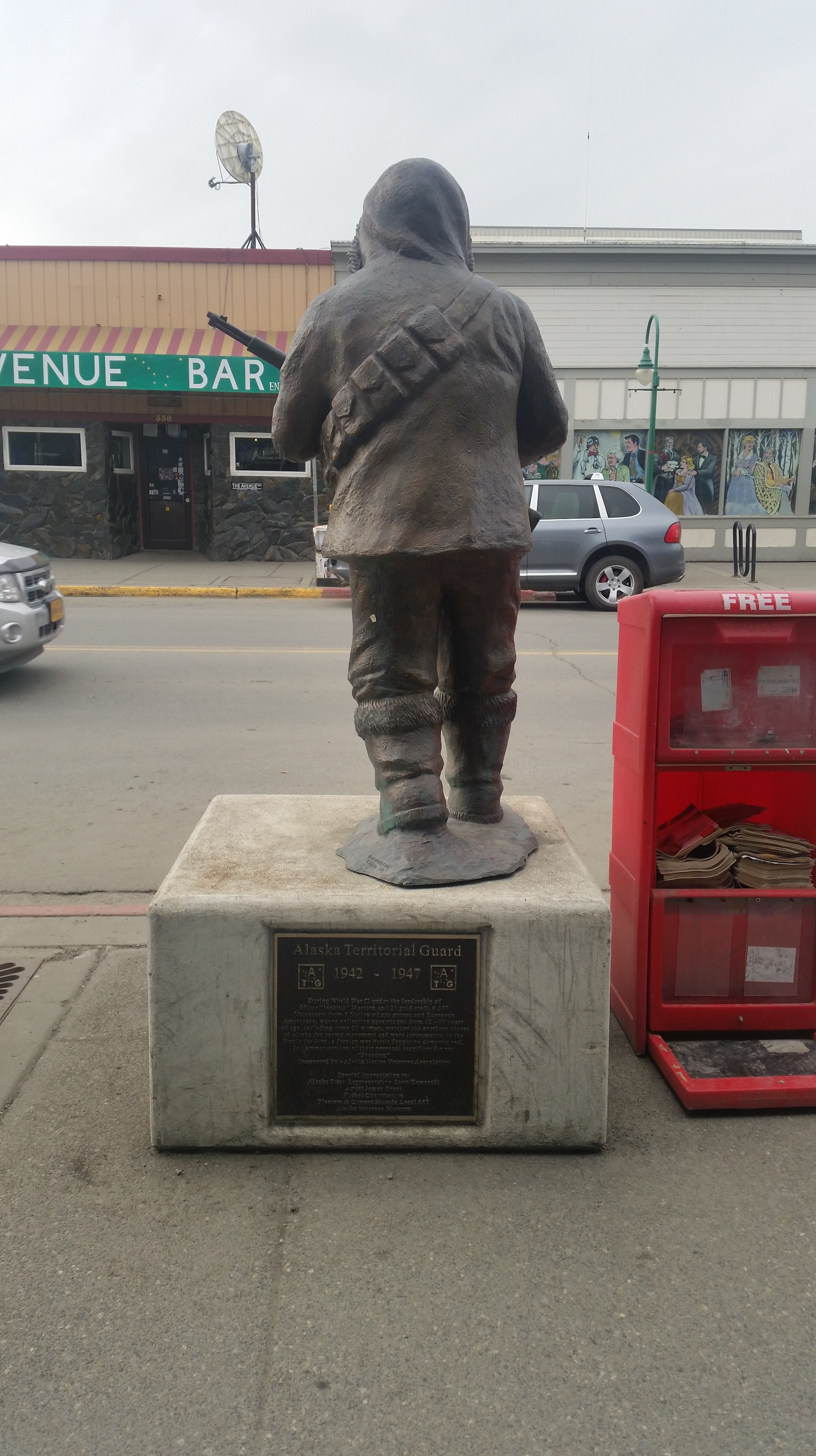
The Alaskan Territorial Guard also gets prominent treatment here, though I am ashamed to say I didn’t get great pictures of that section. Just clumsy lensmanship on my part. The museum itself covers the history of this unit, comprised largely of Alaska Natives under the leadership of Major Marvin ‘Muktuk’ Marston. The unit (including a number of women) was charged with monitoring the coastline to act as a first line of defense. They also had to be on the look out for balloon bombs (sent over the Pacific in the hopes of starting forest fires in the U.S.).
The museum includes several outstanding dioramas, most of which feature naval operations. I struggled to get a good picture of the aircraft carrier, but in the end I had to settle for a few close-ups. The model itself was just too big to get in a single shot.
I was unfamiliar with the story of the U.S.S. Grunion, a submarine lost near Kiska, so this part of the exhibit was entirely new to me. One particular veteran, Percy Blatchford, had a section to himself. You can find him around the net as well. Each of the major conflicts of American history receive some treatment here, in each case focusing on the experiences of Alaskan military personnel.
A couple stories that didn’t get into the museum (at least I don’t think so) would include the Navy’s bombing of Angoon in 1882 and the story of Aleutian internment. They do cover the Japanese internment of Aleutians, but no mention is made of those taken off those Islands by the U.S. personnel. I’m not entirely sure I caught everything during my visits last month, and I am still amazed at the breadth of materials they got into the collection. As I understand it, they have a great deal more in storage, and that storage may be spilling into the homes of those behind the museum itself. It’s obviously a labor of love, so I suppose that is to be expected.
On one of my visits to the Museum, I had the pleasure of meeting Col. Suellyn Wright Novak who heads up the Museum. She had a number of great stories to tell, including that of the Alaskan Territorial Guard statue out in front. Some wonder why it doesn’t have a plaque on it? Those more observant have wondered why the information plaque is behind the guardsman. It turns out, the museum staff just didn’t want anyone to be run-over while reading the plaque from the street.
…good thinking.
I am posting a few pics here, but of course they don’t do the museum justice. As usual, you may click to embiggen.
***
Shenandoah
Course of the Shenandoah
Shenandoah
Dioramas!
Carrier Model Goodness
Small Diorama
Epic Diorama
Moar Epic Diorama!
Epic Diorama Again
Aircraft Carrier Again
Moar Carrier!
DId I mention they have a model carrier?
They definitely have a model carrier
AIrcraft Carrier
Diorama
Aleutian Campaign
I think I would want a lot more uniform!
Map of Kiska
Aleutian Campaign
Alaska Territorial Guard
Alaska Territorial Guard Etched on Baleen
The U.S.S. Grunion
U.S.S. Grunion
The U.S.S. Grunion
General
Desert Storm
A Dress made of Parachute Silk
Bombing of Dutch Harbor
Humorous Advice
A Pilot’s Story
Humor
Okay
Hazards of making a wedding dress out of parachute silk.
Cool!
U.S. Revenue Cutter, The Bear (This ship appears in many stories about Alaska)
For me, The Fog of War (2003) is absolutely the gift that keeps on giving. I get more fascinated every time I watch this film. There are so many angles to it, so many sub-themes to explore. Lately, I find myself more and more interested in its language. The Fog of War was directed by Errol Morris (of the Thin Blue Line). It consists of a series of interviews with Robert S. McNamara, a man at the center of conflict throughout much of the twentieth-century. Few people could have provided more direct insight into the thinking behind some of the most terrible decisions of that era. By ‘terrible decisions’ I don’t mean poor choices so much as decisions with so much at stake, one can’t help tremble at the thought of them. That many of these decisions were also (arguably) also poor choices in the other sense, choices that cost the lives of countless people is also a big part of this story.
A lesser man might not struggle with such questions at all, resting certain in whatever rationalizations suited him best. But there McNamara is in the Fog of War, right on screen talking about those very decisions, and trembling at the thought of them, right in front of the camera. For a man with blood on his hands (and frankly, enormous quantities of it), McNamara is remarkably candid. Also remarkably thoughtful. Still, there are moments when his honesty fails him. Limits he doesn’t seem quite willing to cross, and possibilities he clearly doesn’t want to explore. In those moments, the hesitation is all over his language.
It begins in some of the first frames of the movie. McNamara tells us that in the course of his life he has been “part of wars.” Fair enough, one might say, but more fairly still he has been more than part of wars. He has been a driving force in wars, perhaps in some cases against his better judgement, but he has certainly been more than part of wars. The wording is mild, perhaps a simple lead-in, but the phrase just doesn’t do justice to the facts that will follow.
***
The film is punctuated with lessons drawn from McNamara’s experiences. It is Morris that pulls the lessons out of the narrative and presents them as bullet points for our benefit. The first lesson begins with the importance of empathy, not simply as a source of human kindness, but as a method of survival, a means of understanding adversaries. This alone saved the world from total devastation during the Cuban Missile Crisis, according to McNamara. Morris interrupts him to suggest that McNamara left out a few things in his account of the Russian motivations. Perhaps he didn’t like being interrupted. Perhaps, he wasn’t prepared to acknowledge some of the facts at issue. McNamara is reluctant to get into the issue of genuine Russian grievances, but rallies so to speak, even going so far as to add a few facts in their favor. Still, he wavers at the end, not quite able to come clean on his own role in some of those grievances.
Morris: “Also, we had attempted to invade Cuba.
McNamara: Well, with the Bay of Pigs, that undoubtedly influenced their thinking. I think that’s correct, but more importantly, from a Cuban and a Russian point of view, they knew, what in a sense I really didn’t know. We had attempted to assassinate Castro under Eisenhower and under Kennedy, and later under Johnson, and in addition to that, major voices in the U.S. were calling for invasion.
Every time I watch this film, I wonder what that means. In what sense is it that McNamara didn’t know that the U.S. had tried to assassinate Castro? Is this a fatal failure moral courage? Is McNamara simply unable to admit what he knew? Or is this a key to understanding the (dis-)organization of American diplomacy? Is it possible that he was the left hand, only dimly aware of what the right one was up to? Don’t know, but seriously, that’s a Hell of a hedge coming through an otherwise brilliant narrative.
***
McNamara served in the U.S. Air Forces during World War II, serving under General Curtis LeMay. He provided statistical analysis of U.S. bombing missions. I know paperwork, right? But sometimes the pen really is mightier than the sword, or even the canon. Clearly, McNamara’s reports were not simply filed…
McNamara: I was on the island of Guam, in his command, in March of 1945. In that single night, we burned to death a hundred thousand Japanese civilians in Tokyo. Men, Women, and children.
Morris: Were you aware this was going to happen?
McNamara: Well, I was…, I was part of a mechanism that in a sense recommended it.
I analyzed bombing operations and how to make them more efficient, i.e. not more efficient in the sense of killing more, but more efficient in the sense of weakening the adversary. I wrote one report analyzing the efficiency of the B-29 operations. The B-29 could get above the fighter aircraft, and above the air defense, so the loss rate would be much less. The problem was the accuracy was also much less. Now I don’t want to suggest that it was my report that led to, I’ll call it the firebombing. It isn’t that I’m trying to absolve myself of blame for the firebombing. I don’t want to suggest that it was I that put in LeMay’s mind that his operations were totally inefficient and had to be drastically changed, but anyway that’s what he did. He took the B-29s down to 5,000 feet, and he decided to bomb with firebombs.
The first phrasing of interest here is the recommendation. This is a double hedge. McNamara doesn’t take personal responsibility in this statement. He submerges himself in a larger “mechanism,” but that isn’t enough, because that mechanism only recommends the firebombing “in a sense.” McNamara thus starts his answer to Morris two full shields removed from personal responsibility for the firebombings. He then goes onto assure us that the measure of efficiency he used was not simply the number of people killed but the effectiveness of the bombing in weakening the enemy. It is an interesting distinction, albeit one perhaps lost at the moment when the fires reached their victims. That McNamara struggles with this is clear enough throughout this and many other segments of the film. I don’t mean to suggest he is insensitive to the topic. Rather, his struggle seems to suggest the opposite. McNamara hasn’t quite explained his own role adequately to himself, and the result is the final mess of hedging about the question of personal responsibility. He denies it, but he also denies that he denies it. It’s easy enough to point to LeMay, and with good reason; it was LeMay’s decision. Still, I can’t help thinking that answer wasn’t even sufficient for McNamara.
***
Morris: The choice of incendiary bombs, where did that come from?
McNamara: I think the issue is not so much incendiary bombs. I think the issue is in order to win a war should you kill a hundred thousand people in one night, by firebombing or any other way. LeMay’s answer would be clearly ‘yes’. McNamara do you mean to say that instead of killing a hundred thousand, burning to death of a hundred thousand Japanese civilians in that one night, we should have burned to death a lesser number, or none, and then had our soldiers cross the beaches in Tokyo and been slaughtered in the tens of thousands? Is that what you’re proposing? Is that moral? Is that wise?
Why was it necessary to drop the nuclear bomb if LeMay was burning up Japan? And he went on from Tokyo to firebomb other cities. 58% of Yokohama. Yokohama is roughly the size of Cleveland. 58% of Cleveland destroyed. Tokyo is roughly the size of New York. 51% percent of New York destroyed. 99% of the equivalent of Chattanooga, which was Toyama. 40% of the equivalent of Los Angeles, which was Nagoya. This was all done before the dropping of the nuclear bomb, which by the way was dropped by LeMay’s command. Proportionality should be a guideline in war. Killing 50% to 90% of the people of 67 Japanese cities and then bombing them with two nuclear bombs is not proportional, in the minds of some people, to the objectives we were trying to achieve. I don’t fault Truman for dropping the nuclear bomb. The U.S. Japanese war was one of the most brutal wars in all of human history; kamikaze pilots, suicide, unbelievable. What one can criticize is that the human race, prior to that time, and today, has not really grappled with what are, I’ll call it the rules of war. Was there a rule then that said you shouldn’t bomb, shouldn’t kill, shouldn’t burn to death a hundred thousand civilians in a night. LeMay said, if we’d lost the war, we’d all have been prosecuted as war criminals. And I think he’s right. He, and I’d say I were behaving as war criminals. LeMay recognized that what he was doing would be thought immoral if his side had lost. But what makes it immoral if your lose and not immoral if you win?
This one of the most fascinating monologues I have yet seen in a film. McNamara seems determined to ensure we understand the full gravity of the situation, almost urging the case against himself and others. He wants us to know this was a terrible decision, perhaps even a crime. And yet, he builds a kind of defense into the narrative. It begins with his refusal to answer the question. He had been asked who was responsible for the decision to use incendiary bombs, thus generating more civilian deaths than conventional ordinance might have. Whatever else, McNamara’s speech here gives us, it does not give us a direct answer to that question.
The narrative also serves to shape questions about McNamara’s own role in the affair in terms of his relationship to his commander. It is LeMay’s thoughts on the subject which control McNamara’s story-line. His own decisions are thus framed in terms of what LeMay might have said in response to any argument against the decision to firebomb the Japanese cities. If McNamara himself might have objected, this story suggests, his concerns would have been simply overruled.
Lastly, McNamara deflects the moral questions onto humanity itself. Nevermind who was responsible for this particular decision. The real question is one that falls to humanity itself. How might humanity have handled such an issue? McNamara seems to suggest, the answer would take the form of a rule of war. The specific feasibility of such rules at that time (or any other) is not so clear, but seems to be how he wants to address the issue. And in the end, this means NOT addressing the issue of just who is responsible for burning all those women and children up during World War II. McNamara wants us to understand it’s a serious issue, but he is at great pains to avoid dealing with it too directly.
***
This may seem like a side-issue, but I can’t help thinking it points to a Hell of a drama in its own right. McNamara’s thoughts on his own family and the impact of his service as Secretary of Defense under President Kennedy contain some interesting hedges of their own.
That’s the way it (his role as Secretary of State) began. You know, there was a traumatic period. My wife probably got ulcers from it, may have even ultimately have died from the stress. My son got ulcers; it was a very traumatic, but they were some of the best years of our lives, and all the members of my family benefited from it. It was terrific.
I can’t help wondering how McNamara could say that his service benefited all members of his family while telling us the job may well have killed his wife. It seems cruel to me, even to point this out, and yet, it seems an important fact. Among the many who suffered through this man’s career, one may well count members of his own family. No doubt, this too has its reasons, reasons he doesn’t owe us, but as much as he gives is damned disturbing. And I wonder if that sort of story isn’t a bit more common than one might suspect.
***
Regarding the build-up of the Vietnam War…
There was a coup in South Vietnam. Diem was overthrown, and he and his brother were killed. I was present with the President when together we received information of that coup. I have never seem him more upset. He totally blanched. President Kennedy and I had tremendous problems with Diem, but My God! He was the authority, he was the head of state, and he was overthrown by a military coup, and Kennedy knew, and I knew, that to some degree the U.S. Government was responsible for that.
Here again, one seems to see McNamara posing as the left hand struggling to understand what the right hand was doing. Government is complex, sure, but I can’t help wondering; if I were in a more polemic mood, might I start a criticism of this war by asking just how in the Hell the CIA could give it’s blessings to a coup the President and his Secretary of Defence didn’t support?
***
Speaking of Vietnam, there is a fascinating moment covering the Gulf of Tonkin incident. Twice in August of 1964, the Destroyer USS Maddox reported attacks from North Vietnamese forces. These attacks have long been disputed, but nevertheless, they provided the rational for a resolution authorizing use of greater force by Lyndon Johnson. McNamara provides his own take on the details. One of the more interesting gems here is an audio-taped recording of a man on the Maddox reporting the attacks. Asked if he is sure that a torpedo had been fired at the ship, he replies in the affirmative; “No doubt about that, …I think.”
***
“What I’m doing is thinking it through with hindsight, but you don’t have hindsight available at the time. I’m very proud of my accomplishments, and I’m very sorry that in the process of accomplishing things, I’ve made errors.”
This line comes toward the end of the film as McNamara is beginning to summarize the whole thing. One might question whether or not ‘errors’ would be the most appropriate word to use for the sense of moral transgression that haunts this film. Perhaps, this may seem unfair. McNamara and those he served with had responsibilities some of us will thankfully never know. Had he done too little, he might well have faced similarly questions about the loss of American lives due to failure of nerve. So, does this render the whole issue a kind of practical calculation, a simple cost-benefit analysis? McNamara seems to have been well trained in such accounting. This might well be his honest sense of the issues. Sill, one has to wonder at the use of ‘error’ to describe the moral significance of lives lost wasted.
***
What is morally appropriate in a wartime environment? Let me give you an illustration. While I was Secretary, we used what’s called “Agent Orange” in Vietnam, a chemical that strips leaves off of trees. After the war, it is claimed that that was a toxic chemical, and it killed many individuals, soldiers and civilians exposed to it. Were those who issued the approval to use Agent Orange criminals? Were they committing a crime against humanity? Let’s look at the law. Now what kind of law do we have that says these chemicals are acceptable for use in war and these chemicals are not. We don’t have clear definitions of that kind. I never in the world would have authorized an illegal action. I’m not really sure I authorized Agent Orange. I don’t remember it, but it certainly occurred, the use of it occurred while I was Secretary.
What is most striking about this passage is the distance between McNamara and a decision for which he was clearly responsible. McNamara does acknowledge this happened on his watch. And yet he discusses the issue for the most part as though the responsibility must fall on the shoulders of someone else. Again, McNamara seems to look to the laws for answers to these questions, but that too seems to be a bit of a dodge. Does he really need a law to tell him not to poison people?
…also noteworthy here would be the sense that something is odd about the claim that a chemical that strips leaves from plants might be harmful humans. McNamara doesn’t quite acknowledge that it is harmful. He is content to tell us that “it is claimed…”
***
Near the end of the film, McNamara relates the story of a protester. His account here is fascinating in many ways. What interests me about it at present is the way he frames the moral questions again in terms of humanity itself. This was a protester who died trying to communicate something to McNamara himself, but McNamara saw the significance of his death in the language of the man’s wife, as a question for all of humanity. Perhaps such questions are well asked of all of humanity, and yet I can’t help thinking that a question asked of all of humanity isn’t really asked of any particular person.
…or perhaps, more to the point, a person weary of answering such questions in his own life, weary of his own answers and the consequences of the answers he has given, might well prefer to have humanity itself grapple with those questions.
Anyway, we’ll leave it with this last quote.
Norman Morrison was a Quaker. He was opposed to war, the violence of war, the killing. He came to the Pentagon, doused himself with gasoline. Burned himself to death below my office. He held a child in his arms, his daughter. Passersby shouted, “Save the child!” He threw the child out of his arms, and the child lived, and is alive today. His wife issued a very moving statement, uh; ‘Human beings must stop killing other human beings.’ And that’s a belief that I shared. I shared it then and I believe it even more strongly today. How much evil must we do in order to do good? We have certain ideals, certain responsibilities. Recognize that at times you will have to engage in evil, but minimize it.
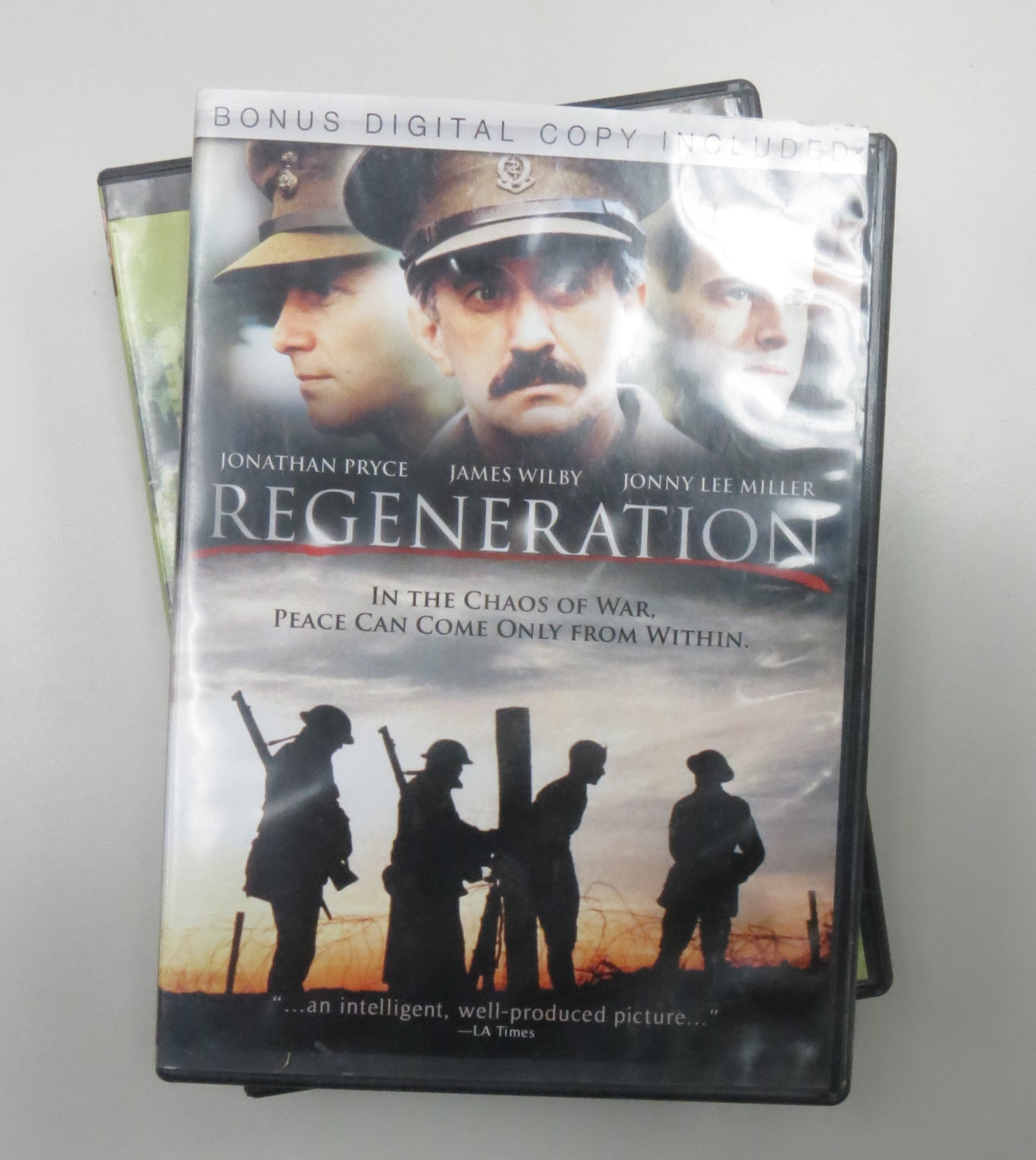
Have a look at the pitch line on this movie. “In the chaos of war, peace can only come from within.” What’s odd about that, you may ask? It is after all a story about a soldier and the psychiatrist who has been assigned to help him recover from Shell Shock. So, the line makes a lot of sense right? Well, yes it does.
Unless of course, you’ve seen the movie.
Because if you’ve seen the movie, then you will likely realize that the premise of the film is actually that the soldier, Sigfried Sassoon is NOT actually suffering from Shell Shock. (Sassoon was in fact a real historical figure, by the way, one well worth knowing about.) He had in fact published an open letter in opposition to the war. As the man was already a highly celebrated war hero and a recipient of the military cross, this posed a bit of an unusual problem for the British high command. You can’t just put a hero in front of a firing squad, can you? So, the British military wasn’t quite sure what to do about this. The solution was to declare him ill and assign a psychiatrist to treat him. By ‘treat’ in this case we mean of course that the psychiatrist in the film was expected to talk Sassoon into going back out to join the fighting. Far from a movie about finding inner peace, this is a film about the misuse of medical science in the politics of war. It is in fact a very bitter tale of a medical practice that wasn’t about finding peace of any kind.
But, hey ad guys! Don’t let that stop you from putting a perfectly vapid cliché on the cover of this wonderful film. Better yet, why don’t you pick a theme that carries forward the very hypocrisy addressed in the movie itself.













 Apparently, it still is.
 “To the heroes who have fallen in various battles with savage Indians in the Territory of New Mexico.”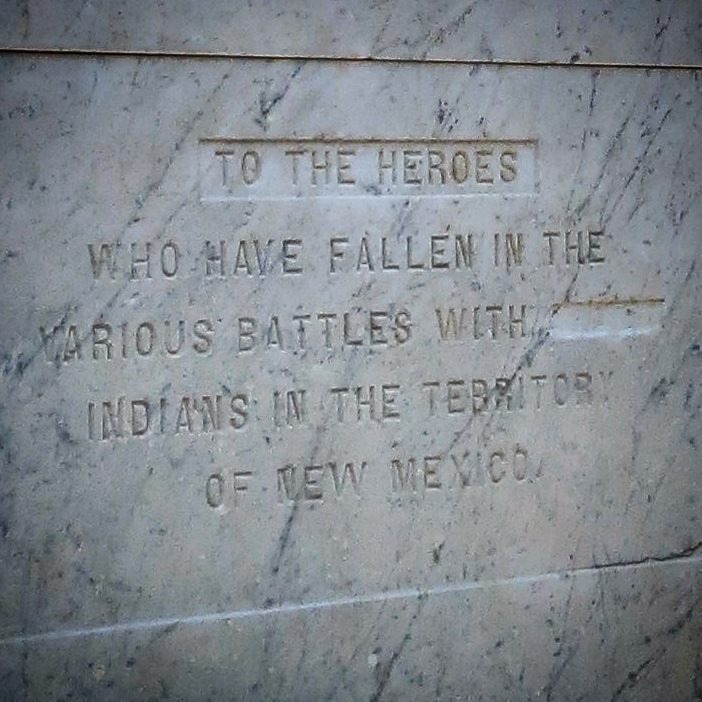




 For me,

 northierthanthou