• About

northierthanthou

northierthanthou

Category Archives: atheism

This is where I get godless in a big way. But seriously, I’m not mad at the Deity; I just don’t believe in Her.

The Devil is in the Deductions: Spiritual Warfare and Apologetics Viewed from the Dark Side

15 Saturday Dec 2012

Posted by danielwalldammit in atheism, Religion

≈ 25 Comments

Tags

atheism, Christianity, Debate, History, Logic, Reasoning, religion, Satan, Spiritual Wafare
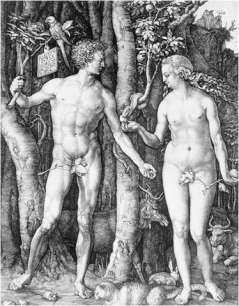
image25The first sin was not the eating of an apple (or even a pomegranate). No, it began when mankind (or at least Eve) gave an ear to the Serpent, or so the story goes, at least according to my old Bible-as-Literature prof. I try to keep that in mind whenever I find myself cast in the role of that Serpent, or at least one of his servants.

I am speaking of course of those moments when someone tells me that I worship Satan, or that I serve him. It is common enough to see this charge leveled at atheists, at least on the net. I doubt its occurrence is limited to that context.

I must say that it took me some time to wrap my mind around the concept. You might think it would be a little difficult to worship an entity in which you don’t believe. I certainly did. But it turns out to be remarkably easy to serve him, he does all the work for you, even without letting you know about it. I have been reassured many times that my actions serve the dark lord, regardless of my own conscious intent. I have also been told that deep down I know this to be the case, whether I will admit it or not. It’s always fascinating to find out what I know and what I believe, especially when it has the makings of a good horror story.

Just think of it; you have two competing stories!

– On the one hand, I would like to think of my story as one of a sincere guy tapping away at the keyboard in the hopes that he can present a reasonable case for a position that he thinks is correct. In the end maybe I can teach something to someone, or perhaps learn something from a well-reasoned response. We could call this the intellectual exchange model of the disc… hey you! Wake up, dammit!

– Okay, on the other hand, you have a minion of Lucifer operating under the auspices of the Dark Lord himself to invest ordinary binary code with the force of evil and send it out to work its insidious wonders on unsuspecting believers. The argument itself is hardly important; it serves as a vehicle for some sort of insidious power.

renaissance-the-school-of-athens-classic-art-paitings-raphael-painter-rafael-philosophers-HD-WallpapersHonestly, it doesn’t take much effort to figure out which is the more interesting story. (Sigh!) And if you too count yourself as a vocal non-believer, this whole thing probably rings a bell or three in your own experience.

In truth, there is little one could do to answer such a claim, that one serves Satan, because of course every answer you give would be subject to the same suspicion. This is why I am inclined to think of the story of Adam and Eve here. …and of the Serpent. The trouble really does begin for that narrative in the decision to listen to that serpent as it is an act of disloyalty to God. To speak with His enemy at all is itself unthinkable! Subsequent troubles could hardly be surprising; they are the narrative consequence of willfully opening oneself to an evil message. If that’s the way some believers see the input of atheists, then that doesn’t bode well for anything along the lines of, um, constructive dialogue.

I do think this is the model behind the charge that atheists serve Satan. It not merely some bit of empirical confusion about what we do and don’t believe, so much as it is a warning about the nature of any message we happen to carry. That is precisely the point of casting atheists in the role of Satan’s servants; it is in effect to construe our every word and deed as an evil which one ought not to give reasonable consideration. It isn’t really even the metaphysics of this proposition that matters; it’s the pragmatics. Simply put, the moral of the story is don’t listen to anyone who casts any sort of doubt on God.

I have tried myself and seen others attempt a range of different responses to this kind of charge, but lately I am inclined to accept it.

I’ll be your huckleberry.
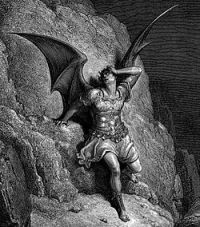
250px-GustaveDoreParadiseLostSatanProfileI don’t mean to say that I actually intend harm to others, but I am simply done trying to convince certain parties that I (or other atheists) can be good without God. If these are the terms, then I sometimes want to say ‘so be it’. I will not give those who make such accusations the satisfaction of trying to plead innocence from the bottom of a poisoned well.

The whole accusation smacks of manipulation of course, but it is not merely manipulation, because some people actually do seem to believe it, or at least they say that they do. In its own right, this sort of charge is actually a fascinating example of the limitations of reasoning.

Another of my old professors, Maurice Finnochiaro, used to talk about the study of argumentation as an historical phenomenon. He was interested in meta-argumentation, arguments about arguments. And in its own way this little gift of frustration for an unbeliever is in fact an argument about an argument. It is a clear and concise statement about the prospects for constructive discussion, albeit a rather pessimistic one.

The viewpoint in question is very much informed by the outlook of Spiritual Warfare. It reflects a range of suppositions about the spiritual powers at play in the world. It is the same sort of thinking that finds Satanic messages in so many rock&roll lyrics, Devil Worshipers in Day-care centers everywhere, and demons in Hentai images. It is the same thinking that leads to talk of protecting baby-Christians (those new in the faith) from exposure to other views, and it is the same sort of thinking that plays havoc with the lives of homosexuals in Uganda and other places where some Charismatic Christians go to press for policies they could never manage in the west. But seriously, my list of horribles aside, the point is that there is a body of religious tenets behind the sort of charge that atheists serve Satan. If we are inconvenienced by the whole thing, chances are we should count our blessings.

…though we won’t actually want to call them ‘blessings’ of course.

But the charge of Satanic worship, absurd though it may be to the mind of an unbeliever is a good reminder of the reflexive nature of reasoning. It would be a swell world for rationalists if we could divide all the ideas of humanity up into those about which we reason and then a separate list of ideas about how to reason about the items on the first list. It would be swell if that second set rested safely outside the scope of disagreement, a sort of neutral arbiter in our disputes. But it just doesn’t work like that. And in this as in any other debate, one must remember that among our disagreements we often also differ on the significance of the disagreements themselves. In other words, part of the argument is also always about the nature of argumentation itself.

Sometimes we are fortunate enough to discuss (or even debate) people with whom we share enough assumptions about the nature of reasoning to proceed with a constructive discussion, even in the face of vast disagreements over issues like belief in God. Folks may not flip their whole belief orientation on the basis of a single conversation (or even thirty of them), but sometimes we shift a little, modify an assumption, or even simply come to appreciate the aesthetics of a well argued point from the other side. Such discussions can be rewarding and pleasant exchanges, …if that is, one starts with a range of assumptions that makes it possible.

Some people just don’t make those same assumptions. When someone says that atheists serve Satan, they are sending a very clear signal that they are not down for the discussion, at least on any terms which would give an unbeliever a chance. To do so would already be a betrayal of their faith, and a mistake exposing them to tremendous evil (evil carried by you and I, my unbelieving friends). It is also a signal that the clear significance of your words (to that person) lies not in the quality of your reasoning so much as an impersonal force over which you may not have conscious control. That force will be the focus of the accuser, not the cogency of any argument you make.

So, what’s a devil to do?

Honestly, I don’t know.

Damn me anyhow!

71.271549 -156.751450

Share this:

  • Tweet
  • Share on Tumblr
  • Click to print (Opens in new window) Print
  • Click to email a link to a friend (Opens in new window) Email
  • Click to share on Reddit (Opens in new window) Reddit
Like Loading...

Of Loyalties and Lords and Faith as a Horror Show

13 Tuesday Nov 2012

Posted by danielwalldammit in atheism, Childhood, Religion

≈ 21 Comments

Tags

Abraham, atheism, Christianity, Christopher Hitchens, God, Heaven, Sacrifice, The Bible

Kent State Memorial
(Rejected)

Of all the Old Testament stories in my old Cartoon Bible, the one that made the greatest impression on me as a child was the story the Abraham and Isaac. It’s a pretty terrible thing for a 6 year old to contemplate, the specter of  a loving father prepared to kill his own child. I was supposed to be impressed with the faith of Abraham and the mercy of the Lord. Instead I shuddered to think of a father willing to do such a thing and a God for whom that would count as a virtue. I had never been taught to fear the Lord, as they say, but I certainly began to wonder if I should fear Him upon reading that scripture. More to the point, I wondered if I should fear my own father?

Significantly, it was my own father that I turned to for questions about the meaning of that Bible. I don’t recall exactly what Dad had to say about that passage, though I want to think that he might have called into question its particular vision of God. There are of course plenty of wonderful messages to be found in (or read into) the story of Abraham, but there is at least one message that I could never reconcile with my own sense of right and wrong, with my own sense of what family should be to one another. It was never Abraham’s faith that impressed me. Rather, it was his faithlessness; his betrayal of his son.

Of course Abraham didn’t actually kill his son, an Angel of the Lord stayed his hand. Still, I couldn’t help but imagine looking into my own father’s eyes and knowing that he was prepared to do such a thing. How could anything be right in the world after a moment such as that?

And how could anything be right in a world where its creator could want such a moment? At 46, the moral universe of that lesson still terrifies me, all the more so, because there are people who reside within it, even if their God does not.

It doesn’t appear that I am alone in this. The late Christopher Hitchens raised this objection several times, most notably in his book, God is not Great. But of course Hitchens is hardly the first public figure to underscore the trace of terror in this narrative. The story of Abraham and Isaac has darkened more than a few moments of artistic expression.

The sinister vision of Abraham appears in Leonard Cohen’s Story of Isaac, and of course in the opening lines of Dylan’s Highway 61. The sculptor George Segal deemed it a fitting symbol for a memorial to the Kent State Shootings (though Kent state University rejected his work, which is why it now rests at Princeton University). I’m also reminded of a rather bad movie with an interesting twist. In The Rapture, Mimi Rogers plays Sharon, a mother commanded by God to kill her own daughter in order to achieve Heaven. Having complied with His commands, she cannot bring herself to enter Heaven. Perhaps she too thought that nothing could ever be right again after crossing such a threshold.

My favorite use of the Abrahamic trope comes from Wilfred Owen who used it to comment on the horrors of World War I. His poem is called The Parable of the Old Man and the Young:

Then Abram bound the youth with belts and straps,

And builded parapets and trenches there,

And stretchèd forth the knife to slay his son.

When lo! an angel called him out of heaven,

Saying, Lay not thy hand upon the lad,

Neither do anything to him, thy son.

Behold! Caught in a thicket by its horns,

A Ram. Offer the Ram of Pride instead.

But the old man would not so, but slew his son,

And half the seed of Europe, one by one.

It would be a mistake to see in all these narratives the sort of polemics Hitchens had in mind, but they do speak to an element of meaning that cannot quite be reduced to the faith of Abraham or the mercy of God. There is something truly disconcerting about the command given to Abraham. Still more so his willingness to follow it. In the story of Abraham, if only for a moment, faith becomes a source of terror. I expect that for most believers the moment passes.

For some of us it never does.

Kurt Vonnegut may have struggled with that moment more than any of us. It haunts the opening chapter of Slaughterhouse Five, though Vonnegut took his point of departure from a different passage. It was the story of Sodom and Gomorrah that seemed to ask too much of Vonnegut.

And Lot’s wife, of course, was told not to look back where all those people and their homes had been. But she did look back, and I love her for that, because it was so human. So she was turned to a pillar of salt. So it goes.

It shouldn’t take much imagination to understand why Vonnegut of all people would identify with Lot’s wife. …to see how he could find in her a fitting symbol of something human, something often lost by demands of faith and loyalty. It was typical of Vonnegut that he didn’t quite field a direct objection to the Biblical narrative. He doesn’t deny the moral order of God’s commands (or even those of the Allied Air Command in his own day). He doesn’t even say that she was right and God was wrong. He simply embraces the moment when Lot’s wife does look back, and in doing so Vonnegut reaffirms the value of all the lives buried in that Biblical tale, …and of course those consumed in the fires of Dresden.

Gods do what they will, so it seems. There is little that mortals can do about it, but the God Abraham has always demanded just a little more. He has always demanded that we love him for it, that we condemn his victims along with him, and that we think of his acts of terror as positive moral actions.

And sometimes that is just too much.

For me that line is crossed in at least one more sort of story, one which brings us full circle to the relationship between father and child.

The concern is illustrated wonderfully in is a scene from the movie Black Robe wherein a missionary (Father LaForge, played by Lothaire Bluteau)  tries to convert an Algonquian-speaking native (Chomina, played by August Schellenberg) to the Christian faith just before the man dies. Desperate to save his companion’s soul, Laforge offers Chomina the promise of eternal life in Heaven. But of course LaForge must admit that none of the Chomina’s heathen relations will be with him in this eternal life. Neither Chomina’s wife, nor his parents, nor even his youngest child will be there to meet him in Heaven, because they died without accepting the faith.

It would be easy to under-estimate the power Chomina’s response to LaForge in that movie, but it has always seemed to me a very compelling argument. It works for me, not because of fictional characters with fictional relations, but because of real people in my own life. I am well aware that some (perhaps many) of those I have known and loved passed away without reconciling themselves to terms of sundry Christian teachings. What must be done of course varies from church to church, but in each case where the price of heaven is conversion, I know of specific people who failed to make that choice in terms described by one or all of these churches. Faced with the prospect of conversion and its benefits myself, I can honestly say that the choice strikes me as a betrayal.

Do I belong in this heaven, while my father does not? And will I enjoy paradise while others that I loved rot in graves, burn in eternal fires, or simply waste away in outer darkness?

If there is a God in heaven that would have this, then I will say ‘no’ to Him.

He is asking for too much.

71.271549 -156.751450

Share this:

  • Tweet
  • Share on Tumblr
  • Click to print (Opens in new window) Print
  • Click to email a link to a friend (Opens in new window) Email
  • Click to share on Reddit (Opens in new window) Reddit
Like Loading...

Jesus is the Homunculus of Human Suffering

04 Thursday Oct 2012

Posted by danielwalldammit in atheism, Philosophy, Religion

≈ 23 Comments

Tags

atheism, Catholicism, Homunculus, Jesus, Meaning, Philosophy, religion, suffering, Theodicy

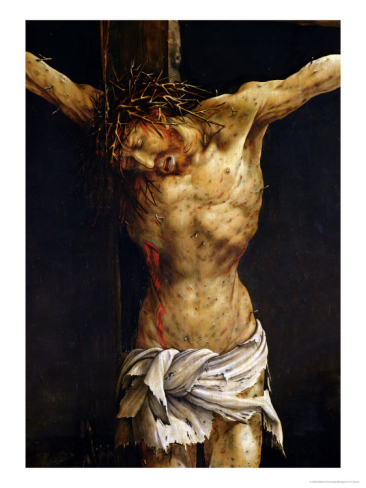
Crucified Christ by
Matthias Grünewald

Sometimes texts and utterances become what they purport to describe. Case in point? This little meditation on the spiritual meaning of suffering, An Attempt to Explain Christianity to Atheists In a Manner That Might Not Freak Them Out by The Bad Catholic at Patheos.com. Well, it certainly became a source of suffering for me (and apparently for P.Z. Myers of Pharyngula), and I suspect not a few others trying to sift through the article for one reason or another. Whether or not the article succeeds in becoming meaningful is another question.

Honestly, the whole thing is a Gish Gallop for me, from the scholastic presentation to the major assumptions of the argument and the vocabulary its author uses. Were I to attempt a refutation, I wouldn’t know where to start. If this was an attempt (as the author suggests) to speak to atheists, I can’t help but think it is an utter failure (or perhaps an ironic joke). If its author ever seriously had an unbelieving audience in mind, then he has done just about as much as he could to avoid communicating with that audience.

There is however one thing about this piece that does catch my attention; its final paragraph (emphasis added):

This changes everything: To see the child with leukemia is to see Christ suffering in that child, suffering to bring the world back to Perfection. To experience agony is to cry out with the strain of lifting this fallen world to Paradise. We are called to recognize this, and to actualize this. This is why I am a Christian.

I say this bit catches my attention, because I find it genuinely disturbing. I also recognize it (or something like it) from a number of previous conversations with believers, many of whom have advanced the argument that life is somehow less meaningful without God. They don’t always state their position in such stark terms, but I do think the view is common enough to rise above the idiosyncracies of this particular article. So, it is perhaps worth a comment or two.

Kitch-Christ: The true meaning of suffering?

The claim that Bad Catholic makes, that to see a child suffering is to see Christ suffering within her is thoroughly dehumanizing, because it relegates the suffering of the child to a secondary role. What is moving about the suffering of a child is not her own suffering but that of Christ. The meaning of suffering has, according to Bad Catholic, less to do with the pain of particular persons than the cosmic struggle of a heroic Jesus trying to lift the fallen world into paradise. I am not even sure if it is the crucified Christ we are supposed to see in this girl. Rather, I think we are supposed to see in the eyes of a child suffering the muscular Jesus of the Lord’s Gym lifting his heavy cross up to save the world. Her suffering is meaningful precisely because of the meaning that Christ gives it.

No.

Not just ‘no’, but Hell no!

And if you want to write about a deficiency of meaning in the world then you have one right there. Never mind a world without God; how about one in which you cannot see the most compelling moments of human suffering because of the big giant Jesus standing in your way!

If the suffering of people right in front of you requires a theory making it about something else altogether, or rather someone else, then your faith does not augment the meaning of suffering; it detracts from it. And the theory that was supposed to deepen our understanding of suffering has instead blunted its very force. It is not the suffering of the little girl that matters; it is not her loss of hope, or her agony, or her tears; it is that of someone else.

As I read this utter crap, I can’t help but to be struck by a quote the Bad Catholic keeps at the top of his webpage. It is attributed to G.K. Chesterton; “Let your religion be less of a theory and more of a love affair.” I can’t help but think this wonderful little quote might well have forestalled this miserable exercise in tortured logic and pathetic indifference to the actual condition of suffering in another living being.

Perhaps one ought to let his sense of other living things be less a theory and more of a love affair.

The meaning of human suffering is immediate. This is no less true of others than it is for ourselves. I for one do not need to see Jesus Christ or any other supernatural entity to give a damn about the suffering of another human being, or even that of an animal.

Do you?

Photo by Kevin Carter

71.271549 -156.751450

Share this:

  • Tweet
  • Share on Tumblr
  • Click to print (Opens in new window) Print
  • Click to email a link to a friend (Opens in new window) Email
  • Click to share on Reddit (Opens in new window) Reddit
Like Loading...

Primitive Superstition and Proxy Fundamentalism: Further Reflections on Native American Spirituality

17 Tuesday Jul 2012

Posted by danielwalldammit in Anthropology, atheism, History, Native American Themes, Religion

≈ 15 Comments

Tags

Aborigine, American Indian, atheism, Native American, Oral Tradition, Primitive, Rationality, Science, Superstition

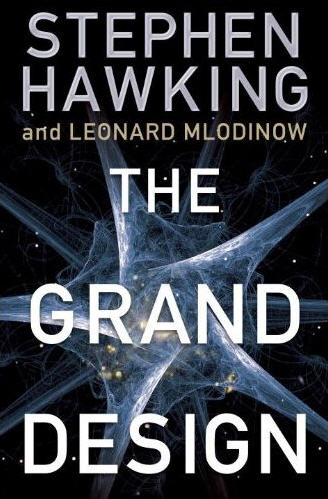
Stephen Hawking and Leonard Moldinow
The Grand Design

It always bends my thoughts a little sideways to hear my fellow unbelievers dismiss Christianity as primitive superstition, but it isn’t Christianity or Christians that I’m worried about (sorry). It’s the ‘primitives’ that concern me.

Having spent most of my career working with indigenous people, people who until recently might well have been dismissed as primitives, I can’t help but bristle a bit when the cultural heritage of my friends and coworkers (or their grandparents) is used as an insult for someone else. More to the point, I can’t help but feel the comparison is deeply misleading, not just as to the nature of ‘primitive’ people and their customs, but as to the whole shape of human history. In the end, references to primitives and/or superstition always strike me as a bit of self-indulgence, or even an ironic expression of faith.

The notion here is that Christianity (and most if not all of the world’s great religions (certainly the Abrahamic faiths) are essentially trying to explain the world about them much as preliterate peoples are presumed to have done in the remote past. Actually, “non-literate” would a better term, but for the present, I am taking the notion of things-primitive to refer to those who haven’t developed writing systems. That’s putting a rather complex topic into a simple formula, but of course this is a blog, not a book, so you are either with me or not at this point; we’ll see what happens. Anyway, the point is that folks comparing Christianity to primitives are essentially suggesting that Adam and Eve, are for example, erroneous attempts to explain human origins much as Australian Aborigines might explain local geography as the concrete result of events in Dreamtime narratives; just as Norseman might explain the shape of a salmon’s tail as a result of Thor’s powerful grip; …and so on. The idea, as I understand it, is to treat religious beliefs as a subset of erroneous explanations for the world around us, explanations that reflect the ignorance of those doing the explaining.

Take for example the following excerpt from Stephen Hawking’s book, The Grand Design (2112):

Ignorance of nature’s ways led people in ancient times to invent gods to lord it over every aspect of human life. There were gods of love and war; of the sun, earth, and sky; of the oceans and rivers; of rain and thunderstorms; even of earthquakes and volcanoes.

Hawking goes on to explain that the development of modern science has displaced such explanations, and as science progresses these sorts of beliefs should essentially fade by the wayside. Thus, we have the germs of a grand historical meta-narrative, one in which humanity tries various means of explaining the world only to commit numerous errors before settling on modern scientific methods.

***

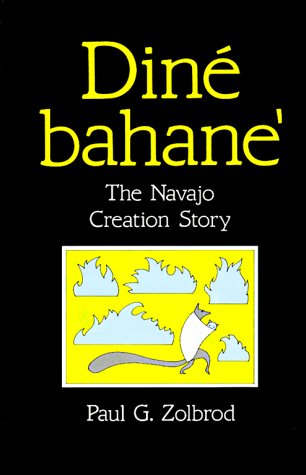
Paul Zolbrod
The Navajo Creation Story

So, what is the problem?

Let me start with an example. When I first headed into Navajo country in 1996, I hired on as a research assistant for a study of local youth gangs. I can’t say that the study yielded much of value, but we did manage to not get anyone killed (…I think). At any rate, one of the items we were supposed to investigate was the question of why gangs had appeared in Navajo country. In the days just before the study kicked up I recall asking an elder that very question. He looked right at me and said; “The separation of the sexes.”

So, what was he talking about?

It was a reference to a specific phase in the Navajo emergence narratives. The most thorough retelling that I’ve looked at would be the book; Diné Bahane’: The Navajo Creation Story by Paul G. Zolbrod. A portion of the narrative has been reproduced here on the website for the Twin Rocks Trading Post, and it’s definitely worth a read, but I’ll paste in a small stretch here. You could just as easily entitle this passage; “Where All The Trouble Began.”

Altse’ hastiin the First Man became a great hunter in the fourth world. So he was able to provide his wife Altse’ asdzaa’ the First Woman with plenty to eat. As a result, she grew very fat. Now one day he brought home a fine, fleshy deer. His wife boiled some of it, and together they had themselves a hearty meal. When she had finished eating, Altse asdzaa’ the First Woman wiped her greasy hands on her sheath.
She belched deeply. And she had this to say:
“Thank you shijoozh my vagina,” she said.
“Thank you for that delicious dinner.”
To which Altse’ hastiin the First Man replied this way:
“Why do you say that?” he replied.
“Why not thank me?
“Was it not I who killed the deer whose flesh you have just feasted on?
“Was it not I who carried it here for you to eat?
“Was it not I who skinned it?
“Who made it ready for you to boil?
“Is nijoozh your vagina the great hunter, that you should thank it and not me?”

To which Altse’ asdzaa’ offered this answer:
“As a matter of fact, she is,” offered she.
“In a manner of speaking it is joosh the vagina who hunts.
“Were it not for joosh you would not have killed that deer.
“Were it not for her you would not have carried it here.
“You would not have skinned it.
“You lazy men would do nothing around here were it not for joosh.
“In truth, joosh the vagina does all the work around here.”
To which Altse’ hastiin the First Man had this to say:
“Then perhaps you women think you can live without us men,” he said.

…and things get worse from there.

Ultimately, the fight between this Ur-couple will lead to the separation of all men and women from one another. The longing that each gender feels for the other will in turn lead them to unnatural sex acts, and these will in turn lead to the birth of monsters (really the story does get quite interesting).

So, what was the elder telling me? On the one hand, he was suggesting that the gangs were themselves the sort of monster that had its ultimate origins in the time of separation, just as had the giant and all the other beasts slain the by Hero Twins later in this same set of legends. On the other hand, he was suggesting something more subtle; he was calling attention to a high divorce rate on the Navajo Nation. In effect, that brief response served to point out not just one but two answers to my question, and to suggest some sort of relationship between them. Either way the separation of men and women from one another was, in this man’s view, the reason that gang violence had begun to appear in Navajo country.

The first of the two answers presented above could be classified as mythology. It is an attempt to explain a known fact by means of a reference to an old (and quite unverifiable) legend. The second approach treats the story in question as an allegory about the importance of marriage, and the elder’s answer becomes a direct social commentary on the relationship between changing family conditions and the rise of gang-related violence in the area. Right or wrong about the issues at hand, this interpretation would suggest the elder had been directing my attention to real world behavior. It would not have been difficult to measure that behavior, and even to formulate strategies for testing the causal connection he had asserted. But the most interesting thing about this whole fashion of speaking is really the interplay between the two forms of explanation. The elder did not choose which approach to communicate; in fact he chose language that suggested both lines of thinking to anyone familiar enough with the issues to know what he was talking about.

***

Standing Rock Sioux Reservation

Standing Rock Sioux Reservation
(September 2011)

So what, right? Thus far, what I have presented is fairly comparable to untold other religious texts. What is the difference, you may ask?

Well, for a start, there is no catechism here. Neither is there any equivalent to the Apostle’s or the Nicene Creed (or any other). Recourse to the emergence narratives presents no set doctrines about which one must agree, nor are there mechanisms for establishing what those would be. Until folks like the early anthropologists make it into the southwest, these stories were not written down at all, and until Zolbrod one could find no single text to unite them all into a single Holy Text. In the old days, as they say, this story might well have been a complete performance in its own right, one told for reasons specific to those present, and adapted a little for that precise purpose. Folks would have understood how this little story related to a number of other stories, but no set canon could be found against which to measure each individual performance or determine its precise meaning. In short, thesignificance of the text above ought to be understood without recourse to any of the mechanisms by which mainstream religions streamline their message and create a uniform set of doctrines.

To understand the elder’s reference one needn’t start by assuming he literally believes in the events described in the narrative above, or even that such a belief is relevant to his answer. One need only recognize that he found the story to be a useful reference point, and that he chose to use that reference point as a means of communicating a sense of the current state of his community.

I think this is the sort of thing John R. Farella must have had in mind when he said in his book, The Main Stalk, that one ought not to assume all natives are fundamentalists. It isn’t even that such folks aren’t out there, but they do not necessarily control the traditions in question. We shouldn’t be too quick to assume that a literal interpretation of things drives every reference to native oral traditions. That is what people raised in the Abrahamic traditions (whether we have accepted those traditions or not) tend to do when encountering the oral traditions of various people around the world, or even when we read ancient texts (such as Genesis) with an eye towards understanding something about the oral traditions incorporated within them.

Understood in these terms, the literal value of mythic events loses a lot of ground to the other implications of the narrative. A god of lightning ceases to be an explanation for lightning, and the lightning becomes a convenient means of letting nature call the name of the god to your mind. References to actual geography in mythic narratives cease to be a means of explaining those geographic features and become a variety of social conventions from territorial claims to moral lessons. The oral traditions become less of an attempt at understanding nature and more of an attempt to use nature as a means of expressing principles of social organization.

***

And where does that leave us?

I think it leaves us without a coherent central theme for the grand meta-narrative. Absent the assumption that every story is supposed to contribute to a single coherent theory (much less the assumption that that theory is a truth the recognition of which all mankind is obligated to acknowledge), we lose any clear reason to treat such stories as pre-scientific explanations of the world around us.

No, this does not mean we must accept any and all religious assertions after first checking to make sure they are offered in a less than literal spirit. What it does mean is that we lose one religious tenant to which not-a-few atheists seem quite prone, namely belief in uni-lineal Progress with a capital P. We lose that tenant, both as a short-cut to understanding the past of humanity, and as a promise of future success.

This does not mean giving up reason as a value, just letting go of the illusion that this value is the axis mundi around which all of human history turns.

Hawking is perfectly right to insist on the superiority of scientific approaches to explaining the world; he is wrong to think that explanation is the key to all those other traditions now conveniently (if quite inaccurately) summarized as a god of this and a god of that.

If there is an explanatory feature to religious tradition, it is largely a function of the means by which religions derive actual doctrine from such narratives and demand that others acknowledge the truth of those doctrines. In this respect the Abrahamic traditions do not merely carry forward the problems of earlier, so-called primitive, traditions. Instead they bring with them a brand new sort of problem, an effort to realign all the creativity one finds in oral tradition with a single obligatory and highly inflexible paradigm. We ought not to be too quick to let the God of Abraham share the blame for this problem with the figures of oral tradition from around the rest of the world. Nor should we be too quick to assume the course of history has been driven first and foremost by the values of scientists and philosophers.

71.271549 -156.751450

Share this:

  • Tweet
  • Share on Tumblr
  • Click to print (Opens in new window) Print
  • Click to email a link to a friend (Opens in new window) Email
  • Click to share on Reddit (Opens in new window) Reddit
Like Loading...

Fragments of Skepticism From My Youth

06 Friday Jul 2012

Posted by danielwalldammit in atheism, Childhood, Religion

≈ 36 Comments

Tags

atheism, Belief, Bigfoot, Chick Tracts, Christianity, Guns, Hell, Noah, Skepticism, The Bible

I have been reading some of the why-I-am-an-atheist stories over on Pharyngula, and it has led to thoughts about the various moments in my younger days which might have led me down that path. I wouldn’t say that any of these stories could really constitute an adequate answer to the question of why I am an atheist. Taken together, I’m not sure they do add up to such an answer either; instead they form a record of the impressions made by various skeptical thoughts in my youth. Some of these were my thoughts; some came from others, but each of them has made a lasting impression on me.

As to others, well we shall see…

***

A CARTOON BIBLE AND AN EAGER YOUNG MIND: No sooner had I learned to read than I decided to tackle the cartoon Bible sitting beside the bed. In fact, I think the ability to read that bible had been one of the major selling points for learning to read to begin with. Cartoons or not, this was a thick volume and it took a lot of time to work through it, just a little reading every night for God knows how long!

…well, no he doesn’t, but you get my point.

Now my choice of early reading material ought to tell you something about my youthful priorities, but please let me assure you that I was every bit as boring and straight-laced as you might have gathered from this fact. Anyway, I loved that book, and I loved it for the right reasons, as some might say; I wanted to learn about God.

So, you can imagine my surprise when my father told me he didn’t believe in the story of Noah and the flood. I was shocked. The mere possibility that any detail of that sacred cartoon filled bundle of Godly goodness could be wrong was beyond me. So, I did what any properly annoying first grader would do. I asked why? Dad told me that the very notion God would need a flood to clear away so many bad people would mean that God made a mistake in the first place, and that seemed unlikely. This is where I must admit I failed in my childhood duties and let Dad off with a single ‘why’. Seriously, I should have pestered him for hours after that. Instead, I just sat there dumb-damned and trying to soak up this new possibility. The Bible could be wrong about something.

Wow!

***

A CHICK IN THE BOY’S BATHROOM: I remember the first time I ever saw a Chick tract. For those of you blessed with ignorance about these things, let me sully your mind with a brief explanation. A chick tract is a cartoon sermon produced by Jack Chick publications. Back in the mid-seventies, it would have been Chick himself who did the one I saw that day. Chick Tracts typically follow the life of some character engaged in a sinful activity such as believing in Evolution, Practicing Paganism, Celebrating Halloween, Playing D&D, or Going to a Catholic Church, for example. The tract will normally include graphic threats of hellfire and damnation before introducing the good news that all of this can be averted by embracing Jesus Christ. It’s a pretty standard script from which neither Chick himself nor those who have filled his shoes deviate by much.

I was in 4th or 5th grade, and I found one of these in the school bathroom. I don’t remember a lot of details, but it definitely followed the familiar script. I don’t think the positive Jesus-loves-you theme made much of an impression on me at the time; I was still tingling in horror at the thought of Hellfire and damnation, and at the thought that someone could be perverse enough to believe in such things. For a kid raised in a Spiritualist household (just think New Age, but not quite as marketable, at least not on the cusp on the 80s) this was quite a shocker. I had heard of people that believed in Hell, but I hadn’t to my knowledge met any of them. And I didn’t know which scared me more; the fantastic thought of actual hellfire, or the very real prospect that someone who embraced the concept had been at my school.

It was shortly after this that I began talking about my ‘beliefs’ (and those of my family) with some classmates. I quickly discovered that my parents were not comfortable with this. I also discovered that I actually knew quite a few people who believed in Hell; I might even have known the person responsible for putting the tract in the school bathroom. And thus I grew to understand my parents’ reluctance to engage in open discussion of the topic.

…and before moving on, let me just say that I think it very fitting that my first encounter with a chick tract would be finding one of them in a bathroom. I could only wish it had been properly disposed of.

***

SASQUATCH, WHERE FOR ART THOU: The highlight of my 6th grade year was the big field trip to somewhere with cabins (I want to say Big Bear). Yes, that’s right; it was that sort of field trip. In the days and weeks leading up to the trip, I heard talk of bunk-beds, long hikes, campfires, and roasted marsh-mellows. …and something else.

Bigfoot! …of course.

Now, you have to remember this was Southern California, and it was the 1970s. Bigfoot was big (pun intended), as was the Devil’s Triangle, and UFOs were everywhere. I even remember a popular movie about reincarnation, and another one about the discovery of Noah’s Ark somewhere in the Himalayas. All of this seemed much more plausible to me as a 6th grader, but more than that, I think it seemed much more plausible to people in the 70s.

I blame it on disco!

The trip would include all the things we talked about, including at least one encounter with Bigfoot, or at least one of our teachers dressed up like him in the dark. It didn’t really fool anyone, …well not after word got out about the zipper.

But the next day…

I don’t remember exactly what we were all supposed to be doing on that day, but apparently it amounted to a stretch of free time. I was near the edge of the campground when some of my classmates began to point out into the trees, just up the mountainside a little. I can still hear them talking; “What is that?” “It’s moving!” “Holy crap!” and “That thing is big!” There weren’t any teachers around this particular spot in the campground, but more and more children (myself included) made our way to the edge of the trees to see what the others were looking at.

I couldn’t see a damned thing!

Like a lot of my classmates I was scared, and I was curious, and those two emotions fought for control of my soul (or at least my feet) in that little spot near the edge of the forest just below the side of a hill. I really wanted to see Bigfoot, and I wanted to live through the experience. In an effort to satisfy my fear while edging closer to the unknown danger I picked up a rock, as did a few of my classmates (because of course Bigfoot would have been no match for 6th graders with rocks). I then stepped as close as I could bring myself to the forest.

When someone said it was moving towards us (whatever it was) we all took a step or three back, but we didn’t quite run. And then of course nothing happened. I grew more and more frustrated, because I still couldn’t see a damned thing. …dammit!

Several of my classmates had surpassed the what-is-that stage and begun to claim with absolute certainty that they were looking right at a Bigfoot. They pointed, and I looked, and I just didn’t see it. A couple kids pointed more and proclaimed still more loudly, and I still didn’t see a damned thing. I edged closer to the forest. I wasn’t the only one who didn’t see him, but I may well have been the kid there who most wanted to.

And I just didn’t.

I’m not entirely sure why, but a few kids began to throw rocks into the forest. When one of the rocks came bouncing back down the side of the mountain, we all took a few hurried steps back. …only most everyone else took a few more than I did, and suddenly there I was out ahead of anyone else. To fully appreciate this you have to understand that I was a pretty flighty kid. (Seriously, my sister and a few of my old classmates could tell you stories, but thankfully this isn’t their blog). For the moment, I was well out ahead of my classmates, rock in hand, ready to confront Bigfoot all by myself if need be.

And damned mad, that he wasn’t making an appearance.

He never did.

When the teachers finally broke up the whole thing and called us inside, I became completely disgusted with the matter, and especially at my classmates. I had recently become acquainted with the phrase; “mass hysteria,” and in the wake of the absentee Bigfoot incident, I made damned sure that everyone within ear-shot was became as familiar with it.

…I could be a really annoying kid.

***

BAD AIM: When I was 14, my Dad and I attended the Daisy International BB-Gun Championship held that year in Bowling Green, Kentucky. Seriously, I think it was mostly the states that supplied teams, but Mexico and Canada sent teams, so I guess that made it an international event. Now I was a budding young gun-nut (seriously, I was), so I hope you will understand that this event was Disneyland, Christmas, and my birthday all rolled into one as far as I was concerned. And I did reasonably well, not well enough to win anything mind you, but, …what the Hell! I was 1 point 1x off a tie for third in prone (he says beaming with pride). But, what the Hell is this story doing here, you may ask?

Well, the contest included a Sunday.

As I recall, there were three options for activities on Sunday morning. One of them was a movie, I do remember that. The third option, I don’t recall, but you’ll never guess the one I chose. I chose to go to a church (or at least a sermon held in the great ballroom that we called church that day). This was my chance to witness mainstream religion in all its glory, and to do it without much effort. For half an hour I could peer into the lives of my Christian classmates and learn what God meant to them, at least on Sundays.

The sermon?

It was about how sin is like missing the mark and failing to hit the bullseye. For half an hour this minister told us all about the nature of sin; it was, in his view, essentially bad aim. I couldn’t believe my ears. I don’t think I had quite mastered the word ‘patronizing’ yet, but as I sat there struggling with the icky feeling in my gut, I knew there had to be some word for the utter stupidity of this man’s sermon. And I came away wondering; is this what mainstream preachers do? …make up lame analogies based on the presumed interests of their target audience?

Suffice to say, I wasn’t dying to repeat the experience.

***

ABSOLUTELY! …OH, WAIT A MINUTE! The words were quite familiar, Hell I had probably said them myself a time or two; “You can’t just expect God to walk up and greet you in person.” It was High school and one of my classmates had just said this in response to another person. I remember nodding in earnest, because everyone knew you couldn’t just expect that, …and then a thought struck me like a bug in the mouth while riding a skateboard.

Why not?

Was that really so unreasonable? Why couldn’t you just say; I’ll believe in God if I actually meet him. And if God failed to pass this test, would He really hold it against someone for having adopted such a standard? Or would he say; oh that’s just So&So; he wants more evidence than I  feel like giving. He’ll learn when I get around to it.

I can’t say that I made this my standard just then, or really that I ever have taken such a stance (it is a bit of a caricature), but in that particular moment, I simply ceased to think of it as an unreasonable position.

Course the fact that my mind was on this while talking to a really cute girl is the rally sad part of this story.

Really, it is.

***

SAY IT AIN’T SO, JOE! I was a freshman in College when my friend Joe told me there were factual errors in the Bible, and I did a double-take. Joe may be surprised to know this, but that was a pretty powerful moment for me, not because I was enamored of the Bible, but because I had grown accustomed to the notion that religious beliefs were vague and fuzzy and didn’t really leave anyone with enough leverage to say; “no that’s just incorrect.” Even my Dad had been talking about moral themes back in that discussion over the cartoon Bible; that left room for disagreement. Joe on the other hand, he was suggesting the Bible could just get its facts wrong, and that blew my mind. This may well have been the first time that I heard any religious matter described as a simple factual error.

Surely, the whole thing was much more complicated than that, I thought, …unless it wasn’t.

This conversation renewed my interest in scripture; but this time it had me wondering just what would happen if you approached the text with more straight-forward expectations than I had grown accustomed to. I think that conversation might have been what led me to read The Age of Reason and to take that “Bible as Literature” class. Having been raised in a world of spirits that may or may not manifest themselves at any given time and Auras that you can see if you’re in the right mind and hold your eyes just like so, the notion that religious matters could raise clear questions of truth value was a little novel to me. …A few years and one article by Anthony Flew later, I even had a word for the problem Joe had just set me to thinking about.

It was ‘falsifiability’.

71.271549 -156.751450

Share this:

  • Tweet
  • Share on Tumblr
  • Click to print (Opens in new window) Print
  • Click to email a link to a friend (Opens in new window) Email
  • Click to share on Reddit (Opens in new window) Reddit
Like Loading...

Auto-Kitty Says ‘Meow’: What she Means is that Belief is not a Choice

16 Wednesday May 2012

Posted by danielwalldammit in atheism, Religion

≈ 39 Comments

Tags

Agnosticism, Animals, atheism, Belief, epistemology, God, Kitty, Philosophy, religion, The Rugburns

Auto-Kitty
(not a Siamese)

Is belief a choice?

I don’t think so.

It is certainly common enough to speak of belief as a choice, but could I choose to believe that I was not sitting in a chair right now? (I am.) Could I choose to believe that the music playing at this moment (Sky-Fucking-Line-of-Toronto) had been recorded by The Kinks? (It was The Rugburns.) Could I choose to believe that my cat, Auto-Kitty (pictured to the left) is a Siamese? (She is of course a Tortie.)

Mind you, I am not asking if I could tell you that Auto-Kitty is a Siamese. I most certainly could. I am not asking if I could play some special word-game in approaching the subject and define ‘Siamese’ in such a manner as to include cats with a tortoise-shell coat. I am not even asking whether or not I could embark on some long-term project to convince myself that my little Auto-Kitty was really a Siamese. …though I really don’t think I could do that either. No, I am asking whether or not I could choose to believe, right here and now, that a cat I know to be something other than a Siamese was in fact (using a conventional understanding of the term) actually a Siamese?

The answer is ‘no’.

I think it is safe to say, dear reader, that we could come up with a range of similar propositions for you, claims that you could not choose to believe, at least not without a complex long-term brain-washing process to get you there. You could probably assert these claims, but you could not actually believe them.

So, there is at least one respect in which belief appears to present a limit to our choices. Somewhere in the question of what one believes, we all encounter an emergent property which is beyond the control of our immediate will. …Okay, at least the vast majority of us do.

No, it is not my intention to suggest that we have no choice at all with respect to beliefs, but rather to suggest that the choices must in some respect live with this emergent property, the one which defies our power to shape it at will. Truth be told I think we could probably put a range of different propositions on a scale of sorts. Auto-Kitty’s non-Siamese status is, for me at least at maximum (or near maximum) resistance to the whims of my personal belief. For you, perhaps, taking my word for it, there is perhaps cause for doubt about the matter, and it might be reasonable to say that one’s response to doubt involves a degree of choice.

More to the point at hand, we could perhaps find a range of propositions about subjects inherently difficult to resolve, full of ambiguity, and perhaps even loaded with more heuristic than factual value. One might get to say that he or she has a bit more choice in such matters. But I still think it is worth knowing that somewhere in our mental landscape, we normally encounter a limitation, a point of resistance to the free play of our choices.

I should add that I do think personality is another variable. Some people seem far more capable of choosing what to believe than others. I should also add that in at least one respect this is far from a virtue.

So what?

Well, what I am getting at is a trace of the larger question of Beliefs with a capital B. I don’t mean beliefs such as; What color is the chair? What kind of cat is that? or Is there too much chili paste in the chicken red curry? No, I mean questions like; Do you believe in God? How about reincarnation? karma? …The Holy Trinity? …you get the idea. Because people often speak of these beliefs as a choice.

The notion that belief in god is a choice is a particularly common fashion of speaking, and that fashion of speaking can be very misleading. It makes of belief a moral decision, and side-steps the epistemological questions about that belief in favor of arguments from consequantialism. One must, according to this approach, choose whether or not to accept or reject God, all of which actually begs the question of whether or not She actually exists.

But I don’t wish to go too far down this particular road at the moment. I am more interested in fleshing out how the issue affects self-presentation in matters of belief.

Okay, I am thinking about how this affects me!

You see, I often think back to these days of my own deconversion, and I realize that I have become accustomed to speaking of the process in unnecessarily mystical terms. I sometimes say that “I lost belief in God at around the age of 18,” or I may explain that “I chose to reject religion at that age.” Perhaps I will say that “I lost my faith,” and so on.

I don’t think this language is at all unusual, but the more I think about it the more I realize that they are not accurate descriptions of what happened at that time in my life at all. It would be far closer to the truth to say that I never really had faith at all. It would be more precise to say that I could find no aspect of my thought process which has ever answered to the concept of ‘faith’ as it is normally used in connection to belief in God.

Still further, I think it would be more accurate to say that I never really believed in God. Oh, I wanted to! As a young teen I REALLY wanted God in my life. I read. I prayed. I meditated. I studied. I did everything I could to ‘find God’ as they say, and the truth is that I just never did. I found a great deal of speech about him, but that speech never resonated with me on any personal level, nor did it point to anything in the objective world that struck me as a good candidate for a deity. When the day came that I finally came to see myself as an unbeliever, it was less a rejection of some viable notion than it was a concession that no such concept could be found in my mental landscape.

It was less a choice to reject belief than an acknowledgement of a mental state over which I did not really have a choice.

This was about the age of 18 or 19, and by that time I had come to know a number of approaches to the subject of God and religion. But these were always bracketed concepts in my own mind. They were ideas that someone else believed in, definitions of God that fit someone else’s beliefs, …or at least their claims. When I embraced my role as an unbeliever, the decision changed absolutely nothing about my beliefs. It was a change in my self-presentation, a decision about how best to describe the beliefs (or the lack thereof) that I already had.

For me at least, I could no more choose to believe in God than I could choose to believe that Auto-Kitty is a Siamese. I could say that God exists of course, but short of equivocation, I could not mean it.

I could deflect the question and say that I do not know whether or not God exists. Better yet, I could grunt and change the subject.

I could choose to put forward a variety of labels for my thoughts on the subject. So, for example, I could probably describe myself as either an ‘atheist’, an ‘agnostic’, or even an ‘agnostic atheist’. I could add the qualifiers ‘weak’ before ‘atheist’ or ‘soft’ before ‘agnostic’, or I could leave them off according to taste. Any of these approaches would be an equally accurate description of my take on the matter of God. I am somewhat inclined to believe that the label ‘non-cognitivism’ would work as well, though I would have to read-up a bit more on that approach to the issue before deciding once and for all on the label. But let us be clear, what I am choosing here is a label and a certain amount of baggage that goes with that label. What I am not choosing is what I will or won’t actually believe.

I have a little more wiggle room on the issue of surety. I could say that I am certain on the matter or that I am open to the possibility that a god does exist. The cognitive hazards of container metaphors aside, both of these could be a reasonably accurate description of my attitude on any given day.  Choosing one or the other term would in a sense help to make the issue normative; it would give me an incentive to try for the attitude I had adopted as a self-description, and to avoid the other. Either way, I do feel like I have a little more choice in the degree of certainty I wish present my approach to this issue to others.

Indeed, I have lots of choices about the way I package my lack of belief and explain it to others. I also have lots of choices about what my (non-)beliefs mean to me and how they will shape my actions in the future.

What I do not have a choice about is what I actually believe on the subject. Somewhere in there, the power of choice simply escapes me.

***

Okay, I lied about what Auto-Kitty was trying to say in the title. What she was actually trying to tell you with that little meow of hers is that in the picture above, she is more comfortable than you or I or any other person in the whole of human history will ever be. She just wanted you to know that.

71.271549 -156.751450

Share this:

  • Tweet
  • Share on Tumblr
  • Click to print (Opens in new window) Print
  • Click to email a link to a friend (Opens in new window) Email
  • Click to share on Reddit (Opens in new window) Reddit
Like Loading...

Native American Ceremonies and the Meaning of ‘Religion’: Unpacking the Semantic Baggage, …Well at Least the Carry-On

03 Thursday May 2012

Posted by danielwalldammit in atheism, Native American Themes, Religion

≈ 37 Comments

Tags

atheism, Belief, Ceremonialism, Christian Forums, History, Indian, Native American, Navajo, religion, Semantics

Hogan

Not everyone has a religion!

More to the point at hand, the term seems to be an awfully bad fit for a lot of the things it is commonly used to describe.

When I was teaching on the Navajo Nation, I used to illustrate this by asking my students; when you hold a healing ceremony, who comes? The answer was always something to the effect of the community itself, friends, relatives, etc. What happens if you don’t believe in the effectiveness of the ceremony? Frankly, I don’t think the question came up very often, at least not in the context of deciding who belonged at the ceremony, but I did once meet a woman who had effectively answered it. A born again Christian, she stayed at the main house during the chants and entered the Hogan to help serve food during the breaks. She thus met her family obligations without implicating herself in a ceremony that was anathema to her own beliefs.

When I asked my students who goes to a church, the answer was invariably something along the lines of its members, believers, etc. Catholics go to a Catholic Church, Baptists to a Baptist Church, and so on. Of course this doesn’t mean that others aren’t welcome at a given church, but there is a distinct sense that the church exists for those that adhere to its doctrines. Those testing the waters will be expected to make a choice at some time.

Which brings me to another point, a religion can be modeled as a debate stance. Who belongs to a church? In many cases, we can literally trot out a range of statements and ask people whether or not they will vouch for the truth of those claims. “God Exists.” “Jesus rose from the dead.” You get the idea. Say ‘yes’ to the right statements, affirm one’s beliefs that they are true, and you are in the club. Say no, and you are out. Whatever else is happening here, it is a process of segregating folks according to an imagined argument within a larger community.

Sandpainting

When I used to post on christianforums.com (CF), this was explicit policy for many years. Those who affirmed the Nicene Creed (or perhaps the Apostle’s Creed) could count themselves as Christian and post in the Christians-only sections. Those of us who could not were asked to restrict our posts to the open-debate areas. The policy varied in its details from time to time, and as I recall it changed rather dramatically a few years back, but when I was there at least CF policy fits the model I am proposing, membership in the faith, as it was defined on CF could be determined by one’s willingness to back a series of truth-claims.

So, what is the difference?

I’m about to paint it in pretty broad strokes, but I’ll warrant the paint gets more or less within the proper lines.

A religion is defined in terms of beliefs which consist of the willingness to vouch for the truth of a claim. A native ceremonial system is defined in terms of community membership and participation. Of course there is considerable overlap between the two. People expressed a number of beliefs connected with Navajo ceremonies, and churches can be remarkable community institutions. But as with any other questions of value, it is the priorities that count. Failure to vouch for essential doctrine gets you out of a church. It doesn’t get you out of a Navajo ceremony, at least it didn’t when I was there.

So, what is going on here? I would suggest, the point of the ceremony is at least partly to unite the community, to get them all involved in something of great importance to the community at large (the health of its members in the Navajo case). What is the point of the religion? Well it is at least partly to distinguish a select membership from some larger community. A religion isn’t simply about what group you belong to; it is about what separates you from those others. What a native ceremonial system unites, a religion divides.

Some might find that shocking, or at least counter-intuitive. Often when religious debates get rather heated, someone will lament the divisiveness of the issue and give a variant of the “can’t we all just get along” speech. The sentiments are noble enough, but I often wonder how many times people can see the process of division before it sinks in; that is what is SUPPOSED to happen.

Rainbow Bridge (Sacred Site)

Of course both ceremonial systems and religions unite as well as divide, but they do so on different parameters. The ceremonial system unites people along the lines of an established community, it gives people who share in a range of political and economic interactions a means of emphasizing their connections. A religion carves off a notch of those people and sets them in ideological opposition to others in their community.

So, this is my particular take on a running theme in Native American studies, the unfitness of “religion” to the understanding of Native American practices commonly described using precisely that term. The problem was particularly critical to the workings of a Federal law passed in 1978, The American Indian Religious Freedom Act, which I happened to study for a bit. The law had a rocky history from the start, and at least in the early 90s (when I studied the matter) an awful lot of people were disappointed in its application to real life.

It was easy enough to say that various indigenous practices raised a lot of First Amendment issues. (Well at least it was in 1978; the prior history of willful abuse is dismal, and a topic for another post.) But actually extending Free Exercise protections to Native American “religious” practices proved very difficult. How do you protect the right to prayer when that might mean a lot more than a moment of silence or even a few words spoken in a certain posture? What do you do about ritual paraphernalia at border crossings? How about odd dress in schools or prisons? How do you deal with strange substances? Nevermind peyote; a simple smudge-pot can really screw up a paradigm! …and (this was the real sticking point) what do you do about access to sacred sites on public lands, especially sites that might not be so sacred anymore if someone builds a road or a fast food restaurant in the vicinity?

See, the problem was that native “religious” practices simply didn’t fit into the niche already carved out for religions within the American political economy. So, time and again, when Native Americans sought to enjoy their religious freedom, they found some official or judge who couldn’t (or wouldn’t) grant that protection. The necessary relief always seemed to be too much to ask, and the resulting case-law was dismal to say the least.

So, what was the problem? At least some folks figured it lay with the key term “religion.” It just didn’t fit. The practices in question may have included enough of what people call ‘religion’ to get the issue on the table, but they weren’t restricted to quite the semantic domain one normally expects of things described using that term. The contents Native American “religions” thus tended to spill over into other social terrain. Where western religions had learned to reside in the spaces between other public matters, their Native American analogs didn’t even come close.

So, if the term “religion” doesn’t fit, what does?

It really is difficult to answer that question. We can of course use the term “religion” anyway, but the warrant for its use is analogical, and my point is the analogy breaks down, often in really inconvenient ways. A common practice is to talk about native “spirituality,” but the chief benefits of “spirituality” seem to be that the term means just about anything you want it to mean, which is not an argument in its favor.

My own solution is to focus on the ceremonial practices. As the community-building functions of those ceremonies take priority over the argument-framing functions, those practices naturally stretch into social interactions well beyond those of religions. Of course this way of talking about the issue involves a judgement about priorities; it is a claim about what matters most. So, I won’t be too offended if someone opts to go another route.

Yes, I will. Let’s fight about it!

Anyway, what interests me about this is that it is the other half of a coin to my own situation when it comes to the subject. Religion obviously doesn’t do much for me, and as my last post ought to have established, I obviously think there is something about religion that is NOT part of my life and thinking. What that is, is another question, and admittedly a satirical post isn’t really going to nail it down. So, I am trying think my way through that issue (for the umpteenth time) by looking at people who may have a similar problem.

…and by “similar” I probably mean “opposite.”

If I as an atheist lack something falling under the heading of ‘religion’, the people I am talking about seem to have a surplus of it. Where the term denotes something I don’t want in my life, it denotes something that falls well short of what they want in their own lives. Where use of the word “religion” commits me to too much, it commits them to too little.

Either way, we have a problem.

***

The Hogan picture comes from the website, Virtual Tourist. It is part of the Navajo Museum and Visitor’s center in Window Rock, AZ. The sandpainting is from navajopeople.org which includes a nice description of its symbolism and ritual significance. The picture of Rainbow Bridge comes from Destination360. It was the subject of sacred site litigation in Badoni v. Higginson, one of many sacred sites litigated in the 70s and 80s.

71.271549 -156.751450

Share this:

  • Tweet
  • Share on Tumblr
  • Click to print (Opens in new window) Print
  • Click to email a link to a friend (Opens in new window) Email
  • Click to share on Reddit (Opens in new window) Reddit
Like Loading...

The Prayer of an Atheist

01 Tuesday May 2012

Posted by danielwalldammit in atheism, Religion

≈ 91 Comments

Tags

atheism, Existentialism, Pastafarianism, PZ Meyers, Richard Dawkins, Sacasm, Sam Harris, The Flying Spaghetti Monster, the Invisible Pink Unicorn

IPU

Okay, believers, you got us!

Atheism really is a religion after all. Yes, I know, some of us have been denying it for years, but I personally just can’t keep up the pretense. I am tired of living a lie, and I must confess to the true nature of my beliefs. I have to open up about my faith and let my spirit-flag fly!

I pray every night. Yes, I do! It goes something like this; “Oh Father who art not in Heaven…” On special days, I ask my non-God to give me a nothing, or maybe a pony. I ask it to confer its non-blessings on those whom I love, or at least I would do that if we atheists were capable of loving others. When I am really mad I say imprecatory prayers in those hopes that the nothingness will embrace my enemies in its nonitude.

Does that surprise you?

Well, we let me tell you about the scriptures! I read a passage from Dawkins every night. And then I meditate on it. (It used to be old Berti Russell, but I have come to see him as a false prophet.) The important thing to know here is that I do not merely think about Dawkins text, I meditate on it. I have to get in just the right frame of mind, and let the spirit of the nothing come upon me, and then it all comes clear.

The Flying Spaghetti Monster

Those of you who do not carry the spirit of the nothing in your heart will never quite understand the writings of atheists, for it will close your eyes and lead you astray. Seriously, the nothing will take one of your socks (or maybe a pen) every time you approach it in a false spirit. You may think this is unfair. How could an unjust nothing be so cruel? But you have only yourselves to blame for rejecting the nullitude.

We atheists always keep our socks!

So, what do I do when I have to make a decision? Well, I used to address every moral dilemma by deducing he proper action from the non-existence of God, but in time I came to see this is a pointless theological exercise. Nowadays I simply ask myself “What would Chuck do?”

I can also go to one of several living authorities on the subject. American Atheists are always happy to provide spiritual guidance and direction. One does not simply speak to Dawkins or Harris on these matters, and the scientifically impure burst into flames when meeting PZ Myers in person. You have to go through intermediaries. I am always a little fearful when speaking with these ministers of the Non-God, because I do not wish to anger them and face ex-communication.

Her Hornyness!

I dabbled briefly in the cults of Pastafarianism and Her Hornyness, The Invisible Pink Unicorn, but through careful reading of scripture and some intense personal questioning (to say nothing of guidance by properly constituted non-believing authorities), I have come to realize that these are but cults leading those new in the faith (the “Baby-Atheists”) astray from the one true path.

To help me stay on course, I consult either the Positivist’s Creed or the Essential Doctrines of Existentialism.

Sometimes I go door to door with The Origin of Species. When people answer, I say; “Do you have a personal relationship with Charles?” If they will talk to me about it, I always ask if I can come into their environment and adapt with them.

Yes, all these things are true and more. We heathen don’t share these things with believers, because atheism is a gnostic faith after all. You have to go through at least 3 levels of initiation before you get your secret decoder ring. Only then will the prophesies of Nietzsche become clear to you.

It’s all true.

Atheism really is a religion.

***

I should also say that my favorite hobby really is not collecting stamps.

71.271549 -156.751450

Share this:

  • Tweet
  • Share on Tumblr
  • Click to print (Opens in new window) Print
  • Click to email a link to a friend (Opens in new window) Email
  • Click to share on Reddit (Opens in new window) Reddit
Like Loading...

Reification is Forever!!!

28 Wednesday Dec 2011

Posted by danielwalldammit in atheism, Religion

≈ 9 Comments

Tags

atheism, complex question fallacy, misplaced concretism, reification, religion, soul

“Where do you go when you die?”

“What happens to you when you die?”

“Where do you go when you die?”

All very familiar questions.

I have a better one (two actually).

What happens to the flame when a cande burns out? Where does that flame go?

71.271549 -156.751450

Share this:

  • Tweet
  • Share on Tumblr
  • Click to print (Opens in new window) Print
  • Click to email a link to a friend (Opens in new window) Email
  • Click to share on Reddit (Opens in new window) Reddit
Like Loading...

A Godless Reason for the Season

26 Saturday Nov 2011

Posted by danielwalldammit in atheism, Religion

≈ 1 Comment

Tags

atheism, Black Friday, Christmas, Commercialism, Holidays, Riots, Unbelief

Knowing that I don’t believe in god, people sometimes ask me if I celebrate Christmas.

My answer?

I can celebrate rampant commercialism just as well as any Christian.

…I could also celebrate giving, togetherness, family, kindness and charity, just as well as any Christian, but I am increasingly convinced that this doesn’t have much to do with the holiday in question.

71.271549 -156.751450

Share this:

  • Tweet
  • Share on Tumblr
  • Click to print (Opens in new window) Print
  • Click to email a link to a friend (Opens in new window) Email
  • Click to share on Reddit (Opens in new window) Reddit
Like Loading...
Newer posts →

Top Posts & Pages

  • I'll Just Leave This Here
    I'll Just Leave This Here
  • When Sex Falls Out of the Performance
    When Sex Falls Out of the Performance
  • What are the Necessities of Life?
    What are the Necessities of Life?
  • Thieves Road (A Review)
    Thieves Road (A Review)
  • The Village of Wainwright, Alaska
    The Village of Wainwright, Alaska
  • Malaglutit: A Review
    Malaglutit: A Review
  • Damn the Science Exhibit; We're Looking at Dioramas!
    Damn the Science Exhibit; We're Looking at Dioramas!
  • Master and Commander Kinda Queered
    Master and Commander Kinda Queered
  • An Uncommon Security Guard: Dave Eshelman, AKA 'John Wayne'
    An Uncommon Security Guard: Dave Eshelman, AKA 'John Wayne'
  • An Uncommon Tree
    An Uncommon Tree

Topics

  • Alaska
  • Animals
  • Anthropology
  • atheism
  • Bad Photography
  • Books
  • Childhood
  • Education
  • Gaming
  • General
  • History
  • Irritation Meditation
  • Justice
  • Las Vegas
  • Minis
  • Movie Villainy
  • Movies
  • Museums
  • Music
  • Narrative VIolence
  • Native American Themes
  • Philosophy
  • Politics
  • Public History
  • Re-Creations
  • Religion
  • Street Art
  • The Bullet Point Mind
  • Travel
  • Uncategorized
  • Uncommonday
  • White Indians
  • Write Drunk, Edit Stoned

Blogroll

  • American Creation
  • An Historian Goes to the Movies
  • Aunt Phil's Trunk
  • Bob's Blog
  • Dr. Gerald Stein
  • Hinterlogics
  • Ignorance WIthout Arrogance
  • Im-North
  • Insta-North
  • Just a Girl from Homer
  • Multo (Ghost)
  • Native America
  • Norbert Haupt
  • Northwest History
  • Northy Pins
  • Northy-Tok
  • Nunawhaa
  • Religion in American History
  • The History Blog
  • The History Chicks
  • What Do I Know?

Archives

  • December 2023
  • November 2023
  • June 2023
  • April 2023
  • February 2023
  • December 2022
  • November 2022
  • October 2022
  • September 2022
  • August 2022
  • July 2022
  • June 2022
  • April 2022
  • January 2022
  • December 2021
  • November 2021
  • October 2021
  • September 2021
  • August 2021
  • June 2021
  • May 2021
  • March 2021
  • February 2021
  • January 2021
  • December 2020
  • November 2020
  • October 2020
  • September 2020
  • June 2020
  • May 2020
  • March 2020
  • February 2020
  • January 2020
  • December 2019
  • November 2019
  • September 2019
  • August 2019
  • July 2019
  • June 2019
  • May 2019
  • April 2019
  • January 2019
  • December 2018
  • November 2018
  • October 2018
  • September 2018
  • August 2018
  • July 2018
  • June 2018
  • May 2018
  • April 2018
  • March 2018
  • February 2018
  • January 2018
  • December 2017
  • November 2017
  • October 2017
  • September 2017
  • August 2017
  • July 2017
  • June 2017
  • May 2017
  • April 2017
  • March 2017
  • January 2017
  • December 2016
  • November 2016
  • October 2016
  • September 2016
  • August 2016
  • July 2016
  • June 2016
  • May 2016
  • April 2016
  • March 2016
  • February 2016
  • January 2016
  • December 2015
  • November 2015
  • October 2015
  • September 2015
  • August 2015
  • July 2015
  • June 2015
  • May 2015
  • April 2015
  • March 2015
  • January 2015
  • December 2014
  • November 2014
  • October 2014
  • July 2014
  • June 2014
  • May 2014
  • April 2014
  • March 2014
  • February 2014
  • January 2014
  • December 2013
  • November 2013
  • October 2013
  • September 2013
  • August 2013
  • July 2013
  • June 2013
  • May 2013
  • April 2013
  • March 2013
  • February 2013
  • January 2013
  • December 2012
  • November 2012
  • October 2012
  • September 2012
  • August 2012
  • July 2012
  • June 2012
  • May 2012
  • April 2012
  • March 2012
  • January 2012
  • December 2011
  • November 2011
  • October 2011

My Twitter Feed

Follow @Brimshack

RSS Feed

  • RSS - Posts
  • RSS - Comments

Enter your email address to follow this blog and receive notifications of new posts by email.

Join 8,076 other subscribers

Blog at WordPress.com.

  • Subscribe Subscribed
    • northierthanthou
    • Join 8,076 other subscribers
    • Already have a WordPress.com account? Log in now.
    • northierthanthou
    • Subscribe Subscribed
    • Sign up
    • Log in
    • Report this content
    • View site in Reader
    • Manage subscriptions
    • Collapse this bar
 

Loading Comments...
 

    %d