• About

northierthanthou

northierthanthou

Category Archives: History

Yep! This is where I put the stuff that pertains to history. Take notes, because there will be a test.

An Uncommon Rosie

18 Friday May 2018

Posted by danielwalldammit in Alaska, History, Politics, Uncommonday

≈ 3 Comments

Tags

Alaska Natives, Anachorage Museum, Art, civil Rights, Decolonization, Elizabeth Peratrovich, History, Museum, Unsettled

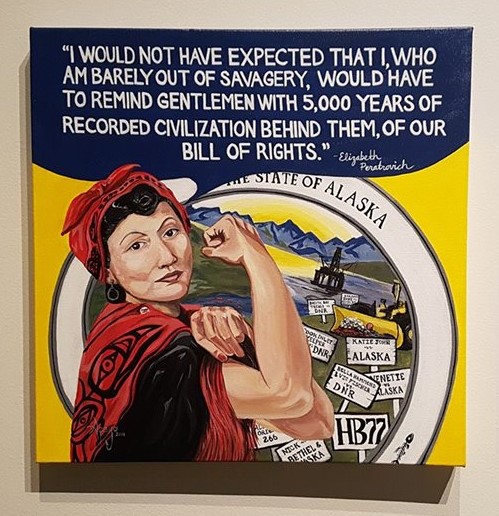
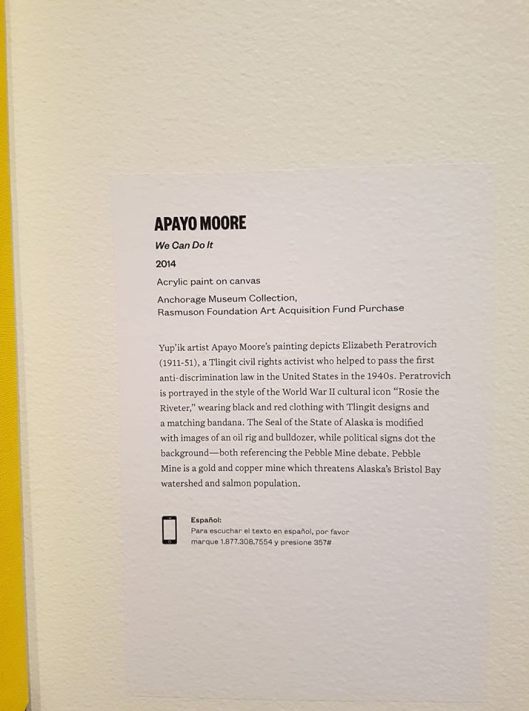
Rosie - Copy2Rosie the Riveter is one of those proverbial gifts that just keeps on giving. So, was Elizabeth Peratrovich. She would have been a contemporary of the many women who inspired this icon, which makes it just a little more interesting to see her standing in here for the women (whose real name was Naomi Parker) most of us envision when thinking about Rosie. This poster is part of the Unsettled exhibition currently showing at the Anchorage Museum.

Elizabeth was a major figure in the movement to combat discrimination against Alaska Natives in the 1940s. She is memorialized every February 16th, the day in which the Alaska Territorial Government signed the Anti-discrimination Act 0f 1945 into law. You can learn more about her work on civil rights at Alaskool.org. The quote featured in this poster is commonly thought to have been part of her testimony at the Alaska Territorial Legislature during hearings over the Anti-Discrimination Act. It isn’t entirely clear whether or not these were her exact words, though it probably says something about her actual testimony that it has become something of a legend in itself. The wit would certainly be right at home with other things that Elizabeth clearly did say.

Seriously, the woman kicked ass!

Apayo Moore, the artist behind this particular piece has the following to say bout it:

32838106_10216397714880526_2160255119801712640_n

Share this:

  • Tweet
  • Share on Tumblr
  • Print (Opens in new window) Print
  • Email a link to a friend (Opens in new window) Email
  • Share on Reddit (Opens in new window) Reddit
Like Loading...

Also Not a Contest: Slavery

29 Thursday Mar 2018

Posted by danielwalldammit in History, Justice, Politics

≈ 7 Comments

Tags

Alt Right, Indentured Servitude, Ireland, Irish Slavery, Labor, Race, Racism, Slavery, Trans-Atrlantic Slave Trade

It’s always been odd to me, seeing how the history of American slavery makes some of my fellow white people uncomfortable. You can see their discomfort in the various ways folks try to minimize the significance of slavery. Sometimes, it’s enough to put slavery in the past, to grant that it was an horrible crime, but to imagine that crime taking place so far in the remote past and so completely resolved with the official end of slavery in that remote past as to be completely free of any political implications today. It’s a bit like the gambit, folks often play with the history of Indian-white relations – all the horrors of the past can be acknowledged, at least in the abstract, so long as you can contain their significance within the history books (and preferably kept well away from any of the more recent chapters). At other times, folks seem to come up with more elaborate schemes to pare down the topic of slavery until it fits into their personal comfort zones.

When I was in college, this kind of pop-racism generally took the form of an argument that Africans started slavery. They did it too, maybe even first, so the argument would go, and of course there was (and is) an element of truth to these claims, but it’s a truth poorly served by its rhetorical packaging. It would be fair to say that slavery existed in Africa (as it did Europe, and indeed most of the world) prior to the founding of the Trans-Atlantic slave trade. Just how much those prior-forms of slavery explain the booming industry that would come is another question. All too often I used to hear people pushing this narrative and think they wanted far too much from the point than it would bear. What they wanted was a kind of absolution, a story that diminished the responsibility of Euro-American peoples for the tragedy of the slave trade. At the very least, they wanted to share the blame with some other groups.

And I always wondered why some of these people seemed to feel personally implicated in the matter? What do you get out of this, I would find myself asking? How does it help you if this story goes to the discredit of someone else’s ancestors? The answer, I think, is (predictably enough) racism. For those who see the world through the lens of race, the disgrace of their ancestors is a disgrace to them personally, and a case against the moral character of their own kind is a direct personal attack. I think this is also the key to common refrains about ‘white guilt’ and ‘liberal guilt’. I’ve never seen liberal politics as an expression of personal shame, but I do think some of our critics are incapable of seeing liberal politics in any other terms.  Such people cannot right the wrongs of the past or work to overcome inequalities in the present; they must instead demolish their own consciousness of those wrongs and rationalize any inequalities they see in the present. It’s the just world hypothesis at work in a racist mind.

In recent years, the pop-racist response to the history of American slavery seems to have evolved a bit. The latest trend seems to be countering stories about the enslavement of Africans with those about the enslavement of Irish men and women, but I should say the trend isn’t even that focused. Time and again you can see people show up with stories about Irish slavery in response to contemporary concerns about African-Americans. Write a blog post or tweet a quick message about police abuse of African-Americans in the present-day and somebody may well just show up to tell you about the history of Irish slavery. It’s as if the prospect of Irish slavery isn’t just a stock answer to any questions about the enslavement of Africans; some folks find it useful as an answer to questions about literally any injustice experienced by African-Americans today. Once again, there is a grain of truth to the narrative, and once again, those producing it clearly want more from the story than the facts of the matter will furnish them.

What proponents of the Irish slavery narratives are talking about is the practice of sending Irish men and women to the Americas under terms imposing temporary servitude upon them. Most of these were indentured servants who agreed to a term of service in exchange for passage, but at least some were prisoners whose terms of service were imposed upon them as a means of punishment.

Okay, so we know all this.

There was a time when perfectly liberal college professors were happy to spell out the horrible conditions of indentured servitude, along with the abuse of Irish in this and other contexts. I used to work with a professor who made quite a point to ensure students learned just how terribly indentured servants could be treated. None of this was part of a racist agenda, and none of it was leveraged against the history of the trans-Atlantic slave trade. Far from fielding a rationale for minimizing the horrors of that slave trade, this was like the opening chapter of a long sequence on the horrors of the full slave trade that would come. Acknowledging both horrors (and many others) used to work just fine.

But that was then, this is now.

What is new? On the surface, what is new here is the use of the word ‘slavery’ to describe what was done to the Irish, but here as always the devil resides in the details. No, I am not linking to any of this literature, but proponents of the Irish slave narrative have worked hard to embellish every embelishible point; inflating numbers, adding stories about the defilement of white women forced to breed with African men, and of course complaining that liberals have hidden the trials of the Irish while pushing the trans-Atlantic narrative in order to keep African-Americans at the forefront of identity politics. With support from racist corners of the internet, some maintain the Irish story is greater in all respects. Who would deny it? Only a liberal, right?

Okay, I deny it.

More importantly, so do vast majority of historians doing work on the subject. Scholars have questioned many of the details put forward in the Irish slave narrative, but the central theme seems to be this, that at its heart, the Irish story really is a story about indentured servitude. Indentured servitude was by no means a benign institution, but it simply isn’t comparable to the chattel slavery associated with the trans-Atlantic slave trade. Most simply would not use the term ‘slavery’ at all to describe indentured servitude, even when it is imposed as a criminal sanction. And of course a good deal of the push-back of these narratives consists of efforts to unmask the clearly racist agendas of key proponents. This isn’t just a mistake, it’s a mistake a lot of committed white racists want people to make.

…which leaves me feeling all somehow.

I’m happy as Hell to see the comparison between indentured servitude and the trans-Atlantic slave trade shredded, and then shredded again. What does somewhat concern me is the equation of ‘slavery’ with the specific form of chattel slavery that took place in the trans-Atlantic trade. Simply put, we do commonly use the word ‘slavery’ in contexts that do not compare in the numbers or the horrors of that specific history. History books often speak of slaves in ancient civilizations many of which fell into that status through financial ruin, or debt. The literature on Indian-white relations is full of stories of ‘slaves’ captured and trade about through raiding practices, and of course the Spanish systems of the encomienda were never described as slavery. When in 1850 California passed a law enabling others to press California Natives into forced labor, that law was actually written up as if it were meant to protect those very Natives. And of course the system of debt peonage found in the post-war south (among many other places) could in practice pass for slavery.

Hell, that was often the point!

…to say nothing of the use of prison systems for purposes of reducing free blacks to forced laborers under the pretext of punishment for crimes, real or imagined.

The subject of slavery has always been broader than the specific history of the trans-Atlantic slave trade. We should not allow malicious people to equate every instance of forced labor with the scale of atrocity behind that trade, but neither should we restrict our own use of the word ‘slavery’ to that very trade. Abusive labor practices shade easily into forced labor, and once that threshold is crossed, real atrocities become much easier.

What specifically doesn’t work about Irish slave narratives is the direct comparison with the trans-Atlantic slave trade. It doesn’t match the scale of atrocity in that trade, either in numbers, or in the quality of treatment for the majority of those involved. This doesn’t mean that indentured servants, Irish or otherwise, were treated well, and it certainly doesn’t mean that people captured or pressed into forced labor in other times and places shouldn’t be a concern. What it does mean is that we shouldn’t let people use the suffering of their own ancestors as a means of diverting attention from that of others.


Share this:

  • Tweet
  • Share on Tumblr
  • Print (Opens in new window) Print
  • Email a link to a friend (Opens in new window) Email
  • Share on Reddit (Opens in new window) Reddit
Like Loading...

Killers of the Flower Moon: A Book Review

05 Monday Mar 2018

Posted by danielwalldammit in Books, History, Justice, Narrative VIolence, Native American Themes

≈ 8 Comments

Tags

American Indian, Federal Bureau of Investigation, Historical Trauma, Killers of the Flower Moon, Murder, Native Americans, Oklahoma, Osage, The FBI

Regarding his own documentary work, Joshua Oppenheimer once wrote of modern Indonesia; “…I felt I’d wandered into Germany 40 years after the holocaust, only to find the Nazis still in power.” I thought about this line as I read Killers of the Flower Moon by David Grann. It’s a different time and a different place, perhaps even a different scale of atrocity (at least if you are counting bodies), but each of these stories raised for me the same haunting thought; what must it be like to live one’s life among those that have murdered your loved ones. Oppenheimer’s movies, the Act of Killing and The Look of Silence are set in Indonesia nearly half a century after genocidal policies resulted in the loss of at least half a million lives. Grann’s work is set in Oklahoma, closer to a century century after a wave of killings struck the Osage community, leaving generations to wonder about what really happened? Both stories recount the details of gruesome murder, and both raise questions about life in the wake of atrocity.

I’m also reminded of Anna Rosmus, whose work on the resistance fighters of her hometown uncovered a sordid history of Nazi collaborators well hidden in the town’s oral narratives. She asked enough questions to draw up a violent response from those still tied to that history. I wouldn’t say this was Grann’s focus, but stories like the one he tells have a particularly reflexive quality. Murder on the scale of his story doesn’t rest neatly in past; it haunts the present.

SPOILER ALERTS!

This book is the story of a series of murders carried out in the Osage community of Oklahoma during the 1920s. Grann begins the story by concentrating on a little over 20 murders which would become the focus of an investigation by the FBI. As this was one of the first big cases to be carried out by the Federal Bureau of Investigation, the book provides insights into the early years of Hoover’s budding new empire. At the same time, the book helps to shed light on one of the darker chapters of Indian-White relations, the long slow looting of Native American communities by outsiders under the policies of General Allotment.

To grasp the events unfolding in this book, you must understand two things: the Osage community had come into control of vast oil fields, and many had been declared incompetent to manage their own estates. To resolve the second of these problems, various white businessmen had been named as trustees and put in charge of the private fortunes belonging to various Osage members. As individual Osage accumulated the proceeds of oil money. It seems that some people found the notion of wealthy natives rather objectionable (a theme often echoed today by those who resent Indian casinos). More importantly, a certain quantity of non-natives found ways of doing something about it, ways of acquiring that wealth for themselves.

At first, the killings seem a bit random, a pair of shootings here, a few mysterious illnesses there. Someone seemed to be killing off a number of Osage, but why? It didn’t help that the first couple investigators to get somewhere were themselves brutally murdered. It helped even less when a bomb was used to kill an Osage couple and their white servant living in the middle of town. Most of the victims knew each other. They had plenty of connections between them. But which ones were the key to the case?

In the end, it was the mysterious ‘wasting’ illnesses that seemed to provide the most representative cases. The medical science necessary to detect poison was not yet widely available, and it certainly wasn’t standard procedure to test for poison in the event of every death. In the midst of the prohibition era, moreover, it was easy enough to attribute poisoning to bad moonshine. So, poisoning could provide a very effective means of killing someone without raising too many suspicions. It was particularly useful for relatives, trustees, and other beneficiaries of life insurance or inheritance policies eager to acquire an Osage headright. Such killings were not only difficult to detect in the day, they are difficult to detect now in the historical record, but as Grann shows, Osage died at an extraordinarily high rate in the 1920s, a rate not fully explained by any other known factors. The FBI wrapped up an investigation of a little over 20 murders. If Grann is right, the number of Osage actually killed in this era is more likely in the hundreds.

Most were killed by relatives, or at least those who’d been hired by them.

I have to admit the specter of so many white marrying into the tribe making friends with Osage for the clear purpose of killing them fills me with a sense of shame. The feeling will pass, of course, for me, but one of the most haunting features of the book is the number of people for whom such feelings clearly will not pass. The final chapters of this book are filled with personal stories those who grew up in the wake of these murders. It’s been nearly a century, yes, but in family terms these are stories about (great) grandparents, great aunts and uncles. These are stories about children who went on to live their own lives and raise their own families knowing that their own parents had been killed by loved ones or trusted neighbors. …and in some cases wondering just who might have been involved?

…or what local businessmen might have profited from these murders?

This kind of violence isn’t contained in one generation, or even two. It haunts a community long after those who participated have passed away. I can’t help thinking part of the horror might lie in the fear that the truth will never be known, that someone’s death could be forever buried in falsehood, which is why books like this are important. They are one means of countering that horror, however inadequate they may be. Grann didn’t stop at the FBI cases. He went on to study murders left unsolved and to explore the causes of deaths that never caught the attention of authorities. He couldn’t always find an explanation, but he does manage to reveal something of the  extent of these crimes.

It’s evident that some folks entrusted Grann with the hopes of finding out the truth behind their family tragedies. That must have been quite a weight to carry.

It must have been a far greater weight for those to carry such stories their whole lives.

***

Postscript: I just wanted to make a couple additional remarks here, regarding the writing style. While Grann is relating a historical narrative, he does so through the lens of a particular woman, Mollie Burkhart, who lost most of her family in ‘reign of terror’, and of the FBI agent, Tom White, who was put in charge of the case. By following the lives of these two people into the story, Grann is able to provide a historical narrative that reads like a murder mystery. Those familiar with the story may know where it’s going, and I’ve shared a portion of that here myself (minus severl significant details), but most of the time this approach leaves the reader to wonder how the pieces will fall together, and to expect that will happen when the main characters put those pieces together themselves. Again, tis is history, but it reads a bit like a murder mystery.

This is an interesting approach to historical narrative, one that should prove helpful in the rather likely event that this is made into a movie.

Grann also fills in a lot of detail as he writes the story. He relates the physical features and demeanor of his characters in this book, much as a fiction writer would. When reading such material, I often find myself wondering where that came from? Is this how someone else described the person in question? Is it the impression Grann gets from looking at their pictures? Some combination? Hard to tell!

I can never decide how I feel about that approach to historical writing. A part of me would like to keep closer to identifiable records, to have the option of checking specific claims about specific source material. Another part of me is just happy to get the story. I can file away the fluffy details and focus on the main story line if the information is worth reading.

…which is definitely the case here.

Share this:

  • Tweet
  • Share on Tumblr
  • Print (Opens in new window) Print
  • Email a link to a friend (Opens in new window) Email
  • Share on Reddit (Opens in new window) Reddit
Like Loading...

A Trip to Central America, and to 1950!

20 Tuesday Feb 2018

Posted by danielwalldammit in History, Politics, Travel

≈ 4 Comments

Tags

Banana Republics, Central America, Coasta Rica, Guatemala, Honduras, Imperialism, Journal, Travel, United Fruit

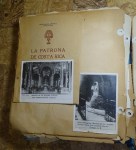
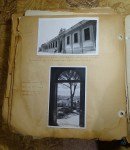
I never met my grandparents on my mother’s side. Hardly a day went by that Mom didn’t mention them, but of course I have more questions about them than answers. So, it was a very pleasant surprise to find out that grandpa left behind a few travel journals. One relates the story of a trip to central America in 1950.

What caught my attention?

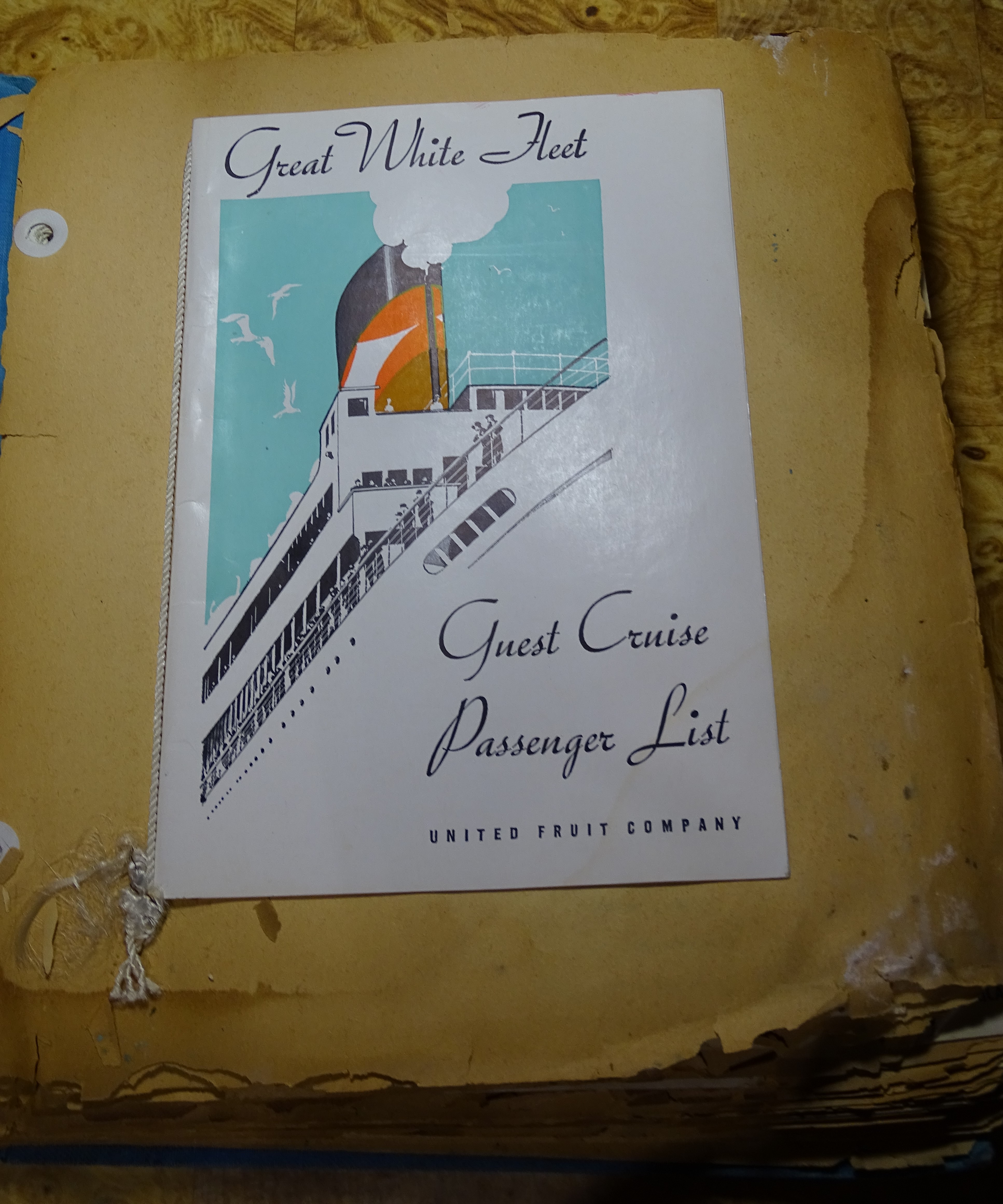
This.

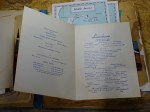
Passenger list

Okay, so it might not be all that obvious why this should be interesting to me or anyone else for that matter. I probably won’t be traveling on the Great White Fleet any time soon, and who has even heard of United Fruit? They probably don’t even exist anymore, right? Well, they don’t. That’s true. If you’ve eaten a Chiquita Banana, then you’ve some familiarity with their progeny, but United Fruit itself doesn’t exist anymore. In the 1950s, though, they were going good and strong.

United Fruit was more than a business. It controlled much of central America and helped give birth to the phrase ‘banana republic,’ which I suppose means it has yet another descendant of sorts in the business world. In just four years, United Fruit and the Central Intelligence Agency would engineer a military coup in Guatemala, one of the nations my grandparents visited on this trip. Two of the ships in United Fruit’s Great White Fleet would later be used in the Bay of Pigs operation. Clearly, United Fruit did a lot more than grow and sell bananas. They would eventually be forced to sell off their monopoly interests in Guatemala, and then merged with another company to become Chiquita. In the meantime, Grandma and Grandpa were free to enjoy the hospitality of the company on the Great White Fleet.

It’s just a travel journal, to be sure, but a travel journal into the business end of American imperialism. Suffice to say, this was enough to peak my curiosity.

***

I can’t say the journal was overflowing with details of military juntas and revolutionary conspirators. That’s not what Grandpa and Grandma went down there to see, and this isn’t exactly my area, anyway, so I may have missed a thing or three. Most of the journal seems like pretty normal stuff for travelers. Its pages are filled with tales of mundane trips about the countryside, meals enjoyed (or simply ensured), beautiful architecture, run-down hovels, archeological sites, and countless random travel companions, most of which slide onto stage and back off without too much fuss.

Yet there are a few notable passages.

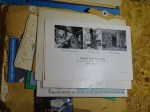
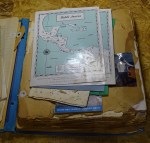
I no longer have the actual journal in my possession, but I took pictures of every page. I reproduced a number of the these below, numbering them for ease of reference. I intend to give the thing a closer reading sometime down the road, but for now, these are a few things that caught my notice for one reason or another…

***

Apparently, my grandparents hit a cow somewhere near Chichen Itza (pic 70). Grandpa also mentions meeting a young man in that area who had been to Peoria, IL during the war (pic 76). I can’t tell enough from the narrative, whether the man is even local, or perhaps an ex patriot, but I wonder if this wasn’t someone who had come up on the Bracero program (workers brought into the U.S. to replace Americans gone to war). Either way, I expect there would be an interesting story there.

They encountered the President of Honduras (Juan Lindo?) whom they were evidently told had been too democratic to live in the President’s Palace. He tipped his hat to someone in their party. (You can read Grandpa’s account of this on pic 55).

Grandpa mentions a banana shaped menu once in his journal (pic 46). Pics 14 and 15 would seem to fit the bill. Oddly enough, I don’t see bananas all over the menus, which is interesting. Under the guidance of Edward Bernays, the father of modern Public Relations, United Fruit made an effort to broaden people’s ideas about when and where to eat bananas, a campaign which included (for instance) reversing ideas about whether or not parents should encourage snacking. I really did expect to see a lot more  gustatory propaganda on those menus, but mostly the fruit (which would have been the Big Mike), seems to show up in pictures and other visual motifs.

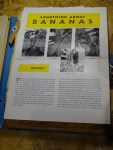
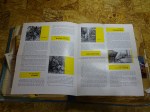
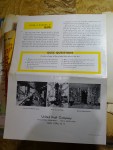
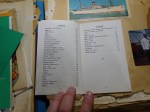
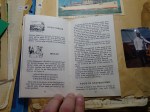
There is an interesting little history of the Banana, according to United Fruit (pics 17-19), and nice overview of the travel services aboard ships of the United Fruit Company (29-45). Oddly enough, this does not mention any of the company’s efforts to monopolize the entire national economies of several of the countries on the itinerary.

A couple of these pamphlets include references to ‘Middle America’. (I think these were menus.) I found the phrase amusing enough, wondering what folks in Oklahoma or Nebraska might make of it, but of course our North American fashions of speaking about ‘America’ can be a little odd once you shift references to include the whole hemisphere. More interesting than that, the phrasing matches a news agency developed by Bernays for the purpose of promoting the interests of United Fruit. The Middle America Information Bureau had gone dormant by 1950, but I do find myself wondering if the phrasing doesn’t reflect some conscious reference to that project.

And then of course there are just a couple cryptic references in Grandpa’s journal to a rather large layoff by United Fruit coupled with the observation that communism is coming in fast (pic 54).

That’s it!

I could easily wish for more. I could wish Grandpa had uncovered a great big smoking gun, or that he had left behind a complete account of the political history of the region, but alas, he was just a tourist along on a vacation. His politics were not mine, and he didn’t know the history of the company. He mostly wrote about the meals and the sites, and the friendly chatter with people he met here and there. It’s me that sees these documents nearly 70 years later and thinks about all the history of the company that took him down there, but perhaps there is an interesting lesson here after all. This is what the imperialism of the day looked like to people like my Grandpa, to guests of United Fruit.

It was central Americans that witnessed the violent side of United Fruit. For so many (North) Americans this company took the form of slices of fruit may have sprinkled over our corn flakes. Or perhaps it was a quaint news story about a far away place. Living here in the United States, the majority of Americans would never have felt the blunt force of this company’s power. Neither would they have seen it in any recognizable manner. What they saw fruit.

If we North Americans heard any more about United Fruit, it was in messages carefully crafted to the company’s benefit.

Whatever else can be learned from my Grandpa’s journal, it seems likely we can learn the same was true for countless American tourists traveling through the region. United Fruit is all over the literature in this journal, but it’s all over it like Disneyland in the memories of afamily outing. Details that would one day matter can be found here and there, along with rumors that even reached the ears of a passing tourist. Still nothing recognizably nefarious pops up in the journal, at least not to the eyes of tourists such as my grandfather. What we can see is a range of pamphlets, dinner menus, and brief canned histories, all of which make the whole region seem so innocent, and so quaint. To so many (North) Americans, that banana shaped menu is precisely what our imperial age did look like.

I could of course rest happy thinking that we are better and wiser today. This is all behind us, right? Then again, we sometimes get a little reminder that there is nothing new under the sun.

Front Cover
Plane Ticket
Ford’s Air Tour

Ford’s Tour (Inside)
Ford’s Air Tour (Backside)
Great White Fleet

Menu
Honduras (Backside)
Folded Paper

San Jose
Places of Interest, San Jose
San Jose Map

San Jose (Folded Out)
Banana Menu
Inside the Bananas

United Fruit (Back)
United Fruit (Front)
United Fruit (Middle)

United Fruit Back (Folded Out)
Breakfast Menu
Menu (Great White Fleet)

Lunch Menu (Open)
Middle America
Dinner Menu (Open)

Great White Fleet Radio News
Great White Fleet Radio News again
Great White Fleet Radio News yet again

Last of the Great White Fleet Radio News
Menus
Pics and United Fruit Pamphlet Cover

United Fruit Pamphlet 1
United Fruit Pamphlet 2
United Fruit Pamphlet 3

United Fruit Pamphlet 4
United Fruit Pamphlet 5
United Fruit Pamphlet 6

United Fruit Pamphlet 7
United Fruit Pamphlet 8
United Fruit Pamphlet 9

United Fruit Pamphlet 10
United Fruit Pamphlet 11
United Fruit Pamphlet 12

United Fruit Pamphlet 13
United Fruit Pamphlet 14
United Fruit Pamphlet 15

United Fruit Pamphlet 16
Reference to the banana menu
Passenger list

Passenger list 2
Costa Rica
Random Pics

Moar Pics
Pics and Journal Entries
Pics and Journal

Reference to a Big Lay-off and threats of communism
Too Democratic for his palace!
Guatemala

Pics
Pics again
Pic and Journal

Pics and Journal
More pics and more journal
black and white pics

Panama tours (I got this one way out of order)
pics on both pages
moar black and white pics

mixed pics
wood carrier

random bit of journal
hit a cow
Mayan Lodge

Chicheni Itza
More Chichen Itza
journal entry about the game court

temples
Temple pics

Exchange Rates
Back Cover

This is hardly a research paper, but I thought it might be worth mentioning a couple sources here. I first Read Bitter Fruit as a teaching assistant to a professor who specialized in Latin-American studies. Somewhere along the way, I picked up a couple other books on the subject. Bananas makes a particularly nice quick read with a lit of interesting details on the history of United Fruit. Cohen’s books is also useful. Galeano’s book helps to draw connections between different regions and phases of history, all with a very pointed sense of significance.

The Bernays angle on all this stuff is particularly interesting. His book Propaganda, is still considered a classic in the history of Public relations. It’s a good peek into the kind of techniques the man used in selling United Fruit and its interests to the American public.

Bernays, Edward. Propaganda. Broooklyn, New Yok: IG Publishing, 1928, 2005.

Chapman, Peter. Bananas: How the United Fruit Company shaped the world. Edinburgh, New York, Melbourne: Canongate, 2007.

Cohen, Rich. The Fish that Ate the Whale: The Life and Times of America’s Banana King. Farrar, Strauss and Giroux, New York: Picador, 2012.

Galeano, Eduardo. Open Veins of Latin America: Five Centuries of the Pillage of a Continent. New York: Monthly Review Press, 1973, 1997.

Schlesinger, Stephen and Stephen Kinzer. Bitter Fruit: The Story of the American Coup in Guatelama. Cambridge and London: Harvard University Press, 1982, 2005.

Share this:

  • Tweet
  • Share on Tumblr
  • Print (Opens in new window) Print
  • Email a link to a friend (Opens in new window) Email
  • Share on Reddit (Opens in new window) Reddit
Like Loading...

Repellent Utopias and the Case Against Black History Month

03 Saturday Feb 2018

Posted by danielwalldammit in History, Politics

≈ 9 Comments

Tags

Black History Month, Ethnicity, Ideals, Multiculturalism, Race, Social Justice, teaching, Utopia

Do we really need a Black History Month?

It’s a common question. It might be a little more common coming from white folks like me, but I’ve certainly heard it from some African-Americans as well. A couple years back, for example, Stacey Dash weighed in on the subject for the benefit of the Fox viewer base. I hear views like that of Dash often enough. So, I blogged my own two cents worth of a response here. It was a short post, and rather sarcastic to be sure, but I still think that post about captures my sense of the issue. (Also it was an excuse to get a Leyla McCalla song onto my blog, which has to be a good thing.) Today, I thought it might be worth spelling out the point a little more directly.

Dash’s comments are hardly unusual. Time and again, you’ll hear someone gripe about the Latin American Music Awards, the Miss Black America Pageant, the existence of Black Entertainment Television, or any number of just-for-the-minority occasions, awards, and honors. In some cases, it’s hard to escape the impression that those making these comments just don’t like the ethnic groups in question and want them to go away. I somehow doubt that’s what Stacy Dash has in mind, but she’s probably not the sole example. Not every objection to minority-specific recognition can be fully understood as a conscious defense of white privilege.

As to latent prejudice, even against one’s own people, the jury is still out.

The most interesting case against such minority-focused honors, for me anyway, seems to to be the argument that they should not be necessary, and that minority-focused recognition is contrary to the spirit of a more unbiased community. Why set aside a specific month for black history, so the argument goes, when we should be incorporating elements of black history throughout the curriculum? Why have special awards for minorities when we should be including those minorities fully in the mainstream awards? Some might even suspect that Black History Month works to put the topic in a ghetto, so to speak, giving us leave to ignore the subject matter throughout the rest of the year. It may or may not work like that, but there does seem to be a certain merit to the notion that what we really out to be doing is ensuring that minorities are recognized when they ought to be recognized on a day-to-day basis, all year. Wouldn’t this be better than trying to set aside specific moments when this or that minority gets a spot of time under the spotlight?

Dash’s comments, like those of many who generate this argument, make a seamless transition from opposition to segregation to opposition to Black History Month, Black Entertainment Television, etc. Some of us might think these horribles (the segregation system of old versus Black History Month today) would weigh a little differently on the scale of man’s inhumanity to man, but that’s raising a question narratives like this simply don’t address. It’s a point of principle, Dash seems to suggest, and the same principle that forbids the one should forbid the other. Hence, the absence of minority-specific recognition becomes the price of freedom from segregation with all of the horrible things that that go with it. Shouldn’t we just approach these subjects in a color-blind way, she argue, and not show any preference at all?

Maybe it’s just my inner redneck, or at least my outer whiteness, but I have to admit this argument has a certain appeal for me. The appeal isn’t entirely self-serving. Sure, there is the notion that life might be simpler without having to deal with a specific month where folks pester me about covering African-Americans in my classes. That might be convenient. But along with that goes the notion that I really should sit down and work really hard to ensure that I am covering the subject adequately all year. Then I should do the same thing for Latinos, Native Americans, Women, the LGBT+ community, and any range of underprivileged peoples who may get squeezed out of the history books and the history lessons in one way or another. Theoretically, at any rate, these kinds of responses shouldn’t lead us to forget minorities; they should lead us to distribute credit more evenly, allocating it to minorities when they’ve earned it, or when the story demands it, just as we supposedly do to those in the majority. Doing that right would not be easy. In fact, it would be damned hard.

…and by ‘damned hard’ I mean, ‘probably not going to happen’.

The plan runs aground on the limitations of human nature. We don’t really have a universal standard for any kind of recognition, not beauty pageants, music or acting awards, journalism, or anything else for that matter. Certainly not history! We all look at questions of merit through the lens of our personal experiences, values, cultural background, etc. Thomas Jefferson doesn’t simply have a privileged role in our history books for reasons of abstract merit. Like it or not, he is also there for his contribution to institutions of white dominance. Frederick Douglas didn’t simply get into the history books because he reached some imaginary threshold of significance that deserves a paragraph or maybe even a page in a textbook. He got there because he made contributions to the present conditions of African Americans. His role in our history books is itself a function of special interests, and that should be neither surprising nor all that objectionable. It’s just how this works!

All of these stories are filtered through the lens of interests shaped by issues like race and gender today. Those who rise to the top of the mainstream narratives typically have some real advantages in the competition for our collective attention. They benefit from personal and institutional bias. Some of these biases are obvious, and some of them are subtle, but the point is that bias is bound to creep into decisions about who does and doesn’t have merit. This is as true of a historical personage as it is an artist or a contestant today.

When I try to put together the materials for a history class, I make any decisions about what to include, what to emphasize, and how to explain things to my students through the lens of my own personal experiences. Those include years of life in lily white neighborhoods talking to other middle class white people. They also include years of exposure to minority subjects in college classes and even more years working in Indian country and then the arctic. Plenty of my influences point me to the dead-white male version of history; others lead me to open that story up and include lots of other people. Whether or not the one is enough to counter-balance the others is always an open question.

My answer is better on some days than others.

Under the circumstances, I don’t think it’s such a bad thing to be reminded for one month out of every year that I might have missed something. There may be some stories about Aftican-Americans that I could and should get to my students somehow. I can’t say that the results always get into the February part of the curriculum, but I have certainly added African-American subject matter to my American history classes during the month of February. I don’t ignore these stories the rest of the year either, but the reminder certainly does nudge me toward a better balance.

More to the point, correcting bias isn’t simply a zen kinda thing. You can’t just sit there and be non-biased. As least I can’t. I’m human. My brain is subject to the same cognitive biases that I see quite readily in so many other people. So, if I just follow my first instincts (or even my first thoughts) on the subject of what to teach, I’m going to miss some things. I’m going to miss some people. I could wish otherwise, but it’s going to happen. So, somewhere in that process, I figure it’s worth it take a little time to think consciously and deliberately about those peoples who tend not to make it into the standard dead-white male narratives that still dominate so much of our common historical narratives. Whatever else, Black History Month does, it forces the issue, and it sets a number of teachers who might otherwise proceed blissfully onward to spend some time asking whether they’ve done enough.

The world would of course be better off if we didn’t need to go through such a process in the first place, if we could all be relied upon to handle minority subjects smoothly and evenly on the first pass.

But we don’t live in that world.

We never will.

Which brings me back to the imagination behind Stacy Dash’s opposition to Black History Month. The ideal she cites is compelling enough. It’s easy to say that we would all be better off without these special moments set aside for recognition of selected groups, but that only works if we imagine away the biases that make them necessary. The problem here is the notion that the ideal in this case will be achieved by eschewing the pro-minority agendas first. We may or may not get around to any sense of larger equality in due time, so the thinking goes, but as a point of personal integrity, we should all give up any effort to assign recognition to specific minorities before we can really expect movement on the larger issues. We have to forget Black History Month before we can be sufficiently color-blind to stop leaving black people out of our regular history lessons.

But that larger equality never comes. Like the communist state or the free market of Libertarian mythology, this world without prejudice just hangs out there somewhere in the ether. We can talk about it. We can imagine we are moving towards it, but it will never get here. In the interim, supposedly, the price of moving toward this ideal will be paid by those already on the short end of the stick. The first step toward that equality will be a sacrifice of what few breaks some folks have managed to gain at one point or another. The rest will come later. The big moment when we all judge each other by the content of our character sits somewhere on the other side of the moment we stop taking an extra beat to see who might have presently been left behind. But we’ll get there. Don’t worry!

…and the check is in the mail.

Share this:

  • Tweet
  • Share on Tumblr
  • Print (Opens in new window) Print
  • Email a link to a friend (Opens in new window) Email
  • Share on Reddit (Opens in new window) Reddit
Like Loading...

May Conservatives Remember you Fondly!

18 Thursday Jan 2018

Posted by danielwalldammit in History, Politics

≈ 5 Comments

Tags

Activism, Black Lives Matter, civil Rights, Colin Kaepernick, Martin Luther King, Protest, Race, Racism, Take a Knee

26239122_10215319195278210_5540301171360502791_nMy title may seem like an oddly partisan blessing, but it’s more of a partisan curse. It’s not the worst form of damnation you could wish upon a person, but for some folks it oughtta be bad enough.

The curse is real though.

This happens.

Civil Rights activists must have felt the sting of this curse this last weekend as right wing America did its best to distinguish Colin Kaepernick from Martin Luther King, Jr. It seems, their efforts had been necessitated by publican of an image linking Kaepernick, Michael Bennett and Martin Luther King, all kneeling together. Outraged to see Kaepernick and MLK connected, plenty of folks took to the net to tell us Bennet and Kaepernick shouldn’t be put on the same level as MLK. Beyond that, cultural conservatives assured us that MLK was selfless and that Kaepernick is simply out for himself, that King was a patriot whereas Kaepernick hates America, and that MLK preached unity whereas Kaepernick is being deliberately divisive.

Heard that last one a lot this weekend.

I’m not old enough to remember MLK’s activism in its day, but I am old enough to remember cultural conservatives attitudes towards him before he became a national holiday, before you could find roads named after him all over America, before admiration or MLK became a forgone conclusion. And of course before conservatives began to claim him as one of their own. We heard many of the same things about Martin Luther King back then that are said of Colin Kaepernick today. Lots of folks were not so impressed with his patriotism. As to divisiveness? Hell, he could be so lucky as to be described as merely divisive! I grew up hearing stories about how MLK and other civil rights leaders were just trying to cause trouble, simply drawing attention to themselves. Things were getting better, plenty of people assured me. Those activists were simply making things so much worse. Divisive? Hell, MLK that would have been an improvement over the things said of him at some of the dinner tables I’ve attended.

It’s a poetic injustice, really, seeing Martin Luther King transformed into a means of silencing black activists. He’s been held over the heads of the Black Lives Matter movement for some time now, and thrown in the face of just about any African-American deemed a little too disruptive by conservatives, especially by those conservatives moderate enough to think of they’ve learned the lessons of the civil rights movement. Gone are the days when cultural conservatives would spit ‘commie’ after hearing the name of Martin Luther King. Now, being more comfortable with his legacy, they spit his name at any black activists they find more threatening today.

That’s gotta be a special kind of Hell, to be used against those who carry on your legacy? If so, it’s a special Hell reserved for people who’ve earned a lot better.

What I think a lot of moderate conservatives and a good deal of middle-of-the-road America likes about MLK is the notion that we should be color blind. Some folks may even mean it. Others just like the prospects of using this principle against social justice warriors, affirmative action programs, and any number of left wing causes that ask us to take difference into account. Yet, the message of equality changes a great deal when it’s employed in this manner. When King delivered his “I have a dream” message, equality was message flying in the face of white privilege. If you’ll pardon the cliche, it really was a way of speaking truth to power. Today that message is used to speak power to truth. It is a call to ignore real differences in opportunity, to silence those in need of help, and to preemptively dismiss any political agenda aimed at helping the underprivileged. There is something genuinely vicious about the way cultural conservatives have turned King’s message on its head and turned him into a weapon well-suited to re-enforcing comfort and privilege.

It’s enough to make you lose your lunch.

***

Sadly, this isn’t an uncommon thing. It seems that those leaning to the right have a general tendency to remember some lefty figures fondly, but only after forgetting the lefty part. How many people have complained about the politics in Roger Waters concerts over the years? Some folks may have specific complaints about aspects of Waters’ politics, but a fair number seem genuinely shocked to find political content in Animals or The Wall.

Maybe they were just too stoned to listen the first time.

I know. Pink Floyd lyrics may not warrant the same admiration as the life of Martin Luther King, but in a sense that impression too illustrates the point. Just as with Kaepernick and questions about whether he should be on the same par as MLK, the veneration of MLK here misses the mark. When someone advocates on behalf of those in need, or confronts those who abuse power, should we really be all that concerned about how they compare to other heroes? Or should we be more concerned about how their politics contributes to something of value?

Yes, that was a rhetorical question.

***

And then of course, there were those people shocked and outraged to find Coretta Scott King. As George W. Bush attended her funeral, some thought it inappropriate for those honoring her legacy to speak out against the Iraq. And thus his decision to honor her, became her limitation, or rather the limitation on what could be said in her honor while he was present. I get it. It’s a little rude to criticize the President when he’s sitting right there, especially knowing that he doesn’t have to be. But you know what’s more rude? Expecting the funeral of an activist with a life-long commitment to non-violence to pass by without any comments on the greatest war of the day.

In America, even our conservatives are happy to celebrate liberal activists.

Once they and their own learn to be quiet about it.

“We love you, shhhhhhh…”

Share this:

  • Tweet
  • Share on Tumblr
  • Print (Opens in new window) Print
  • Email a link to a friend (Opens in new window) Email
  • Share on Reddit (Opens in new window) Reddit
Like Loading...

Map Ain’t Time Either.

30 Saturday Sep 2017

Posted by danielwalldammit in History, Native American Themes

≈ 9 Comments

Tags

American Indian, Boundaries, Cartography, Distortion, History, Maps, Nations, Native American, Territory

indian_tribesI often see maps of Indian territories pop up on the net. I like them. And then again, I don’t. I’ve seen also some of these same maps in classrooms and academic papers. In such cases, the narrative usually does a bit more to put the visual presentation in context, but on the net, that visual is often all you get.

…along with a couple hashtags, and sometimes a catchy title.

The specific subject matter varies a bit from map to map. Sometimes they purport to show linguistic variation. Sometimes, they show the culture areas used by anthropologists or the general divisions of Native American peoples into related peoples. Mostly, these maps purport to show the specific locations of various tribes.

…whatever that means?

Don’t get me wrong. The basic idea isn’t entirely off base, and it’s a lot better than silence on the topic, but the notion of an Indian tribe carries a lot of baggage, only some of which goes away if we replace the term ‘Indian’ with ‘Native American’. We can also replace ‘tribes’ with ‘nations’ or ‘peoples’.

…we still end up with plenty of baggage.

There really isn’t any vocabulary that just works here. You really have to pick a term, and just bear in mind the distortions it imposes on the subject matter. But my point here today isn’t so much to work over the vocabulary as it is to focus attention on the maps themselves. It’s great to have them, but they too can distort the subject matter, all the more so when the map circulates as a meme-in-in-itelf, so to speak, just an image without a narrative to go with it.

So, what’s the problem?

***

Well, we have a few of them actually. One of the first things going through my own mind is the other half of the contextualization schema. The maps give us a where. That leaves me asking when? These maps purport to show us where different Native American peoples lived, but they rarely give us a strong sense of when they lived there. This goes hand-in-hand with common assumptions about the timelessness of Native American societies. Folks are only too happy to imagine that most Indian peoples had been living in the same place since time immemorial, just waiting for the rest of us to show up and kick-start the history machine. All the timely-changey stuff must have come after Columbus, so the thinking goes. Before that, Indian peoples just stayed put, living in harmony without any real need for big changes like a major population movements.

All of this is of course, nonsense, and I think most people know it is, at least when the question is put to them directly. I repeat, they know it WHEN you put the question to them directly. Until then, I think folks fall quite easily into the assumption that Indian peoples rested in a kind of temporal stasis. Hell, sometimes Native Americans themselves fall into this assumption.Don’t be too surprised. Stereotypes often come in a user-friendly version, an ever-so-inviting role to play, for those who are willing. The noble savage may be a cliché, but it’s not one without its charms, and it’s easily as timeless as any of its less PC counterparts. In any event, folks often seem to imagine Native American societies as timeless communities.

Case in point?

These maps.
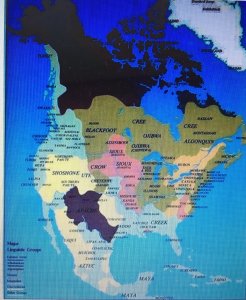
DJdFnI-W4AI9LXEI found this little gem to the left on twitter, at least I believe that’s where I got it. It’s pretty cool, really. It definitely matches my general sense of where various people should be. But then again, my general sense of where everybody should be rests on a skewed timeline. I expect them to be in certain places when the stories I read or tell about them in history class take place. So, if the different natives peoples are in the right place on cue for the historical narratives I expect to feature them, then the map matches my initial expectations, and I end up saying stuff like “it’s pretty cool.” The whole thing almost works, but it doesn’t take too many questions to bust up both those expectations and the maps that go with them.

When did everyone get where they are in the map above? It’s controversial question, and one that I may regret raising here, but still… See the Apacheans down there in the Southwest? You might think they had been there since time immemorial, right? Well the archaeological evidence suggests this isn’t the case. As I recall, the earliest evidence for Diné (Navajo) placement in the four corners area predates the Spanish by a little over a hundred years. They came along with the other Apachean peoples by means of a hotly debated route. Of course archaeological finds happen every day, so the historical evidence may change, and I may have missed a recent find or three, but the point is that these people arrived in the area within comprehensible time frame. This placement on teh map isn’t from time immemorial; it begins at the cusp of the 1400s, give or take a bit, and that enables us to place their entrance into a sequence of events for the region. They were still settling into the total territory on this map when the Spanish began exploring the region, arriving well after their Pueblo neighbors. Knowing that helps to put the map in perspective. Not knowing that invites an a-historical reading of the map.

Now look at the plains. The peoples placed there seem right to me, but it’s worth considering that many of them didn’t get there until well after the beginnings of the colonial period. Specific migration routes and the scale of ground shifted are of course open to debate, but I think it is fair to say that a great deal of the population on this portion of the map filled in after the beginnings of the fur trade, and even more importantly, after the horse began spreading through the plains in the wake of the Pueblo Revolt.

243

From the New Mexico Museum of Art

That would be a war the Indians won folks, not simply a battle. a war. But that’s another rant…

…anyway, the point is that the population of the plains as we now understand it changed a great deal during the colonial period. So, if the southwest takes on roughly the territories represented in the map just ahead of the colonial period, the great plains takes its apparently map-worthy shape during that very period. We can point to a time frame sometime on down the road that reflects this mapping, but by then other things have shifted. Case in point? The eastern seaboard. By the time the plains looks like it does on this map, the settler population is already pushing a lot of people out and away from the coasts. By the time Lakota, Comanche, and Kiowa have reached their positions on this map, the eastern seaboard should already be looking a bit white-washed.

These are just the areas I think I know something about (and admittedly, I am often wrong). The rest of the map is full of movement too. Some areas may be more stable than others. The amount of movement is itself variable.

So, what does the map represent? It really isn’t a clear snapshot of any particular time-frame. We really can’t locate a specific time in which all the territories assigned to various indigenous peoples really were under their control. Rather, it seems to be a representation of the territories controlled by various peoples during something like a period of peak cultural autonomy. …as perceived by white people. In a very real sense, each of these territories is set onto the map in precisely the locations at which we non-natives really became interested in the regions and/or first became aware of the native peoples in question. Fair enough as far as it goes, but to say that this leaves out a lot of information is a Hell of an understatement.

***

Speaking of non-native perceptions. Names are a bit of a problem here as well. I hope it will come as no surprise to learn that many of the names appearing on these maps are not those used by the people to refer to themselves. ‘Navajo’ was for example a Tewa term for open fields. ‘Sioux’ is usually described as a shortened version of an Ojibwa term (it has something to do with snakes). As I recall, there is a competing narrative for that one, but the point is that the name DID NOT come from the Sioux themselves. ‘Eskimo’ was a Montagnais term often translated as ‘raw fish eater’, though it is more likely to have meant ‘snow-shoe netter’. Each of these origin narratives is a complicated story in itself (information is problematic all the way down), but for the present, the point is that the names typically appearing on these maps generally come from the neighbors of the peoples in question. They made their way into the popular lexicon after European colonists asked some other tribe who lives over there. The answers to those questions then made their way into our history books and onto our maps.

tribal_nation_map_custom-973eefab3541e8d2c23056100549ac543e59beee-s1600-c85This is one reason I like this map by Aaron Carapella. He makes an effort to identify the native names for themselves and get them onto the territory. That’s a big improvement. Of course, we still have the timeline problem mentioned above, but at least the names are a bit more authentic. I should add that they are more authentic because they are the names the people in question use for themselves, not because they are ‘original’, as folks sometimes suggest. ‘Original’ alludes to a timeless beginning. Talk of an original name just points us back to the timeline problem, but there is definite value in using the name people prefer to use for themselves. We may have to switch back and forth, or introduce a topic using the more popular names, but working with materials that provides the native terms helps to normalize them.

***

imagesOne additionally interesting feature of Carapella’s maps is the fact that he leaves off the territorial boundaries. The names of each people simply appear on the  map without any clear sense of the boundaries around them. We are left to imagine the full extent of each native territory. This avoids one of the larger problems one commonly finds in maps of Indian territory, their tendency to construe that territory in terms comparable to that of nation states. We all know the convention, color-coded spaces with clear boundaries between them. This conveys both a sense clear boundaries between different Indian peoples and a sense of homogeneity within those boundaries. Every part of Cherokee territory on such a map is just as Cherokeeish as any other part. They are all equally blue, or yellow, or mauve. One gets the sense that someone could pinpoint the exact moment they stepped into (or out of) Cherokee land, or that of any other tribe. We can practically see someone stopping on a dime, just like the cops in an old outlaw trucker movie do when they reach state lines. That’s how modern nation states work. It isn’t clear that this is now native territories work(ed).

It isn’t that native peoples didn’t have territories. They certainly did claim specific lands, and even defend them from others, but this system would have worked without the benefit of a scientific grid defining the exact moment one would step over the line from one territory to the next (much less collection of maps to represent them). Of course, natural features such rivers or mountains, and so forth would be used as reference points, but thus too leaves open questions as to just where the boundary rested. Did a given people claim both sides of a river or just one? The answers would vary. The end result was of course a lot of overlapping claims.

I often wonder if some of these maps could be improved by representing the overlapping territories, Venn diagram-style, at least where such instances do occur, but of course, this leaves open questions about timelines and the adequacy of information as to how the territories on these maps have been assigned to begin with. It’s not as though the historical record is entirely silent on these matters, but there is something about the way these maps fill in the details with a little too much precision. Judgement calls have been made on these maps, and the way they have been made is erased by the nature of the maps.

The problem isn’t really unique to Native American territories, but at least as applied to modern states and nations the techniques used by the map-makers matches those of the powers that be a bit more. People who live in and around important boundaries may or may not live life in a way that bears out the conventions of cartography, but the powers that be will likely support the notion that we can pin-point exactly where one state leaves off and another begins. They will also support the notion that we know exactly who belongs on one side or another, if necessary with guns or walls. The trouble here is that these maps purport to describe the territories of a different world altogether, one which reckons turf a bit differently.

Don’t get me wrong; it’s great to have these maps, but they distort even as they inform. I’m always curious about the prospects of improvement. In the interim, I reckon the best cure for the distortion is to be aware of the problems.

…of which, I hope I have at least scratched the surface.

Sundry Maps (Click to embiggen)…

California Indian Territories
Indian Tribes of the U.S.
Aaron Carapella's map
Aaron Carapella’s map
North American Linguistic territories
Territorial Losses (ironically Native American territories become more clear as they shrink at the onslaught of colonism
Culture Areas Again
Culture Areas Again
Culture Areas
Culture Areas
Nuther Aaron Carapella map
AK Natives
AK Natives

Share this:

  • Tweet
  • Share on Tumblr
  • Print (Opens in new window) Print
  • Email a link to a friend (Opens in new window) Email
  • Share on Reddit (Opens in new window) Reddit
Like Loading...

Violent Memories and the Civil War Era in the Southwest

20 Sunday Aug 2017

Posted by danielwalldammit in History, Native American Themes, Politics

≈ 17 Comments

Tags

Civil War, History, Kit Carson, Monuments, Navajo, Old West, Santa Fe, Southwest, War

It must have been a couple decades back. I was at a small party in Forth Defiance. Those attending included a number of officials in the Navajo tribal government. Fort Defiance serves as kind of a bedroom community for the capital of the Navajo Nation, so this was hardly unexpected. What none of us expected that evening was a quick lesson that began when our host asked if anyone knew the name of the main street going through the town? No-one did. As it happens, the name was Kit Carson Drive.

Kit CarsonApparently, it still is.

To say that most of the party-goers found this shocking is putting it mildly. It may not be obvious to some of my readers why a room full of Navajos would object to a street named after Kit Carson, but even the most cursory knowledge of their history would make this pretty well obvious.  The man is popularly known as an old western Indian fighter, and as it happens, a good number of the Indians he fought were Navajo.  When General James H. Carleton, the Army Commander for the Territory of New Mexico decided to go to war with the Navajo people, it was Colonel Kit Carson that he sent off to do it. Carson marched through Canyon de Chelly, the heart of Navajo territory, destroying resources (just as Sherman might have) and letting winter bring his enemies in to surrender. This campaign, and the four years of internment at Hwéeldi (Fort Sumner) still constitute the darkest chapter of most historical narratives about the Navajo people. So, you can just imagine what it must have meant for people who can still tell you about relatives lost on the long walk to Fort Sumner to learn that a road right through their community bears the name of the man responsible for their deaths.

Kinda put a damper on the party.

You might think it odd that folks didn’t know the name of the road to begin with, but it’s hardly unusual. Folks don’t pay that much attention to street names out that way. Many of the roads don’t have signs at all, and I don’t recall seeing that particular name on a street sign when I lived out there (though one can certainly be found in Fort Defiance today). This party was the only time anyone ever mentioned it to me.

The old south isn’t the only place in this country with a questionable sense of public history from the Civil War era. Those in the Southwest have less to do with the war between the states than the early stages of the Indian wars which would dominate the interior west for a couple decades. Kit Carson Drive is one of many such examples. The Obelisk in the town square of Santa Fe provides another. It’s had its own share of controversies over the years, not the least of them being this dedication:

20914595_10214035631069907_2575022190736341192_n“To the heroes who have fallen in various battles with savage Indians in the Territory of New Mexico.”

It should come as no surprise that this line acquired its share of critics over the years. It has had some defenders as well, to be sure, but plenty of critics. The sentiments might have seemed appropriate enough to those who erected it in 1868, but in the 1970s, sentiments had changed a bit, as had the political status of some of those ‘savage Indians’ referenced in the piece. So it really should have come as no surprise when calls went out for removal or modification of the monument. Today, at least, it may seem a little surprising to find the monument had Native American defenders, which apparently it did. Attempts were made to put the original wording into it’s proper context, so to speak, preserving it without appearing to endorse it, but some clearly weren’t satisfied with this way of thinking about the issue. Resolution apparently came in the form of a chisel, and the result is a monument with its own fill-in-the-blank question.

20992726_10214035596509043_4949865469052976294_n

It seems, the American public is hashing out a new round of debates over public monuments, particularly those in the South. Some no doubt find the entire debate quite trivial. Who reads the placards on a monument anyway? Of course when people fight over seemingly trivial things, you can bet your ass they aren’t really fighting over the trivial things. It isn’t actually history (much less historical monuments) that has people up in arms over Confederate Statues, just as it wasn’t really history that caused a word to fall off the monument in Santa Fe. Such battles are always about the present. They are about the way that people think and use history to shape the present, and there are usually some very specific present implications in these battles.

People typically see the present interests loud and clear when they confront advocates of social justice. If anyone ever forgets this, the term ‘political correctness’ is right there to remind us that someone (or at least someone on the left) has an agenda. What folks are slower to get, it seems, is the fact that these sorts of gestures are hardly neutral to begin with. There is a reason James W. Loewen devoted a fair portion of his book, Lies Across America, to Confederate monuments, and it wasn’t because these monuments contain sober and thoughtful commentary on the actual history of the region. A statue to a confederate hero isn’t just a reference to history as such; it says something to those who those whose ancestors those heroes fought to keep in bondage. And a monument to heroes who died fighting ‘savage Indians’ may say something noble to those descended from colonists (Spanish or Anglo) in the American southwest; it says something else to those descended from those very ‘savage Indians’.

To be sure, complications abound. Some folks may have ancestors on either end or neither of his memorial demographics, and some people may have no dog in the fight at all. Also ironic usage happens. Not every Native American takes umbrage at the word ‘savage’ just as not every Native American objects to the term ‘Redskins’. But we should be wary of efforts to make these exceptions into the rule. The Washington football team has, for, example paid good money trying to find, cultivate, and promote just about any Native American willing to help foster the notion that the team name reflects anything but a racist stereotype. Were the team name really so bland, one might almost wonder what use it would have for people interested in such a martial sport! And of course we now have the Cheetoh-in-Chief (who has his own bullshit civil war monument) mourning the loss of beautiful artwork and a desecration of history with every Confederate statue that goes down. His language is so flowery and positive. You’d almost think these monuments held no serious political significance in the present age.

Of course the folks delivering the Nazi salute in defense of Robert E. Lee might seem to argue otherwise.

There are people, times, and places who don’t find it necessary to remove or modify monuments to their sordid past. Some of these might not even be terrible people, places, or times. But if the monuments to an abusive past aren’t so toxic, this isn’t simply because potential critics choose to let it slide; it’s because the community as a whole has somehow managed to handle the issues in question. When the dominant voices prove tone-deaf or outright hostile to the interests of those on the wrong-side of monumental history, then we are all a lot less likely to get along. Then statues get pulled down.

…or someone just shows up with a chisel.

***

Just a few pics of Canyon de Chelly (click to embiggen):


19732010_10213608255385782_3134402216345552500_n
20264884_10213790741107811_6139379835115073225_n
20776824_10213976954923040_6197824098058023091_o
20799382_10213964731857471_643789261344359561_n
19554785_10213533887766638_4703562301468482973_n


Share this:

  • Tweet
  • Share on Tumblr
  • Print (Opens in new window) Print
  • Email a link to a friend (Opens in new window) Email
  • Share on Reddit (Opens in new window) Reddit
Like Loading...

When Culture Appropriates You

04 Wednesday Jan 2017

Posted by danielwalldammit in History, Museums, Native American Themes

≈ 18 Comments

Tags

Art, Diné, Fort Sumner, Hweeldi, indexicality, Mural, Navajo, Shonto Begay, The Long Walk

15871703_10211699926478752_5551079935863716489_nTo the left is one of my favorite images from a mural painted by Shonto Begay and Mike Scovel at the Fort Sumner Memorial in New Mexico. What’s to be memorialized at Fort Sumner, you might ask? It was the site of an internment camp, one which held the Navajo people for roughly 4 years (about 1864-1868). It also held Mescalero Apaches, but Begay’s and Scovel’s  mural is about the Navajo end of this story. Specifically, it is about “the long walk” to this place, still called Hwéeldi out in Navajo country.

What fascinates me about the image is a trick of context. It’s just one part of a rather breathtaking piece of art, but to me it’s definitely the most interesting. The larger mural wraps around the wall on both sides of a hallway at the memorial. If you follow the hallway, you come to a small movie theater where you an watch a short film about the long walk and the Navajo experience at Hwéeldi. The images are striking. Devastating. They depict a national disgrace, and in surrounding us with the images, this mural invites us to see that disgrace, not from the standpoint of objective observer, but from the standpoint of someone in the midst of it. Walking down that hallway, one is surrounded on both sides by images of people (Navajos) herded along by soldiers and scouts. The mural depicts a great deal of suffering, and it places that suffering all around us. Begay’s and Scovel’s work denies us the chance to step outside the event and view it as a disinterested party.

But when you come to this image, the immersion takes on a more dramatic significance. Suddenly, it becomes clear why all the solders seem to be facing us. The Navajo figures simply plod along, mostly looking in other directions, but the soldiers, they look right at us as we stand in that hallway.

It’s an interesting effect to begin with, but when you walk down that hallway, at some point that soldier’s rifle is pointed at you. The soldier in that painting doesn’t care who you are, what your ethnicity is. He doesn’t even care what your plans are for later in the day. And as my girlfriend pointed out, his rifle seems to follow your movements a bit, at least for a step or two. (I swear it does!) It’s a rather brilliant move on the part of the artists, because it places his viewers in the scene more effectively than anything else. More than placing the viewers in the scene, it confers a specific role on the viewer, as one of those forced along the walk.

It’s just art of course. We will at some point walk on to other parts of the exhibit, and many of us will no doubt shake off the effect of the image a bit quicker than those whose family histories include stories of those lost along the way. Still it’s an interesting contrast with the many times non-natives have chosen ourselves to assume some aspect of a native identity. Whether playing Indian as school-children, wearing a headdress at some music festival, or aping the Tonto-speak of Indian characters in countless westerns, many of us have done it at one time or another. Hell, some people have made a life out of it! Countless non-Indian actors have played Indians on screen, and countless non-Indian characters have become Indians in the story-arc of a common movie theme. And of course there is the Washington football team! What all of these other examples have in common, is a choice to assume some part of native identity, if only for a moment. They also have in common that the identity assumed creates a positive experience for those choosing it. When we non-natives play at being Indian, we get something out of it. It may not be much, often little more than a momentary source of amusement, but the choice is ours, and when choose it, we do so to our own advantage.

That’s the genius of this particular image. It forces that same transformation on anyone walking through the memorial. For just a moment, it makes us play Indian, and to do so on terms we didn’t choose for ourselves. On terms no-one would choose for themselves! We will survive that moment of course, perhaps even without really learning much from it. Still, it’s an interesting twist in the narrative.

That moment, when the business end of a rifle points you right into the story.

***

Here are a few more images from the mural (click to embiggen)!

15871703_10211699926478752_5551079935863716489_n
dsc03617
dsc03601
dsc03600
dsc03609
dsc03598
dsc03623
dsc03608
15781749_10211678431701396_4152348944393224568_n
dsc03599
dsc03603

Share this:

  • Tweet
  • Share on Tumblr
  • Print (Opens in new window) Print
  • Email a link to a friend (Opens in new window) Email
  • Share on Reddit (Opens in new window) Reddit
Like Loading...

Southern Paiutes as Portrayed in Las Vegas Area Museums.

17 Sunday Jul 2016

Posted by danielwalldammit in History, Las Vegas, Museums, Native American Themes

≈ Leave a comment

Tags

Clarke County Museum, Las Vegas, Mormon Fort, Museums, Native Americans, Nevada, Paiute, Paiutes, Springs Preserve

Paiutedisplay

Clark County Museum

One of the dominant themes in Vegas area museums would have to be the struggle with nature. By ‘nature’ I of course mean the desert. It’s kind of fascinating to me as parallel themes dominate literature and cinema dealing with the arctic. It’s a pretty straight-forward notion in either event. Extreme environments help to frame a basic man-against-nature story-line, which is a common enough theme in fiction as well as some historical narratives, even a good number of anthropological works.

Where the arctic narratives focus on cold and the lack of food, Vegas area narratives focus on heat and lack of food & water. Both themes definitely have a little space reserved for the indigenous peoples of the region. “How did THEY survive?” would seem to be a common question, one which segways easily into stories about how WE survive now. The part about how WE survive typically morphs into a larger narrative about thriving civilization. Okay, so the North Slope of Alaska may be a little soft on the civilization theme, not that that’s ever stopped a runaway narrative, but more to the point, in Vegas that narrative steams full bore ahead to land us in a world of casinos, mobsters, and showgirls.

…but those narratives often start with Paiutes.

Okay, so sometimes these narratives start with older Puebloan societies or even Paleo-Indians, but even then the stories quicken with the arrival of Paiutes into the area. These were the indigenous community of Las Vegas when Europeans arrived, so they figure more prominently in plot-lines anticipating those casinos and showgirls. Not surprisingly, the Vegas area museums often use the presence of Paiutes in the valley to frame general questions about survival in the desert, questions that will then play well into later developments in the area. Their own modest use of the area sets the stage in these stories for the mega-resorts of today. And if that seems an odd contrast, that is precisely the point. A miracle in the desert, so to speak. It’s all the more miraculous if we catch a glimpse of its modest beginnings.

SouthernPaiute

A Convenience Store (Not

Of course, American stories of progress often treat Native Americans as just one more feature of nature standing in the way of progress, but I honestly think most of these museums try to handle things a little better than that. Still, there is a bit of slippage here and there. Anyway, the topic is worth a little time on my keyboard, so let’s just get on with it, shall we?

***

What first got me interested in this was a visit to the Mormon Fort, a state park commemorating the first Anglo-American settlement in the Vegas Valley. It contains a number of exhibits, one of which enables you to watch a video recounting the history of Vegas from the creation of the fort itself up through to the development boom of the 1980s (about the time my own family moved into the area). It’s the story of a city built in the midst of a hot desert, and that story begins with the discovery of two springs by European explorers.

As with other such discoveries, it turns out someone was already there. According to one of my old anthropology professors, Martha C. Knack, the Vegas Valley was already home to about a 150 Paiutes with a variety of related communities nearby. It was at these Springs, a kind of Oasis in the middle of the hot desert, that the story of Las Vegas begins.

This story takes off when Brigham Young sends a small group of missionaries to build at Fort at the Springs to serve as a weigh station on the way to Southern California. According to the video, local Paiutes had used the Springs for irrigation projects, so there is little doubt as to a native presence at the Springs. Still, when those first missionaries up and leave, the video suggests that their major accomplishment was to prove that people could make a permanent settlement in the area.

…which of course leaves me wondering what about the Paiute? Hadn’t they already proved that?

This may not be as egregious as it sounds. I could well see white folks at the time thinking of it in that light, biased as it is, so I could see the point of calling attention to this perspective. Still, the commentary in the video is as invested in the bias as any Anglo-American might have been at the time the missionaries left, and so the resulting narrative does seem to erase the Paiute. There is enough information about the local Paiute around the rest of Mormon Fort and even in the video itself to contradict that kind of thinking, but the story-line has its own impact.

Could be worse, could be better.

Mostly, it could be better.

***

That said, the Mormon Fort is a great place in its own right. If you’re in the area, and have a little pocket change left, I would definitely go check it out.

***

I found a couple of interesting origin-narratives for the local Paiute, one at the Clark County Museum and one at the Springs Preserve. Each of these are Coyote stories, so it goes without saying that something is going to go terribly  wrong in them. That’s how trickster narratives work. Each presents the choice of a Paiute homeland as something of an accident. At the Springs Preserve, this accident seems to suggest that Paiute ended up in the wrong place. Coyote opened the basket early (somewhere between Las Vegas and Moapa). The Clark County variant suggests that people had already been escaping and heading in different directions, and Coyote closed the sack before carrying it a ways further and pouring out those who would become Paiute. Whether this means they ended up where they were supposed to go or not, I can’t tell from the source at the museum.

I’ve presented both of these stories directly below (a video and a picture). Of course this kind of presentation strips a lot of the context out of each narrative, but I think a bit of the flavor in such stories does come through. I find myself thinking of the accident in terms of the arid setting, as if it were meant to explain how Paiute ended up in such a dry location with its sparse resources. Still, I’m not sure how much of that would have been the point of the Paiute story and how much of that may be the rest of the presentations in which they occur. With so much of each exhibit devoted to explaining how these people survived in the local desert, it seems easy to think of this as the point of the accident, that Paiute weren’t really meant to be here, but perhaps just me. Either way, I can’t help thinking it’s an interesting way of thinking about how one’s people ended up where they are. Mistakes happen. Sometimes a mistake mean you ruin lunch, put up a video with bad sound quality, or end up with a low grade on a test.

…and sometimes a mistake create a world to live in.

Sackofalltribes

***

Now the Springs Preserve is interesting in itself. This place is huge, and after four visits, I’m pretty sure I haven’t seen everything. It contains the Nevada State Museum and the Origin Museum as well as a number of outdoor exhibits (one of which is the Paiute village where I recorded the origin story above). That story is one of several narratives relating to Paiutes that you can find in the Springs Preserve. The Origin Museum contains a couple more videos. One appears to be a straight-foreword history of Las Vegas beginning with the arrival of Native Americans in the area. It further mentions the brief history of interaction (including conflict) between whites and natives. A second, more dramatic video (set up in a stand of artificial tulies) appears to depict a Paiute elder greeting us (the visitors) as if she were meeting non-natives for the first time. She is friendly, of course, and explains a thing or two about her people’s survival strategies, but the video ends on a dark turn. She sees change coming, and it seems to fair to suggest this is an allusion to the hazards of contact and colonization.

Neither of these videos goes into much detail about the troubled relations between Paiute and non-natives, but each mentions them. Where the first is dry and a little up-beat, the second is cryptic and disturbing.

A quick listen to the Coyote narrative always seems to put things in perspective for me. Odd, I know to want to follow modern history with an origin narrative, but I doubt Coyote would object.

Oh, the videos!

.


***

The Springs Preserve also contains a history of Las Vegas as portrayed in paintings by the artist Roy Purcell. The only explicit mention of natives I recall seeing in this exhibit is a reference to Spanish raids on local Indians. That’s pretty much it. It’s an interesting history. I at least would have found it a bit more interesting if it had a place for the indigenous population. His website suggests that Purcell is working on Native American subjects now. This sounds promising.

No pictures are allowed in the Purcell exhibit, so I haven’t anything to show for that part of the Springs Preserve.

***

The Nevada State Museum (also in the Springs Preserve) doesn’t seem as focused on questions of subsistence, but it does have a few interesting pieces on indigenous peoples of the area. A life-size photo of Sarah Winnemucca had me wondering if she wasn’t a bit south of her usual residence. My personal fussiness aside, she certainly deserves a place in the Nevada STATE Museum. The museum also includes a video presentation in which a modern actress interprets some of her words for visitors at the Museum. Similar videos provide a glimpse of Wovoka’s prophesies, and a woman whose name translates to Little Willow teaches us a bit about basket-making. Please accept my apologies for the poor quality of the audios. To get the full experience, you’ll just have to go to the Museum.

.

.


***

CnNS4cNUMAELRKRThere is one other thing I really must say about the Nevada State Museum, and that it that it seems to contain the White Tree of Gondor. Oh, they call it a Great Basin Bristle Cone Pine, but I know the White Tree of Gondor when I see it. You can’t fool me!

I know, this has nothing to do with Paiutes, but seriously, I think the White Tree of Gondor deserves at least a mention. Don’t you?

***

I’ve written about the Atomic Testing Museum before, and I don’t have a lot to add here, except to note that the museum does reference the indigenous populations of the testing zones. It’s a smallish display by comparison, focusing primarily on cultural preservation. By some accounts Newe Segobia is the most bombed nation in the world, but that story falls a bit North of this post. It’s worth noting though, the general tenor of the Museum’s approach to Native Americans. They want us to know they are trying to do the right thing, but their treatment of the issue doesn’t really escape the largely pro-testing narratives of the museum as a whole.

Let me conclude with a smattering of selected photos from the museums. As always, you may click to embiggen.

Paiute Village in the Springs Preserve
Springs Preserve (Origen Museum)
Mormon Fort describes pre-contact use of the Springs area for crops
Display in the Mormon Fort
Very cool diorama in the Mormon Fort
White Tree of Gondor, ...duh!
White Tree of Gondor, …duh!
Sarah Winnemucca at the Nevada State Museum
Atomic Testing MUseum
Atomic Testing Museum
Clark County Museum
Clark County Museum
Clark County Museum
Clark County Museum
Clark County Museum
Clark County Museum
This mural depicts Southern Paiute. Yes, it's on the side of a 7-11. I don't know what to make of that.
This mural depicts Southern Paiute. Yes, it’s on the side of a 7-11. I don’t know what to make of that.
Close-up
Close-up

Share this:

  • Tweet
  • Share on Tumblr
  • Print (Opens in new window) Print
  • Email a link to a friend (Opens in new window) Email
  • Share on Reddit (Opens in new window) Reddit
Like Loading...
← Older posts
Newer posts →

Top Posts & Pages

  • An Uncommon Security Guard: Dave Eshelman, AKA 'John Wayne'
    An Uncommon Security Guard: Dave Eshelman, AKA 'John Wayne'
  • Hostiles and Spoilers: A Magic Studi
    Hostiles and Spoilers: A Magic Studi
  • Map Ain't Time Either.
    Map Ain't Time Either.
  • Remember Kids! False Equivalence is a Way of Life
    Remember Kids! False Equivalence is a Way of Life
  • The North Pacific Fur Fish
    The North Pacific Fur Fish
  • Happy Juzo Day, And Damn You to Hell if you Don't Know What I'm Talking About!
    Happy Juzo Day, And Damn You to Hell if you Don't Know What I'm Talking About!
  • Spurious Hitler Spuriates Furiously About Guns!
    Spurious Hitler Spuriates Furiously About Guns!
  • Master and Commander Kinda Queered
    Master and Commander Kinda Queered
  • When Sex Falls Out of the Performance
    When Sex Falls Out of the Performance
  • The Erotic Heritage Museum Revisited
    The Erotic Heritage Museum Revisited

Topics

  • Alaska
  • Animals
  • Anthropology
  • atheism
  • Bad Photography
  • Books
  • Childhood
  • Education
  • Gaming
  • General
  • History
  • Irritation Meditation
  • Justice
  • Las Vegas
  • Minis
  • Movie Villainy
  • Movies
  • Museums
  • Music
  • Narrative VIolence
  • Native American Themes
  • Philosophy
  • Politics
  • Public History
  • Re-Creations
  • Religion
  • Street Art
  • The Bullet Point Mind
  • Travel
  • Uncategorized
  • Uncommonday
  • White Indians
  • Write Drunk, Edit Stoned

Blogroll

  • American Creation
  • An Historian Goes to the Movies
  • Aunt Phil's Trunk
  • Bob's Blog
  • Dr. Gerald Stein
  • Hinterlogics
  • Ignorance WIthout Arrogance
  • Im-North
  • Insta-North
  • Just a Girl from Homer
  • Multo (Ghost)
  • Native America
  • Norbert Haupt
  • Northwest History
  • Northy Pins
  • Northy-Tok
  • Nunawhaa
  • Religion in American History
  • The History Blog
  • The History Chicks
  • What Do I Know?

Archives

  • December 2023
  • November 2023
  • June 2023
  • April 2023
  • February 2023
  • December 2022
  • November 2022
  • October 2022
  • September 2022
  • August 2022
  • July 2022
  • June 2022
  • April 2022
  • January 2022
  • December 2021
  • November 2021
  • October 2021
  • September 2021
  • August 2021
  • June 2021
  • May 2021
  • March 2021
  • February 2021
  • January 2021
  • December 2020
  • November 2020
  • October 2020
  • September 2020
  • June 2020
  • May 2020
  • March 2020
  • February 2020
  • January 2020
  • December 2019
  • November 2019
  • September 2019
  • August 2019
  • July 2019
  • June 2019
  • May 2019
  • April 2019
  • January 2019
  • December 2018
  • November 2018
  • October 2018
  • September 2018
  • August 2018
  • July 2018
  • June 2018
  • May 2018
  • April 2018
  • March 2018
  • February 2018
  • January 2018
  • December 2017
  • November 2017
  • October 2017
  • September 2017
  • August 2017
  • July 2017
  • June 2017
  • May 2017
  • April 2017
  • March 2017
  • January 2017
  • December 2016
  • November 2016
  • October 2016
  • September 2016
  • August 2016
  • July 2016
  • June 2016
  • May 2016
  • April 2016
  • March 2016
  • February 2016
  • January 2016
  • December 2015
  • November 2015
  • October 2015
  • September 2015
  • August 2015
  • July 2015
  • June 2015
  • May 2015
  • April 2015
  • March 2015
  • January 2015
  • December 2014
  • November 2014
  • October 2014
  • July 2014
  • June 2014
  • May 2014
  • April 2014
  • March 2014
  • February 2014
  • January 2014
  • December 2013
  • November 2013
  • October 2013
  • September 2013
  • August 2013
  • July 2013
  • June 2013
  • May 2013
  • April 2013
  • March 2013
  • February 2013
  • January 2013
  • December 2012
  • November 2012
  • October 2012
  • September 2012
  • August 2012
  • July 2012
  • June 2012
  • May 2012
  • April 2012
  • March 2012
  • January 2012
  • December 2011
  • November 2011
  • October 2011

My Twitter Feed

Follow @Brimshack

RSS Feed

  • RSS - Posts
  • RSS - Comments

Enter your email address to follow this blog and receive notifications of new posts by email.

Join 8,072 other subscribers

Blog at WordPress.com.
  • Subscribe Subscribed
    • northierthanthou
    • Join 8,072 other subscribers
    • Already have a WordPress.com account? Log in now.
    • northierthanthou
    • Subscribe Subscribed
    • Sign up
    • Log in
    • Report this content
    • View site in Reader
    • Manage subscriptions
    • Collapse this bar
 

Loading Comments...
 

    %d