• About

northierthanthou

northierthanthou

Category Archives: History

Yep! This is where I put the stuff that pertains to history. Take notes, because there will be a test.

I’ll take Cold Tropes and War Analogies for $50, Alex!

19 Friday Apr 2013

Posted by danielwalldammit in Education, History

≈ 26 Comments

Tags

Analogies, Cold War, Communism, Education, History, Metaphors, Pokemon, teaching, Trops

coldwar_nike1It’s getting harder to explain the history of the cold war, at least insofar as students are less and less likely to relate to the era in any personal way. Gone are the days when the subject could elicit a visceral reaction from the under-thirty age-set. I distinctly recall that fear of the world ending with the push of a single button played a big role in my own teen angst, and I doubt I am special in that regard. Hell, I sorta figured it was actually going to happen at some point, all of us were going to die in one big final feud, but then again I’m fun like that. The point is that the subject hung like a cloud over the heads of some of us back in the day.

I suspect a lot of my students have trouble wrapping their minds around the whole thing. So, when you come to something like the Cuban Missile Crisis, it takes a little prep work to get across what would have seemed obvious to my own generation, that this little event, a paragraph or two in the average textbook, actually threatened all of life as we know it. Today, I usually just tell my students that none of us would have been born had things gone differently in that particular sequence of events.

I think they get it.

…sort of.

It’s not just the subject matter that is slipping away, so to speak; it’s also the imagery. This isn’t just true of the cold war. Many of my favorite pop-references are becoming less and less relevant to younger students as my youth passes further and further from the realm of things about which the kids at the cool table could be asked to give a damn.

cokeOne of my favorite teaching-gambits for the cold war has slowly faded into the realm of useless. For years I used to ask my students who lost the cola wars. This always got some funny looks, followed by suggestions of ‘Coke’ then ‘Pepsi’ both of which I would shoot down without the slightest hint of an explanation, …leaving them to give me more funny looks.

How could it be neither?

Sooner or later someone would suggest Shasta, Nehi, RC-Cola, or some other obscure brand of soda most likely consumed by cave men in the sad old days before Paula Abdul and Michael Jackson. This suggestion would then become a jumping off point for discussing the impact of the cold war on various third world nations forced to articulate their own interests in terms framed by the U.S. and Soviet Union.

imagesToday my students still give me blank stares, but they are not the blank stares of students struggling with a conundrum; they are the blank stares of students listening to someone try and explain a complicated issue by means of a metaphor that is no more accessible to them than the full story in itself. Sadly, it is time for me to move this metaphor to the back shelf and put some other theme in the specials section of my intellectual supermarket.

(See what I did there?)

Missionary colonial periodI once TAed for an instructor that used to compare the Cold War to the conflict between Protestants and Catholics in the colonial era, each bringing a vision of absolute truth to Native Americans, promising that truth was the key to liberation, demanding their loyalty, and taking everything they had in the process. (How’s that for a run-on sentence!) So, that professor seemed to be suggesting there was nothing new under the sun, just two new world powers playing the same old shell games with the rest of humanity. I like this analogy too, but it’s not so much a quick entry into the topic as a food-for-thought and what-does-it-all-mean kinda notion.

Today I was trying to explain the dynamics of proxy wars to a student when I could see the light go off over her head. A moment later she exclaimed that it was just like Pokémon. The other students quickly nodded, and after a brief moment in which I sort of wanted to cry, I thought actually that isn’t too bad.

PiakchuSo, here I sit, watching the next batch of students suffer their way through an exam and wondering if this is the wave of my pedagogical future? Will I soon find myself saying things like; “And then Nikita Kruschev said, ‘Fidel Castro, I choose you!'” Can I wrap my mind around the concept of West Germany as Picachu? Can I use this narrative without promoting anyone to the heroic status of Ash? Or should I just let John Wayne have that role? Can y’all imagine the Duke in his Green Beret uniform whipping out a pocket monster and saying; “have at ’em liddle pardner!” The imagery almost seems promising, but I just don’t know if I am up to the task. This isn’t my era, and I don’t know the game.

The whole project does have a certain amount of promise. I wonder if I can get faculty development funds for this? I wonder if the Dean of Instruction will give me money to go to the gym and develop my Pokédex?

Cause I really don’t think I can teach this subject without a fancy new gym badge!

71.271549 -156.751450

Share this:

  • Tweet
  • Share on Tumblr
  • Print (Opens in new window) Print
  • Email a link to a friend (Opens in new window) Email
  • Share on Reddit (Opens in new window) Reddit
Like Loading...

Bonus Super-Villain: This Girl is Nasty in Real Life and on Screen!

10 Wednesday Apr 2013

Posted by danielwalldammit in History, Movie Villainy, Movies

≈ 26 Comments

Tags

Anna Rosmus, Deviance, Germany, History, Holocaust, Memory, Nazis, Villainy, World War II

1990-the-nasty-girl-poster1What makes Sonia Rosenberger so nasty? It isn’t what you would think, or even what the cover of The Nasty Girl would seem to suggest. Precocious though she may be, Sonia’s crimes are those of an historian. She earned the title in her hometown by asking the wrong questions about its history.

I love her.

Sonia’s journey into super-villainy began with an essay contest. As a young student at a Catholic school in Germany, Sonia decided to enter into a national writing contest. She had two topics to choose from; “The concept of Europe” and “My Hometown During the Third Reich.” Sonia’s teacher sensibly encouraged her to go with the first topic, but Sonia had been brought up to believe that the good people of her home town had resisted the Nazis. How could she pass up the opportunity to reveal the heroics of her friends and neighbors?

Please don’t fault Sonia for the innocence of her original intentions! Even the dark flowers of villainy take some time to bloom.

You see it wasn’t long before it became clear to Sonia that something was amiss. Everyone in town seemed to agree that the only true Nazi had been the mayor, but she could not quite seem to get her hands on his files at the local library. What little information she could find on Professor Juckenack, the great hero of the resistance, turned out to be an essay in support of Nazi racial politics. And no-one could seem to remember the concentration camp in town, at least not without a little needling on the subject, in which case they were quick to point out that it was far better than all the others. …the camp that didn’t exist, that is.

Something was amiss!

So, you might wonder what would a good girl wold do upon finding such a mystery? What should a good girl do upon discovering that the people she most looked up to seemed to be damned uncomfortable whenever she tried to talk to them about her personal project? Well, I personally have no idea what a good girl would do about such a quandary, but I can tell you what this bad Betty did.

She dug deeper!

Despite hints, pleas, and even threats, Sonia just kept pressing on in pursuit of the unwelcome truth. Hell, she even kept at it after someone chucked a brick through her car window. Trust me, that was just the beginning. Sonia ignored the advice of neighbors, parents, and even her husband in her pursuit of the truth, sacrificing health and safety in an effort to learn just what had really happened in her hometown during the Nazi years.

I ask you, would a good girl do that? Not a chance!

Left with no other options, Sonia sued the town to gain access to the mayor’s old documents, and when the town changed its laws to prevent her from getting access yet again, …she just sued the town again. She acted as her own lawyer in both ventures, by the way. (Yeah, she’s just that bad-ass.) And do I need to say that she won the second case too? That’s right; good guys don’t always win. Sometimes they get their butts kicked by villainous nasty girls.

Twice!

I’m not even going to tell you what Sonia did when the town library pretended to lose the mayor’s files in yet another effort to hide the truth from her villainous campaign. Suffice to say this juggernaut of naughtiness would not be dissuaded! You know what else I’m not going to tell you? What Sonia found out about Professor Juckenack and his activities under the Third Reich. Nor will I tell you what happened when he sued her for writing about it in her book on the subject. I’m not going to tell you, because I’m feeling a little bad myself today. (Sonia has inspired me to evil.) And if you want to know the answers to these questions, well then you are just going to have to come over to the dark side and dig a little yourself.

Ha!

RosmusPassau300pxwBut you know what the best part of this story is? It is actually based on the life of a real person. her name is Anna Rosmus of Passau, Germany, and she is every bit as wicked as the celluloid creation she inspired. Anna didn’t stop with one book about her hometown, she turned her tireless pursuit of unwelcome truths into a career in scholarship, much of it dedicated to ensuring that the memorials to this painful chapter in German history would not be forgotten, neglected, concealed from the public, or outright defaced. Time and again, Dr. Rosmus has called attention to realities good decent folk would just as soon forget.

Who would do such a thing?

Only a nasty girl.

A very nasty girl indeed!

***

(The image of Anna Rosmus is from http://www.history.ucsb.edu/faculty/marcuse/classes/133c/133cPrevYears/133c04/133c04l17-NaziPast70s80s.htm)

71.271549 -156.751450

Share this:

  • Tweet
  • Share on Tumblr
  • Print (Opens in new window) Print
  • Email a link to a friend (Opens in new window) Email
  • Share on Reddit (Opens in new window) Reddit
Like Loading...

Point Hope (Photo Gallery)

08 Friday Feb 2013

Posted by danielwalldammit in Alaska, History

≈ 21 Comments

Tags

Alaska, Atomic Energy Commission, Environmentalism, History, Igloo, Nuclear Power, Point Hope, Social Justice

Old Sod House

Old Sod House

I spent a couple days at Point Hope in August of 2010, and I thought I’d share a few of the pics from out that way.

Point Hope is a community of a little over 700 people at the far end of the Lisburne Penninsula reaching out into the Chukchi Sea. It is commonly thought to be one of the more culturally conservative communities of the North Slope. At least that’s what folks say up here in the North Slope.

In his Autobiography, Charles Brower, Sr. relates a number of interesting stories about Point Hope and its residents before travelling up to settle in Barrow. It’s a great read anyhow, but I think Brower’s comments on Point Hope are particularly interesting.

(If you zoom out on the map one click at a time, it’s kinda cool.)

There are at least 2 interesting things about Point Hope.

First, according to some sources, Point Hope is the oldest documented settlement in the arctic. I’m a little wary of that particular claim, so we’ll just say it’s damned old. The initial Inupiat settlement at this spot was known Tikagagmiut (there are a few small variations on the name), and its people were somewhat of a force to be reckoned with in the region.

So, why did people settle here? After two days of wind and freezing rain, I was inclined to think it might have been the climate, but I guess that wasn’t it after all. Actually, it was the fact that the region is ideal for hunting both sea and land mammals***. Anyway, the archaeological digs here go back a thousand years or so. I didn’t see anything that old myself, or if I did, I may not have recognized it, but I did get to walk around an interesting collection of old homes and sod houses.

Before going out to look in the old houses, I asked a local if it was acceptable to approach them, and if it would be okay to take a camera. I didn’t want to do anything disrespectful. The advice I got was to call out at the door of any home I saw and if anyone answered, they said; “don’t go in!” …Good advice. One of my colleagues says she lived out here in the 70s. She lived out in the old abandoned houses as a child. Wish I had had her along as I was looking around. I was still new to the area, and had lots of questions.

You can see at least two different types of dwellings in the abandoned housing area which sits just on the other side of the tracks. There are basic wooden houses, many of which piled sod up outside for insulation. One also finds traditional Inupiat sod houses. Sorry folks, Inupiat in Alaska didn’t live in ice houses. They dug down a ways and then used driftwood and whale-bone to create a structure around the pit. Sod was then piled up around this to make the walls. This is a traditional home (or at least the Cliffnotes version thereof). The ice houses most people associate with Eskimos? Well you gotta go way East to find people that live in them.

Older remains can be found underneath the buildings in my pictures and some of the older remains have been washed out to sea (cause all these shorelines up here are receding).

The second thing that is interesting about Point Hope is an event that didn’t happen after all, …thankfully. Around 1958-62, the Atomic Energy Commission decided to create a deep water harbor about 30 miles south of Point Hope.

They were going to do it in a jiffy, so to speak.

Spokesmen for the AEC held a gathering at Point Hope and assured its residents that there were no lasting effects from radiation in Japan, and that any harms experienced by those in the Pacific were due to their own negligence. You may think they neglected a few facts in saying this. One additional fact they neglected to note was that the Inupiat were taping the meeting.

**** I am grateful to Barbara and Jack Donachy of Cutterlight.com for correcting my initial presentation here. If you scroll down a bit, you’ll see that they left a very informative comment on the topic. Y’all might also want to check out their own blog, because they live in Point Hope right now. ****

All of these were taken on an old Blackberry. I don’t seem to have taken too many pictures in town, so most of these are of the old houses and such. Sadly, I missed one of the most interesting features of th community, it’s huge graveyard. I saw it from above, and my Blackberry went wacko as I was trying to take the picture. Very disappointing!

If you click on a picture it will embiggen.

I’ve flown in smaller.
I think this was my first view of the tundra.
More Tundra.

Point Hope from the Air
Post Office
Hotel

As I recall, this room cost about 200 a night.
Yes, the fuselage is built into the home.
Fuselage Manner from the alley.

Surf
Whale Bones
Old House

Old House II)
Old House III
Traditional Skin boat (Umiaq) frame and sled frames.

Frame
Note the sod piled up around the walls.
Just what it looks like.

Old Sod House
Doorway
Looking down into the house.

71.271549 -156.751450

Share this:

  • Tweet
  • Share on Tumblr
  • Print (Opens in new window) Print
  • Email a link to a friend (Opens in new window) Email
  • Share on Reddit (Opens in new window) Reddit
Like Loading...

Sweatshops and the Invisible Hand of Satan: A Few Thoughts on Some Not-So-Invisible Fires

03 Monday Dec 2012

Posted by danielwalldammit in History, Politics

≈ 32 Comments

Tags

Adam Smith, Bangladesh, Diplomacy, Economics, Free Market, Sweatshops, Tazreen, Triangle Shirtwaist Fire, Walmart

MK-BZ106_SOURCI_G_20121129204437A hundred and twelve people died horribly last weekend. They died so that you and I can look fabulous.

…at a discount.

I am of course talking about the fire that broke out in Tazreen Fashion Factory in Bangladesh on Saturday, November 24th. Employees were hard at work in the factory, making clothes for Walmart, Disney, and perhaps other American labels when the fire broke out. Under normal circumstances, these people face working conditions unheard of in the contemporary U.S. According to one source, they earn 18 to 26 cents an hour and put in 72-81 hours a week, experiencing physical and mental abuse from managers on a regular basis. But of course last Saturday, all that ended, at least for 112 of them.

So, is it fair to suggest that these people died for you and I? After all, you probably didn’t decide their hours or their wages, much less pick their managers, lock an exit, or order them back to work when word first broke out of a fire. Neither did I. Someone else did all of that. You and I merely chose what clothes to wear; we were not consulted on the conditions under which they were made.

But of course that is precisely the point.

Events such as the Tazreen fire, or the horrible working conditions which preceded it, do not occur because any malevolent human being wills them to happen. They are the outcome of countless individual decisions made by perfectly reasonable human beings. You and I want quality clothing at a reasonable price. The retailers wants to make a profit, as do the distributors, and so on. All these seemingly innocent decisions combine to create a market for labor manufactured under conditions which constitute a living Hell for the workers in those factories. Last Saturday the fires of that Hell claimed the lives of people condemned not by the conscious choice of any living person, but by the invisible hand of the marketplace.

Just to be clear, I do not wish to deny the other, more familiar, metaphor of the invisible hand. At least I do not mean to deny the realities which Adam Smith used the metaphor to describe, the process by which individuals pursuing their own self interest may indeed contribute to the common good. I do not deny that such things happen. I deny that they are always the case, and I assert that they occur right alongside a process that is far more insidious than the common metaphor suggests. If the market may be thought a God, that God is a Janus-faced deity at best, content to restore market equilibrium regardless of the human cost. Market Equilibrium is simply not a standard of moral value; it may be achieved with tears as easily as it does with a smile.

Or worse.

What happened in Bangladesh is hardly a new story. A sweatshop full of workers, locked inside, people burning, others jumping to their deaths. Last week’s tragedy recalls the events of the Triangle Shirtwaist Fire of 1911. Then it was primarily Jewish immigrants plunging to their death, or burning in the flames. Last week it was foreigners living in their own country. Either way, it is people without much say over the workings of American government laboring to supply goods for the American public (and other nations to be sure). Separated by half the globe and a hundred years, the stories could hardly be more similar if an evil genius had produced them as a message for all mankind to see.

287px-Image_of_Triangle_Shirtwaist_Factory_fire_on_March_25_-_1911But who would see it now that couldn’t have seen it before the fire happened? The dynamics at stake in this fire have been clear for the better part of a century, if not longer still. It is a question of political boundaries, and the way those boundaries limit government response to exploitive working conditions.

In the wake of the Triangle Shirtwaist Fire, America has seen countless reforms aimed at protecting the rights and safety of workers. Quite a number of these have carried the force of Federal Law under the Commerce Clause of the U.S. Constitution. The rationale for laws protecting workers remains simple enough. They exist to protect workers from conditions deemed unacceptable by the public at large (and one is tempted to say by decent folk anywhere).

Some would maintain that the nature of a free labor contract requires no such regulations, nor tolerance of unions. Workers are free to decline the contract, so the argument goes; is that not enough? Such arguments ignore the realities of job conditions like those in Tazreen or the Triangle Shirtwaist Factory. But the problem with such an approach is less that it fails to deal with the inequalities of labor contracts than it is a willful dismissal of the lives of workers who end up in such places. It is less an approach that fails to account for the limitations of the market than it is an approach that sees in the lives of people working themselves to death little other than a unit of value in a mathematical equation.

Thankfully that argument has been defeated in every Federal Law regulating maximum hours, child labor, workplace safety, and a host of other protections, however inadequate they may sometimes prove to be. But why do such laws need to be made at the Federal level? The Supreme Court nailed the answer to this question damned well in United States v. Darby, 1941.

…interstate commerce should not be made the instrument of competition in the distribution of goods produced under substandard labor conditions which competition is injurious to the commerce and to the states from and to which the commerce flows.

Simply put, if we are to leave the protection of workers to the states, then the end result will be a race to the bottom, with that state granting the least protections becoming a magnet for factory work, all at the expense of workers in that state. And in the long run no state could long hold to high standards in the treatment of workers without risking a good deal of lost commerce. In the end, the only plausible hope of resolving the problems of exploitative (or even dangerous) working conditions lies in the prospect of Federal laws preventing trade in products made under those conditions.

We still have those laws in America, and American workers are (at least in theory, and commonly in practice) relatively safe from the scale of exploitation leading to events such as the fire of 1911. But of course many of the world’s developing nations do not, and that is precisely what many large scale corporations like about them. Several generations of American political leadership (Democrat as well as Republican) have done very little to protect American markets from competition with the products of such factories. We’ve already seen the deleterious effects of that process in the slow drain of jobs outsourced to other nations. And last weekend we saw the harmful effects on people now getting those jobs.

In effect, the free market as American diplomacy has envisioned it has opened up opportunities for exploitation on a scale most Americans can now hardly imagine. And of course we don’t have to, because it happens so far away to people we will never know. We notice the scarcity of jobs; we do not notice the lives wasted doing the work that has left our shores, at least not until events like this. But this is the cost of a global market wandering freely across the political boundaries of nations.

Simply put, there is a link between the difficulties American workers have in finding jobs and the difficulties of workers like those in Bangladesh have in finding a working exit from their own jobs.

The public is hardly capable of stopping such events as public pressure is always behind the curve. We learn about such working conditions through disasters, but not in time to stop them. The self policing efforts of companies like Walmart are hardly sufficient, and their conflict of interest should be perfectly apparent to anyone capable of reading the price tag on a shirt or a skirt. But then we pay the price in lost jobs all the while wage slavery flourishes in other parts of the world, driven by demands shaped here, at least while what’s left of the middle class still has money to spend.

I’m not arguing for any particular solution to this sort of problem, but I am increasingly impatient with those who don’t see this sort of thing as a problem at all, with those who see in the workings of the market a uniformly benevolent force, those who would pretend that all will be well, or as well as it could be, if we just keep governments from interfering with business.

If we just let the market run its course, some would say, the world will in the long run be a better place.

Last weekend the market ran its course.

It consumed a hundred and twelve people.

71.271549 -156.751450

Share this:

  • Tweet
  • Share on Tumblr
  • Print (Opens in new window) Print
  • Email a link to a friend (Opens in new window) Email
  • Share on Reddit (Opens in new window) Reddit
Like Loading...

Myth-Busting For Fun and Frustration: A History Lesson that Just Didn’t Take

05 Wednesday Sep 2012

Posted by danielwalldammit in Education, History

≈ 12 Comments

Tags

America, American History, Cognitive Bias, Education, History, Myth, Myth-Busting, Note-taking, Puritans, Study-Habits, teaching

I still remember my first real object-lesson in teaching. I had just started as a teaching assistant and they had me working in a class on early American History. The professor spent a good deal of time on the Puritan colonists that semester. By “spent a good deal of time on” I mean he railed on about this particular subject for hours while we slowly fell behind the syllabus, …which was fine with me actually, but quite a few students balked at this approach.

The professor did his best to debunk one common misconception about the Puritans; the notion that they came to America for religious liberty. In his view, it would have been more fair to describe the Puritans as coming to America because their efforts to oppress others had been thwarted in England and Holland. He could go on in great detail about various things they did which were wholly inconsistent with the notion of religious freedom. The very idea was as foreign to them as it was to any of their supposed oppressors.

This message found its way into several lectures that semester. The textbook was a little less emphatic on the subject, but it certainly did nothing to undermine the message my Professor had been working so hard to get across. Whenever I had a chance to talk to the students I was right on the message. Hell I loved that argument, and I was happy to have a go at it whenever I got a chance. With three separate sources providing re-enforcement for the same message, I was pretty confident that it would get through. If the students in that course had learned nothing else, surely I thought they would have learned that the Puritans did not really come to America seeking anything we would recognize as religious liberty.

So, you can imagine my surprise when well over half the class turned in midterm exams with essays going on at length about how the Puritans had come here to find religious liberty and establish democracy!  I actually had to ask the instructor to go over the subject one more time, just for me, because I was convinced I must have misunderstood something. But no, his take on the subject was exactly as I had remembered it.

I looked for signs of conscious disagreement. Were these students showing spine? Could they be fighting back (I hoped)? No. I didn’t see that either; no-one fielded a counter to the specific points made in class. Not one essay fielded any new ideas or information. They were simply repeating the same platitudes the teacher had been at pains to refute as if they had no reason to suspect anything was wrong with those notions. Near as I could tell, these students were telling a story they simply took for granted, a story the truth of which they had no call to question at ll. It wasn’t absenteeism either; many of those hitting this theme had been present virtually every day of class. Judging by the essays, only a handful of the seventy or so students in that class had picked up on the actual lesson. Most were completely unaware that they were telling us the exact opposite of what we had been telling them for over a month.

Why?

It was a complete mystery to me, but I red-inked the Hell out of the tests, assigned grades with a touch of mercy, and we both set about explaining the subject one more time.

Over the next few weeks I came up with a theory. I never had a chance to test this explanation, but it remains my guess as to how the whole thing happened. I watched carefully to see how the students were taking notes, and in most cases the pattern was pretty clear. When the instructor announced the general topic for a stretch of his lectures, the students I could see wrote down down that topic and then sat back to listen to what he had to say about it (or perhaps to drift off to think of something else while appearing as though they were listening). As each each major sub-theme came down, they would write down a single word or phrase underneath the major topic and continue listening. The end-result was something that looked a lot like the outline for a speech or paper. So, when it came time to study for the midterm, a lot of the notebooks must have ended up with a section that looked something like this:

Puritans

– Religious Freedom

– Democracy

Assuming I am right about the note-taking, I can just see the students looking down at their notes when it came time to study for that exam and seeing a simple list of topics. Lacking any of the details from the actual lecture, the students must have simply filled in the gaps with their own preconceptions about the topic, preconceptions that had been re-enforced by years of K-12 lessons and countless pop-cultural references.

All the instructor had managed for all his railing against the notion was to underscore the importance of the very message he had set out to refute. All I had done was to help him underscore that very message.

I try keep this in mind whenever I feel like indulging in a spat of myth-busting.

71.271549 -156.751450

Share this:

  • Tweet
  • Share on Tumblr
  • Print (Opens in new window) Print
  • Email a link to a friend (Opens in new window) Email
  • Share on Reddit (Opens in new window) Reddit
Like Loading...

Primitive Superstition and Proxy Fundamentalism: Further Reflections on Native American Spirituality

17 Tuesday Jul 2012

Posted by danielwalldammit in Anthropology, atheism, History, Native American Themes, Religion

≈ 15 Comments

Tags

Aborigine, American Indian, atheism, Native American, Oral Tradition, Primitive, Rationality, Science, Superstition

Stephen Hawking and Leonard Moldinow
The Grand Design

It always bends my thoughts a little sideways to hear my fellow unbelievers dismiss Christianity as primitive superstition, but it isn’t Christianity or Christians that I’m worried about (sorry). It’s the ‘primitives’ that concern me.

Having spent most of my career working with indigenous people, people who until recently might well have been dismissed as primitives, I can’t help but bristle a bit when the cultural heritage of my friends and coworkers (or their grandparents) is used as an insult for someone else. More to the point, I can’t help but feel the comparison is deeply misleading, not just as to the nature of ‘primitive’ people and their customs, but as to the whole shape of human history. In the end, references to primitives and/or superstition always strike me as a bit of self-indulgence, or even an ironic expression of faith.

The notion here is that Christianity (and most if not all of the world’s great religions (certainly the Abrahamic faiths) are essentially trying to explain the world about them much as preliterate peoples are presumed to have done in the remote past. Actually, “non-literate” would a better term, but for the present, I am taking the notion of things-primitive to refer to those who haven’t developed writing systems. That’s putting a rather complex topic into a simple formula, but of course this is a blog, not a book, so you are either with me or not at this point; we’ll see what happens. Anyway, the point is that folks comparing Christianity to primitives are essentially suggesting that Adam and Eve, are for example, erroneous attempts to explain human origins much as Australian Aborigines might explain local geography as the concrete result of events in Dreamtime narratives; just as Norseman might explain the shape of a salmon’s tail as a result of Thor’s powerful grip; …and so on. The idea, as I understand it, is to treat religious beliefs as a subset of erroneous explanations for the world around us, explanations that reflect the ignorance of those doing the explaining.

Take for example the following excerpt from Stephen Hawking’s book, The Grand Design (2112):

Ignorance of nature’s ways led people in ancient times to invent gods to lord it over every aspect of human life. There were gods of love and war; of the sun, earth, and sky; of the oceans and rivers; of rain and thunderstorms; even of earthquakes and volcanoes.

Hawking goes on to explain that the development of modern science has displaced such explanations, and as science progresses these sorts of beliefs should essentially fade by the wayside. Thus, we have the germs of a grand historical meta-narrative, one in which humanity tries various means of explaining the world only to commit numerous errors before settling on modern scientific methods.

***

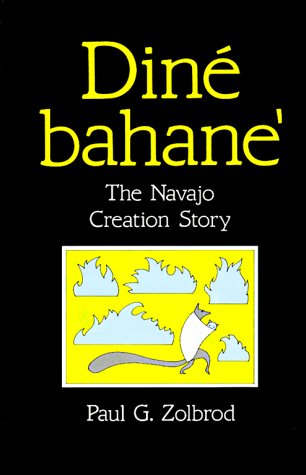
Paul Zolbrod
The Navajo Creation Story

So, what is the problem?

Let me start with an example. When I first headed into Navajo country in 1996, I hired on as a research assistant for a study of local youth gangs. I can’t say that the study yielded much of value, but we did manage to not get anyone killed (…I think). At any rate, one of the items we were supposed to investigate was the question of why gangs had appeared in Navajo country. In the days just before the study kicked up I recall asking an elder that very question. He looked right at me and said; “The separation of the sexes.”

So, what was he talking about?

It was a reference to a specific phase in the Navajo emergence narratives. The most thorough retelling that I’ve looked at would be the book; Diné Bahane’: The Navajo Creation Story by Paul G. Zolbrod. A portion of the narrative has been reproduced here on the website for the Twin Rocks Trading Post, and it’s definitely worth a read, but I’ll paste in a small stretch here. You could just as easily entitle this passage; “Where All The Trouble Began.”

Altse’ hastiin the First Man became a great hunter in the fourth world. So he was able to provide his wife Altse’ asdzaa’ the First Woman with plenty to eat. As a result, she grew very fat. Now one day he brought home a fine, fleshy deer. His wife boiled some of it, and together they had themselves a hearty meal. When she had finished eating, Altse asdzaa’ the First Woman wiped her greasy hands on her sheath.
She belched deeply. And she had this to say:
“Thank you shijoozh my vagina,” she said.
“Thank you for that delicious dinner.”
To which Altse’ hastiin the First Man replied this way:
“Why do you say that?” he replied.
“Why not thank me?
“Was it not I who killed the deer whose flesh you have just feasted on?
“Was it not I who carried it here for you to eat?
“Was it not I who skinned it?
“Who made it ready for you to boil?
“Is nijoozh your vagina the great hunter, that you should thank it and not me?”

To which Altse’ asdzaa’ offered this answer:
“As a matter of fact, she is,” offered she.
“In a manner of speaking it is joosh the vagina who hunts.
“Were it not for joosh you would not have killed that deer.
“Were it not for her you would not have carried it here.
“You would not have skinned it.
“You lazy men would do nothing around here were it not for joosh.
“In truth, joosh the vagina does all the work around here.”
To which Altse’ hastiin the First Man had this to say:
“Then perhaps you women think you can live without us men,” he said.

…and things get worse from there.

Ultimately, the fight between this Ur-couple will lead to the separation of all men and women from one another. The longing that each gender feels for the other will in turn lead them to unnatural sex acts, and these will in turn lead to the birth of monsters (really the story does get quite interesting).

So, what was the elder telling me? On the one hand, he was suggesting that the gangs were themselves the sort of monster that had its ultimate origins in the time of separation, just as had the giant and all the other beasts slain the by Hero Twins later in this same set of legends. On the other hand, he was suggesting something more subtle; he was calling attention to a high divorce rate on the Navajo Nation. In effect, that brief response served to point out not just one but two answers to my question, and to suggest some sort of relationship between them. Either way the separation of men and women from one another was, in this man’s view, the reason that gang violence had begun to appear in Navajo country.

The first of the two answers presented above could be classified as mythology. It is an attempt to explain a known fact by means of a reference to an old (and quite unverifiable) legend. The second approach treats the story in question as an allegory about the importance of marriage, and the elder’s answer becomes a direct social commentary on the relationship between changing family conditions and the rise of gang-related violence in the area. Right or wrong about the issues at hand, this interpretation would suggest the elder had been directing my attention to real world behavior. It would not have been difficult to measure that behavior, and even to formulate strategies for testing the causal connection he had asserted. But the most interesting thing about this whole fashion of speaking is really the interplay between the two forms of explanation. The elder did not choose which approach to communicate; in fact he chose language that suggested both lines of thinking to anyone familiar enough with the issues to know what he was talking about.

***

Standing Rock Sioux Reservation

Standing Rock Sioux Reservation
(September 2011)

So what, right? Thus far, what I have presented is fairly comparable to untold other religious texts. What is the difference, you may ask?

Well, for a start, there is no catechism here. Neither is there any equivalent to the Apostle’s or the Nicene Creed (or any other). Recourse to the emergence narratives presents no set doctrines about which one must agree, nor are there mechanisms for establishing what those would be. Until folks like the early anthropologists make it into the southwest, these stories were not written down at all, and until Zolbrod one could find no single text to unite them all into a single Holy Text. In the old days, as they say, this story might well have been a complete performance in its own right, one told for reasons specific to those present, and adapted a little for that precise purpose. Folks would have understood how this little story related to a number of other stories, but no set canon could be found against which to measure each individual performance or determine its precise meaning. In short, thesignificance of the text above ought to be understood without recourse to any of the mechanisms by which mainstream religions streamline their message and create a uniform set of doctrines.

To understand the elder’s reference one needn’t start by assuming he literally believes in the events described in the narrative above, or even that such a belief is relevant to his answer. One need only recognize that he found the story to be a useful reference point, and that he chose to use that reference point as a means of communicating a sense of the current state of his community.

I think this is the sort of thing John R. Farella must have had in mind when he said in his book, The Main Stalk, that one ought not to assume all natives are fundamentalists. It isn’t even that such folks aren’t out there, but they do not necessarily control the traditions in question. We shouldn’t be too quick to assume that a literal interpretation of things drives every reference to native oral traditions. That is what people raised in the Abrahamic traditions (whether we have accepted those traditions or not) tend to do when encountering the oral traditions of various people around the world, or even when we read ancient texts (such as Genesis) with an eye towards understanding something about the oral traditions incorporated within them.

Understood in these terms, the literal value of mythic events loses a lot of ground to the other implications of the narrative. A god of lightning ceases to be an explanation for lightning, and the lightning becomes a convenient means of letting nature call the name of the god to your mind. References to actual geography in mythic narratives cease to be a means of explaining those geographic features and become a variety of social conventions from territorial claims to moral lessons. The oral traditions become less of an attempt at understanding nature and more of an attempt to use nature as a means of expressing principles of social organization.

***

And where does that leave us?

I think it leaves us without a coherent central theme for the grand meta-narrative. Absent the assumption that every story is supposed to contribute to a single coherent theory (much less the assumption that that theory is a truth the recognition of which all mankind is obligated to acknowledge), we lose any clear reason to treat such stories as pre-scientific explanations of the world around us.

No, this does not mean we must accept any and all religious assertions after first checking to make sure they are offered in a less than literal spirit. What it does mean is that we lose one religious tenant to which not-a-few atheists seem quite prone, namely belief in uni-lineal Progress with a capital P. We lose that tenant, both as a short-cut to understanding the past of humanity, and as a promise of future success.

This does not mean giving up reason as a value, just letting go of the illusion that this value is the axis mundi around which all of human history turns.

Hawking is perfectly right to insist on the superiority of scientific approaches to explaining the world; he is wrong to think that explanation is the key to all those other traditions now conveniently (if quite inaccurately) summarized as a god of this and a god of that.

If there is an explanatory feature to religious tradition, it is largely a function of the means by which religions derive actual doctrine from such narratives and demand that others acknowledge the truth of those doctrines. In this respect the Abrahamic traditions do not merely carry forward the problems of earlier, so-called primitive, traditions. Instead they bring with them a brand new sort of problem, an effort to realign all the creativity one finds in oral tradition with a single obligatory and highly inflexible paradigm. We ought not to be too quick to let the God of Abraham share the blame for this problem with the figures of oral tradition from around the rest of the world. Nor should we be too quick to assume the course of history has been driven first and foremost by the values of scientists and philosophers.

71.271549 -156.751450

Share this:

  • Tweet
  • Share on Tumblr
  • Print (Opens in new window) Print
  • Email a link to a friend (Opens in new window) Email
  • Share on Reddit (Opens in new window) Reddit
Like Loading...

The Stars and Stripes in Two Takes

28 Thursday Jun 2012

Posted by danielwalldammit in History, Native American Themes, Politics

≈ 18 Comments

Tags

American Indian, Flag, Jingoism, Native American, Patriotism, Rodeo, Star Spangled Banner, Taos

Entrance of the Flag

July 4th came a little early for me this year, or at least I found the American flag playing an unexpectedly prominent role in my weekend. The first occasion to think about the Stars and Stripes occurred at the Rodeo de Santa Fe on Saturday.

We arrived just a few minutes before the announcer asked the crowd to rise for “the most beautiful flag in the world.” He went on to tell us that people in other parts of the world look to it as a symbol of freedom. In just a few moments, a young lady with a beautiful voice begin to sing the National Anthem, but I have to admit I was already out of the moment. There was something about the tone of the introduction that had me a little on edge.

The announcer presented himself well and genuinely enhanced the overall experience of the rodeo, but I personally like my patriotism without a dose of jingoism. Hell, I could live with the description of the Star Spangled Banner as the most beautiful flag in the world. People in other nations might say the same of theirs, but if patriotic sentiments made their appearances solely in such expressions, then all my concerns about the matter could be resolved with a wink and a chuckle.

No harm – no foul, as far as I’m concerned. But of course, that wasn’t all…

When I heard this same announcer say; “(America) love it or leave it,” I have to admit I was genuinely displeased. That is the sort of chip-on-the-shoulder patriotism that I can do without. Granted, this sort of expression was not entirely to be unexpected at a rodeo, an event that out-Americans apple pie. But perhaps that was the problem; this little bit of verbal shadow boxing was quite unnecessary. It’s one thing to get aggressive when facing opposition, but when you’re doing your own thing amongst folks with a similar outlook, and its going well, and people are enjoying themselves, I can’t help thinking that a simple invitation to find some positive value in the flag and the nation would be the way to go.

The thing that really caught my attention was the claim that others around the world look to the American flag as a symbol of freedom. To be fair, I expect some do, but I also expect some don’t. Standing there waiting for the national anthem to begin, I couldn’t help wondering how far I would have to go to find someone who might find the flag just a little ominous.

As it turns out, I did not have to go far at all.

The next day, I found myself standing with a group of friends and coworkers in the Catholic Church at Taos Pueblo. The gentlemen showing us around the Pueblo called attention to the clothing upon the saints at the head of the church. He told us it wasn’t modesty that required the clothing; it was there to cover burn marks, burn marks dating back to first days of American presence in New Mexico. To his ancestors, the Star Spangled Banner had first appeared as a symbol of occupation. To say that this occupation had been traumatic would be putting it mildly.

The Taos Revolt of 1847 carried all the horrors one might expect from a local outbreak of violence. The first Governor of New Mexico died horribly in the early stages of the revolt, as did many others who took office under the new territorial government. For the residents of Taos the revolt ended with the shelling of their church and the killing of around 150 rebels. A number of executions would soon follow.

One needn’t feign naïveté about the role of any participants in the brutal events of that conflict, or any other. We needn’t believe in the moral superiority of any participants in that war. It is enough to understand that the events of 1847 have left their mark on the Pueblo, quite literally in fact. It is there in the relics of the contemporary church, and it is there in the ruins of the old church still standing in the village. It should also come as no surprise to find that such events might color the meaning of the flag to residents of the Pueblo.

I don’t mean to suggest that the meaning of the flag can be reduced to violence and oppression, and I really don’t think that is what our host in Taos meant to suggest either. His story was enough to remind us of the power that symbol and the nation behind it have to inflict harm on others, and to suggest that the consequences of such harm can be far more reaching than people often imagine. I think there is a lot of room for patriotism in places where such stories are told, but I do wonder if there is any room for those stories (or folks who care about them) in places where people are reminded that they must love America or leave it

There ought to be.

***

Cameras are strictly forbidden at Taos Pueblo which is why none appear in this post. For a quick brush-up on the Taos Revolt, I consulted a piece by the state Historian of New Mexico, William H. Wroth.

71.271549 -156.751450

Share this:

  • Tweet
  • Share on Tumblr
  • Print (Opens in new window) Print
  • Email a link to a friend (Opens in new window) Email
  • Share on Reddit (Opens in new window) Reddit
Like Loading...

Ten Little White Indians: Reflections on a Hollywood Cliché

18 Wednesday Apr 2012

Posted by danielwalldammit in History, Movies, Native American Themes, White Indians

≈ 24 Comments

Tags

Dance Me Outside, Film, History, Holywood, Hombre, Indian, Little Big Man, Movies, Native American, Stereotypes, White Indians

Let’s talk about American Indians!

Better yet, let’s talk about Indians in the movies!

You ever notice how many movies about Indians are really movies about white people? More specifically, many stories about Indians are actually about white people who live among them. Such characters are often called “white Indians” in the literature. They are certainly a worthy subject in their own right, but Hollywood seems quite dependent on these characters in its treatment of Native American subjects. The white character provides a lens through which non-natives can observe native culture. It is a role that we can identify with, even as we are shown a world perhaps foreign to us (assuming the film actually does attempt to show us something about the lives of Native Americans, which is not always the case).

It’s an old cliché, often tiresome, and in some respects outright pernicious, but I must admit that a couple of these characters actually resonate for me. At other times, it tempts my lunch to return to the free air about me. At the very least, I think one ought to be clear about the subject matter. All too often these films about non-natives are pitched to the public as films about the lives and customs of Native Americans. Even if this is just a difference in emphasis, the emphasis is often highly significant.
So, let’s see a few examples, shall we?

***

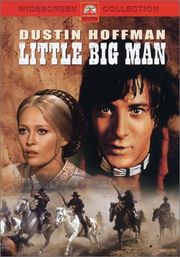
Little Big Man

We shall begin with an old favorite of mine, LITTLE BIG MAN. This is the story of Jack Crabb, supposedly the sole white survivor of the Battle of Little Bighorn. We meet jack in an old folks home as a man well over a hundred years old. Visited by an anthropologist, Jack is angered at the suggestion that was an old Indian fighter and proceeds to tell his life story with a tape recorder rolling.

It turns out that Jack had been adopted by Cheyenne (whom he refers to as “Human Beings” throughout the narrative) after his family was slaughtered by Pawnee. During the course of his life, Jack returns to white society for a time and experiences life as a religious youth, a con artist, a “gun fighter,” a drunkard, and even a mule skinner. But Jack returns to the Human Beings several times during the course of the movie, even taking a wife (eventually four) and living among them. Jack explains that he reckoned he would stay there and live among Human Beings for the rest of his life, right there on the Washita River.

And for those that know a little about the history of Indian-white relations, the appearance of Custer will be no surprise. For me at least, the scenes that follow are quite difficult to watch. It is in revenge for this attack, that Jack Crabb ultimately plots to lead Custer into a trap, tricking him as it were into attacking the Indian village at Little Bighorn.

Little Big man was the first major motion picture in decades to take an explicitly pro-Indian stance on the history of the west. It is almost too late to capture the full shock value of its portrayal. The movie and television audiences of the 1970s had seen many depictions of Indian savagery. To see the U.S. cavalry shooting women and children in cold blood was a straight-forward reversal of the prevailing expectations of the time.

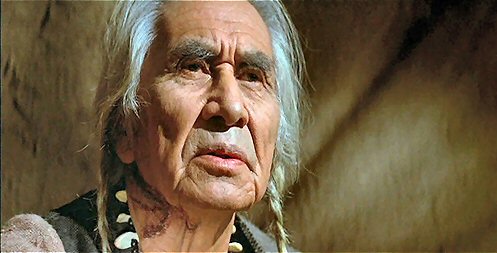
More than that, Little Big Man is filled with vibrant Cheyenne characters, not least of them being Old Medicine Lodge (played by chief Dan George). The characters are even allowed to occupy social roles defined at least partly by Cheyenne cultural patterns. (We are for example introduced to a contrary and a hee-man-eh.) Crabb himself manages to occupy the role of the White Indian without crowding the Native American characters into the background. He is accepted among the Human Beings, not because he is a great warrior (not really, at any rate), but because he has a knack for survival. Crabb bumbles his way through life, understanding a lot about what goes on around him, but without ever really taking control of his own fate.

Chief Dan George

But what has always struck me as the true genius of this movie is that having done far more than normal for the times, it makes no real claims to historical accuracy. Jack Crabb is essentially telling us a tall tale, and his own biases provide the filter through which each event is portrayed. One gets the impression that Crabb’s story must approximate the actual truth (he simply knows too much to have made everything up), but if we believe him a number of the particulars, we have certainly gone well beyond the boundaries of fact when he takes credit for the slaughter of Custer.

But who could fault Crabb for stretching the truth. We can only love him for somehow surviving the real events of his life whatever they may have been, and for sharing a perspective on events which was at that time completely novel to the motion picture industry of that day.

***

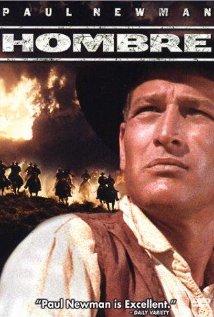
Hombre

Did you know that Paul Newman once played an Apache? …well, sort of. In HOMBRE, Newman plays John Russell, a white man raised among the Apache. Old pictures of Apaches fill the screen during the opening credits, and soon we are treated to an image of Newman dressed as an Apache.

Hombre

Russel and two Apache companions have been earning a living by capturing wild horses to be sold to the stage-coach line. They learn that a railroad will soon replace the stage-coach line, and horses will no longer be needed.

Russell learns that he has inherited a boarding house from his original family. He returns to civilization and sells the house before heading back west aboard a stage-coach.

Newman in Hombre

When the stage-coach is robbed, it is Russell (with his superior survival instincts) who keeps the other passengers alive, their prejudice against him notwithstanding. In time, Russell learns that the robbers are after money meant for the San Carlos Apache reservation. It had been stolen by a fellow passenger. Russell’s treatment of his companions is harsh, bordering on cruel, which seems fitting enough given their own attitudes towards him. In the end, Russell will sacrifice himself to save a woman who would not share the stage-coach with him. He asks only that the money should be taken to the people for whom it was intended.

The movie ends with a vintage photograph. It contains the image of a white boy surrounded by Apache children of his own age.

***

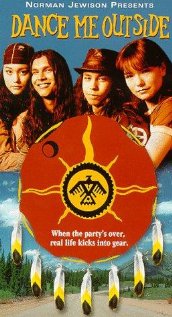
Dance Me Outside

DANCE ME OUTSIDE: This movie is not on the whole about a white Indian. I include it in this list, because it has an absolutely wonderful scene which serves to comment on the whole phenomenon. For reasons which we need not get into here, the main characters, Silas crow and Frank Fencepost (both Anishinabe), are asked to keep Robert McVey, a white in-law, busy while his wife is off doing something important. Unable to think of anything else to do, and really unhappy about spending the night in his rather lame company, Silas and Frank decide to initiate him into the tribe. What follows is a hilariously improvised ceremony. The scene could easily have been painful to watch, but there is something about the way the white character embraces the ceremony which comes across as endearing. It is as though he has simply chosen to accept the ritual for whatever it is. The man commits so completely to the absurd little made-up ritual that his own sincerity (absurd as it is) seems to redeem the whole event. In the end, he earns a grudging respect from Silas and Frank, not for being a properly initiated member of the tribe, but for simply being human, foibles and all.

Silas and Frank

What I particularly like about this scene is the sense of compassion behind the treatment of this subject. This movie takes the piss out the old white Indian cliché as well as anyone has, but it does it without rancor. The white character is mocked, yes, but he is mocked with a gentle touch. Dance me outside is an obscure movie, and I must say that it has a kind of after-school special quality to it. Still it’s a wonderful tale well told.

***

That’s it for now. There will be two more volumes in this one.

***

Okay, no I can’t let my readers off that easy. These movies are actually pretty good, so I’m afraid you haven’t got the full cringe-worthyness of this subject. So, let’s have a listen shall we?

…okay, I know. That was unnecessary. I’m a bad man, and I’m sorry.

…sort of.

71.271549 -156.751450

Share this:

  • Tweet
  • Share on Tumblr
  • Print (Opens in new window) Print
  • Email a link to a friend (Opens in new window) Email
  • Share on Reddit (Opens in new window) Reddit
Like Loading...

Real World Villains, Volume III: Those Troublesome Alaska Natives!

15 Sunday Apr 2012

Posted by danielwalldammit in Alaska, History, Justice, Native American Themes, Politics

≈ 15 Comments

Tags

Alaska, Alaska Natives, Alberta Schenck, civil Rights, Duck-In, Ducks, Elizabeth Peratrovitch, Hunting, Inupiat, Subsistence

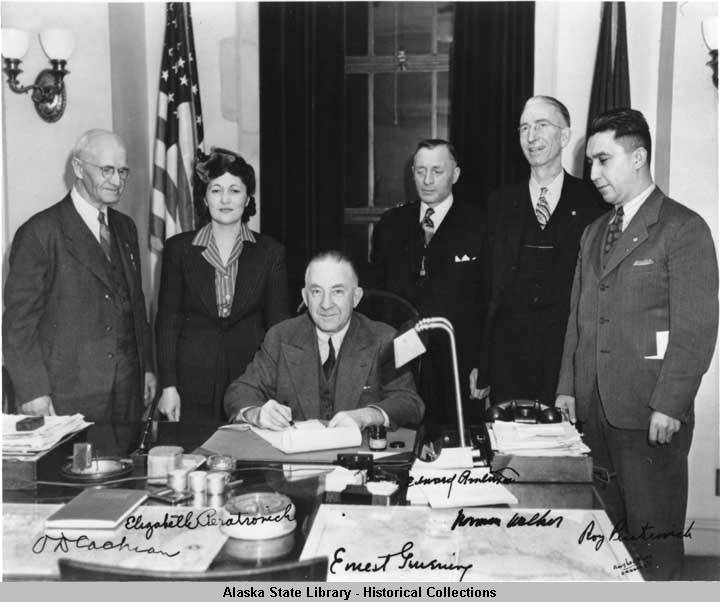
Governor Gruening Signs the Anti-Discrimination Act of 1945

“What the Hell is a duck in?”

That must have been my first response to one of the stories I want to write about today. Hopefully, I didn’t say it out loud, but the duck-in is one of many historical narratives that has changed my sense of the political landscape since coming to Alaska.

Yes, I’m still a lefty. I said “changed” not “destroyed.”

And like many a lefty, I spend a fair amount of time thinking about civil rights issue. You know, Martin Luther King, the Freedom Rides, Brown vs. Board of Education, …all good stuff!

Since coming to Alaska, I have been blessed to learn about several new and unexpected additions to the list of civil rights struggles, some with clear parallels to those taking place outside Alaska.

Somewhere in my list of my thoughts about nuclear power, I now add the struggle over Project Chariot. Next to the relocation of Japanese in World War II, I now have a definite place for the story of Anangan (Aleutian) relocation. And of course the big story up here, at least in my mental timeline would certainly be passage of the Alaska Native Lands Claims Act.

But I don’t want to talk about any of those things today.

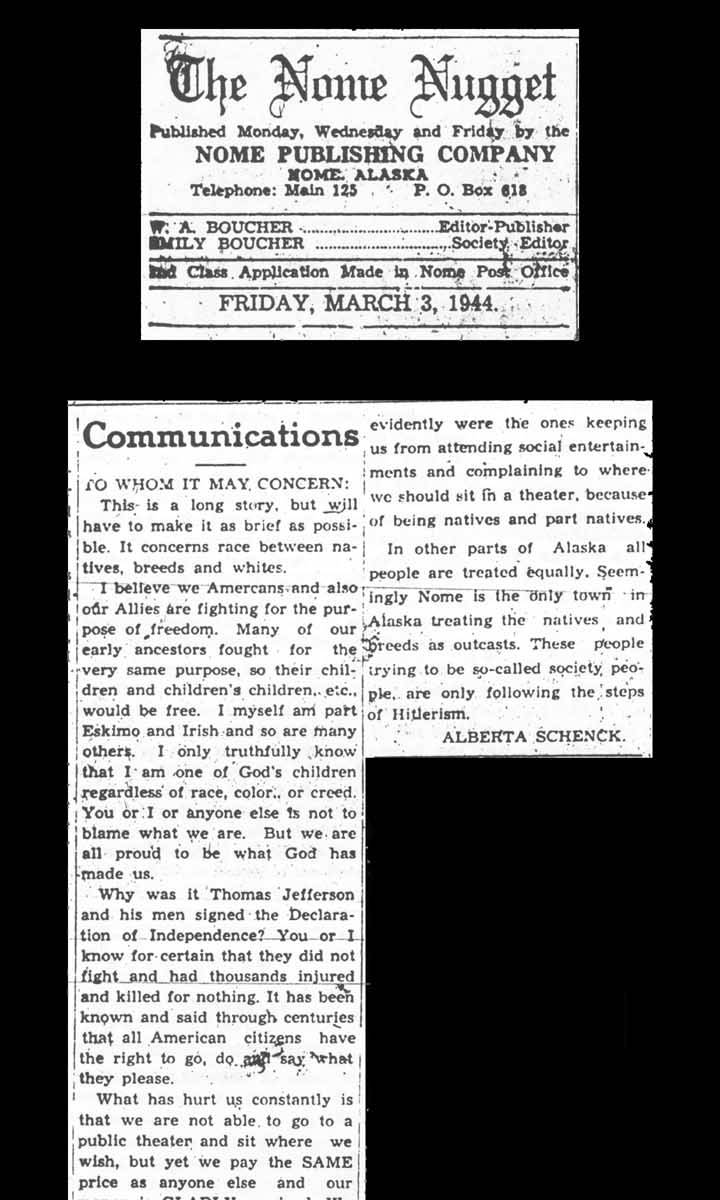
No, what interests me at the moment is a range of smaller battles, and the story of those who fought them. I’m talking about battles like the one fought by Alberta Schenck.

Alberta Schenck Letter

Who is Alberta Schenck? Well, she was the best kind of troublemaker. As a girl of mixed heritage (her mother was Inupiat and her father was white), Schenck faced discrimination against Alaska Natives and “half breeds” on several occasions. At the age of 16, she wrote this letter to the editor of the Nome Nugget, protesting the segregated seating of natives and whites at a local movie house, known as the Dream Theater. To say that the significance of her protest stretched beyond the specific policies of that specific theater would be an understatement.

It’s worth noting that Schenck herself worked at Dream Theater, at least she did until the letter was published. She later returned to that very theater on a date with a white army sergeant. After refusing to leave her seat, the Chief of Police for the city of Nome physically removed Schenck from her seat and she spent the night in jail.

Outrage over Schenck’s arrest helped eventually to fuel for passage of the Anti-Dicrimnatory act of 1945. She was subsequently elected Queen of Nome during the Spring Carnival of that year. This was in 1944, 11 years before Rosa Parks picked her fight with the city of Montgomery Alabama. …well before the sit-ins, or the freedom rides.

And then of course there is Elizabeth Peratrovitch, a Tlingit Native whose testimony before the territorial senate helped to secure the final passage of the Anti-Discriminatory Act, mentioned above. She said a lot of things in that testimony, but this particular line is particularly memorable:

I would not have expected that I, who am barely out of savagery, would have to remind gentlemen with five thousand years of recorded civilization behind them, of our Bill of Rights.

With actions like those of Alberta Schenck and testimony such as that of Elizabeth Peratrovich, the territory finally passed a law banning such acts of discrimination.

I should add that the law did not merely eliminate discriminatory policies at the government level; it forbade discrimination by private businesses. Opponents of the bill had argued, as many do today, that government had no role to play in limiting the choices of private businessmen. Fortunately, that argument lost in 1945, as it did in 1964, and as it should today. Those who imagine it is enough to keep government policies free of racial bias have seriously underestimated the impact of private discrimination. Here as elsewhere the individual decisions of private businesses were the centerpiece of segregation.

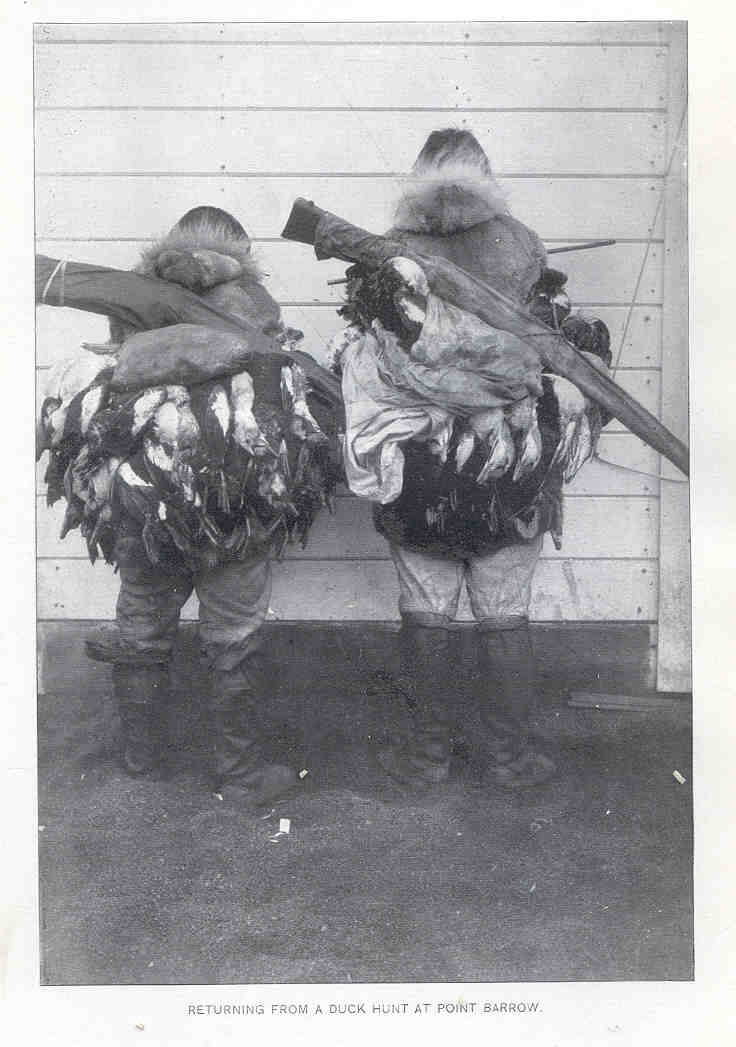
But my all time favorite story about civil disobedience in the great state of Alaska would have to be the “Duck in.” This narrative begins in 1918 with a treaty between the United States, Canada, and Mexico. Under this treaty, the U.S. agreed to ban the taking of migratory waterfowl from the period between March 10th and September 1st.

So what’s the trouble? That is the ONLY time that migratory waterfowl can be found on the North Slope of Alaska. For a people very much dependent on subsistence hunting for their survival, the terms of this treaty removed a critical resource from the Spring and Summer menu.

The issue does not appear to have been much of a problem, at least not until Alaska became a state and began to enforce Federal laws with greater diligence. Then Fish and Wildlife officers began arresting people and confiscating their weapons, and their catch.

Duck Hunters at Point Barrow

How did the Inupiat population of Barrow respond to the arrest of people in their own community? How did they deal with a game warden in town to enforce the hunting regulations?

Well, they were very cooperative.

He found about a hundred and fifty Barrow residents outside his hotel room one day, each with a duck in hand. He didn’t have enough forms to process all the arrests, so Barrow Magistrate Sadie Neakok advised him to record the names on extra paper and attach them to the main form. And thus, everyone with a duck got counted.

Subsequent to this, State Senator, Eben Hopson, sent a request to then Governor, William Egan, asking that welfare officials be sent to help take care of all the children whose parents would be locked up due to enforcement of the law.

…and Fish and Wildlife simply stopped enforcing the regulations.

That’s called a ‘win’ folks!

*********************

Okay, that’s it, just a few of my favorite stories about troublesome Alaska Natives. I haven’t covered any of this with sufficient detail to do justice to these stories, so I’ll just briefly mention some better sources:

Rachel Naninaaq Edwardson produced a wonderful documentary on the Duck In. It is available through the North Slope Borough School District.

Wikipedia does seem to have a page on Elizabeth Peratrovitch. , and she is mentioned in quite a few additional sources. This one from Alaschool.org has a pretty thorough discussion of her contributions to the state of Alaska.

Numerous references to Alberta Schenck may be found in sundry parts of the net. Her memorial website would be a good place to start.

One good reading on the subject of discrimination would be an article by Terrence M. Cole, “Jim Crow in Alaska: The Passage of the Alaska Equal Rights act of 1945,” in Stephen W. Haycox and Mary Childers Mangusso (eds.) An Alaska Anthology: Interpreting the Past, (Seattle and London. University of Washington Press, 1996) pp 314-335.

The Images of Governor Gruening signing the Anti-discriminatory Act, Elizabeth Peratrovich, and Alberta Schenck’s letter are from Alaska’s Digital Archives. The image of Duck Hunters came from the Marine Image Bank of the Digital Collections at the University of Washington.

71.271549 -156.751450

Share this:

  • Tweet
  • Share on Tumblr
  • Print (Opens in new window) Print
  • Email a link to a friend (Opens in new window) Email
  • Share on Reddit (Opens in new window) Reddit
Like Loading...

Quanah Parker, Progress, and the Lack Thereof, …Christmas and Torture!

18 Sunday Dec 2011

Posted by danielwalldammit in Books, History, Native American Themes

≈ 2 Comments

Tags

American Indian, American West, Comanche, Cruelty, Native American, Progress, Quanah Parker, Texas, Torture

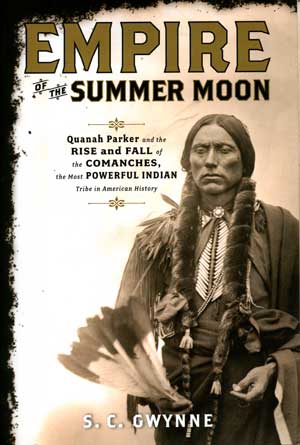
There is always one! One book in the airport bookstore that looks like something I might actually want to read. This time it was “Empire of the Summer Moon: Quanah Parker and the Rise and Fall of the Comanches, the Most Powerful Indian Tribe in American History,” by S.C. Gwynne (Scribner, 2011).

Mind you, the title alone carries at least one red flag. Were the Comanche really the “most powerful Indian tribe in American history?” Reading the book, I began to wonder if there was ever a raid, or a battle, or a tribe that didn’t strike the author as “the most’ or “the greatest” something?  Seriously, this book, has the most superlatives contained in any volume published in this century. (Okay, not really, but it has enough of them that it looked kind of fun. So, I thought I’d try it.) But faced with 16 hours in the hands of the airlines (the most air-time ever… Okay I’ll stop, really, I will), it just looked like the kind of fun-read that might do the trick for all those hours imitating a sardine. So, I bought it and put my larger, more theoretical, volume on the back burner, at least until Quanah could be “tamed,’ as I thought surely the book would put it.

I was not disappointed.

It is certainly an enjoyable yarn, and I learned a few things while reading it, but excessive superlatives aside, there are also a number of factual problems in the book. Gwynne, for example credits Spanish failure to protect the Pueblos with the cause of the Pueblo Revolt of 1680. This is simple confirmation bias. It ties their story more closely to the one Gwynne is telling. But it’s outright fiction. The Pueblo’s rebelled against the Spanish because what the Spanish were doing to them, not because of what the Spanish were not doing for them. Other critics have raised similar objections to other parts of the book, but I’m not really interested in picking apart the details.

What does strike me about this work is its use of a familiar spin. Gwynne is a firm believer in the march of progress, and he does not hesitate to frame the Comanche squarely in this larger story. Channeling Frederick Jackson Turner, Gwynne is telling the tale of the clash between savagery and civilization at the edge of the frontier. And Comanche play a damned familiar role in that story.

It is not really that Gwynne describes the horrors of Comanche raiding in vivid detail, or that he recounts the torture and execution of white captives in numerous chapters. I don’t need sugar-coating in my history books, nor do I need constant reassurance that an author is not a racist. But “progress” is a faith I can do without, and this book would have been much better without it.

Simply put, Gwynne sees Comanche’s as exemplars of a more primitive life-way than Europeans, or even a number of other Indian peoples. His reasons are familiar; they are hunter-gatherers, which sets them apart from and well behind the progress of agricultural societies, from the Pueblos to the Spaniards, …maybe even the Texans. To Gwynn, the cruelties that Comanche’s inflicted on their enemies stem from their lack of progress in comparison to Agricultural tribes such as those found in Mexico.

If the irony of that comparison doesn’t scream in your ears, then perhaps we could take a little time to discuss the history of Central American civilization. …Well some other time, anyway.

On some level, I cannot help but think Gwynne must know better. He certainly does not hesitate to tell us about the atrocities committed by other peoples, including Texans. At times, he seems quite prepared to concede all the facts which should suggest a degree of moral parity. Yet Gwynne sees a difference between the cruelties of commanches and those of other people.

Gwynne has at least the beginnings of an explanation for the difference. He maintains that other peoples consistently show some level of condemnation for the act of torture. Such brutal violence may be carried out by civilizations as modern as our own, but Gwynne seems to suggest, we at least know it is wrong. The Comanche however, revel in it. And that makes all the difference in the world to Gwynne. It is the difference between a “savage,” a “low barbarian,” and someone from a civilization.

So, apparently, cognitive dissonance is a virtue. If you have to torture someone, then you should at least have the decency to feel bad about it.

But I cannot help thinking we can do better than that! We can relegate the job to soldiers serving on some far-flung corner of the world, and if those soldiers should fail to be just as violant as we wish them to be (no more and no less), or should they fail to cover up any actual cruelties they might commit, then perhaps we can just disown them. If nothing else fails, we can at least wring our hands about it, schedule a few talking heads to debate it on the news channels, and sweat a lot over the whole thing. Because knowing at least that torture is wrong sets us apart from those that do not, or so it would seem

In torture, as in Christmas gifts, it is apparently the thought that counts.

It is an interesting question, just how it is that societies allocate boundaries within which cruelty becomes objectionable, and how do they square those boundaries with the interests of military defense, …or outright conquest? Both of these are damned tough problem to sort out, and woe be unto those who end up on the wrong side of the sorting, at least when someone with a camera-phone is around to record it!

The story of Quanah Parker would not be a bad spring board for addressing questions about the cultural construction of violence. It certainly provides enough fodder to get the issue squarely on the table, but of course all this falls by the wayside when the author has recourse to a convenient explanation with a lot of cultural force behind it. The Comanche’s are cruel because they are savage. Others are cruel because their civilization has yet to be perfected.

Problem solved!

This probably is not the best place to try to refute the notion of progress. Suffice to say, that I consider it largely a dead issue, at least as applied to the history of Indian-white relations, and certainly in reference to the comparison between hunter-gathering economies and those of settled agriculturists. Hell, the critique of this notion has been done and redone for a couple of generations of scholarship now. Were I to come across a learned article purporting to refute the notion of progress, I would no doubt feel sympathy for the dead horse that was about to be kicked. And yet, in this book, I find that dead horse alive and grazing in the pastures of every airport in the country.

When the average American reads about Comanche history for the next few months anyway, there is a damned good chance they will read it in this book. They will learn a lot to be sure, much of it reasonably accurate, informative, and interesting. And they will also read in that book yet another chapter in the myth of the progress of civilization.

It is just a little depressing.

71.271549 -156.751450

Share this:

  • Tweet
  • Share on Tumblr
  • Print (Opens in new window) Print
  • Email a link to a friend (Opens in new window) Email
  • Share on Reddit (Opens in new window) Reddit
Like Loading...
← Older posts
Newer posts →

Top Posts & Pages

  • An Uncommon Security Guard: Dave Eshelman, AKA 'John Wayne'
    An Uncommon Security Guard: Dave Eshelman, AKA 'John Wayne'
  • Hostiles and Spoilers: A Magic Studi
    Hostiles and Spoilers: A Magic Studi
  • Map Ain't Time Either.
    Map Ain't Time Either.
  • Happy Juzo Day, And Damn You to Hell if you Don't Know What I'm Talking About!
    Happy Juzo Day, And Damn You to Hell if you Don't Know What I'm Talking About!
  • Spurious Hitler Spuriates Furiously About Guns!
    Spurious Hitler Spuriates Furiously About Guns!
  • Remember Kids! False Equivalence is a Way of Life
    Remember Kids! False Equivalence is a Way of Life
  • The North Pacific Fur Fish
    The North Pacific Fur Fish
  • Southern Paiutes as Portrayed in Las Vegas Area Museums.
    Southern Paiutes as Portrayed in Las Vegas Area Museums.
  • I'll Just Leave This Here
    I'll Just Leave This Here
  • Master and Commander Kinda Queered
    Master and Commander Kinda Queered

Topics

  • Alaska
  • Animals
  • Anthropology
  • atheism
  • Bad Photography
  • Books
  • Childhood
  • Education
  • Gaming
  • General
  • History
  • Irritation Meditation
  • Justice
  • Las Vegas
  • Minis
  • Movie Villainy
  • Movies
  • Museums
  • Music
  • Narrative VIolence
  • Native American Themes
  • Philosophy
  • Politics
  • Public History
  • Re-Creations
  • Religion
  • Street Art
  • The Bullet Point Mind
  • Travel
  • Uncategorized
  • Uncommonday
  • White Indians
  • Write Drunk, Edit Stoned

Blogroll

  • American Creation
  • An Historian Goes to the Movies
  • Aunt Phil's Trunk
  • Bob's Blog
  • Dr. Gerald Stein
  • Hinterlogics
  • Ignorance WIthout Arrogance
  • Im-North
  • Insta-North
  • Just a Girl from Homer
  • Multo (Ghost)
  • Native America
  • Norbert Haupt
  • Northwest History
  • Northy Pins
  • Northy-Tok
  • Nunawhaa
  • Religion in American History
  • The History Blog
  • The History Chicks
  • What Do I Know?

Archives

  • December 2023
  • November 2023
  • June 2023
  • April 2023
  • February 2023
  • December 2022
  • November 2022
  • October 2022
  • September 2022
  • August 2022
  • July 2022
  • June 2022
  • April 2022
  • January 2022
  • December 2021
  • November 2021
  • October 2021
  • September 2021
  • August 2021
  • June 2021
  • May 2021
  • March 2021
  • February 2021
  • January 2021
  • December 2020
  • November 2020
  • October 2020
  • September 2020
  • June 2020
  • May 2020
  • March 2020
  • February 2020
  • January 2020
  • December 2019
  • November 2019
  • September 2019
  • August 2019
  • July 2019
  • June 2019
  • May 2019
  • April 2019
  • January 2019
  • December 2018
  • November 2018
  • October 2018
  • September 2018
  • August 2018
  • July 2018
  • June 2018
  • May 2018
  • April 2018
  • March 2018
  • February 2018
  • January 2018
  • December 2017
  • November 2017
  • October 2017
  • September 2017
  • August 2017
  • July 2017
  • June 2017
  • May 2017
  • April 2017
  • March 2017
  • January 2017
  • December 2016
  • November 2016
  • October 2016
  • September 2016
  • August 2016
  • July 2016
  • June 2016
  • May 2016
  • April 2016
  • March 2016
  • February 2016
  • January 2016
  • December 2015
  • November 2015
  • October 2015
  • September 2015
  • August 2015
  • July 2015
  • June 2015
  • May 2015
  • April 2015
  • March 2015
  • January 2015
  • December 2014
  • November 2014
  • October 2014
  • July 2014
  • June 2014
  • May 2014
  • April 2014
  • March 2014
  • February 2014
  • January 2014
  • December 2013
  • November 2013
  • October 2013
  • September 2013
  • August 2013
  • July 2013
  • June 2013
  • May 2013
  • April 2013
  • March 2013
  • February 2013
  • January 2013
  • December 2012
  • November 2012
  • October 2012
  • September 2012
  • August 2012
  • July 2012
  • June 2012
  • May 2012
  • April 2012
  • March 2012
  • January 2012
  • December 2011
  • November 2011
  • October 2011

My Twitter Feed

Follow @Brimshack

RSS Feed

  • RSS - Posts
  • RSS - Comments

Enter your email address to follow this blog and receive notifications of new posts by email.

Join 8,072 other subscribers

Blog at WordPress.com.

  • Subscribe Subscribed
    • northierthanthou
    • Join 8,072 other subscribers
    • Already have a WordPress.com account? Log in now.
    • northierthanthou
    • Subscribe Subscribed
    • Sign up
    • Log in
    • Report this content
    • View site in Reader
    • Manage subscriptions
    • Collapse this bar
 

Loading Comments...
 

    %d