Tags
Alaska, Art, History, Ketchikan, Saxman Park, Seward Shaming Pole, Totem Pole, William Seward, Wood Carving
Not to be sarcastic or anything, but I’ll just leave this here.
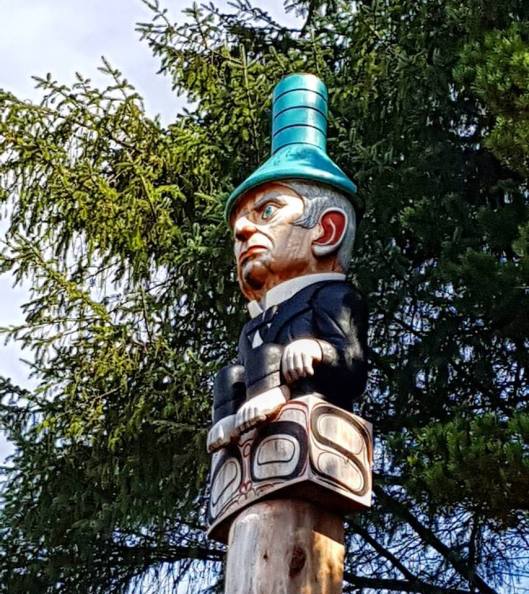

30 Monday Mar 2020
Posted in Alaska, History, Native American Themes, Public History, Uncategorized
Tags
Alaska, Art, History, Ketchikan, Saxman Park, Seward Shaming Pole, Totem Pole, William Seward, Wood Carving
Not to be sarcastic or anything, but I’ll just leave this here.

26 Thursday Dec 2019
Posted in atheism, Native American Themes
Tags
atheism, Belief, College, Communication, Ghosts, Monsters, Navajo, Scary Stories, Skinwalkers
 “You drive back home to Flagstaff every Friday night, right?”
A student asked me this one evening. Sitting as we were in Chinle, well inside the Navajo Nation, and a hundred and sixty or so miles away from Flagstaff, we both knew that he was describing a rather long drive late at night after a long week. Normally, I would be leaving just around 9pm and I could expect to get into town shortly before midnight. I’d been doing this for years, and I think most of my students knew about it. I wondered, why was this student asking me about it now?
“Do you ever see anything strange on that road?”
It seems, I learned that night, that a significant stretch of the road I was traveling was known for skinwalkers. From the reaction of his classmates, I gathered, this student wasn’t the only one curious about my experiences on that drive. I had only recently come to learn that the ghost of a small child was rumored to walk the halls of the school where I taught evening courses. Being stubborn enough to keep class the full time on most evenings, I was frequently the last person out of the building. I hadn’t seem this apparition either. Nor had I ever heard his footsteps in the hallway
It was an interesting moment, a conversation that reached across cultural boundaries, and did so in an unusually personal way. We weren’t discussing official Navajo Educational Philosophy or touching on any of the well known themes of Navajo ceremonialism, economics, etc. Were were discussing neither any part of Navajo culture nor any themes from western education in the abstract. This was a student who actually believed in skinwalkers asking me if I’d seen them myself, knowing full well that I didn’t. It wasn’t just that I was white. He knew, as most of my students knew, that I am an atheist and generally skeptical of all things purportedly supernatural. He knew this, and chose to raise the subject anyway.
This didn’t strike me as a confrontation so much as an expression of genuine curiosity, and an effort to communicate across cultural barriers and well-established differences of opinion. He wanted to hear about my own experiences on a road known for its share of scary stories. For my own part, I was as curious to see what stories were told of the road as he was to see if I had one.
But of course I didn’t have a story. None at all.
…which was a bit awkward.
Don’t get me wrong. Nobody’s world view came crashing down that evening. My students and I just sat there in an odd silence, each contemplating the next step in this conversation. I suppose some of them must have been trying to decide, as I was myself, just how much we wanted to get into this? We could have taken it in all sorts of different directions. Finally, a student offered the following; “Since you don’t believe in skinwalkers, they probably wouldn’t bother you.”
I think I started to put together an argument, even made the first couple sounds of a reply which would probably have involved questions about the meaning of his words or the nature of his reasoning, and then I hesitated. I couldn’t help smiling.
“You know. I think I can agree with that.”
Everyone laughed, and then it was time to say goodnight for the evening.
You never really know when you will find yourself in agreement with people whose thoughts differ so very much from your own.

05 Thursday Sep 2019
Posted in Native American Themes, Street Art, Travel
Tags
Arizona, Art, Gray Mountain, Jetsorama, Murals, Navajo Nation, Southwest, Street Art, Uranium
 “Honey, this place looks like it’s closed.”
Moni is trying to brush the sleep from her eyes. Leaning forward as far as the seat belt will let her, she cranes her neck around to see if she can see why I have pulled over. The more she sees, the more she realizes how very right she is. As I recall, this place was already closed over ten years ago when I used to drive through Gray Mountain on my way to work. It’s well past closed now.
“Why are we stopping here?”
After a moment, she realized the answer to her question.
(Click to embiggen. …You know you wanna!)


This seems to be the work of Jetsonorama whose “Painted Desert Project” has produced a lot of wonderful pieces. I am occasionally lucky enough to get down there and see some of this beautiful work.
FWIW: My Instagram.

16 Friday Nov 2018
Posted in History, Irritation Meditation, Native American Themes, Re-Creations
Tags
Apache, Geronimo, Lozen, Native Americans, Photography, Photoshop, Retouched, Sex, Warrior
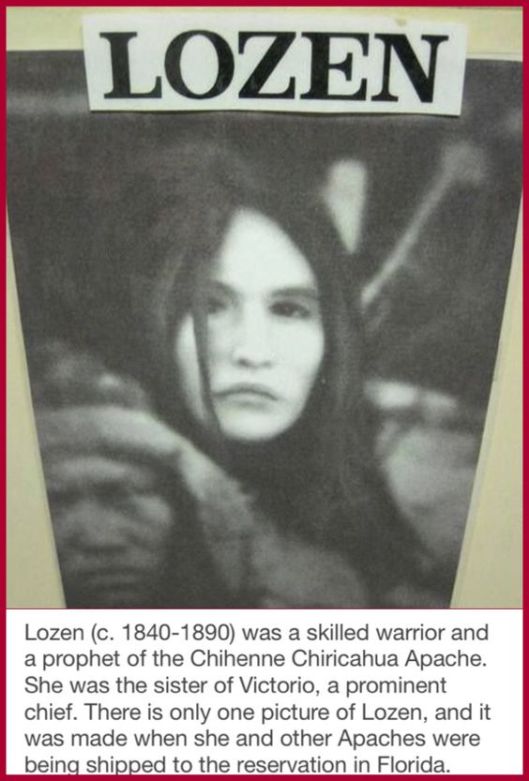 I see this image from time to time circulating about the net. It passes, I suppose, for a kind of homage to Lozen, one of at least three women who fought beside Geronimo at one time or another in the course of his campaigns. Lozen, it seems was with him at the end. She was sent to Florida along with the rest of his warriors (and some of the scouts who had helped bring him). As mentioned in the meme here, the picture above was taken as she and the other prisoners waited in front of the train to be taken away.
So, what has me griping about this?
Well, take a look at the original. Lozen is the 6th figure from the right on the back row.

…and here is another close-up derived from that same photo:
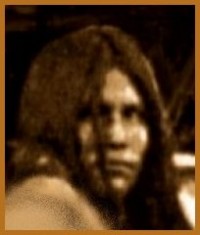
So, just take a moment to compare the two and you might be able to tell what’s bothering me about the first photo.
Yeah, …they sexed her up.
The computer rendering in the first pic definitely lightened up her skin, brought her eyes out more, and gave the overall impression of much more delicate features. Hell, you can practically hear the photographer asking her to lick her lips and work it for the camera. The woman in this meme is a modern heterosexual (white?) male’s dream girl. From what I gather of the stories told about her, Lozen was no such dream.
Far from it!
The problem here isn’t necessary a question of objectivity. People make choices when they render a photo or tell a story. Maybe I’m being a little too cynical here, but I can’t help thinking the choices made in producing the image for this meme aren’t entirely in keeping with the spirit of the woman it portrays.

20 Thursday Sep 2018
Posted in Movies, Native American Themes, Re-Creations
Tags
Arctic, Canada, Inuit, John Ford, John Wayne, Malaglutit, Monument Valley, The Searchers, Zacharias Kunuk
 One of the more iconic images we get from The Searchers, features John Wayne standing in the doorway of a home, the majestic landscape of Monument valley behind him. It’s a recurrent motif in The Searchers, looking out through a doorway; it makes a great metaphor through which to view the content of a western. Those of us watching in the present look out into the wilderness beyond, almost as if we were viewing the frontier from the shelter of civilization itself. Men like John Wayne move back and forth across that threshold, but we don’t. We view the mythic American frontier from the safety of the hearth while dangerous men, real men, like John Wayne transform the world beyond into the safe environments we now call home. After standing in the doorway a bit in the final scene, Wayne saunters off back out onto that wilderness. He may be an agent of civilization, but he’s never quite at home in it. Wayne belongs out there, in the desert with all kinds of wild men. It’s about as powerful a statement as anyone ever made in the western genre.
This image returns to us in Malaglutit, a remake of The Searchers by Zacharias Kunuk and Natar Angalaaq featuring an all-Inuit cast. This time what passes for an entrance is a hole torn into an igloo by men for the explicit purpose of taking women by force. Just as in the John Wayne/John Ford version of this story, the raiders have carried women off to parts unknown. The effort to reclaim these women will of course provide the substance of the story itself, but that moment when the men in either film return to find carnage in what should be a home is one of the more powerful scenes in the story. In The Searchers, Wayne enters the wrecked home and pauses in a small doorway, clearly distraught by what he sees. In Malaglutit, the porthole isn’t even a doorway it’s a gaping wound. This porthole isn’t about frontier mythology; its symbolism is more direct, far more graphic, and it speaks far more directly to the violence that has occurred inside, the violence still occurring somewhere out there.
This film has been on the festival circuit for a couple years now, but it’s still rather hard to come by. I finally got a chance to watch it when we showed Malaglutit at the Motif Film Festival in Fairbanks last month. Zacharias Kunuk may not be that well known south of the arctic circle and outside of indigenous circles, but he probably should be. His movie, Atanarjuat (Fast Runner), is perhaps the most well known of his creations. Now THAT film you can get ahold of. It’s well worth the watch. Angalaaq is best known for playing the lead role in Atanarjuat, though he was also excellent in The Necessities of Life. And it’s one of the reasons I have been looking forward to Malaglutit. The Searchers is easily one of the greatest westerns ever made. To see it remade as an indigenous production raises all manner of interesting prospects. To see it done by people as talented as Kunuk and Angalaaq makes them all that much more interesting.
Oh yeah; Spoiler alert!
It’s difficult to make a sustained comparison between the two films, though that seems to be where I am going with this. Kunuk’s cast is all Inuit. The villains, the heroes, the heroines; all of them are Inuit. So, the many racial themes present in the original Searchers just don’t enter into this version of the story. Along with the absence of race, I think you’d have to say the essential themes of an American western are largely missing here (though at least one critic has referred to it as a Northern). It seems that some of the landscape Kunuk filmed might echo the rock formations of Monument Valley, but if so, the resemblance is slight. Most significantly, the central protagonist here is doesn’t carry the moral complexity of John Wayne’s Ethan Edwards. At least, we don’t have to wonder if Kuanana (the hero in Malaglutit) will kill his wife and daughter instead of rescuing them. That was a big part of the original Searchers, and it’s not present in this story.
What is present here, what is new to the basic-story-line, is an extraordinarily frank meditation on rape. In the original Searchers, violence between men is all over the screen, but the rape and torture of women takes place off-screen. We are invited to imagine its horrors, but what we see are men shooting at each other in a plot-line shaped by those horrors. In Malaglutit, we see much (though not all) of the sexual violence. From the moment of capture to the actual rape of the women in this film the camera lingers; we are forced to watch this play out slowly on screen. I wouldn’t say that the scenes are all that sexually explicit, but I would say that they are emotionally explicit. What we see isn’t body parts; people struggling with one another. Perhaps the most disturbing scene in the whole film, at least for me, occurs shortly after the initial capture when the kidnappers pause for a break in their travel, their captives still tied to the sleds. Ostensibly a chance to eat and rest, it is also the first time they and their victims are alone together with enough time to contemplate the prospects ahead of them. It is a moment of calm, and yet one thoroughly saturated with violence.
There is something about the stripped down nature of this story line that helps us focus on the violence against the women here. Yes, there men struggling to save these women, but the epic battle between good men and evil men doesn’t eclipse the struggle between the captors and their captives in this story. We are never afforded the luxury of thinking about this as a story about men. The unimagined horrors of The Searchers have been put right there in front of us in Malaglutit. In the original, John Wayne’s character is driven made at the thought that his niece might have gone native so to speak, that she had been sullied by a Comanche and (worse) that she might have grown to accept it. Racial themes play a big part of the horror through which Wayne’s character views the events in question. In Malaglutit, racial differences are non-existent, and the violent process by which a captive might be made to give up hope unfold right there on the screen in front us us.
But do they?
Do they give up hope?
That was the question that occupied my attention throughout this story. Of course I also wanted Kuanana to rescue them, and I wanted the bastards who committed these terrible acts to be punished. But more than anything else, I wanted the women, Ailla and her daughter, to come through themselves. I wanted to see them hold on, not because Kuanana would have wanted them to, but because I saw enough of their story to care about their own struggle, their own part in this story-line.
At the end of the day, this really is its own film
…
(Movie Trailer)
(Kunuk on Malaglutit)

10 Monday Sep 2018
Tags
Cheyenne, Grave, Greasy Grass, Great Sioux War, History, Lame White Man, Litte Bighorn, Montana, Monument


Posted by danielwalldammit | Filed under History, Native American Themes, Public History
29 Wednesday Aug 2018
Posted in Movies, Native American Themes
Tags
Christian Bale, Hostiles, Magic Negro, Movies, Old West, Rosemund Pike, Violence, Wes Studi, Western
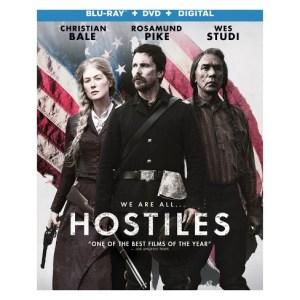 It’s good to be young and beautiful.
If you can’t be both, then you should probably be beautiful. If you are a character in a tragic story-line, it also helps to be white.
That’s all I can think of as I watch the final scene of Hostiles. It was a dark and bloody movie, and it certainly had its moments, but in the end it was our beautiful male and female leads, both white, who made it through the carnage. Oh yes, there was one Cheyenne child who survived the ordeal, but he was hardly a full character. We don’t really get to know him. His hopes and dreams are hardly present in the story-line, not those of the many characters native and white who never made it to ride off into a better life at the end of the film, not those of the two lead actors who accompany him. He is present at the end of the story, but largely as a symbol of something about them. The story is about our two beautiful white survivors.
It always was about them.
Hostiles begins with a Comanche raid on a remote homestead somewhere in the west. Rosalee Quaid (played by Rosemund Pike) survives the raid by hiding in a rock outcropping after seeing her husband killed & scalped and all three of her children shot. In the next scene, Captain Joseph Blocker (Christian Bale) captures a small group of Apache and drags them in chains to fort in New Mexico which will serve as their prison for the immediate future. It is quickly established that Blocker has done far worse than this in his days fighting Indians out west. He’s seen worse, and he’s done worse, and we’ve seen just enough of his own cruelty to believe it. The message is pretty clear from the get-go the frontier is brutal. Both native and non-native alike are engaged in terrible acts of violence and suffering abounds.
It is 1892, just a couple years after Wounded Knee, and we are looking the tail end of the frontier in American history. The characters filling this story are fully immersed in the bloodshed. That bloodshed has left Blocker and the soldiers with him lacking a bit of humanity and full of hatred. Rosalee Quaid is for the moment left out in the wilderness to suffer alone with the bodies of her dead family. This a world without much in the way of redeeming qualities.
It turns out that Blocker will soon be retiring from military service. The major plot takes shape when he is given one final assignment. He must escort Yellow Hawk (Wes Studi), a Cheyenne war chief, to the man’s home in Montana. Blocker objects to this. Yellow Hawk is an old enemy. Yellow Hawk has personally killed a number of Blocker’s friends, and so he wants no part of any plan to help the man regain his freedom, but Yellow Hawk is dying. With the aid of Indian reformers, he has obtained an order from President Harrison authorizing his own release along with a military escort home. Whether he likes it or not, Blocker must take Yellow Hawk and his family to Montana.
The story-line that follows is every bit as violent as the opening sequence. Blocker would rather kill Yellow Hawk than help him (in fact he tries). They find Quaid of course. Her suffering provides Blocker with a chance to prove he still has a human side, albeit one reserved at the moment for some people and not others. The whole lot of them are pursued by the same Comanche that’d killed Quaid’s entire family. Blocker and his troops struggle to fight them off with the help of Yellow Hawk and his son (played by Adam Beach), both of whom are still in chains in this opening exchange. In time, Blocker is convinced to remove their chains, and shortly after they come to find the remaining members of the same Comanche raiding party have been killed in the night. Blocker is both relieved and embarrassed. Soon after, he and his Indian wards find themselves fighting fur traders who have kidnapped the women. An additional battle or two with an imprisoned soldier rounds out most of the fighting. They arrive in Montana just in time for Yellow Hawk to die peacefully in his homeland.
…but not before he and Blocker become friends.
When a local rancher objects to Yellow Hawk’s burial on his own property, the resulting battle leaves everyone dead but Blocker, Quaid, and one young Cheyenne boy, all of which leads us to that final scene.
Don’t get me wrong. There is a lot that this movie gets right. Their use of Cheyenne is particularly well done, and the characters are both vivid and interesting. The grimness of the whole story-line would normally be a strong selling point for me. Hell, it was. I liked that part of this movie.
What I didn’t like was the convenience of the story. The magic negro can as easily be just about any other magic minority, and Yellow Hawk fits that role perfectly. He has lived through the same violent period of American history that Blocker has, and he has committed atrocities just as Blocker has. He has even spent much of his recent life in prison. Yet he lacks the bitterness of Blocker and the rest of the soldiers. Yellow Hawk’s wisdom is a stabilizing force throughout the film. Studi is brilliant, as usual, and so the performance isn’t as over-the-top as many who have played such roles. Still, you can’t help but notice this is another story in which a minority with great wisdom helps the central character, a white man, overcome his own demons and face the world.
…but only after this same minority-advisor has died.
Yellow Hawk isn’t in possession of magical powers, which is a staple of the Magic minority character. Or is he? We never do learn how he and his son managed to kill the Comanche raiders, and it didn’t likely actually involve magical powers. Still, the action is inexplicable in terms of the plot line. Nobody else could have done it, and we never do see it as anything but an accomplished fact. It’s not a supernatural event, but it might as well have been.
And then of course, there is Yellow Hawk’s death, preceded of course by a conversation with Blocker, one in which Blocker finally achieves some peace, realizing that Yellow Hawk too has lost friends in the wars they have both fought. It’s a deeply moving scene. It’s also a very familiar scene. Once again, the death of a great and wise person of color leaves our wounded white protagonist with the strength and wisdom to put the rest of his life back together and move on.
And so the stories ends, as I began it here, with Quaid and Blocker and that one Cheyenne child at a train station. She will evidently raise him, a sort of replacement for her own lost children, and Blocker will go on to build a new life for himself, a life that might now be worth living, now that he has finally set aside the hatred he carried in the opening scenes. Even the child is safe now.
We should be happy.
I should be happy.
But I’m not.
Why is the child there anyway? He is there to confirm the healing of the two main white characters, both of whom now treat him with kindness despite enduring great loss at the hands of native peoples. He too accepts them, but his acceptance was never central to the plot. It was Quaid who could hardly be expected to endure the presence of Indians a few scenes into this film. It was Blocker that wanted to kill his Indian wards in the opening scenes. It is their ability to treat Indians well despite everything that we are supposed to find reassuring in the end.
This a very convenient reassurance, coming as it does at the price of so many other lives.
It would be easy to accept the victory we have been offered in Hostiles, easy to feel good because hearts have healed. The price of this healing was the lives of countless others, and in particular the life of the very Indians we are now reassured these two main characters no longer hate and fear. Every major native character was killed, and the only one we are left with is a child who will now be raised in the white world.
This really is a perfect symbol for the time of boarding schools and general allotment. Our heroes will go on to live in a world less violent, but a world less violent because many never made it into that world with them. The one ‘savage’ left alive at the conclusion of this story is no threat,of course, so what are we to make of the peace these adults make with him? They will go on to enjoy a well-earned peace, so we are shown, but what about him?
This child will no doubt survive.
But will the Indian?

07 Monday May 2018
Posted in Movies, Native American Themes
Tags
Alaska Natives, Betty White, Cultural Appropriation, Dance, Film, Get Low, Haida, Sandra Bullock, The Proposal
I will admit that I enjoyed the Proposal, but I’m not so sure I liked it.
Well that makes sense to me at any rate. So anyway…
There is one scene in this movie that sits in my memory like a stone in my shoe. I just don’t know what to make of it. It’s this one:
Don’t get me wrong, it ain’t no hangin’ matter as far as I’m concerned, but I have to wonder. Didn’t anybody involved in this production question the wisdom of having two women perform other people’s music and dance? First Betty White pretends to carry out a Haida ritual, adopting the stilted speech patterns of native movie characters for the entire scene. Tasked with joining her in the performance, Sandra Bullock ends up channeling Lil Jon and the East Side Boys. So, one of these women engages in faux native spirituality and the other effectively turns in a rap performance. It’s all at least a little appropriative.
It’s also more than a little cringe-worthy.
To me anyway.
I am admittedly prone to cringitude.
It’s a light comedy anyway, so I guess I shouldn’t expect them to take these issues any more seriously than the rest of the subject matter appearing in the movie. Still, I can’t help but shake my head at the apparent cluelessness.
…but then I wonder!
I come back to my original question; didn’t somebody question the wisdom of this scene? Wasn’t somebody aware that it’s more than a little odd to have two white women finding their bliss in the performance of other people’s music, dance, and ceremony. Wasn’t someone on set at least cognizant of the issue?
And then I wonder, what if someone was?
Could that have been the point?
Quite unexpectedly, the spirit of Nathan Poe haunts this scene!
The whole performance is so completely over the top, I find myself wondering if it isn’t an intentional parody of precisely the kind appropriation I’ve been talking about. Which would make it kinda cool after all.
…I still cringe.
***
I’ve looked around a bit to see if some movie reviewers can shed light on the scene, and I can’t say that I’ve found much. Newspaper Rock comments on the matter pretty directly, but he doesn’t seem to have any extra information on the production itself. The late Roger Ebert seemed perplexed by the scene, particularly insofar as it related to the Alaskan sunrise. Most reviewers seemed to skip the subject altogether. Here is an interesting blog post on the house where they filmed the movie. (I know, that’s a little left of the actual topic here, but it’s just kinda cool.) The Orlando Sentinel quotes Betty White as saying that she had to learn an ‘Eskimo’ song for the film. The Daily News has her explaining that the language was actually Tlingit. I can’t say that any of this sheds much light on the matter, but that’s about enough of this.
Ah well!
My girlfriend will be calling me ‘Danno Downer” after she reads this.
Guilty as charged.

19 Thursday Apr 2018
Posted in Native American Themes, Politics, White Indians
Tags
Football, Indian Mascots, Ives Goddard, Native Americans, Race, Redskins, Sports, Sports Mascots, Washington redskins
I haven’t been monitoring the controversy about the Washington football team that closely for awhile now, but the topic hasn’t entirely escaped my attention. This morning, I took a moment to scan the old Redskinsfacts website, which is a case-study in double-speak if there ever was one. That hasn’t changed.
…either.
One thing I find fascinating and revolting in equal measures is the way the site uses the work of a linguist, Ives Goddard, in defense of the team’s name, If you click on the option to “Get the facts” on the home page of the “Redskins Facts” website, you will be taken to another page telling you about the history of the name. Near as I can tell, that page hasn’t changed in awhile. Here is a screenshot of that history as it is now on 4/19/18:
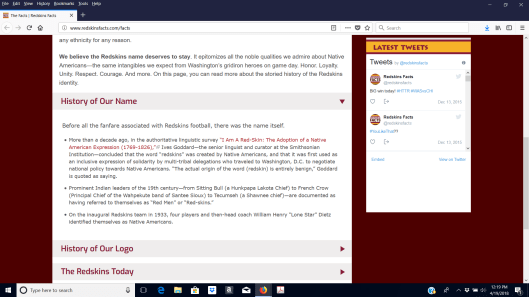
With just three items, this is a brief history to be sure, but the omissions aren’t entirely a function of brevity. What they leave out here is every bit as important as what they choose to tell us. Taking their bullet points in reverse order:
Notice they tell us that when the team came into being four players and the head coach “identified themselves as Native Americans.” This wording was carefully chosen to promote a common team legend without actually claiming that legend is true. Defenders of the team name commonly tell us that the team was named after a Native American (William “Lone Star” Dietz). It’s not at all clear that the team name was ever meant to honor him, but more importantly, Dietz’s claims to Native American heritage are questionable at best, having come under intense scrutiny when Dietz stood trial for evading the draft during World War I. The folks at Redskinsfacts.com know very well that team fans team defenders still cite the story of Lonestar Dietz in defense of the team name. Telling us that Dietz claimed a Native American identity enables them to promote that story without actually making any false claims on the topic themselves. So, I guess it’s not an outright lie. More like, a cowardly equivocation.
The second bullet point in this ‘history’ is simply off topic (and rather vague). That prominent native leadership of the 19th century, have referred to themselves as ‘redskins’ does not establish that the term is not now or at any other time free of pejorative implications. Resting as it does in this simple, narrative the claim that some of them have done so does nothing to tell us how they felt about the term or why they came to use it. It doesn’t even enable us to sort which ones called themselves ‘red men’ and which ones called themselves ‘redskins’. It doesn’t address problems of translation. It really doesn’t establish anything except for the sloppy thought process of the website administrator. He’d have to answer a few questions before we could even get to the ‘so what?’ part of the conversation. Or we could just skip to the chase, I suppose.
So what?
The first point in the pseudo-history of the team name is the one that interests me the most. Defenders of the name will often cite Goddard’s article as proof that the term in question is not an insult. (Seriously, I’ve long since lost track of the number of people that have done this,) I always ask them if they have actually read the article. Often that seems to be the end of the conversation. When these folks do tell me they’ve read the article, I ask them if they’ve read the last line in the article. To date, none have answered that question. So, what is the last line in Goddard’s article?
The descent of this word into obloquy is a phenomenon of more recent times.
My point is of course that Goddard didn’t write an article telling us that the term in question is not an insult. He wrote an article telling us that it did not begin as an insult, which is an entirely different claim. It isn’t entirely clear from Goddard’s piece just how he would account for the present significance of the term, but he is very clear on the fact that his own work does not actually address that question. So, the article should leave us with a full stop right around the 1830s. Goddard helps us to understand the use of the term up to that point, and he doesn’t have much to say about anything after that.
Goddard’s work is interesting for a number of reasons, but it doesn’t tell us much about what the term means today, or even what it meant by the end of the 19th century. He does take issue with the claims of at least some modern activists, Susan Shown Harjo being among them, but he himself points out that rejecting her claims about the origin of the term does not prove that many Native Americans find the term objectionable in the present time (p.1). I think Goddard does a pretty good job of showing that Harjo and others have been wrong about the origins of the term, leaving the rest of the case against the team name largely untouched by his article. The correction seems a bit one-sided to me, but at least Goddard has been clear about the limits of his own work on the subject. If he has published anything addressing the later history of the term or correcting any of team’s misuse of his work, I am not aware of it. (If anyone does know of such a response, I would very much appreciate a reference.)
So, why is Goddard’s work the first thing Redskinsfacts.com cites in their history of the term? Well they have to know that many people equate the origin of a term (or at least our earliest known account of it) with its contemporary meaning. This is called the etymological fallacy, and it’s an extraordinarily common mistake. So, they don’t really have to tell us the article proves the term is innocent; the folks at Redskinsfacts.com know very well that is what many of their fans will take away from their reference to the article. Citing Goddard and providing a link to his work enables them to strengthen the impression that the team name is innocent without actually going so far as to say that’s what Goddard has shown. They invite their readers to indulge in an etymological fallacy, just as they invite us to think of Lonestar Dietz as a Native American when he was likely an outright fraud. It’s fascinating to see how the site avoids making the false claims in question, even as they invite readers to infer those very claims from the one they do make.
Don’t get me wrong. This isn’t even the worst of it. Defense of the Washington football team has produced all manner of horribles over the years. This isn’t even the worst of it.
Still, it’s pretty damned deceitful.
And cowardly.

05 Monday Mar 2018
Posted in Books, History, Justice, Narrative VIolence, Native American Themes
Tags
American Indian, Federal Bureau of Investigation, Historical Trauma, Killers of the Flower Moon, Murder, Native Americans, Oklahoma, Osage, The FBI
 Regarding his own documentary work, Joshua Oppenheimer once wrote of modern Indonesia; “…I felt I’d wandered into Germany 40 years after the holocaust, only to find the Nazis still in power.” I thought about this line as I read Killers of the Flower Moon by David Grann. It’s a different time and a different place, perhaps even a different scale of atrocity (at least if you are counting bodies), but each of these stories raised for me the same haunting thought; what must it be like to live one’s life among those that have murdered your loved ones. Oppenheimer’s movies, the Act of Killing and The Look of Silence are set in Indonesia nearly half a century after genocidal policies resulted in the loss of at least half a million lives. Grann’s work is set in Oklahoma, closer to a century century after a wave of killings struck the Osage community, leaving generations to wonder about what really happened? Both stories recount the details of gruesome murder, and both raise questions about life in the wake of atrocity.
I’m also reminded of Anna Rosmus, whose work on the resistance fighters of her hometown uncovered a sordid history of Nazi collaborators well hidden in the town’s oral narratives. She asked enough questions to draw up a violent response from those still tied to that history. I wouldn’t say this was Grann’s focus, but stories like the one he tells have a particularly reflexive quality. Murder on the scale of his story doesn’t rest neatly in past; it haunts the present.
SPOILER ALERTS!
This book is the story of a series of murders carried out in the Osage community of Oklahoma during the 1920s. Grann begins the story by concentrating on a little over 20 murders which would become the focus of an investigation by the FBI. As this was one of the first big cases to be carried out by the Federal Bureau of Investigation, the book provides insights into the early years of Hoover’s budding new empire. At the same time, the book helps to shed light on one of the darker chapters of Indian-White relations, the long slow looting of Native American communities by outsiders under the policies of General Allotment.
To grasp the events unfolding in this book, you must understand two things: the Osage community had come into control of vast oil fields, and many had been declared incompetent to manage their own estates. To resolve the second of these problems, various white businessmen had been named as trustees and put in charge of the private fortunes belonging to various Osage members. As individual Osage accumulated the proceeds of oil money. It seems that some people found the notion of wealthy natives rather objectionable (a theme often echoed today by those who resent Indian casinos). More importantly, a certain quantity of non-natives found ways of doing something about it, ways of acquiring that wealth for themselves.
At first, the killings seem a bit random, a pair of shootings here, a few mysterious illnesses there. Someone seemed to be killing off a number of Osage, but why? It didn’t help that the first couple investigators to get somewhere were themselves brutally murdered. It helped even less when a bomb was used to kill an Osage couple and their white servant living in the middle of town. Most of the victims knew each other. They had plenty of connections between them. But which ones were the key to the case?
In the end, it was the mysterious ‘wasting’ illnesses that seemed to provide the most representative cases. The medical science necessary to detect poison was not yet widely available, and it certainly wasn’t standard procedure to test for poison in the event of every death. In the midst of the prohibition era, moreover, it was easy enough to attribute poisoning to bad moonshine. So, poisoning could provide a very effective means of killing someone without raising too many suspicions. It was particularly useful for relatives, trustees, and other beneficiaries of life insurance or inheritance policies eager to acquire an Osage headright. Such killings were not only difficult to detect in the day, they are difficult to detect now in the historical record, but as Grann shows, Osage died at an extraordinarily high rate in the 1920s, a rate not fully explained by any other known factors. The FBI wrapped up an investigation of a little over 20 murders. If Grann is right, the number of Osage actually killed in this era is more likely in the hundreds.
Most were killed by relatives, or at least those who’d been hired by them.
I have to admit the specter of so many white marrying into the tribe making friends with Osage for the clear purpose of killing them fills me with a sense of shame. The feeling will pass, of course, for me, but one of the most haunting features of the book is the number of people for whom such feelings clearly will not pass. The final chapters of this book are filled with personal stories those who grew up in the wake of these murders. It’s been nearly a century, yes, but in family terms these are stories about (great) grandparents, great aunts and uncles. These are stories about children who went on to live their own lives and raise their own families knowing that their own parents had been killed by loved ones or trusted neighbors. …and in some cases wondering just who might have been involved?
…or what local businessmen might have profited from these murders?
This kind of violence isn’t contained in one generation, or even two. It haunts a community long after those who participated have passed away. I can’t help thinking part of the horror might lie in the fear that the truth will never be known, that someone’s death could be forever buried in falsehood, which is why books like this are important. They are one means of countering that horror, however inadequate they may be. Grann didn’t stop at the FBI cases. He went on to study murders left unsolved and to explore the causes of deaths that never caught the attention of authorities. He couldn’t always find an explanation, but he does manage to reveal something of the extent of these crimes.
It’s evident that some folks entrusted Grann with the hopes of finding out the truth behind their family tragedies. That must have been quite a weight to carry.
It must have been a far greater weight for those to carry such stories their whole lives.
***
Postscript: I just wanted to make a couple additional remarks here, regarding the writing style. While Grann is relating a historical narrative, he does so through the lens of a particular woman, Mollie Burkhart, who lost most of her family in ‘reign of terror’, and of the FBI agent, Tom White, who was put in charge of the case. By following the lives of these two people into the story, Grann is able to provide a historical narrative that reads like a murder mystery. Those familiar with the story may know where it’s going, and I’ve shared a portion of that here myself (minus severl significant details), but most of the time this approach leaves the reader to wonder how the pieces will fall together, and to expect that will happen when the main characters put those pieces together themselves. Again, tis is history, but it reads a bit like a murder mystery.
This is an interesting approach to historical narrative, one that should prove helpful in the rather likely event that this is made into a movie.
Grann also fills in a lot of detail as he writes the story. He relates the physical features and demeanor of his characters in this book, much as a fiction writer would. When reading such material, I often find myself wondering where that came from? Is this how someone else described the person in question? Is it the impression Grann gets from looking at their pictures? Some combination? Hard to tell!
I can never decide how I feel about that approach to historical writing. A part of me would like to keep closer to identifiable records, to have the option of checking specific claims about specific source material. Another part of me is just happy to get the story. I can file away the fluffy details and focus on the main story line if the information is worth reading.
…which is definitely the case here.

 northierthanthou