• About

northierthanthou

northierthanthou

Category Archives: Religion

I have lots of thoughts about the topic of religion. Much of this stuff may be polemic in nature, but that isn’t always the case.

A Damnable Dilemma!

25 Wednesday Mar 2015

Posted by danielwalldammit in atheism, Religion, Write Drunk, Edit Stoned

≈ 12 Comments

Tags

Argument, atheism, Atheists, Debate, Ethics, Etiquette, Judgement, religion, Unbelief

Ah to be just as cool as this! (pun intended)

Ah to be just as cool as this! (pun intended)

Seems like I’m always reading (or hearing) that atheists are just as bad as religious folks. This theme has a few funny variants! Pushy atheists are just as bad as pushy  believers, or maybe they are just as closed minded as fundamentalists. Atheists who force their views on others are just as obnoxious as Christians who do the same. You can add all manner of pejorative adjectives and get the same formula. We non-believers always seem to be just as annoying, just as rude, and get on people’s nerves just as bad as those we criticize.

I guess atheists are justazzy people.

…which I suppose is fair enough, but is being ‘just as’ really just as bad as being what others just are when someone accuses them of being justazzy?

It’s a bit of a dark night where all cows are grey, this world of justazzyness. I guess it’s a question of priorities, and some folks’ priorities don’t leave much place for the the particulars. Those without a damn to give will hear only that others talk too much about a thing and not much about what each has to say about it.

…which makes for a whole lot of justazzyness.

It’s easy enough to imagine the possibilities. We’ve all met the assholes who could easily square this equation off quite nicely. But of course, folks complaining about the justazzyness of non-believers are rarely clear about just what it takes to cross the line into justazzyness. It could as easily be a thoughtful question as a bit of snark; just likely to be respectful disagreement as a bitter bit of insult. I can’t help thinking in most cases one enters the land of justazzyness simply by stating a point of view in the first place.

My old high school used to suspend both parties in a fight, even if one clearly attacked the other. To them defending yourself was just as much a ticket to the principal’s office as picking a fight to begin with. This would seem to have been just as much a case of justazzism as the one that has me up at this fricking hour. It’s 3:30am fer fuck’s sake! And my dreams no doubt find this topic just as poor an excuse for keeping them waiting as any other.

Soon, dammit!

Oddly enough I can’t help thinking this justazzitude is just as unfair to the justazzinination as it is for the justazzinandum. It can be no better to be a measure of damnation than it is to be damned for opposing the damnable. But of course that’s just as one would expect it to be. But is it really a forgone conclusion that faith imparts an evil to anything that shares a measure of whatever it may be? Is belief really such a settled villain that the only question left is will it take its foes down with into a Hell of great peevishness? I’m no friend of Jesus, and even I wouldn’t say it’s such a settled matter as that. But who could fault a fellow for saying ‘no’ to anything so easily dismissed as that? Who but someone who really just wants the issue off the table whatever the costs and whatever the merits of the parties involved?

What a damnable state it must be to live in a world where one can neither affirm nor deny with anything more than a shrug and a meh!

It’s a tragic narrative I suppose. An unbeliever confronts the monsters of superstition and gullibility only to find himself becoming a monster in the eyes of a third party. Try as he might, our soldier of reason can only see in those eyes staring back at him  the very darkness he seeks to combat. The vision is painted in broad strokes to be sure, but some eyes don’t see care for detail. There is no argument against apathy. But is faith not the original sin for this tragedy, a seed which bears fruit in the form of a rotten dilemma? One may accept faith, or one may just as well accept it in the very act of denial. Damned if you do and damned if you might as well have anyway.

You have to wonder! Will those impatient souls who make no distinction keep to that mood Saturday and Monday as well as Tuesday and Friday? Or will they take a side some day, perhaps one which is just as present today in their thoughts as it will be when they at least choose to voice it? Not that they will wish to discuss the matter then, now, or ever.

…which is just as frustrating to some of us anyway.

I expect this rant makes just about as much sense as a kite in a bowl of soup, but then again, I’m feeling kinda justazzy tonight.

Anyway, I guess we’ll have cause for concern when folks start talking more about how religious folks are just as bad as unbelievers. When people of great faith are just as bad as us already justazzy folk, then me must have taken a wrong turn after all.

Till then…

Share this:

  • Tweet
  • Share on Tumblr
  • Click to print (Opens in new window) Print
  • Click to email a link to a friend (Opens in new window) Email
  • Click to share on Reddit (Opens in new window) Reddit
Like Loading...

Merry [War on the (War On)] Christmas!

18 Thursday Dec 2014

Posted by danielwalldammit in atheism, Politics, Religion

≈ 8 Comments

Tags

atheism, Christianity, Christmas, Media, Pundits, Right Wing Politics, Santa Clause, Secularism, War on Christmas

Got this here: http://savannahchristian.com/blog/christmas-with-a-capital-c

Got this here: http://savannahchristian.com/blog/christmas-with-a-capital-c

If I was to list the things I hate about Christmas, that list might well include Black Friday, bland food, and blander music. Jesus isn’t on that list. Oh, I know that I’m supposed to be working hard to get the Christ out of Christmas, at least according to certain talking heads, because that’s just what atheists do. But seriously, it would never occur to me to try and scratch Baby Jesus out of this holiday.

…mainly, because Jesus isn’t a big part of Christmas to begin with.

Yes, I understand American Atheists did a snarky Billboard. With that and a pickle, they’d still be one sandwich short of a lunch plate. Some of us will laugh (I know I did), but this is hardly a credible threat to the Prince of Peace. And seriously, atheist kids can’t be the only ones hoping to skip church for Christmas.

Schaedenfreude for All!

Schaedenfreude for All!

…if you think about it, they probably aren’t all that worried about it.

The annual fake war on Christmas is always entertaining. When folks find ‘Happy Holidays’ offensive or suspect an entire agenda behind use of the infamous X in ‘Xmas’, I can’t help but laugh. But I like to remind myself when the explicit reasoning people use makes no sense whatsoever, that’s usually because it isn’t the one guiding their actual thought process.

I figure the war on Christmas is primarily good marketing for right wing pundits, and apparently for Kirk Cameron. Near as I can tell, Cameron has never really outgrown his character on Growing Pains, but the culture wars certain do provide him with plenty of grist for the still-vapid mill. This year he’s working the Christmas angle. …meh! Anyway, the war on Christmas does two things near as I can tell; it helps Christian conservatives misrepresent the battle over civic religious pronouncements, and it helps those same Christians rally the faithful by wagging the dog, so to speak.

savingchristmas_smI know, I’m mixing my metaphors, yes, but what the Hell do you expect from a Godless bastard?

The battle over civil religion has been driven by concerns about the entanglement of religion in public institutions. This is not an effort to drive God entirely from the public sphere, nor is it an effort to enshrine atheism in that sphere. The question is simply whether or not government facilities ought to be making any kind of explicit religious expressions, whether it be a copy of the Ten Commandments or a Manger scene.

Now I’m not entirely sold on the value of opposing every cross, prayer, or hand-made sign with religious sentiments that makes an appearance on public property, but every time I’m tempted to support a compromise on these issues, some joker from the religious right (or ten of them) makes it a point to suggest those reflect the true Christian nature of this country. …and what seemed possibly harmless then becomes a great big power grab that needs answering immediately.

In any event, those defending use of public institutions for explicitly religious expressions have some real questions to answer about how this squares with the establishment clause, and near as I can tell most of the culture warriors are too busy generating narratives that bypass the whole problem. The War on Christmas is just such a narrative. As long as every challenge to a public display of Jesus in the manger counts as part of an effort to crush the joy of Christmas, the Christian right will never have to address the constitutionality of its public agenda. People will be too busy saving Christmas from godless grinches.

…just like in a television sitcom.

Vintage Christmas

Vintage Christmas

The larger and deeper misdirection here is also simpler. (It’s a multi-layered misdirection, really it is!) Jesus has been a rather minor theme in the actual celebration of Christmas for most of modern history. Sure, children sing the occasional Silent Night in a Christmas pageant, but they also sing Jingle Bells. Were I a believer, I wouldn’t want to take bets on which one gets a bigger round of applause from the audience. But that’s just the tip of the pagan pine bough. The fact is that Christ is always playing catch-up with His own holiday, and last I checked, he was well behind the marketing professionals on this one.

These days I hear a lot of people talking about putting the Christ back in Christmas, as if simply saying the phrase ‘Merry Christmas’ would provide them with a real victory. The fact of the matter is, though, that people have been saying ‘Merry Christmas’ for generations without meaning much more than ‘Yippee, presents!’ or ‘Hope you get a good bonus.’ Hell, even the more profound messages of giving and family togetherness are as easily embraced in secular circles as those of the truest of the True Christians™. The right wing culture warriors know this and they want to change it, or at least they want to be seen trying to change it.

Whatever else the war on the ‘war on Christmas’ is, it’s also a means of investing the phrase ‘Merry Christmas’ with a new and more politically aggressive meaning. It effects that investment by conjuring an enemy, so when you say ‘Merry Christmas’ now, you aren’t just wishing people a nice glass of egg-nog. Hell, you aren’t even just telling them to celebrate the birth of Jesus or wishing them all the blessings the Prince of Peace could possibly bring. When you say it now, you’re pissing off an atheist (or even a liberal Christianl), and nothing says you love Jesus more than pissing off an atheist (or a liberal)!

Good fun for all!

Only, most of us aren’t all that bothered by the phrase. Hell I say ‘Merry Christmas’ as often as I say ‘Happy Holidays.’ When I did a brief stint at a Jewish private school, I said ‘Happy Holidays’ more often, but that certainly wasn’t about pissing off any Christians. When my Jewish colleagues said ‘Happy Holidays’ to me, they were showing far more compassion and tolerance than the right wingers pushing this fake war can possibly imagine. None of this strikes me as expressing animosity toward those saying “Merry Christmas.” Anyway, I don’t think I’m unusual in this regard. The phrase “Merry Christmas” just isn’t a problem for most unbelievers, and certainly not liberals in general, at least not when Bill O’Reilly isn’t writing the script.

vintagecoke

Coke, another “reason for the season.”

The real threats to the religious perspectives on Christmas have never been secularists; they have been the myriad pleasures of worldly ways. The threats have been train-sets and iphones, bicycles, and Barbie-dolls, well-spiked punch-bowls at office parties, gaudy lights, and near riots at the local Walmart. It’s these things that compete with Jesus for our attention on December 25th, and quite frankly, it isn’t atheists that are pushing them on people. It’s good old-fashioned American capitalism, and let’s be honest, Christian conservatives are hardly interested in fighting a battle against corporate capitalism. So, they’ve conjured up a scape-goat. This way they get to have their stale gingerbread and eat it too. Through the ‘war on Christmas’ Christian conservatives can pretend to fight for the spiritual significance of their holiday all the while going right along with the very practices that keep turning the conveniently imagined birthday of Christ into a hollow and impious event.

Don’t laugh; it works folks!

I can’t be the first or even the thousand and first scaped goat to complain about this little gambit, but well, it’s a white Christmas up here in the arctic, and I’d rather gripe than go outside. Plus, I’m an atheist. I’m supposed to be grumpy and grinchy. Some days I am happy to oblige.

Oh yeah, there’s one more thing.

Merry Christmas everybody!

Share this:

  • Tweet
  • Share on Tumblr
  • Click to print (Opens in new window) Print
  • Click to email a link to a friend (Opens in new window) Email
  • Click to share on Reddit (Opens in new window) Reddit
Like Loading...

God, This Movie is Awfully Damned Trite!

22 Sunday Jun 2014

Posted by danielwalldammit in atheism, Religion

≈ 13 Comments

Tags

Apologetics, atheism, Christianity, College, Education, Film, God is Not Dead, Movies, religion

gods-not-dead-prof-and-studentThe most fascinating thing about the movie ‘God is Not Dead’ isn’t the conflict between atheism and Christianity; it’s the tension between narrative and argumentative styles of presentation. The premise for this film is simple enough; an atheist professor demands that his students sign a statement to the effect that God is dead. When a student refuses to do so, the professor commands him to prove that God exists in a series of 3 debates to be held in the first few weeks of class. Failure, it is clear from the outset, will mean an ‘F’ for the class, but the student’s only other option is to sign the statement. This a clash between Christianity and atheism to be sure, but its also a clash that takes the form of a debate, and the sort of reasoning that takes place in a debate changes a great deal when it is reframed in narrative form. In God is Not Dead, arguments become a story, and the premises and conclusions of those arguments become events in a storyline.

If the main characters appear as proponents in a debate between a College Professor (Jeffrey Raddison played by Kevin Sorbo) and a college student (Josh Wheaton played by Shane Harper), they are also antagonists in a life or death struggle quite familiar to movie-goers of all faiths and none. Josh is the underdog fighting for his faith; Radisson is a monster who torments his students without mercy. This is David and Goliath to be sure, but this time Goliath wields a grade-book, and David goes to the library. The David and Goliath aspects of the story are not an accident, and the film-makers were clearly trying to make a statement about the treatment of Christians in academia.

The opening scenes of God is Not Dead drive home just how important winning the debate will be to Josh Wheaton. In the event that he loses that debate, Josh will get an ‘F’ in the class, and (as his high-school sweetheart reminds him) that will be the end of long-term career plans. To make matters worse, she regards his willingness to risk his own future as a betrayal of the future they have planned together. She will thus leave him if he goes through with the effort. Josh’s pastor doesn’t help matters much by telling Josh his own actions may be the only exposure his classmates will have to Christianity. So, the stakes are awfully high. Just as David, Josh is fighting not only for his own future, but also for the good of his people (in this case, his classmates). This might seem like a heavy load to put on the shoulders of a college freshmen, but they would be quite familiar to many Christian apologists. This is not just debate over the the truth of a given claim; it is a battle for the souls of all involved.

So, this story about a classroom debate is really a sort of war-story. And of course it will be told in three acts. It should come as no surprise that the villain will be vanquished in the end, though it may come as a surprise just how completely vanquished (and yes, saved) this villain will be.

The first act of the story is largely about Josh’s decision to accept the debate in the first place. His preparations are unimportant, as is the actual argument he produces when the time comes. Josh begins this first round of battle with an argument to the effect that the Big Bang is consistent with, and even requires, the existence of a creator. Radisson simply tells him that according to Stephen Hawking it doesn’t, going on to ask if Josh thinks himself smarter than Hawking. Thus ends the first debate with an outcome that should surprise no-one. What kind of principle villain gets his ass kicked in the First Act of the story? Certainly not this mean-spirited professor!

Still, the first debate does establish a bit more than the fully expected set-back for our underdog Josh. Already, a few patterns begin to emerge from the vision of academic dialogue presented in this film. Both participants rely heavily on appeal to authority, even to the point of simple quote-mining. Both parties will also spend a significant amount of time on science, and in particular the science of cosmogony. The end result is a rather sophomoric vision of philosophy in which the battling heroes themselves pay homage to their own heroes in lieu of exploring the full arguments, all the while coming across as arm-chair scientists rather than participants in a philosophical exchange. To say that this is an impoverished vision of philosophy would be putting it mildly. To say that it is a vision common among Christian apologists would be putting it closer to the point.

In the second debate, Josh returns with a source describing Hawking’s own arguments on the origins of everything as circular. Pressed upon the matter, he reminds Professor Radisson that Hawking himself has suggested that philosophy is dead. Josh goes on to raise familiar concerns about abiogenesis in evolutionary theory.  Hawking was of course talking about precisely this sort of second-hand science discussion, but most importantly, playing the anti-philosophical card in this scene raises the dramatic significance of the debate. A humiliated Radisson has little to offer in response, opting instead to mock Wheaton after the other students have left the room. It is an angry confrontation, and in his anger Radisson reveals his greatest weakness. Asked by Josh, what happened to make him so angry, Radisson recounts the story of his own mother’s death and the prayers he offered as a twelve year old in the hopes she would live. This is an interesting speech, because it is one of the few times when the professor is allowed to be something other than a foolish caricature. He ties his own pain in the loss of a loved one to the outrage that some divine plan could ever account for it, and for just a brief moment Radisson seems both eloquent and human.

The final debate is all about the argument from evil, the notion that the existence of God as he is commonly envisioned in Christianity cannot be reconciled with the existence of suffering. Both parties advance arguments on the topic, but the most significant feature of this scene is the increasingly emotional tone of the discussion. Josh can feel the threat to his grade and his ambitions and Radisson can feel the growing threat to his own credibility. Their voices grow louder, and their demeanor more intense. As both parties become increasingly excited, Josh asks Radisson in front of the class to explain why he hates God so much knowing that science supports His existence. In the heat of the moment, Professor Radisson answers Josh in precisely those terms, proclaiming that God took everything from him.

One could chase ugly rabbits down so many holes in this film, but that single response from Professor Radisson really is the core message of the film. It is also the most disturbing thing about the film. For all it’s many simplicities and distortions, God is Not Dead is first and foremost a statement to the effect that atheism is really about hatred of God rather than disbelief.It is a statement that arguments against the existence of God (and counters to arguments in favor of His existence) are simply deceitful rationalizations. The argument from evil is, as this film would have it, less an argument about the (in)consistency of someone’s thoughts about God than an expression of hatred aimed directly at God himself.

In this plot twist, the very topic of debate simply vanishes in front of us, and the story sets all questions of god’s existence aside. Radisson is not really an unbeliever at all; he is a rebellious child (which might help to explain his childish antics). The storyline of the film thus overtakes any effort to address the issues at hand, presenting us with a narrative in which non-believers produce arguments only in the service of venting their own pain. One does not resolve their questions by rational rational argument so much as a kind of spiritual counseling. This counseling is presented still more clearly in one of the films many side-stories, that of a snarky atheist blogger who enjoys poking wholes in religious thought (…hey!). The script-writers must have found it quite amusing to pre-empt a decent portion of their future critics with this particular story-line, but to get back to the point, Amy Ryan (played by Trisha LaFache) learns that she is dying of cancer, a fact which throws quite a curve ball into her life of internet snarketry. When she finds her way backstage at a Christian concert, all of her arguments crumble quite completely as the drummer for the Newsboys suggests that she had actually come to their concert, not to mock them, but so so that they could help her find faith.

…and the subplot ends with a lovely group prayer.

The Newsboys concert fills the final moments of the film with enough exposition to compete with the worst papers from a creative writing workshop. It includes an appearance from Duck Dynasty’s Willie Robertson who cheers on Josh and invites the concert audience to send out a text telling everyone they know that God is Not Dead. This is a message clearly intended to break through the fourth wall and reach into the lives of audience members in the theaters. So I suppose it is no small wonder that evangelical Christians of all shapes and sizes were indeed pushing this film for awhile. I lost track of the number of people who told me that I really should watch the film, assuring me that even non-believers would find it thoughtful and enjoyable. Most seemed quite prepared to concede the one-sidedness of the story-line, even to accept that Sorbo’s character was a bit over the top (it was in fact, well out of earth orbit). What many of those urging this film on others seem unaware of is just how demeaning the story really is for those of us who don’t believe in God. It isn’t just that this film portrays an atheist in an extraordinarily bad light, or even that portrays academia in general as a place filled with cruel and sadistic professors just looking for an excuse to hurt those of faith. What this film does is to empower a dismissiveness that undermines any subsequent dialogue. It encourages believers to think of atheists (and skeptics in general) as people who do not understand our own motivations. It encourages Christian apologists to think of our words as unworthy of consideration, mere diversions from a spiritual tragedy which they understand and we do not.

It is a deeply dehumanizing vision of atheists that this movie presents. For me at least that vision is a conversation-ender; it is not the opening stages of a promising dialogue. As with so much of what passes for Christian apologetics, what is so unfortunate about this film is the degree to which it poisons its own well. In the end, this film does little to engage those of us who don’t share the Christian faith. It never really takes us seriously to begin with, and it never takes seriously the possibilities of dialogue between believers and non-believers.

Its fans should not be surprised to find many of us will respond in kind.


Share this:

  • Tweet
  • Share on Tumblr
  • Click to print (Opens in new window) Print
  • Click to email a link to a friend (Opens in new window) Email
  • Click to share on Reddit (Opens in new window) Reddit
Like Loading...

God is Not an Apologist! (Except Maybe on Tuesdays and Thursdays from 8:30 to 9:45am)

16 Friday May 2014

Posted by danielwalldammit in Philosophy, Religion

≈ 6 Comments

Tags

Apologetics, Christianity, Cosmogony, First Cause, God, God is Not Dead, Intelligent Design, Philosophy, religion

006

Yes, the Holy Bible comes in an Arctic Edition

Somewhere in the movie, God is Not Dead, the main character proclaims that the burden both theists and atheists must face is the question of how the universe was created. In this moment, I think it’s fair to suggest Wheaton speaks for the movie makers themselves; his voice is the one we are meant to believe, and in this respect I think he is also voicing the views of many Christian apologists. From this standpoint, the debate over the existence of God is essentially a debate over alternative explanations of the universe. And fair enough, I suppose, one can certainly approach the subject in this manner, but I wonder sometimes if people realize just how much baggage this leaves unpacked?

We could start with the use of deictic markers to reference one of the key points of that debate. The word ‘God’ isn’t a descriptive term, much less a scientific one. It is a label which points at someone without doing much to tell us anything about Him, thus bringing God (along with His presumed attributes) into the debate by way of presupposition rather than demonstration. Raising questions about the existence of god in this way has the effect of setting a lot of interesting questions about His nature aside. The typical manner in which we have become accustomed to talk about God thus grants a strong presupposition in his favor and in favor of a number of assumptions about who He is and what role He plays in the universe. By ‘we’ here I mean pretty much any of us who talk about the subject, including non-believers like me. We Godless bastards doubt the existence of the Lord, and yet in doing so we happily fall into a manner of speech that practically puts him in the room.

That’s a bad habit.

It would be nice if we could put this habit down to twitter-apologetics or something, but as I recall the approach was already strong in the work of Thomas Aquinas, and with him, in philosophy seminars throughout the world. But seriously, how often do we talk about alternative explanations for anything using personal pronouns for key terms? We don’t explain falling Objects with reference to Mr. Gravity. Meteorologists don’t tell us about storms by warning us that Mother Earth is in a bad mood today. And we certainly don’t expect our doctors to enter into dialogue with the causes of our aches and pains. “…the cause of your sore throat is a guy named Fred. I’ve asked him to leave, and he said he would if only you would gift him these blue pills twice a day for the next two weeks.” Anyway, the point is that this is one respect in which the very vocabulary of God-talk is damned tricky. In using it, we may start with interesting questions, but we end up discussing it in personal terms.

…literally.

The point here is that folks rarely examine the implications of that transition. But they should. Some of us may have qualms about using such sloppy rhetoric to try and explain anything, much less the entire universe (which is itself an odd almost-notion that could bear a little reflection), but you have to wonder about the proprieties of the matter? It isn’t really all that nice to talk about someone as though they aren’t in the room. It has to be a little rude to sit there and tell people about God making this and god making that when folks assure us he hears the whole conversation. We non-believers can at least plead ignorance if we turn out wrong, but I have to wonder about the theists among us. What’s your excuse?

Okay, tongue in cheek remarks aside, my point is that this whole fashion of reference to God throws every explanation sideways and it makes every theoretical explanation using God just a little conky-wobble, more than a little actually. The sheer awkwardness of that transition, seemingly naturalized by countless centuries of habitus touches on an interesting question about the history of this God. When did he become an explanation? It might have been the same time that he dispensed with all his companions and decided to become the only deity in town.

Most of your deities in classic polytheism just don’t play the same kind of role in the intellectual life of their believers. Sure they create (often by accident, …ahem, Coyote!), but they do not create out of nothing. More importantly, it isn’t clear that they are really there to serve as explanations for anything. A god of lightning may seem a poor explanation for lightning in this day and age, but one shouldn’t be too quick to assume he is really there to explain lightning. It is at least as plausible that those speaking of such gods may simply want us to think of them whenever we see lightning, in effect making the physical world (or at least its storms) a reminder of the stories told about them. This isn’t the logic of scientific (or even unscientific) explanation; it is a narrative style of its own. And the God of Abraham has his early days in those conventions. One searches in vain for anything like the rigor of Thomas Aquinas in the Book of Genesis, or even the rest of the Bible.

The God of Abraham was a god of war long before he was a First Cause. He was a god of agriculture long before he was a being than which nothing greater can be conceived. And he was a god of shepherds long before he was the supreme watch-maker. He was a god of many other things too, one of the being creation, but the conventions of that creation are not those of philosophical explanation. The account of creation we find in the Old Testament is the sort of loose-ended story-telling that one finds in the Iliad, the Mahabharata, or even the stories of elders in various native communities. The moral lessons of such stories and the ethos they facilitate are simply not those of the great philosophical arguments. We may use the same name to reference Him in each of these instances, but there is little reason to believe he is really the same person.

Truth be told, I suspect this is true of much of Christianity. The God who appears in the great philosophical arguments has little to do with the God spoken of in churches every Sunday. Small wonder that it is often the believers in the room who don’t really want to discuss the arguments for God’s existence. At least that was my experience when I taught Introduction to Philosophy. Each time I seemed to find myself, the only atheist in the room, trying to convince my students that the cosmological argument was worth thinking about, that the Ontological Argument wasn’t entirely insane, and that even Pascal’s Wager had its merits. Time and again, my students would simply proclaim that you couldn’t prove that God exists, all the while clearly insisting that he does. For me at least, the exchange was always fascinating and frustrating at the same time. I can’t help but think that my students were right about one thing though, that sort of intellectual exchange had little to do with their own approach to the subject. The God of the First Cause argument wasn’t really the God of their prayers, and it bothered them to speak of Him as though He was.

It isn’t really all that clear to me that anyone has to figure out where it all came from, so to speak, and it certainly isn’t clear that we must accept Christian accounts in the absence of an alternative. More to the point of this post, it isn’t clear that belief in God or gods has always been about answering such questions.

…or even that it is so today.


Share this:

  • Tweet
  • Share on Tumblr
  • Click to print (Opens in new window) Print
  • Click to email a link to a friend (Opens in new window) Email
  • Click to share on Reddit (Opens in new window) Reddit
Like Loading...

Mansplaining Hobby Lobby At the Silly Girls: Ain’t Free Exercise Fun!?!

25 Tuesday Mar 2014

Posted by danielwalldammit in Justice, Politics, Religion

≈ 24 Comments

Tags

Affordable Care Act, Birth Control, First Amendment, Free Exercise Clause, Hobby Lobby, Obamacare, religion, Supreme Court

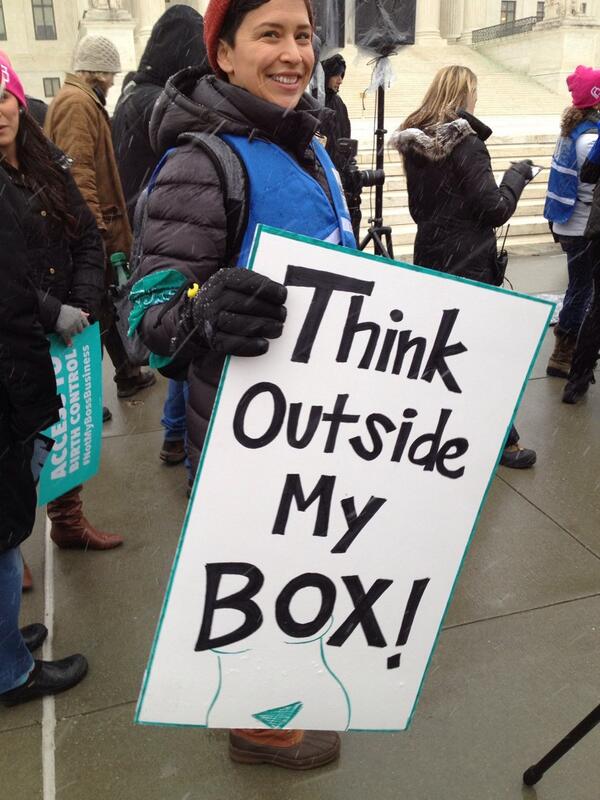
Bjk4aOWIEAABqBXI understand the compulsion to wish that people would separate religion from politics, but you might as well tell the wind to stand in a corner and think about all the tall grass it pushes around. Religion IS politics. It always has been and it always will be. So, it really shouldn’t come as a surprise that the GOP has found Jesus again. The Prince of Peace showed them a little leg by means of Citizens United, and the good political Christians have been composing love poems ever since. Today it’s working on rhyme scheme full of obby, gobby, and a great big bibilo-bobby.

It’s moments like these when the distinction between religion and politics simply vanishes. Both embrace visions of a moral order; both anchor that order in some vision of the world at large, and both impose that order on real people. So, it shouldn’t come as any surprise when Jesus turns out to want the same things Uncle Sam does (especially when he’s talking out the right side of his mouth). Does it really make a difference whether the government controls your body or a church? …or for that matter a hobby store?

For practical purposes the word ‘your’ today excludes anything claimed by those of us with a y chromosome, but take heart mens’ rights activists! I’m sure someone is oppressing a man somewhere; y’all can still howl!

This notion that corporations are persons for purposes of the Bill of Rights really has opened up new ground in the frontiers of collectivism, and all manner of good commie-bashing Republicans have jumped the gun to homestead this new turf without the slightest trace of irony. So, today we face the perverse prospect that the religious views of a corporate entity may trump the personal liberties of a woman (along with the good judgement of her doctor).

Pardon me, I have to vomit.

If there was ever any doubt that religious exemptions to the terms of the Affordable Care Act are about controlling the bodies of women, that should have been dispelled long ago. It should have been dispelled the day Rush Limbaugh reacted to a critic of these exemptions by calling her a ‘slut’ and a ‘prostitute’ and spreading lies about her sex life. It should certainly have been dispelled when good respectable conservatives all across the land shouted ‘yea verily’ at the grand bigot-pontiff of hack radio and promptly drafted themselves up a rash of laws restricting the health options of any women unfortunate enough to live in the wrong state or county. For all the rhetoric of rights, one doesn’t have to look hard to see the naked power politics of the right wing’s current approach to women’s health. Control over women’s bodies is an end in itself, and the Republicans want it now.

On this topic, they can count on the support of half-baked misogynists everywhere.

Today the great masculine hope lies with Hobby Lobby and misogynists are lining up to buy a kitchy piece of cloth, or perhaps a nice candle. Others are happy to simply tweet their support. Their keyboards say ‘Religious freedom’, but so often their texts read sexism, and they read it loud and clear. Take for example this little gem from the Matt Walsh Blog. Matt’s thoughts on individual rights aren’t particularly interesting; one is hard-pressed actually to call them thoughts, at least insofar as they appear on the pages of this post, but what’s really fascinating to me is the social posture he takes in this post, the footing as it were. You see Matt isn’t content to frame a basic argument about religious freedom or the rights of supposedly Christian corporations, he wants to set his post up as a direct response to those women who may want birth control. The result is epic mansplaining.

I’ve poured through mounds of research, read pages and pages of court precedent; I’ve reflected on it, meditated, retreated into the mountains to ponder this mystery in peace; I’ve even Googled it, and all of these measures have brought me to one incredible solution for women who want birth control:

Pay for it yourselves.

Or find an employer that chooses to provide it.

Or have sex and don’t use it.

Or don’t have sex.

Basically, take responsibility for your sex life, one way or another.

By ‘epic’ I suppose I mean childish and petty, but what do you expect. Anyway, there you have it folks; at bottom this issue is basic childishness. Apparently, women need to take more responsibility for their own sex lives. So, Matt is going to give them all a good lecture and be done with it.

Can you just hear the guy saying “I won’t cum inside you baby?” No really just the tip? If it comes to that, he no doubt promises to do the honorable thing.  …You get the idea. I’m almost sorry if this is too graphic, but I’ll be damned if the issue of personal responsibility for sexual matters doesn’t play out in just such moments all over the world. Seriously the notion that women need to take more responsibility for their sex lives is perversely ironic and that is precisely what Walsh’s framing of the issue sets up. His blog post isn’t a polemic on a tricky political problem, it is a lecture given to an errant little girl, one whose rights certainly don’t extend to questions about her own medical care. Why not? Well, let’s let Matt tell you…

It used to be that your rights were infringed upon if the government punished or threatened you for expressing your sincerest beliefs.

Now, your rights are infringed upon if you want something but someone refuses to buy it for you.

It used to be that the vision of tyranny was a man or woman bound, gagged, and shoved in a cage for speaking his or her mind.

Now, tyranny is the tragic image of man or woman forced to spend their own money on something because nobody would give it to them for free.

We used to fight and die for free speech.

Now we sit around and whine for free birth control.

Here Matt’s language echoes that of Limbaugh’s old attack on Sandra Fluke. This is a simple case of someone wanting something for free (which isn’t true, but don’t tell these hacks). Gone is any consideration of larger medical issues or questions about how one decides to deal with his or her own body. I say ‘his’ because I think most of us can relate to those moments when an insurance company turns out to be the reason your doc is doing this as opposed to that, and I sincerely doubt that Matt and his fawning fans are any less likely to grumble about such things when faced with them. But when Hobby Lobby turns out to be the reason why a woman can’t get birth control, well that’s just the facts of life, dontchaknow! Oh yes, of course she can pay for the birth control herself, just like you can pay for any number of medical procedures and prescriptions yourself. The fact is that in THIS world, and I by THIS world (I mean the crappy world of health-care we have here in the U.S.A.) what insurance will and won’t pay for is often the difference between what we get and what we don’t. In the real world Hobby Lobby’s policies will make a difference in the care some women get. Some of us think that difference ought to be up to her and her doctor, but apparently that is the view of tyrants.

…and of silly girls who whine.

Of course this is the tip of the Obamacare iceberg here, and many of those telling women to go fly a kite for contraception are the same folks who fought tooth and nail to stop the Affordable Care Act. Their solution for women is the same solution they offered all of us in the years leading up to the ACA, let the market run its course. Pay for your own insurance or pay for your own medical care; that’s what apple pies and supply curves are all about! That folks would say this knowing that medical bills in the U.S. have long since become prohibitive for large sections of the working public is irresponsible in the extreme. It isn’t just governments that skew the market; corporations (and particularly insurance corporations) do that too, but don’t tell the free market fundamentalists. They’ll call you un-American, …or maybe a slut or something.

In any event, the ACA is law now, warts and all, and the present battle is a classic exercise in scapegoating. It turns out that health-care for women is more complicated than it is for men, and when it comes to sex and its consequences, women are more vulnerable than men. So, Hobby Lobby and its pious supporters have risen to the occasion, leading the right wing to its scape-goat. We may have to accept this abortion of a law, they seem to be suggesting, but at least we can leave the sluts out in the cold.

And if they don’t like it?

Well then there are always mansplaining culture warriors to put them in their place. You can’t help but notice the pleasure some of these folks take in explaining the issue. For some, it’s a kind of theatrical moment, a chance to play the role of the stern father or maybe the soup Nazi.

No sex for you!

Ah well! Let’s give Matt the last word here:

And, seriously, in case I forgot to mention it: pay for your own birth control.

The end.

Next issue?


71.271549 -156.751450

Share this:

  • Tweet
  • Share on Tumblr
  • Click to print (Opens in new window) Print
  • Click to email a link to a friend (Opens in new window) Email
  • Click to share on Reddit (Opens in new window) Reddit
Like Loading...

An Uncommon Holy Relic: Sheela-Na-Gig!

20 Monday Jan 2014

Posted by danielwalldammit in History, Religion, Uncommonday

≈ 9 Comments

Tags

Archaeology, Christianity, Churches, Femininity, Gender, Sculpture, Sex, Sheela-Na-Gig, Stone-Work

220px-SheelaWikiOkay, now I know what you are thinking; “Dan is posting porn again! Will someone please keep him away from that damned erotic heritage place!?!” But no. I tell you I didn’t find this in a red light district, smut shop, or even a kinky museum. This naughty little lady was found at a church. Her name is Sheela, or at least that’s what folks call her and a vast array of figures like her. She and her sisters go by the full name of ‘Sheela-na-Gigs’, and you can find them on churches throughout the United Kingdom. Yes, that’s right, it appears that one can find images of grotesque women spreading their labia can be found at old churches throughout the United Kingdom.

Why, you may ask. Well it’s a fair question, but the answer appears to be difficult to nail down. There are a couple theories as to the origins of the term, Sheela-Na-gig, just as there are a few theories as to the reason such images could be found in old churches. Is she a relic of past paganism, an omen about the temptations of sin, or possibly just an erotic gargoyle of sorts. It really depends on who you ask. As I recall, an archaeologist once suggested that she was a symbol of Jesus himself, but I can’t find a written source on that. Presumably, that theory didn’t get very far. Anyway, the whole thing is a little too far outside my own areas for me to weigh in on the controversies with confidence, but I think we can safely draw one conclusion from it; the history of Christianity is far more complex and interesting than you would gather from your local neighborhood church (unless perhaps you are in England).

Of course most history is more complex than folks would gather from the world as it is now, but it doesn’t hurt to remind people of the full range of human possibility from time to time.

That’s what Sheela is here for.

***

The image above is on Kilpeck Church. I have included a few others below, most of which I drew from a website called The SheelaNaGig Project. Also included are images from Chloran, Moulton, Fiddington, Binstead, Oxford, and Llandrindod. You may click to embiggen (if you dare), but a visit to the almighty wiki or the SheelanaGig Project is well worth the time it takes to read about these figures.

Chloran (Got this one from the British Museum website)
Binstead
Llandrindod

The Moulton Pair
Fiddington
Oxford

71.271549 -156.751450

Share this:

  • Tweet
  • Share on Tumblr
  • Click to print (Opens in new window) Print
  • Click to email a link to a friend (Opens in new window) Email
  • Click to share on Reddit (Opens in new window) Reddit
Like Loading...

Love as a Decoy and Ducks as a Many-Layered Narrative

26 Thursday Dec 2013

Posted by danielwalldammit in Politics, Religion

≈ 25 Comments

Tags

A&E, Culture Wars, Duck Dynasty, Fox News, Gay Rights, Homosexuality, Phil Robertson, Racism

phil-robertson-getty-gospel-according-to-phil-gq-magazineIf I does it, I get a whippin’.

I does it!

At least I should get a whippin’ for posting about this already tired story, but what the duck! I have a few words to tap out over Phil Robertson’s interview with GQ Magazine.

For me, the most striking thing about the recent dust-up over the Duck Dynasty star is a recurrent theme of decoys and deceptions, perhaps even self-deception. In the GQ article, the author’s (Drew Magary) focuses on one prominent theme about the show itself, the role of Duck Dynasty in a message of redemption. That message begins (at least chronologically) with Phil Robertson’s own transformation from an drunken, abusive, and neglectful husband and father to an upstanding head of a household filled righteous dignity. The message will end, so we are told when Duck Dynasty has run its course and Phil is free to make his ministry into a full-time occupation – barring breaks for duck-hunting of course. For Magary, the real story of Duck Dynasty is one of personal redemption. The beards, the ducks, and all the rest are but flavor for that story.

And suddenly it seems ever-so fitting that a man who has made his living off a device intended to lure ducks in for hunters might have used a show to lure in the audience for a sermon on how to live one’s life. The intent itself seems a little bit more benign, at least at this level, but it is still very much a false-front operation. And fair enough, as far as it goes. The Robertson family certainly doesn’t hide their beliefs in the show, and yet they have surrounded themselves with artifice. A family of well-costumed men, playing out a series of scripted scenarios; this is the same sort of pap television has been selling as ‘reality’ for some time now. Even the apparently rustic backwater home is carefully engineered to maintain just the sort of rustic lifestyle this opponent of modern technology wants to live and to show us on television.  Phil’s faith may be one of the most sincere features of the show, wrapped as it is in a facade of down-home-ish nonsense. So, I suppose it is fitting, almost noble, that Phil would hope the success of Duck Dynasty might in the end furnish him with a means to do something more substantive.

***

There isn’t much reason to doubt that Phil is serious about his core message, about the role of Christ in redemption as he sees it. After all, Christianity was central to his own transformation, a transformation that does indeed seem to have been quite dramatic. In assuming that the road to redemption is the same path the rest of us must ultimately take, he is hardly out of step with the mainstream Christian practice. For Robertson, his troubled pas is what comes of sin, and Jesus is the only answer to those problems, just as he would be for the rest of us. This is where his message begins to chafe. The major controversies in this story begin when Phil explains what it will take to go down the path towards Jesus. The tricky parts of the trail would seem to include the following:

It seems like, to me, a vagina—as a man—would be more desirable than a man’s anus. That’s just me. I’m just thinking: There’s more there! She’s got more to offer. I mean, come on, dudes! You know what I’m saying? But hey, sin: It’s not logical, my man. It’s just not logical.

.

Phil On Growing Up in Pre-Civil-Rights-Era Louisiana
‘I never, with my eyes, saw the mistreatment of any black person. Not once. Where we lived was all farmers. The blacks worked for the farmers. I hoed cotton with them. I’m with the blacks, because we’re white trash. We’re going across the field…. They’re singing and happy. I never heard one of them, one black person, say, ‘I tell you what: These doggone white people’—not a word!… Pre-entitlement, pre-welfare, you say: Were they happy? They were godly; they were happy; no one was singing the blues.’

I should say at this point that I am at least a little concerned about the context behind Magary’s presentation of the racial politics. I am currently taking the block above at face value, though the quote itself does not contain a direct reference to segregation era politics. Magary fills that in himself with a heading for the block quote on the subject. If Robertson didn’t mean to address that particular topic with these comments, then I shall have to revise my thinking on that particular point.

[Robertson]Everything is blurred on what’s right and what’s wrong,” he says. “Sin becomes fine.”

[Magary]What, in your mind, is sinful?

[Robertson]’Start with homosexual behavior and just morph out from there. Bestiality, sleeping around with this woman and that woman and that woman and those men,’ he says. Then he paraphrases Corinthians: ‘Don’t be deceived. Neither the adulterers, the idolaters, the male prostitutes, the homosexual offenders, the greedy, the drunkards, the slanderers, the swindlers–they won’t inherit the kingdom of God. Don’t deceive yourself. It’s not right.’

For conservative Christians, this is pretty standard fare. Phil is preaching a gospel of self-reliance and upstanding moral conduct. The power of this message can be seen in the narrative of Phil’s own life, and many conservative Christians will no doubt claim it can be seen in their own lives as well. Ultimately, they might suggest, what Phil is offering is salvation, not condemnation, and that is surely a message of love.

Who could deny that message? Who could reject that love?

It should be added that much of the conservative Christian defense of Phil Robertson (including the family’s own public statement on the matter) has centered on the notion that his views are essentially Biblical in nature. To reject his views one is, so the implication would seem, to reject the Bible. And who could deny that?

Well, I’ll be your huckleberry.

***

duck-dynasty-gq-magazine-january-2014-01More to the point, there is a great deal more than scripture in Phil’s views, and his chosen horribles (welfare dependence and homosexual behavior) are not dictated by scripture. They are dictated by the politics of modern conservatism.

That Phil denies the horrors of Jim Crow is particularly telling, and particularly disturbing. Perhaps he didn’t see anyone mistreat a black man (though I suspect it more likely that he didn’t recognize it when he did, or that he simply won’t admit it); but Phil goes beyond his personal experience to suggest that blacks were better off in the days of segregation. The notion that Jim Crow was not-so-bad and that welfare is an absolute evil are both hallmarks of modern conservatism. One can no doubt cobble-together a scriptural argument or three on this topic, but that is the way the genre works. It’s a big book, and one can find a broad range of ideas in there, especially is he is fast and loose with the particulars. In point of fact, Robertson’s views on this point are those of the Republican party.

Regarding homosexuality, we may begin by noting that Robertson does not merely say that it is sinful; he uses it as the paradigm case of sinfulness, even going so far as to suggest that other forms of sin can be understood as transformations of homosexuality. This too is a modern pre-occupation, and it is a telling one. I still remember my days on christianforums.com, back when it was the largest Christian forum on the net. The biggest divisions on that forum were not those between Catholic and Protestant or even between Christian and non-Christian. No, the defining battles of that forum were fought over homosexuality and its significance for membership, moderation, and its user-iconography. For all the richness of Christian traditions, and all the varieties of life commitments Christians can make, in the public sphere the dividing line between Christian and non-Christian is today first and foremost a question of how one views homosexuality. This foregrounding of the issue does not come from scripture, much less from Jesus; it is a function of modern politics.

Conservative Christians have employed a great variety of means to argue the point about homosexuality, some plausible, many outright ignorant or deceitful. But what do we get from Phil? In this interview, we get a sermon on the aesthetic benefits of a vagina. The Bible is a big book, but I somehow doubt that is in there. More to the point, I doubt that is where Phil got his thoughts on that particular matter.

There is something particularly disturbing, almost pornographic, about the way some homophobes talk about mechanics of anal sex. The notion that anal sex is somehow-the go-to moment for questions about the meaning of homosexuality is hardly obvious. It misses questions about oral and digital sex, anal sex occurring in straight couples, and (I believe) the vast majority of acts occurring between lesbian couples. It is by no means obvious that this is the sex act of choice for gay men either. And all of this ignores the larger questions of love and the formation of relationships, be they fleeting or long-lasting. Still, one finds folks like Phil meditating on the act of anal sex as if it is the key to the whole issue. That’s just a little creepy.

Did I say that the interest was almost pornographic? Let’s just delete the ‘almost’!

The bottom line is that there is a great deal worth objecting to in Phil’s comments, and much of it simply does not come from the Bible so much as the Republican play book. Small wonder that Phil tells us he voted for Mitt Romney over Barack Obama. Fair enough, he may vote for whomever he wishes, but his stated reason is pathetic (I’ll leave it to y’all to look it up in the article). But I’ve already spent too long on the details, which have been hashed over dozens of times in other posts.

Coming to the point of the matter, what I hear from conservative Christians on this subject is that this is not a message of hatred; it is a message of love and redemption. I can even see a certain case for this, or at least the outlines of a consistent narrative. Phil isn’t saying these things to be hurtful, so the argument goes; he is saying them because he believes that people need Christ in order to overcome the terrible consequences of a life of sin. What looks like condemnation is in fact, so the argument goes, righteous criticism, all part of an effort to help people find the right path. That right path is of course the one Phil has followed, and the one we must all follow. To describe all of this as hatred or cruelty would seem to be a deliberate misreading of the man’s intent.

This is all well enough, providing that one accepts Phil’s narrative at face value, providing one accepts at face value that the horrors Phil is calling out really are horrors. If they are not, then it is a perverse comfort to hear that he is offering hope of salvation. It is hardly a token of love and affection to follow baseless attacks with assertions of hope for change. And herein lies the heartbreaking feature about all this rhetoric; it asks us to simply accept the premise that homosexuality is evil without any evidence (or with the scant evidence of scriptures, many of which are poorly understood by those citing them). Failing that it asks us to accept at face value that Christians believe this premise at least, and to measure their own actions in the light of this belief. Thus, does a premise wholly without foundation become a given for purposes of the conversation about homosexuality, and the intent of people spreading genuinely harmful messages rises to a height beyond reproach. The love in this sort of sermon thus becomes the perfect cover for a harmful message, and its human source is hidden behind a Godly facade.

It does not add to the case for Phil’s love and compassion that his thoughts on the subject would stretch to a defense of segregation or pornographic meditations on other people’s sex lives. This is not merely a reflection of Godly thought; it is perfectly human, and to many of us perfectly contemptible.

This kind of love feels an awful lot like hatred. It looks like hatred, it sounds like hatred, and it smells like hatred. All the talk of love and redemption does little to change this impression, nor does do much to change the impact of such messages on the actual world. Countless African-Americans suffered through life under the system that Phil appears to be defending, and high suicide rate among those of homosexual persuasion alone is enough to give the lie to the distinction between sin and sinner. You simply cannot condemn the most basic elements of a person’s sex drive and then say; “no harm done, I love you.”

It just doesn’t work.

***

The aftermath of the interview is interesting enough. We all know that A&E suspended Phil. Well, maybe not all of us. The folks at Fox seem to think A&E declared war on Christianity, but of course they also think there is a war on Christmas. Note to Fox: if you want an example of an actual war incited by media, y’all can look at Iraq and the propaganda that you used to sell that disaster. Sarah Palin and hoards of similarly illiterate people (et tu Joe Perry)  have hyped this as a free speech issue, thus throwing yet another decoy out into the pond. It has since come to light that Palin did not actually read the interview in question, but I suppose it should come as no surprise to anyone that she didn’t read something or that this fact did not prevent her from commenting on the matter.

4272972928376089539More to the point, this simply isn’t a free speech issue, nor is it an issue of A&E silencing Christians, as many have pretended. It looks to me like A&E has been giving this particular Christian a forum for 5 years. Phil Robertson is certainly free to preach his message, just as he has done before (and it should be noted his actually a very skilled public speaker). Just like the rest of us, he must bear the consequences of his own speech, and if that includes trouble with his employers, then this is part of the price of freedom.

For those of us not privy to the negotiations going on behind the scenes, it is unclear as to whether or not A&E ever intended to keep Phil off the show permanently, but for the moment is appears that Phil’s supporters have enough weight to put Phil back on the show and the Robertson family back in the Cracker Barrel. Whether it because of greater numbers of greater passion, they appear to be winning the battle over Phil’s presence on the show. But this battle too is not what meets the eye. It simply is not a battle over free speech; it is a battle over the thoughts and ideas Phil actually communicated in that speech. Simply put, the vast majority of Phil’s supporters are not merely defending his right to say what he wants; they are endorsing his message itself

Is that a message of love?

Sure it is.

It is about as authentic as a duck call made from a blind.

71.271549 -156.751450

Share this:

  • Tweet
  • Share on Tumblr
  • Click to print (Opens in new window) Print
  • Click to email a link to a friend (Opens in new window) Email
  • Click to share on Reddit (Opens in new window) Reddit
Like Loading...

Satirical Santa Only Visits Talking Heads Who Remember to Bring the Irony

15 Sunday Dec 2013

Posted by danielwalldammit in Politics, Religion

≈ 39 Comments

Tags

Aisha Harris, Christmas, Fox News, Irony, Megyn Kelly, Reza Aslan, Santa Clause, Satire, Slate Magazine

131210_HOL_SantaMakeover.jpg.CROP.original-original

This illustration by Mark Stamaty appeared in Aisha Harris’ original article for Slate.

What so many in the right wing echo chamber do not seem to get is that Satire does not begin the moment you are called out for making an ass of yourself. You cannot simply toss bigoted statements about the airwaves and play the irony card whenever someone says no to your bigotry. Jokes are meant to be funny the first time around, not simply when the whole world finds your position too stupid to take seriously. Even when the humor is intended one always has to content with the with-me or at-me question. And if the point of your joke is to make fun of someone’s race, gender or sexual orientation, all the laughter in the world will not let you off the hook. Humor is NOT a get-out-of-trouble-free card, especially for those who simply weren’t joking to begin with.

Granted, satire can be a tricky game to play (just ask Sarah Silverman), but an ironic intention doesn’t usually materialize out of thin air. We can generally spot some sign of it in the original moment, so to speak, or at least we should recognize that irony when it is pointed out later.

This is what makes Megyn Kelly’s I-was-joking defense of her comments on Santa’s race so ridiculous. In case you’ve been comatose for the last day or three I’ll let Kelly tell you the story, but let me just say one thing first, watch closely for the light-hearted tone of her original comments. In this clip, she tells us that her comments about Santa were meant as a joke, then plays the original clip. When the original clip comes up, let’s watch closely and maybe we can find the signals of humorous intent:

Did you see the humor? Did you hear that light-hearted tone in her treatment of the subject?

Okay neither did I.

There was nothing funny about the original segment, and that is not changed by Kelly’s forced humor in subsequent statements. She wants us to believe she was joking, but dammit, a joke doesn’t look like that, and it doesn’t sound like that. What is hilarious about this pathetic defense of Kelly’s own racism is that the very video clip she plays ought to be a positive refutaion that her own attempt to recast the moment as humor. Everything from her tone of voice in that original clip to her body posture and the complete lack of humor in all of those present should suggest that she (as the others) were taking the issue VERY seriously. …even too seriously. There is nothing in Kelly’s words that suggests any intent to undercut the seriousness of her claims; she does nothing to show us that she didn’t mean exactly what she said. Everything about he original clip suggests that she meant to be taken seriously.

It’s all just a little funnier when you realize that the original article written by Aisha Harris for slate magazine was in fact offered in a satirical tone, as Kelly herself (now) concedes. So, the bottom line is that Kelly and company read a satirical piece about a real issue (racial identification with a major holiday figure), took it as a serious threat to their own racial politics, and proceeded to pronounce, ex cathedra, that one ought not to mess with Santa’s racial identity, because he is white.

He just is.

Just like Jesus.

John Stewart and his guest (Jessica Williams)are spot-on as usual. To watch that, click here.

So irony is playing quite a shell game with us here. It is present in the piece Kelly was talking about altogether absent in her initial comments on the subject, and present only as an effort to save face in her attempt to address the controversy. …which is unintentionally ironic in the extreme. Is this irony fail or irony jackpot? I really can’t say.

Maybe it’s both.

Don’t read the comments of her twitter defenders by the way. …I mean it don’t! You’ll lose faith in humanity, or at least I did, which is odd considering that I didn’t think I really had any faith in humanity before this, but anyway…

Kelly does have one defender worth considering, though his defense is flawed as Hell. Reza Aslan a Professor of Creative Writing and historian of religion at the University of California, Riverside, tells us that Kelly was actually right about something, sort of. He tells us that she was right about Christ, but not Jesus. Jesus, Aslan tells us was the historical person in question. Jesus would most certainly not count as a white person, as Aslan tells us, but Christ, the cultural construction of Jesus as a God is most certainly white. So, Aslan is trying to tell us that the vision of Christ near and dear to Kelly is certainly white whereas the historical reality of any person whose life might have served as the inspiration for that vision is not.

Okay that’s interesting. It just isn’t all that helpful.

See the problem is that Kelly was not just telling us that Jesus is white as he is imagined in western religious traditions; she was telling us that he really was white. Hell she still hasn’t quite wrapped her mind around the fact that he most certainly wasn’t but apparently she has learned enough to concede that the matter is open to question.

It isn’t.

The bottom line is that Aslan is introducing a distinction that his subject matter does not make which is ironic. More ironic still, Aslan is using this highly flexible manner of speaking about Jesus to defend someone who was most emphatically denying any flexibility to the notion of Jesus whatsoever. She wasn’t telling us that Jesus was white to her and a number of others; she was telling us that it was wrong to think of Jesus as anything but white.

This is the sort of thing that has always bothered me about the study of comparative religion. Too often it seems to amount to a claim that religious faith in general is a good thing even if any particular faith is problematic. I can accept that religious institutions may produce a wide range of wonderfully positive values but I expect those fall in an undefined array of social benefits whereas those who study comparative religion often seem to want to locate them in religiosity itself. It’s an ironic form of apologetics that always seems to stop just short of a literal defense. But that’s just my general beef with the academic field of religious studies; it bears a strong resemblance to Aslan’s effort to rescue some value in Kelly’s views even as he acknowledges their inaccuracy as applied to actual history. The trouble is that Kelly herself isn’t really cooperating with his analysis. She was talking about the history even as she was also talking about the religious imaginary.

And that brings us back to Kelly’s disingenuous attempt to hide her bigotry under the guise of humor. She wants to remind us that both she and Harris acknowledged the same thing, that Santa and Jesus has historically been thought of as white but of course this would h=be a half truth if it were even a little truth. Kelly misses the alternative visions that are in fact out there. More to the point, she is opposed to those alternatives.

Make no mistake Kelly was telling us to say no to anything but a white Jesus and Santa, and she was not joking.

I think I prefer to say no to racism.

71.271549 -156.751450

Share this:

  • Tweet
  • Share on Tumblr
  • Click to print (Opens in new window) Print
  • Click to email a link to a friend (Opens in new window) Email
  • Click to share on Reddit (Opens in new window) Reddit
Like Loading...

Damn the Semiotics! All Hail the Lexicographer-Judge (If Only We Could Find Him)

05 Thursday Dec 2013

Posted by danielwalldammit in Religion

≈ 28 Comments

Tags

Authority, Cultural Conservatism, Dictionary, Language, Rhetoric, Semantics, Semiotics, Vocabulary, Words

046

Consulting Lexi-Kitties

I am continually amazed at the faith some conservative Christians place in the authoritative pronouncements of a single ancient book. No, not that one. I am talking about the dictionary.

…pardon me, ‘thuh dictionary’.

I have long since lost track of the number of times someone has told me what this or that word means according to ‘thuh dictionary’. It could be any word, but frankly, the most common ones to land me in front of the court of lexicography are ‘homophobia’ and ‘atheism’. Significantly, I don’t think many of the people who launch into this sort of dictionary-whinging gambit have even looked up the words they hold court over. If you ask them which dictionary, they will often tell you ‘Websters’, as if that meant a damned thing!

Dictionary-Whinging (Sorta verb-like, but more gerundy) Pronounce the g like a j, dammit. It means being a jerk, but a certain kind of jerk. …a jerk with or over a dictionary.

Sometimes folks will invoke the power of ‘Merriam-Webster‘. This at least is a real entity, a branch of Encyclopaedia Britannica, so that will at least tell us something about the source, but it doesn’t do much to pin down the book in question. As to the name ‘Webster’s’? That is in the public domain. Anybody can publish a Webster’s Dictionary. You, me, the homeless guy down the street could write out a couple definitions and call it a “Webster’s Dictionary” Hell I could translate my cats noises and call it a Webster’s Dictionary.

In fact, let’s do that!

WEBSTER’S COLLEGIATE DICTIONARY OF ARCTIC CATISMS

Compilerized and Authoritated by Daniel S. Dammit

July or maybe December, 2013.

Editorial Staff: Fido, Junkmail, and Auto-Kitty

Mrrour: Pet. (e.g. ‘Pet me please!’)

Me’a’our: Pet, used with a sense of urgency (e.g. ‘pet me now dammit!’)

Mmmmmeuurrrrrr: Pet, used in a polite way (e.g. “If you have a moment, could you please pet me, …and perhaps change teh literbox. …no hurry.”)

Meow: Ironic Usage. It means; “I don’t actually sound like this human. You are imagining things.”

Meeeh!: Head-Butt (e.g. I’m lonely, human. Please head-butt me this very instant.”)

There. That’s my Webster’s Dictionary. Suck it Lexi-Judges! You have to use that now when you interpret cat. I has spoken.

(Aside over. We now bring you back to your regularly scheduled, cat-free, post.)

The bottom line is that a significant portion of people citing the authority of ‘Webster’s’ are simply bluffing. They haven’t looked anything up, much less thought about it. I guess they figure the meaning of the words in question is so obvious to anyone but the idiot they are talking to (which if often me) that there is no real need to consult the authority of the imaginary lexical-judge; it goes without saying that this good Justice will back their own understanding. I guess the spirit-filled just know what thuh dictionary would say.

It seems to me that some people look upon a dictionary as a judge of sorts, or maybe a legislature, both if they get their way, but most of these folks are happy to admit that ‘thuh dictionary’ is not an executioner. No, that is a role they hope to play themselves.

One thing I find quite amusing about all of this feigned dictionary-deference is that it always works best with the really bad dictionaries. You see a good dictionary will include a number of entries spelling out a variety of different uses of a given term, but the ideal dictionary for the the lexical authoritarian contains just one reference for every word. So, on the off chance that he actually bothers to look anything up, our dictionary-whinging fellow is not going to want to bother with anything resembling choice. He wants a single entry, and (Webster’s willing) he will present that single entry as clear and convincing proof that the word in question has just that one proper meaning. …thus effectively turning the weaknesses of an incomplete dictionary into a virtue. For these purposes Dictionary.com will serve the vocabulary fascists much better than the Oxford English Dictionary. Webster’s Third New International would be right out, …at least it would be if such folks knew enough about dictionaries to realize what that infamous source of lexical permissiveness contains.

Which brings me to a second point of amusement about the art of dictionary-whinging. Its practitioners seldom (perhaps never) understand how dictionaries are actually made. They haven’t studied lexicography, and they haven’t even read the methodology section of any given dictionary. Most, probably don’t even know that such a section exists; it fits in those automatically skipped pages at the beginning of the book they aren’t actually reading anyway. These folks certainly haven’t read Samuel Johnson’s preface to his Dictionary of the English language or any other thoughtful discussion of the topic. If they did, the first thing they would find is that lexicographers generally don’t work the way they think they do, and they don’t intend their dictionaries to be used the way they think they do.

Now let me give you a minute to parse all the ‘they’s of the last sentence. Wait a minute! I sense a new volume of Webster’s coming. Here it is:

WEBSTER’S NEW NOT-SO-COLLEGIATE DICTIONARY OF DANOLOGICAL THEM-ITUDE

Compiled on a Lark, 2013

They: Them.

They2: Those people.

They3: Them other guys.

They4: They (like I sad …dammit!)

They5: I obviously don’t get laid often enough.

Anyway, my point is that with the possible exception of early editions of the American Heritage Dictionary, lexicographers are not legislating and they are not adjudicating language. They are informing us about common usage. In short, their approach is descriptive rather than prescriptive. This is exactly NOT the approach that those seeking to use dictionaries authoritatively would wish it to be.

To put it another way the judge in this instances refuses to do his job as the dictionary-whinging bastards of this world would have him do it. What dictionary-makers consistently seek to do is provide us with a responsible account of the way language is actually spoken and the meanings of words that people speaking a given language actually use. What the dictionary-whinging types consistently want is an authoritative pronouncement delivered from on-high about just what meanings we SHOULD be attaching to any given word. They want the dictionary to tell us how to use language.

That really should be end-game folks. When the judge doesn’t adjudicate; it oughtta be case-dismissed, but that is almost never the case. Pretty much every one hitting me over the head with an imaginary Websters will just go right on doing it after they have just been shown that their weapon of choice is not really meant to be used that way.

Dunning and Kruger should demand that such folks return their effect with interest.

My rant began with a reference to religious folks though, didn’t it? Okay, it did. To be fair, this is a post I dropped several months ago and just picked back up. The sticking point was just that. Do I really want to talk about the general misuse of imaginary lexical authority? Or do I want to explore the specific role of such  practices in the thinking of pious people. Tonight, my solution is this. I will make just one point about the religious variation, and that is this:

It is sort of fitting to find that people who wish to approach life as though it must be lived according to a specific set of directives from on-high would replicate that model in their approach to language. This is the prescriptive life well lived. They find an ought-to in every decision and an essential meaning in every word, all hard-wired right into the universe itself. Actual language use then becomes a set of cases fitting clearly into categories of right and wrong, just as anything else one might do in a world defined by an ultimate Legislator. The deus ex machina that some folks look for in a dictionary is thus pretty much the same one they commonly proclaim outright in their other book-weapon of choice.

So much for the arbitrary nature of the sign!

71.271549 -156.751450

Share this:

  • Tweet
  • Share on Tumblr
  • Click to print (Opens in new window) Print
  • Click to email a link to a friend (Opens in new window) Email
  • Click to share on Reddit (Opens in new window) Reddit
Like Loading...

Your Lips Say ‘No’, But Your Eyes Say ‘Chicken-Whistle Star-Bullets!’

01 Sunday Dec 2013

Posted by danielwalldammit in atheism, Movies, Religion

≈ 15 Comments

Tags

atheism, Critical Thinking, Debate, Film, Movies, Religulous, Reliion, Rhetoric, Sarcasm

51mGiYaPfqL._SY300_So I finally watched Religulous. I found it a truly underwhelming experience. Honestly, I think I must be over the joys of poking holes in religious thinking. In other news, boxing with Girl Scouts no longer brings me quite the same thrills that it used to.

…at least on Thursdays and Saturdays. It is entirely possible that I may relapse on Tuesdays and Fridays.

Okay, it’s not always that easy, I know; sometimes I meet a religious person with genuinely challenging thoughts, but perhaps that is my point. One can find a pretty broad range of qualities fitting under the heading of ‘religion’, and it can be just a little too easy to look for the easy pickings. Some people treat debunking religion as a sport, and those people rarely seek out the challenging thinkers. No, they hunt the naive in remote and highly uneducated corners of the globe; they sniff out the cooks and the crankcases. I should point out that the sport-debunker isn’t always an atheist, but of course, this time it is.

Religulous is the intellectual equivalent of a canned hunt. In this movie, Bill Maher seeks out and makes a fool of one believer after another and I cannot help but think most of those interviewed have been selected for their capacity to appear nutty to the rest of us. Maher does little to explore the intellectual lives of any of those interviewed in Religulous. His discussions bear a strong-resemblance to a cross-examination in a courtroom (or at least a courtroom drama). Maher’s questions rarely veer far from the effort to produce a contradiction or an implausible claim, and he doesn’t hesitate to interrupt, argue, or insult his subjects at any point in the movie. Not wanting his subjects to go-off half-mocked, Maher includes several segments in which he trashes those already interviewed while driving about, presumably on the way to the next ambush interview. When he does interview intelligent believers, Maher’s sole interest seems to be getting them to help debunk their brethren. The most interesting and complex thinkers in this movie would easily include a number of Priests but they are of interest to Maher only insofar as they help us to dismiss the beliefs of others.

I have to admit, there was a time when I would have been into this. Now, I just find it rather predictable.

…and pointlessly rude.

Ironically, I think Maher’s snide disrespect for his quarry in this film actually blunts the force of his criticism and lets them off the hook. In interviewing John Westcott,  an ex-gay minister, for example, Maher makes a point to suggest the sexuality of the man’s children remains in question. In the commentary track, he further laughs at the irony of a man denying his homosexuality when Maher can tell by his behavior that the man is gay. Personally, I think this underscores the irony of a man proporting to call a believer to task for mistreatment of homosexuality while exhibiting all the insight and sensitivity one might expect to find in the boys locker room of a high school football game. Maher’s games do absolutely nothing to reveal the intellectual dishonesty and outright harmfulness of ex-gay therapies and related ministries. While Maher plays to the cheap seats by making fun of the man and his children, the interview goes nowhere. Maher learns nothing about the minister’s actual point of view, and he does nothing to show us just how harmful these organizations can actually be.

And I wonder if I am supposed to be pleased with this?

Maher is casting religion in a bad light, and in this movie (as in other contexts), he does sometimes score a hit, or even a home-run. I should be able to enjoy this, and I would, if I thought Maher was doing a consistently good job of it, but what bothers me most about this movie is a sneaking suspicion that it isn’t an exercise in healthy skepticism, that in fact Maher is selling a message that doesn’t quite fit the label on the packaging. Shallow as it is, Maher’s engagement with the proponent’s of God-talk is not merely intended to show us how foolish they are. He is building a narrative with assumptions going well beyond the foibles of his hapless quarry.

One particularly telling moment occurs during an interview with a Muslim cleric. the man’s cell phone goes off, and the ringtone is Led Zeppelin’s Kashmir. Maher suggests that this is odd. The prospect that a song called ‘Kashmir’ might strike a cord with a Muslim seems to have completely escaped him. More to the point, he doesn’t ask why the Cleric uses that ringtone or what it means to him. To Maher it seems to be self-evident that the Cleric’s choice of music reveals an inconsistency. He drives this point home further in the commentary track, suggesting that people steeped in outdated beliefs should not get to use modern conveniences.

The mode of engagement used here is consistently that of polemics. Maher wants to poke holes in religion; he doesn’t want to understand anything else about the people he is talking to, or at least he doesn’t want to show us anything else in the final cut of the movie. To describe the end result as superficial would be giving superficial a bad name. But of course there is something a little more insidious at work here. It arises in the notion that religion is simply outdated, that the cleric’s interest in a cell phone is simply incommensurate with religious beliefs. This is old fashioned unilineal evolution, the belief that human history follows a set course. To Maher (and evidently his producer) it goes without saying that religious beliefs are chatter out of place, so to speak, and that history is incomplete so long as these throwbacks remain with us. This is the key to his polemic approach. He wants to show us that religion is stupid, urge us all to leave it all behind, and thereby advance one further step in human history.

In taking this approach, Maher is unfortunately (and ironically) doing a good deal more than debunking the beliefs of his interview subjects; he is advancing a faith of his own, a faith in Progress with a capital ‘P’, and a specific vision of that Progress. The film ends with an emphasis on growing conflicts between Muslims and Christians, and a recurrent expression of fear that these faiths will lead us to nuclear disaster. Maher addresses the claim that these conflicts are really political, and of course it is easy enough for Maher to assert that they are also religious, but of course this is a unique marriage of the fallacies of straw man false alternatives. The question is not which category various conflicts fall into, but rather how politics and religion intersect in actual human history. That is a question Maher is completely unprepared to answer, or even ask. He relies on a stock vision of humanity’s course throughout the film, and herein lies the value of his deceptively simple interview agenda. So long as we are focused on the foibles of the faithful we may not take the time to think critically about Maher’s own millenarian vision of the future.

This is bait & switch.

Maher quite rightly calls some of his interview subjects to task for glossing over the role of faith in political violence, but his refusal to address the politics is itself a telling source of ignorance. He is telling as simple story in which the source of modern evil is found in beliefs and beliefs alone. If only we can deal with the bad beliefs once and for all in the fashion of lunch-room debate tactics, then the world will be a better place.

In advancing this simple message Maher shows us that he has a lot more in common with believers than he would suppose.

71.271549 -156.751450

Share this:

  • Tweet
  • Share on Tumblr
  • Click to print (Opens in new window) Print
  • Click to email a link to a friend (Opens in new window) Email
  • Click to share on Reddit (Opens in new window) Reddit
Like Loading...
← Older posts
Newer posts →

Top Posts & Pages

  • I'll Just Leave This Here
    I'll Just Leave This Here
  • Movie Review: The Orator
    Movie Review: The Orator
  • An Uncommon Security Guard: Dave Eshelman, AKA 'John Wayne'
    An Uncommon Security Guard: Dave Eshelman, AKA 'John Wayne'
  • Hostiles and Spoilers: A Magic Studi
    Hostiles and Spoilers: A Magic Studi
  • A Joke from a Bygone Era
    A Joke from a Bygone Era
  • An Ironic Beating
    An Ironic Beating
  • An American Flag as a Weapon, Redux.
    An American Flag as a Weapon, Redux.
  • An Irritation Meditation: The Majority Rules Meme
    An Irritation Meditation: The Majority Rules Meme

Topics

  • Alaska
  • Animals
  • Anthropology
  • atheism
  • Bad Photography
  • Books
  • Childhood
  • Education
  • Gaming
  • General
  • History
  • Irritation Meditation
  • Justice
  • Las Vegas
  • Minis
  • Movie Villainy
  • Movies
  • Museums
  • Music
  • Narrative VIolence
  • Native American Themes
  • Philosophy
  • Politics
  • Public History
  • Re-Creations
  • Religion
  • Street Art
  • The Bullet Point Mind
  • Travel
  • Uncategorized
  • Uncommonday
  • White Indians
  • Write Drunk, Edit Stoned

Blogroll

  • American Creation
  • An Historian Goes to the Movies
  • Aunt Phil's Trunk
  • Bob's Blog
  • Dr. Gerald Stein
  • Hinterlogics
  • Ignorance WIthout Arrogance
  • Im-North
  • Insta-North
  • Just a Girl from Homer
  • Multo (Ghost)
  • Native America
  • Norbert Haupt
  • Northwest History
  • Northy Pins
  • Northy-Tok
  • Nunawhaa
  • Religion in American History
  • The History Blog
  • The History Chicks
  • What Do I Know?

Archives

  • December 2023
  • November 2023
  • June 2023
  • April 2023
  • February 2023
  • December 2022
  • November 2022
  • October 2022
  • September 2022
  • August 2022
  • July 2022
  • June 2022
  • April 2022
  • January 2022
  • December 2021
  • November 2021
  • October 2021
  • September 2021
  • August 2021
  • June 2021
  • May 2021
  • March 2021
  • February 2021
  • January 2021
  • December 2020
  • November 2020
  • October 2020
  • September 2020
  • June 2020
  • May 2020
  • March 2020
  • February 2020
  • January 2020
  • December 2019
  • November 2019
  • September 2019
  • August 2019
  • July 2019
  • June 2019
  • May 2019
  • April 2019
  • January 2019
  • December 2018
  • November 2018
  • October 2018
  • September 2018
  • August 2018
  • July 2018
  • June 2018
  • May 2018
  • April 2018
  • March 2018
  • February 2018
  • January 2018
  • December 2017
  • November 2017
  • October 2017
  • September 2017
  • August 2017
  • July 2017
  • June 2017
  • May 2017
  • April 2017
  • March 2017
  • January 2017
  • December 2016
  • November 2016
  • October 2016
  • September 2016
  • August 2016
  • July 2016
  • June 2016
  • May 2016
  • April 2016
  • March 2016
  • February 2016
  • January 2016
  • December 2015
  • November 2015
  • October 2015
  • September 2015
  • August 2015
  • July 2015
  • June 2015
  • May 2015
  • April 2015
  • March 2015
  • January 2015
  • December 2014
  • November 2014
  • October 2014
  • July 2014
  • June 2014
  • May 2014
  • April 2014
  • March 2014
  • February 2014
  • January 2014
  • December 2013
  • November 2013
  • October 2013
  • September 2013
  • August 2013
  • July 2013
  • June 2013
  • May 2013
  • April 2013
  • March 2013
  • February 2013
  • January 2013
  • December 2012
  • November 2012
  • October 2012
  • September 2012
  • August 2012
  • July 2012
  • June 2012
  • May 2012
  • April 2012
  • March 2012
  • January 2012
  • December 2011
  • November 2011
  • October 2011

My Twitter Feed

Follow @Brimshack

RSS Feed

  • RSS - Posts
  • RSS - Comments

Enter your email address to follow this blog and receive notifications of new posts by email.

Join 8,075 other subscribers

Blog at WordPress.com.

  • Subscribe Subscribed
    • northierthanthou
    • Join 8,075 other subscribers
    • Already have a WordPress.com account? Log in now.
    • northierthanthou
    • Subscribe Subscribed
    • Sign up
    • Log in
    • Report this content
    • View site in Reader
    • Manage subscriptions
    • Collapse this bar
 

Loading Comments...
 

    %d