Point Hope (Photo Gallery)

Tags

, , , , , , ,

Old Sod House

Old Sod House

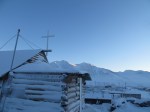
I spent a couple days at Point Hope in August of 2010, and I thought I’d share a few of the pics from out that way.

Point Hope is a community of a little over 700 people at the far end of the Lisburne Penninsula reaching out into the Chukchi Sea. It is commonly thought to be one of the more culturally conservative communities of the North Slope. At least that’s what folks say up here in the North Slope.

In his Autobiography, Charles Brower, Sr. relates a number of interesting stories about Point Hope and its residents before travelling up to settle in Barrow. It’s a great read anyhow, but I think Brower’s comments on Point Hope are particularly interesting.

(If you zoom out on the map one click at a time, it’s kinda cool.)

There are at least 2 interesting things about Point Hope.

First, according to some sources, Point Hope is the oldest documented settlement in the arctic. I’m a little wary of that particular claim, so we’ll just say it’s damned old. The initial Inupiat settlement at this spot was known Tikagagmiut (there are a few small variations on the name), and its people were somewhat of a force to be reckoned with in the region.

So, why did people settle here? After two days of wind and freezing rain, I was inclined to think it might have been the climate, but I guess that wasn’t it after all. Actually, it was the fact that the region is ideal for hunting both sea and land mammals***. Anyway, the archaeological digs here go back a thousand years or so. I didn’t see anything that old myself, or if I did, I may not have recognized it, but I did get to walk around an interesting collection of old homes and sod houses.

Before going out to look in the old houses, I asked a local if it was acceptable to approach them, and if it would be okay to take a camera. I didn’t want to do anything disrespectful. The advice I got was to call out at the door of any home I saw and if anyone answered, they said; “don’t go in!” …Good advice. One of my colleagues says she lived out here in the 70s. She lived out in the old abandoned houses as a child. Wish I had had her along as I was looking around. I was still new to the area, and had lots of questions.

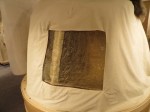
You can see at least two different types of dwellings in the abandoned housing area which sits just on the other side of the tracks. There are basic wooden houses, many of which piled sod up outside for insulation. One also finds traditional Inupiat sod houses. Sorry folks, Inupiat in Alaska didn’t live in ice houses. They dug down a ways and then used driftwood and whale-bone to create a structure around the pit. Sod was then piled up around this to make the walls. This is a traditional home (or at least the Cliffnotes version thereof). The ice houses most people associate with Eskimos? Well you gotta go way East to find people that live in them.

Older remains can be found underneath the buildings in my pictures and some of the older remains have been washed out to sea (cause all these shorelines up here are receding).

The second thing that is interesting about Point Hope is an event that didn’t happen after all, …thankfully. Around 1958-62, the Atomic Energy Commission decided to create a deep water harbor about 30 miles south of Point Hope.

They were going to do it in a jiffy, so to speak.

Spokesmen for the AEC held a gathering at Point Hope and assured its residents that there were no lasting effects from radiation in Japan, and that any harms experienced by those in the Pacific were due to their own negligence. You may think they neglected a few facts in saying this. One additional fact they neglected to note was that the Inupiat were taping the meeting.

**** I am grateful to Barbara and Jack Donachy of Cutterlight.com for correcting my initial presentation here. If you scroll down a bit, you’ll see that they left a very informative comment on the topic. Y’all might also want to check out their own blog, because they live in Point Hope right now. ****

All of these were taken on an old Blackberry. I don’t seem to have taken too many pictures in town, so most of these are of the old houses and such. Sadly, I missed one of the most interesting features of th community, it’s huge graveyard. I saw it from above, and my Blackberry went wacko as I was trying to take the picture. Very disappointing!

If you click on a picture it will embiggen.

Not All Umpty-Bummos are Bammagoons, but all Bammagoons are Surely Gummatistas!

Tags

, , , , , , , ,

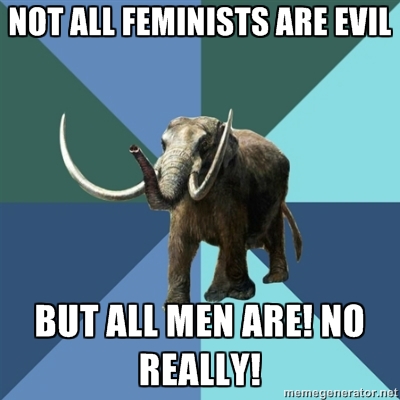
3qdrc4Do you remember the first time you heard this little Gem? If you’re like me, you might even remember going on a little mental roller-coaster ride from “Okay, good” to “I guess that’s reasonable” to “no it’s not” to “not even close actually” and then on to “fuck you asshole for saying that shit!” all in the space of less than a second.

Okay, so I take that particular roller coaster ride all the time, but let’s not dwell on that! The point is that this particular line of reasoning has a certain seductive quality to it. If you are lucky, you escape its wiles within a moment; if you are a Fox News Fan, you probably still think it’s gospel.

…which reminds me of a certain meme with temptations of its own. er, cough! cough! It is tempting, …oh so tempting.conservatives

And yet, I hear the voice of Nietzsche calling back to me, reminding me of the dangers of staring into a void, and suddenly I feel naked, and I want to say; “you stop staring back at me you damned void. You just stop that right now!”

And I somehow manage to squirm free.

It was John Stuart Mill, and he did say ‘most’ rather than ‘all’ in that last part, and he definitely meant something different by ‘Conservative’ than I was thinking when I started down this route. …and I’m really not sure if all those caveats help or hurt my case, so we are just moving on now.

Hell, I’m not even sure if the quotation is all that accurate.

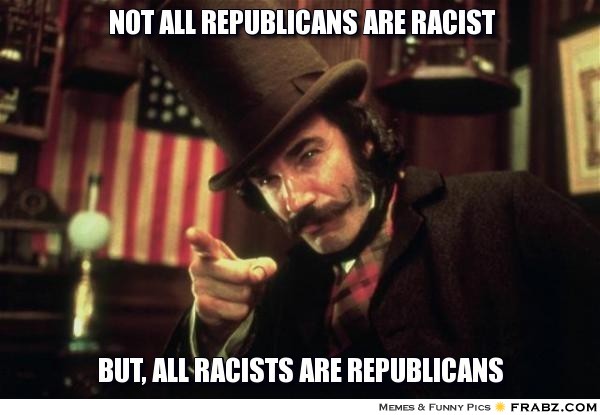
frabz-Not-all-republicans-are-racist-but-all-racists-are-republicans-17a2b9Does this help?

No?

Okay, this post is getting to be a guilty pleasure, I know. But the point is that we can turn this logic around and apply it in all sorts of different directions. If it hasn’t escaped you that I have failed to apply it to my own political camp, well then let’s just treat that as an object lesson in how this particular gambit works. You apply it to your enemies, silly, not your friends.

It does get sillier!

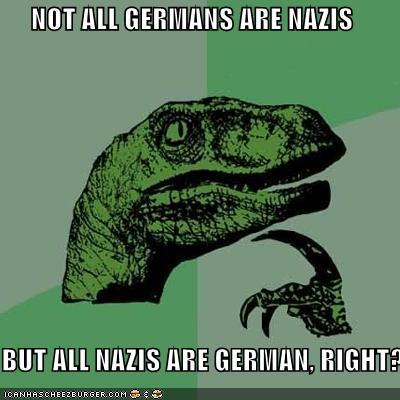
64feda52-bbf8-409a-83db-ddc818661e1fIs this a good question? Um, …no.

Seriously, do I have to provide links to the American Nazi party? Cause I’m not gonna.

No.

Nuh-uh!

You’re just going to have to get the point. And you know, it’s entirely possible that is even the point of this meme (or even the last one), because that damned Nathan Poe dogs my every judgement.

Besides everything else, this one is completely out of date, but what else can you expect from a thinking dinosaur. Not all anachronisms are philosophical lizards, but all… nevermind!

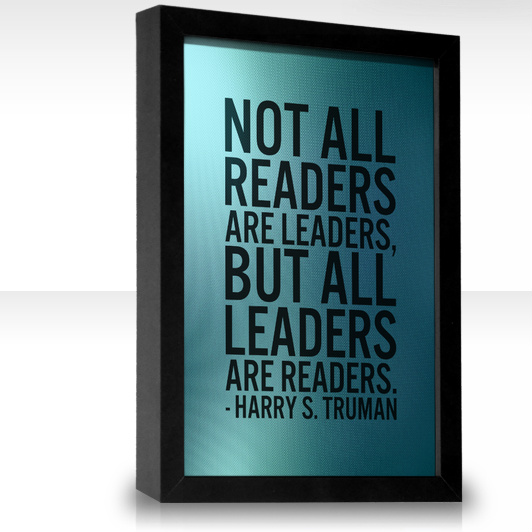
4OLOF57GB5NKD_U1FK00_IL_P_LSMaybe we could take this quotation in a positive direction? This sounds wonderful and warm and smart, and …well I should probably verify the quotation and discern it’s context and what not, but that would take time away from basking in the glow if literositude that this one kindles in my heart. I just want to sit here and think about how leading and reading go together like carrots and cake.

Or Christmas and BB Guns. Or lingerie and a live wallaby.

…I’ve said too much.

25989_482098188503425_1116285728_nBut hey, let’s get even more positive. Boy you just read this one and you can’t help but feel the love. Doesn’t it just make you want to reach down inside your soul and let the good stuff out for a walk in a park called Success.

Seriously folks, you just gotta let your awesome blossom!

That’s all I’m sayin’.

And who the Hell is Mark Gorman?

Okay kids, that was a rhetorical question. I just googled him and the only thing I learned is that I really don’t want to know anything more about him at all. We are moving on again.

MjAxMi04ZGY1ZmQ0ZWEwMTcwMjk5_50cfdcef8a5dcDid I mention that it gets sillier?

No really, it does.

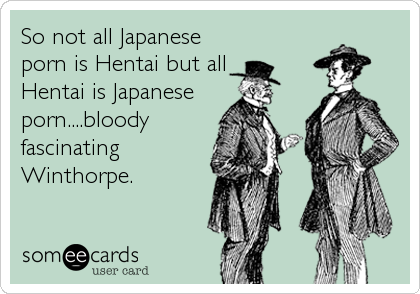
Honestly, I’m not sure what to do with this one. It’s actually rather clever. I might even like it. But I don’t know much about Hentai, or porn, …or one of those anyway.

Not me! Huh uh!

er, not all men watch porn, but… nevermind!

28639618It also gets ickier. Much ickier!

Okay, that one doesn’t even begin to make sense, and I probably should have left  it out. But you know, you turn over a rock and see something gross underneath…

…so, you post it on the internets for all your friends to see,

…and to feel just a little creeped out by the whole thing.

Which is fine with me, actually, I believe in sharing the misery.

…in case you hadn’t noticed.

30448069Alright, this one might be real. At least I can’t think of a counter-example. Seriously, I’ve been trying.

But part of what makes this so fun is that it breaks the mold a little; gender politics aside, this is a nice little exercise in creating an expectation and then violating it. …which is very cool in a joke-I-just-killed-by-explaining-it kinda way, but the point is that the whole meme rests on a manipulation of expectations. You start by repudiating a generalization, thus leading people to expect a smarter wiser replacement and hope they won’t notice that you left them with a whole new pile of dumbitude sitting there in place of the one you repudiated. This one just takes that approach and drives it to Hawaii.

…Yes, I said drives.

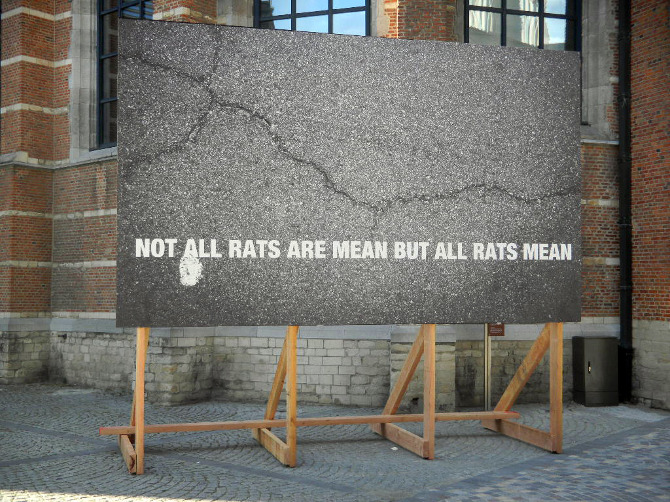
rats1I’m not sure what to make of this one, but I think I might love it.

So anyway, I guess you can file all of this under the category of, “Shit we oughtta know better”

Ordering Pizza in the Arctic

Tags

, , , , , , , ,

004


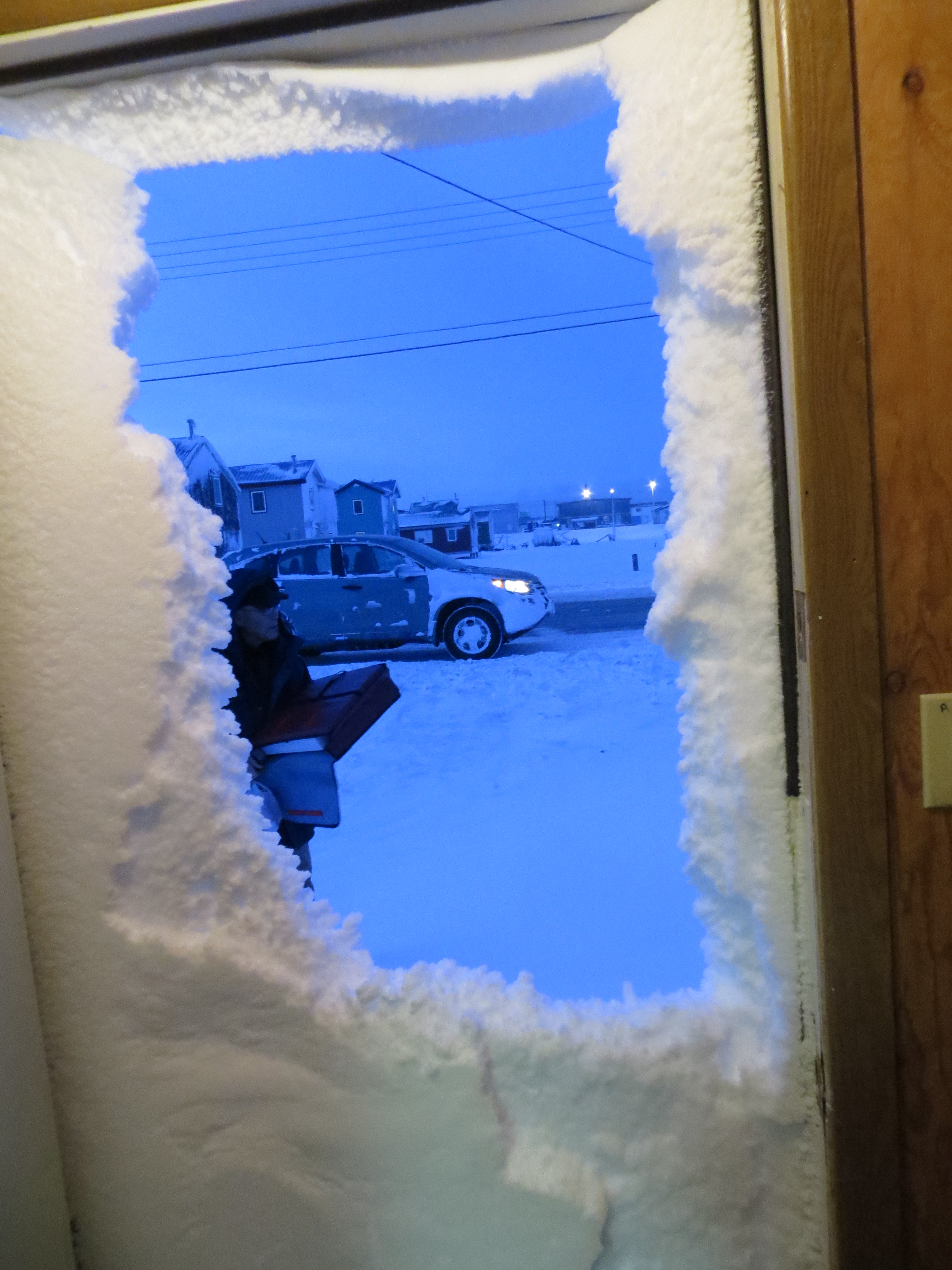
This was after about two and a half days of blizzard. The odd thing is that I don’t actually think it snowed, but apparently the wind blew straight at my door for awhile.


Vegas Street Art, Volume II: … and a Museum of What?

Tags

, , , , , ,

Beautiful

Beautiful

So, this is the second half of my photo gallery from Las Vegas, again focusing on the murals of the arts district. (Volume I is here.) I want to thank my friend Liliana for helping get a couple of these from my crazy phone to the net.

A few items of note:

This website has a list of a hundred murals in Vegas, including quite a few that i haven’t managed to get in here.

The Erotic Heritage Museum had some interesting pieces. …and by ‘interesting’ I mean…. uh, nevermind.

A number of the pieces included here (and some I never found) appeared to be the result of an event, called the Meeting of Styles in September of 2012.

And a couple of interesting stories:

Not quite Banksy, but interesting!

Dammit!

…as always you may click on a photo to embiggenn it.

Movie Review: The Orator

Tags

, , , , , , ,

TheOrator_A5flyer_cover_1It wasn’t easy to get a copy of the Orator, but it was well worth it. Filmed in Samoa, using Samoan actors who speak Samoan throughout the film, it is a wonderful peek into a world far from the icy tundra outside my window. It is also a chance to glimpse something of the world from which quite a few local residents have come. People are often surprised to find that the community of Barrow, Alaska, has a significant number residents from the Pacific Islands, but we do. Watching the Orator was a chance to escape to a world of warm green vegetation, land perhaps to learn a thing or two about the place a few friends and coworkers might call home.

My knowledge of Samoan politics is scant – mostly it’s the stuff of textbooks – so I must admit that some of the more nuanced details of this film have escaped me. And yet, elements of the story seem quite familiar. They could almost have been written about Barrow.

This film tells the story of Saili (played by Fa’afiaula Sagote) and his attempts to resolve a number of quarrels threatening the well-being of his family. He lives with his wife, Vaaiga (Tausili Pushparaj), and her daughter, Litia (Salamasina Mataia). It is a small family, but each of them has a quarrel with someone outside the household, and each of those quarrels would be more than enough to provide all the drama needed for one film.

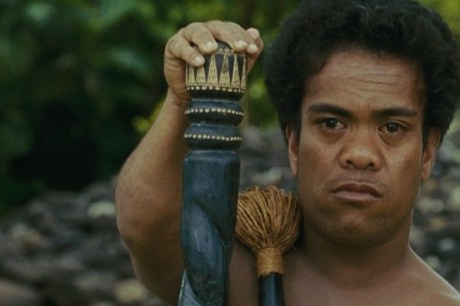
Saili’s problem appears simple enough at first. He is the son of a chief, and by all rights he should rise to the title himself. But Saili is also a dwarf, and his eyes as well as those around him that is a problem. How can he rise to a position of leadership when he cannot command the respect of those around him. He can hardly chase people away from the store where he works as a night watchman; others are planting taro root around the graves of his parents; and he cannot bring himself even to face his in-laws when they arrive to speak with Vaaiga. It isn’t simply that others fail to respect Saili because of his stature; his own lack of self-respect is palpable throughout the film. This is a man with more problems than most, and chief among them is his own inability to deal with any of them.

We learn quite early in the film that Vaaiga (Tausili Pushparaj) has been living in exile for 17 years, about the age of her daughter, Litia. She has been living with Saili ever since she was banished from her own village all those years back. Now her brother wants her to return with him. How they will deal with her banishment remains an open question. But he is quite insistent, returning with additional family members to pressure Vaaiga into changing her mind.

For her own part, Litia is having an affair with a married man, a fact which is rapidly becoming common knowledge throughout the village.

What one must understand about each of these conflicts is that resolving them is not entirely a question of establishing who is in the right. Whatever the outcome of each of the running battles that plague his family, Saili must find a solution that will enable him and his kin to live peacefully with those around them. The characters do not live a metropolis; they will not have the luxury of melting into the larger community after some judge has pronounced a verdict on the conflicts which divide them. They will not have the option to forget about each other in the wake of some legal solution. Each of the conflicts driving this story are as much about future relations with family and neighbors as they are about the propriety of past actions. And none of these conflicts will be resolved until the parties can find a way to live with each other in peace.

But is Saili up to the challenge?

Clearly the High Chief of Saili’s own village does not appear to think so. In an effort to secure his rights to the land wherein his father is buried, Saili seeks to claim the title which is his birthright. Instead he receives an object lesson in bravery. A chief must have the courage to bare his heart and soul before others, but the high chief isn’t sure that Saili has the balls to do the job; so he asks Saili to prove that he does, literally and metaphorically by baring himself on the spot.

Saili was not up to the task.

As events unfold, each of the three major conflicts intersect with one another and spiral out of control. Litia’s affair brings trouble directly into the home, and Vaaiga soon adds a life-threatening illness to her own troubles. For his own part, Saili’s efforts at using brute force to solve his problems by engaging in a rock fight do not end well.

theoratorfilmBut of course it isn’t really physical force that is required of Saili, which is precisely the point of the High Chief’s lesson. Saili’s adversaries are not evil, but he must find it within himself to earn their respect. It is not rocks that are required of Saili, but words.

And here I am close to saying all that I wish to say about this movie, other than that you should watch it. But I would suggest that the superficial morality tale I have outlined above does not even begin to reveal the richness of this film. It isn’t simply that Saili must learn how to speak up for himself, the lessons of his High Chief extend to the kind of words that he will need to use, and to the manner of his self-presentation.

But of course, his lesson is also about more than that.

A Day at Anaktuvuk Pass

Tags

, , , , , , ,

Moon Over a Mountain

Moon Over a Mountain

Earlier this week I was fortunate enough to spend the day at Anaktuvuk Pass. We flew in at about 10ish in the morning and back out at 8ish in the evening. Anaktuvuk Pass is a small community on the North side of the Brooks range. It is currently home to about 300 people, having grown out of the settlement of Nunamiut (interior Inupiat).

At one time, I am told caribou herds used to come through this pass in the thousands. Today the numbers are not so high, and I hear they don’t come quite so conveniently close-by for supper. Still, I’d wager you can get a good bowl of tutu stew in this community.

Anaktuvuk Pass is also the home of Rainey Hopson, whose blog Stop and Smell the Lichen is a favorite of mine. I didn’t get a chance to meet her, but some day… Anyway, if you really want to know what life is like, read Rainey’s blog. She also makes mustards and jams, etc. from local berries and sells them online. …yes, I’m giving her a plug.

Highlights of the trip included a visit to the school, another visit to the museum, and several walks around the community, a camera in my frozen hand.

See how I suffer for you, my dear readers!

Actually, I was rather surprised to find it was only 25 below, because it sure felt worse than that. By this time of year, I should be getting used to that kind of temperature, but we’ve had a rather warm winter thus far in Barrow. It’s just 6 degrees below here at the moment. …getting spoiled!

(If you zoom out one click at a time, it’s kinda neat.)

Heh, …when we first flew in, I was excited because I thought I saw trees, but my colleague quickly corrected me. They were merely bushes.

(Sigh!)

As always, you may click a picture to embiggen it.

Always a Tourist in Vegas, or Look What I Found! (Street Art, Part I)

Tags

, , , , , , , ,

Clowns Close-Up

Clowns Close-Up

When I mentioned that I was in Sin City for Christmas, someone on Twitter asked if there were any murals in Vegas. I hadn’t really thought about it, as I soon proved with my answer. Vegas to me can usually be divided between the bare (earth-toned) walls of most residential neighborhoods and the kitchy goodness of the Strip and its progeny. …I tend not to notice either as I go about my business.

If you look closely you can see signs of effective graffiti-abatement programs all over the town. Graffiti does not last in much of Vegas, and it doesn’t appear that most of these programs distinguish a well done work of art from a simple tag. Even a legal mural can apparently be quite a problem.

This area was home to me for a good chunk of my life, but I always feel like a tourist when I come back to Vegas. …more so when I venture near the places this town is known for. Some parts of Vegas are more Vegassy than others.

…and sometimes it’s better to be a tourist than others.

Like this time for instance!

I decided to look around and see if I could find a mural or three, just for the heck of it. I soon discovered the Las Vegas Arts District, a neighborhood that was nowhere near this colorful back in the days I called this area home. But here it is, the source of most of the pictures I posted below. They hold an art fair here on the First Friday of every months, but my own interests lay mainly with the murals strewn about the walls of various buildings in this district.

Suffice it to say that I was very wrong to think Vegas doesn’t have interesting Street Art. They have rather a lot of it. You just have to know where to look.

***

This is a two part post (cause I got a lot of pics). I’ll add a few comments on some particular locations to the second post.

(As always, you may click to embiggen!)

Willy Wonka Gets Wiggy With the Woo! Irritation Meditation Number Three.

Tags

, , , , , , ,

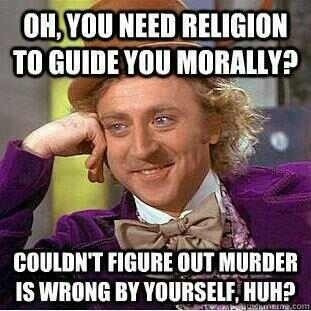
20130118-0632321Okay, I love Condescending Wonka as much as the next connoisseur of sarcasm, but sometimes its difficult to separate the crap he rightfully calls out from the crap he obscures in the process.

Case in point?

Look to your left.

The thing about this gem is that it skewers a pretense for which I have absolutely no sympathy. I’ve been asked far too many times why I don’t commit great acts of cruelty dishonesty, or outright villainy, all on the assumption that failure to believe in God apparently means you are well on your way to doing the worst things imaginable. It’s a pretty common theme in the amateur apologetics camps, and some folks keep coming back to it no matter how often (or how reasonably) you answer their questions.

And yes, the people who insist that all sense of morality goes out the window once you walk away from God scare me, …more than a little bit.

So, I have no sympathy for the mindset mocked by this little meme, none whatsoever.

But Wonka’s argument here is a little troubling in itself, because of course nobody really does figure out that murder is wrong, all by themselves. It might be easier if the category in question were simply ‘killing’, but it isn’t. It’s ‘murder’. And murder is a social construction. (How many people are really against ‘killing’ in all its forms anyway, or even ‘killing sentient creatures.’ No. Most of us are quite willing to kill under the right circumstances, even if we might find it difficult to do so.

Attempted-Murder-500x346If you’ve ever tried to sort the difference between killing that is acceptable from killing that isn’t you can see how very quickly a simple question leads to a very complex maze of possible answers. Issues of self defense, defense of others, and military or police service all skew the simple answer in a variety of ways. Add in possible mercy killings and a mix of government and business polices that lead accidentally or by design to deaths of innocent people in one part of the world or another, the whole damned thing gets that much more messy.

I’m not even suggesting that you can’t sort the mess. What I am saying is that social conventions are a big part of the means by which this mess does get sorted. We don’t figure out that murder is wrong all by ourselves; we learn what murder is from those around us. Others are actively involved in helping is form an orientation towards the prospect of killing another person, helping us decide when and under what circumstances we would be willing to do so.

It’s worth noting that references to God(s) serve as a pretty common part of that social process by which this and other moral questions are sorted out for a lot of people. One could question, as I do, whether or not gods are an essential part5 of that equation, and even conceding the role that gods do play in communicating ethics for many people does not entail belief in the literal existence of any of them. But there is a big difference between suggesting you can be good without God, or even questioning the role of divine entities in ethical lessons and the pretense that it’s all so perfectly obvious you can settle the whole matter all on your own.

It’s a particularly obnoxious fellow that insists we would all go conky-wobble with each other in the absence of God. More reasonable theologians have asked whether or not non-believers can produce an adequate explanation for the ethics that we do have. …I think the answer is yes, but that’s a response to a different kind of discussion. It’s hard to tell what to do when one runs into someone who insists that we are all one god shy of an shoot-out at the K-Mart Corral. Their position is crap, and their arguments are profoundly disturbing.

Still, it isn’t quite true that each of us handles the moral questions of life on the strength of our own individual conscience alone. We get a lot of help from our friends and loved ones.

The answer to both Wonka and the target of his abuse turns out to be the same; it’s more complicated than that.

Allegiance to God and Country, …and to Anachronisms Aplenty!

Tags

, , , , , , , ,

Moses1-244x300One hears it all the time; the notion that religion ought to be kept out of politics. I’m torn by the suggestion, because it is commonly used in response to the politics of conservative Christians, …and I have little sympathy for their politics. But the fact is, that just isn’t where I would draw the battle lines. If most people frown at the likes of Pat Robertson or Rick Warren, I suspect they are frowning for reasons that differ significantly from my own.

Religion IS politics as far as I am concerned; it’s bad politics, but politics just the same. I don’t quite mean to suggest that religion is simply a crass tool by which some folks seek to enhance their own power and influence.

….seriously, I don’t QUITE mean to say that.

…at least not as a general rule.

No. What I am suggesting is that religion consistently presents folks with a vision of order in the cosmos. That vision answers questions about how one ought to behave, yes, but it also contains answers to questions about the nature of authority and the social expectations that go with it. These traditions may tell us about Heaven and Hell, Karma, etc. all visions of a cosmic order, but they also tell us a little about how one ought to treat others, assess other people’s character, and what we may fairly do in response to the virtues or vices of those around us. The notion that all of this is supposed to stop short of addressing real political questions strikes me as a rather improbable.

…it’s also unreasonable.

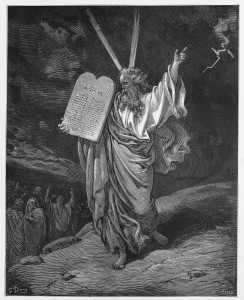
To put it in more concrete terms, it makes sense to me that someone who believes in the Ten Commandments would (when stepping into the voting booth) bear in mind the likelihood that a political candidate was going to follow them as well. It makes sense to me that folks would bear such things in mind when making in countless other decisions of a political nature.

Which is part of what makes the role of religion in American government (and perhaps other settings as well) so completely absurd. On the one hand, religious teachings are all about precisely the sort of questions that one must address in politics; on the other, it is separate from and distinct from those institutions, limited in some respect by the establishment clause and re-enforced by the free exercise clause. Religion has a potentially absolute absolute claim on every aspect of life, and yet while protecting the rights of believers, we expect them to stop short of weighing in on the most important questions of the day. The whole situation is at least a little odd, to say the least.

Far from the natural order of things, this feature of American politics rests in our Constitution and popular culture like a fault line running through a population trying its best to ignore it and get on with life.

…which I think is the real reason people want to keep religion out of politics. If they can keep folks from putting the two topics together in the same conversation, then they can avoid dealing with a mountain of contradictions even Mohammed would be hard pressed to move about.

The history of religion certainly doesn’t teach us to expect its proponents to stop short of political commentary. The God of Abraham in particular has played an overtly political role in each of his major religions. It is only with the decline of ancient empires that Christianity and Islam have come to be defined as something distinct from politics. Each of these traditions became mere ‘religions’ when the moral order they espoused lost its connections to the political order in which they once flourished. Institutions that we think of today as religion were once unashamedly political. Few if any thought twice about it.

What distinguishes religious traditions from those of modern politics is less of an ontological divide than a range of social conventions, not the least of them being a clear discordance between the visions of authority contained in each. Indeed, the notions are so far apart that people often fail to recognize them as different answers to the same question. The end result is a rather marked failure to notice something very interesting about the relationship between religion and politics in modern life. You see, there is something highly ironic (and more than a little tragic) about the sensibilities of those who speak of a Lord in world wherein we elect a President (or, for that matter, a Congressman or a Parliamentian).

And this is what I mean by a fault line that the public does its damnedest to ignore. Most people don’t even pause to think about this, but the notion of a ‘Lord’ has not always been so divorced from the social order. The language about which one spoke of God was not always so completely severed from the language about which one thought about their own government. There was a time when that term, ‘Lord’, would have pointed not merely to a benign old man in the sky, but also to the nobility of Europe. The implication was neither accidental, nor trivial. Indeed, the point of such language was to draw a clear parallel between the loyalties that men owed to each other (or more to the point, that commoners owed to the aristocracy) and those that they owed to the keeper of cosmic justice. A reference to the ‘Lord’ would have meant for many in past times a role reflected in both their religious discourse and in the social realities of their daily lives.

How weird it must be to live in a world in which one answers to a Lord in Heaven but votes for politicians down here! At least it would be weird if we paid more attention to the way either of these institutions actually handle questions about how people ought to behave.

But of course the problem is not merely a function of this one word. When Conservative Christians speak of power, they almost invariably invoke a range of metaphors ill-fitted to the realities of a republican style government. They speak of God as a sovereign, all the while operating in a public life wherein the people are assumed to be sovereign. They speak of the Ten Commandments in a world wherein laws are deemed in some sense to be created by the people (albeit indirectly). And how strange that we (and by ‘we’ I mean mainly Christians) want Children to pledge allegiance to one nation (under God or not), as if such an oath had much bearing on modern notions of citizenship! It cannot mean nothing that people who live in a participatory democracy envision so much of their lives through the language of aristocracy.

Does this mean that Conservative Christians do not understand democracy?

No it doesn’t.

…at least  not in principle, but I can think of a few folks!

It does suggest a certain tension between the nature of authority some folks encounter on Sunday and those they are called upon to use in the voting booth. This sort of tension might even have some positive benefits, though I suspect that would require people to be more aware of the difference than they generally seem to be. It probably should not surprise us too much when the language of one sphere creeps into that of another. I think we can see this in the way that many conservative Christians speak of the founding fathers in reference to a broad range of constitutional questions. So much the more so on litmus test politics such as gay rights which so many use to discern the loyalties of those around us.

I could field a number of polemics at this point, but perhaps that is not really where I want to go with this. The divergence between modern visions of political authority and the archaic language with which conservative Christians approach that same subject is an interesting point in itself. What to make of it is another question. And of course this returns us to the original question of whether or not one can reasonably expect religious leaders to keep their noses out of politics.

If I am reading the popular culture correctly, I think most people expect a natural division between these spheres of social (and political) life, as if some great natural boundary separates them. For my own part, I think it’s little other than history. Indeed, I don’t think the term ‘religion’ denotes a clear and well defined body of institutions, beliefs, or practices, certainly not any that fall neatly outside the boundaries of political life. As it happens, the modern world has developed a range of political expectations which simply differ from those of the institutions we now call religion. That difference does not lie in the nature of the institutions in questions, it lies in the particular approach that each takes to the deeper moral questions of social life.

What keeps conservative Christianity from enjoying a more direct role in American political life is its political anachronism. It’s vision of authority is not (thankfully) that of our own government.

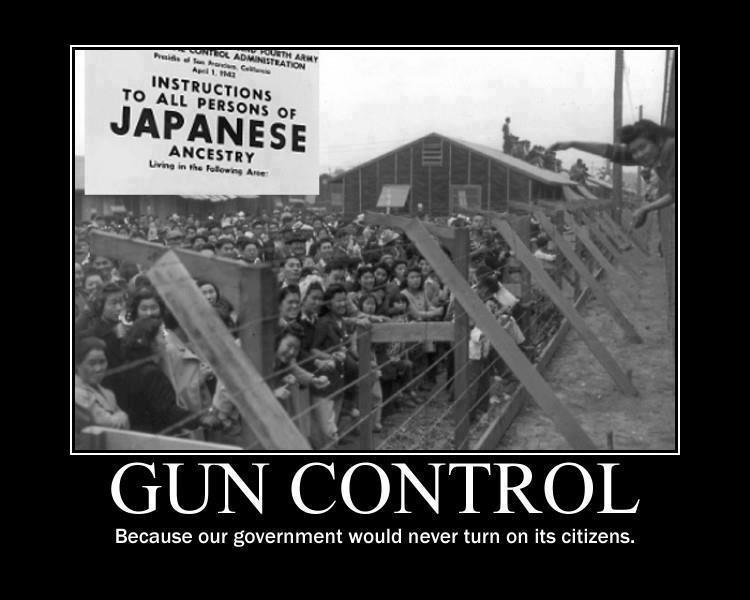
Irritation Meditation Number 2: The Second Amendment and Japanese Internment

Tags

, , , , , , , ,

580694_475788705791155_2127648074_nI suppose it is too much to ask that folks distinguish the varieties of gun control from an outright ban. The way the gun rights crowd raises the specter of a completely disarmed populace when speaking about any variety lesser measures smacks of dishonesty.

It would hardly give away the farm to distinguish such things from one another. There are plenty of legitimate questions about the efficacy of lesser gun control measures, especially when applied to a population already so well armed as we are here in the U.S. But that is an interesting and well focused discussion some folks don’t seem to want to risk.

But what is really fascinating about memes like this is the slippage between a right to bear arms and a prescription for doing so. The second Amendment was alive and well when the internment of Japanese occurred in the first place. So, that right and that right alone simply is not a cure for the evil that this pic wants us to think about. The meme only works if we are to imagine a population which is not merely in possession of the right to bear arms, but which actively uses that right even to the point of preparing for war against its own government.

And can anyone really imagine Japanese immigrant population of the west coast doing this in the years leading up to World War II? Can anyone imagine the response from their neighbors?

This is not merely a defense of the Second Amendment, it is an argument for the expansion of private gun ownership well beyond anything previously imagined in American history. To make this argument work, we need more than just the right to bear arms, we all need to have the arms, the training to use them, and enough firepower to make them an effective counter to the powers of the United States Government.

Is the author suggesting that gun owners could stop such a thing as internment? Perhaps, but would they?

It’s a pretty common claim from the gun rights crowd, the notion that the Second Amendment puts the teeth in the rest of our civil rights. It is through gun ownership, so the argument goes, that people are protected from abuse by government officials. It is the most important means by which our rights are protected.

Pardon me, …from ‘thuh government.’

But gun owners did not stop the internment of Japanese.

Or of Aleuts during the same war.

Neither did they stop lynching of blacks.

Nor did gun owners secure the right to vote for African Americans.

…or for women.

…or Native Americans.

Gun owners did not stop the Federal Government from kidnapping Native American children to be taken to schools far from their families.

They didn’t stop police harassment of homosexuals.

They didn’t improve treatment of the mentally ill.

They didn’t stop the Zoot Suit Riots.

…or legacy provisions precluding Jews from owning homes in some neighborhoods.

Gun Ownership didn’t stop Jim Crow laws.

It was not gun owners that secured for any number of minorities the right to an education or any other protections by states or the federal government.

In each of these instances, the rights in question were won by protestors, and lawyers, and people who talked a hell of a lot, even if their main opponents didn’t. In many of these instances gun owners were actively involved in the very repression suffered by those in question. Since the founding of the country, Gun violence has played a far greater role in the repression of civil rights than it has in protecting them. There are exceptions to be sure, but this narrative is not built on the exceptions. It is built on a fantasy that skips any active consideration of how these things actually work.

Herein lies the biggest problem with this fantasy scenario; it presents us with the image of a government acting on its own, independent of the public will. That could happen, I suppose, but is far less likely than the countless times in which government policies actually have facilitated repressive measures popular with the American people, or at least a large segment of it. And in such moments, the victims of repression have rarely been sufficiently well armed to make an effective stand against those who wanted a piece of their liberty.

In real world history, those who have suffered the greatest deprivations did not merely face the threat of Federal Authority; they also have had to contend with the prejudice of an American population content to have them suffer.

…one that sometimes even demanded it.

We can imagine the victims of repression better armed, yes, but only if we also imagine the majority better armed as well. This is hardly a story which leads to a successful defense of liberty. I would call the scenario anarchy, but I don’t wish to sully the term ‘anarchy’ with such a vision of violence and destruction.

It’s damned hard to read these self-indulgent fantsies when considering the actual history of people struggling for their rights. It’s hard to give credence to this juvenile narrative, knowing what it took for the people in these camps to survive, what it took the Freedom Riders to earn rights enjoyed by gun-toting whites in the South. And it is especially hard to hear such arguments from those with so little to say about such things as Guantanamo Bay or the countless encroachments on Fourth Amendment Rights we’ve seen over the last few decades.

What pisses me off about this argument isn’t the defense of gun ownership, or even opposition to gun control. Frankly I don’t think this kind of crap even touches either one of those issues. It sheds no light on those issues whatsoever, and leave us with a whole different discussion to have if we can ever get clear of noise like this. What bothers me about this stuff is the scorched-earth tactics; the vision of politics as warfare and questions about rights as an invitation to shoot at one another. It’s a vision of government as a faceless evil empire in opposition to private citizens, and begging for opposition from heroic gun-owners everywhere. Folks telling this yarn have no sense of how such things actually happen. But they are happy to tell stories of gun-toting heroes squaring off against a government turned inexplicably on its own population. How that will work is a Hell we can only hope we will never see.


And it’s a Hell as likely to be brought about by gun-owners defending their own rights (as they define them) as anything done by a corrupt and tyrannical government.

While others have struggled and died for some of the most basic human rights imaginable, so many in the gun crowd openly fantasize about acts of violence over basic policy disagreements and the possibility of restricted access to a commodity. The pretense that this commodity is the key to civil rights plays a big role in these fantasies. The end result is a tantrum born of paranoia and privilege and a gun culture increasingly dangerous to the rest of us.

No. I’m not talking about the weapons. I am talking about the mindset of people who produce memes like the one above. People who make such arguments are not interested in protecting anyone under serious threat of government repression. The gun rights crowd did not protect the Japanese during World War II, and I for one don’t believe they will be there the next time someone decides to create camps like this.

…unless of course it is to close and lock the gates.