A Hyponym Walks into a Bar…

Tags

, , , , , , , ,

Here is how I would spend that money!

I could believe in a God of Korean BBQ, yes I could!

I Grumble: I wish I had a nickel for every time a Christian told me that my take on the existence of God isn’t really atheism; it’s agnosticism. No, those nickels wouldn’t make me rich, but they would add up to a nice meal at a decent restaurant, and with enough change to leave a damned good tip.

On one level, this is  interpersonal aggression. If someone can take your identity away (or at least that part of your identity most salient to the topic at hand), then the rest of the discussion is going to suck no matter how well you handle the particulars. It’s the sort of argument that is really about who is in charge.

…and I mean in a right-here-and-now kinda way.

Just like a husband and wife engaged in a two-day spat over which brand of butter would have been a better purchase, atheists and theists (mostly Christians) will tap away on our keyboards well into the wee hours of the morning, all over the question of just what atheism really is and who gets to call themselves an ‘atheist’. It’s almost as though we have that agreement, you know the one about never going to bed with unresolved issues, only we never do get to the make-up sex on this particular topic. We just keep jabbering at each other until the sun rises and it’s time to go to work tired. (Thanks honey!) The bottom line is what ought to be the opening stages of a larger dialogue becomes the overwhelming focus of an exhausting (and often pointless) pseudo-discussion.

On another level, the subject is certainly worth some time. The semantics are tricky here, and one will need to sort the meaningful possibilities out before proceeding to any substantive issues. And Hell, I figure I’ve encountered a genuine concern or three amidst all the bunk believers have thrown at me on this issue over the years. I know I have a few truth-in-advertizing concerns for those calling themselves Christians as well. Plus, I think I’m actually adjusting my views on this one a bit lately. So, I’m going to have a go at this all-too familiar old topic and hope that the results won’t lead to any incidents of self-mutilation.

So, please take a deep breath!

***

The Basics: The problem is this, among the group of people calling themselves atheists, some of us will happily do so without presenting any reason to believe that there are no gods. If pressed on the issue, we will often claim that the burden of proof lies with the believer. Atheism thus represents a stance we will take in the absence of positive reason to believe in God. This approach to atheism is sometimes known as “weak atheism,” as opposed to “strong atheism,” which is generally taken to refer to the stance of someone prepared to argue that no gods exist at all. Some might say that a weak atheist simply doesn’t believe in any gods whereas a strong atheist says there are no gods.

And here is where Theists often cry foul. Isn’t the neutral position really that of agnosticism, they will say, and how can it be that atheists (weak or otherwise) have no burden of proof? Isn’t that unfair?

But of course atheists have a number of arguments in favor of these terms, not the least of them being an analogy to legal reasoning and/or the structure of formal debate organization wherein an affirmative position is often given the burden of proof. If someone is accused of a crime, we do not expect the defense to prove them innocent; we expect the prosecutors to prove them guilty. The problem, as weak atheists often phrase it is that you cannot prove a negative. This isn’t quite true, or even close really; but it does touch on a real problem. Many negatives can be proven true, but many cannot. If for example the original claim to be disproved is too vague, it will be difficult to formulate grounds for proving it false. Making someone responsible for proving a negative thus creates a double-bind of sorts, making the critic responsible for any ambiguities in the position he seeks to criticize.

The weak atheist position construes this debate in terms of a proof that at least one God exists. If the theist can make his case, then great he wins, but if he fails, then we go back to our default judgement that no gods exist.

Theists typically reject these terms of debate, often by suggesting its proponents have mislabeled themselves. ‘Atheism’, they will suggest should be reserved for those prepared to prove god doesn’t exist and those who merely assume he doesn’t in the absence of evidence are better described as ‘agnostics’.

It is actually a rather soft version of agnosticism that theists keep advancing as the proper alternative to the weak atheist position; effectively telling us; “if you don’t know, then leave it at that.” The shoulder-shrug version of agnosticism is not to be confused with hard agnosticism (i.e. the notion that questions about the existence of God are inherently unknowable, in short; “I don’t know, and neither do you”).

Of course soft agnosticism could be a perfectly reasonable description of the absence of affirmative belief, but so would weak atheism. In fact, the two categories could well apply at the same time. …hence the common practice of referring to oneself as an agnostic atheist.

Many do just that.

***

Holy Holistics Batman!  It’s worth considering that such labels go well beyond the stance one takes in a particular debate and extend to questions about behavior, values, etc. Life is full of decisions one has to make in the absence of perfect information, and this is one of them. Sooner or later we have to make decisions predicated on our answer to questions about whether or not God does exist. I will either keep the Sabbath or not; I will either say the Sinner’s Prayer with conviction, or not. I will either covet my neighbor’s hot wife or not. …you get the idea. If the debate over whether or not God exists ends in a stalemate the actual pace of real life decisions does NOT respect that stalemate (and from what I hear, neither will the God of Abraham). Whatever the balance of evidence, one has to make a decision. This is exactly what burdens of proof are about. Assigning a default judgement is a process of deciding what you will do if you do not know the answer to a given question.

The weak atheist position may be frustrating as Hell to theists, but it has the virtue of addressing this question of how one will actually live.

***

Let’s Take a Step Back: There is just one thing about that last twist in the argument above; it isn’t quite a function of logic or reason, …not entirely so anyway. Rather, it is a question of how the merits of a reasoned position will map onto the practical judgements of actual life.

Default judgements lie at the intersection between reason and social interaction, and the question of who has the burden of proof in this debate is just one of the moments when the politics of religion intrudes on the intellectual exercise of reasoning about it. However much the participants may want to imagine themselves capable of resolving the issue on the merits of the case, the prospect looms large that it will still be an open case long after any particular discussion (or even years of study and centuries of dialogue). It would be nice if someone could produce end-game proof one way or another, but the reality is that most of us will end up making our decisions about a range of relevant issues in the wake of a stalemate shaded by a little other than a sense that one side or another has a good point here and a slight advantage there. In short, the debate may never end, but sooner or later we have to declare our own take on the issue. At that moment, when we have to decide in the absence of a clear accounting, the burden of proof may well prove to be the decisive consideration.

And so we haggle about the terms of the debate even to the point of never getting to the debate itself, partly because we know this little technicality is likely to make a difference on down the road a bit.

Whatever else weak atheists are saying, they are also saying “let’s handle this issue one God at a time. You give me one sound case for one God as you define Her, and I’ll give up my position and go with that one God.” This position offers real advantages for both parties, not the least of them being that it bundles all the tricky semantic questions about what one means by ‘God’ into the same package and lets the Theist have first crack at resolving them. The details of the discussion will then be on her terms (or at least about her terms).

This has the advantage of providing for a pretty direct test of that God, at least for those willing to approach the subject by means of reason (which is admittedly a diminishing portion of the population …it having become an article of faith that religion is about faith). In short, this approach to the conversation maximizes the relevance of any conclusions drawn to the actual beliefs of the Theist involved in any particular discussion.

But what about the atheist? For him, this way of modelling the issue really tests a pretty narrow aspect of his professed stance; his ability to present a reasonable objection to one particular approach to belief in one particular god, …at least as argued by one particular person. It leaves his take on any other gods pretty much off the table altogether. And (here is where I am cutting against years of habit) I think there is some justice to the claim that this is something of a dodge.

If someone has concluded that there are no gods, or even that he sees no reason to believe in any, then even this latter version of his stance necessarily goes well beyond the subject of one debate with one believer. It’s a fair question; what about the others? How do you deal with them?

Those professing weak atheism are generally unwilling to enter onto that turf, not the least of reasons being that any attempt to produce an end-game argument on the subject will effectively make them responsible for resolving all he tricky semantic questions while theists stand-by with an easy out. If an atheist attempts to prove that all gods don’t exist; he has to settle on a definition, and he has to do it without a claim that that definition fits the real thing (since he doesn’t think there is a real thing). The mistakes of believers thus become the responsibility of the atheist, and the liar’s paradox then mocks his every move.

And yet, there remains some trace of a legitimate question here. Does the stance of even a weak atheist not go beyond the particular gods of the particular theists with whom he is talking at any given moment? Clearly, he expects to reject any given god with whom he he is confronted at any given time. If that expectation does not yield a direct argument on the topic, is there no accounting for it whatsoever? None?

At the very least we could frame the conclusion that there are no gods as an induction of sorts, derived from our past experiences debating the existence of particular gods with particular people in a variety of different conversations. At some point, one begins to form an expectation, even a tentative conclusion. The judgement is there, and one can even find ways of framing it for purposes of discussion. It’s just that the conversation gets kind of messy if you go this route.

But maybe that’s a mess more of us ought to consider getting into.

***

Let’s Wrap it Up (and it’s About Time!): The issue here isn’t really what kind of atheist are you; it’s what kind of conversation do you want to have? How do you prefer to frame the debate? And the truth is that most of those professing weak atheism do in fact cultivate a number of alternative approaches to the subject; they just don’t recognize them as appropriate answers to questions about the existence of God or gods. This happens precisely because the conversation must at some point cease to be a question of metaphysics and become a question about social practice.

Ultimately, the judgement that there are no gods has less to do with the nature of the universe than the value of certain ways of talking about it. It is a judgement that god-talk never has nor ever will produce a description of a superntural entity that is literally true. On a good day, god-talk might produce inspiring poetry, amazing architecture,  profound moral thoughts, or even deeply moving personal narratives, but it will not produce a plausible case for a supernatural entity. Even the assertion of a weak atheist stance means at least this much; that one does not expect to hear talk of gods produce a believable claim about the existence of such a being. One may prefer to test that one god at a time with the Theist on the hot seat, but those of us claiming the label are certainly communicating something about our expectations regarding the subject at hand.

We can do more than that, and we actually do more than that every time we comment on the realities of religious practice; every time we describe the horrors committed in god’s name or link any poor judgement to the vagaries of religious thought. This sort of talk doesn’t always rise far above the level of gossip (or even outright idiocy), but it often calls attention to real problems. At least part of the rationale for rejecting belief in God is a sense that talk about him is unlikely to produce a claim worth affirming, at least not in its most literal sense. (Some of us may find Martin Luther King Jr.’s words inspiring or even turn the radio up for a religious tune or two, but there is always some sense in which we are not quite down with the whole message.) And herein lies the moment when even a ‘weak atheist’ goes a little beyond the confrontation with any one case for God; he is pronouncing a verdict on a vast range of discourse about gods, and he is telling us that all of it (in his estimation) fails to produce a compelling case for belief in that God. In some instances the God is too vague, in others She is a contradiction, and when a clear and coherent concept does make an appearance it just doesn’t have the ring of truth to it. This is a judgement that goes beyond the test of one particular god belief, and weak atheists make these sorts of judgements on a pretty regular basis.

So, it isn’t really that we have two types of atheists here so much as two (or more) different ways of setting up a discussion with theists over the subject. One typically uses the deductive models of metaphysical reasoning to test one God at a time (preferably that of the particular believer we happen to be talking to). The other typically uses probabalistic reasoning to pass judgement on a range of loosely connected ideas sailing under the rubric of god-talk. In effect, the second approach deals not with God Herself so much as the language in which she is typically presented, and it deals with that subject in terms of summary judgements. There is nothing inherently wrong with this approach, but it’s a bit less rhetorically satisfying, especially when squaring off over the subject with someone who insists that some version of God is real after all.

Most of us are uncomfortable with generalizations, and I think even atheists are oddly attached to the sense of absolute truth that one expects from metaphysical discussion. When we approach the topic that way, we can often say ‘no’ with something approaching certainty. It is the certainty of deductive reasoning and all-or-nothing proofs. Theoretically those are the stakes, the theist too could win one for the Gipper, …or Jesus, I suppose. If these are the stakes, then yes, I think I am still inclined to opt for the weak atheist position. But I do think it is reasonable to expect some accounting for the rejection that goes beyond the god of one particular conversation; that account will of necessity turn into a form of social commentary. And thus my rejection of god turns out to be a rejection of what men say about Her, and on that score perhaps there are sufficient grounds to field an affirmative argument.

About the hyponym? Turns out he’s kinda hyper.

The Ocean in a Surprisingly Liquid State

Tags

, , , , , , , ,

014What can a beach bum say; the ocean is fascinating. I don’t mean that in a body-surfing or bikini-watching way of course, and no I haven’t dipped more than a foot in the local waves, even in the summer. Folks do that here in the summer, go in the water. By ‘folks’ I mean ‘mostly tourists’ of course. Some get a certificate. I don’t know who produces it, but I still think the whole prospect falls under the let’s-not-and-say-we-did variety. Anyway, no, I haven’t done that, and I don’t plan to do it any time soon.

But the arctic ocean is certainly cool (pun intended). One of the coolest things about living on this coastline is the changing geography of the ocean surface. You walk out one day and a big old ridge-line is sitting where flat ice had been the night before.

That was starting to happen this year; it was getting interesting. And then suddenly I come out to find open water just a few hundred feet out from shore. Folks would be expecting a lead to open up between the shore-fast ice on our coastline and the larger ice-pack out in the deep, but this much open water is a bit unusual.

It’s strange. Most of Alaska seems to be having a colder-than-usual year. Here in Barrow, it’s been abnormally warm. Might be the open water is due to other reasons, and it might even be that other folks would know more about that than I would.

…I don’t mean folks swimming in the waters of course.

That would be insane!

I have to apologize for the quality of the first video. I was actually talking the whole time, but you can’t hear me over the wind. I should probably also apologize for the second video cause it shakes horribly (and the sound sucks in this one too, but it’s just good enough that you can enjoy my nasal-sounding narrative, complete with ridicu-pauses for that unintended type of comic effect. …there is a reason I’m not a video-blogger). Anyway, I’m a bad man. So, just think of it as a cognitive assault.

Muhahahah!

Metaphors that Miss and Tropes that Trip: Mental Musings and, Hey Look a Cow!

Tags

, , , , , , ,

Maybe the mind is like a lake in the morning?

Maybe the mind is like a calm river in the morning, full of napalm and watermelon seeds.

The mind is a strange place.

Unless it’s not a place at all; maybe it’s a cabbage.

I don’t mean that it has wings or anything, but maybe it’s filled with pretty little guppies. Vampires, I mean. Vampire guppies! Yes, the mind is filled with vampire guppies. In that respect, it is very like a cabbage.

George Lakoff says it’s a container of sorts. That’s not exactly what Lakoff says, or even remotely like what he says, really, but I’m feeling a little left of my own mind today, so that’s the best that bastard is going to get from me right now.

Unless it isn’t.

I get confused sometimes.

What do any of us know about that sort of thing? It’s all cabbages and containers anyway, and sometimes a pill bug in a pear tree.

Don’t look at me like that; you have your tropes and I have mine!

Puts the term objectification in a new dark, doesn’t it? Cause sometimes you have to reinvent your subject in order to talk about it, which seems to be what most of us do when we want to get mental. That’s when we dip in the metaphor closet and bring back a fishing hook.

Or something.

But sometimes these metaphors of the mind take us downtown when we are trying to head out to the lake.

Like when people start talking about ‘inner beauty‘ and such. Folks fiddling out that tune are usually trying to tell us they care more about mental stuff than they do a pretty smile or a chiseled chin. For my part, I usually figure it means they can’t value a thought until they’ve imagined it in the form of a pretty face.

Failure, thou art ugly to the bone!

Course there is always the ‘power of the mind,’ which passes for praise in some circles. What’s so good about the mind, you may ask? Well apparently, it’s so good it can almost do what we normally do with a muscle. Think Uri Geller with a spoon, or better yet think of any range of movies where a character begins to impress us with his brilliance, and then (because some of us are too dim to be impressed by impressive reasoning skills) they start moving the physical world about with their great mental powers. Then we go ‘ooh’ and ‘ah’, because that’s a really cool mind that can move things all on it’s own. Way cooler than one that just does damned cool mental stuff.

Remember the movies Powder and Phenomenon? Neither one of the main characters in those movies would have been quite so interesting without telekinetic powers?

…Unless they would have.

Or think of Mr. Frost, another movie improved by the powers of the mind. The premise? A guy in a Lunatic Asylum says he is Satan; says he has an evil plan involving his Doctor. Something about an act of faith, or at least a crime of faith. But is he really Satan? Damned smart, that he is; knows things he shouldn’t. I mean, he really shouldn’t know that stuff, and that’s damned creepy. Could this evil genius really be who he claims to be? It’s damned mysterious!

…until supernatural powers make an appearance.

See, Satan’s mind can make things happen without the help of a body; it just has that much force. And that makes the movie much more interesting.

Just like mayonnaise on wonder bread.

Yep!

But seriously, how cool is that? The mind is so damned impressive that sometimes it can do, …um, what a body does.

That’s a damned good cabbage! Unless of course it’s more like an axe, or an axe stuck in a cabbage, but that image really only applies on Mondays, or on that odd day we get on leap years.

…if you go swimming I mean.

Can you dig it?

Cause sometimes mental stuff is deep, which is better than those days when it’s shallow, and you know damned well that means deeper is more mental. So, maybe the mind is a bit like a ditch; and a really impressive mind is like a great big hole in the ground. which brings us back to those container metaphors Lakoff writes about.

Or maybe deep thoughts really mean super high water pressure?

Speaking of water polo, does anyone else love beauty pageants?

Yeah, not me either.

But what I really don’t love is the question and answer parts of them. You know, 60 seconds or so to wax philosophical on one of the world’s great problems? Just once I’d like to hear one of these girls respond with “Get real!”

“Grow up!” would also work.

Sometimes a mind is a wonderful accessory.

It’s a fine line between smart and cute. At least it is within one hour of a bathing suit c0mpetition.

Anyway, it’s like I said. The mind is a terrible thing to paste.

I didn’t actually say that of course, but I wouldn’t have anyway, and it’s beside the line. The plane truth is that this mind is a thing (or more like a non-thing) that folks have a hard time describing. So, we trope it up one side and down the other, just like a long bow or a fish made of pasta. We do this for all sorts of reasons, and sometimes we do it to show how much we love this non-thing of a guppy-filled cabbage.

And sometimes we just end up showing how we really don’t love the mind at all.

Preaching to the Non-Choir and Slouching Towards an Apologetic Tradition

Tags

, , , , , , ,

What is the difference between a Christian philosopher and a Christian apologist?

Quite simply, marketing.

When I think of a Christian philosopher, I think of someone genuinely engaged in thinking through the issues, someone who makes his bread and butter by addressing alternative viewpoints in a direct and reasonable manner. His career depends on his ability to challenge others with cogent arguments to the topic at hand. He writes and he speaks with an audience in mind that includes non-believers, even dedicated opponents of his own position. Good Christian philosophers give me pause; they make me think twice, and I enjoy reading or listening to their thoughts.

When I think of a Christian apologist, I think of someone whose real audience is already sitting in the church, and they have no intention of going anywhere else on a Sunday. That audience is happy to take in some argument fresh out of a can, telling them why the other guys (people like me) are wrong. They don’t really need convincing, just reassurance, and they certainly won’t be asking any tough questions, at least not without accepting any token answers that may come along. When I think of apologists I think of endless circular arguments and enough straw men to earn a visit from the fire marshal. Apologists can do this, precisely because they are not really making an effort to engage non-believers, they are just making a show of it for the benefit of the faithful.

The philosopher has a potentially hostile audience, and he knows it; the apologist is preaching to the choir, and he knows it too.

When I think of Christian philosophers I think of Alvin Plantinga. When I think of apologists I think of Ray Comfort and his damned banana. (Then I think of Dunning and Kruger, but that’s a rant for a different day.) Don’t get me wrong, there is no hard and fast dividing line between these practices, but one cannott help noticing the differences at the far ends of the continuum. Some folks are making an honest effort to engage people with different views, and some folks are just going through the motions.

An entire industry falls on the less-than-worthy side of that distinction, producing stock arguments for the benefit of believers everywhere. Diehard consumers of this literature often become adept at identifying the issues, naming the conventional arguments, and applying the necessary responses, or at least the labels thereof. Being tone-deaf to the particulars of any given conversation, such folks are happy to point you to a book or even supply a link to some guy who answered your argument (or at least another argument that would fall under the same label). “Just go there and read it and you’ll see…”

Damned irritating is the nicest thing I can say about such people.

But all of this is just background material. What has me thinking about this is the possibility of an emergent apologetics tradition within atheism. Now some might take it for granted that everything I just said about arguments for Christianity would be true of non-believers as well; if one side of a debate is doing it, so a kind of popular wisdom goes, you can sure bet the other side is doing it too. But that just isn’t always the case. (Allow us please the possibility of a different set of vices.) In this instance the difference lies in the relative absence of a viable market for such messages.

…until recently.

For most of my life being an atheist has been a rather lonely experience. Oh sure, I could find lots of people happy to bitch about religion, and plenty more who could tell me (their faces beaming) about the time their minister got mad at them for asking too many questions. But with few exceptions, these same folks stop well short of  denying the existence of God altogether. Most have little better tom say about atheists than they do the preachers of those stories.

Perhaps, my experiences have been atypical, but I don’t think so. Near as I can tell, unbelievers haven’t generally run in crowds all that much, not in the western world at any rate, not the least of reasons being that we have a hard time finding each other.

Had, that is! …had.

The Friendly Atheist, Hemant Mehta, once suggested that the invention of the internet has served to empower atheism in important ways, perhaps even given us an edge over believers in public discourse. I have my reservations over Mehta’s full take on the subject, but there is something about his observations that ring true for me. I do think the net is a bit of a game changer even if the outlook of this new game may be less than clear at this point.

The whole issue reminds me of an evening spent surfing the Apologetics page at Christianforums.com only to find the only other people on there were atheists like me. I challenged one of my fellow heathen to debate me anyway, suggesting we flip a coin to decide who would play the part of a believer, but he just wrote ‘lol’. The internet had no love for an argumentative guy that night. Anyway, that was my first taste of the power of the net to draw the unbelievers out into the open, or at least the virtual equivalent thereof.

I live and work in a remote village in the Bible hat of the country. I’ve met three self-professed atheists (that I know of) since moving here, and that’s three more than I met the dozen or so years I worked on the Navajo Nation. In this respect my experience is clearly not typical, but here is my point, I still count dozens of atheists as my friends, and I can interact with them as often as I want to. I have only to go online. That, for me anyway, is the difference between unbelief with the net and unbelief without it.

And yes, that strikes me as a good thing.

What worries me is the possibility that with this form of empowerment, some of us have picked up a few vices, not the east of them being a penchant for crafting arguments with less probative value than inflammatory potential. You can often do both at the same time, and maybe there is good reason to rally the troops on occasion, but sometimes people do make a choice, even without realizing it. There is something deeply inauthentic about fielding an argument that just doesn’t confront the other side in a meaningful way.

It is concerns about this that have me looking sideways at some of the memes circulating through the unbelieving corners of the net. Don’t get me wrong, I laugh at (and hit the ‘like’ button) on lots of these, but some are just genuinely foolish or outright deceptive. I did find it a little disturbing one day when I realized the front page of the atheist reddit consisted of nothing but memes, and I shudder to think at the 140-bit mindset developing on twitter. One can hope that people are learning and developing more complex messages in other contexts, but the medium of expression does shape content. And I can’t help thinking the sound-bite quality of some internet media will have an impact on the sorts of messages circulating about in them.

But of course I am not simply talking about a non-believing net. Recent years have seen the rise of countless conferences for skepticism, secularism, and non belief. Numerous unbelieving organizations, including a range of student groups have come into being, each pursuing a range of closely related agendas. Once again, there is tremendous potential in this. But at least part of that potential is a capacity for group-think and a chance to build a reputation (perhaps even a career) out of interactions with mostly like-minded people. In itself, that isn’t necessarily a bad thing, but it doesn’t hep if one’s goals are at least partly to engage with others.

The recent Palin-Billboard debacle over at American Atheists would be a nice case-in-point. Everyone makes mistakes, but not everyone puts them on a billboard, or doubles down on the subject when questioned about it (or brags about high standards when finally correcting the mistake). No, not everyone does that, and David Barton is NOT good company folks. But of course the point here is hardly that someone made a mistake and was slow to correct it. The problem is that such behavior becomes much more likely when your bread&butter does not rest so much on your ability to issue a credible challenge to believers as it does on your ability to comfort those already in your own camp.

No, this post is not about being nice, and it’s not about compromise. It’s about taking the time and effort to do more than tell dirty stories about the stupidity of believers, and to field arguments that will do more than make other non-believers feel good. We are all hit or miss on the topic, even with the best of intentions, but some folks may not even be making that effort.

When your intended audience is in your camp, it is amazing how easy it is to field a compelling argument.

But that is a path that leads to Comfort and bananas.

The point here is that those of us who just say ‘no’ to gods can communicate our views more effectively now than ever. We can reach more people and we can insert our views into more conversations than previously possible. It would be a damned shame if these new possibilities were wasted on the production of in-jokes and arguments appealing only to confirmation bias.

I’m not against Schadenfreude either; I don’t much care what people laugh about three beers into a night out with the guys. But one ought to know the difference between a cheap shot and cogent argument. And one ought to be able to sober up when the time comes and field a case for one’s own position, a case that actually moves the conversation with others forward in some meaningful way.

I do think a few folks could work on that a bit.

Stolen Virtues and Teen Angst: Fond Memories of the ‘Nuke Table’

Tags

, , , , , , , ,

0001Something today set my mind down an old alley, so to speak, a memory I had all but left behind for good. I couldn’t help but smile as I remembered “The Nuke Table” from Mrs. Lenning’s old classroom during my Freshman year at Boulder City High School in southern Nevada. The Nuke Table was largely my doing, …or perhaps I should say that it was a transgression for which I was largely the main culprit. It was a large, sturdy wooden table that served as my seat more often than a writing surface, at least if you mean by ‘writing surface’ one on which you would put put a notebook, a paper, or a test before commencing to write.

The table itself? Well that I was happy to write on.

And between Drama, Speech, and many lunch hours in which Mrs. Lenning graciously allowed myself and others to hang-out and goof off in her room, I managed to write on that table an awful lot.

…it was mostly just the one sentence!

The sentence began in fashion folks would have found quite familiar in the early eighties. I wrote “Nuke the…” From here of course one would normally insert something like ‘seals’, ‘whales’, or even ‘gay-baby-whales’ in a macabre joke that had already become quite old. To grasp the fascination with this trope you have to wrap your mind around both the fear of nuclear war and the extreme irritation at sundry environmental causes common to the times. I suspect many today will manage the latter easily enough, but the scale former problem may be a bit foreign to those fortunate enough to have been born after the ‘collapse’ of state-sponsored communism. All these nuke jokes helped to allay fears over the one, by setting them full horror on the other.

Simple scapegoating; good fun for everyone.

But not for me. I turned that theme into one big glorious run-on sentence, adding one more dependent clause after another with every lunch hour. You had to read the whole sentence to determine just exactly who was to feel the wrath of the atomic age as I would have directed it. The target of the nukes changed from one day to the next as I added more information about just who should be nuked, but of course that was part of the fun. Others added their two cents here and there, but for me this table had become something of a personal project.

How I got by with this? Well, you’d have to ask Mrs. Lenning.

The thing is, the joke really wasn’t as innocent as I would have pretended at the time. No, I don’t mean that I actually wanted someone killed, much less blasted away along with anyone foolish enough to live within a short drive of them, but I certainly was working a pointed theme, and that theme was hippies and a range of left wing types I had come to associate with them. Tongue-in-cheek as the whole thing was to me, I did show some real resentment with that pen of mine.

Gee! Someone else who hated hippies?

Go figure!

The thing is that I didn’t hate hippies, not really. I had some fond memories of the off-beat personalities that used to wander through our house in Apple Valley, California just four or five years before. I had a few bad memories too, but enough good ones to know better than to vent that kind hatred at people I was actually happy to have had in my life. Dad was a college professor when we lived in California, retired military, and politically conservative. So, how we came to be adopted by the local counter-culture is beyond me? But that we did. And our house became a regular stopping point for many of the folks living off the grid, so to speak, just a ways out from town. This was something of a mixed blessing of course, but  a blessing it was.

…well, except when I was sitting on The Nuke Table in Boulder City, Nevada, pen in hand.

Truth-be-told, I think I took to capping on hippies a lot that year. For whatever reason, I had little good to say about such folks at that point in my life. This was despite my hair, which was as long as I could get it before my parents lost their patience; despite my growing habit of walking barefoot on the hot summer ground; despite the jumble of ‘spiritual’ thoughts then ambling through my brain, and despite a love of personal freedom firmly rooted in liberal tradition. It was despite the fact that virtually all of my friends were stoners, which was as close to a ‘hippie’ as the social categories of my own high school could get me. The point is that for all the contempt I had begun to express for the long-haired people in my past, their influence was all over me.

And I was smart enough to have known that.

And maybe that was the problem. If I hadn’t learned a thing or two from the counter-culture of the previous generation, it wouldn’t have mattered. Hippies had not earned a virtual nuclear attack in my virtual universe because they were so very different from me, but rather because they were so very similar. For one reason or another, at that particular time in life, I needed to distinguish myself from the long-haired freaks I still remembered with a smile. That phase didn’t last long, and somehow the excesses of the nuke-table were enough to purge a lot of it from my thinking.

Perhaps that is why Mrs. Lenning let me have the Nuke Table, at least for a time.

I miss her.

…and the Nuke Table.

A Few Smiles, a Tear, and a Laugh

Tags

, , , , , , , ,

Every now and then the net gives you something really beautiful. I’m particularly fond of Stumbleupon these days. In any event, here are a few of my favorite finds. No special point to be made; I just invite you to enjoy the performances.

A guitarist from Botswana

I’m not even sure how to describe this.

Carolina Chocolate Drops – Memphis Shakedown.

CCD gets two, because I’m in love with want Rhiannon Giddens.

Okay, I’m sorry. This one just has to be done.

Arctic Graffiti!

Tags

, , , , , , ,

Beware to look at the snow; the snow looks back at you!

Beware to look at the snow; the snow looks back at you!

The other day I opened an email from a friend in the lower 48. It said; “-28, wow!” I had no idea what he was trying to tell me. Turns out, he had looked up the current temperature in Barrow.

Hey, look graffiti!

…sort of.

(Click to embiggen!)

Hold Your Nose; I’m Going to Talk About ‘#LiberalTips2AvoidRape’

Tags

, , , , , , , ,

20130219_121710_cd18joe_salazar_200

Joe Salazar
(Image from Denver Post)

Okay, so this hashtag, #LiberalTips2AvoidRape, stood as the top trend on Twitter for much of today. Last I checked, the twitter page for this one contains a mixed bag of comments intended to illustrate the absurdity of Colorado Congressman, Joe, Salazar’s comments on the prospect of allowing guns on college campuses. Net dust-ups being what they are, quite a few folks are happy to fold any manner of insulting reference to liberals in there, and quite a few more folks have revealed (perhaps unintentionally) a trace of a tendency to blame the victim of rape in their approach to the subject. It’s an ugly chapter in a full book of ugly twitterage; y’all can see for yourself if you like:

https://twitter.com/search?q=%23LiberalTips2AvoidRape&src=hash

Yes, those of us on the left have weighed in on the subject as well, not just at Twitter, but also in the mainstream media. The Huffington Post produced a piece on this, and MSNBC couldn’t help noting the irony that a Democrat had just put his foot in his mouth over the topic of rape.

What fascinates me about this issue isn’t the repugnant nature of the humor, or even the views expressed in some of the worst jokes; it’s the degree to which outrage over Salazar’s comments facilitates an interesting shift in the politics of common sense.

College campuses have traditionally been gun-free zones. (I remember this from my old freshman informative speech, which was on gun safety. I was allowed to bring a gun-stalk into class for a prop, just so long as I left the barrel at home.) It does appear that the law in question is a new development in Colorado, but access to guns on campus is definitely not the norm. Much of the American public and much more of us on the left (including a rather large number of folks in academia) see this as a basic common sense policy. Whatever the (de-)merits of gun ownership in the rest of the public, the conventional wisdom has been to keep guns off our campuses. Hell, we don’t even allow them at my college, polar bear alerts notwithstanding.

Okay, so conservatives want to see these policies changed, and many on the right side of the political spectrum have come to see gun-free zones as a terrible sort of policy. It is for them common sense that taking guns away from students, staff, and faculty makes college a more dangerous place. This is for folks on the right simply a common sense issue.

The gun lobby has even produced some reasonable arguments on the topic of safe-zones, in effect showing that a pocket of unarmed citizens in the context of a larger community full of weapons creates unfortunate unintended consequences. But of course much of this argument has focused on K-12 schools, which are smaller, and in many cases lack armed security. Colleges on the other hand typically employ security forces of their own along with a variety of measures such as call-boxes, whistles, etc. So, with or without a personal weapon, a college is not normally the kind of soft target one sees in a public school. Add to this genuine fears about the sorts of dangers armed students may themselves pose to a campus population (just think about well-armed frat brothers!) and you have a range of variables to look at. There is a genuine empirical question as to how all of these considerations stack up.

Are we safer with guns on campus or without them?

That is a fair question, and I can actually see reasonable and honest people coming down on either side of the answer to it. That is also the question Salazar was trying to answer in his speech, trying anyway. Frankly, it looks like he lost his train of thought and kept talking anyway, which was a bad idea. So, he ends up suggesting that safe zones were created to protect women (which is from the standpoint of a woman who wants to protect herself with a gun, …well, getting the problem backwards). Salazar’s argument that a woman might accidentally kill someone who isn’t attacking her is misplaced at best. Concerns over accidental gunfire, mistaken shootings, or crimes of passion, etc. require a much larger scope of considerations. Putting them all on the shoulders of a single woman (hypothetical or otherwise), particularly one in fear of genuine harm is foolishness taken to 11. And to hear Salazar  making this entire case while using a universal ‘you’  throughout the speech (as if he spoke from experience) lends the whole thing a real fingernails-on-chalkboard experience.

All in all, it’s a thoroughly mockable performance. Apparently, the University of Colorado didn’t help matters by publishing some truly awful advice to rape victims on its website. And of course the point of the #LiberalTips2AvoidRape hashtag is to mock Salazar’s performance (and that of the University). …and of course to cash in on the mockery so as to finesse a number of tough questions.

Many of the tweets mocking Salazar seem to miss the basic context of the debate itself, suggesting that he thinks whistles will work most anyplace. He wasn’t. He was talking about whistles on and around a college campus. Others suggest that Salazar wants to disarm women in general, which is just a blatant misrepresentation of Salazar’s actual comments. Salazar’s suggestion that women might not know if they are about to be attacked has been taken as a suggestion that they will not know when they are actually being raped. It would seem that Salazar’s own foolishness makes a good license to add to it with a range of subtle (and not-so-subtle) misrepresentations.

The hashtag serves as an excellent vehicle for abstracting the larger question, and enabling right wing net-warriors to present their own values as the default judgement. Instead of making a case that women would be safer on campus with a gun than simply relying on all the other devices available on campus, one can simply mock Salazar (and liberals in general) for believing that a whistle could stop a rapist.  And if folks would prefer to think of this in terms of an imaginary scenario where no-one else is around, well then, how many folks would check them on the fact. (It doesn’t help that Twitter tends t suspend accounts that engage in direct debate, so mistakes or distortions of this kind typically go unchallenged.) Perhaps this is one of the means by which social media seem to facilitate polarization of the issues. What can you say in a hundred and forty characters that won’t be some variety of ‘y’all suck!’

No, I’m not concerned about about netiquette here. Some people do suck, and I have no problem when folks want to call them out for it. What does concern me is the degree to which this new whipping boy for the right seems to be serving as a short-cut right through an interesting discussion about whether or not we (as a nation) want to open up a variety of safe zones to gun owners. I’m also fascinated by the degree to which the status quo for college campuses has, at least in the minds of the right wing, become a form of lunacy. Why make the case for your own policy preferences when you can simply point at Joe Salazar and watch the left squirm? And through all of this, the bulk of the public will never hear a solid case for the net-effect of changing gun-laws on college campuses.

The prospects for a reasonable discussion of gun-control have never been very good.

Today, they just got a little worse.

Cognitive Bias Goes to Church: Irritation Meditation Number 4 (This Time With Smilies!)

Tags

, , , , , , , ,

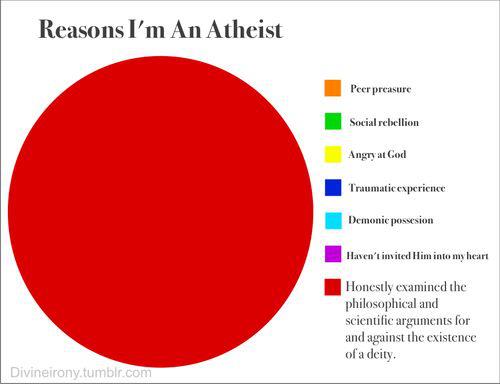
atheist-reasonsI found this piece on Stumbleupon, I believe. As far as Memes go, I actually kind of like this one. And by ‘kind of” I mean ‘really’ …kind of.

You see, I look at this meme, and a part of me wants to shout; “Yeah Boyeeee!” (…preferably in the face of some believer who has just suggested one of the alternatives). It’s damned frustrating to deal with that kind of commentary. You know how it goes; “The only reason you don’t believe is blah blah, blah…” …Blech! Seriously I’ve heard that line way too many times (and apparently so did someone else). So, it’s nice to see a bold affirmation that one’s own judgement really is the basis of, …well, ones own judgement!

…as opposed to some dismissive third person narrative.

Still, I wonder, would this look any different from any other religious perspective? If I asked for ‘Reasons I believe in God’, used the exact same sentence for the red color, and then made just a few strategic changes to the decoy list (Peer Pressure, Social Conformity, Afraid of Death, Raised That Way, Mental Disturbance, Haven’t Really Thought About It), I imagine we could present this to a few believers and generate exactly the same sense of vindication that I feel looking at this meme right now. “Damned right,” I can just hear them saying about that red line. …some might even add a “Praise Jesus!” or something like that, but my mind’s ear just doesn’t really want to go there.

Seriously, …yuck!

My point is of course that trivializing generalizations are a stick in the side of lots of folks, not just atheists. This is just the tip of the iceberg, a larger problem looms beneath the surface. And no, I didn’t just choose that image, because I live in Alaska; I actually thought about it and decided that it would be the best metaphor I could… well, anyway… the point is that this is part of a larger problem.

In the classic formulation of the problem, humans seem to possess a nearly universal tendency to explain other people’s actions (particularly those we don’t like) as a function of some consistent feature of their own personality while explaining our own actions in terms of situational factors. This tendency has generally been described as the Fundamental Attribution Error, or alternatively, as a function of Actor-Obeserver Asymmetry. What does this mean? Well, it means the reason you didn’t pay your bill on time this month is because of those unexpected medical expenses, the repair bill for the car, and well, it was little Johnny’s birthday, and you had to get him something… (You know the story). The reason your friend didn’t pay you the money he owes you? Well, he’s just a lazy bastard!

Okay, so that’s classical attribution theory, at least if you add a little salt to the vocabulary. Recent studies have shown that this basic contrast between situational versus dispositional explanations doesn’t quite explain the full range of data on this topic. Not to worry, a replacement theory is available, and it seems to illustrate the same point, albeit with a little less flair. The folk-conceptual theory approaches this same phenomenon by suggesting that people apply a range of different folk models to explain their own behavior and those around them. Depending on just how much one identifies with a person whose behavior they seek to explain, he/she is likely to adopt radically different descriptions of the behavior in question. One of the variables, for example is a difference between offering a reason for a behavior as its explanation and offering a history of reasoning as its explanation.

Case in point?

Saying; “I don’t believe in the Christian God, because the problem of evil renders this notion incoherent,” or conversely, saying; “I believe in God, because aspects of DNA coding appear to be irreducibly complex, and hence they require more of an explanation than chance evolution could provide.” What both of these explanations for a belief have in common is that each serves to explain a belief and at the same time to advance an active case for it. Conversely, saying “That guy Johnny, well he believes what he believes, because he has a deep fear of death (or Hell).” This latter sort of explanation describes a stage in a causal chain of behavior, one which doesn’t actively make much of a case for Johnny’s beliefs. In fact, the explanation undermines his credibility. The bottom line here is that we are looking at two different types of explanation, and the choice of which type to offer depends an awful lot on the disposition of the speaker towards the behavior/belief in question.

People thus have different ways of explaining behavior that they value and behavior that they don’t, and those differences serve more to shift the narrative around our feet than they do to set up a straight-forward evaluation of the issue. I really do think this is the key to the problem addressed in that meme above. People use dismissive explanations for beliefs they don’t identify with while presenting the reasons for beliefs they do identify with in terms of their own judgements.

You can see this consistently in the sphere of religious and philosophical discussions wherein you and I can supply all manner of thoughtful reasons for the judgements we’ve made, but that guy over there? Well, you know where he was raised and how his parents are! And all those people in the church on the corner? Well, they just have to believe in something; it fills a void somehow; they really are just brained washed aren’t they!?!

…and so on.

I’m including you in the good and thoughtful narrative of course, dear reader, but that’s just because you are reading my blog. When you’re gone I’m going to tell my other friend that you just had a traumatic experience.

😛

The bottom line is that it’s difficult to disentangle the full range of human motivation, and when we do this for religion, the tendency is to do it in a way that privileges one’s own judgement while trivializing that of others. Folks we identify with can enjoy praise by association, and those that we don’t, well damn them anyhow, right? They really need to learn to think for themselves!

So, why do I like this meme? Well, it took me down that path just now, and lucky you, I brought you along for the ride. I guess this is yet another instance of ‘liking’ something not quite meaning that I agree with it.

This meme is a good answer to half of the actor-observer bias.

…and it’s a damned good illustration of the other half.

I suppose that is something of a win-win situation.

😕

Compassion with Caveats Aplenty and Malice by Any Other Name: The Case of a Teacher with a Purpose!

Tags

, , , , , , ,

UPDATE_-Local-Students-Want-Traditional-Prom-Gays-BannedSometimes your 15 minutes of fame is a moment in the sunshine (or so I hear), and sometimes it’s fifteen minutes under the spotlight of public interrogation (or so I fear). Sometimes, I expect it’s a confusing mixture of both. Take for example the case of Diane Medley, a special needs teacher who claims those of homosexual orientation have no purpose in life. She will be grist for the left wing mill for a little while, and I suppose a hero to Christian conservatives and right wing culture warriors.

Just to be clear, we will be doing the grist-grinding thing here in this post.

…just a little.

So, what’s the story? Well apparently the standard prom for the local high school will be allowing those of homosexual orientation to attend, which is the reason Medley and others have taken to advocating a second prom in which homosexuals will not be admitted. Wabashvalley.com come attributes the following quote to Medley.

Homosexual students come to me with their problems, and I don’t agree with them, but I care about them. It’s the same thing with my special needs kids, I think God puts everyone in our lives for a reason.

Asked if this also holds for those of homosexual orientation, she responded:

No I honestly don’t. Sorry, but I don’t. I don’t understand it. A gay person isn’t going to come up and make some change unless it’s to realize that it was a choice and they’re choosing God.

Now to be fair, there is a trace of compassion somewhere in these comments, but it’s struggling for shoulder room with a whole mess of condemnation. One suspects that Diane Medley’s caring may well be cold comfort for those whose lives she has declared to be utterly without purpose.

The same could be said of assurances made by some of the others in favor of the alternative prom, and by Christians everywhere who wish to assure us that they hate the sin but not the sinner.

A distinction that often comes up short of any real difference.

And here it is easy to get dismissive, easy to write Medley and so many others off as people without redeeming value. I can’t pretend I don’t feel that way at times, but herein lies the really terrible thing. I actually don’t think she sounds like a person completely devoid of humanity. I strongly suspect that she does indeed help students on a regular basis, that she cares for them deeply, and that her caring does extend in some perverted sense to the homosexuals that may come to her for help.

I said perverted, didn’t I?

And I mean it too.

And yes, it is Medley’s approach to homosexuality that strikes me as perverted, deeply so in fact. To imagine that one could help someone whose very life one accords so little value requires an exercise in mental gymnastics that would surely break the back of a healthy conscience.

This is good will gone wrong folks, and that’s the charitable interpretation of her statements.

You can ask people to change and rethink an awful lot in life, and yes that includes religious beliefs, political commitments, work ethics, and even favorite sports teams. Hell, you can ask people to get over an aversion to cats. But you cannot reasonably expect people to change their sexual orientation, nor to live their whole lives as though it didn’t matter. I expect there is a certain range of people with bisexual orientation who could make conscious choices about what gender they do and don’t want to be with, but for the vast majority of us that decision has simply been made for us. We don’t choose which gender we find attractive; we learn it. …and that learning process can be difficult enough for those of us fortunate enough to end up on the socially acceptable side of the spectrum. So much the more difficult for those whose desires take them in a different direction! People going through that deserve all the help that they can get; they do not deserve the conditional embrace of those whose love is full of caveats and footnotes. And they certainly do not need to hear that the only choice that they can make which would possibly make any difference in their lives, the only choice that could give their existence meaning, is the one that will have them going against their their own natural inclinations.

That approach just isn’t good enough.

And God is no excuse.

Medley has attached conditions to her compassion, conditions that dehumanize those who may need her help. That she accounts for these conditions by recourse to her faith in Christ is both beside the point and ironic at the same time. Frankly, I don’t think you get to set aside the vast array of evidence on the subject of human sexuality and proceed as though important factual questions can be safely relegated to the sphere is personal faith, not when other people’s lives and mental health lies in the balance. But beyond that, there is something deeply inauthentic about that approach.

It isn’t that Medley and her allies have renounced the love and compassion, so central to the vision of Christianity. Indeed that message is all over their approach to the subject. But they have reduced it to a sort of footnote. Gone is the motivating force of this powerful message, and what is left of that message is a mere rationalization. Love does not guide their actions; it guides their narrative. Because it is unthinkable that a Christian should act without love, an explanation must be offered which includes it. And so we get one, a vision of love and compassion so filled with caveats that it is guides actions indistinguishable from those motivated by clear malice. And we are left with an absolutism of laws and rules while the very value of a human life is reduced to an artistic expression of sorts, a trick of story telling.

Again, I don’t think Medley is a beast. But in this matter, her faith is hardly a virtue. Indeed, Christianity as she articulates it in this story is an outright moral failing. It is the reason she cannot treat some students with the dignity they deserve. I’ve known Christians who took the message of love to heart, Christians for whom it was a genuine force in their lives. And perhaps on other days, in other moments it is for Medley.

But not today.

And not for those that are gay.