So, here I am surfing along the wifi challenged net of my lovely hotel room and what do I find in between 404 notices? Well it appears to be the latest talking point from the right wing echo chamber; a snappy little infographic promoting the virtues of a national day devoted to the celebration of Capital!
It seems that labor and capital both need each other, at least according to this catchy little visual. So, in the interests of fairness, we really ought to have a national Capital Day, at least if we are going to have a national Labor Day. And if we can’t have that, well then we should at least celebrate them together.
I mean it’s only fair!
I found this on Tumblr, a account for The Bill of Rights Institute, … so, Koch Brothers, yep! The visual has the stamp of FEE on it, which leads us easily enough to the Foundation for Economic Education, an unsurprisingly Libertarian bastion of economic chatter, and once there it doesn’t take long to find a whole article (penned by none other than the President of the foundation, Lawrence Reed) touting this movement to counter-balance the celebration of labor with that of capital.
Now to be fair, Lawrence does tell us he will be celebrating Labor Day. Apparently, that’s okay, just as long as we don’t dip into any lefty labor union kinda thinking. Good workers know their place, and their place is working for capital! …without complaints and collective bargaining power. And of course Reed does want to reassure us that he is NOT engaging in class warfare, no. He loves labor. Hell, workers too can become capitalists if they save and invest.
I wonder what Reed thinks the average worker has to invest in today’s climate?
Apparently, we aren’t supposed to think of capital as something deployed only by bankers, because of course workers COULD invest in stock themselves. And in the classic tone-deaf stylings that have become the hallmark of libertarian thought, that little bit of formal equivalence is supposed to help us forget the massive difference between the economic power of the investing classes and those who might have a chunk of their fragile retirement fund riding on the fate of a corporation or two.
I could wonder a lot of things about the fairy-tale land of free market fundamentalism this preacher sells from his think-tank pulpit, but for the present it is enough to meditate on the vision of fairness he has in mind here. It is somehow unfair, he and the folks at FEE seem to be suggesting, that Americans should think about labor and not give a happy nod to capital as well. I wonder where that sense of fairness can be found when paychecks are measured against dividends, personal bankruptcies to corporate bailouts, and second homes to rental properties? I wonder where that sense of fairness is when people like Donald Trump talk about building this or that casino with hardly a nod to those who actually did the dirty work? I wonder where that emphasis on interdependence can be found when folks talk about ‘job creators’ as though they were the unmoved movers of the economic world? And I wonder where all this painfully important need for balanced credit falls when we measure the access of workers to the ear of public officials against that of capitalists? Today, it seems we must be reminded that workers and capitalists work hand-in-hand; on most days that same vision of cooperation is deemed to mean every-man-for-himself, and shame on those who fall short at the end of the month.
No doubt the fine folks at FEE will protest (as Libertarians often do) that they are against sundry special treatments for big business as well. And I suppose, one can indeed imagine a world in which the libertarian scheme of things offers a fair chance to everyone and a better more efficient economy for all. That world is every bit as real as the communist state. In the world we live in though, Libertarian intervention always seems so much more focused on the denial of benefits to the lower classes. Bail out a corporation and they will tell you that sucks and things are not supposed to work that way. Offer health care to the working poor and they will burn the country down around our ears if that’s what it takes to stop you.
And just as a small petty footnote in economic history, they may even find a way to begrudge working men and women a single day of acknowledgement.
When you catch the other guy doing something wrong, most folks would say that’s an opportunity of sorts, an opportunity to correct them. For some though, it’s license. This is the basis for much of Rush Limbaugh’s schtick. His narratives rarely stray far from the Libs-do-it-too theme. He is particularly fond of saying that he is only “illustrating absurdity with the absurd”, which is a fancy way of saying that his cheap shots are really attempts to undermine some parallel logic on the part of his political enemies. Were such moments carefully tacked to some particular piece of liberal rhetoric, this might be a plausible angle, but this just isn’t generally the case.
If Rush Limbaugh is satire, then it is a particularly adolescent form of satire. Whether or not he is just kidding depends a lot on how much backlash he gets, and whether or not he and his fans feel like distancing themselves from a given comment. All to often, his cheap shots become gospel to a significant segment of the pseudo-conservative public. His game becomes satire precisely when Limbaugh is forced to deal with the absence of a rational case for his position.
Case in point, many people still seem to think Sandra Fluke testified about her own sexual activities and/or that she wanted the public to pay for her contraceptives. She didn’t.
But that’s a different rant. What has my attention today is a rather different gambit, Limbaugh’s efforts to spin the captivity and sexual abuse of three young women in Cleveland Ohio into a diatribe against the welfare state. Media Matters ran a story about Limbaugh’s comments here. The audio is painful to anyone with an ounce of sense, but it’s what I will be commenting on, so my apologies…
Limbaugh’s narrative is slick as Hell. He doesn’t assert that the Cleveland kidnapping has anything directly to do with welfare opportunism; he simply uses the coincidence of an episode of Hawaii 5-0 to field the story. The potential effectiveness of this meme is readily apparent, welfare as a subsidy for kidnappers, the mere thought of it may do more to combat aid to the poor than a thousand stories about the dreaded welfare mother. Limbaugh doesn’t need to assert the truth of his narrative; it is enough to generate the association. Much as he has done with one outrageous suggestion after another, Limbaugh settles for insinuation.
Limbaugh will of course cry foul (or ‘drive-by media’) if people call him on the claim, because of course he never quite made it. But that is a skillful propagandist for you. Long after his audience has forgotten the details of his particular presentation, they will remember the narrative he presented for them. The power of that narrative is what will matter in the long run, and neither the facts of the case, nor the logic of Limbaugh’s half-assed argument will matter in the long run.
But what really interests me is the disclaimer; “I couldn’t help but make the connection. I mean if everybody else in the low-information crowd is gonna use what happens on TV for reality, why can’t I?”
‘Low-information crowd’ is of course a reference to ‘low information voters’ which is how the right wing echo-chamber has taken to referring to liberals. That this summary judgement is utter nonsense has little to do with its value in pseudo-conservative rhetoric, and Limbaugh must know that his own less-than-impressive fan-base will love to think of their enemies as ill-informed. Of course this remark adds another ingredient to that theme, suggesting that liberals rely too much on TV for their information. He doesn’t need a reason to believe this is true, and neither will his fans. It is enough to assert it.
But all of this is the powdered sugar on the brownie, so to peak. The real work of this disclaimer is the suggestion that if there is anything wrong with using a TV show to interpret a news story about which Limbaugh admits himself to be ignorant, well then that fault lies with his liberal opponents. They are the ones who do this for real, Limbaugh is merely showing us how silly they are. This gambit is a tu quoque fallacy at best, or in terms with a little more widespread usage, it is two-wrongs-make-a-right. I think teh average third grader can understand the problem with this gambit, but it’s pretty much standard operational procedure for Limbaugh.
The particular particular utility of this you-do-it-too gambit lies in its conjunction with the inability to field a hard claim in this instance (and so many others). Limbaugh has no evidence that this kidnapping is a welfare scam; he just wants people to associate the two themes, preferably without thinking too much about the details. A quick they-do-it-too serves both to relieve him of responsibility for checking the facts before spouting off about them, and to shift responsibility for his own sleazy gambit to others. If it is shocking that Limbaugh would make (or almost make) such a wildly outrageous claim without any evidence, well then that is all the fault of liberals, because Limbaugh is only satirizing their behavior.
…except it isn’t.
This is Limbaugh advancing a narrative, and past experience has shown it is an effective strategy. Time and again Limbaugh’s fans have adopted his narratives as gospel truth long after the facts should have led any reasonable person to conclude otherwise. There is no satire in the successful propagation of such lies. The tu quoque gambit is there simply to cover his tracks in the event that the backlash proves too strong. When the public tires of answering this kind of idiocy, Rush and his fans stick to their guns.
This is not mere entertainment, and it is not satire. It is a propagandist doing what he does best, which is to deceive the public. The man has made quite a career out of it.
One hears it all the time; the notion that religion ought to be kept out of politics. I’m torn by the suggestion, because it is commonly used in response to the politics of conservative Christians, …and I have little sympathy for their politics. But the fact is, that just isn’t where I would draw the battle lines. If most people frown at the likes of Pat Robertson or Rick Warren, I suspect they are frowning for reasons that differ significantly from my own.
Religion IS politics as far as I am concerned; it’s bad politics, but politics just the same. I don’t quite mean to suggest that religion is simply a crass tool by which some folks seek to enhance their own power and influence.
….seriously, I don’t QUITE mean to say that.
…at least not as a general rule.
No. What I am suggesting is that religion consistently presents folks with a vision of order in the cosmos. That vision answers questions about how one ought to behave, yes, but it also contains answers to questions about the nature of authority and the social expectations that go with it. These traditions may tell us about Heaven and Hell, Karma, etc. all visions of a cosmic order, but they also tell us a little about how one ought to treat others, assess other people’s character, and what we may fairly do in response to the virtues or vices of those around us. The notion that all of this is supposed to stop short of addressing real political questions strikes me as a rather improbable.
…it’s also unreasonable.
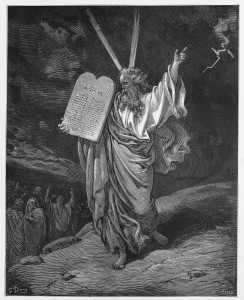
To put it in more concrete terms, it makes sense to me that someone who believes in the Ten Commandments would (when stepping into the voting booth) bear in mind the likelihood that a political candidate was going to follow them as well. It makes sense to me that folks would bear such things in mind when making in countless other decisions of a political nature.
Which is part of what makes the role of religion in American government (and perhaps other settings as well) so completely absurd. On the one hand, religious teachings are all about precisely the sort of questions that one must address in politics; on the other, it is separate from and distinct from those institutions, limited in some respect by the establishment clause and re-enforced by the free exercise clause. Religion has a potentially absolute absolute claim on every aspect of life, and yet while protecting the rights of believers, we expect them to stop short of weighing in on the most important questions of the day. The whole situation is at least a little odd, to say the least.
Far from the natural order of things, this feature of American politics rests in our Constitution and popular culture like a fault line running through a population trying its best to ignore it and get on with life.
…which I think is the real reason people want to keep religion out of politics. If they can keep folks from putting the two topics together in the same conversation, then they can avoid dealing with a mountain of contradictions even Mohammed would be hard pressed to move about.
The history of religion certainly doesn’t teach us to expect its proponents to stop short of political commentary. The God of Abraham in particular has played an overtly political role in each of his major religions. It is only with the decline of ancient empires that Christianity and Islam have come to be defined as something distinct from politics. Each of these traditions became mere ‘religions’ when the moral order they espoused lost its connections to the political order in which they once flourished. Institutions that we think of today as religion were once unashamedly political. Few if any thought twice about it.
What distinguishes religious traditions from those of modern politics is less of an ontological divide than a range of social conventions, not the least of them being a clear discordance between the visions of authority contained in each. Indeed, the notions are so far apart that people often fail to recognize them as different answers to the same question. The end result is a rather marked failure to notice something very interesting about the relationship between religion and politics in modern life. You see, there is something highly ironic (and more than a little tragic) about the sensibilities of those who speak of a Lord in world wherein we elect a President (or, for that matter, a Congressman or a Parliamentian).
And this is what I mean by a fault line that the public does its damnedest to ignore. Most people don’t even pause to think about this, but the notion of a ‘Lord’ has not always been so divorced from the social order. The language about which one spoke of God was not always so completely severed from the language about which one thought about their own government. There was a time when that term, ‘Lord’, would have pointed not merely to a benign old man in the sky, but also to the nobility of Europe. The implication was neither accidental, nor trivial. Indeed, the point of such language was to draw a clear parallel between the loyalties that men owed to each other (or more to the point, that commoners owed to the aristocracy) and those that they owed to the keeper of cosmic justice. A reference to the ‘Lord’ would have meant for many in past times a role reflected in both their religious discourse and in the social realities of their daily lives.
How weird it must be to live in a world in which one answers to a Lord in Heaven but votes for politicians down here! At least it would be weird if we paid more attention to the way either of these institutions actually handle questions about how people ought to behave.
But of course the problem is not merely a function of this one word. When Conservative Christians speak of power, they almost invariably invoke a range of metaphors ill-fitted to the realities of a republican style government. They speak of God as a sovereign, all the while operating in a public life wherein the people are assumed to be sovereign. They speak of the Ten Commandments in a world wherein laws are deemed in some sense to be created by the people (albeit indirectly). And how strange that we (and by ‘we’ I mean mainly Christians) want Children to pledge allegiance to one nation (under God or not), as if such an oath had much bearing on modern notions of citizenship! It cannot mean nothing that people who live in a participatory democracy envision so much of their lives through the language of aristocracy.
Does this mean that Conservative Christians do not understand democracy?
No it doesn’t.
…at least not in principle, but I can think of a few folks!
It does suggest a certain tension between the nature of authority some folks encounter on Sunday and those they are called upon to use in the voting booth. This sort of tension might even have some positive benefits, though I suspect that would require people to be more aware of the difference than they generally seem to be. It probably should not surprise us too much when the language of one sphere creeps into that of another. I think we can see this in the way that many conservative Christians speak of the founding fathers in reference to a broad range of constitutional questions. So much the more so on litmus test politics such as gay rights which so many use to discern the loyalties of those around us.
I could field a number of polemics at this point, but perhaps that is not really where I want to go with this. The divergence between modern visions of political authority and the archaic language with which conservative Christians approach that same subject is an interesting point in itself. What to make of it is another question. And of course this returns us to the original question of whether or not one can reasonably expect religious leaders to keep their noses out of politics.
If I am reading the popular culture correctly, I think most people expect a natural division between these spheres of social (and political) life, as if some great natural boundary separates them. For my own part, I think it’s little other than history. Indeed, I don’t think the term ‘religion’ denotes a clear and well defined body of institutions, beliefs, or practices, certainly not any that fall neatly outside the boundaries of political life. As it happens, the modern world has developed a range of political expectations which simply differ from those of the institutions we now call religion. That difference does not lie in the nature of the institutions in questions, it lies in the particular approach that each takes to the deeper moral questions of social life.
What keeps conservative Christianity from enjoying a more direct role in American political life is its political anachronism. It’s vision of authority is not (thankfully) that of our own government.
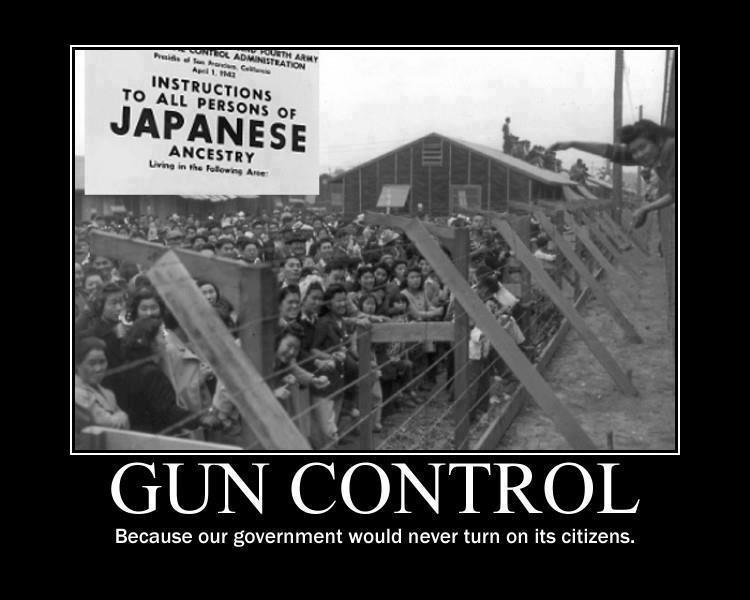
I suppose it is too much to ask that folks distinguish the varieties of gun control from an outright ban. The way the gun rights crowd raises the specter of a completely disarmed populace when speaking about any variety lesser measures smacks of dishonesty.
It would hardly give away the farm to distinguish such things from one another. There are plenty of legitimate questions about the efficacy of lesser gun control measures, especially when applied to a population already so well armed as we are here in the U.S. But that is an interesting and well focused discussion some folks don’t seem to want to risk.
But what is really fascinating about memes like this is the slippage between a right to bear arms and a prescription for doing so. The second Amendment was alive and well when the internment of Japanese occurred in the first place. So, that right and that right alone simply is not a cure for the evil that this pic wants us to think about. The meme only works if we are to imagine a population which is not merely in possession of the right to bear arms, but which actively uses that right even to the point of preparing for war against its own government.
And can anyone really imagine Japanese immigrant population of the west coast doing this in the years leading up to World War II? Can anyone imagine the response from their neighbors?
This is not merely a defense of the Second Amendment, it is an argument for the expansion of private gun ownership well beyond anything previously imagined in American history. To make this argument work, we need more than just the right to bear arms, we all need to have the arms, the training to use them, and enough firepower to make them an effective counter to the powers of the United States Government.
Is the author suggesting that gun owners could stop such a thing as internment? Perhaps, but would they?
It’s a pretty common claim from the gun rights crowd, the notion that the Second Amendment puts the teeth in the rest of our civil rights. It is through gun ownership, so the argument goes, that people are protected from abuse by government officials. It is the most important means by which our rights are protected.
Pardon me, …from ‘thuh government.’
But gun owners did not stop the internment of Japanese.
Or of Aleuts during the same war.
Neither did they stop lynching of blacks.
Nor did gun owners secure the right to vote for African Americans.
…or for women.
…or Native Americans.
Gun owners did not stop the Federal Government from kidnapping Native American children to be taken to schools far from their families.
They didn’t stop police harassment of homosexuals.
They didn’t improve treatment of the mentally ill.
They didn’t stop the Zoot Suit Riots.
…or legacy provisions precluding Jews from owning homes in some neighborhoods.
Gun Ownership didn’t stop Jim Crow laws.
It was not gun owners that secured for any number of minorities the right to an education or any other protections by states or the federal government.
In each of these instances, the rights in question were won by protestors, and lawyers, and people who talked a hell of a lot, even if their main opponents didn’t. In many of these instances gun owners were actively involved in the very repression suffered by those in question. Since the founding of the country, Gun violence has played a far greater role in the repression of civil rights than it has in protecting them. There are exceptions to be sure, but this narrative is not built on the exceptions. It is built on a fantasy that skips any active consideration of how these things actually work.
Herein lies the biggest problem with this fantasy scenario; it presents us with the image of a government acting on its own, independent of the public will. That could happen, I suppose, but is far less likely than the countless times in which government policies actually have facilitated repressive measures popular with the American people, or at least a large segment of it. And in such moments, the victims of repression have rarely been sufficiently well armed to make an effective stand against those who wanted a piece of their liberty.
In real world history, those who have suffered the greatest deprivations did not merely face the threat of Federal Authority; they also have had to contend with the prejudice of an American population content to have them suffer.
…one that sometimes even demanded it.
We can imagine the victims of repression better armed, yes, but only if we also imagine the majority better armed as well. This is hardly a story which leads to a successful defense of liberty. I would call the scenario anarchy, but I don’t wish to sully the term ‘anarchy’ with such a vision of violence and destruction.
It’s damned hard to read these self-indulgent fantsies when considering the actual history of people struggling for their rights. It’s hard to give credence to this juvenile narrative, knowing what it took for the people in these camps to survive, what it took the Freedom Riders to earn rights enjoyed by gun-toting whites in the South. And it is especially hard to hear such arguments from those with so little to say about such things as Guantanamo Bay or the countless encroachments on Fourth Amendment Rights we’ve seen over the last few decades.
What pisses me off about this argument isn’t the defense of gun ownership, or even opposition to gun control. Frankly I don’t think this kind of crap even touches either one of those issues. It sheds no light on those issues whatsoever, and leave us with a whole different discussion to have if we can ever get clear of noise like this. What bothers me about this stuff is the scorched-earth tactics; the vision of politics as warfare and questions about rights as an invitation to shoot at one another. It’s a vision of government as a faceless evil empire in opposition to private citizens, and begging for opposition from heroic gun-owners everywhere. Folks telling this yarn have no sense of how such things actually happen. But they are happy to tell stories of gun-toting heroes squaring off against a government turned inexplicably on its own population. How that will work is a Hell we can only hope we will never see.
And it’s a Hell as likely to be brought about by gun-owners defending their own rights (as they define them) as anything done by a corrupt and tyrannical government.
While others have struggled and died for some of the most basic human rights imaginable, so many in the gun crowd openly fantasize about acts of violence over basic policy disagreements and the possibility of restricted access to a commodity. The pretense that this commodity is the key to civil rights plays a big role in these fantasies. The end result is a tantrum born of paranoia and privilege and a gun culture increasingly dangerous to the rest of us.
No. I’m not talking about the weapons. I am talking about the mindset of people who produce memes like the one above. People who make such arguments are not interested in protecting anyone under serious threat of government repression. The gun rights crowd did not protect the Japanese during World War II, and I for one don’t believe they will be there the next time someone decides to create camps like this.
…unless of course it is to close and lock the gates.
Steve Sheldon told about a woman giving birth alone on a beach. Something went wrong. A breech birth. The woman was in agony. ‘Help me please! The baby will not come,’ she cried out. The Pirahãs sat passively, some looking tense and some talking normally. ‘I’m dying! This hurts. The baby will not come!’ She screamed. No-one answered. It was late afternoon. Steve started toward her. ‘No! She doesn’t want you. She wants her parents,’ he was told, the implication being clearly that he was not to go to her. But her parents were not around, and no-one else was going to her aid. The evening came and her cries came regularly, but ever more weakly. Finally, they stopped. In the morning Steve learned that she and her baby had died on the beach, unassisted.
Daniel L. Everett uses this passage from Don’t Sleep, There are Snakes to illustrate the ideas of an Amazonian people about personal responsibility and their attitudes towards the suffering of others. In context, this story is a little more subtle than it may appear on this page, because Everett tell us that Pirahã will devote great effort to helping one another under the right circumstances. The point is that under this circumstance, Pirahã did not consider it appropriate to aid the woman in question, even though her need was obvious. It was the sort of trouble that Pirahã felt an individual must face alone, or with the aid of family. Since no family was there to help her, the woman in this story had to face this struggle alone.
I read a lot of stories like this, and some still have the power to shock and anger me. I can think my way to an understanding of the behavior in question, but in some cases (like this one) I lose my interest at least momentarily in learning about the cultural context behind it, and I want desperately to confront those responsible. The image of a woman and her child dying alone on a beach because people would not help her is just too much to bear. How could anyone, ANYONE, countenance such a thing?
It doesn’t help that Everett follows this with another story about an orphan girl he had been nursing back to health from a near coma, that is until her father killed her with the aid of his fellow villagers. To them this was a mercy killing, as Everett tells us. The villagers had become convinced the little girl was too sick to survive. His efforts to nurse her back to health had in their eyes accomplished nothing except to prolong her suffering. So, they killed her. I read that story, and I understand the point, and still stories like this fill me with rage. I want desperately to do something about a death I didn’t witness, to confront people I’ve never met, to stop them, to beat them, to punish them. No explanation will suffice for such things, I sometimes feel, and I cannot imagine living in a world in which I must abide such behavior.
But of course I do live in such a world; we have it right here in America.
Oddly enough these passages have helped me to understand something I have been struggling to grasp since the last election, the old yarn about death panels. Don’t get me wrong. I certainly understand the fear and horror that comes from the notion that some committee may have the power to make life and death decisions for other people. What I could never grasp was just how anyone could be so alarmed at the prospect that such a panel could operate under the auspices of government authority while remaining unconcerned about the reality of such entities in the private sector today. Insurance companies make such decisions every day which effectively sentence people to death or suffering, and this is at best a matter for reform; it is something we have to work on, because maybe there is room for improvement. Yet the mere hint of such a committee operate under the auspices of government authority is enough to render the man responsible for it into something of a vampire.
The case for the existence of Death Panels in Obamacare was never much more than a highly malicious rumor, at least as outlined by Republicans in 2008. Yet people die in America every day because they cannot get coverage for important procedures, or they suffer needlessly from lack of care. Think of dental care alone. For years I struggled to find a safe tooth to use for chewing before I finally got a decent dental package, and now I see friends and family doing the same thing. None of this is necessary. They aren’t screaming down at the river, and perhaps they won’t die, but their suffering is absolutely unnecessary. So much the more so for those who cannot get treatment for serious ailments.
So, how is it that folks could be so accepting of deaths resulting from lack of medical care in the present economy while falling over themselves at dark rumors about Obama’s heath care package? I’ve come to understand this sort of thing as one of the powers of the Free Market.
Yea verily!
“The power of the market!” I often wonder if the people uttering this little mantra recognize its religious overtones. You would swap “Jesus” in there for the market if you like, or perhaps “the mind” if you prefer to think of yourself as “spiritual but not religious.” Either way, it is an expression of wonder at the power of an entity to work miracles. Those uttering this phrase usually mean it to suggest something to the effect that free markets will bring about good things if only they are left to themselves.
My own suggestion is sarcastic, of course, but I do think it is the rhetoric of free markets that works this miracle, perverse as it may be. It is what separates the horrors of some deaths from the natural occurrences of others.
Time and again, one hears folks (and by ‘folks’ I mean ‘Libertarians’) assuring us that government actions aimed at correcting some remedial evil will only create more difficulties in the long run. If wages are too low, raising a minimum wage will only lead to a reduction in jobs, and if banks are charging ridiculous overdraft fees, rules against this can only lead to other fees. To correct such horrors is to fight the tide itself. The course of the market is thus a perfectly natural, inexorable force, and government action to correct it can only lead to greater harms on down the road.
And of course there is a certain degree of evidence to back this up. By a certain degree of evidence, I of course mean scads of economic analysis regarding details such as those above. We can see the adjustments that market values make in the wake of government changes quite regularly, and it isn’t hard to see just how often those adjustments prove the undoing of many well-intentioned policies.
And yet the rhetoric of Free Market Fundamentalism seems to stretch a little beyond this evidence, turning tendencies into laws and social behavior into the tell-tale signs of a god passing in the night. It is not merely that supply and demand react to one another, but that they do so under the command of an entity of sorts, one with great powers. Somewhere along the line, reasonable arguments about the particulars give rise to a mythic narrative, one which simplifies the choices in front of us.
All of this begs the question of just how simple it is to keep government actions out of business. Money, like government office, is a vehicle of power, and there is no inherent reason why we should moralize the one and naturalize the other. But of course that is precisely the point of so much talk about the power of the market; that market will do what it does, and individuals seeking profit will do what they do. Neither morals, nor governments, nor all the devils in Hell will alter the course of self interest. What is left for us to do but acknowledge in stoic terms the limitations of humanity and civic service? …and hence to let things run their course? A virtuous government is thus one that does not interfere. Likewise with virtuous politicians!
And damn those who would trespass against the will of the market.
Thus a man who dies because an insurance company will not pay for an expensive operation has in effect passed away of natural causes, but one who has died because a government panel denied him the operation? Well, his death is the result of arcane forces. Worse still, a life prolonged by such a committee must also be an unnatural event, a form of undeath, sustaining itself by draining the life from others. And if folks stop short of blaming those whose health is the result of government programs, well we can certainly point a finger at the necromancers who created those programs.
Cough, …Obama!
This is the attraction of a narrative that separates the world of power into forms about which we can make decisions of right or wrong and those about which we can only hope to adapt. Government is thus saturated with moral significance; there are good politicians and bad politicians, even evil ones. But market forces? These are as natural as the tide itself. One might as well urge reform on the laws of gravity as hope to change the nature of business.
It is for this same reason that welfare queens elicit so much more effective anger than corrupt bankers. We can understand someone fudging the numbers to make a profit, but a woman who lives off the coercive power of government authority? That is an abomination. Likewise with all manner of horrors resulting from poverty; they are natural. We might shed a tear for those that die of such things, but we expect them to handle it themselves, or to turn to family.
“She doesn’t want you; she wants her parents.”
If you want to help your neighbor, so one hears, then do so with your own money! Give to charity, or pay your brother’s bills, but don’t force others to do the same. But of course the market in its infinite wisdom sets the price for the necessities of life too high for such personal action, at least if one hopes to get ahead in life. And so neither government nor private individuals can really do much about this man’s teeth or that woman’s liver. The result is natural, so the narrative goes, and there is nothing for us to do but go about our lives as people all about us suffer.
We can only hope they will do it in silence, behind a door somewhere, not screaming down at the river.
This may seem ironic, but among the topics generally falling under the purview of logic and/or critical thinking is a little gem called the “principle of charity.” Simply put, this entails an obligation to interpret any given argument in the strongest sense possible, consistent with its actual wording. In other words, when you come to one of those moments where you could think of more than one way to take what someone else is saying, pick the one that gives them the strongest case possible. You don’t have to rewrite an argument for someone, or pretend you don’t see obvious flaws, but when there are genuine questions about the intent of an author, opt for the interpretation that gives him a fighting chance.
Then give him a hug.
This isn’t really about being nice. One of the most important reasons for applying the principle of charity is that it helps to ensure your own analysis will not be wasted. If you take advantage of some ambiguity in the text of an argument and spin it into something utterly foolish, then your own evaluation of that argument becomes all that much more trivial. If you are in actual dialogue with someone, then it’s easy enough for the other guy to simply restate his argument, filling in the gaps so as to avoid whatever silliness you have read into his claims. By sticking with the strongest version of an argument, you an help to ensue that you really are evaluating a case worth considering.
And then it’s open season!
I’ve often had occasion to reconsider this approach to critical thinking, not the least of reasons being that there seem to exist a rather large number of occasions when folks don’t want to use it. And by ‘folks’ in this instance, I mean “me too!” Whether reading or listening to an argument, sometimes I just don’t feel all that charitable. More to the point, sometimes, I think there are substantial reasons to set the principle aside.
I first noticed this, sitting in an anthropology class, listening to a critical theorist shred some text I have long since forgotten. Simply put, the principle of charity was quite lacking in that analysis, as it was with many similar texts I had been reading in that program. This was no accident. Where my critical thinking teachers had been preparing me for open dialogue with people with whom I might disagree, the critical theorists I had begun to read were far more interested in exploring the role of a given text in promoting power relations within a larger social context. Where the one approach talked about what a text might mean, the other talked about what it did in fact mean, at least under the prevailing circumstances.
And it occurs to me that I did this sort of thing myself in my post on the California law for the protection of the Indian, …i.e. the Law that enslaved Indians in California even as that very state entered the union as a “Free state.” The text is not an argument, but it raises many of the questions I am talking about here. The text sets up a range of legal mechanisms which include indentured servitude as a possible alternative to incarceration. Bearing, in mind the principle of charity, one could ask if it is really fair to think of this law as a means of establishing slavery? You have to read between the lines, or you have to know some facts about the politics which produced it and guided its implementation. Once, you do know these things, the answer very quickly becomes ‘yes’.
And herein lies the crux of the problem. Application of the principle of charity means setting aside important questions about the actual impact of an argument in order to engage in dialogue with its proponents. This begs the question of whether or not you want such a dialogue in the first place (or whether or not it is even possible). And sometimes, the answer to that question is just ‘no’.
Case in point? Let’s look at this moment of Mitt Romney fame.
Now I know you think I’m going to attack him, and the truth is that I probably am, but not until after I am done defending him.
…I know; it confuses me too.
The common take on this topic is that Romney was echoing the sentiments of Citizens United v. Federal Election Commission (2010), namely the principle that corporations possess many if not all of the same rights as people. The notion that corporations are fictional people is hardly new to the political landscape. My Constitutional History Teacher was quite clear about that matter back in 1992, long before the current outrage, but for various reasons which needn’t concern us here, Citizens United brought about a frightful new firestorm of controversy over the notion, and that was fresh in a lot of people’s minds when Romney made this speech. Add to this a general sense that the Republican party is responsible for the relevant composition of the Supreme Court and for backing its rationale, and you have a ready-made battle just waiting for someone to drop in with the perfect phrasing
But is that what Romney was actually trying to tell his audience? If you look at the video, he was in the midst of making a very different point at the time, namely the fact that someone will have to bear the cost of raising taxes. Urged to levy the tax on corporations, Romney adds quickly that corporations are people. So, the question is this; was he affirming the legal rights of corporations, as per Citizens United, or was Romney trying to suggest that any costs applied to corporations will be paid by people somewhere in the marketplace (investors, employees, or even customers)? Although the categorical language suggests the former, Romney’s subsequent comments suggest the latter. The video itself doesn’t really yield a clear answer, and it is entirely possible that both lines of thought came together in one big mutant two-headed reason with no clear notion of the relationship between its sources.
At some point you have to make a choice as to the meaning of his comment.
If it’s the former choice, then well, go get him Lizzy Warren! And I must admit to a certain soft-spot for this inquiry as to the kind of person that a modern corporation would be, if indeed it were a person. But if Romney really was trying to tell us that costs accrued to corporations are ultimately borne out by people, then he is right.
Broken clocks, and all that!
Hell, there really isn’t much to gainsay that proposition that people will ultimately pay for costs imposed on corporations. There is a lot room for debate about how that works (or doesn’t) and whether or not it adds up to the kind of policies Romney wants to advocate. But that is a debate in which those of us on the left have as much responsibility to chase the devil through the details as Romney and the conservatives.
It’s a lot easier to tell Romney that corporations aren’t really people.
And here is where questions about the willingness to grant someone the Principle of Charity shade into larger questions about whether or not one wishes meaningful dialogue with them to begin with. If you really are exploring an issue with someone, and if they are approaching it in the same spirit, then the effort to assess their views in the strongest light possible facilitates that discussion. If no such goodwill exists, then extending the benefit of the doubt can cost more than its worth.
If the target audience for a debate is more responsive to cheap shots and sound bites, then failure to respond on that level begins to look a lot less like the responsible (grown-up) approach to a discussion and a lot more like failure on the horizon, all the more so if the point of the debate is really is to win something (a legal case or an election for example). If the other guy is just being a jerk, then you can always walk away. But if that jerk is trying to take something of value, then it may well be time to roll up your sleeves and pull out that roll of dimes hidden in your pocket.
Metaphorically speaking, of course.
So, do you really want to have a thoughtful discussion, or do you just want to kick the other guy’s ass? I know the Dudley Dialogue-Right in me wants to say “let’s have that thoughtful discussion,” but years of figurative blunt head trauma combine with political realism to say that sometimes the answer is just ‘no’.
Sometimes the answer is ‘no’, because the larger social context removes all doubt as to intent (the California example); sometimes it’s ‘no’ because the expectations of dialogue are essentially “no quarter given” (Romney?); and sometimes the answer is ‘no’, because you just don’t want to grant any legitimacy to the other side. This is why responsible scholars rarely debate holocaust revisionists, flat-earthers, or creation science hacks. It’s why feminists often give Men’s Rights Activists the face-palm instead of an argument, and its one of the reasons that both sides of the recent debate over Atheism-Plus have done a wonderful job of talking right past one another (just to name a couple netroversies currently bubbling over in sundry parts of the blogosphere). It’s also why you should never read the comments on any article posted anywhere (except here). And of course it’s why only a fool would debate anyone with a 160 character limit on each tweet.
…okay guilty as charged on that last one, but the point stands.
There are of course many ways in which one can shut off meaningful dialogue with others, but at least one of them occurs when you are no longer willing to give someone the benefit of the doubt. One takes their statements at face value and fills in the ambiguities according to a standard script; the possibility that the other guy may have something more interesting in mind is simply not worth the effort to give him a chance. This isn’t the kind of approach folks normally recommend, but it is the kind many of us engage in at one time or another. Combine this with the increasing role of discursive minimalism in public discourse and we have an ever increasing premium on short snide answers to arguments that never really came into their own to begin with.
There is no clear formula here; no objective test to distinguish those who have earned the benefit of the doubt from those who haven’t. While it can be particularly satisfying to see someone you think unworthy of debate forced to talk to the hand, it is equally frustrating when you are looking at that palm yourself. When neither side of a given debate seems capable of engaging the other in meaningful discussion, the results range from entertaining to downright tragic, often within the space of a single paragraph.
I certainly don’t have any great notions about how to make the call, but I do find it a interesting feature of public debate.
It’s a funny thing, even unbelievers typically assume there is a difference between God and Satan. It seems so obvious. After all we don’t confuse our friend Mike with our friend Chuck, but such friends are there to remind us of the difference between them on a daily basis. Entities such as God and Satan operate under no such constraints. Their traits change from one faith to another, even from one believer to another, or (truth be told) sometimes from morning to noon out of the same mouth.
Satan has certainly made a few significant changes in the years, graduating from a mere servant of the Lord to a principle nemesis for the Lord. For his own part, God has taken on a range of different faces over the course of human history. He still keeps an awful lot of them handy, even within the same tradition. Indeed the Christian world keeps its pretension to monotheism only by ignoring a likely case of multiple personality disorder. He is at the least bipolar.
And of course a trace of projection runs through all of this, right down to the most specific details and sources. You can tell a lot about people from what they say about their gods. And that is precisely why the quote above gives me such pause. To hear some folks talk about God, they might as well be speaking of the Devil.
When I was younger, I used to hear this phrase a lot; “The devil made me do it!” This usually came after someone had just done something they shouldn’t have, something they knew was wrong. Seems like these days people are more likely to lay their sins off on Jesus. Whenever their actions cannot be defended in reasonable terms, it is because Jesus wants it that way.
I’m not just being facetious here, not JUST anyway.
All to often, Jesus is the reason someone must suffer some indignity at the hands of a believer. Every enemy of Christendom, every native forced to endure abuse at the hands of his more forceful missionaries has certainly borne the brunt of this gambit. Yet they are not alone in learning that the Prince of Peace has ugly designs on their health and happiness. Jesus, we are told, is the reason that gay couples cannot marry; he is also the reason those of homosexual orientation must endure any number of indignities from ‘Christian’ circles. Jesus is the reason for compromising women’s health care. He is often the reason you cannot find certain books at the librar. He is the inspiration for a good deal of pseudo-science (some of which is genuinely harmful), for a good deal of pseudo-history, and even for the occasional cold cereal mishap. Jesus may or may not be responsible for some novel forms of corporal punishment and parenting practices, but if sundry Christian organizations are to be believed, he certainly approves of some highly creative approaches to that practice. Time and again, Jesus is the reason someone supplies for actions that are manifestly dishonest or demonstrably harmful to other people.
It really is difficult to tell just how far the Lamb of God is willing to take his lust for violence and cruelty, but it seems that he likes to do the really nasty work himself. To hear some folks talk, he is the reason for one or two great disasters; 9-11, earthquakes and Tsunamis ravaging Thailand or Japan. I remember when Jesus demanded a ransom to spare the life of Oral Roberts, one of His most trusted servants. But of course, such divine temper tantrums are nothing new; just ask Lot’s wife.
Has it escaped anyone’s notice that the witnesses to Jesus’ greater crimes are the ones who so consistently inflict suffering in his name? Can it be a coincidence that the same people who speak approvingly of god’s greater acts of cruelty would be so quick to commit the mortal equivalent in his name?
Jesus is not just a source of terrible headlines; he is also the source of myriad petty cruelties which will never make it far into the public discussion. I expect most of us have learned in one form or another that Jesus has taken sides in some personal dispute with friends, family, or coworkers. Lord knows, he is certainly the reason given for most of the dick moves made by the moderators on sundry Christian message boards. Indeed, Jesus seems to be implicated in all manner of grievances great and small.
One wants to say to some of these people; “dude, your Jesus is a dick!”
But of course, the real point is that Jesus could never have been anything else but a dick to some of these people; he begins and ends in their least admirable qualities. And if there is anything more to the story of Jesus than a sort of malice to be inflicted upon others, you would never know this from the words and deeds of so many who claim to be doing his will.
There comes a time in all of this, when Jesus can no longer be distinguished from Satan. For some people, He is in effect little other than a name they give to their own vices.
What does it take to make the words “agreement to disagree” work? I’d say at minimum, it requires a certain understanding of each others’ position, but perhaps that is a point for a different discussion. At present I am wondering just how much such an agreement can cost one of the parties before that respectful disagreement turns to shit.
Case in point, this conversation between John McCain and Ellen Degeneres:
I hear McCain frame this issue as respectful disagreement all the while diminishing a woman’s love to her very face, and I just can’t find the words or how I feel about it. You can see how uncomfortable he is about it, but that doesn’t stop him. I wonder if his words sick to the bottom of his own stomach the way they do mine? Or if he has words to explain the painful look on his own face?
But of course, history repeats himself.
See how respectfully Mitt Romney denies this man the same rights that he himself enjoys. He looks almost pained as he says this. Luckily he respects the mans right to disagree with him over the issue.
…and once again, I am at a loss for words.
And then of course we have the controversy over today’s Twitter comments on Sally Ride. It seems rude to throw it back in Romney’s face that her partner of 27 years will not now be entitled to spousal benefits, an option his stance on gay marriage would deny her as a point of principle.
That really does seem, …No, wait a minute, what’s rude is the part about denying someone the right to marry the love of her life on principle. What’s rude is the fact that someone surviving a 27-year relationship is denied the dignity as well as the benefits available to the rest of us.
That’s rude!
No, “rude” doesn’t even come close.
If the folks who so carefully frame this as respectful disagreement would drop their own sense of entitlement and show some decency for a change, then maybe, we wouldn’t have to bring up such issues AT THE END OF SOMEONE’S LIFE.
Anyway, I think I just found the words I was looking for. They come from Greta Christina at the Freethought Blogs. She wants to send Mitt a memo; it simply says “Fuck You.”
I don’t have a lot to say about this news story, but it’s worth a look. …a look at the three paragraphs that CNN devotes to the stated topic of the article before reverting to a bog-standard narrative about Wikileaks and the legal troubles of Julian Assange.
I suppose we could learn a thing or two about media bias here.
– Perhaps a bit about the limits to the oft-cited left wing bias of the media, which is certainly true for a certain range of issues in the culture wars of the U.S. That bias quickly reverses course when substantial features of the world political economy are at stake. Wikileaks does far too much to threaten those interests.
…which is why the topic makes a much better sex scandal.
– There may also be a lesson in here about the way that news stories get their titles. Seriously, you click on a link to an article entitled; “Wikileaks Releases 2.4 Million Syria emails,” and you get a story about its founder’s legal troubles. It isn’t all that uncommon, and the author may not be at fault. Still someone is responsible for this. Someone chose to run a story under a false flag. And that someone ought to get noogies from his boss every morning for the rest of July.
…unless, it is the boss. Then he gets Indian burns.
– Or perhaps there is a lesson in here about editing? Who knows what interesting information might have been in the original piece. The 3 paragraphs on the initial topic certainly hint at interesting and juicy information, shortly before reverting to old news. I think there is a pretty good chance there was something worth reading in that original story.
…and I wonder if they will ever let us read it?
– And most of all, I suspect what we have here is a story about the economics of news reporting and the growing tendency to regurgitate the same old shit, all the while calling it news. It will take time and work to sort through the Wikileaks material, and it will take some knowledgable folks to do that. Why put out that effort when you could just take some old stuff about a long-running story and slip it under the sexy new title about a genuine news development?
…cut corners much?
But hey, I’m sure that with good sound journalistic practices like this, CNN will quickly put the whole Supreme Court ruling fiasco behind them! And seriously, this may be yet another extension of that story. Is the misleading title an attempt to finesse the issue of time, a means of holding off the story while they look over the material? Possible.
…but still damned foolish.
Please pardon me now. I’m off to see if I can find someone who actually did a story about the Syrian email leaks.
What do you do when someone on your side says or does something so utterly beyond the pale that it is completely indefensible?
Those Americans calling themselves ‘conservatives’ got a chance to show us their response to this sort of dilemma back when Rush Limbaugh attacked Sandra Fluke, actively misrepresenting her testimony before an unofficial hearing and insulting her on his radio show. He would later retract the insults while leaving his lies about Fluke’s actual testimony uncorrected. His lies continue to circulate through the population, effectively replacing a responsible debate about the wisdom of mandatory birth control coverage and reasonable accommodations for religious objection with a fantasy battle over personal sex lives and government subsidies. The end result would seem indefensible, even outright embarrassing for anyone implicated in supporting Limbaugh.
One would think the responsible thing to do would be to say not just ‘no’, but ‘Hell no’, and refuse to back Limbaugh’s approach to the subject. One might even suggest that such an approach would help to distinguish the conservatives from the many playground bullies currently reveling in the delusion that their sundry bits of prejudice add up to some sort of political philosophy.
Suffice to say this was not the most common Republican response to the situation. The right wing echo chamber cried foul over liberal backlash against Limbaugh and quickly spun the story into a case-study in liberal hypocrisy. Liberals condemn Limbaugh, so the argument goes, but then look at Bill Maher and his comments about Sarah Palin! (I recall a few other examples, but Maher clearly occupied center stage in the right wing response to this issue.) Thus, Limbaugh’s disgusting personal attacks on a young student activist became proof of liberal misogyny?
How many of the right wing pundits jumping on the “what about___” response ever bothered to make a principled criticism of Limbaugh, one that went beyond merely disclaiming the insults to call him to account for his misrepresentations of her testimony? I wouldn’t say that the answer is ‘none’, but it certainly falls well short of the total commenting on the issue. Most of these ‘conservatives’ have simply been content to comment on liberal hypocrisy without making any serious effort to correct those in their own camp.
The focus on liberal hypocrisy enables conservatives to defend Limbaugh and complain about Maher without ever laying their own cards on the table. So long as the focus of thought rests on whether or not liberals have been consistent on the issue, right wing pundits never have to take responsibility for addressing the issues squarely themselves. And they can effectively work both angles of the debate just as they accuse liberals of doing, all the while laying responsibility for the inconsistencies of the entire national discourse squarely at the feet of those damned liberals.
And thus the charge of hypocrisy facilitates the same.
We could call this particular gambit the META-HYPOCRISY SHUFFLE. It consists of disguising your own inconsistencies by pretending you are just responding to those of someone else. There is nothing particularly new about this tactic, nor is it exclusive to conservatives. And of course the plot thickens when calling attention to this problem as well, because one can always add another layer to the house of cards by refusing to take a stand on the particulars while complaining about the inconsistency of the other guy.
…and on into infinity.
The problem is easy enough to identify. Untangling it is another matter, not the least of reasons being that the perception of hypocrisy is easy to manipulate in a variety of ways.
If you are not sure whether or not any particular individual is guilty of hypocrisy, you can always use the tactic of INCONSISTENCY BY ASSOCIATION. This consists of treating all of those who belong to a given group as though they are collectively responsible for producing a single ideologically consistent position. Thus, if I can find one self-described conservative who says that it is wrong to degrade women, quote him, then go find another self-described conservative who does just that, well then voila! I have proven conservatives inconsistent.
…unless I haven’t.
To make the charge honestly, I need one person who does both things, not two or more people who simply share the label.
And of course there is always the possibility of GAMING THE PRINCIPLE. This is really just another variety of the straw man fallacy. The tactic exploits a common weakness that typically accompanies expressions of outrage. When people are really angry over something, they often fail to state the principles they feel have been violated with any degree of precision, …or even at all. This makes it easy for others to come along and rewrite the principle in question for them. Even if the outraged individual has spelled out the specific principles they feel have been violated, a loose paraphrase can often lead readers to forget that inconvenient detail.
Someone who feels that Sandra Fluke did not personally deserve Limbaugh’s personal attacks, for example, could easily be construed as claiming that one ought never to insult a political opponent (thus confusing a claim about what is a reasonable criticism with a claim that some people ought never to be criticized). The point here is to supply a principle to one’s critic that puts him on the worst footing possible, even if that principle has little to do with their actual concerns. From there it is a simple task to demonstrate the individual in question has violated the principle they never actually endorsed, and that’s Q.E.frickin-D.
Except that it isn’t.
To make the charge honestly one must be sure that a person has violated a principle she herself has actually advocated, not one that sounds close enough.
And finally there is the very simple tactic of SKIPPING THE FACTS. Just because accusations and insults may be leveled in all directions does not mean that all of them have equal value. Sometimes party A really has done something wrong and party B hasn’t. It’s easy enough to flip the tables of accusation and say; “see how you like it?”…but if the claims don’t have equal merit, then this gambit is hollow as hell.
All of these tactics help to transform the sort of inconsistency that shows up under the scrutiny of critical thinking into one that will show up in a political narrative whether or not it is warranted on the facts at hand. These tactics did not emerge with the Limbaugh-Fluke controversy, nor will they be filed away in the wake of that dust-up. They are constant presence in the political landscape, and the right wing of this country is making very effective use of them.
In the long run, the problem here is not that questions about liberal behavior have been put on the table; it’s that putting those questions on the table has become a very effective way to get questions about right wing behavior off the table.

 So, here I am surfing along the wifi challenged net of my lovely hotel room and what do I find in between 404 notices? Well it appears to be the latest talking point from the right wing echo chamber; a snappy little infographic promoting the virtues of a national day devoted to the celebration of Capital!











 northierthanthou