• About

northierthanthou

northierthanthou

Author Archives: danielwalldammit

Old Gripes, New Tundra, and a Thin Ray of Hope.

10 Thursday Nov 2011

Posted by danielwalldammit in Alaska, Education, Native American Themes

≈ Leave a comment

Tags

Alaska, Arizona, College, Culture, Curriculum Development, Diné, Education, Indigenization, Inupiat, Native American, Navajo, North Slope

How do you adapt course material to the cultural context of a tribal college? I have had enough conversations about that topic in the last couple days to last me a little while. Whether any of them will help or not is of course an open question, but for the moment, I have a little time to reflect on the matter.

It feels like I am never on the same page with others when the topic comes up. Most of the cultural materials I have seen have been saturated with over-extended metaphors, clunky diagrams with over-simplified cultural motifs all over them, and deep philosophical discussions on the English gloss of some native term. When such materials show up, I always feel some trepidation. When such materials show up, I can’t help but want to step outside and get a breath of fresh air.

It’s no big deal, really. I get that feeling in most meetings sooner or later. Why should those aimed at indigenizing education be any different!

But seriously, before moving on I suppose I should say that my ‘exhibit A’ for how not to to an indigenous educational policy would be Diné Educational Philosophy, at least as it was taught when I was at Diné College. At the heart of this policy was a grand metaphor in which call lessons could be divided into four stages of learning, each of which corresponded to four stages of life development, which in turn corresponded to the four cardinal directions, and from there the metaphors multiplied as various aspects of Navajo cosmology could be mapped onto this four-part division. I should say that the whole thing always fascinated me, and there are a lot of interesting details about it that just are not going to make it into this blog piece. In practice, it was an awful clunky system.

Mind you, it was college policy that all classes had to incorporate a methodology based on this metaphor into each of our classes. New full-time instructors took classes in the subject (unless it conflicted with our schedules) and part-time instructors had a training day on it (or at least they were supposed to). So what most of us did was to draw a circle on the board, divide it into a four-piece pie, attach the requisite metaphors, and get on with what we would have been doing anyway. To say that this paint-by-numbers approach to an indigenous education was less than helpful would be putting it mildly. As often as not, it was the more “traditional” students who were displeased to see one  of those circles go up on the board at the beginning of a lesson.

So, leaving my past frustrations aside, how would I prefer to approach this? I’m still relatively new to the North slope, so my learning curve is still pretty steep. And tonight, I think I may have just had a mini epiphany, the kind that advances the process for me. It came while reading the blog, “Stop and Smell the Lichen,” written by Rainey Hopson, a woman living in Anaktuvuk pass.

A wonderful piece entitled, “A Good Person,” had the following observations about how one judges character in a small village:

In the village you know everyone, and everyone knows you. You know their secrets and their deeds of kindness. You know wether they are kind to the elder that needed help walking on slippery ice. You know every mean word that they ever said. You know the bad as well as the good. You always act as politely as you can, because you know you will have to deal with this person for the rest of your life, wether you like them or not. You know, after years of interaction and observing a persons actions wether they are good or not, wether you can trust them for certain things, wether or not this person speaks with authority and knowledge. We see each other as permanent beings in our life, and the job and the money and the physical objects as fleeting insubstantial things. A very different view. A different set of scales.”

There is a lot to think about in this piece, but what turned my head back to the subject of adapting lessons to the cultural context of teaching native students was the realization that this is a critical difference between the great city of Barrow (with its enormous population of around 4,000 people) and the smaller villages with populations in the low hundreds.

To someone living in a modern city, much less a metropolitan center, the difference must seem negligible. Living in a town of four thousand and isolated from any major cities by hundreds of miles of tundra must seem to pose many of the same challenges as living in one with a few hundred people. But there are critical differences.

Barrow does have a small town feel. But here it is still possible, even for long-time residents, to see people one does not yet know, or to choose whether one wishes to deal with at least some people. If the population is small, it is not so small as to render relationships entirely inevitable as the village relationships Mrs. Hopson describes in the passage above. Small wonder that our “village students” often seem to have trouble adapting to life in the big city of Barrow, or (more to the point, perhaps) to life away from home.

Thinking about this, I made a small connection to just one lesson in one of the classes that I teach, an introductory course on cultural anthropology. What part of my anthropology class did I connect to this piece? Well life in the Amazonian rainforest of course.My textbook for that class contains an extensive discussion of the limits of leadership by personal credibility. When leaders lack coercive authority, the ability to influence others depends on the ability to form direct personal relationships with them. Some anthropologists have attempted to put a number on the possibilities, an objective limit to the number of people whose actions you can guide without the ability to issue an order, point to a rule, or hand out a set punishment.

What is the magic number? Pssh! Don’t believe everything I tell you!

…Okay, if you insist. To say this is an oversimplification is an an understatement dipped in some damned weak sauce, but anyway, the limit is somewhere in the low hundreds.

It occurred to me that the difference between the smaller villages and Barrow falls somewhere in the vicinity of that same set of limitations. Whatever the number in question, the point is that there is some point at which a population becomes too big to ensure significant personal interactions with someone in any given household, and THAT means real differences in the social organization of the community. What Rainey Hopson described in her blog is a quality of social life that is present in the smaller of the North Slope. If the Amazonian specialists covered in my anthropology texts are to be believed, it also exists (or existed) in a number of Amazonian societies.

So, in reading Mrs. Hopson’s blog I had a little ‘aha!’ moment about a connection between something my students have not experienced at all (life in an Amazonian village) and something they with which they will most likely have some familiarity. Even those students who have not lived in the villages will likely be familiar with the difference. They will know there is a difference, and those that have lived here all their lives will have formed ideas about that difference. This means that I can use the comparison as a jumping off point for exploring a range of related issues. I can now use the bridge between these topics as a means of helping students understand he foreign topics of Amazonian villagers and in turn use the study of those Amazonian villages as a jumping off point for discussions of local living conditions.

So, now I have a link between something I will teach at least once a year (and the truth is it will come up in other classes). The question is what to do with it? Some might view this as an opportunity to create a lesson plan, some set exercise in which students will be invited to meditate on the linkage. And such a lesson may or may not be a good thing. To me, however, that is not really the point.

For myself, I will address this point in as many different ways as I can in my different classes, asking students a variety of questions, and working to see just how far I can push the connection, just how much it can explain, and where else might the topic lea.

The point is that I need more moments like that, more links between the familiar pieces of life here on the North Slope, and various strange topics that I cover in my classes (many of which are as foreign to my life experiences as to those of my students).

And that is where my revulsion at so much prefabricated cultural literacy comes in. It is a simple question of where you want to put your effort. If I’m a new teacher, just in from off-slope, I don’t need an exercise or a diagram that will draw this connection for me. …one that I can use in my classroom with or without understanding the point at hand myself. I don’t need a master mataphore in which to plug all my regular lessons. What I need to help me do my job is a venue wherein I can learn as much as possible about life here in this area, where I can talk to people from the local communities about things relevant to my teaching responsibilities. What I need is something that helps me form personal relationships with the right folks, learn the right information from them, and put that information into practice in my courses.

And here is where so many educators in this area miss the boat, because it is simply easier (and perhaps more effective when dealing with accreditation agencies) to produce formulaic educational materials than it is to build learning environments. It is easier to dictate cultural content to instructors than it is to facilitate learning that will enable an educator to draw connections between their subject and the cultural environment in which they work.

This is how I actually approached my classes at Diné College, and it is how I hope to approach them here; learning as much as I can about the cultural setting and engaging my native students in dialogue about the issues that affect their lives here.

If circles go on the board, hopefully, it won’t be because they have become a procedural requirement.

Note: The photo is a picture of the village of Wainwright, AK. The Anthropology text mentioned above is John H. Bodley. Cultural Anthropology: Tribes, States, and the Global System. Fourth Edition. (Boston: McGraw Hill) 2005. Rainey Hopson’s blog is called; “Stop and Smell the Lichen.”

http://www.salmonberryblood.blogspot.com/

71.271549 -156.751450

Share this:

  • Tweet
  • Share on Tumblr
  • Print (Opens in new window) Print
  • Email a link to a friend (Opens in new window) Email
  • Share on Reddit (Opens in new window) Reddit
Like Loading...

Great Real World Villains, Volume I: The Damned Welfare Mother!

08 Tuesday Nov 2011

Posted by danielwalldammit in Politics

≈ Leave a comment

Tags

human rights, medicade, Politics, public housing, scape-goating, spam, sterlization, voting rights, welfare

I’ve just been thinking about the latest bit of political-spam making its way around the net, appearing in mailboxes here and there and on blogs in sundry corners of the net. Ostensibly published as a Letter to the Editor of the Waco Herald tribune, I’ve reproduced this bit of revenge-porn below.

What fascinates me about this piece is the hatred it directs at the poor.

The author makes no effort to explain the degree to which the programs she describes actually do constitute a burden on the economy, nor does she seem aware of the reforms of 1996. It is not even clear that she sees any concrete public policy benefit for her proposals. In fact, she makes no claim that this will ease the public obligation, nor even that her proposals will actually decrease the amount of government aid needed by the poor. What she does do is argue that this wholesale surrender of rights in return for public assistance is fair, and that it will teach people a lesson. How it will do the latter is never quite clear. Apparently, it is enlightening to be demeaned.

Perhaps the most glaring assumption of the author is that those on public assistance of any kind are there through some personal failure. The prospect that circumstances beyond someone’s control might lead someone to need public assistance appears to be completely beyond the author of this letter.

Of course, we could find plenty of people on public assistance with a number of mistakes in their past, and I’ll warrant many who have been less than diligent in the work place. But is that what really separates them from the rest of us? Is that the defining feature of poverty? The invariant principle that explains each person on public assistance?

Yes, those are rhetorical questions.

If anyone has not figured out yet that we have a growing number of working poor, or that circumstances beyond people’s control can and will land them in poverty, then they have been working very hard to remain ignorant about a lot of things.

Simply put, a rather large number of Americans are one serious illness away from similar circumstances.

But here is what really bothers me about the attack on the poor; it the clearest of double standards. The very thought that someone on welfare might not really need all they are getting seems to drive some people to heights of cruelty unimaginable. And yet those same people remain well aware that others with varying degrees of wealth may also get by with a crime or two.

To be sure this does not mean that folks necessarily accept crime from other wlaks of life, but it certainly does not get their attention quite so much as the fear that someone on food stamps might be running a scam. The prospect that a banker might embezzle funds is not usually seen as a good argument against the existence of banks. But the welfare mother who doesn’t really need the money? She is public enemy number one.

But perhaps this is all too abstract. Let’s put it in more concrete terms; the same people who rolled their eyes and complained about the bank and corporate bailouts that began with Bush and continued with Obama actually did something to stop government-funded health-care. The former was an objection “in principle,” but the latter was a battle that some fought tooth and nail.

It is a pattern seen all too frequently. But why? I think for most of the people who write letters such as this corporate corruption is simply too far beyond them. It is a bit like the weather, a storm one must survive, but not one someone can do anything about. If the banks and lending agencies have pulled a fast one on all of us in recent years, then well, go tell it on the mountain.

But what we can do, what is absolutely within our power as ordinary people, is to punish those who might be unworthy of government aid. …to make their lives miserable, and to demean them. If you cannot do something about the corporate monsters of the world, then you can sure as hell make someone on food-stamps cry. And that of course is the point.

It would be a mistake to suggest that this letter was a serious effort to advocate reform, or even to discuss any actual problems with public assistance. It is an exercise in fantasy, and that fantasy is about hurting people. Whoever wrote this letter understands one thing very well. When you are looking for a scape-goat, make damned sure it is someone less powerful than yourself.

Edited to add: Just in case anyone fails to grasp the significance of some of these suggestions, let us take a look at what happened the last time government agents were empowered to decide who was fit to breed and who was not:

http://rockcenter.msnbc.msn.com/_news/2011/11/07/8640744-victims-speak-out-about-north-carolina-sterilization-program-which-targeted-women-young-girls-and-blacks

http://faculty.utep.edu/LinkClick.aspx?link=lawrence.pdf&tabid=19869&mid=71730

*****

Here is the letter as it appeared in my email-box.

Put me in charge . . .

Put me in charge of food stamps. I’d get rid of Lone Star cards; no
cash for Ding Dongs or Ho Ho’s, just money for 50-pound bags of rice
and beans, blocks of cheese and all the powdered milk you can haul
away. If you want steak and frozen pizza, then get a job.

Put me in charge of Medicaid. The first thing I’d do is to get women
Norplant birth control implants or tubal ligations. Then, we’ll test
recipients for drugs, alcohol, and nicotine and document all tattoos
and piercings. If you want to reproduce or use drugs, alcohol, smoke or
get tats and piercings, then get a job.

Put me in charge of government housing. Ever live in a barracks?
You will maintain our property in a clean and good state of repair.
Your “home” will be subject to inspections anytime and possessions will
be inventoried. If you want a plasma TV or Xbox 360, then get a job and
your own place.

In addition, you will either present a check stub from a job each week
or you will report to a “government” job. It may be cleaning the
roadways of trash, painting and repairing public housing, whatever we
find for you. We will sell your 22 inch rims and low profile tires and
your blasting stereo and speakers and put that money toward the “common
good..â€

Before you write that I’ve violated someone’s rights, realize that all
of the above is voluntary. If you want our money, accept our rules..
Before you say that this would be “demeaning” and ruin their “self
esteem,” consider that it wasn’t that long ago that taking someone
else’s money for doing absolutely nothing was demeaning and lowered
self esteem.

If we are expected to pay for other people’s mistakes we should at
least attempt to make them learn from their bad choices. The current
system rewards them for continuing to make bad choices.

AND While you are on Gov’t subsistence, you no longer can VOTE! Yes
that is correct. For you to vote would be a conflict of interest. You
will voluntarily remove yourself from voting while you are receiving a
Gov’t welfare check. If you want to vote, then get a job.

71.271549 -156.751450

Share this:

  • Tweet
  • Share on Tumblr
  • Print (Opens in new window) Print
  • Email a link to a friend (Opens in new window) Email
  • Share on Reddit (Opens in new window) Reddit
Like Loading...

Great Movie Villains, Vol. III: Nevermind the Nazgûl, Fear the Fellowship!

03 Thursday Nov 2011

Posted by danielwalldammit in Movie Villainy, Movies

≈ 5 Comments

Tags

D&D, Fantasy, Film, Hobbits, Irony, Lord of the Rings, Movie Villainy, Movies, Storytelling, Tolkein

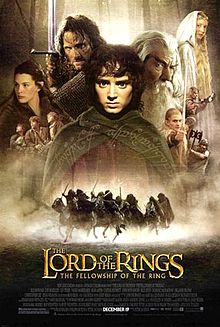
Which members of the Fellowship of the Ring are villainous? Almost all of them, if you ask me.

Just not Boromir though. He’s the one guy you can almost trust. Given a chance for power, he took it. Sounds like a straight-up kinda guy. He’s okay by me.

But those damned Halflings! They are just all bad.

We’ll save Frodo for later, but it’s short work to see that a couple of no-good thieves like Pippin and Merry are full-on bad guys, even if they are short and cheerful. Between starting fires, and raising false alarms, Pippin is a damned mess. I can almost understand his desire to steal the biggest marble in the known universe. That’s understandable. But with a petty offense like that, you gotta come clean when the jig is up. I mean, seriously, it’s Sauron’s marble. Pippin didn’t win it in a fair match. The least he can do is have a polite conversation with the man he’s cheated out of the coolest boulder on the playground. But no! Apparently, that was too much to ask. He has to cry to Gandolf and start a war over it, just so he can keep his prize. It wasn’t even a cleary, fer cryin’ out loud!

And then there is Merry stabbing the king of Angmar in the back during what would have been a perfectly honorable duel with an upstart Princess who has done nothing but disrespect her father, her brother, and every authority figure who tried to help her out in the course of the story. She was about to get taught a damned good lesson when that little runt goes and gets all 9th-level Rogue on her enemy.  Absolutely disgraceful!

Don’t even get me started on that “faithful” toadie, Samwise Gamgee! Can there be any doubt that he is responsible for the terrible depression that befell poor Golem? I mean that guy is in the middle of a deep blue funk that lasts for well over a hundred years and this furry-footed bully goes around calling him names and picking on him constantly.

Plus, poor golem had lost his precious ring. Who the Hell can blame him for wanting it back? It was a damned good ring! And look who stole it? Hobbits. Hobbits, like the very two halfwits golem is now supposed to be helping, one of whom is flaunting his precious under the poor wretche’s very nose. This whole story-line is messed-up in a big morbid way, and there poor golem is on the edge of sanity. Leave it to the fricking henchman to push him off.

Then there is the Gimli and Legolas, with their friendly little competition over how many orcs they can kill. War is one thing folks, you gotta do what you gotta do, but this shit is way over the line! When did killing become fun, I ask you people? Just when did it become a contest? Apparently, when the killers became an elf and a dwarf. Oh look at the cute little creatures killing the ugly people! Let’s bet on who can kill the most!

And then of course there is Aragorn. I could go on and on about this geriatric black sheep of the royal family, but let’s just look at one thing here. Have you ever noticed Aragorn’s sword in the minutes before the final battle at the gates of Mordor? It’s got blood on it. Yeah that’s right, BEFORE the fight he has blood on his sword. Know why? Cause he killed a messenger from Sauron in a deleted scene.

That’s right!

No sooner had said messenger returned a lost mithril shirt that stupid Frodo lost somewhere in Mordor when Aragorn goes and repays this act of great kindness by killing the guy (in cold blood, and during a parlay, no less). Small wonder the director chose to cover that  up. …but he couldn’t hide the blood.

No he couldn’t

Next time someone tries to tell you Aragorn is a hero, just keep asking him; “what about the blood?”

So, now we are down to the last two bad guys. Which is the worse? I know what you’re thinking; it’s Frodo right? After all, he is the one that destroys the most valuable piece of jewelry in all of Middle Earth, causing a great cataclysm which leads to the genocidal destruction of many of the world’s great kindreds. (Seriously do you not see all the orcs and goblins and trolls falling into a great pit at the end of this terrible tragedy? Are we supposed to cheer that shit on?) Yes, Frodo did that. All that destruction is Frodo’s claim to infamy, and it’s a damned good one.  But it still doesn’t win him the prize for the most-hated villain at the Fellowship ball.

Before moving on though, I wonder if we need to say a thing or two about the little guy’s sappy buzz-kill attitude through just about the complete series? What do you do when you have the power to rule the entire world at your finger tips? Sulk and cry about it for three fricking over-long movies. Three of them, I tell you! That alone should get him an award for something.

Still!

Frodo is not the principal villain of this story. It’s Gandolf. What you have to ask yourself is why this big-ass powerful wizard uses his magic so sparingly. I know, I know, he’s only supposed to help and council people, not solve their problems for them. Right? He’s been sent by the powers that be to guide mankind in its struggles. Doing more than that would spoil the moral of the story for them and us. Yadayadayada! We’ve heard this yarn before.

That’s the excuse of every manipulative god-like being in all of history, real or imagined. Just what the Hell are people supposed to get out of all this anyway? Wisdom? A sense of accomplishment?

Tell that to the dead!

Gandolf could have ended the entire war with a bit of basic parlor-magic. He could have returned the ring to its rightful owner and all would have been right with the world of middle earth. Failing that, he could have gone wompy-stompy with his great powers and beat the crap out of his enemies in the first half of the first movie. Still the bad guys win that way, but at least it’s over with quickly. And that my friends is what makes Gandolf the ultimate villain. He doesn’t just want to kill Sauron, whose only crime was in gifting jewelry to the great leaders of the world. No, Gandolf wants to make sure a lot of people die unnecessarily along the way. If you ask me this villainous puppet-master is the worst of the bunch.

…which is saying a lot, because he has a real den of iniquity there in the Fellowship of the Ring. What’s the difference between the dirty dozen and these guys?

Three people!

71.271549 -156.751450

Share this:

  • Tweet
  • Share on Tumblr
  • Print (Opens in new window) Print
  • Email a link to a friend (Opens in new window) Email
  • Share on Reddit (Opens in new window) Reddit
Like Loading...

Gallery

Occupy Anchorage, Communism, and Other Red Herrings

30 Sunday Oct 2011

Posted by danielwalldammit in Alaska, Politics

≈ 2 Comments

Tags

53%, 99%, Activism, Alaska, Anchorage, Economics, Occupy Wallstreet, Politics

This gallery contains 1 photo.

It was a busy day for me last Saturday when I first noticed the Occupy Anchorage folks in Town Square, …

Continue reading →

Alaska Federation of Natives, 2011

28 Friday Oct 2011

Posted by danielwalldammit in Alaska, Native American Themes, Politics

≈ Leave a comment

Tags

Activism, Alaska, American Indian, Anchorage, Elections, Indigenous, Joe Miller, Lisa Murkowski, Native American, Politics, Tea Party

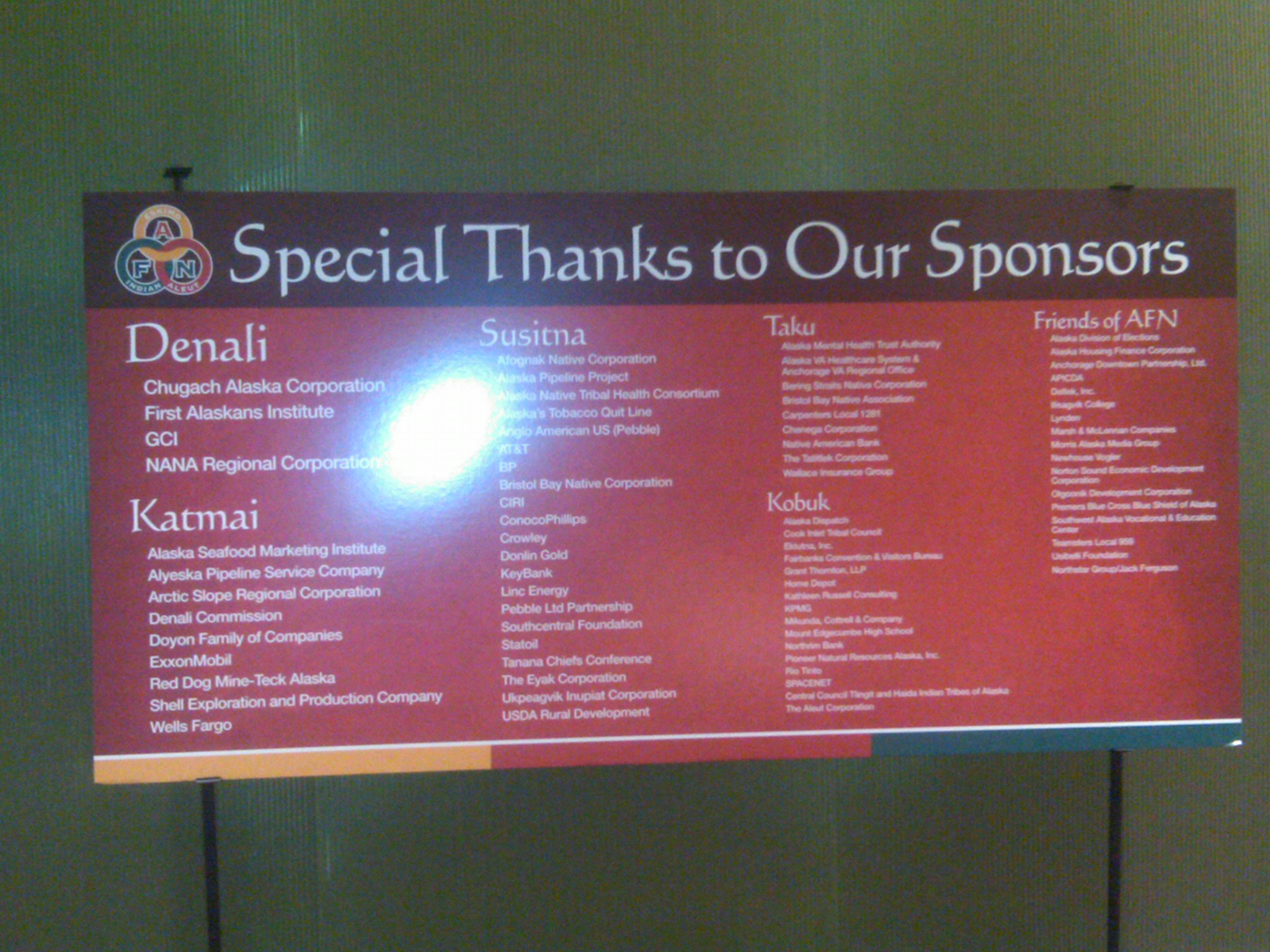
The Alaska Federation of Natives held its annual meeting in Anchorage this last week (October 20-22). This is a big event and it’s filled with enough stories to fill many a blog. What grabbed my attention this year was the participation of Senator Lisa Murkowski.  Watching the first of two presentations she was to give at this year’s convention, brought to mind two other moments.

First, there was last year’s meeting of the AFN, held in Fairbanks. Senator Murkowski spoke then as well. At that time, she was a write-in candidate for her own office. Her principal opposition, Joe Miller, had secured the Republican nomination for Murkowski’s position. A Tea Party favorite, Miller had been openly critical of Alaska’s tribal corporations. Faced with a near certain Republican victory, Alaska’s Native leadership threw its weight behind Murkowski. Lost in the shuffle, the Democratic nominee, Scott McAdams, struggled to keep in the race.

The Alaska Federation of Natives endorsed Murkowski and she spoke at their convention. Denied the chance to debate Murkowski in a public forum, or to speak on their own, McAdams and Joe Miller made appearances on the floor of the convention. If McAdams received little in the way of attention, Miller must have received a very chilly reception.

A year later, Senator Murkowski took to the podium again, this time at the Dena’ina Civic and Convention center appropriately enough, the very location at which she announced her write-in candidacy. This year, Murkowski took to the floor once during the convention itself, and once again at the closing banquet, both times the substance of her speech was an expression of thanks. If Murkowski’s gratitude was apparent, so was the pride of AFN leadership. They had played a substantial role in getting her back into office, and this year’s AFN proved to be an opportune moment to trumpet that victory.

The second thing on my mind proved to be a very different kind of moment in the politics of indigenous affairs. In early February, 1998, then President of the Navajo Nation, Albert Hale, threatened to shut down the roads passing through Navajo lands. Doing so, he suggested would help to teach non-natives to respect the sovereignty of the Navajo Nation

The immediate response to Hale’s threat was fascinating. Non-Indians wrote all manner of letters to various local newspapers, most of them angry. On the one hand, much of the criticism seemed understandable. Hale hadn’t really put any specific issue on the table, so no-one knew really what he wanted out of the move. (Some of the more cynical among us might have believed it was to draw attention away from an ethics investigation which soon led to Hale’s ouster.) But something more interested proved to be happening in those letters; an awful lot of non-natives were learning the hard way that Indian people’s still held a measure of power in the United States. For all the poverty and corruption one can find in Indian country, for all the problems that tribal leadership seemed unable to resolve, there were at least a few things that they could still do. And one of those things was to make it a lot more difficult to drive through parts of the Southwest.

This is where the other letters from that time come in, the ones from the Navajo people. Many were less than pleased with Hale’s gambit themselves. I was living in Fort Defiance at the time and I recall quite well the shaking heads and office gossip. This was not the way to do things, at least according to the folks I knew.  What use is sovereignty if it only means shutting down roads, some seemed to say? It would be far better, so the argument went, to build a road, or at least to repair the roads already there.  A gesture intended to show the power and force of the Navajo Nation, Hale’s threats seemed only to underscore the relative weakness of Navajo leadership.

I couldn’t help but think about Albert Hale’s road-gambit as I saw Lisa Murkowski speak at AFN.  The basis for the comparison sis simple enough. To me, Hale’s move had always been something of a low-moment in Native American politics, but now I was watching a high one, at least as measured by raw political power. This was Native Alaskans doing what Hale had failed to do back in 1998, they were actually building something.  Now as it happens, it wasn’t a road that Alaskan natives built here, it was a political base capable of affecting a major election, but that election itself is precisely what it will take to get the roads built in Alaska’s Native communities.  Faced with a threat from an outside source, The Alaska Federation of Natives did what it took to ensure that their own interests were protected.

Such victories are hardly new for the Alaska Federation of Natives, but perhaps that is my point. In a world where native politics is so often relegated to symbolic victories, this organization stands out as one of the major players in Alaskan politics. The theme for this meeting of the AFN was “Strength in Unity,” and what better proof could its leaders offer than the re-election of Murkowski to the U.S. Senate. Here at least, Native Leaders had demonstrated with perfect clarity that they were a force to be reckoned with.

Share this:

  • Tweet
  • Share on Tumblr
  • Print (Opens in new window) Print
  • Email a link to a friend (Opens in new window) Email
  • Share on Reddit (Opens in new window) Reddit
Like Loading...

Great Movie Villains, Volume II: Princess Fricking Buttercup!

19 Wednesday Oct 2011

Posted by danielwalldammit in Movie Villainy, Movies

≈ 2 Comments

Tags

Film, Movie Villainy, Movies, Princess Bride, Story-Telling

True love, my ass!

What is it that her principal love interest keeps saying to lovely  Buttercup at the beginning of the movie? “As you wish.” Whatever Buttercup  tells him to do, Westley answers with “as you wish.” Seriously, if hearing that doesn’t make you shudder, then this witch’s powers have already reached through your flatscreen TV monitor and bitch-slapped the good sense out of your soul. That isn’t love; it’s co-dependency. Learn the difference people!

My God, what that poor soul, Westley, must have been through to have been reduced to such a wretched state by the start of our little fairy tale. And this is but the first caress, a mere taste of the suffering Buttercup is capable of inflicting on people. Long before Lt. Columbo begins to relate this tragic narrative to the helpless little boy he is about to horrify, the dreaded Butterup has already reduced our would-be hero to a mere shadow of a man.

But of course Westley’s suffering is only just beginning, because it is “true love” that keeps him alive when he is captured by pirates. Are we really supposed to believe that this witchcraft is benign? Small wonder that when our kitty-whipped hero re-emerges he is clothed in black just like any other form of living dead would be. One can only guess at the horrors his own victims have suffered, all at the hands of a man empowered by little other than his morbid devotion to a woman far away!

It does not end there, no. First the lovely miss Buttercup seduces a boat-load of innocent men and leads each of them one by one to their ruin. First Inigo, then Fezzik, and finally Vizzini, each in turn meets our mere shadow-of-a-man on their own terms, and each faulters in a test of his own greatest strength.  Are we really supposed to believe that the spineless little co-dependent has developed so many talents in his short years as an undead pirate? No, my friends, it was the malevolent power of the lovely Buttercup that weakened these once proud men and brought them all to ruin.

I know it’s a fairy tale; strange things are supposed to happen. My point is that fairies can be fricking scary. If Buttercup does not scare you yet, then you have got balls of steel my good reader.

Or do you?

Let us not even consider the many examples of Buttercup’s other monstrous powers; her moral destruction of a Prince and likely his entire kingdom, the reduction of a high priest in all his dignity to a mere Pythonesque caricature, the pointless slaughter of unusual and probably endangered swamp creatures, and the morbid double reanimation of twice-dead Westley by a pair of witches who conveniently enter the story just in time to keep the finally-vanquished abomination going.

Seriously, they say that it takes 4 witches to make a coven. We know who the first 3 are, but Princess Bride never reveals the fourth. I have my suspicions.

But that is of course the real power of Buttercup, Mistress of Ultimate Evil. She reaches right through the story and corrupts to heart of a young and defenseless boy. Does he not ask his uncle to read the part with all the kissing? And what self-respecting young boy would ever do that? None, I tell you. And in that moment, this movie reveals the real target of Buttercup’s mischief. It was the boy she was after all along. It was his heart she sought to corrupt, his will she sought to weaken. And she succeeded, did she not?

Buttercup’s powers are not merely restricted to characters in her own story. No, she has the capacity to reach right through the narrative frame and corrupt the hearts of those for whom she is supposed to be a mere character in a story.

And THAT my friends is precisely why you must fear this woman. Can you name any apparent chick-flick about which grown men have ever sung so many praises? How many self-respecting testosterone-poisoned grunt-brains have taken time away from a good wrestling match to tell you they actually like THAT movie, as if to suggest that this is the exception to their normal preferences. No, they haven’t succumbed to the power of the girlie-romance; it’s just that this movie is so damned good and so unusual that they cannot help but like it. The story of the Princess Bride is not really just another girlie-flick; it’s a romance movie that even men can love. That is what so many men want you to believe.

Take care, my friends! For, that is also what SHE wants you to believe.

71.271549 -156.751450

Share this:

  • Tweet
  • Share on Tumblr
  • Print (Opens in new window) Print
  • Email a link to a friend (Opens in new window) Email
  • Share on Reddit (Opens in new window) Reddit
Like Loading...

Against Tolerance

17 Monday Oct 2011

Posted by danielwalldammit in Politics

≈ Leave a comment

Tags

Culture Wars, Gay Rights, Homosexuality, Hypocrisy, Politics, Tolerance

“Tolerance?” Yep, I’m agin’ it!

…or at least certain rhetorical uses of the term.

Let’s start with the most obvious, and perhaps the most important example in contemporary American politics, tolerance of homosexuality. People often invoke the value of tolerance as a means of advancing acceptance of homosexuality. There is definitely some positive value to this approach, but the stratagem has at least two major flaws.

Problem 1: Apparent contradiction. The typical response here is to say that those pushing tolerance of homosexuality often show themselves to be intolerant of those who are intolerant of homosexuality. (Yes, that’s a serious double-negative maze in there, but you can manage it, I know you can.) Simply put, some people advocating tolerance really are too quick to attack cultural conservatives (particularly evangelical Christians) in personal and inappropriate ways. And if there are reasonable ways  to advocate tolerance for homosexuals while remaining critical of its critics, well, let us just say that an awful lot of people are too tone deaf to notice the necessary distinctions.

Problem 2: The Open Door Defense. I first noticed this problem when I heard someone claim to be tolerant of blacks. I just could not get my mind past the notion that there was anything about African Americans that needed tolerating. And therein lies the problem; at least one way of construing the term in question suggests that the person to be tolerated has actually done something wrong, something that will require a gesture of goodwill, even mercy, if they are not to be condemned in some manner. I think most people see this implication quite clearly in most uses of the term, and I think that is precisely why we do not normally ask for tolerance of blacks? Jews? Mexicans? …or people from New Jersey. We don’t normally ask people to tolerate different ethnic groups, precisely because that’s a rather damning defense of them.

If you are serious about defending the rights of minorities, then an appeal to tolerance is not how you would go about it. So, why is this continually the go-to principal for defense of homosexuality?

Tolerance is what one grants to kids that are acting up, to drunks that are getting loud, or to obnoxious customers when one is unfortunate enough to work in customer service. Tolerance is what one extends to people, not because they deserve it, but because you are feeling especially generous today (or when the boss is paying you to accept fecal input without complaint).

And therein lies the liver of this problem. Lots of people ‘tolerate’ homosexuality. …which is to say that they don’t scream and point, or get out a baseball bat when they see folks of homosexual orientation. They might not even fire a gay or bisexual worker at the first sign of good fashion sense, and that is the extent of their tolerance. And some folks congratulate themselves on their lack of violent and overt hostility. They think they are doing very well because they don’t attack or openly condemn homosexuals, at least not literally. But of course the very logic of tolerance suggests that they reserve the option to do so. …to express their disapproval if and when the mood strikes them.

Tolerance is what one extends to others out of personal largess. It’s a kindness one does for others when one isn’t feeling a little left of their own mind on any given day. This kind gesture goes to the glory of the one doing the tolerating, not the person tolerated. The object of toleration is, in a sense, demeaned by the implication that he requires this treatment for one reason or another.

Tolerance is a gift, and the problem is the gift is given or not given at the whim of the giver.

Advocating tolerance is like asking people to be nice. Folks may or they may not go along with it, but the request does little to foster the notion that there is anything obligatory about the matter. Granted, a willingness to accept people as they really are might be implied somewhere in notion, and that’s a damned fine value if someone truly embraces it. But for every individual that truly takes that message to heart there are many more who learn by the virtue of ‘tolerance’ to set their jaws and be quiet, sit an extra chair over from the offending party and go about their business, or just generally let it slide …for now.

As a substantive agenda, this is begging for scraps. And it’s settling for a truce while the enemy keeps his guns pointed. (…yes, we can produce additional metaphors, but you get the idea.)

I’d rather enter the debate with a little more muscle. To the degree that this is a public issue at all, it is an issue that involves rights. And rights are not asked for. They are not requested, and they are not presented as optional. One does not prove oneself to be an exceptionally good person by recognizing the rights of another. It is expected.

Rights are demanded. One should not be asking folks, for example, to tolerate a homosexual in the work place; one should be making it clear that mistreatment is not an option. It is not that someone would be nicer if they didn’t condemn the gay friend at a social outing; they should be informed clearly that doing so will not be …tolerated.

Told you I was against tolerance.

Share this:

  • Tweet
  • Share on Tumblr
  • Print (Opens in new window) Print
  • Email a link to a friend (Opens in new window) Email
  • Share on Reddit (Opens in new window) Reddit
Like Loading...

Wrestler on a Machine (Warning: Spoilers!)

17 Monday Oct 2011

Posted by danielwalldammit in Movies

≈ Leave a comment

Tags

Dissapointment, Film, Movies, Narrative, Story-Telling, Wrestling

So, I finally watched “The Wrestler,” and I almost liked it.

Almost.

I find myself wondering, at what point does failure to resolve a conflict amount to the same thing as letting the hand of God resolve it for you. The movie goes well out of its way to show us that this character has depth, that he has feelings, that the bits and pieces of his broken life matter to him in deeply personal ways.

All of which just makes the final ending such a disappointment.

The way I read it anyway, the central problem is what is he going to do with his life now that wrestling is over. Sadly, the final answer appears to be “pretend that it isn’t.” The move is tantamount to suicide, of course, but that is beside the point. It really doesn’t matter if we imagine the main character dying two minutes after the closing credits or surviving the match, even somehow doing another one. The bottom line is that this solution doesn’t work unless we ignore the very premise which led to it, namely that his heart won’t allow him to wrestle.

Of course the main character has his reasons which he delivers in a compelling speech to the love interest he is turning his back on to go wrestle, but that is the main problem. This guy can’t find any other way to proceed with his life than to go back in the ring? I think the writers believed in this character less than they wanted the audience to. In the end, they could not let him be anything but a meat-head. And all the rest goes out the window with that decision.

He took the easy way out.

So, did the people who made this movie.

71.271549 -156.751450

Share this:

  • Tweet
  • Share on Tumblr
  • Print (Opens in new window) Print
  • Email a link to a friend (Opens in new window) Email
  • Share on Reddit (Opens in new window) Reddit
Like Loading...

My Novel

17 Monday Oct 2011

Posted by danielwalldammit in General

≈ 4 Comments

Tags

Folklore, Half Baked Ideas, Internet, Myth, Nigerian Letters, Scams

Okay, so let’s start with the protagonist. He is from somewhere in sub-saharan Africa. We’ll call him Mbaté Ngu(click)ulu. Now Mbaté is a dedicated man. He has devoted his entire life to his people in the capacity of Deputy Foreign Minister to his nation. Now as a result of some coup backed by an opportunistic multinational corporation, Mbaté and his entire government is out, and Mbaté doesn’t quite know what to do. Having access to almost a hundred million dollars, Mbaté knows that he can’t access it directly or the bastards that stole his country will just get him and his money. So, he goes online where he begins contacting people. He has a short list of trustworthy individuals, all provided by mutual friends, and Mbaté knows that with the help of just one of these people, he will yet save the day…

It’s a heartbreaking story of one man’s quest to find a helping hand in an increasingly cynical world. You too will be caught up in Mbaté’s struggle to find help. You’ll laugh; you’ll cry. You’ll probably go to the bathroom at least once. (Seriously, you’ll want to take Mbaté with you.) Because poor Mbaté isn’t going to have it easy, and this epic struggle is not resolved overnight.

Thankfully though, Mbaté will not have to do all of this alone. With the help of his friends, a Viagra salesman, a IRS man with a a bunch of checks for you and me, and an army of horny MILFs just looking for someone to have sex with (no strings attached), Mbaté may yet succeed in finding a single trusting soul, just one person willing to help him secure the means of helping his own people.

Stay tuned for “Mbaté’s Plea,” coming in the Spring of 2012, 2013, or even 2014, if that’s really necessary. Mbaté will soldier on for as long as it takes.

Share this:

  • Tweet
  • Share on Tumblr
  • Print (Opens in new window) Print
  • Email a link to a friend (Opens in new window) Email
  • Share on Reddit (Opens in new window) Reddit
Like Loading...

Great Movie Villains, Volume I: Surrender Dorothy!

16 Sunday Oct 2011

Posted by danielwalldammit in Movie Villainy, Movies

≈ Leave a comment

Tags

Film, Movie Villainy, Movies, Wicca, Wizard of Oz

I was reading a forum discussion about great movie villains, and it suddenly occurred to me that people always seem to get this wrong. So, I wanted to say something about the REAL villains of the movies. None of this namby-pamby, “Oh Sauron is such a meanie, don’t take his rings” gift-horse-in-the-mouth kinda whinging. I mean, what’s a few orcs and black riders!?! That ain’t villainy. I want to get serious here and find the REAL thing. Truly evil movie characters that deserve their spot in the villainy hall of fame.

Let’s start with Dorothy from The Wizard of Oz. Now you’d think she was just another homeless teenager wandering the streets, you know. “Oh look, she’s so cute, and she sings too, maybe we should feed her,” that’s what most people seem to think. But I am not buying the “accidental” status of that first killing. No way man! Especially not when she takes the poor woman’s shoes. It’s a straight up smash and grab operation, no question about it. She pops the poor woman with a house and takes her stuff. I ask you, how is that NOT villainy?

And it’s awful damn convenient that Dorothy can’t take the shoes back off. Yeah right! I’m guessing whoever she has lined up to fence the rubies will do just fine when the time comes. Then she steals a scarecrow and a robot. Are we supposed to think the original owners had no use for them? As if that wasn’t enough, she goes and takes a lion out of the wild. I know it sounds PC to say this, but I’m telling you some creatures just aren’t meant to be used as pets.

Don’t even get me started about her thing with the Poppies. This isn’t the eighties anymore, you know people. Drugs are NOT cool!

And of course we’re supposed to be proud of her when we see little miss pigtails ruin the whole Wizard’s gig, but I’ve got no sympathy for hecklers who absolutely refuse to sit back and enjoy the show. The old guy was rather gracious about it, but that doesn’t change the fact that sweet little Dorothy proved herself to be one of the greatest spoilsports of all time in that scene. What’s next? Does she go to the mall and tell all the children Santa is really Uncle Bob?

I mean honestly, if you can’t enjoy the show, then please don’t ruin it for others. Sheesh!

And then there is the not-so-small matter of our little darling’s second victim. Accident my rootie tootie! Dorothy knew exactly what she was doing. And that’s two witches within the space of one show. I mean what does this woman have against Wiccans anyway!?! They’re a peaceful lot, never harmed anybody, but no, this sweet face is just an anti-Pagan killing machine. And we’re supposed to be happy she made it home? Happy she finally left, you mean. Now at last the people of Oz can begin to put their lives back together, whatever she left of them.

I’m telling you, for my book, this no-good little hussy has got to be one of the top movie villains of all time.

…and her little dog too!

71.271549 -156.751450

Share this:

  • Tweet
  • Share on Tumblr
  • Print (Opens in new window) Print
  • Email a link to a friend (Opens in new window) Email
  • Share on Reddit (Opens in new window) Reddit
Like Loading...
← Older posts
Newer posts →

Top Posts & Pages

  • Hostiles and Spoilers: A Magic Studi
    Hostiles and Spoilers: A Magic Studi
  • An Uncommon Security Guard: Dave Eshelman, AKA 'John Wayne'
    An Uncommon Security Guard: Dave Eshelman, AKA 'John Wayne'
  • Arctic Graffiti!
    Arctic Graffiti!
  • When Sex Falls Out of the Performance
    When Sex Falls Out of the Performance
  • Barter Island ...Includes Bears
    Barter Island ...Includes Bears
  • A Little Monday Mischief
    A Little Monday Mischief
  • The Grey - Movie Review (Yeah Spoilers)
    The Grey - Movie Review (Yeah Spoilers)
  • Old Pranks Don't Matter, ...Unless They Do.
    Old Pranks Don't Matter, ...Unless They Do.
  • The Truly Trashy Post: Barrow's Finest Dumpsters!
    The Truly Trashy Post: Barrow's Finest Dumpsters!
  • An Uncommon Beer Tap.
    An Uncommon Beer Tap.

Topics

  • Alaska
  • Animals
  • Anthropology
  • atheism
  • Bad Photography
  • Books
  • Childhood
  • Education
  • Gaming
  • General
  • History
  • Irritation Meditation
  • Justice
  • Las Vegas
  • Minis
  • Movie Villainy
  • Movies
  • Museums
  • Music
  • Narrative VIolence
  • Native American Themes
  • Philosophy
  • Politics
  • Public History
  • Re-Creations
  • Religion
  • Street Art
  • The Bullet Point Mind
  • Travel
  • Uncategorized
  • Uncommonday
  • White Indians
  • Write Drunk, Edit Stoned

Blogroll

  • American Creation
  • An Historian Goes to the Movies
  • Aunt Phil's Trunk
  • Bob's Blog
  • Dr. Gerald Stein
  • Hinterlogics
  • Ignorance WIthout Arrogance
  • Im-North
  • Insta-North
  • Just a Girl from Homer
  • Multo (Ghost)
  • Native America
  • Norbert Haupt
  • Northwest History
  • Northy Pins
  • Northy-Tok
  • Nunawhaa
  • Religion in American History
  • The History Blog
  • The History Chicks
  • What Do I Know?

Archives

  • December 2023
  • November 2023
  • June 2023
  • April 2023
  • February 2023
  • December 2022
  • November 2022
  • October 2022
  • September 2022
  • August 2022
  • July 2022
  • June 2022
  • April 2022
  • January 2022
  • December 2021
  • November 2021
  • October 2021
  • September 2021
  • August 2021
  • June 2021
  • May 2021
  • March 2021
  • February 2021
  • January 2021
  • December 2020
  • November 2020
  • October 2020
  • September 2020
  • June 2020
  • May 2020
  • March 2020
  • February 2020
  • January 2020
  • December 2019
  • November 2019
  • September 2019
  • August 2019
  • July 2019
  • June 2019
  • May 2019
  • April 2019
  • January 2019
  • December 2018
  • November 2018
  • October 2018
  • September 2018
  • August 2018
  • July 2018
  • June 2018
  • May 2018
  • April 2018
  • March 2018
  • February 2018
  • January 2018
  • December 2017
  • November 2017
  • October 2017
  • September 2017
  • August 2017
  • July 2017
  • June 2017
  • May 2017
  • April 2017
  • March 2017
  • January 2017
  • December 2016
  • November 2016
  • October 2016
  • September 2016
  • August 2016
  • July 2016
  • June 2016
  • May 2016
  • April 2016
  • March 2016
  • February 2016
  • January 2016
  • December 2015
  • November 2015
  • October 2015
  • September 2015
  • August 2015
  • July 2015
  • June 2015
  • May 2015
  • April 2015
  • March 2015
  • January 2015
  • December 2014
  • November 2014
  • October 2014
  • July 2014
  • June 2014
  • May 2014
  • April 2014
  • March 2014
  • February 2014
  • January 2014
  • December 2013
  • November 2013
  • October 2013
  • September 2013
  • August 2013
  • July 2013
  • June 2013
  • May 2013
  • April 2013
  • March 2013
  • February 2013
  • January 2013
  • December 2012
  • November 2012
  • October 2012
  • September 2012
  • August 2012
  • July 2012
  • June 2012
  • May 2012
  • April 2012
  • March 2012
  • January 2012
  • December 2011
  • November 2011
  • October 2011

My Twitter Feed

Follow @Brimshack

RSS Feed

  • RSS - Posts
  • RSS - Comments

Enter your email address to follow this blog and receive notifications of new posts by email.

Join 8,068 other subscribers

Blog at WordPress.com.

  • Subscribe Subscribed
    • northierthanthou
    • Join 8,068 other subscribers
    • Already have a WordPress.com account? Log in now.
    • northierthanthou
    • Subscribe Subscribed
    • Sign up
    • Log in
    • Report this content
    • View site in Reader
    • Manage subscriptions
    • Collapse this bar
 

Loading Comments...
 

    %d