Kivgiq II: The Box Drum Dance

Tags

, , , , , , , ,

As I mentioned in the last post, my favorite dance at Kivgiq is the Box Drum Dance. As it happens, I got a decent set of videos from a performance of the Barrow Dancers. By ‘decent’ I of course mean for a random guy sitting in the stands with an okay sorta camera. This stuff ain’t gonna make the Home Video Hall of fame. But the subject speaks for itself. The first video is the Box Drum Dance. Unfortunately, I botched the second film, so one key dance is missing. It’s a damned shame too, because it’s an interesting dance. But immediately following that missing dance, there are usually a series of performances usually described as fun dances. I got those.

I wouldn’t pretend to know enough about this dance to describe it accurately. So, I will instead include a link to a wonderful page on the topic.

http://www.nativetech.org/inupiat/pullinginnewyearbody.html

Anyway, here are the videos.

.

.

.

.

.

.

.

Kivgiq!!!

Tags

, , , , , , , ,

Canadian Guests

Canadian Guests

Oh my, how time does fly!

It’s been over two months since Kivgiq. I’ve been meaning to write something about that since, well, …since two months ago. I’ve also been putting it off while catching up on other things. But you never do catch up, do you? And Kivgiq is worth a moment of bloggetry, so here goes!

So, what the Hell am I talking about? I’m talking about the Messenger Feast! At this point, it’s a biennial celebration taking place in February here in the North Slope. All the other villages of the North Slope are invited to several days of singing and dancing, and of course to a grand feast. Mostly, it means Iñupiat dance troops from all over the place. Sometimes folks even come in from Canada.

February is a special time of year in the North Slope, owing to the rapid return of the sun. It’d difficult to convey just how much that means to folks. After two months of polar midnight, people are ready for it. More than ready for it! And it’s return is spectacular. By February, we are starting to have something resembling an actual day here in Barrow, and yes, this is one more thing to celebrate.

Having recently picked up David Graeber’s chapter on the Myth of barter in Debt: The First 5,000 Years I was particularly interested in the role this feast may have played in the traditional economies of the region. One of the most interesting chapters in Graeber’s work details the absence of barter within small-scale small scale communities (this despite all the efforts of economists to put it there via thought experimentation). What happens in such communities, according to Graeber? Well people share the resources within their own community; they barter with outsiders, particularly those with whom they might be as likely to fight as to trade. Graeber further notes that the possibility of violence is often worked into the symbolism of the exchange.

To see the cooperative economics of the native community in Barrow, one needs only look at the whaling activities and subsequent distribution of muktuk throughout the community, though I suppose if you were looking for a ritual that enshrines this practice it would be Nalukataq in mid to late June. To see the tradition of bartering with neighbors? Well, now that would be Kivgiq, at least as it was initially practiced.

Charles Brower Sr., a town patriarch of sorts, provided a description of a Messenger Feast from the early twentieth-century which is particularly striking. Two messengers had been sent out to other villages, returning with the guests in July. The feast began as it does today with a footrace. Afterwards…

The main body of visitors followed, two hundred or more stretching out in a long line. Some bore mysterious packages on their backs, others dragged sleds piled high with skins. Everyone was dressed in his worst. I never saw a more disreputable looking crowd – nor one whose tatters covered more suppressed excitement.

Just above the station they were met by a picked up group of village men, naked to the waist. Each wore a loonskin on his head and carried a few arrows and a bow. Suddenly they gave a yell and started shooting over the heads of the strangers. Their arrows gone, they then retreated to the dance house where the rest of the crowd was congregated, still a bit put out over the results of the foot race (the local participants from the village of Utkiagvik had been soundly beaten).

At this time our messengers who had supposedly returned with the guests were nowhere to be seen. They’d have a hard time sneaking in the dance house now, I thought unless they too had dressed in old clothes, hoping to mingle with the guests and escape detection.

I was scanning the crowd with this in mind when a riot broke out in the doorway. A group of visitors laden with rolls of deer-skins, were demanding entrance, the guards steadfastly refusing to let them through. Higher and higher rose angry voices until, with final protesting shrieks, the guests were forced to unroll their deer-skins, and there inside lay our messengers, nearly smothered by heat and stifled laughter.

Mungie came by, grinning broadly. an old trick, he said.these inland people must have thought we’d never heard of it.

Our ‘home folks’ furnished the music that first day, visitors doing the dancing. A man and a woman would enter and dance, then loudly announce what they had brought for the one who had invited them. After which the recipient joined in and all three danced together.

Later the women disappeared to make ready the feast – mostly whale meat and seal. Many of the inland people, unfamiliar with such delicacies, couldn’t get the stuff down. Lucky for me that I’d learned to take my muctuc like any coast native, for this enabled me to join the crowd in making fun of our visitors. Their only comeback was to hint broadly at what they expected in return for their presents.

Since it was a matter of tribal pride that visitors be satisfied or else given back their own presents – a most humiliating procedure, our people went to ridiculous lengths to meet the demands. Many sold their whalebone to provide needed funds. A few of the poorest even asked for additional credit at the station. Anything to uphold the reputation of Utkiavie. It was silly – and a little touching.

I hadn’t yet seen our visitors at their best, for all this time they had been wearing their most ragged clothing. But when they took over the drums the second day while our crowd danced it was like the transformation of cocoons into butterflies. Decked in all the finery they had brought in bundles, they certainly were a fine looking lot of people. Many of the men were six feet tall. Even their women seemed larger and better looking than average Eskimos.

The third and last day was given over to the actual exchange of presents. I say ‘exchange.’ In reality it turned into one grand bargain-driving spree. If a gift fell below expectations, the owner kept adding to it until he had nothing more to offer. And when this failed to satisfy, the other par6ty demanded his present back even though he often sold it later for whatever it would bring.

I’ll end the narrative there, both because that is the relevant portion and because the whole story soon takes a tragic turn. After trading with non-native whaling crews, the guests contracted a disease, Brower figured it to be a kind of flu. Severely weakened from the flu, they elected to return home. For some time, the bodies could be found scattered along the river way headed inland, Brower doubts that any made it home.

What Brower saw was one of the last celebrations of the Messenger Feast held in the early twentieth-century. By the 1920s, natives had stopped holding this feast entirely. It would not be revived until 1988 when North Slope Borough leadership held the first Messenger Feast in roughly 80 years.

The Messenger Feast still retains many of the same themes present in Brower’s description, though specific details vary considerably. If I had dragged my butt out of bed early enough to catch the race, I could tell you all about that, but well, …I suck.

Seriously, I do.

The tradition of gift giving is still present, though it is less central to the ritual. People give a broad range of gifts to others (though items with a distinctively Iñupiat cultural significance seem to figure prominently in these events). One often sees the gifts sitting on the floor of selected open dances (in which any in the audience are invited to participate). Special gifts sometimes merit a moment in the spotlight for those involved. Either way the giver and the recipient will be out there for at least one dance.

I have asked a number of people whether or not reciprocation is expected, and or how that might be structures. The range of answers I’ve collected so far defies my ability to interpret all the variations. I most definitely did not see haggling, or heated exchanges over the value of the items in question. And if the significance of this theme has faded a bit, I would suggest that is at least partly due to the changing local economy. Gone are the days when inland and coastal peoples would have provided distinct contributions, much less the days when an event such as this could have presented a truly unique opportunity to get exotic foods or products. What remains is a symbol of generosity, albeit one with a very interesting history.

My favorite event in Kivgiq would have to be the box-drum dance, but I’ll save that material for a follow-up post. I wasn’t that happy with my pictures this year, but I think a few of them are worth sharing. If you click the pictures they will of course embiggen.

I just have one video here that I will include in this batch. It stands out for me, because it illustrates so wonderfully the role of children at these events. Planned or unplanned, they are seemingly always involved in the performances. And if that lends a little chaos to a dance, then so much the better.

Irritation Meditation # 5: Persecution Ain’t a Fricking Contest!

Tags

, , , , , , ,

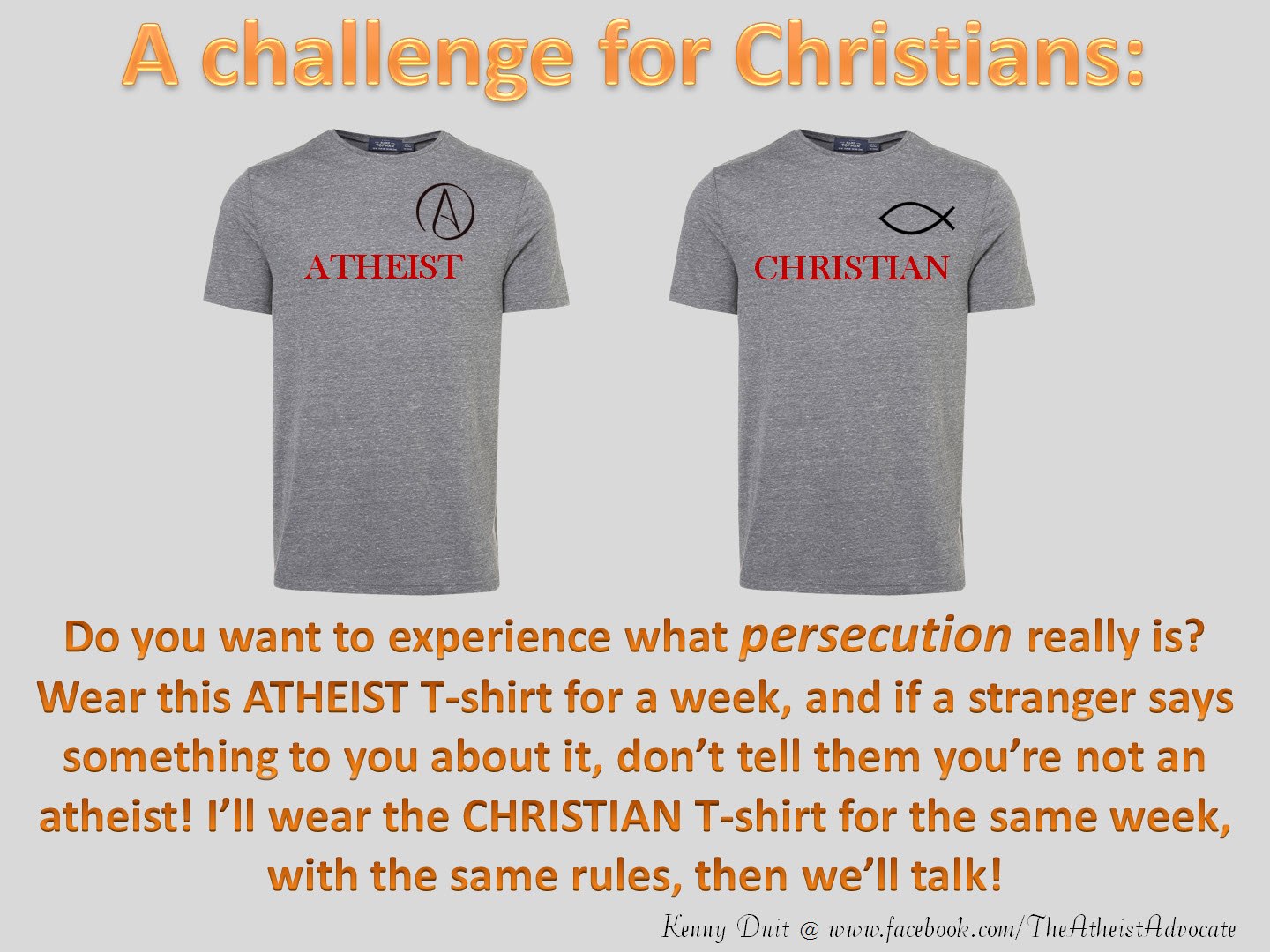
FXdukveAs far as irritation goes, this one comes close to being a mere amusement. I am talking about a challenge issued by The Atheist Advocate, the terms of which are fairly well explained by the illustration here, and I have to admit it’s tempting to just get behind this one. Seriously, I can almost go along with it.

…almost.

If only I had a nickel for all the times I have seen Christians complain about petty grievances or pass along outright falsehoods about this or that attack on their faith, well I could certainly afford another nice meal on that change. Hell, the non-existent war on Christmas alone ought to earn some believers a permanent subscription to “Cry Wolf Daily” (which actually wouldn’t be a bad blog project, come to think of it). Anyway, the point is that it gets damned tiresome to hear a dominant religious majority whine about how religious minorities are oppressing them.

But of course it isn’t really a dominant majority that spreads these cries of repression. Rather it is a small and highly vocal group of political Christians who would like very much to define repression of their beliefs so broadly as to include the failure to bow to their every Goddamned whim.

Taken at face value, I can’t help thinking this little gambit doesn’t quite rise above the difficulties it seeks to address. This whole thing really strikes me as something of a contest over First World Problems. One would hate to run into the occasional lunatic that might make either of these T-Shirts cause for real violence. …or the occasional workplace bigot that might actually use less violent means of putting someone from the wrong camp in their place. In any event, I expect most folks here in America would probably face little other than an uncomfortable conversation or three over wearing either of these shirts. There are some definite regional exceptions to be sure (cough! …deep South! …midwest!), but for the most part I think we are talking about a war of words.

Yes, I do figure those wearing an ‘atheist’ T-Shirt will have quite a few more of those unpleasant conversations than those wearing a ‘Christian’ T-Shirt, but I am open to the possibility that I am wrong about that, and I certainly wouldn’t estimate the flack for wearing the Christian shirt to be zero. Oddly enough, I expect some of the grief given to both Christians and atheists over this sort of thing could come from the same sources. An awful lot of people seem to want to have their sin and get to heaven too, so to speak, and they can be equally testy with religious fundamentalists and non-believers alike. This ‘moderate’ bunch can be especially testy if they believe someone else has brought the issue to the table and tried to force the question, …say by advertizing their (non-)beliefs in public.

That said, yes, I do think Christians are more likely to get a free pass on public expressions of their views f for no other reasn than that they have had their foot in that door for longer than those of us in the just-say-no camp. What strikes me as far more important is the fact that the list of people who have found out what ‘persecution really is’ would be unlikely to include anyone whose main worry of the day is what people will say about an ugly T-Shirt. There are people out there who face real consequences because of their belief-stances, and both atheists and theists are among them. That list also includes plenty of people who face real suffering as a result of things over which they have absolutely no control whatsoever. So, I think people should count themselves blessed if they live somewhere that you could actually play this game and expect life to continue in the wake of it.

As a general rule, I think anyone who wants others to appreciate the struggles they face could do better than to start by trivializing those of others people. I also think we would all be better served if folks spent less time claiming the title of most-repressed and more time thinking about what constitutes reasonable treatment of those with whom we disagree.

Oddly enough I’m not really opposed to the challenge, per se, just a certain over-billing of its significance. Still, if this leads a few of the more self-important Christians to rethink their narratives of martyrdom, then perhaps it’s a good thing. If it leads some people of either camp (or any other) to think carefully about their own bully-triggers and what we can do to help those under the gun for such things, so much the better.

Thoughts on the Cherokee Blood-Feud, or Anthropology is Only Fun Till Someone Puts an Eye Out!

Tags

, , , , , , , ,

Three Cherokee

Three Cherokee

…and of course that is when it gets really interesting.

By poking an eye out, I am of course talking about a special sort of moment one gets from time to time in the study of anthropology, at least I do. It’s the sort of moment when some cultural practice causes the hair on the back of your neck stand up and your stomach tries to dig its way to China (or Antarctica, as would be the case here in Barrow). I’m talking about that kind of moment when you encounter something in an ethnography that just seems like too much. So, you sit there and ask yourself, “How in the Hell could that be anything but wrong?” And for a little while anyway, your mind just doesn’t want to travel down that road, the one that leads to understanding the practice in its own context. You’d rather just say ‘no’. Hell, you’d rather shout it at them across the waters, over the mountains, and even if need be through the ages, cause someone needs to say it somehow, “This is just wrong!”

For the students in one of my classes this semester that moment came courtesy of the Cherokee blood feud, and the sticking point was very clearly collective responsibility for murder. Simply put, the feud enabled the clan of a murdered individual to claim revenge against any member of the clan to which the offending party belonged. More than that, the terms of this blood feud obligate people to do so.

But I said ‘murdered’ didn’t I?

Sequoyah

Sequoyah

That’s not quite right. In the old way, any individual responsible for killing another Cherokee could initiate the obligation to exact revenge, even if the killing was an accident. As our reading described it, a horse borrowed for the day could start trouble by bucking its rider off, thus triggering a feud between the clan of its owner and that of the deceased rider. So pretending for this paragraph anyway that I am Cherokee – I’m not, …not even the ubiquitous Cherokee grandmother every other white guy seems to have been blessed with – but let’s just pretend for a moment. If my brother’s horse spooks and kills a rider, I could be killed in revenge for this event. They do not need to take the offending party (if there even is such a person in this example); they might prefer to kill a different member of my brother’s clan (someone like ME, perhaps). So, I could die because of something my brother did, …even if that was an accident. The article we read even contained an instance in which a killer talked the avenging parties into killing someone else from his own clan.

And yes, this bothered my students. I can’t really blame them, because I can remember my own feelings years ago as I came to grips with this kind of dispute-system. It violates my sense of justice too, or at least the master metaphors through which I and my students typically process this kind of information.

But it’s worse than that!

You see, the point here isn’t merely that people do this, but that this system is actually normative. In a certain time and place, according to a certain cultural order, this is what was SUPPOSED to happen. This is what’s right, at least as the Cherokee once defined it, and that proved more than a little disturbing to my students this semester.

Proper verdicts thunder!

Proper verdicts thunder!

I’m inclined to think the sticking point is an intuitive sense that guilt is an individual responsibility, at least for myself and the students in my classroom last week. Guilt is the medium through which we seem to want to look at deviant behavior, and that concept does not seem to want to travel in large groups; it resides in the soul of a single individual.

Heh, …I said soul, didn’t I?

It is perhaps part of the legacy of historical Christianity under which all moral failings could at one time be construed as defiance of the Lord. Whether one had committed murder, taken to drink, or charged interest on a loan, all of these crimes and others were testimony to personal defiance of the Lord. And of course, much like Santa Clause, He would know!

I’m inclined to think the projection of an omniscient judge and jury played an important role in shaping the concepts of guilt so familiar to people today. One can even see a trace of this mythic imaginary in secularized notions such as crimes against the state (or against society as a whole). Guilt is personal, it is absolute, and it obtains even when the social facts proceed on without taking notice of it. Even the medicalized notions of deviance stemming from the mid to late twentieth-century seem to be largely focused on the individual. The insanity defense is about the capacity of an individual to grasp right or wrong, and it is one individual after another whose failures in life can be described as due to this or that syndrome. When we withhold the pronouncement of guilt on an individual, it is rather often to pronounce sickness upon him instead. Either way, we do not typically assign counseling as a condition of probation for all the members of his extended family.

In short, we care who dunnit. We really care!

Adam and Eve Hide from God

Adam and Eve Hide from God

That of course has less to do with anything inherently wrong with clan-based blood-feuds than it does the cultural logic of western traditions. What pokes my students and I in the eye as we study this custom has less to do with has less to do with Cherokee society than our moral sensibilities. We just can’t fit their approach into our own world, not without feeling a little violated when doing it.

I’ve learned to regard that feeling as evidence that I have just found something worth studying. For some of my students, the problem was collective responsibility, but the real irony here is that we are not really strangers to collective responsibility. Not by a long shot.

It probably won’t help matters much to mention gangs in this regard, though the logic of a gang hit is certainly comparable in some respects (one needn’t get the original culprit, just one of his home-boys). But of course gang members are hardly the only people in modern America to engage in disputation at the level of collective responsibility. We may have fought a war against Saddam Hussein, but in real-world terms that meant killing a lot of Iraqis. The same can be said of the Taliban whose principal cause of war appears to have been sheltering Bin Laden. The story will not change much for any given war; war is by definition a conflict between collective entities. Either way someone is dying because of what some other bastard did, and folks may be sad about it, we might even make a regretful movie or sing a sad song about it, but such is war.

kcarson2In some cases the absurdity of this collective logic creeps through the practice of war more than others. When I used to teach Navajo history, I used to despair that the first of my two textbooks spent far too much time detailing a pattern of raid and retribution between Navajos and the Spanish. Time and again, the book would describe a raid conducted by Navajos followed by a punitive expedition carried out by the Spanish. It’s a pattern that continued clear up through the Mexican period in the Southwest, and further still into the early years of American occupation. And in all these punitive actions, no-one seems to have bothered to ask if the Navajo communities bearing the brunt of the attack had much to do with those who had been doing the raiding. Collective responsibility was simply assumed.

It should be added that Navajos seem to have taken the brunt of the blame for a pattern of raiding that was fairly ubiquitous in the Southwest. They were certainly not the only group conducting such raids, but that is a gripe for another day.

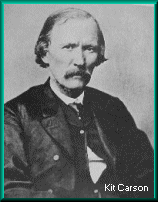
imagesFor their own part Navajos developed an oral tradition describing a very different allocation of responsibility to the specific raiding parties, viewed as irresponsible young men bringing trouble to their own people. This point becomes that much more clear in the wake of the Long Walk and internment at Fort Sumner. This event marks the nadir of most stories about Navajo history, it is story in which Kit Carson ’rounded up’ the vast majority of the Navajo people and took them to a small reservation in Southeastern New Mexico. The next four years (1864-68) were difficult to say the least for Navajos and damned expensive for the U.S. government. In the end they were allowed to return home.

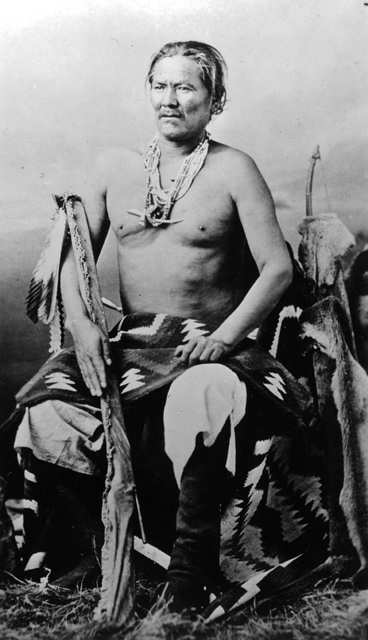
ManuelitoSome have defended Carson’s actions on the grounds that it had at least ended the raiding patterns of the past centuries. What these historians consistently missed was that the raiding patterns continued in the years after fort Sumner. After Fort Sumner, a raid brought Federal troops who went straight to the Navajo police under the leadership of Ganado Mucho or Manuelito. The Navajo police then brought back whatever livestock had been stolen. Before Fort Sumner a Navajo raid was an act of war with collective responsibility applying to the Navajo people as a whole; after Fort Sumner it was a criminal act, the responsibility for which fell on individual shoulders. The difference that makes this distinction had less to do with actions than understandings.

…and in this case that was all the difference in the world.

Perhaps the logic of warfare is too remote for the majority of us in modern America, but there is one respect in which the notion of collective responsibility is absolutely a part of our every day lives, the business of corporations. As some would describe it, the very point of forming a corporation is to re-allocate responsibility for the actions associated with a business concern. Once a source of great controversy, the existence of these collective entities in American business (and that of the world at large) is easily accepted as an accomplished fact.

It is just the way the world works, so common wisdom would have it. We accept that we will not get to talk to the bastard (or bastards) at Bank of America, Wells Fargo, or any other major bank who decided they could reorder your checks from the biggest to the smallest in the event of an overdraft and charge extra fees in the process. We accept that the poor agent who answers our call will be the one to hear whatever we have to say about such an outrage. We accept that CEOs in charge of failing corporations may travel freely on to the next chapter in their bright shining futures, leaving countless lives ruined in their wake. And we accept that (with rare exceptions) lives lost or immiserated by corporations will never result in punishment of those specifically responsible for polluting this river or putting that firebomb of a vehicle on the market.

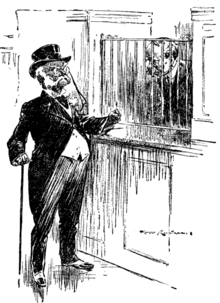
"I warn you, Sir! The discourtesy of this bank is beyond all limits. One word more and I — I withdraw my overdraft!"

“I warn you, Sir! The discourtesy of this bank is beyond all limits. One word more and I — I withdraw my overdraft!”

Of course, there are circumstances in which charges of criminal fraud or negligence may occur, but this would seem to be the rare exception (except perhaps in Island where they actually have the balls to hold white collar criminals accountable for wrecking a national economy) Under normal circumstances, these giant entities screw customers and maim communities with impunity, and there is little one can do about it. The most one might hope to see in the way of justice from such practices will take the form of financial compensation from a corporate entity, the loss shared out through its stock-holders. Those directly responsible for terrible decisions will in most cases never see any significant retribution for the harm they cause to others.

…and the more I think about it, the more this one starts to feel like another poke in the eye.

If collective responsibility is the sticking point in accepting the justice of a clan-based feud system, it is not because collective responsibility escapes us, or perhaps it is because it escapes us when we actually use such an approach in our own lives. The real question is just why do we allow for collective responsibility in warfare and corporate business activities while insisting on individual responsibility for ‘crimes’? I and my students didn’t follow this question, because of course that wasn’t the task at hand, but it’s the sort of thing I hope will hang in their minds long after they have hit send on their final papers. If it’s done right, a good anthropology course should leave students with more than a collection of facts about other people in other times and places, it should also leave them with a new sense of the communities in which they themselves live.

The cognitive poke in the eye is on the house.

***

Three Cherokee are from here. The image of Sequoyah is from the Smithsonian Institution. The image of Kit Carson is from the Kit Carson Museum. Ganado Mucho comes from Navajo People.org. Adam and Eve hiding from God comes from an old engraving by Julius Schnorr von Carolsfeld. I got it from istockphoto. Manuelito comes from a class at ASU. The gavel is from Sara Marberry’s Blog. The Bank Cartoon comes origonally from an entry of Punch Magazine published in 1917, but I got it from Wikipedia.

Piuraagiaqta!

Tags

, , , , , , ,

A Sledding We Will Go! (Pic taken with my phone.)

A Sledding We Will Go! (Pic taken with my phone.)

So, we recently celebrated Piuraagiaqta here in Barrow. That’s our Spring festival for those of you whose tongues aren’t feeling adventurous. I was pretty busy during this several-day event, but I snuck outside on a few occasions to catch the outdoor games held on one of our lagoons.

Simon Says “Click to embiggen!”

Harpoon Toss!

A view of the games from above.

The Final Race. It was held at 4:00pm Barrow time, which turned out to be about 5:00pm. For the longest time it looked like they were going to have 3 racers, but a fourth showed. (and my battery died just before the second place guy crashed.  I think he was okay, but maybe his machine wasn’t)

I’ll take Cold Tropes and War Analogies for $50, Alex!

Tags

, , , , , , , ,

coldwar_nike1It’s getting harder to explain the history of the cold war, at least insofar as students are less and less likely to relate to the era in any personal way. Gone are the days when the subject could elicit a visceral reaction from the under-thirty age-set. I distinctly recall that fear of the world ending with the push of a single button played a big role in my own teen angst, and I doubt I am special in that regard. Hell, I sorta figured it was actually going to happen at some point, all of us were going to die in one big final feud, but then again I’m fun like that. The point is that the subject hung like a cloud over the heads of some of us back in the day.

I suspect a lot of my students have trouble wrapping their minds around the whole thing. So, when you come to something like the Cuban Missile Crisis, it takes a little prep work to get across what would have seemed obvious to my own generation, that this little event, a paragraph or two in the average textbook, actually threatened all of life as we know it. Today, I usually just tell my students that none of us would have been born had things gone differently in that particular sequence of events.

I think they get it.

…sort of.

It’s not just the subject matter that is slipping away, so to speak; it’s also the imagery. This isn’t just true of the cold war. Many of my favorite pop-references are becoming less and less relevant to younger students as my youth passes further and further from the realm of things about which the kids at the cool table could be asked to give a damn.

cokeOne of my favorite teaching-gambits for the cold war has slowly faded into the realm of useless. For years I used to ask my students who lost the cola wars. This always got some funny looks, followed by suggestions of ‘Coke’ then ‘Pepsi’ both of which I would shoot down without the slightest hint of an explanation, …leaving them to give me more funny looks.

How could it be neither?

Sooner or later someone would suggest Shasta, Nehi, RC-Cola, or some other obscure brand of soda most likely consumed by cave men in the sad old days before Paula Abdul and Michael Jackson. This suggestion would then become a jumping off point for discussing the impact of the cold war on various third world nations forced to articulate their own interests in terms framed by the U.S. and Soviet Union.

imagesToday my students still give me blank stares, but they are not the blank stares of students struggling with a conundrum; they are the blank stares of students listening to someone try and explain a complicated issue by means of a metaphor that is no more accessible to them than the full story in itself. Sadly, it is time for me to move this metaphor to the back shelf and put some other theme in the specials section of my intellectual supermarket.

(See what I did there?)

Missionary colonial periodI once TAed for an instructor that used to compare the Cold War to the conflict between Protestants and Catholics in the colonial era, each bringing a vision of absolute truth to Native Americans, promising that truth was the key to liberation, demanding their loyalty, and taking everything they had in the process. (How’s that for a run-on sentence!) So, that professor seemed to be suggesting there was nothing new under the sun, just two new world powers playing the same old shell games with the rest of humanity. I like this analogy too, but it’s not so much a quick entry into the topic as a food-for-thought and what-does-it-all-mean kinda notion.

Today I was trying to explain the dynamics of proxy wars to a student when I could see the light go off over her head. A moment later she exclaimed that it was just like Pokémon. The other students quickly nodded, and after a brief moment in which I sort of wanted to cry, I thought actually that isn’t too bad.

PiakchuSo, here I sit, watching the next batch of students suffer their way through an exam and wondering if this is the wave of my pedagogical future? Will I soon find myself saying things like; “And then Nikita Kruschev said, ‘Fidel Castro, I choose you!'” Can I wrap my mind around the concept of West Germany as Picachu? Can I use this narrative without promoting anyone to the heroic status of Ash? Or should I just let John Wayne have that role? Can y’all imagine the Duke in his Green Beret uniform whipping out a pocket monster and saying; “have at ’em liddle pardner!” The imagery almost seems promising, but I just don’t know if I am up to the task. This isn’t my era, and I don’t know the game.

The whole project does have a certain amount of promise. I wonder if I can get faculty development funds for this? I wonder if the Dean of Instruction will give me money to go to the gym and develop my Pokédex?

Cause I really don’t think I can teach this subject without a fancy new gym badge!

Bonus Super-Villain: This Girl is Nasty in Real Life and on Screen!

Tags

, , , , , , , ,

1990-the-nasty-girl-poster1What makes Sonia Rosenberger so nasty? It isn’t what you would think, or even what the cover of The Nasty Girl would seem to suggest. Precocious though she may be, Sonia’s crimes are those of an historian. She earned the title in her hometown by asking the wrong questions about its history.

I love her.

Sonia’s journey into super-villainy began with an essay contest. As a young student at a Catholic school in Germany, Sonia decided to enter into a national writing contest. She had two topics to choose from; “The concept of Europe” and “My Hometown During the Third Reich.” Sonia’s teacher sensibly encouraged her to go with the first topic, but Sonia had been brought up to believe that the good people of her home town had resisted the Nazis. How could she pass up the opportunity to reveal the heroics of her friends and neighbors?

Please don’t fault Sonia for the innocence of her original intentions! Even the dark flowers of villainy take some time to bloom.

You see it wasn’t long before it became clear to Sonia that something was amiss. Everyone in town seemed to agree that the only true Nazi had been the mayor, but she could not quite seem to get her hands on his files at the local library. What little information she could find on Professor Juckenack, the great hero of the resistance, turned out to be an essay in support of Nazi racial politics. And no-one could seem to remember the concentration camp in town, at least not without a little needling on the subject, in which case they were quick to point out that it was far better than all the others. …the camp that didn’t exist, that is.

Something was amiss!

So, you might wonder what would a good girl wold do upon finding such a mystery? What should a good girl do upon discovering that the people she most looked up to seemed to be damned uncomfortable whenever she tried to talk to them about her personal project? Well, I personally have no idea what a good girl would do about such a quandary, but I can tell you what this bad Betty did.

She dug deeper!

Despite hints, pleas, and even threats, Sonia just kept pressing on in pursuit of the unwelcome truth. Hell, she even kept at it after someone chucked a brick through her car window. Trust me, that was just the beginning. Sonia ignored the advice of neighbors, parents, and even her husband in her pursuit of the truth, sacrificing health and safety in an effort to learn just what had really happened in her hometown during the Nazi years.

I ask you, would a good girl do that? Not a chance!

Left with no other options, Sonia sued the town to gain access to the mayor’s old documents, and when the town changed its laws to prevent her from getting access yet again, …she just sued the town again. She acted as her own lawyer in both ventures, by the way. (Yeah, she’s just that bad-ass.) And do I need to say that she won the second case too? That’s right; good guys don’t always win. Sometimes they get their butts kicked by villainous nasty girls.

Twice!

I’m not even going to tell you what Sonia did when the town library pretended to lose the mayor’s files in yet another effort to hide the truth from her villainous campaign. Suffice to say this juggernaut of naughtiness would not be dissuaded! You know what else I’m not going to tell you? What Sonia found out about Professor Juckenack and his activities under the Third Reich. Nor will I tell you what happened when he sued her for writing about it in her book on the subject. I’m not going to tell you, because I’m feeling a little bad myself today. (Sonia has inspired me to evil.) And if you want to know the answers to these questions, well then you are just going to have to come over to the dark side and dig a little yourself.

Ha!

RosmusPassau300pxwBut you know what the best part of this story is? It is actually based on the life of a real person. her name is Anna Rosmus of Passau, Germany, and she is every bit as wicked as the celluloid creation she inspired. Anna didn’t stop with one book about her hometown, she turned her tireless pursuit of unwelcome truths into a career in scholarship, much of it dedicated to ensuring that the memorials to this painful chapter in German history would not be forgotten, neglected, concealed from the public, or outright defaced. Time and again, Dr. Rosmus has called attention to realities good decent folk would just as soon forget.

Who would do such a thing?

Only a nasty girl.

A very nasty girl indeed!

***

(The image of Anna Rosmus is from http://www.history.ucsb.edu/faculty/marcuse/classes/133c/133cPrevYears/133c04/133c04l17-NaziPast70s80s.htm)

It’s the Sub-Deduction Stupid: Scalia’s Thoughts on Absurdity and Gay Rights

Tags

, , , , , , ,

Justice Scalia testifies on Capitol Hill in WashingtonTime was when Antonin Scalia seemed fairly dedicated to the pretense of Judicial restraint. These days he appears content to be known as a political lobbyist for the right wing echo chamber. We can see this in the increasing number of public statements he has made on a range of political issues, effectively tipping his hand to those weighing their prospects in the legal arena.

…all of which makes Scalia’s role in the gay rights cases recently argued before the Supreme Court (Hollingsworth v. Perry and United States v. Windsor) that much more disturbing. Not surprisingly, the subject has come up in his extra-judicial engagements. Asked to defend his equation between homosexuality and sundry horribles such as incest, bestiality, and child pornography (among other things) in Lawrence v. Texas, Scalia made the following remarks at Princeton University:

It’s a form of argument that I thought you would have known, which is called the ‘reduction to the absurd,'” Scalia told [freshman Duncan] Hosie of San Francisco during the question-and-answer period. “If we cannot have moral feelings against homosexuality, can we have it against murder? Can we have it against other things?

Condescension aside, what Scalia is saying is basically Freshman Logic material. In his Dissenting opinion for Lawrence, Scalia had indeed used the standard argument form of a reductio ad absurdum against the position taken by the majority (holding that a Texas law banning sodomy was in violation of the Due Process Clause of the 14th Amendment). A reductio ad absurdum essentially consists of an attempt to derive an absurd conclusion from a given claim as a means of refuting it. If a given assertion can be shown to lead to absurd implications, so the logic goes, then one ought to reject it. In this case, the claim at stake would be something along the lines of a restriction on judgements (or laws) against homosexual activity. Scalia hopes to show that this holding will lead to an intolerable list of absurdities.

I sincerely doubt that Hosie failed to recognize the argument form, and Scalia’s response does little to shed light on the logic of his argument. The question in this case is more properly, whether or not Scalia’s had successfully shown that the claim made by the majority in Lawrence was actually absurd. In essence, the question is whether or not Scalia had successfully negotiated the transition from the claim he wished to refute to the absurdity he wished to assert in his argument. That transition is sometimes described as the ‘Sub-deduction’ of the argument. That is, in this instance, where the real argument lies.

And here is where the story gets interesting.

The sub-deduction of Scalia’s argument comes in a weak and a ‘strong’ version. By ‘weak’, I mean ‘truly shitty’ and by ‘strong’ I mean rather heartless’, but allow me to demonstrate…

Sub-Deductions in Need of a Workout: Sundry net warriors will be familiar with the weak version, because we’ve heard it from conservative Christians for years. It is essentially an argument against moral relativism, or at least a certain straw rendering thereof. We heard it a little more in the wake of Lawrence, and frankly, Scalia’s remarks in this instance tended toward the weak version, if only because their brevity does little to shed light on the logic of his original argument on the subject. Rick Santorum gifted us with one of the best examples of this tripe in an interview with USA Today back in 2003:

You have the problem within the church. Again, it goes back to this moral relativism, which is very accepting of a variety of different lifestyles. And if you make the case that if you can do whatever you want to do, as long as it’s in the privacy of your own home, this “right to privacy,” then why be surprised that people are doing things that are deviant within their own home? If you say, there is no deviant as long as it’s private, as long as it’s consensual, then don’t be surprised what you get. You’re going to get a lot of things that you’re sending signals that as long as you do it privately and consensually, we don’t really care what you do. And that leads to a culture that is not one that is nurturing and necessarily healthy. I would make the argument in areas where you have that as an accepted lifestyle, don’t be surprised that you get more of it.

Here, Santorum treats the right to privacy as an abandonment of moral principles altogether, arguing that if we can’t condemn homosexuality, then we can’t condemn anything. We can’t stop people from molesting children; we can’t stop polygamy; we can’t stop any number of horribles from happening. It’s worth noting that in this instance Santorum was arguing that the sex abuse scandals of the catholic Church were essentially a problem of homosexuality, which is in itself a pathetically ignorant position to have taken. But I suppose it’s fitting that someone facing what he takes to be the obliteration of moral judgement would respond to that by abandoning any honest effort to address the actual claims at stake in the issue.

Yes, Rick Santorum lives in a special place where ignorance and dishonesty come together and start a family, but sadly, he has a lot of neighbors in the land of ignorance which is the weak version of this argument. A large number of conservative Christians have approached the notion of a right to privacy in precisely these terms.

Setting aside the folk-demon of relativism, the problem with this take on right to privacy is it ignores the essential balancing tests by means of which that right enters into the American legal system. The point of a right to privacy has never been that you actually get to do anything you want so long as it’s in the privacy of your bed-room, but rather that government interest in stopping you must be weighed against the right to privacy. In simple terms, if the government has a legitimate interest in doing so (say if you are hurting a child), then the right to privacy folds and the government wins. If no such government interest is present, or if that interest pales in significance to the cost to others, then the right to privacy wins.

Here the sub-deduction fails for precisely the same reason that moral opportunists find it attractive in the first place. They hope to refute the notion of a right to privacy by connecting it to a range of genuinely harmful activities. Faced with a choice between condemning homosexuality and allowing child abuse, practitioners of this stratagem hope that most of us will throw the gay folks under the bus. But when real harms can be shown, the right to privacy would not prevail, and the sub-deduction fails.

The courts have never presented the right ti privacy as an absolute boundary to government regulation; it is if anything a sort of raising of the ante, a provision that requires government officials to show they have a good reason for what they are doing. Rick Santorum and Christian net-warriors all over the land don’t seem to understand this.

Scalia does, at least when he needs to.

Mach-Macho-Subdeductions: Now we come to the strong version of Scalia’s argument which is a rejection of the balancing tests themselves, at least as applied in Lawrence. In this case, Scalia isn’t making a broad point about the value of moral judgements. His point isn’t that granting a right to privacy leads to the destruction of western civilization, or that it will lead us to turn our children over to the nearest sexual predator. No, in Lawrence, Scalia was saying that the courts should not be the ones to weigh the benefits of legislation against the costs to people’s privacy, or at least that the court had failed to articulate a principle in that case which would enable it to make a sound distinction between issues like homosexuality and those likely to be regarded as more abhorrent, even to those in favor of gay rights. Absent a clear and coherent principle on which to make a decision, Scalia suggested that the court was making just the sort of judgement call that legislators ought to be doing, not judges. Such judgement calls are intrinsically political, and ought in Scalia’s view to be left to those branches of government best suited to making political judgements. It is in other words a variant of his oft-repeated call to Judicial restraint. Hence, the following remarks from Scalia’s dissent in Lawrence (at 603-4):

Let me be clear that I have nothing against homosexuals, or any other group, promoting their agenda through normal democratic means. Social perceptions of sexual and other morality change over time, and every group has the right to persuade its fellow citizens that its view of such matters is the best. That homosexuals have achieved some success in that enterprise is attested to by the fact that Texas is one of the few remaining States that criminalize private, consensual homosexual acts. But persuading one’s fellow citizens is one thing, and imposing one’s views in absence of democratic majority will is something else. I would no more require a State to criminalize homosexual acts-or, for that matter, display any moral disapprobation of them-than I would forbid it to do so. What Texas has chosen to do is well within the range of traditional democratic action, and its hand should not be stayed through the invention of a brand-new “constitutional right” by a Court that is impatient of democratic change. It is indeed true that “later generations can see that laws once thought necessary and proper in fact serve only to oppress,” ante, at 579; and when that happens, later generations can repeal those laws. But it is the premise of our system that those judgments are to be made by the people, and not imposed by a governing caste that knows best.

There is in the strong version of Scalia’s argument a logical consistency which is entirely lacking in the pop-Christian variants of this same position as articulated by Santorum and legions of faith-bigots happy to explain why homosexuality is wrong. Where Scalia was actually making a point about the nature of Judicial reasoning, various cultural conservatives have carried forward that argument in the form of a simplistic claim that if we can’t condemn homosexuality, then we can’t condemn anything.

In the babblerized version of the reductio ad absurdum, the sub-deduction simply does not follow. In scalia’s, it is at least plausible.

Balancing the Unbalanced: But where does that leave us? Scalia would say that that it leaves us with a better balance of powers and a stronger system of checks and balances. Yet, one can see in Scalia’s own writing and comments hints at the costs of such an approach. Regarding the prospect of overturning Roe v. Wade, for example, Scalia offers the following:

Many States would unquestionably have declined to prohibit abortion, and others would not have prohibited it within six months (after which the most significant reliance interests would have expired). Even for persons in States other than these, the choice would not have been between abortion and childbirth, but between abortion nearby and abortion in a neighboring State.

Here Scalia makes an interesting point, that removing the precedent of Roe v. Wade would not necessarily have meant an immediate ban on abortions everywhere, but rather the creation of legislative options which some states would take and others would not. The actual choices presented to women with unwanted pregnancies would then be a question of travel (at least for those in geographically unfortunate circumstances). It’s an interesting scenario, and one in which the right to have an abortion does not die with Roe v. Wade, but that scenario would of course be cold comfort for those women unable to travel. The right to an abortion now enjoyed under Roe would translate through this scenario into an option more or less available, depending on one’s finances and/or family obligations.

The right thus becomes a privilege, and that privilege then falls beyond the reach of many that need it most.

One imagines that the right to engage in homosexual acts (or any number of proscribed sexual practices) would translate into a similar choice under Scalia’s approach, and residence might soon become a function of sexual proclivities. Do you want the right to have sex with your own gender? Better then to move out of a red state under this approach. And we can only imagine just how much more heartache this will cause in some instances, and how many lives lived through deception in others.

Apparently, this is an acceptable outcome in Scalia’s view.

It may well be that the right to vote as a minority could also become a function of where one lives if we are to give up the ‘racial entitlements‘ included in the present voting rights act, as Scalia terms them. Granted the issue there is a technical one, pre-clearance of voting procedures for selected states, but the language of Scalia’s recent questions in reference to the Voting Rights Act is more than a little disconcerting.

Or consider Scalia’s remarks in Oregon v. Smith, 1990. In the majority opinion for that case he argued that the free exercise clause of the First Amendment did not provide members of the Native American Church with a valid reason for exemption from generally applicable state laws banning use of peyote.  Scalia then moved on to suggest that while states might allow for such an exemption, it was not required of them, hence leaving the rights of religious freedom for the Native American Church open to the political process. What Scalia wrote next has always struck me as one of the most telling features of his approach to jurisprudence.

It may fairly be said that leaving accommodation to the political process will place at a relative disadvantage those religious practices that are not widely engaged in; but that unavoidable consequence of democratic government must be preferred to a system in which each conscience is a law unto itself or in which judges weigh the social importance of all laws against the centrality of all religious beliefs.

Here Scalia has essentially conceded to the tenuous status of minority rights under his approach (though perhaps he would say that they are not rights, as such). Those with less leverage over the political process must simply accept a reduced set of options? What are the benefits? The court will behaving as it ought to under Scalia’s view, showing proper restraint and deference to the legislative branch of government.

The problem in this instance is not as simple as the utter foolishness seen in remarks like those of Santorum, or even that of Scalia’s answer to Hosie; Scalia’s argument in Lawrence seems plausible to me, at least on the face of it.  The problem is that the value which is central to Scalia’s argument in this instance (the strong version of the sub-deduction) is awfully hollow in comparison to the conceded costs of its adoption. What Scalia offers us is a narrative in which every part of government rests in its proper place. What he is willing to sacrifice in order to get that value is the actual liberty of countless minorities seeking only the enjoyment of options fully available to the rest of us. The absurdity to which Scalia points us is one in which judges behave a little less like judges, and quite frankly some of us find that a little less absurd than the notion that liberty is best preserved by leaving this and so many other issues central to the happiness of many at the mercy of a political process which has proven time and again that it is inadequate to ensure.

Irony of Ironies: It is worth noting that the strong version of Scalia’s argument empowers the weak version. Whatever else he is saying, Scalia is also saying that if enough people seem to think that the only way to save our children from a list of horribles too awful to bear is to deny those of homosexual orientation the liberty to conduct themselves as they see fit, then they are within their rights to pass all manner of laws restricting gay rights. No effort to show that homosexual conduct really will hurt anybody would be needed in Scalia’s approach, at least not i the courtroom.

And in the legislatures and the court of political opinion, flippant remarks like those Scalia gave to Hosie, and patently offensive rhetoric like that of Santorum will be all that is needed to consign some people to lives lived without the benefit of meaningful liberty.

Absurd, indeed.

Oops! Barter Island Bears Revisited

Tags

, , , , , ,

I don’t know why I didn’t post this way back in August. Maybe it’s because the video quality is so bad, or maybe I just didn’t notice that it was a video. Anyway, I have a small clip of some Polar Bears from Barter Island, and for all its poor quality, it is kinda neat. I present it here for your enjoyment.

(Please pardon the crappy sound.)

Also Apropos of Nothing, the Worst Thing I Ever Saw a Teacher do to a Student

Tags

, , , , , , ,

coreSo, I am sitting down for the final exam in an upper division course. This was the last of 5 courses on the history of philosophy that I took as an undergraduate; its graded assignments consisted of two essay exams and a research project. My project has already been turned in. All I had to do was manage a few decent essays on this particular phase of intellectual history, and then I could go home and sleep.

I remember the scene rather well actually.

We are sitting around a conference table in a room adjoining the professor’s office, about half a dozen of us, furiously scribbling at our blue-books when the instructor walks into his office. He later emerges with a green apple and a single research paper in one of those plastic binders that teachers hate. (Seriously, I didn’t understand this until I started grading myself. Those are nothing but a pain in the ass.) Anyway, the professor frees the essay from its plastic binder with a slight sneer and takes a bite of the apple.

It is the beginning of a long and dramatic performance.

As I and the others were trying to wax brilliant on this and that subject, I think each of us gradually became aware of a couple things about the professor’s activities at the authoritative end of the table. The first thing I noticed was how thoroughly the professor was eating that apple. The man was truly voracious! I want to say that he ate the core, but that may be 20 years of memory rounding the corners of my original experience. What I can definitely say is that he came damned close to it. Drove me nuts, watching that; I wanted to tell him to stop and give the poor thing a break. It had long since done its duty by normal standards and what was left deserved a good Christian burial in the garbage can. He didn’t even look like he was enjoying the apple goodness all that much. It was just there, and that was apparently an unforgivable crime. I don’t think I have ever felt sorry for a piece of fruit before, but that poor apple had my sympathies.

And the paper?

Well let’s just say the professor couldn’t have put more red ink on that paper if he had opened up the pen and poured it out all over the he pages. I honestly think the prof. was putting down as much material as we were. He did this with grand gestures. You could see him drawing broad circles around some offending bit of text before proceeding with a straight line toward the margins where he then proceeded to write essays of his own, all no doubt about the utter stupidity of the poor paper’s author. That sneer got worse and worse. He shook he head as he wounded the pages of that poor term paper, and I could almost make out some of the cursing under his breath. Contempt oozed off of the prof. and slowly filled the room with a strange and rotten feeling as we struggled to produce our own candidates for the red ink of death.

I forced myself to concentrate on my own essay as I took in the drama happening just off to my left, and I wondered what poor Freshman from his intro class would soon be crying in his red cup full of already-watery beer. What the poor victim had done to earn his feedback-beating, I couldn’t imagine, but I told myself I would be fine. Just keep writing!

Finally, the instructor put down the paper, shook his head, stood up and gave a heavy sigh before walking back into his office and then out into the hall. One of my classmates put down his pen, and sat there a moment, obviously stressed. The guy looked around the room a bit. And we all looked back at him.

“Well, I gotta look.”

After learning he had just received a D- on his research paper, the graduating law-school candidate struggled a bit with his blue-book and eventually turned in his unfinished exam.