Tags
Alaska, Art, History, Ketchikan, Saxman Park, Seward Shaming Pole, Totem Pole, William Seward, Wood Carving
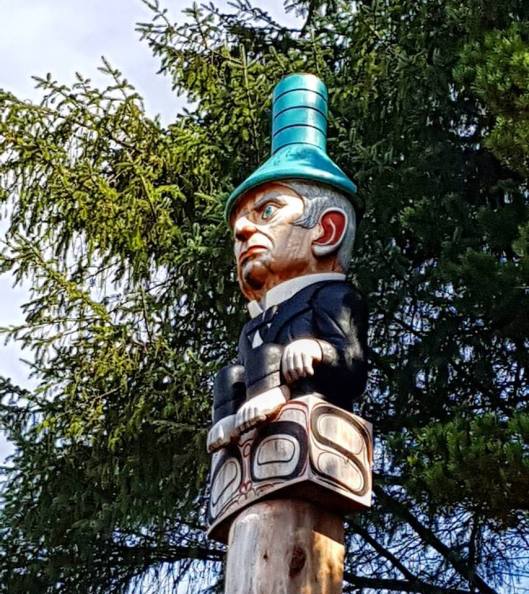
Not to be sarcastic or anything, but I’ll just leave this here.

30 Monday Mar 2020
Posted in Alaska, History, Native American Themes, Public History, Uncategorized
Tags
Alaska, Art, History, Ketchikan, Saxman Park, Seward Shaming Pole, Totem Pole, William Seward, Wood Carving
Not to be sarcastic or anything, but I’ll just leave this here.

01 Saturday Jun 2019
Tags
Critical Thinking, Defensiveness, History, Internet, Pinterest, Quotes, Rationalization, spam, Spurious Quotes
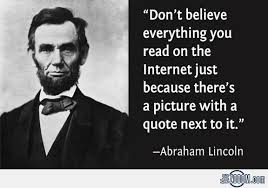 Been thinking a bit lately about THIS old post?
It’s still an interest of mine.
So, I sometimes make a point to call out the spurious quotes thriving all over the net these days. It’s not the most noble of personal callings, I know, but I noticed a long time ago that the information correcting some of this stuff isn’t often found in the same electronic neighborhood as the political pornography in which these bullshit quotes normally reside. So, I reckon it ain’t the least useful thing a guy could do with a spare 15 minutes or so to introduce the author of an un-sourced quote to a well reasoned debunkitation.
I’m often fascinated by the responses I get.
***
I was quite interested when Pinterest suspended my account for a few weeks, …I think over this. I could be wrong, but I do think this pastime is what did it.
The thing is, you can find the same spurious quotes in countless memes all over Pinterest. It’s just so damned easy to spread information when all it takes is the click of one ‘save’ button. The net is full of ccrap, I know, but the political hashtags at Pinterest are a particularly bullshit rich environment.
I can say it in a few different ways, but what needs to be said in response to these fake quotes is usually pretty simple, and I can’t help thinking a good link to Mount Vernon or Monticello.org ought to find itself somewhere in the response. The link alone really ought to suffice. The trouble is that these misquote-laden memes are distributed through a variety of different accounts on Pinterest. If I’m posting a lot of links to the same page correcting them, then of course I am the spammer.
Oops!
Don’t get me wrong, the principle in question makes a kind of sense, as does its application. You don’t want someone posting the same link over and over again on a social media platform, but it does create an ironic outcome. In this instance, at least, it seems that’s a lot easier to spread disinformation than it is to counter it.
Oh well!
***
Before moving onto the more personal responses I’ve gotten over the years, I must admit that my own tone here varies. If I think the person passing along a fake quote has done so accidentally, I try to just call attention to the problem. Hell, I reckon I’ve probably made this mistake myself once or twice. It ain’t no hanging matter; I just want to correct a (hopefully honest) mistake. If, on the other hand, the fake quote is accompanied by narratives about how teachers, media, and liberals are too damned deceitful to share the ‘truth’ of the quote, I must admit, my own response is likely to come with a little sarcasm on the top. There are of course other signs of bad faith that I typically meet with a more combative tone.
Sometimes I’m nicer about this than others.
Also, sometimes, I just ask people for a source to see what they come up with.
Anyway…
***
Oh yeah, my first post on this topic, the one about Abe Lincoln, has a couple rich responses of its own. Still kinda chuckle about those.
***
By far and away,, the most interesting response I get is the occasional effort to document the quote by linking me to the ‘spurious quotes’ pages at Monticello or Mount Vernon. Seriously, this has happened a few times.
“Did you read it?” I ask.
At least once, someone realized their mistake at that point and owned up to it. She gets props for doing the right thing.
Once I was assured by someone that clearly hadn’t read the material that he totally had read every word of it. He also assured me that he understood what ‘spurious’ means. Yep! Definitely! We went a few rounds on that, before he dropped out of the conversation. A ‘block’ button may have been pushed. I dunno…
Others simply stopped responding immediately.
Someone else told me I was being rude.
…which was of course true.
***
Several people have tried to tell me that the quote in question may have been undocumented, but that it accurately reflected what the person to whom it was attributed really did believe. I got this at least once with a popular bastardization of George Washington’s first address to Congress.
…right after I had explained in detail exactly how the quote misrepresented him.
It seems that to some people making this argument these quotes are a kind of Kantian thing-in-itself (a truth truth-in-itself?). The truth as they envision it rests over and above the facts, even the facts of its own expression. If you can’t find one clear expression of that truth in the messy real-world of the historical record, that doesn’t matter, because we know the truth and the source to whom it has been attributed must have known it. So they might as well have said it.
It’s all true anyway, so what’s the problem?
This is one of the more disturbing responses I get, because it reveals an air tight echo chamber in the thinking of the person in question. They love America’s founding fathers and they love their guns and such, and two things they love must love each other, and so when the real-world George Washington doesn’t live up to their masturbatory fantasies, well then, they can just speak up and say what he woulda said anyway.
The rationale also works for any number of subjects certain people feel America’s founding fathers must certainly have loved every but as much as they do.
…even if those founders didn’t actually say so.
Not much to be done about folks who reason like that.
***
Another common response is to ask how I know the quote isn’t real.
…and that’s one of those moments when I remember why burdens of proof matter.
***
A related tactic is to assure me that the quote is real and tell me to do my own research. Faced with credible sources that claim the quotes can’t be found in any known archives, those using this tactic assure me that the quote is real and that we skeptics really ought to work harder.
…which brings to mind words like ‘gaslighting’, ‘trolling’, ‘asshole’, and a quick end to the conversation.
***
Sometimes people complain that my efforts to check them reveal a character flaw on my own part. Don’t I have anything better to do?
No such questions seem to have been asked about the time it takes the individuals in question to pass along a spurious quote. But of course, we all have much more important things to do when the one we are presently engaged in turns out to be a little frustrating. It’s human nature.
***
Probably the most common response I get to declare the source of the quote irrelevant. It’s the idea that matters, I am told, and surely that idea is true. So, it doesn’t matter if Thomas Jefferson or Benjamin Franklin or any other made up source didn’t really say what they were supposed to have said. That’s not the point. The point is it’s true.
I must say that it’s an interesting coincidence that so many timeless truths that could come from any source really, seem so often to be attributed to sources of great political value. It’s also an interesting coincidence that so many of them seem quite useful to specific political agendas today, agendas which often sail under the banner of faithfulness to American principles and respect for the wishes of America’s founding fathers. It’s really quite convenient that so many questionable quotes would seem to provide the politics of the people in question with the authority of a voice from the founding fathers. The sources really don’t matter, so it seems, not after the source has been debunked.
Perhaps I could be excused for thinking the source mattered, at least a little, before that source came into question.
What I always find most interesting about this tactic is how seamless the transition is from presenting an undocumented quote to declaring the named source irrelevant to its content. People employing this tactic rarely take so much as a moment to acknowledge their error. Often they avoid conceding the point altogether as they shift from a historical claim about who said what to a kind of Platonic reasoning in which the idea itself is all that really matters.
And thus a person wholly unconcerned with the falsehood of a factual claim suddenly becomes the priest of a timeless truth.
***
Oh yeah, some people don’t respond at all. Some just keep right on producing the bullshit quotes too. This is particularly true of some websites like BrainyQuote. It’s also true of some dedicated ideological warriors. They just keep right on posting the fake quotes long after a reasonable person might have at least quietly deleted the material from a blog or a social media account.
***
There is one response that gets me every time, and that’s the one where somebody simply acknowledges the mistake. Often this is followed by a ‘thank you’. Maybe they take down the quote. Maybe they just let their acknowledgement of the correction stand for itself in the discussion. Either way, it’s a class move.
These days, such responses surprise me a little more than they ought to.
…and that’s kinda sad.
***
I suppose it doesn’t really surprise me that people would respond defensively to such things. People don’t usually like to be corrected. I know I don’t. And of course, any of us could get things like this wrong. That’s not terrible. It’s human. Still, some of these rationalizations do seem to give you a peak behind the curtain, so to speak, into the mind of someone for whom due diligence is simply unthinkable. They must be right one way or another, so they seem to think.
…even if they are wrong!

10 Wednesday Apr 2019
Tags
Candace Owns, Charlie Kirk, History, Hitler, prejudice, Racism, Ted Lieu, Turning Point USA, White Nationalism
…been awhile!
 So what has me thinking with my keyboard again after such a long absence from the blog? It’s the latest dust-up over Candace Owens’ comments on Hitler. Owens was recently called to testify as a witness for congressional hearings on the topic of hate crimes by white nationalists. Expressing contempt over the decision to bring her in for such testimony, Ted Lieu opted to play ‘the first 30 seconds’ of comments she once made on the subject of Adolf Hitler. He then moved on to ask another witness about the significance of those comments, leaving Owens without a chance to respond and the rest of us without much sense for the context in which her comments had originally been made. Given the chance to respond shortly thereafter, Owens charged asserted that Lieu had assumed African Americans wouldn’t look into the matter further, suggesting she had been taken out of context.
…and the fight was quickly farmed out to various social media platforms.
Such is modern politics!
First let me say that this was not one of Lieu’s finer moments. It’s hard to get past the sense that he left out critical information about the context of Owen’s remarks or the sense of unfairness that goes with attacking someone in their own presence without giving them a chance to respond. I can think of all sorts of reasons why he might have chosen to do this, and yes, I want to support his efforts here, but this falls short of certain minimum standards that ought to guide someone’s conduct. Lieu can do better than this. He normally does.
That said, I can certainly empathize with Lieu’s unflattering take on Owens’ credibility. She is not an expert in politics, crime, or anything else coming up in that hearing. It’s tough to say just how we came to the point where Candace Owens counts as having something important to say at a congressional hearing on racially motivated hate crimes.
Answering that question was actually the first thing Owens herself addressed at the hearings. Why was she there? She told us. Her answer just wasn’t all that helpful. What Owens said was that she has herself been the target of racially motivated hate crimes. She said this in order to establish a personal connection to the issue, then went on to talk about anything but that very issue. The rest of Owens’ opening remarks were spent reminding us that words like ‘racism’ meant something in the context of segregation in the old Democratic South while the real threats to African-Americans today come from Democratic policies purportedly aimed at helping them. In short, Owens was there to minimize the significance of racially motivated hate crimes against minorities and shift the discussion to something that might embarrass the Democrats.
You can see all of this for yourself in the video from C-SPAN presented below. Owens’ opening statement begins at around 47:40 and ends at 53:42. Lieu’s remarks begin at around 2:33:14 and end at 2:38:27. Owens reply occurs between 2:38:50 and 2: 40:38.
https://www.c-span.org/video/?459662-1/house-judiciary-committee-holds-hearing-hate-crimes
Much of the subsequent discussion has focused on the question of whether or not Lieu misrepresented Owens in suggesting that she had tried to legitimize Hitler. For her own part, Owens told the committee that she had done no such thing, that she had in fact been trying to suggest that Hitler wasn’t really a nationalist. “A nationalist,” Owens, tells us, “would not kill their own people.”
So what did Owens actually say at the event in question? Her comments can be found here from around 38:45 to around 40:55.
So, did Lieu misrepresent Owens?
Only if we allow the context to swallow the text entirely, and even then, only if we don’t think very hard about that context itself.
What do I mean?
We can start by looking at aspects of the message that appear to support the claim that Owens was defending Hitler. Here it is!
But if Hitler just wanted to make Germany great and have things run well, OK, fine. The problem is that he wanted, he had dreams outside of Germany. He wanted to globalize.
Owens’ and her own defenders have reassured us that these remarks were made in an effort to distinguish Hitler’s actions from those of a proper nationalist. On one level, this is fair enough. That clearly is Owens’ main point, and her remarks are in fact consistent with that point.W should not lose sight of the larger goal of Owens’ remarks even as we ask ourselves why she chose to pursue them using the particular set of claims she did on that day.
The problem is that point isn’t inconsistent with a defense of Hitler, half-assed though it may have been. The odd description of Hitler as someone who might have “just wanted to make Germany great and have things run well” does suggest a sympathetic understanding of Hitler’s motives at least insofar as they applied to Germany. Adding to that, the sense that Hitler’s actions only become a problem when he goes global and you have a point that does more than distinguish Hitler’s politics from those of an idealized nationalism; you end up with a point that suggests his internal policies were in themselves just fine, that his politics becomes a problem at precisely the when when those politics cross the border. While we shouldn’t lose sight of the fact that Owens is indeed trying to distinguish Hitler from nationalism as she would have it understood, her actual argument leaves plenty of reason to believe that she is in fact sympathetic to aspects of Hitler’s agenda.
Simply put, Owens’ speaks approvingly of Hitler’s domestic agenda, condemning him only when his ambitions cross the border. In subsequent remarks, she may have acknowledged his murderous actions, but in the immediate context of her remarks at the time, Owens shows no awareness of anything worth condemning in Hitler’s domestic policies? Does she think his crimes began on the other side of the border? Does Owens think Hitler did nothing wrong inside of Germany?
In effect, Owens was praising Hitler with faint damn.
All of this brings us to a much larger point; why was Owens trying to distinguish nationalism from the actions of Adolf Hitler in the first place? The simple answer is because that is something key parties in right wing politics want to do at this point in history. Owens is not the only person pushing the idea that nationalism isn’t always a terrible thing. Charlie Kirk’s own comments in that clip push that very theme. It’s a talking point that someone in right wing circles has clearly seen fit to push onto the public stage and the folks at the event in question were hitting their marks quite nicely on this talking point.
…Owens included.
The goal in this agenda is of course to distinguish nationalist politics from the horrors of the Nazi regime and leave us with a reassuring notion that nationalists just want secure borders and lower crime rates in the nations wherein they live, etc. They aren’t, we are supposed to believe, the kind of folks to exterminate 11 million people. No, that was just the Nazis, and they were actually globalists not real nationalists. Real nationalists, true nationalists, would never do that!
The problem of course is that this is utter bullshit, and the reason it’s bullshit is exactly the reason for the hearing Owens had come to troll. Nationalist movements always bring with them a degree of violence, xenophobia, and terrorism, and that means people get hurt at the border. It means they get hurt on the other side of the border. It means they get hurt well inside the border.
…and, yes, nationalists do kill their own people. Hell, they do it all the time!
Also, oh yes, nationalists always seem to have global ambitions as well. You can see this, not only in Hitler’s own plans, but also in Trump’s many ties to Russia, to Saudia Arabia, and to countless other international entities. Hell, you can even see it in Owens and Kirk going to England to help promote nationalist politics across the pond. If what makes a nationalist is a politics that stops at the borders, then Hitler may not be a true nationalist, ok, but then neither is Owens, neither is Kirk, and neither is the Manchurian Cheeto.
Few movements have ever gone global quite like the wave of nationalism presently sweeping the (ahem!) globe and drawing shameless opportunists like Owens into the picture. Her efforts to distinguish the politics of Nazi Germany from the kind of nationalism she herself promotes is little other than a parlor trick. She is telling us to ignore the genocidal maniac behind the curtain even as we look right at him. For that matter, she is also asking us to ignore the countless nationalists who dragged Europe into World War I, because frankly Nazis aren’t the only nationalists to leave a body count behind them. There is a reason ‘nationalism’ has been a dirty word in politics for some time, and that reason isn’t something Owens has even begun to address with her half-assed efforts to address the issue. She may not want us to think there is any connection between nationalism and crime, but her efforts to distract us from that connection are the very problem with her remarks on this subject.
In short, Owens’ own agenda is in fact a lot closer to that of Hitler than she wants us to believe. That’s why her critique of the man falls well short of anything a thoughtful person would produce, even on the spur of the moment.
Should we pay attention to the context of Owen’s comments?
Oh Hell yes!
It is that very context that condemns her.

02 Wednesday Jan 2019
Tags
Advertizing, Boneyard, History, Las Vegas, Museums, Neon, Neon Museum, Nevada, Travel
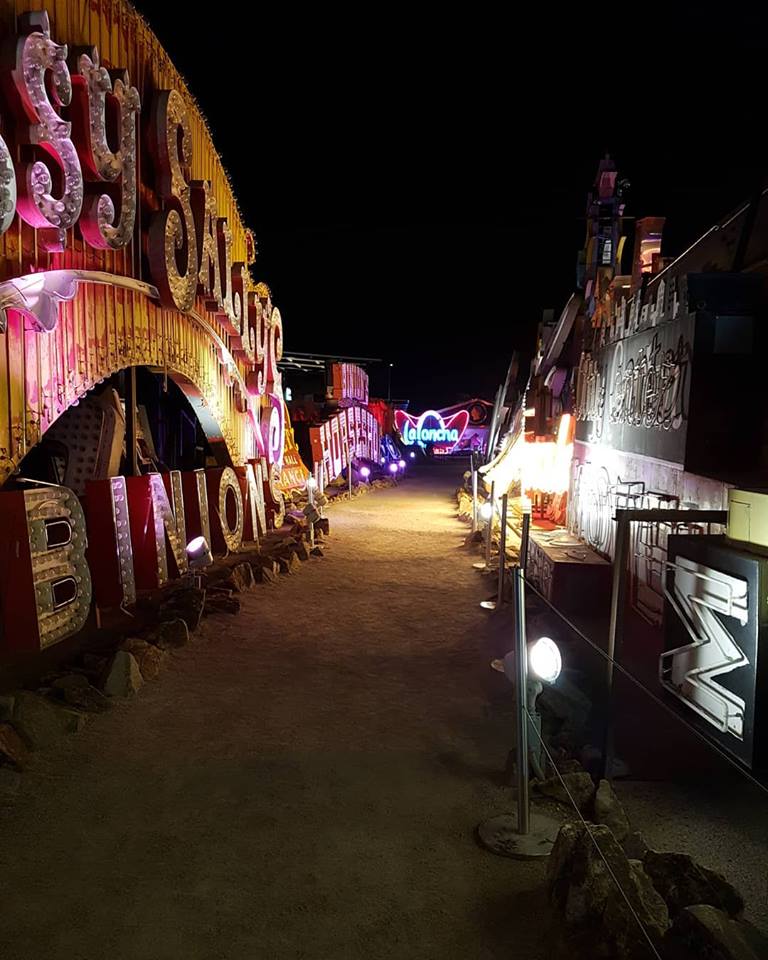
Neon alleyway
Moni and I are back in the icebox now, having just returned from a relatively short bout of southyness over the Christmas break. Didn’t get to see near enough of our loved ones, but it was good to connect with those we could.
We made a stop at one of my favorite haunts in Vegas, the Neon Museum, otherwise known as The Boneyard. This is the afterlife for many of the old marquees used on the strip and throughout town. It’s strange for me, because I used to live in the Vegas area (Boulder City, to be exact). I remember some of these signs when they were alive and in the wild, so to speak. I should say that I sort of remember them. The Strip and much of what most people think of as Vegas was always just as foreign to me as it might be to the tourists coming through town. I don’t think that’s an unusual perspective for locals, but it does give Vegas nostalgia an interesting mix of oddity and familiarity. One of the cultural consequences of tourism, I suppose, a past rendered both intimate and alien. Of course, in this case, the whole thing comes surrounded with the faint glow of neon lights.
Moni and I took a daytime tour of the museum a couple years ago, and we’ve been planning to go back ever since. This time, we made it! Thanks to Mark Thiel of Powel’s Camera Shop for helping us to figure out a few things about our new(ish) cameras. Moni and I made the Neon Museum our testing ground, so to speak. Looking at the photos now, I can see that I have a lot of practice to do, but anyway, the place is cool enough to overcome my clumsy camera skills in at least a couple pics.
The guided tours are an interesting mix of commentary on the signs themselves and stories about old Vegas. One minute you are learning about how they bend neon tubes to make the signs, and the next you are hearing about the role of divorce tourism in the mid-century development of the city. The tours are at their best in those moments when the two themes come together in a single narrative. The stars on the old Stardust marquee are a good example of that. As I recall our old daytime tour-guide related a rumor he couldn’t quite vouch for that they might have been meant to reflect the fall of radioactive dust in the days of nuclear testing. Our night guide on this tour was content to connect them to the era of space exploration. Either way, it’s interesting to see larger patterns of history in the very objects in front of you, or at least in the stories told about them.
My favorite story would have to be that of the Moulin Rouge accord. It’s hard to get a good picture of the Moulin Rouge sign, because it’s so big and distributed in with so many other signs, but the casino played an interesting role in Vegas history. So, it features prominently in the tours. As the first of the Vegas casinos to desegregate, it quickly became a Vegas hot spot, a place where the you could see Frank Sinatra hanging out with Sammy Davis Jr. after doing their own shows. So, it was fitting that the Moulin Rouge would pay a role in the civil rights movement. Facing protests in 1960 over segregation throughout the city, hotel owners met with civil rights leaders at the (already closed) Moulin Rouge. The resulting agreement desegregated the Las Vegas strip.
The tour guides have lots of other stories, of course. I wish I could remember them all.
(Anyway, …click to embiggen!)


10 Monday Sep 2018
Tags
Cheyenne, Grave, Greasy Grass, Great Sioux War, History, Lame White Man, Litte Bighorn, Montana, Monument


Posted by danielwalldammit | Filed under History, Native American Themes, Public History
21 Tuesday Aug 2018
Posted in Narrative VIolence, Politics
Tags
Atrocity, Facism, History, MAGA, Martin Niemöller, Nazis, Persecution, Terror, Violence
We all know the famous quote from Martin Niemöller:
First they came for the communists, and I did not speak out—
Because I was not a communist.Then they came for the trade unionists, and I did not speak out—
Because I was not a trade unionist.Then they came for the Jews, and I did not speak out—
Because I was not a Jew.Then they came for me—and there was no one left to speak for me.
It’s a great quote of course, one that invites us all to slip right into the role of the narrator, to imagine ourselves in Niemöller’s place. To make us think about how we ought to speak out early. But of course, Niemöller didn’t, not until it was too late, and neither did so many others, ever.
One question that’s been on my mind a lot though lately; the ones who come for people, what if they never came for you?
Or anyone like you?
What if the wrong people never made it out of those camps, not in enough numbers to get anyone’s attention?
What if there was no foreign power interested in stopping them? At least none capable of it! No enemy troops to escort you and your neighbors through the killing grounds? To make you handle the nameless bodies? Or tell you what was done in your name? To make you see it or smell it?
What if those people, the ones who come, never bit off more than they could chew? What if they never gave you a reason to rethink your silence?
What if you were never the one who needed someone to speak out?
What sort of stories might you tell then?

18 Friday May 2018
Posted in Alaska, History, Politics, Uncommonday
Tags
Alaska Natives, Anachorage Museum, Art, civil Rights, Decolonization, Elizabeth Peratrovich, History, Museum, Unsettled
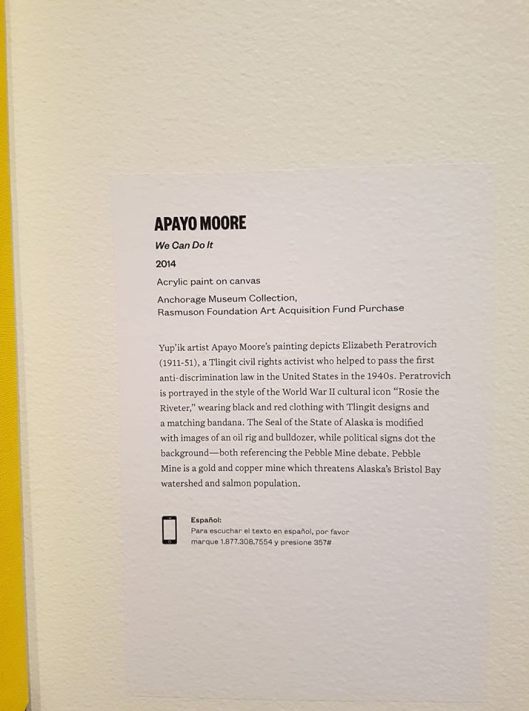
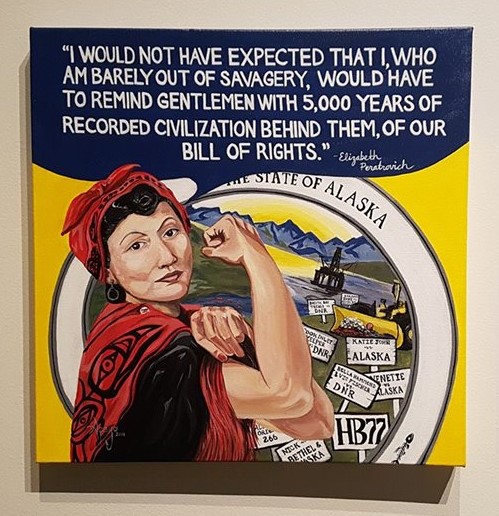 Rosie the Riveter is one of those proverbial gifts that just keeps on giving. So, was Elizabeth Peratrovich. She would have been a contemporary of the many women who inspired this icon, which makes it just a little more interesting to see her standing in here for the women (whose real name was Naomi Parker) most of us envision when thinking about Rosie. This poster is part of the Unsettled exhibition currently showing at the Anchorage Museum.
Elizabeth was a major figure in the movement to combat discrimination against Alaska Natives in the 1940s. She is memorialized every February 16th, the day in which the Alaska Territorial Government signed the Anti-discrimination Act 0f 1945 into law. You can learn more about her work on civil rights at Alaskool.org. The quote featured in this poster is commonly thought to have been part of her testimony at the Alaska Territorial Legislature during hearings over the Anti-Discrimination Act. It isn’t entirely clear whether or not these were her exact words, though it probably says something about her actual testimony that it has become something of a legend in itself. The wit would certainly be right at home with other things that Elizabeth clearly did say.
Seriously, the woman kicked ass!
Apayo Moore, the artist behind this particular piece has the following to say bout it:

08 Monday Jan 2018
Posted in Alaska, Public History
Tags
Airport, Alaska, Anchorage, Geography, History, Posters, Public History, Ted Stevens International Airport, Travel

Vintage
Compliments of a late night layover, my girlfriend and I were recently treated to a little lesson on the history of Anchorage. We were looking for a quiet place to grab a nap before an early morning flight back up to the ice-box when I noticed this series of posters on the history and geography of Anchorage.
These can be found on the second floor of the Ted Stevens International Airport, which seems to be an area reserved for office space. There really isn’t a lot of foot traffic along that area, which is part of why Moni and I were there to begin with. Anyway, I’m guessing the public doesn’t see these all that much. If they are published elsewhere, I’m not aware of it.
The logo on the lower-right hand corner suggests that these were prepared for the Anchorage Centennial in 2015. I don’t have anything in particular to add to these visuals. A lot of information has been crammed into each of the posters, but the context is pretty sparse. Still, it’s kind of an interesting glimpse into the city and its past. So, I’ll just leave these pics here.
You may click to embiggen, which is particularly helpful if you want to read them. I tried to at least ensure that the main text was legible here on the blog, but if you want to read some of the small text, you might try downloading it so you can magnify it.


07 Thursday Dec 2017
Posted in Irritation Meditation, Politics
Tags
Bonnie and Clyde, Fox News, History, Internet, Journalism, Media, Photography, Photos, Twitter
It’s always fascinating to see the slippage commonly coming between a story and its headline, and again between a headline and a social media message about it. The hackwits at Fox News are always happy to provide examples of this sort of thing. Last week I couldn’t help but gripe about their misrepresentation of a major story on twitter. Today, the angle isn’t all that clear, but sloppy slippage is a habit that seems to serve them well.
What got my attention a few minutes ago was this tweet:

So, I see this and I am thinking; Really? I always thought Bonnie and Clyde were in their car when they were shot. Or was that just the movie? No, I’m pretty sure they were in their car. So, when was this? Just before they got in? How long before… No, this says the pic was taken right before they were shot. But…
…and thus I clicked the link (which is admittedly to say that I fricking fell for this click-bait bullshit. Still kicking myself over that.)
So, anyway, and at the expense of providing a link to a common source of right wing propaganda, here is the story.
The opening passages of this story are fascinating in much the same sense that grading a freshman essay is often fascinating. By ‘fascinating’ I of course mean saddening. It’s not just the brief, blurby, writing style that jumps out at me. (Seriously, this is clearly written for people with the attention span of not-even-gerbils.) What really irks with a vengeance here is the complete inability to stick to a consistent account of the story.
Check it out!

Mini-paragraph 2 says the photo was taken ‘days before’ Bonnie and Clyde were shot down. Mini paragraph 3 says ‘shortly before’. I guess ‘days before’ could count as ‘shortly before’, at least if you aren’t paying attention enough to wonder why they are re-framing the time-scale in the very next sentence. Most sensible people would think that was at least a little odd. And most sensible people would think that change of wording does shift the meaning, at least a little bit. Either way, it would certainly be a stretch to say that ‘days before’ counts as ‘right before’ or ‘moments before’, as indicated on the Fox News twitter account.
So why do this? It really doesn’t seem like deliberate spin. It seems more like a short attention span. Perhaps, it’s a habit of a mind accustomed to spinning an inch into a mile every chance it gets. These micro-shifts in meaning can be damned useful if you are spinning a story with a purpose. A mountain is easily reduced to a molehill with a little crafty word choice. The folks at Fox News are well accomplished at this technique. Still, it’s a little odd to see this much slippage crowded into such a small and simple account. The only clear pay-off in this particular instance is the added dramatic value of the click-bait, but even that doesn’t explain the shear quantity of equivocation in the Fox account. The story itself uses two different time-frames, and that shift isn’t explained by the desire to generate click-bait. Neither does the use of two different time-frames on the twitter account. A subtle shift is one thing, but these guys are all over the place. I find myself wondering if they folks can stick to a simple account even when they don’t have an axe to grind on the story.
Seriously, I can’t figure out how this will help to advance the war on the poor. Neither will it enable the Manchurian Man-Child to gin up a war to help keep all our minds off the Mueller investigation. I can’t even tell how this proves Hillary killed Han Solo in the living room with a candle stick. It’s not all that agenda driven. It’s just drivel-driven. it’s also a hell of a way to hack up a simple story.
…idiots!

30 Saturday Sep 2017
Posted in History, Native American Themes
Tags
American Indian, Boundaries, Cartography, Distortion, History, Maps, Nations, Native American, Territory
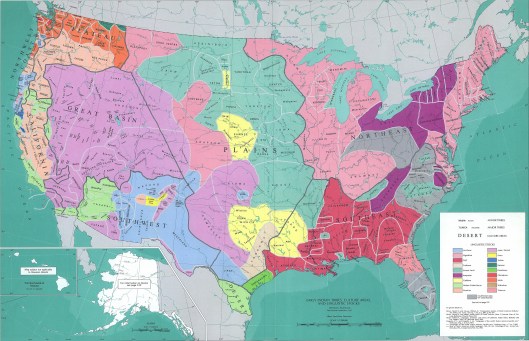 I often see maps of Indian territories pop up on the net. I like them. And then again, I don’t. I’ve seen also some of these same maps in classrooms and academic papers. In such cases, the narrative usually does a bit more to put the visual presentation in context, but on the net, that visual is often all you get.
…along with a couple hashtags, and sometimes a catchy title.
The specific subject matter varies a bit from map to map. Sometimes they purport to show linguistic variation. Sometimes, they show the culture areas used by anthropologists or the general divisions of Native American peoples into related peoples. Mostly, these maps purport to show the specific locations of various tribes.
…whatever that means?
Don’t get me wrong. The basic idea isn’t entirely off base, and it’s a lot better than silence on the topic, but the notion of an Indian tribe carries a lot of baggage, only some of which goes away if we replace the term ‘Indian’ with ‘Native American’. We can also replace ‘tribes’ with ‘nations’ or ‘peoples’.
…we still end up with plenty of baggage.
There really isn’t any vocabulary that just works here. You really have to pick a term, and just bear in mind the distortions it imposes on the subject matter. But my point here today isn’t so much to work over the vocabulary as it is to focus attention on the maps themselves. It’s great to have them, but they too can distort the subject matter, all the more so when the map circulates as a meme-in-in-itelf, so to speak, just an image without a narrative to go with it.
So, what’s the problem?
***
Well, we have a few of them actually. One of the first things going through my own mind is the other half of the contextualization schema. The maps give us a where. That leaves me asking when? These maps purport to show us where different Native American peoples lived, but they rarely give us a strong sense of when they lived there. This goes hand-in-hand with common assumptions about the timelessness of Native American societies. Folks are only too happy to imagine that most Indian peoples had been living in the same place since time immemorial, just waiting for the rest of us to show up and kick-start the history machine. All the timely-changey stuff must have come after Columbus, so the thinking goes. Before that, Indian peoples just stayed put, living in harmony without any real need for big changes like a major population movements.
All of this is of course, nonsense, and I think most people know it is, at least when the question is put to them directly. I repeat, they know it WHEN you put the question to them directly. Until then, I think folks fall quite easily into the assumption that Indian peoples rested in a kind of temporal stasis. Hell, sometimes Native Americans themselves fall into this assumption.Don’t be too surprised. Stereotypes often come in a user-friendly version, an ever-so-inviting role to play, for those who are willing. The noble savage may be a cliché, but it’s not one without its charms, and it’s easily as timeless as any of its less PC counterparts. In any event, folks often seem to imagine Native American societies as timeless communities.
Case in point?
These maps.
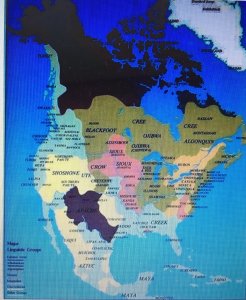 I found this little gem to the left on twitter, at least I believe that’s where I got it. It’s pretty cool, really. It definitely matches my general sense of where various people should be. But then again, my general sense of where everybody should be rests on a skewed timeline. I expect them to be in certain places when the stories I read or tell about them in history class take place. So, if the different natives peoples are in the right place on cue for the historical narratives I expect to feature them, then the map matches my initial expectations, and I end up saying stuff like “it’s pretty cool.” The whole thing almost works, but it doesn’t take too many questions to bust up both those expectations and the maps that go with them.
When did everyone get where they are in the map above? It’s controversial question, and one that I may regret raising here, but still… See the Apacheans down there in the Southwest? You might think they had been there since time immemorial, right? Well the archaeological evidence suggests this isn’t the case. As I recall, the earliest evidence for Diné (Navajo) placement in the four corners area predates the Spanish by a little over a hundred years. They came along with the other Apachean peoples by means of a hotly debated route. Of course archaeological finds happen every day, so the historical evidence may change, and I may have missed a recent find or three, but the point is that these people arrived in the area within comprehensible time frame. This placement on teh map isn’t from time immemorial; it begins at the cusp of the 1400s, give or take a bit, and that enables us to place their entrance into a sequence of events for the region. They were still settling into the total territory on this map when the Spanish began exploring the region, arriving well after their Pueblo neighbors. Knowing that helps to put the map in perspective. Not knowing that invites an a-historical reading of the map.
Now look at the plains. The peoples placed there seem right to me, but it’s worth considering that many of them didn’t get there until well after the beginnings of the colonial period. Specific migration routes and the scale of ground shifted are of course open to debate, but I think it is fair to say that a great deal of the population on this portion of the map filled in after the beginnings of the fur trade, and even more importantly, after the horse began spreading through the plains in the wake of the Pueblo Revolt.

From the New Mexico Museum of Art
That would be a war the Indians won folks, not simply a battle. a war. But that’s another rant…
…anyway, the point is that the population of the plains as we now understand it changed a great deal during the colonial period. So, if the southwest takes on roughly the territories represented in the map just ahead of the colonial period, the great plains takes its apparently map-worthy shape during that very period. We can point to a time frame sometime on down the road that reflects this mapping, but by then other things have shifted. Case in point? The eastern seaboard. By the time the plains looks like it does on this map, the settler population is already pushing a lot of people out and away from the coasts. By the time Lakota, Comanche, and Kiowa have reached their positions on this map, the eastern seaboard should already be looking a bit white-washed.
These are just the areas I think I know something about (and admittedly, I am often wrong). The rest of the map is full of movement too. Some areas may be more stable than others. The amount of movement is itself variable.
So, what does the map represent? It really isn’t a clear snapshot of any particular time-frame. We really can’t locate a specific time in which all the territories assigned to various indigenous peoples really were under their control. Rather, it seems to be a representation of the territories controlled by various peoples during something like a period of peak cultural autonomy. …as perceived by white people. In a very real sense, each of these territories is set onto the map in precisely the locations at which we non-natives really became interested in the regions and/or first became aware of the native peoples in question. Fair enough as far as it goes, but to say that this leaves out a lot of information is a Hell of an understatement.
***
Speaking of non-native perceptions. Names are a bit of a problem here as well. I hope it will come as no surprise to learn that many of the names appearing on these maps are not those used by the people to refer to themselves. ‘Navajo’ was for example a Tewa term for open fields. ‘Sioux’ is usually described as a shortened version of an Ojibwa term (it has something to do with snakes). As I recall, there is a competing narrative for that one, but the point is that the name DID NOT come from the Sioux themselves. ‘Eskimo’ was a Montagnais term often translated as ‘raw fish eater’, though it is more likely to have meant ‘snow-shoe netter’. Each of these origin narratives is a complicated story in itself (information is problematic all the way down), but for the present, the point is that the names typically appearing on these maps generally come from the neighbors of the peoples in question. They made their way into the popular lexicon after European colonists asked some other tribe who lives over there. The answers to those questions then made their way into our history books and onto our maps.
 This is one reason I like this map by Aaron Carapella. He makes an effort to identify the native names for themselves and get them onto the territory. That’s a big improvement. Of course, we still have the timeline problem mentioned above, but at least the names are a bit more authentic. I should add that they are more authentic because they are the names the people in question use for themselves, not because they are ‘original’, as folks sometimes suggest. ‘Original’ alludes to a timeless beginning. Talk of an original name just points us back to the timeline problem, but there is definite value in using the name people prefer to use for themselves. We may have to switch back and forth, or introduce a topic using the more popular names, but working with materials that provides the native terms helps to normalize them.
***
 One additionally interesting feature of Carapella’s maps is the fact that he leaves off the territorial boundaries. The names of each people simply appear on the map without any clear sense of the boundaries around them. We are left to imagine the full extent of each native territory. This avoids one of the larger problems one commonly finds in maps of Indian territory, their tendency to construe that territory in terms comparable to that of nation states. We all know the convention, color-coded spaces with clear boundaries between them. This conveys both a sense clear boundaries between different Indian peoples and a sense of homogeneity within those boundaries. Every part of Cherokee territory on such a map is just as Cherokeeish as any other part. They are all equally blue, or yellow, or mauve. One gets the sense that someone could pinpoint the exact moment they stepped into (or out of) Cherokee land, or that of any other tribe. We can practically see someone stopping on a dime, just like the cops in an old outlaw trucker movie do when they reach state lines. That’s how modern nation states work. It isn’t clear that this is now native territories work(ed).
It isn’t that native peoples didn’t have territories. They certainly did claim specific lands, and even defend them from others, but this system would have worked without the benefit of a scientific grid defining the exact moment one would step over the line from one territory to the next (much less collection of maps to represent them). Of course, natural features such rivers or mountains, and so forth would be used as reference points, but thus too leaves open questions as to just where the boundary rested. Did a given people claim both sides of a river or just one? The answers would vary. The end result was of course a lot of overlapping claims.
I often wonder if some of these maps could be improved by representing the overlapping territories, Venn diagram-style, at least where such instances do occur, but of course, this leaves open questions about timelines and the adequacy of information as to how the territories on these maps have been assigned to begin with. It’s not as though the historical record is entirely silent on these matters, but there is something about the way these maps fill in the details with a little too much precision. Judgement calls have been made on these maps, and the way they have been made is erased by the nature of the maps.
The problem isn’t really unique to Native American territories, but at least as applied to modern states and nations the techniques used by the map-makers matches those of the powers that be a bit more. People who live in and around important boundaries may or may not live life in a way that bears out the conventions of cartography, but the powers that be will likely support the notion that we can pin-point exactly where one state leaves off and another begins. They will also support the notion that we know exactly who belongs on one side or another, if necessary with guns or walls. The trouble here is that these maps purport to describe the territories of a different world altogether, one which reckons turf a bit differently.
Don’t get me wrong; it’s great to have these maps, but they distort even as they inform. I’m always curious about the prospects of improvement. In the interim, I reckon the best cure for the distortion is to be aware of the problems.
…of which, I hope I have at least scratched the surface.
Sundry Maps (Click to embiggen)…


 northierthanthou