It must have been a couple decades back. I was at a small party in Forth Defiance. Those attending included a number of officials in the Navajo tribal government. Fort Defiance serves as kind of a bedroom community for the capital of the Navajo Nation, so this was hardly unexpected. What none of us expected that evening was a quick lesson that began when our host asked if anyone knew the name of the main street going through the town? No-one did. As it happens, the name was Kit Carson Drive.
Apparently, it still is.
To say that most of the party-goers found this shocking is putting it mildly. It may not be obvious to some of my readers why a room full of Navajos would object to a street named after Kit Carson, but even the most cursory knowledge of their history would make this pretty well obvious. The man is popularly known as an old western Indian fighter, and as it happens, a good number of the Indians he fought were Navajo. When General James H. Carleton, the Army Commander for the Territory of New Mexico decided to go to war with the Navajo people, it was Colonel Kit Carson that he sent off to do it. Carson marched through Canyon de Chelly, the heart of Navajo territory, destroying resources (just as Sherman might have) and letting winter bring his enemies in to surrender. This campaign, and the four years of internment at Hwéeldi (Fort Sumner) still constitute the darkest chapter of most historical narratives about the Navajo people. So, you can just imagine what it must have meant for people who can still tell you about relatives lost on the long walk to Fort Sumner to learn that a road right through their community bears the name of the man responsible for their deaths.
Kinda put a damper on the party.
You might think it odd that folks didn’t know the name of the road to begin with, but it’s hardly unusual. Folks don’t pay that much attention to street names out that way. Many of the roads don’t have signs at all, and I don’t recall seeing that particular name on a street sign when I lived out there (though one can certainly be found in Fort Defiance today). This party was the only time anyone ever mentioned it to me.
The old south isn’t the only place in this country with a questionable sense of public history from the Civil War era. Those in the Southwest have less to do with the war between the states than the early stages of the Indian wars which would dominate the interior west for a couple decades. Kit Carson Drive is one of many such examples. The Obelisk in the town square of Santa Fe provides another. It’s had its own share of controversies over the years, not the least of them being this dedication:
“To the heroes who have fallen in various battles with savage Indians in the Territory of New Mexico.”
It should come as no surprise that this line acquired its share of critics over the years. It has had some defenders as well, to be sure, but plenty of critics. The sentiments might have seemed appropriate enough to those who erected it in 1868, but in the 1970s, sentiments had changed a bit, as had the political status of some of those ‘savage Indians’ referenced in the piece. So it really should have come as no surprise when calls went out for removal or modification of the monument. Today, at least, it may seem a little surprising to find the monument had Native American defenders, which apparently it did. Attempts were made to put the original wording into it’s proper context, so to speak, preserving it without appearing to endorse it, but some clearly weren’t satisfied with this way of thinking about the issue. Resolution apparently came in the form of a chisel, and the result is a monument with its own fill-in-the-blank question.
It seems, the American public is hashing out a new round of debates over public monuments, particularly those in the South. Some no doubt find the entire debate quite trivial. Who reads the placards on a monument anyway? Of course when people fight over seemingly trivial things, you can bet your ass they aren’t really fighting over the trivial things. It isn’t actually history (much less historical monuments) that has people up in arms over Confederate Statues, just as it wasn’t really history that caused a word to fall off the monument in Santa Fe. Such battles are always about the present. They are about the way that people think and use history to shape the present, and there are usually some very specific present implications in these battles.
People typically see the present interests loud and clear when they confront advocates of social justice. If anyone ever forgets this, the term ‘political correctness’ is right there to remind us that someone (or at least someone on the left) has an agenda. What folks are slower to get, it seems, is the fact that these sorts of gestures are hardly neutral to begin with. There is a reason James W. Loewen devoted a fair portion of his book, Lies Across America, to Confederate monuments, and it wasn’t because these monuments contain sober and thoughtful commentary on the actual history of the region. A statue to a confederate hero isn’t just a reference to history as such; it says something to those who those whose ancestors those heroes fought to keep in bondage. And a monument to heroes who died fighting ‘savage Indians’ may say something noble to those descended from colonists (Spanish or Anglo) in the American southwest; it says something else to those descended from those very ‘savage Indians’.
To be sure, complications abound. Some folks may have ancestors on either end or neither of his memorial demographics, and some people may have no dog in the fight at all. Also ironic usage happens. Not every Native American takes umbrage at the word ‘savage’ just as not every Native American objects to the term ‘Redskins’. But we should be wary of efforts to make these exceptions into the rule. The Washington football team has, for, example paid good money trying to find, cultivate, and promote just about any Native American willing to help foster the notion that the team name reflects anything but a racist stereotype. Were the team name really so bland, one might almost wonder what use it would have for people interested in such a martial sport! And of course we now have the Cheetoh-in-Chief (who has his own bullshit civil war monument) mourning the loss of beautiful artwork and a desecration of history with every Confederate statue that goes down. His language is so flowery and positive. You’d almost think these monuments held no serious political significance in the present age.
Of course the folks delivering the Nazi salute in defense of Robert E. Lee might seem to argue otherwise.
There are people, times, and places who don’t find it necessary to remove or modify monuments to their sordid past. Some of these might not even be terrible people, places, or times. But if the monuments to an abusive past aren’t so toxic, this isn’t simply because potential critics choose to let it slide; it’s because the community as a whole has somehow managed to handle the issues in question. When the dominant voices prove tone-deaf or outright hostile to the interests of those on the wrong-side of monumental history, then we are all a lot less likely to get along. Then statues get pulled down.
…or someone just shows up with a chisel.
***
Just a few pics of Canyon de Chelly (click to embiggen):
Someone I know and love likes to say that Game of Thrones is all fake. It’s fantasy, so there is nothing realistic about it. This same individual (whom I know and love) eats up reality TV like it was candy. I think he knows as well as I do that those shows are often contrived, but that doesn’t stop him from getting really into the moment that alligator is on the hook and the second guy in the boat can’t seem to find his shot. I know as well as he does that Westeros ain’t real, but that doesn’t stop me from worrying about the fate of Jon Snow. Each mode of storytelling works for one of us and not the other.
But what does realism have to do with it? Or anything else for that matter?
***
It’s easier to see the connection for reality TV, not because it’s more real in an objective sense, but because the theme is more central to the genre. Reality television purports to be showing us something about how people in some part of this world really do live. That’s a claim that goes a bit beyond the story-line itself and reaches into the mess of life we sometimes call the real world. That claim constitutes a significant portion of the genre’s appeal. It’s a bit like porn, actually. The dialogue may be utter crap, but somehow the sense that you are seeing something real makes it a little more interesting. At least I think that’s the point, or at least part of it. For myself, I just can’t get into it. Knowing just how much manipulation goes into the stories told in reality television, constitutes a bit of deal-breaker for me. Perhaps I would enjoy it more if I could suspend disbelief and just enjoy the stories, but how does that suspension of disbelief work when a sense of veracity is central to the genre?
…also, there is the expository crutch!
Reality television leans very heavily on the use of exposition. Far too often, for me anyway, they break away from the action to have one of the characters explain events to the audience in their own words. Without these moments we would be missing a lot of the plot-line. Reality television uses these moments to fill in the gaps. It also uses them to tell us what’s at stake in the action, often playing up the drama well beyond any significance we could draw from the events ourselves. …if we don’t get this fish trap to work we’ll starve! We need to fix the oil leak in our car or we’ll freeze to death on this mountain top. That chef needs to change his recipe or the whole business will go under! …you get the idea. They’ll repeat these narratives a few times each episode, just to make sure you get caught up in the point. Maybe, I’m a hard sell, but most of the time I just don’t believe them. More importantly, I find the whole convention damned tedious. When did so much exposition become good writing? I’m guessing that moment in television history came during the early episodes of MTV’s Real World and that first season of Survivor.
Remember Survivor? Remember the hype leading up to the first episode? This was supposed to be about people surviving on their own under primitive conditions. Only they couldn’t! Those guys really couldn’t do much to feed themselves and contribute to their own survival. But they did get just enough food and water from the show producers to survive so long as they didn’t waste their energy trying to survive on their own. So they mostly sat around and bickered with each other. Somewhere in there, I imagine, the production team must have had a collective panic attack. …My God, the whole story just ain’t happening! What do we do? The answer turned out to be high school soap opera, and thus the master script was born for just about every reality television program made ever since.
That’s how I imagine it anyway. It may not be real, but if you had me and five of my friends telling you the story of this blog post, I’ll bet it would pass muster for reality TV.
“…this really is a must write blog post for Dan. He’s at his breaking point.”
“I knew, I had to do post something today. This post was like a dark cloud hanging over my head.”
“If Dan doesn’t finish this post today, I’m pretty sure he’ll be eaten by black bears.”
“I don’t see what the big deal is. Nobody reads blogs anymore anyway.”
I’m voting that last fucker of the island!
***
But let’s come back to the Game of Thrones! I get the concern. It’s fantasy. There are dragons. Magic works (except when it doesn’t), and well, hell, did I mention there are dragons? Clearly, some things about Game of Thrones are not real at all. Still, I think the show has two (maybe three) realisms lacking in many more ‘realistic’ genres.
First and foremost, it’s all the death, the gruesome terrible deaths, the ones that happen to central characters that we all know and love. Love it or hate it, George R.R. Martin’s penchant for killing off key protagonists has long since become the defining feature of the show. For myself, I love it, but there is a certain dwarf that better be in good health at the end of this coming season or I’ll, I’ll, …I don’t know what I’ll do.
Take that Martin!
People ask Martin about this all the time. I’m particularly fond of the answer he once gave The Independent:
“A writer, even a fantasy writer, has an obligation to tell the truth and the truth is, as we say in Game of Thrones, all men must die,” he told Galaxy’s Edge Magazine. “Particularly if you’re writing about war, which is certainly a central subject in Game of Thrones.”
He continued: “We’ve all read this story a million times when a bunch of heroes set out on an adventure and it’s the hero and his best friend and his girlfriend and they go through amazing hair-raising adventures and none of them die. The only ones who die are extras.
“That’s such a cheat. It doesn’t happen that way. They go into battle and their best friend dies or they get horribly wounded. They lose their leg or death comes at them unexpectedly.”
The author goes on to explain, slightly morbidly, that we’re all going to die at some stage as mortality is inevitable. “Once you’ve accepted that you have to include death then you should be honest about death and indicate it can strike down anybody at any time.
“You don’t get to live forever just because you are a cute kid or the hero’s best friend or the hero. Sometimes the hero dies, at least in my books.”
I take that to be a kind of realism. It’s not about authentic costumes or weaponry, or the details of some known historical event. It’s about the human cost of warfare. Martin is known to have patterned his fiction after some real historical conflicts (most notably the War of the Roses), but of course his work remains fiction. Hell, it remains fantasy-fiction. So, we have no baseline from which to compare his description of events to a known fact, at least not any he is obligated to render with accuracy. Still, Martin’s willingness to kill off the characters we care about tells us something about war that many more ‘realistic’ stories keep leaving out.
I would add that it isn’t just Martin’s willingness to kill important characters that sets his stories off from others. It’s his willingness to do it unexpectedly, suddenly, and often without any hint of heroics in the moment of death. Time and again, Game of Thrones invites us to identify with a character, to root for them, only to kill them in the end.
…only to leave us watching as the struggle goes on without those whose story arc had once defined the whole meaning of the show for us.
That is a kind of realism, one largely absent in a good deal of historical fiction.
***
None of this is exactly Italian neorealism. But each of these genres effects a kind of realism amidst a story-line saturated with fiction. Where one purports to show us something akin to lives of people in odd walks of life, another aims to show us how human beings struggle to deal with terrible events. For either to work, something in story-line must resonate for the viewer (or reader). Each in its own way speaks to a sense of reality, though each also weds that sense of reality to a fabricated universe of its own.
***
Historical accuracy might be thought to present another type of realism, but of course historical films (and even documentaries) are saturated with their own contrivances. The blog, An Historian Goes to the Movies presented a very thoughtful discussion of the subject here, here, and here (and really throughout his entire website). In one of the most interesting passages in this series, he talks about the public’s penchant for scrutinizing the accuracy of material culture and fighting techniques in film while ignoring the historical accuracy of plot points:
I find it very striking that audiences apparently want a sense of accuracy about violence, but not about plot. They cheerfully accept absurd plot developments (like Isabella being way too young and way too far way to have an affair with Wallace), but will complain if the sword fighting looks too fake. (Compare contemporary film violence to that from the 60s, for example, to see just how much effort Hollywood has put into improving the realism of its violence.)
Imagine for a moment a film in which the emphasis was on accuracy of the plot, but not on accuracy of the costuming or weaponry. Picture William Wallace running around in a 20th century British military uniform carrying an AK-47 but engaging in fairly accurate political maneuverings.
Most people would react to that poorly, I suspect, because Hollywood trains us that accuracy means specific things and generally excludes other things. But theatrical and cinematic adaptations of Shakespeare employ this device fairly frequently. Instead of setting his Richard III in the 1480s, like the historical Richard III, or in the 1590s, when the play was first performed, Ian McKellan set his version of the play in the 1930s, depicting Richard as a would-be fascist dictator. A particular favorite detail is the arrangement of 16th century poem “Come Live with Me and Be My Love” as a sort of Swing-era piece. The famous “Now is the winter of our discontent” speech becomes a political speech. It works beautifully, and while the setting isn’t faithful to the play as Shakespeare envisioned it, it works marvelously and offers a wonderful comment on the politics of both the 15th and the 20th centuries while still being true to the spirit of the play. This is a film making careful, clever use of its choices about historical inaccuracy.
Perhaps the most interesting part of this commentary lies in the comparison with Shakespearean theater. While it’s easy to fall into the trap of thinking that the kind of bias he exposes here is just to expected from viewers, the comparison with Shakespeare shows us that it isn’t. There is indeed at least one genre which reverses the emphasis, taking us out of the realm of period dress and sword techniques and inviting us to dwell on the plot-line.
I want to underscore at least one aspect of this question about accurate plot-lines, namely the sense of a character’s world view. Historical plot-lines can be inaccurate for any number of reasons, but one of the most interesting and common inaccuracies would seem to be a penchant for reading modern thought worlds into the motivations of historical characters. In this respect, Mel Gibson is the gift that keeps on giving. Whether it be a southern plantation owner who doesn’t own slaves, or William Wallace crying ‘freedom’ as he is about to die, his historical characters typically speak to the sensibilities of modern peoples more than those of the era in which they purportedly lived. Whatever the (in-)accuracy of his dress or battlefield depictions, Gibson’s characters are often living anachronisms, thinking and behaving in ways that have less to do with the period than the social order of the modern day.
Here is another respect in which I think Game of Thrones is particularly good. For those of us who live in a modern republic, the logic of an aristocracy can seem quite vicious, often unnecessarily so. Why all the fighting? Is it vain ambition? And if these characters must fight for control of their worlds, could they not at least spare the children of their enemies? Even the title of the series points to the answer, but I believe it was Cercei who explained it best.
Again, this is fiction. Hell, it’s fantasy fiction, but it’s fantasy fiction pointing at a kind of world that has existed in human history, one many of us have trouble grasping. It’s a world in which heredity defines power, and even a child with the wrong bloodline is a very real threat to the powers that be. This too is a kind of realism, one which reminds us people in other times and places may not be able to act as we would, even if they wanted to. I admired Eddard Stark’s efforts to show mercy in this scene, and I expect I’m not entirely alone in this. But of course we call know how that turned out. We are 6 seasons into the show, and thus far, I have every reason to believe Cersei was right about this. Not just Certei. Martin too. This is Martin telling us something about the social order of a certain kind of world. His world may be fiction, but others like it would not be, and his story does indeed help to illustrate how those worlds work. Is it realism? Not quite. But you could learn a lot about real worlds from this kind of story.
***
So it seems the attempt to show us how certain people live in certain times and places always reflect the priorities of those who produce them. Are they trying to show us how people dressed, how a certain series of events unfolded, or how people thought about their lives in the context of the times depicted? One could find other priorities in a film, to be sure, but it would be a rare story that didn’t have some serious blind spots.
The funny thing about such blind spots is they can be hard to see at first, but once you find them, they can be equally hard to ignore.
***
Okay, so one of the ways I am cheating my way through this topic, so far, is that I keep picking examples where one can arrive at a reasonably sure sense of what the facts would say about a given issue, what would count as real if we chose to care about it. What about when you don’t know? What is realism when we don’t exactly know what the fact is?
Take the film, Atanarjuat (Fast Runner). Better yet, take the film Reel Injun in which director, Zacharias Kunuk discusses one of the challenges he faced in making Atanarjuat. He wanted to shoot some love scenes, but that raised an interesting question. How would two Inuits living essentially in the pre-contact era have actually made love. He couldn’t very well just have them start sucking face for foreplay, as would be the case in most love scenes, because Inuit in the precontact era didn’t kiss the way people do now. Lots of people have heard of an ‘Eskimo kiss’, which is essentially rubbing noses, or so we are told, but how does that work? Past movies set in the arctic depict this in rather comic terms, which was definitely not what Kunuk was going for. He wanted to portray this as accurately as possible. So, he talked to the elders in his own community and based his own love scenes on their answers.
So, is the ‘Eskimo kiss’ in Atanarjuat accurate? Is it realistic?
It seems rather likely that the answer is ‘yes’, but that isn’t entirely obvious. The elders Kunuk spoke to, might have been wrong. It’s certainly possible. Historical information isn’t carried in the blood, and customs change a great deal over time while people’s ideas about tradition are often rooted in the eras of their own youth. So, it is possible that Kunuk’s elders might have been factually wrong about an Eskimo kiss.
So what if they were?
Worst case scenario, the love scene in Atanarjuat is still the best answer that an Inuit director could come up with after speaking with Inuit elders in preparation for a movie with an Inuit cast and made essentially with an Inuit audience in mind. I can manufacture (as I just did) an objective question that Kunuk might have gotten wrong, but his answer is still the most authoritative I know of. It is certainly the most authoritative answer most of his non-Inuit audience will ever see. Whatever the facts of this topic, Kunuk’s portrayal is still a thoughtful expression of an Inuit perspective about the subject. That has to count for something.
So if someone asks me what is an ‘Eskimo kiss’, how am I going to answer them? I’m going to point them right to Atanarjuat, or maybe to Reel Injun. Of course, I could also say that an ‘Eskimo kiss’ is a silly western caricature of what different Eskimo peoples actually did, but then I’m still going to point them to Fast Runner, because what happens in Fast Runner is STILL the most authoritative answer to that question that I know of, at least on film. In effect, it is the most realistic film portrayal that I’m aware of at present.
The point here in this overly-belabored sub-theme is that realism isn’t always about objective facts. Sometimes it’s about perspective, Sometimes, it’s about the most authentic voice(s) you can find on a subject, the ones whose values and priorities are most relevant to a subject. This is particularly true of movies about exotic peoples, whether they be past civilizations, foreign cultures, or just the guy who does that really odd job. An outsider might manage a perfectly accurate portrayal of the lives of such people, but without some insight into their thinking, what would that be worth? Such insights must involve a native voice at some point. Better still when that voice can actually shape the narrative!
The Atomic testing Museum in Las Vegas would be among the more interesting places I visited this summer. The museum has two major exhibits, one for Atomic testing and one for Area 51. I’m really not sure what to make of the Area 51 section, and really I’d just as son not be picked up by the Men in Black, so we’ll just leave commentary on that aside for the present. Besides, the Atomic Testing Museum provides plenty of interesting material t consider.
Seeing the Dina Titus reading room in there made me smile. It’s been a long time, but I do remember my old Political Science Professor rather fondly. Her book, Bombs in the Backyard would be the most obvious connection to this facility, though I’m not entirely sure how much of a role she played in the development of the museum and it’s collections. She does provide one of the more critical voices in one of the films shown in museum. I find myself wondering if her views couldn’t have received more coverage.
I’d have to say the material collections in this museum are fantastic. I’ll include a few pictures, but they really don’t do the place justice. It’s worth a trip to see this stuff, so remember this place if you’re ever in Las Vegas and your hangover is under control. Of course you may also pick up a bit about Nuclear testing at the Neon Museum, because nuclear tourism was once so very Vegas. But of course the Atomic testing Museum is a long way from Neon. Much of it is drab green and grey, just like I remember my dad’s old military paraphernalia, which is very fitting I suppose.
There is a tremendously matter-of-fact tone to the presentation in this museum. As you proceed down it’s halls you will learn how scientists first came to understand the possibilities which would give rise to nuclear technology; you will learn about the rush to acquire that technology during World War II, and you will learn about the many twists and turns of the nuclear arms race which would follow. Also you will learn about the steps and procedures taken to set up and run the actual facilities in Nevada.What bothers me is just how unproblematic each step in this process would seem to be in the narratives this museum provides.
The Atomic testing Museum presents the rationale for each stage in the history of its subject in a very straightforward manner. It does the same with protests, and even with various decisions to scale back nuclear testing and/or to discontinue certain programs. I wouldn’t say that the museum slights the protest movement in an overt manner, but the museum leaves a strong impression that the development of nuclear technology proceeded along a rational course. Whatever the pros and cons of nuclear testing, and of specific events in the history of nuclear testing, the planning process behind that history was, at least as far as the narrators here would have it, utterly reasonable.
This is of course exactly how I remember those in favor of nuclear testing presenting the case for it when I lived in Nevada. It’s also what I see whenever I dip my toes into the history of Atomic power. For whatever its worth, this does appear to be the view of those who worked in the industry. And of course those who worked in the industry are strongly represented in the Museum and its supporters.
This doesn’t mean that the museum is insensitive to critics of Atomic testing, but it does mean that the narrative presentation at the museum provides a strong bias in favor of the grounds for testing in each of its various phases. Whether testing is right or wrong, so it would seem, the case for doing was always a function of careful, rational consideration. The problem is of course that this just isn’t entirely true. It may well be that the arms race was inevitable. It may well be that the bomb needed to be dropped on Japan, as so many still argue today. It may even be that we needed to keep testing for so many years into the cold war. All these things may well be (and yet they may not), but that doesn’t mean that each step in the process can be fully explained as a rationale decision by someone genuinely interested in pursuing national security.
There are moments in the history of Nuclear testing in which the larger narratives just don’t fully explain what’s going on; moments in which the fingerprints of Dr. Strangelove seem to be found all over the course of nuclear testing; moments in the mad scientist seems to upstage the soldiers and scientist doing heir grim duty for the sake of loved ones, the nation, and possibly the entire world. When I see images of U.S. troops marching towards ground zero of an explosion because someone wanted to see how the bomb would affect troop movements, I can’t help thinking that I’m seeing one such moment in the history of nuclear testing
I look at such an image and I can’t help but wonder at the supposed reason for putting those troops in harms way, at least on that particular day and in that particular manner. Was this really a serious research question? Or was someone doing that simply because they could? Because they could put people out there and expose them to great danger in the name of science, and because being able to put human beings in danger for any reason must be one of the surest signs ever that you are somebody and that what you do is important.
I’m fairly certain that I see one such moment in one of the smaller placards of the museum, that devoted to Operation Plowshare. The placard reads as follows:
The Atomic Energy Commission’s Plowshare Program was named after a Biblical verse referring to “beating swords into plowshares.” The program was intended to find peaceful applications for nuclear weapons.
The Plowshare program, initiated in 1958, sought to develop peaceful uses for nuclear explosives to construct major facilities such as canals, harbors, earthen dams, and other engineering projects. Twenty-Six of the 35 Plowshare nuclear experiments were conducted at the Nevada test site. In 1961, the first off-site multi-purpose experiment, “Project Gnome,” near Carlsbad New Mexico was fired in a salt dome to study heat generated by a nuclear explosion, isotope and energy production, and seismic measurements. The most notable experiment in 1962 was Sedan, a 104 kiloton thermonuclear detonation, equivalent t an earthquake magnitude of 4.75 on the Richter Scale. The blast displaced 12 million tons of earth, creating a crater 1,280 feet in diameter and 320 feet deep. The crater could hold four football fields, end to end. Concluding the experiments in 1973 was Rio Blanco near Rifle, Colorado which focused on fracturing natural gas-bearing formations. The Plowshare program terminated in 1975 due to waning industrial interest and mounting public concern about the environmental consequences.
Not mentioned in this placard would one of the Plowshare projects never completed, Project Chariot. Project Chariot was an effort to build a harbor via nuclear detonations at a site just south of Point Hope, Alaska. Dan ONeill’s book, The Firecracker Boys provides a pretty thorough account of the politics behind this project as well as the opposition which eventually killed the project. Rachel Naninaaq Edwardson’s documentary, Project Chariot, also provides an interesting take on the subject, one focused the local Iñupiat population and their efforts to deal with the lasting impact of their brief encounter with an almost-bombing. I don’t particularly wish to rehash the full subject here, but it’s hardly a study in rational scientific inquiry. The Atomic Energy Commission ignored a great deal of science in planning the project, misrepresented the findings of its own scientists, lied to the people of Point Hope, and finally, when forced to abandon their plans to bomb the Alaskan coastline, the research team left radioactive material buried at the site without telling anyone.
I think about project Chariot when I read this placard telling us about the many successes of Operation Plowshare, when I see this matter of fact discussion of Plowshare’s goals and the simple decision to discontinue it. I think about the lives of scientists whose careers were trashed because they opposed it, and I think about the people in Point Hope today still unsure of just what did actually happen in their region, still wondering what effect it had upon them. In it’s pursuit of Project Chariot, the behavior of the Atomic Energy Commission was (as ONeill suggests) closer to that of kids with firecrackers, all-too eager to blow something up, than the sort of benign search for new ways to help mankind that one might expect from reading this placard on Operation Plowshare.
I think about all that, and I wonder how many similar stories never made it into the placards at the Atomic Testing Museum.
***
(Gallery. You may click the pictures. Don’t worry. They won’t explode!)
Neat Ad
Yep!
Newe Segobia, the most bombed nation on earth. …did I type that out loud?
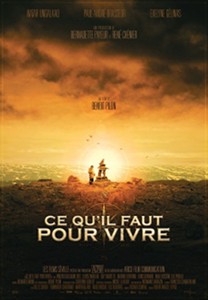
We meet the protagonist of this 2008 Canadian film in Baffin Island of the 1950s. Tiivii (played by Natar Ungalaaq) struggles for breath as he ascends a small hill in search of geese, his wife and children are just waking in their tent below. Upon seeing a boat on the half-frozen ocean, Tiivii sets aside the hunt and takes his family aboard for a series of medical tests. As the boat prepares to leave, Tiivii is told he must remain aboard, leaving his wife and children to fend for themselves while he undergoes treatment for tuberculosis.
When next we see Tiivii, he is soon staring at a tree at the hospital in Quebec City, amazed at his new surroundings and quite unprepared for the coming hardships that await him. He does not fully understand his illness, nor does he realize how long it will take him to recover. He also has no idea how his family will fair without him.
An Inuit lost in civilizations? It’s an interesting twist on a familiar theme, that of a stranger in a strange land. The point is soon driven home as we see Tiivii struggle to master the use of a fork and spoon while the other hospital patients consume platefuls of pasta. He figures it out, but not before earning the derision of his roommates.
Through the story, we are invited to see the hospital and western civilization through Tiivii’s eyes, to see common utensils from the perspective of one who has never used them before and to imagine a common meal from the standpoint of someone has never eaten anything like it. We can also imagine his confusion at the sterile bathroom with its flush toilet; his longing for someone to talk to makes perfect sense; as does his desire to eat familiar food.
We’ve seen this storyline before, a person completely out of his element. It is often used to explore the differences between civilization and savagery. This was the premise for Dances With Wolves, and before that with Little Big-Man and A Man Called Horse. It’s a common enough theme in arctic films as well, being found in White Dawn and Snow Walker among others. What makes this film different is the trajectory of the stranger in this case; he has left a world unfamiliar to most of us, to enter one most of us will find rather familiar. We are used to seeing the story go the other way. Still Tiivii’s journey is compelling. Through his eyes, the western world becomes strange, unreasonable, and quite insane.
This particular twist on the stranger in a strange land contains an element of nuance, however, that would be easy to miss. Audiences may think they know what it means for an emissary of modern western society to live amongst primitives, but what does it mean for such an individual to come live amongst us, or at least the 1950s variation thereof? It would be easy to think that Tiivii spends the entire story marveling at the wealth and richness of the city. In the space of a few opening scenes he has made a transition from the life of a forager scratching out a meager existence on the tundra to a cosmopolitan center with all the wonders of contemporary society. Tiivii may see this world from the shelter of a hospital bed, but he does see it just the same. How could he possibly understand the complexities which have put food on his plate in that hospital, or those that enable him to flush that same food away in the porcelain toilet? It would be awfully easy to think of this as the story of a simple man lost in the wealth of the modern world
…except that would not explain the title of the movie.
The title comes to us in a scene near the end of the film, one in which Tiivii explains to a young patient named Kaki (Paul-André Brasseur) what it is like to be out on the tundra. Although Inuit himself, Kaki, has spent his formative years in the hospitals. He does not understand the kind of life his own people have led. Asked what his homeland is like, Tiivii explains:
Beautiful. Lots of mountains. From the top you can see everything. You can see exactly where you are going. Not like here, where there are trees everywhere and you can’t see ahead. There’s a huge island. It takes many days to travel around it. There’s everything you need, all the necessities of life. Seals. Caribou. Geese.
Tiivii’s face lights up with each point of his speech, but the point of the scene would be missed entirely if this was thought to be nostalgia. Tiivii’s speech provides the strongest hint in the movie as to just how he sees the world around him. It is not a world of abundance at all; it is one in which he cannot see the materials out of which to make his clothes much to less to build a home. It is a world in which he cannot see food or medicine. All of these things must be brought to him. If this is mysterious, it is not the mystery of a miracle so much as a perverse trickery, one which hides the means of life from him while doling out the necessities a little at a time. Far from marveling at the wealth of civilization, Tiivii has been lost in the desert the whole time. He doesn’t see modern miracles in plumbing or cutlery. Instead he sees a world of mostly useless materials.
I think this is the real genius of Necessities of Life, that it actually flies in the face of conventional notions of the difference between foragers and civilized folks. Ever since Nanook of the North, mainstream film-makers have marveled at the struggle of arctic hunters against hunger and the elements. Time and again, Hollywood’s ‘Eskimos’ have been portrayed as dwelling on the edge of starvation, and it would be awfully easy to see in Tiivii’s story just another chapter in that narrative, one in which one of these primitives actually gets to experience the wealth of modernity. And yet, what Tiivii actually tells us is just the opposite; wealth is waiting for him back home on Baffin Island, and he cannot wait to leave the extreme poverty of the modern world behind.
The ongoing feud between Reza Aslan and the so-called “New Atheists” continues to shed more heat than light. The latest round of this race to the bottom of the intellectual barrel comes to us in the form of a Salon piece written by Aslan. It presently carries the provocative title, “Reza Aslan: Sam Harris and “New Atheists” aren’t new, aren’t even atheists.” This is certainly a provocative enough title. I expect I wasn’t the only person to open the page wondering just how he was going to make the case that Dawkins and company aren’t atheists.
Score one for the god of misleading headlines. This article gets its provocative angle compliments of a rather weak bit of semantics:
In fact, not only is the New Atheism not representative of atheism. It isn’t even mere atheism (and it certainly is not “new”). What Harris, Dawkins and their ilk are preaching is a polemic that has been around since the 18th century – one properly termed, anti-theism.
Apparently, the New Atheists aren’t really Atheists because they aren’t merely Atheists. So, if you aren’t ‘merely’ a thing you aren’t that thing at all, at least in the mind of whoever wrote the title of that Salon piece. And if you’re also a thing+ or possess an extra helping of thingatude, then well, no, you’re not even a thing at all.
Out of generosity, I’ll assume it wasn’t Aslan that chose that title.
The larger point of Aslan’s piece is actually to differentiate the ‘New Atheism’ from its predecessors, and apparently to embed that differentiation in a narrative that does as much as possible to discredit new atheism. The resulting sleight of hand is definitely Aslan’s doing. It is admittedly more clever than the title fiasco.
Aslan’s essay includes a rather sweeping narrative about the history of non-belief, touching on a number of things well worth thinking about. Aslan comes to the main point with a fairly specific passage in which he ties the New Atheism with the atrocities of state communism. To get to that point, he first introduces the notion that anti-theism is an intellectual tradition in its own right, one of many twists an turns in the history of unbelief. As strident opposition to religion is what folks like Dawkins, Harris, and the late Christopher Hitchens do, Aslan assures us they are themselves clearly part of the intellectual movement of anti-theism rather than simply part of the traditions of atheism.
I’m not entirely sold on the historicism here, but as far as this goes, it’s probably fair enough to describe these folks as anti-theists. The problem here is what Aslan does with this point. While he works hard to distinguish anti-theism from mere unbelief, Aslan works equally hard to ensure that we do not distinguish intellectual opposition to religion from the slaughter of innocents.
It wasn’t atheism that motivated Stalin and Mao to demolish or expropriate houses of worship, to slaughter tens of thousands of priests, nuns and monks, and to prohibit the publication and dissemination of religious material. It was anti-theism that motivated them to do so. After all, if you truly believe that religion is “one of the world’s great evils” – as bad as smallpox and worse than rape; if you believe religion is a form of child abuse; that it is “violent, irrational, intolerant, allied to racism and tribalism and bigotry, invested in ignorance and hostile to free inquiry, contemptuous of women and coercive toward children” – if you honestly believed this about religion, then what lengths would you not go through to rid society of it?
For an historian of religion this is an inexcusable bit of misdirection. Aslan moves seamlessly from a narrative about the work of Marx and the rise of state communism to a series of direct references to his present intellectual opponents in the New Atheism movement. In fact, he uses the views of today’s New Atheists as a direct explanation for the motivations of Stalin and Mao. It doesn’t get much more anachronistic than that.
…actually, I should say he uses some of their more outrageous quotes. This isn’t really a consideration of their views so much as a bit of quote-mining masquerading as an intellectual criticism, but still the main point is, the man is explaining the actions of communist dictators with random comments from people who weren’t yet a gleam in their fathers’ eyes when Stalin was starving his peasants and Mao was waging his war on sparrows.
In effect, Aslan turns Harris and company into the present-day spokesmen for some of history’s most horrific genocides. This is anachronism at its worst, and Aslan uses it to advance the notion that anti-theism is responsible for the tragic abuses of state communism.
So, there it is. According to Aslan, the Stalinist purges and those of Mao can be understood as a direct reflection of an anti-theistic world view. We needn’t consider the politics of either nation, it’s economic complexities, or any alternative explanations behind these histories. We need only look at what New Atheists have to say today in order to know that this is what the New Atheists is capable of.
…and perhaps to shudder at the prospect.
Ironically, Aslan’s critique of New Atheism smacks of the very inattention to social complexities that many (including Aslan) see in the approach Dawkins and Harris have taken to Islam. It’s an approach that treats doctrines as if they themselves were the driving engines of history, and in doing so it reduces historical knowledge to the needs of present-day polemics. This view of history sees little in human conflict that one can’t fit into a well-written tweet (or perhaps a pithy and misleading title). Aslan has often advocated a nuanced view of the relationship between religion and violence, but with this piece, that nuance might as well be a nine-pound hammer.
Frankly, I’m a bit tired of the battle between Aslan and Harris, et. al. The dialog is increasingly more personal points, and that just isn’t the best role that a public intellectual could play. This a duel between two simplistic views of history, each of them equally myopic. If the rest of us are supposed to choose a side, then I for one will be choosing ‘none of the above’.
I came across this D-Nuts bit last night. It’s not the first time I’ve seen it, but what the Hell? This time I thought I’d take a moment to bloggetize a comment or two on the matter. What’s interesting about this piece, you may ask?
We could start with the most obvious game that’s being played here. On one level it is simply a red herring. A claim about the present-day Republican Party has been answered with a series of claims about the history of the GOP and the Democrats, thus substituting a question about what each HAS BEEN for an argument about what each IS today.
Taken at face value, this red herring contains another problem, a seriously convenient omission of historical information, namely the shift in voting patterns over the 20th century culminating in the famous “southern strategy” of Richard Nixon. Simply put, an awful lot of southern conservatives switched parties over the years since the founding of the GOP and of the KKK. It’s tempting to say that a number of them did so precisely because they saw the modern GOP as a better vehicle for their own racist agenda. In any event, the shift has left both parties flip-flopped on civil rights and the proper balance of federal and state authority. There are some other factors besides race at work here to be sure, but a number of GOP leaders have made conscious appeals to racist sentiments over the years and the results have been quite striking.
So, is it fair to say that the GOP is racist?
I could see reasonable arguments against an affirmative answer. Those arguments do not rest on a conveniently incomplete account of history.
Even still, I can’t help thinking the best (worst) part about this cartoon is just how well its content fits with its intended purpose. Here we have Charlie Brown whitesplaining the topic of racism to Franklin, the one black character in Peanuts. Franklin is clueless in comparison to Charlie’s wisdom. The cartoonist has him reacting with a stubborn inarticulate refusal to see Charlie’s point or even to engage the argument in any meaningful way. He just sticks to his position as if incapable of grasping the issues at hand. He is in effect simply playing the so called race card without any substantive reasons for doing so. The GOP isn’t racist, so the cartoon would have us believe, but apparently it takes a white person to understand that.
…a message which would probably come as no surprise to Franklin.
“We hold these truths to be self-evident, that all men are created equal, that they are endowed by their Creator with certain unalienable Rights, that among these are Life, Liberty and the pursuit of Happiness. — That to secure these rights, Governments are instituted among Men, deriving their just powers from the consent of the governed…”
I wish I had a habanero for every time someone (usually a conservative) told me that passage was in the U.S. Constitution. My friends and coworkers would all eat really hot chili for couple of days!
Most recently, it was Jim DeMint who Declarified the Constitution, so to speak. That’s hardly an unusual mistake from right wingers, but it is a little uncommon from one who actually gets paid to sound like he knows what he’s talking about. Flat out getting the documents wrong is more common among the grunts of the culture wars, not their leaders at the Heritage Foundation. Usually, the talking heads just refer a constitutional question to the Declaration and hope you don’t notice the switch.
It would be easy to dismiss this as a mere accident, but there is a sort of logic to this, albeit a logic of deception. Usually the gambit facilitates a kind of scorched earth tactic in which all that is good and gooey about the Constitution becomes a direct consequence of Christianity (as evangelical Christians choose to understand it). See, the only mention of God in the U.S. Constitution is in the date, and that makes the explicit mention of a creator in the Declaration much more sexy for those who want their gods right up there behind the gavel of government. Now if you just ignore a few things about context of the Declaration (Jefferson’s Deism for instance), you can pretend that ‘creator’ means ‘Jesus’, pretend the Declaration is the Constitution, and pretend the whole point of the passages was not to say we have rights but to tell us where those rights come from, and voila! The Declaration is thus transformed into a speculative theological treaties and the constitution is taken along for the ride (whether by association or mis-recognition depends on whether the operative principle here is deceit or outright ignorance).
But of course such arguments are only meant for real O’Muricans! Us damned liberals aren’t expected to understand the miracles of Republican Jesus. DeMint only reminds us of the importance of God in passing, because this time he is trying to call attention to yet another of the great miracles of this document, the Declastution. This time DeMint was busy trying to convince us that constitutionalism amounts to belief in the power of small government, which is a truly miraculous transformation rivaling that of the Eucharist. This particular piece of conservative theology usually works by telling us about the importance of federalism, which is then defined as a need for balance between federal and state powers. Balance is such a magical word, because you can use it to describe the effort to increase Federal authority (which was clearly the point of the early Federalists) and then you can use it to describe the agenda of those hard at work weakening the Federal government (which is a common goal of contemporary ‘Federalists’). And you say this with enough faith and conviction modern voters won’t even notice the switch in emphasis.
Those that do can be dismissed as low-information voters!
Not content with such airy theological matters, Demint has proven himself a true charismatic, because he has performed a miracle in the name of Republican Jesus. Demint has enabled the Constitution itself and the conscience of good constitutionalists to end slavery without exercising the power of a big government. To hear DeMint tell the story, the move to end slavery was itself the work of those faithful to small government. They just willed it to happen. Some might think Lincoln had centralized our government and asserted Federal power over a states’ rights luvin’ Confederacy, but then again, some people believe in letting scientists define the science curriculum. There is just no accounting for the foolishness of liberal Apostates, but Republican Jesus will kick our asses on judgement day for sure.
And then Republican Jesus will transform water into Miller Lite.
Yeah verily, his miracles abound! In His name, phrases like “No person” or “all criminal prosecutions” will refer only to the rights of U.S. Citizens. Non-O’Muricans are just fucked! By His grace, the word “religion” appearing twice in the First Amendment will only mean ‘religion’ once. The other time it will mean “state-sponsored church.” Hell, it might even be more narrow still if Republican Jesus wants it to. He will delete the Federal Supremacy Clause entirely, or at least guide the eyes of Teapublicans safely past this passage without inflicting its terrible words upon them. In His eyes, the Fourteenth Amendment is but the scribblings of a small school-girl, and it has no more force of law than a doggie drawn with a crayon. The Ninth Amendment has been sent to the cornfield, but the police are searching your home in hopes of finding the Fourth. And by “no religious tests”, the Constitution of course means “more religious tests.” All these things are known to those filled with the spirit of Republican Jesus.
One has only to accept that the Constitution is first and foremost a half remembered paragraph from a completely different document produced by a different group of people for a completely different purpose. If you also half-remember the Second and Tenth Amendments you get to call yourself a constitutionalist.
Sometimes moving to a new location can change your place in history as much as it does your place on the map. I first noticed this a day or two after arriving in Barrow as I watched a small child drive an ATV down the street. No-one seemed to notice, not that time or the next. I’m pretty sure that it’s as illegal here as it is most places I’ve lived, but law on the books and law in daily life aren’t always the same thing. So, I saw this for the first time, and the word ‘frontier’ came to mind.
…and I smiled.
Of course, the notion of a ‘frontier’ (with all its ideological baggage) would seem to place Barrow on the cutting edge of history. That notion comes up from time to time, especially in the context of oil exploration and drilling, but also with scientific research, and other topics that people like to project onto a scheme of ‘progress’.
At other times, the logic of history places us behind the curve, so to speak. By “behind the curve” I mean that we fall behind someone else’s idea of the direction history is supposed to be going. It might seem more reasonable to think of the issue in terms of straight-forward disagreement, people do things that others don’t approve of, but the point is that people sometimes filter such disagreements through ideas about the general arc of history. It may be a history they urge on the public, or it may be a history they take for granted, but people often plot their values on some sense of an historical timeline. It’s not real history that I’m talking about; it’s an ideological projection of the way history ought to proceed.
I was reminded of this quite clearly the other day when a student of mine recently shared the video below. It starts with some beautiful outdoor shots of Barrow, AK, but (readers be warned) it continues to show the butchering of a Bowhead whale. The video might seem a jarring journey to some, but for most of us (I believe) here on the North Slope, the transition seems quite natural. A whale harvest is a joyous event as it means food for a lot of people. Much as the serene images at the start of the video, a whale harvest is prone to make us want to smile.
I asked what kind of comments, the video had gotten. A moment of scrolling later, I received my answer. The images of whaling had drawn criticism both on the video and on my student’s Facebook account. On the video itself one individual had written; “It’s really strucked up about how cruel people are to animals. It would be great for all animals and humans to go vegan and to respect each other.” I smiled and laughed as I recalled the first time I posted images of a whale harvest to my own Facebook account. I’ve since learned to post warnings and what-not.
This is one of the many ways that life in Barrow (and much of Alaska) differs markedly from that of the lower 48; hunting is a way of life for many people up here. It simply isn’t for the majority of people down there, and at least some of those people imagine all of history moving towards their way of life. The many artifacts of subsistence hunting are bound to rub such folks the wrong way. A friend once commented about the necessity to remove one’s furs before hitting the Seattle airport, and we both laughed. Surrounded by folks in all-manner of furs, I could only imagine the reception some of the day-to-day outfits of the North Slope would get in other places.
I remember once trying to find a gift for a friend who likes Native American art. A vegetarian with significant interest in animal welfare, she would not have appreciated the ivory earrings or baleen etchings locals produced, nor the many varieties of fur. Most of the native artwork here involves dead animals of one form or another, and that really should come as no surprise in a community where hunting is for many people a fundamental part of their way of life.
The issue isn’t simply a question of whether or not to support or oppose hunting, fur, whaling, and so on.; it’s also a question of how you frame the issues. There is a big difference between the commercial fur industry and the hand-made clothes of locals who’ve eaten the meat previously kept warm by that same fur. Likewise, there is a big difference between a whale taken for commercial purposes and those whose blubber will be shared out to the community. Whether or not that settles the issue is another question, but quite often I think people simply fail to notice the difference.
Which brings us back to whaling!
There is a world of difference between the significance of whaling up here and the meaning given to it in other places. This problem was all over a New York Times article on Spring Whaling published a few years back. Its author framed the whole issue in terms of ‘tradition’, then proceeded to worry over the use of technological innovation in pursuit of that tradition. I also recall a discussion of the Makah whale hunt on a random website (I can’t find it now). Participants simply dismissed the idea that native whaling could be anything but a token gesture, a practice akin to preserving a museum exhibit. A similar view can be found in one of the comments to this post, Whaling Camp: Frozen Seas and Ice-scapes at the blog, Cutterlight. In response to this post, a woman named Kirsten Massebeau wrote:
There is no humane way to kill a whale. Today we know whales and dolphins are higher beings. Sometimes these whales suffer for up to 5 hours after being harpooned. Isn’t it time we stop letting the word “tradition” be an excuse for doing something so wrong. Please stop murdering the people of the sea! You are obviously wearing store bought clothes and shoes. Surely you can see your way clear of murdering our ocean friends.
Don’t get me wrong, I think this woman (as with others) raises some legitimate concerns in her comment, but I also think there are legitimate answers to those concerns, and I think the whole thing thrown askew by a certain refusal to take the Native Alaskan population seriously.
What all of these examples have in common is a refusal to allow or even to imagine the practice of whaling in the modern world. They cannot even fathom the possibility that such a thing could occur in the present world. To many of these folks, whaling (or at least the indigenous version of it) is by definition a thing of the past, a mere tradition, and one gathers an empty one at that. This seems to be a common perception of whaling on the North Slope, and that perception injects a great deal of prejudice into any subsequent discussion. It is a prejudice shaped and defined by people’s ideological views about history as much as anything else.
Whaling here on the North Slope is first and foremost a native matter, but it affects us all. The effort to bring in a bowhead is not limited to the crew of a single boat. Extended families and friends all work together to outfit and support a given crew, and the entire community of the North slope accommodates the needs of those involved. Time off from work is granted without question when it’s time to cut a trail through the ice. Homework deadlines are extended when it’s time to butcher and cook the blubber. Blubber and meat are shared throughout the community following a successful whale harvest. Whaling is no quaint tradition on the North Slope; it is one of the most important economic activities taking place up here.
Seeing the importance of whaling to an entire community, the condescension of some of these random comments can be quite maddening. Of course these are merely random comments on social media, but they provide a telling glimpse into the way that the larger public closes itself to local realities. Folks just can’t seem to find room in their view of the present for activities such as whaling and subsistence hunting. Presented with evidence to the contrary, it seems a common response to construe such things in terms of a museum exhibit.
…even when that exhibit is real people going about their daily lives, very much in the present day.
***
Epilogue: The disconnect between people’s perceptions of whaling works both ways. I recently received a charming example of this when a student of mine who teaches in one of the local villages passed information about the New England whaling fleet of the 19th century onto her own native students. They wanted to know how the meat and blubber would be shared.
To the best of my knowledge, there is but one instrument that can be played without touching it in any way. It was invented in 1920 by Léon Theremin, and yes, it’s called a Theremin. The idea occurred to him while developing an early form of motion detector. Theremin’s own life is a damned interesting story in its own right, and questions still remain about much of it, but let’s just concentrate on the fact that he designed an instrument to be played without physical contact. The instrument generates an electromagnetic field which is then played by moving one’s hands in proximity to its antennae. One hand controls the frequency; the other its volume.
The result is music!
The video above features Theremin playing his own instrument. Below is an audio recording of his protégé, Clara Rockmore, whose work helped to popularize the instrument. If you are having trouble placing the sound of this instrument, just think ‘horror movies’. It has featured in quite a few.

 Apparently, it still is.
 “To the heroes who have fallen in various battles with savage Indians in the Territory of New Mexico.”























 northierthanthou