• About

northierthanthou

northierthanthou

Category Archives: Religion

I have lots of thoughts about the topic of religion. Much of this stuff may be polemic in nature, but that isn’t always the case.

Who Needs Christmas? I Can be a Grinch All Year Long!

19 Thursday Sep 2013

Posted by danielwalldammit in atheism, Religion

≈ 15 Comments

Tags

atheism, Christianity, Comedy, Debate, Humor, Jamie Kilstein, John Fugelsang, Kamau Bell, Race

Y’all might have noticed a little clip making the rounds on the net lately. It’s a debate between Jamie Kilstein and John Fugelsang over the existence of God. It occurs on Totally Biased with Kamau Bell, and frankly, the whole thing is a lot of fun.

Yes, I am going to take a stand against fun here. I mean, someone has to do it!

Seriously though, it’s hard to dislike this piece, because all three come across as funny and likable, and all three make interesting points, though I have to say the best point Kilstein makes is the one he attributes to his girlfriend. I’d have to give the edge to Fugelsang on this one though. His humor was the edgier of the bunch, and definitely the most thoughtful. If I had to pick a winner, …or even if I didn’t, I’d give it to the believers in this one.

Lest you think I have already give up the gripe and joined the fan-club though, let me get to the problem. Okay, I don’t really have a problem with anything in this video. I don’t literally agree with a lot of the points made by any of these guys, but I’m happy to have a laugh and take it as food for thought. What bothers me is the way some folks are touting this as a model of religious discussions and debate between different viewpoints. By some people, frankly I mean the folks at Upworthy.

…and I like Upworthy, but that’s not going to stop me from cappin’ on them.

…the bastards!

By ‘bastards’ in this case I mean Joseph Lamour, who has this to say about the segment:

If you’re religious, think about the last time you had a talk with an atheist about religion. If you’re an atheist, think about the last time you talked religion with someone who was devout.

Now think how you would have liked that to go.

Okay, Lamour isn’t really a bastard, but dammit, I’m trying to pick a fight here, so I’m calling him one anyway. Someone has to be the bad guy amidst all this goodwill and nice-ossity.

…dammit!

I should add that Upworthy puts this page under the following title: “A Debate Between An Atheist And A Christian Has Quite A Surprising Result.”

So what’s the problem?

Well first, I’m still looking for my surprise. Believe it or not, a polite and friendly conversation doesn’t count as a surprise ending for some of us. These happen all the time; ugly conversations too, but friendly and polite conversations about religious topics are not that rare. If that was supposed to be the surprise, then I’m a little disappointed. I feel like a kid who just got a Happy Meal without a toy. And no, I don’t want the damned cashier to give me one now; it’s too damn late dammit!

I do damn-say.

I do!

Okay, but what’s the real problem with this piece? It’s this. There are reasons this debate went so well, and those reasons should make it perfectly clear why this bit of comedy fun isn’t really a model for how these discussions are supposed to work. If this is a fun chapter in the story of interfaith discussion and debate, it is ultimately a unique chapter, and it isn’t going to set the tone for the rest of that story. Sorry, it just isn’t.

For one thing the Christian wasn’t very ‘Christian’, so to speak. That might actually be because he was too Christian for Christians, though I suspect many would respond that he wasn’t Christian enough, and of course he may well be right to say that Jesus wouldn’t be either, cause Christianity is a tough club and the Prince of Peace may well be barred entrance at this point, and well, …fun with identity-belief games. The point is that he wasn’t representative of Christianity as it is conventionally defined in the public eye. That may be a good thing in itself, but let’s be honest, it’s one of the reasons this debate went so well.

Fugelsang’s values, at least as he represented them in this discussion, don’t necessarily clash with those of Kilstein or any number of secularists such as, …well, myself. He may well have values to which we object, but he did not put those values front and center in the discussion above. Fogelsang may believe in something we don’t, but in this discussion he did not threaten many (or perhaps any) secular ideas about how to live and behave. Put a conservative Christian up there, standing up for conservative Christian values, and we would have a much deeper clash between all the parties involved. I suspect that both Kilstein and Bell would have had a much more difficult time relating with God’s man in this debate had he taken a different approach to the issues in question.

Is Fugelsang’s faith better, more accurate, or more true than that of the folks we normally associate with the label? Well that’s a battle between him and them (though I kinda hope he win’s it). For the present, the point is that he is for many of us in the just-say-no-to-God club the kinda Christian we can readily get along with.

So, perhaps it isn’t so surprising that the folks in this debate got along after all.

More to the point, look at the contours of the debate. These are comedians; they are playing for laughs. Each makes his points, but not one of them really scrutinizes the claims made by the others. In fact, each gets by with a lot of shaky reasoning and imprecise language because we don’t normally expect rigorous arguments from comedians. We expect to laugh. …and if a comedian also gives us something to think about, well hey, then that’s a plus. But we don’t sit in the front row and shout “red herring” at folks like this. And apparently they don’t do it to each other either.

…which is another reason why this turns out to be a friendly debate. The poison pens and trashy talk comes out on this issue when people actually begin to take apart each other’s reasoning on the subject. That’s when it starts to get personal, not necessarily because the other guy is calling you names, but because your own thinking is actually on the line in such a debate. …and okay, because people also call each other names. Discussions about religion get a lot more heated when people actually respond directly to the arguments of the other person, …when they say things like; “that’s not true!” or “that’s totally irrelevant.” It’s at such moments that people start to pepper the discussion with additional phrases like “…you stupid git” or “you miserable cur!” It is much easier to keep it calm when folks just outline their basic point of view and move-on. It’s counter-arguments that turn up the heat on iterfaith conversations, and those really didn’t happen here.

Which means none of these guys got called-out on their cheap shots, their wonky reasoning, or their not-literally-true claims. None of these guys even had to make up his mind as to just how serious he was about the claims he made on the topic, much less answer a direct challenge to the truth of those claims. The tougher arguments don’t necessarily happen because people are trying to be mean, but because there are genuine questions about whether or not some points of view are just wrong, and once you put those questions on the table, the pulse rates start to go up. Counter-arguments are where the shit gets real, and counter-arguments didn’t really happen here.

Counter-arguments didn’t happen, because of course this wasn’t really a debate; it was a venue providing each party with a chance to highlight aspects of their comedy routine, and each did so with remarkable skill. In short, this was comedians doing what comedians do.

The debate wasn’t ugly, because they never really got to the ugly questions.

Won’t someone please think of the ugly questions?

71.271549 -156.751450

Share this:

  • Tweet
  • Share on Tumblr
  • Print (Opens in new window) Print
  • Email a link to a friend (Opens in new window) Email
  • Share on Reddit (Opens in new window) Reddit
Like Loading...

Jesus H. Attitude-Dancing Christ, MSN News Blurbs Can Be Damned Irritating!

01 Thursday Aug 2013

Posted by danielwalldammit in History, Irritation Meditation, Religion

≈ 15 Comments

Tags

Bullshit, Jesus, Jesus Christ, Journalism, MSNBC, News, Skepticism, The Cross

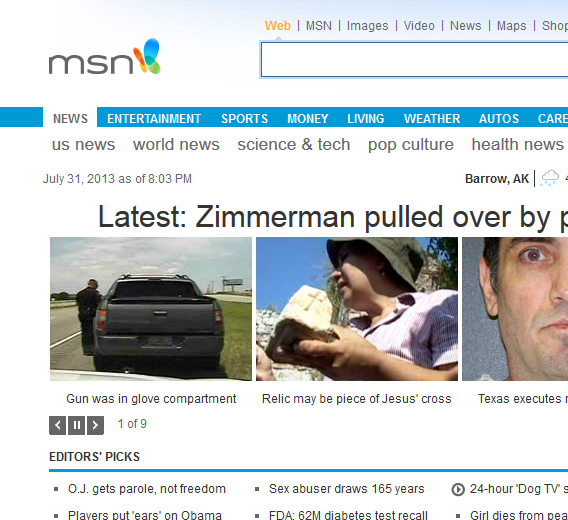
JesusDon’t the folks at MSN know that I’m busy? Don’t they realize I have better things to do than rant about the slippage between their storylines and their headlines? Or is it some kinda clever plot to drive me bonkle-wozzies before the end of summer?

I mean, seriously, take a look at the teaser line for that story on MSN. Isn’t that amazing? No, not Zimmerman, silly, or the guy whose face I deliberately cut in half with the cropping tool (I’m in a bad mood); I mean the lady in the funny hat. Check out the line underneath it.

Seriously?

Somebody has reason to think they actually found a piece of the cross to which our dear and fluffy bamble-hussy was nailed in the way back when. And if that is true, then maybe a few other claims about that old carpenter’s cat might be true too, and damn! If that’s true, I guess I better re-evaluate a few things, not the least of them being the way I talk about our Lord and Savior.

Seriously, …uh oh!

Okay, I know it’s not really alleging proof of a miracle, but what the lie does suggest is that they have serious reason to believe a piece of wood actually dates back to the historical event of Christ’s crucifiction, and THAT would be a Hell of a piece of research to produce. It really would.

Jesus2But wait a minute, the actual headline on NBC News doesn’t have quite the same force as the front page teaser on MSN. The teaser is just the sort of phrasing you would use to put a claim on the table; the actual headline could as easily be used to suggest you were getting ready to throw the claim in the trash. This whole thing just got less interesting with a single click of the mouse. Still, I wonder what the Hell this is all about.

Guess I’ll have to read the article…

Oh well, it’s right here in the first paragraph.

Turkish archaeologists say they have found a stone chest in a 1,350-year-old church that appears to contain a relic venerated as a piece of Jesus’ cross.

It turns out that what MSNBC meant was little more than that they unearthed a artifact that WAS venerated as a piece of the old bad bark by a particular people in a particular time and place. The rest of the article discusses some of the comments thrown back and forth about such artifacts in centuries past, all of which is actually quite interesting, but what this piece does NOT contain is any reason to believe that it really is a piece of the most famous chunk of wood in human and (Divine) history.

Speaking of Icons, there is definitely an iconic relationship between the marketing of this article and its informative content, one that probably shouldn’t be there. Seriously MSN-NBCNews guys, it’s one thing to tell us about holy relic hyping; it’s quite another to hype a relic yourselves. …or at least those SHOULD be two-different things. The problem is at least partly a matter of slippage between the various stages of publication and promotion, but somewhere in there a potentially interesting story has been transformed into the rhetoric of carnival barking.

So, I guess this isn’t really the journalism-as-apologetics piece that the original teaser seemed to suggest it would be. Don’t get me wrong; this is actually kind of neat – in a perfectly-sober-professional-archaeologist-doing-what-those-guys-do sorta way, maybe even in a cool-find-and-high-fives-all-around-kinda-way, but definitely not in holy-carble-monkeys-you-has-found-the-holy-of-holies kinda way.

…one of these days I’ll go back to using real words in my posts.

But not today.

Today I am just blowing raspberries at the whole damned thing.

Speaking of absolutely bunk, let’s try an online poll. This oughtta be about as meaningful as all the other junk polls you get with news stories. I only regret that it will probably fail to find it’s way into anybodies talking points.

Dammit!

.

CORRECTION: I took a second look at this and changed a few things (including the title) on accounta I still think it’s June of 2012. Thanks to John for catching my mistake.

71.271549 -156.751450

Share this:

  • Tweet
  • Share on Tumblr
  • Print (Opens in new window) Print
  • Email a link to a friend (Opens in new window) Email
  • Share on Reddit (Opens in new window) Reddit
Like Loading...

Irritation Meditation # 5: Persecution Ain’t a Fricking Contest!

29 Monday Apr 2013

Posted by danielwalldammit in atheism, Irritation Meditation, Religion

≈ 33 Comments

Tags

atheism, discrimination, First World Problems, Logos, Persecution, religion, Repression, T-Shirts

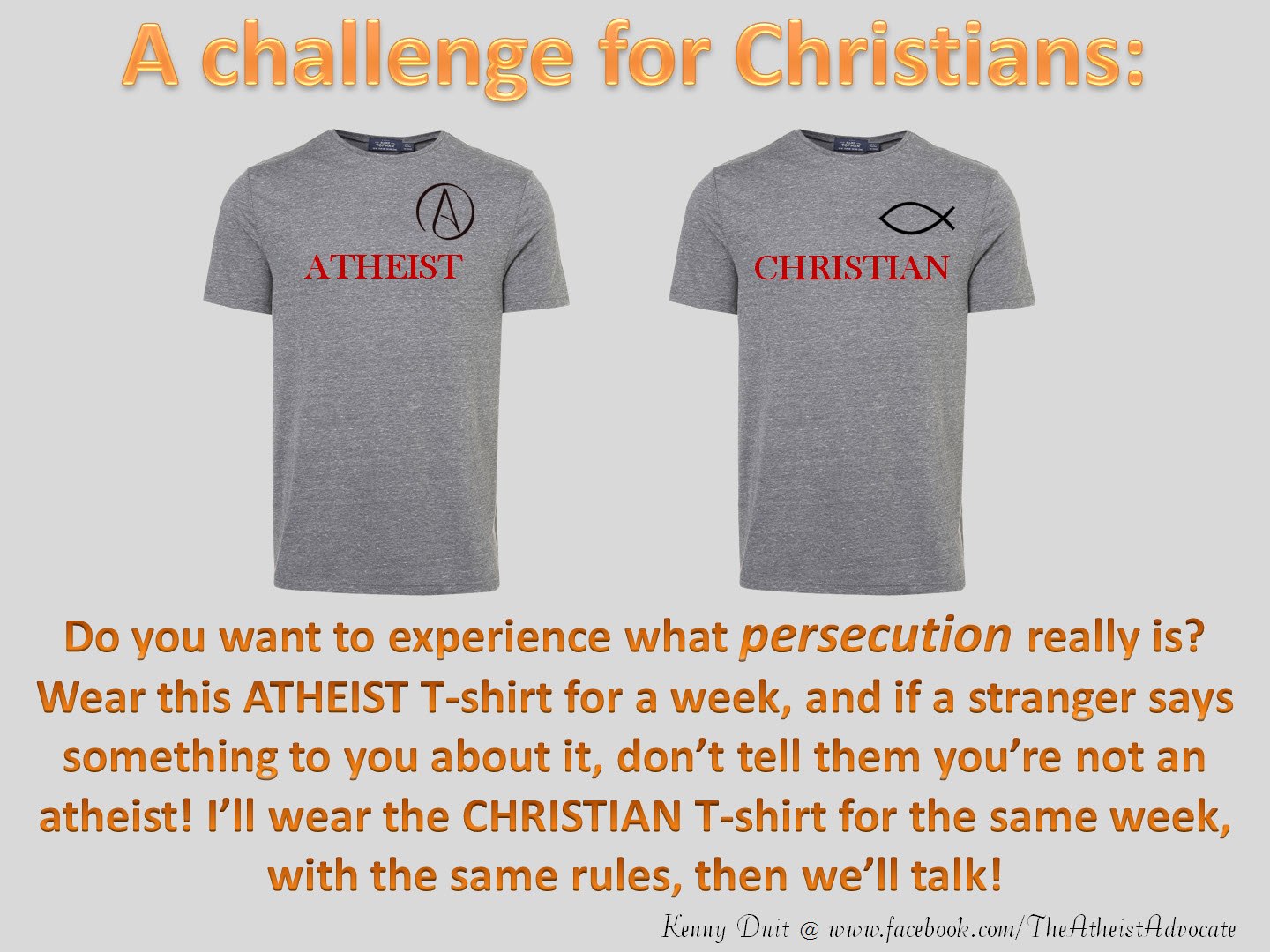
FXdukveAs far as irritation goes, this one comes close to being a mere amusement. I am talking about a challenge issued by The Atheist Advocate, the terms of which are fairly well explained by the illustration here, and I have to admit it’s tempting to just get behind this one. Seriously, I can almost go along with it.

…almost.

If only I had a nickel for all the times I have seen Christians complain about petty grievances or pass along outright falsehoods about this or that attack on their faith, well I could certainly afford another nice meal on that change. Hell, the non-existent war on Christmas alone ought to earn some believers a permanent subscription to “Cry Wolf Daily” (which actually wouldn’t be a bad blog project, come to think of it). Anyway, the point is that it gets damned tiresome to hear a dominant religious majority whine about how religious minorities are oppressing them.

But of course it isn’t really a dominant majority that spreads these cries of repression. Rather it is a small and highly vocal group of political Christians who would like very much to define repression of their beliefs so broadly as to include the failure to bow to their every Goddamned whim.

Taken at face value, I can’t help thinking this little gambit doesn’t quite rise above the difficulties it seeks to address. This whole thing really strikes me as something of a contest over First World Problems. One would hate to run into the occasional lunatic that might make either of these T-Shirts cause for real violence. …or the occasional workplace bigot that might actually use less violent means of putting someone from the wrong camp in their place. In any event, I expect most folks here in America would probably face little other than an uncomfortable conversation or three over wearing either of these shirts. There are some definite regional exceptions to be sure (cough! …deep South! …midwest!), but for the most part I think we are talking about a war of words.

Yes, I do figure those wearing an ‘atheist’ T-Shirt will have quite a few more of those unpleasant conversations than those wearing a ‘Christian’ T-Shirt, but I am open to the possibility that I am wrong about that, and I certainly wouldn’t estimate the flack for wearing the Christian shirt to be zero. Oddly enough, I expect some of the grief given to both Christians and atheists over this sort of thing could come from the same sources. An awful lot of people seem to want to have their sin and get to heaven too, so to speak, and they can be equally testy with religious fundamentalists and non-believers alike. This ‘moderate’ bunch can be especially testy if they believe someone else has brought the issue to the table and tried to force the question, …say by advertizing their (non-)beliefs in public.

That said, yes, I do think Christians are more likely to get a free pass on public expressions of their views f for no other reasn than that they have had their foot in that door for longer than those of us in the just-say-no camp. What strikes me as far more important is the fact that the list of people who have found out what ‘persecution really is’ would be unlikely to include anyone whose main worry of the day is what people will say about an ugly T-Shirt. There are people out there who face real consequences because of their belief-stances, and both atheists and theists are among them. That list also includes plenty of people who face real suffering as a result of things over which they have absolutely no control whatsoever. So, I think people should count themselves blessed if they live somewhere that you could actually play this game and expect life to continue in the wake of it.

As a general rule, I think anyone who wants others to appreciate the struggles they face could do better than to start by trivializing those of others people. I also think we would all be better served if folks spent less time claiming the title of most-repressed and more time thinking about what constitutes reasonable treatment of those with whom we disagree.

Oddly enough I’m not really opposed to the challenge, per se, just a certain over-billing of its significance. Still, if this leads a few of the more self-important Christians to rethink their narratives of martyrdom, then perhaps it’s a good thing. If it leads some people of either camp (or any other) to think carefully about their own bully-triggers and what we can do to help those under the gun for such things, so much the better.

71.271549 -156.751450

Share this:

  • Tweet
  • Share on Tumblr
  • Print (Opens in new window) Print
  • Email a link to a friend (Opens in new window) Email
  • Share on Reddit (Opens in new window) Reddit
Like Loading...

Cognitive Bias Goes to Church: Irritation Meditation Number 4 (This Time With Smilies!)

18 Monday Feb 2013

Posted by danielwalldammit in atheism, Irritation Meditation, Religion

≈ 14 Comments

Tags

Actor-Observer Bias, atheism, Cognitive Science, Faith, Fundamental Attribution Error, Judgement, Memes, Psychology, religion

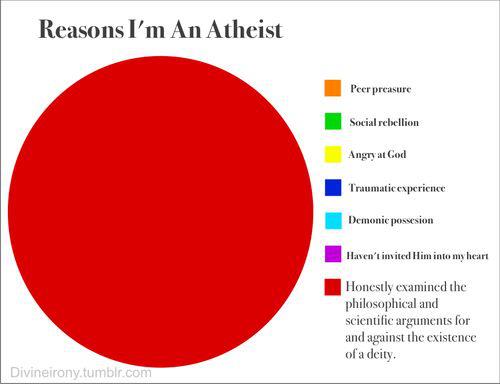
atheist-reasonsI found this piece on Stumbleupon, I believe. As far as Memes go, I actually kind of like this one. And by ‘kind of” I mean ‘really’ …kind of.

You see, I look at this meme, and a part of me wants to shout; “Yeah Boyeeee!” (…preferably in the face of some believer who has just suggested one of the alternatives). It’s damned frustrating to deal with that kind of commentary. You know how it goes; “The only reason you don’t believe is blah blah, blah…” …Blech! Seriously I’ve heard that line way too many times (and apparently so did someone else). So, it’s nice to see a bold affirmation that one’s own judgement really is the basis of, …well, ones own judgement!

…as opposed to some dismissive third person narrative.

Still, I wonder, would this look any different from any other religious perspective? If I asked for ‘Reasons I believe in God’, used the exact same sentence for the red color, and then made just a few strategic changes to the decoy list (Peer Pressure, Social Conformity, Afraid of Death, Raised That Way, Mental Disturbance, Haven’t Really Thought About It), I imagine we could present this to a few believers and generate exactly the same sense of vindication that I feel looking at this meme right now. “Damned right,” I can just hear them saying about that red line. …some might even add a “Praise Jesus!” or something like that, but my mind’s ear just doesn’t really want to go there.

Seriously, …yuck!

My point is of course that trivializing generalizations are a stick in the side of lots of folks, not just atheists. This is just the tip of the iceberg, a larger problem looms beneath the surface. And no, I didn’t just choose that image, because I live in Alaska; I actually thought about it and decided that it would be the best metaphor I could… well, anyway… the point is that this is part of a larger problem.

In the classic formulation of the problem, humans seem to possess a nearly universal tendency to explain other people’s actions (particularly those we don’t like) as a function of some consistent feature of their own personality while explaining our own actions in terms of situational factors. This tendency has generally been described as the Fundamental Attribution Error, or alternatively, as a function of Actor-Obeserver Asymmetry. What does this mean? Well, it means the reason you didn’t pay your bill on time this month is because of those unexpected medical expenses, the repair bill for the car, and well, it was little Johnny’s birthday, and you had to get him something… (You know the story). The reason your friend didn’t pay you the money he owes you? Well, he’s just a lazy bastard!

Okay, so that’s classical attribution theory, at least if you add a little salt to the vocabulary. Recent studies have shown that this basic contrast between situational versus dispositional explanations doesn’t quite explain the full range of data on this topic. Not to worry, a replacement theory is available, and it seems to illustrate the same point, albeit with a little less flair. The folk-conceptual theory approaches this same phenomenon by suggesting that people apply a range of different folk models to explain their own behavior and those around them. Depending on just how much one identifies with a person whose behavior they seek to explain, he/she is likely to adopt radically different descriptions of the behavior in question. One of the variables, for example is a difference between offering a reason for a behavior as its explanation and offering a history of reasoning as its explanation.

Case in point?

Saying; “I don’t believe in the Christian God, because the problem of evil renders this notion incoherent,” or conversely, saying; “I believe in God, because aspects of DNA coding appear to be irreducibly complex, and hence they require more of an explanation than chance evolution could provide.” What both of these explanations for a belief have in common is that each serves to explain a belief and at the same time to advance an active case for it. Conversely, saying “That guy Johnny, well he believes what he believes, because he has a deep fear of death (or Hell).” This latter sort of explanation describes a stage in a causal chain of behavior, one which doesn’t actively make much of a case for Johnny’s beliefs. In fact, the explanation undermines his credibility. The bottom line here is that we are looking at two different types of explanation, and the choice of which type to offer depends an awful lot on the disposition of the speaker towards the behavior/belief in question.

People thus have different ways of explaining behavior that they value and behavior that they don’t, and those differences serve more to shift the narrative around our feet than they do to set up a straight-forward evaluation of the issue. I really do think this is the key to the problem addressed in that meme above. People use dismissive explanations for beliefs they don’t identify with while presenting the reasons for beliefs they do identify with in terms of their own judgements.

You can see this consistently in the sphere of religious and philosophical discussions wherein you and I can supply all manner of thoughtful reasons for the judgements we’ve made, but that guy over there? Well, you know where he was raised and how his parents are! And all those people in the church on the corner? Well, they just have to believe in something; it fills a void somehow; they really are just brained washed aren’t they!?!

…and so on.

I’m including you in the good and thoughtful narrative of course, dear reader, but that’s just because you are reading my blog. When you’re gone I’m going to tell my other friend that you just had a traumatic experience.

😛

The bottom line is that it’s difficult to disentangle the full range of human motivation, and when we do this for religion, the tendency is to do it in a way that privileges one’s own judgement while trivializing that of others. Folks we identify with can enjoy praise by association, and those that we don’t, well damn them anyhow, right? They really need to learn to think for themselves!

So, why do I like this meme? Well, it took me down that path just now, and lucky you, I brought you along for the ride. I guess this is yet another instance of ‘liking’ something not quite meaning that I agree with it.

This meme is a good answer to half of the actor-observer bias.

…and it’s a damned good illustration of the other half.

I suppose that is something of a win-win situation.

😕

71.271549 -156.751450

Share this:

  • Tweet
  • Share on Tumblr
  • Print (Opens in new window) Print
  • Email a link to a friend (Opens in new window) Email
  • Share on Reddit (Opens in new window) Reddit
Like Loading...

Compassion with Caveats Aplenty and Malice by Any Other Name: The Case of a Teacher with a Purpose!

15 Friday Feb 2013

Posted by danielwalldammit in Religion

≈ 25 Comments

Tags

Christianity, Cognitive Dissonance, Compassion, Cultyral Conservatism, Diane Medley, Gay Rights, Homosexuality, School

UPDATE_-Local-Students-Want-Traditional-Prom-Gays-BannedSometimes your 15 minutes of fame is a moment in the sunshine (or so I hear), and sometimes it’s fifteen minutes under the spotlight of public interrogation (or so I fear). Sometimes, I expect it’s a confusing mixture of both. Take for example the case of Diane Medley, a special needs teacher who claims those of homosexual orientation have no purpose in life. She will be grist for the left wing mill for a little while, and I suppose a hero to Christian conservatives and right wing culture warriors.

Just to be clear, we will be doing the grist-grinding thing here in this post.

…just a little.

So, what’s the story? Well apparently the standard prom for the local high school will be allowing those of homosexual orientation to attend, which is the reason Medley and others have taken to advocating a second prom in which homosexuals will not be admitted. Wabashvalley.com come attributes the following quote to Medley.

Homosexual students come to me with their problems, and I don’t agree with them, but I care about them. It’s the same thing with my special needs kids, I think God puts everyone in our lives for a reason.

Asked if this also holds for those of homosexual orientation, she responded:

No I honestly don’t. Sorry, but I don’t. I don’t understand it. A gay person isn’t going to come up and make some change unless it’s to realize that it was a choice and they’re choosing God.

Now to be fair, there is a trace of compassion somewhere in these comments, but it’s struggling for shoulder room with a whole mess of condemnation. One suspects that Diane Medley’s caring may well be cold comfort for those whose lives she has declared to be utterly without purpose.

The same could be said of assurances made by some of the others in favor of the alternative prom, and by Christians everywhere who wish to assure us that they hate the sin but not the sinner.

A distinction that often comes up short of any real difference.

And here it is easy to get dismissive, easy to write Medley and so many others off as people without redeeming value. I can’t pretend I don’t feel that way at times, but herein lies the really terrible thing. I actually don’t think she sounds like a person completely devoid of humanity. I strongly suspect that she does indeed help students on a regular basis, that she cares for them deeply, and that her caring does extend in some perverted sense to the homosexuals that may come to her for help.

I said perverted, didn’t I?

And I mean it too.

And yes, it is Medley’s approach to homosexuality that strikes me as perverted, deeply so in fact. To imagine that one could help someone whose very life one accords so little value requires an exercise in mental gymnastics that would surely break the back of a healthy conscience.

This is good will gone wrong folks, and that’s the charitable interpretation of her statements.

You can ask people to change and rethink an awful lot in life, and yes that includes religious beliefs, political commitments, work ethics, and even favorite sports teams. Hell, you can ask people to get over an aversion to cats. But you cannot reasonably expect people to change their sexual orientation, nor to live their whole lives as though it didn’t matter. I expect there is a certain range of people with bisexual orientation who could make conscious choices about what gender they do and don’t want to be with, but for the vast majority of us that decision has simply been made for us. We don’t choose which gender we find attractive; we learn it. …and that learning process can be difficult enough for those of us fortunate enough to end up on the socially acceptable side of the spectrum. So much the more difficult for those whose desires take them in a different direction! People going through that deserve all the help that they can get; they do not deserve the conditional embrace of those whose love is full of caveats and footnotes. And they certainly do not need to hear that the only choice that they can make which would possibly make any difference in their lives, the only choice that could give their existence meaning, is the one that will have them going against their their own natural inclinations.

That approach just isn’t good enough.

And God is no excuse.

Medley has attached conditions to her compassion, conditions that dehumanize those who may need her help. That she accounts for these conditions by recourse to her faith in Christ is both beside the point and ironic at the same time. Frankly, I don’t think you get to set aside the vast array of evidence on the subject of human sexuality and proceed as though important factual questions can be safely relegated to the sphere is personal faith, not when other people’s lives and mental health lies in the balance. But beyond that, there is something deeply inauthentic about that approach.

It isn’t that Medley and her allies have renounced the love and compassion, so central to the vision of Christianity. Indeed that message is all over their approach to the subject. But they have reduced it to a sort of footnote. Gone is the motivating force of this powerful message, and what is left of that message is a mere rationalization. Love does not guide their actions; it guides their narrative. Because it is unthinkable that a Christian should act without love, an explanation must be offered which includes it. And so we get one, a vision of love and compassion so filled with caveats that it is guides actions indistinguishable from those motivated by clear malice. And we are left with an absolutism of laws and rules while the very value of a human life is reduced to an artistic expression of sorts, a trick of story telling.

Again, I don’t think Medley is a beast. But in this matter, her faith is hardly a virtue. Indeed, Christianity as she articulates it in this story is an outright moral failing. It is the reason she cannot treat some students with the dignity they deserve. I’ve known Christians who took the message of love to heart, Christians for whom it was a genuine force in their lives. And perhaps on other days, in other moments it is for Medley.

But not today.

And not for those that are gay.

71.271549 -156.751450

Share this:

  • Tweet
  • Share on Tumblr
  • Print (Opens in new window) Print
  • Email a link to a friend (Opens in new window) Email
  • Share on Reddit (Opens in new window) Reddit
Like Loading...

Allegiance to God and Country, …and to Anachronisms Aplenty!

16 Wednesday Jan 2013

Posted by danielwalldammit in Politics, Religion

≈ 5 Comments

Tags

America, Anachronism, Aristocracy, Christianity, Civil Religion, Democracy, Metaphors, Politics, religion

Moses1-244x300One hears it all the time; the notion that religion ought to be kept out of politics. I’m torn by the suggestion, because it is commonly used in response to the politics of conservative Christians, …and I have little sympathy for their politics. But the fact is, that just isn’t where I would draw the battle lines. If most people frown at the likes of Pat Robertson or Rick Warren, I suspect they are frowning for reasons that differ significantly from my own.

Religion IS politics as far as I am concerned; it’s bad politics, but politics just the same. I don’t quite mean to suggest that religion is simply a crass tool by which some folks seek to enhance their own power and influence.

….seriously, I don’t QUITE mean to say that.

…at least not as a general rule.

No. What I am suggesting is that religion consistently presents folks with a vision of order in the cosmos. That vision answers questions about how one ought to behave, yes, but it also contains answers to questions about the nature of authority and the social expectations that go with it. These traditions may tell us about Heaven and Hell, Karma, etc. all visions of a cosmic order, but they also tell us a little about how one ought to treat others, assess other people’s character, and what we may fairly do in response to the virtues or vices of those around us. The notion that all of this is supposed to stop short of addressing real political questions strikes me as a rather improbable.

…it’s also unreasonable.

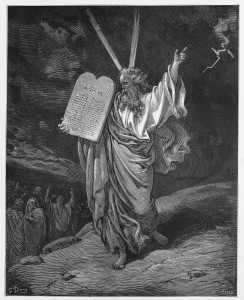
To put it in more concrete terms, it makes sense to me that someone who believes in the Ten Commandments would (when stepping into the voting booth) bear in mind the likelihood that a political candidate was going to follow them as well. It makes sense to me that folks would bear such things in mind when making in countless other decisions of a political nature.

Which is part of what makes the role of religion in American government (and perhaps other settings as well) so completely absurd. On the one hand, religious teachings are all about precisely the sort of questions that one must address in politics; on the other, it is separate from and distinct from those institutions, limited in some respect by the establishment clause and re-enforced by the free exercise clause. Religion has a potentially absolute absolute claim on every aspect of life, and yet while protecting the rights of believers, we expect them to stop short of weighing in on the most important questions of the day. The whole situation is at least a little odd, to say the least.

Far from the natural order of things, this feature of American politics rests in our Constitution and popular culture like a fault line running through a population trying its best to ignore it and get on with life.

…which I think is the real reason people want to keep religion out of politics. If they can keep folks from putting the two topics together in the same conversation, then they can avoid dealing with a mountain of contradictions even Mohammed would be hard pressed to move about.

The history of religion certainly doesn’t teach us to expect its proponents to stop short of political commentary. The God of Abraham in particular has played an overtly political role in each of his major religions. It is only with the decline of ancient empires that Christianity and Islam have come to be defined as something distinct from politics. Each of these traditions became mere ‘religions’ when the moral order they espoused lost its connections to the political order in which they once flourished. Institutions that we think of today as religion were once unashamedly political. Few if any thought twice about it.

What distinguishes religious traditions from those of modern politics is less of an ontological divide than a range of social conventions, not the least of them being a clear discordance between the visions of authority contained in each. Indeed, the notions are so far apart that people often fail to recognize them as different answers to the same question. The end result is a rather marked failure to notice something very interesting about the relationship between religion and politics in modern life. You see, there is something highly ironic (and more than a little tragic) about the sensibilities of those who speak of a Lord in world wherein we elect a President (or, for that matter, a Congressman or a Parliamentian).

And this is what I mean by a fault line that the public does its damnedest to ignore. Most people don’t even pause to think about this, but the notion of a ‘Lord’ has not always been so divorced from the social order. The language about which one spoke of God was not always so completely severed from the language about which one thought about their own government. There was a time when that term, ‘Lord’, would have pointed not merely to a benign old man in the sky, but also to the nobility of Europe. The implication was neither accidental, nor trivial. Indeed, the point of such language was to draw a clear parallel between the loyalties that men owed to each other (or more to the point, that commoners owed to the aristocracy) and those that they owed to the keeper of cosmic justice. A reference to the ‘Lord’ would have meant for many in past times a role reflected in both their religious discourse and in the social realities of their daily lives.

How weird it must be to live in a world in which one answers to a Lord in Heaven but votes for politicians down here! At least it would be weird if we paid more attention to the way either of these institutions actually handle questions about how people ought to behave.

But of course the problem is not merely a function of this one word. When Conservative Christians speak of power, they almost invariably invoke a range of metaphors ill-fitted to the realities of a republican style government. They speak of God as a sovereign, all the while operating in a public life wherein the people are assumed to be sovereign. They speak of the Ten Commandments in a world wherein laws are deemed in some sense to be created by the people (albeit indirectly). And how strange that we (and by ‘we’ I mean mainly Christians) want Children to pledge allegiance to one nation (under God or not), as if such an oath had much bearing on modern notions of citizenship! It cannot mean nothing that people who live in a participatory democracy envision so much of their lives through the language of aristocracy.

Does this mean that Conservative Christians do not understand democracy?

No it doesn’t.

…at least  not in principle, but I can think of a few folks!

It does suggest a certain tension between the nature of authority some folks encounter on Sunday and those they are called upon to use in the voting booth. This sort of tension might even have some positive benefits, though I suspect that would require people to be more aware of the difference than they generally seem to be. It probably should not surprise us too much when the language of one sphere creeps into that of another. I think we can see this in the way that many conservative Christians speak of the founding fathers in reference to a broad range of constitutional questions. So much the more so on litmus test politics such as gay rights which so many use to discern the loyalties of those around us.

I could field a number of polemics at this point, but perhaps that is not really where I want to go with this. The divergence between modern visions of political authority and the archaic language with which conservative Christians approach that same subject is an interesting point in itself. What to make of it is another question. And of course this returns us to the original question of whether or not one can reasonably expect religious leaders to keep their noses out of politics.

If I am reading the popular culture correctly, I think most people expect a natural division between these spheres of social (and political) life, as if some great natural boundary separates them. For my own part, I think it’s little other than history. Indeed, I don’t think the term ‘religion’ denotes a clear and well defined body of institutions, beliefs, or practices, certainly not any that fall neatly outside the boundaries of political life. As it happens, the modern world has developed a range of political expectations which simply differ from those of the institutions we now call religion. That difference does not lie in the nature of the institutions in questions, it lies in the particular approach that each takes to the deeper moral questions of social life.

What keeps conservative Christianity from enjoying a more direct role in American political life is its political anachronism. It’s vision of authority is not (thankfully) that of our own government.

71.271549 -156.751450

Share this:

  • Tweet
  • Share on Tumblr
  • Print (Opens in new window) Print
  • Email a link to a friend (Opens in new window) Email
  • Share on Reddit (Opens in new window) Reddit
Like Loading...

The Devil is in the Deductions: Spiritual Warfare and Apologetics Viewed from the Dark Side

15 Saturday Dec 2012

Posted by danielwalldammit in atheism, Religion

≈ 25 Comments

Tags

atheism, Christianity, Debate, History, Logic, Reasoning, religion, Satan, Spiritual Wafare

image25The first sin was not the eating of an apple (or even a pomegranate). No, it began when mankind (or at least Eve) gave an ear to the Serpent, or so the story goes, at least according to my old Bible-as-Literature prof. I try to keep that in mind whenever I find myself cast in the role of that Serpent, or at least one of his servants.

I am speaking of course of those moments when someone tells me that I worship Satan, or that I serve him. It is common enough to see this charge leveled at atheists, at least on the net. I doubt its occurrence is limited to that context.

I must say that it took me some time to wrap my mind around the concept. You might think it would be a little difficult to worship an entity in which you don’t believe. I certainly did. But it turns out to be remarkably easy to serve him, he does all the work for you, even without letting you know about it. I have been reassured many times that my actions serve the dark lord, regardless of my own conscious intent. I have also been told that deep down I know this to be the case, whether I will admit it or not. It’s always fascinating to find out what I know and what I believe, especially when it has the makings of a good horror story.

Just think of it; you have two competing stories!

– On the one hand, I would like to think of my story as one of a sincere guy tapping away at the keyboard in the hopes that he can present a reasonable case for a position that he thinks is correct. In the end maybe I can teach something to someone, or perhaps learn something from a well-reasoned response. We could call this the intellectual exchange model of the disc… hey you! Wake up, dammit!

– Okay, on the other hand, you have a minion of Lucifer operating under the auspices of the Dark Lord himself to invest ordinary binary code with the force of evil and send it out to work its insidious wonders on unsuspecting believers. The argument itself is hardly important; it serves as a vehicle for some sort of insidious power.

renaissance-the-school-of-athens-classic-art-paitings-raphael-painter-rafael-philosophers-HD-WallpapersHonestly, it doesn’t take much effort to figure out which is the more interesting story. (Sigh!) And if you too count yourself as a vocal non-believer, this whole thing probably rings a bell or three in your own experience.

In truth, there is little one could do to answer such a claim, that one serves Satan, because of course every answer you give would be subject to the same suspicion. This is why I am inclined to think of the story of Adam and Eve here. …and of the Serpent. The trouble really does begin for that narrative in the decision to listen to that serpent as it is an act of disloyalty to God. To speak with His enemy at all is itself unthinkable! Subsequent troubles could hardly be surprising; they are the narrative consequence of willfully opening oneself to an evil message. If that’s the way some believers see the input of atheists, then that doesn’t bode well for anything along the lines of, um, constructive dialogue.

I do think this is the model behind the charge that atheists serve Satan. It not merely some bit of empirical confusion about what we do and don’t believe, so much as it is a warning about the nature of any message we happen to carry. That is precisely the point of casting atheists in the role of Satan’s servants; it is in effect to construe our every word and deed as an evil which one ought not to give reasonable consideration. It isn’t really even the metaphysics of this proposition that matters; it’s the pragmatics. Simply put, the moral of the story is don’t listen to anyone who casts any sort of doubt on God.

I have tried myself and seen others attempt a range of different responses to this kind of charge, but lately I am inclined to accept it.

I’ll be your huckleberry.

250px-GustaveDoreParadiseLostSatanProfileI don’t mean to say that I actually intend harm to others, but I am simply done trying to convince certain parties that I (or other atheists) can be good without God. If these are the terms, then I sometimes want to say ‘so be it’. I will not give those who make such accusations the satisfaction of trying to plead innocence from the bottom of a poisoned well.

The whole accusation smacks of manipulation of course, but it is not merely manipulation, because some people actually do seem to believe it, or at least they say that they do. In its own right, this sort of charge is actually a fascinating example of the limitations of reasoning.

Another of my old professors, Maurice Finnochiaro, used to talk about the study of argumentation as an historical phenomenon. He was interested in meta-argumentation, arguments about arguments. And in its own way this little gift of frustration for an unbeliever is in fact an argument about an argument. It is a clear and concise statement about the prospects for constructive discussion, albeit a rather pessimistic one.

The viewpoint in question is very much informed by the outlook of Spiritual Warfare. It reflects a range of suppositions about the spiritual powers at play in the world. It is the same sort of thinking that finds Satanic messages in so many rock&roll lyrics, Devil Worshipers in Day-care centers everywhere, and demons in Hentai images. It is the same thinking that leads to talk of protecting baby-Christians (those new in the faith) from exposure to other views, and it is the same sort of thinking that plays havoc with the lives of homosexuals in Uganda and other places where some Charismatic Christians go to press for policies they could never manage in the west. But seriously, my list of horribles aside, the point is that there is a body of religious tenets behind the sort of charge that atheists serve Satan. If we are inconvenienced by the whole thing, chances are we should count our blessings.

…though we won’t actually want to call them ‘blessings’ of course.

But the charge of Satanic worship, absurd though it may be to the mind of an unbeliever is a good reminder of the reflexive nature of reasoning. It would be a swell world for rationalists if we could divide all the ideas of humanity up into those about which we reason and then a separate list of ideas about how to reason about the items on the first list. It would be swell if that second set rested safely outside the scope of disagreement, a sort of neutral arbiter in our disputes. But it just doesn’t work like that. And in this as in any other debate, one must remember that among our disagreements we often also differ on the significance of the disagreements themselves. In other words, part of the argument is also always about the nature of argumentation itself.

Sometimes we are fortunate enough to discuss (or even debate) people with whom we share enough assumptions about the nature of reasoning to proceed with a constructive discussion, even in the face of vast disagreements over issues like belief in God. Folks may not flip their whole belief orientation on the basis of a single conversation (or even thirty of them), but sometimes we shift a little, modify an assumption, or even simply come to appreciate the aesthetics of a well argued point from the other side. Such discussions can be rewarding and pleasant exchanges, …if that is, one starts with a range of assumptions that makes it possible.

Some people just don’t make those same assumptions. When someone says that atheists serve Satan, they are sending a very clear signal that they are not down for the discussion, at least on any terms which would give an unbeliever a chance. To do so would already be a betrayal of their faith, and a mistake exposing them to tremendous evil (evil carried by you and I, my unbelieving friends). It is also a signal that the clear significance of your words (to that person) lies not in the quality of your reasoning so much as an impersonal force over which you may not have conscious control. That force will be the focus of the accuser, not the cogency of any argument you make.

So, what’s a devil to do?

Honestly, I don’t know.

Damn me anyhow!

71.271549 -156.751450

Share this:

  • Tweet
  • Share on Tumblr
  • Print (Opens in new window) Print
  • Email a link to a friend (Opens in new window) Email
  • Share on Reddit (Opens in new window) Reddit
Like Loading...

Of Loyalties and Lords and Faith as a Horror Show

13 Tuesday Nov 2012

Posted by danielwalldammit in atheism, Childhood, Religion

≈ 21 Comments

Tags

Abraham, atheism, Christianity, Christopher Hitchens, God, Heaven, Sacrifice, The Bible

Kent State Memorial
(Rejected)

Of all the Old Testament stories in my old Cartoon Bible, the one that made the greatest impression on me as a child was the story the Abraham and Isaac. It’s a pretty terrible thing for a 6 year old to contemplate, the specter of  a loving father prepared to kill his own child. I was supposed to be impressed with the faith of Abraham and the mercy of the Lord. Instead I shuddered to think of a father willing to do such a thing and a God for whom that would count as a virtue. I had never been taught to fear the Lord, as they say, but I certainly began to wonder if I should fear Him upon reading that scripture. More to the point, I wondered if I should fear my own father?

Significantly, it was my own father that I turned to for questions about the meaning of that Bible. I don’t recall exactly what Dad had to say about that passage, though I want to think that he might have called into question its particular vision of God. There are of course plenty of wonderful messages to be found in (or read into) the story of Abraham, but there is at least one message that I could never reconcile with my own sense of right and wrong, with my own sense of what family should be to one another. It was never Abraham’s faith that impressed me. Rather, it was his faithlessness; his betrayal of his son.

Of course Abraham didn’t actually kill his son, an Angel of the Lord stayed his hand. Still, I couldn’t help but imagine looking into my own father’s eyes and knowing that he was prepared to do such a thing. How could anything be right in the world after a moment such as that?

And how could anything be right in a world where its creator could want such a moment? At 46, the moral universe of that lesson still terrifies me, all the more so, because there are people who reside within it, even if their God does not.

It doesn’t appear that I am alone in this. The late Christopher Hitchens raised this objection several times, most notably in his book, God is not Great. But of course Hitchens is hardly the first public figure to underscore the trace of terror in this narrative. The story of Abraham and Isaac has darkened more than a few moments of artistic expression.

The sinister vision of Abraham appears in Leonard Cohen’s Story of Isaac, and of course in the opening lines of Dylan’s Highway 61. The sculptor George Segal deemed it a fitting symbol for a memorial to the Kent State Shootings (though Kent state University rejected his work, which is why it now rests at Princeton University). I’m also reminded of a rather bad movie with an interesting twist. In The Rapture, Mimi Rogers plays Sharon, a mother commanded by God to kill her own daughter in order to achieve Heaven. Having complied with His commands, she cannot bring herself to enter Heaven. Perhaps she too thought that nothing could ever be right again after crossing such a threshold.

My favorite use of the Abrahamic trope comes from Wilfred Owen who used it to comment on the horrors of World War I. His poem is called The Parable of the Old Man and the Young:

Then Abram bound the youth with belts and straps,

And builded parapets and trenches there,

And stretchèd forth the knife to slay his son.

When lo! an angel called him out of heaven,

Saying, Lay not thy hand upon the lad,

Neither do anything to him, thy son.

Behold! Caught in a thicket by its horns,

A Ram. Offer the Ram of Pride instead.

But the old man would not so, but slew his son,

And half the seed of Europe, one by one.

It would be a mistake to see in all these narratives the sort of polemics Hitchens had in mind, but they do speak to an element of meaning that cannot quite be reduced to the faith of Abraham or the mercy of God. There is something truly disconcerting about the command given to Abraham. Still more so his willingness to follow it. In the story of Abraham, if only for a moment, faith becomes a source of terror. I expect that for most believers the moment passes.

For some of us it never does.

Kurt Vonnegut may have struggled with that moment more than any of us. It haunts the opening chapter of Slaughterhouse Five, though Vonnegut took his point of departure from a different passage. It was the story of Sodom and Gomorrah that seemed to ask too much of Vonnegut.

And Lot’s wife, of course, was told not to look back where all those people and their homes had been. But she did look back, and I love her for that, because it was so human. So she was turned to a pillar of salt. So it goes.

It shouldn’t take much imagination to understand why Vonnegut of all people would identify with Lot’s wife. …to see how he could find in her a fitting symbol of something human, something often lost by demands of faith and loyalty. It was typical of Vonnegut that he didn’t quite field a direct objection to the Biblical narrative. He doesn’t deny the moral order of God’s commands (or even those of the Allied Air Command in his own day). He doesn’t even say that she was right and God was wrong. He simply embraces the moment when Lot’s wife does look back, and in doing so Vonnegut reaffirms the value of all the lives buried in that Biblical tale, …and of course those consumed in the fires of Dresden.

Gods do what they will, so it seems. There is little that mortals can do about it, but the God Abraham has always demanded just a little more. He has always demanded that we love him for it, that we condemn his victims along with him, and that we think of his acts of terror as positive moral actions.

And sometimes that is just too much.

For me that line is crossed in at least one more sort of story, one which brings us full circle to the relationship between father and child.

The concern is illustrated wonderfully in is a scene from the movie Black Robe wherein a missionary (Father LaForge, played by Lothaire Bluteau)  tries to convert an Algonquian-speaking native (Chomina, played by August Schellenberg) to the Christian faith just before the man dies. Desperate to save his companion’s soul, Laforge offers Chomina the promise of eternal life in Heaven. But of course LaForge must admit that none of the Chomina’s heathen relations will be with him in this eternal life. Neither Chomina’s wife, nor his parents, nor even his youngest child will be there to meet him in Heaven, because they died without accepting the faith.

It would be easy to under-estimate the power Chomina’s response to LaForge in that movie, but it has always seemed to me a very compelling argument. It works for me, not because of fictional characters with fictional relations, but because of real people in my own life. I am well aware that some (perhaps many) of those I have known and loved passed away without reconciling themselves to terms of sundry Christian teachings. What must be done of course varies from church to church, but in each case where the price of heaven is conversion, I know of specific people who failed to make that choice in terms described by one or all of these churches. Faced with the prospect of conversion and its benefits myself, I can honestly say that the choice strikes me as a betrayal.

Do I belong in this heaven, while my father does not? And will I enjoy paradise while others that I loved rot in graves, burn in eternal fires, or simply waste away in outer darkness?

If there is a God in heaven that would have this, then I will say ‘no’ to Him.

He is asking for too much.

71.271549 -156.751450

Share this:

  • Tweet
  • Share on Tumblr
  • Print (Opens in new window) Print
  • Email a link to a friend (Opens in new window) Email
  • Share on Reddit (Opens in new window) Reddit
Like Loading...

Jesus is the Homunculus of Human Suffering

04 Thursday Oct 2012

Posted by danielwalldammit in atheism, Philosophy, Religion

≈ 23 Comments

Tags

atheism, Catholicism, Homunculus, Jesus, Meaning, Philosophy, religion, suffering, Theodicy

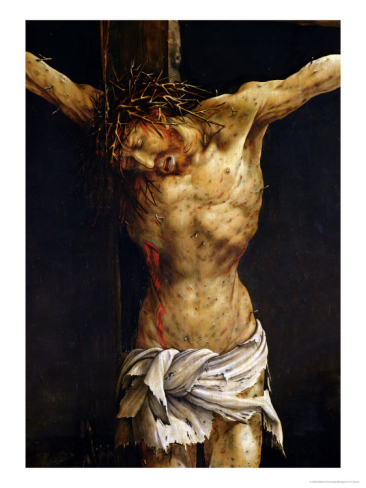
Crucified Christ by
Matthias Grünewald

Sometimes texts and utterances become what they purport to describe. Case in point? This little meditation on the spiritual meaning of suffering, An Attempt to Explain Christianity to Atheists In a Manner That Might Not Freak Them Out by The Bad Catholic at Patheos.com. Well, it certainly became a source of suffering for me (and apparently for P.Z. Myers of Pharyngula), and I suspect not a few others trying to sift through the article for one reason or another. Whether or not the article succeeds in becoming meaningful is another question.

Honestly, the whole thing is a Gish Gallop for me, from the scholastic presentation to the major assumptions of the argument and the vocabulary its author uses. Were I to attempt a refutation, I wouldn’t know where to start. If this was an attempt (as the author suggests) to speak to atheists, I can’t help but think it is an utter failure (or perhaps an ironic joke). If its author ever seriously had an unbelieving audience in mind, then he has done just about as much as he could to avoid communicating with that audience.

There is however one thing about this piece that does catch my attention; its final paragraph (emphasis added):

This changes everything: To see the child with leukemia is to see Christ suffering in that child, suffering to bring the world back to Perfection. To experience agony is to cry out with the strain of lifting this fallen world to Paradise. We are called to recognize this, and to actualize this. This is why I am a Christian.

I say this bit catches my attention, because I find it genuinely disturbing. I also recognize it (or something like it) from a number of previous conversations with believers, many of whom have advanced the argument that life is somehow less meaningful without God. They don’t always state their position in such stark terms, but I do think the view is common enough to rise above the idiosyncracies of this particular article. So, it is perhaps worth a comment or two.

Kitch-Christ: The true meaning of suffering?

The claim that Bad Catholic makes, that to see a child suffering is to see Christ suffering within her is thoroughly dehumanizing, because it relegates the suffering of the child to a secondary role. What is moving about the suffering of a child is not her own suffering but that of Christ. The meaning of suffering has, according to Bad Catholic, less to do with the pain of particular persons than the cosmic struggle of a heroic Jesus trying to lift the fallen world into paradise. I am not even sure if it is the crucified Christ we are supposed to see in this girl. Rather, I think we are supposed to see in the eyes of a child suffering the muscular Jesus of the Lord’s Gym lifting his heavy cross up to save the world. Her suffering is meaningful precisely because of the meaning that Christ gives it.

No.

Not just ‘no’, but Hell no!

And if you want to write about a deficiency of meaning in the world then you have one right there. Never mind a world without God; how about one in which you cannot see the most compelling moments of human suffering because of the big giant Jesus standing in your way!

If the suffering of people right in front of you requires a theory making it about something else altogether, or rather someone else, then your faith does not augment the meaning of suffering; it detracts from it. And the theory that was supposed to deepen our understanding of suffering has instead blunted its very force. It is not the suffering of the little girl that matters; it is not her loss of hope, or her agony, or her tears; it is that of someone else.

As I read this utter crap, I can’t help but to be struck by a quote the Bad Catholic keeps at the top of his webpage. It is attributed to G.K. Chesterton; “Let your religion be less of a theory and more of a love affair.” I can’t help but think this wonderful little quote might well have forestalled this miserable exercise in tortured logic and pathetic indifference to the actual condition of suffering in another living being.

Perhaps one ought to let his sense of other living things be less a theory and more of a love affair.

The meaning of human suffering is immediate. This is no less true of others than it is for ourselves. I for one do not need to see Jesus Christ or any other supernatural entity to give a damn about the suffering of another human being, or even that of an animal.

Do you?

Photo by Kevin Carter

71.271549 -156.751450

Share this:

  • Tweet
  • Share on Tumblr
  • Print (Opens in new window) Print
  • Email a link to a friend (Opens in new window) Email
  • Share on Reddit (Opens in new window) Reddit
Like Loading...

Jesus and the Devil Get into a Fight, …He Wins!

07 Tuesday Aug 2012

Posted by danielwalldammit in Religion

≈ 13 Comments

Tags

Anthropomorphism, Christianity, Cruelty, Gay Marriage, Homosexuality, Hypocrisy, Jesus, Politics, Satan, The Bible

If I have to be terrified of God, then I don’t see a difference between God and Satan…

– Sonya D. Fowler, Posted on Twitter, July 29th, 2012

South Park

It’s a funny thing, even unbelievers typically assume there is a difference between God and Satan. It seems so obvious. After all we don’t confuse our friend Mike with our friend Chuck, but such friends are there to remind us of the difference between them on a daily basis. Entities such as God and Satan operate under no such constraints. Their traits change from one faith to another, even from one believer to another, or (truth be told) sometimes from morning to noon out of the same mouth.

Satan has certainly made a few significant changes in the years, graduating from a mere servant of the Lord to a principle nemesis for the Lord. For his own part, God has taken on a range of different faces over the course of human history. He still keeps an awful lot of them handy, even within the same tradition. Indeed the Christian world keeps its pretension to monotheism only by ignoring a likely case of multiple personality disorder. He is at the least bipolar.

And of course a trace of projection runs through all of this, right down to the most specific details and sources. You can tell a lot about people from what they say about their gods. And that is precisely why the quote above gives me such pause. To hear some folks talk about God, they might as well be speaking of the Devil.

When I was younger, I used to hear this phrase a lot; “The devil made me do it!” This usually came after someone had just done something they shouldn’t have, something they knew was wrong. Seems like these days people are more likely to lay their sins off on Jesus. Whenever their actions cannot be defended in reasonable terms, it is because Jesus wants it that way.

I’m not just being facetious here, not JUST anyway.

All to often, Jesus is the reason someone must suffer some indignity at the hands of a believer. Every enemy of Christendom, every native forced to endure abuse at the hands of his more forceful missionaries has certainly borne the brunt of this gambit. Yet they are not alone in learning that the Prince of Peace has ugly designs on their health and happiness. Jesus, we are told, is the reason that gay couples cannot marry; he is also the reason those of homosexual orientation must endure any number of indignities from ‘Christian’ circles. Jesus is the reason for compromising women’s health care. He is often the reason you cannot find certain books at the librar. He is the inspiration for a good deal of pseudo-science (some of which is genuinely harmful), for a good deal of pseudo-history, and even for the occasional cold cereal mishap. Jesus may or may not be responsible for some novel forms of corporal punishment and parenting practices, but if sundry Christian organizations are to be believed, he certainly approves of some highly creative approaches to that practice. Time and again, Jesus is the reason someone supplies for actions that are manifestly dishonest or demonstrably harmful to other people.

It really is difficult to tell just how far the Lamb of God is willing to take his lust for violence and cruelty, but it seems that he likes to do the really nasty work himself. To hear some folks talk, he is the reason for one or two great disasters; 9-11, earthquakes and Tsunamis ravaging Thailand or  Japan. I remember when Jesus demanded a ransom to spare the life of Oral Roberts, one of His most trusted servants. But of course, such divine temper tantrums are nothing new; just ask Lot’s wife.

Has it escaped anyone’s notice that the witnesses to Jesus’ greater crimes are the ones who so consistently inflict suffering in his name? Can it be a coincidence that the same people who speak approvingly of god’s greater acts of cruelty would be so quick to commit the mortal equivalent in his name?

Jesus is not just a source of terrible headlines; he is also the source of myriad petty cruelties which will never make it far into the public discussion. I expect most of us have learned in one form or another that Jesus has taken sides in some personal dispute with friends, family, or coworkers. Lord knows, he is certainly the reason given for most of the dick moves made by the moderators on sundry Christian message boards. Indeed, Jesus seems to be implicated in all manner of grievances great and small.

One wants to say to some of these people; “dude, your Jesus is a dick!”

But of course, the real point is that Jesus could never have been anything else but a dick to some of these people; he begins and ends in their least admirable qualities. And if there is anything more to the story of Jesus than a sort of malice to be inflicted upon others, you would never know this from the words and deeds of so many who claim to be doing his will.

There comes a time in all of this, when Jesus can no longer be distinguished from Satan. For some people, He is in effect little other than a name they give to their own vices.

71.271549 -156.751450

Share this:

  • Tweet
  • Share on Tumblr
  • Print (Opens in new window) Print
  • Email a link to a friend (Opens in new window) Email
  • Share on Reddit (Opens in new window) Reddit
Like Loading...
← Older posts
Newer posts →

Top Posts & Pages

  • That Time I Got High
    That Time I Got High
  • An Uncommon Security Guard: Dave Eshelman, AKA 'John Wayne'
    An Uncommon Security Guard: Dave Eshelman, AKA 'John Wayne'
  • Oh Hello Dere!
    Oh Hello Dere!
  • When Sex Falls Out of the Performance
    When Sex Falls Out of the Performance
  • This is Really Gross: You Probably Shouldn't Read It!
    This is Really Gross: You Probably Shouldn't Read It!
  • Spring Break Up and a Video: No, Not that Kind!
    Spring Break Up and a Video: No, Not that Kind!
  • It's the Sub-Deduction Stupid: Scalia's Thoughts on Absurdity and Gay Rights
    It's the Sub-Deduction Stupid: Scalia's Thoughts on Absurdity and Gay Rights
  • Creeditize it! ...or Don't.
    Creeditize it! ...or Don't.
  • Spring in Barrow and the Sudden Onset of Southitation!
    Spring in Barrow and the Sudden Onset of Southitation!
  • Taking a Knee?
    Taking a Knee?

Topics

  • Alaska
  • Animals
  • Anthropology
  • atheism
  • Bad Photography
  • Books
  • Childhood
  • Education
  • Gaming
  • General
  • History
  • Irritation Meditation
  • Justice
  • Las Vegas
  • Minis
  • Movie Villainy
  • Movies
  • Museums
  • Music
  • Narrative VIolence
  • Native American Themes
  • Philosophy
  • Politics
  • Public History
  • Re-Creations
  • Religion
  • Street Art
  • The Bullet Point Mind
  • Travel
  • Uncategorized
  • Uncommonday
  • White Indians
  • Write Drunk, Edit Stoned

Blogroll

  • American Creation
  • An Historian Goes to the Movies
  • Aunt Phil's Trunk
  • Bob's Blog
  • Dr. Gerald Stein
  • Hinterlogics
  • Ignorance WIthout Arrogance
  • Im-North
  • Insta-North
  • Just a Girl from Homer
  • Multo (Ghost)
  • Native America
  • Norbert Haupt
  • Northwest History
  • Northy Pins
  • Northy-Tok
  • Nunawhaa
  • Religion in American History
  • The History Blog
  • The History Chicks
  • What Do I Know?

Archives

  • December 2023
  • November 2023
  • June 2023
  • April 2023
  • February 2023
  • December 2022
  • November 2022
  • October 2022
  • September 2022
  • August 2022
  • July 2022
  • June 2022
  • April 2022
  • January 2022
  • December 2021
  • November 2021
  • October 2021
  • September 2021
  • August 2021
  • June 2021
  • May 2021
  • March 2021
  • February 2021
  • January 2021
  • December 2020
  • November 2020
  • October 2020
  • September 2020
  • June 2020
  • May 2020
  • March 2020
  • February 2020
  • January 2020
  • December 2019
  • November 2019
  • September 2019
  • August 2019
  • July 2019
  • June 2019
  • May 2019
  • April 2019
  • January 2019
  • December 2018
  • November 2018
  • October 2018
  • September 2018
  • August 2018
  • July 2018
  • June 2018
  • May 2018
  • April 2018
  • March 2018
  • February 2018
  • January 2018
  • December 2017
  • November 2017
  • October 2017
  • September 2017
  • August 2017
  • July 2017
  • June 2017
  • May 2017
  • April 2017
  • March 2017
  • January 2017
  • December 2016
  • November 2016
  • October 2016
  • September 2016
  • August 2016
  • July 2016
  • June 2016
  • May 2016
  • April 2016
  • March 2016
  • February 2016
  • January 2016
  • December 2015
  • November 2015
  • October 2015
  • September 2015
  • August 2015
  • July 2015
  • June 2015
  • May 2015
  • April 2015
  • March 2015
  • January 2015
  • December 2014
  • November 2014
  • October 2014
  • July 2014
  • June 2014
  • May 2014
  • April 2014
  • March 2014
  • February 2014
  • January 2014
  • December 2013
  • November 2013
  • October 2013
  • September 2013
  • August 2013
  • July 2013
  • June 2013
  • May 2013
  • April 2013
  • March 2013
  • February 2013
  • January 2013
  • December 2012
  • November 2012
  • October 2012
  • September 2012
  • August 2012
  • July 2012
  • June 2012
  • May 2012
  • April 2012
  • March 2012
  • January 2012
  • December 2011
  • November 2011
  • October 2011

My Twitter Feed

Follow @Brimshack

RSS Feed

  • RSS - Posts
  • RSS - Comments

Enter your email address to follow this blog and receive notifications of new posts by email.

Join 8,069 other subscribers

Blog at WordPress.com.

  • Subscribe Subscribed
    • northierthanthou
    • Join 8,069 other subscribers
    • Already have a WordPress.com account? Log in now.
    • northierthanthou
    • Subscribe Subscribed
    • Sign up
    • Log in
    • Report this content
    • View site in Reader
    • Manage subscriptions
    • Collapse this bar
 

Loading Comments...
 

    %d