
Tags
Alaska, Anchorage, Betty Friedan, Feminism, Gina Gionfriddo, Phyllis Schlafly, Play, Rapture Blister Burn, Theater

Catherine Croll (Anna Wyndham) writes about violent pornography. She’s a well known feminist and a successful scholar. So, what is she doing singing the praises of Phyllis Schlafly?
Well it seems that something is missing from Catherine’s life, and that something is the family that conservative anti-feminist Schlafly warned women about so many decades past. Coming home to help her ailing mother, Catherine finds herself living near her college boy-friend, Don Harper (played by Frank Delaney) and his wife. Don’s wife is Catherine’s own former friend and roommate, Gwen (Shelly Wozniak). The two of them have two children. Catherine can see that they are struggling, and yet she can’t help but envy them. Seeing them makes her rethink some of her own life choices, and a part of her wishes she could exchange her life for Gwen’s. Impossible, right?
But what if it isn’t?
As it turns out, Gwen has second thoughts about her own life, and Don? Well, Don still fancies Catherine. So, it just may be that she can have him after all. It may well be that she can step right into Gwen’s life as Gwen runs off to pursue an advanced degree of her own.
Yep! The ghost of Trading Places haunts this play. It does indeed.
***
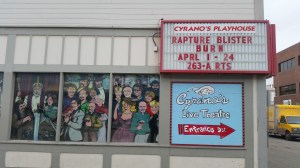 There isn’t a lot of live theater on the North Slope of Alaska. No, there isn’t. Heck, there isn’t a lot of movie theater on the North Slope. Nope! Hell, there isn’t even a lot of television theater in my own home. (Okay, that’s my own choice, but still!). So, I often check to see if anything is playing at a local theater when I’m in Anchorage. This time the answer was yes, at Cyrano’s, and my schedule didn’t even stop me. So, there I sat watching the opening scenes of this play and realizing for the first time what it was about.
The play is Rapture Blister Burn, written by Gina Gionfriddo and directed by Krista M. Schwarting. It’s been playing at Cyrano’s since April 1st and it’ll continue running through the 24th. If you’re in the area, and if the F-word doesn’t scare you, it’s definitely worth seeing.
So anyway, there I sat, watching as a series of inter-related stories began to unfold on the small stage in front of me. Much of the action takes place in a class Catherine teaches during the summer. Put together at the last minute, the class ends up with exactly two students, Gwen, and a young college student named Avery (Olivia Shrum). When Catherine’s mother, Alice (Sharon Harrison) joins the conversation, the result is three generations of women gathered together to discuss feminist theory. We are soon treated to a quick and dirty version of Betty Friedan’s critique of domesticity, followed shortly thereafter by an account of Schlafly’s critique of feminism. Throughout this, the focus of discussion remains squarely on the trade-off between family life and a career as each of the characters weighs in on the (dis-)advantages of each.
 I’m not normally a fan of explicit theory in a story-line. I always want to ask the writer to write an essay if that’s what they really want to do. In this case, however, all this theory really is part of a story. The real question here is how the women use these theories to make sense of their own lives and to communicate with one another about the decisions each of them face. We are asked to consider the theories, yes, but we are also invited to think about what each theory means to the characters invoking them.
Oddly enough, it is Gwen (the stay at home mother) who champions Friedan and Catherine (the single woman with a successful career) who keeps telling us that Schlafly “had a point.” Avery and Alice are there largely to provide a running commentary as each of the two main participants struggle to rework their own life stories in light of the course material. This is very much a story about women in their middle-ages, women with enough life behind them to have a few regrets and with enough ahead of them to feel a trace of hope.
I would be remiss if I didn’t take a moment to say how much fun the dialogue can be in this play. each of the characters comes into her own at some point in the story. Even Don has his moments, but for my money Avery has the best lines. Perhaps, it’s just the wicked joy that Shrum seems to take in playing her. At any rate, she had me laughing. But then they all did at one time or another.
Catherine’s praise for Schlafly is ironic, of course. We are supposed to understand this is a heresy of sorts, and yet it’s a heresy born of a deeply personal dilemma. For all her success, Catherine is clearly not happy, and she sees in Gwen’s family something that is missing in her own life. She will of course get a chance to test this theory. She will get Don back, if only briefly. She will get a chance to take care of Gwen’s youngest child, and she will see this arrangement all fall apart before the end of the summer. Gwen will give up grad school and return home. Don will prove himself unwilling to keep up with a successful spouse and opt for the comfortable life he has already made for himself, leaving Catherine with little to do but take up her promising career once again and plow through her successful life without a steady relationship.
It is perhaps not such a bad fate for Catherine, so it would seem. She is free despite herself. In the end, we are told Schlafly was right, though perhaps the lonely fate of a successful feminist is not so bad after all.
***
I’m back in the North Slope now and still wondering what it was I watched. I find myself in the ever so odd position of feeling a bit out-cyniced. That doesn’t often happen to me. There is a story in here about families. It’s not a very pretty one. Don and Gwen are pathetic. They had created a family out of their own personal failures, and in the course of the story, they recreated it when their newfound courage failed them once again. Catherine and Avery are the only ones who walk away from the story with anything like a future, but they do so with little hope for families of their own. In Catherine’s case, at least, that is a genuine loss. She did want to have her cake and eat it too, and in this case she just isn’t going to get to do that.
So, how do I feel about this? It depends on the stories of the moral.
The play is at its strongest if we minimize the lesson. This can be a story about how life has a way of refuting our theories and foiling our choices. As a story about middle-aged people, this is also a story about how decisions once meant to create a life become the source of limitations inhibiting our lives. We see in this story how Catherine once sacrificed a relationship for a career only to find (too late) the choice cost her more than she imagined. Don and Gwen both chose a family life over career ambitions only to find their own family languishing in the lack of professional rewards. Each of these characters seems to find the down-side of their past decisions a bit more significant than they once imagined. It’s an excellent story about the many ways that simply being human can damned well get in the way of trying to be something else. That’s a lesson I can identify with.
As specific statement about feminism, I can’t help thinking the play is a bit more objectionable. It’s view of family life is especially grim, perhaps unfairly so. (By perhaps, I probably mean something more like “almost certainly.”) What the play says about career women seems still more egregious. It asks us to accept that this one woman, Catherine, must choose between a family and a career, and of course the real problem here is just how much we may generalize about her dilemma. That is where I find myself wanting to back out of the premise.
It isn’t just that I think Catherine should have her cake and eat it too. I could swear that I know women who have done precisely that. I’ve dated women who’ve done that. Hell, I’ve worked with and/or for women who have raised families and enjoyed successful careers. I don’t doubt the stress of doing both may have made misery of their lives on at least a few occasions, and I don’t doubt the cost of trying to do both falls harder on women than it does men. I don’t even doubt that in some individual cases, handling both becomes too much, but my point is that women have done it.
Of course, I can accept the premise that trying to have both isn’t working for a single character in a wonderful little play. But I can’t help thinking the story isn’t just about her. There is a reason, she and the others spend so much time telling us about feminist theory, and it isn’t because this is only a particular story of a particular woman and her particular set of friends.
Which brings us to yet another story. Whatever else this play is about, it definitely contains a story about feminism. But in this respect it is NOT a story about middle-aged women at all. It is a story about elderly and deceased women. I can’t help wondering at the focus on Friedan and Schlafly. These are the iconic figures that haunt the tales told by the characters in this story, the figures who have shaped the stories of those characters. Their choices have thus been framed in terms of gender politics as they were defined quite some time ago. I’m a little out of my element here, but I feel safe in suggesting other theorists might have provided these characters with an entirely different set of questions to struggle with. This is an interesting story, but I suspect one that missed a few options in the telling.
By ‘missed’ I might mean ‘denied’.
***
(Whenever I’m a Cyrano’s I can’t help wishing I’d been around for a few of these plays. …Jihad Jones?)


 For me,

 First! Number one! The main, first-most, and totally beginning number on my list list of numbered things on the list that is totally numbered. The point of that number is to, …um …Number you tips! Yep. You gotta totally number them. Otherwise people won’t know the count, or maybe they will forget your advice as they read through it. Plus, it might be that your advice really sucks, but at least the numbers will make sense, so if you give bad advice, you can at least give good numbers. That’s why you gotta make sure you give people tips and make sure you number them so people can count as they read your tips.
 Two: At least half your advice can be totally obvious or completely meaningless. In fact, it’s probably better that way, because it leaves less for people to disagree with. You just have to use the right words. If you are giving advice on how to do a bang up blog, for example, then be sure to tell people they should produce ‘quality content’. That may sound to you like an obvious call to write good stuff, but that’s because you haven’t grasped the full nuance. See, words like “quality content” are just so qualitative, they will make people feel all somehow, and then they will think you’ve actually said something, and they will respect you more. Plus, think how important that advice really is. Your readers were probably planning to write something that sucked, but you totally steered them in the right direction with that advice. Isn’t that cool?
 Drei:
Drei:  Quatro: Try to include at least one useful piece of information. It doesn’t have to be original. It doesn’t really even have to be all that relevant. Hell, you can steal it shamelessly from someone wiser than yourself. The point is that you want your reader to have something to hold on to. That way when they remember your post and can’t remember all the other stuff you said, because – CAN THE CAN, HONEY – after all you really didn’t say anything in most of your advice post, but when they think about that,
  5) Some bullet points can be really brief. People won’t mind the break. Reading is hard.
 Tallimat) Oh, brevity? That’s a good one! Reading is hard. Remember that point when you write stuff. People don’t like to read, which is one of the reasons that writing is hard. Writing is hard, because reading is hard. Maybe writing is actually hard, because reading seems hard, or maybe there is a lesson about laziness here, but the point is writing is really rude. I don’t know about the rest of this paragraph, but I am totally serious about this point. Writing is definitely rude. When you write something, you are asking someone to read it, and no-one wants to do that. So, don’t write anything, you rude mother-fucker!
 VII: Promise them money. I don’t mean that you should offer to pay your readers, though that might work. …No, it wouldn’t. (No-one wants to read.) Anyway, my point is that you should allude to financial success. Hint that people will earn a lot of money if they just follow your advice. Ideally, you should get that hint into your title as well, and into every other
  восьмой: Wrap it up and hit the ‘Publish’ button. Seriously,
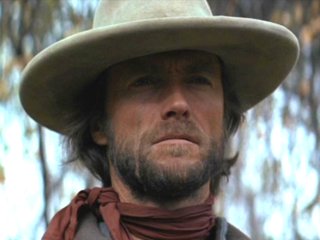 Don’t get me wrong. I owe countless hours of entertainment, and many profound lessons learned to Clint Eastwood and his lifetime of utter brilliance. In this post, I will of course repay him by attacking his work on one of my all-time favorite films.
 Pedagogical metaphors are like a sober friend on your way out an especially good party. You can lean on him a bit. If he’s a good friend, you can lean a little more. Lean too much and you both fall in the gutter and he’s not gonna wanna party with you any more.


 There is a reason I put my picture posts for this blog in the category of “Bad Photography.” I really don’t know what I’m doing. I started taking pictures when I realized I lived in a place full of amazing sights I am very lucky to witness. As I’ve traveled more, I’ve found even more reasons to take pictures. What I haven’t done is learn enough about the settings on my cameras to make any intelligent use of them. Neither have I made much use of post-production technologies. Most of the pictures on this website are thus straight out of the camera using the most basic settings available. This summer, I began using


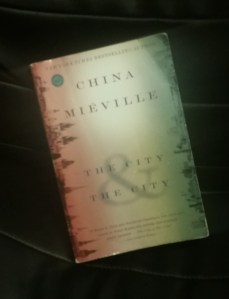 It was quite sometime ago that a friend of mine passed along a copy of China Miéville’s book, The City & The City. As with an awful lot of fiction, no sooner had I decided it looked interesting than I set it aside in pursuit of other (probably less interesting) things. Anyway, I finally dug it out awhile back and for a time I set a few other things aside in order to pursue its own story. I had to unsee some work to read this book, so to speak, but that’s a sub-reference you (my own reader) won’t get for a few more paragraphs. Just keep reading and I’ll pretend I didn’t notice.
 I used to think that made sense, but then Joffrey happened, and I learned very clearly that I can indeed hate someone I don’t believe in. Seriously, I have spent more time hating that little bastard than I ever spent on any real person. Neither Adolf Hitler nor John Chivington from actual history have been given nearly so many fucks from me as that perfectly fictional little piss-ant. Neither my old playground Nemesis, Scotty, nor the bastard who embezzled money from my Dad’s business when I was a teenager ever got my goat quite so effectively as that perfectly pathetic little bit of unreal royalty has. (Admittedly, Jofrrey has the advantage of being a recent pebble in my viewing-shoe, but presently anyway, he rouses more irkitude than any other.) So, yes, the bottom line here is simple. I can hate a person that doesn’t exist. I really can.
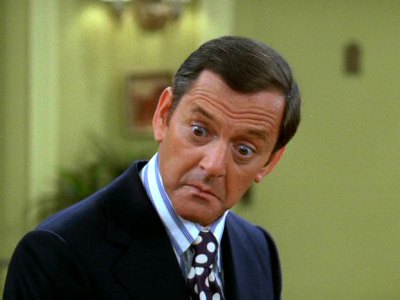 Then again, there is Felix Unger. I know that’s probably one for the over-40 crowd, but seriously, you kids need to get off my lawn anyway, so I’m using him. He’s not quite a villain I know, but man could that character set me to gnashing my teeth. Don’t get me wrong, Tony Randall was great, and he was particularly great at making me hate that fricking Felix Unger. Also there is Frank Burns from Mash. Wasn’t that guy’s mere presence in a scene just like fingernails on a chalk-board? (Which brings me to a question; do young people understand how bad that chalk-board sound was? I haven’t heard it in well over a decade and I still hate it. Almost as much as I hated Frank Burns. I expect some folks have escaped this sound entirely, and maybe I should find a more current metaphor for a truly cringe-worthy event. …maybe something like Joffrey.) Anyway, the point is that you can hate fictional characters.
 All of which brings me back to the uncomfortable curve of the matter. I think an awful lot of unbelievers struggle with the hold that religious narratives have on our imaginations. I know my own religious sentiments stuck with me for years after I ceased vouching for their truth. This bothered me sometimes, but I began as a reluctant atheist anyway, so perhaps it didn’t bother me too much. I don’t know when, but sometime in the last couple decades many of my old religious thoughts fell away. Just the same, I remember what it was like to disbelieve and yet to feel moved by the same old religious narratives.
 It’s been a long time since I read Lakoff and Johnson’s book
 northierthanthou