• About

northierthanthou

northierthanthou

Tag Archives: History

Time Heals All Wounds …Unless it Doesn’t

10 Monday Jun 2013

Posted by danielwalldammit in History, Narrative VIolence, Native American Themes

≈ 40 Comments

Tags

Accidental Racist, American Indians, History, Holocaust, Memory, Native Americans, The Long Walk, Time, Tragedy

http://www.newmexicohistory.org/filedetails.php?fileID=494

http://www.newmexicohistory.org

A career in Native American studies makes you the grammatical equivalent of a time machine. No sooner do people learn where you work, what you study, or what specific things you happen to be working on than they suddenly switch to past tense. Often this will be accompanied by sad tones and slightly downcast eyes. Seriously, I’ve lost track of the number of times a few comments from me have led people to great moments of reflection about “what we have done to them.”

These moments of introspective time-travel usually leave me with a bit of motion sickness. See, the thing is that people go back to the past like this when I am actually talking about perfectly contemporary issues. When I worked on the Navajo Nation, simply telling folks what I do for a living was often enough to send their souls searching through history for resolution of collective sins, real or imagined. In most cases I don’t think folks had any real sense of the specifics in question, no real idea of just what Anglos had done to Navajos, for example. In most cases, I suspect the sudden trip to the past tense was filled with thoughts of generic cowboys and even more generic Indians, …who probably looked more like Lakota than Navajos anyway. In any event, the problem is simple enough; for far too many people Native Americans simply belong in the past.

…and yes, I do wonder just how often Native Americans get this? Perhaps it’s a white thing after all. I don’t remember getting this effect in the presence of natives, just when it’s me talking to my own, so to speak.

Anyway, I figure it makes it a Hell of a lot easier to be sorry about something if it happened a few generations back. Try to talk to people about issues such as uranium poisoning, forced relocation, or any number of contemporary issues, and they are less certain that what ‘we’ are doing to ‘them’ isn’t somehow justified, or at least necessary, or at least.

But folks are happy to talk about Custer.

Wasn’t he a bastard!?!

Rarely do I get the sense that this sort of time warp is meant to provide historical perspective; often it strikes me as just one more way of changing the subject.

Of course somber regrets for crimes long forgotten are only the nice-guy half of this coin. Flip the quarter over and you get a range of narratives effectively using time to disclaim responsibility for these same crimes, perhaps even a comment to the effect that it’s best for Native Americans to put the past behind them. Occasionally people will actually tell me that reservations or casinos, etc. are attempts to pay for what ‘our ancestors’ did, and of course the point is always to suggest that such concessions are unfair to the rest of us here in the present.

And no, this time-to-forget theme is not limited to Native Americans. One has only to suffer his way through “The Accidental Racist” to hear Brad Paisley play precisely this shell game with history. I don’t have the stomach to parse the details of this terrible tune, but let’s just say that Brad is apparently paying for the mistakes of a southern past, and L.L. Cool Jay is happy to let bygones be bygones.

…Seriously, both of them should have known better.

It’s funny those who support the rebel flag are always prepared to discuss its significance in the civil war. Rarely do they want to comment on its use in opposition to the civil rights movement.  History textbooks probably don’t make this much easier, telling us that slavery ended with the close of the civil war. Sure they note the existence of debt peonage and Jim Crow Laws, etc., but that is a more complex story. The morality tale for most people ends at Appomattox. I suspect it is the story of slavery that many will imagine when they ask why African-Americans have trouble putting the past behind them. The notion that some folks can still remember when there was real danger in looking a white person in the eye just seems to escape a lot of people.

…most of them white.

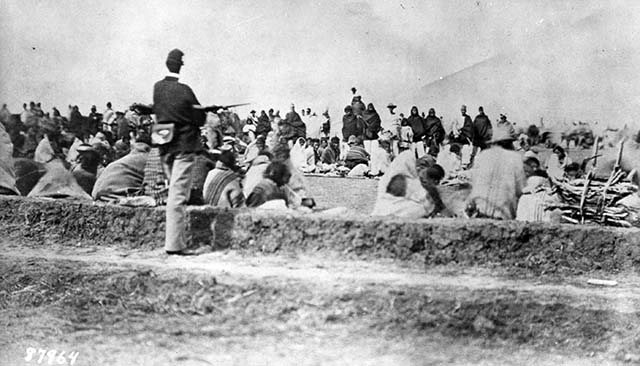
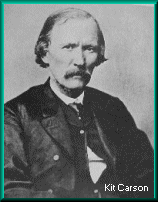
But what’s past isn’t equally past for all people. I learned this very clearly out in Navajo country. The nadir or their historical narratives begins with the story of the Long Walk. In 1864 Kit Carson burned marched through Navajo country, burned their crops and destroyed their homes. He then waited for winter to bring them to him.

It worked.

The result was 4 years of internment at a place called Fort Sumner in Southeastern New Mexico. Many of those who started the “Long Walk” to Fort Sumner didn’t make it to the end.

When my friends, students, and coworkers told me their stories about the long walk, what struck me most about their narratives was the way they always began.  They almost always began with a clear reference to some family member. These weren’t simply stories about something that happened to their ancestors; they were stories about the death of a Great Aunt or the trials of a Great Great Grandmother. People telling me these stories consistently anchored narratives of the long walk in their own relationship to one of those who had been through it. These were not stories about an event over a hundred years ago; they were intensely personal stories of family tragedy.

I’ve heard similar stories, …from my high school history teacher, for example. A native of Georgia, her account of Sherman’s march included a great grandmother’s efforts to save a family heirloom (she stuck it on a wall in the hopes Union troops wouldn’t notice). When I taught briefly at a Jewish private school in Houston, I heard such stories from survivors of the Holocaust. More importantly, my students heard those stories. They hear them every year, directly from the survivors, and in countless other contexts throughout the year. I’ve heard such tragic narratives from Inupiat speaking about the horrors of influenza epidemics brought by whalers and the trials of the boarding schools. Exposure to virgin soil epidemics is hardly ancient history on the North slope, and most any native can tell you about some elder who was punished for speaking her own language at the schools. What all these narratives have in common isn’t simply tragedy; it’s direct personal connection to the suffering.

Of course, the suffering in some of those stories is greater than that in others.

People don’t just forget these sorts of events. They keep them alive; they keep them personal. The suffering becomes part of the meaning of history, and part of the personal identity of those that have been through it, of their children, and their children’s children.

Whether or not such stories should be kept alive in that way is a whole other question, and a rather ironic one at that. The suggestion that people subjected to injustice ought somehow to simply move on has more than a trace of might-makes-right in it. It is an attempt to suggest that certain horrors are simply an accomplished fact, as are the long-term consequences of those horrors; land lost, buildings and nations built for the benefit of someone else, and whole scores of missing family – aunts and uncles not present and cousins never born, all of it, so the argument goes is just a done deal. Yet some people say that it would be best to just move on; accept all of this and focus on the future.

Best for whom?

Your land is ours now, but let’s not dwell on how that happened. Your grandmother’s language is gone now, but let’s not think too much about that. Cities wrecked? Whole populations wiped out? What’s past is past, so some say; let’s look to the future.

But if the long-term consequences of such atrocities might be thought an accomplished fact, then so are the bitter narratives.

…and the bitterness itself.

It seems those with such tragedy in their past rarely (if ever) take such advice. They remember! They remember with a passion. Here we have at least a trace of poetic justice. It seems to me quite fitting that those hoping the descendants of tragedy would accept the consequences and simply move on should run square up against one other uncomfortable and very stubborn fact, namely that folks just don’t forget such things.

They really don’t.

71.271549 -156.751450

Share this:

  • Tweet
  • Share on Tumblr
  • Click to print (Opens in new window) Print
  • Click to email a link to a friend (Opens in new window) Email
  • Click to share on Reddit (Opens in new window) Reddit
Like Loading...

Slavery: Still Sexy After All These Years! (Or Yes Quentin, There is a Reason it’s Called an ‘Exploitation’ Flick)

23 Thursday May 2013

Posted by danielwalldammit in History, Movies

≈ 16 Comments

Tags

Django Unchained, Fiction, Film, History, Movies, Quentin Tarantino, Race, Sex, Slavery

imagesJust what is the relationship between the events occurring inside a film and those occurring the world in which we live? I will not say the ‘real world’, because of course part of the problem here is that the ‘worlds’ in which we live are saturated by myriad narratives, preconceptions, and cultural artifacts which shape our understanding of events in ways few of us can fully understand. So, when we see something happening in a movie, it is important to grasp that this too is one more of those narratives, one more thing that shapes the meaning of events in own own lives. Just how it does that, well now that is a tricky question.

It’s a difficult question with a number of plausible answers, but I think we can rule out one answer at least, the one that says; ‘nothing’. Quentin Tarantino would seem to disagree, at least he does when he’s angry and dodging interesting interview questions. In a now infamous rant, Tarantino took the position that there was no relationship between on-screen violence and real world violence, refusing even to elaborate on this position or to explain his reasons for taking it.

(Oh yeah, SPOILERS!)

To be fair, it was the interviewer, Krishnan Guru-Murthy, that fielded the stance in a sort of complex question (at 4:30 in the clip below), but for all his belligerence Tarantino does not disavow the position attributed to him. Guru-Murthy claims that his own research has produced little in the way of an explanation from Tarantino, just a consistent repetition of this stance. It’s a common enough claim in any event, often serving as a defense mechanism, both for those that create guilty pleasures and those of us who enjoy them (and yes, I do count myself among the guilty). So long as there is no relationship between fantasy violence and real-world violence, one is free to explore the one while taking no responsibility for the other.

But of course the world isn’t that simple, and as Guru-Murthy also points out, Tarantino was happy to link his latest film to the serious issues of slavery, even taking taking credit for starting a dialogue about that subject. He also takes credit for the cathartic violence he puts on screen, but has little to say about the ‘real’ violence perpetrated by the villains against their slaves on that very same screen. But are we really to believe Tarantino means us to feel emotional investment for Django’s acts of revenge while sitting guiltless through the torture and slaughter of innocents throughout the film? Does the elaborate detail of ‘Mandingo fighting’, the ‘hot box’, and the vicious execution of a slave torn apart by dogs leave the viewer without any sense of complicity for the “brutality of the violence of the day?”

Tarantino’s own writing belies this approach. His villains are too clever, their speeches too fascinating, their point of view far too prominent in these moments to dismiss. The victims of this violence remain largely silent. We know that the Mandingo fighters suffer and regret what they are forced to do, we know that Django’s love interest is defiant, and that she suffered greatly for it, and we know that the man torn apart by dogs could not bear to fight again; none of these characters really say much in the movie. They do not introduce interesting plot twists; they do not dazzle us with fascinating speeches. They suffer just as we would expect them to, providing us with no insights at all into the world in which they live.

Those that inform us about this movie are the killers. DiCaprio’s Calvin Candie explains quite clearly what he expects of his slaves before setting the dogs loose. Dr. King Schultz (played brilliantly by Christoph Waltz) introduces us to the fascinating world of bounty hunter, one who would see a man shot in front of his child but who balks at seeing another torn apart by dogs. And of course we understand Django’s motives; his goals are the driving force of the movie; it is his killings which provide us with the final pay-off, the glorious conclusion of the film.

It is consistently the logic of those enacting violence which Tarantino fleshes out for us in this film, and as always, he does it ever so well. The victims are there to suffer, and to provide a pretext for the ‘cathartic’ violence that is to come. In short, Django consistently draws us into the viewpoint of the killer; the movie does this when the killer is a villain, and it does it again when he is a hero. This is the myth of redemptive violence presented in a special way that allows us to have our cake and eat it too. We can enjoy Dicaprio’s sadism just as we will enjoy his downfall. If there is a moment of regret in a scene, or a brief period in which we might wish for the suffering to simply stop, well that moment passes in due time, transformed as it were into the rationale for yet another killing. In Django, we understand the killers, the victims are simply silent.

But villains gotta be villainous, don’t they?

Of course they do, but what is lacking in Django is a genuine counter-balance, any real sense of what is at stake in this story for anyone who is not a killer. When our principal reward at the end of the story is the death of the bad guy (DiCaprio or Jackson, …or so many others), we are never far from the mindset of the killer. In the end, Django leaves a wanted man, accepting this fate without so much as the blink of an eye, his wife drawing a rifle as they ride off from the scene. Two lives now wholly engulfed in violence. If this is a victory, it is at least partially a victory for the world of villainy.

…which brings us back to the initial question, just how does this story relate to the realities of violence in everyday life? I honestly enjoyed much of this movie, as I did with Inglorious Bastards. (Yeah, I know about the spelling, take that Quentin!) But I always feel a little uncomfortable with Tarantino films, precisely because I can’t escape the feeling that I am witnessing something a little creepy; it’s a bit like watching a teenager doing something truly inappropriate in public. Whether it is sheer joy with which Tarantino employs the n-word just a little more than his faux-realism rationale would warrant, or the raw celebration of violence which is present in every film he makes, I cannot help but to think the limitations of Tarantino’s stories are the limitations of the world in which he lives, the world of narratives informing his sense of sense of the world off-screen. And I cannot help but think he is inviting us to normalize those limitations and accept a world of cartoonish violence as a moral standard of sorts.

It is not as though the world lacks for people who think this way off-screen.

One can see it in that interview above as well, when Tarantino tells us that Django deals with the ‘Auschwitzian’ characteristics of slavery. (I guess it’s a word now, …why not?) Honestly, I don’t know what he meant by saying that Americans have dealt with the Native American holocaust, but he clearly seems to think this movie is saying something about the realities of slavery, so much so that when people talk about the film, Tarantino takes that in itself to be a meaningful dialogue about slavery. And yet there is little about this film that could shed light on the nature of slavery as an historical institution.

Tarantino’s choice of comparison is telling, because the story of Auschwitz is largely the story of cruelty for the sake of cruelty, and this is Tarantino’s vision of slavery itself. In one of the most interesting (and insightful) speeches of the film, Dr. Shultz tells us quite frankly that he deals in dead bodies while slavers deal in live bodies; bother are economic institutions. So, why then do slaves first make an appearance in this film walking a great distance barefoot in the cold? Sure, one could probably come up with a plausible explanation based on historical possibilities. But the more plausible answer is that Tarantino wanted to show us the raw cruelty of the institution. More to the point, he did not wish so much to tel us something about slavery as to use slavery as a pretext for telling us something about cruelty. Tarantino presents this story of raw cruelty for us again in the sadistic foremen whom Django will kill part way through the movie, and again in the institution of Mandingo fighting. He presents it in virtually everything that DiCaprio’s character and Samuel Jackson’s character say and do. In this film slavery is not an economic enterprise, it is the conspicuous consumption of sadists, an extravagance of cruelty for the sake of cruelty.

One should add that it is a highly sexualized cruelty that one sees in this film. While Tarantino denies that rape appears in the film, its presence in the narrative is prominent. Django is quick to tell us that his wife will be used as a comfort woman, a prospect apparently confirmed by the words of another villain later in the film. Throughout the plantations in this film, black women appear in full southern dress, lounging about, the clear implication being that they are there for the pleasure of the owners. And of course when Django is captured, it is his genitalia which first get the attention of his would-be tormenters. The slaves portrayed in this film exist largely for the purpose of providing the villains with cheap thrills. And while this sort of thing was certainly not absent in the real history, its significance has completely eclipsed those of plantation agriculture in Tarantino’s narrative.

Slavery insofar as it appears in this movie, is little other than a sadistic fantasy. It is a source of pleasure for the villains, and fleeting moments of pain for the victims about whom we learn so very little. And perhaps we could sweep all of this under the rug and just call it entertainment were it not for one thing; Tarantino himself wants to tell us this movie is about slavery.

A part of me wants to say that it simply isn’t.

But of course that too would be inaccurate. The movie is about a vision of slavery bearing little resemblance to the actual institution, but perhaps one with a disturbing resemblance to Tarantino’s own thoughts about race, violence and sexuality. More disturbing still is the very real possibility that this film tells us still more about the general public’s understanding of the relationship between these features of American society.

***

I suppose all of this brings us full circle to the cathartic violence that Tarantino is talking about. On one level, that would be cathartic violence against the perpetrators of slavery as Tarantino envisions it. On another level, if I am right that Tarantino is getting off on the sadistic possibilities available in a world of slavery, that he is inviting his audience to enjoy the same possibilities, then the catharsis is perhaps a bit more personal. It is the moment in which one erases his or her investment in the sadistic themes presented here through the actions and words of the villains. It is a moment in which one finally rejects the villain despite his cleverness, and perhaps it is a moment in which one rejects one of the ills of history (at least insofar as it is almost dealt with in the form of that villain). The destruction of the villain thus becomes our own ritual purification.

I have my doubts as to where that leaves us in the end.

71.271549 -156.751450

Share this:

  • Tweet
  • Share on Tumblr
  • Click to print (Opens in new window) Print
  • Click to email a link to a friend (Opens in new window) Email
  • Click to share on Reddit (Opens in new window) Reddit
Like Loading...

Thoughts on the Cherokee Blood-Feud, or Anthropology is Only Fun Till Someone Puts an Eye Out!

26 Friday Apr 2013

Posted by danielwalldammit in Anthropology, Education, History, Native American Themes

≈ 22 Comments

Tags

Blood Feud, Cherokee, Collectivism, Conflict Resolution, Ethnography, History, Justice, Navajo, War

Three Cherokee

Three Cherokee

…and of course that is when it gets really interesting.

By poking an eye out, I am of course talking about a special sort of moment one gets from time to time in the study of anthropology, at least I do. It’s the sort of moment when some cultural practice causes the hair on the back of your neck stand up and your stomach tries to dig its way to China (or Antarctica, as would be the case here in Barrow). I’m talking about that kind of moment when you encounter something in an ethnography that just seems like too much. So, you sit there and ask yourself, “How in the Hell could that be anything but wrong?” And for a little while anyway, your mind just doesn’t want to travel down that road, the one that leads to understanding the practice in its own context. You’d rather just say ‘no’. Hell, you’d rather shout it at them across the waters, over the mountains, and even if need be through the ages, cause someone needs to say it somehow, “This is just wrong!”

For the students in one of my classes this semester that moment came courtesy of the Cherokee blood feud, and the sticking point was very clearly collective responsibility for murder. Simply put, the feud enabled the clan of a murdered individual to claim revenge against any member of the clan to which the offending party belonged. More than that, the terms of this blood feud obligate people to do so.

But I said ‘murdered’ didn’t I?

Sequoyah

Sequoyah

That’s not quite right. In the old way, any individual responsible for killing another Cherokee could initiate the obligation to exact revenge, even if the killing was an accident. As our reading described it, a horse borrowed for the day could start trouble by bucking its rider off, thus triggering a feud between the clan of its owner and that of the deceased rider. So pretending for this paragraph anyway that I am Cherokee – I’m not, …not even the ubiquitous Cherokee grandmother every other white guy seems to have been blessed with – but let’s just pretend for a moment. If my brother’s horse spooks and kills a rider, I could be killed in revenge for this event. They do not need to take the offending party (if there even is such a person in this example); they might prefer to kill a different member of my brother’s clan (someone like ME, perhaps). So, I could die because of something my brother did, …even if that was an accident. The article we read even contained an instance in which a killer talked the avenging parties into killing someone else from his own clan.

And yes, this bothered my students. I can’t really blame them, because I can remember my own feelings years ago as I came to grips with this kind of dispute-system. It violates my sense of justice too, or at least the master metaphors through which I and my students typically process this kind of information.

But it’s worse than that!

You see, the point here isn’t merely that people do this, but that this system is actually normative. In a certain time and place, according to a certain cultural order, this is what was SUPPOSED to happen. This is what’s right, at least as the Cherokee once defined it, and that proved more than a little disturbing to my students this semester.

Proper verdicts thunder!

Proper verdicts thunder!

I’m inclined to think the sticking point is an intuitive sense that guilt is an individual responsibility, at least for myself and the students in my classroom last week. Guilt is the medium through which we seem to want to look at deviant behavior, and that concept does not seem to want to travel in large groups; it resides in the soul of a single individual.

Heh, …I said soul, didn’t I?

It is perhaps part of the legacy of historical Christianity under which all moral failings could at one time be construed as defiance of the Lord. Whether one had committed murder, taken to drink, or charged interest on a loan, all of these crimes and others were testimony to personal defiance of the Lord. And of course, much like Santa Clause, He would know!

I’m inclined to think the projection of an omniscient judge and jury played an important role in shaping the concepts of guilt so familiar to people today. One can even see a trace of this mythic imaginary in secularized notions such as crimes against the state (or against society as a whole). Guilt is personal, it is absolute, and it obtains even when the social facts proceed on without taking notice of it. Even the medicalized notions of deviance stemming from the mid to late twentieth-century seem to be largely focused on the individual. The insanity defense is about the capacity of an individual to grasp right or wrong, and it is one individual after another whose failures in life can be described as due to this or that syndrome. When we withhold the pronouncement of guilt on an individual, it is rather often to pronounce sickness upon him instead. Either way, we do not typically assign counseling as a condition of probation for all the members of his extended family.

In short, we care who dunnit. We really care!

Adam and Eve Hide from God

Adam and Eve Hide from God

That of course has less to do with anything inherently wrong with clan-based blood-feuds than it does the cultural logic of western traditions. What pokes my students and I in the eye as we study this custom has less to do with has less to do with Cherokee society than our moral sensibilities. We just can’t fit their approach into our own world, not without feeling a little violated when doing it.

I’ve learned to regard that feeling as evidence that I have just found something worth studying. For some of my students, the problem was collective responsibility, but the real irony here is that we are not really strangers to collective responsibility. Not by a long shot.

It probably won’t help matters much to mention gangs in this regard, though the logic of a gang hit is certainly comparable in some respects (one needn’t get the original culprit, just one of his home-boys). But of course gang members are hardly the only people in modern America to engage in disputation at the level of collective responsibility. We may have fought a war against Saddam Hussein, but in real-world terms that meant killing a lot of Iraqis. The same can be said of the Taliban whose principal cause of war appears to have been sheltering Bin Laden. The story will not change much for any given war; war is by definition a conflict between collective entities. Either way someone is dying because of what some other bastard did, and folks may be sad about it, we might even make a regretful movie or sing a sad song about it, but such is war.

kcarson2In some cases the absurdity of this collective logic creeps through the practice of war more than others. When I used to teach Navajo history, I used to despair that the first of my two textbooks spent far too much time detailing a pattern of raid and retribution between Navajos and the Spanish. Time and again, the book would describe a raid conducted by Navajos followed by a punitive expedition carried out by the Spanish. It’s a pattern that continued clear up through the Mexican period in the Southwest, and further still into the early years of American occupation. And in all these punitive actions, no-one seems to have bothered to ask if the Navajo communities bearing the brunt of the attack had much to do with those who had been doing the raiding. Collective responsibility was simply assumed.

It should be added that Navajos seem to have taken the brunt of the blame for a pattern of raiding that was fairly ubiquitous in the Southwest. They were certainly not the only group conducting such raids, but that is a gripe for another day.

imagesFor their own part Navajos developed an oral tradition describing a very different allocation of responsibility to the specific raiding parties, viewed as irresponsible young men bringing trouble to their own people. This point becomes that much more clear in the wake of the Long Walk and internment at Fort Sumner. This event marks the nadir of most stories about Navajo history, it is story in which Kit Carson ’rounded up’ the vast majority of the Navajo people and took them to a small reservation in Southeastern New Mexico. The next four years (1864-68) were difficult to say the least for Navajos and damned expensive for the U.S. government. In the end they were allowed to return home.

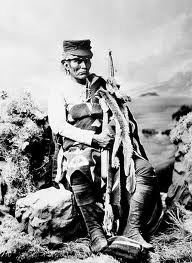
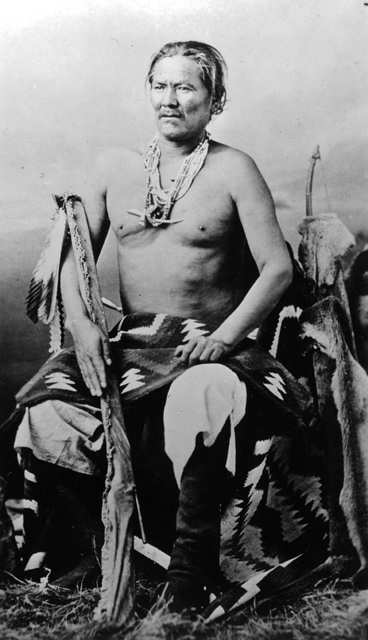
ManuelitoSome have defended Carson’s actions on the grounds that it had at least ended the raiding patterns of the past centuries. What these historians consistently missed was that the raiding patterns continued in the years after fort Sumner. After Fort Sumner, a raid brought Federal troops who went straight to the Navajo police under the leadership of Ganado Mucho or Manuelito. The Navajo police then brought back whatever livestock had been stolen. Before Fort Sumner a Navajo raid was an act of war with collective responsibility applying to the Navajo people as a whole; after Fort Sumner it was a criminal act, the responsibility for which fell on individual shoulders. The difference that makes this distinction had less to do with actions than understandings.

…and in this case that was all the difference in the world.

Perhaps the logic of warfare is too remote for the majority of us in modern America, but there is one respect in which the notion of collective responsibility is absolutely a part of our every day lives, the business of corporations. As some would describe it, the very point of forming a corporation is to re-allocate responsibility for the actions associated with a business concern. Once a source of great controversy, the existence of these collective entities in American business (and that of the world at large) is easily accepted as an accomplished fact.

It is just the way the world works, so common wisdom would have it. We accept that we will not get to talk to the bastard (or bastards) at Bank of America, Wells Fargo, or any other major bank who decided they could reorder your checks from the biggest to the smallest in the event of an overdraft and charge extra fees in the process. We accept that the poor agent who answers our call will be the one to hear whatever we have to say about such an outrage. We accept that CEOs in charge of failing corporations may travel freely on to the next chapter in their bright shining futures, leaving countless lives ruined in their wake. And we accept that (with rare exceptions) lives lost or immiserated by corporations will never result in punishment of those specifically responsible for polluting this river or putting that firebomb of a vehicle on the market.

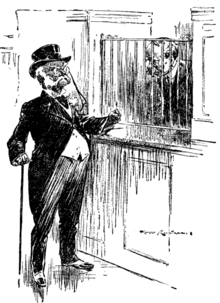
"I warn you, Sir! The discourtesy of this bank is beyond all limits. One word more and I — I withdraw my overdraft!"

“I warn you, Sir! The discourtesy of this bank is beyond all limits. One word more and I — I withdraw my overdraft!”

Of course, there are circumstances in which charges of criminal fraud or negligence may occur, but this would seem to be the rare exception (except perhaps in Island where they actually have the balls to hold white collar criminals accountable for wrecking a national economy) Under normal circumstances, these giant entities screw customers and maim communities with impunity, and there is little one can do about it. The most one might hope to see in the way of justice from such practices will take the form of financial compensation from a corporate entity, the loss shared out through its stock-holders. Those directly responsible for terrible decisions will in most cases never see any significant retribution for the harm they cause to others.

…and the more I think about it, the more this one starts to feel like another poke in the eye.

If collective responsibility is the sticking point in accepting the justice of a clan-based feud system, it is not because collective responsibility escapes us, or perhaps it is because it escapes us when we actually use such an approach in our own lives. The real question is just why do we allow for collective responsibility in warfare and corporate business activities while insisting on individual responsibility for ‘crimes’? I and my students didn’t follow this question, because of course that wasn’t the task at hand, but it’s the sort of thing I hope will hang in their minds long after they have hit send on their final papers. If it’s done right, a good anthropology course should leave students with more than a collection of facts about other people in other times and places, it should also leave them with a new sense of the communities in which they themselves live.

The cognitive poke in the eye is on the house.

***

Three Cherokee are from here. The image of Sequoyah is from the Smithsonian Institution. The image of Kit Carson is from the Kit Carson Museum. Ganado Mucho comes from Navajo People.org. Adam and Eve hiding from God comes from an old engraving by Julius Schnorr von Carolsfeld. I got it from istockphoto. Manuelito comes from a class at ASU. The gavel is from Sara Marberry’s Blog. The Bank Cartoon comes origonally from an entry of Punch Magazine published in 1917, but I got it from Wikipedia.

71.271549 -156.751450

Share this:

  • Tweet
  • Share on Tumblr
  • Click to print (Opens in new window) Print
  • Click to email a link to a friend (Opens in new window) Email
  • Click to share on Reddit (Opens in new window) Reddit
Like Loading...

I’ll take Cold Tropes and War Analogies for $50, Alex!

19 Friday Apr 2013

Posted by danielwalldammit in Education, History

≈ 26 Comments

Tags

Analogies, Cold War, Communism, Education, History, Metaphors, Pokemon, teaching, Trops

coldwar_nike1It’s getting harder to explain the history of the cold war, at least insofar as students are less and less likely to relate to the era in any personal way. Gone are the days when the subject could elicit a visceral reaction from the under-thirty age-set. I distinctly recall that fear of the world ending with the push of a single button played a big role in my own teen angst, and I doubt I am special in that regard. Hell, I sorta figured it was actually going to happen at some point, all of us were going to die in one big final feud, but then again I’m fun like that. The point is that the subject hung like a cloud over the heads of some of us back in the day.

I suspect a lot of my students have trouble wrapping their minds around the whole thing. So, when you come to something like the Cuban Missile Crisis, it takes a little prep work to get across what would have seemed obvious to my own generation, that this little event, a paragraph or two in the average textbook, actually threatened all of life as we know it. Today, I usually just tell my students that none of us would have been born had things gone differently in that particular sequence of events.

I think they get it.

…sort of.

It’s not just the subject matter that is slipping away, so to speak; it’s also the imagery. This isn’t just true of the cold war. Many of my favorite pop-references are becoming less and less relevant to younger students as my youth passes further and further from the realm of things about which the kids at the cool table could be asked to give a damn.

cokeOne of my favorite teaching-gambits for the cold war has slowly faded into the realm of useless. For years I used to ask my students who lost the cola wars. This always got some funny looks, followed by suggestions of ‘Coke’ then ‘Pepsi’ both of which I would shoot down without the slightest hint of an explanation, …leaving them to give me more funny looks.

How could it be neither?

Sooner or later someone would suggest Shasta, Nehi, RC-Cola, or some other obscure brand of soda most likely consumed by cave men in the sad old days before Paula Abdul and Michael Jackson. This suggestion would then become a jumping off point for discussing the impact of the cold war on various third world nations forced to articulate their own interests in terms framed by the U.S. and Soviet Union.

imagesToday my students still give me blank stares, but they are not the blank stares of students struggling with a conundrum; they are the blank stares of students listening to someone try and explain a complicated issue by means of a metaphor that is no more accessible to them than the full story in itself. Sadly, it is time for me to move this metaphor to the back shelf and put some other theme in the specials section of my intellectual supermarket.

(See what I did there?)

Missionary colonial periodI once TAed for an instructor that used to compare the Cold War to the conflict between Protestants and Catholics in the colonial era, each bringing a vision of absolute truth to Native Americans, promising that truth was the key to liberation, demanding their loyalty, and taking everything they had in the process. (How’s that for a run-on sentence!) So, that professor seemed to be suggesting there was nothing new under the sun, just two new world powers playing the same old shell games with the rest of humanity. I like this analogy too, but it’s not so much a quick entry into the topic as a food-for-thought and what-does-it-all-mean kinda notion.

Today I was trying to explain the dynamics of proxy wars to a student when I could see the light go off over her head. A moment later she exclaimed that it was just like Pokémon. The other students quickly nodded, and after a brief moment in which I sort of wanted to cry, I thought actually that isn’t too bad.

PiakchuSo, here I sit, watching the next batch of students suffer their way through an exam and wondering if this is the wave of my pedagogical future? Will I soon find myself saying things like; “And then Nikita Kruschev said, ‘Fidel Castro, I choose you!'” Can I wrap my mind around the concept of West Germany as Picachu? Can I use this narrative without promoting anyone to the heroic status of Ash? Or should I just let John Wayne have that role? Can y’all imagine the Duke in his Green Beret uniform whipping out a pocket monster and saying; “have at ’em liddle pardner!” The imagery almost seems promising, but I just don’t know if I am up to the task. This isn’t my era, and I don’t know the game.

The whole project does have a certain amount of promise. I wonder if I can get faculty development funds for this? I wonder if the Dean of Instruction will give me money to go to the gym and develop my Pokédex?

Cause I really don’t think I can teach this subject without a fancy new gym badge!

71.271549 -156.751450

Share this:

  • Tweet
  • Share on Tumblr
  • Click to print (Opens in new window) Print
  • Click to email a link to a friend (Opens in new window) Email
  • Click to share on Reddit (Opens in new window) Reddit
Like Loading...

Bonus Super-Villain: This Girl is Nasty in Real Life and on Screen!

10 Wednesday Apr 2013

Posted by danielwalldammit in History, Movie Villainy, Movies

≈ 26 Comments

Tags

Anna Rosmus, Deviance, Germany, History, Holocaust, Memory, Nazis, Villainy, World War II

1990-the-nasty-girl-poster1What makes Sonia Rosenberger so nasty? It isn’t what you would think, or even what the cover of The Nasty Girl would seem to suggest. Precocious though she may be, Sonia’s crimes are those of an historian. She earned the title in her hometown by asking the wrong questions about its history.

I love her.

Sonia’s journey into super-villainy began with an essay contest. As a young student at a Catholic school in Germany, Sonia decided to enter into a national writing contest. She had two topics to choose from; “The concept of Europe” and “My Hometown During the Third Reich.” Sonia’s teacher sensibly encouraged her to go with the first topic, but Sonia had been brought up to believe that the good people of her home town had resisted the Nazis. How could she pass up the opportunity to reveal the heroics of her friends and neighbors?

Please don’t fault Sonia for the innocence of her original intentions! Even the dark flowers of villainy take some time to bloom.

You see it wasn’t long before it became clear to Sonia that something was amiss. Everyone in town seemed to agree that the only true Nazi had been the mayor, but she could not quite seem to get her hands on his files at the local library. What little information she could find on Professor Juckenack, the great hero of the resistance, turned out to be an essay in support of Nazi racial politics. And no-one could seem to remember the concentration camp in town, at least not without a little needling on the subject, in which case they were quick to point out that it was far better than all the others. …the camp that didn’t exist, that is.

Something was amiss!

So, you might wonder what would a good girl wold do upon finding such a mystery? What should a good girl do upon discovering that the people she most looked up to seemed to be damned uncomfortable whenever she tried to talk to them about her personal project? Well, I personally have no idea what a good girl would do about such a quandary, but I can tell you what this bad Betty did.

She dug deeper!

Despite hints, pleas, and even threats, Sonia just kept pressing on in pursuit of the unwelcome truth. Hell, she even kept at it after someone chucked a brick through her car window. Trust me, that was just the beginning. Sonia ignored the advice of neighbors, parents, and even her husband in her pursuit of the truth, sacrificing health and safety in an effort to learn just what had really happened in her hometown during the Nazi years.

I ask you, would a good girl do that? Not a chance!

Left with no other options, Sonia sued the town to gain access to the mayor’s old documents, and when the town changed its laws to prevent her from getting access yet again, …she just sued the town again. She acted as her own lawyer in both ventures, by the way. (Yeah, she’s just that bad-ass.) And do I need to say that she won the second case too? That’s right; good guys don’t always win. Sometimes they get their butts kicked by villainous nasty girls.

Twice!

I’m not even going to tell you what Sonia did when the town library pretended to lose the mayor’s files in yet another effort to hide the truth from her villainous campaign. Suffice to say this juggernaut of naughtiness would not be dissuaded! You know what else I’m not going to tell you? What Sonia found out about Professor Juckenack and his activities under the Third Reich. Nor will I tell you what happened when he sued her for writing about it in her book on the subject. I’m not going to tell you, because I’m feeling a little bad myself today. (Sonia has inspired me to evil.) And if you want to know the answers to these questions, well then you are just going to have to come over to the dark side and dig a little yourself.

Ha!

RosmusPassau300pxwBut you know what the best part of this story is? It is actually based on the life of a real person. her name is Anna Rosmus of Passau, Germany, and she is every bit as wicked as the celluloid creation she inspired. Anna didn’t stop with one book about her hometown, she turned her tireless pursuit of unwelcome truths into a career in scholarship, much of it dedicated to ensuring that the memorials to this painful chapter in German history would not be forgotten, neglected, concealed from the public, or outright defaced. Time and again, Dr. Rosmus has called attention to realities good decent folk would just as soon forget.

Who would do such a thing?

Only a nasty girl.

A very nasty girl indeed!

***

(The image of Anna Rosmus is from http://www.history.ucsb.edu/faculty/marcuse/classes/133c/133cPrevYears/133c04/133c04l17-NaziPast70s80s.htm)

71.271549 -156.751450

Share this:

  • Tweet
  • Share on Tumblr
  • Click to print (Opens in new window) Print
  • Click to email a link to a friend (Opens in new window) Email
  • Click to share on Reddit (Opens in new window) Reddit
Like Loading...

Point Hope (Photo Gallery)

08 Friday Feb 2013

Posted by danielwalldammit in Alaska, History

≈ 21 Comments

Tags

Alaska, Atomic Energy Commission, Environmentalism, History, Igloo, Nuclear Power, Point Hope, Social Justice

Old Sod House

Old Sod House

I spent a couple days at Point Hope in August of 2010, and I thought I’d share a few of the pics from out that way.

Point Hope is a community of a little over 700 people at the far end of the Lisburne Penninsula reaching out into the Chukchi Sea. It is commonly thought to be one of the more culturally conservative communities of the North Slope. At least that’s what folks say up here in the North Slope.

In his Autobiography, Charles Brower, Sr. relates a number of interesting stories about Point Hope and its residents before travelling up to settle in Barrow. It’s a great read anyhow, but I think Brower’s comments on Point Hope are particularly interesting.

(If you zoom out on the map one click at a time, it’s kinda cool.)

There are at least 2 interesting things about Point Hope.

First, according to some sources, Point Hope is the oldest documented settlement in the arctic. I’m a little wary of that particular claim, so we’ll just say it’s damned old. The initial Inupiat settlement at this spot was known Tikagagmiut (there are a few small variations on the name), and its people were somewhat of a force to be reckoned with in the region.

So, why did people settle here? After two days of wind and freezing rain, I was inclined to think it might have been the climate, but I guess that wasn’t it after all. Actually, it was the fact that the region is ideal for hunting both sea and land mammals***. Anyway, the archaeological digs here go back a thousand years or so. I didn’t see anything that old myself, or if I did, I may not have recognized it, but I did get to walk around an interesting collection of old homes and sod houses.

Before going out to look in the old houses, I asked a local if it was acceptable to approach them, and if it would be okay to take a camera. I didn’t want to do anything disrespectful. The advice I got was to call out at the door of any home I saw and if anyone answered, they said; “don’t go in!” …Good advice. One of my colleagues says she lived out here in the 70s. She lived out in the old abandoned houses as a child. Wish I had had her along as I was looking around. I was still new to the area, and had lots of questions.

You can see at least two different types of dwellings in the abandoned housing area which sits just on the other side of the tracks. There are basic wooden houses, many of which piled sod up outside for insulation. One also finds traditional Inupiat sod houses. Sorry folks, Inupiat in Alaska didn’t live in ice houses. They dug down a ways and then used driftwood and whale-bone to create a structure around the pit. Sod was then piled up around this to make the walls. This is a traditional home (or at least the Cliffnotes version thereof). The ice houses most people associate with Eskimos? Well you gotta go way East to find people that live in them.

Older remains can be found underneath the buildings in my pictures and some of the older remains have been washed out to sea (cause all these shorelines up here are receding).

The second thing that is interesting about Point Hope is an event that didn’t happen after all, …thankfully. Around 1958-62, the Atomic Energy Commission decided to create a deep water harbor about 30 miles south of Point Hope.

They were going to do it in a jiffy, so to speak.

Spokesmen for the AEC held a gathering at Point Hope and assured its residents that there were no lasting effects from radiation in Japan, and that any harms experienced by those in the Pacific were due to their own negligence. You may think they neglected a few facts in saying this. One additional fact they neglected to note was that the Inupiat were taping the meeting.

**** I am grateful to Barbara and Jack Donachy of Cutterlight.com for correcting my initial presentation here. If you scroll down a bit, you’ll see that they left a very informative comment on the topic. Y’all might also want to check out their own blog, because they live in Point Hope right now. ****

All of these were taken on an old Blackberry. I don’t seem to have taken too many pictures in town, so most of these are of the old houses and such. Sadly, I missed one of the most interesting features of th community, it’s huge graveyard. I saw it from above, and my Blackberry went wacko as I was trying to take the picture. Very disappointing!

If you click on a picture it will embiggen.

I’ve flown in smaller.
I think this was my first view of the tundra.
More Tundra.

Point Hope from the Air
Post Office
Hotel

As I recall, this room cost about 200 a night.
Yes, the fuselage is built into the home.
Fuselage Manner from the alley.

Surf
Whale Bones
Old House

Old House II)
Old House III
Traditional Skin boat (Umiaq) frame and sled frames.

Frame
Note the sod piled up around the walls.
Just what it looks like.

Old Sod House
Doorway
Looking down into the house.

71.271549 -156.751450
Share this:

  • Tweet
  • Share on Tumblr
  • Click to print (Opens in new window) Print
  • Click to email a link to a friend (Opens in new window) Email
  • Click to share on Reddit (Opens in new window) Reddit
Like Loading...

The Devil is in the Deductions: Spiritual Warfare and Apologetics Viewed from the Dark Side

15 Saturday Dec 2012

Posted by danielwalldammit in atheism, Religion

≈ 25 Comments

Tags

atheism, Christianity, Debate, History, Logic, Reasoning, religion, Satan, Spiritual Wafare

image25The first sin was not the eating of an apple (or even a pomegranate). No, it began when mankind (or at least Eve) gave an ear to the Serpent, or so the story goes, at least according to my old Bible-as-Literature prof. I try to keep that in mind whenever I find myself cast in the role of that Serpent, or at least one of his servants.

I am speaking of course of those moments when someone tells me that I worship Satan, or that I serve him. It is common enough to see this charge leveled at atheists, at least on the net. I doubt its occurrence is limited to that context.

I must say that it took me some time to wrap my mind around the concept. You might think it would be a little difficult to worship an entity in which you don’t believe. I certainly did. But it turns out to be remarkably easy to serve him, he does all the work for you, even without letting you know about it. I have been reassured many times that my actions serve the dark lord, regardless of my own conscious intent. I have also been told that deep down I know this to be the case, whether I will admit it or not. It’s always fascinating to find out what I know and what I believe, especially when it has the makings of a good horror story.

Just think of it; you have two competing stories!

– On the one hand, I would like to think of my story as one of a sincere guy tapping away at the keyboard in the hopes that he can present a reasonable case for a position that he thinks is correct. In the end maybe I can teach something to someone, or perhaps learn something from a well-reasoned response. We could call this the intellectual exchange model of the disc… hey you! Wake up, dammit!

– Okay, on the other hand, you have a minion of Lucifer operating under the auspices of the Dark Lord himself to invest ordinary binary code with the force of evil and send it out to work its insidious wonders on unsuspecting believers. The argument itself is hardly important; it serves as a vehicle for some sort of insidious power.

renaissance-the-school-of-athens-classic-art-paitings-raphael-painter-rafael-philosophers-HD-WallpapersHonestly, it doesn’t take much effort to figure out which is the more interesting story. (Sigh!) And if you too count yourself as a vocal non-believer, this whole thing probably rings a bell or three in your own experience.

In truth, there is little one could do to answer such a claim, that one serves Satan, because of course every answer you give would be subject to the same suspicion. This is why I am inclined to think of the story of Adam and Eve here. …and of the Serpent. The trouble really does begin for that narrative in the decision to listen to that serpent as it is an act of disloyalty to God. To speak with His enemy at all is itself unthinkable! Subsequent troubles could hardly be surprising; they are the narrative consequence of willfully opening oneself to an evil message. If that’s the way some believers see the input of atheists, then that doesn’t bode well for anything along the lines of, um, constructive dialogue.

I do think this is the model behind the charge that atheists serve Satan. It not merely some bit of empirical confusion about what we do and don’t believe, so much as it is a warning about the nature of any message we happen to carry. That is precisely the point of casting atheists in the role of Satan’s servants; it is in effect to construe our every word and deed as an evil which one ought not to give reasonable consideration. It isn’t really even the metaphysics of this proposition that matters; it’s the pragmatics. Simply put, the moral of the story is don’t listen to anyone who casts any sort of doubt on God.

I have tried myself and seen others attempt a range of different responses to this kind of charge, but lately I am inclined to accept it.

I’ll be your huckleberry.

250px-GustaveDoreParadiseLostSatanProfileI don’t mean to say that I actually intend harm to others, but I am simply done trying to convince certain parties that I (or other atheists) can be good without God. If these are the terms, then I sometimes want to say ‘so be it’. I will not give those who make such accusations the satisfaction of trying to plead innocence from the bottom of a poisoned well.

The whole accusation smacks of manipulation of course, but it is not merely manipulation, because some people actually do seem to believe it, or at least they say that they do. In its own right, this sort of charge is actually a fascinating example of the limitations of reasoning.

Another of my old professors, Maurice Finnochiaro, used to talk about the study of argumentation as an historical phenomenon. He was interested in meta-argumentation, arguments about arguments. And in its own way this little gift of frustration for an unbeliever is in fact an argument about an argument. It is a clear and concise statement about the prospects for constructive discussion, albeit a rather pessimistic one.

The viewpoint in question is very much informed by the outlook of Spiritual Warfare. It reflects a range of suppositions about the spiritual powers at play in the world. It is the same sort of thinking that finds Satanic messages in so many rock&roll lyrics, Devil Worshipers in Day-care centers everywhere, and demons in Hentai images. It is the same thinking that leads to talk of protecting baby-Christians (those new in the faith) from exposure to other views, and it is the same sort of thinking that plays havoc with the lives of homosexuals in Uganda and other places where some Charismatic Christians go to press for policies they could never manage in the west. But seriously, my list of horribles aside, the point is that there is a body of religious tenets behind the sort of charge that atheists serve Satan. If we are inconvenienced by the whole thing, chances are we should count our blessings.

…though we won’t actually want to call them ‘blessings’ of course.

But the charge of Satanic worship, absurd though it may be to the mind of an unbeliever is a good reminder of the reflexive nature of reasoning. It would be a swell world for rationalists if we could divide all the ideas of humanity up into those about which we reason and then a separate list of ideas about how to reason about the items on the first list. It would be swell if that second set rested safely outside the scope of disagreement, a sort of neutral arbiter in our disputes. But it just doesn’t work like that. And in this as in any other debate, one must remember that among our disagreements we often also differ on the significance of the disagreements themselves. In other words, part of the argument is also always about the nature of argumentation itself.

Sometimes we are fortunate enough to discuss (or even debate) people with whom we share enough assumptions about the nature of reasoning to proceed with a constructive discussion, even in the face of vast disagreements over issues like belief in God. Folks may not flip their whole belief orientation on the basis of a single conversation (or even thirty of them), but sometimes we shift a little, modify an assumption, or even simply come to appreciate the aesthetics of a well argued point from the other side. Such discussions can be rewarding and pleasant exchanges, …if that is, one starts with a range of assumptions that makes it possible.

Some people just don’t make those same assumptions. When someone says that atheists serve Satan, they are sending a very clear signal that they are not down for the discussion, at least on any terms which would give an unbeliever a chance. To do so would already be a betrayal of their faith, and a mistake exposing them to tremendous evil (evil carried by you and I, my unbelieving friends). It is also a signal that the clear significance of your words (to that person) lies not in the quality of your reasoning so much as an impersonal force over which you may not have conscious control. That force will be the focus of the accuser, not the cogency of any argument you make.

So, what’s a devil to do?

Honestly, I don’t know.

Damn me anyhow!

71.271549 -156.751450
Share this:

  • Tweet
  • Share on Tumblr
  • Click to print (Opens in new window) Print
  • Click to email a link to a friend (Opens in new window) Email
  • Click to share on Reddit (Opens in new window) Reddit
Like Loading...

Myth-Busting For Fun and Frustration: A History Lesson that Just Didn’t Take

05 Wednesday Sep 2012

Posted by danielwalldammit in Education, History

≈ 12 Comments

Tags

America, American History, Cognitive Bias, Education, History, Myth, Myth-Busting, Note-taking, Puritans, Study-Habits, teaching

I still remember my first real object-lesson in teaching. I had just started as a teaching assistant and they had me working in a class on early American History. The professor spent a good deal of time on the Puritan colonists that semester. By “spent a good deal of time on” I mean he railed on about this particular subject for hours while we slowly fell behind the syllabus, …which was fine with me actually, but quite a few students balked at this approach.

The professor did his best to debunk one common misconception about the Puritans; the notion that they came to America for religious liberty. In his view, it would have been more fair to describe the Puritans as coming to America because their efforts to oppress others had been thwarted in England and Holland. He could go on in great detail about various things they did which were wholly inconsistent with the notion of religious freedom. The very idea was as foreign to them as it was to any of their supposed oppressors.

This message found its way into several lectures that semester. The textbook was a little less emphatic on the subject, but it certainly did nothing to undermine the message my Professor had been working so hard to get across. Whenever I had a chance to talk to the students I was right on the message. Hell I loved that argument, and I was happy to have a go at it whenever I got a chance. With three separate sources providing re-enforcement for the same message, I was pretty confident that it would get through. If the students in that course had learned nothing else, surely I thought they would have learned that the Puritans did not really come to America seeking anything we would recognize as religious liberty.

So, you can imagine my surprise when well over half the class turned in midterm exams with essays going on at length about how the Puritans had come here to find religious liberty and establish democracy!  I actually had to ask the instructor to go over the subject one more time, just for me, because I was convinced I must have misunderstood something. But no, his take on the subject was exactly as I had remembered it.

I looked for signs of conscious disagreement. Were these students showing spine? Could they be fighting back (I hoped)? No. I didn’t see that either; no-one fielded a counter to the specific points made in class. Not one essay fielded any new ideas or information. They were simply repeating the same platitudes the teacher had been at pains to refute as if they had no reason to suspect anything was wrong with those notions. Near as I could tell, these students were telling a story they simply took for granted, a story the truth of which they had no call to question at ll. It wasn’t absenteeism either; many of those hitting this theme had been present virtually every day of class. Judging by the essays, only a handful of the seventy or so students in that class had picked up on the actual lesson. Most were completely unaware that they were telling us the exact opposite of what we had been telling them for over a month.

Why?

It was a complete mystery to me, but I red-inked the Hell out of the tests, assigned grades with a touch of mercy, and we both set about explaining the subject one more time.

Over the next few weeks I came up with a theory. I never had a chance to test this explanation, but it remains my guess as to how the whole thing happened. I watched carefully to see how the students were taking notes, and in most cases the pattern was pretty clear. When the instructor announced the general topic for a stretch of his lectures, the students I could see wrote down down that topic and then sat back to listen to what he had to say about it (or perhaps to drift off to think of something else while appearing as though they were listening). As each each major sub-theme came down, they would write down a single word or phrase underneath the major topic and continue listening. The end-result was something that looked a lot like the outline for a speech or paper. So, when it came time to study for the midterm, a lot of the notebooks must have ended up with a section that looked something like this:

Puritans

– Religious Freedom

– Democracy

Assuming I am right about the note-taking, I can just see the students looking down at their notes when it came time to study for that exam and seeing a simple list of topics. Lacking any of the details from the actual lecture, the students must have simply filled in the gaps with their own preconceptions about the topic, preconceptions that had been re-enforced by years of K-12 lessons and countless pop-cultural references.

All the instructor had managed for all his railing against the notion was to underscore the importance of the very message he had set out to refute. All I had done was to help him underscore that very message.

I try keep this in mind whenever I feel like indulging in a spat of myth-busting.

71.271549 -156.751450

Share this:

  • Tweet
  • Share on Tumblr
  • Click to print (Opens in new window) Print
  • Click to email a link to a friend (Opens in new window) Email
  • Click to share on Reddit (Opens in new window) Reddit
Like Loading...

Native American Ceremonies and the Meaning of ‘Religion’: Unpacking the Semantic Baggage, …Well at Least the Carry-On

03 Thursday May 2012

Posted by danielwalldammit in atheism, Native American Themes, Religion

≈ 37 Comments

Tags

atheism, Belief, Ceremonialism, Christian Forums, History, Indian, Native American, Navajo, religion, Semantics

Hogan

Not everyone has a religion!

More to the point at hand, the term seems to be an awfully bad fit for a lot of the things it is commonly used to describe.

When I was teaching on the Navajo Nation, I used to illustrate this by asking my students; when you hold a healing ceremony, who comes? The answer was always something to the effect of the community itself, friends, relatives, etc. What happens if you don’t believe in the effectiveness of the ceremony? Frankly, I don’t think the question came up very often, at least not in the context of deciding who belonged at the ceremony, but I did once meet a woman who had effectively answered it. A born again Christian, she stayed at the main house during the chants and entered the Hogan to help serve food during the breaks. She thus met her family obligations without implicating herself in a ceremony that was anathema to her own beliefs.

When I asked my students who goes to a church, the answer was invariably something along the lines of its members, believers, etc. Catholics go to a Catholic Church, Baptists to a Baptist Church, and so on. Of course this doesn’t mean that others aren’t welcome at a given church, but there is a distinct sense that the church exists for those that adhere to its doctrines. Those testing the waters will be expected to make a choice at some time.

Which brings me to another point, a religion can be modeled as a debate stance. Who belongs to a church? In many cases, we can literally trot out a range of statements and ask people whether or not they will vouch for the truth of those claims. “God Exists.” “Jesus rose from the dead.” You get the idea. Say ‘yes’ to the right statements, affirm one’s beliefs that they are true, and you are in the club. Say no, and you are out. Whatever else is happening here, it is a process of segregating folks according to an imagined argument within a larger community.

Sandpainting

When I used to post on christianforums.com (CF), this was explicit policy for many years. Those who affirmed the Nicene Creed (or perhaps the Apostle’s Creed) could count themselves as Christian and post in the Christians-only sections. Those of us who could not were asked to restrict our posts to the open-debate areas. The policy varied in its details from time to time, and as I recall it changed rather dramatically a few years back, but when I was there at least CF policy fits the model I am proposing, membership in the faith, as it was defined on CF could be determined by one’s willingness to back a series of truth-claims.

So, what is the difference?

I’m about to paint it in pretty broad strokes, but I’ll warrant the paint gets more or less within the proper lines.

A religion is defined in terms of beliefs which consist of the willingness to vouch for the truth of a claim. A native ceremonial system is defined in terms of community membership and participation. Of course there is considerable overlap between the two. People expressed a number of beliefs connected with Navajo ceremonies, and churches can be remarkable community institutions. But as with any other questions of value, it is the priorities that count. Failure to vouch for essential doctrine gets you out of a church. It doesn’t get you out of a Navajo ceremony, at least it didn’t when I was there.

So, what is going on here? I would suggest, the point of the ceremony is at least partly to unite the community, to get them all involved in something of great importance to the community at large (the health of its members in the Navajo case). What is the point of the religion? Well it is at least partly to distinguish a select membership from some larger community. A religion isn’t simply about what group you belong to; it is about what separates you from those others. What a native ceremonial system unites, a religion divides.

Some might find that shocking, or at least counter-intuitive. Often when religious debates get rather heated, someone will lament the divisiveness of the issue and give a variant of the “can’t we all just get along” speech. The sentiments are noble enough, but I often wonder how many times people can see the process of division before it sinks in; that is what is SUPPOSED to happen.

Rainbow Bridge (Sacred Site)

Of course both ceremonial systems and religions unite as well as divide, but they do so on different parameters. The ceremonial system unites people along the lines of an established community, it gives people who share in a range of political and economic interactions a means of emphasizing their connections. A religion carves off a notch of those people and sets them in ideological opposition to others in their community.

So, this is my particular take on a running theme in Native American studies, the unfitness of “religion” to the understanding of Native American practices commonly described using precisely that term. The problem was particularly critical to the workings of a Federal law passed in 1978, The American Indian Religious Freedom Act, which I happened to study for a bit. The law had a rocky history from the start, and at least in the early 90s (when I studied the matter) an awful lot of people were disappointed in its application to real life.

It was easy enough to say that various indigenous practices raised a lot of First Amendment issues. (Well at least it was in 1978; the prior history of willful abuse is dismal, and a topic for another post.) But actually extending Free Exercise protections to Native American “religious” practices proved very difficult. How do you protect the right to prayer when that might mean a lot more than a moment of silence or even a few words spoken in a certain posture? What do you do about ritual paraphernalia at border crossings? How about odd dress in schools or prisons? How do you deal with strange substances? Nevermind peyote; a simple smudge-pot can really screw up a paradigm! …and (this was the real sticking point) what do you do about access to sacred sites on public lands, especially sites that might not be so sacred anymore if someone builds a road or a fast food restaurant in the vicinity?

See, the problem was that native “religious” practices simply didn’t fit into the niche already carved out for religions within the American political economy. So, time and again, when Native Americans sought to enjoy their religious freedom, they found some official or judge who couldn’t (or wouldn’t) grant that protection. The necessary relief always seemed to be too much to ask, and the resulting case-law was dismal to say the least.

So, what was the problem? At least some folks figured it lay with the key term “religion.” It just didn’t fit. The practices in question may have included enough of what people call ‘religion’ to get the issue on the table, but they weren’t restricted to quite the semantic domain one normally expects of things described using that term. The contents Native American “religions” thus tended to spill over into other social terrain. Where western religions had learned to reside in the spaces between other public matters, their Native American analogs didn’t even come close.

So, if the term “religion” doesn’t fit, what does?

It really is difficult to answer that question. We can of course use the term “religion” anyway, but the warrant for its use is analogical, and my point is the analogy breaks down, often in really inconvenient ways. A common practice is to talk about native “spirituality,” but the chief benefits of “spirituality” seem to be that the term means just about anything you want it to mean, which is not an argument in its favor.

My own solution is to focus on the ceremonial practices. As the community-building functions of those ceremonies take priority over the argument-framing functions, those practices naturally stretch into social interactions well beyond those of religions. Of course this way of talking about the issue involves a judgement about priorities; it is a claim about what matters most. So, I won’t be too offended if someone opts to go another route.

Yes, I will. Let’s fight about it!

Anyway, what interests me about this is that it is the other half of a coin to my own situation when it comes to the subject. Religion obviously doesn’t do much for me, and as my last post ought to have established, I obviously think there is something about religion that is NOT part of my life and thinking. What that is, is another question, and admittedly a satirical post isn’t really going to nail it down. So, I am trying think my way through that issue (for the umpteenth time) by looking at people who may have a similar problem.

…and by “similar” I probably mean “opposite.”

If I as an atheist lack something falling under the heading of ‘religion’, the people I am talking about seem to have a surplus of it. Where the term denotes something I don’t want in my life, it denotes something that falls well short of what they want in their own lives. Where use of the word “religion” commits me to too much, it commits them to too little.

Either way, we have a problem.

***

The Hogan picture comes from the website, Virtual Tourist. It is part of the Navajo Museum and Visitor’s center in Window Rock, AZ. The sandpainting is from navajopeople.org which includes a nice description of its symbolism and ritual significance. The picture of Rainbow Bridge comes from Destination360. It was the subject of sacred site litigation in Badoni v. Higginson, one of many sacred sites litigated in the 70s and 80s.

71.271549 -156.751450

Share this:

  • Tweet
  • Share on Tumblr
  • Click to print (Opens in new window) Print
  • Click to email a link to a friend (Opens in new window) Email
  • Click to share on Reddit (Opens in new window) Reddit
Like Loading...

Ten Little White Indians: Reflections on a Hollywood Cliché

18 Wednesday Apr 2012

Posted by danielwalldammit in History, Movies, Native American Themes, White Indians

≈ 24 Comments

Tags

Dance Me Outside, Film, History, Holywood, Hombre, Indian, Little Big Man, Movies, Native American, Stereotypes, White Indians

Let’s talk about American Indians!

Better yet, let’s talk about Indians in the movies!

You ever notice how many movies about Indians are really movies about white people? More specifically, many stories about Indians are actually about white people who live among them. Such characters are often called “white Indians” in the literature. They are certainly a worthy subject in their own right, but Hollywood seems quite dependent on these characters in its treatment of Native American subjects. The white character provides a lens through which non-natives can observe native culture. It is a role that we can identify with, even as we are shown a world perhaps foreign to us (assuming the film actually does attempt to show us something about the lives of Native Americans, which is not always the case).

It’s an old cliché, often tiresome, and in some respects outright pernicious, but I must admit that a couple of these characters actually resonate for me. At other times, it tempts my lunch to return to the free air about me. At the very least, I think one ought to be clear about the subject matter. All too often these films about non-natives are pitched to the public as films about the lives and customs of Native Americans. Even if this is just a difference in emphasis, the emphasis is often highly significant.

So, let’s see a few examples, shall we?

***

Little Big Man

We shall begin with an old favorite of mine, LITTLE BIG MAN. This is the story of Jack Crabb, supposedly the sole white survivor of the Battle of Little Bighorn. We meet jack in an old folks home as a man well over a hundred years old. Visited by an anthropologist, Jack is angered at the suggestion that was an old Indian fighter and proceeds to tell his life story with a tape recorder rolling.

It turns out that Jack had been adopted by Cheyenne (whom he refers to as “Human Beings” throughout the narrative) after his family was slaughtered by Pawnee. During the course of his life, Jack returns to white society for a time and experiences life as a religious youth, a con artist, a “gun fighter,” a drunkard, and even a mule skinner. But Jack returns to the Human Beings several times during the course of the movie, even taking a wife (eventually four) and living among them. Jack explains that he reckoned he would stay there and live among Human Beings for the rest of his life, right there on the Washita River.

And for those that know a little about the history of Indian-white relations, the appearance of Custer will be no surprise. For me at least, the scenes that follow are quite difficult to watch. It is in revenge for this attack, that Jack Crabb ultimately plots to lead Custer into a trap, tricking him as it were into attacking the Indian village at Little Bighorn.

Little Big man was the first major motion picture in decades to take an explicitly pro-Indian stance on the history of the west. It is almost too late to capture the full shock value of its portrayal. The movie and television audiences of the 1970s had seen many depictions of Indian savagery. To see the U.S. cavalry shooting women and children in cold blood was a straight-forward reversal of the prevailing expectations of the time.

More than that, Little Big Man is filled with vibrant Cheyenne characters, not least of them being Old Medicine Lodge (played by chief Dan George). The characters are even allowed to occupy social roles defined at least partly by Cheyenne cultural patterns. (We are for example introduced to a contrary and a hee-man-eh.) Crabb himself manages to occupy the role of the White Indian without crowding the Native American characters into the background. He is accepted among the Human Beings, not because he is a great warrior (not really, at any rate), but because he has a knack for survival. Crabb bumbles his way through life, understanding a lot about what goes on around him, but without ever really taking control of his own fate.

Chief Dan George

But what has always struck me as the true genius of this movie is that having done far more than normal for the times, it makes no real claims to historical accuracy. Jack Crabb is essentially telling us a tall tale, and his own biases provide the filter through which each event is portrayed. One gets the impression that Crabb’s story must approximate the actual truth (he simply knows too much to have made everything up), but if we believe him a number of the particulars, we have certainly gone well beyond the boundaries of fact when he takes credit for the slaughter of Custer.

But who could fault Crabb for stretching the truth. We can only love him for somehow surviving the real events of his life whatever they may have been, and for sharing a perspective on events which was at that time completely novel to the motion picture industry of that day.

***

Hombre

Did you know that Paul Newman once played an Apache? …well, sort of. In HOMBRE, Newman plays John Russell, a white man raised among the Apache. Old pictures of Apaches fill the screen during the opening credits, and soon we are treated to an image of Newman dressed as an Apache.

Hombre

Russel and two Apache companions have been earning a living by capturing wild horses to be sold to the stage-coach line. They learn that a railroad will soon replace the stage-coach line, and horses will no longer be needed.

Russell learns that he has inherited a boarding house from his original family. He returns to civilization and sells the house before heading back west aboard a stage-coach.

Newman in Hombre

When the stage-coach is robbed, it is Russell (with his superior survival instincts) who keeps the other passengers alive, their prejudice against him notwithstanding. In time, Russell learns that the robbers are after money meant for the San Carlos Apache reservation. It had been stolen by a fellow passenger. Russell’s treatment of his companions is harsh, bordering on cruel, which seems fitting enough given their own attitudes towards him. In the end, Russell will sacrifice himself to save a woman who would not share the stage-coach with him. He asks only that the money should be taken to the people for whom it was intended.

The movie ends with a vintage photograph. It contains the image of a white boy surrounded by Apache children of his own age.

***

Dance Me Outside

DANCE ME OUTSIDE: This movie is not on the whole about a white Indian. I include it in this list, because it has an absolutely wonderful scene which serves to comment on the whole phenomenon. For reasons which we need not get into here, the main characters, Silas crow and Frank Fencepost (both Anishinabe), are asked to keep Robert McVey, a white in-law, busy while his wife is off doing something important. Unable to think of anything else to do, and really unhappy about spending the night in his rather lame company, Silas and Frank decide to initiate him into the tribe. What follows is a hilariously improvised ceremony. The scene could easily have been painful to watch, but there is something about the way the white character embraces the ceremony which comes across as endearing. It is as though he has simply chosen to accept the ritual for whatever it is. The man commits so completely to the absurd little made-up ritual that his own sincerity (absurd as it is) seems to redeem the whole event. In the end, he earns a grudging respect from Silas and Frank, not for being a properly initiated member of the tribe, but for simply being human, foibles and all.

Silas and Frank

What I particularly like about this scene is the sense of compassion behind the treatment of this subject. This movie takes the piss out the old white Indian cliché as well as anyone has, but it does it without rancor. The white character is mocked, yes, but he is mocked with a gentle touch. Dance me outside is an obscure movie, and I must say that it has a kind of after-school special quality to it. Still it’s a wonderful tale well told.

***

That’s it for now. There will be two more volumes in this one.

***

Okay, no I can’t let my readers off that easy. These movies are actually pretty good, so I’m afraid you haven’t got the full cringe-worthyness of this subject. So, let’s have a listen shall we?

…okay, I know. That was unnecessary. I’m a bad man, and I’m sorry.

…sort of.

71.271549 -156.751450

Share this:

  • Tweet
  • Share on Tumblr
  • Click to print (Opens in new window) Print
  • Click to email a link to a friend (Opens in new window) Email
  • Click to share on Reddit (Opens in new window) Reddit
Like Loading...
← Older posts
Newer posts →

Top Posts & Pages

  • I'll Just Leave This Here
    I'll Just Leave This Here
  • When Sex Falls Out of the Performance
    When Sex Falls Out of the Performance
  • What are the Necessities of Life?
    What are the Necessities of Life?
  • Thieves Road (A Review)
    Thieves Road (A Review)
  • The Village of Wainwright, Alaska
    The Village of Wainwright, Alaska
  • Malaglutit: A Review
    Malaglutit: A Review
  • Damn the Science Exhibit; We're Looking at Dioramas!
    Damn the Science Exhibit; We're Looking at Dioramas!
  • Master and Commander Kinda Queered
    Master and Commander Kinda Queered
  • An Uncommon Security Guard: Dave Eshelman, AKA 'John Wayne'
    An Uncommon Security Guard: Dave Eshelman, AKA 'John Wayne'
  • An Uncommon Tree
    An Uncommon Tree

Topics

  • Alaska
  • Animals
  • Anthropology
  • atheism
  • Bad Photography
  • Books
  • Childhood
  • Education
  • Gaming
  • General
  • History
  • Irritation Meditation
  • Justice
  • Las Vegas
  • Minis
  • Movie Villainy
  • Movies
  • Museums
  • Music
  • Narrative VIolence
  • Native American Themes
  • Philosophy
  • Politics
  • Public History
  • Re-Creations
  • Religion
  • Street Art
  • The Bullet Point Mind
  • Travel
  • Uncategorized
  • Uncommonday
  • White Indians
  • Write Drunk, Edit Stoned

Blogroll

  • American Creation
  • An Historian Goes to the Movies
  • Aunt Phil's Trunk
  • Bob's Blog
  • Dr. Gerald Stein
  • Hinterlogics
  • Ignorance WIthout Arrogance
  • Im-North
  • Insta-North
  • Just a Girl from Homer
  • Multo (Ghost)
  • Native America
  • Norbert Haupt
  • Northwest History
  • Northy Pins
  • Northy-Tok
  • Nunawhaa
  • Religion in American History
  • The History Blog
  • The History Chicks
  • What Do I Know?

Archives

  • December 2023
  • November 2023
  • June 2023
  • April 2023
  • February 2023
  • December 2022
  • November 2022
  • October 2022
  • September 2022
  • August 2022
  • July 2022
  • June 2022
  • April 2022
  • January 2022
  • December 2021
  • November 2021
  • October 2021
  • September 2021
  • August 2021
  • June 2021
  • May 2021
  • March 2021
  • February 2021
  • January 2021
  • December 2020
  • November 2020
  • October 2020
  • September 2020
  • June 2020
  • May 2020
  • March 2020
  • February 2020
  • January 2020
  • December 2019
  • November 2019
  • September 2019
  • August 2019
  • July 2019
  • June 2019
  • May 2019
  • April 2019
  • January 2019
  • December 2018
  • November 2018
  • October 2018
  • September 2018
  • August 2018
  • July 2018
  • June 2018
  • May 2018
  • April 2018
  • March 2018
  • February 2018
  • January 2018
  • December 2017
  • November 2017
  • October 2017
  • September 2017
  • August 2017
  • July 2017
  • June 2017
  • May 2017
  • April 2017
  • March 2017
  • January 2017
  • December 2016
  • November 2016
  • October 2016
  • September 2016
  • August 2016
  • July 2016
  • June 2016
  • May 2016
  • April 2016
  • March 2016
  • February 2016
  • January 2016
  • December 2015
  • November 2015
  • October 2015
  • September 2015
  • August 2015
  • July 2015
  • June 2015
  • May 2015
  • April 2015
  • March 2015
  • January 2015
  • December 2014
  • November 2014
  • October 2014
  • July 2014
  • June 2014
  • May 2014
  • April 2014
  • March 2014
  • February 2014
  • January 2014
  • December 2013
  • November 2013
  • October 2013
  • September 2013
  • August 2013
  • July 2013
  • June 2013
  • May 2013
  • April 2013
  • March 2013
  • February 2013
  • January 2013
  • December 2012
  • November 2012
  • October 2012
  • September 2012
  • August 2012
  • July 2012
  • June 2012
  • May 2012
  • April 2012
  • March 2012
  • January 2012
  • December 2011
  • November 2011
  • October 2011

My Twitter Feed

Follow @Brimshack

RSS Feed

  • RSS - Posts
  • RSS - Comments

Enter your email address to follow this blog and receive notifications of new posts by email.

Join 8,076 other subscribers

Blog at WordPress.com.

  • Subscribe Subscribed
    • northierthanthou
    • Join 8,076 other subscribers
    • Already have a WordPress.com account? Log in now.
    • northierthanthou
    • Subscribe Subscribed
    • Sign up
    • Log in
    • Report this content
    • View site in Reader
    • Manage subscriptions
    • Collapse this bar
 

Loading Comments...
 

    %d